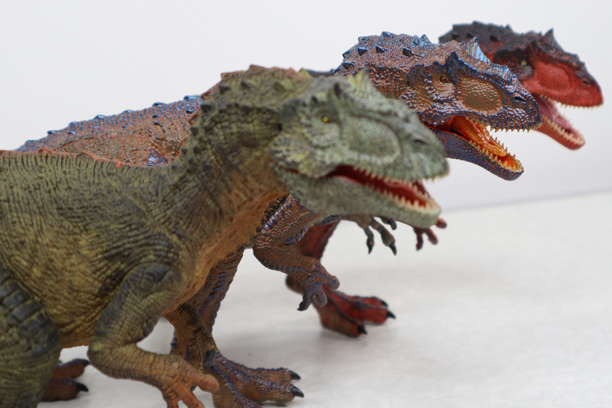
All about dinosaurs, fossils and prehistoric animals by Everything Dinosaur team members.

About Mike

Mike runs Everything Dinosaur, a UK-based mail order company specialising in the sale of dinosaur and prehistoric animal models, He works alongside Sue, and between them they have become the "go to guys" for museum quality prehistoric animal models and figures. An avid fossil collector and reader of dinosaur books, Mike researchers and writes articles about palaeontology, fossil discoveries, research and of course, dinosaur and prehistoric animal models.
16 03, 2022

The Earliest Armoured Dinosaur found in Asia to Date

By |2024-10-28T13:52:04+00:00March 16th, 2022|Categories: Adobe CS5, Dinosaur and Prehistoric Animal News Stories, Dinosaur Fans, Main Page, Palaeontological articles, Photos/Pictures of Fossils|0 Comments

Scientists including Professor Paul Barrett of the London Natural History Museum have described a new species of basal armoured dinosaur from fossils found in China. The dinosaur named Yuxisaurus kopchicki, represents the first valid and undisputed member of the Thyreophora (armoured dinosaurs) to be described from fossils found in Lower Jurassic Asian strata.
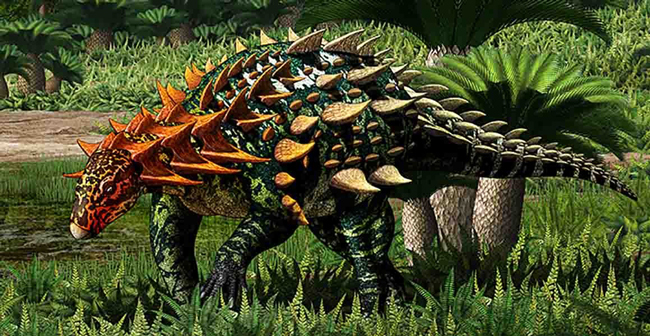
Yuxisaurus life reconstruction

A life reconstruction of the newly described, Early Jurassic Chinese armoured dinosaur Yuxisaurus kopchicki. Picture credit: Yu Chen.

Picture credit: Yu Chen

The Rapid Geographic Spread of Early Armoured Dinosaurs

With an estimated body length of around three metres, Yuxisaurus might be small compared to some of the later and much more famous members of the Thyreophora clade such as Ankylosaurus and Stegosaurus, but confirmation of the presence of early armoured dinosaurs in China underlines the rapid geographic dispersal of these ornithischians. The first armoured dinosaurs are thought to have evolved around 200 million years ago (Hettangian faunal stage of the Early Jurassic). Yuxisaurus fossils consisting of vertebrae, skull bones, elements from the limbs, shoulder blades (scapulae) and 120 osteoderms (bony armour), were excavated from the upper portion of Fengjiahe Formation exposures, near Jiaojiadian village, Yimen County, Yuxi Prefecture, Yunnan Province (southwestern China).

Although the dating of the strata has proved problematical, it is likely that the fossils are somewhere between 192 and 182 million years old (late Sinemurian to early Toarcian stage of the Early Jurassic).

Variety Amongst Early Members of the Thyreophora

Although relatively small compared to later armoured dinosaurs, the limb bones suggest a robust, stout animal indicating that Yuxisaurus had a different body shape compared to other known early thyreophorans such as Scutellosaurus and Emausaurus. This suggests that early armoured dinosaurs had a diverse morphology and ecology and they spread rapidly establishing a wide geographical distribution and filling a variety of niches in Early Jurassic ecosystems.
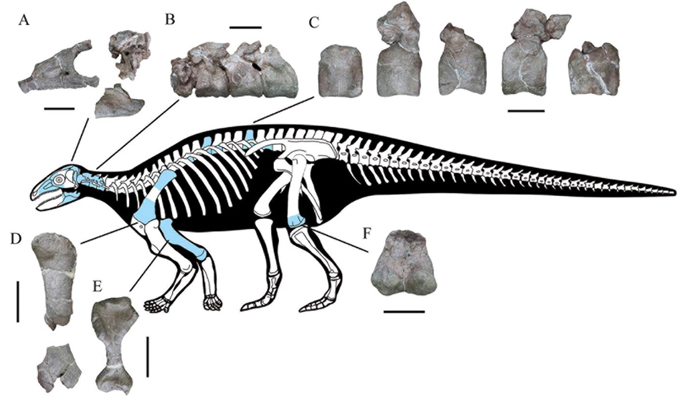
Yuxisaurus skeletal drawing.

Skeletal reconstruction of Y. kopchicki showing main preserved elements from the holotype (highlighted in blue). Details of the skull bones (A), cervical vertebrae (B) and dorsal vertebrae (C). The left scapula is shown (D) and the right humerus (E) along with the distal portion of the left femur (F). Note scale bars equal 5 cm for A-C and 10 cm for D-F. Osteoderms have been omitted to show the skeleton. Picture credit: Xi Yao.

Picture credit: Xi Yao

The First Unambiguous Armoured Dinosaur from the Early Jurassic of Asia

First author of the scientific paper, Professor Paul Barrett (Natural History Museum, London), commented:

“Although we’ve had tantalising fragments of early armoured dinosaurs from Asia, this is the first time we’ve had enough material to recognise a new species from the region and investigate its evolutionary history. I hope it’s the first of many new dinosaurs from the localities being discovered by my colleagues in Yunnan.”

Senior author of the paper, Dr Shundong Bi, a professor at Indiana University of Pennsylvania, explained that the dinosaur had been named Yuxisaurus kopchicki in honour of the Yuxi Prefecture, whilst the trivial or species name was in recognition of the work of molecular biologist Dr John J. Kopchick and for his support and funding of a new Indiana University of Pennsylvania science complex which is due to open in autumn 2023.

Dr Shundong Bi stated, that despite its robust body:

“Yuxisaurus was possibly a facultative quadrupedal. It was primarily adapted for walking on four legs, but also able to walk on two legs.”

Where Did Armoured Dinosaurs Originate?

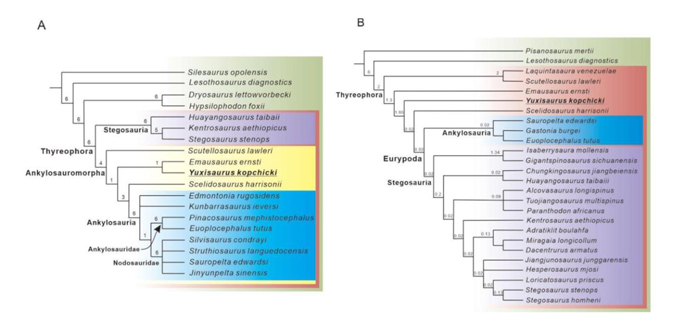
Until recently all the unambiguous Early Jurassic Thyreophora taxa were described from fossils found in North America (Scutellosaurus) or Europe (Emausaurus and Scelidosaurus). This led palaeontologists to conclude that armoured dinosaurs originated in Laurasia, however, new phylogenetic analyses (Butler et al 2020, Boyd 2015, Raven and Maidment 2017, Maidment et al 2020 and Baron et al 2017a) have proposed that Lesothosaurus from southern Africa and Laquintasaura from Venezuela might also represent early members of the Thyreophora. If Lesothosaurus and Laquintasaura are early armoured dinosaurs, then this suggests that this clade could have originated in Gondwana.
Yuxisaurus phylogeny

Phylogenetic assessments plotting the relationship of Yuxisaurus within the Thyreophora. Analysis (A) modified from Norman (2021) dataset which places Yuxisaurus as a sister taxon to Emausaurus which is known from the Early Jurassic (Toarcian) of Germany. Analysis (B) modified from Maidment et al (2020) places Yuxisaurus within the Thyreophora as an early-diverging branch between Emausaurus and Scelidosaurus which is known from the older sedimentary deposits from Charmouth on the Dorset coast. Picture credit: Yao et al.

Picture credit: Xi Yao et al

The phylogeny of early ornithischians remains disputed, it is hoped that further fossil finds will resolve this debate.

Everything Dinosaur acknowledges the assistance of a media release from the London Natural History Museum in the compilation of this article.

To read an article about the discovery of Laquintasaura: Laquintasaura What Does it All Mean?

The scientific paper: “A new early-branching armoured dinosaur from the Lower Jurassic of southwestern China” by Xi Yao, Paul M. Barrett, Lei Yang, Xing Xu and Shundong Bi preprint via bioRxiv before publication in eLife.

Visit the award-winning Everything Dinosaur website: Dinosaur Toys and Gifts.

15 03, 2022

The Amazing Rebor Saurophaganax “Jungle” Colour Variant

By |2024-10-28T13:44:28+00:00March 15th, 2022|Categories: Adobe CS5, Dinosaur Fans, Everything Dinosaur Products, Main Page, Photos of Everything Dinosaur Products, Product Reviews|0 Comments

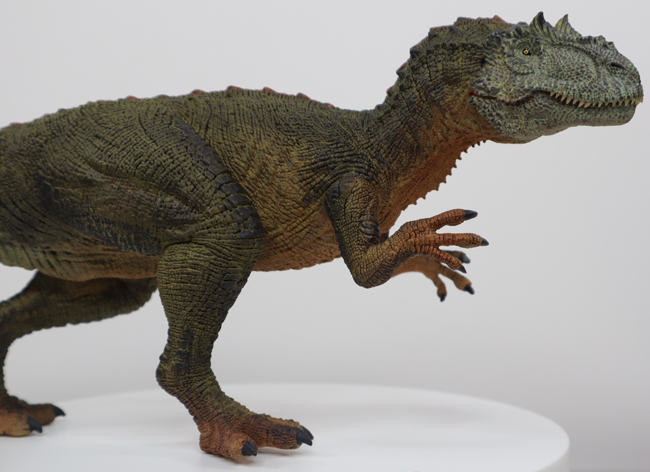
Team members at Everything Dinosaur review the Rebor Saurophaganax maximus “Notorious Big” dinosaur model in the “jungle” colour scheme. Three colour variants of this Late Jurassic apex predator have been introduced. “Badlands” was highlighted in an earlier blog post: Rebor Saurophaganax “Badlands”, we intend to showcase the crimson-coloured “volcanic cavern” in the near future but today, we focus on the “jungle” colour variant.

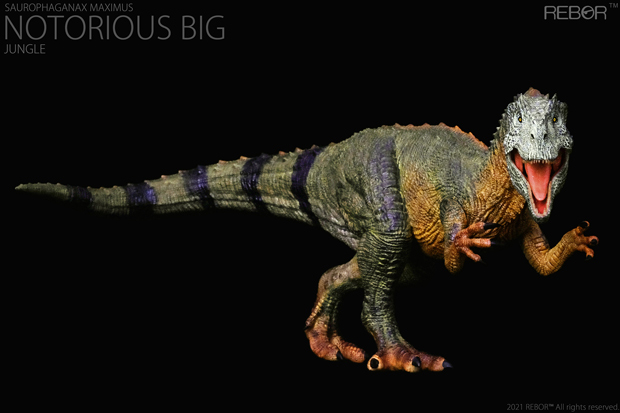
Rebor Saurophaganax dinosaur model in the "jungle" colour scheme.

The Rebor Saurophaganax maximus 1:35 scale dinosaur model in the “Notorious Big” series. This is the “jungle” colour variant. Picture credit: Everything Dinosaur.

Picture credit: Everything Dinosaur

An Articulated Dinosaur Model

The Saurophaganax figure measures 41.5 cm long and it is articulated, with a flexible tail, moveable forelimbs and an articulated lower jaw so the model can be posed either mouth open or mouth closed. Of the three figures introduced, the “jungle” colouration is perhaps the most realistic colour scheme, after all, Saurophaganax fossils are associated with the famous Morrison Formation of the United States and these strata represent deposits laid down in a lush, verdant floodplain environment.

The Rebor Saurophaganax maximus

The Rebor Saurophaganax maximus dinosaur model has a declared scale of 1:35.

Conifers dominated the riparian* environment along with cycads, horsetails, tree ferns and ginkgo trees. As these tend to be predominately shades of green, a green coloured theropod would have been well camouflaged amongst the vegetation.

Rebor Saurophaganax in the "jungle" colour scheme.

The colouration of the Rebor Saurophaganax model is predominately green with yellow countershading. Prominent stripes can be seen on the broad, deep tail. Picture credit: Everything Dinosaur.

Picture credit: Everything Dinosaur

A riparian* environment is a terrestrial zone that lies between the land and a river or stream. It describes the ecosystem (plant habitats and animal communities) that inhabit river margins and the banks of streams. The Morrison Formation deposits were laid down in floodplains and riparian zones. Several theropod dinosaurs have been described from fossils found in these strata, Saurophaganax (S. maximus) is one of the largest described to date.

Rebor Saurophaganax dinosaur model (jungle colour scheme)

A view of the Rebor Saurophaganax maximus “jungle” colour variant (lateral view). Picture credit: Everything Dinosaur.

Picture credit: Everything Dinosaur

Rebor Saurophaganax maximus dinosaur model (jungle colour variant).

The Rebor Saurophaganax maximus Museum Class replica in the jungle colour scheme. All three colour variants will be available from Everything Dinosaur.

To view the Rebor Saurophaganax dinosaur models in stock at Everything Dinosaur including the “jungle” colour variant: Rebor Models and Figures.

Visit the Everything Dinosaur website: Dinosaur Toys and Models.

14 03, 2022

When Did Killer Whales Become Killers of Whales?

By |2024-10-28T13:37:16+00:00March 14th, 2022|Categories: Adobe CS5, Dinosaur and Prehistoric Animal News Stories, Main Page|0 Comments

Only two living species of dolphins (members of the Delphinidae family), are known to attack and feed upon large mammals. There is the killer whale, also referred to as the Orca, (Orcinus orca) and the false killer whale (Pseudorca crassidens). Orcas attack a wide variety of other marine mammals including seals, sealions, whales and other dolphins, whereas the false killer whale mainly eats fish but attacks on smaller dolphins, sperm whales and the young of baleen whales have been reported.

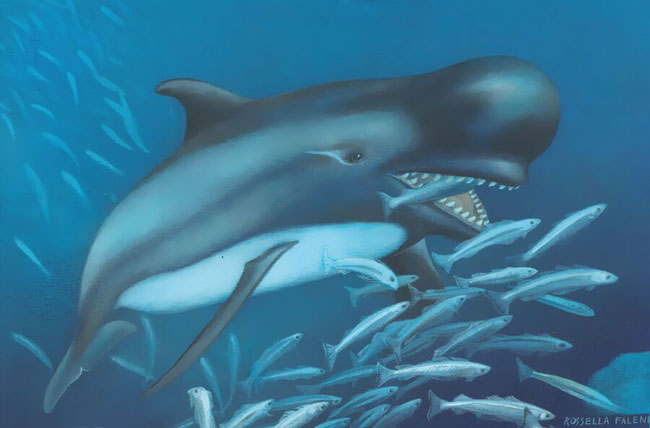
When did this feeding behaviour evolve? The fossilised remains of a newly described killer whale (Rododelphis stamatiadisi) which is believed to be the closest relative to both O. orca and P. crassidens may provide an answer. The fossils of R. stamatiadisi were found in Pleistocene strata aged between 1.5 and 1.3 million years old on the Greek island of Rhodes, traces of the last meal consumed were found, fish – blue whiting. This suggests that macropredation in members of the Delphinidae evolved relatively recently.

Rhododelphis life reconstruction

A life reconstruction of Rhododelphis feeding on blue whiting. Picture credit: Rossella Faleni.

Picture credit: Rossella Faleni

Comparing Two Ancient Whale Fossils Found Centuries Apart

Researchers from the University of Pisa (Italy) and the New York Institute of Technology (USA), analysed the fossil remains from Rhodes, discovered in 2020 and compared them to the fossils of Orcinus citoniensis, from Pliocene-aged deposits in Tuscany (Italy). The O. citoniensis fossils, consisting of partial postcranial material, skull and jaw bones were first described in 1883 by the famous Italian palaeontologist Giovanni Capellini.

Co-author of the Rododelphis paper, published in the academic journal “Current Biology”, Sara Citron (University of Pisa), had just finished her master’s thesis on Orcinus citoniensis. Microwear on the teeth was consistent with a diet of medium-sized fish, so although Orcinus citoniensis had a body length in excess of four metres, it probably did not specialise in hunting other marine mammals.

The Rododelphis material was discovered in the Bay of Pefkos on the south-eastern coast of the island by Polychronis Stamatiadis, an expert in the geology and palaeontology of Rhodes. Analysis of these fossils revealed five otoliths (calcium carbonate structures found in the inner ear of fish) from Micromesistius poutassou (blue whiting) which indicates that the last meal of this extinct cetacean was fish.

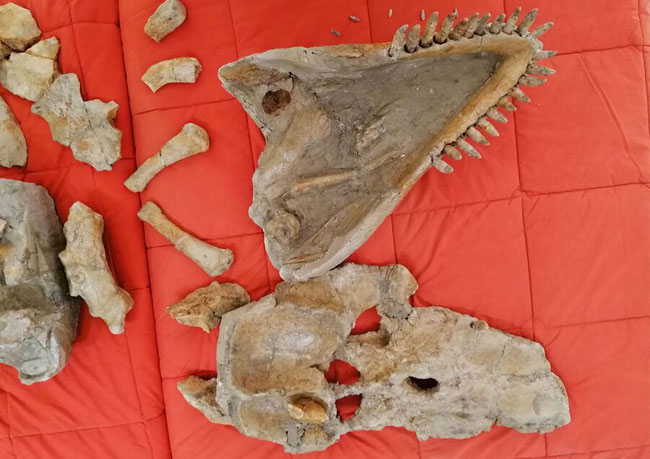
Rododelphis Fossils

Cranial and postcranial Rododelphis fossil material. Analysis of tooth wear suggests that this 5 metre-long cetacean was primarily a piscivore. Picture credit: G. Bianucci (University of Pisa).

Picture credit: G. Bianucci (University of Pisa)

Although estimated to have been around five metres long, R. stamatiadisi, like Orcinus citoniensis, was probably not a hunter of other marine mammals.

Evolution of Macropredation not Linked to Gigantism in Baleen Whales

Anatomist and co-author Jonathan Geisler (New York Institute of Technology), carried out an phylogenetic assessment and identified that Rododelphis was a close relative to Pseudorca crassidens as well as the extinct Orcinus citoniensis, which in turn was closely related to the living killer whale.

Dr Geisler explained:

“Our study supports the hypothesis that the Rhodes dolphin [R. stamatiadisi] and the Italian Orca [Orcinus citoniensis] represent two similar, but separate, evolutionary stages. In these stages, true and false killer whales preferentially preyed on medium-sized fish, rather than on seals, dolphins, and baleen whales. Thus, feeding on marine mammals happened very recently, showing that the predation by these fossil killer whales was not a driving force in the evolution of gigantism in baleen whales”.

Orcinus citoniensis lived around three million years ago, Rododelphis stamatiadisi is more recent, having lived approximately 1.5 to 1.3 million years ago. As baleen whales had already evolved large forms by the Late Miocene, it seems that predation from other cetaceans was not a factor in the development of gigantism.

Rododelphis stamatiadisi ribs and vertebrae.

Prepared vertebrae and ribs of the recently described cetacean from the Pleistocene of Rhodes (Rododelphis stamatiadisi). Picture credit: G. Bianucci (University of Pisa).

Picture credit: G. Bianucci (University of Pisa)

Everything Dinosaur acknowledges the assistance of a media release from the University of Pisa in the compilation of this article.

To read a related article on the origin of filter feeding in whales: Coronodon havensteini – An Important Transitional Fossil.

The discovery of a four-legged whale ancestor from the Eocene of Peru: Ancient Ancestor of Modern Whales Discovered.

The scientific paper: “The origins of the killer whale ecomorph” by Giovanni Bianucci, Jonathan H. Geisler, Sara Citron and Alberto Collareta published in Current Biology.

The award-winning Everything Dinosaur website: Prehistoric Animal Toys.

13 03, 2022

Is Bashanosaurus the Oldest Stegosaur? A New Dinosaur Taxon

By |2024-10-27T22:05:57+00:00March 13th, 2022|Categories: Adobe CS5, Dinosaur and Prehistoric Animal News Stories, Dinosaur Fans, Main Page, Palaeontological articles, Photos/Pictures of Fossils|0 Comments

The trouble with being regarded as the biggest, longest, tallest or oldest when you are newly described species of dinosaur, is that sooner or later another fossil discovery will take this claim away from you. Back in 2019, team members wrote a blog post about the discovery of Adratiklit boulahfa from the Middle Jurassic of Morocco North Africa’s First Stegosaur. The fossils of this armoured dinosaur were estimated to be around 168 million years old (Bathonian faunal stage), making Adratiklit the oldest definitive stegosaur described.

Scientists including Dr Susannah Maidment a senior researcher at the London Natural History Museum, who co-authored the paper describing A. boulahfa, have announced the discovery of an even older stegosaur, this time from China. The new stegosaur named Bashanosaurus primitivus is at least one million years older than the Moroccan stegosaur.

The Fossils of Bashanosaurus

The fossils of Bashanosaurus herald from the Lower Member of the Shaximiao Formation and radiometric dating based on isotope decay analysis using zircon crystals (geochronological data), suggest that the deposits associated with the fossil bones are around 169 ± 0.68 million years of age.

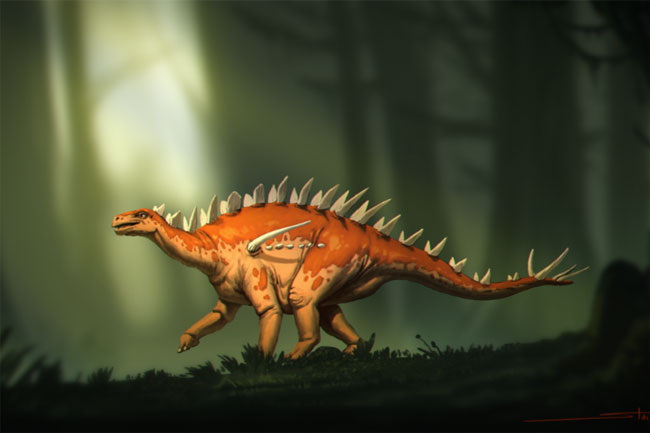
Bashanosaurus life reconstruction.

A life reconstruction of the newly described Chinese stegosaur Bashanosaurus primitivus. Picture credit: Banana Art Studio.

Picture credit: Banana Art Studio

Did the Stegosauria Evolve in Asia?

The fossil record of early stegosaurs is highly fragmentary and the evolution of this iconic branch of the Thyreophora is poorly understood. The Stegosauria represents a major clade within the Ornithischia (bird-hipped dinosaurs). Fourteen genera of stegosaur have been described to date and they are both geographically and temporally widespread, known from all the major landmasses except for Australia and Antarctica.

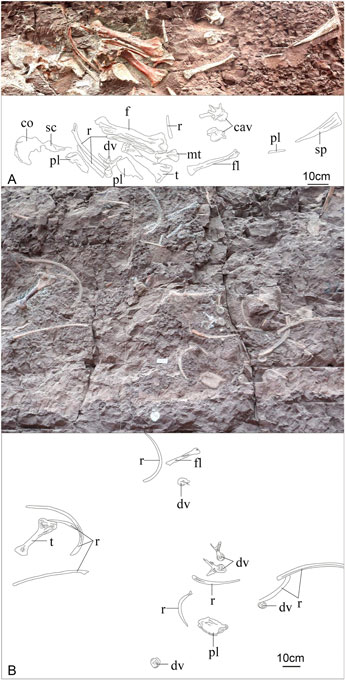
In 2016, a new dinosaur quarry was opened in Yunyang County, Chongqinq Municipality in southwestern China. Stegosaur fossil material was identified on the western side of the quarry. The disarticulated material preserved within the sandstone consisted of a dorsal vertebra, two tail bones (caudal vertebrae), a right scapula, a right coracoid and elements from the hind legs. Three pieces of dermal armour were also discovered at this location (one plate and two spines) along with fragments of rib bones. These fossils (CLGPR V00006-1) are regarded as the holotype of B. primitivus.

Potentially Three Bashanosaurus Specimens

More stegosaur fossils were found at the site approximately fifty metres away from the holotype material (CLGPR V00006-2). They consist of five dorsal vertebrae, a right tibia, a right fibula some ribs and a single piece of dermal armour (one plate). In addition, a single dorsal vertebra (CLGPR V00006-3) was found on the eastern part of the site some one hundred and twenty metres away from the holotype material.

Whilst the researchers have confidently assigned these fossils to the Stegosauria and specifically to Bashanosaurus primitivus, three individual stegosaurs are represented by the bones.

Bashanosaurus fossils.

Photograph (A) with interpretative line drawing showing the position of the B. primitivus holotype fossil material (CLGPR V00006-1) on the western side of the wall of dinosaur fossils. Photograph (B) with interpretative line drawing showing the second location with B. primitivus fossil material ((CLGPR V00006-2) towards the middle of the wall of dinosaur fossils. Picture credit: Hui et al.

Picture credit: Hui et al

It is not known whether the fossil bones represent a juvenile or a fully-grown animal. However, based on these bones, the researchers estimate that the largest stegosaur from the quarry was about 2.8 metres in length.

Unique Anatomical Traits

The scientists who include researchers from the Chongqing Bureau of Geological and Mineral Resource Exploration and Development in China and London’s Natural History Museum identified several unique anatomical traits that led to the erection of a new genus. Bashanosaurus possesses anatomical characteristics associated with basal thyreophorans as well as more derived features associated with early stegosaurs. For example, it has a smaller and less developed shoulder blade, the bony projection of the thighbone (fourth trochanter) is positioned below the middle of the shaft and the bases of the armour plates curve outwards and are thicker than the plates on the backs of later stegosaurs.

The genus name is derived from “Bashan” in reference to the ancient name for the area of Chongqing in China where the dinosaur was found. The species moniker is derived from the Latin for “first” – primitivus.

Lead author of the research team, Dr Dai Hui from the Chongqing Bureau of Geological and Mineral Resource Exploration and Development commented:

“All these features are clues to the stegosaurs’ place on the dinosaur family tree. Bashanosaurus can be distinguished from other Middle Jurassic stegosaurs, and clearly represents a new species.”

Phylogenetic Analysis

Phylogenetic analysis shows that Bashanosaurus primitivus is the earliest-diverging stegosaur, along with Chungkingosaurus (C. jiangbeiensis), which is thought to be closely related, although Chungkingosaurus lived much later than Bashanosaurus. Chungkingosaurus fossils are known from the Upper Member of the Shaximiao Formation.

The discovery of Bashanosaurus will help researchers to learn more about the evolution of stegosaurs and supports the theory that this type of armoured dinosaur first appeared in Asia. Although there have been some exciting fossil discoveries helping to improve understanding with regards to the evolution of armoured dinosaurs (Thyreophora), there are still numerous gaps in the fossil record which makes mapping the evolutionary development of these iconic dinosaurs extremely difficult.

For example, Everything Dinosaur recently wrote an article about the discovery of the basal thyreophoran Yuxisaurus kopchicki, whose fossils also come from China. Scientists from the London Natural History Museum also contributed to the scientific paper on Yuxisaurus: The Earliest Armoured Dinosaur Found to Date.

Everything Dinosaur has inserted Yuxisaurus kopchicki within the phylogenetic assessment of Bashanosaurus to help put these recent fossil discoveries into context (see below).

Bashanosaurus phylogeny and comparison with the recently described Yuxisaurus.

A phylogenetic analysis showing the placement of B. primitivus within the Stegosauria. It is believed to be around one million years older than the recently described Adratiklit boulahfa (Maidment et al) from the Middle Jurassic of Morocco. The earliest armoured dinosaur from Asia known to date (Yuxisaurus kopchicki) from Yunnan Province, China (Yao et al) has been incorporated into the image by Everything Dinosaur to show the approximate phylogenetic and temporal placement of Y. kopchicki when compared to B. primitivus. Picture credit: Hui et al with additional annotation by Everything Dinosaur.

Picture credit: Hui et al with additional annotation by Everything Dinosaur

The Stegosauria Clade Originated in Asia?

Commenting on the phylogenetic assessment Dr Hui stated:

“What’s more, our analysis of the family tree indicates that it [B. primitivus] is one of the earliest-diverging stegosaurs along with the Chongqing Lizard (Chungkingosaurus) and Huayangosaurus. These were all unearthed from the Middle to Late Jurassic Shaximiao Formation in China, suggesting that stegosaurs might have originated in Asia”

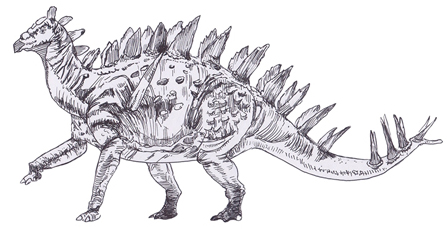
Chungkinogsaurus illustrated.

An illustration of the Chinese Stegosaur Chungkingosaurus. Picture credit: Everything Dinosaur.

Picture credit: Everything Dinosaur

The picture (above) shows a drawing of a model from the PNSO model range.

To view this range of prehistoric animal figures: PNSO Age of Dinosaurs Figures.

Co-author of the scientific paper published in the Journal of Vertebrate Paleontology, Dr Susannah Maidment of the London Natural History Museum and an expert in ornithischian dinosaurs added:

“The discovery of this stegosaur from the Middle Jurassic of China adds to an increasing body of evidence that the group evolved in the early Middle Jurassic, or perhaps even in the Early Jurassic, and as such represent some of the earliest known bird-hipped dinosaurs. China seems to have been a hotspot for stegosaur diversity, with numerous species now known from the Middle Jurassic right the way through until the end of the Early Cretaceous period.”

Everything Dinosaur acknowledges the assistance of a media release from the Taylor & Francis Group in the compilation of this article.

The scientific paper: “New Stegosaurs from the Middle Jurassic Lower Member of the Shaximiao Formation of Chongqing, China” by Dai Hui, Li Ning, Susannah C. R. Maidment, Wei Guangbiao, Zhou Yuxuan, Hu Xufeng, Ma Qingyu, Wang Xunqian, Hu Haiqian and Peng Guangzhao published in the Journal of Vertebrate Paleontology.

Visit the Everything Dinosaur website: Everything Dinosaur.

12 03, 2022

Win a Copy of “Explorers of Deep Time”

By |2024-10-27T20:23:10+00:00March 12th, 2022|Categories: Adobe CS5, Book Reviews, Dinosaur Fans, Everything Dinosaur News and Updates, Main Page, Press Releases|10 Comments

Everything Dinosaur has another fantastic, prehistoric animal themed giveaway. We have a copy of the new book “Explorers of Deep Time” by the eminent palaeontologist Roy Plotnick of the University of Illinois, Chicago and we are giving you the chance to win it.

Please note the competition is now closed!

Visit Everything Dinosaur’s Facebook page for a chance to win: Everything Dinosaur on Facebook.

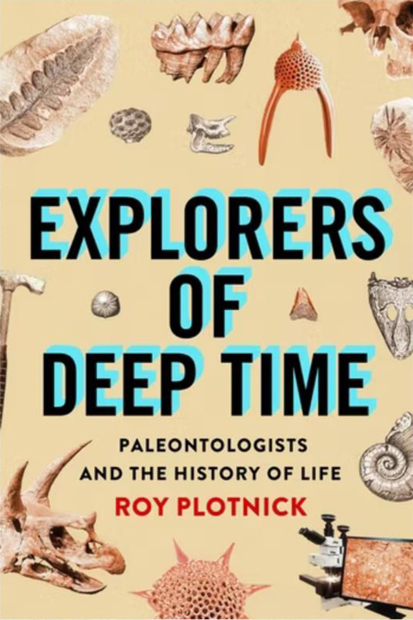
Explorers of Deep Time front cover

The front cover of “Explorers of Deep Time” by eminent American palaeontologist Roy Plotnick. Picture credit: Columbia University Press.

Picture credit: Columbia University Press

“Explorers of Deep Time” Competition

In this beautifully crafted book, author Roy Plotnick provides a rare and very personal look at the trials and tribulations of working in the Earth sciences. If you have ever wondered about what it is like to be a palaeontologist, then this book is for you. Roy does not write about fossils, this book is dedicated to the scientists that study them.

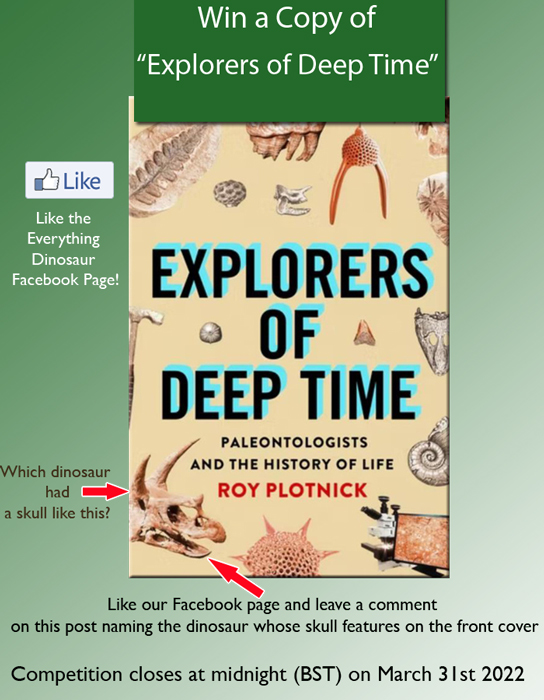
All you have to do to enter the competition to win a free copy is visit Everything Dinosaur on Facebook “Like” our page, then leave a comment on the competition post naming the dinosaur whose skull fossil features on the front cover.

Win a copy of "Explorers of Deep Time"

Win a copy of “Explorers of Deep Time” in Everything Dinosaur’s free to enter Facebook competition. Picture credit: Everything Dinosaur.

Picture credit: Everything Dinosaur

Please note the competition is now closed!

To Enter the Competition

To enter Everything Dinosaur’s competition to win a free copy of “Explorers of Deep Time”, all you have to do is:

Visit Everything Dinosaur’s Facebook page: Our Facebook Page.

“Like” Everything Dinosaur on Facebook.

“Like” our competition post and enter the competition.

Name the dinosaur whose skull is shown on the front cover of the book (hint – it is the skull of a famous horned dinosaur).

Not on Facebook? Not a Problem You can Still Enter the Competition

Or, if you are not on Facebook, just leave a comment on this blog post to enter. Tell us the name of the horned dinosaur whose skull is shown on the bottom of the front cover of “Explorers of Deep Time” in the comments section of this blog post and we will automatically enter you into our free prize draw to win a copy of the book.

Terms and Conditions of the “Explorers of Deep Time” Book Competition

  • Automated entries are not permitted and will be excluded from the draw.
  • Only one entry per person.
  • The prize is non-transferable and no cash alternative will be offered.
  • The Everything Dinosaur “Explorers of Deep Time” runs until midnight (BST) Thursday 31st March 2022.
  • Winner will be notified by private message on Facebook or the Everything Dinosaur Blog.
  • Prize includes postage and packing.

For full terms and conditions contact: Contact Everything Dinosaur.

Good luck naming the horned dinosaur, the skull of which can be found on the front cover of the book.

The Everything Dinosaur website: Dinosaur Toys.

11 03, 2022

Rebor Smilodon populator Stray Cat Year of the Tiger

By |2024-10-27T12:52:12+00:00March 11th, 2022|Categories: Adobe CS5, Dinosaur Fans, Everything Dinosaur News and Updates, Everything Dinosaur Products, Main Page, Press Releases|0 Comments

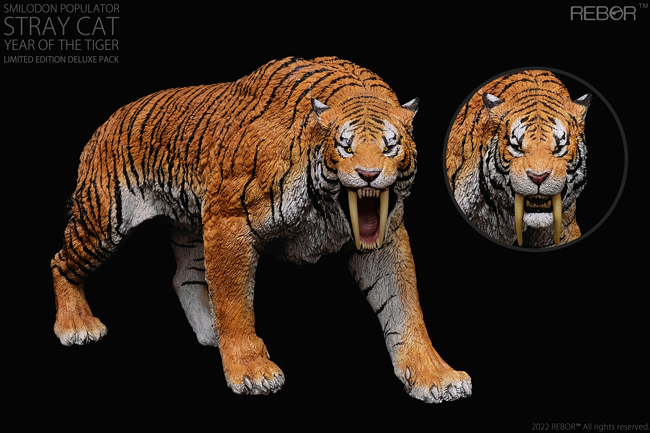
Everything Dinosaur will be stocking the Rebor Smilodon populator Stray Cat Year of the Tiger limited-edition model. This figure is due to be in stock in June (2022). The sabre-tooth cat model with its tiger colouration is a 1/35th scale replica. Like the other Smilodon models introduced by Rebor, this figure has two interchangeable heads, permitting the big cat to be displayed either mouth closed or mouth open.

Rebor Smilodon populator Stray Cat Year of the Tiger

The Rebor Smilodon populator Stray Cat Year of the Tiger model.

The Year of the Tiger

The Rebor model commemorates the Chinese zodiac and the year of the tiger (2022). The tiger is known as the king of all beasts in Chinese folklore and astrological circles. As a zodiac sign the tiger is regarded as a symbol of strength and being brave.

Rebor Smilodon model.

The Rebor Smilodon populator model commemorates the Chinese Year of the Tiger.

Smilodon populator

Several species of Smilodon have been named and scientifically described. S. populator is regarded as the biggest. Some individuals had enormous upper canine teeth measuring more than 28 cm in length. This stocky and powerful predator roamed the southern portions of the American continent. With an estimated shoulder height of 1.2 metres, it would have dwarfed other Sabre-toothed cats that roamed the United States. S. populator was one of the largest members of the Felidae to have ever lived.

A spokesperson from Everything Dinosaur commented:

The Rebor Smilodon populator Stray Cat Year of the Tiger limited-edition figure, should be in stock around June 2022. Another version, one painted like a Jaguar and named “Jungle” will be available later in the year. We expect to have more stock of the “Ice Age” colour variant available in a few weeks (late April 2022).”

The Everything Dinosaur website: Prehistoric Animal Models.

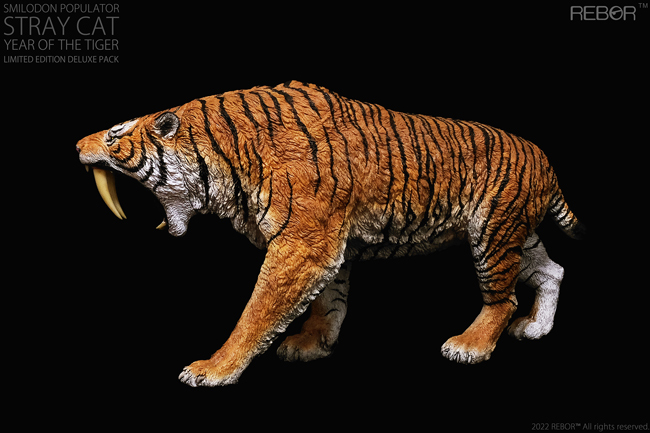
Rebor Smilodon model

The Rebor Smilodon populator shown in lateral view with mouth open. This is the tiger colour variant.

The limited-edition Rebor Smilodon populator in the tiger colour scheme is likely to be a “roaring success”.

To view the range of Rebor prehistoric animal figures and models in stock at Everything Dinosaur: Rebor Models and Prehistoric Animal Figures.

10 03, 2022

Rebor Saurophaganax in the “Badlands” Colour Scheme

By |2024-10-27T12:45:30+00:00March 10th, 2022|Categories: Adobe CS5, Dinosaur Fans, Everything Dinosaur Products, Main Page, Photos of Everything Dinosaur Products, Product Reviews|0 Comments

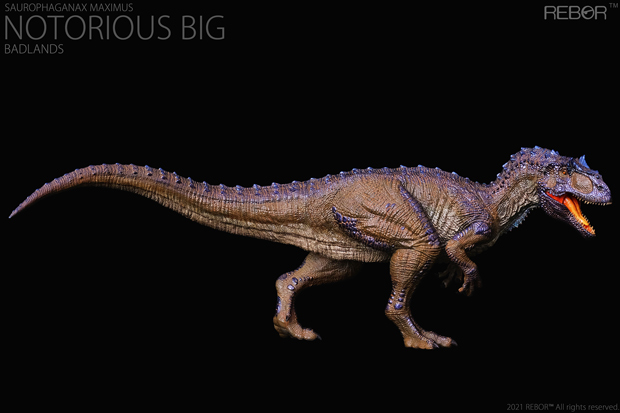
Recently, Rebor introduced three Saurophaganax scale models under the moniker “Notorious Big”. Today, we at Everything Dinosaur take a look at one of the three colour variants – the Rebor Saurophaganax maximus in the “Badlands” colour scheme.

Rebor Saurophaganax dinosaur model "Badlands"

Rebor 1:35 Saurophaganax maximus Museum Class Replica “Notorious Big” in the “Badlands” colour scheme.

The “Badlands” Variant

Saurophaganax is the official state fossil of Oklahoma, where the first fossils that were ascribed to this genus were found (although originally named Saurophagus maximus, until it was discovered the genus name was preoccupied). The validity of the genus remains controversial. Fossils assigned to S. maximus, could represent exceptionally large examples of Allosaurus.

The “Badlands” colour variant with its purple hues and glossy appearance is a bit of a misnomer, no fossils ascribed to Saurophaganax have been found in areas referred to as “Badlands”, its fossils, as far as we at Everything Dinosaur are aware, are confined to sedimentary deposits associated with the vast Morrison Formation.

Rebor Saurophaganax maximus (Badlands Colour Scheme)

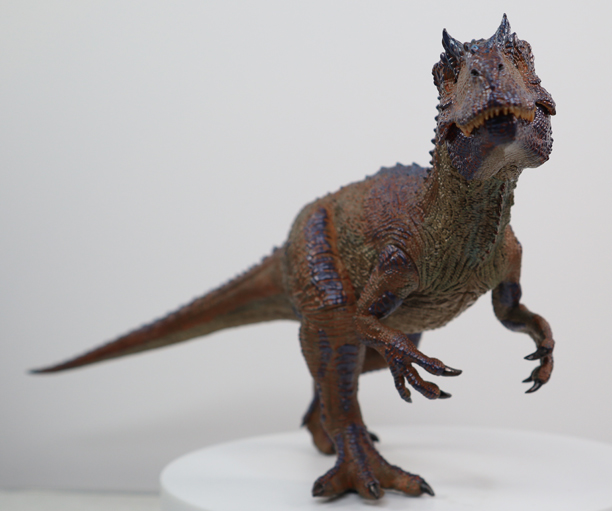
The Rebor Saurophaganax maximus “Notorious Big” in the “Badlands” colour scheme. One of a trio of Saurophagnax scale models introduced in the early spring of 2022. Picture credit: Everything Dinosaur.

Picture credit: Everything Dinosaur

The figure has articulated arms, a flexible tail and an articulated lower jaw. It has a declared scale of 1:35 the model measures around 41.5 cm long and has a head height of approximately 13 cm.

Saurophaganax was one of the largest, terrestrial predators of the Late Jurassic. Fossils are associated with Upper Kimmeridgian to Lower Tithonian aged deposits (155.7 to 145 million years ago). Several major dinosaur-fossil bearing geological formations have revealed that there were many contemporaneous large carnivorous theropods present in the ancient ecosystem. For example, Morrison Formation fossil material indicates the presence of Torvosaurus, Allosaurus, Saurophaganax, Ceratosaurus and Marshosaurus. The roughly contemporaneous Lourinhã Formation (Portugal) indicates a similar theropod biota – Lourinhanosaurus, Torvosaurus, Allosaurus, Ceratosaurus, plus possible megalosauroids and abelisaurids, although no material ascribed to the Saurophaganax genus has been found to date in Portugal.

Rebor Saurophaganax maximus "Notorious Big"

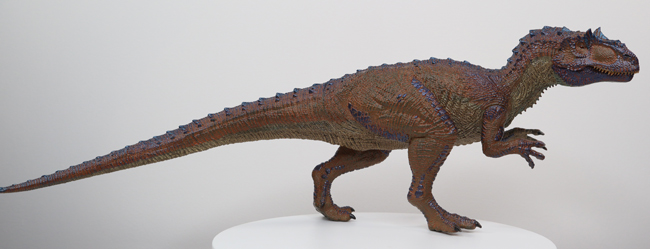
The Rebor Saurophaganax maximus “Notorious Big” 1:35 scale dinosaur model shown in right lateral view. The model is in the “Badlands” colour scheme. Picture credit: Everything Dinosaur.

Picture credit: Everything Dinosaur

Visit the award-winning Everything Dinosaur website: Prehistoric Animal Models and Figures.

Rebor "Badlands" Saurophaganax model

The Rebor Saurophaganax maximus has a flexible tail, movable arms and an articulated lower jaw. IThe “Badlands” colour variant is seen here in lateral view. Picture credit: Everything Dinosaur.

Picture credit: Everything Dinosaur

A Beautifully Detailed Dinosaur Model

Described by collectors as a beautifully detailed dinosaur model, the Rebor Saurophaganax maximus in the “Badlands” colour scheme is already proving to be a popular addition to the Rebor range of dinosaur models.

To view the range of Rebor prehistoric animal models and figures available from Everything Dinosaur: Rebor Models and Figures.

9 03, 2022

Explorers of Deep Time Video Script

By |2024-10-27T12:38:54+00:00March 9th, 2022|Categories: Adobe CS5, Book Reviews, Dinosaur Fans, Everything Dinosaur News and Updates, Main Page, Press Releases|0 Comments

Team members at Everything Dinosaur have been busy making preparations for a free to enter Facebook competition to win a copy of the brilliant “Explorers of Deep Time” by the eminent American palaeontologist Roy Plotnick.

The competition will be up on the company’s Facebook site in the very near future (March 2022).

Please note the competition is now closed!

To visit Everything Dinosaur on Facebook: Visit Everything Dinosaur on Facebook.

Explorers of Deep Time front cover

The front cover of “Explorers of Deep Time” by eminent American palaeontologist Roy Plotnick. Picture credit: Columbia University Press.

Picture credit: Columbia University Press

A YouTube Video Linking the Facebook Competition

The plan is to produce a video outlining the details of the book competition on Everything Dinosaur’s YouTube channel. The video can provide a short review of “Explorers of Deep Time” and give details on how to enter the contest to win a copy of the book.

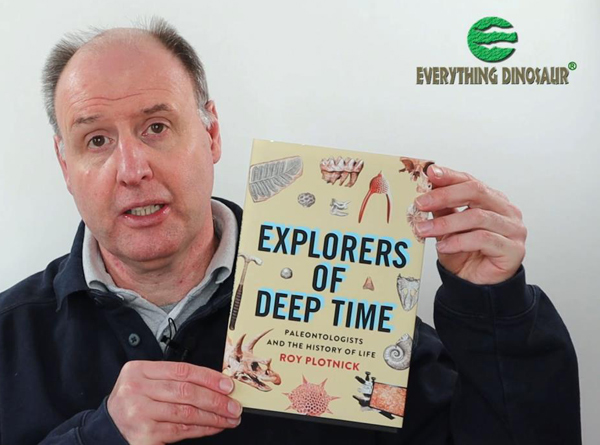
Everything Dinosaur promotes "Explorers of Deep Time"

A still from Everything Dinosaur’s YouTube video reviewing “Explorers of Deep Time” and explains the free to enter competition. Picture credit: Everything Dinosaur.

Picture credit: Everything Dinosaur

The Everything Dinosaur website: Dinosaur Models.

“Explorers of Deep Time”

A script has been written for that part of the video that reviews “Explorers of Deep Time” by Roy Plotnick.

Here are the details:

Dedicated to Arnold and Mildred who we suspect were the author’s parents, the book is divided into four, carefully crafted general sections, each one exploring an element of what it is like to work in the Earth sciences.

For example, there is a chapter on working in the field, liberally sprinkled with contributions from an eclectic range of scientists and researchers at all stages of their careers who describe their own field work experiences. Roy’s enthusiasm for field work is skilfully reflected in his writing, after all, the chapter is entitled “Attending Marvels”.

Although there are black and white photos of fossils, this book is not about the fossils themselves but about the lives and careers of the people who collect them.

Chapter six entitled “Cool Toys” looks at the vast number of new research techniques and methodologies now used in palaeontology. Don’t expect numerous pictures, tables and diagrams, but interwoven into the narrative are lots of anecdotes from real scientists who discuss their experiences, their trials and triumphs as they pursue their careers.

Roy Plotnick concludes “Explorers of Deep Time” with a chapter headed “Last Thoughts”. In it he provides a S.W.O.T. analysis that looks at the strengths, weaknesses, opportunities and threats associated with pursuing a career path in palaeontology. An excellent ready reckoner for anyone considering working in the Earth sciences.

Roy Plotnick and "Old White Male" challenging stereotypes.

The author describing himself as an OWM (old, white male) writes about the need to encourage greater diversity in the Earth Sciences with increased access and appropriate support for women, minorities, the disabled and other groups that may feel excluded. Picture credit: Roy Plotnick (University of Illinois).

Picture credit: Roy Plotnick (University of Illinois)

Roy, who describes himself as an “Old, White Male” champions diversity and he ardently supports greater inclusiveness in science disciplines.

The book has been very well received amongst fellow academics, as demonstrated by the glowing reviews, some of which are featured on the back cover. Including one from the very talented Victoria Arbour, a world-renowned authority on armoured dinosaurs.

Explorers of Deep Time gets a big thumbs up from Everything Dinosaur.

Please note the competition is now closed!

To visit Everything Dinosaur’s YouTube: Everything Dinosaur on YouTube.

8 03, 2022

Celebrating a Special Day – International Women’s Day

By |2024-10-27T12:32:40+00:00March 8th, 2022|Categories: Educational Activities, Main Page, Teaching|0 Comments

Today, Tuesday the 8th of March is International Women’s Day, a day that is celebrated across the world, recognising the achievements of women in business, the arts, politics and of course in the sciences. A movement that began in the early years of the 20th century has expanded to encompass all aspects of gender equality.

The theme for International Women’s Day 2022 is “breaking the bias”.

Celebrating women in science. International women's day.

A collection of women scientists part of a poster montage spotted during a school visit. Celebrating International Women’s Day. Picture credit: Everything Dinosaur.

Picture credit: Everything Dinosaur

#BreakTheBias

Using the hashtag #BreaktheBias the official website states that whether deliberate or unconscious, bias makes it difficult for women to move ahead. Knowing that bias exists is not enough. Action is needed to level the playing field. Many academic institutions, museums and educational bodies are working to improve opportunities and to support gender equality.

Imagine a world with gender equality, collectively we can all #BreakTheBias.

No matter your gender, visit the award-winning Everything Dinosaur website: Dinosaur Toys for Girls and Boys.

7 03, 2022

New Rebor Saurophaganax Dinosaur Models in Stock

By |2024-10-27T12:28:52+00:00March 7th, 2022|Categories: Adobe CS5, Dinosaur Fans, Everything Dinosaur News and Updates, Everything Dinosaur Products, Main Page, Photos of Everything Dinosaur Products, Press Releases|0 Comments

The Rebor Saurophaganax maximus dinosaur models are in stock at Everything Dinosaur. This trio of terrific 1:35 scale dinosaur figures – “Jungle”, “Badlands” and “Volcanic Cavern” have arrived at Everything Dinosaur’s warehouse. Each figure has an articulated lower jaw, moveable arms and a flexible tail. The S. maximus replicas are supplied with a data card and an Everything Dinosaur Saurophaganax fact sheet.

Three Rebor Saurophaganax dinosaur models.

The Rebor Saurophaganax maximus dinosaur model comes in three colour variants “Jungle” (left), “Badlands” centre and “Volcanic Cavern” (right). Picture credit: Everything Dinosaur.

Picture credit: Everything Dinosaur

A Trio of Colourful Theropods

These Rebor replicas represent one of the largest meat-eating dinosaurs known from the Late Jurassic. Size estimates vary, but Saurophaganax maximus is regarded as the biggest carnivore described to date from fossil material associated with the famous Morrison Formation. Some palaeontologists have suggested that this dinosaur could have reached 13 metres or more in length. The discovery of a femur (thigh bone) in New Mexico, which is more than a metre long and isolated teeth measuring in excess of 12 cm indicate that this member of the Allosauridae family was a formidable, super-sized predator.

A trio of Rebor Saurophaganax models.

Three in a row! The three new for 2022 Rebor Saurophaganax maximus dinosaur models. Foreground “Jungle” colour scheme, middle “Badlands” and in the background “Volcanic Cavern”. Picture credit: Everything Dinosaur.

Picture credit: Everything Dinosaur

Visit the Everything Dinosaur website: Dinosaur Toys and Models.

Rebor Saurophaganax maximus “Notorious Big”

Rebor has nicknamed their Saurophaganax “Notorious Big”, perhaps in recognition of this dinosaur’s estimated size. The genus was originally erected based on observed differences in the shape of the backbones (vertebrae). Palaeontologists remain uncertain as to the validity of this genus, the fossil material could represent large Allosaurus individuals, after all, Allosaurus itself has become something of a taxonomic wastebasket and revision of fossil material has led to erection of a third species Allosaurus jimmadseni: A New Species of Allosaurus A. jimmadseni.

A spokesperson from Everything Dinosaur commented:

“It is wonderful to see a scale replica of Saurophaganax introduced to the Rebor range. Several theropods have been named from fossils found in Morrison Formation deposits, megalosaurs such as Torvosaurus and Marshosaurus, numerous species of Ceratosaurus plus other ceratosaurs too and of course, allosauroids. Of all these fearsome predators associated with the Upper Jurassic Morrison Formation, Saurophaganax maximus is regarded by many palaeontologists as being the largest described to date.”

To view the range of Rebor models and prehistoric animal figures available at Everything Dinosaur: Rebor Dinosaur Models and Figures.

Go to Top