A New Genus of Troodontid Dinosaur from New Mexico
Palaeontologists have named a new species of theropod dinosaur from New Mexico. The dinosaur, Dinevenator robustus, lived around 73 million years ago (Campanian faunal stage of the Late Cretaceous). Researchers identified the dinosaur from a fossil skull bone (a frontal) found in north-western New Mexico. It represents a new genus and species of troodontid.
Troodontids were lightly built, theropod dinosaurs closely related to birds. They also possessed relatively large brains compared to many other dinosaurs. The discovery of Dinevenator robustus provides new information about troodontid diversity in Late Cretaceous North America.
The research was undertaken by Dr Steven E. Jasinski and Dr Robert Sullivan. Their study was published in the scientific journal “Fossil Studies” earlier this month.
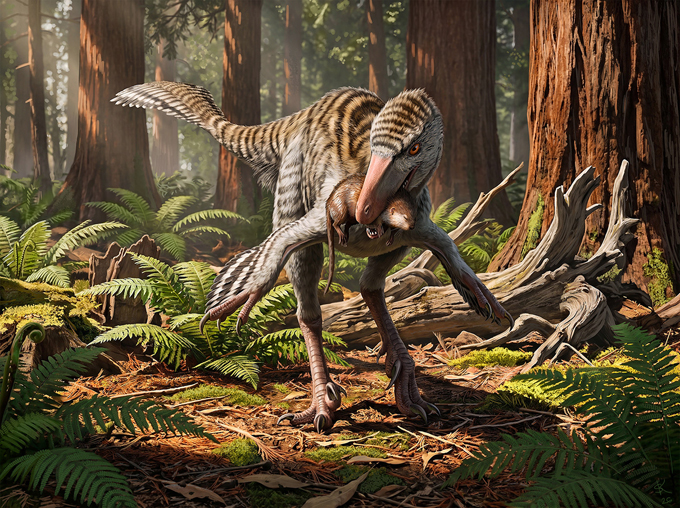
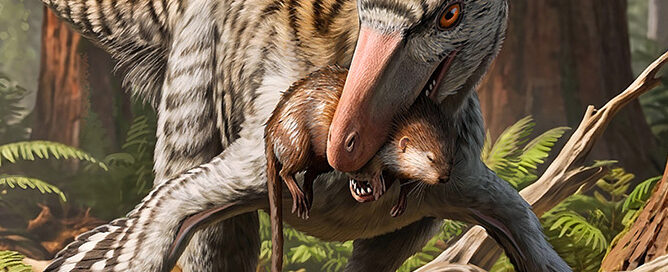
Dinevenator robustus life reconstruction. The newly described, large troodontid has caught a mammal. Whilst rare, the De-na-zin Member of the Kirtland Formation has recorded fragmentary remains of metatherian mammals. Picture credit: Sergey Krasovskiy.
Picture credit: Sergey Krasovskiy
A Large Troodontid Theropod Dinosaur
Although scientists have found very little fossil material, Dinevenator (pronounced Din-ee-ven-nay-tor), may have been surprisingly large for a troodontid. Comparisons with the skull bones of related dinosaurs suggest a body length of around 2.4 to 3 metres. Researchers estimate that it weighed approximately 68 to 136 kilograms. Therefore, Dinevenator robustus ranks amongst the larger troodontids currently known.
Palaeontologist Dr Steven Jaskinski, from the New Mexico Museum of Natural History and Science (NMMNHS) and corresponding author of the study commented:
“This really helps us get a clearer picture of the diversity in this family of dinosaurs during the Late Cretaceous in North America, and it adds to our knowledge of dinosaurs that once roamed New Mexico.”
The discovery of this new dinosaur helps clarify troodontid diversity during the Late Cretaceous. Furthermore, it increases our knowledge of New Mexico’s dinosaur biota.
Dinosaurs of the Kirtland Formation
Dinevenator robustus lived on a subtropical floodplain approximately 73 million years ago. It shared this environment with a remarkable variety of dinosaurs. For example, the crested lambeosaurine hadrosaur Parasaurolophus tubicen inhabited the same ecosystem. Armoured ankylosaurs and horned ceratopsians also roamed the region.
To read a recent blog post about the discovery of new lambeosaurine from Alberta, Canada: A New Lambeosaurine Hadrosaur from Alberta.
In addition, dome-headed pachycephalosaurs lived alongside agile dromaeosaurids. Huge tyrannosaurs represented some of the ecosystem’s largest predators. Consequently, the discovery adds another dinosaur to an already diverse Late Cretaceous fauna.

The left frontal of Dinevenator robustus (holotype) specimen number SMP VP-1955 shown in dorsal view (left) and ventral view (right). Picture credit: Sullivan (New Mexico Museum of Natural History and Science).
Picture credit: Sullivan (New Mexico Museum of Natural History and Science)
A Fossil Discovered in 2005
The fossil that eventually led to the new dinosaur’s identification was discovered more than twenty years ago. Dr Robert Sullivan found the specimen during the summer of 2005. He was collecting Cretaceous fossils in New Mexico’s San Juan Basin. The fossil came from the De-na-zin Member of the Kirtland Formation. Sullivan had discovered part of the skull of a relatively small theropod dinosaur. Initially, researchers thought the bone belonged to a dromaeosaur.
Dromaeosaurids include famous dinosaurs such as Velociraptor. However, subsequent research demonstrated that the specimen belonged to a troodontid.
Scientists have recently learned much more about North American troodontids. For instance, studies of Albertavenator from Alberta provided important comparative information. Research into Xenovenator from northern Mexico also helped scientists reassess the New Mexico fossil.
A phylogenetic analysis was conducted on a modified dataset, recovering Dinevenator robustus in a clade of robust troodontins (Troodontini) as the basal-most taxon and as the sister taxon to (Albertavenator curriei and Xenovenator espinosai). The recognition of a distinct, large, robust-skulled troodontid also increases the known diversity of theropod dinosaurs from the southern United States and provides further evidence for dinosaurs that are unique to the Kirtlandian faunas of New Mexico during the Late Cretaceous.
To read Everything Dinosaur’s blog post from 2017 about the discovery of Albertavenator: Albertavenator – Something to Get Your Teeth into.
Identifying Dinevenator robustus
Scientists have named this dinosaur from just one fossil skull bone (frontal). This bone forms part of the upper surface of the skull. Despite the limited material, the fossil preserves distinctive anatomical characteristics. Most notably, the frontal is thicker than equivalent bones in many related troodontids. Researchers also identified other features that distinguish the specimen.
These anatomical differences supported the establishment of a new genus and species. The fossil currently resides at the State Museum of Pennsylvania. However, plans are being made to transfer it to the New Mexico Museum of Natural History and Science.
Understanding Troodontid Diversity
The discovery of D. robustus increases the known dinosaur diversity of New Mexico. More importantly, it provides another piece of the complex troodontid evolutionary puzzle.
Palaeontologists continue to reassess fragmentary fossils as new discoveries provide additional comparative material. As a result, specimens collected decades ago can reveal entirely new dinosaur species.
Dr Anthony Fiorillo, Executive Director of the New Mexico Museum of Natural History and Science, highlighted this dynamic process stating:
“This new work illustrates the dynamic nature of dinosaur studies as we continue to test what we think we know. Furthermore, it demonstrates that New Mexico clearly has a prominent place in those global conversations.”
Everything Dinosaur acknowledges the assistance of a media release from the New Mexico Museum of Natural History and Science in the compilation of this article.
The scientific paper: “Dinevenator, a New Genus of Troodontid Dinosaur from the Late Cretaceous of New Mexico” by Steven E. Jasinski and Robert M. Sullivan published in Fossil Studies.
The award-winning Everything Dinosaur website: Models of Troodontids and Other Dinosaurs.