All about dinosaurs, fossils and prehistoric animals by Everything Dinosaur team members.
5 04, 2026

New “Prehistoric Times” Magazine (Issue 156) Reviewed

By |2026-04-06T12:25:35+01:00April 5th, 2026|Categories: Magazine Reviews|2 Comments

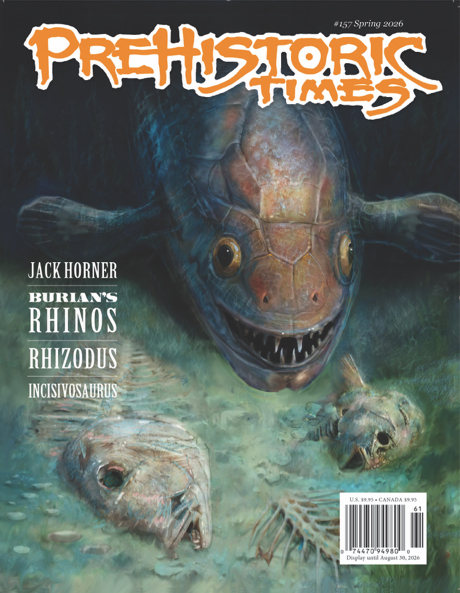
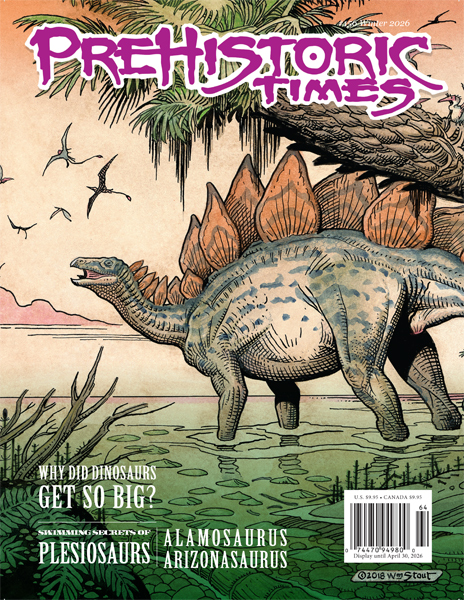
Another enjoyable edition of “Prehistoric Times” magazine.  This quarterly publication aimed at fans of prehistoric animals and palaeoart just gets better and better.  The front cover artwork for “Prehistoric Times” issue 156 was supplied by acclaimed American artist and illustrator William Stout.  The artwork depicts a scene from the Jurassic and readers are treated to some other examples of William’s work inside.

John Lavas continues his inventory of Zdeněk Burian’s prehistoric elephants with part two of the discussion on mammoths. Most of the beautiful illustrations featured were created in 1961 but look out for an iconic example of Mammuthus primigenius artwork from 1941 which occurs towards the end of the article.  Burian’s work inspired talented Polish sculptor Marta Szubert to create a bust of a Coelodonta antiquitatis.  It was the start of a career recreating prehistoric life for numerous museums.  Several examples of her work are included in an article inside this issue.

"Prehistoric Times" issue 156.

The front cover of the next issue of “Prehistoric Times” magazine (issue 156 – winter 2025/6). Picture credit: Mike Fredericks.

Picture credit: Mike Fredericks

Alamosaurus and American Faunal Interchange

Phil Hore is our guide to the titanosaurian sauropod Alamosaurus and there are some spectacular illustrations too.  Congratulations to all the contributors.  Readers who submitted artwork include Tim Bollinger, Dale Novak, Chuck Egnaczak and Jeri Hurt.  Some illustrations depict this giant herbivore interacting with predatory dinosaurs. A theme utilised by Anthony Pichler and Christoffer Gertz Bech.  We noted the Alamosaurus shown in lateral view by Jason Abdale and Phil Hore’s use of the term “sauropod hiatus”.  The absence of sauropods from North America is subsequently discussed by the aforementioned Jason Abdale in a feature that explores the faunal interchange between North and South America towards the end of the Cretaceous.  Jason, a professional historian, writer and artist also outlines the presence of hadrosaurs in South America.

In turn, Tracy L. Ford continues the hadrosaur theme in his regular column.  The challenging task of understanding the hadrosaur manus (hand) is explained. New information gleaned from hadrosaur mummies has enabled palaeontologists to gain a better understanding of the anatomy of the manus.  Excellent line drawings help to clarify how the fossil material has been interpreted.

New Prehistoric Animal Models

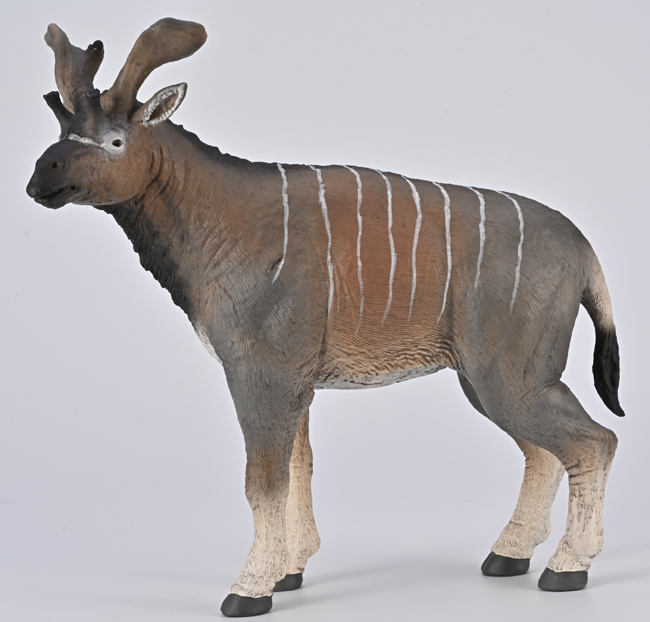
Other regular contributors include editor Mike Fredericks who reviews some of the latest offerings by CollectA, Papo, and Schleich.  His favourite new CollectA model is the 1:20 scale prehistoric giraffid Sivatherium.

CollectA Deluxe male Sivatherium giganteum.

The new CollectA male Sivatherium model shown in lateral view.  The CollectA Deluxe 1:20 scale model is a favourite of the magazine’s editor.

Mike demonstrates his versatility by also overseeing the “Mesozoic Media” section of the magazine.  Reviews of several publications are provided. It is great to see a review of “The Secret Lives of Dinosaurs” by Dr Dean Lomax and illustrated by Bob Nicholls.  This is an excellent book – highly recommended.  Prehistoric plants enter the limelight with the publication of “The Princeton Field Guide to Mesozoic Plants”.  In addition, we note the inclusion of “Spinosaur Tales: The Biology and Ecology of Spinosaurs” by Dr David Hone and Dr Mark Witton.

Regular contributor Randy Knol opines on eurypterids and praises the CollectA Jaekelopterus figure before moving on to discuss megalosaurs and small theropods.  He concludes his round up of news for model collectors by discussing Australian Pleistocene megafauna.

Examining Arizonasaurus

The second prehistoric animal to be highlighted is Arizonasaurus.  Our thanks to Phil Hore for his entertaining and enlightening article. This Middle Triassic archosaur has inspired a large amount of reader submitted artwork.  There are too many amazing sail-backed reptile illustrations to enable me to name check all the talented and dedicated artists, but favourite illustrations include those contributed by Paul Passano, Giovanni DeBenedictis, Josh Dillon, Maximillan Reichardt, Joshua Ballze and Gabriel Ugueto. Other noteworthy contributions come from Wade Carmen and Kevin Hedgepeth who along with Tracy L. Ford chose to highlight elements of the skeleton.  Thanks also to George Feldman for his ammonite crunching Arizonasaurus.

Issue 156 of “Prehistoric Times” also includes several palaeontological articles.  For example, palaeontologist Dr Jordan Mallon explains why some dinosaurs grew to enormous sizes and American palaeontologist Kenneth Carpenter dives into the swimming secrets of plesiosaurs.  Preston Knowles discusses the evolution of sharks, an article that continues the elasmobranch theme from an earlier issue, whilst Sean Kotz walks us through the painting of a Paralititan figure.

A World Without the “Park”

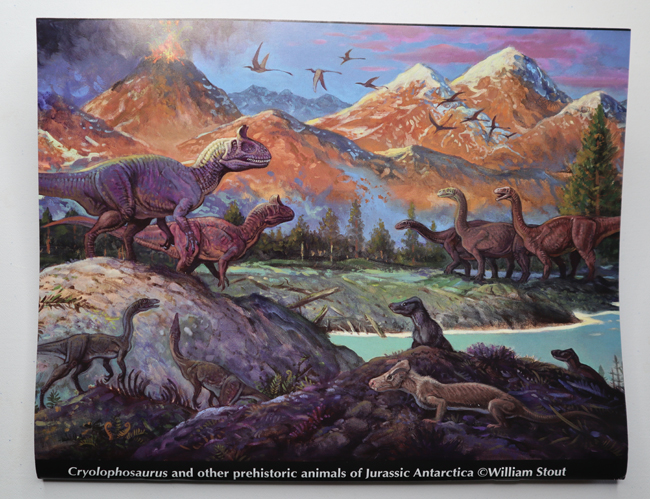
The usual “Paleonews” feature is included, and it was great to see the work on diplodocid integument by Tess Gallagher summarised in this section of the magazine. Robert Telleria pens an intriguing article that unpicks the “Jurassic Park/Jurassic World” franchise and examines the toy merchandise that accompanies the films. Last by not least, we note the two superb illustrations of Triassic Antarctica that can be found inside this issue. William Stout created this artwork. We referred to these beautiful illustrations earlier.  The fauna of the most southerly landmass has inspired this artist. A diorama of the Antarctica during the Jurassic is featured on the magazine’s back cover.

The back cover artwork (issue 156) highlights the fauna of Antarctica in the Jurassic.

The back cover artwork of “Prehistoric Times” issue 156 highlights the fauna of Antarctica in the Jurassic. The illustration was created by William Stout and readers will find two other examples of the American artist and illustrator’s work inside the magazine. Picture credit: Everything Dinosaur.

Picture credit: Everything Dinosaur

Visit the “Prehistoric Times” website and subscribe: The Magazine’s Website.

4 04, 2026

The Curious Case of a Dinosaur Handbag

By |2026-04-05T11:45:27+01:00April 4th, 2026|Categories: Dinosaur and Prehistoric Animal News Stories|0 Comments

A remarkable — and controversial — fusion of palaeontology, biotechnology and luxury fashion has just emerged. According to a recent Reuters report, scientists and designers have unveiled a one-of-a-kind handbag made using collagen derived from Tyrannosaurus rex fossils.  At first glance, it sounds like an April Fool’s story. However, the Tyrannosaurus rex handbag is real.

This accessory, described in the media release as highly distinctive and teal-coloured is on display at Amsterdam’s Art Zoo museum.  Appropriately, it sits beneath a replica T. rex skeleton. What makes the bag extraordinary is not its appearance, but its material. Scientists extracted ancient protein fragments from Tyrannosaurus fossils and used them to engineer collagen in living cells. This collagen was then processed into a leather-like material. The project represents a collaboration between biotech firms and creative agencies, aiming to demonstrate the potential of lab-grown leather as a sustainable alternative to traditional animal hides.

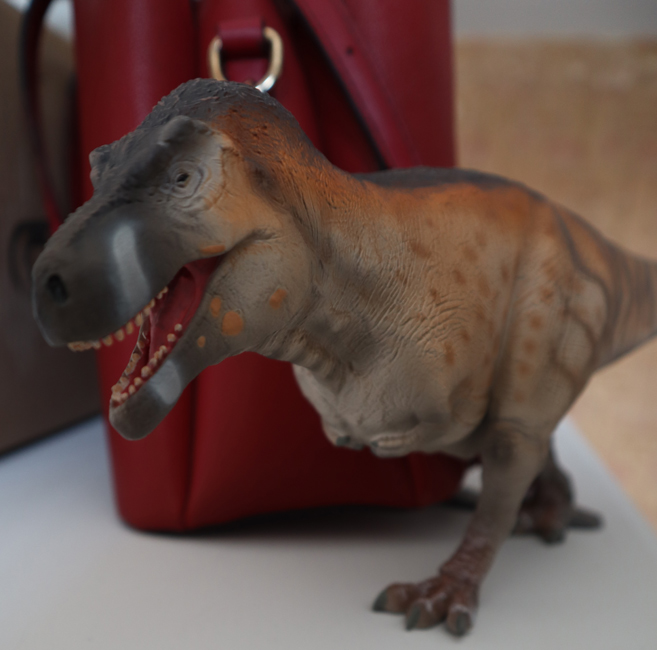
A Tyrannosaurus rex handbag.

A handbag on display in the Netherlands has been labelled as a handbag made from collagen derived from T. rex fossils. This represents an unusual connection between vertebrate palaeontology and fashion. Picture credit: Everything Dinosaur.

Picture credit: Everything Dinosaur

The tyrannosaur model in Everything Dinosaur’s image (above) is the Everything Dinosaur Evolution 1:33 scale T. rex.

To view this museum quality range of models: Everything Dinosaur Evolution Model.

A Tyrannosaurus rex Handbag with a Lofty Price Tag

This unique item of apparel is going up for auction.  The purchaser is going to need a wallet bigger than an Argentinosaurus.  The bag is expected to fetch more than $500,000 USD.  The lofty price tag reflects the complex processes behind creating the handbag. The key to this project lies in collagen, the protein that forms the basis of skin, bone, and connective tissue in animals.

The handbag is designed by high-end Polish techwear label Enfin Levé.  The manufacturing process involved three organisations.  Firstly, VML the creative firm that announced the development and this company collaborated with The Organoid Company and Lab-Grown Leather Ltd.  The technical process involves the fossil-derived protein fragments being analysed, then scientists reconstruct missing parts of the original collagen sequence.  This genetic information is transferred to living cells which subsequently produce collagen.  Harvesting the collagen permits the project team to process the material into a leather-like substitute.

In reality, the handbag has been made from bioengineered collagen inspired by a Tyrannosaurus rex, rather than leather directly produced from fossilised dinosaur integument.

As well as generating lots of publicity, the objective of this unusual project is to highlight that ethical, lab-grown materials can be just as desirable – if not more so – than traditional leather.

Scientists are Sceptical – It’s Not Real Dinosaur Skin

While the collaboration is certainly intriguing, many academics remain sceptical.  For example, Thomas Holtz a vertebrate palaeontologist at the University of Maryland has remarked that the lab-created skin will not be authentic because there’s no actual T. rex skin or DNA to serve as a basis for this process.  Indeed, dinosaur collagen has been recovered from fossil material, but this collagen is extremely fragmentary and associated with bone not integument.

This story is undeniably compelling, however, this is not “Jurassic Park”, but rather the creation of a modern biomaterial loosely based on ancient proteins. Arguably, the term “Tyrannosaurus rex handbag” is not scientifically accurate, it is probably more of a branding exercise than a literal description. That said, the science behind this work is remarkable and lab-grown leather is perhaps a more ethical product than leather made from animal hide.

With an auction price likely to exceed $500,000 USD, we will stick to Tyrannosaurus rex models.

The Everything Dinosaur website: Dinosaur and Prehistoric Animal Models.

3 04, 2026

Unpacking the Latest Beasts of the Mesozoic and Cyberzoic Figures

By |2026-04-03T22:22:51+01:00April 3rd, 2026|Categories: Beasts of the Mesozoic Models|0 Comments

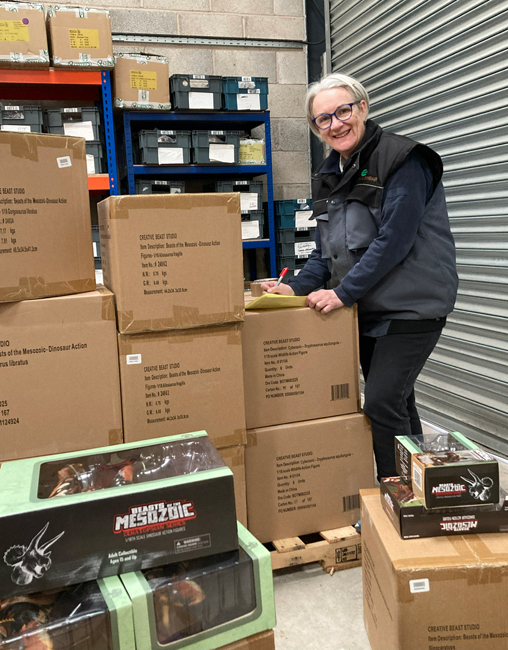
Our warehouse has received a new delivery of Beasts of the Mesozoic and Beasts of the Cyberzoic articulated figures.  Time to get busy alerting customers as we approach the Bank Holiday weekend in the UK. Tyrannosaur, ceratopsian and dromaeosaurid figures are included in the shipment.  In addition, some Beasts of the Cyberzoic models were also delivered.  Once the figures have been unpacked and checked over, they will be stored in their designated bays at the warehouse. Having different parts of the warehouse assigned to different product lines makes picking orders more convenient.  In addition, stock takes are easier too.

Sue from Everything Dinosaur checks over the various pallets and makes sure all the stock is stored properly.

Beasts of the Cyberzoic and Beasts of the Mesozoic figures being unpacked.

Sue is busy checking the latest shipment of Beasts of the Mesozoic and Beasts of the Cyberzoic figures that have arrived at the warehouse. Picture credit: Everything Dinosaur.

Picture credit: Everything Dinosaur

To view the range of Beasts of the Mesozoic, Cenozoic and Beasts of the Cyberzoic figures available: Beasts of the Cyberzoic Figures.

Sue commented:

“It is important to check deliveries and to get stock booked in correctly.  With hundreds of different lines and thousands of prehistoric animal figures we want to make sure we monitor the inventory.  After all, it is easy to get a 1:18 scale Allosaurus mixed up with a 1:35 scale Allosaurus figure. You have to keep focused when counting dinosaurs.”

The multiple-award-winning Everything Dinosaur website: Prehistoric Animal Figures.
2 04, 2026

Celebrating Creativity: A Dinosaur Fan Reimagines a Favourite Model

By |2026-04-02T15:40:24+01:00April 2nd, 2026|Categories: Dinosaur and Prehistoric Animal Drawings|0 Comments

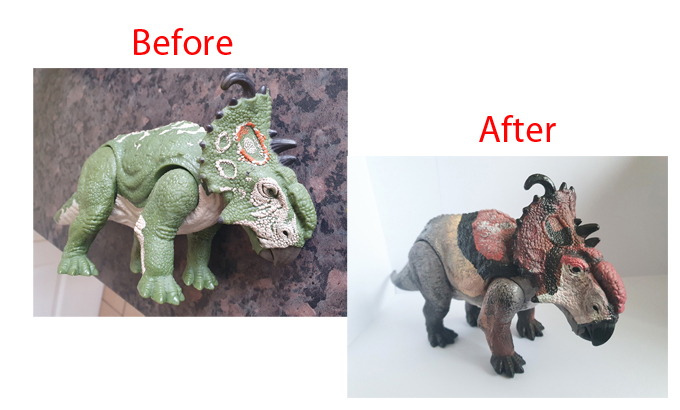
Sue and I, always enjoy seeing how dinosaur model fans engage with prehistoric animals. Recently, we were delighted to receive wonderful photographs from a talented young artist. She had taken a dinosaur model and transformed it with her own imaginative repaint. The results are impressive.  We think the new colour scheme is better than the manufacturer’s original version.  Dinosaur model repainting is fun.

Thank you Caldey, for sending your images.  If this is your first dinosaur model repaint, you’ve done a brilliant job!

Dinosaur model repainting by a young dinosaur fan. Repainting a dinosaur model can be extremely satisfying.

Our thanks to Caldey and her mum for sending into us some fabulous photographs of Caldey’s dinosaur model repaint. Picture credit: Caldey.

Picture credit: Caldey

Repainting a Dinosaur Model

At first, the original model featured a simple, predominately green colour scheme. However, with care and creativity, the horned dinosaur has been completely reimagined. The new version displays bold contrasts, richer tones, and has striking details.  It has been skilfully painted with a particularly expressive nasal boss and neck frill.  The dinosaur model has more personality.

Caldey’s mum emailed explaining that the figure in question was the Mattel Jurassic World Fallen Kingdom Pachyrhinosaurus.  She confirmed this was Caldey’s first attempt at repainting a dinosaur model. Repainting models is a fantastic way for young people to explore their creativity. Not only does it encourage artistic expression, but it also helps develop patience and fine motor skills. Furthermore, it helps to develop powers of observation.  We spend quite a bit of time debating prehistoric animal colouration with palaeontologists and other experts.  For example, we are currently working on our new Everything Dinosaur Evolution Triceratops figure.  What colours will be chosen for our own horned dinosaur figure?

A Confident Use of Colour

Sue commented that she was impressed by the confident use of colour in this dinosaur model repaint. For example, Sue praised the darker stripe across the body adding:

“This bold stripe adds depth and realism.  It contrasts with other markings and the lighter shades seen on the face and the area just in front of the hips.”

Clearly, a lot of thought and effort went into this piece of dinosaur art.

At Everything Dinosaur, we actively encourage young fans to personalise their models. Whether through painting, diorama building, or storytelling, these activities bring prehistoric worlds to life. Furthermore, they help foster a lifelong interest in science and natural history.

So, if you have a dinosaur model at home, why not try a repaint of your own? With a little imagination, you can create something entirely unique.

We would love to see your creations too. Keep up the fantastic work!

The award-winning Everything Dinosaur website: Dinosaur Models.

1 04, 2026

April Fool’s Day and Prehistoric Pranks: When Fossils Fool Us

By |2026-04-03T18:09:29+01:00April 1st, 2026|Categories: Photos/Pictures of Fossils|0 Comments

April Fool’s Day is the perfect excuse for a little mischievous fun. Every year on the 1st of April, people play practical jokes and the media is full of bizarre news stories that turn out to be hoaxes. However, while jokes are often harmless fun, some deceptions have had a lasting impact on science. Prehistoric pranks can come in various shapes and sizes.  For example, we are aware of bogus new dinosaur model announcements in the past.  Strange chimera consisting of theropods crossed with ceratopsians.  Indeed, we have been asked to help out with museums when they wanted to add a little bit of mischief to their April communications.

In addition, even the likes of Sir David Attenborough have been fooled by fossils.  The accomplished naturalist and broadcaster recalls the story of how he was once convinced to purchase a trilobite mating fossil.  The specimen proved to be a fake, a clever concoction prepared by a Moroccan fossil preparator to bump up the price.

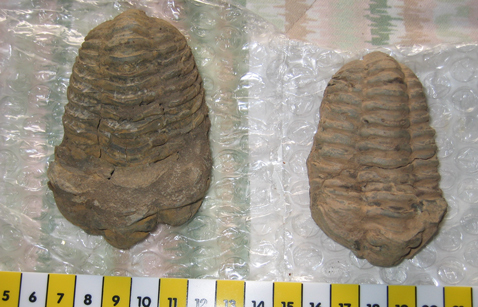
The definition of benthic. A pair of trilobite fossils. Trilobites feature in the televison programme "First Life".

Calymene trilobites. Unscrupulous fossil sellers often “customise” fossils to make them more valuable. Even Sir David Attenborough has been caught out by such practices. Picture credit: Everything Dinosaur.

Picture credit: Everything Dinosaur

When Science Gets it Wrong

In fact, the world of palaeontology has not been immune to prehistoric pranks and trickery. Over the years, a few famous fossil hoaxes have fooled experts and captured the public imagination. So, as we enjoy April Fool’s Day, it is worth exploring how even scientists can sometimes be misled. Science relies on evidence. However, mistakes can be made when it comes to interpreting the evidence. Occasionally, these mistakes are not accidents at all. Instead, they are deliberate hoaxes designed to mislead.

One of the most famous examples is the so-called “missing link” known as Piltdown Man. In 1912, fragments of a skull were discovered in Sussex, England. At the time, this discovery seemed extraordinary. The remains were claimed to represent a new species of early human, one with both human and ape-like features.  It was not until 1953 that the fossils were definitively proved to be a hoax. The material was identified as a human skull from the Middle Ages, fossil teeth from ape (chimpanzee), and an orangutan jawbone that was a few hundred years old.

As a result, Piltdown Man became one of the greatest scientific hoaxes of all time.

Lessons from a Prehistoric Prank

The Piltdown Man forgery provides important lessons for palaeontologists. Science is not just about discovery; it is also about verification. Because of this case, scientists became more cautious. They now rely on improved techniques and stricter peer review.

Similarly, a fossil from China claimed to be a missing link between birds and theropod dinosaurs. The specimen was given the informal name of “Archaeoraptor”. A sensational article announced this remarkable discovery in an article in “National Geographic” magazine (1999). Subsequently, the specimen was found to consist of several pieces from real fossils that had been rearranged and stuck together to make the material more valuable.

Moreover, the story highlights how expectations can influence interpretation. At the time, many researchers expected a transitional form between terrestrial theropods and true birds to be discovered.

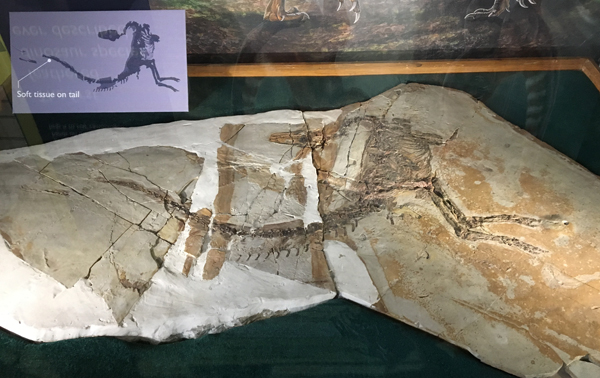
Sinosauropteryx fossil material.

Sinosauropteryx on display – the first feathered dinosaur described. It was described in 1996, and scientists were expecting more feathered dinosaur fossils from China.  This helped set the scene for the “Archaeoraptor” forgery. Picture credit: Everything Dinosaur.

Picture credit: Everything Dinosaur

A Light-Hearted Look at Fossil Discoveries

Of course, not all “fossil surprises” are serious. Every year, museums, universities, and even palaeontology blogs join in April Fool’s Day fun. From imaginary dinosaur species to bizarre fossil discoveries, these playful stories entertain and educate at the same time. At Everything Dinosaur, we have enjoyed joining in over the years. After all, a good-natured joke can spark interest in the Earth sciences. For example, fifteen years ago we were asked to help promote a prehistoric animal exhibition by helping to organise the discovery of a dinosaur bone on a beach in Cumbria.

To read more about this prehistoric prank: Unbelievable! Dinosaur Bone Found at Whitehaven.

April Fool’s Day is an annual reminder to question what we see and read. Whether it is a surprising fossil claim or an unusual news story, it is best to be sceptical. At the same time, curiosity remains at the heart of scientific endeavour. By asking questions and testing ideas, we continue to uncover more amazing evidence about life on Earth.

So, if you come across a “new dinosaur discovery” today, take a closer look. It might just be an April Fool’s trick!

And if it is real—well, that’s even more exciting!

The award-winning Everything Dinosaur website: Dinosaur and Prehistoric Animal Models.

Go to Top