All about dinosaurs, fossils and prehistoric animals by Everything Dinosaur team members.
7 03, 2025

Exciting News! We have our First Frogspawn!

By |2025-03-07T09:16:10+00:00March 7th, 2025|Categories: Animal News Stories|0 Comments

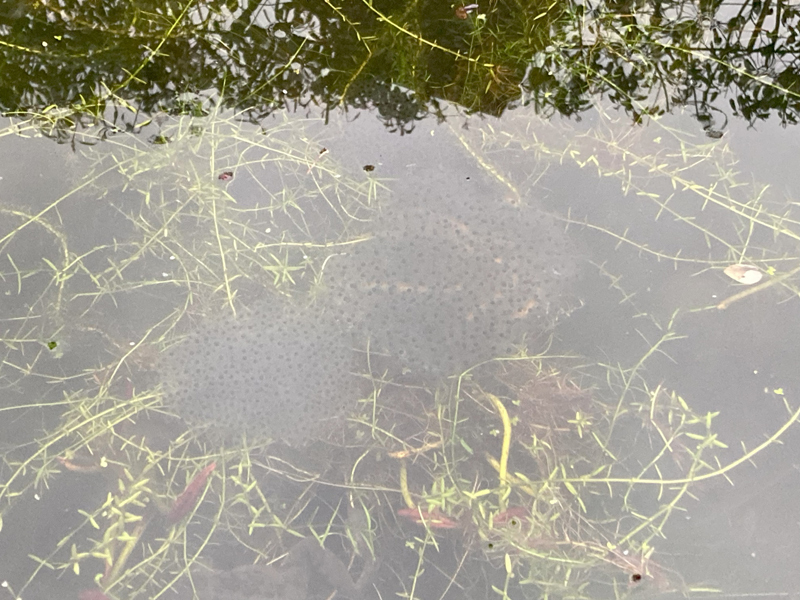
Frogspawn spotted in the Everything Dinosaur office pond. After numerous cold nights, the frogs (Rana temporaria) have begun to spawn.  The first three batches of frogspawn were spotted this morning (7th March).  Last year, (2024) the first observation of frogspawn in the office pond occurred on the 18th of February.  This was the earliest date that it had been recorded since we began gathering this information.  We have noticed a marked trend in frogs spawning earlier.  However, the cold nights with freezing temperatures delayed spawning this year.

Frogspawn spotted in the office pond.

Frogspawn in the office pond spotted on the morning of the 7th of March. The cold weather had delayed spawning this year. Picture credit: Everything Dinosaur.

Picture credit: Everything Dinosaur

For the article on the earliest frogspawn recorded: Frogspawn Discovered in the Office Pond.

Frogspawn Spotted

At least ten frogs have been counted.  If you look carefully at the picture above, you might be able to see a frog in the lower half of the picture.  We took great care not to disturb the animals as we photographed the frogspawn.

Mike from Everything Dinosaur commented:

“We had been worried.  Some work undertaken in the area last summer could have disturbed the frogs.  However, it is pleasing to see frogspawn once again in the office pond.  Ponds like this one are a haven for wildlife and we do what we can to help nature.”

He explained that as part of the work undertaken last year Everything Dinosaur has arranged to plant some insect-friendly plants close to the pond.

Mike stated:

“We wanted to do more to attract honeybees and other important insects.  Some of these plants have begun flowering and their nectar has already attracted numerous honey and bumble bees.”

By this time last year, more than a dozen batches of frogspawn had been recorded.  The frogs have some catching up to do.

The award-winning Everything Dinosaur website: Dinosaur Toys.

6 03, 2025

Rare Scottish Dinosaur Specimen Probably an Early Ornithopod

By |2025-03-07T14:50:08+00:00March 6th, 2025|Categories: Palaeontological articles|1 Comment

A jumbled set of bones first spotted on a beach on the southern portion of the Isle of Skye in 1973 have been identified as a probable ornithopod.  The Elgol dinosaur fossil is Scotland’s earliest recorded dinosaur fossil discovery.  A research team led by Dr Elsa Panciroli (NERC Independent Research Fellow at National Museums Scotland), visited the site in 2018 and began the challenging process of extracting the fossil specimen from the surrounding boulders.

A specialist Canadian company was invited to supervise the extraction of the rare fossil.  Once the difficult task of releasing the fossil slab was completed, it was carefully loaded onto an inflatable dingy and piloted safely back to port by a local crew from Elgol’s Bella Jane Boat Trips.  The researchers were so worried about the fossil block sinking that they tied several buoys to it in the hope that if the boat should capsize, the rare fossil could still be located.
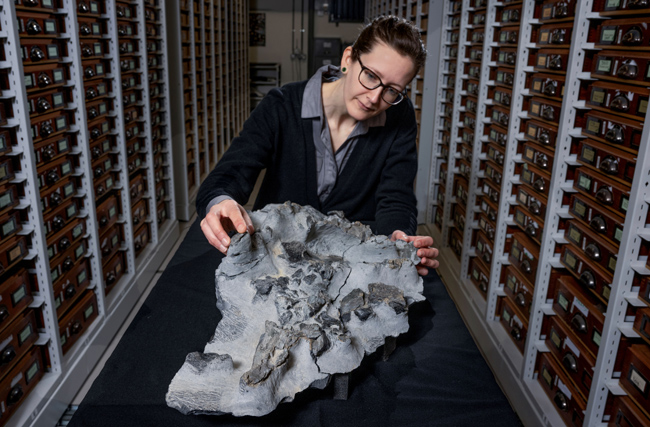
Dr Elsa Panciroli with the Elgol dinosaur fossil.

Lead author Dr Elsa Panciroli with the Elgol dinosaur fossil. The jumbled bones have proved difficult to identify. Picture credit: Neil Hanna.

Picture credit: Neil Hanna

The Dinosaur Fossil Record of Scotland

The fossil record of dinosaurs in Scotland mostly comprises isolated highly fragmentary bones from the Great Estuarine Group in the Inner Hebrides.  These sediments were deposited in the Middle Jurassic (Bajocian–Bathonian faunal stage).  The Elgol dinosaur fossil is estimated to be around 166 million years old. It is the first and most complete partial dinosaur skeleton currently known from Scotland. The material has been assigned a specimen number (NMS G.2023.19.1).

After manual preparation, the scientists were able to identify part of the spine, ribs and elements from the hips (a partial ilium).  Unfortunately, micro-CT scanning failed to help with fossil identification.  However, the team are confident that the material does represent a dinosaur, an ornithischian and most likely an ornithopod.  If it does prove to be an ornithopod, then it would be one of the world’s oldest ornithopod body fossils described to date.
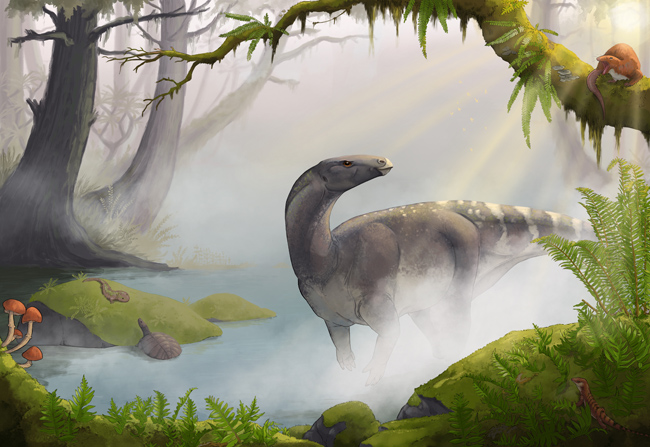
The Elgol dinosaur fossil has been interpreted to represent a small ornithischian dinosaur.

The Elgol dinosaur fossil has been interpreted to represent an early ornithopod. Picture credit: Maija Karala.

Picture credit: Maija Karala

Lead author of the study, Dr Elsa Panciroli stated:

“This was a really challenging extraction, in fact we’d previously felt was too difficult to collect the fossil, but I thought it was really important to study it. I was able to persuade the team to give it a try. It took a lot of hard work from a lot of people, but we did it: finally we can confirm and publish Scotland’s first recorded and most complete dinosaur, and that makes it all worthwhile”.

Cerapodan or Ornithopod Dinosaur

The ornithischian (bird-hipped) clade of the Dinosauria has been subdivided into several groups.  Although the exact taxonomy remains undetermined, most palaeontologists distinguish two main groups. Firstly, there is the Thyreophora which comprises the armoured dinosaurs. In addition, there is the Cerapoda which can be further divided into the Ornithopoda and the Marginocephalia (ceratopsids and pachycephalosaurs).

The partial ilium and a histological analysis of fossil bone led the team to conclude that NMS G.2023.19.1 was definitely ornithischian and probably an early ornithopod. Ornithopods were much more common in the Early and Late Cretaceous.  Famous ornithopods such as Iguanodon, Hypsilophodon and Mantellisaurus are associated with Lower Cretaceous deposits.
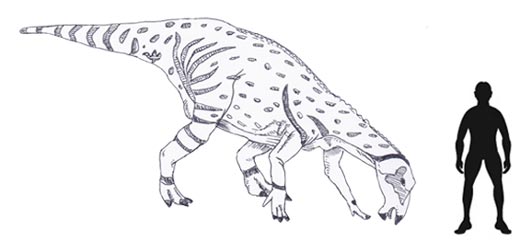
Mantellisaurus scale drawing.

A Mantellisaurus scale drawing.  An illustration of an Early Cretaceous ornithopod.  Picture credit: Everything Dinosaur

Picture credit: Everything Dinosaur

The ornithopod illustration (above) is based on the CollectA Age of Dinosaurs Mantellisaurus model that was introduced in 2018.  This was the same year when the fossil was removed from its difficult to access location.

To view the range of CollectA Age of Dinosaur figures, including many ornithopods: CollectA Age of Dinosaurs Figures.

Late Cretaceous ornithopods were extremely successful.  Hadrosaurs became the dominant herbivores in many ecosystems.  The Hadrosauridae family (duck-billed dinosaurs) had a global distribution. Some of these dinosaurs were enormous.  For example, Shantungosaurus from the Late Cretaceous of China reached lengths in excess of fourteen metres.

The Elgol Dinosaur Fossil

The Elgol fossils suggest an animal about the size of a pony.  Histological analysis concluded that the animal was at least eight years of age when it died. The new description of the Elgol dinosaur is published in the Earth and Environmental Science Transactions of the Royal Society of Edinburgh. If the fossil material does represent an ornithischian, as tentatively suggested from the partial ilium and histological sectioning, it represents the geologically youngest known occurrence in Scotland, and first from the Kilmaluag Formation.  This adds to the diversity of dinosaurs known from the Middle Jurassic of the Isle of Skye.

To read an article about the types of dinosaurs that lived in this part of the world during the Middle Jurassic: Tracks of Middle Jurassic Dinosaurs.
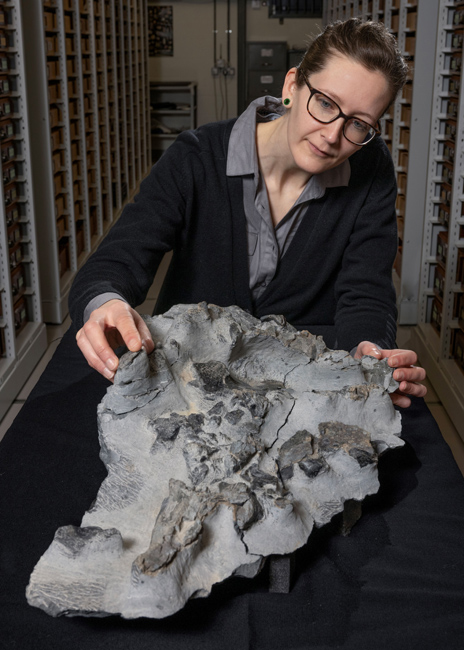
Dr Elsa Panciroli carefully examines the Elgol dinosaur fossil material.

A close-up view of the 166-million-year-old Elgol dinosaur fossil. Dr Elsa Panciroli carefully examines the fossil material. Picture credit: Neil Hanna.

Picture credit: Neil Hanna

Co-author of the study, Dr Stig Walsh (National Museums Scotland) said:

“This is a wonderful addition to the rapidly growing set of Jurassic finds from the Isle of Skye which are enabling us to learn more and more about the rich ecosystem of the time. We’ve known there were dinosaurs there for a while, most obviously from the famous footprints at An Corran, Brother’s Point and Duntulm and from individual bones, but it’s exciting to see a more complete, if still partial, skeleton. We’re delighted to add it to the other amazing finds now in the National Collection”.

Other recent Jurassic discoveries from Skye include the description of adult and juvenile mammals of the same species, Krusatodon, which revealed that these mammals grew more slowly than mammals today, and possibly one of the world’s largest Jurassic pterosaurs, Dearc sgiathanach.

To read Everything Dinosaur’s article about the Krusatodon fossils: Providing an Insight into Krusatodon Ontogeny.

To read about the discovery of D. sgiathanachFantastic Pterosaur from the Isle of Skye.

More Dinosaur Fossils?

Fellow author Professor Susie Maidment of the London Natural History Museum and the University of Birmingham, added:

“The Elgol dinosaur was a challenge to collect, and has proven perhaps an even bigger challenge to identify. Some aspects of the bones indicate that the specimen may be an ornithopod, a group of plant-eating dinosaurs that are best known from the Cretaceous. This specimen, however, would already have been a fossil by the time that the better-known ornithopods like Iguanodon and Hypsilophodon were walking the Earth. Recent research on the fossils of Elgol has revealed a diverse ecosystem of extraordinarily preserved Middle Jurassic animals, and I’m sure there are more exciting discoveries to come.”

The other authors on the paper were Professor Roger Benson (American Museum of Natural History), Professor Richard Butler (University of Birmingham), Brett Crawford (Research Casting International – RCI), Matt Fear (RCI), Dr Nick Fraser (National Museums Scotland) and Dr Gregory Funston (Royal Ontario Museum).

With the description of the Elgol dinosaur fossil, the significance of the Isle of Skye is once again emphasised.  Furthermore, it demonstrates the importance of this part of Scotland in terms of learning more about the dinosaur biota from the Middle Jurassic.

Everything Dinosaur acknowledges the assistance of a media release downloaded from National Museums Scotland.

The scientific paper: “The first and most complete dinosaur skeleton from the Middle Jurassic of Scotland” by Elsa Panciroli, Gregory F. Funston, Susannah C. R. Maidment, Richard J. Butler, Roger B. J. Benson, Brett L. Crawford, Matt Fair, Nicholas C. Fraser and Stig Walsh published in the Earth and Environmental Science Transactions of The Royal Society of Edinburgh.

The award-winning Everything Dinosaur website: Prehistoric Animal Models.

5 03, 2025

The Beautiful PNSO Lokiceratops Model is Now in Stock

By |2025-03-05T20:49:03+00:00March 5th, 2025|Categories: PNSO Age of Dinosaurs Models|0 Comments

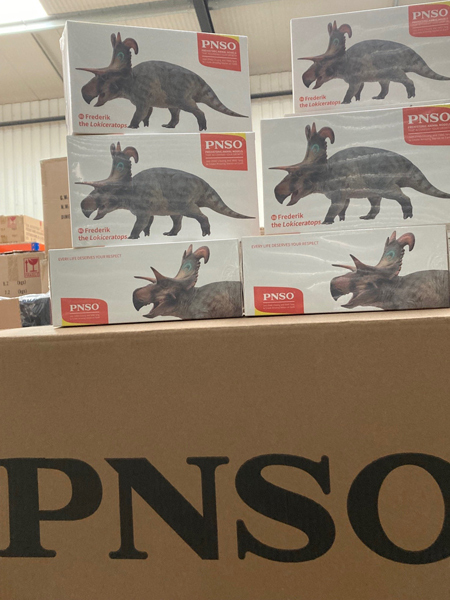
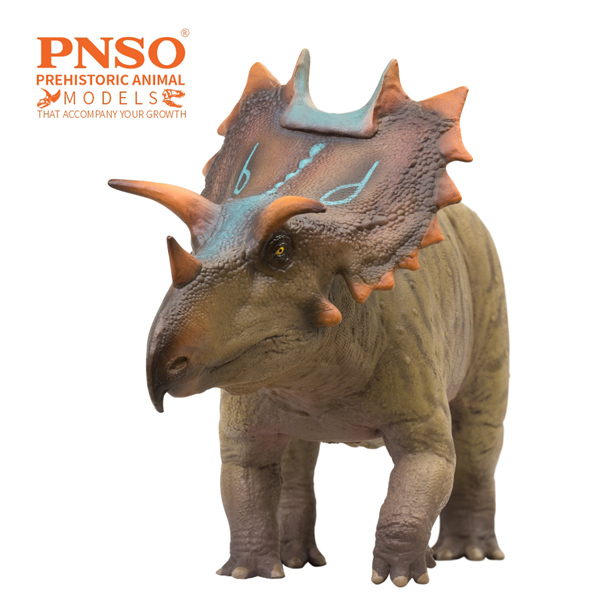
The beautiful PNSO Lokiceratops dinosaur model is now in stock at Everything Dinosaur. Team members have been busy unpacking the figures in the warehouse.  This is the first, new PNSO model to arrive at Everything Dinosaur this year (2025).

PNSO Lokiceratops boxes in the Everything Dinosaur warehouse.

PNSO Lokiceratops boxes in the Everything Dinosaur warehouse. Picture credit: Everything Dinosaur.

Picture credit: Everything Dinosaur

To view the range of PNSO prehistoric animal models in stock: PNSO Age of Dinosaurs Figures.

The New for 2025 PNSO Lokiceratops

The centrosaurine was formally named and described in 2024 (Loewen et al). The fossil material comes from Judith River Formation (Campanian) exposures in northern Montana.

To read Everything Dinosaur’s blog post about the discovery of Lokiceratops: Lokiceratops a New Horned Dinosaur from Montana.

The large number of similar horned dinosaur taxa identified from this part of North America suggests that dinosaur diversity has been underestimated. Moreover, there is considerable evidence to indicate centrosaurines were living and evolving in a small geographic area (high endemism). This high endemism identified in the Centrosaurinae subfamily contrasts with the extensive (historic) ranges seen in most large extant mammals.

In total, five ceratopsians have been described from this small area of northern Montana.  To date, four centrosaurines and one chasmosaurine have been described:

  • Wendiceratops pinhornensis.
  • Albertaceratops nesmoi.
  • Medusaceratops lokii.
  • Lokiceratops rangiformis.
  • Judiceratops tigris (the chasmosaurine).

Mike from Everything Dinosaur welcomed the new PNSO figure and commented.

“Congratulations to PNSO for making a model of a horned dinosaur that has only recently been scientifically described.”

The award-winning Everything Dinosaur website: Dinosaur Models.

4 03, 2025

PNSO Announce a New Ceratopsian Figure (Spiclypeus)

By |2025-03-04T22:43:47+00:00March 4th, 2025|Categories: PNSO Age of Dinosaurs Models|0 Comments

PNSO will introduce a new ceratopsian figure in the late spring of 2025.  Say hello to Judith the Spiclypeus.  This is a replica of a chasmosaurine that was named and described in 2016 (Mallon et al).  A spokesperson from Everything Dinosaur confirmed that this was the first new model of 2025 to be announced by PNSO.

PNSO Judith the Spiclypeus dinosaur model.

The new for 2025 Spiclypeus dinosaur model from PNSO (Judith the Spiclypeus). The dinosaur’s trivial name has been inspired by the Judith River Formation (Montana, USA).

To view the range of PNSO models and figures currently in stock at Everything Dinosaur: PNSO Prehistoric Animal Models.

PNSO Judith the Spiclypeus

The PNSO Judith the Spiclypeus model measures 17 cm in length. It is supplied with a full-colour, sixty-four-page booklet and an A3-sized colour poster.  It is a beautiful horned dinosaur figure. The holotype (CMN 57081) was collected from the lower Coal Ridge Member of the Judith River Formation. These sediments were laid down in a swampy environment. It is fitting to see PNSO depict their Spiclypeus figure in a swamp.

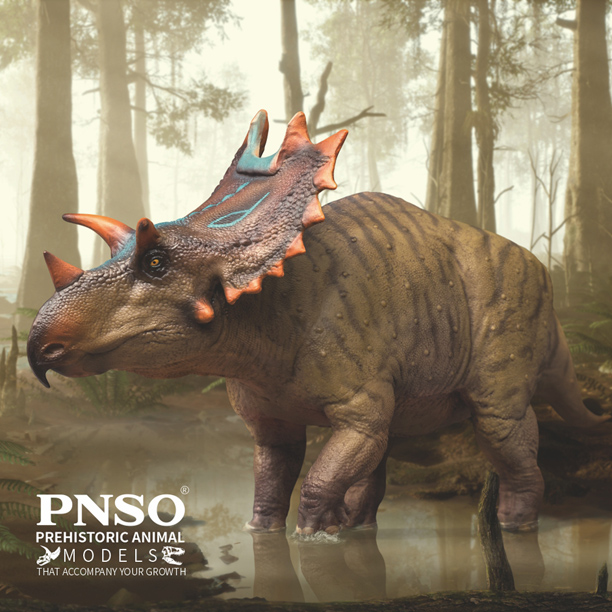
PNSO Judith the Spiclypeus in the swampy landscape.

The Spiclypeus model is depicted in a swampy environment. The holotype (CMN 57081) was collected from the lower Coal Ridge Member of the Judith River Formation. These sediments were indeed laid down in a swampy environment.

Mike confirmed that Everything Dinosaur would be stocking this new, superb ceratopsian figure.

Visit the award-winning Everything Dinosaur website: Dinosaur and Prehistoric Animal Models.

3 03, 2025

New Eofauna Figures in Stock at Everything Dinosaur

By |2025-03-03T17:31:46+00:00March 3rd, 2025|Categories: Eofauna Scientific Research Models|0 Comments

Three new Eofauna figures have arrived in stock at Everything Dinosaur. The Ankylosaurus (A. magniventris), Columbian mammoth and the beautiful American mastodon are in stock.  Mike and Sue have been busy contacting customers who wanted to be alerted when the figures arrived at the company’s warehouse.  These models have a declared scale of 1:35.

The three new Eofauna Scientific Research figures:

  • Ankylosaurus magniventris.
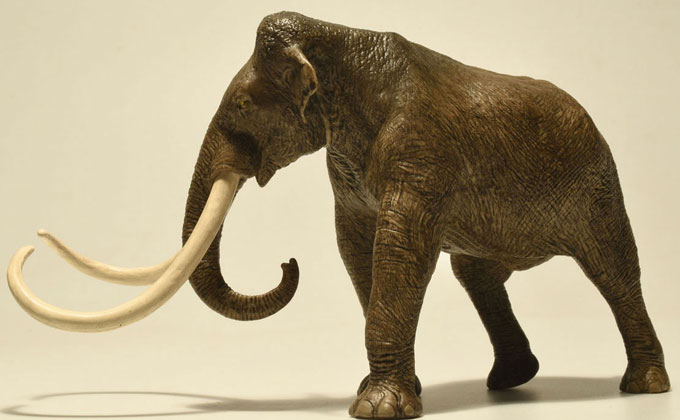
  • Mammut americanum (American mastodon).
  • Mammuthus columbi (Columbian mammoth).
Three new Eofauna figures.

Three, new for 2025 Eofauna Scientific Research figures are in stock at Everything Dinosaur. The Ankylosaurus (A. magniventris) is left. The American mastodon (Mammut americanum) bottom and top, the stunning Columbian mammoth (Mammuthus columbi). Picture credit: Everything Dinosaur.

Picture credit: Everything Dinosaur

To view the range of Eofauna prehistoric animal models in stock at Everything Dinosaur: Eofauna Scientific Research Models.

New Eofauna Figures

These three Eofauna Scientific Research models have been eagerly anticipated.  The company has developed a strong reputation for their proboscidean figures.  Several proboscidean figures are already available and the Mammuthus columbi and Mammut americanum are welcome additions.

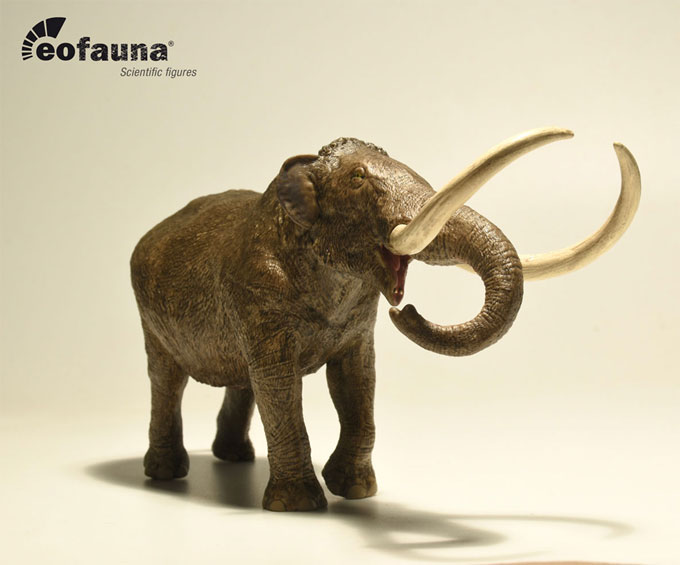
The Eofauna American mastodon figure.

The Eofauna American mastodon figure.

All these new prehistoric animal model figures will be sent out with free, exclusive Everything Dinosaur fact sheets.

Columbian mammoth figure (Eofauna Scientific Research).

The beautiful Columbian mammoth figure.

Mike from Everything Dinosaur commented:

“We have had a busy day contacting all those customers who wanted to be informed when these models arrived.  All three are fantastic and it is wonderful to see the Eofauna range of prehistoric animal models expanding”.

Ankylosaurus magniventris figure (Eofauna).

Ankylosaurus magniventris figure (Eofauna Scientific Research).  A stunning replica in 1:35 scale of a Late Cretaceous armoured dinosaur.

Visit the customer-friendly and award-winning Everything Dinosaur website: Prehistoric Animal Models.

2 03, 2025

A Beautiful Camarasaurus Exhibit

By |2025-03-09T09:40:56+00:00March 2nd, 2025|Categories: Photos/Pictures of Fossils|0 Comments

A trip to the London Natural History Museum back in 2023 permitted team members to get up close to a remarkable Camarasaurus exhibit.  The mounted cast of Camarasaurus fossils towers over visitors.  It is one of the largest exhibits in the dinosaur gallery.  The cast is a replica of fossils excavated from the famous Upper Jurassic Morrison Formation.  It remains one of our favourite sights at the London Natural History Museum.

Camarasaurus exhibit at the London Natural History Museum.

The Camarasaurus exhibit at the London Natural History Museum. Picture credit: Everything Dinosaur.

Picture credit: Everything Dinosaur

Mike from the UK-based mail order company commented:

“The dinosaur gallery at the Museum is quite dark.  It is difficult to take photographs due to the lighting conditions.  However, we wanted to take a photograph of the head and the cervical vertebrae.  Luckily, we were able to pick out some of the beautiful features of the ornate ceiling and the detailed carvings on the columns.  The London Natural History Museum not only houses rare treasures such as the Camarasaurus exhibit, it is also an incredible building.”

Visit the award-winning Everything Dinosaur website: Dinosaur Models and Prehistoric Animal Figures.

The Camarasaurus Exhibit

Camarasaurus fossils are the most common sauropod fossils known from the famous Morrison Formation.  Camarasaurus was formally named and described in 1877 (Cope). Currently, four species are recognised. We suspect this mount represents cast materials from the collection of the American Museum of Natural History in New York.  Several models of this iconic dinosaur have been made.  For example, Safari Ltd have made a model of Camarasaurus.

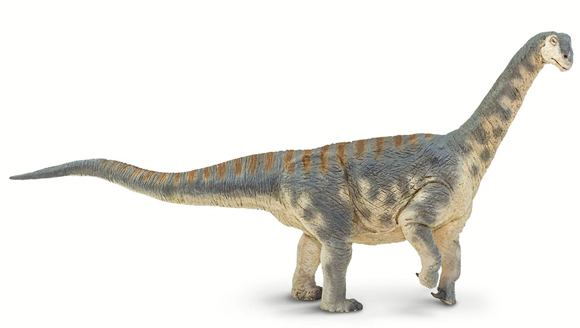
Wild Safari Prehistoric World Camarasaurus dinosaur model.

The award-winning Wild Safari Prehistoric World Camarasaurus dinosaur model.

This dinosaur model was voted the best new dinosaur model by readers of “Prehistoric Times” magazine.

To view the Safari Ltd range of prehistoric animal figures: Safari Ltd – Prehistoric World Models.

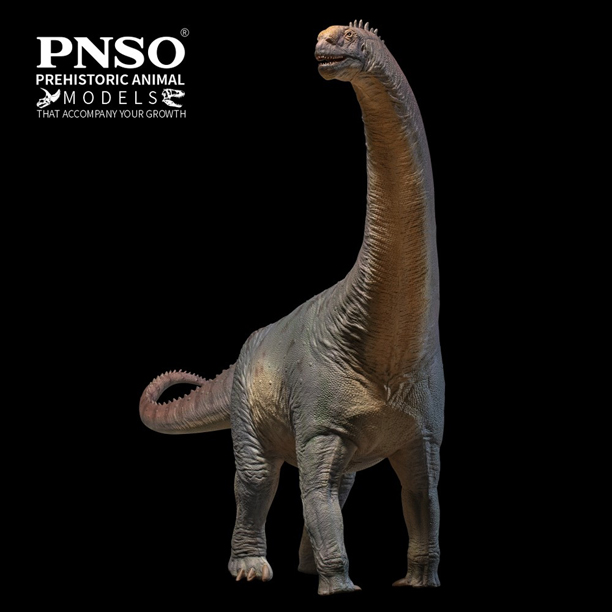
Moreover, Haolonggood recently introduced Camarasaurus figures.  In addition, PNSO have added a Camarasaurus to their impressive range of figures. The PNSO Njor the Camarasaurus figure measures thirty-five centimetres long. In addition, it stands an impressive twenty-four centimetres tall. It is supplied with an A3 Sci-Art poster and a sixty-four-page, full-colour booklet. Naturally, we also send out a free Camarasaurus fact sheet with this excellent sauropod figure.

PNSO Camarasaurus model in anterior view.

The PNSO Camarasaurus model (Njor) in anterior view.

To view the range of PNSO models and figures: PNSO Prehistoric Animal Models and Figures.

1 03, 2025

Everything Dinosaur Provides a New Company Biography

By |2025-02-28T13:35:54+00:00March 1st, 2025|Categories: Everything Dinosaur News and Updates|0 Comments

It might not feel like spring at the moment.  However, by the meteorological calendar, today, March the 1st is the first day of spring.  The days are certainly getting longer, but it is still chilly, especially in the Everything Dinosaur warehouse.  Not to worry, with all the deliveries scheduled for next week, we are going to be busy.  Eofauna, PNSO, Haolonggood and possibly Beasts of the Mesozoic are all due to arrive shortly.

Sue has been busy tidying in the warehouse.  It is important that we make room for all the new stock.  The warehouse is getting a spring clean.  However, it is very tidy and well organised already.  A tidy warehouse helps us to pick, pack and despatch orders quickly.  However, we do have other important tasks.  For example, we have been asked to provide a short biography of the company.  We are happy to oblige.

Sharing a passion for dinosaur toys - Sue and Mike from Everything Dinosaur.

Sharing a passion for dinosaur toys – Sue and Mike from Everything Dinosaur. Picture credit: Everything Dinosaur.

Picture credit: Everything Dinosaur

Providing an Everything Dinosaur Biography

It can be a challenge writing about your own business.  Fortunately, we were able to brainstorm some ideas and make plenty of notes.

We are a multi-award-winning company that specialises in the sale of museum quality prehistoric animal models. Established in 2005, the company is run by people who enjoy sharing their passion for the past with fellow collectors and model fans.

The business is based in Cheshire (UK), and it has developed a worldwide customer base. Everything Dinosaur also supplies museums, events, attractions and educational bodies with dinosaur and prehistoric animal themed merchandise.  Customers are at the very centre of everything we do.

Visit the Everything Dinosaur website: Dinosaur Models and Figures.

Mike added:

“Sue and I are committed to promoting a greater appreciation for the Earth sciences. For example, we research and write our own fact sheets on prehistoric animals and send these out free of charge.  We are also committed to tidying up our warehouse and making the picking and packing of orders more efficient.  Having worked on the company biography it is time to roll up my sleeves and get back into the warehouse.”

28 02, 2025

Wonderful Feefo Customer Feedback Received by Everything Dinosaur

By |2025-02-28T12:16:49+00:00February 28th, 2025|Categories: Everything Dinosaur News and Updates|2 Comments

Our thanks to one of our customers in Canada who sent into us some fabulous comments about their recent purchase.  We received some wonderful Feefo customer feedback.  February might be a short month, but over the last four weeks we have received over a hundred service and product ratings.  We are truly grateful for all the feedback and kind comments we receive.  For example, here is the wonderful feedback from one of our Canadian customers.

Feefo customer feedback received by Everything Dinosaur.

Wonderful feedback from an Everything Dinosaur customer based in Ontario, Canada. Picture credit: Feefo.

Picture credit: Feefo

Feefo Customer Feedback

Feefo is an independent ratings agency.  They collate feedback from customers on our service and products.  Everything Dinosaur has won many awards for its customer service.

Mike from Everything Dinosaur commented:

“We are extremely grateful for all the feedback that we receive.  We do our best to help and support all our customers and we have developed an excellent reputation for speedy delivery of parcels, even to customers as far away as Canada.”

The award-winning Everything Dinosaur website: Dinosaur Toys and Models.

27 02, 2025

New Images of the 2025 Papo Suchomimus Dinosaur Model

By |2025-02-28T15:12:48+00:00February 27th, 2025|Categories: Papo Prehistoric Animal Models|0 Comments

Mike from Everything Dinosaur has been busy preparing some images of the new for 2025 Papo Suchomimus dinosaur model.  This exciting new theropod model is expected in stock soon.  As soon as the model arrives at the company’s warehouse, team members will get busy contacting customers.  This new Papo dinosaur model has attracted a lot of interest. Sue and Mike first saw the prototype of this Papo dinosaur around two years ago.  There is not long to wait now until the new model is in stock.

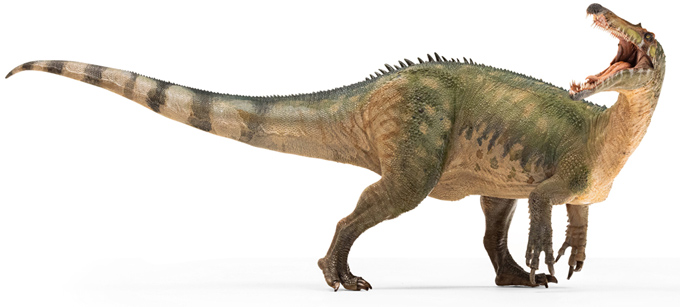
Papo Suchomimus dinosaur model.

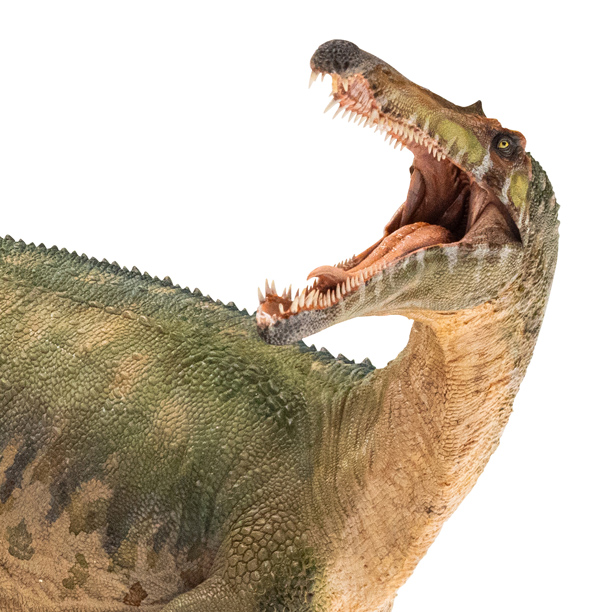
The Papo Suchomimus dinosaur model shown in lateral view.  It is a stunning dinosaur model.  We congratulate the design team at Papo for producing such a fabulous figure.

Papo Suchomimus Dinosaur Model

The Papo Suchomimus figure is one of two new Papo models expected in stock.  The other figure is the Papo Corythosaurus.  Mike from Everything Dinosaur commented that he had been busy sorting out some images of this new meat-eating dinosaur model.  He explained that these images were going to be used on the Papo Suchomimus product page.

A close-up view of the new for 2025 Papo Suchimimus dinosaur model.

A close-up view of the new for 2025 Papo Suchomimus dinosaur model. This new Papo figure has an articulated lower jaw.

To view the range of Papo prehistoric animal figures in stock at Everything Dinosaur: Papo Prehistoric Animal Models.

Mike added:

“We know that dinosaur model fans are eagerly awaiting this new figure.  Rest assured, as soon as it comes into stock, we will get this figure on-line.  In addition, we will make sure we email all those Papo model fans who requested a Suchomimus model.”

The award-winning and highly-rated Everything Dinosaur website: Dinosaur Toys.

To request further information about the Papo Suchomimus model, or indeed, to enquire about other Papo dinosaurs and prehistoric animals: Email Everything Dinosaur.

26 02, 2025

Australian Theropods – A Unique Predator Hierarchy

By |2025-02-26T14:15:47+00:00February 26th, 2025|Categories: Palaeontological articles|0 Comments

A newly published scientific paper highlights the uniqueness and diversity of Australian theropods.  The research, published in the Journal of Vertebrate Paleontology identifies the world’s oldest known megaraptorid.  In addition, the study provides the first evidence of the presence of carcharodontosaurs in Australia.  These fossil discoveries are rewriting the evolutionary history of theropod dinosaurs.  Furthermore, they highlight a unique predator hierarchy in Australia during the Early Cretaceous.

The research was led by Museums Victoria Research Institute and Monash University PhD student Jake Kotevski. The scientists describe five new theropod specimens. Three tibiae, and a fossil consisting of two articulated caudal vertebrae with haemal arches, from the upper Strzelecki Group. In addition, the study includes a single tibia from the slightly younger Eumeralla Formation.

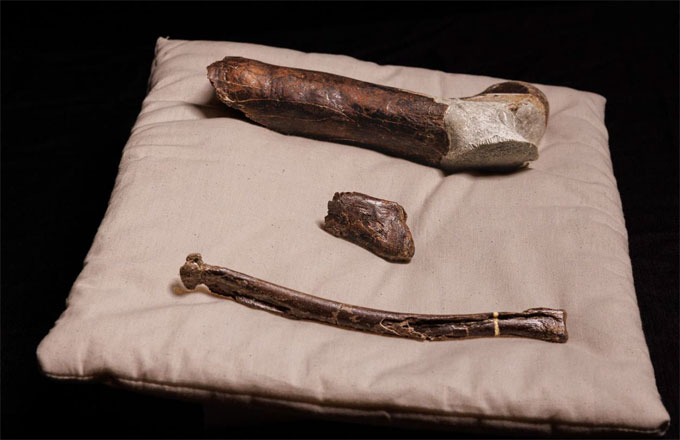
A selection of newly described Australian theropod fossils.

Unenlagiinae left tibia (front). Carcharodontosauria left tibia (middle) and Megaraptoridae right tibia (rear). New research highlights the diversity of Early Cretaceous Australian theropods. Picture credit: Nadir Kinani/Museums Victoria.

Picture credit: Nadir Kinani/Museums Victoria

Describing the Theropod Fossils

The five specimens included in the study are:

  • Articulated Megaraptoridae caudal vertebrae (NMV P257414) – from upper Strzelecki Group exposures from the Twin Reefs locality.
  • A partial right tibia (Megaraptoridae) specimen number NMV P257415 also from upper Strzelecki Group exposures at the Twin Reefs locality.
  • Carcharodontosauria indet. left tibia (NMV P186143). A fragmentary fossil collected from the Lesley’s Lair site by Patricia Vickers-Rich in 1988 (upper Strzelecki Group).
  • NMV P221042 a Carcharodontosauria indet. right tibia from the Point Lewis locality of the Eumeralla Formation.
  • NMV P257601 a crushed left tibia assigned to Unenlagiinae indet. This fossil was found at Eagles Nest, near Inverloch, (upper Strzelecki Group).

For context, the upper Strzelecki Group deposits are dated from 121.4 to 118 million years ago.  Whilst the geologically younger Eumeralla Formation dates from 113 to 108 million years ago.

Fragmentary fossil material found in Australia has been assigned to the Megaraptoridae family previously.  However, these megaraptorid fossils from the upper Strzelecki Group are several million years older.  As such, they are the oldest assigned Megaraptoridae fossil material known to science.  Previously, Everything Dinosaur has reported on the discovery of Australian megaraptor fossil material that dates from approximately 110 million years ago.

To read more about this research: Australian Theropod Bone Challenges Gondwana Break-up Theory.

Australian megaraptorid partial right tibia.

Megaraptoridae right tibia. Picture credit: Nadir Kinani/Museums Victoria.

Picture credit: Nadir Kinani/Museums Victoria

A Fresh Perspective on Australian Theropods

These newly described theropod fossils offer insights into Victoria’s dinosaur dominated, Early Cretaceous ecosystem.  The fossils suggest that the apex predators were megaraptorids.  In contrast, the coeval carcharodontosaurs were much smaller and lighter.  For example, the partial tibia and articulated caudal vertebrae indicate the presence of megaraptorids that were around six to seven metres in length.  The fossils assigned to carcharodontosaurs indicate much smaller theropods.  A size estimate for the carcharodontosaurs of two to four metres in length has been proposed.

One of the authors of the study, PhD student Jake Kotevski commented:

“The discovery of carcharodontosaurs in Australia is ground-breaking. It’s fascinating to see how Victoria’s predator hierarchy diverged from South America, where carcharodontosaurs reached Tyrannosaurus rex-like sizes up to 13 metres, towering over megaraptorids. Here, the roles were reversed, highlighting the uniqueness of Australia’s Cretaceous ecosystem.”

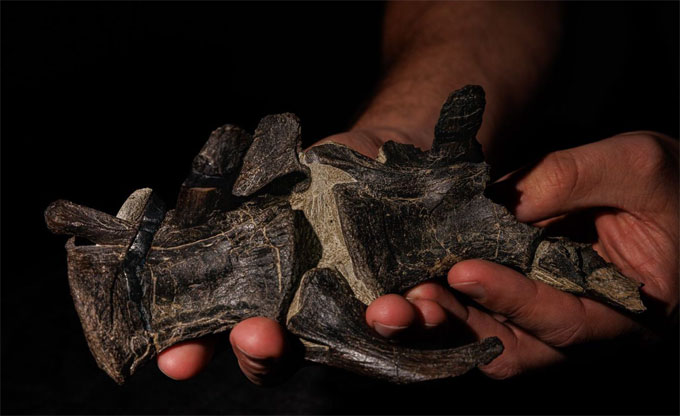
Fossil discoveries highlight Early Cretaceous Australian theropods.

Two Megaraptoridae caudal (tail) vertebrae and haemal arches. Picture credit: Nadir Kinani/Museums Victoria.

Picture credit: Nadir Kinani/Museums Victoria

Numerous small ornithopods are known from the Early Cretaceous of Victoria.  However, sauropod remains are absent.  This may have favoured the evolution of smaller, cursorial predators such as megaraptors.  Whereas, in South America large carcharodontosaurs were the apex predators.  They probably hunted the abundant sauropods.  This suggests the composition of the herbivorous dinosaurs in each region led to different theropods dominating the ecosystem.

To read a blog post from 2019 about the discovery of a new ornithopod from Victoria: A New Early Cretaceous Ornithopod from Australia is Described (Galleonosaurus).

Evidence of Faunal Interchange

Co-author Dr Thomas Rich (Museums Victoria) added:

“The findings not only expand Australia’s theropod fossil record but offer compelling evidence of faunal interchange between Australia and South America through Antarctica during the Early Cretaceous. The findings also challenge previous assumptions about body-size hierarchies in Gondwanan predator ecosystems highlighting Victoria’s unique Cretaceous fauna.”

Specimen number NMV P257601 has been referred to the Unenlagiinae.  Their taxonomic position within the Theropoda remains controversial.  For example, some palaeontologists consider unenlagiines to be a subfamily of the Dromaeosauridae.  However, other scientists consider, these small, long-snouted dinosaurs as a separate family (Unenlagiidae). Most unenlagiine fossil remains have been found in South America. Historically, Australia had limited evidence for their presence.  Nevertheless, the crushed tibia (NMV P257601) provides further robust evidence for a faunal interchange between South America and Australia across Antarctica.

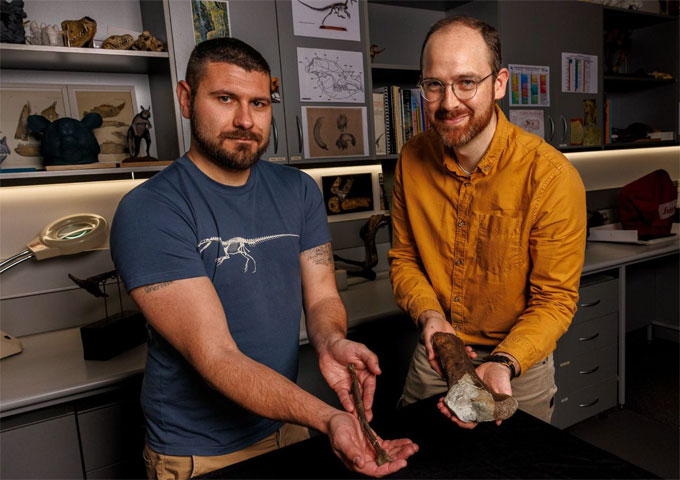
Scientists holding newly described Australian theropod fossils.

Jake Kotevski (left) holding Unenlagiinae left tibia and Tim Ziegler (right) holding Megaraptoridae right tibia. Picture credit: Nadir Kinani/Museums Victoria.

Picture credit: Nadir Kinani/Museums Victoria

The Importance of Museum Collections

Co-author Tim Ziegler (Museums Victoria) highlighted the importance of access to museum collections to foster scientific breakthroughs.

He stated:

“Museum collections are crucial to advancing our understanding of prehistoric life. Specimens preserved in the State Collection for decades – unidentifiable until now – are providing new insights into the evolution of dinosaur ecosystems.”

Three of the fossils, uncovered between 2022 and 2023, were first identified by Museums Victoria volunteer Melissa Lowery. This discovery highlights the essential contributions of community members working alongside seasoned researchers to further our understanding of Australia’s Cretaceous past.

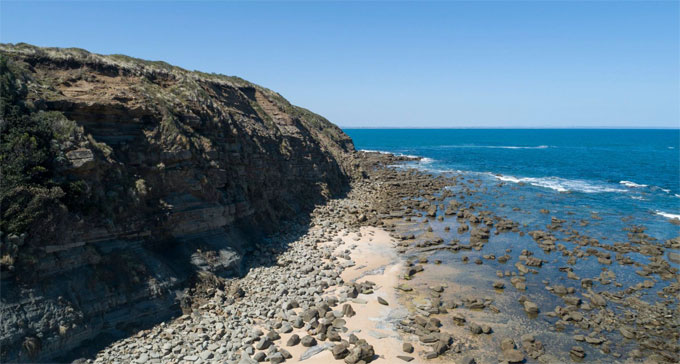
An aerial view of Twin Reefs, Bunurong Coastal Reserve (Victoria).

An aerial view of Twin Reefs, Bunurong Coastal Reserve (Victoria), the area where some of the dinosaur fossils were found. Picture credit John Broomfield/Museums Victoria.

Picture credit: John Broomfield/Museums Victoria

Everything Dinosaur acknowledges the assistance of a media release from Museums Victoria in the compilation of this article.

The scientific paper: “Evolutionary and paleobiogeographic implications of new carcharodontosaurian, megaraptorid, and unenlagiine theropod remains from the upper Lower Cretaceous of Victoria, southeast Australia” by Jake Kotevski, Ruairidh J. Duncan, Tim Ziegler, Joseph J. Bevitt, Patricia Vickers-Rich, Thomas H. Rich, Alistair R. Evans and Stephen F. Poropat published in the Journal of Vertebrate Paleontology.

The award-winning Everything Dinosaur website: Prehistoric Animal Models.
Go to Top