All about dinosaurs, fossils and prehistoric animals by Everything Dinosaur team members.
7 07, 2024

Nine New Species of Fossil Grapes Described

By |2024-07-07T16:30:09+01:00July 7th, 2024|Categories: Palaeontological articles|0 Comments

A newly published study led by scientists from the Field Museum in Chicago (USA) includes descriptions of nine new species of fossil grapes.  The paper, published in the journal “Nature Plants” reveals how the extinction of the non-avian dinosaurs may have permitted grape vines to spread and diversify.  Some of the newly described grape taxa are the oldest found to date in the Western Hemisphere.  The fossils were found in Peru, Panama and Columbia and range in age from sixty million years old to around nineteen million years old.  The seeds range in geological age from the Palaeocene Epoch to the Miocene Epoch.
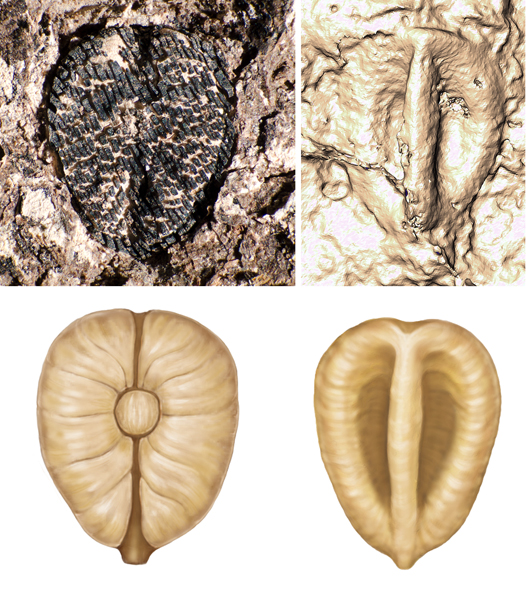
Fossil grapes.

Fossil grape (photograph top left) with computer model generated from CT fossil scans (top right). Line drawings illustrating the fossil by Pollyanna von Knorring (below). Picture credit: Fabiany Herrera.

Picture credit: Fabiany Herrera

Studying Fossil Grapes

These fossil seeds from Central and South America help to show how the grape family (Vitis) spread in the years following the extinction of the dinosaurs.

Lead author of the paper Fabiany Herrera (assistant curator of palaeobotany at the Field Museum in Chicago), commented:

“These are the oldest grapes ever found in this part of the world, and they’re a few million years younger than the oldest ones ever found on the other side of the planet.  This discovery is important because it shows that after the extinction of the dinosaurs, grapes really started to spread across the world.”

It is rare for fruits to be preserved in the fossil record.  However, seeds are more likely to survive the fossilisation process.  What palaeobotanists know about the evolution of angiosperms has been greatly enhanced by studying seeds and fossil pollen.  The earliest known grape seed fossils were found in India.  They are approximately sixty-six million years old.  At this time, there was a global extinction event.  This extinction was probably caused by the impact of an extra-terrestrial bolide.  This devastated life on Earth and led to a re-setting of ecosystems.  The composition of forests was altered as the extinction event affected both fauna and flora.
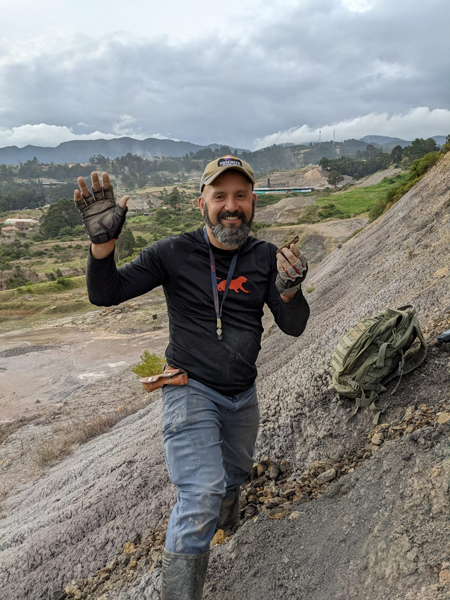
Nine species of fossil grapes identified. Researcher Fabiany Herrera holding a fossil specimen.

Fabiany Herrera in the field holding a grape fossil. Picture credit: Fabiany Herrera.

Picture credit: Fabiany Herrera

Dinosaur Extinction Helped Grape Growers

Herrera and his colleagues postulate that the extinction of the Dinosauria helped alter the flora within forests.

Co-author Mónica Carvalho explained:

“Large animals, such as dinosaurs, are known to alter their surrounding ecosystems. We think that if there were large dinosaurs roaming through the forest, they were likely knocking down trees, effectively maintaining forests more open than they are today.”

With the dinosaurs having died out and the absence of large mammals during the Palaeocene, forests became more crowded.  There were no large animals present to deplete the forest understorey and create a more open environment.  These new, dense forests provided an opportunity for plants like vines to become more widespread.  Ultimately, modern-day wine producers might have to thank dinosaurs for the evolution of the grape family of plants.

The diversification of mammals and birds may also have aided the spread of vines by helping to spread their seeds.

The Significance and Importance of Fossil Grapes

In 2013, Herrera’s PhD advisor and senior author of the new paper, Steven Manchester, published the paper describing the oldest known grape seed fossil from India.  Herrera suspected that ancient grape vines existed in South America too.

Herrera commented:

“Grapes have an extensive fossil record that starts about fifty million years ago.  I wanted to discover one in South America, but it was like looking for a needle in a haystack.  I’ve been looking for the oldest grape in the Western Hemisphere since I was an undergraduate student.”

Field work in the Colombian Andes with study co-author Mónica Carvalho provided the breakthrough.  Mónica discovered a fossilised grape seed.  The specimen was at least sixty million years old.  It was the first grape fossil to be found in South America.
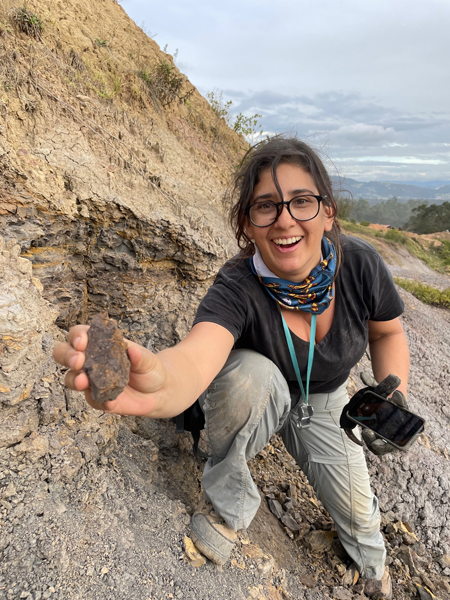
Mónica Carvalho studying fossil grapes.

Mónica Carvalho excitedly holding a grape fossil. Picture credit: Fabiany Herrera.

Picture credit: Fabiany Herrera

A Tiny Fossil Seed

The fossil seed is extremely small. However, Herrera and Carvalho were able to identify it based on its particular shape, size, and other morphological features. CT scans were undertaken to examine the fossil’s internal structure and confirm its affinity with the grape family.  This new taxon was named Lithouva susmanii.  The binomial name translates as “Susman’s stone grape”.  The name honours Arther T. Susman a supporter of South American palaeobotany at the Field Museum.

Co-author Gregory Stull of the National Museum of Natural History (Washington DC) explained the significance of these fossil grapes:

 “This new species is also important because it supports a South American origin of the group in which the common grape vine Vitis evolved.”

The field studies in Central and South America led to the scientific description of nine new species of fossil grapes.  These fossilised seeds not only tell the story of grapes’ spread across the Western Hemisphere, but also of the many extinctions and dispersals the grape family has undergone. The fossils are only distant relatives of the grapes native to the Western Hemisphere and a few, like the two species of Leea identified are only found in the Eastern Hemisphere today.

A Tumultuous Evolutionary Journey

These fossils suggest that the evolutionary journey of the grape family has been tumultuous.  Herrera commented that the fossil record of grapes demonstrates that these plants are extremely resilient.

Given the mass extinction our planet is currently facing, Herrera commented that studies like this one are valuable because they reveal patterns about how biodiversity crises play out.

Everything Dinosaur acknowledges the assistance of a media release from the Field Museum (Chicago) in the compilation of this article.

The scientific paper: “Cenozoic seeds of Vitaceae reveal a deep history of extinction and dispersal in the Neotropics” by Fabiany Herrera, Mónica R. Carvalho, Gregory W. Stull, Carlos Jaramillo and Steven R. Manchester published in Nature Plants.

The Everything Dinosaur website: Everything Dinosaur.
6 07, 2024

New Carnotaurus Model (Li Zhong) Reviewed

By |2024-07-07T13:06:32+01:00July 6th, 2024|Categories: Haolonggood Prehistoric Animal Models|0 Comments

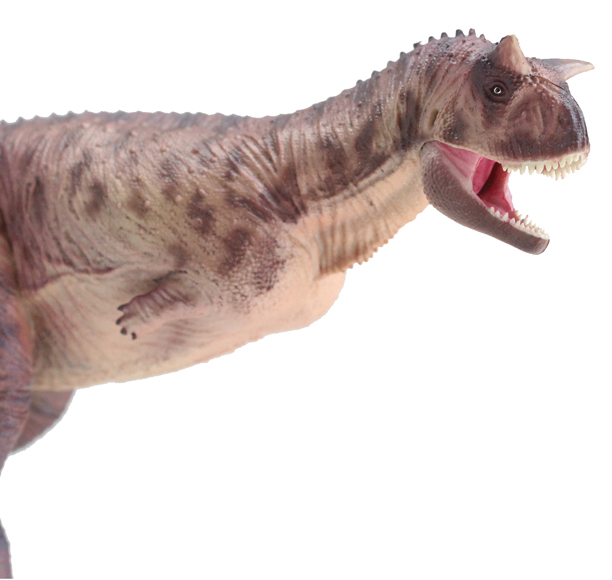
Our thanks to dinosaur model collector William, who sent into Everything Dinosaur a Haolonggood Carnotaurus model review.  The review focuses upon the brown-coloured Li Zhong Haolonggood Carnotaurus.  The reviewer explained that he enjoyed collecting dinosaur models in pairs and considered Li Zhong to represent a female Carnotaurus.  A review of the other Carnotaurus figure, the grey-coloured version (Zhou Tong) was published on this blog last month.

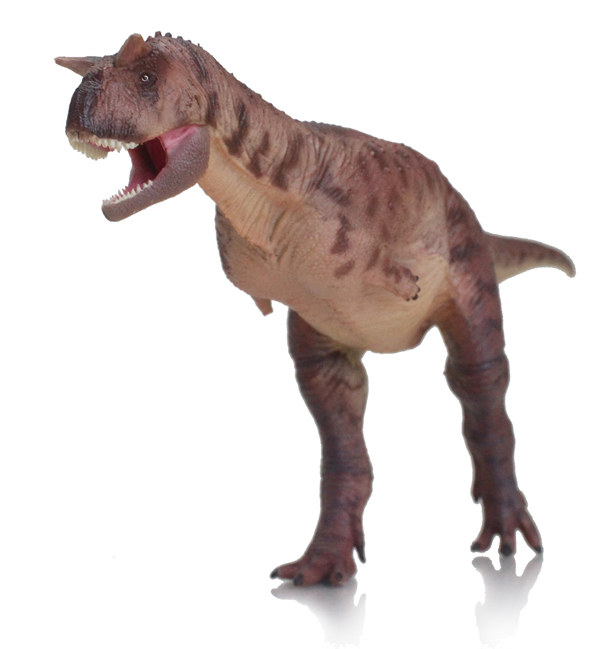
The Haolonggood Carnotaurus model (Li Zhong).

The new for 2024 Carnotaurus sastrei figure from Haolonggood.

To read a review of Haolonggood’s counterpart Carnotaurus model: New Carnotaurus Figure is Reviewed.

Li Zhong – A Haolonggood Carnotaurus Model Review

William congratulated the design team at Haolonggood for making such an excellent theropod figure.  The detailed design was commented upon.  This dinosaur model has an articulated lower jaw, and it measures a little under twenty-three centimetres in length.  The Haolonggood Carnotaurus has a declared scale of 1:35.

The reviewer stated:

“I consider Li Zhong to be a female. Her beautiful earth tones would have been well suited to stand watch over a nest during the day, whilst her mate Zhou Tong guarded the nest at night whilst she hunted.”

A close-up view of the articulated jaw on the Haolonggood Carnotaurus model.

A close-up view of the articulated lower jaw on the Haolonggood Carnotaurus model.

To view the range of Haolonggood prehistoric animal figures available from Everything Dinosaur: Haolonggood Dinosaur Models.

William added:

“This is a great figure and a rather classy Carnotaurus sastrei figure.”

A Reliable Supplier of Prehistoric Animal Models

The reviewer concluded the review by praising Everything Dinosaur.  The UK-based mail order company is a reliable supplier of prehistoric animal models.  He wanted to give “praise where praise is due” to Mike and Sue and Everything Dinosaur. Helping to provide a wide range of prehistoric animal collectible figures and ensuring a swift delivery of parcels, Everything Dinosaur had built up a deserved reputation for excellent customer service.

The Haolonggood Carnotaurus model (Li Zhong) in lateral view.

The Haolonggood Carnotaurus model (Li Zhong) in lateral view.

Mike from Everything Dinosaur thanked William for his review and for his kind words about Everything Dinosaur.

To visit the award-winning Everything Dinosaur website: Dinosaur Toys.

5 07, 2024

New Basal Tetrapod Honours Jenny Clack

By |2024-07-07T11:30:43+01:00July 5th, 2024|Categories: Dinosaur and Prehistoric Animal News Stories|0 Comments

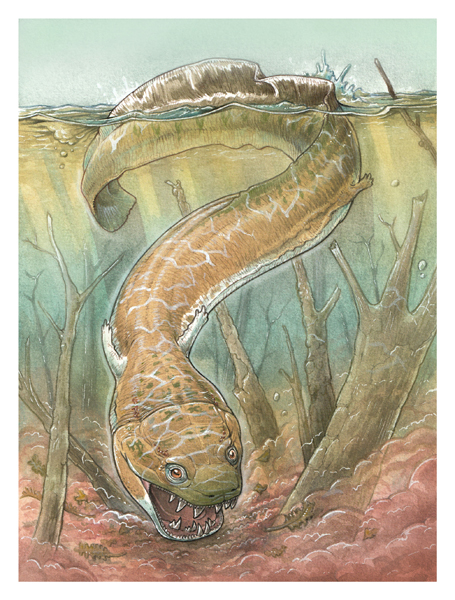
The largest stem tetrapod known to have digits has been scientifically described. Named Gaiasia jennyae it lurked in the chilly waters of a Namibian swamp around 280 million years ago (Cisuralian Epoch of the Early Permian). Its discovery indicates a more global distribution of continental stem tetrapods during the Carboniferous-Permian transition.  Although no complete skeleton is known, G. jennyae was probably more than two metres in length.  The skull measures around sixty centimetres long.  It was probably an ambush predator, relying on suction capture to grab and swallow any prey item unfortunate to swim too close.  Once in the mouth, there was no escape as the jaws were lined with large fangs.

Gaiasia jennyae life reconstruction.

Gaiasia jennyae life reconstruction. A newly described stem tetrapod from a high palaeolatitude (approximately fifty-five degrees south). Picture credit: Gabriel Lio.

Picture credit: Gabriel Lio

Gaiasia jennyae Honouring the Late Professor Jenny Clack

Writing in the journal “Nature”, the scientists describe Gaiasia as a stem tetrapod, one from a high palaeolatitude (approximately fifty-five degrees south).  This is a significant fossil discovery, most other stem tetrapods from the Early Permian are known from palaeoequatorial regions.  The genus name is derived from the Gai-As Formation of Namibia.  The species name honours the late Professor Jenny Clack (1947–2020), in recognition for her ground-breaking work studying early tetrapods.

Tetrapods are four-limbed vertebrates (amphibians, reptiles, mammals and birds), that evolved from lobe finned fishes (Sarcopterygii).

To read an article from 2013, highlighting the work of Professor Jenny Clack on Ichthyostega: Ichthyostega Gets a Makeover.

Co-lead author of the study, Jason Pardo (NSF postdoctoral fellow at the Field Museum in Chicago) commented:

“Gaiasia jennyae was considerably larger than a person, and it probably hung out near the bottom of swamps and lakes. It’s got a big, flat, toilet seat shaped head, which allows it to open its mouth and suck in prey. It has these huge fangs, the whole front of the mouth is just giant teeth.  It’s a big predator, but potentially also a relatively slow ambush predator.”

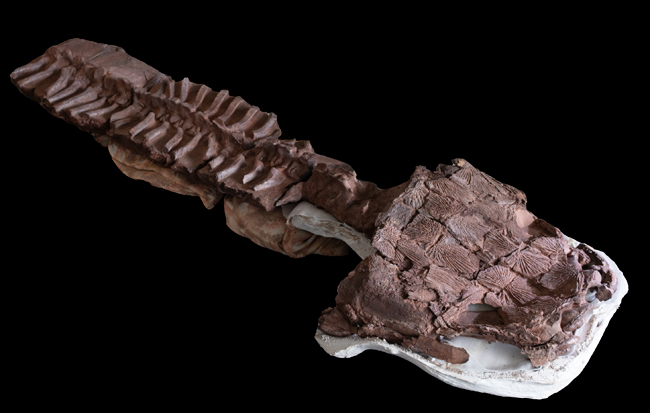
Some of the prepared Gaiasia jennyae fossil material.

A photograph of some of the prepared Gaiasia jennyae fossil material. Picture credit C. Marsicano

Picture credit: C. Marsicano.

Interlocking Large Fangs

The presence of such a large predator in the environment indicates that there was a rich and diverse ecosystem present.  Palaeontologists are aware that in the equatorial regions of Pangaea new four-limbed vertebrates (Tetrapodomorpha) were evolving.  However, in higher palaeolatitudes more ancient creatures persisted.

Co-lead author of the research Claudia Marsicano (University of Buenos Aires) explained:

“When we found this enormous specimen just lying on the outcrop as a giant concretion, it was really shocking. I knew just from seeing it that it was something completely different. We were all very excited.  After examining the skull, the structure of the front of the skull caught my attention. It was the only clearly visible part at that time, and it showed very unusually interlocking large fangs, creating a unique bite for early tetrapods.”

Several specimens were discovered, including one with a well-preserved, articulated skull and spine.  Although there might be a bias in fossil preservation, the number of individuals found suggests that Gaiasia jennyae was relatively common in the ancient Namibian cold-water swamp habitat.

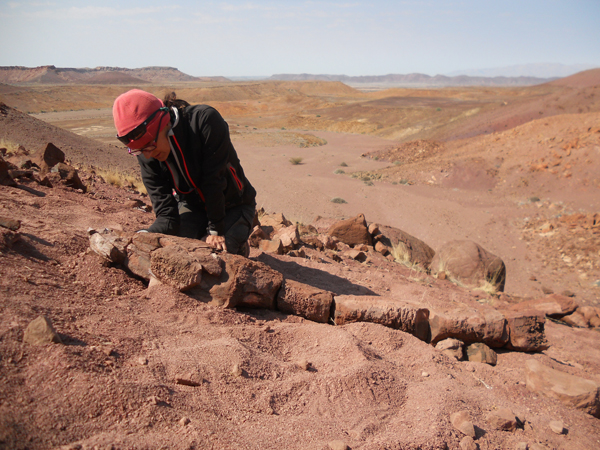
Gaiasia jennyae fossil excavation in the Namibian desert.

Gaiasia jennyae fossil excavation in the Namibian desert. Claudia Marsicano examining nodules containing fossil bones. Picture credit: Roger M. H. Smith.

Picture credit: Roger M. H. Smith

Applying Bergmann’s Rule

With several specimens to study, the team were able to conduct an in-depth phylogenetic analysis.  The analysis indicates that Gaiasia might be related to other early tetrapods that became extinct around forty million years earlier.  This suggests that in highly palaeolatitudes “relic” taxa could still be found.

Namibia today, is located much further north than it was approximately 280 million years ago.  During the Cisuralian Epoch of the Early Permian, this area was a cold-water swamp.  At this time in Earth’s history, a global Ice Age was drawing to a close.  Equatorial regions were drying up and becoming more forested, but closer to the poles, swampy habitats persisted, potentially alongside patches of ice and glaciers.

The Biggest Suction-feeding Tetrapod from the Palaeozoic

As the largest Palaeozoic suction-feeding tetrapod known to science, it is also possible that Gaiasia may reflect thermophysiological constraints associated with cold-temperate climates in alignment with Bergmann’s rule.  Bergmann’s rule states that organisms in cold environments tend to be larger than their counterparts in warmer regions.  Larger organisms tend to be better at conserving heat.

Jason Pardo stated:

“Gaiasia is a stem tetrapod. It is a holdover from that earlier group, before they evolved and split into the groups that would become mammals, birds, reptiles and amphibians, which are called crown tetrapods. It’s really, really surprising that Gaiasia is so archaic. It was related to organisms that went extinct probably 40 million years prior.”

Intriguingly, for a relic of an older lineage, Gaiasia is doing more than just holding its own.

Pardo added:

“There are some other more archaic animals still hanging on 300 million years ago, but they were rare, they were small, and they were doing their own thing.  Gaiasia is big, and it is abundant, and it seems to be the primary predator in its ecosystem.”

Everything Dinosaur acknowledges the assistance of a media release from the Field Museum in Chicago in the compilation of this article.

The scientific paper: “Giant stem tetrapod was apex predator in Gondwanan late Palaeozoic ice age” by Claudia A. Marsicano, Jason D. Pardo, Roger M. H. Smith, Adriana C. Mancuso, Leandro C. Gaetano and Helke Mocke published in Nature.

The award-winning Everything Dinosaur website: Prehistoric Animal Models.

4 07, 2024

About Everything Dinosaur – Picking up on the Positive

By |2024-07-04T15:00:27+01:00July 4th, 2024|Categories: Press Releases|0 Comments

When updating our website, it is important to keep the focus on our core business of dinosaur toys and models.  However, we think it is also important for customers to learn a little more about the people behind Everything Dinosaur.  It is time to examine and re-write the “About Us” page on our website.

The “About Us” page provides an introduction to the business and its values. It allows a company to highlight key moments in its history and development. Furthermore, it can provide information on company values and introduce the people who work in the organisation. After all, people do business with people, and we believe that it is essential to build trust and credibility with our audience.

The “About Us” Page on a Website

A well-crafted “About Us” page can demonstrate our passion for dinosaur toys and prehistoric animal models. It can provide visitors with a better understanding of who we are and what we do. Moreover, a carefully constructed “About Us” page can foster a sense of connection and transparency, which can lead to increased audience engagement.

Sharing a passion for dinosaur toys - Sue and Mike from Everything Dinosaur.

Sharing a passion for dinosaur toys – Sue and Mike from Everything Dinosaur.  Picture credit: Everything Dinosaur.

Picture credit: Everything Dinosaur

At Everything Dinosaur, we believe that the importance of the “About Us” section should not be overlooked.

To view the Everything Dinosaur About Us page: About Everything Dinosaur.
It’s Not Just Dinosaur Toys and Models

The Everything Dinosaur website focuses on dinosaur toys and models.  However, it also provides customers with a window to view the company has a whole.  The “About Us” segment explains a little more “about us”.  It is an opportunity to build trust and to demonstrate our expertise in the supply of prehistoric animal figures.

This part of our website provides a location for the company overview and to state our core values. Furthermore, it is an ideal location to introduce team members. Industry awards, milestones and achievements can also be highlighted. Importantly, it is an ideal place to list contact details.

Details such as:

  • Physical address.
  • Telephone number(s).
  • Email address.
  • Confirmation of website address.

The aim should be to make it as easy as possible for customers to be able to contact you.

Don’t Forget the Images

Adding relevant, properly sized images can complement the text on the page.  It is important to use high-quality images, ones that are relevant and also optimised for site loading speed.  We have just added new images to our “About Us” page.  These images help to bring this part of our website to life and encourage engagement.

The Everything Dinosaur website: Dinosaur Toys, Models and Gifts.

3 07, 2024

Admiring the Beautiful CollectA Deluxe Beishanlong Figure

By |2024-07-03T22:20:24+01:00July 3rd, 2024|Categories: CollectA Deluxe Prehistoric Animal Models|0 Comments

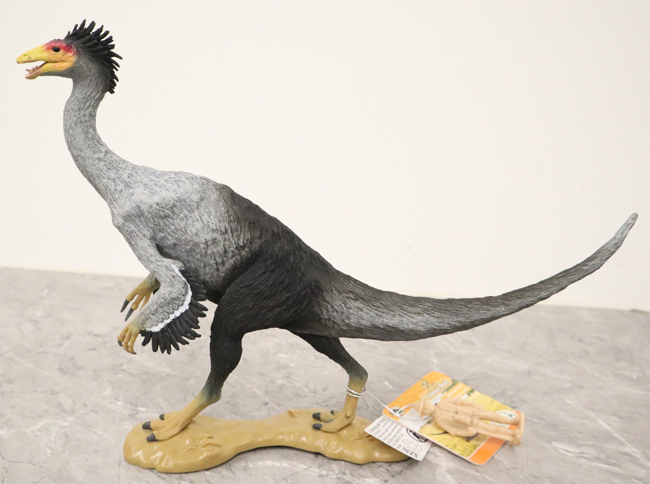
Whilst working in the warehouse, we came across some beautiful CollectA Deluxe Beishanlong dinosaur models.  This 1:40 scale replica of a member of the Ornithomimosauria clade is quite difficult to obtain.  Most CollectA stockists do not have this feathered dinosaur model available.  However, we at Everything Dinosaur are committed to supporting the entire CollectA prehistoric model range.  As we checked and counted our stock, we took the opportunity to take some photographs of the Beishanlong figure.

The CollectA Deluxe Beishanlong figure.

The CollectA 1:40 scale Beishanlong dinosaur model shown in lateral view. Picture credit: Everything Dinosaur.
 

Picture credit: Everything Dinosaur

The CollectA Deluxe Beishanlong

The model is fixed to a display base.  The CollectA Deluxe Beishanlong model measures a fraction under twenty-three centimetres in length.  That impressive head stands seventeen centimetres off the ground.  It is beautifully painted.

To view the range of CollectA Deluxe scale models available from Everything Dinosaur: CollectA Deluxe Prehistoric Animal Models.

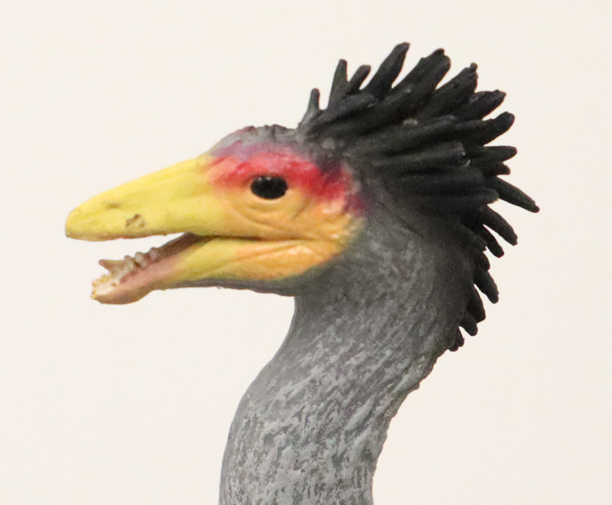
The head of the CollectA Deluxe Beishanlong model.

The beautiful head of the CollectA Beishanlong figure. Beishanlong is regarded as a basal member of the Ornithomimosauria clade. The figure has teeth in its jaws. More derived ornithomimosaurs were edentulous. Picture credit: Everything Dinosaur.

Picture credit: Everything Dinosaur

Beishanlong (B. grandis), was named and described in 2010 (Makovicky et al).  CollectA introduced a Beishanlong figure into their Deluxe range in 2016.  Beishanlong has been classified as a basal member of the Ornithomimosauria clade.  At around eight metres in length, it is thought to be one of the largest of the ornithomimosaurs.  It is regarded as a primitive member of the Ornithomimosauria clade. The CollectA Deluxe figure has teeth in its jaws. More derived ornithomimosaurs were edentulous.

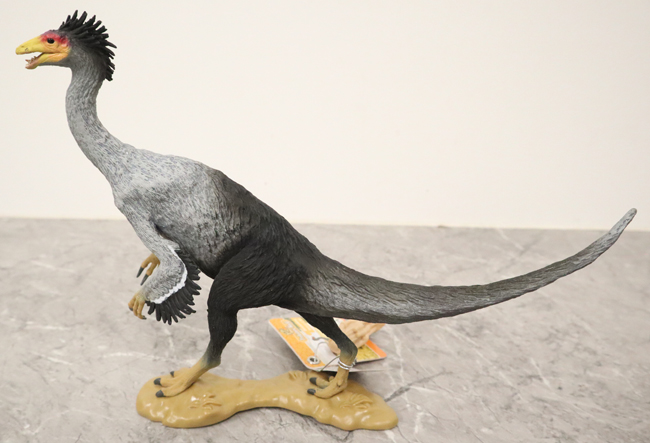
The CollectA Beishanlong figure.

The CollectA Beishanlong figure has been carefully painted and we adore the subtle greys and charcoal colours. Picture credit: Everything Dinosaur.

Picture credit: Everything Dinosaur

Everything Dinosaur stocks and extensive range of feathered dinosaur models.

To visit the award-winning Everything Dinosaur website: Feathered Dinosaur Models and Toys.

2 07, 2024

New for 2024 Utahraptor Dinosaur Model Due to Arrive Soon

By |2024-07-01T15:18:20+01:00July 2nd, 2024|Categories: Beasts of the Mesozoic Models|0 Comments

The new for 2024, Beasts of the Mesozoic Utahraptor dinosaur model is due to arrive shortly.  A spokesperson from Everything Dinosaur confirmed that this articulated dromaeosaurid figure will be arriving early July (2024).  The Utahraptor model is the latest figure in the 1:18 scale series.  Customers will receive an Everything Dinosaur Utahraptor ostrommaysi fact sheet with purchases.

This is model has been painted in stunning colours and the figure shows some amazing detail. The artwork on the product packaging has been produced by the renowned palaeoartist Gabriel Ugueto.

Beasts of the Mesozoic Utahraptor dinosaur model in anterior view.

The beautifully painted Utahraptor figure in 1:18 scale.

The Beasts of the Mesozoic Utahraptor Dinosaur Model

The model measures around thirty-eight centimetres in length.  It is supplied with two sets of interchangeable feet, and an adjustable, transparent plastic display base.  This model is going to be in stock at the same time as the recently launched Achillobator giganticus Beasts of the Mesozoic figure.

To read a recent article about the Beasts of the Mesozoic A. giganticus figure: The New Beasts of the Mesozoic Achillobator Model.

Utahraptor ostrommaysi product packaging.

The splendid Beasts of the Mesozoic Utahraptor ostrommaysi product packaging. The Utahraptor artwork was supplied by Gabriel Ugueto.

To view the range of Beasts of the Mesozoic figures available from Everything Dinosaur: Beasts of the Mesozoic Articulated Figures.

Utahraptor ostrommaysi

Utahraptor is regarded as one of the largest members of the Dromaeosauridae family. Size estimates vary, but this theropod could have reached an adult size of more than six metres in length. It might have weighed as much as a North American grizzly bear (350 kilograms plus). It is known from fossil material collected from Cedar Mountain Formation of Utah. This dinosaur was formally named and described in 1993 (Kirkland, Gaston and Burge).

The design team behind the Beasts of the Mesozoic “raptors” are keen to introduce models of some of the larger dromaeosaurids into their range.

A spokesperson from Everything Dinosaur confirmed that they were looking forward to the shipment arriving at the company’s warehouse.

The spokesperson added:

“We have a substantial customer reserve list for Beasts of the Mesozoic figures.  When the stock arrives, we will make sure to contact all those customers who wanted one of these exciting new figures.”

To visit Everything Dinosaur’s user friendly website: Dinosaur Toys and Models.

1 07, 2024

Improving Website Accessibility is Important at Everything Dinosaur

By |2024-07-01T15:19:27+01:00July 1st, 2024|Categories: Everything Dinosaur News and Updates|0 Comments

Today, we seem to rely on technology more and more each day. For example, our website continues to attract thousands of visitors. However, not everyone in society can browse our site easily. Having an accessible website is crucial for an on-line business. Ensuring that our website: Everything Dinosaur can be easily navigated and understood by users of all abilities is a priority. To this end, we have set about making some changes and improving website accessibility.

Improving Website Accessibility

A key aspect of website accessibility is providing sufficient contrast between the font colour and the colour of the background.  Poor colour contrast can make text difficult to read, especially for individuals with visual impairments like low vision or colour blindness.  A lack of contrast between the font colour and the background can also cause difficulties for people who suffer from frequent headaches or migraines.

Fortunately, some free software developed by Utah State University (WAVE), can be employed to help website owners make their sites more accessible. This software can identify many accessibility issues and Web Content Accessibility Guideline (WCAG) errors.  These issues impact on the end-user experience and once factors such as contrast issues have been addressed, the site can be checked again to ensure it complies with best practice.

Everything Dinosaur conducted an analysis of our website’s colour scheme and made some updates to enhance accessibility.  The contrast ratio between the white font colour and the pale blue background was examined and the background colour changed to dark green to meet recommended guidelines. This small change has made a big difference.  It allows users with poor eyesight to easily read and engage with our content.

Improving website accessibility (Everything Dinosaur)

Helping to improve accessibility to Everything Dinosaur’s website. The image (top) shows the website’s previous design. The image (bottom) shows the new layout with the improved contrast between the font colour and the background. The sharper contrast will help site visitors with eyesight difficulties to view the website more easily.

Picture credit: Everything Dinosaur

Comparing “Before” and “After”

The image (above) shows two views of the Everything Dinosaur website.  The top image shows the original layout, whilst the image (bottom) shows the new high contrast layout.  The white font stands out against the new, dark green backdrop.  Beyond just improving the visual aspects of the site, enhancing website accessibility benefits all site visitors. Content that is easy to perceive and navigate is better for everyone. Removing barriers to access means that the Everything Dinosaur website will be more inclusive.

A spokesperson from Everything Dinosaur commented:

“By changing the contrast we have improved our website.  It is now more inclusive, but we recognise that there is more work to be done.  Hopefully. the changes we have made are a step in the right direction.”

If you have a suggestion to make about improving website accessibility or any other aspect of the Everything Dinosaur website, please feel free to contact us: Email Everything Dinosaur.

30 06, 2024

New Haolonggood Carnotaurus Model is Reviewed

By |2024-07-01T21:37:01+01:00June 30th, 2024|Categories: Haolonggood Prehistoric Animal Models, Product Reviews|0 Comments

Our thanks to prehistoric animal model fan William who sent into Everything Dinosaur a review of the Haolonggood Carnotaurus model.  William’s first review focused on the grey-coloured version know as Zhou Tong.  This is a 1:35 scale replica of the famous South American abelisaurid Carnotaurus sastrei.

The Haolonggood Carnotaurus is available in two distinct colour schemes.  There is Zhou Tong with its greyish tones and this figure contrasts nicely with the other Haolonggood Carnotaurus.  The second figure is known as Li Zhong.  This model is a dusky brown colour.

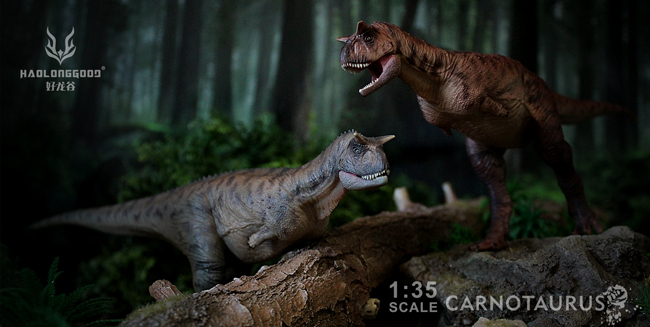
Haolonggood Carnotaurus models.

Two new Haolonggood Carnotaurus models are coming into stock at Everything Dinosaur. The grey-coloured figure (Zhou Tong) is seen on the left. The other, dusky brown Haolonggood Carnotaurus (Li Zhong) is on the right.

The Haolonggood Carnotaurus Model (Zhou Tong)

In his review, William explained that he had begun to collect Haolonggood figures as he liked the idea of buying models in pairs or trios.  In addition, he explained that he thought Zhou Tong was the male Carnotaurus.  Whereas the brown-coloured Li Zhong was probably the female.  The reviewer explained that he had seen similar colour patterns in extant birds such as fowls.  The male being silver or grey in colour with its mate being either brown or wheat coloured.

Both figures measure approximately 22.5 cm in length and stand a fraction under 10 centimetres high. Each Haolonggood Carnotaurus has an articulated lower jaw.

William praised the design team at Haolonggood for their chosen colours.  These colours would help to camouflage these predators as they hunted at twilight or dawn.

The new for 2024 Haolonggood Carnotaurus model (Zhou Tong).

The new for 2024 Haolonggood Carnotaurus sastrei figure shown in left lateral view.

When asked to comment about Zhou Tong the reviewer exclaimed:

“It is a great all-round figure from sculpt to colouration.  Haolonggood have made a rather classy Carnotaurus sastrei, and at a great price too.”

To view the range of Haolonggood prehistoric animal figures available from Everything Dinosaur: Haolonggood Dinosaurs.

Praising Everything Dinosaur

William concluded his dinosaur model review by praising Everything Dinosaur.  He explained that the legion of prehistoric animal figure collectors truly valued the work of Everything Dinosaur team members.  He highlighted the company’s commitment to using quality packaging materials and pointed out that Everything Dinosaur had recently won an international award for customer service.  In addition, the reviewer praised Everything Dinosaur for the swift delivery of parcels.

“From searching the leading brands to all the tireless efforts to get the stock from suppliers into the company warehouse and onto customers.  Patrons of Everything Dinosaur can have the highest confidence in this UK-based business.”

William ended his review by stating that without the presence of Everything Dinosaur many collectors would miss out on dinosaur figures.

Our thanks to William for sending into Everything Dinosaur his Haolonggood Carnotaurus model review.

Visit the award-winning Everything Dinosaur website: Dinosaur Models and Toys.

29 06, 2024

New Beasts of the Mesozoic Achillobator in Stock Soon

By |2024-07-01T09:09:54+01:00June 29th, 2024|Categories: Beasts of the Mesozoic Models|0 Comments

The new for 2024 Beasts of the Mesozoic Achillobator dinosaur model will be in stock at Everything Dinosaur shortly. The figure is due to be available in July.  This superb, articulated model of Achillobator giganticus has twenty-three points of articulation.  It will be supplied with stunning package artwork.

Beasts of the Mesozoic Achillobator dinosaur model.

The new for 2024 Beasts of the Mesozoic Achillobator figure.

The Beasts of the Mesozoic Achillobator Dinosaur Model

This new, articulated replica of a large dromaeosaur from Mongolia measures thirty-eight centimetres in length.  The model will be supplied with two sets of interchangeable feet, and an adjustable, transparent plastic display base.  The figure is in approximately 1:18 scale.

The Beasts of the Mesozoic Achillobator figure.

The Beasts of the Mesozoic Achillobator figure has twenty-three points of articulation.

To view the range of Beasts of the Mesozoic figures in stock at Everything Dinosaur: Beasts of the Mesozoic Figures.

Achillobator is one of the largest dromaeosaurids known to science. It measured around four to five metres in length, and it may have weighed more than three hundred kilograms. Its fossils were found in Mongolia (Bayan Shireh Formation), and it was formally named and described in 1999 (Perle et al).

The Beasts of the Mesozoic Achillobator dinosaur model product packaging.

The Achillobator is supplied in a beautiful box with stunning artwork. Customers will also receive an Everything Dinosaur Achillobator fact sheet.

In Stock at Everything Dinosaur Soon

A spokesperson from Everything Dinosaur commented that team members were looking forward to the arrival of the Achillobator giganticus figures.

The spokesperson added:

“We expect these wonderful, articulated dinosaur models to arrive in the next few days [early July].  Customers who have asked us to set aside a figure for them will be emailed and alerted that the models have arrived.”

To view the range of dinosaur toys and models available from Everything Dinosaur, visit the company’s award-winning website: Dinosaur Models and Toys.

28 06, 2024

Ammonites Still a Success at the End of the Cretaceous

By |2024-06-30T22:26:20+01:00June 28th, 2024|Categories: Palaeontological articles|0 Comments

Ammonites were not in decline immediately before the End-Cretaceous extinction event that wiped out the dinosaurs.  Newly published research led by the University of Bristol has found that there is evidence to indicate that these cephalopods were still relatively successful at the end of the Age of Dinosaurs.  The study suggests the fate of ammonites was not set in stone.  Instead, the final few million years of their evolutionary history is more complex than previously thought.  Ammonite fossils might be very familiar, but we still have a lot to learn about the ammonoids.

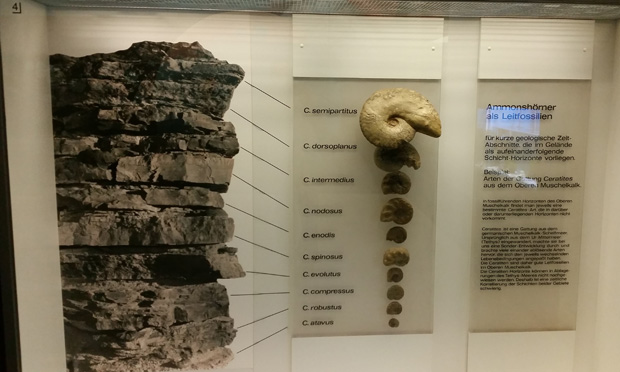
Ammonite Biozones

Demonstrating a sequence of ammonite fossils identified from specific strata that helps to form a biostratigraphic column.  Ammonites provide an important resource to help with the relative dating of strata.  It was thought these marine molluscs were in decline in the Late Cretaceous, but new research challenges this theory.  Picture credit: Everything Dinosaur.

Picture credit: Everything Dinosaur

Ammonite Fossils

Ammonites were marine molluscs that flourished in the Earth’s seas and oceans for more than 350 million years before they became extinct.  They died out during the same chance event that wiped out the dinosaurs, pterosaurs and most of the marine reptiles sixty-six million years ago.

It had been suggested that the extinction of the ammonites was inevitable as changes in climate and marine biota took hold.  It had been thought that the number of species was in decline at the end of the Cretaceous.

Newly published research challenges this assertion.  Writing in the journal “Nature Communications”, the scientists demonstrate that a detailed study of the ammonite fossil record reveals a more nuanced and complex picture.

Lead author of the study Dr Joseph Flannery-Sutherland (University of Bristol), stated:

“The fossil record tells us some of the story, but it is often an unreliable narrator. Patterns of diversity can just reflect patterns of sampling, essentially where and when we have found new fossil species, rather than actual biological history.  Analysing the existing Late Cretaceous ammonite fossil record as though it were the complete, global story is probably why previous researchers have thought they were in long-term ecological decline.”

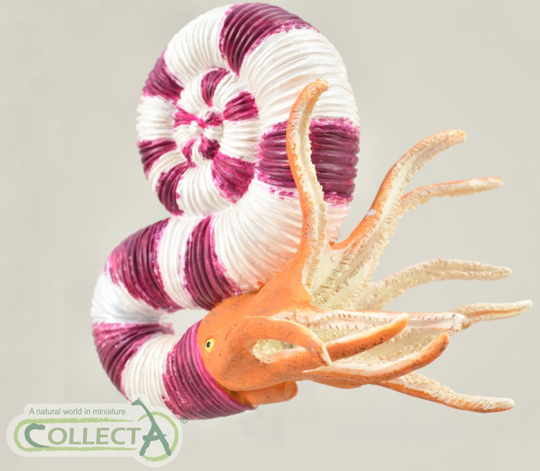
CollectA Pravitoceras model.

The colourful heteromorphic ammonoid model – CollectA Pravitoceras.  An ammonite of the Late Cretaceous.

The picture (above) shows a model of an ammonite with an irregularly coiled shell (heteromorphic ammonite).  This is the CollectA Pravitoceras ammonite figure from the “CollectA Prehistoric Life” range.

To view the range of CollectA prehistoric animal models and figures in stock at Everything Dinosaur: CollectA Prehistoric Life Models and Figures.

A Database of Late Cretaceous Ammonite Fossils

In a bid to better understand Late Cretaceous ammonite speciation the researchers constructed a new database of Late Cretaceous ammonite fossils to help fill in the sampling gaps in their record.

Co-author of the study, Cameron Crossan, a 2023 graduate of the University of Bristol’s Palaeobiology MSc programme, explained:

“We drew on museum collections to provide new sources of specimens rather than just relying on what had already been published.  This way we could be sure that we were getting a more accurate picture of their biodiversity prior to their total extinction.”

Using this database, the researchers then analysed how ammonite speciation and extinction rates varied in different parts of the world. If ammonites were in decline through the Late Cretaceous, then their extinction rates would have been generally higher than their speciation rates wherever the team looked.  However, the team found that the balance of speciation and extinction changed both through geological time and between different geographic regions.

Ammonites basking under the Late Cretaceous sun.

Two different types of ammonite (a regularly coiled homomorphic ammonite and an irregularly coiled heteromorphic ammonite) in a Late Cretaceous marine environment. Picture credit: Callum Pursall.

The differences in ammonoid diversification in different parts of the world has not been fully explored.  However, it is crucial to understanding their state prior to the mass extinction event.

Co-author Dr James Witts (London Natural History Museum), explained:

“These differences in ammonoid diversification around the world is a crucial part of why their Late Cretaceous story has been misunderstood.  Their fossil record in parts of North America is very well sampled, but if you looked at this alone then you might think that they were struggling, while they were actually flourishing in other regions.  Their extinction really was a chance event and not an inevitable outcome.”

Why Did Ammonoids Continue to be Successful?

To discover more about the factors responsible for the continued success of ammonoids, the team looked for possible influencing criteria that might have caused their diversity to change.  There are two contrasting theories.  Were speciation and extinction rates driven mainly by environmental conditions like sea temperatures and sea levels (the Court Jester Hypothesis), or by biological processes like pressure from predators and intraspecific competition (the Red Queen Hypothesis).

Co- author Dr Corinne Myers (University of New Mexico) commented:

“What we found was that the causes of ammonite speciation and extinction were as geographically varied as the rates themselves.  You couldn’t just look at their total fossil record and say that their diversity was driven entirely by changing temperature, for example. It was more complex than that and depended on where in the world they were living.”

Dr Flannery-Sutherland added:

“Palaeontologists are frequently fans of silver bullet narratives for what drove changes in a group’s fossil diversity, but our work shows that things are not always so straightforward. We can’t necessarily trust global fossil datasets and need to analyse them at regional scales. This way we can capture a much more nuanced picture of how diversity changed across space and through time, which also shows how variation in the balance of Red Queen versus Court Jester effects shaped these changes.”

Everything Dinosaur acknowledges the assistance of a media release from the University of Bristol in the compilation of this article.

The scientific paper: “Late Cretaceous ammonoids show that drivers of diversification are regionally heterogeneous” by Joseph Flannery-Sutherland, Cameron Crossan, Corinne Myers, Austin Hendy, Neil Landman and James Witts published in Nature Communications.

The Everything Dinosaur website: Prehistoric Animal Models and Toys.

Go to Top