All about dinosaurs, fossils and prehistoric animals by Everything Dinosaur team members.
4 10, 2024

Remarkable Pachyrhinosaurus Skull Fossil Carefully Removed from Pipestone Creek Bonebed

By |2024-10-08T08:06:27+01:00October 4th, 2024|Categories: Dinosaur and Prehistoric Animal News Stories|0 Comments

Staff from the Philip J. Currie Museum (Wembley, Alberta, Canada) have safely removed a massive Pachyrhinosaurus lakustai fossil skull from the Pipestone Creek Bonebed.  The specimen nicknamed “Big Sam” is estimated to weigh around two hundred and seventy kilograms (six hundred pounds).  The famous Pipestone Creek site is one of the densest dinosaur fossil deposits known.  The remains of hundreds of horned dinosaurs (P. lakustai) have been excavated.  Parts of the site have around three hundred individual fossils per square metre. “Big Sam” is the first complete skull to have been found at the site for more than a decade,
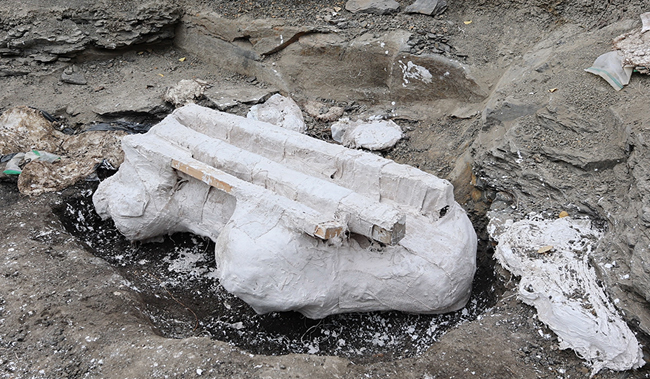
"Big Sam" the Pachyrhinosaurus lakustai skull wrapped in plaster and burlap.

“Big Sam” the Pachyrhinosaurus lakustai skull wrapped in plaster and burlap. Picture credit: Philip J. Currie Dinosaur Museum.

Picture credit: The Philip J. Currie Dinosaur Museum

The Pipestone Creek Bonebed

The Pipestone Creek bonebed deposits constitute part of the Wapiti Formation. These strata were laid down during the Late Cretaceous.  This remarkable site has yielded an exceptional fauna dominated by abundant remains of the centrosaurine ceratopsian Pachyrhinosaurus.  However, Lambeosaurus and Edmontosaurus along with ankylosaurs and theropods have also been recorded from the Wapiti Formation.  The Pachyrhinosaurus skull measures over a metre in length.  It is one of the largest ceratopsid skulls to have been found in northern Alberta.
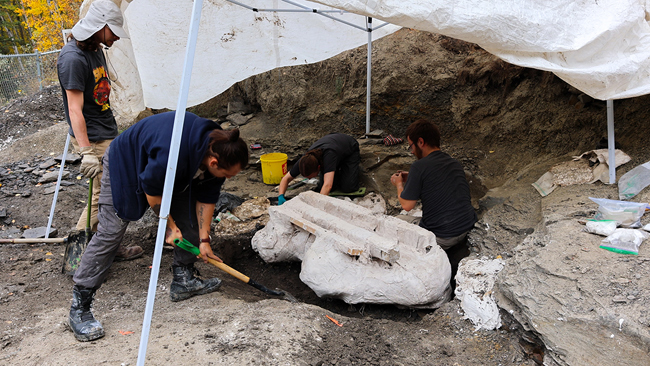
Digging away at the sediment underneath the Pachyrhinosaurus skull fossil.

Digging away at the underlying sediment to prepare “Big Sam” for flipping prior to extraction. Picture credit: Philip J. Currie Dinosaur Museum.

Picture credit: The Philip J. Currie Dinosaur Museum

The fossil skull is preserved upside-down and with its head frill still attached, a preservation event that has not previously been documented.  A field team from the Phillip J. Currie Museum have spent the last two summers meticulously mapping, excavating and jacketing the skull ready for transporting away from the quarry.
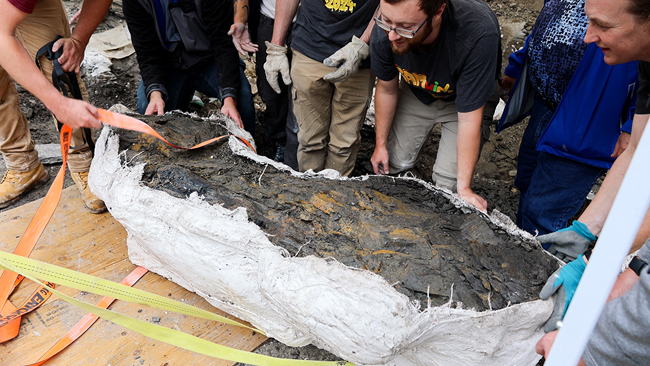
Inspecting the underside of the Pachyrhinosaurus lakustai skull jacket.

Inspecting the underside of the Pachyrhinosaurus lakustai skull jacket as “Big Sam” is prepared for transport. Picture credit: Philip J. Currie Dinosaur Museum.

Picture credit: The Philip J. Currie Dinosaur Museum

Pachyrhinosaurus lakustai

Pachyrhinosaurus lakustai is one of three Pachyrhinosaurus species that have been named. It is the geologically oldest species, having lived around 73 million years ago (Campanian stage of the Late Cretaceous). This species was formally named and described in 2008 (Currie, Langston and Tanke).

Pachyrhinosaurus was a smaller, older cousin of the Triceratops, with a big, bony protrusion on its nose instead of a nose horn.
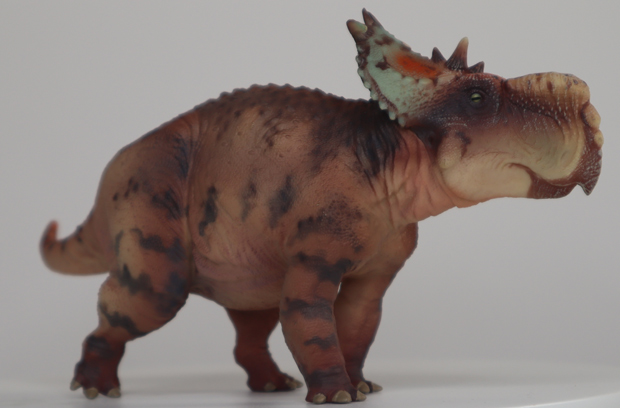
The Haolonggood Pachyrhinosaurus dinosaur model (LvFang)

The Haolonggood Pachyrhinosaurus dinosaur model (LvFang) photographed in the studio. Picture credit: Everything Dinosaur.

Picture credit: Everything Dinosaur

Dr Emily Bamforth, the curator at the Philip J. Currie Museum commented in an email sent to Everything Dinosaur:

“We were very excited to finally have ‘Big Sam’, the skull of a Pachyrhinosaurus lakustai we recently collect from the Pipestone Creek Bonebed, safe in our lab! I noticed that you do carry two models of P. lakustai, which is awesome. We actually use the Haolonggood Pachyrhinosaurus and Edmontosaurus for our outreach and education programmes here.”

To view the range of Haolonggood prehistoric animal figures in stock: Haolonggood Dinosaur Models.

Extracting the Fossil Skull

Once the three hundred or so other bones had been carefully removed from the surrounding area, the Museum team began the process of turning the jacketed fossil over and securing it ready for its journey away from the dig site.
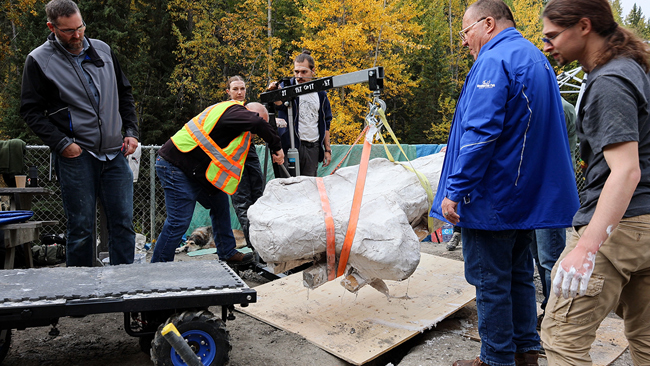
The "Big Sam" fossil skull is carefully winched onto a trolley for transport away from the quarry

“Big Sam” is carefully winched onto a trolley for transport away from the quarry. Picture credit: Philip J. Currie Dinosaur Museum.

Picture credit: The Philip J. Currie Dinosaur Museum

The huge block was slowly but surely winched up onto a trolley so that staff and volunteers could take this important fossil discovery to the preparation laboratory at the museum.  Laboratory technicians will then begin the laborious process of removing the fossil bones from the matrix allowing “Big Sam” to be seen in its glory.
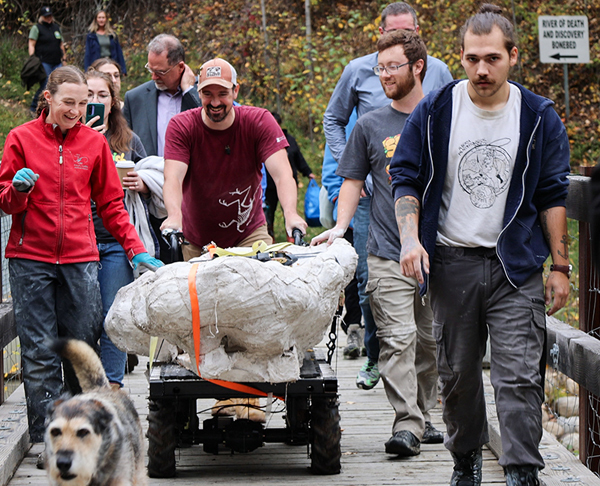
Transporting the Pachyrhinosaurus skull.

Team members carefully escort the Pachyrhinosaurus skull fossil away from the quarry. The fossil will spend many months in the preparation lab being cleaned and prepared. Picture credit: Philip J. Currie Dinosaur Museum.

Picture credit: The Philip J. Currie Dinosaur Museum

Members of the public can visit and see the skull undergoing cleaning and preparation.  The objective is to eventually put this remarkable fossil specimen on display.

Everything Dinosaur acknowledges the assistance of a media release from the Philip J. Currie Dinosaur Museum in the compilation of this article.


3 10, 2024

New CollectA and Beasts of the Mesozoic Slides for TetZooCon

By |2024-10-06T21:12:41+01:00October 3rd, 2024|Categories: Everything Dinosaur News and Updates|0 Comments

CollectA and Beasts of the Mesozoic prehistoric animal models feature on a pair of slides created by Everything Dinosaur for TetZooCon. These slides are part of a presentation that had been especially prepared for the annual TetZooCon event.  In total, five new for 2024 CollectA models were highlighted along with a quintet of recent Beasts of the Mesozoic figures.

Five new CollectA prehistoric animal figures feature on the TetZooCon slide.

CollectA prehistoric animal models feature on a slide prepared by Everything Dinosaur for the recent TetZooCon event in London. Picture credit: Everything Dinosaur.

Picture credit: Everything Dinosaur

To view the two ranges of CollectA models in stock at Everything Dinosaur:

Not-to-scale CollectA models: CollectA Age of Dinosaurs Popular.

CollectA models with a declared scale: CollectA Deluxe Models.

Highlighting Prehistoric Animal Models

Highlighting dinosaurs and other prehistoric animal models in a slideshow is helpful for the audience. It showcases unique features and details that attract interest. In addition, the audience can be informed about new figures being added to ranges. For example, the Beasts of the Mesozoic slide highlighted five new additions to this range, including the albino Zuniceratops figure.

The Beasts of the Mesozoic figures that feature on the Everything Dinosaur TetZooCon slide.

Five new for late 2024 Beasts of the Mesozoic prehistoric animal figures feature on a slide prepared for the TetZooCon event. Picture credit: Everything Dinosaur.

Picture credit: Everything Dinosaur

To view the Beasts of the Mesozoic range of articulated figures: Beasts of the Mesozoic Figures.

The slides were quite easy to create.  Visual presentations engage attendees and spark discussions. They help collectors appreciate the diversity of models and their significance.

A spokesperson from Everything Dinosaur commented.

“We appreciate that this was the last ever TetZooCon.  However, the event organisers have exciting plans for next year.  We have been delighted to be able to support this excellent convention.  We are looking forward to revealing more information about the 2025 event, it’s going to be special.”

The award-winning Everything Dinosaur website: Dinosaur Toys and Models.

2 10, 2024

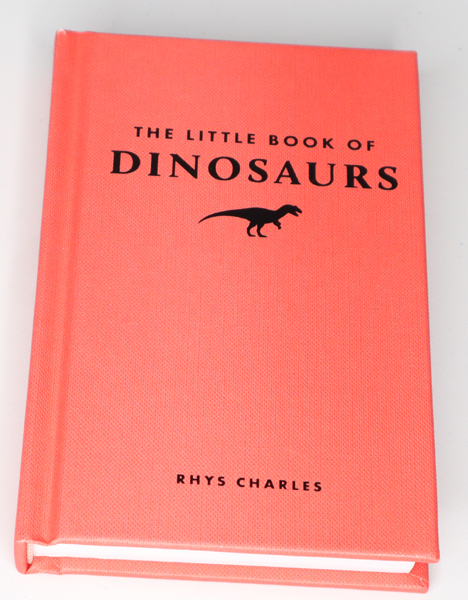
A New Dinosaur Book “The Little Book of Dinosaurs”

By |2024-10-06T15:38:08+01:00October 2nd, 2024|Categories: Book Reviews|0 Comments

A new book about dinosaurs is due to be published by Princeton University Press later this month (October 2024).  Entitled “The Little Book of Dinosaurs” it has been written by British palaeontologist Rhys Charles.  Rhys is the Senior Engagement and Impact Officer at the School of Earth Sciences at the University of Bristol.  He has also been involved with the famous Bristol Dinosaur Project since 2016.

It is a delightful, pocket-sized guide to the Dinosauria and their close relatives.  This book would make an ideal gift for the festive season.

A new dinosaur book "The Little Book of Dinosaurs"

A new dinosaur book “The Little Book of Dinosaurs” in time for the festive season. Picture credit: Everything Dinosaur.

Picture credit: Everything Dinosaur

The “Little Book of Dinosaurs” by Rhys Charles

“The Little Book of Dinosaurs” captivates readers with well-crafted and informative text. Vibrant illustrations and photographs of important fossil specimens are included in this charming little book.  It is broken down into numerous chapters.  Topics covered include defining the Dinosauria, dinosaur diversity and the evolution of flight.  Moreover, there is a fascinating section on the K-Pg extinction event. Readers can expect other archosaurs such as pterosaurs to feature too.

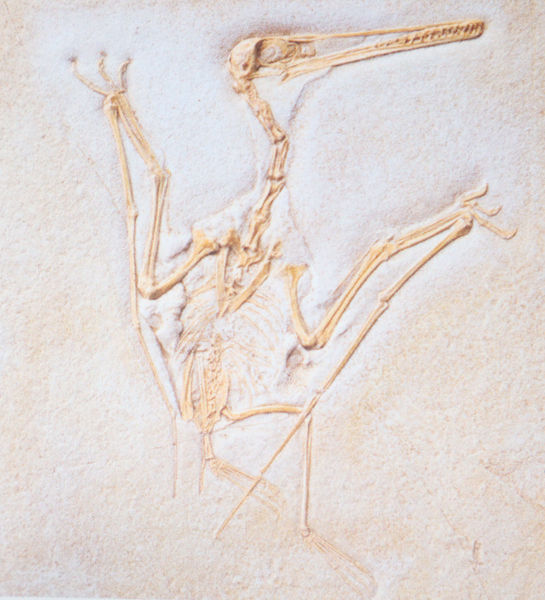
A photograph of a pterosaur fossil.

A skeleton of a pterosaur from the new dinosaur book “The Little Book of Dinosaurs” by Rhys Charles. Picture credit: Everything Dinosaur.

Picture credit: Everything Dinosaur

Book Details

Here is further information about this new publication:

Title: “The Little Book of Dinosaurs”

Author: Rhys Charles

ISBN: 9780691259895

Publisher: Princeton University Press

Due to be published on October 22nd, 2024. It contains 160 pages and 140 colour illustrations.

The publisher’s website: Princeton University Press.

Detailed illustrations of dinosaurs.

The book contains lots of beautiful illustrations of dinosaurs and their fossils. Picture credit: Everything Dinosaur.

Picture credit: Everything Dinosaur

It’s perfect for budding palaeontologists and fans of dinosaurs. Overall, it is a delightful read and highly recommended.

A spokesperson from Everything Dinosaur commented:

“This is an enchanting book.  It is aimed at the dinosaur enthusiast as well as the general reader.  We recommend this dinosaur book.”

The Everything Dinosaur website: Dinosaur Toys and Models.

1 10, 2024

New Mateo the Tyrannotitan Model is Reviewed

By |2024-10-05T20:54:59+01:00October 1st, 2024|Categories: PNSO Age of Dinosaurs Models|0 Comments

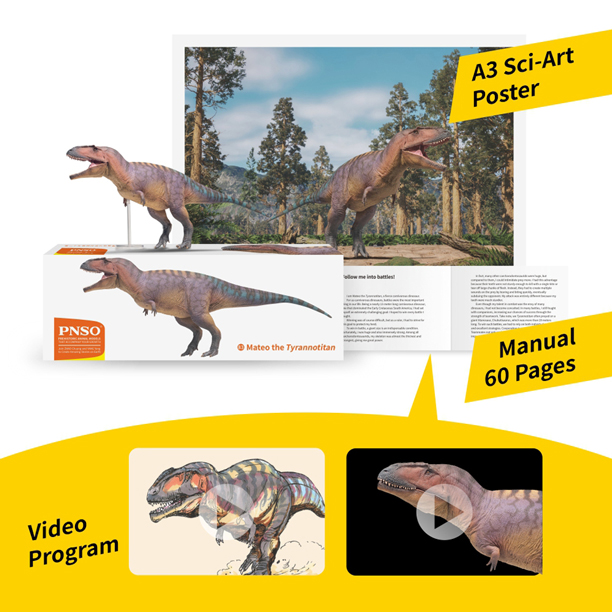
Our thanks to William who sent into Everything Dinosaur a review of the PNSO Mateo the Tyrannotitan figure.  This is one dinosaur figure the collector had been keen to acquire and review.  The model is described as having a similar head sculpt to the other PNSO Carcharodontosauridae figures.  The unlipped, articulated jaw impressed, and the head was praised.

PNSO Tyrannotitan chubutensis model.

The new for 2024 PNSO Tyrannotitan chubutensis dinosaur model.

The PNSO Mateo the Tyrannotitan Model

The forelimbs and hind legs were highlighted for their accuracy.  The colour scheme chosen for this figure was commented upon.  The paint scheme for the model is described as:

“Fantastic admixtures of blues and oranges with stripes.”

The figure has a stated scale of 1:35 and the reviewer confirmed the model’s measurements. The model is supplied with a beautiful colour poster, a transparent support stand and a fully illustrated booklet.

To view the range of PNSO models and figures in stock at Everything Dinosaur: PNSO Age of Dinosaurs Models.

Concluding his review of the PNSO Mateo the Tyrannotitan figure, William stated:

“I am really thankful that PNSO concluded Carcharodontosauridae, well, almost now we need a Concavenator to conclude the family.”

The PNSO Mateo the Tyrannotitan model accessories.

The PNSO Mateo the Tyrannotitan figure is supplied with a clear, plastic stand, a fully illustrated booklet and a colour poster.

Providing Information on the Giganotosaurini

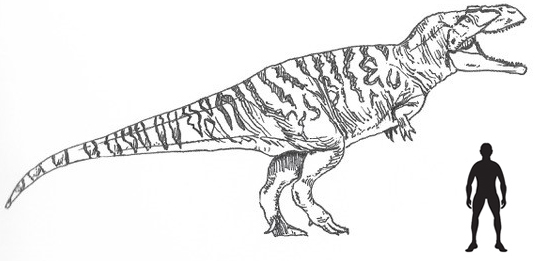
William provided some information on the Giganotosaurini.  Tyrannotitan (T. chubutensis), is regarded by many palaeontologists as a basal member of this tribe.  It was stated that fossils of this large theropod were found in the Chubut Province of southern Argentina. The fossil material is believed to have come from the Cerro Castaño Member of the Cerro Barcino Formation.  These deposits were laid down in the Early Cretaceous (Aptian faunal stage).

Tyrannotitan chubutensis scale drawing.

The Tyrannotitan chubutensis scale drawing commissioned in preparation for the arrival of the new PNSO Tyrannotitan figure. Picture credit: Everything Dinosaur.

Picture credit: Everything Dinosaur

In Praise of Everything Dinosaur

Our thanks to William for his Tyrannotitan review and for his kind words praising Everything Dinosaur.  He commented that purchasing from Everything Dinosaur is easy, safe and secure.  In addition, William highlighted our customer service and commented:

“The level of packaging and the dedication shown with deliveries is like the big guys of the web and high street.  Furthermore, your customer service could teach them a thing or too. A giant thank you to you all.”

Mike from Everything Dinosaur responded:

“Thank you William for your kind words about Everything Dinosaur.  We really appreciate your comments about the Tyrannotitan figure too.  Perhaps PNSO will grant your request and introduce a Concavenator.”

Moreover, visit the award-winning Everything Dinosaur website: Dinosaur Models.

30 09, 2024

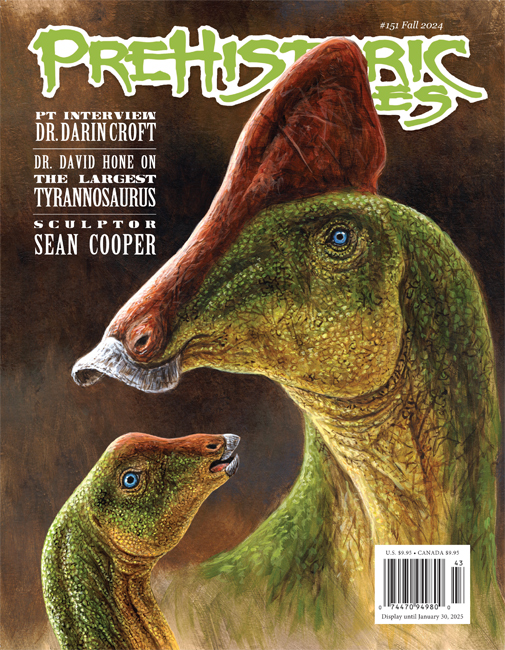
The Front Cover of the New “Prehistoric Times” Magazine

By |2024-10-01T08:21:34+01:00September 30th, 2024|Categories: Prehistoric Times|0 Comments

Our thanks to editor Mike Fredericks who emailed to Everything Dinosaur the new front cover for the next issue of “Prehistoric Times” magazine.  This magazine is produced four times a year.  Not long to wait now until the autumn (fall) edition arrives. This issue will feature an interview with palaeontologist and writer, Dr David Hone. Dr Hone is a Reader in Zoology at Queen Mary, University of London in the School of Biological and Behavioural Sciences.  He is an exceptionally busy scientist what with his teaching work, research and media commitments.

Dr Hone will be discussing the largest specimen of Tyrannosaurus found to date.

Prehistoric Times magazine issue 151.

The front cover of “Prehistoric Times” magazine highlights ornithischian parenting. This is issue number 151 (autumn 2024). Picture credit: Mike Fredericks.

Picture credit: Mike Fredericks

“Prehistoric Times” Magazine Issue 151

The stunning front cover artwork features a pair of duck-billed dinosaurs.  The illustration shows an adult and a juvenile.  It highlights the ontogenetic differences.  It certainly is a beautiful front cover illustration.  One of the featured prehistoric animals in this edition is Maraapunisaurus.  This is a genus of Late Jurassic sauropod from the Morrison Formation of the western United States.  It was originally known as Amphicoelias.  Having been described from a single fossil bone, it was thought to be the largest dinosaur known to science.  The interpretation of the fossil material remains controversial.  We look forward to reading more about this remarkable dinosaur in the forthcoming edition of “Prehistoric Times” magazine.

To learn more about the magazine and to subscribe: “Prehistoric Times” Magazine.

South American Mammals

The magazine also features an interview with Dr Darin Croft. Dr Croft is a palaeontologist who specialises in the study of prehistoric mammals. His main interest is the evolution of South American mammals. For most of the Cenozoic, South America has been isolated as an island continent. This isolation led to the evolution of a unique fauna. For example, sparassodonts occupied the predatory niches that were occupied by placental mammals like bears, dogs and felids elsewhere in the world. No placental carnivores were present in South America until a few million years ago.

The interview is going to be fascinating and most insightful.

We can’t wait for “Prehistoric Times” magazine to arrive.

29 09, 2024

New PNSO Dinosaur Models Slides for TetZooCon 2024

By |2024-10-01T08:03:05+01:00September 29th, 2024|Categories: Everything Dinosaur News and Updates|0 Comments

Everything Dinosaur is supporting the amazing TetZooCon event once again this year.  The company is a sponsor of this fantastic event, now in its eleventh year.  TetZooCon is an annual meeting centred around the world-famous blog Tetrapod Zoology.  There will be presentations, book signings, art demonstrations, discussion panels, workshops and talks from leading exponents in their field.  This event gives us the opportunity to highlight some of the prehistoric animal models that we stock.  For example, the slideshow we have compiled will include PNSO dinosaur models.

PNSO dinosaur models slide from TetZooCon 2024.

The PNSO figures Mateo the Tyrannotitan and Xilin the Wuerhosaurus feature on one of the slides.  The stegosaur Wuerhosaurus is shown on the left with the Tyrannotitan model on the right. Picture credit: Everything Dinosaur.

Picture credit: Everything Dinosaur

The image (above) shows one of the slides from our TetZooCon presentation.  It features the recently introduced PNSO Tyrannotitan and Wuerhosaurus dinosaur figures.

To view the range of PNSO prehistoric animal models in stock: PNSO Dinosaur Models.

PNSO Dinosaur Models Including Megalosaurus bucklandii

This year, 2024, marks the 200th anniversary of the first, formal scientific description of a dinosaur.  Megalosaurus bucklandii was described in 1824 (Buckland). Megalosaurus was a large, bipedal predator that could reach lengths of up to nine metres. Characterised by its robust body, sharp teeth, and powerful limbs, Megalosaurus was likely an apex predator in its ecosystem. Its scientific description in 1824 played a pivotal role in the early understanding of dinosaurs, marking the beginning of palaeontology as a scientific discipline.

It seemed fitting that we should include a slide featuring the PNSO Megalosaurus model in our presentation.

Megalosaurus and other PNSO dinosaur models feature on the TetZooCon slideshow.

Celebrating the 200th anniversary of the first scientific description of a dinosaur (Megalosaurus bucklandii). Picture credit: Everything Dinosaur.

Picture credit: Everything Dinosaur

Best wishes to the organisers and to everyone attending TetZooCon 2024.

Visit the award-winning and user friendly Everything Dinosaur website: Dinosaur Models and Toys.

28 09, 2024

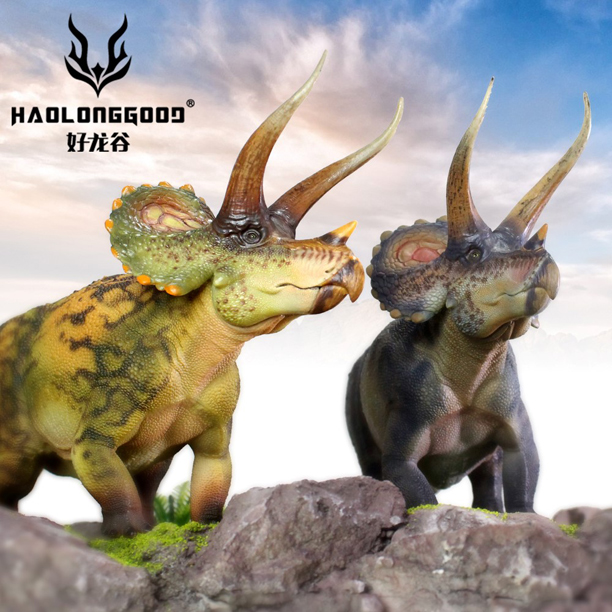
New Haolonggood Triceratops Models Announced

By |2024-09-29T13:44:18+01:00September 28th, 2024|Categories: Haolonggood Prehistoric Animal Models|0 Comments

A pair of new Haolonggood Triceratops models have been announced. These horned dinosaur figures will be in stock at Everything Dinosaur shortly.  The new ceratopsians are part of a growing range of Haolonggood ornithischian dinosaurs.  For example, Everything Dinosaur already stocks several Haolonggood chasmosaurine replicas including Kosmoceratops and the beautiful Chasmosaurus figures.

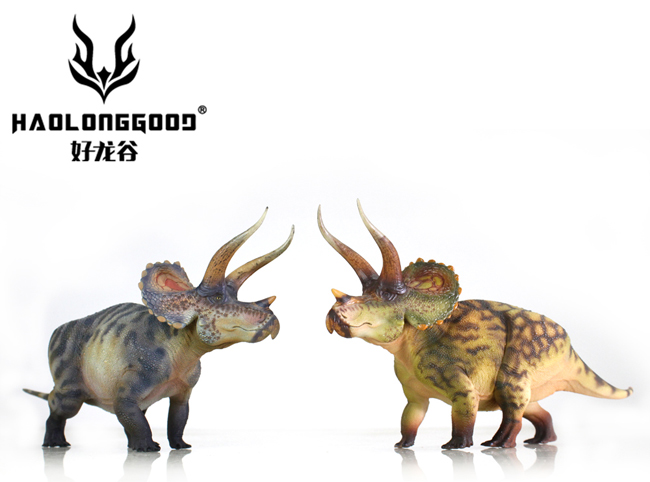
Haolonggood Triceratops models.

The beautifully painted Haolonggood Triceratops models.  Two colour variants will be available.  There is a green variant (left) and a grey-coloured model (right).

Haolonggood Triceratops Models

Two colour variants will be available.  Haolonggood will be introducing a green variant and a second figure, which is the same sculpt but in a predominantly grey colour scheme.  Both models will measure around twenty-three centimetres in length.  Those magnificent head shields will be around six centimetres off the ground.  Like most of the other Haolonggood prehistoric animal figures in stock, these models will be in 1/35th scale.

The Haolonggood Triceratops pair.

Haolonggood will be adding a pair of Triceratops figures to the model range.

To view the range of Haolonggood dinosaur and prehistoric animal figures available from Everything Dinosaur: Haolonggood Prehistoric Animal Models.

Mike, from the UK-based mail order company commented:

“These are two splendid models of horned dinosaurs. They look extremely detailed, and we can’t wait to bring them into stock.”

The Haolonggood Ceratopsian Figures

Haolonggood have introduced several different horned dinosaur figures.  They represent both chasmosaurines and members of the other subfamily of the Ceratopsia, the Centrosaurinae.

The Haolonggood horned dinosaur range includes:

  • Chasmosaurus (Zou Run and Zou Yuan).
  • Kosmoceratops (Cai Fu and Cai Qing).
  • Pentaceratops (Li Kui and Liou Tang).

These figures represent chasmosaurines.

The centrosaurines in the Haolonggood range currently include:

  • Sinoceratops (Lei Heng and Zhu Tong).
  • Nasutoceratops (Hua Rong and Van Qing).
  • Pachyrhinosaurus (Lv Fang and Guo Sheng)

Other horned dinosaurs are also expected to join the Haolonggood range such as Styracosaurus and Einiosaurus.

Mike from Everything Dinosaur added:

“It is wonderful to see more models of plant-eating dinosaurs introduced by Haolonggood.”

Visit the award-winning Everything Dinosaur website: Dinosaur Toys and Models.

27 09, 2024

Geladas Dig Up an Amazing Ammonite Fossil

By |2024-09-29T12:28:58+01:00September 27th, 2024|Categories: Photos/Pictures of Fossils|0 Comments

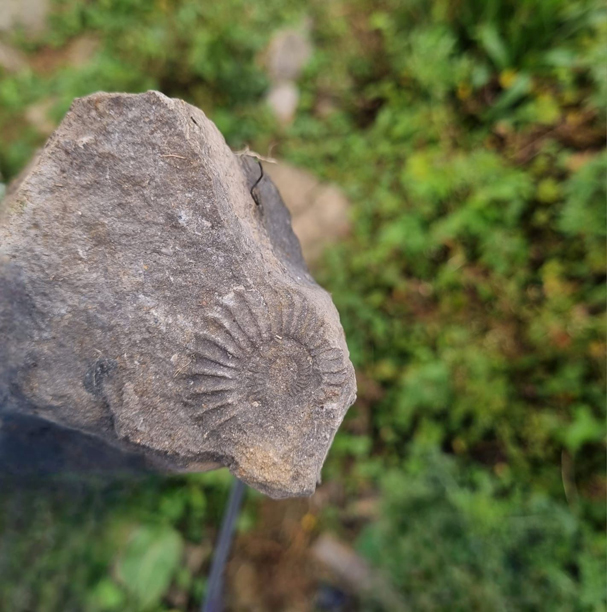
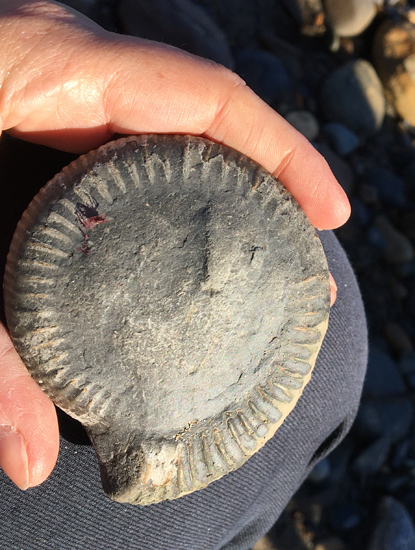
Many people enjoy fossil hunting. It is a fascinating hobby. However, we are not the only higher primate that finds fossils. Recently, Everything Dinosaur team members heard of a group of geladas at the Bristol Zoo Project that discovered an ammonite fossil in their enclosure. The bachelor group of geladas dug up a rock to play with, the stone contained an ammonite fossil.

The ammonite fossil found by the geladas.

The ammonite fossil discovered by the geladas. Probably from Lower Jurassic sediments, the Avon area is well-known for its Late Triassic and Early Jurassic fossils. Picture credit: Bristol Zoo Project.

Picture credit: Bristol Zoo Project

Geladas Discover an Ammonite Fossil

Geladas (Theropithecus gelada) are a genus of Old World monkey (Catarrhini), native to the Ethiopian Highlands. They are sometimes referred to as “bleeding-heart monkeys” because of their distinctive, heart-shaped chest markings. These robust animals are almost entirely terrestrial. Their diet in the wild mostly consists of grasses. They are extremely social animals and form large, gregarious groups.

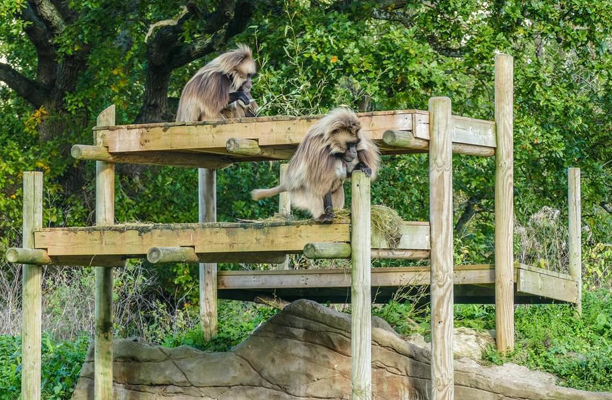
Members of the bachelor group were observed playing with a large stone. This turned out to be a fossil ammonite. Geladas often display stone handling, which is a play and foraging behaviour seen in some primates, however the discovery of a fossil is a first for the group.

Geladas discover an ammonite fossil.

A pair of geladas in their enclosure. These Old World monkeys found a fossil. Picture credit: the Henstridge Family/Bristol Zoo Project.

Picture credit: The Henstridge Family/Bristol Zoo Project.

Males typically weigh around fifteen to eighteen kilogrammes. Females are smaller. Today, most scientists place the gelada in its own genus. However, genetic studies indicate an affinity with the baboon (Papio). The fossil record of these animals suggests that they evolved during the Pliocene. Several taxa have been described including the much larger Theropithecus brumpti which is known from the late Pliocene of Ethiopia.

Modern geladas have even been reported to use stones for “drawing,” using a stone to mark a surface and even using their finger to spread and adjust the colour. The manus (hand) of the gelada is extremely similar to our own hand. They possess long thumbs, a strong index finger, and the highest thumb-to-digits ratio among catarrhines.

The Bristol Zoo Project is home to six male gelada, Kito, Hobbit, Harshit, Kidame, and recent newcomers Leena, and Takeze who all live in a special area designed to replicate their native landscape in the Ethiopian highlands. The long grasses, rocks and climbing platforms, give them good vantage points and plenty of areas to forage.   Furthermore, the underlying rocks have provided the opportunity for these intelligent animals to develop their own fossil collection.

Discovering Ammonite Fossils

Ammonites are extinct molluscs (subclass Ammonoidea). They are closely related to extant cephalopods such as the cuttlefish.  Their fossils are common in Mesozoic-aged sedimentary rocks.  They are important zonal fossils helping with the relative dating of geological formations.  Team members at Everything Dinosaur have quite a big collection of ammonite specimens that they have collected on their fossil hunting adventures.

An ammonite fossil find.

An ammonite partially eroded out of a nodule. We think this is an example of Dactylioceras commune.  Picture credit: Everything Dinosaur.

Picture credit: Everything Dinosaur

It turns out that we hominins are not the only primate with an interest in collecting fossils. Ironically, Everything Dinosaur team members have just despatched some ammonites to fossil collectors based in Dorset.  The strongly ribbed models we sent to the fossil collectors represent the ammonite genus Arietites (we think).   These ammonite fossils are found in rocks from the Lower Jurassic.  The fossil found by the geladas shows large, prominent ribs.  Perhaps, this too is a specimen of Arietites.

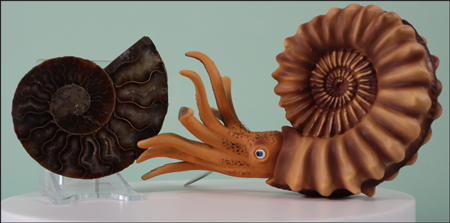
The Bullyland ammonite model next to a polished section of an ammonite fossil.

The Bullyland ammonite model is often used in museum displays to depict the living animal next to fossil material. Picture credit: Everything Dinosaur.

Picture credit: Everything Dinosaur

The picture above shows a polished ammonite fossil next to the Bullyland ammonite figure.  This model is extremely popular with the fossil hunting fraternity in Lyme Regis.

To view the Bullyland range of prehistoric animal models: Bullyland Models.

Everything Dinosaur acknowledges the assistance of the Bristol Zoo Project in the compilation of this article.
26 09, 2024

A New Species of New Zealand Ghost Shark

By |2024-09-29T10:07:01+01:00September 26th, 2024|Categories: Animal News Stories|0 Comments

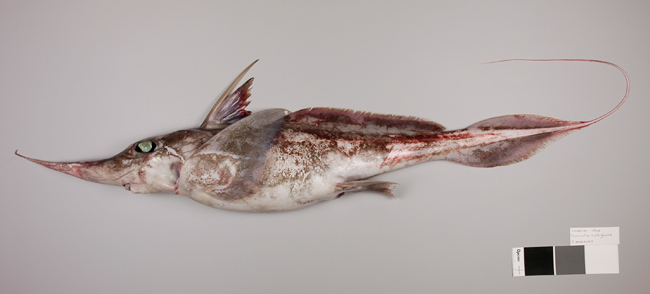
Scientists have discovered new species of ghost shark that lives exclusively in the deep waters of Australia and New Zealand. It is a type of Australasian Narrow-nosed Spookfish and has been named Harriotta avia.  The new fish species has been scientifically described by Dr Brit Finucci of New Zealand’s National Institute of Water and Atmospheric Research (NIWA).

It was previously thought to be part of a single globally distributed species, until research revealed it is genetically and morphologically different from other ghost fish.

Harriotta avia – A New Species of Ghost Shark

Dr Finucci named the new species in memory of her grandmother.

Dr Finucci explained:

“Avia means grandmother in Latin; I wanted to give this nod to her because she proudly supported me through my career as a scientist. Chimaeras are also rather ancient relatives – the grandmas and grandpas – of fish and I thought the name was well suited.”

Harriota avia a new species of ghost fish.

A new species of ghost fish has been described. Named Harriotta avia it lives exclusively in the deep waters of Australia and New Zealand. Picture credit: NIWA.

Picture credit: NIWA

An Ancient Order of Cartilaginous Fish

Chimaeriformes certainly are an ancient order of cartilaginous fish (Chondrichthyes).  They probably evolved in the Devonian. Most extant species are found at depths greater than two hundred metres, and they live on the seafloor.  Harriotta avia feeds on crustaceans, however in the Palaeozoic these types of fish evolved to fill a variety of niches.  For example, in 2023, research was published that identified suction feeding in Carboniferous Chimaeriformes.

To read about this research: Carboniferous Chimaeras were Suction Feeders.

Most fossil and extant chimaeras are small, very few specimens exceed one metre in length. However, other prehistoric, cartilaginous fish that were distantly related to the newly described H. avia grew much larger. For example, the Permian genus Helicoprion with its bizarre tooth-whorl jaw, has been estimated to have grown to around eight metres in length.

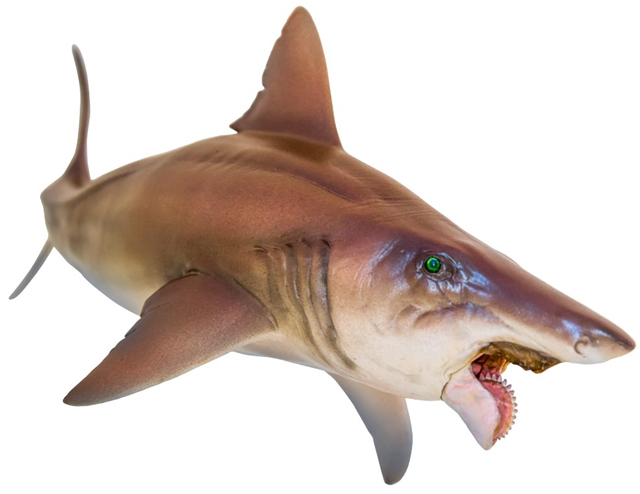
PNSO Haylee the Helicoprion anterior view

PNSO Haylee the Helicoprion replica. The stunning emerald eye on the model is reminiscent of the eye of a chimaera such as the deep-water Rabbit Fish (Chimaera monstrosa) to which Helicoprion is distantly related.

The picture above shows a model of the prehistoric fish Helicoprion.  This Permian predator is distantly related to extant ghost sharks.  The Helicoprion model is from the mid-size model range produced by PNSO.

To view the PNSO models and figures in stock: PNSO Models and Figures.

Chimaeriformes

Ghost sharks (Chimaeriformes) are a group of cartilaginous fish closely related to rays and sharks. These mysterious creatures are also known as rabbitfish, ratfish and elephant fish.

They have a smooth skin, free of scales.  Most feed on crustaceans such as shrimp and molluscs with their distinctive beak-like teeth.

Dr Finucci added:

“Harriotta avia is unique due to its elongated, narrow and depressed snout; long, slender trunk; large eyes; and very long, broad pectoral fins. It is a lovely chocolate brown colour.”

Ghost sharks are mainly found in the depths of the ocean.  Some are thought to live at depths of up to 2,600 metres.  This makes them hard to monitor and study.  Marine biologists know very little about their habits, reproduction or their conservation status.

A spokesperson from Everything Dinosaur commented:

“This is an exciting development.  It is likely that the deep ocean holds many more secrets.”

The specimens were collected in the Chatham Rise off New Zealand’s coast during research surveys for Fisheries New Zealand.

Everything Dinosaur acknowledges the assistance of a media release from the National Institute of Water and Atmospheric Research in the compilation of this article.
25 09, 2024

Amazing Brazilian Fossils Uncover Groundbreaking Insights into Mammal Evolution

By |2024-09-24T10:43:21+01:00September 25th, 2024|Categories: Palaeontological articles|0 Comments

Remarkable cynodont fossils from southern Brazil are helping researchers from the University of Bristol and their South American colleagues to better understand mammal evolution.  The fossils represent the mammal-precursors Brasilodon quadrangularis and Riograndia guaibensis.  These animals lived in the Late Triassic.  The fossils provide a critical insight into the development of the mammalian middle ear and jaw.  These key anatomical features of the Mammalia may have evolved millions of years earlier than previously thought.

Getting to Grips with Mammal Evolution

Mammals have a distinctive jaw structure and have evolved three middle ear bones to help with hearing.  The evolutionary transition from earlier tetrapods which had a single middle ear bone, has intrigued palaeontologists.  This new research, published in the journal “Nature” examines how mammalian ancestors (cynodonts), evolved these features over time.

Computed tomography (CT scans) was used to create digital models of the jaw joint of these Brazilian cynodonts.  The scientists discovered a “mammalian-style” contact between the skull and the lower jaw in Riograndia guaibensis.  This feature was not found in the Brasilodon quadrangularis fossil material.   B. quadrangularis is closer to the stem mammals than Riograndia guaibensis. This discovery suggests that the defining mammalian jaw feature evolved multiple times in different groups of cynodonts.  In addition, Riograndia lived around seventeen million years earlier than the previous oldest known example of this structure.  This indicates that this anatomical feature had evolved earlier than previously thought.

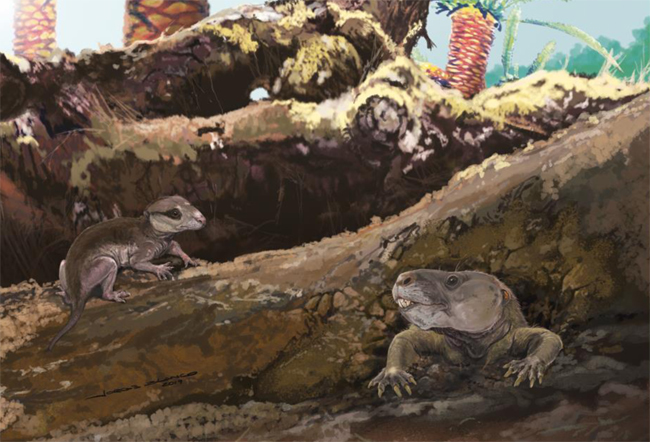
Riograndia guaibensis and Brasilodon quadrangularis life reconstruction part of an article on mammal evolution.

Riograndia guaibensis and Brasilodon quadrangularis life reconstruction. Brasilodon quadrangularis (left) and Riograndia guaibensis (right). Picture credit: Jorge Blanco.

Picture credit: Jorge Blanco

Brazilian cynodont fossils have played an important role in helping to better understand mammal evolution. In 2022, Everything Dinosaur reported on an analysis of the teeth of Brasilodon quadrangularis that led palaeontologists to suggest the Mammaliaformes (the lineage leading to the modern Mammalia), originated some twenty million years earlier than previously perceived.

To read this article: Nibbling Away at the Earliest Date for True Mammals.

New Study Suggests Mammaliaformes Experimented with Different Jaw Functions

The authors of this new study conclude that Mammaliaformes experimented with different jaw functions, leading to the evolution of “mammalian” traits independently in various lineages.

Lead author of the study, James Rawson (University of Bristol) explained:

“The acquisition of the mammalian jaw contact was a key moment in mammal evolution. What these new Brazilian fossils have shown is that different cynodont groups were experimenting with various jaw joint types, and that some features once considered uniquely mammalian evolved numerous times in other lineages as well.”

This new research has significant implications for the understanding of the early stages of mammal evolution.  The study illustrates that features such as the mammalian jaw joint and middle ear bones evolved in a patchwork, or mosaic, fashion across different cynodont groups.

Fossils from Brazil Have Global Significance for Understanding Mammal Evolution

Co-author of the study, Dr Agustín Martinelli (Museo Argentino de Ciencias Natural, Buenos Aires) added:

“Over the last years, these tiny fossil species from Brazil have brought marvellous information that enrich our knowledge about the origin and evolution of mammalian features. We are just in the beginning and our multi-national collaborations will bring more news soon.”

The researchers are eager to investigate further the South American fossil record.  It has proven to be a rich source of new information on mammalian evolution.

Professor Marina Soares of the Museu Nacional, Brazil, exclaimed:

“Nowhere else in the world has such a diverse array of cynodont forms, closely related to the earliest mammals.”

By integrating these findings with the results from other studies, the scientists hope to deepen their understanding of how early jaw joints functioned and contributed to the development of the Mammalia.

James added:

“The study opens new doors for palaeontological research, as these fossils provide invaluable evidence of the complex and varied evolutionary experiments that ultimately gave rise to modern mammals.”

Everything Dinosaur acknowledges the assistance of a media release from the University of Bristol in the compilation of this article.

The scientific paper: “Brazilian fossils reveal homoplasy in the oldest mammalian jaw joint” by James Rawson et al published in Nature.

The Everything Dinosaur website: Dinosaur and Prehistoric Mammal Toys.

Go to Top