Recommended Reading – “The Story of the Dinosaurs in 25 Discoveries”
With an estimated one quarter of the world’s population currently in lockdown and not able to get out and about, team members at Everything Dinosaur have been providing lots of support and assistance. As we are unable to visit schools or to work in museums, we have ensured that our huge range of dinosaur and fossil teaching materials remain accessible to all those teachers, parents and guardians attempting to home educate.
However, we have also been asked to recommend suitable prehistoric animal themed reading materials. So, in this spirit, the first publication we shall highlight is the excellent “The Story of the Dinosaurs in 25 Discoveries”, written by the highly talented American palaeontologist and geologist Donald R. Prothero, adjunct professor of geological sciences at California State Polytechnic University (Pomona, California).
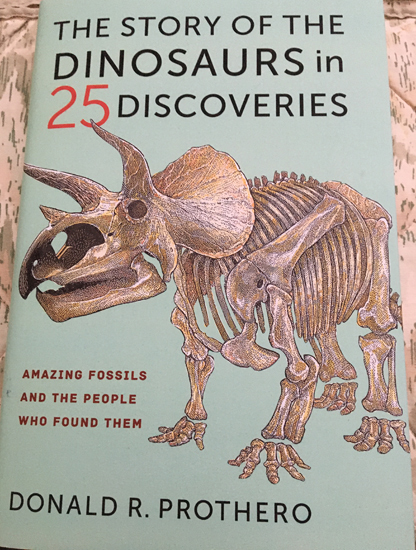
The Front Cover of “The Story of the Dinosaurs in 25 Discoveries”
Front cover of the new book by Professor Donald R. Prothero “The Story of the Dinosaurs in 25 Discoveries”.Picture credit: Everything Dinosaur.
Picture credit: Everything Dinosaur
Our Book Review – All About Dinosaurs
Team members were lucky enough to be sent an advance copy of this new book. Having read it, we produced a review and put this on our blog site in December (2019).
A spokesperson from Everything Dinosaur commented:
“This book tells the fascinating story of how our understanding of the Dinosauria has changed and evolved from the early days of the science of palaeontology through to some of the latest research involving dinosaur colouration and inferred social behaviours. Dinosaur fans will be delighted with this latest offering from Columbia University Press and Everything Dinosaur highly recommends this new publication.”
This book can be acquired from the Columbia University Press website: Columbia University Press. The search function on the Columbia University Press website can be used to find other books authored by Donald R. Prothero.
Whilst much of the world is in lockdown, it might be prudent and indeed opportune to catch up with some reading.
Dineobellator notohesperus – A Velociraptorine with Extra Attitude!
Scientists have described a new species of “raptor” from the Late Cretaceous of New Mexico. Described from fragmentary remains, this two-metre-long carnivore was related to Velociraptor. It may have been roughly the same size as the Mongolian genus, but it probably was even more agile with a stronger grip. Its discovery suggests that the dromaeosaurids were diversifying right up to the end of the Age of Dinosaurs.
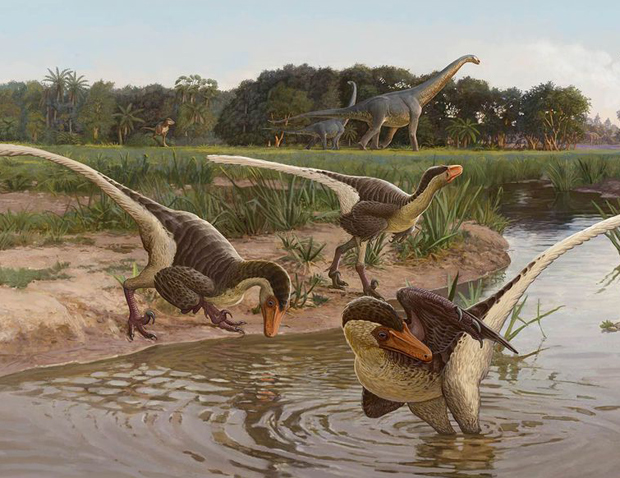
Life Reconstruction Dineobellator notohesperus (Maastrichtian of New Mexico)
A trio of the newly described dromaeosaurid from the Late Cretaceous of New Mexico (Dineobellator) gather at a waterhole. The titanosaur Alamosaurus passes by in the background and in the distance a tyrannosaur is approaching.
Picture credit: Sergey Krasovskiy
Dineobellator notohesperus
Writing in the academic journal “Scientific Reports”, the researchers from The University of Pennsylvania and the New Mexico Museum of Natural History and Science, describe a partial, skeleton excavated from the Bisti/De-na-zin Wilderness of New Mexico, found within a few metres above the base of the Naashoibito Member. The coarse sandstone deposits are notoriously difficult to date, these sediments were deposited towards the end of the Cretaceous between 70 and 66.3 million years ago (Maastrichtian faunal stage).
Fossil material includes parts of the skull, elements from the jaws, fragments of vertebrae, tail bones (caudal vertebrae), one rib with other pieces of rib and limb bones including a nearly complete right upper arm bone (humerus) and a nearly complete right ulna (bone from the forearm). The first fossilised remains were found in 2008, subsequent field work carried out in 2009, 2015 and 2016 yielded more fossil material, mostly very fragmentary in nature. It is believed all the fossil material, including a claw from the right hand, represents the remains of a single dinosaur.
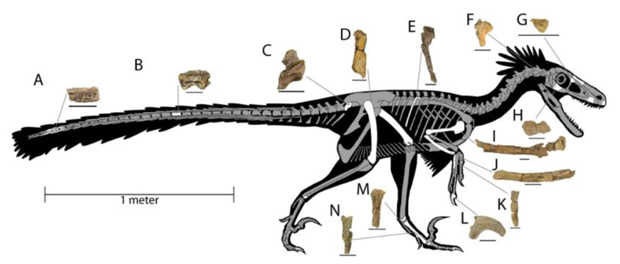
A Skeletal Reconstruction of Dineobellator notohesperus
A silhouette and postulated skeleton of Dineobellator (known fossil material in white).
Picture credit: Jasinski et al/Scientific Reports
A Small but Dangerous Dinosaur
Dineobellator notohesperus is the first dromaeosaurid to be described from the southern United States. It would have lived in the south of the Cretaceous landmass of Laramidia. Although no evidence of feathers has been found, the ulna shows evidence of a row of small rounded pits in the bone, interpreted as anchor points for large feathers on the arm (ulna papillae). Analysis of the forelimbs suggest that Dineobellator had stronger arms with a more powerful grip. A study of the tail bones suggest that the tail had greater movement which would have made this dinosaur adept at making sharp turns and agile changes of direction.
The researchers suggest these anatomical traits provide an insight into how this small theropod hunted and behaved.
The researchers, which include Dr Steven Jasinski (Department of Earth and Environmental Science, University of Pennsylvania), postulate that Dineobellator was an active predator that occupied a discrete ecological niche in the food chain whilst living in the shadow of Tyrannosaurus rex.
The newest North American “raptor” Dineobellator notohesperus is pronounced dih-nay-oh-bell-ah-tor noh-toh-hes-per-us and the genus name comes from the native Navajo word “Diné”, a reference to the Navajo Nation and the Latin word “bellator” which means warrior. The trivial name has been erected to acknowledge the location of the fossil find. The word “noto” is from the Greek meaning southern and “hesper” the Greek for western. This is an acknowledgement that Dineobellator roamed the south-western part of the United States. In addition, Hesperus is a reference to a Greek god, the personification of the evening star (Venus) and by extension “western”.
Dr Jasinski has already had a considerable impact on the Dromaeosauridae family. Back in 2015, Everything Dinosaur reported on the formal description of Saurornitholestes sullivani, a dinosaur named by Steven Jasinski whilst a PhD student at the University of Pennsylvania. To read more about S. sullivani: Sniffing Out a New Dinosaur Species.
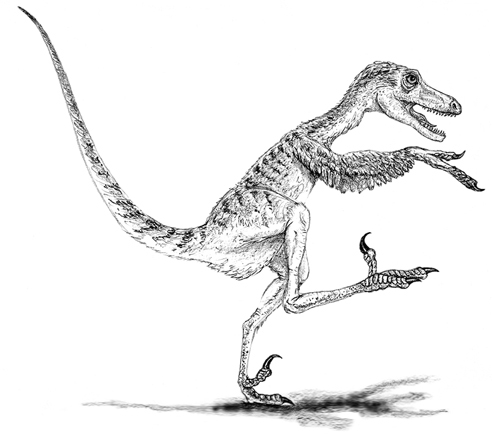
An Illustration of Saurornitholestes sullivani
An agile dinosaur, an illustration of Saurornitholestes sullivani. Although the fossil material associated with this species was found in New Mexico, S. sullivani lived several million years earlier than Dineobellator notohesperus.Picture credit: Everything Dinosaur.
Picture credit: Everything Dinosaur
A Tough Life for a Tough Dinosaur
A phylogenetic analysis undertaken by the research team places Dineobellator within the Velociraptorinae subfamily of the Dromaeosauridae. Other Maastrichtian “raptors” known from North America are few and far between (Acheroraptor and Dakotaraptor – both from the Hell Creek Formation). The discovery of Dineobellator suggests that dromaeosaurids were still diversifying at the end of the Cretaceous and as an velociraptorine, its fossils lend further weight to the idea that faunal interchange between Asian and North American dinosaurs took place sometime during the Campanian/Maastrichtian.
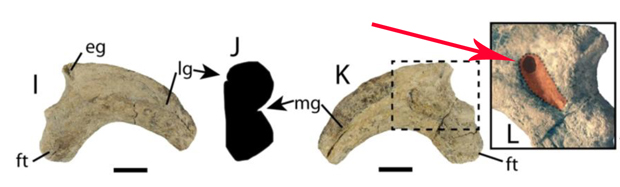
It is not known whether Dineobellator notohesperus was a pack hunter. The fossilised remains do indicate that this was one very tough dinosaur but it did not have everything its own way. A rib shows a deformity, suggesting that this bone was broken, but the animal suffered this trauma a while before it died as the break is healed. Intriguingly, the scientists identified a prominent gouge mark preserved on the hand claw (manual ungual). This gouge mark, which measures nearly a centimetre long, terminates in a small depression.
The scientists suggest that this damage was not caused by disease or by any process associated with the preservation of the fossil bones. The team suggest that this was an injury that occurred close to, or at the time of this dinosaur’s demise.
Injured in a Fight?
The researchers speculate that this Dineobellator received an injury in a fight with another Dineobellator or perhaps this damage to its hand claw was inflicted upon it by another type of predatory theropod.
Views of the Hand Claw of Dineobellator notohesperus Showing Damage Interpreted as a Wound Inflicted by Another Theropod Dinosaur
Views of the hand claw of Dineobellator. The right manual ungual of Dineobellator notohesperus (I) lateral view, with (J) a silhouette of the transverse plane of the right manual ungual near the distal end. Image (K) shows the claw in media view with the dashed area highlighted in (K) showing the gouge mark (L). The red arrow indicates the pathology. Scale bars equal 1 mm, please note (L) is not to scale.
Picture credit: Jasinski et al/Scientific Reports with additional annotation by Everything Dinosaur
The scientific paper: “New Dromaeosaurid Dinosaur (Theropoda, Dromaeosauridae) from New Mexico and Biodiversity of Dromaeosaurids at the end of the Cretaceous” by Steven E. Jasinski, Robert M. Sullivan and Peter Dodson published in Scientific Reports.
By Mike|2024-01-20T12:40:13+00:00March 26th, 2020|Categories: General Teaching|Comments Off on Spotting a Super Diplodocus on Display
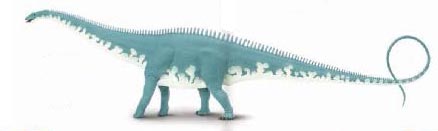
A Wild Safari Prehistoric World Diplodocus Dinosaur Model Spotted at an Exhibition
Whilst working at a library supporting the “Dippy the Diplodocus” nationwide tour, an eagle-eyed Everything Dinosaur team member spotted a Wild Safari Prehistoric World Diplodocus dinosaur model that was being used to help demonstrate what scientists think Diplodocus looked like when it roamed the Late Jurassic of western North America.
The Wild Safari Prehistoric World Diplodocus Dinosaur Model
Safari Ltd will introduced a counter shaded Diplodocus model in 2017.
The Natural History Museum’s famous cast of this famous sauropod used to grace Hintze Hall at the Museum. In January 2017, the skeleton was dismantled (all 292 bones of it) to make space for a new Blue Whale exhibit “Hope”. This permitted the replica to go on a nationwide tour of the UK and Rochdale is just one of eight venues selected for this exhibition. To date, over 100,000 people have visited the skeleton in Rochdale. As well as the twenty-metre long replica itself, an exciting programme of events has been put together to help to inspire the next generation of young scientists.
A Famous Diplodocus
Everything Dinosaur staff members have been providing expertise and assistance and have enjoyed helping to organise the family-themed science activities.
A spokesperson from Everything Dinosaur, in between delivering fossil hunting workshops for the Borough Council as part of a series of outreach activities commented:
“The aim of this tour and the exhibition programme is to help inspire and enthuse the next generation of scientists. The Diplodocus has also done a great deal to attract visitors to the area and to boost the local economy. It is wonderful to see such nationally-important exhibits like “Dippy the Diplodocus” visiting the northwest of England”.
“Dippy the Diplodocus” can be seen at the Number One Riverside, Rochdale venue until June 28th (2020), with numerous other dinosaur themed events taking place in the Rochdale area for the duration of the exhibition.
Rochdale Borough Council has been able to source a wide range of dinosaur and prehistoric animal themed items to help support this exhibition. Together with Everything Dinosaur team members the Council has been planning for the arrival of the famous sauropod for more than a year. All the hard work has certainly paid off with over 100,000 visitors recorded to date.
Dear Customers and Friends of Everything Dinosaur,
We are living in unprecedented times. The COVID-19 (Coronavirus) pandemic has global implications, we would once again, like to convey our thoughts and sympathies to all those people who have been affected by this virus.
An Update from Everything Dinosaur
Everything Dinosaur would like to extend our well wishes to each and every one of our customers and friends. We want to pass on our thoughts and sympathies to all those people who have been affected by this outbreak. This is a very difficult time for all of us. We would like to briefly update you on the current situation at our company.
We are far from extinct! Whilst we are constantly reviewing advice received from the UK Government, the Chamber of Commerce and our Dept of Trade and Industry account manager, for the time being at least, our mail order business is operating as normal.
Business as Usual for Everything Dinosaur
Everything Dinosaur has put in place a number of measures that means the company can operate the mail order business.Picture credit: Everything Dinosaur.
Picture credit: Everything Dinosaur
Customers Can Still Place Orders!
We are still operating! The plans we put in place weeks ago have put us in a reasonable position when it comes to our mail order business. Whilst we will always heed the advice of the Government and the Chamber of Commerce, we are still able to operate our mail order business. Customers can still place orders; we are still despatching and our customers are receiving their parcels.
We don’t have a crystal ball, but because we have lots of contacts in China and elsewhere in the world, team members at Everything Dinosaur quickly became aware of the potential implications if the disease spread outside of Hubei Province (China). Team members started to put plans in place back in January (2020), a rolling set of measures to support our staff, our customers, our suppliers and our local community.
Everything Dinosaur Putting Plans In Place to Manage in Difficult Times
Everything Dinosaur working hard to stay on top of the situation. Picture credit: Everything Dinosaur.
Picture credit: Everything Dinosaur
Everything Dinosaur Preparations and Plans
The United Kingdom and much of the world, may now be in lockdown. Everything Dinosaur began its preparations on a “just in case scenario” ten weeks ago.
These preparations included:
Cutting back on the amount of teaching work undertaken to permit more management time dedicated towards the mail order business.
Using stocks (purchased 2018 for outreach science programmes) of alcohol based hand sanitisers (some of which have already been donated to vulnerable members of the local community).
Deliberately building up stock of dinosaur models, figures and other items and ensuring that these could be packed and despatched from homes if needed.
Building up quantities of packaging supplies to help support the mail order operations.
Implementing stringent cleanliness regimes and social distancing.
Taking all essential steps to ensure the safety and protection of all Everything Dinosaur team members.
Switching shipment delivery addresses to permit stock to remain accessible to Everything Dinosaur team members.
Liaising closely with factories in order to put in place contingency plans to ensure continuity of stock.
Suspension of all but essential travel, suspension of all face-to-face meetings.
Postponement of outreach science programmes and dinosaur themed workshops.
In the last three weeks we have received a total of eighteen FEEFO reviews all of them rated Everything Dinosaur as a 5-star service provider.
We are still continuing to maintain the very highest levels of customer service.
Helping Out at Home
Lots of our customers have been in touch, with many of our customers having to stay at home, they have been looking for products and projects to help get them through these uncertain times. We are should not overlook the mental health of those persons advised to self-isolate. A hobby like dinosaur model collecting, model making, replica painting, building dioramas and so forth can play a significant part in helping with well-being. We are also aware of the large numbers of children currently at home.
Keeping Children Occupied – Dinosaurs for Creative, Imaginative Play
Children playing with dinosaur and prehistoric animal models.
Free Resources, Downloads, Fact Sheets, Games and Teaching Materials
It has always been our philosophy to support teachers, teaching assistants and home educators. It is our belief that play is an essential part of childhood and the young people learn more whilst they are having fun. A new dinosaur is named and described every two weeks or so. There is always plenty to talk about when it comes to prehistoric animals. In the light of the current situation, our staff acknowledge that some of our customers have additional needs and we have rolled out a programme of extra support and assistance.
Ensuring that everyone, not just schools have access to our free, educational downloads: General Teaching Resources.
Reception, nursery and Early Years Foundation Stage (ages 3-6) dinosaur themed teaching resources to download: Early Years Downloads.
Key Stage 1 and Key Stage 2 (ages 6 to 12) dinosaur and fossil themed teaching resources to download: Key Stage 1 and 2 Downloads.
Key Stage 3 and Key Stage 4 (ages 12 to 16) dinosaur and fossil themed teaching resources to download: Key Stage 3 and 4 Downloads.
The Everything Dinosaur website, lots of helpful dinosaur themed toys and gifts: Everything Dinosaur.
In addition, there is this blog site, with over 4, 750 articles and features about prehistoric animals and fossil discoveries.
Over the last ten days, Everything Dinosaur has initiated a programme of sending out every day to a lucky customer a free Mojo Fun golden model.
Support for our customers with additional needs have been rolled out including surprise free gifts, learning materials and free downloads.
Sending out personalised projects and providing one-to-one support for parents of children/young people with an interest in fossils and dinosaurs.
Supplying free puzzles, games, top trumps, crosswords as part of a programme to help support families in lockdown.
Supporting Families
Everything Dinosaur Has Launched a Programme of Supporting Families at Home
Everything Dinosaur providing lots of free resources to support families.Picture credit: Everything Dinosaur.
Picture credit: Everything Dinosaur
Everything Dinosaur remains committed to doing all it can to help in the current difficult situation. For the time being, we are able to operate our mail order business with the minimum of disruption. Everything Dinosaur is far from extinct!
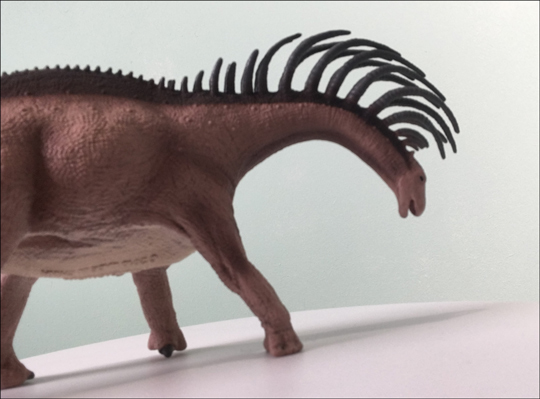
Time to pop into our studio and to put the new for 2020 CollectA Deluxe Bajadasaurus dinosaur model through its paces for “turntable Tuesday”. Each week, Everything Dinosaur intends to feature a prehistoric animal on the company’s YouTube channel and today, it is the CollectA Deluxe Bajadasaurus going for a spin.
CollectA Deluxe Bajadasaurus
“Turntable Tuesday” – The CollectA Deluxe 1:40 Scale Bajadasaurus
Video credit: Everything Dinosaur
Everything Dinosaur on YouTube
The YouTube channel of Everything Dinosaur features lots of videos of dinosaurs and other prehistoric animal figures. Our aim is to provide model reviews, hints and tips for collectors and to develop videos that provide a useful resource for our customers and for dinosaur fans of all ages.
The CollectA Deluxe 1:40 Scale Bajadasaurus (B. pronuspinax)
Bajadasaurus was only formally named and scientifically described in February 2019 (although the fossils were found back in 2010), we congratulate the design team at CollectA for being so quick off the mark when it comes to bringing out a figure representing a dinosaur that was described a little over a year ago. It has been assigned to the Dicraeosauridae family of long-necked dinosaurs, although, these dinosaurs are characterised by their relatively short necks when compared to the related diplodocids such as Apatosaurus, Brontosaurus and Diplodocus.
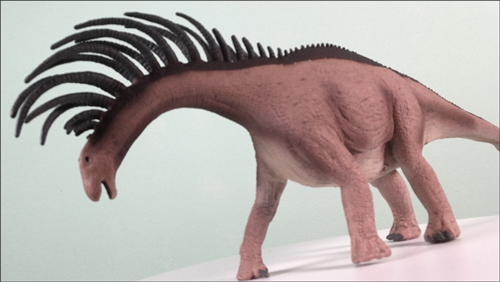
The CollectA Deluxe Bajadasaurus with its Bizarre Neck Spines
The new for 2020 CollectA Deluxe1:40 scale Bajadasaurus dinosaur model. The neck spines (enlarged, paired neural spines) are forward facing and may have had a role in defence against theropod dinosaur attacks.Picture credit: Everything Dinosaur.
If the fossil material has been interpreted correctly, then Bajadasaurus was one of the most bizarre of all the Dinosauria known to science. The model, and indeed the scientific illustrations of this prehistoric animal have been based on better-known dicraeosaurids. The huge neural spines, associated with the cervical vertebra assigned to position C5 in the neck of this dinosaur, gave rise to the idea that each neck bone had a pair of enormous, keratin-coated spines which would have acted as a formidable deterrent for any meat-eating dinosaur looking for a meal.
A Very Spiky Sauropod – The CollectA Deluxe Bajadasaurus Dinosaur Model
CollectA Bajadasaurus dinosaur model (1:40 scale). A view of the amazing neck spines of this South American dinosaur that lived approximately 14o million years ago.Picture credit: Everything Dinosaur.
Picture credit: Everything Dinosaur
To view the CollectA Deluxe Bajadasaurus and the rest of the prehistoric animals in the CollectA Deluxe Prehistoric Life model range: CollectA Deluxe Prehistoric Life.
A team of international scientists have identified the first ancestor of animals that show bilateral symmetry, in ancient marine sediment around 555 million years old. Palaeontologists had predicted that such an organism would be identified in Ediacaran sediments, essentially a creature with a body plan that has been adopted by the majority of the Kingdom Animalia, now thanks to the use of sophisticated three-dimensional laser scans funded by NASA, the “smoking gun” evidence has been found.
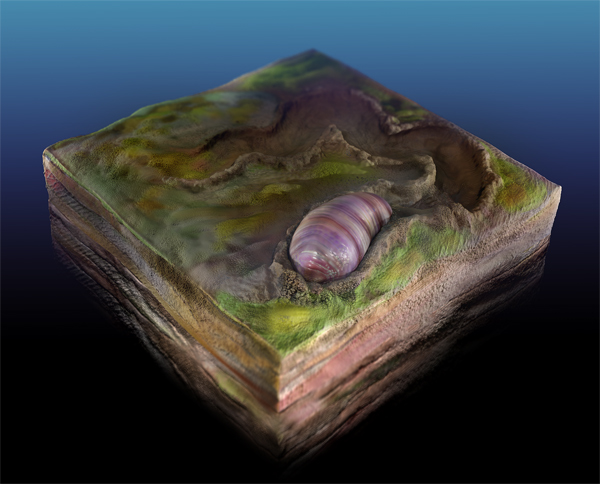
A Life Reconstruction of the Earliest Bilaterian Known to Date (I. wariootia)
Ikaria wariootia life reconstruction.
Picture credit: Sohail Wasif/University California Riverside
Ikaria wariootia – The Size of a Rice Grain but a Big Discovery!
Writing in the journal “Proceedings of the National Academy of Sciences of the United States of America”, the researchers, which included scientists from University California Riverside and the South Australian Museum, examined tiny trace fossils, essentially burrows and borings into an ancient Ediacaran seabed (Ediacara Member, South Australia).
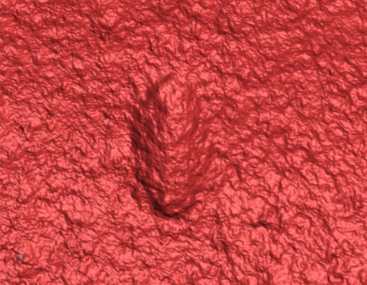
Proximal to some of these traces were very small oval impressions. Thanks to funding from a NASA exobiology grant, the team were able to employ a sophisticated three-dimensional laser scanner to map these depressions in the ancient rock. Computer-generated images revealed a worm-like organism with a cylindrical body and faintly grooved musculature. A distinct head and tail were also identified. This little animal represents the earliest bilaterian, a hugely significant step in the evolution of life on Earth.
The transition from simple, microscopic forms of life to the abundance and variety of complex creatures in the Cambrian remains quite poorly understood. However, the beautifully preserved remains of soft-bodied organisms, many of which look like nothing alive today, associated with the ancient strata of the Ediacara Hills of South Australia have permitted palaeontologists the opportunity to learn about life on our planet prior to the evolution of hard body parts such as shells and exoskeletons.
Bizarre Body Forms
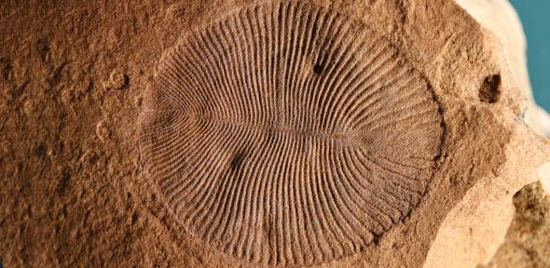
Many of the creatures identified from their fossils had bizarre body forms such as the circular Dickinsonia (below), but scientists had predicted that animals with bilateral symmetry would be present in this ecosystem, it was just a question of finding them.
A Circular Impression of an Organism from the Ediacara Hills (South Australia) – Dickinsonia costata Fossil
The Ediacaran fossil Dickinsonia costata, specimen P40135 from the collections of the South Australia Museum.
Picture credit: Dr Alex Liu (Cambridge University)
The Development of Bilateral Symmetry
The development of bilateral symmetry was a critical step in the evolution of animal life, giving organisms the ability to move purposefully and a common, yet successful way to organise their bodies. In the scientific paper, the research team describe Ikaria wariootia as ranging in size between 2 and 7 millimetres in length and being around 1 to 2.5 millimetres wide. The largest specimens were about the size of a grain of rice, just the right size to have made the burrows and borings (trace fossils).
The discovery of Ikaria wariootia is consistent with predictions based on modern animal phylogenetics, that the last ancestor of all bilaterians was simple and small and represents a rare link between the Ediacaran and the subsequent record of animal life. Put simply, I. wariootia is on the same part of the animal family tree as the majority of animals alive today and that includes us (Homo sapiens).
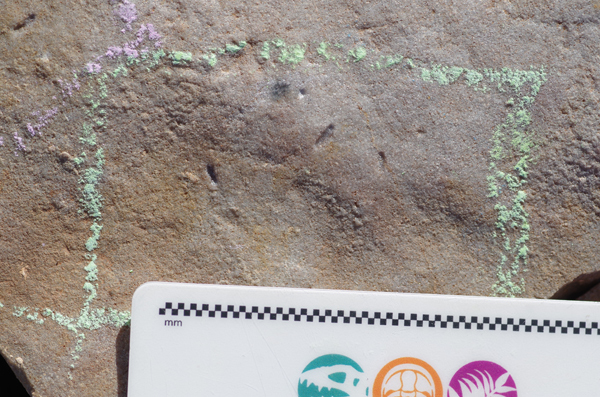
Ikaria wariootia Impressions Preserved in Ancient Marine Sediment
Ikaria wariootia impressions preserved in ancient marine sediments.
Picture credit: Droser Laboratory/University of California Riverside
Commenting on the significance of the discovery, one of the authors of the scientific paper, Scott Evans (University of California Riverside), stated:
“We thought these animals should have existed during this interval [Ediacaran], but always understood they would be difficult to recognise. Once we had the 3-D scans, we knew that we had made an important discovery.”
Examining Ediacaran Trace Fossils
Analysis of modern animals and Ediacaran trace fossils predicted that the oldest bilaterians would be very small with simple body plans. The research team found that the size and shape of Ikaria matched the predictions that had been made with regards to the maker of the trace fossil Helminthoidichnites, indicating sediment displacement and purposeful animal movement.
Importantly, in the Ediacara Member, Helminthoidichnites occurs stratigraphically below classic Ediacara body fossils such as Dickinsonia. Together, these suggest that Ikaria represents one of the oldest total group bilaterians identified to date, with very little deviation from the characters and traits predicted for their last common ancestor.
In addition, these trace fossils persist into the Phanerozoic Eon (from the Cambrian Period onwards), providing a critical link between the Ediacaran and Cambrian biota.
A Three-Dimensional Laser Image of a Scan of a Rock Depression Revealing the Body Plan of Ikaria wariootia
A three-dimensional laser scan of an Ikaria wariootia impression.
Picture credit: Droser Laboratory/University of California Riverside
What’s in a Name?
The genus name comes from Ikara, which means “meeting place” in the local Adnyamathanha dialect. It is the Adnyamathanha term for a grouping of mountains known as Wilpena Pound. The trivial name comes from Warioota Creek, which runs from the Flinders Ranges to Nilpena Station in the Ediacara Hills. It may look a fairly simple animal to us, but back in the Ediacaran Ikaria was one of the most complex organisms around. It burrowed in thin layers of well-oxygenated sand on the ocean floor in search of organic matter, indicating rudimentary sensory abilities.
The depth and curvature of Ikaria represent clearly distinct front and rear ends, supporting the directed movement found in the burrows. The walls of the burrows preserve evidence of “v-shaped” ridges, which indicate that Ikaria moved by contracting muscles across its body like an earthworm. This is known as peristaltic locomotion.
Everything Dinosaur acknowledges the assistance of a media release from the University of California Riverside in the compilation of this article.
The scientific paper: “Discovery of the oldest bilaterian from the Ediacaran of South Australia” by Scott D. Evans, Ian V. Hughes, James G. Gehling and Mary L. Droser published in the Proceedings of the National Academy of Sciences of the United States of America.
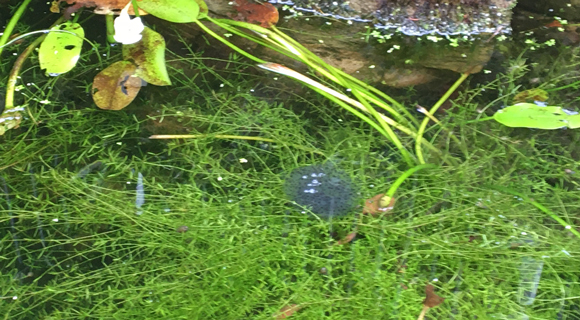
These might be challenging times for us humans (Homo sapiens), what with all the concerns about the coronavirus outbreak, but at least for some animals it is business as usual. We have frogspawn in our office pond! The first eggs were laid in the early morning of the 19th March. We normally have frogspawn around the third week of March in our part of the world, the date of laying can vary by a couple of weeks, depending on the weather and the type of winter we have had. However, the spawning usually takes place around this time of year (third week of March).
Frogspawn is Spotted
The First Frogspawn Spotted in the Office Pond Early on the 19th March 2020
The first batch of frogspawn laid in the office pond (March 19th 2020). The photograph was taken a few minutes after 8am in the morning. From the size of the frogspawn we think that these are the eggs from a single female and that they had only just been laid.Picture credit: Everything Dinosaur.
Picture credit: Everything Dinosaur
Common Frog (Rana temporaria)
We have counted a total of seven frogs in the pond, the majority were males. We tend to have the males arriving first and the females taking up residence a little time later (after all, the females tend to be pounced upon as soon as they enter the pond). The frogs are all Common frogs (Rana temporaria), their name is a bit of a misnomer these days, as like many amphibians, they are becoming increasingly rare.
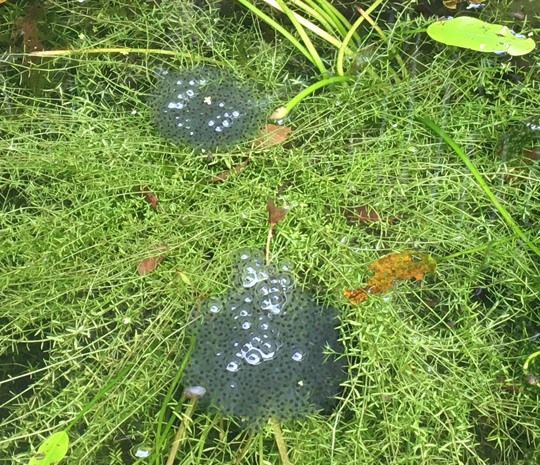
More Frogspawn was Laid that Morning (March 19th 2020)
More frogspawn laid on the morning of 19th March 2020. Team members at Everything Dinosaur estimate that the egg masses represent the eggs from two or three females. We shall continue to carefully monitor the pond (taking care not to disturb the frogs too much), to see if more eggs will be laid.Picture credit: Everything Dinosaur.
Picture credit: Everything Dinosaur
As we cope with the current restrictions on our lives due to the coronavirus crisis, we will be able to observe how the tadpoles are getting on – something for us to think about in these challenging times. At least the frogs are behaving as normal, for them at least, it is business as usual.
Everything Dinosaur and Fossil Workshops Postponed
The planned dinosaur and fossil themed workshops that were scheduled to take place this weekend (Saturday, 21st March, 2020) have been postponed due to the coronavirus outbreak. These events had proved to be extremely popular but with the growing concern over coronavirus, staff at Rochdale Borough Council responsible for the “Dippy the Dinosaur” exhibition, have reluctantly decided to postpone these workshops along with all the other related exhibition events and activities.
Fossil Workshops Postponed
Everything Dinosaur Was Conducting a Series of Family Themed Workshops and Other Activities
Everything Dinosaur’s dinosaur and fossil themed workshops planned for the “Dippy on Tour” exhibition have been postponed due to the coronavirus outbreak. Picture credit: Everything Dinosaur.
A statement posted on the Borough Council’s “The Dippy Experience” website explains the reasoning behind the suspension of planned events related to the dinosaur exhibition:
“In light of the current situation we’ve taken the difficult decision to suspend Dippy in Rochdale. The health and safety of our residents and visitors must come first and now is the time to take a pause. We will review the possibility of reopening Dippy on Tour in Rochdale in the upcoming months.”
A spokesperson from Everything Dinosaur commented:
“Families are at the centre of everything we do and this is particularly important during these challenging times. We have been monitoring the situation very closely and we fully understand and support the decision taken. The hands-on nature of our fossil handling activities would make operating the workshops extremely difficult given the current restrictions. However, we have moth-balled all the various activities that we had planned and prepared, these will be stored at one of our warehouses, so that before “Dippy” leaves the northwest of England, we could deliver the workshops we promised.”
A Chance to Reschedule the Dinosaur and Fossil Workshops
A spokesperson from Rochdale Borough Council thanked the team members at Everything Dinosaur for their efforts so far and stated that the Council would love to welcome Everything Dinosaur back, rescheduling later on in the year.
We shall see how things go, but dates in our busy diaries can be switched around and changed over to accommodate the eager young palaeontologists of the northwest of England.
Everything Dinosaur Continuing to Support Schools and Home Educators
At this time of uncertainty due to the coronavirus outbreak, Everything Dinosaur team members want to let you know how we are responding to the recent announcement about school closures. Our hearts go out to all those affected globally by the coronavirus (COVID-19) crisis. We are doing all we can to assist the education sector. Everything Dinosaur is currently operating as normal and we intend to provide regular updates in what is a very fluid situation. We are working very hard to limit the disruption to schools, nurseries and other academic bodies.
Everything Dinosaur Helpinig to Support the Education Sector
Everything Dinosaur has released the following statement:
Everything Dinosaur Team Members Helping to Support the Education Sector and Home Schooling
Team members working hard to support the educational sector and home schooling at this difficult time (coronavirus outbreak 2020).Picture credit: Everything Dinosaur.
Picture credit: Everything Dinosaur
The website links to gain access to our free teaching resources and other educational materials:
In addition, this blog site has posted up news stories, information about fossils, features about dinosaurs, evolution, natural selection, new theories and articles on other science related subject areas, every day since May 2007. This is a resource that has over 4,750 articles, which are all free to access, helping to provide additional materials for teachers, teaching assistants, academics and home schoolers.
Furthermore, our hard-working and enthusiastic staff handle numerous email enquiries each day, providing advice, free prehistoric animal fact sheets and other resources.
Team members are working extremely hard to help support universities, colleges, nurseries, other academic bodies and home educators. We continue to provide free of charge, a wide range of fossil and dinosaur themed teaching resources and learning materials.
By Mike|2024-01-19T07:27:28+00:00March 19th, 2020|Categories: General Teaching|Comments Off on Everything Dinosaur Continues to Offer Vital Support to Schools
Everything Dinosaur Supports Schools and Home Educators
At Everything Dinosaur, the interests of our customers, our people and our communities are at the centre of everything we do and this is particularly important during these challenging times. Our hearts go out to those affected globally by the Coronavirus (COVID-19) outbreak. We want to let you know that you remain our top priority and we are doing all we can to assist schools, universities, nurseries and home educators.
In the light of the recent announcement with regards to school closures, the UK-based mail order company has released the following statement:
Everything Dinosaur Helping to Support Education and Home Schooling
Everything Dinosaur team members working hard to support the educational sector and home schooling at this difficult time (coronavirus outbreak 2020). Picture credit: Everything Dinosaur.
Furthermore, our dedicated staff handle dozens of email enquiries every day, providing advice, free prehistoric animal fact sheets and other resources.
In China, there is a saying “may you live in interesting times”. These are certainly “interesting times”. The company is doing all it can to help support schools, other academic bodies and home educators. We are currently operating as normal and will update you regularly with any changes. We are all working together to help limit the disruption to our customers and to still provide our excellent award-winning service.
Everything Dinosaur is working extremely hard to help support schools, colleges, universities, nurseries, other academic bodies and home educators. We continue to provide free of charge, a wide range of fossil and dinosaur themed teaching resources and learning materials.