All about dinosaurs, fossils and prehistoric animals by Everything Dinosaur team members.
19 03, 2020

Amazing Canadian Fish Fossil Lends Palaeontologists a Helping Hand

By |2024-01-19T07:25:44+00:00March 19th, 2020|Categories: Dinosaur and Prehistoric Animal News Stories, Main Page, Photos/Pictures of Fossils|0 Comments

Fish Fossil Helps to Demonstrate How Fins Turned into Hands

A team of international scientists including researchers from Flinders University in Adelaide (South Australia) and the Université du Québec à Rimouski (Canada), have scanned the fossilised remains of an ancient fish with tetrapod tendencies to reveal evidence of how the limbs of fish evolved into the terrestrial appendages of land animals.

Elpistostege watsoni

The fossilised remains date from the Late Devonian and are approximately 380 million years old.  The fossil is a specimen of Elpistostege (E. watsoni), the discovery of a much more complete skeleton of this strange animal gave the researchers the opportunity to analyse the body plan of this predator in much greater detail than previously.

A Near Complete Specimen of Elpistostege watsoni with Accompanying Line Drawing
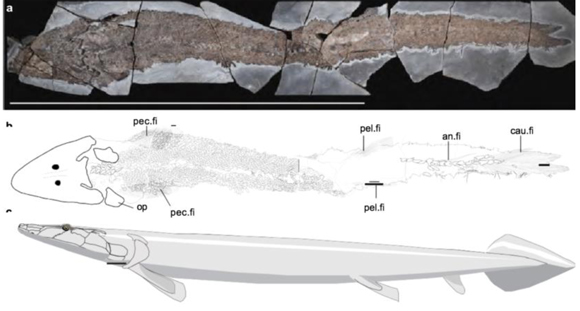
Elpistostege watsoni fossil with interpretive drawing and life reconstruction.
The near complete Elpistostege specimen with line drawing showing the outline of the skeleton and a life reconstruction.  The research was conducted on a fossil specimen that had been discovered in 2010.

Picture credit: South Australia Leads/Flinders University

Strategic Professor in Palaeontology (Finders University), Professor John Long, announced the discovery of the near complete fossil specimen in the journal “Nature”.  Commenting on the significance of the fossil find, he stated that the specimen “reveals extraordinary new information about the evolution of the vertebrate hand.”

High Energy X-Rays to Assess Fin Structure

The research team bombarded the fossil specimen with high energy X-rays to reveal the presence of limb and wrist bones hidden in the fins.  Evidence of finger-like bones could also be made out.

The Professor added:

“This is the first time that we have unequivocally discovered fingers locked in a fin with fin-rays in any known fish.  The articulating digits in the fin are like the finger bones found in the hands of most animals.  This finding pushes back the origin of digits in vertebrates to the fish level and tells us that the patterning for the vertebrate hand was first developed deep in evolution, just before fishes left the water.”

A Life Reconstruction of the Late Devonian Elpistostege
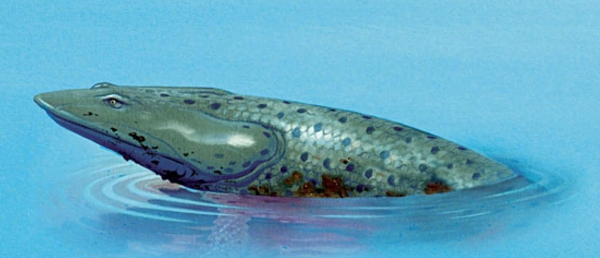
Elpistostege life reconstruction.
A life reconstruction of Elpistostege.

Picture credit: Miguasha National Park/Johanne Kerr and François Miville-Deschênes

Studying the “Limb Bones” of a Fish

The high resolution scans revealed the presence of a humerus (upper arm bone), the radius and ulna (the two bones from the forearm), carpal bones from the wrist and the presence of bones that resembled digits.  The fossil specimen measures 1.57 metres in length.  It comes from exposures of the Escuminac Formation located in the Canadian province of Quebec.

The strata represent a brackish water, estuarine environment and palaeontologists have long speculated that such a habitat may have been one of the driving forces behind the evolution of limbs capable of terrestrial locomotion in certain types of ancient fish.  The teeth in the broad jaw suggest that Elpistostege was an apex hypercarnivore, but whether it fed on other fish or ventured out onto land to grab insects and arthropods on the shore (as indicated by the position of the eyes at the top of the head suggesting an ambush predator), remains unknown.

Co-author of the scientific paper Richard Cloutier (Université du Québec à Rimouski), commented that over the last ten years or so, fossils representing the fish-to-tetrapod transition had helped palaeontologists to gain a better understanding about this important stage in vertebrate evolution.

He added:

“The origin of digits relates to developing the capability for the fish to support its weight in shallow water and for short trips out on land.  The increased number of small bones in the fin allows more planes of flexibility to spread out the weight through the fin.”

A Primitive Tetrapod

In previous studies, Dr Cloutier had postulated that Elpistostege might represent the most primitive tetrapod known to science, an accolade currently held by the closely related Tiktaalik, fossils of which come from northern Canada (Ellesmere Island).

Australian Professor John Long has dedicated much of his academic career to studying Devonian fish and the early stages of the evolution of the modern tetrapod body plan.

Here are some blog articles that provide more details of his research: The Early Evolutionary History of Sharks.

A Placoderm “Platypus”: Ancient Placoderm from Australia.

The Everything Dinosaur website: Everything Dinosaur.
18 03, 2020

Every Day Everything Dinosaur Will Give Away a Lucky Charm

By |2024-01-19T07:20:44+00:00March 18th, 2020|Categories: Adobe CS5, Dinosaur Fans, Everything Dinosaur News and Updates, Everything Dinosaur Products, Main Page, Press Releases|0 Comments

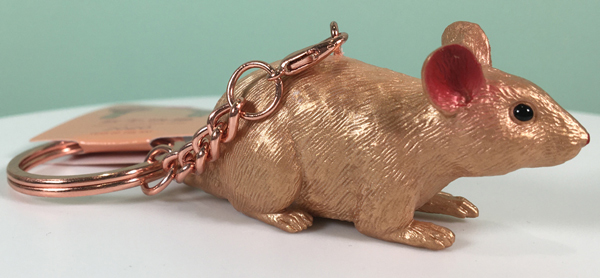
Golden Rat Lucky Charm Giveaway with Everything Dinosaur

Things might be a little difficult right now due to the coronavirus outbreak, but team members at Everything Dinosaur are determined to keep cheerful and are trying to spread a little joy and happiness in these challenging times.  Take for example, an initiative started this week to include a Mojo Fun golden rat lucky charm as a free gift to one Everything Dinosaur customer each day.

The Beautiful Mojo Fun Golden Rat Lucky Charm Key Ring

Mojo Fun lucky charm key ring - golden rat.
The beautiful Mojo Fun lucky charm rat key ring. Picture credit: Everything Dinosaur.

Picture credit: Everything Dinosaur

Everything Dinosaur Giving Away Mojo Fun Golden Rat Lucky Charms

In the Chinese lunar calendar, the year 2020 is the year of rat.  The rat in the Chinese zodiac is seen as a sign of surplus, good prospects and wealth.  The rat is strongly linked to the family in Chinese culture (a consequence of this rodent’s ability to breed rapidly), rats are seen as successful, adaptable but happy to lead a quiet, peaceful existence.

Each year for the past few years, Mojo Fun has produced a special, limited edition replica of the animal represented by the new Chinese year.  These figures are highly prized and difficult to obtain, but at Everything Dinosaur, we have decided to include one of these beautiful models in a parcel every day until our stock runs out.

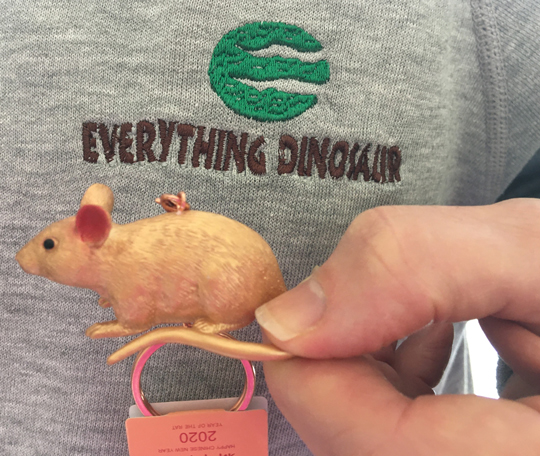
Everything Dinosaur Giving Away Lucky Charms

Everything Dinosaur lucky charm giveaway.
Everything Dinosaur is giving away a golden rat lucky charm key ring to one customer every day until the stock runs out. Picture credit: Everything Dinosaur.

Picture credit: Everything Dinosaur

A spokesperson from the UK mail order company commented:

“We had intended to give away these stunning little models once the new for 2020 Mojo Fun prehistoric animal models arrived, but due to the coronavirus outbreak, these models, like a lot of other items have been delayed.  So, we thought we would cheer everybody up by sending one of these special figures out to a customer every day for as long as our stocks last.  For us, it’s all about spreading a little happiness and joy at this difficult time.”

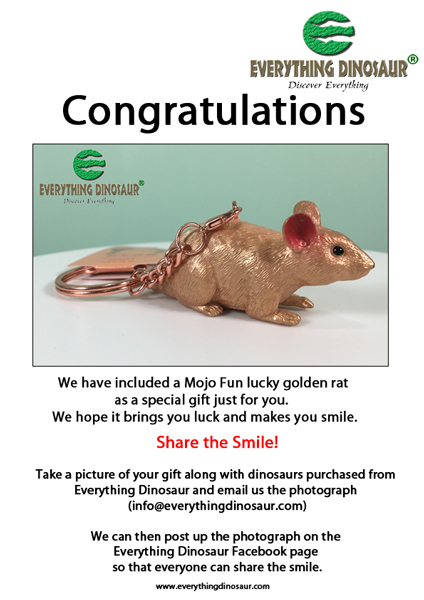
Take a Photograph – Share the Smile!

In addition, we are asking all those customers who receive a golden rat, to take a picture of their lucky charm next to their purchases from Everything Dinosaur.  If they email the picture to us, we will then post it up onto our social media pages so that we can share the joy a little.

Take a Photograph of Your Gift Next to the Items from Everything Dinosaur – Share the Smile

Everything Dinosaur giving away Mojo Fun golden rat key rings.
Everything Dinosaur giving away Mojo Fun golden rat lucky charms. Picture credit: Everything Dinosaur.

Picture credit: Everything Dinosaur

Be lucky! Visit the Everything Dinosaur website: Our Website.

As a valued customer, we hope this gift brings a little happiness and we have asked recipients to take a picture of their gift alongside the prehistoric animals purchased from Everything Dinosaur.  If the photograph is then emailed to us, we will post the picture up onto our social media pages so that everyone can share in the fun.

To view the Mojo Fun range of prehistoric animal models and replicas available from Everything Dinosaur: Mojo Fun Prehistoric and Extinct Model Range.

17 03, 2020

New CollectA Deluxe Fukuisaurus 1:40 Scale (Turntable Tuesday)

By |2024-01-19T07:12:39+00:00March 17th, 2020|Categories: Adobe CS5, Dinosaur Fans, Everything Dinosaur News and Updates, Everything Dinosaur Products, Everything Dinosaur videos, Main Page, Photos of Everything Dinosaur Products|0 Comments

CollectA Deluxe Fukuisaurus 1:40 Scale (Turntable Tuesday)

As Everything Dinosaur team members get better acquainted with the video management software and other technical aspects of the company’s small studio, we have opted to try and produce at least one dinosaur or prehistoric animal themed YouTube video a week.  With the arrival of a small turntable, we decided to start showcasing various dinosaur figures by producing short (around one or two minutes long), videos.  In this brief YouTube video, we highlight the new for 2020 CollectA Deluxe 1:40 scale Fukuisaurus dinosaur model.

Turntable Tuesday – The CollectA Deluxe 1:40 Scale Fukuisaurus Dinosaur Model Takes a Spin

Video credit: Everything Dinosaur

Fukuisaurus – A Japanese Dinosaur

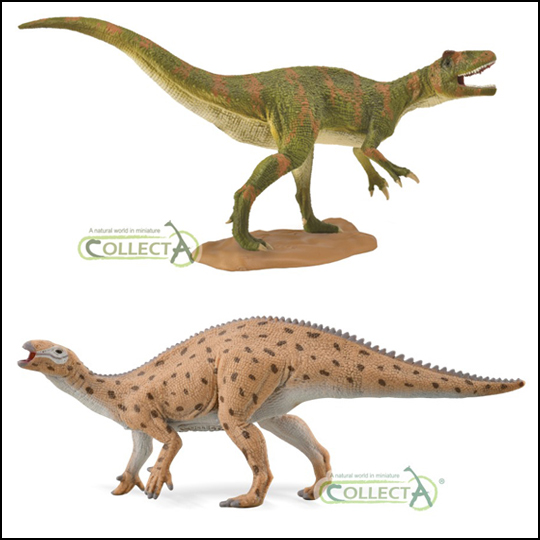
The CollectA Fukuisaurus model follows hot on the heels of the CollectA Fukuiraptor figure that was introduced in 2019.  Both dinosaurs are associated with the famous Kitadani Formation of Fukui on the Japanese island of Honshu.  The ornithopod Fukuisaurus (which was named and described in 2003) and the theropod Fukuiraptor, which was formally scientifically described three years earlier, come from the same bonebed in the Kitadani Dinosaur Quarry (Bonebed I).  It has been speculated that Fukuiraptor preyed upon Fukuisaurus, but there is very little scientific evidence other than the proximity of the fossil material to support this supposition.

Two Models of Dinosaurs from the Lower Cretaceous of Japan

CollectA dinosaur models Fukuiraptor and Fukuisaurus.
The CollectA Fukuiraptor (top) and the CollectA Deluxe Fukuisaurus (bottom). Picture credit: Everything Dinosaur.

Picture credit: Everything Dinosaur

Visit the Everything Dinosaur website: The Everything Dinosaur Website.

CollectA Fukuisaurus and CollectA Fukuiraptor

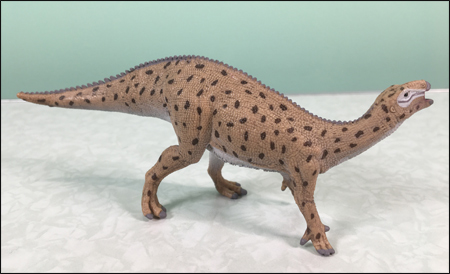
Towards the end of this short video (it lasts a fraction over two minutes long), the CollectA Deluxe Fukuisaurus and the CollectA Fukuiraptor are shown together.  This permits dinosaur model fans and collectors to get a really good look at both figures.  Although the Fukuisaurus is part of the CollectA Deluxe range and it is in approximately 1:40 scale, as Fukuisaurus was a relatively small member of the hadrosaurid lineage, the actual dinosaur model is quite small.  Everything Dinosaur team members have measured the replica and it is approximately 14 cm long and stands around 5.5 cm high at the hips.

It is beautifully detailed and there is much to be admired in this CollectA figure (yes, we do point out in the video that this dinosaur model does have a cloaca).

A spokesperson for Everything Dinosaur commented:

“A lot of dinosaur model fans and collectors have asked us to make more videos about prehistoric animals, we are working hard to get up to speed and we do intend to produce another forty or so videos this year, including reviews of some of the new for 2020 CollectA models.”

The CollectA Deluxe Fukuisaurus 1:40 Scale Dinosaur Model

CollectA Deluxe 1:40 scale Fukuisaurus.
The new for 2020 CollectA Deluxe Fukuisaurus dinosaur model (1:40 scale). Picture credit: Everything Dinosaur.

Picture credit: Everything Dinosaur

When will the CollectA Fukuisaurus be in Stock?

The first batch of the new for 2020 CollectA prehistoric animal models including the Fukuisaurus have been delayed (coronavirus).  As soon as Everything Dinosaur have news about these models, then it will be posted up onto this blog and onto the company’s social media pages.

In the meantime, to view the Fukuisaurus production sample video and all the other videos on the Everything Dinosaur YouTube channel: Everything Dinosaur on YouTube.

To see the CollectA Deluxe Prehistoric Life range of models: CollectA Deluxe Prehistoric Life.

17 03, 2020

Beautiful Prehistoric Animal Drawings Help to Inspire Young Artists

By |2024-01-17T15:22:05+00:00March 17th, 2020|Categories: General Teaching|Comments Off on Beautiful Prehistoric Animal Drawings Help to Inspire Young Artists

Prehistoric Animal Drawings Help to Inspire Young Artists

Everything Dinosaur team members have been asked to support the science outreach activities being organised by Rochdale Borough Council as the Natural History Museum’s “Dippy the Diplodocus” exhibition arrives in the northwest of England.  The Diplodocus exhibit, donated to the London Natural History Museum in 1905, is currently undergoing a nationwide tour.  Staff from Everything Dinosaur have been asked to put together a series of fun, fossil themed workshops in various parts of the northwest.

Prehistoric Animal Drawings

Whilst visiting a library, a team member spotted some very familiar prehistoric animal figures helping to promote a drawing competition aimed at eager, enthusiastic young palaeontologists.

Prehistoric Animal Model Help to Inspire Dinosaur Drawings

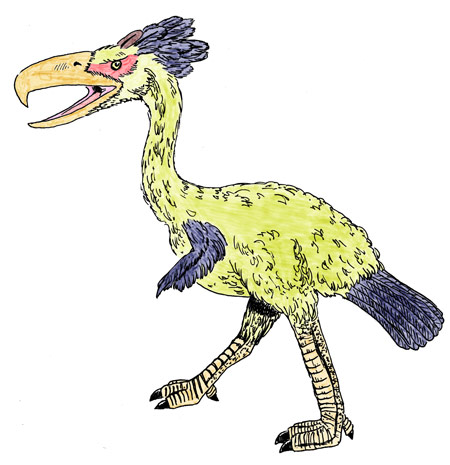
A drawing of Kelenken. Phorusrhacids illustrated. The "Terror Birds".
The Kelenken in all its glory Picture credit: Everything Dinosaur.

Picture credit: Everything Dinosaur

The CollectA Kelenken (Prehistoric Animal Drawing)

A colourful drawing of large, flightless bird Kelenken is highlighted (above). In the library team members spotted a Liopleurodon (marine reptile), from the CollectA Prehistoric Life range of figures.  A model on the right of the Liopleurodon was a replica of an Iguanodon, also from the CollectA range.  Both these models represent long extinct creatures, fossils of which have been found in the British Isles.

View the CollectA Prehistoric Life model range: CollectA Prehistoric Life Figures.

CollectA also provide a selection of scale models. To view this range: CollectA Deluxe Prehistoric Life Scale Models.

A team member from Everything Dinosaur, in a break between delivering dinosaur and fossil themed workshops commented:

“It has been great to meet so many young dinosaur fans.  The Diplodocus event has attracted over a hundred thousand visitors to the area.  This has provided a real boost to the local economy.  We have seen a number of the entries in the dinosaur drawing competition and we have been most impressed with the illustrations and artwork.”

The Everything Dinosaur website: Everything Dinosaur.
16 03, 2020

Coronavirus Fears Brings a Halt to Jurassic World Three

By |2024-01-19T07:07:05+00:00March 16th, 2020|Categories: Dinosaur Fans, Main Page, Movie Reviews and Movie News|0 Comments

Film Project Stopped as a Precaution

One of the consequences of the global coronavirus outbreak is that many film projects have been halted in their tracks.  It has been announced that filming on “Jurassic World: Dominion”, the third movie in the reprised “Jurassic Park/Jurassic World” film franchise has been postponed until further notice.  Everything Dinosaur understands that some filming had taken place in Canada and a set built at Pinewood Studios (London), but all filming has been stopped and a decision as to when production will start again will be taken in a few weeks.

Filming Halted on “Jurassic World: Dominion”

Mosasaurus poster.
The Mosasaurus poster from the film “Fallen Kingdom. However, filming of another movie in the franchise has been interrupted.

Picture credit: Everything Dinosaur

Filming Commenced on February 25th (2020)

Filming had started in Canada on February 25th (2020).  Director Colin Trevorrow confirmed this in a message on his Instagram account.  Over recent years, several science fiction/adventure films have been shot in Canada, dubbed “the Hollywood of the north” by some movie insiders.

Jurassic World 3 is just one of several major film and television projects that have had to be suspended due to the worldwide coronavirus outbreak.  The film was due to be released in the United States on June 11th 2021, with a release date in the UK of June 21st.  It is not known at this time, whether the postponements will result in a delay in the release in the film.

“Jurassic World” a Monster Hit!

When “Jurassic World” was released in June 2015, it become the first film in movie history to take more than $500 million USD in its opening weekend.  The film went onto gross a total of $1.6 billion USD in box office revenues across the world.  The second film in this trilogy “Jurassic World: Fallen Kingdom”, released in 2018, was nearly as successful.  Although the film received mixed reviews, it went onto gross $1.3 billion USD in box office receipts.  Analysts are expecting the third film, which is expected to be the final instalment, “Jurassic World: Dominion”, to continue the financial success story, after all, as a team member from Everything Dinosaur commented:

“People just love dinosaurs”.

“Jurassic World: Dominion” sees a number of the original actors and actresses in the “Jurassic Park” film of 1993 reprising their roles.  Steven Spielberg is expected to continue his role as executive producer.  Dinosaur fans and movie goers may have to wait just a little bit longer to see the final film.

Visit Everything Dinosaur’s website: Everything Dinosaur.

15 03, 2020

New Evidence Casts Doubt over Oculudentavis

By |2024-01-19T07:01:17+00:00March 15th, 2020|Categories: Dinosaur and Prehistoric Animal News Stories, Dinosaur Fans, Main Page, Palaeontological articles, Photos/Pictures of Fossils|0 Comments

Is Oculudentavis a Member of the Archosauria?

On the 11th March (2020), Everything Dinosaur posted up a blog article featuring the discovery of a remarkably well-preserved fossil skull that had been found in amber from northern Myanmar.

To read our blog post: Hummingbird-sized Dinosaur from Burmese Amber.

Oculudentavis khaungraae

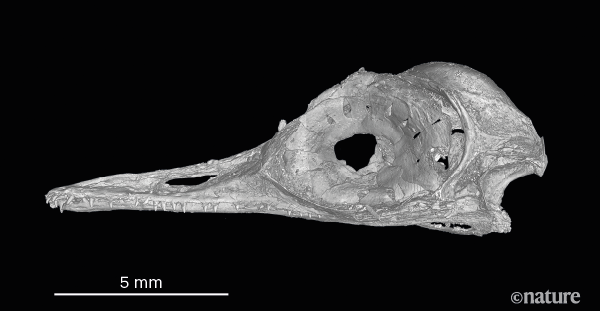
Following publication, a number of academics have questioned the conclusions made by Xing et al with regards to this fossil representing a member of the Maniraptora.  It is certainly true that the validity of the interpretation of the fossil skull as maniraptoran has subsequently been challenged post publication (Wang Wei et al).  They comment that the shape of the skull is not unique to archosaurs, many lizards for example, show similar characteristics, the phylogenetic analysis is questioned, along with the apparent absence of an antorbital fenestra (an opening in the skull of all known archosaurs between the orbit and the naris).

The Very Bird-like Skull of Oculudentavis khaungraae But Can Appearances be Deceptive?

Oculudentavis khaungraae computer generated image of the skull.
Oculudentavis khaungraae computer generated image of the skull (left lateral view).

Picture credit: Xing et al (Nature)

It is suggested that the skull actually comes from a lizard and that the specimen is not from an archosaur at all.

The original publication noted that the spoon-shaped bones that make up the sclerotic ring were reminiscent of that seen in the eye sockets of lizards.  Scleral bones of this shape have never been found in a dinosaur or a bird, it is suggested that these bones support the idea that the fossil is that of a lizard and not a member of the Archosauria.

Trouble with the Teeth

The roots of the tiny teeth do not seem to be located in sockets in the jawbone (thecodont dentition).  This was a peculiar feature remarked upon by a number of academics once this paper had been widely circulated.  Teeth located in sockets is a characteristic of toothed-archosaurs such as crocodilians and the dinosaurs.  Other types of tetrapod also show this tooth morphology, but in Oculudentavis the teeth are not in sockets but either fused to the jaw (acrodont dentition) or located within grooves that can be found along the length of the jaw bones (pleurodont dentition).

The number of teeth in the jaw far exceeds that known for any type of ancient bird.  The tooth line extending under the eye-socket (orbit), is also highly unusual.  Such anatomical traits are associated with the Squamata (lizards and snakes), not with the Archosauria.

These arguments (along with others, such as the absence of feathers), have led some scientists to question the conclusions made in the original Nature publication.  Oculudentavis might not be a bird or a dinosaur, it might represent the preserved remains of a lizard.

An Anolis Lizard (A. equestris) Displaying its Throat Sac

Is the skull that of a lizard?
An Anolis lizard, note the long snout, large eyes and the jaw that extends under the orbit. Picture credit: Everything Dinosaur.

Picture credit: Everything Dinosaur

The scramble to publish can sometimes lead to a lack of peer review opportunities and a foreshortening of pre-publication correspondence amongst academics.  When the “Nature” paper was published it certainly created a great deal of interest in the wider media.  Sadly, we suspect that any challenge to the original paper’s conclusions or subsequent revision will not attract anywhere near as much publicity.

We shall await developments.

Perhaps, in future we could refer to such controversies as “Oculudentavism”.

The Everything Dinosaur website: Everything Dinosaur.
14 03, 2020

March Model Madness with New Newsletter

By |2024-01-19T06:56:20+00:00March 14th, 2020|Categories: Adobe CS5, Dinosaur Fans, Everything Dinosaur News and Updates, Everything Dinosaur Newsletters, Everything Dinosaur Products, Main Page, Photos of Everything Dinosaur Products|0 Comments

Everything Dinosaur Newsletter – March Model Madness

It is March model madness, with a new edition to the Everything Dinosaur model range plus the return of some old favourites.  Newsletter subscribers will have received this week our latest missive and it provides details of the new Wild Past Protoceratops, plus Rebor replicas and a “heads up” that the mighty 1:20 scale CollectA Deluxe Elasmotherium is back in stock!

The Everything Dinosaur Newsletter

The brand Wild Past has only recently been launched, but the first of the models in this exciting range is already in stock at Everything Dinosaur, but be warned, the 1:35 scale Protoceratops andrewsi complete with a nest of dinosaur eggs has had a very limited production run, so stock of this particular member of the Protoceratopsidae is likely to sell out fast.

Headlining the Everything Dinosaur Newsletter – The Wild Past Protoceratops Model

Wild Past Protoceratops dinosaur model makes headlines.
The Wild Past Protoceratops dinosaur model makes headlines.  Picture credit: Everything Dinosaur.

Picture credit: Everything Dinosaur

Visit Everything Dinosaur: Everything Dinosaur.

The Return of Rebor Replicas

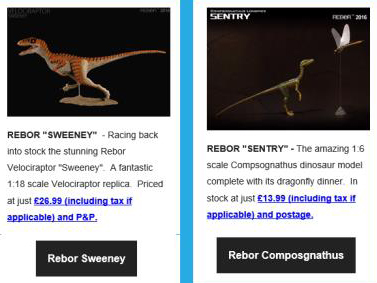
Good news for fans of Rebor replicas.  Although the extended Chinese New Year led to disruption in international delivery networks, Everything Dinosaur had been able to arrange the shipment of the popular Rebor “Raptor” replica called “Sweeney” and the 1:6 scale Compsognathus model “Sentry”.  Newsletter readers were the first to receive an update letting them know that both these Rebor figures were once again available.

The Rebor “Raptor” 1:18 Scale Velociraptor “Sweeney” and the 1:6 Scale Compsognathus “Sentry” are Back in Stock

Rebor "Sweeney" and "Sentry".
The Rebor 1:18 scale Velociraptor replica called “Sweeney” and the Rebor 1:6 scale Compsognathus model “Sentry” are back in stock at Everything Dinosaur.  Picture credit: Everything Dinosaur.

Picture credit: Everything Dinosaur

See Rebor models and figures on the Everything Dinosaur website: Animal Models by Rebor.

Fascinating Foetus and a Charging 1:20 scale Elasmotherium

In addition, the Rebor Oddities Velociraptor foetus wet specimen with light up base is also available.  This fascinating model of an embryonic dinosaur was first introduced in the late summer of last year.  Standing around 22 centimetres high, the figure makes a striking centrepiece to any prehistoric animal model collection.  Joining the Velociraptor is the CollectA Deluxe 1:20 scale Elasmotherium, this replica too is also now available.

Rebor and Rhinos (Elasmotherium) Available from Everything Dinosaur

Rebor Oddities Velociraptor and CollectA Deluxe Elasmotherium.
The Rebor Oddities Velociraptor foetus with light up base and the CollectA Deluxe 1:20 scale Elasmotherium model are in stock at Everything Dinosaur.  Picture credit: Everything Dinosaur.

Picture credit: Everything Dinosaur

There may be a number of issues surrounding international logistics with the continuing coronavirus outbreak but there are lots of prehistoric animal models in stock at Everything Dinosaur including the Wild Past Protoceratops, Rebor replicas and the CollectA Deluxe Elasmotherium.

Subscribe to Everything Dinosaur’s Newsletters

Subscribing to Everything Dinosaur’s newsletters is easy, to get updates, information about new releases, dinosaur discoveries and fossil news, just drop us an email.

To request to join the Everything Dinosaur newsletter subscribers list just send us an email: Email Everything Dinosaur.

13 03, 2020

Telling the Time in the Late Cretaceous

By |2024-01-19T06:55:19+00:00March 13th, 2020|Categories: Dinosaur and Prehistoric Animal News Stories, Main Page, Palaeontological articles, Photos/Pictures of Fossils|0 Comments

Fossil Clam Helps Scientists to Tell the Time

Researchers from the Vrije Universiteit Brussel and the University of Ghent have used 70 million-year-old fossil bivalves to gain information about day length and seasonal variations during the Late Cretaceous.  tyrannosaurids and duck-billed dinosaurs had days that were approximately 30 minutes shorter than ours, as a consequence of this their year was about a week longer.

Writing in the academic journal Paleoceanography and Paleoclimatology, the researchers conducted a series of tests on the fossilised shells of a type of bivalve (Torreites sanchezi).  The fossil was found on a mountainside in Oman, but back in the Campanian stage of the Late Cretaceous, this area was a shallow, subtropical sea.

Daily Growth Rings Preserved in Fossil Bivalves Can Provide Scientists with Data About Ancient Planetary Systems

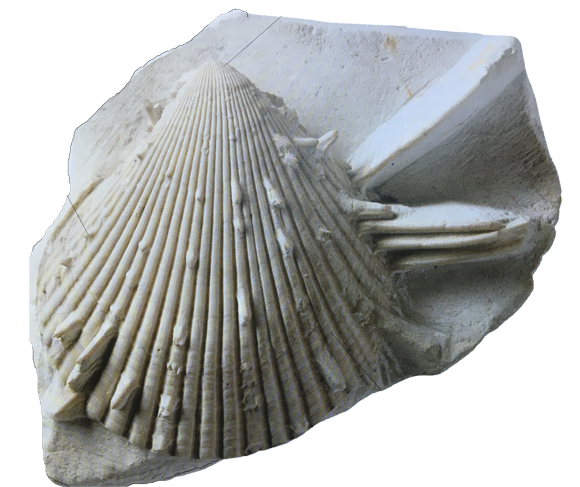
Fossil bivalves can help scientists understand planetary systems.
The growth rings laid down by rudist bivalves can help scientists to better understand ancient planetary systems.  An example of a bivalve fossil (Spondylus) from the Cretaceous.  This type of bivalve evolved in the Early Jurassic and can still be found today in tropical seas. Picture credit: Everything Dinosaur.

Picture credit: Everything Dinosaur

Laser Used to Bore a Hole in the Shell

Many types of molluscs grow quickly and they lay down discernible growth rings on their shells every day.  Scientists can conduct a series of tests on these markers and identify useful information about the climate and the environment in which the mollusc lived.  For example, using the growth rings, the researchers were able to determine that the fossil specimen died when it was around nine years of age.

A laser was used to bore a series of tiny holes in the shell, samples were taken and analysed for trace elements.  Using this information, the scientists were able to gain information on the temperature and the chemistry in the sea water in the reef environment where the mollusc lived.  The marine temperatures fluctuated between summer and winter, with a peak of around 40 ˚ Celsius in summer and 30 ˚ Celsius in winter.  The average annual sea temperatures were warmer than previously thought.

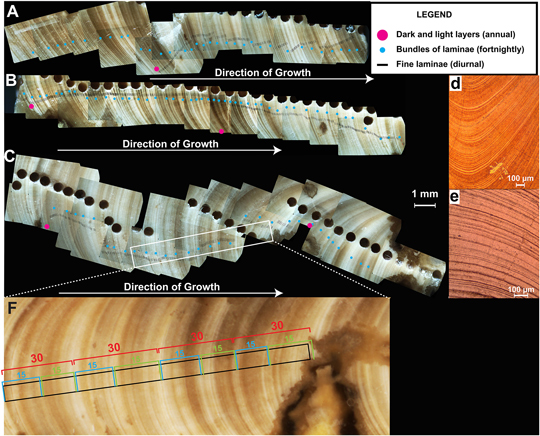
The Rings on the Bivalve Shell Can Provide a Lot of Information

Fossil Bivalves provide dating data.
Microscopic analysis of the fossil shell can help scientists work out day length and seasonal variations in the past.

Picture credit: Niels de Winter et al

Determining the Growth Rate of a Fossil Bivalve

In addition, the scientists determined that the bivalve grew much faster during the day than it did at night.  This phenomenon is not uncommon with bivalves today, some species form symbiotic relationships with algae, it is thought that the Cretaceous species was in a similar relationship.  A combination of counting layers, spectral analysis of chemical cyclicity and chemical layer counting shows that the mollusc laid down 372 daily laminae per year, demonstrating that length of day has increased since the Late Cretaceous, as predicted by numerous astronomical models and previous studies of fossil molluscs.

However, this study represents the most accurate assessment of seasonal growth, day length and annual environmental changes recorded in a fossil from the Late Cretaceous.

The Earth’s orbit around the sun does not alter that much, the extra 7 days recorded in a year, are not really a record of the Earth taking longer to make its orbit, but a reflection of the fact that the Earth was spinning faster on its axis 70 million years ago.  With the Earth turning faster, a day was slightly shorter compared to what we experience in the 21st century.  A day in the Cretaceous would have lasted approximately 23 1/2 hours.

An Explanation – Why is the Rotation of the Earth Slowing Down?

The Earth’s orbit around the sun does not change a great deal, but the length of a day on Earth has been steadily increasing since our planet and its moon were formed.  The moon’s gravity is acting on our planet, it creates friction from ocean tides and this is gradually slowing the Earth’s rotation.  At the same time, Earth’s own gravity is having an effect on the moon.  The pull of the tides accelerates the moon, so the satellite is being pushed away from our planet.

When the Torreites sanchezi bivalve was alive, a dinosaur on the beach at night would have seen a moon that looks bigger than the one we see today, it was several thousand metres closer to Earth.

The research team conclude that as bivalve shell calcite preserves quite well, this study permits further work using other fossils to determine seasonality, marine temperatures and day length.  This should help to document environmental change in warming ecosystems and widen our understanding of the magnitude of short‐term changes during greenhouse climates.

The scientific paper: “Subdaily-Scale Chemical Variability in a Torreites sanchezi Rudist Shell: Implications for Rudist Paleobiology and the Cretaceous Day-Night Cycle” by Niels J. de Winter, Steven Goderis, Stijn J.M. Van Malderen, Matthias Sinnesael, Stef Vansteenberge, Christophe Snoeck, Joke Belza, Frank Vanhaecke, and Philippe Claeys published in Paleoceanography and Paleoclimatology.

Visit the Everything Dinosaur website: Everything Dinosaur.
12 03, 2020

Amazing Scottish Stegosaurs

By |2024-01-19T06:48:32+00:00March 12th, 2020|Categories: Dinosaur and Prehistoric Animal News Stories, Dinosaur Fans, Main Page, Palaeontological articles, Photos/Pictures of Fossils|0 Comments

Scottish Island – A Dinosaur Stomping Ground Complete with Stegosaurs

Scientists led by researchers from Edinburgh University have reported the discovery of dozens of dinosaur footprints preserved in exposed mudstones at two locations on the Isle of Skye.  The trace fossils preserve evidence of a variety of different types of dinosaurs, which helps palaeontologists to gain a better understanding of dinosaur distribution and diversity during the Middle Jurassic.

The tracks indicate a variety of dinosaur trackmakers, including bipedal theropods of various sizes, possible ornithopods and a quadrupedal ornithischian dinosaur, the tracks of which show a resemblance to the ichnotaxon Deltapodus, which is believed to represent a stegosaur.  If these prints do represent a member of the Stegosauria, then this is the first time that evidence for this type of armoured dinosaur has been discovered on the Isle of Skye.

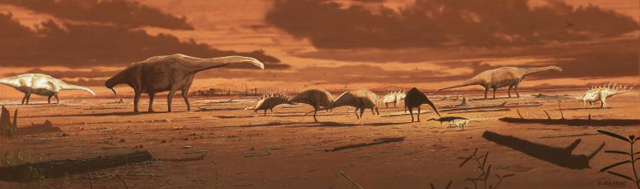
Dinosaurs Congregating Around Mudflats on the Isle of Skye (Middle Jurassic)

Dinosaurs on a mudflat (Isle of Skye).
Life reconstruction of the Isle of Skye mudflat.  Note no sauropod tracks have been identified to date at the two sites described in the newly published scientific paper.

Picture credit: Jon Hoad

Globally Important Fossil Discovery

During the Middle Jurassic the Dinosauria rapidly diversified and many new types evolved.  Unfortunately, the fossil record for terrestrial vertebrates from the Middle Jurassic is particularly poor.  The abundant trace fossils associated with the Isle of Skye are globally important, providing scientists with an opportunity to plot which types of dinosaurs are associated with this location.  Since the first dinosaur footprint in Scotland was found in the 1980s numerous tracksites representing several ichnotaxa have been recorded.

Writing in the academic journal PLOS One, the researchers describe two new tracksites from Rubha nam Brathairean (Brothers Point).  The sites are referred to as BP1 and BP3, site BP2, which revealed sauropod and theropod prints has already been reported upon: Isle of Skye Steps into the Jurassic Spotlight (2018).

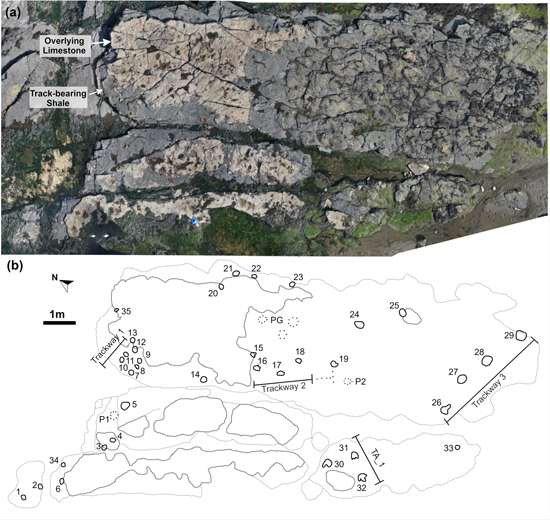
An Aerial View and Line Drawing of BP1 Showing the Distribution of the Dinosaur Tracks

BP1 site of dinosaur tracks (
Isle of Skye dinosaur tracks (BP1).  All three sites BP1, BP2 and BP3 were discovered between 2015 and 2017.

Picture credit: PLOS One

An Insight into the Fauna Around a Subtropical Coastal Area

The trace fossils at both BP1 and BP3 were formed when mudflats were exposed and dinosaurs walked over them.  Today, the mudstones comprise part of the Lealt Shale Formation of the Great Estuarine Group.  The dinosaurs inhabited a coastal environment in what was a subtropical climate.  The fossil bearing rocks might be exposed on the coast today, but the climate on the Isle of Skye today is very different to what it was like around 170 million years ago.  The notorious Scottish weather prevented the researchers from using drones on several occasions in their attempts to photograph and map the sites.

An Aerial View of BP3 and Accompanying Line Drawing Showing the Various Dinosaur Tracks

Isle of Skye dinosaur tracks (BP3).
Skye dinosaur tracks (BP3).

Picture credit: PLOS One

The tracks at both sites are preserved as impressions (concave epirelief) and the signs of mud cracks associated with the trace fossils suggest that the surfaces of both sites were briefly exposed before being quickly reclaimed by the return of brackish water.  Whilst the dinosaur tracks at BP3 were being mapped, an articulated pterosaur skeleton was found in the overlying limestone layer.  The state of the bones (largely unfractured) and the articulated skeleton suggest that the overlying limestone was deposited in a relatively low energy environment.  The pterosaur is currently being studied and will be covered in a future scientific paper.

Evidence of a Scottish Stegosaur

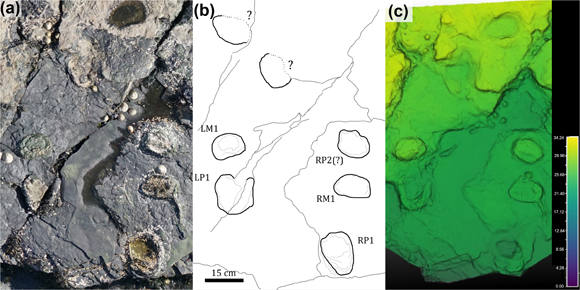
One of the tracks at location BP1 (BP1_Twy-01) shows a series of prints made by a quadrupedal dinosaur.  Although the tracks are a little distorted, distinctions between the pes (rear foot) and the manus (front foot) can be made.  The researchers conclude that these prints and other, single prints from this site are similar to the ichnotaxon Deltapodus.  Evidence of a potential armoured dinosaur from the Isle of Skye adds to the diversity of dinosaur types known from this location.

Mapping the Ornithischian Tracks (Potential Stegosaur – Ichnotaxon Deltapodus)

The quadrupedal trackway (BP1_Twy_01).
Potential Scottish Stegosaur tracks from the Isle of Skye.  The photograph (above) shows (a) an aerial overview of the site, (b) a line drawing showing the position of the tracks and (c), a false colour rendering of the tracks showing topography.

Picture credit: PLOS One

Together these two new tracksites demonstrate the wide variety of different types of dinosaur present in the area and will help palaeontologists gain more data on the early evolution and radiation of the Dinosauria.  As the researchers conclude, essentially BP1 and BP3 provide a snapshot of a “day in the life” of a Middle Jurassic ecosystem.

A Palaeontological Puzzle

No sauropod tracks have been described to date from BP1 or BP3, although they have been found at BP2.  The absence of sauropod evidence could be coincidental or perhaps an indication that during the time the mudflats were exposed, these large herbivores were not present in the area.  Environmental factors could help to explain the absence of sauropods.  Site BP2 represents a shallow lagoon, whilst BP1 and BP3 represent mudflats.  The sauropods may have preferred to occupy the lagoons.

The scientific paper: “Novel track morphotypes from new tracksites indicate increased Middle Jurassic dinosaur diversity on the Isle of Skye, Scotland” by Paige E. dePolo, Stephen L. Brusatte, Thomas J. Challands, Davide Foffa, Mark Wilkinson, Neil D. L. Clark, Jon Hoad, Paulo Victor Luiz Gomes da Costa Pereira, Dugald A. Ross and Thomas J. Wade published in the journal PLOS One.

Visit the Everything Dinosaur website: Everything Dinosaur.
12 03, 2020

Remarkable Tiny Dinosaur Discovery Coincides with British Science Week

By |2024-01-19T06:42:48+00:00March 12th, 2020|Categories: General Teaching, Key Stage 3/4|Comments Off on Remarkable Tiny Dinosaur Discovery Coincides with British Science Week

Remarkable Tiny Dinosaur Discovery Coincides with British Science Week

Everything Dinosaur marks British Science Week 2020 by reporting on the remarkable discovery of a tiny fossilised skull preserved in amber from northern Myanmar (Burma).  The fossil skull, which measures just 14 millimetres long represents a new species within the clade Dinosauria.  It has been named Oculudentavis khaungraae it probably weighed about as much as the smallest living bird, the Bee Hummingbird.  Scientists have estimated that it was around 8-10 centimetres long.  This makes Oculudentavis the smallest dinosaur known to science.

The Tiny Skull of the Newly Described Oculudentavis khaungraae Preserved in Amber from Myanmar

Oculudentavis khaungraae computer generated image of the skull.
Oculudentavis khaungraae computer generated image of the skull (left lateral view).

Picture credit: Lida Xing et al

Oculudentavis khaungraae

Team members at Everything Dinosaur have compared Oculudentavis to Tyrannosaurus rex (a distant relative of this tiny creature).  They estimate that an adult Tyrannosaurus rex weighed around 3.5 million times heavier.  Ironically, the tiny teeth in the jaw of Oculudentavis suggest that just like T. rex it was a predator.  It probably hunted insects.  The fossil is estimated to be around 99 million years old.

The fossil discovery represents the smallest member of the Mesozoic Dinosauria clade known to science and it demonstrates the importance of amber as a means of permitting scientists to gain an insight into the ecology of an ancient habitat thanks to the preservation of small animals and other material in fossilised tree resin.

Specimens preserved in amber are emerging as an exceptional way to study very small animals that once lived alongside the generally much larger pterosaurs and dinosaurs.

What an amazing fossil discovery, the publication of the scientific paper having coincided with British Science Week.

Note

The conclusions of the scientific paper have been challenged, this fossil might represent the preserved remains of a lizard.

The Everything Dinosaur website: Everything Dinosaur.
Go to Top