All about dinosaurs, fossils and prehistoric animals by Everything Dinosaur team members.
4 12, 2021

Everything Dinosaur Reviews the New CollectA Edmontosaurus Model

By |2024-09-15T19:09:51+01:00December 4th, 2021|Categories: Adobe CS5, Dinosaur Fans, Everything Dinosaur News and Updates, Everything Dinosaur Products, Everything Dinosaur videos, Main Page, Photos of Everything Dinosaur Products, Product Reviews|0 Comments

Everything Dinosaur team members have produced a video review of the recently announced new for 2022 CollectA Deluxe Edmontosaurus model. In our brief video, posted up on the Everything Dinosaur YouTube channel, the narrator looks at the model and outlines the research that has led to the features seen on this figure, such as the soft tissue head crest and the prominent hoof on the third finger of the hand.

Video credit: Everything Dinosaur

The Third Video in a Series of Four

The YouTube video, which lasts a little over 12 minutes, introduces the new figure and examines some of the latest research into the Edmontosaurus genus. It is the third video in a series of four. Team members producing a video every few days highlighting the new model announcements made by CollectA throughout the month of November.
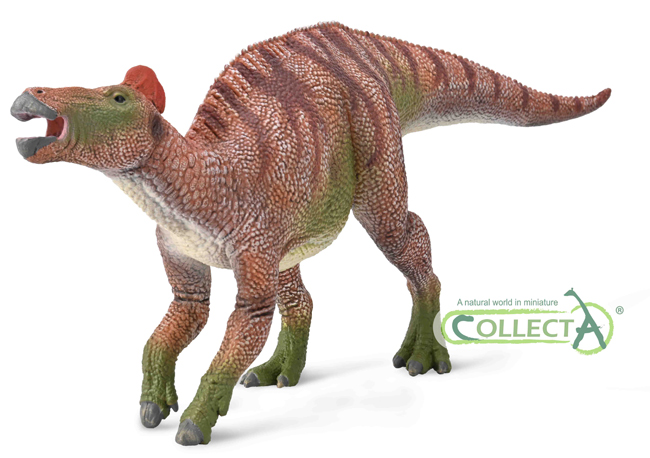
CollectA Deluxe 1:40 scale Edmontosaurus dinosaur model

The new for 2022 CollectA Deluxe 1:40 scale Edmontosaurus dinosaur model. CollectA had wanted to introduce a replica of this iconic Late Cretaceous hadrosaur for some time.

Mummified Dinosaurs

The video looks at the remarkable research into one specific dinosaur specimen. A mummified Edmontosaurus specimen nicknamed “Dakota”. The narrator explains how “dinosaur mummies” are formed and looks at the particular circumstances that led to the remarkable preservation of the “Dakota” specimen, the fossilised remains of an Edmontosaurus annectens, that were found in North Dakota, hence the specimen’s nickname.

The fossil specimen “Dakota” is on display at the North Dakota Heritage Centre and State Museum and research into this remarkable fossil is on-going.

The Everything Dinosaur YouTube channel is jam-packed with videos reviewing prehistoric animal figures, updates on the latest fossil finds, book reviews and hints and tips about model collecting. Subscribe to Everything Dinosaur on YouTube: Subscribe to Everything Dinosaur on YouTube.

Edmontosaurus Video – Question of the Day

The design team at CollectA had been wanting to create a model of this Late Cretaceous ornithischian dinosaur for some time. In our video, we look at the reason why the model has been given dark stripes on its flank and tail. We look at the fossil evidence for a soft crest and examine recent photographs that reveal that Edmontosaurus had an enlarged, weight-bearing third finger with a hoof-like nail. The narrator explains why the neck scales on the new for 2022 CollectA Edmontosaurus look very different from the scales seen on the rest of the dinosaur figure and accurate model measurements are provided.

Visit Everything Dinosaur: Everything Dinosaur.

CollectA Deluxe Edmontosaurus

As part of our planned engagement with our customers and fans of the Everything Dinosaur YouTube channel we like to ask a question in our CollectA videos. For example, at the moment, there is a Deluxe Parasaurolophus in the CollectA 1:40 scale range, this is to be joined next year by the 1:40 scale Edmontosaurus, which brings us to this query – what other Late Cretaceous duck-billed dinosaur would you like CollectA to add to their CollectA Deluxe series?

We pass on feedback to our chums at CollectA.
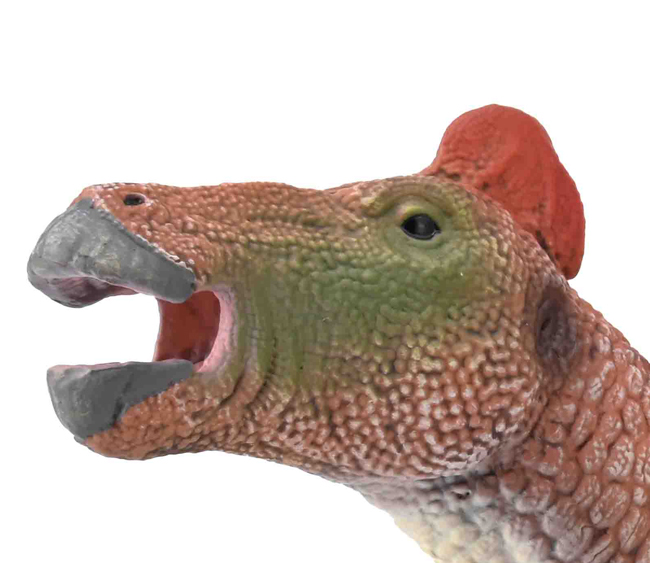
A view of the head of the CollectA Edmontosaurus

A close-up view of the head of the Edmontosaurus replica with its prominent crest made of soft tissue. This crest reflects the evidence of a soft tissue comb reported in 2013 following the analyis of the skull of an Edmontosaurus regalis.

The new CollectA Deluxe 1:40 scale Edmontosaurus dinosaur model is due to be in stock at Everything Dinosaur next year (2022).

To view the range of CollectA Deluxe prehistoric animal models currently available from Everything Dinosaur: CollectA Deluxe Prehistoric Animal Models.

3 12, 2021

Fantastic Festive Theropod Gift Ideas

By |2024-09-15T18:40:52+01:00December 3rd, 2021|Categories: Dinosaur and Prehistoric Animal News Stories, Dinosaur Fans, Educational Activities, Main Page|0 Comments

Searching for an unusual festive gift for a dinosaur fanatic can be a bit of a challenge. However, those hard-working and dedicated staff at Wollaton Hall, currently curating the Titus the T. rex is King exhibition, have it all in hand.  Make shopping for the festive season easier with a theropod dinosaur inspired gift idea.

If you are looking for new and exciting stocking filler present ideas for dinosaur fans of all ages, look no further with Titus T. rex is King unique Christmas gift vouchers and official merchandise.

Titus the T. rex Christmas gift experience

For a limited period (November until 24th December), exclusive festive-themed ticket vouchers will be available to purchase from the Wollaton Hall website. The opportunity to see a fossils of a real T. rex exhibited in England for the first time in over 100 years. Picture credit: Wollaton Hall.

For Dinosaur Fans of All Ages

This festive season, give a gift like no other with a truly unique experience to visit the first real Tyrannosaurus rex to be exhibited in England for over a hundred years.

For a limited period up until, Friday 24th December – exclusive festive-themed ticket vouchers will be available to purchase from the Wollaton Hall website. To ensure delivery in time for Christmas, the last chance to purchase the vouchers will be Sunday December 12th.

Visit the Wollaton Hall website to learn more about the Christmas 2021 offers: Visit Wollaton Hall website.

A range of special merchandise developed to accompany the exhibition is also available, including a limited-edition guidebook which provides a comprehensive overview of the discovery of Titus, the on-going research into the specimen and gives a glimpse of life 66 million years ago in the Hell Creek of Montana. There are plenty of stocking fillers including pens, bags, t-shirts and a limited-edition hardback companion guide – all ideal for dinosaur lovers of all ages.

Titus the T. rex Skull and Jaws. Dinosaur extinction.

The skull of the T. rex exhibit on display at Wollaton Hall until August 2022. Picture credit: Everything Dinosaur.

Picture credit: Everything Dinosaur

The Titus: T. rex is King exhibition at Wollaton Hall Natural History Museum (Nottingham), which runs until August 2022, is a once in a lifetime experience and the perfect gift for friends and family of all ages. This is an exciting opportunity to see an amazing theropod dinosaur exhibit.

General tickets for TITUS T. REX IS KING are on sale now, set at £12 for an adult, £8 for a child (under 16 years), students and concessions, £32 for a family ticket (two adults and two children under 16 years) and under 3s and carers have no entry fees to pay. Excludes booking fee.

Please note: this exhibition has now closed.

The award-winning Everything Dinosaur website: Dinosaur Toys and Gifts.

2 12, 2021

Sizing Up Tethyshadros Thanks to New Research

By |2024-03-10T12:00:03+00:00December 2nd, 2021|Categories: Adobe CS5, Dinosaur and Prehistoric Animal News Stories, Dinosaur Fans, Main Page, Photos/Pictures of Fossils|0 Comments

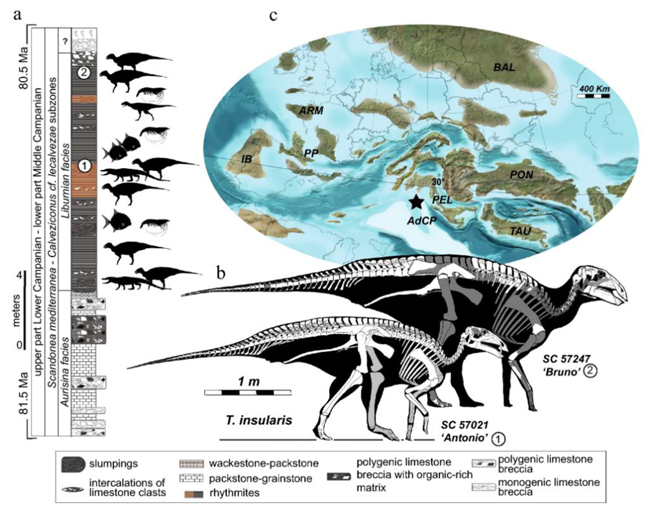
Tethyshadros (T. insularis), which was formally named and described in 2009 from a superbly preserved fossil specimen discovered in a limestone quarry near to the village of Villaggio del Pescatore (Italy), had been thought to represent a dwarf hadrosaur. However, newly published research suggests that this Late Cretaceous dinosaur was not diminutive. Its body-size fits with the range in body sizes seen in other non-hadrosaurid Eurasian hadrosauroids.

The holotype specimen SC 57021 nicknamed “Antonio” represents a sub-adult. Writing in the academic journal “Scientific Reports”, researchers describe a second, much larger specimen SC 57247, which was discovered when “Antonio” was been excavated. The larger specimen given the moniker “Bruno” is much bigger and the original hypothesis that this taxon was a dwarf form is refuted in this new study.

Tethyshadros study.
Diagram showing the stratigraphy of the site and the approximate placement of dinosaur and other fossil finds at the quarry (a) with a comparison of the holotype “Antonio” now regarded as sub-adult and the larger, much more mature specimen “Bruno” (b). Map of Europe in the Campanian showing the location of the island where Tethyshadros lived, the black star indicates the position (c). Picture credit: Chiarenza et al

Insular Dwarfism

During the Late Cretaceous much of Europe was covered by sea. There were numerous islands and these fragmented landmasses were populated by dinosaurs, many of which were dwarf forms when compared with closely related genera known from other continents. This was accepted as fossil evidence for the “island rule”, a theory, famously postulated by the 20th Century polymath Baron Franz Nopcsa von Felső-Szilvás. He proposed that the limited resources such as food, water and space on islands would result in a reduction of the size of animals that lived there. These island dwelling populations would become smaller over many generations when compared to their continental counterparts. Nopcsa referred to this idea as “insular dwarfism”.

The palaeo-Mediterranean region is best represented by the Villaggio del Pescatore quarry as it preserves a record of the fauna to be found on one of these islands. In this new research, this location is critically re-evaluated as early Campanian in age. This is significant, as it means that Tethyshadros lived prior to the final fragmentation stages of the European Archipelago. Tethyshadros lived prior to the emergence of the dwarf European taxa such as those animals associated with Hațeg Island which is geologically younger (Maastrichtian faunal stage of the Late Cretaceous).

Tethyshadros Fossils
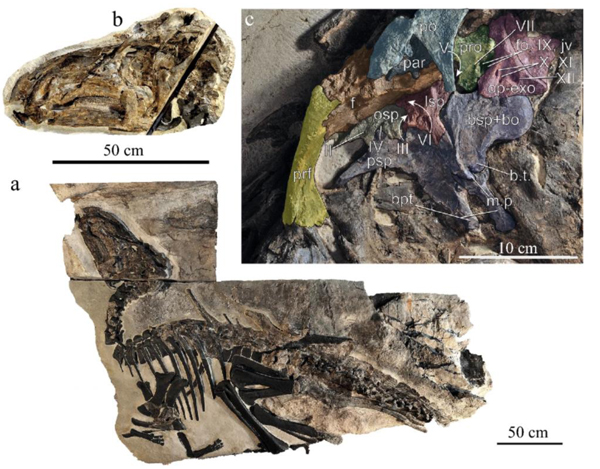
The new skeleton of Tethyshadros insularis “Bruno” (a) preserving details of its cranial anatomy such as the nearly complete skull (b) exposing its braincase (c) adding important information for the anatomy and systematic of this taxon. Elements in black are reconstructed. Picture credit: Chiarenza et al.

Examination of the bones of “Bruno” (histological study), confirms that these dinosaurs were bigger than previously thought. The research team, which included Alfio Alessandro Chiarenza (Universidade de Vigo, Spain) and Matteo Fabbri (Field Museum of Natural History, Chicago, USA), conducted a phylogenetic analysis examining the body size of Tethyshadros compared to related species. They discovered that the body size of T. insularis is within the range of the body sizes of other non-hadrosaurid Eurasian hadrosauroids

Tethyshadros was not a diminutive form, it was not a “pygmy” dinosaur. Team members at Everything Dinosaur have updated their Tethyshadros fact sheet which is supplied with sales of Tethyshadros figures.

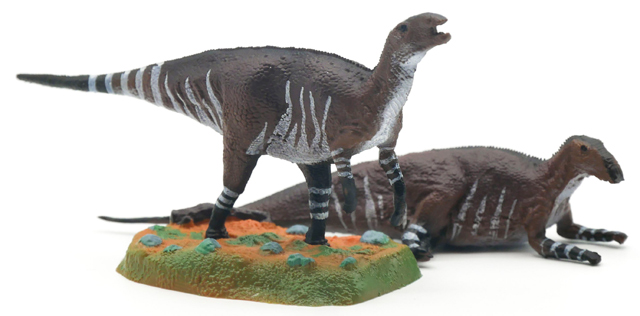
Although “Antonio” and “Bruno” perhaps represent the most complete and best preserved of all the European dinosaur fossils discovered to date, Tethyshadros does not feature in many model ranges. However, a pair of Tethyshadros figures was added to the Wild Past series last year (2021).

To view the Wild Past model range: Wild Past Prehistoric Animal Models.

Wild Past Tethyshadros dinosaur models
The Wild Past Tethyshadros dinosaur models. Everything Dinosaur’s free fact sheet that is sent out with these models has been updated after the publication of the new T. insularis research.

The scientific paper: “An Italian dinosaur Lagerstätte reveals the tempo and mode of hadrosauriform body size evolution” by Alfio Alessandro Chiarenza, Matteo Fabbri, Lorenzo Consorti, Marco Muscioni, David C. Evans, Juan L. Cantalapiedra and Federico Fanti published in Scientific Reports.

1 12, 2021

New Armoured Dinosaur from Chile

By |2024-08-27T07:34:50+01:00December 1st, 2021|Categories: Adobe CS5, Dinosaur and Prehistoric Animal News Stories, Dinosaur Fans, Main Page, Palaeontological articles, Photos/Pictures of Fossils|0 Comments

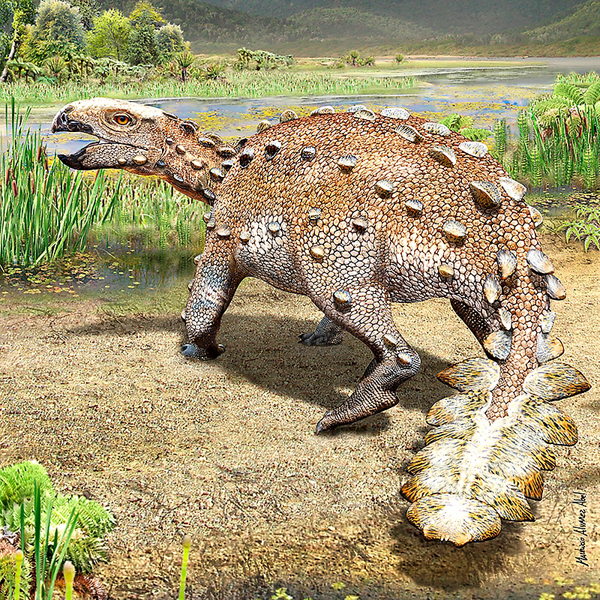
Scientists writing in the journal “Nature” have announced the discovery of a new species of Late Cretaceous ankylosaur from southernmost Chile. The dinosaur named Stegouros elengassen evolved a large tail weapon, unlike any other tail weapon known in the Dinosauria. Stegouros had a flat, frond-like structure formed by seven pairs of laterally projecting osteoderms. This formidable tail weapon superficially resembles a macuahuitl, a frightening war club used by Aztec warriors.

Stegouros life reconstruction

A life reconstruction of the newly described Gondwana ankylosaur Stegouros elengassen. Picture credit: Mauricio Álvarez.

Picture credit: Mauricio Álvarez

A Combination of Stegosaur and Ankylosaur Anatomical Characteristics

The researchers from the University of Chile (Universidad de Chile) in Santiago report on an articulated, nearly complete fossil specimen representing a single animal that was excavated by a field team in February 2018 from sediments relating to the Dorotea Formation in the province of Ultima Esperanza in southern Chile. Stegouros was very small for an ankylosaur, measuring around two metres in length and weighing approximately 100 kilograms.

It shows ankylosaurian cranial characters, but a largely ancestral postcranial skeleton, with some stegosaur-like characters.

A phylogenetic analysis places Stegouros in the Ankylosauria and the research team postulate that it is closely related to other ankylosaurs known from southern Gondwana such as Kunbarrasaurus from Australia and Antarctopelta, fossils of which were found on James Ross Island off the Antarctic Peninsula.

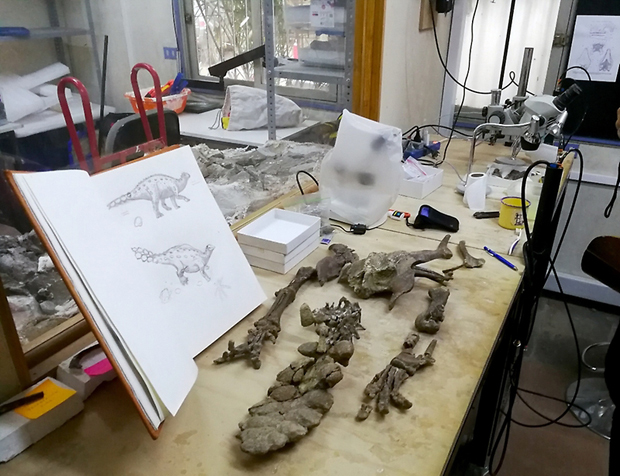
Stegouros fossil excavation.

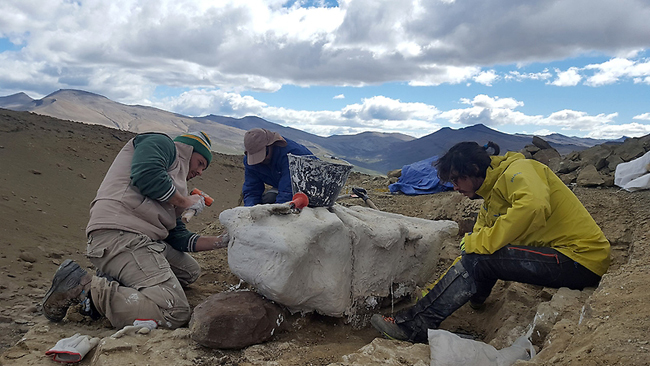
Field team members jacket the fossilised remains of Stegouros. Picture credit: Universidad de Chile.

Picture credit: Universidad de Chile

The Parankylosauria Clade

The researchers propose the establishment of a new clade of ankylosaurs – the Parankylosauria which consists of basal ankylosaurs that split from the main ankylosaurian lineage during the Middle Jurassic, although the fossil evidence for this is currently lacking with Stegouros, Antarctopelta and Kunbarrasaurus forming part of a ghost lineage of basal ankylosaurs with origins back in the mid-Jurassic.

Stegouros fossil remains.

The posterior of the Stegouros specimen with the armoured tail clearly shown. Picture credit: Universidad de Chile.

A Transitional Ankylosaur

Commenting on the significance of this fossil discovery, lead author of the scientific paper, Sergio Soto, a researcher at the University of Chile stated that the fossilised remains of S. elengassen represent a “Rosetta Stone” for deciphering the fragmentary fossils of other ankylosaurs from southern Gondwana.

He added:

“Stegouros is an evolutionary link between ankylosaurs and other older lineages of armoured dinosaurs. Stegouros has only some of the features normally found in ankylosaurs, particularly the skull, but many others are absent. It also has some traits similar to stegosaurs, inherited from a common ancestor with them, but that other ankylosaurs lost in evolution.”

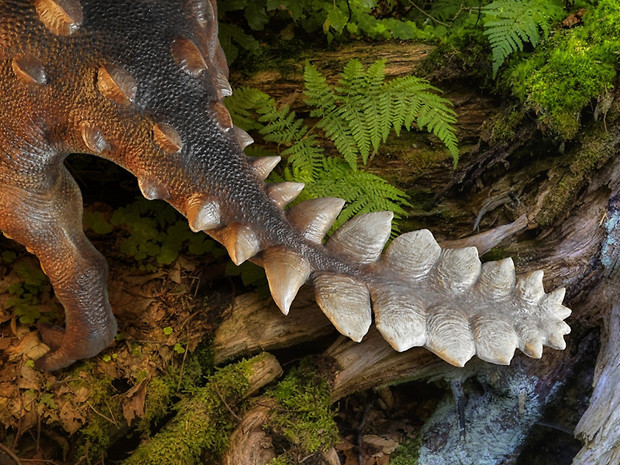
A close-up view of the armoured tail of Stegouros elengassen.

A close-up view of the armoured tail of Stegouros elengassen. The tail club served as a defensive structure perhaps used in intraspecific combat or to deter attacks from predators. Picture credit: Universidad de Chile.

Picture credit: Universidad de Chile

Stegouros roamed the Chilean Patagonia around 74 million years ago. The genus name translates as “roofed tail”, whilst the species name comes from a mythical armoured monster from the folklore of the indigenous Tehuelche people.

Note

CollectA introduced a 1:6 scale figure of this remarkable dinosaur in 2023.  Safari Ltd also added a Stegouros model to their range in 2024.

CollectA Deluxe 1:6 scale Stegouros elengassen dinosaur model

The CollectA Deluxe 1:6 scale Stegouros elengassen dinosaur model – due to be available mid 2023.

To view the range of CollectA Deluxe prehistoric animal figures available from Everything Dinosaur: CollectA Deluxe Prehistoric Life Models.

The scientific paper: “Bizarre tail weaponry in a transitional ankylosaur from subantarctic Chile” by Sergio Soto-Acuña, Alexander O. Vargas, Jonatan Kaluza, Marcelo A. Leppe, Joao F. Botelho, José Palma-Liberona, Carolina Simon-Gutstein, Roy A. Fernández, Héctor Ortiz, Verónica Milla, Bárbara Aravena, Leslie M. E. Manríquez, Jhonatan Alarcón-Muñoz, Juan Pablo Pino, Cristine Trevisan, Héctor Mansilla, Luis Felipe Hinojosa, Vicente Muñoz-Walther and David Rubilar-Rogers published in the journal Nature.

The Everything Dinosaur website: Dinosaur Toys and Models,

30 11, 2021

Effigia – A Triassic Browser According to New Research

By |2024-08-26T20:22:54+01:00November 30th, 2021|Categories: Dinosaur and Prehistoric Animal News Stories, Dinosaur Fans, Main Page, Palaeontological articles|0 Comments

A Triassic herbivore, known for its supposed similarities to a modern-day ostrich and ornithomimid dinosaurs has been revealed to have an entirely different approach to feeding than previously thought, according to newly published research. The new discovery reveals a much broader diversity of herbivore behaviour during the Triassic period than has been recognised to date.

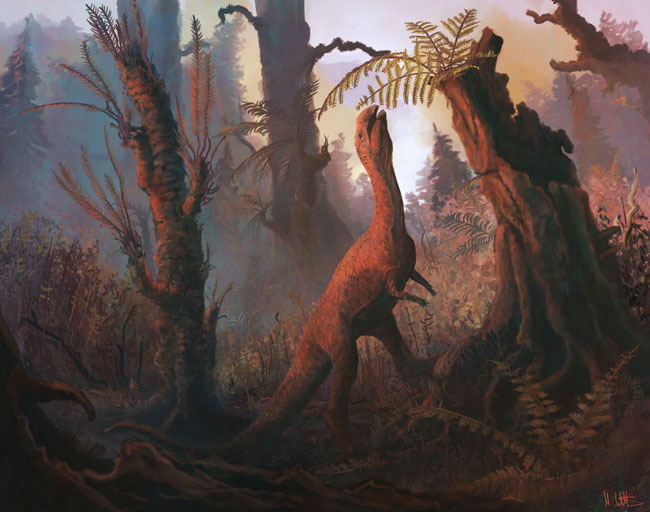
Effigia life reconstruction

Effigia life reconstruction. New research has clarified the mode of feeding for this Late Triassic archosaur. It was probably a browser. Picture credit: Mark Witton.

Picture credit: Mark Witton

Effigia okeeffeae

Formally named and described in 2006 (Nesbitt and Norell), although fossils of this little archosaur on the crocodilian lineage of the Archosauria family tree were first found in the 1940s, Effigia (E. okeeffeae) roamed New Mexico around 205 million years ago.

Fossil remains had been relatively poorly preserved and the skull, in particular, was quite badly deformed, making accurate reconstruction challenging. Early analysis of the specimen concluded that it belonged to the group of reptiles that includes crocodilians and birds and which started to flourish in the Triassic period. Although more closely related to crocodilians, Effigia’s lightweight body, elongated neck, large eyes and beak shared many similarities with a modern-day ostrich, leading researchers to believe the animal fed by pecking plant material from the ground.

A new study of the fossil material, undertaken by experts at the University of Birmingham, has revealed this animal was probably an entirely different type of herbivore. The research, carried out in partnership with experts at the University of Bristol, University College London, University of York, Virginia Tech and the Natural History Museum in London, has been published in the academic journal “The Anatomical Record”.

The researchers examined CT scans of Effigia’s skull which permitted a much more accurate and three-dimensional reconstruction of the animal. This included new information about the morphology of the cranium, such as a more rounded, bulbous brain cavity and curved upper and lower jaws. Unlike the bill of an ostrich, which is more rounded, Effigia’s bill is concave with jaws that open and close a bit like a pair of shears.

Examining Different Forces on the Skull

The team used this information to model the effects of different forces acting on the skull, including what happens when the animal pecks at the ground. By modelling the forces the skull would need to withstand in order to feed by pecking, the researchers calculated that Effigia’s skull would probably have shattered. Instead, they suggest, the animal probably used its jaws to snip off and nibble pieces of soft plant material such as young shoots, or ferns. Effigia was likely to have been a selective browser.

Commenting on the significance of the research into the feeding habits of this Late Triassic archosaur, an animal that when first discovered was thought to be a dinosaur, lead researcher Dr Jordan Bestwick (University of Birmingham), stated:

“The herbivores we already recognise in the Triassic period fed either by digging for roots, such as the pig-like aetosaurs, or reaching for leaves high up in the treetops, like the long-necked sauropods. These two-legged browsers with a weak bite are unique to this period and show a previously unrecognised diversity among the herbivores of this period.”

Everything Dinosaur acknowledges the assistance of a media release from the University of Birmingham in the compilation of this article.

The scientific paper: “Cranial functional morphology of the pseudosuchian Effigia and implications for its ecological role in the Triassic” by Jordan Bestwick, Andrew S. Jones, Sterling J. Nesbitt, Stephan Lautenschlager, Emily J. Rayfield, Andrew R. Cuff, David J. Button, Paul M. Barrett, Laura B. Porro, Richard J. Butler published in The Anatomical Record.

The Everything Dinosaur website: Dinosaur Models and Toys.

29 11, 2021

The New PNSO “Logan” Nanotyrannus is Reviewed

By |2024-05-11T23:06:48+01:00November 29th, 2021|Categories: Adobe CS5, Dinosaur Fans, Everything Dinosaur Products, Main Page, Product Reviews|0 Comments

The recently introduced PNSO Logan the Nanotyrannus dinosaur figure has divided model collectors and dinosaur fans. Is Nanotyrannus lancensis a valid species or do the fossils assigned to this theropod represent juvenile examples of Tyrannosaurus rex?

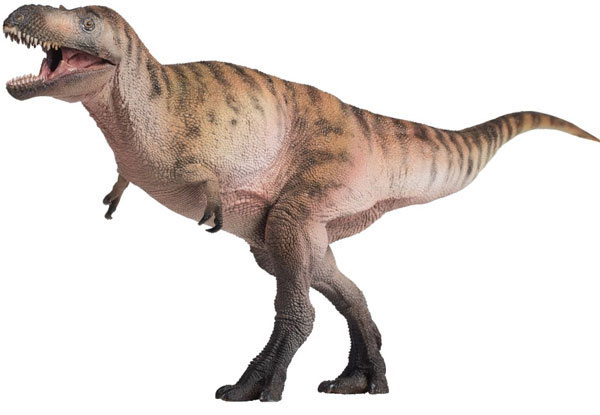
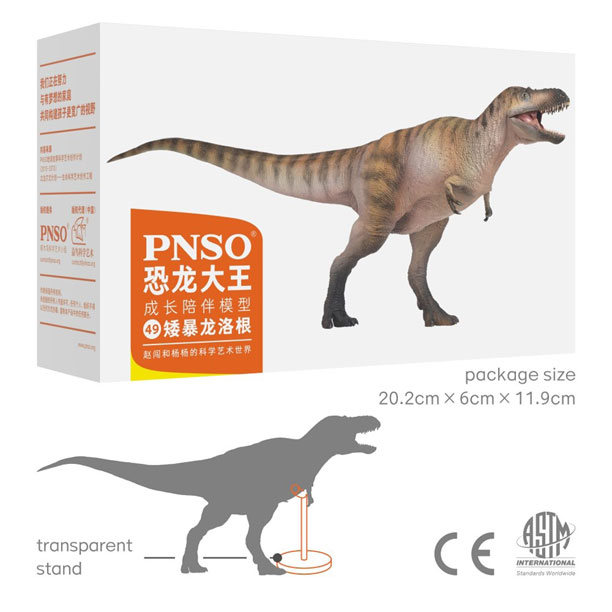
PNSO Nanotyrannus dinosaur model.
The new for 2021 PNSO Nanotyrannus dinosaur model. Is Nanotyrannus lancensis a valid species?

The consensus view amongst most palaeontologists seems to favour the latter interpretation, that Nanotyrannus is not a valid genus and that the fossil specimens represent juvenile tyrannosaurs but what about the actual Nanotyrannus model itself? One Everything Dinosaur customer, William offers an opinion.

PNSO “Logan” the Nanotyrannus

Logan is a fantastic little guy and whichever camp you are in he’s a perfect example of a top-of-the-line Nanotyrannus lancensis or medium-sized juvenile Tyrannosaurus rex figure. You decide what he is to be in your collection.”

The reviewer praised the detail on the head commenting on the articulated lower jaw and complimented the shape of the skull that provides an accurate reflection of the fossil record.

Tongue placement was highlighted and its position towards the rear of the mouth commented upon and the finely crafted lacrimal crests earned the reviewer’s approval.

PNSO Nanotyrannus dinosaur model with an articulated jaw.
Like most of the other mid-size PNSO theropod figures, Logan the Nanotyrannus has an articulated lower jaw.

Visit the Everything Dinosaur website: Everything Dinosaur.

Longer Forelimbs Reminiscent of Allosaurids

Scientists are aware that the body shape of Late Cretaceous tyrannosaurs changed radically as they grew. The limbs were proportionately longer and the longer forelimbs of this PNSO figure reminded the reviewer of the limbs of allosaurids. The limb shape contrasts nicely with PNSO T. rex figures, Andrea the female T. rex for example.

William commented upon the well-sculpted legs and feet and described juvenile tyrannosaurs/Nanotyrannus as “like Cretaceous wolverines”.

The packaging was described as “superb” and the box containing the Nanotyrannus figure includes a detailed illustrated booklet and a clear, plastic support stand for the model.

PNSO Nanotyrannus packaging
The new PNSO mid-size range Nanotyrannus is supplied with a clear support stand.

When discussing the colour scheme chosen for this theropod, the reviewer stated that the dinosaur model had been painted in a rich, warm beige, with chocolate brown patches. The painting around the eyes was highlighted and the dark stripes on the flanks praised.

As with previous model reviews, William summarised the figure’s vital statistics.

Model Dimensions

Length: 6.5 inches.

Height: 2.5 inches.

Scale: 1:30.

Final Thoughts

In conclusion, William stated:

“The wee guy is a must for your collection be he a dwarf tyrant or a tyrant lizard king. Add him and you will see for yourself, he may be wee, but he is mighty!”

To view the PNSO Nanotyrannus figure and the rest of the prehistoric animal models available from Everything Dinosaur: PNSO Age of Dinosaurs.

28 11, 2021

Exclusive Feefo 5-star Customer Review

By |2024-05-12T06:52:39+01:00November 28th, 2021|Categories: Dinosaur Fans, Everything Dinosaur News and Updates, Main Page, Press Releases|0 Comments

Our thanks to all the hundreds of Everything Dinosaur customers who leave feedback and reviews on our website and on our Feefo review page. Feefo is an independent ratings company and they email our customers requesting comments and feedback about products and on our customer service.

Everything Dinosaur is one of the highest rated companies for product quality and customer service in Feefo’s considerable portfolio. We consistently win awards for our customer service.

The Feefo platinum service award.
The Feefo Platinum Service Award. Everything Dinosaur has been awarded this accolade two years running.

Here is a typical review which we received recently:

5-stars for Everything Dinosaur

William, a regular Everything Dinosaur customer wrote:

“The lines of stock that Everything Dinosaur carries are of the highest quality and are safety tested for their younger customers. They have fantastic products that cannot be purchased anywhere else. The customer service is superior to any other company I have ever dealt with.”

Praising the Everything Dinosaur Blog

The reviewer went onto praise this blog, stating that the Everything Dinosaur blog covers a wide range of subjects from the earliest dinosaurs to the last of the megafauna that became extinct around 12,000 years ago.

Everything Dinosaur Blog
Examples of recent articles published on the Everything Dinosaur blog.

William concluded his review by stating:

“Every model I receive comes with an individual information sheet up to date with latest information on the prehistoric animal. I intend to expand my collection, but it wouldn’t even exist without Everything Dinosaur they are that important to me.”

Our thanks to William and every other customer who provides feedback and comments to Everything Dinosaur.

Visit the Everything Dinosaur website: Everything Dinosaur.

27 11, 2021

The New CollectA Kamuysaurus Dinosaur Model

By |2024-08-26T18:11:14+01:00November 27th, 2021|Categories: Adobe CS5, Dinosaur Fans, Everything Dinosaur Products, Main Page, Photos of Everything Dinosaur Products, Press Releases|0 Comments

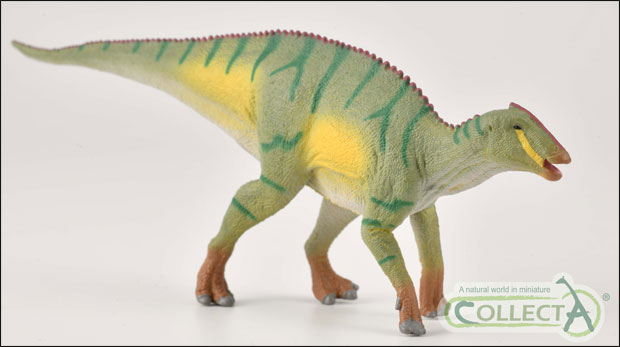
With all the attention given to the recent new for 2022 CollectA prehistoric animal models, some of the 2021 figures made by CollectA can be overlooked. We have posted up some pictures of the excellent CollectA Prehistoric Life Kamuysaurus dinosaur model which was introduced this year (spring 2021).

The new for 2021 CollectA Kamuysaurus dinosaur model

The new for 2021 CollectA Kamuysaurus dinosaur model continues the trend for CollectA to make replicas of the unique Japanese dinosaur biota. Kamuysaurus follows on from Fukuiraptor and Fukuisaurus that were introduced previously. Picture credit: Everything Dinosaur.

Picture credit: Everything Dinosaur

Kamuysaurus japonicus

Named and described in 2019, the design team at CollectA were quick to add this hadrosaurid to their range of not to scale prehistoric animal models. When Everything Dinosaur sells one of these excellent figures, we send out a Kamuysaurus fact sheet that provides more information on this Late Cretaceous herbivore. These fact sheets are an integral part of the company’s education programme.

As part of our project to research and write a Kamuysaurus fact sheet we commissioned a scale drawing of the dinosaur.

Kamuysaurus scale drawing

A scale drawing of the hadrosaurid Kamuysaurus (K. japonicus) that was formally named and described in 2019. This Late Cretaceous duck-billed dinosaur is estimated to have measured around 8 metres in length and weighed 4 tonnes. Picture credit: Everything Dinosaur.

Picture credit: Everything Dinosaur

In 2021, CollectA introduced a total of eleven prehistoric animal models and a mini prehistoric animal model box set. The Kamuysaurus model was one of six not to scale figures to be added by the company. As this year draws to a close, team members at Everything Dinosaur remember the introduction of the CollectA Prehistoric Life Kamuysaurus dinosaur model in early 2021.

CollectA Kamusaurus dinosaur model.

The CollectA Age of Dinosaurs Kamuysaurus model. A replica of a hadrosaurid from the Late Cretaceous of Japan.

To view the range of CollectA Prehistoric Life models and figures in stock at Everything Dinosaur: CollectA Dinosaur and Prehistoric Animal Models.

Visit the award-winning Everything Dinosaur website: Dinosaur Models.

26 11, 2021

New CollectA Models for 2022 (Final Part)

By |2024-08-26T17:53:36+01:00November 26th, 2021|Categories: Adobe CS5, Dinosaur Fans, Everything Dinosaur News and Updates, Everything Dinosaur Products, Main Page, Photos of Everything Dinosaur Products, Press Releases|2 Comments

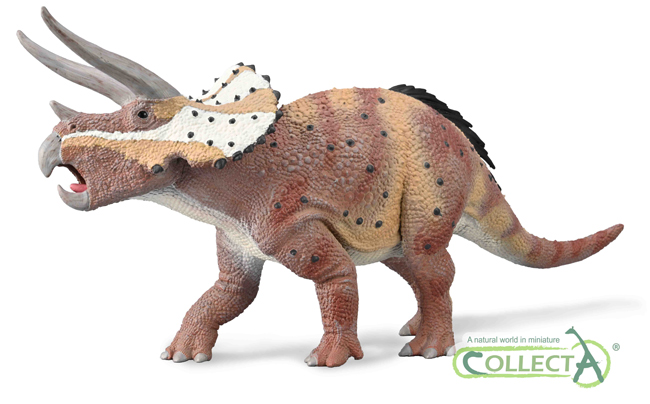
In our fourth and final blog post about new CollectA prehistoric animal models for 2022, we announce that a new version of the CollectA Deluxe 1:40 scale Triceratops will be introduced. The figure represents the species Triceratops horridus, the geologically older of the two Triceratops species formally recognised.

The model is due to be in stock at Everything Dinosaur around mid-2022.

CollectA Deluxe Triceratops horridus
The new for 2022 CollectA Deluxe Triceratops dinosaur model.

The image (above), shows the prototype, pre-production model the actual figure will have an articulated jaw.

T. horridus – Horrible Horned Face

Triceratops horridus is known from the Lower Hell Creek Formation dating from approximately 67.5 million years ago. Triceratops bones and teeth are relatively common in this part of the Hell Creek Formation and studies have shown that Triceratops fossils make up about 40% of the dinosaur fossil material. The robust skulls preserve relatively well and compared to its body size, the skull of this horned dinosaur was proportionately one of the largest known of any vertebrate. CollectA have chosen to give their new Triceratops a muted colour tone, with countershading on the underside. The exceptions to this are the neck frill and the side of the face with its large patches of white.

Those white flashes certainly give “horrible three-horned face” a striking appearance.

A close-up view of the head of the new for 2022 Collect Deluxe Triceratops.
A close-up view of the head of the new for 2022 CollectA Deluxe Triceratops model.

A Model Based on the Latest Scientific Evidence

Although Triceratops is a very familiar dinosaur to members of the public, after all, it has appeared in films, television documentaries, novels, video games and even on stamps, vertebrate palaeontologists acknowledge that they still have a lot to learn about “three-horned face”.

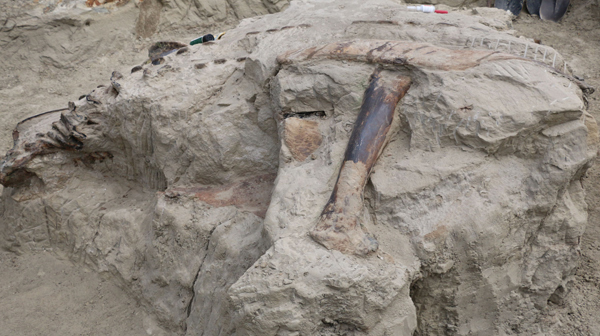
There are lots of Triceratops fossils to found in the famous Hell Creek and Lance Formations but very few articulated, specimens have been excavated. The discovery of a superb T. horridus specimen in 2014 has helped palaeontologists to piece together more information about this iconic prehistoric animal.

The specimen was collected from private land in Montana (USA). The bones found represent about 87% of the entire skeleton and it will form part of a major dinosaur display at Melbourne Museum. The skull and neck frill are the most complete of any known Triceratops specimen (>99% complete) and the assembled frill measures over 1.48 metres wide.

The Triceratops fossil being excavated.
The Triceratops fossils in the quarry. The skeleton is slowly being excavated and the bones exposed. Picture credit: Museums Victoria.

The design team at CollectA have utilised some of the research into the Montana specimen along with recently published studies, reports and photographs on other Triceratops horridus specimens to create a model that reflects the latest scientific thinking.

Commenting on the significance of the Montana Triceratops specimen, Dr Erich Fitzgerald (Museums Victoria’s senior curator of palaeontology) stated:

“This is the Rosetta Stone for understanding Triceratops. Despite its popularity, there are still many unanswered questions about the anatomy and palaeobiology of Triceratops. This fossil comprises hundreds of bones including a complete skull and the entire vertebral column which will help us unlock mysteries about how this species lived 67 million years ago.”

The Skin of Triceratops

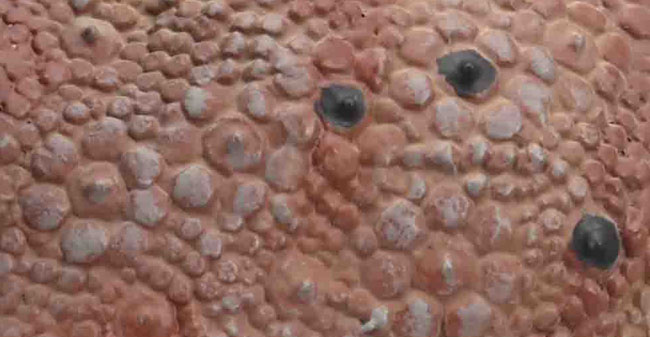
The new for 2022 CollectA Deluxe Triceratops replica has skin textures and scales that reflect what has been recorded in Triceratops horridus skin impressions.

The preserved skin of a Triceratops specimen on display at the Houston Museum of Natural Science (Texas, USA) indicates that this horned dinosaur had skin unlike any other ornithschian. It had substantial hexagonal tubercles (rounded, prominent scales) along with additional enormous (>10 cm across) tubercles with conical projections.

These skin impressions come from a specimen excavated in Wyoming and nick-named “Lane”. No formal scientific description has been published but the photographs that have been made available suggest that Triceratops had skin somewhat reminiscent of a Saltasaurus (titanosaur).

Model designer Anthony Beeson explained:

“The new CollectA model incorporates polygonal rosettes with central nipple-scales.”

CollectA Deluxe Triceratops (new for 2022) skin impressions
A close-up view of the skin texture on the new for 2022 CollectA Deluxe 1:40 scale Triceratops figure. The details on the skin reflect what is known from the fossil record.

Model Measurements

The new for 2022 CollectA Deluxe Triceratops horridus measures 28 cm in length and those impressive brow horns are some 13.6 cm off the ground. The figure has been given a scale of 1:40.

A spokesperson from Everything Dinosaur confirmed that this model is scheduled to be available around the middle of next year (2022).

To view the range of CollectA Prehistoric Life figures available from Everything Dinosaur: CollectA Prehistoric Life.

To view the range of CollectA Deluxe prehistoric animals available from Everything Dinosaur: CollectA Deluxe Prehistoric Animal Models.
The Everything Dinosaur website: Dinosaur Models.

25 11, 2021

William Reviews the New PNSO “Andrea” Female T. rex

By |2024-08-26T17:50:52+01:00November 25th, 2021|Categories: Adobe CS5, Dinosaur Fans, Everything Dinosaur Products, Main Page, Product Reviews|0 Comments

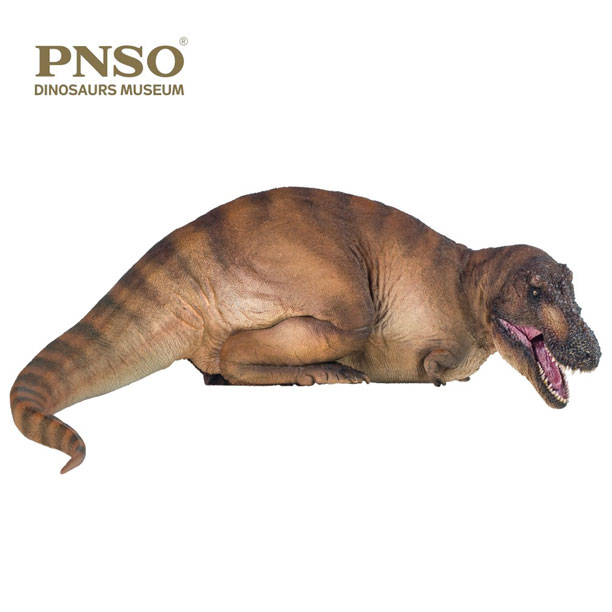
Dinosaur fan and model enthusiast William sent into Everything Dinosaur his review of the PNSO Andrea the female T. rex figure. William has been avidly collecting PNSO prehistoric animal models and figures for a while now. He was delighted when “Wilson” a new version of Tyrannosaurus rex was introduced recently and has been able to acquire the “Andrea” female T. rex figure so that the male and his mate can be together.

PNSO Andrea the female T. rex dinosaur model in lateral view
Although the position of the hind legs in this resting pose is controversial it is great to see a manufacturer introduce a figure of a theropod dinosaur in a prone, resting position. The reviewer praised the position of the front limbs and commented on the detailed musculature hinted at by the skin folds.

PNSO Female T. rex Model Review

William started his review by praising PNSO for all the wonderful figures that they have introduced this year and he was looking forward to seeing what marvels the company would launch in 2022.

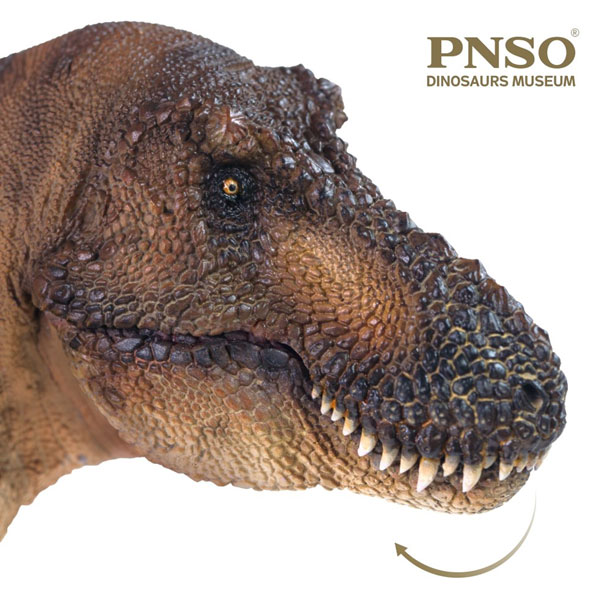
The head sculpt is highlighted for its detail. William commented that the artist Zhao Chuang did his research into whether this theropod had lips, explaining that osteological research has identified large facial scales present beyond the margin of the upper mandible and therefore no lips have been added to this figure. The fully articulated jaw is well designed and the lower jaw fits into the upper jaw exactly. As the dinosaur is in a resting pose, to display it with the jaws open, the model’s head must be positioned over the edge of a shelf or slightly raised.

The eyes are placed correctly to indicate stereoscopic/binocular version and the sclera is coloured a dark yellow/reddish hue with a black pupil. William stated that the eyesight of this apex predator was believed to be particularly acute T. rex could pick out prey even when the intended victim was hidden in cover.

Andrea the female T. rex dinosaur model has an articulated jaw
PNSO Andrea the female T. rex dinosaur model has an articulated lower jaw.

In Praise of the Skin and Texture

The painstaking care taken to get the skin texture on the head so detailed is highlighted by the reviewer.

He comments that:

“The lacrimal crests are on the money and converge onto the nasal crest. No shrink wrapping on his antorbital fenestrae and orbits.”

The robust teeth are impressive and the mouth has been painted correctly in a rich, wet pink to give a natural look and William stated that if this dinosaur lost a tooth, then a replacement would erupt from the jaw. Tongue placement was accurate with a nasal opening in the roof of the palate also observed. William praised PNSO for these additional highlights.

The stocky body shape was commented upon in William’s review, both the male PNSO T. rex figure “Wilson” and his partner are regarded as having “ample heft”, the arms and figures of Andrea were praised. The shoulder muscles hidden under the skin folds were discussed and the muscles depicted in the tiny arms highlighted. William commented that the arms held close to the body gave the figure a natural resting pose.

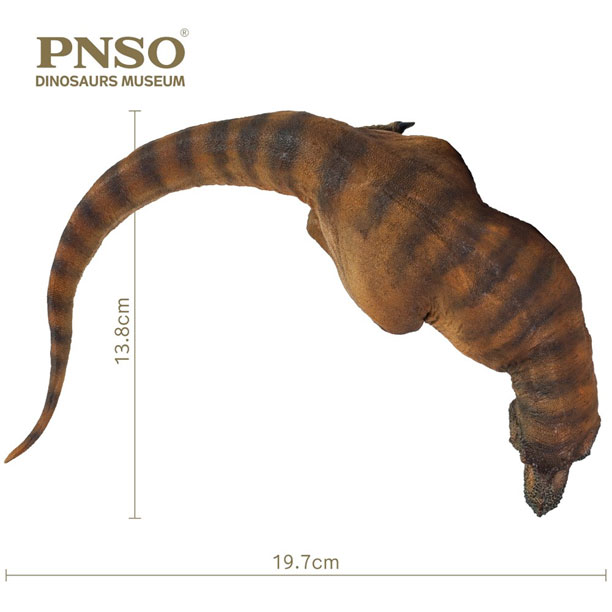
PNSO Andrea the female T. rex in dorsal view.
PNSO Andrea the T. rex measures 19.7 cm long, accounting for the curve of the tail. The model is 13.8 cm wide and it has a stated scale of 1:35. The reviewer preferred to give the model’s measurements in imperial units.

Model Supplied with a Beautifully Illustrated Book

As befits a replica from PNSO with the talented palaeoartist Zhao Chuang on their team, this T. rex model comes with a beautifully illustrated book. The narrator comments on the position of the hind legs the presence of a cloaca and comments that this meat-eater looks poised ready to rise from her slumbers adding:

“Andrea’s powerful leg muscles are outstanding we can imagine her rising straight up in heartbeat to defend or feed.”

William explained that this figure is supplied in a superb white box, there is no need for a support stand for this dinosaur model, the prone position of the model is perfectly stable.

Comments on the Colour

The female T. rex has a much darker face with rich hues consisting of blacks and charcoals from the tip of the snout running along the upper jaw line rising upwards around the eyes with a column of black reaching up to fuse with the darkened crown of the skull. The reviewer comments that the chosen colour scheme “sets the head sculpt off to perfection”.

Model Dimensions

William states that the PNSO “Andrea” the female T. rex measures:

  • Length 12 inches
  • Height 2.75 inches

He concludes his review by stating:

“Andrea is worth adding to your collection! She is a true Tyrant Queen and accurate rexes come but once in one’s life.”

Our thanks to William for sending into Everything Dinosaur his review.

To view the PNSO female T. rex figure and the rest of the models in the PNSO prehistoric animals range: PNSO Age of Dinosaurs.

The Everything Dinosaur website: Dinosaur Toys.

Go to Top