It was the English engineer William Smith (1769-1839), who pioneered the idea that different strata located in different places could be correlated using the fossils that were contained therein. Although, his astonishing feat of compiling the world’s first geological map did not receive all the recognition it deserved, after all, it was only later in his life that his achievements gained prominence in scientific circles, William Smith is regarded by many as the “father of geology”.
As he examined different layers of rock he perceived that any succession of fossils could represent particular periods of geological time. Furthermore, the age of widely separated strata could be compared and correlated using the fossils that they contained. These fossils helped to indicate the relative age of various rock formations. Thus, Smith helped to lay the foundations for the science of biostratigraphy. ammonites and other invertebrate fossils are extremely important in the relative dating process.
Different Fossils of Ammonites Associated with Different Layers of Rock – Building a Biostratigraphical Column
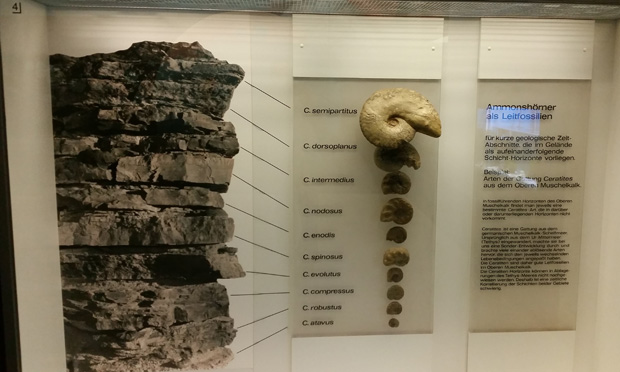
Demonstrating a sequence of ammonite fossils identified from specific strata that helps to form a biostratigraphic column.Picture credit: Everything Dinosaur.
Picture credit: Everything Dinosaur
Ammonite Biozones
The above photograph was taken by an Everything Dinosaur team member on a recent visit to the Naturmuseum Senckenberg (Frankfurt, Germany), it demonstrates that different types of ammonite fossils are associated with different layers of rocks in a sequence of deposition. The stratigraphic column can therefore be divided into zones (biozones), that are characterised by one or more particular type of fossil. The sequence of these biozones in the correct order, creates a biostratigraphical column.
Ammonites are ideal zone fossil candidates. These cephalopods were ubiquitous in Mesozoic marine deposits, their shells formed abundant fossils and ammonites evolved rapidly into many distinctive types (species). We congratulate the Museum for such a beautifully created and instructive display.
A new species of large, toothless pterosaur has been described based on fossil specimens excavated from the “cemitério dos pterossauros” (pterosaur graveyard), in southern Brazil. This new flying reptile has been named Keresdrakon vilsoni. The researchers, writing in the academic journal “Anais da Academia Brasileira de Ciências” conclude that Keresdrakon co-existed with another, smaller and, based on the fossil evidence more numerous, pterosaur (Caiuajara dobruskii). In addition, the two distinct pterosaurs coexisted with a theropod dinosaur (Vespersaurus paranaensis) and together they provide an unique insight into an ancient desert ecosystem.
The Palaeoenvironment of the “Cemitério dos Pterossauros”
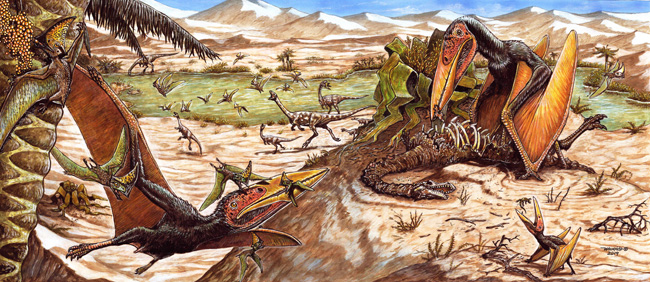
Keresdrakon life reconstruction, feeding on the carcase of a Vespersaurus.
Picture credit: Maurilio Oliveira
Interpreting the Palaeoenvironment
The age of the strata is disputed. Some authors favour a Turonian to Campanian age indicating Upper Cretaceous deposits, whilst other scientists have suggested that the rocks might be Lower Cretaceous in age (Aptian to Albian). The bonebeds associated with these sandstones indicate a congregation of vertebrates in what was probably an interdunal wetland in the middle of a desert. Caiuajara is interpreted as a likely frugivore, a feeding behaviour associated with other members of the Tapejaridae family. Although, the much larger, edentulous (toothless), Keresdrakon probably filled a different niche in the ecosystem. Its fossils are much rarer than those of Caiuajara, the researchers infer that Keresdrakon vilsoni might have behaved as an opportunistic predator or a scavenger.
Analysis of this pterosaur’s beak suggest that it did not have a strong bite, so overcoming larger prey such as the theropod Vespersaurus might have been difficult for Keresdrakon, but it could have fed on carrion, as depicted in the above illustration.
Keresdrakon vilsoni
The authors of the scientific paper, which include pterosaur expert Alexander Kellner of the Museu Nacional/Universidade Federal do Rio de Janeiro (Brazil), consider Keresdrakon to be the equivalent of a modern-day Marabou stork (Leptoptilos crumenifer), which scavenges but also eats any small animal that it can swallow.
The scientists speculate that K. vilsoni might have eaten juvenile Caiuajara or even hatchlings and eggs. Given the geological and fossil evidence, it is likely that these two pterosaurs along with Vespersaurus co-existed together and that the “cemitério dos pterossauros”, demonstrates evidence of sympatry in the Pterosauria, if this is the case, then these sandstone deposits of uncertain age in Paraná State represent an extremely significant discovery for vertebrate palaeontologists.
The Holotype Fossil Material of Keresdrakon vilsoni
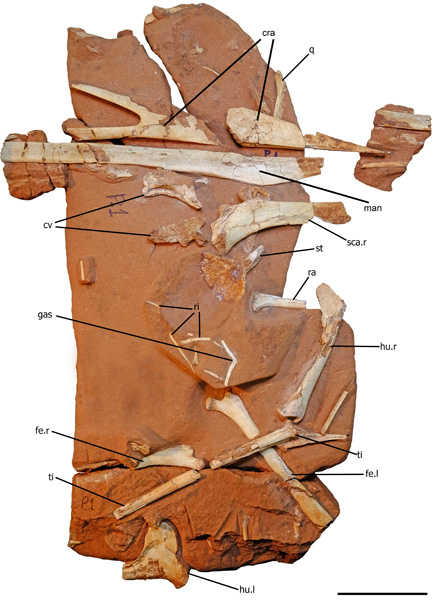
Holotype of Keresdrakon vilsoni gen. et sp. nov. (CP.V 2069). Skull and lower jaw are presented in right lateral view. Note scale bar = 10 cm.
Picture credit: Kellner et al
What is Sympatry?
Sympatry is a term used in biology to describe the situation when two or more related species co-exist in the same environment at the same time. Caiuajara and Keresdrakon are contemporaneous, occupying the same space and time in the fossil record.
A phylogenetic analysis suggests that Keresdrakon sits outside the Tapejaridae family but is still quite closely related to these types of flying reptiles. It is described as part of a non-tapejarid lineage within the wider Tapejaromorpha.
A Sandstone Block Showing Keresdrakon vilsoni and Caiuajara dobruskii Fossils in Association
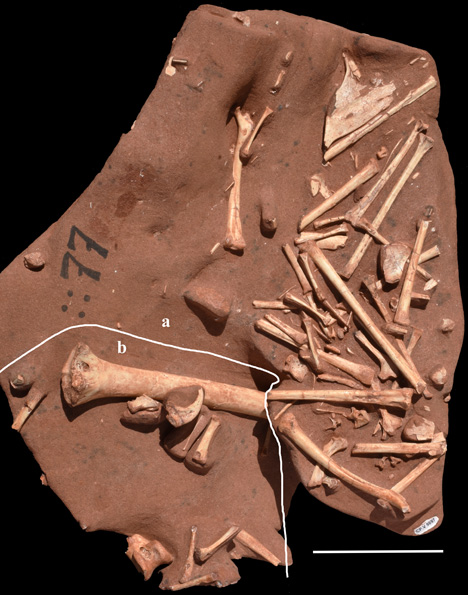
Sample (CP.V 5697) from bonebed C showing on the right (a) a partial skeleton of the Caiuajara dobruskii the left (b) elements of Keresdrakon vilsoni gen. et sp. nov. separated by the white line. Scale bar = 10 cm.
Picture credit: Kellner et al
The scientific paper: “A new toothless pterosaur (Pterodactyloidea) from Southern Brazil with insights into the paleoecology of a Cretaceous desert” by Kellner, Alexander W. A.; Weinschütz, Luiz C.; Holgado, Borja; Bantim, Renan A. M.; Sayão, Juliana M. and published in the Anais da Academia Brasileira de Ciências.
Researchers from the Chinese Academy of Sciences, in collaboration with colleagues from Carleton University (Ottawa, Canada) and Bristol University, have produced a new study on the Early Cretaceous Asian dinosaur Psittacosaurus (P. lujiatunensis). This new research, published in PeerJ, provides the first detailed survey of Ceratopsian braincase changes as a dinosaur grows.
Three growth stages were studied – hatching, juvenile and adult and as Psittacosaurus got bigger, so its brain changed in shape. Furthermore, the study suggests that these little, herbivorous dinosaurs changed posture as the aged. When young they were facultative quadrupeds, but as they matured they favoured a bipedal stance.
Psittacosaurus Gets Its Head Examined
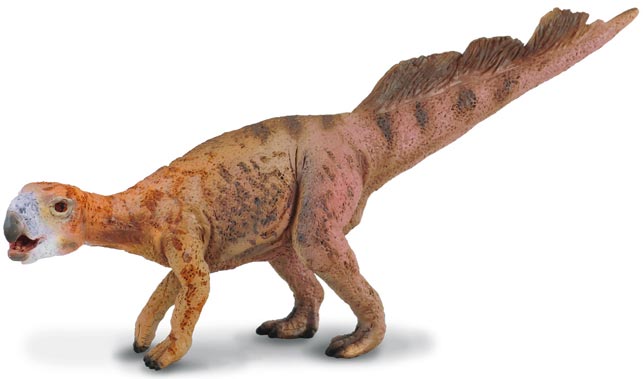
A typical psittacosaurid. A model of Psittacosaurus (CollectA Psittacosaurus).
Hundreds of Psittacosaurus Specimens Examined
Hundreds of Psittacosaurus fossil specimens were examined. These fossils herald from the Early Cretaceous (Barremian–Aptian) of China, specifically from the Yixian Formation. The lack of fossils representing dinosaurs at different growth stages limits ontogenetic studies, but Psittacosaurus is an exception, it is one of the better represented members of the Ornithischia. The cranial and endocranial morphology of Psittacosaurus has been well documented, but only cursory details have been published on the bones surrounding the brain.
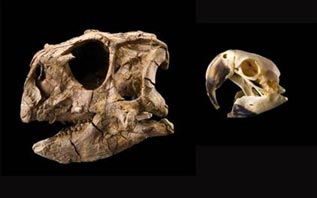
Comparing Skulls Psittacosaurus “Parrot Lizard” Compared to a Parrot
Comparing skulls. The skull of an adult Psittacosaurus – P. gobiensis (left) is compared with an adult parrot (right).
Picture credit: Mike Hettwer
From Hamster-sized Hatchlings to Two-metre-long Adults
From hamster-sized babies these dinosaurs grew relatively quickly into two-metre-long adults. As they grew, their brain changed in shape from being crammed into the back of the head, behind the huge eyes in the hatchling, to being longer, and extending under the skull roof in the adult animals. The braincase provides evidence that supports the idea that these dinosaurs changed posture as they got older. The position and the orientation of the semi-circular canals, which helped these dinosaurs with their balance, changed as they grew.
Corresponding author of the paper, Claire Bullar (University of Bristol School of Earth Sciences), commented:
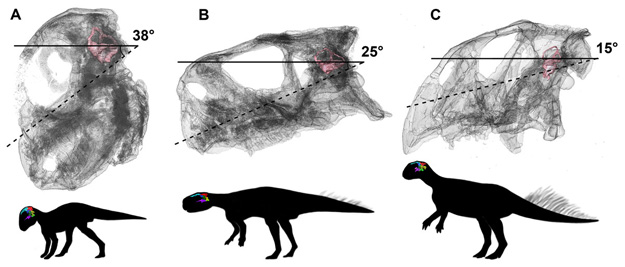
“I was excited to see that the orientation of the semi-circular canals changes to show this posture switch. The semi-circular canals are the structures inside our ears that help us keep balance, and the so-called horizontal semi-circular canal should be just that – horizontal – when the animal is standing in its normal posture. This is just what we see, with the head of Psittacosaurus pointing down and forwards when it was a baby – just right for moving on all-fours. Then, in the teen or adult, we see the head points exactly forwards, and not downwards, just right for a biped.”
Dinosaur Brains from Baby to Adult (left to right)
A study of the brain of Psittacosaurus (ontogenetic study). Head posture if the lateral (horizontal) semi-circular canal is parallel to the ground, in hatching (A), juvenile (B) and adult (C) Psittacosaurus lutjiatunensis. Images not to scale.
Picture credit: Claire Bullar/Institute of Vertebrate Palaeontology and Palaeoanthropology
Changing Postures
The change in posture is supported by postcranial fossil evidence. The relative limb lengths indicate that a juvenile Psittacosaurus would have moved around on four legs, but by the age of two or three, they switched to a bipedal posture, standing upright on their elongate hind legs. This would have freed up the arms and hands to help with gathering food. The team used reconstructions created from micro-computed tomography scans of well-preserved skulls to plot the ontogenetic changes.
Co-supervisor Dr Qi Zhao from the Institute of Vertebrate Palaeontology and Palaeoanthropology (IVPP) in Beijing, where the specimens are housed, added:
“It’s great to see our idea of posture shift confirmed, and in such a clear-cut way, from the orientation of the horizontal ear canal. It’s also amazing to see the results of high-quality CT scanning in Beijing and the technical work by Claire to get the best 3-D models from these scan data.”
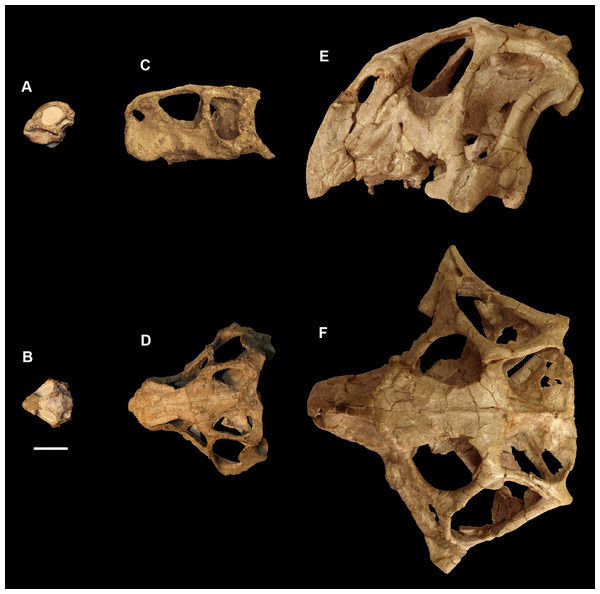
Skulls of Psittacosaurus (P. lujiatunensis) Showing Different Growth Stages
Ontogenetic skull sequence from hatchling to adult (Psittacosaurus). Hatchling (IVPP V15451) – (A) in lateral view. (B) Hatchling in dorsal view. (C) Juvenile (IVPP V22647) in lateral view. (D) Juvenile in dorsal view. (E) Adult (IVPP V12617) in lateral view. (F) Adult in dorsal view. All shown to the same scale; scale bar represents 2 cm.
Picture credit: Claire Bullar/Institute of Vertebrate Palaeontology and Palaeoanthropology
Psittacosaurus and the Posture Shift
Co-author Professor Michael Ryan (Carleton University) contributed:
“This posture shift during growth from quadruped to biped is unusual for dinosaurs, or indeed any animal. Among dinosaurs, it’s more usual to go the other way, to start out as a bipedal baby, and then go down on all fours as you get really huge. Of course, adult Psittacosaurus were not so huge, and the shift maybe reflects different modes of life: the babies were small and vulnerable and so probably hid in the undergrowth, whereas bipedalism allowed the adults to run faster and escape their predators.”
Professor Michael Benton (Bristol University), another collaborator in this study commented:
“This is a great example of classic, thorough anatomical work, but also an excellent example of international collaboration.”
Everything Dinosaur acknowledges the assistance of a press release from Bristol University in the compilation of this article.
The scientific paper: “Ontogenetic braincase development in Psittacosaurus lujiatunensis (Dinosauria: Ceratopsia) using micro-computed tomography” by C. Bullar, Q. Zhao, M. Benton and M. Ryan in PeerJ — the Journal of Life and Environmental Sciences.
Adratiklit boulahfa – The Oldest Definitive Stegosaur
A team of British scientists in collaboration with colleagues from Morocco, have announced the discovery of a new species of armoured dinosaur, described from remains found in the Atlas Mountains. The dinosaur has been named Adratiklit boulahfa and it is the first stegosaur to have been found in northern Africa. Adratiklit is also the oldest definitive stegosaur described, it having roamed Morocco some 168 million years ago (Bathonian faunal stage of the Middle Jurassic). This fossil discovery is significant, as it hints at the possibility of more armoured dinosaurs likely to be found on the continents that once made up the ancient landmass of Gondwana.
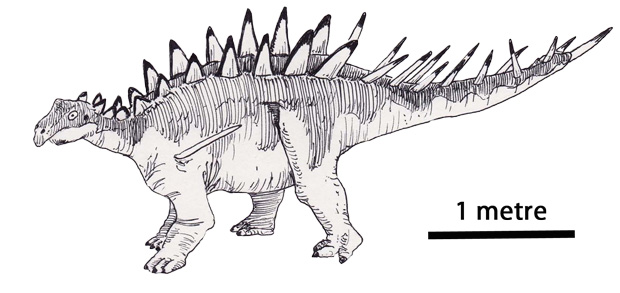
A Life Restoration of the Newly Described North African Stegosaur Adratiklit boulahfa
A life restoration of Adratiklit boulahfa based on the closely related Dacentrurus. The scale size estimate for this dinosaur has been compiled using the left humerus (NHMUK PV R37007). Picture credit: Everything Dinosaur.
Picture credit: Everything Dinosaur
The Third Stegosaur from Africa
The fossils were acquired by the Natural History Museum (London). The material consists of cervical and dorsal vertebrae and the left humerus. Although fragmentary, these fossils permitted the scientists to erect a new armoured dinosaur genus. Although the exact provenance of these fossils is unclear, they probably came from the siltstone deposits of the El Mers II Formation located in the Middle of the Atlas Mountains (Fès-Meknes, northern Morocco). The age of this formation has been dated biostratigraphically based on ammonite fossils. Adratiklit is only the third stegosaur known from Africa, although a phylogenetic assessment carried out by the researchers, indicates that it was probably more closely related to European stegosaurs such as Dacentrurus (D. armatus).
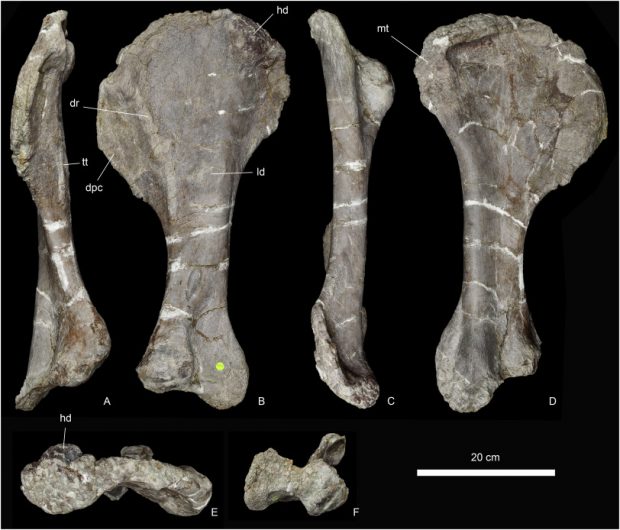
Views of the Left Humerus Ascribed to A. boulahfa
Views of the left humerus ascribed to A. boulahfa. NHMUK PV R37007, left humerus referred to Adratiklit boulahfa in A, lateral, B, posterior, C, medial, D, anterior, E, dorsal and F, ventral views. Note the white scale bar.
Picture credit: Gondwana Research/Maidment et al
The two other stegosaurs known from Africa described to date are:
Kentrosaurus – K. aethiopicus from the Late Jurassic (approximately 156-148 million years ago), fossils found in Tanzania.
Paranthodon P. africanus from the Early Cretaceous (approximately 139-131 million years ago), fossils come from Cape Province, South Africa.
Adratiklit boulahfa – What’s in a Name?
The generic name (Adratiklit), is from the local Berber terms for “mountain” and “lizard”, whilst the trivial epithet refers to Boulahfa, the likely site of the fossil discovery. Commenting on the significance of this stegosaur from Morocco, lead author Dr Maidment commented:
“The discovery of Adratiklit boulahfa is particularly exciting as we have dated it to the Middle Jurassic. Most known stegosaurs date from far later in the Jurassic period, making this the oldest definite stegosaur described and helping to increase our understanding of the evolution of this group of dinosaurs.”
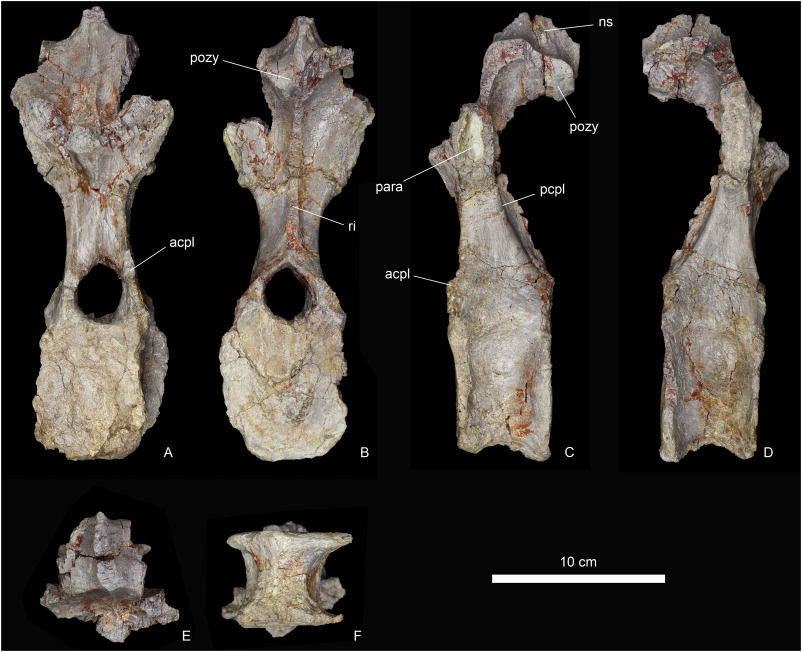
One of the Two Dorsal Vertebrae Preserved (A. boulahfa)
Views of the holotype fossil specimen (dorsal vertebra) of Adratiklit boulahfa. NHMUK PV R37366, holotype specimen of Adratiklit boulahfa. Dorsal vertebra in A, anterior, B, posterior, C, left lateral, D, right lateral, E, dorsal and F, ventral view.
Picture credit: Gondwana Research/Maidment et al
The Implications for Stegosaurs and Ankylosaurs from Gondwana
The Stegosauria together with the Ankylosauria form a clade within the Ornithischian dinosaurs, this is referred to as the Eurypoda, which has been defined to include the iconic armoured dinosaurs Ankylosaurus, Stegosaurus and their most recent, common ancestor and all its descendants. The fossil record suggests that stegosaurs were more common than ankylosaurs in the Jurassic, but during the Cretaceous the ankylosaurs rose in prominence and the stegosaurs as a group went into decline.
It is important to note that numerous members of the Eurypoda are known from Mesozoic rocks that made up the northern landmass of Laurasia, but only a few Eurypoda taxa are known from the super-continent of Gondwana.
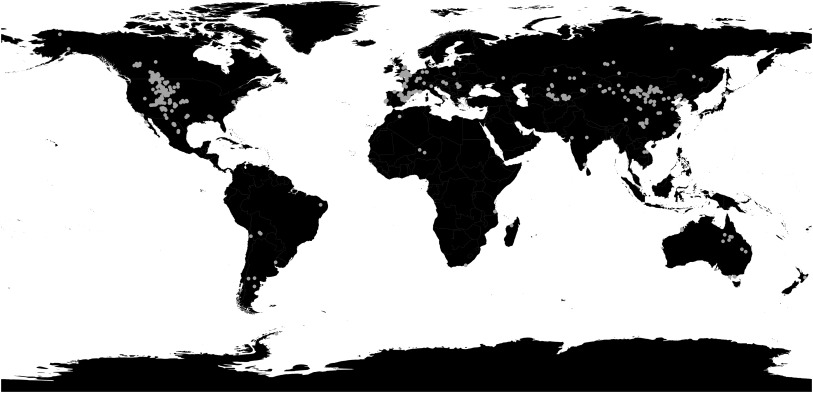
The Global Distribution of Eurypoda Fossil Finds (Stegosaurs and Ankylosaurs)
A map showing the known fossil distribution of the Eurypoda. The grey dots indicate the presence of fossils associated with the Eurypoda clade. More dinosaurs assigned to the Eurypoda have been found in areas associated with Laurasia, in contrast fossils representing the Eurypoda from Gondwana are relatively sparse.
Picture credit: Tom Patterson, Nathaniel Vaughn Kelso et al from naturalearthdata.com, along with Bjørn Sandvik via Wikimedia Commons.
Writing in the academic journal, “Gondwana Research”, the scientists conclude that it remains unclear whether these types of armoured dinosaurs were genuinely rare in Gondwanan Mesozoic ecosystems, or whether their poor fossil record on southern continents is the result of sampling bias. The discovery of a Moroccan stegosaur hints at the possibility that there could be many more armoured dinosaurs awaiting discovery in South America, India, Africa, Madagascar, Australia and Antarctica.
The scientific paper: “North Africa’s first stegosaur: Implications for Gondwanan thyreophoran dinosaur diversity” by Susannah C. R. Maidment, Thomas J. Raven, Driss Ouarhache and Paul M. Barrett published in Gondwana Research.
The Predatory Cambroraster falcatus from the Burgess Shale
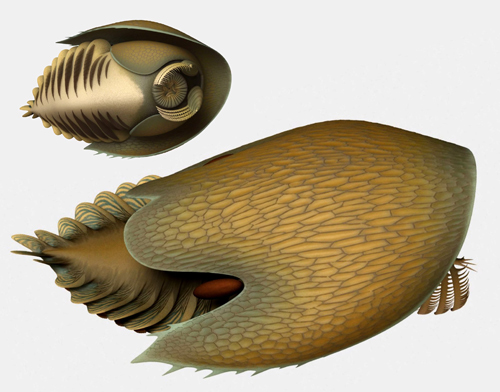
Palaeontologists at the Royal Ontario Museum and the University of Toronto have announced the discovery of a new 500-million-year-old predator, adding to the diversity associated with the Cambrian-aged Burgess Shale biota. The animal, a distant relative of today’s spiders, insects and crustaceans, has been named Cambroraster falcatus. At around thirty centimetres in length C. falcatus was one of the biggest animals around in the Late Cambrian and it was a distant relative of the formidable Anomalocaris, the apex predator on Earth during this time in our planet’s history.
A Life Reconstruction of Cambroraster falcatus
Cambroraster life reconstruction (dorsal view) and top, a view of the animal’s underside.
Picture credit: Royal Ontario Museum
Providing New Information About the Diversity of Early Arthropods
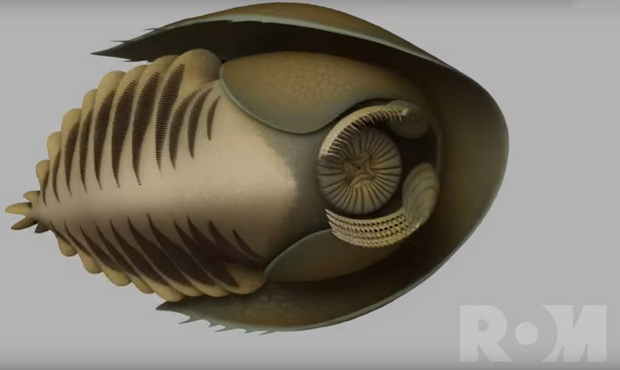
Fossils of this newly described species were found in the Kootenay National Park in the Canadian Rockies. Cambroraster has rake-like claws and a pineapple-slice-shaped mouth at the front of an extremely large head, it probably used its rake-like claws to sift through sediment and trap prey.
Lead author of the scientific paper published in the Proceedings of the Royal Society B (Biology), Joe Moysiuk, based at the Royal Ontario Museum stated:
“Its size would have been even more impressive at the time it was alive, as most animals living during the Cambrian Period were smaller than your little finger. Cambroraster was a distant cousin of the iconic Anomalocaris, the top predator living in the seas at that time, but it seems to have been feeding in a radically different way.”
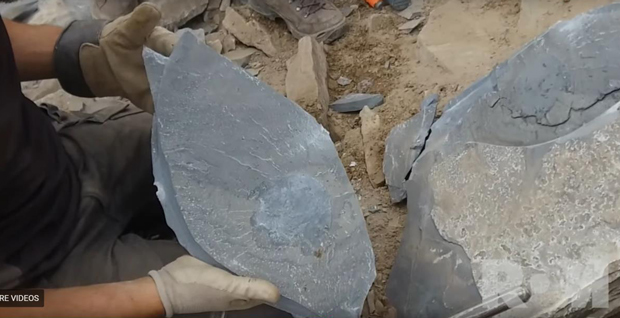
Revealing a Fossil of a Cambroraster at the Kootenay National Park Field Site
Excavating a Cambroraster fossil from the Burgess Shale. Although flattened, enough detail has been preserved in the fine sediments for paleaontologists to reconstruct the animal.
Image credit: Royal Ontario Museum
Cambroraster falcatus – Remarkable Claws and the Millennium Falcon
The name Cambroraster refers to the remarkable claws of this animal, which bear a parallel series of outgrowths, looking like forward-directed rakes. With the space between the spines on the claws at typically less than a millimetre, this would have enabled Cambroraster to feed on very small organisms, although larger prey could also likely be captured, and ingested into the circular tooth-lined mouth. It is this specialised radial mouth that links Cambroraster to the Radiodonta, a clade of stem arthropods that were geographically widespread during the Cambrian, with many genera evolving into large nektonic predators.
The species or trivial name “falcatus”, is in honour of another of this marine animal’s distinctive features – the large, shield-like carapace covering the anterior part of the body. This shield reminded the scientists of the iconic spaceship the Millennium Falcon from the Star Wars movie.
Graduate student Moysiuk added:
“With its broad head carapace with deep notches accommodating the upward facing eyes, Cambroraster resembles modern living bottom-dwelling animals like horseshoe crabs. This represents a remarkable case of evolutionary convergence in these radiodonts.”
The researchers conclude that such convergence is likely reflective of a similar environment and mode of life, like modern horseshoe crabs, Cambroraster may have used its carapace to plough through sediment as it fed.
A Large Number of Specimens Found
Co-author of the paper, Dr Caron, an Assistant Professor at the University of Toronto commented:
“The sheer abundance of this animal is extraordinary. Over the past few summers we found hundreds of specimens, sometimes with dozens of individuals covering single rock slabs.”
Based on over a hundred exceptionally well-preserved fossils now housed at the Royal Ontario Museum, the researchers were able to reconstruct Cambroraster in unprecedented detail, revealing characteristics that had not been seen before in related species.
Dr Caron added:
“The radiodont fossil record is very sparse, typically, we only find scattered bits and pieces. The large number of parts and unusually complete fossils preserved at the same place are a real coup, as they help us to better understand what these animals looked like and how they lived. We are really excited about this discovery. Cambroraster clearly illustrates that predation was a big deal at that time with many kinds of surprising morphological adaptations.”
A View of the Underside of Cambroraster with a Close-up View of the Radial Mouth
A life reconstruction of Cambroraster showing the underside (ventral view) and the unusual mouth parts with the pair of raking appendages.
Picture credit: Royal Ontario Museum
The Significance of the Burgess Shale
The fossils from the Burgess Shale of British Columbia document a remarkable time during the evolution of life on Earth. There was a huge increase in biodiversity and food chains became much more complex as most of the major Phyla of animals that are around today evolved.
The Cambroraster fossil material comes from several locations in the Marble Canyon area of Kootenay National Park. These locations and others like them are being explored and mapped by field teams from the Royal Ontario Museum. These sites are about 25 miles (40 km) away from the original Burgess Shale fossil site in Yoho National Park that was discovered in 1909. Scientists are confident that more new species will be discovery in this area of Kootenay National Park
Everything Dinosaur acknowledges the assistance of a press release from the Royal Ontario Museum in the compilation of this article.
The scientific paper: “A new hurdiid radiodont from the Burgess Shale evinces the exploitation of Cambrian infaunal food sources” by J. Moysiuk and J.B. Caron published in the Proceedings of the Royal Society B.
A team of international researchers writing in the academic journal “Scientific Reports” have concluded that the extinction of cave bears (Ursus spelaeus), could probably be put down to the impact of our own species – Homo sapiens. Anatomically modern humans would have competed with this large, mostly herbivorous bear for caves as our species migrated into Europe. This competition and our hunting of the bear, along with our impact on the populations of other species of large mammal, put increased pressure on the species leading it into a terminal decline before final extinction some 24,000 years ago.
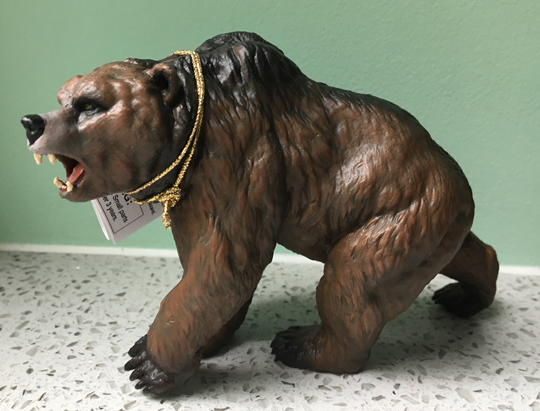
The Papo Cave Bear (U. spelaeus) Model
Lateral view of the Papo cave bear model. Specimens from Europe including France were used in this new cave bear study.Picture credit: Everything Dinosaur.
A Spectacular Mammalian Fauna – Until about 50,000 – 40,000 Years Ago
Today, Europe has a relatively impoverished big mammal fauna, however, this was not always the case. As recently as 50,000 years ago, some of the largest terrestrial mammals known roamed the extensive European forests, grasslands and steppes.
By the onset of the Holocene Epoch, the vast majority of terrestrial mammals more than fifty kilograms in weight had disappeared. The reasons for the demise of the once relatively ubiquitous cave bear has been the subject of numerous scientific studies.
In this latest paper, the researchers used an analysis of mitochondrial DNA taken from cave bear fossils from several European countries. Specimens from Switzerland, Serbia, Italy, Germany, Spain and France were involved in the study (59 specimens). The DNA analysis, in combination with a statistical evaluation, was used to plot the decline of the cave bear, which was related to the extant brown bear (Ursus arctos).
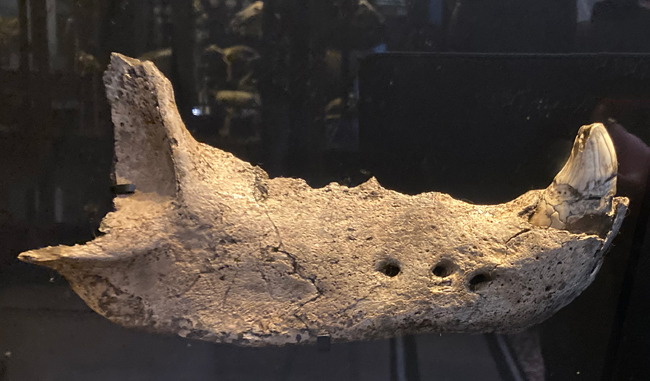
A Lower Jawbone of a Cave Bear (Ursus spelaeus)
A lower jaw from a cave bear which is around 40,000 years old. Picture credit: Everything Dinosaur.
Picture credit: Everything Dinosaur
Five Major Mitochondrial DNA Lineages
The researchers discovered five major mitochondrial DNA lineages resulting in a noticeably more complex biogeography of the European lineages during the last 50,000 years than had been previously thought. In addition, the team propose that there was a drastic decline in the cave bear population commencing around 40,000 years ago, which coincides with the arrival of anatomically modern humans. This study supports a potential significant human role in the general extinction and local extirpation (localised extinctions) of the European cave bear and illuminates the fate of this megafauna species.
Lead-author of the study, Professor Verena Schuenemann (University of Zurich, Switzerland), stated:
“It is the clearest evidence we have so far that humans might have played a big role in the extinction of the cave bear.”
Populations of Cave Bears Affected by Human Activity
Biogeologist Hervé Bocherens of the University of Tuebingen (Germany), a co-author of the scientific paper added:
“There is more and more evidence that modern humans have played a determinant role in the decline and extinction of large mammals once they spread around the planet, starting around 50,000 years ago. This happened not just by hunting these mammals to extinction, but by causing demographic decline of keystone species, such as very large herbivores, that led to ecosystems’ collapse and a cascade of further extinctions.”
The scientific paper: “Large-scale mitogenomic analysis of the phylogeography of the Late Pleistocene cave bear” by Jocsha Gretzinger, Martyna Molak, Ella Reiter et al published in Scientific Reports.
The “Scunthorpe Pliosaur” – What is it? When and Where Did it Live? What it May Have Eaten and Lived Alongside
A few weeks ago, we set young palaeontologist Thomas a challenge, could he research and write an article for posting up onto the Everything Dinosaur blog. Thomas has taken up our offer and here is the first of his articles, it provides information on a prehistoric animal close to Thomas’s heart the “Scunthorpe Pliosaur”.
The “Scunthorpe Pliosaur”, a specimen announced earlier this year, was a large plesiosauroid belonging to the family Pliosauridae and is related to the better known pliosaurs such as Pliosaurus and Liopleurodon in fact, it may have lived alongside and directly competed with these two better-known pliosaurs at some point. It has been estimated at 8 metres long.
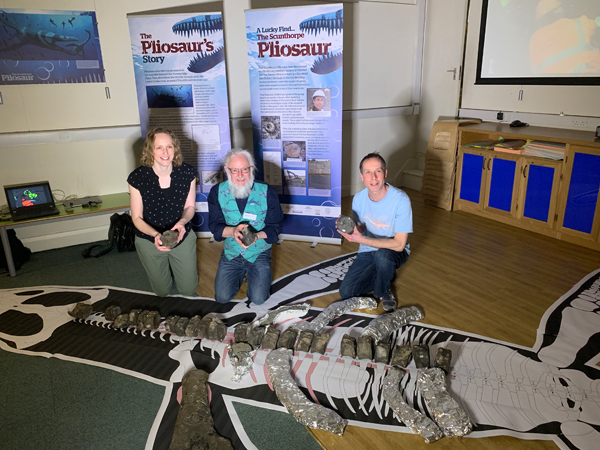
The “Scunthorpe Pliosaur” on Display at North Lincolnshire Museum
Rose Nicholson from North Lincolnshire Museum, palaeontologist Richard Forrest and Darren Withers from Stamford and District Geological Society with the “Scunthorpe Pliosaur”.
Picture credit: North Lincolnshire Museum
When and Where Did the “Scunthorpe Pliosaur” Live and Where was it Found?
The “Scunthorpe Pliosaur” lived around 160 to 155 million years ago in what is now north Lincolnshire (England). These fossils date from the Late Jurassic and the United Kingdom 160 million years ago was a very mysterious place. Whilst marine fauna is decently represented in the fossil record, there is still much science does not know about the seas from this time and this new specimen may help open up a new window into that mysterious world. The terrestrial fauna on the other hand, is poorly represented and full of mystery with one of the only described theropods being the British Metriacanthosaurus from Dorset (a close relative of Sinraptor from China). The pliosaur specimen was recovered from a CEMEX quarry.
What Did it Live With and What Might it Have Eaten?
Inhabiting the seas alongside the “Scunthorpe Pliosaur” were other pliosaurs, plesiosaurs, turtles, fish, ichthyosaurs, squid, ammonites, marine crocodiles, sharks and more. Some of these animals include the pliosaurs Liopleurodon, Simolestes and Pliosaurus which would have competed with it and the plesiosaurs Cryptocleidus and Colymbosaurus which could have been prey of the pliosaur especially the latter plesiosaur’s young.
Looking at the “Scunthorpe Pliosaur’s” dentition, the known teeth of this pliosaur are reminiscent of teeth associated with Pliosaurus (Pliosaurus brachydeirus), a species which has been found in Lincolnshire. From this comparison, it can be concluded that the Scunthorpe individual possibly preyed upon other marine reptiles and other large marine fauna. Stomach content of related pliosaurs and bite marks left by them on their prey show that pliosaurs like the Scunthorpe specimen would have been hunting a wide range of hard bodied marine prey from large ammonites to plesiosaurs and ichthyosaurs. However, they wouldn’t have shied away from preying on softer bodied animals.
A Powerful Sense of Smell
Like most pliosaurs, the “Scunthorpe Pliosaur” probably had a very powerful sense of smell, good eyesight, acute hearing and a powerful bite, all necessary adaptations for a hunting pliosaur to have in order to hunt effectively.
The ecology at the time would have consisted of kelp forests, reefs, coastal shallows and a steep pelagic drop-off that plummets into a benthic zone. Pliosaurs such as Liopleurodon, Pliosaurus and the “Scunthorpe Pliosaur” probably used these drop-off points as ambush spots to strike unsuspecting prey from below.
When attacking prey, pliosaurs would have come up from below like white sharks and either rammed or bitten prey in one massive disabling blow to the prey item to prevent it’s escape. In conclusion, the “Scunthorpe Pliosaur “was a large pliosaur which could have occupied the apex predator niche in its warm, shallow coastal ecosystem hunting all manners of prey from fish and squid to marine reptiles using sight, hearing and smell to track down its prey and applying similar hunting strategies to modern Great Whites to secure and catch that prey.
This discovery is an important one as it opens up a window into a little known area of the Late Jurassic British seas and helps palaeontologists piece together that ancient ecosystem over 155 million years ago.
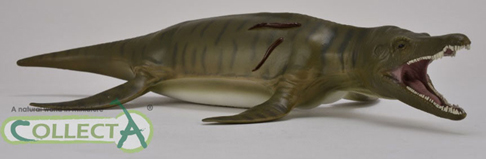
A Model of a Typical Pliosaur
The CollectA Deluxe 1:40 scale Pliosaurus diorama.
Our thanks to Thomas for compiling this article on the “Scunthorpe Pliosaur”.
Crossvallia waiparensis – Monster Penguin from New Zealand
Sixty-six million years ago, the non-avian dinosaurs became extinct. The end-Cretaceous mass extinction event also resulted in the extinction of the majority of the marine reptiles, the mosasaurs and the plesiosaurs. Nature abhors a vacuum and in some parts of the world, the apex piscivore niche became occupied by man-sized penguins. This idea of prehistoric penguin super-predators has been boosted with the naming and scientific description of a “monster penguin” from Palaeocene-aged deposits on New Zealand’s South Island. Weighing in at an estimated eighty kilograms, and standing around 1.6 metres tall, Crossvallia waiparensis is one of the largest penguins known to science.
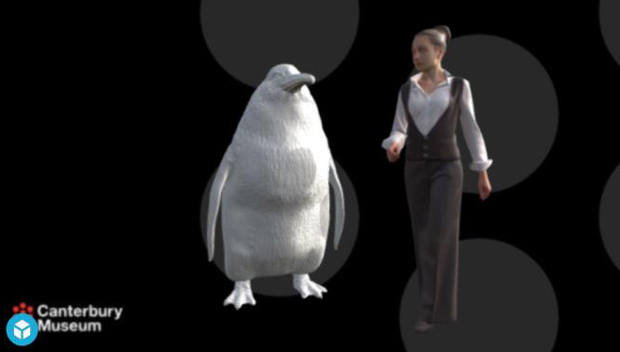
The Newly Described Crossvallia waiparensis Compared to an Average-height Woman
Crossvallia waiparensis compared to an average-height woman.
Picture credit: Canterbury Museum
One of the World’s Oldest Species of Penguin
Writing in the scientific journal “Alcheringa: An Australasian Journal of Palaeontology”, researchers Dr Paul Scofield and Dr Vanesa De Pietri (Canterbury Museum), in collaboration with their colleague Dr Gerald Mayr (Senckenberg Natural History Museum in Frankfurt, Germany), describe C. waiparensis based on leg bones representing an individual animal and tentatively referred partial humeri (upper arm bones). The fossils were found by amateur palaeontologist Leigh Love last year, during field work at the Waipara Greensand fossil site located north of Canterbury.
The sediments were laid down in the Palaeocene Epoch (66 to 56 million years ago), making C. waiparensis is one of the world’s oldest known penguin species. The discovery also reinforces the idea that penguins (Sphenisciformes), attained large size early in their evolutionary history. The biggest extant penguin is the Emperor Penguin (Aptenodytes forsteri), which can weigh more than twenty kilograms and stands around 1.2 metres high.
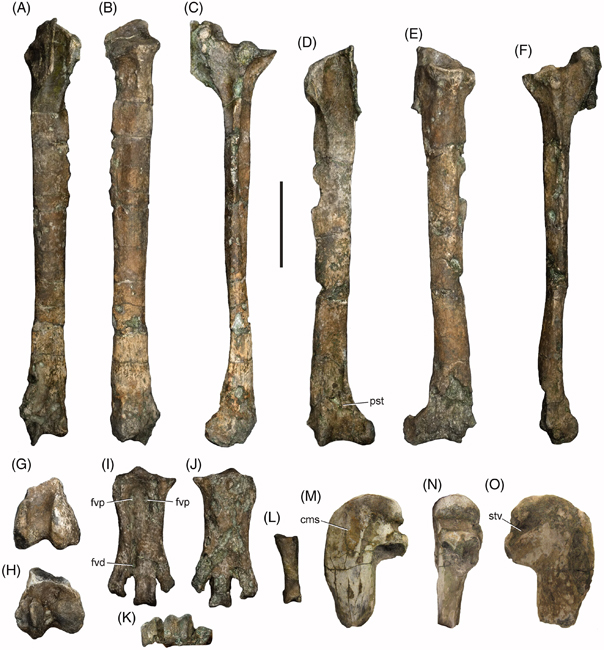
Overview of the Leg Bones of C. waiparensis
Fossils of Crossvallia waiparensis a giant penguin from the Palaeocene of New Zealand.
Picture credit: Mayr et al
The photograph (above), shows an overview of the leg bones of Crossvallia waiparensis (A-L), along with views of the tentatively referred proximal end of a left humerus (M-O), scale bar = 5 centimetres.
The Phylogeny of Crossvallia waiparensis
The team have concluded that the closest known relative of C. waiparensis is a fellow Palaeocene species Crossvallia unienwillia, which was identified from a fossilised partial skeleton found in the Cross Valley in Antarctica. This newly described “monster penguin” is not the first giant penguin to have been discovered. For example, the Eocene taxa Anthropornis and Palaeeudyptes were comparable in size, if not bigger and this suggests that giant penguins evolved several times in the evolutionary history of the penguin family.
The scientific paper: “Leg bones of a new penguin species from the Waipara Greensand add to the diversity of very large-sized Sphenisciformes in the Paleocene of New Zealand” by Gerald Mayr, Vanesa L. De Pietri, Leigh Love, Al Mannering and R. Paul Scofield published in Alcheringa; An Australasian Journal of Palaeontology.
Pseudotherium argentinus – A Very Mammal-like Cynodont from the Triassic of Argentina
Scientists have described a new species of cynodont, from a single, well-preserved skull found in north-western Argentina. The animal has been named Pseudotherium argentinus and although this animal was not a mammal, the skull shows some very mammal-like characteristics. For example, the cochlea is elongated but uncoiled and this feature is reminiscent of basal mammaliamorphs, the lineage that was to lead to true mammals and of course, ultimately, our own species.
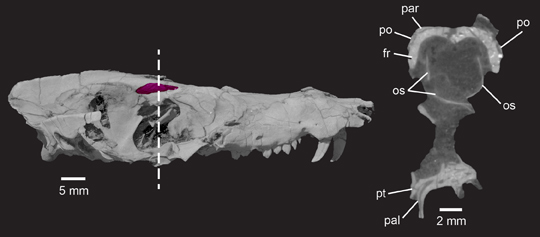
CT Scan (Right Lateral View of the Skull of Pseudotherium argentinus
Computer generated model of the skull of Pseudotherium. The skull in right lateral view with the cross-sectional profile indicated by the dotted line shown in white.
Picture credit: PLOS One
A Cynodont Helping to Unravel Mammal Evolution
Classified as a member of the Probainognathia, one of two clades within the Infraorder Eucynodontia, which includes modern mammals, the skull shows an enlarged braincase, large eye-sockets and other anatomical traits that indicate that this animal might have been developing the heightened senses associated with more advanced therapsids.
The fossil was found in 2006 during a field trip to the Ischigualasto Formation carried out by the Instituto y Museo de Ciencias Naturales of the Universidad Nacional de San Juan. The strata in this region is believed to be between 231 and 226 million years old approximately. The researchers conclude that Pseudotherium, the name means “false wild beast [mammal]” in reference to its mammal-like skull, may lie just inside or very close to the Mammaliamorpha, indicating that it might be a transitional form between the Probainognathia and basal mammals.
Many of the mammal-like cynodont specimens known, have badly crushed and deformed skulls. Their state of preservation prevents palaeontologists from identifying key anatomical changes leading to more advanced therapsids. The research team hope to recover more specimens from the Ischigualasto Formation which will shed further light on the evolution of our early mammal ancestors.
The scientific paper: “First record of a basal mammaliamorph from the early Late Triassic Ischigualasto Formation of Argentina” by Rachel V. S. Wallace, Ricardo Martínez and Timothy Rowe published in PLOS One.
We had known about this for a little while, but we wanted to keep our beaks firmly shut until the scientific paper had been published, the biggest parrot known to science has been announced. The metre tall, most probably flightless psittaciform roamed the South Island of New Zealand around 19 million years ago. Named Heracles inexpectatus it was part of a bizarre Miocene-aged biota that existed in New Zealand, the remains of which have been excavated from a riverbank on the Manuherikia River, Home Hills Station, Otago (Bannockburn Formation).
The fossil deposits are close to the small town of St Bathans, this area is renowned for its remarkable fossil deposits that record life in a sub-tropical forest environment which surrounded a huge, lake, which at its largest extent covered an area equivalent to nearly four times the size of the city of London.
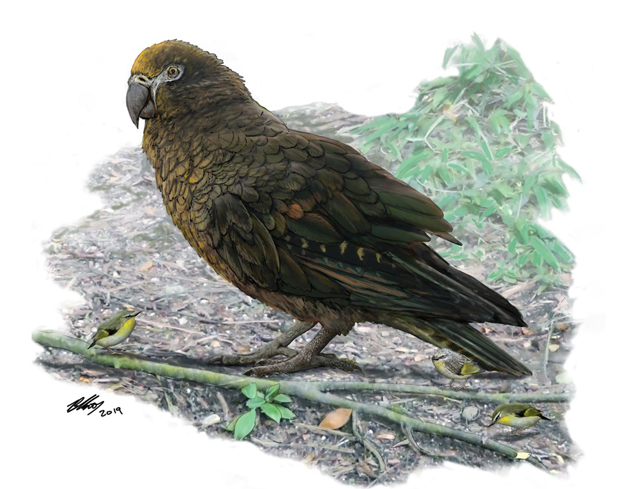
A Life Reconstruction of Heracles inexpectatus
A life reconstruction of the newly described giant prehistoric parrot from New Zealand. If you look carefully at this image you can see three small birds as well as the giant parrot. These represent the extinct genus Kuiornis, which at around 8 cm high was dwarfed by H. inexpectatus.
Picture credit: Dr Brian Choo (Flinders University)
Heracles inexpectatus – A Flightless Forager
Writing in “Biology Letters”, the researchers which include Associate Professor Trevor Worthy (Flinders University, Adelaide, South Australia), suggest that this parrot weighed around seven kilogrammes, and if it did, this makes it twice as heavy as the largest living parrot, the Kakapo (Strigops habroptilus), which also comes from New Zealand. H. inexpectatus has been described based on partial lower leg bones (the shafts of the left and right tibiotarsi), which were collected in January 2008. These two bones probably came from the same individual and since no other fossils related to a giant parrot have been found in the St Bathans area before, the discovery was quite unexpected, hence the trivial name of this new parrot species.
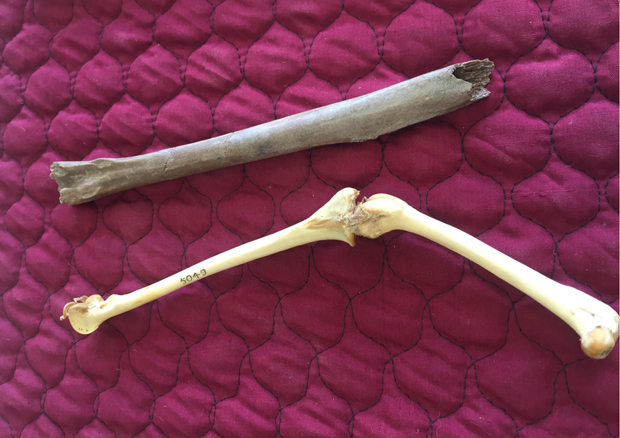
Comparing the Fossil Bone to the Leg Bones of an Extant Kakapo (Largest Living Parrot)
Heracles leg bone (top) compared to the lower leg bones of a Kakapo parrot (bottom).
Picture credit: Flinders Palaeontology Laboratory
Commenting on this quite surprising discovery, Associate Professor Worthy stated:
“New Zealand is well known for its giant birds. Not only moa dominated avifaunas, but giant geese and adzebills shared the forest floor, while a giant eagle ruled the skies. But until now, no-one has ever found an extinct giant parrot – anywhere.”
Carnivore or Omnivore?
It is the leg bones that give an indication of the bird’s size. What it ate can be speculated upon, for example, in the absence of large mammalian predators Heracles could have been an apex predator, perhaps a hypercarnivore. The rarity of the fossils, could indicate it was relatively uncommon and therefore likely to be near the top of an ancient food chain.
Associate Professor Worthy added:
“We have been excavating these fossil deposits for 20 years, and each year reveals new birds and other animals. It [Heracles] was likely a flightless forager who ate abundantly on fruit and seeds but may have preyed on small animals that it could dig out of logs, or even snack on dead or dying moa.”
Co-author Professor Mike Archer (University of New South Wales), suggests that the feeding habits of such a large parrot could have been quite gruesome.
He explained:
“Heracles, as the largest parrot ever, no doubt with a massive parrot beak that could crack wide open anything it fancied, may well have dined on more than conventional parrot foods, perhaps even other parrots.”
More Amazing Fossil Finds from Otago Likely
Whilst the discovery of a giant prehistoric parrot is quite remarkable, the researchers are confident that the Miocene-aged sedimentary strata in this area (Manuherikia Group), will yield even more amazing fossils in the future. In these rocks, palaeontologists have discovered the fossilised remains of around forty different types of bird, as well as bats, frogs and a crocodilian.
These fossil deposits have provided palaeontologists with an insight into the rich avian fauna of prehistoric New Zealand. In 2018, Everything Dinosaur wrote about the discovery of fragmentary bones that suggested a type of prehistoric pigeon inhabited New Zealand during the Early Miocene: A New New Zealand Pigeon from the Early Miocene.
What’s in a Name?
A number of media outlets reporting this discovery have stated that the genus name Heracles honours the Greek hero (Hercules), renowned for his great strength. That is true, but the inspiration behind the genus name is a little more subtle than that. Some of the authors of this scientific paper about Heracles, were also involved in the discovery and naming of another much smaller parrot species from the Bannockburn Formation.
Nelepsittacus was named and described in 2011, its genus name was inspired by Neleus, who in Greek myth was the son of Poseidon and Tyro. Neleus refused to release Hercules from a debt and was murdered by Hercules, so it seemed logical to give the much larger psittaciform from the St Bathans Fauna a name honouring Hercules.
The scientific paper: “Evidence for a giant parrot from the early Miocene of New Zealand” (2019) by Trevor H Worthy, Suzanne J Hand, Michael Archer, R Paul Scofield and Vanesa L De Pietri published in Biology Letters.