All about dinosaurs, fossils and prehistoric animals by Everything Dinosaur team members.

Pictures of fossils, fossil hunting trips, fossil sites and photographs relating to fossil hunting and fossil finds.

13 07, 2020

Lusovenator santosi – A New Carcharodontosaur from the Upper Jurassic of Portugal

By |2024-03-08T08:02:11+00:00July 13th, 2020|Categories: Dinosaur and Prehistoric Animal News Stories, Dinosaur Fans, Main Page, Palaeontological articles, Photos/Pictures of Fossils|0 Comments

The “Hunter of Lusitania” – Lusovenator santosi

The fearsome carcharodontosaurids (family Carcharodontosauridae), comprise some of the largest terrestrial predators that ever lived.  Giant theropods such as Giganotosaurus, Carcharodontosaurus and Tyrannotitan rivalled the largest tyrannosaurs in terms of size and probably (in some cases), were even bigger.  It had been thought that these types of carnivorous dinosaur were confined to the Cretaceous, but there is a growing body of evidence to suggest that this group was well established and geographically widespread by the Late Jurassic.

Lusovenator santosi

A team of scientists writing in the “Journal of Vertebrate Paleontology” have described a new species of carcharodontosaurid based on fossils found in Portugal.  The dinosaur has been named Lusovenator santosi, the genus name translates as “hunter of Lusitania”, a reference to the Lusitanian Basin, the geological region where the fossils are from.  Their research supports the idea that these types of predators were present in the Northern Hemisphere some twenty million years earlier than previously thought.

A Life Reconstruction of the Late Jurassic Carcharodontosaurid Lusovenator santosi
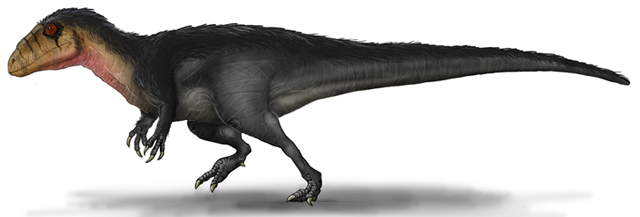
Lusovenator life reconstruction.
A life reconstruction of Lusovenator.

Picture credit: Carlos de Miguel Chaves

A Reassessment of Allosaur Fossil Material

The researchers, based in Lisbon and Madrid, re-evaluated fragmentary fossil material collected over the last two decades at sites located on the Portuguese coast about 35 miles (60 kilometres), north of Lisbon.  Initial examination suggested that this material represented a member of the Allosauridae, but a more detailed analysis of the fossils led the researchers to conclude that this material represented a dinosaur from the Carcharodontosauridae, a family nested within the clade Allosauria, but distinct from famous Late Jurassic super-predators such as Allosaurus fragilis, which is known from the western United States.

Lead author of the scientific paper, Elisabete Malafaia (University of Lisbon), commented that this discovery demonstrates the importance of the Iberian Peninsula as a key region for understanding the dispersal of carcharodontosaurids as well as other types of dinosaur across the northern hemisphere during the Late Jurassic and Early Cretaceous.

Fossil Material Assigned to Lusovenator santosi
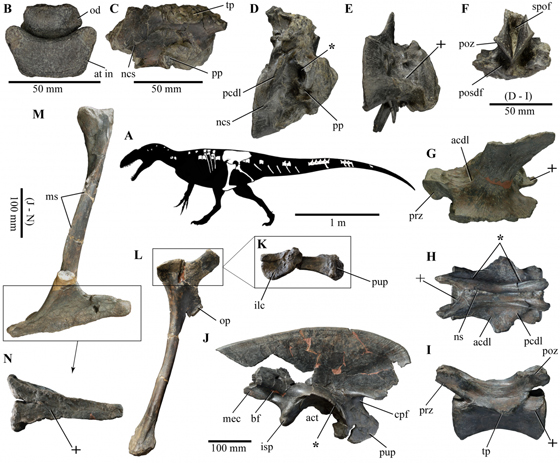
Lusovenator fossil material.
Fossil material assigned to Lusovenator santosi with a silhouette showing skeletal location.

Picture credit: Malafaia et al (Journal of Vertebrate Palaeontology)

One of the Oldest Members of the Carcharodontosauridae

The oldest definitive carcharodontosaurid described to date is Veterupristisaurus (V. milneri) from the Middle Dinosaur Member of the famous Tendaguru Formation of Tanzania.  Veterupristisaurus (pronounced Vet-ter-roo-pris-tee-sore-us), is believed to have lived around 154 million years ago (Kimmeridgian faunal stage of the Late Jurassic).  Other fragmentary fossil remains from China and Germany have also been tentatively assigned to Late Jurassic carcharodontosaurids.  Lusovenator lived around 145 million years ago, as such, it is the oldest carcharodontosaurian allosauroid yet discovered from Laurasia.

The fossil material is believed to represent a relatively young animal, with a body length of approximately 3.5 metres.  Although, probably not fully grown, the vertebrae and the ilium show a number of anatomical traits that distinguish Lusovenator from the Allosauridae and nest it with the related, but distinct Carcharodontosauridae.

A Member of a Field Team Working on a Fossil Specimen
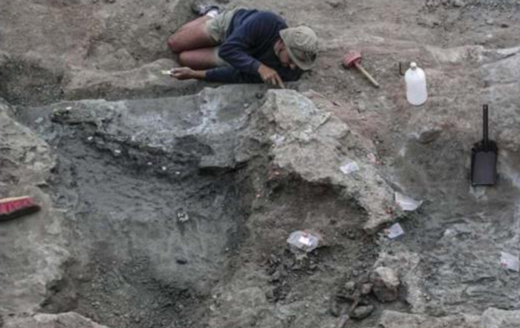
Field work - carefully extracting fossil material.
A field team member working on fossil material.

Picture credit: LUSA

Furthermore, the identification of this new species expands the diversity of theropod dinosaurs known from the Late Jurassic of Portugal and reinforces the theory that the Iberian Peninsula is a key region to help understand the dispersal of a number of different types of dinosaur across the Northern Hemisphere at the end of the Jurassic and into the Early Cretaceous.

The scientific paper: “A new carcharodontosaurian theropod from the Lusitanian Basin: evidence of allosauroid sympatry in the European Late Jurassic” by Elisabete Malafaia, Pedro Mocho, Fernando Escaso and Francisco Ortega published in the Journal of Vertebrate Paleontology.

The Everything Dinosaur website: Visit Everything Dinosaur.
10 07, 2020

Aratasaurus museunacionali “Lizard Born of Fire”

By |2024-03-07T06:35:26+00:00July 10th, 2020|Categories: Dinosaur and Prehistoric Animal News Stories, Dinosaur Fans, Main Page, Palaeontological articles, Photos/Pictures of Fossils|0 Comments

Aratasaurus museunacionali Newly Described Basal Coelurosaur

This month a new basal member of the Coelurosauria has been named and described from limb bones sourced from the Romualdo Formation in north-eastern Brazil.  The dinosaur has been named Aratasaurus museunacionali, the genus name translates as “lizard born of fire” a reference to the fact, the fossil had been in the National Museum of Brazil (Museu Nacional), when a fire ripped through the building.  Fortunately, the fossil material was not damaged and the research could be successfully concluded and a new genus of Early Cretaceous dinosaur described.

A New Theropod – Aratasaurus museunacionali

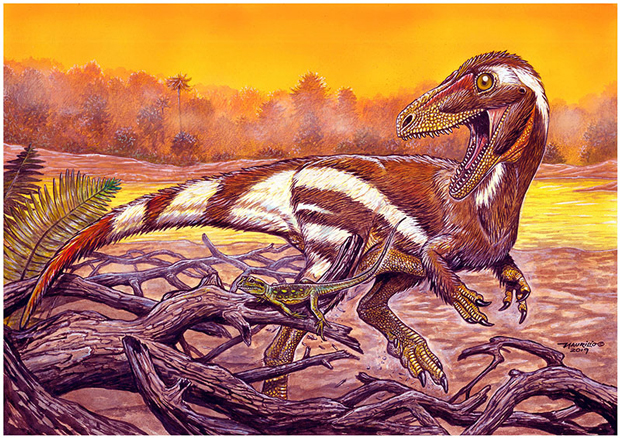
Aratasaurus museunacionali Life Reconstruction

Aratasaurus museonacionali illustration.
Aratasaurus museunacionali life reconstruction.

Picture credit: Museu Nacional

The species name honours the Museu Nacional in recognition of the tragic fire that took place in September 2018.  To read more about the fire: Devastating Fire at Brazil’s National Museum.

Helping to Better Understand the Coelurosauria

Juliana Sayão, a palaeontologist from the Federal University of Pernambuco and lead author of the scientific paper, commented that this new theropod will help scientists to better understand the evolutionary history of the Coelurosauria, an extensive clade of dinosaurs that consists of the tyrannosaurids, compsognathids, the ornithomimosaurs and the Maniraptora which includes birds.

A phylogenetic assessment suggests that Aratasaurus is closely related to Zuolong (Z. salleei), from the Late Jurassic of China, although it lived much more recently, the sediments from which the limb elements were excavated have been dated to approximately 110-115 million years ago (Albian faunal stage of the Cretaceous).

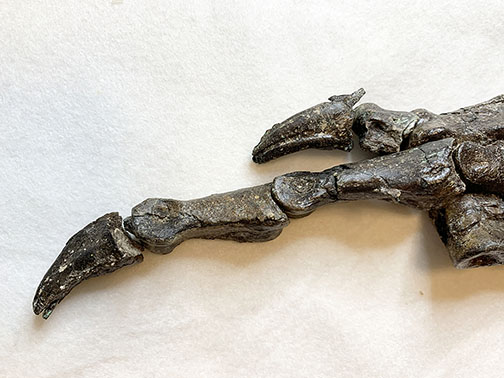
The Right Pes of Aratasaurus museunacionali after Preparation

Fossils associated with Aratasaurus museonacionali.
Aratasaurus museunacionali fossils.  The fossils although fragmentary and fragile were preserved in a partially articulated state.

Picture credit: Museu Nacional

Evidence of Seasonal Fires

The genus name might reflect the ordeal of the fire at the Museu Nacional but tiny pieces of fossilised wood found in association with the dinosaur bones suggest that Aratasaurus had to contend with forest fires within its ecosystem when it roamed this part of Gondwana more than 100 million years ago.

Highlighting the significance of this fossil discovery Juliana Sayão commented:

“Every discovery of a fossil is important because we obtain records that help to reconstruct the history of the planet and remake the path of evolution of the organisms that lived here millions of years ago.  Many times the fossil is unique and provides all the information about that species or group of animals”.

Brazil’s Newest Carnivorous Dinosaur

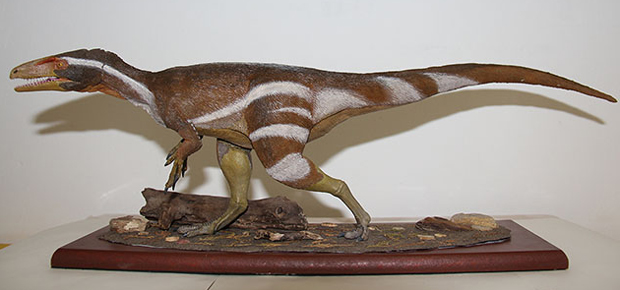
A model of the Brazil’s newest carnivorous dinosaur from the Araripe Basin has been commissioned.  Careful examination of the bone structure (histology), suggests that the individual was approximately four years old when it died.  Based on the growth rates of other, better known coelurosaurs, the researchers propose that the fossils represent a sub-adult specimen.  As such, the size estimate of around three metres in length probably does not represent the maximum size for this dinosaur species.

The Model of Aratasaurus museunacionali

Aratasaurus museonacionali model on display at the museum.
A detailed model of the newly described Aratasaurus museunacionali.

Picture credit: Museu Nacional

The fossils, consisting of a partial femur, a tibia and foot bones representing an incomplete right limb were discovered in 2008 and first taken to the Museum of Palaeontology Plácido Cidade Nuvens, in Santana do Cariri but transferred to the Laboratory of Paleobiology and Microstructures, at the Academic Centre of Vitória, (Federal University of Pernambuco), for further preparation and study.

As part of the research project, the fossil material was taken in 2016 to the Museu Nacional for further analysis.  Although caught up in the conflagration that destroyed much of the museum in 2018, the specimen survived and the analysis was able to be completed.

Photograph and Line Drawing Showing the Right Pes (Foot)

Fossil and line drawing of Aratasaurus pes.
Part of the holotype material for Aratasaurus with an accompanying line drawing showing metatarsals and pedal digits.  Scale bar equals 5 cm.

Picture credit: Manso Sayão et al (Scientific Reports)

Comments from Everything Dinosaur

A spokesperson from Everything Dinosaur commented:

“The specimen might be fragmentary, but it’s discovery underpins the significance of the Romualdo Formation and helps to extend our knowledge of the dinosaur biota inhabiting this part of Gondwana in the later stages of the Early Cretaceous.  As this genus has been classified as the sister taxon of the Chinese Zuolong, it suggests that basal coelurosaurs may have been more widely distributed and had a greater temporal range than previously thought.”

Everything Dinosaur acknowledges the assistance of a media release from the Museu Nacional in the compilation of this article.

The scientific paper: “The first theropod dinosaur (Coelurosauria, Theropoda) from the base of the Romualdo Formation (Albian), Araripe Basin, Northeast Brazil” by Juliana Manso Sayão, Antônio Álamo Feitosa Saraiva, Arthur Souza Brum, Renan Alfredo Machado Bantim, Rafael Cesar Lima Pedroso de Andrade, Xin Cheng, Flaviana Jorge de Lima, Helder de Paula Silva and Alexander W. A. Kellner published in Scientific Reports.

Visit the Everything Dinosaur website: Visit Everything Dinosaur.
9 07, 2020

Voracious Xiphactinus was More Widespread than Previously Thought

By |2024-03-07T06:24:21+00:00July 9th, 2020|Categories: Dinosaur and Prehistoric Animal News Stories, Dinosaur Fans, Main Page, Photos/Pictures of Fossils|0 Comments

The Voracious Xiphactinus was More Widespread than Previously Thought

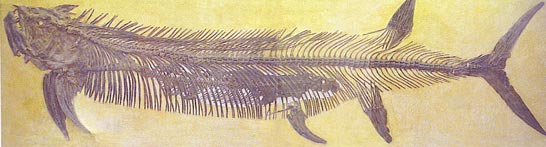
Xiphactinus (pronounced zee-fak-tin-us), was a fast swimming voracious predator of Cretaceous seas.  With a body length of up to six metres, this bony fish was one of the top predators associated with the Western Interior Seaway of North America.  It has a formidable reputation amongst palaeontologists, as several fossils have been found which show the undigested body parts of prey, preserved inside the stomach cavity.  Perhaps, the most famous specimen that documents predatory behaviour is the Xiphactinus (X. audax), with the complete skeleton of a 1.8 metre-long fish preserved inside its skeleton which is on display at the Sternberg Museum of Natural History (Kansas).

A Voracious Predator

A Bony Fish with a Fearsome Reputation

Xiphactinus with its last meal preserved inside it.
A fossil fish within a fish.  The Xiphactinus audax specimen collected by George F. Sternberg (son of the famous American palaeontologist Charles H. Sternberg).  Inside the body cavity, a nearly complete specimen of the related ichthyodectid Gillicus arcuatus can be seen.

A team of scientists have reported this week the first occurrence of Xiphactinus from southern South America.  Writing in the academic journal “Alcheringa”, researchers from the Museo Argentino de Ciencias Naturales “Bernardino Rivadavia” in collaboration with a colleague from Universidad Maimónides, both located in Buenos Aires, report the discovery of fragments of upper jaw bone (maxilla), as well as vertebrae from the Salamanca Formation (Chubut Province, Argentina).  It is estimated that this fish lived around 70 million years ago (Maastrichtian age of the Late Cretaceous).

Xiphactinus Geographically and Temporally Widespread

Xiphactinus has been widely reported from Upper Cretaceous strata throughout the Northern Hemisphere, although to date, equivalent discoveries in the Southern Hemisphere have been limited to a single fossil specimen consisting of elements from the skull and the spine from the Cenomanian aged limestones of the La Aguada Member, La Luna Formation, near Monay, Candelaria Municipality in western Venezuela.

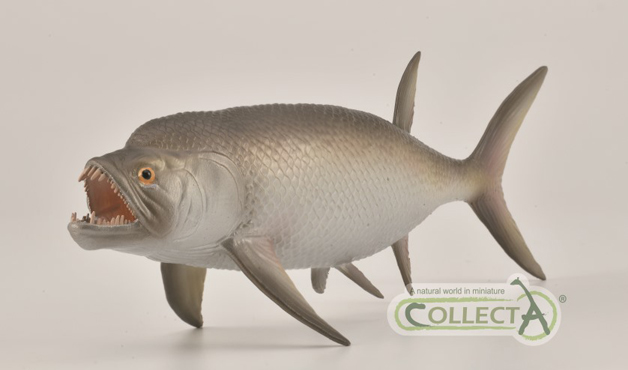
A Life Reconstruction Xiphactinus

CollectA Deluxe Xiphactinus model.
The CollectA Deluxe 1:40 scale Xiphactinus prehistoric fish model.

The picture (above) shows a CollectA Deluxe Xiphactinus model.

To view the CollectA Deluxe range of prehistoric animals: CollectA Deluxe Prehistoric Life Models.

This discovery extends the known geographical range for this genus and suggests that this teleost was widespread during the Cretaceous (Albian to Maastrichtian faunal stages).  It is related to the majority of fish species alive today, although the entire family of these types of predatory fish (Ichthyodectidae), became extinct at the end of the Cretaceous.

A Bony Fish with a Formidable Reputation

Xiphactinus attacks.
A bony fish with a very formidable reputation – Xiphactinus audax.

The scientific paper: “First record of the ichthyodectiform fish Xiphactinus (Teleostei) from Patagonia, Argentina” by Julieta J. De Pasqua, Federico L. Agnolin and Sergio Bogan published in Alcheringa: An Australasian Journal of Palaeontology.

Visit the Everything Dinosaur website: Everything Dinosaur.

8 07, 2020

Research on a Lower Jaw Suggests Dromaeosaurids Endemic to Alaska

By |2024-03-05T08:59:42+00:00July 8th, 2020|Categories: Dinosaur and Prehistoric Animal News Stories, Dinosaur Fans, Main Page, Photos/Pictures of Fossils|0 Comments

The First Juvenile Dromaeosaurid from Alaska

This blog has covered a lot of news stories about dinosaur fossil discoveries from Alaska, principally the remarkable Prince Creek Formation with its abundance of juvenile hadrosaurid remains.  A tiny partial lower jaw recovered from sediment screen washings indicates that dromaeosaurid dinosaurs were also present and from the size of the bone, complete with its two tiny teeth, it is likely that some dinosaurs were year-round residents and that they bred in the Arctic Circle.

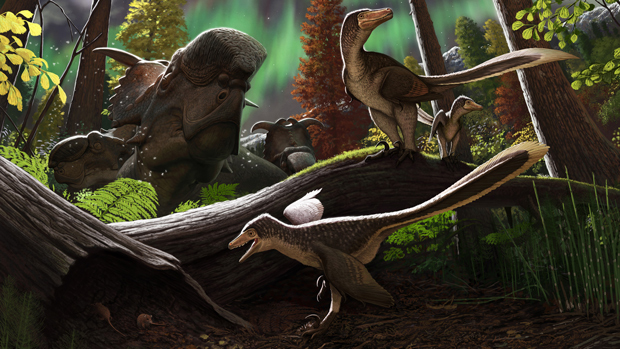
A Flock of Dromaeosaurids Pursue Prey Under the Noses of Pachyrhinosaurs

The "Alaskan Raptor".
A flock of dromaeosaurids chase small mammals whilst a herd of Pachyrhinosaurs are oblivious to the hunt going on underneath their feet.  Although isolated teeth have been tentatively assigned to the dromaeosaurids, this is the first incidence of fossil bone being found that indicates the presence of members of the Dromaeosauridae within the polar ecosystem.

Picture credit: Andrey Atuchin

A Juvenile Dromaeosaurid

Writing in the on-line academic journal PLOS One, researchers including Alfio Alessandro Chiarenza (Imperial College London) and Anthony R. Fiorillo (Southern Methodist University, Dallas Texas), report upon the discovery of the tiny jaw fragment that adds to a growing body of evidence that suggests Cretaceous Arctic dinosaurs of Alaska did not undergo long-distance migration, but rather they were year-round residents of these northern latitudes.

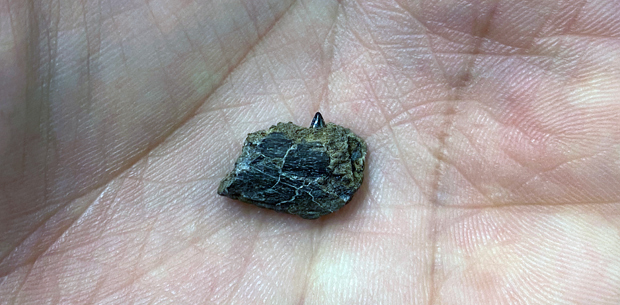
The fossil, which measures less than 1.5 cm in length, was collected from the Pediomys Point locality along the Colville River, some five miles (eight kilometres), upstream from the Liscomb bonebed with its abundant hadrosaurid remains.  Field team members had collected a large amount of bulk sediment over several field seasons and the specimen (specimen number DMNH21183), was recovered after screen washing and sorting of material conducted back at the Perot Museum of Nature and Science (Texas).

The Tiny Fossil Specimen (Assigned to a Saurornitholestinae Dromaeosaurid)

The tiny Arctic dromaeosaurid fossil jaw.
The tiny fossil dromaeosaurid jaw with one tooth erupted and one unerupted tooth present in the bone.

Picture credit: A. A. Chiarenza

Anatomical features such as the fibrous bone surface coupled with the small size of the fossil suggest a juvenile.

Dinosaurs of the Far North

Commenting on the significance of the fossil find, Anthony Fiorillo stated:

“Years ago, when dinosaurs were first found in the far north, the idea challenged what we think we know about dinosaurs.  For some time afterwards, there was a great debate as to whether or not those Arctic dinosaurs migrated or lived in the north year round.  All of those arguments were somewhat speculative in nature.  This study of a predatory dinosaur jaw from a baby provides the first physical proof that at least some dinosaurs not only lived in the far north, but they thrived there.  One might even say our study shows that the ancient north was a great place to raise a family and now we have to figure out why.”

What Type of Dromaeosaurid?

At least four different subclades of dromaeosaurid are known from the Late Cretaceous of North America (Dromaeosaurinae, Microraptorinae, Saurornitholestinae, and Velociraptorinae).  A phylogenetic assessment of the specimen suggests that this fossil represents a member of the Saurornitholestinae.  This subfamily consists of two species of Saurornitholestes and Atrociraptor, between them these dromaeosaurs, although restricted to the Late Cretaceous, do have a widespread palaeo-geographical range, with fossils found as far north as Alberta (Canada) and as far south as New Mexico in the USA.

The scientific paper: “The first juvenile dromaeosaurid (Dinosauria: Theropoda) from Arctic Alaska” by Alfio Alessandro Chiarenza , Anthony R. Fiorillo, Ronald S. Tykoski, Paul J. McCarthy, Peter P. Flaig and Dori L. Contreras published in the academic journal PLOS One.

To read our recent blog article about the hadrosaurids associated with the Prince Creek Formation: Is this the demise of a duck-billed dinosaur?

The Everything Dinosaur website: Everything Dinosaur.

6 07, 2020

“Dinosaurs How they lived and evolved” Book Review

By |2024-03-05T08:49:32+00:00July 6th, 2020|Categories: Adobe CS5, Book Reviews, Dinosaur Fans, Main Page, Photos/Pictures of Fossils|0 Comments

A Review of “Dinosaurs How they lived and evolved”

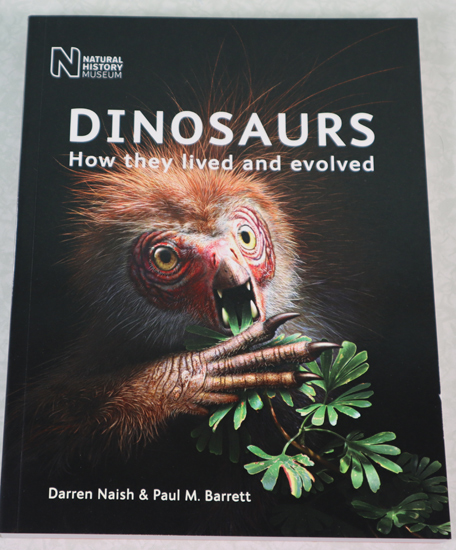
Time to sink our teeth into “Dinosaurs – how they lived and evolved”, the second edition of this comprehensive account of the Dinosauria written by Darren Naish and Paul  M. Barrett.  This book was first published four years ago but this is a much revised edition with a soft cover.  Conveniently split into six broad chapters, it is aimed at the general reader as well as the dedicated dinosaur enthusiast and student of the Earth Sciences.  The authors possess a rare gift, sadly often lacking in other science communicators, that is, the ability to convey complex ideas and information in an entertaining and coherent manner.

“Dinosaurs – How They Lived and Evolved”

The text is supported by a small glossary, a section directing the reader to further sources of information and a comprehensive index.  In addition, the carefully selected illustrations, diagrams, stunning photographs and artwork help to acquaint the reader with new ideas and developments in vertebrate palaeontology.

The Front Cover of “Dinosaurs How They Lived and Evolved”

The front cover of the dinosaur book.
The front cover of the revised and updated second edition of “Dinosaurs How they lived and evolved” by Darren Naish and Paul. M. Barrett. Picture credit: Everything Dinosaur.

Picture credit: Everything Dinosaur

What’s New in this Edition?

Originally published in 2016, this second edition is described by the publishers as a “fully revised and updated version”, suffice to say this expression probably undersells this new edition somewhat.  Such is the nature of palaeontology that our knowledge of the Dinosauria is constantly changing, new ideas are being put forward and long established mindsets challenged.  This publication updates the general reader and incorporates some substantial changes.

There’s much more to this book than just a new cover!  Although we have to congratulate the authors for selecting renowned palaeoartist Bob Nicholls and his interpretation of the Chinese heterodontosaurid Tianyulong, it is an inspired choice (see above).  This stunning artwork dramatically sums up how what we know about dinosaurs has changed and the way in which these “fearfully great lizards” are depicted.

New Images and Illustrations

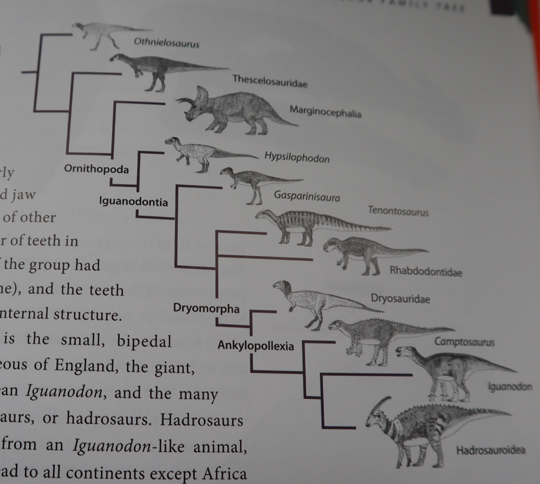
In the second edition a number of images have been changed and several of the simplified cladograms have been revised to incorporate new research.

For example, in Chapter 2 “The Dinosaur Family Tree” this chapter has been rewritten and includes the controversial reassessment of the Dinosauria by Baron et al that was published in 2017.

To read more about the scientific paper: Root and Branch Reform of the Dinosaur Family Tree.

Many new taxa are included with illustrations and the sections covering the origin of birds and their relationships within the Maniraptora have been revised and updated.

Simple, Easy to Understand Diagrams

Ornithopoda cladogram.
Simplified cladograms provide information and many have been updated to reflect new research. Picture credit: Everything Dinosaur.

Picture credit: Everything Dinosaur

Beautiful Photographs of Famous Museum Exhibits

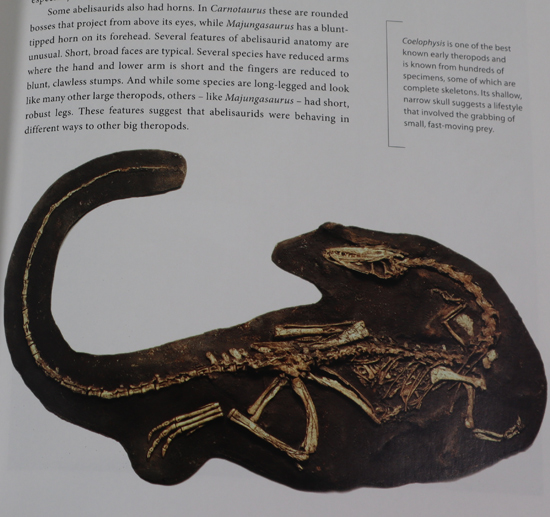
Throughout this beautifully illustrated publication there are lots of full colour photographs of famous dinosaur fossils and museum exhibits to enjoy.  Credit to the authors for concluding this excellent book with a final chapter that not only details the mass extinction event that marks the end of the Mesozoic but looks at how the Aves faired during this period of dramatic turmoil and their continuance of the theropod line into modern times.

The Book Features Detailed Images of Iconic Dinosaur Fossils and Museum Exhibits

Coelophysis dinosaur fossil.
The book contains beautiful photographs of some of the most iconic dinosaur fossils. Picture credit: Everything Dinosaur.

Picture credit: Everything Dinosaur

This dinosaur book is highly recommended.

Visit the award-winning Everything Dinosaur website: Everything Dinosaur.

5 07, 2020

Preparing for the New Chilesaurus Model

By |2024-03-05T08:42:50+00:00July 5th, 2020|Categories: Adobe CS5, Dinosaur Fans, Everything Dinosaur News and Updates, Everything Dinosaur Products, Main Page, Photos/Pictures of Fossils|0 Comments

Preparing for Chilesaurus

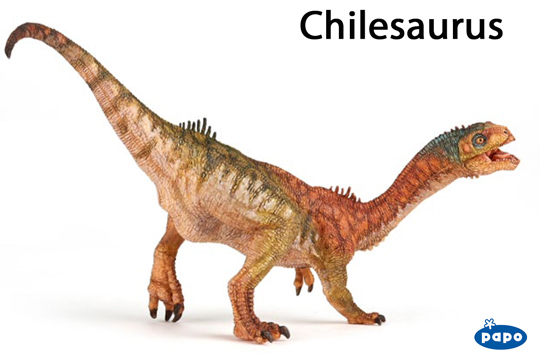
Team members at Everything Dinosaur have been busy making plans for the arrival of the Papo Chilesaurus dinosaur model.  The COVID-19 pandemic severely disrupted the production plans of Papo and Chilesaurus, although not planned to be one of the first new for 2020 model releases, it now looks like Chilesaurus will be coming into stock at Everything Dinosaur before the Stygimoloch and the Megaloceros figures.

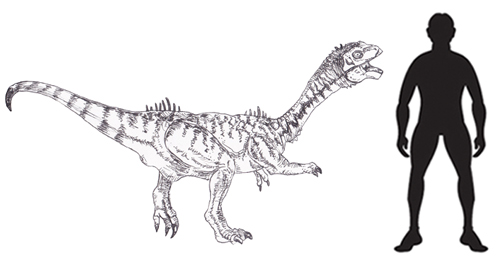
The Chilesaurus Scale Drawing Commissioned by Everything Dinosaur

Chilesaurus scale drawing.
A scale drawing of the bizarre Late Jurassic dinosaur Chilesaurus. Picture credit: Everything Dinosaur.

Picture credit: Everything Dinosaur

The Papo Chilesaurus Dinosaur Model

The Chilesaurus and the controversial Giganotosaurus are due to arrive first, with the Stygimoloch following a few weeks later. The new Papo Parasaurolophus and feathered Velociraptor colour variants are now scheduled for an early autumn release, although we do stress, that this itinerary is liable to change.

To view the range of Papo dinosaurs and prehistoric animal figures available from Everything Dinosaur: Papo Dinosaur and Prehistoric Animal Figures.

The First Jurassic Body Fossils Known from Chile

Although several dinosaur tracks and footprints that date from the Jurassic have been found in Chile, when the first fossils of Chilesaurus were discovered by a seven-year-old boy on the 4th of February 2004, these were the first dinosaur body fossils to have been found in Chile.

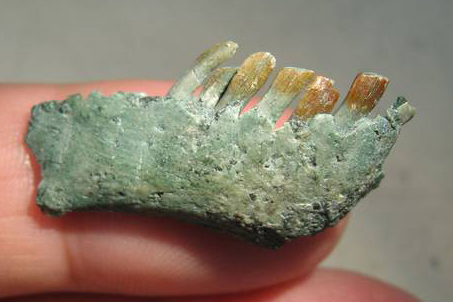
A Fossilised Jaw with Strange Square-shaped Tooth Tips

The fossilised jaw of Chilesaurus.
Teeth adapted for cropping plants.  A partial jawbone attributed to Chilesaurus diegosuarezi.

Picture credit: Dr Fernando Novas (Museo Argentino de Ciencias Naturales (Buenos Aires, Argentina)

This bizarre dinosaur, when first formally named and described (2015), was regarded as a tetanuran theropod.  The tetanurans are the largest clade of theropod dinosaurs and include all members of the Theropoda more closely related to modern birds than they are to Ceratosaurus.  Chilesaurus demonstrated a highly unusual combination of anatomical characteristics that could be interpreted within phylogenetic studies in numerous ways, depending on the data set used.

A Controversial Scientific Paper

Following a controversial scientific paper published in 2017 entitled  “A New Hypothesis of Dinosaur Relationships and Early Dinosaur Evolution”, written by Matthew Baron and David Norman (Cambridge University) along with Paul M. Barrett (London Natural History Museum), this little biped has taken up a prominent position within Dinosauria research.

A paper published a few months after the controversial publication that challenged the traditional view of dinosaur classification, suggested that Chilesaurus with its strange suite of features, was not a theropod at all.  It was suggested that it was the earliest diverging member of the Ornithischia.  It was proposed that Chilesaurus was a “transitional taxon”, bridging the morphological gap between the Theropoda and the Ornithischia.

This little, unassuming dinosaur might just prove to be one of the most significant dinosaur discoveries of the 21st century.

The Papo Chilesaurus Dinosaur Model

Papo Chilesaurus dinosaur model.
The Papo Chilesaurus dinosaur model (available in the next few weeks from Everything Dinosaur).

Visit the Everything Dinosaur website: Everything Dinosaur.

2 07, 2020

A New Study Examines Rare Japanese Dinosaur Eggs

By |2024-03-05T08:23:55+00:00July 2nd, 2020|Categories: Dinosaur and Prehistoric Animal News Stories, Dinosaur Fans, Geology, Main Page, Palaeontological articles, Photos/Pictures of Fossils|0 Comments

Dinosaur Eggs Provide a View on a “Hidden Ecosystem”

Not all the dinosaurs that ever existed are likely to be named and described by scientists.  Identifying these long extinct creatures relies on there being a fossil record of some sort to study.  A team of researchers writing in the journal “Cretaceous Research”, report on a new Lower Cretaceous fossil egg locality in Hyogo Prefecture, Japan, that provides a tantalising glimpse into a hidden dinosaur dominated ecosystem.

The researchers, which include Kohei Tanaka (University of Tsukuba, Japan) and Darla Zelenitsky (University of Calgary, Canada), describe eggs and eggshell fragments associated with four ootaxa, two of which are new to science.  The site reveals a hidden diversity of small dinosaurs, particularly non-avian theropods, in the Hyogo region and indicates the area was utilised for nesting by various small dinosaur species in the Early Cretaceous.

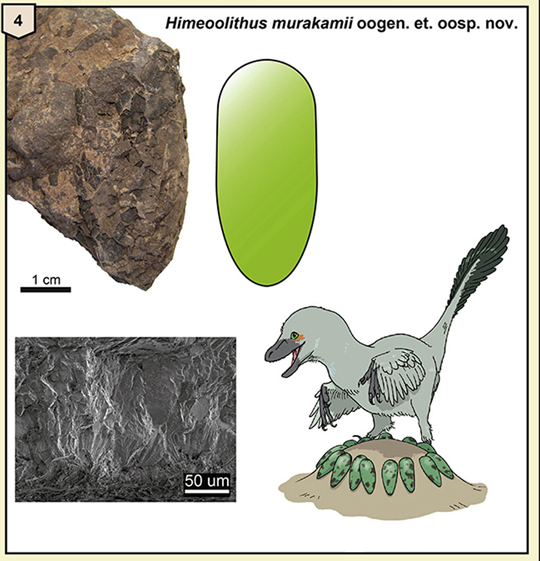
The Newly Erected Ootaxa Himeoolithus murakamii the Most Abundant Ootaxa from the Quarry Site

Himeoolithus murakamii a new ootaxa from Japan.
Himeoolithus murakamii egg fossil, high resolution image, line drawing of egg showing elongated shape and life reconstruction.

Picture credit: University of Tsukuba and Museum of Nature and Human Activities Hyogo Prefecture with life reconstruction by Ayaka Nagate

The Kamitaki Locality

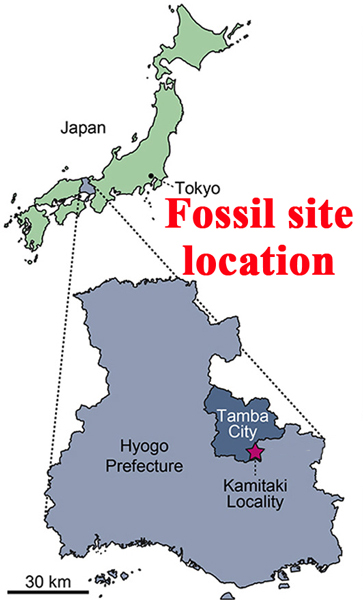
The fossil site, known as the Kamitaki locality lies close to the  Sasayama River in Kamitaki, Sannan-cho, Tamba City,  Hyogo Prefecture.  One horizon has yielded a variety of small vertebrate fossils including frogs and lizards, plus a partial tail from a titanosaur that was formally named and described in 2014 (Tambatitanis amicitiae).  Eggshell fragments are also associated with this part of the site.  However, a horizon some 5.5 to 6.75 metres above the bonebed layer has yielded an astonishing quantity of egg fossils, including a nearly complete egg, several partial eggs and hundreds of eggshell fragments.

The researchers conclude that this horizon represents a nesting area in which a variety of small theropods raised their young.

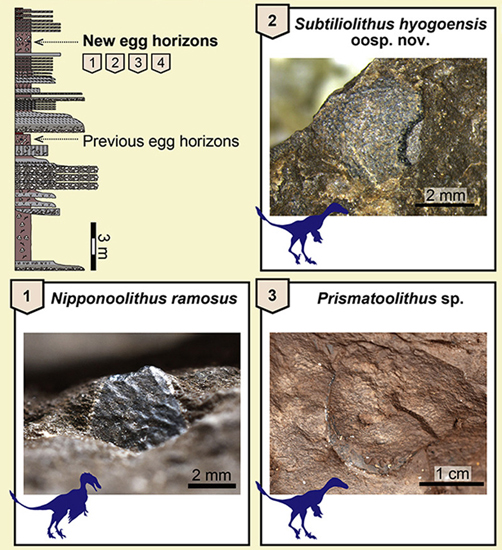
As a result of this research, two new theropod egg taxa have been named – Himeoolithus murakamii and Subtiliolithus hyogoensis.  Although no skeletal remains of these little dinosaurs have been found, the presence of all the egg fossils suggests that there were numerous different types of small theropod co-existing in this ancient ecosystem.

The Location of the Fossil Site within Hyogo Prefecture

Fossil site location.
The location of the Kamitaki fossil site and the discovery of the dinosaur eggs.

Picture credit: University of Tsukuba and Museum of Nature and Human Activities Hyogo Prefecture/Cretaceous Research with additional annotation by Everything Dinosaur

Examining the Mudstone Deposits

The mudstone deposits are thought to have been laid down around 110 million years ago (Albian faunal stage of the Lower Cretaceous) and the palaeoenvironment has been described as floodplain which was subjected to a extremes of seasonality with long periods of very dry conditions punctuated by a very wet season that led to flood events.

The most abundant ootaxon at the quarry, Himeoolithus, is represented by four eggs and over 1300 scattered eggshell fragments. Himeoolithus accounts for over 96% of all the egg fossils associated with this site.  Himeoolithus is the smallest non-avian theropod egg known to date, the scientists estimate that the egg probably weighed about as much as a quail egg (around 9.9 grammes).  It is also a very unusual shape, being elongate with its length 2.25 times its width (length : width ratio 2.25).

The new egg fossil horizon was discovered in 2015 and was mapped and intensively excavated in the winter of 2019.  In total, the egg fossil horizon and the lower Kamitaki Bonebed (Ohyamashimo Formation), have yielded six small theropod ootaxa.

The Stratigraphy of the Kamitaki Locality and Examples of Associated Ootaxa

Stratigraphy of the Kamitaki locality with examples of theropod ootaxa from the site.
The stratigraphy of the Kamitaki locality with examples of theropod ootaxa from the site.  Subtiliolithus hyogoensis is the second of the new ootaxa to be reported in the scientific paper.

Picture credit: University of Tsukuba and Museum of Nature and Human Activities Hyogo Prefecture/Cretaceous Research

Notable Biodiversity

The ootaxa demonstrate that this ancient habitat was home to a variety of small theropod dinosaurs.  It is likely that many other palaeoenvironments associated with the Lower Cretaceous were also home to a diverse variety of small theropods too, these animals being currently under-represented in the fossil record.

Lead author of the paper, Professor Kohei Tanaka, confirmed that the research team thought that the new egg fossil horizon was a nesting site and the deposit was not the result of a transportation and subsequent burial of egg material from another location:

“Our taphonomic analysis indicated that the nest we found was in situ, not transported and redeposited, because most of the eggshell fragments were positioned concave-up, not concave-down like we see when eggshells are transported.”

Commenting About the Dinosaur Eggs

The professor added:

“The high diversity of these small theropod eggs makes this one of the most diverse Early Cretaceous egg localities known.  Small theropod skeletal fossils are quite scarce in this area.  Therefore, these fossil eggs provide a useful window into the hidden ecological diversity of dinosaurs in the Early Cretaceous of south-western Japan, as well as into the nesting behaviour of small non-avian theropods.”

Everything Dinosaur acknowledges the assistance of a media release from the University of Tsukuba (Japan), in the compilation of this article.

The scientific paper: “Exceptionally small theropod eggs from the Lower Cretaceous Ohyamashimo Formation of Tamba, Hyogo Prefecture, Japan” by
Kohei Tanaka, Darla K. Zelenitsky, François Therrien, Tadahiro Ikeda, Katsuhiro Kubota, Haruo Saegusa, Tomonori Tanaka and Kenji Ikuno published in the journal Cretaceous Research.

The Everything Dinosaur website: Everything Dinosaur.

1 07, 2020

Guineafowl Contribute to a Better Understanding of Early Jurassic Dinosaur Tracks

By |2024-03-05T07:39:52+00:00July 1st, 2020|Categories: Adobe CS5, Dinosaur and Prehistoric Animal News Stories, Dinosaur Fans, Main Page, Photos/Pictures of Fossils|0 Comments

Guineafowl – Walking Like Dinosaurs

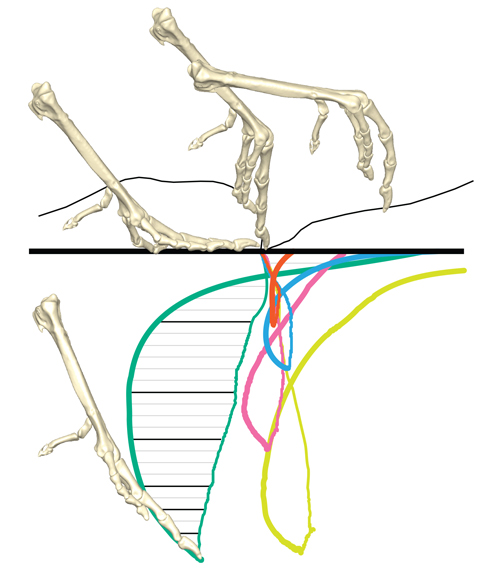
Researchers from Brown University (Rhode Island, USA) and Liverpool John Moores University, have plotted the tracks made by living birds in a bid to reveal new information about how some of the early theropod dinosaurs walked.  In a paper, published today in Biology Letters, the scientists describe how they analysed the locomotion of guineafowl (Order Galliformes) and discovered that dinosaurs may have moved in a similar way, despite the absence of a long, counter-balancing tail in modern Aves.

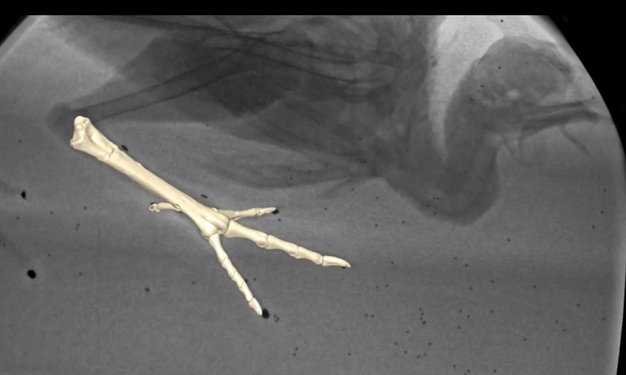
A X-ray Imagery was Used to Map the Movement of Bones in the Foot of Guineafowl

Modern birds help to interpret dinosaur tracks.
Plotting the foot movements of extant Guineafowl to help interpret Early Jurassic dinosaur footprints.

Picture credit: Turner et al/Liverpool John Moores University

Retaining Features of Their Non-avian Dinosaur Ancestors

The researchers used X-rays to image and plot the bird tracks in three-dimensions, as the guineafowl walked through a variety of substrates with different properties.  The feet of ground-dwelling birds retain many features of their dinosaurian ancestors, after all, living birds are members of the Order Theropoda along with famous dinosaurs such as Velociraptor and Tyrannosaurus rex.  The locomotion of the guineafowl permits insights into the complex interplay between anatomy, foot motion (kinematics) and substrate.  The results can then be used to assess the tracks made by dinosaurs.

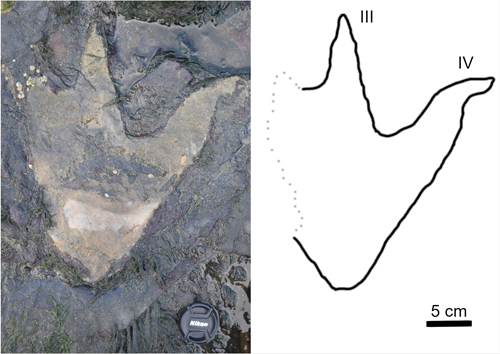
Studying Avian Dinosaur Tracks Provides a Fresh Perspective on Ancient Non-avian Dinosaur Fossil Tracks

Dinosaur footprint.
A dinosaur footprint from the Isle of Skye.  This new study can shed light on ancient dinosaur trackways.

Picture credit: Scottish National Heritage

A Looping Pattern Below the Ground Identified

Despite substantial step-to-step variability, the foot consistently moves in a looping pattern below the ground, matching the “looping motion” of dinosaur feet captured in the fossil record from the Early Jurassic.

One of the scientific paper’s authors, Dr Peter Falkingham, a senior lecturer in vertebrate biology at Liverpool John Moores University stated:

“Dinosaurs were moving in very similar ways to modern birds even 200 million years- ago (many millions of years before birds evolved), even though they were quite different, having long, muscular tails, for instance.  The similarity of motion, and the similarity of foot shape (three-toed) between dinosaurs 200 million years ago and birds today tells us how successful and versatile that foot has been evolutionarily.”

A Lateral View Showing the Foot Movement and the Looping Pattern of the Toes

The consistant looping pattern.
Plotting the movement of digit III through a variety of substrates revealing the consistent looping pattern identified below the ground.

Picture credit: Turner et al/Liverpool John Moores University

The scientists report that when a foot sinks into the sediment, a) the sub-surface motion gets recorded and b) the foot has to get out again.  Where it exits relative to where it went in can tell us how the foot was moving.  Despite substantial kinematic variation, the foot consistently moves in a looping pattern below ground.  As the foot sinks and then withdraws, the claws of the three main toes create entry and exit paths in different locations.  Sampling these paths at incremental horizons captures two-dimensional features just as fossil tracks do, allowing depth-based zones to be characterised by the presence and relative position of digit impressions.

Analysis of Early Jurassic Theropod Tracks

Analysis of Early Jurassic dinosaur tracks.
Exit features and depth zone attribution in Early Jurassic theropod fossil tracks.

Picture credit: Turner et al/Liverpool John Moores University

Studying Theropod Dinosaur Tracks

When the fossilised tracks of a small, theropod dinosaur were examined, the scientists found an equivalent looping response to soft substrates.  This study, comparing extant and extinct track-makers provides important new data on substrate properties and will assist with the interpretation of dinosaur tracks providing a fresh perspective on these important trace fossils.

This paper provides a new theoretical framework and vocabulary for describing relative positions of entry and exit traces, offering a new way of studying fossil footprints.

For a related article where researchers from Brown University in collaboration with international colleagues conducted earlier research on dinosaur footprints using guineafowl: Walking with Dinosaurs – the Birth of a Dinosaur Footprint.

Everything Dinosaur acknowledges the assistance of Liverpool John Moores University in the compilation of this article.

The scientific paper: “It’s in the loop: shared sub-surface foot kinematics in birds and other dinosaurs shed light on a new dimension of fossil track diversity” by Morgan L. Turner, Peter L. Falkingham and Stephen M. Gatesy published in Biology Letters.

Visit the Everything Dinosaur website: Visit Everything Dinosaur.
26 06, 2020

New Study Suggests “Marsupial Sabre-tooth” Was a Scavenger

By |2024-02-23T14:59:45+00:00June 26th, 2020|Categories: Dinosaur and Prehistoric Animal News Stories, Main Page, Photos/Pictures of Fossils|0 Comments

Thylacosmilus atrox – A Specialist Scavenger of Large Carcases

Huge canines in predatory mammals has developed on several occasions within the Class Mammalia.  Indeed, enormous sabre-like teeth can be found in the fossil record long before placentals and marsupials evolved, a case in point being the gorgonopsids of the Late Permian.  However, when the various types of mammal that developed such over-sized front teeth in their upper jaws are compared, it seems that not all sabre-toothed mammals were the ferocious predators that palaeontologists thought them to be.

Studying Thylacosmilus atrox

Writing in the open access, on-line journal “PeerJ” researchers from the University of Birmingham, Bristol University and the Vanderbilt University (Nashville, Tennessee), conclude that the South American “marsupial sabre-tooth”, Thylacosmilus atrox may have been a scavenger, using its huge upper canines to eviscerate carcases before removing internal organs with a large tongue.

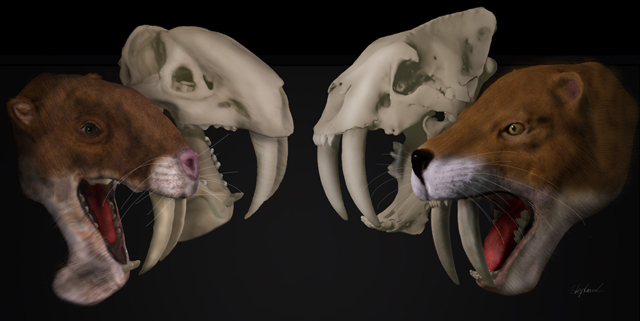
The South American Marsupial Thylacosmilus may not have been an Active Predator

Comparing the skulls of Thylacosmilus and Smilodon.
Skulls and life reconstructions of the marsupial sabre-tooth Thylacosmilus atrox (left) and the sabre-tooth cat Smilodon fatalis (right).  Examples of convergent evolution in unrelated animals, but a new study suggests that T. atrox may have behaved very differently, preferring to consume carcases rather than to actively hunt.

Picture credit: Stephan Lautenschlager/University of Birmingham

Thylacosmilus atrox – A Very Peculiar Carnivore

Thylacosmilus (pronounced Thy-lak-o-smile-us), is a member of the extinct Order Sparassodonta and only distantly related to the marsupials of Australia.  Its fossils come mostly from northern Argentina, and it lived during the Late Miocene and Pliocene Epochs.  Described as a jaguar-sized marsupial with huge maxillary canines, bite force studies had indicated that, for its size, it had a relatively weak bite, much lower than modern, large felids.

Whilst most palaeontologists would agree that the placental genus Smilodon was an active predator, albeit with a different method of dispatching victims when compared to extant “big cats”.  This new research proposes that Thylacosmilus, in contrast, was not a fearsome hunter.

Skull comparisons and an analysis of fossil teeth indicate that, Thylacosmilus, with its generally longer and more slender upper canines, was not able to stab prey that effectively when compared to the likes of Smilodon fatalis.  What it lacked in penetration it made up for in pulling power, with a strong “pull-back” action using its jaws to rip apart the bodies of dead animals.

Differences in Behaviour Thylacosmilus and Smilodon

Dr Stephan Lautenschlager (University of Birmingham) explained:

“We found there was a difference in behaviour between the two species: Thylacosmilus’ skull and canines are weaker in a stabbing action than those of Smilodon but stronger in a ‘pull-back’ type of action.  This suggests Thylacosmilus was not using its canines to kill with, but to open carcasses.  We suspect it was some sort of specialised scavenger, using those canines to open carcasses and perhaps using a big tongue to help extract the innards.”

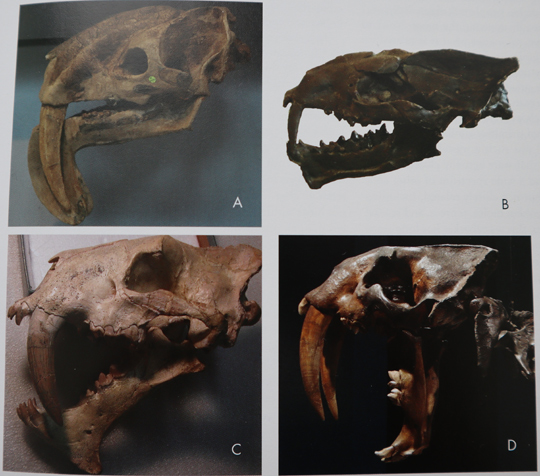
Convergent Evolution of a Sabre-toothed Skull

Convergent evolution of the sabre-toothed skull shape.
Convergent evolution.  A sabre-toothed skull has developed on several occasions in different types of tetrapod.  Note the presence of incisors in B, C and D but they are absent in the Thylacosmilus skull (A).

Picture credit: Everything Dinosaur/C. R. Prothero/D. R. Prothero

Convergent Evolution

The image (above), shows (A) the skull of Thylacosmilus, (B) the creodont Machaeroides, (C) Hoplophoneus, a member of the Nimravidae from North America and (D) the skull of the sabre-toothed cat Smilodon.  This is an example of convergent evolution – the similar body plan has evolved independently in several not closely related species.

The scientists discovered that the maxillary canines of Thylacosmilus were different from the teeth of other sabre-toothed mammals.  They were more triangular in shape, like a claw rather than flat like the blade of a knife.

Co-author, Dr Christine Janis (University of Bristol) added:

“The animal has impressive canines, but if you look at the whole picture of its anatomy, lots of things simply don’t add up.  It lacks incisors, which big cats today use to get meat off the bone and its lower jaws were not fused together.”

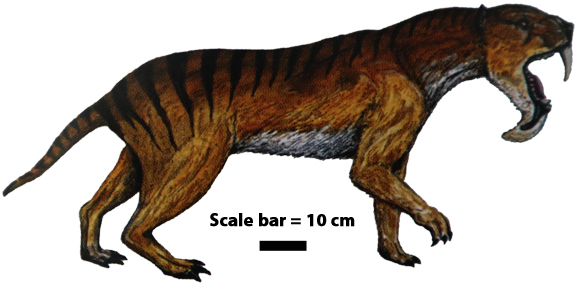
A Life Reconstruction of Thylacosmilus atrox

Thylacosmilus life reconstruction.
A life reconstruction of Thylacosmilus atrox from the Late Miocene/Pliocene of South America.  Note scale bar equals 10 cm. Picture credit: Everything Dinosaur.
Picture credit: Everything Dinosaur

A Puzzling Combination of Anatomical Traits

As well as lacking incisors, the researchers found that the molars of Thylacosmilus were proportionately small and not worn along their sides as expected in an animal that fed on meat.

Explaining the significance of this finding, Dr Larisa DeSantis (Vanderbilt University) commented:

“The molars tend to wear flat from the top, rather like you see in a bone crusher.  But if you examine the detailed microwear on tooth surfaces, it’s clear that it was eating soft food.  Its wear is most similar to that of cheetahs which eat from fresh carcasses and suggests an even softer diet than fed to captive lions.  Thylacosmilus was not a bone-crusher and may have instead specialised on internal organs.”

Not a Sparassodont Version of Smilodon

Far from being a sparassodont version of Smilodon, Thylacosmilus probably filled a very different niche in the ecosystem.  In addition, to the differences in the skull and the teeth, Thylacosmilus was relatively short-legged and lacked a very flexible spine.  These characteristics along with an absence of retractile claws suggests that Thylacosmilus would have struggled to pursue all but the slowest of prey and would have had difficulty pouncing and holding on to victims.

Everything Dinosaur acknowledges the assistance of a media release from the University of Birmingham in the compilation of this article.

The scientific paper: “Thylacosmilus was not a marsupial “saber-tooth predator’ ” by Christine Janis, Borja Figueirido, Larisa DeSantis and Stephan Lautenschlager published in PeerJ.

The award-winning Everything Dinosaur website: Everything Dinosaur.
25 06, 2020

Is this the Demise of a Duck-billed Dinosaur?

By |2024-02-23T14:32:47+00:00June 25th, 2020|Categories: Adobe CS5, Dinosaur and Prehistoric Animal News Stories, Dinosaur Fans, Main Page, Palaeontological articles, Photos/Pictures of Fossils|0 Comments

Taxonomic status of Ugrunaaluk kuukpikensis is Challenged

Five years ago, Everything Dinosaur reported the naming of a new species of duck-billed dinosaur that lived well inside the Arctic circle during the Late Cretaceous.  The dinosaur was named Ugrunaaluk kuukpikensis (pronounced 00-grew-na-luck kook-pik-en-sis).  At the time of publication, Ugrunaaluk was thought to be closely related to Edmontosaurus.  Since then, there has been quite a debate regarding the taxonomic validity of Ugrunaaluk.  In the latest twist of a tale set in prehistoric polar latitudes, researchers writing in PLOS One conclude that this Arctic dinosaur is most probably a species of Edmontosaurus.

The Taxonomic Validity of the Arctic Hadrosaur Ugrunaaluk kuukpikensis is Challenged

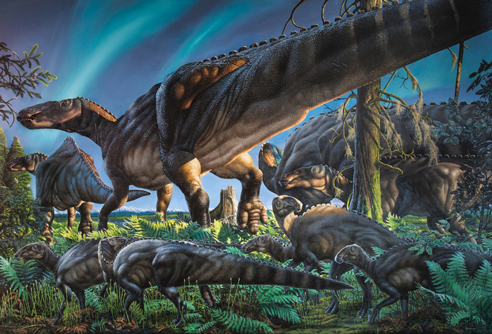
Ugrunaaluk illustrated.
The taxonomic validity of Ugrunaaluk kuukpikensis is controversial as this species was erected based on the study of the bones of immature, not fully adult individuals.

Picture credit: James Havens

The Prince Creek Formation Specimens

Duck-billed dinosaur fossils from the Liscomb Bonebed (Prince Creek Formation, North Slope, Alaska), were the first dinosaur bones discovered from the Arctic.  When originally assessed, it was proposed that these hadrosaurids were Edmontosaurus, members of the sub-clade Hadrosaurinae.  In 2015, a scientific paper was published that proposed the closely related species Ugrunaaluk kuukpikensis.  However, the taxonomic status of this material is problematical.  The fossils associated with the Liscomb Bonebed site represent immature, sub-adults and as such many of the anatomical traits used to characterise U. kuukpikensis, may reflect the developmental age of the individual and the shape of the bones may have altered as the dinosaur grew and matured.

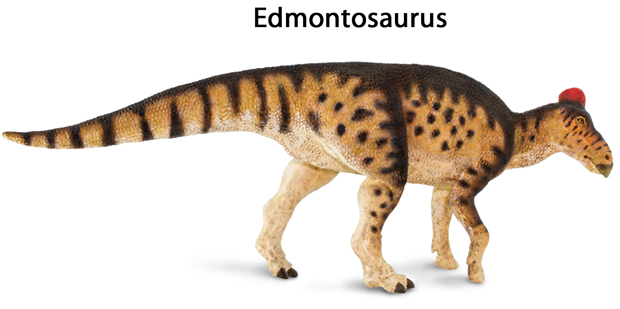
A Model of an Adult Edmontosaurus

Wild Safari Prehistoric World Emontosaurus model.
The new for 2020 Wild Safari Prehistoric World Edmontosaurus dinosaur model.

Picture credit: Everything Dinosaur

The picture (above) shows an Edmontosaurus figure from the Wild Safari Prehistoric World model series.

To view this range of prehistoric animal figures: Wild Safari Prehistoric World Models.

Looking at the Evidence for an Edmontosaurus taxon Hypothesis

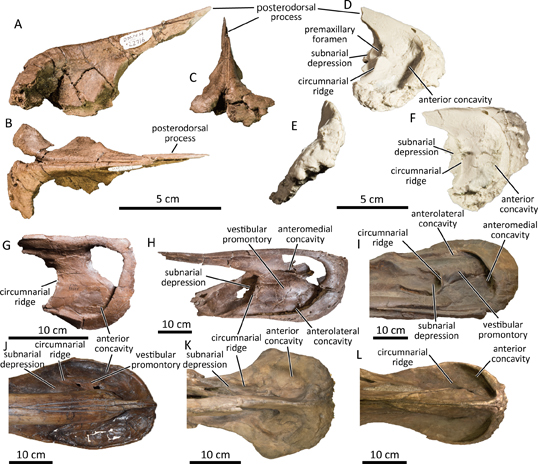
In this newly published paper, researchers from Okayama University of Science (Japan), the Perot Museum of Nature and Science (Texas) and Hokkaido University Museum (Japan), re-examined the skull bones from the Liscomb Bonebed and determined that the traits used to distinguish these Arctic fossils from those ascribed to Edmontosaurus were questionable.

In 2015, the scientific paper describing Ugrunaaluk kuukpikensis (Mori et al), proposed eight diagnostic characters for this new species.  Among the eight characters identified, three were proposed to distinguish Ugrunaaluk kuukpikensis from the Edmontosaurus genus.  Four of these eight characters distinguished Ugrunaaluk from Edmontosaurus annectens, which is known from Maastrichtian aged deposits from Montana and one character to distinguish Ugrunaaluk from the geologically older Edmontosaurus regalis, fossils of which are found in Canada.

It is likely that the shape of the skull of Edmontosaurus changed as it grew.  The bones forming the skull would also undergo change in shape and size, because of this, any taxon erected solely based on the shape of skull bones from young animals is questionable.  In this newly published paper, the researchers, which include Ryuji Takasaki, a researcher at the Okayama University of Science and Professor Yoshitsugu Kobayashi (Hokkaido University Museum), conclude that the Liscomb Bonebed hadrosaurid material should be ascribed to Edmontosaurus.

Comparing the Liscomb Bonebed Fossil Material with Known Edmontosaurus Skull Bones

Determining the identify of Alaskan duck-bills at the genus level.
A study of skull bones from the Prince Creek Formation (Alaska), suggests that the immature individual duck-billed dinosaurs found at this site are from the Edmontosaurus genus and that Ugrunaaluk kuukpikensis should be regarded as nomen dubium.

Picture credit: PLOS One (Takasaki et al)

Was Edmontosaurus Geographically Widespread

If the Arctic fossils are ascribed to Edmontosaurus, then this suggests that Edmontosaurus was geographically very widespread during the Late Cretaceous with fossils associated with this genus found in the northern states of the USA, Canada and Alaska.  The scientists consider that the Prince Creek Formation Edmontosaurus should be regarded as Edmontosaurus sp. until further discoveries of mature hadrosaurines from the Prince Creek Formation Bonebed and/or equivalently juvenile Edmontosaurus specimens from the lower latitudes allow direct comparisons.

Furthermore, if Edmontosaurus is associated with the very far north of Laramidia, this has implications for the ancestry of Late Cretaceous Asian hadrosaurids.  A number of duck-billed dinosaurs found in Asia may represent descendants of the Edmontosaurini lineage that migrated from Laramidia into Asia.

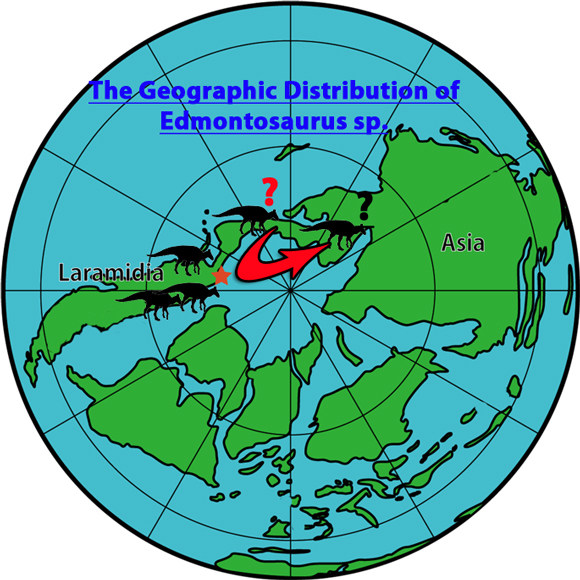
The Distribution of Edmontosaurus sp.

The distribution of Edmontosaurus.
The researchers suggest that Edmontosaurus was geographically very widespread occupying much of northern Laramidia and many of the Late Cretaceous Asian hadrosaurs may have been descended from the Edmontosaurus lineage.

Picture credit: Scientific Reports with additional annotation by Everything Dinosaur

The map (above), illustrates the distribution of Edmontosaurus as proposed by the research paper.  There is some evidence to suggest that Edmontosaurus preferred coastal environments and that this genus was widely distributed across northern Laramidia during the Late Cretaceous.  If this assessment proves to be correct, Edmontosaurus had a geographical distribution spanning about 4,000 kilometres from north to south in North America.

The scientists speculate that the ancestor of Asian hadrosaurids such as Kamuysaurus migrated from North America.

Japanese Hadrosaurs Had North American Roots

Professor Kobayashi commented:

“It is possible that the ancestor of Kamuysaurus that adapted to the environment at the northern limit of the species’ habitat crossed from North America to Asia and eventually evolved to Kamuysaurus.”

To read Everything Dinosaur’s article on the naming of Kamuysaurus: Famous Fossils from Japan are Named.

If the Prince Creek Formation hadrosaurs are established as members of the Edmontosaurus genus, then they could represent a new species of Edmontosaurus.  The large latitudinal distribution of this taxon could be re-established, the latitudinal range for Edmontosaurus would extend from about 40 degrees north to at least 70 degrees north.

The researchers conclude that despite the extensive geographical and temporal range of this taxon, the morphological disparity within different species associated with this genus is relatively small when compared to other members of the Hadrosaurinae.  The lack of any substantial anatomical differences between widely distributed species could reflect the relatively low latitudinal temperature gradient during the Late Cretaceous compared to today.  A relatively benign and unchanging environment would not have imposed significant pressure on species to evolve in order to adapt to new conditions.

To read our original article on the naming of Ugrunaaluk kuukpikensis: The Latest Dinosaur from Polar Latitudes.

Our article published in 2017, following a study of Edmontosaurus cranial material that also cast doubt on the taxonomic validity of U. kuukpikensisStudying the Skulls – Getting our Heads Around Edmontosaurus.

The scientific paper: “Re-examination of the cranial osteology of the Arctic Alaskan hadrosaurine with implications for its taxonomic status” by Ryuji Takasaki, Anthony R. Fiorillo, Ronald S. Tykoski and Yoshitsugu Kobayashi published in PLOS One.

Visit the Everything Dinosaur website: Everything Dinosaur.
Go to Top