All about dinosaurs, fossils and prehistoric animals by Everything Dinosaur team members.
25 11, 2008

What does Wyoming and the Remarkable Isle of Skye have in Common? Answer Stunning Jurassic Dinosaurs

By |2024-04-15T13:43:50+01:00November 25th, 2008|Categories: Dinosaur and Prehistoric Animal News Stories, Geology, Main Page|0 Comments

Scotland’s Mid Jurassic Heritage

The Isle of Skye is a beautiful island off Scotland’s rugged west coast, approximately 640 square miles of idyllic Scottish scenery, an island known for its Scottish heritage and tourism, so what does it have to do with the state of Wyoming in the American mid-west. The answer Jurassic dinosaurs.

Jurassic Dinosaurs

Well for a start, both places are sparsely populated and both areas have spectacular scenery and surprisingly the Isle of Skye has evidence of prehistoric animals that once roamed across the western USA.  The data gathered on this Scottish island’s dinosaurs is helping to provide information regarding the Jurassic fauna of Wyoming, in fact Skye is fast becoming recognised as a place of great interest to palaeontologists.  The same types of dinosaur roamed across Skye and Wyoming approximately 170 million years ago (Bajocian faunal stage), in a geological period known as the mid-Jurassic – but how is this possible?

During the Jurassic the American and European continents were very much closer together than they are today.  There was no Atlantic ocean (this did not begin to form until towards the end of the Jurassic period),  a series of rifts began to open up in the continental plates, separating the giant continent of Laurentia into the Americas and Eurasia.  However, that part of the world that was eventually to form the rocks in areas like Staffin Bay on the Isle of Skye was still joined to the North American continent.  A dinosaur could have walked from central Europe to Alaska had it had the mind to do so.

The Isle of Skye

The Isle of Skye’s importance to palaeontologists, particularly those studying the Middle Jurassic is enhanced by an article published in the current issue of the Scottish Journal of Geology.  The article suggests that fossil footprints found on Skye and others across the Atlantic in Wyoming were left by the same type of dinosaur – or at least a closely related species – dating back to the mid-Jurassic period, when Scotland and the United States were both part of the same landmass.

The authors of this study into the fossil trackways, Dr Neil Clark, the curator of palaeontology at Glasgow University’s Hunterian Museum, and Dr Michael Brett-Surman of the Smithsonian Institution in Washington DC, state that the tracks found in rock formations in Wyoming’s Bighorn Basin are very similar to footprints found in the Valtos sandstone beds on the Isle of Skye.

The footprints have been classified as having been made by a Coelophysid, an agile Theropod dinosaur.  Coelophysids were the most common type of meat-eating dinosaur in the Late Triassic and survived into the Jurassic before finally being replaced by new types of theropod such as the megalosaurs.

An Illustration of a Coelophysid (Coelophysis)
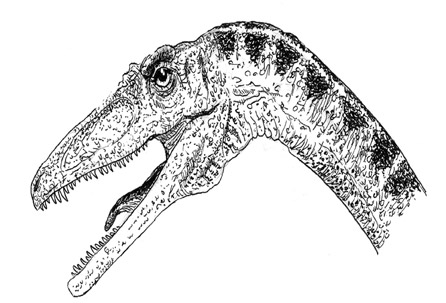
Picture credit: Everything Dinosaur

The illustration above shows a typical coelophysid, theropod, with its long neck, slender jaws lined with sharp, needle-like teeth.  The best-known of these dinosaurs is Coelophysis, a Triassic carnivore with its slender, muscular body, hollow bones (Coelophysis means “hollow form”) and long legs.  A number of articulated skeletons of this dinosaur are known, mostly recovered from the famous Ghost Ranch site in New Mexico.

Commenting on the link between Wyoming and the Isle of Skye, Dr Clark stated:

“The importance of this apparent link between Skye and Wyoming is that the Americans don’t actually have any dinosaur remains, apart from these footprints, from this particular period, the mid-Jurassic, whereas we have the bones of a number of different animals from that period here in Scotland.  So, basically, we’re enabling the Americans to see what sort of dinosaurs were probably roaming about North America at the same time”.

He added:

“The Americans do have the animal called Coelophysis, but their fossils of them are all from the Lower Jurassic or Upper Triassic periods, so they are a lot older than what we have in Skye, which is a representative of that group of dinosaurs which was still alive in the Middle Jurassic.  It seems to be associated with a particular type of footprint which also occurs in Wyoming at that particular time, so it’s quite possible they have a similar animal.”

While the footprints remain America’s only mid-Jurassic traces of the creature, Skye’s fossil beds from the same period have revealed a tooth and a tail bone, as well as the footprints.  Although most associated with the Ghost Ranch discoveries, it seems that the Isle of Skye can claim to have important evidence too, regarding the evolution of meat-eating dinosaurs.

A Rare Glimpse into Prehistoric Life

The island has afforded palaeontologists other rare glimpses into prehistoric life, footprints of a large ornithopod dinosaur were discovered in the 1980s along with more evidence of coelophysid dinosaurs (fossil bones) and a fragment of bone that is believed to have come from a sauropod (long-necked dinosaur).

Whilst the rock formations in the mid-western USA are vast and have a wealth of fossil information, the finds on Isle of Skye are somewhat limited, although this does not diminish their scientific importance.  The island’s Jurassic strata is overlaid by igneous material and the palaeontologists have only a few exposures to explore.  They are situated in places such as the exposed Trotternish peninsula where the rocks are weathered by harsh winds and strong tides.  It is often a battle with nature to find and preserve specimens before weathering destroys them for ever.

A Typical Sauropod of the Jurassic
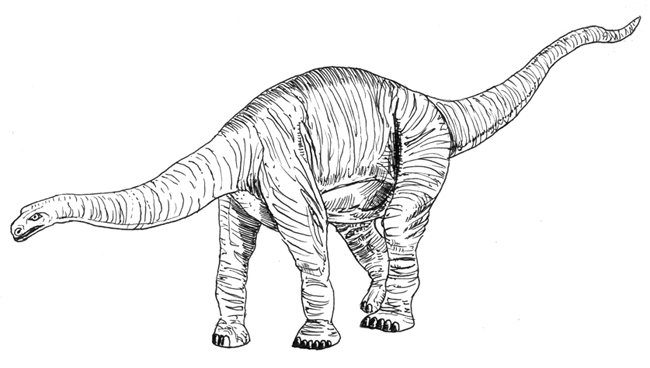
Jurassic dinosaurs

An illustration of a typical sauropod from the Middle Jurassic (Cetiosaurus). Picture credit: Everything Dinosaur.

Picture credit: Everything Dinosaur

The Isle of Skye may be a wild and rugged place, but it can hold its head up high when it comes to Jurassic dinosaur fossils, helping the likes of Wyoming to piece together its own ancient past.  Not bad considering that Wyoming is much more associated with dinosaurs than Scotland, after all, the state dinosaur (yes, they do have a state dinosaur), of Wyoming is Triceratops.

Everything Dinosaur stocks a huge range of dinosaur and prehistoric animal models including replicas of many Jurassic dinosaurs: Models of Jurassic Dinosaurs.
23 11, 2008

Open Wide – The Bite Force and Attack Strategy of Smilodon

By |2022-12-11T06:41:59+00:00November 23rd, 2008|Categories: Dinosaur and Prehistoric Animal News Stories, Main Page|0 Comments

New Study Sheds Light on the Bite Force and Gape of Smilodon spp.

The large, sabre-like teeth of Smilodon (Sabre-toothed Cat) were too fragile and likely to be damaged if this member of the Machairodontinae bit down onto bone.  How the large canines of these predators were used, has been the subject of considerable debate.  Some scientists have even suggested that the sabre-teeth were highly ornamental and only used for display, perhaps to intimidate other members of the pride and to establish a social hierarchy.  It had been argued that the row of forward pointing incisors in the upper jaw were the main killing teeth and these teeth were also the most effective at stripping meat from any kills.

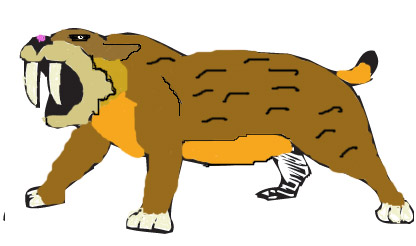
An Illustration of Smilodon (Sabre-Tooth Cat)

Picture credit: Everything Dinosaur

What has been established, is that Smilodon was able to open its jaws far wider than any species of extant Felidae.  The wide gape was an adaptation to having over-sized teeth in the jaws.  But how strong a bite and indeed, how the jaw muscles evolved to permit such a gape have been the subject of a new study, the results of which have been published in this month’s edition of the Zoological Journal of the Linnean Society.

The new analysis, carried out by scientists from Aalborg University (Denmark), reveals that the Smilodon’s jaw muscles evolved into a specialised pattern, which allowed them to open their mouths so wide.  The study was led by Dr Per Christiansen, who used a complex model to assess how the muscles in the jaws evolved.

Pictures show a modern big cat’s jaws on the left with the lower jaw opened as wide as it can be without damage to the jaw and the jaw muscles.  This is compared in the picture above to the jaws of an extinct Smilodon spp.  The jaws of Smilodon can be opened to a much wider angle than a jaws of a modern extant big cat.

Smilodon

His model revealed how the cat’s jaw muscles were aligned to pull its jaws closed, very directly and efficiently.  But Smilodon would also have done something that every cat-owner can see a relic of in their own pet.

Dr Christiansen explained:

“When you put a piece of food on the floor for your cat, you’ll see it bobs its head forward as it eats it.  And we know that [Smilodon] probably closed its jaws by twisting its head downward and throwing its head forward.  Its neck was longer than that of modern cats and its neck muscles would have been stronger.”

The study also examined the earliest and most primitive members of the Machairodontinae, although Dr Christiansen did state that Smilodon in particular was “outrageous in terms of its anatomy”.

He went onto add that Smilodon:

“Was the most [highly evolved and therefore] different from modern cats, so to understand this animal from a biological sense, you need to study more primitive animals to work out why they have become that way through evolution.”

He examined hundreds of skulls, drawing an evolutionary map showing why Sabre-tooths evolved such different jaw anatomy from modern cats.

Dr Christiansen explained that what he termed “killing ecology”, was the driving factor, the evolutionary pressure to kill prey with a deep and efficient stab to the throat.

He stated:

“The cat species became gradually more and more specialised, culminating with monsters such as Smilodon.”

Longer Canine Teeth

As Sabre-toothed cats evolved longer canine teeth, their jaw muscles actually grew smaller, but the fibres became more vertically orientated and thus probably more efficient in closing the jaw.

Dr Christiansen explained:

“At the same time, changes in the way the muscle fibres inserted on the lower jaw meant that the animals could stretch their muscles more – the fibres became re-orientated so as to allow a higher gape, necessary for gaping with huge fangs.”

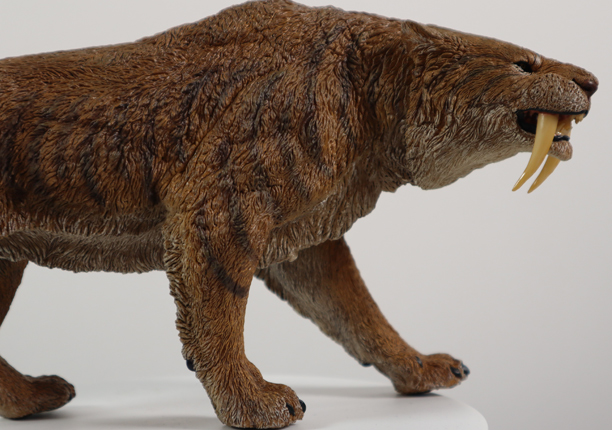
A Model of a Smilodon (S. populator)

Rebor Smilodon populator Stray Cat

The Rebor Smilodon populator Stray Cat 1/11th scale model shown in close-up view. This is the “plain” colour variant and it has the mouth-closed head attachment. The model is shown in lateral view. Picture credit: Everything Dinosaur.

Picture credit: Everything Dinosaur

However, as specialist carnivores, dependent on large, relatively slow moving prey that they could ambush, this could have been the reason for their demise whilst other members of the Felidae such as leopards, tigers and lions are the apex predators in their environments today.

Everything Dinosaur stocks a wide range of Smilodon models and figures: Models of Prehistoric Mammals.

22 11, 2008

Anger over Dinosaur Tail up for Sale in Portugal

By |2022-12-11T06:37:52+00:00November 22nd, 2008|Categories: Dinosaur and Prehistoric Animal News Stories, Main Page|0 Comments

Portuguese Builder hopes to Cash In on his Lucky Find

With increasing prices being paid for dinosaur fossils and other artifacts from the past, sometimes scientific research can be thwarted by an entrepreneur out to make a quick profit.  A dinosaur tail is up for sale.

One such scenario is currently being played out in Portugal, where the owner of a construction company has put his dinosaur discovery up for sale to the highest bidder.

Gonsalo Ribeiro, the finder of the dinosaur fossils, believed to be an articulated sauropod tail that dates from the Late Jurassic, has put this rare find up for sale on the internet.  Commenting on his discovery, Mr Ribeiro stated:

“I own an excavation business, and one day when we were out digging, we came across some stones, but when I looked closer, I noticed that they were not stones”.

Dinosaur Tail up for Sale

Ever since the most complete Tyrannosaurus rex skeleton found to date was auctioned by Sotheby’s in 1997, dinosaur fossils up for sale have hit the headlines and prices have rocketed.  That particular fossil was the famous “Sue” T. rex discovered in August 1990 by Susan Hendrickson, it was auctioned on October 27th 1997 and fetched $8.36 million.

A number of other widely publicised auctions of ancient prehistoric animal remains have taken place, there are major sales at least once a year.  Some of these sale items are purchased by the public purse or by philanthropists who later donate these items to museums.  This enables scientists to carry out research on them, but many are bought  by private collectors and they are then no longer available for study.

To read about a marine reptile fossil being auctioned: Fancy a Mosasaur for Christmas? Prehistoric animals under the hammer.

Recently, an almost complete Triceratops skeleton was sold (T. horridus), although the reserve price of 500,000 Euros at the original auction was not met, it did eventually sell for nearly 600,000 Euros a few days later.

Triceratops article: Triceratops for Sale.

The advertisement for this particular fossil sale reads: “For sale, dinosaur spine 90 per cent intact”.  It sounds to us like these are elements of the caudal vertebrae, perhaps those located immediately posterior to the sacral vertebrae, (the tail bones immediately behind the hips).

The tail section is estimated to be 3.6 metres long and has been dated between 152 and 146 million years (Kimmeridgian to Tithonian faunal stages).

When asked to comment on the auction, leading Portuguese palaeontologist Dr Octávio Mateus of the Museum of the Lourinhã stated that this particular find was of “huge scientific value”.

Mr Ribeiro has refused to hand over his treasure to a museum, claiming “the figures they offer are far off the mark.” A bold statement as setting a monetary value on such an item is a very difficult business.  It is believed that he has already turned down an offer of 100,000 euros (£84,000).

An Opportunity to Make Some Money

For Mr Ribeiro, this may be an opportunity to make some money, perhaps a lot of money, but this is really a sordid business as his actions are denying scientists the opportunity to study precious Late Jurassic sauropod material and eventually such a set of fossils could be put on public display at a museum for everyone in the community to see.

Dr Mateus, a specialist in the Jurassic dinosaurs of Portugal having worked on a number of specimens including the brachiosaurid Lusotitan that he helped name and describe in 2003,  has published a note on the website denouncing what he called the “sale of our heritage as if it were a car or a pair of shoes”.

Palaeontologists are calling for legislation to help protect fossils so that they can be declared “public heritage” and protected from being sold to the highest, wealthiest bidder to the detriment of the scientific community and the public.

Such instances are likely to become more and more common as internet sites and specialist auction companies provide a ready market for such valuable items.  We wish Dr Mateus and his colleagues well and hope their case is given a fair hearing by the Portuguese legislature.

Everything Dinosaur offers affordable dinosaur and prehistoric animal models.  There is no need to upset the scientific community, take a look at the models section of the Everything Dinosaur website: Dinosaur and Prehistoric Animal Figures.

21 11, 2008

Cambrian Trace Fossils – It was the Single-Celled Life Forms that Made Them

By |2022-12-11T06:33:57+00:00November 21st, 2008|Categories: Dinosaur and Prehistoric Animal News Stories, Main Page|0 Comments

Single Celled Giant – Responsible for Ancient Trace Fossils?

One of the most momentous events in the history of life on our planet took place around 545 million years ago, at a time when the Earth looked very different than today.  For a start it was spinning faster on its axis, meaning that our 24-hour orbit was something unimaginable back then, days would have lasted something like 20 hours.  The atmosphere would have been completely alien to us, in fact had a human being been able to travel back in time to the Cambrian, they would have needed to bring breathing apparatus as the air with its lack of oxygen would have been quite toxic to us.

Cambrian Trace Fossils

The continents with which we are so familiar today, would have been unrecognisable, in the western hemisphere; the fragmented parts of a super continent were being pulled apart by an ocean ridge, in the east, another, larger remnant of this huge landmass stretched almost pole to pole.  Most of the United Kingdom lay off the coast of Gondwana, the name given to the area of land in the eastern hemisphere, although rock that is found in Scotland today was actually thousands of miles away in the western hemisphere.    The geological period we now know as the Cambrian was first defined in 1835 by an English professor of geology – Adam Sedgewick.  He mapped rock strata in Wales and showed that it was formed after older Precambrian rocks but before the rocks believed to have been formed in the Silurian period.

As our understanding of geology has improved, these Welsh rocks are not used anymore to delineate the start of the Cambrian, strata in Newfoundland are regarded as indicative and distinctive enough to be seen as forming the boundary between the Precambrian and the Cambrian.  The starting point of the Cambrian is marked by the appearance of trace and body fossils, indicating diverse animal life.  Trace fossils are preserved evidence of activity, for example a fossil cast of a worm burrow or a trail left in soft mud on the ocean floor that has become preserved.

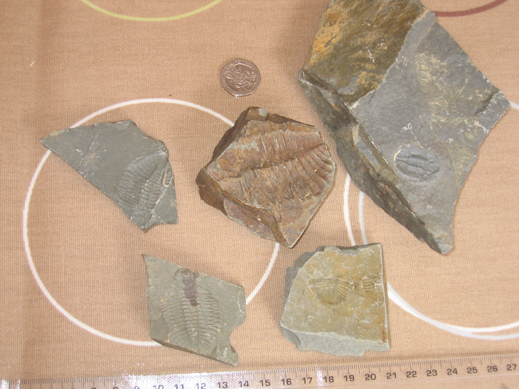
During the Cambrian, there was a rapid acceleration in evolution and a vast array of new creatures suddenly appear in the fossil record.  Animals with hard parts such as shells and external skeletons evolved and this phenomenon has been termed the “Cambrian Explosion”.  Prior to the evolution of hard parts that have a higher potential for fossilisation, only a very few types of fossil were known – many of which were trace fossils, such as tracks preserved in mud as a creature crawled over the seabed.  The first trilobites appear, amazing arthropods, distant ancestors of spiders, mite, insects and crustaceans.  trilobites are one of the “star turns” in the fossil record.  These marine creatures evolved into at least nine Orders and survived right through the Palaeozoic, with the very last of their kind becoming extinct at the end of the Permian approximately 250 million years ago.

An Illustration of a Typical Trilobite

Illustration credit: Everything Dinosaur

To view a model of a trilobite – from Everything Dinosaur’s fossil replica series:-

Model trilobite and other prehistoric anmals: Prehistoric Animal Models.

Up until now, the trace fossils, many of which are preserved trackways, are believed to have been made by complex, soft-bodied organisms, perhaps ancestors of the armoured trilobite.  This has been an appropriate assumption as; in a relatively short period of geological time, the Cambrian explosion occurs and a myriad of life forms are recorded as fossils.  It had been widely accepted by palaeontologists and ichnologists that trace fossils such as these trackways were made by soft bodied, complex, bio-symmetrical organisms, a fair assumption, since just a few million years later a great diversity of complex life occurred and these animals must have had complex ancestors and life would have been abundant.  Being soft-bodied there is little fossil evidence to be found, the fossils were thought to be disproportional to the amount of life forms that had already evolved.

However, new insight into the habits and lifestyle of a very ancient creature has cast doubt on this assumption, it appears that single-celled, very simple organisms are capable of leaving tracks in soft mud and it could be these life forms, not more complex ones that left the Early Cambrian and Precambrian tracks in mud that became trace fossils.

New Research

New research into a little known, distant relative of microscopic amoebas called Gromia sphaerica has proved that these little organisms travel across the sea floor and as they do, they leave trackways behind.  These tracks are very similar to the fossilised tracks found in Precambrian rocks.  It has been suggested that the Precambrian trace fossils may not be evidence of complex organisms but the preserved trails of an ancient type of Gromia.

If this is the case, then the Cambrian explosion becomes even more of a mystery, as what evidence we have of complex organisms in Precambrian strata may be reduced if some of these tracks are attributed to types of single-celled organism.

G. sphaerica was believed to be sessile and of a epifaunal habit (living on the sea floor, either on soft sediment or attached to rocks, but not moving).  Observations from the bottom of the Arabian Sea indicated this.  However, a group of researchers have located a colony of the coast of the Bahamas and these creatures are vagrants (move over the sea floor), leaving trails up to half-a-metre in length.

Gromia sphaerica is gigantic for a single-cell eukaryote (cell enclosed by a membrane), some specimens have been measured with diameters in excess of 30 mm, about the size of a large marble.  These creatures were recorded wandering across the seabed by Mikhail Matz of the University of Texas at Austin and a group of fellow researchers

A distant relative of amoebas, these strange organisms have left trails in the Caribbean seabed that resemble the trace fossils found in Precambrian rocks.

The red arrow in the picture is pointing to a trail left by a Gromia sphaerica.  The round lump is the organism itself, covered in a light coating of sediment.  The trail consists of two small ridges on the outside, and one thin bump running down the middle.  This pattern is consistent with certain trace fossils.  Scientists are confident that prior to the Cambrian, life forms were exploiting the surface layers of marine sediments, now this new evidence may indicate that multi-celled, bio-symmetrical organisms were not as abundant as the fossil record indicates, if some of these trace fossils can be attributed to the ancestors of Gromia sphaerica.

Commenting on the research, Matz stated:

“If these guys were alive 600 million years ago, and their traces got fossilised, a palaeontologist who had never seen this thing would not have a shade of doubt attributing this kind of trace to the activity of a big, multicellular, bilaterally symmetrical animal”.

“This is a very important discovery,” Shuhai Xiao of Virginia Polytechnic Institute added. “The fact that protists can make traces has important implications for how we interpret many trace fossils.”

This research could have dramatic implications for the Cambrian Explosion, if single-celled organisms were making some of the trackways, complex animals were not as abundant as previously thought.   To quote the researcher Matz, every type of animal phyla around today “suddenly burst out of a magic box.  It wasn’t a gradual development”.

In addition, genetic analysis of the water-filled cells of G. sphaerica reveal tantalising evidence that it could be one of the oldest type of organism on the planet – a living fossil.

“There’s a 1.8 billion year old fossil from the Stirling Formation in Australia that looks just like one of their traces, and with a discoidal body impression similar to these guys [G. sphaerica]“.  Matz commented.

“We have not proved anything, but we might be looking at the ultimate living macroscopic fossil”.

The Stirling Formation in south-western Australia is famous for its fossils of Precambrian life, many types of soft-bodied animal are preserved in what was a shallow, tidal, sandy sea bottom.  Sharing this ancient world, a part of the geological time scale called the Cryptozoic (time of invisible life due to the paucity of the fossil record), were jellyfish.

Jellyfish are another example of a living fossil, this type of animal may have swam in prehistoric seas, as much as one billion years ago.

To read a related article on jellyfish and life before the Cambrian explosion:

Jellyfish – an example of a living fossil.

Everything Dinosaur supplies a model of a Medusa type jellyfish, part of a set of fossil animal replicas that include belemnites and ammonites.

20 11, 2008

Ready to Start Exploring Dinosaurs – Christmas Gift Suggestion

By |2022-12-09T16:21:07+00:00November 20th, 2008|Categories: Educational Activities, Main Page, Press Releases|0 Comments

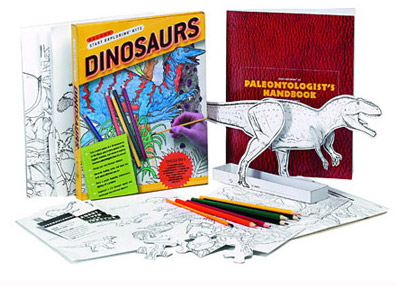
Start Exploring Dinosaurs – Box Set (Christmas Gift Idea)

This time of year we get lots of phone calls and emails from Mums, Dads, and Grandparents asking advice about purchasing Christmas gifts for children, how can they help them start exploring dinosaurs?  Since our company is made up of parents, teachers and dinosaur experts we are well placed to make recommendations.  Indeed, as we conduct our own focus groups and test products before they go into our shop we have a big database which helps us provide information and advice.

Often we are asked to recommend something that will entertain, educate and won’t be a “five minute wonder” to quote one parent.  There are a lot of very good quality and excellent items in our ranges but one particular gift idea is the Start Exploring Dinosaurs Kit.

Start Exploring Dinosaurs Activity Set

Picture credit: Everything Dinosaur

Discover the secrets of dinosaurs with this entertaining and educational activity pack.  Kit comes complete with watercolour pencils, paintbrush, young palaeontologist’s handbook, in fact everything you need to complete the posters, make the puzzle, build the model.  Lots and lots of dinosaur themed activities which can be used to help turn a child’s bedroom into their own “Jurassic Park”.

To view the huge range of dinosaur toys and prehistoric animal gifts available from Everything Dinosaur, visit the company’s website: Everything Dinosaur.

19 11, 2008

Bolivian Dinosaur Footprints from the Early Cretaceous

By |2022-12-09T14:42:48+00:00November 19th, 2008|Categories: Dinosaur and Prehistoric Animal News Stories, Main Page|0 Comments

Farmer finds Ancient Dinosaur Trackways

A Bolivian farmer called Primo Rivera who, had since childhood wondered about the strange marks in a rocky hill near his family home has helped a team of palaeontologists discover the oldest dinosaur trackways ever found in his country.

As a boy, Primo had often examined the strange potholes and dents exposed halfway up a rock face but he did not know what to make of them.  It was only when he visited a dinosaur exhibit at Sucre, (the provincial capital), that he realised that the marks etched into the rock near his home might be dinosaur footprints.

“I used to come to look at the prints when I was a kid … but I didn’t know what had made them,” the farmer commented at a press conference.

The fossilised tracks are believed to date from the very beginning of the Cretaceous period, approximately 140 – 145 million years ago (Berriasian faunal stage).

In pictures, one of the researchers is measuring the stride length of a trackway.  A lot of data can be gathered from such sets of prints, for example, an estimate of the size of the animal and its travelling speed.  Scientists who study fossilised footprints, tracks and other trace fossils are called Ichnologists.

At least three different types of dinosaur are represented by the trackways, including an armoured Ankylosaur type dinosaur.  These are the oldest footprints of Ankylosaurs ever found in the southern hemisphere.  Some of the prints are over 30 cms long and indicate dinosaurs that would have been about 10 metres in length.

Dinosaur Trackways

Pictures show the approximate size of one of the prints (the hand is facing in the same direction as the dinosaur was walking).  The prominent toes indicate ankylosaur, the depth to which the print has sunk shows that this animal was extremely heavy.

Close to the larger prints, the palaeontologists found smaller ones that probably belonged to baby dinosaurs.  This might indicate that ankylosaurs were capable of providing parental care.  Perhaps these large animals protected their offspring.  Ankylosaur trackways have been found in South America before, in fact one such trackway indicates a trotting armoured dinosaur, moving at quite a speed, approximately 10 miles an hour, quite impressive for a large animal.

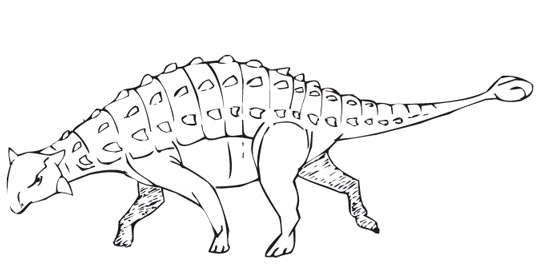
An Illustration of A Typical Ankylosaurid

Picture credit: Everything Dinosaur

The farmer by chance met a team of scientists carrying out research in the area and took them to see the strange marks in the rocks, once the team had examined them they quickly realised that they were looking at a very special site.

The Thyreophora

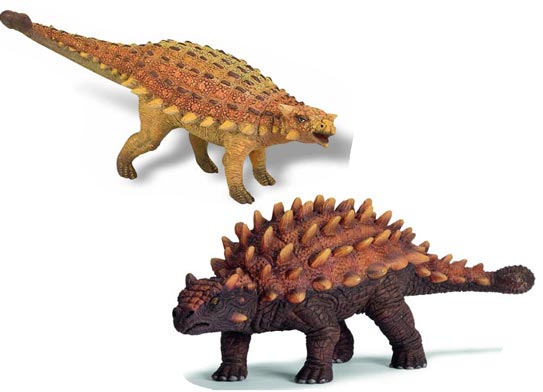
This group of armoured dinosaurs, part of the Thyreophora (shield bearers) along with stegosaurs, were built like tanks.  They possessed heavy body armour and in the ankylosaurids – a defensive tail club.  The group persisted right up until the end of the Mesozoic.  The body armour, some species even had armoured eye shields, probably evolved to help protect these relatively slow moving herbivores from large theropods, allosaurs and carcharodontosaurids in South America at the start of the Cretaceous and tyrannosaurs in the northern hemisphere up to the end of the Age of Reptiles.

A Models of Ankylosauridae (Ankylosauridae)

Armoured dinosaur models.

Picture credit: Everything Dinosaur

To view the model of this dinosaur and other armoured dinosaurs: Dinosaur Models and Prehistoric Animal Toys.

18 11, 2008

New Research Suggests Violent Death for Prehistoric “Nuclear Family”

By |2024-04-15T13:24:39+01:00November 18th, 2008|Categories: Dinosaur and Prehistoric Animal News Stories, Main Page|0 Comments

Neolithic Grave indicates “Nuclear Family” who met a Violent Death

Analysis of the human remains found buried together in Neolithic graves indicate that our Stone Age ancestors lived in similar family groups as we do.  Genetic study of four bodies found in a 4,600-year old grave near Eulau in Germany shows that four unfortunate victims of a tribal raid were all related to each other and that they were buried together in an intimate arrangement, together in one another’s arms.

This burial site has been studied over the last few years and has yielded remarkable insights into the lives of our ancestors as they moved from a nomadic, hunter-gatherer existence into a more sedentary one.  Earlier research indicated that social groups were built around the menfolk who raided other tribes and stole women.

To read an earlier related article: Evidence of Neolithic Violence – Fighting over the Girls.

The Neolithic remains, which demonstrate evidence of a genetic relationship belong to a man aged between 40 and 60, a woman aged between 35 and 50, and boys aged 4 to 5 and 8 to 9 years of age.  Together they provide the earliest firm evidence for the existence of nuclear family units.

Neolithic Graves

Scientists know that burials were extremely ritualistic, a trait that has remained with us, adults, for example were buried in a particular way with females laid out on one side of their body and males on the opposite side in most ancient burials found in this part of central Europe dating from Neolithic Times.

Pictures show the layout of the skeletons within one of the burial pits. The bodies have been positioned carefully in a close and intimate position, the illustration at the top shows more detail.

The whole site paints a macabre scene, a number of bodies have been uncovered, most showing signs of violent death and defensive wounds such as broken wrists and fingers as they tried to protect themselves from blows.

The majority of the bodies in the graves were children or women, and only one of the skeletons belonged to a man in his prime, aged between 25 and 40.  It is likely that these people were murdered in a raid by a rival tribe, out to steal young women, before the survivors returned to bury their dead.

Studying Ancient Communities

Many anthropologists have assumed, based on observations of sometimes polygamous modern-day hunter-gatherers, that the basic social unit of early humans was the band or tribe rather than the family.  Figuring out when the nuclear family became central to human social organisation has been difficult.

Archaeologists have dug up thousands of skeletons at early farming sites across the Near East and Europe, and many of them are buried together in ways that might suggest family ties.  For example, at the 9500-year-old early farming site of Çatalhöyük in Turkey, excavators have uncovered two skulls with their foreheads touching and the skull of a man cradled in the arms of a woman.  But without DNA evidence, researchers are reluctant to ascribe modern-day interpretations to ancient burials.

Now, a team led by Wolfgang Haak, a geneticist at the Australian Centre for Ancient DNA in Adelaide, claims to have worked out some family relationships in a remarkable series of burials uncovered in central Germany in 2005.  At the early farming site of Eulau, German archaeologists found four graves containing 13 individuals who had apparently met a violent death.

Working with the German team, Haak and colleagues were able to extract enough mitochondrial and nuclear DNA from the skeletons in one of the graves to conclude that the two adults were the parents of the two boys.  In a second, nearby grave, the team concluded that the bodies of three children were probably brothers and sisters, although the adult female found with them was not their mother. Rather, the researchers suggest, she might have been an aunt or a step-mother, perhaps some other close relative.

Commenting on the research, published in the scientific journal “The Proceedings of the National Academy of Sciences”,  Haak and his co-workers state that:

“We have established the presence of the classic nuclear family in a prehistoric context”.

In further analysis, the team studied the strontium isotope content of a number of the skeletons’ teeth, which varies according to the chemistry of the soil where an individual spends his or her childhood. The researchers found that the children and the adult men grew up in the Eulau area of Germany, whereas the adult women came from at least 35 miles away; an indication that nuclear families in this region were organised around local men who mated with women from outside their own community.

“A Great Piece of Work”

“This is a great piece of work,” commented Alexander Bentley, an anthropologist at Durham University. Bentley adds that the new findings, including the signs of violence on the skeletons, such as multiple skull fractures, a flint arrow head lodged in spine of one of the females and defensive marks on the hands and arms, are consistent with other archaeological evidence from Central Europe that men raided outside communities and captured their women.

Other archaeologists argue that the evidence is inconclusive and the author’s claims regarding the biological relationship between the skeletons is stretching matters a little.  The genetic markers the team used are “very widespread in Europe”, according to one source meaning that they cannot be used to work out exact family relations without a broader study of prehistoric skeletons from the region.

Everything Dinosaur stocks the CollectA range of prehistoric animal models, this series also includes models of Stone Age people: CollectA Prehistoric Life Models.

16 11, 2008

Amargasaurus – Reptile from Amarga Province

By |2022-12-09T14:33:10+00:00November 16th, 2008|Categories: Dinosaur and Prehistoric Animal News Stories, Main Page|0 Comments

Amargasaurus – A Bizarre Late Diplodocid

As an increasing number of bizarre forms of sauropod have been unearthed for example Amargasaurus. The family tree of these huge long-necked dinosaurs is becoming more complicated.  Although, thanks to recent discoveries of more basal sauropods and prosauropods the evolution of these saurischians has become a little clearer, there is still a lot of confusion over the taxonomic relationships between the various families.

To read further about this: Changing Views on Sauropods.

The Argentine Amargasaurus for instance, is an example of a strange looking, long-necked dinosaur and the strata from which the single fossil skeleton so far known was discovered adds to the mystery of the sauropods.  The global fossil record indicates that the diplodocid type of sauropod was beginning to become rare during the Early Cretaceous. Their heyday appears to have been the Late Jurassic when behemoths such as Diplodocus, Barosaurus and Apatosaurus roamed.  However, the fossils of Amargasaurus date from the early Cretaceous (Hauterivian faunal stage – approximately 135-130 million years ago).  This indicates that this particular group of long-necked dinosaurs were still present, at least in the southern hemisphere during the Early Cretaceous.

Amargasaurus also had a very strange appearance, being relatively small compared to the diplodocids known from the Upper Jurassic deposits of the Morrison Formation of the western United States.  For a start, it was only about 12 metres in length, considerably smaller than Diplodocus and Apatosaurus and it had a much shorter neck, compared to other diplodocids.

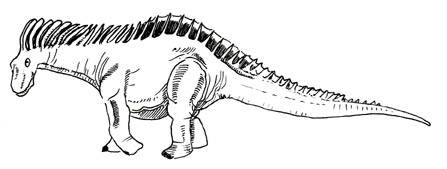
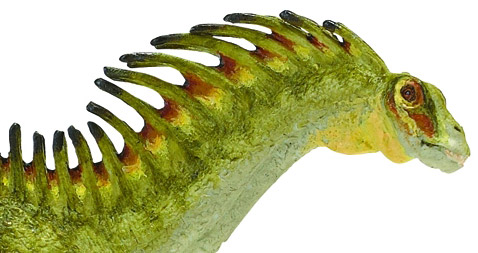
The most distinguishing feature though was that along the neck and back of the animal was an array of long, spines extending up from the back bone.  These spines consisted of two rows of long spines over the neck and shoulders, gradually reducing to a set of single spines running along the back to the hind quarters.

An Illustration of Amargasaurus

Picture credit: Everything Dinosaur

To view a model of Amargasaurus and other long-necked dinosaurs: Dinosaur and Prehistoric Animal Models.

The exact purpose of these spines is hotly debated by scientists.  Some believe that they supported a brightly coloured sail that could have been used as signalling device amongst members of the herd, whilst others suggest that the spines were for defence against attack from large meat-eaters that shared the same environment.  Those spines on the neck which are paired, may not have supported a sail, but been covered in horn helping to protect a vulnerable part of this animal’s body.  Certainly, with the likes of members of the Allosaur family wandering around it would pay to have some form of protection, but the precise purpose of these spines remains unclear.

Amargasaurus may be a member of the Dicraeosauridae, a group of sauropods that all possessed long neural spines.  Amargasaurus may have been a descendant of the genus Dicraeosaurus, a diplodocid from the Late Jurassic of East Africa.

Close up of Amargasaurus Head

Picture credit: Everything Dinosaur

As can be seen in this illustration of Amargasaurus, the presence of skin stretched between the large neural spines is played down, instead they are depicted as having more of a defensive purpose.  What ever they were for, this is certainly a very peculiar looking sauropod, with its large neural spines, so of which were over 5 feet tall.

15 11, 2008

Brooding Meat-eating Dinosaurs – New Evidence Uncovered in Montana

By |2024-04-15T13:26:07+01:00November 15th, 2008|Categories: Dinosaur and Prehistoric Animal News Stories, Main Page|2 Comments

Nesting Dinosaurs – More Evidence from North America

Imagine the scene, it is late in the Cretaceous and a small theropod dinosaur has a difficult decision to make, should it stay, guarding its nest on the banks of a rapidly rising river or make a run for it before the fast rising waters engulf both it and its brood  It’s a tough decision for brooding meat-eating dinosaurs.

That is the scenario imagined by a team of Canadian researchers as they study a unique fossilised dinosaur nest dating from the Campanian faunal stage (dated to approximately 77 million years ago), found in the Medicine Hat Formation of Montana.  The research team have used this fossil dinosaur nest to learn more about how these ancient reptiles constructed nests and brooded eggs.

Brooding Meat-eating Dinosaurs

However, working out what type of dinosaur was responsible for the nest was quite a challenge, the team’s efforts to study this unique find and identify the culprit are written up in the scientific journal Palaeontology.

“Working out who the culprit was in this egg abandonment tragedy is a difficult problem to crack,” commented Darla Zelenitsky, University of Calgary palaeontologist and co-author of a paper, in a statement, part of a Calgary press release.  Dr Zelenitsky, an Associate Professor of the Deparment of Geoscience at Calgary University has worked on a number of North American dinosaur eggshell discoveries, particularly egg fragments discovered in the Oldman Formation (Judith River Group – Alberta), which also date from the Campanian faunal stage.

“After further investigation, we discovered that this find is rarer than we first thought.  It is a one of a kind fossil.  In fact, it is the first nest of its kind in the world.”

It is often difficult to relate the fossil material to a particular dinosaur family (taxonomic reference).  In this case, the specimen of a fossil nest was part of a private collection and had been labelled as belonging to a Hadrosaur (duck-billed dinosaur).  Such misidentification is unstandable, as in the absence of any fossil bones either from brooding adults or embryos still inside the unhatched eggs or the fossil remains of baby dinosaurs, it is difficult to work out what type of dinosaur laid the eggs.

Dinosaur Eggshell Fragments

However, by analysing the eggshell fragments, the team were able to identify that this was the nest of a small meat-eating dinosaur and not from a plant-eating ornithopod.

“Nests of small theropods are rare in North America and only those of the dinosaur Troodon have been identified previously,” added Dr Zelenitsky.

“Based on characteristics of the eggs and nest, we know that the nest belonged to either a caenagnathid or a small raptor, both small meat-eating dinosaurs closely related to birds.  Either way, it is the first nest known for these small dinosaurs.”

Raptors, more appropriately termed dromaeosaurids, were small, agile, hunters of the Late Cretaceous, a typical dromaeosaur would be Saurornitholestes (the name means “lizard bird thief”), a swift predator that reached lengths in excess of two metres.  A number of dromaeosaurid fossils are known from Montana, animals such as the fearsome Deinonychus and the smaller, meat-eater called Bambiraptor – a dinosaur named after the deer in the Disney film.

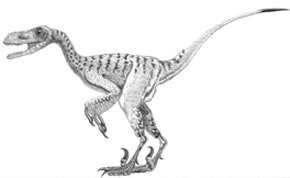
An Illustration of a Typical Dromaeosaurid

Picture credit: Mike Fredericks/Everything Dinosaur

The picture above shows a typical dromaeosaur, covered with proto-feathers, grasping hands and the three-toed claws with the single retractable claw on each foot.

“Our research tells us a lot about the dinosaur that laid the eggs and how it built its nest,” commented Francois Therrien, another member of the scientific team and curator of Dinosaur Palaeoecology at the Royal Tyrrell Museum in Drumheller (Alberta).

Dinosaur Fossil Nests

The fossil nest is a mound of sandstone, approximately 50 cm in diameter.  The eggs were laid in pairs on the sloping sides of the mound to form a ring of eggs.  The flattened top of the mound was where the adult dinosaur sat to brood the clutch.  Whether, this was the duty of just one of the breeding pair is unknown, perhaps the female brooded the eggs whilst her mate brought food to the nest, or perhaps these little dinosaurs worked in shifts to protect the eggs and keep them warm.  Unfortunately, evidence of behaviour such as this is not preserved in the known fossil record.

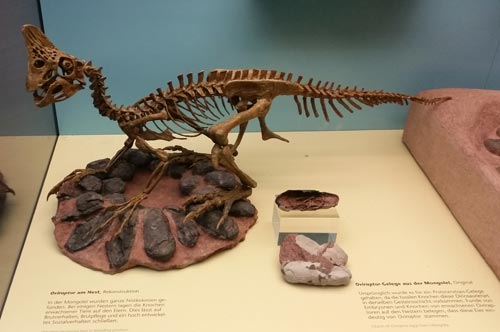
A Theropod Dinosaur Nest (Oviraptor)

An Oviraptor and dinosaur eggs exhibit.

An Oviraptor and its nest. Picture credit: Everything Dinosaur.

Picture credit: Everything Dinosaur

By studying the fossil the scientists have been able to determine that this dinosaur dug its nest in freshly deposited, loose sand, possibly along the shore of a river.  An analysis of the substrate under the actual fossil indicates that the dinosaur disrupted the rock underneath, indicating that there was a substantial amount of effort put into the digging when excavating the nest.  Perhaps this indicates that the mated pair worked together or that both the front claws and the strong hind limbs were used to construct the nesting mound.

Approximately, a dozen asymmetrical, slightly elongated eggs were laid in pairs against the sides of the mound.  The raised central area was flat, a comfortable place for the dinosaur to crouch down to brood the clutch.   These type of feature can be clearly seen in the fossilised nest of a dromaeosaur shown in many pictures.

The Montana specimen may also represent the nest of a Caenagnathidae dinosaur, a type of dinosaur closely related to the bird-like oviraptorids.  The word caenagnathid means “recent jaws”.  When these Cretaceous animals were first researched, it was noted that the lower jaws possessed several features that resembled the jaws of ostriches and other modern flightless birds.  It was due to this resemblence that these animals were called caenagnathids.

Using high powered microscopes the detail on the outer surface of the eggshells was revealed.  The eggs had a ridge-like pattern on them.  The fact that the eggs were laid in pairs is significant.  This indicates that these dinosaurs had two oviducts (the tubes through which the eggs pass through whilst being laid).  Modern birds have only one oviduct.  Scientists believe that birds lost the second oviduct as this helped them become lighter which was an aid to flight.  The changes in the Aves reproduction processes occurred to prevent them having to fly around with a body full of eggs, this is why a bird may take several days to lay its clutch with one egg being laid at a time.

The evidence from these fossil theropod nests indicate that they laid eggs in pairs, laying from both oviducts at the same time and their exact placement in the nest may show that the mother pushed the eggs down into the sand to secure them in place.  As far as we know from the fossil record no other animal has ever laid eggs in this manner; laying eggs out of both oviducts at the same time.  It is also likely that the eggs were laid in one big clutch with no long interval between laying.  This can be assumed as it would have been difficult for a dinosaur, even one as nimble as a small theropod to return to egg laying, say after laying half her batch.

It would be quite tricky to keep glancing around your legs to make sure that you were laying the next pair of eggs in the right position relative to the previous pair laid.  Best thing to do would be to try to complete the egg laying in one rhythmic sequence, after all, crocodiles lay all their eggs at once.

Finding evidence of two oviducts in theropod dinosaurs is significant, particularly if the nest is suspected of having been made by a dromaeosaur.   This has implications for a theory put forward by the American palaeontologist Greg Paul.  In his book “Dinosaurs of the Air”, published in 2002, Paul puts forward the theory that dromaeosaurs such as Velociraptor and Deinonychus are descended from flying ancestors.  He speculates that the ancestor of these agile, carnivores would have been an animal with the capability of flight but with teeth and claws – something like an Archaeopteryx (Late Jurassic).

At some time between the end of the Jurassic and the Late Cretaceous the descendants of these birds would have lost their power of flight and taken to a ground dwelling existence.  The wings would have gradually become smaller over many generations and the powerful chest muscles required for flight would have been reduced.  The jaws, teeth and the long tail would have been retained, the tail acting as a balancing device rather than a rudder and stabiliser in powered flight.  These dromaeosaurs would have retained feathers as insulation and their warm-blooded metabolism, like flightless birds today such as emus and rheas.  These animals would have gradually become heavier, until the only connections between them and their flying ancestors were subtle similarities in the skeleton.

However, the fact this fossil nest shows evidence of two oviducts in the animal that laid the eggs, challenges this particular theory.  If a dromaeosaur had built this nest then how could an animal such as this have two oviducts, whilst in Paul’s thesis the creatures that it is supposed to be descended from were on their way to having only one?  Unless of course primitive birds did not lose the ability to lay eggs in pairs until much later in their evolution, or this fossilised nest from Montana is not evidence of dromaeosaur activity but caenagnathid instead.

Such fossils as the one studied by the Canadian team, help provide fresh insight into dinosaur behaviour and their anatomy, but they also open up lots and lots of new intriguing questions.

As part of our many dinosaur themed activities the team at Everything Dinosaur published a dinosaur chocolate nest recipe, a fun recipe idea for young palaeontologists to make their own dinosaur nests – and get to eat them as well.  They are easy to make (we have all had a go) and great for parties or just an occasional treat.

Our Dinosaur Chocolate Eggs

Picture credit: Everything Dinosaur

Notice how the mini eggs have been placed in our little dinosaur nests, they have been laid in pairs, just like the eggs laid in the fossil studied by the Canadian palaeontologists.

To view the many dinosaur and prehistoric animal themed gifts and toys available from Everything Dinosaur, visit the company’s website: Everything Dinosaur.

13 11, 2008

The First Signs of Exciting Christmas Festivities – Well at Least for Us Anyway

By |2024-04-15T13:36:35+01:00November 13th, 2008|Categories: Everything Dinosaur News and Updates, Main Page|0 Comments

Christmas is on the Way

Shops have been selling Christmas lights and novelties since, August.  Barely has all the paraphernalia of Halloween and Bonfire Night been cleared away before they are replaced in the aisles by Christmas trees and other accessories, deemed essential for the festive season for Everything Dinosaur team members, time to get busy.

Time to Get Busy

For us however, there is one sure fire sign that Christmas is on the way and that it is time for us to start our shopping and making arrangements for the holiday season.  Schools, youth clubs, and other organisations get in touch wanting us to make an appearance at their various money raising events that take place this time of year.  Our first event of what we call our “Christmas season” is taking place tonight at a school just a few miles from our warehouse.  It is an evening event, starting at around 7pm with a scheduled finish at about 10pm.  It is going to be another late night for team members at Everything Dinosaur.

Everything Dinosaur

This time of year we tend to get bombarded with requests, after all there are not many organisations that can bring fossils and dinosaur replica teeth and claws into schools.  The parents are often as fascinated by these artefacts as the children.  Personally, school visits are a little more satisfying as we can really brighten up and enhance a teaching session.  For example, when children are learning about the concept of deep time, we have a clock exercise that takes them through their school day but relates it to a time scale dating from 720 million years ago so that they can appreciate the enormous lengths of geological time involved but from the perspective of a typical day in their own lives.  For instance, using our exercise, the dinosaurs evolved around 8.10am or perhaps more pertinently for a school child, not long after breakfast and shortly before they had to leave for school.

By using techniques such as this children can relate to the concepts that we are trying to get across.  When we draw out a scale of geological time and they get the chance to put the different types of animal and plants that evolved in chronological order, everybody has the chance to get involved.  There are a large number of schools up and down the country with murals depicting key events in evolution.

Foundation Stage Dinosaur Display photographed by Everything Dinosaur.

The Foundation Stage “wonder wall” full of dinosaur facts and information (Carlton Primary School). Picture credit: Everything Dinosaur.

Picture credit: Everything Dinosaur

That reminds me, before I leave for the event tonight I must remember to remove the sauropod coprolite from our exhibit cases.  Dinosaur doings always fascinate.

Visit Everything Dinosaur’s award-winning website: Everything Dinosaur.

Go to Top