All about dinosaurs, fossils and prehistoric animals by Everything Dinosaur team members.
10 12, 2008

Shunosaurus – A Spectacular Dinosaur goes Clubbing

By |2024-04-15T14:07:43+01:00December 10th, 2008|Categories: Dinosaur Fans, Everything Dinosaur Products, Main Page|0 Comments

Shunosaurus – A Chinese Dinosaur with a Club on its Tail

The city of Zigong in Sichuan province in south-west China has a population of several million.  The city was once one of the wealthiest in the Orient as it was the centre of the region’s salt trade, and although it has a rich legacy of human history, it is also at the centre of one of the most important palaeontological sites in the world.

Much of the exposed strata in the area dates back to the mid Jurassic, with sediments dating from around 170 million years ago to about 150 million years ago and a number of dinosaur fossils have been found in the area.  In Jurassic times, the region was a lush lowland with rivers slowly meandering across it and wide, scattered shallow lakes.  The forests were dominated by tall conifers and there were groves of cycads and vast amounts of ferns.  The climate and the environment seemed to have remained remarkable unchanged for millions of years, rivers deposited mud and silts and the remains of many different types of animals and plants were preserved in the soft mud.   Dead dinosaurs were entombed in the mud and their skeletons preserved without being broken up so a number of fully articulated specimens have been excavated, permitting scientists to gain a great deal of information on the sauropods that dominated the ecosystem at the time.

Shunosaurus

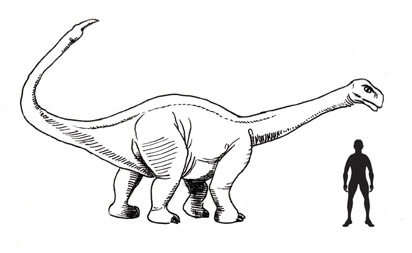
The most numerous fossils of an animal classes as a “megafauna” creature have been identified as Shunosaurus, sometimes also known as Shuosaurus.  Shunosaurus was named after the term “Shu” which is the old Chinese name for this ancient province.  Shunosaurus is pronounced “Shu-no-sore-us”, it was a relatively small sauropod when compared to the better known and later long-necked sauropods from the Morrison Formation of the USA, measuring around 9-10 metres in length.  The most remarkable feature of Shunosaurus was the spiked club on the end of its tail.  When the first fossils of this animal were found it was thought that the tail structure was a deformity in the specimen, but as more fossils were found this club-tail was confirmed as an anatomical feature.  The relatively stiff tail had a large round club at the end, with two pairs of spikes.

An Illustration of Shunosaurus

Picture credit: Everything Dinosaur

When swung from side to side this would have made a very formidable weapon.  Shunosaurus would have been very capable of defending itself from the large meat-eating theropods such as Gasosaurus that shared the habitat with this peaceful herbivore.

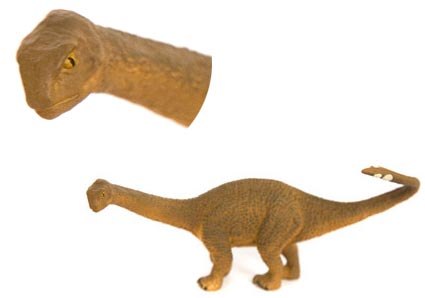
Many model manufacturers base their production in China, it is refreshing to see a model manufacturer design a Chinese dinosaur model.  American and European dinosaurs normally dominate dinosaur toy and model ranges but the diversity and importance of Chinese dinosaurs has at least been recognised by one designer and a dinosaur model of Shunosaurus has recently been added to the Everything Dinosaur – Dinosaur collection section of our website.

A Picture of the Shunosaurus Model

A dinosaur goes clubbing!

Picture credit: Everything Dinosaur

To view the model of Shunosaurus and other long-necked dinosaur models: Dinosaur Toys and Prehistoric Animal Models.

As well as the club-like tail, Shunosaurus had another strange feature, perhaps not so obvious in the model until it is compared with other dinosaur toys and models of long-necked dinosaurs.  Shunosaurus for a sauropod, had a relatively short neck.  As sauropods evolved from their more primitive herbivorous ancestors, the number of vertebrae in the neck increase.  This probably helped them to adapt to a lifestyle of feeding on taller and taller trees.  Shunosaurus however, bucks this trend, so it may have fed on the understorey, on shorter shrubs and bushes – perhaps specialising in feeding on types of plants such as cycads and bennettitales.  This may have been an important evolutionary adaptation to allowed Shunosaurus to co-exist with a large number of different types of sauropod in the Sichuan province.

9 12, 2008

Update on Last Posting Dates for Christmas

By |2022-12-11T09:07:17+00:00December 9th, 2008|Categories: Everything Dinosaur News and Updates, Main Page|0 Comments

Last Safe Posting Dates for Christmas

The staff at Everything Dinosaur are working until 10pm (GMT) every night up until Christmas to ensure that parcels are packed and despatched in good time for the festive season as we are aware that the last posting dates are upon us.  We do all we can to ensure that there are as few delays as possible in the despatch of dinosaur toys, dinosaur games and models to customers.

Lots of chocolate and tea is being consumed at the moment, perhaps we should switch over to coffee to help us keep alert as we work late into the night to ensure orders are packed and despatched promptly.

We have organised a rota between us to ensure that as well as covering Saturdays, (permitting us to despatch parcels on a Saturday morning), Sunday is also covered.  This prevents us having to catch up on Monday morning, thus ensuring as little a delay as possible in the preparing and packing of the parcels and other items we send out this time of year.

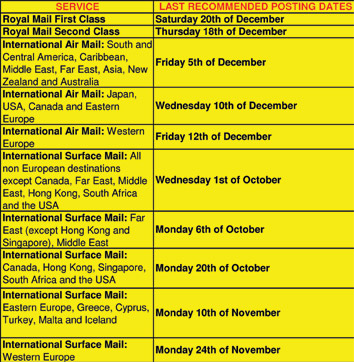
Last Posting Dates

We have tried to keep our customers informed about last safe posting dates.  We know how hard the Post Office and Royal Mail work this time of year, for example they are handling something like 60 million items of mail a day in the UK.

A couple of important dates this week to remember:

Last recommended posting date for Airmail to USA, Canada, Japan and Eastern Europe is – Wednesday 10th December

Last recommended posting date for Airmail to Western Europe is –

Friday 12th December

We know that the mail handling and delivery staff work exceptionally hard and do all they can to get parcels out to customers in time for Christmas, but these dates are important and we would recommend that they are adhered to where possible to avoid disappointment.

Confirmation of the Last Recommended Posting Dates (Royal Mail)

Source: Royal Mail

Hope this information helps, must go as I am required in the warehouse (more packing to do).

To see the extensive range of dinosaur toys and gifts available from Everything Dinosaur: Everything Dinosaur.

8 12, 2008

Doting Fathers – A Dinosaur Trait passed on to Modern Birds

By |2023-02-26T09:33:11+00:00December 8th, 2008|Categories: Dinosaur and Prehistoric Animal News Stories, Main Page, Palaeontological articles|0 Comments

Parental Care – Fathers helping to Brood the Eggs

Parental care is a behaviour strongly associated with warm-blooded animals such as mammals and birds, however was parental care a dinosaur trait too?  From a human perspective, we can perceive a strong emotional tie between a mother and her offspring when we view the behaviour of a female chimp with her baby, we often superimpose human emotions onto our primate relatives.  Whether all the higher apes are capable of exhibiting such a range of emotions is open to debate.  Scientists and anthropologists frequently disagree over the breadth and depth of emotions that apes are able to exhibit, after all, our humanity and ability to express emotions and respond to others and their emotions is one of the defining characteristics of being human.

Parental Care

We perceive most mammals as having a strong bond between themselves and their young.  From a scientific perspective, mammals invest a great deal in the next generation, the females carry the embryos inside them (monotremes excepted), as opposed to the egg-laying birds and reptiles; the other members of the group of animals called amniotes.  An amniote is an animal whose young is internally fertilised.  In reptiles and birds the embryo is surrounded by fluid and is protected by a protective shell – an egg.  In virtually, all mammals, the developing embryo is also surrounded by fluid but is retained inside the mother’s body for some time before birth.

Maternal and paternal behaviours are easy to impose on fur covered mammals but with the cold-blooded reptiles it is perhaps more difficult to associate these alien looking, scaly creatures with parental responsibility.  We now know that a number of species of reptile demonstrate some form of parental care, in extant reptiles, this is perhaps developed to the highest degree by the crocodilians, those reptiles alive today that are most closely related to dinosaurs.

Dinosaur Trait

For many years, white European explorers did not believe the stories told to them by the native American Indians about Alligators looking after their young.  Scientists now know that Alligators, along with other types of crocodilian show a strong bond between their offspring and even the nest in which the eggs were laid.  Female Alligators guard the nesting sites, protecting the eggs as they incubate.  When alerted by the chirping and pipping sounds made by the young as they are about to hatch, the females will dig the nest out and escort the brood down to a nursery area, carrying many of the newly hatched baby Alligators in her jaws.  When first observed by Europeans, this behaviour was thought to be cannibalism, reinforcing the beliefs about the cold-blooded and uncaring reptiles.  Many text books written as late as the 1970s documented this behaviour and cited it as evidence of the harsh and cruel nature of crocodiles.

When the role of mammal parents is considered, the burden of responsibility for the brood and the rearing of young lies very much with the female.  In many species of mammals, the male has nothing further to do with the parenting process after mating.  Male tigers, for example, leave the impregnated female to fend for herself, give birth and to raise the cubs.  These cubs may stay with their mother for as long as two years.  The male plays no real role in raising the family – although they may offer protection indirectly by maintaining a territory and keeping rival males at bay.

With modern species of birds, in contrast, the male usually plays a role in brooding the clutch of eggs and helping to feed the hatch-lings.  Indeed, with some species of birds such as the Ostrich, it is the male who carries out the greater portion of the parental duties.  A new research paper, published in the professional journal “Science” suggests that birds may have inherited their brooding behaviours from theropod dinosaurs.

A Place for the Father – A Fossil Theropod Nest
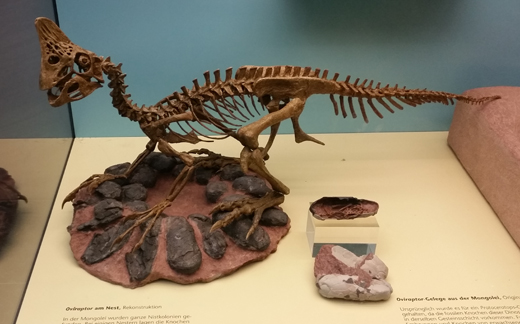
An Oivraptor fossil with nest.

An Oviraptor dinosaur sitting on her nest.  Picture taken by Everything Dinosaur team members (Frankfurt). Picture credit: Everything Dinosaur.

Picture credit: Everything Dinosaur

The picture above is of a fossil nest of a dinosaur.  By studying the unborn, baby dinosaurs preserved inside the eggs, scientists have been able to determine that this was the nest of a oviraptorid dinosaur – a member of the theropod group.

Studying Birds

In more than 90% of modern bird species (neornithes), it is the male parent that volunteers to sit on and incubate eggs in the nest.  By comparison, males contribute to parental care in fewer than 5% of mammals and even more rarely among crocodiles, lizards and snakes.  With the majority of the mammals and reptiles it is the girls that do all the work when it comes to raising the youngsters.

However, the remains of several types of Cretaceous theropods, bird-like dinosaurs have been found in association with fossil nests.  Scientists believe that these dinosaurs were brooding the clutch of eggs, adopting what we would recognise as bird-like incubating and protecting behaviours.  The research paper, puts forward evidence to suggest that the animals brooding the nest were actually the males – but how can a scientist be certain of the sex of an animal when they only have the fossilised skeletal remains to go on?

Eggshell Formation

It is thought that theropod dinosaurs laid their clutches of eggs all in one sitting, laying eggs using both their oviducts, hence the eggs are laid in pairs and this can be seen in the picture of the fossilised theropod nest above.  In contrast, birds only have one oviduct this is believed to be an adaptation for flight, the birds evolving a lighter skeleton and losing an oviduct to save weight.  To produce the eggshells the female needs a source of calcium and phosphorous to help her make the protective shell for her embryos.  These minerals are sourced from her own bones.  Specialised reproductive bone tissue is laid down inside the bones of the female during ovulation. This extra bone tissue is converted into the resources required to produce the eggshells.  The bone used in this process is called medullary bone.  Once the temporary tissue has provided the necessary calcium and other minerals for eggshell formation; it is completely reabsorbed into the body but tell-tale bone cavities are left behind for a time after the egg-laying and if identified within a fossil bone, this is strongly indicative of the fossil bones belonging to a female dinosaur.

Medullary bone is only found in modern female birds, no other egg-laying animals, including crocodiles produce this special bone tissue naturally.

The researchers led by Dr David Varricchio of Montana State University examined the fossilised bones of three species of theropod dinosaur – Troodon formosus, Oviraptor philoceratops and Citipati osmolskae, (another oviraptorid dinosaur from Mongolia).  The fossils had all been found in association with nests and many of the specimens had been preserved in a brooding like posture.  The researchers examined the internal structure of the fossilised bones, looking for bone cavities that would have been left after the process of egg formation.  The lack of any evidence for bone cavities, led the scientists to conclude that these fossils represented males.  The assumption being that these were the fathers and that they were brooding the nests, a behaviour seen in most types of modern bird.

Generalising for a moment, in birds, large clutches of eggs are associated with paternal care (the male doing most of the brooding work).  Small clutch volumes are associated with care by both parents and medium clutch volumes with maternal care, the female doing the majority of the sitting on the nest.

Commenting on the conclusions drawn from this study Dr Varricchio stated:

“Paternal care in both troodontids and oviraptorids indicates that this care system evolved before the emergence of birds and represents birds’ ancestral condition”.

So perhaps, next Spring, when you see a male garden bird dusting his feathers or taking a dip in a puddle to refresh himself as he takes a break from his incubating duties you could dwell on that behavioural trait being a direct link between the birds you see in the garden and their dinosaur ancestors.

Deducing Behaviour from the Fossil Record

Deducing behaviour patterns from the fossil record is an extremely difficult process.  Many theories can be put forward, but the trouble is, it is very difficult without the living species to prove a behaviour conclusively.  The role of males and females in rearing dinosaurs will debated for many years to come, perhaps more fossils of dinosaur nests will be found and more evidence gathered.  One of the problems with relying on bone cavities to assess the sex of a fossil is that it is often difficult to analyse the internal structure of the bone in its permineralised (fossilised state).  Another problem is that their is no real chronological record left in the fossil record when it comes to studying dinosaur nests.  It is unclear how long the incubation period would be.  With birds for example, the gestation period can be 3 weeks with a reptile, such as an Alligator it can take up to 75 days for eggs to hatch.  With limited information available on the gestation period for dinosaurs, it is possible that the bone tissue could have returned to normal and bone cavities would not be present after a period of brooding on the nest.  If this is the case then the fossil specimens found in association with dinosaur nests could be female, the cavities could simply be no longer present by the time the animal died.

Visit Everything Dinosaur’s award-winning website: Everything Dinosaur.

6 12, 2008

Cute or perhaps not so cute Polacanthus

By |2022-12-11T08:51:47+00:00December 6th, 2008|Categories: Dinosaur and Prehistoric Animal News Stories, Dinosaur Fans, Main Page|0 Comments

A British Armoured Dinosaur – Polacanthus

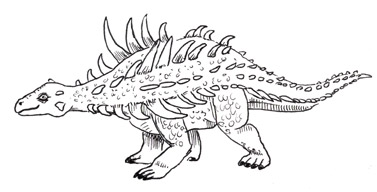
Polacanthus was a slow-moving, heavily armoured herbivore characterised by rows of spines sticking out from the neck, shoulders and back. Along each side of the tail there were thin, sharp plates pointing outwards. Scientists believe that the tail when swung from side to side would have been a very effective defensive weapon. This dinosaur is known from one skeleton and several other fragmentary remains, including isolated pieces of the armour. This armour plate is often referred to as scutes.  Unfortunately, no skull of this animal has ever been found, so interpretations of what this animal actually looked like can vary, and indeed the placement of the armour and spikes associated with this dinosaur is also based on assumptions.

An Illustration of Polacanthus

Picture credit: Everything Dinosaur

The lack of specific evidence such as an articulated skeleton has not prevented model makers from creating dinosaur toys and models of this one tonne ornithischian.  In fact a new model has been added to the Dinosaur Collection range recently.

Polacanthus

To view models of Polacanthus and other armoured dinosaur replicas: Dinosaur Toys and Models.

Polacanthus was named and described by the English scientist John Whitaker Hulke in 1881. Two species of Polacanthus are recognised, P. foxii was named after the Rev. William Fox who discovered the first fossils of a Polacanthus on the Isle of Wight in 1865, neither species has an associated skeleton.  Holotypes, the fossil from which the original specimens are described, are fragmentary.

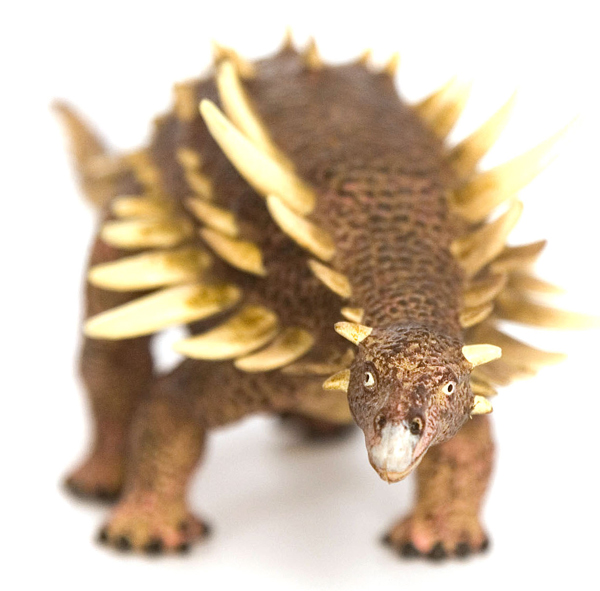
A Model of a Polacanthus

Polacanthus

The Collect Age of Dinosaurs Popular Polacanthus dinosaur model (anterior view). Picture credit: Everything Dinosaur.

Picture credit: Everything Dinosaur

It is thought that Polacanthus may have happily co-existed with iguanodonts, grazing side-by side with these huge herbivores.  The keen eyesight of the Iguanodons, coupled with their tall bipedal stance would have made them excellent look outs, able to spot approaching predators.  The squat Polacanthus may have gained protection by associating itself with a herd of iguanodonts and would have happily browsed on low bushes and the trampled remains of trees and other plants left behind by the iguanodonts.

To view the CollectA Age of Dinosaurs Popular model range: CollectA Age of Dinosaurs Popular Models.

3 12, 2008

New Pterosaur Discovery Announced (Despite the problem with the Car Filler)

By |2023-02-25T17:12:29+00:00December 3rd, 2008|Categories: Dinosaur and Prehistoric Animal News Stories, Main Page, Palaeontological articles|0 Comments

Discovery of new Cretaceous Pterosaur Announced

The latest edition of the scientific journal Palaeontology contains a paper on a new type of pterosaur, written by a team of researchers from Portsmouth University.  This new type of flying reptile has been named and described, despite the compressed nature of the specimen and the fact that car body filler was used in the excavation to hold all the fragments of bone in place.

New Pterosaur Discovery

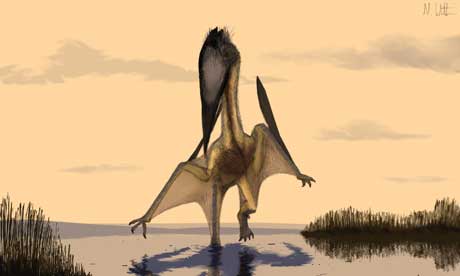
The animal has been named Lacusovagus magnificens (means magnificent lake wanderer), a flying reptile with an estimated wingspan of 5 metres and standing as tall as a grizzly bear.  Although, a very imposing creature, the hollow bones and other anatomical adaptations for flight would have made this animal extremely light, perhaps weighing less than a 12 year-old child.

Lacusovagus magnificens

The fossil was discovered in the Araripe Basin, in north-east Brazil.  This specimen is providing a fresh insight into the evolution and spread of Pterosaurs as this particular creature’s nearest relatives originate from China.  The skull material is the most important part of the fossil, allowing palaeontologists to establish taxonomic relationships between different species and genera.  Lacusovagus is the biggest Pterosaur of this type found to date, most of the Chinese specimens had wingspans of less than one metre.

An Illustration of Lacusovagus magnificens

Picture credit: Mark Witton/University of Portsmouth

This toothless pterosaur (the technical term for flying reptiles – the name means winged lizard), has been dated to approximately 115 million years ago (Aptian faunal stage), but the pterosaur fossil record dates back much further into the Triassic.  These animals were the first vertebrates to develop powered flight.  Unfortunately, the remains were first discovered were so fragile that it was decided to protect them by covering them with car filler.  This certainly helped strengthen the fossil and aided the recovery process but the preparation of this specimen has proved to be extremely difficult as researchers tried to remove filler so that they could study the fossil bone.

The Car Filler Problem

The car filler was so difficult to remove, that the research team had to make do with examining the small pieces that were exposed out of the limestone and car filer matrix and rely on CAT scans of the block of stone to reveal more internal detail.

Mark Witton, the University of Portsmouth academic who identified the specimen, broke several tools trying to cut through the filler, unfortunately, this is not the first time an inappropriate material has been used in the fossil preservation process.  Another Brazilian fossil, this time of a dinosaur from strata dating from the the later Albian faunal stage proved extremely difficult for the scientists to research properly.  A skull of an unknown type of dinosaur was researched by British palaeontologist David Martill, also from the University of Portsmouth.  Unfortunately, the 80 cm skull had been doctored, with bits of filler and plaster added to make the specimen look more exciting and hence more valuable.  So frustrated by the “extra bits” added by the finder hoping to make more money from the sale, that the team reflected their angst in the naming of this particular dinosaur – it was called Irritator.

Commenting on the preservation status of this new pterosaur find, Mark Witton stated:

“The specimen was quite fragile so the guys who were collecting it – probably quarrymen – very sensibly decided to put a large slab of limestone underneath to strengthen it.  Unfortunately, they used car body filler as the glue. The infernal car filler was a real cow to get through. I don’t know how many tools I broke trying to cut it”.

Unlike the Irritator case, Mark does not believe that these people intended to defraud.

“I’m sure it was used with the best of intentions but the person who did it perhaps hadn’t thought it through,” he added.

Interpreting the Fossil Specimen

Further problems in interpreting the remains were encountered because the skull was misshapen and compressed.  The distorted skull fragments make interpretation very difficult, the position of this fossil in the matrix was quite unusual and this added to the preparation problems.

“Usually fossils like this are found lying on their sides, but this one was lying on the roof of its mouth and had been rather squashed, which made even figuring out whether it had teeth difficult.”

The skull of this particular flying reptile was much wider than is usual for pterosaurs and Mark Witton has suggested that it had a wide throat, which would have vastly increased the range of prey available to it. pterosaurs are widely thought of as fish-eaters, but he said it was likely that the new species would have eaten small dinosaurs, which it would have swallowed whole.  The toothless beak and wide throat would have enabled it to catch and swallow various prey animals – perhaps moving in groups across the fern plains flushing out lizards, mammals and even small dinosaurs a bit like the lifestyle of the Marabou stork in Africa.

This particular habit has been proposed for pterosaurs before.   In an earlier blog article we reported on Mark Witton’s work on the Late Cretaceous pterosaur Quetzalcoatlus and speculation about these extremely large creatures having a more terrestrial lifestyle than previously thought.

To read this article: Getting stalked by a flock of Quetzalcoatlus.

For Mark and his team, fossils such as this one from Brazil are providing new insights into these amazing animals.

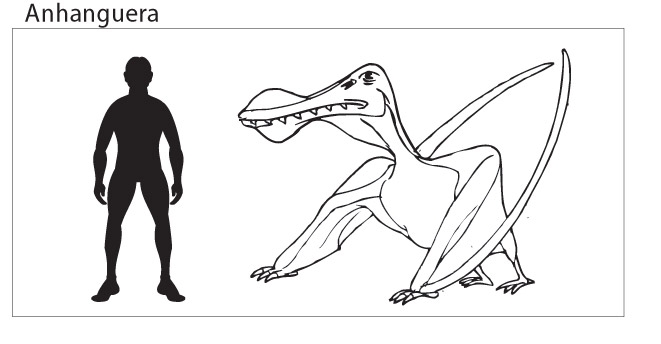
Brazil is becoming quite famous for pterosaur finds, a number of new genera have been identified from the Santana Formation of Brazil, a series of rock strata dating from the Early Cretaceous.  Both toothless and toothed types of pterosaur have been found in the upper layers of the Santana Formation, including the toothed flying reptile Anhanguera (name means old devil).  Those pterosaurs with teeth in their beaks were probably fish-feeders, swooping low over the sea (the early Atlantic ocean) and catching fish in their toothed beaks.

An Illustration of Anhanguera (Toothed Pterosaur)

Anhanguera illustrated.

Picture credit: Everything Dinosaur

To view models of pterosaurs and flying reptiles: Pterosaur and Prehistoric Animal Models.

2 12, 2008

The Last Stand of the Gharial

By |2022-12-11T08:09:01+00:00December 2nd, 2008|Categories: Animal News Stories, Dinosaur and Prehistoric Animal News Stories, Main Page|0 Comments

Critically Endangered Crocodile Species – The Gharial on the Brink of Extinction

In a web log article back in February we reported on the mysterious deaths of a number of adult Gharial crocodiles in their last remaining sanctuaries in northern India.    This long-snouted fish-eating Crocodilian can trace its ancestry back to the dinosaurs but the species is facing extinction.

To read the first article: Time Running Out for the Indian Gharial.

Analysis of the bloated corpses of these crocodiles show high levels of lead, but the fish that they eat don’t show any significant levels of this toxic metal.  The demise of the Gharial in one of the last natural habitats remains a mystery.

In another one of the few places in India where these animals can still be seen in the wild, their last nesting sandbank is under threat from construction companies anxious to commandeer the sand for use in building projects.

The plight of this extremely rare reptile and the work of a remarkable group of conservationists as they attempt to save it is highlighted in a BBC 2 programme this evening – part of the Natural World series.

Herptologist Romulus Whitaker in collaboration with other conservationists has set up a “crocodile bank” (Madras Crocodile Bank Trust), this conservation centre has managed to start a breeding programme for gharials (the first time this has been achieved).  Thanks to efforts of Romulus and his dedicated team this magnificent creature may have a future after all.

The Natural World is broadcast tonight at 8pm GMT on BBC2.

For further information about the work Everything Dinosaur has done to raise the awareness of the plight of endangered animals with schoolchildren and teachers: Email Everything Dinosaur.

30 11, 2008

Spectacular Insect Fossil Find in Eastern USA

By |2023-02-26T07:56:56+00:00November 30th, 2008|Categories: Dinosaur and Prehistoric Animal News Stories, Main Page|0 Comments

Ancient winged Insect left Impression in Carboniferous Mud

The western part of the United States may have a higher profile than the eastern part of the USA when it comes to fossils, this may be due to the large number of dinosaur fossils found in states such as Utah and Montana, but the east of the USA can produce some amazing fossil finds as well, such as a spectacular insect fossil.

Spectacular Insect Fossil

Careful research combined with a little luck has helped fossil hunter Richard Knecht find an amazing fossil of a flying insect near Emerald Square in Massachusetts.  Locked away for over 310 million years, the oldest known imprint of an insect, a trace fossil,  has been found, whilst Richard was lost.

The three-inch-long Arthropod, which scientists believe may be a distant relative of the modern mayfly, apparently made its mark by briefly landing on a pool of soft mud over 310 million years ago, the trace fossil has preserved the moment it landed and rested on the soft, sticky ground.  The fossil is so well preserved that individual body segments of the long abdomen can be seen and the imprints made by the insect’s six legs are clearly visible.

A Rare Find

Knecht and his professor, palaeontologist Jacob Brenner of Tufts University, are hoping that this rare find, along with the subsequent discovery of a fossilised wing at the site last week, will yield new insights into insect behaviour at a time when such creatures dominated life in the air.

“The level of detail is really unseen in continental deposits,” commented professor Brenner. “It’s unusual to see a flying insect make such a deep impression in this muddy sediment . . . and we don’t have many good body fossils from this time period with these early flying insects.”

Photographs may look a little indistinct but if you look carefully the impression of the dragonfly-like creature can be seen.  The head of the animal is facing to the right of the picture and the six impressions either side of the long, stick-like structure are the legs , behind the last pair of legs the abdomen can clearly be seen.

Wings Not Preserved

The wings are not preserved as they did not touch the mud when the creature landed.  The legs look quite stubby, but only part of them was preserved.  This is a trace fossil, a fossil that shows evidence of the activity of an organism, such as their tracks, trails, burrows or borings.

This is a truly remarkable discovery, it is very rare for delicate creatures like insects to become fossilised in rock, if they do the fossils that are preserved are usually fragmentary in nature, compressed, distorted and subsequently difficult to interpret.

Talking about his find Richard said:

“It’s not squished. It’s not deformed. We don’t have to try to piece it back together. We can see it as it was, and we get the behaviour,”.

Richard Knecht and professor Brenner went hunting in that area because research they had carried out enabled them to uncover a 1929 thesis that indicated that fossils may be found in the strata of the region.   New England isn’t a particularly rich source of prehistoric remains.

This really is a lucky find, firstly because these types of impressions were not made very often and the chances of one being preserved is extremely remote.  In addition, Richard has been trying to find another site and got lost, simply finding this fossil location by accident.

As Richard wandered around trying to get his bearings, at one rock outcrop, he gripped a broken edge, it came off in his hand, revealing the insect fossil.  The outer part of the rock was already split and had it been exposed to the cold of a New England winter, ice and frost action may have damaged this fossil, perhaps destroying if forever.

It really was a lucky find.

Increased levels of oxygen in the Carboniferous enabled arthropods to grown to huge sizes, many times bigger than their modern counterparts.  According to some researchers, atmospheric oxygen may have been as high as 30%.  To stay in the air, flying insects need to burn up a lot of oxygen in their muscles, the maximum size of a flying insect is governed by the extent to which oxygen can reach the tissues in the animal that require oxygen.

A higher level of oxygen in the atmosphere would have helped increase the efficiency of the insect’s metabolism and allowed them to evolve into larger sizes.  At the time, no other creatures flew; (pterosaurs for example did not come along until the Triassic), so insects such as the one found by Richard Knecht would have dominated the air.

Everything Dinosaur stocks a range of invertebrate prehistoric animal models, replicas of iconic creatures from the fossil record: Replicas of Iconic Animals from the Fossil Record.

28 11, 2008

Nothronychus – A Dinosaur Designed by Committee

By |2023-02-26T07:58:14+00:00November 28th, 2008|Categories: Dinosaur and Prehistoric Animal News Stories, Everything Dinosaur News and Updates, Main Page|2 Comments

The Bizarre Therizinosaurids such as Nothronychus

There are a great many different types of dinosaur, ranging from tiny crow-sized species up to the huge leviathans such as the sauropods.  One particular group of these incredible creatures has proved particularly difficult to classify and study.  This is because their fossils are exceptionally rare and they seem to have possessed a mixture of characteristics – a sort of dinosaur made up from features of other dinosaurs.  We are referring to the unusual therizinosaurids, a rare, exclusively Cretaceous group which is still not well understood today, despite the first of their kind (Therizinosaurus), being named and described more than fifty years ago.

These dinosaurs seem to show a mixture of meat-eating and plant-eating characteristics, the name therizinosaur means “scythe lizard”, a reference to the huge claws on each of their fingers (three-fingered hands).  The technical term for these hand claws is manual ungual.  The claws are long, slightly curved and in the case of Therizinosaurus, the largest member of this group discovered to date; the fossilised claws are over 70 cm long.  In life they would have been covered with a horny sheath, so they in reality would have been even longer.  It has been suggested that these claws may have been used to help break open termite mounds, indicating that these animals were insectivores, however, the more favoured theory at present is that the claws were used to pull branches down in a giant-sloth like manner and these creatures were largely vegetarian.

Incidentally, Therizinosaurus has a number of unique characteristics amongst therizinosaurs, so much so that it may be reclassified into its own group – the segnosaurs.

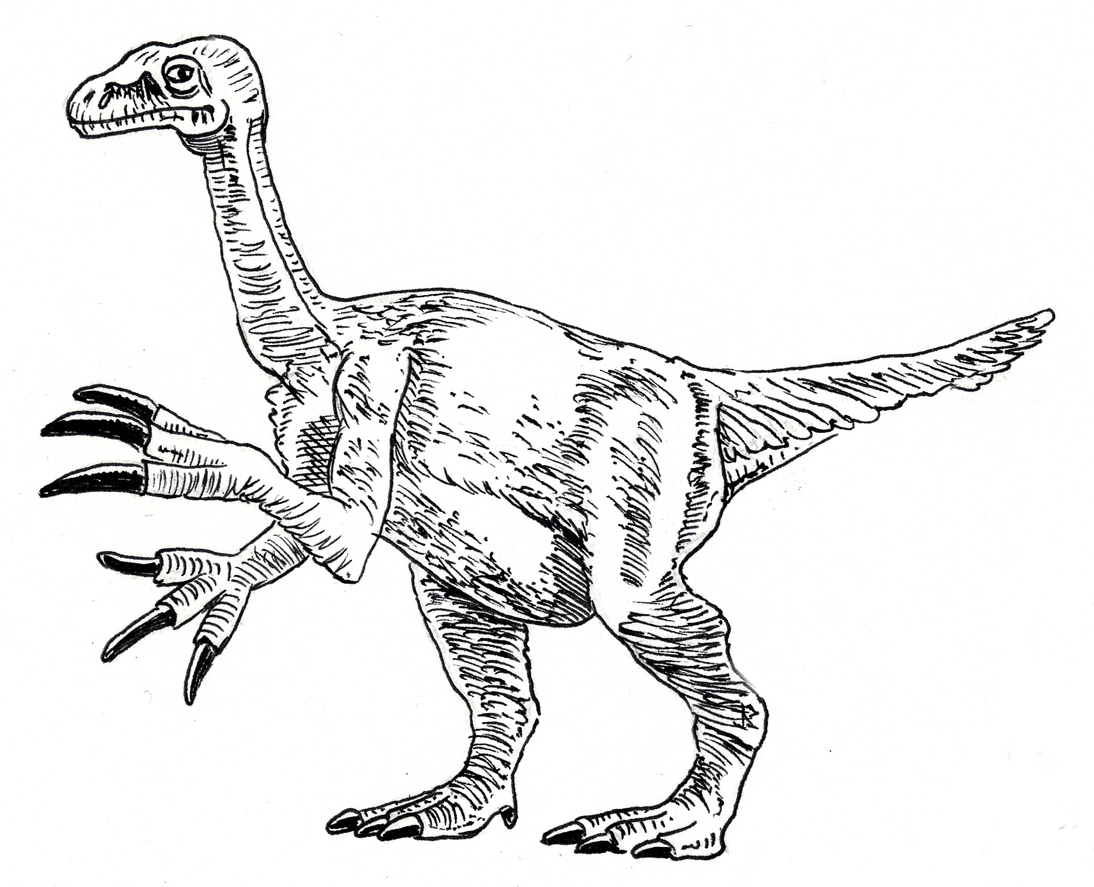
Illustration of a Typical Therizinosaur (Nothronychus)

Picture credit: Everything Dinosaur

Nothronychus

To view a model of a therizinosaur (model of Nothronychus) and other strange dinosaurs you can visit the model section of the Everything Dinosaur website: Dinosaur and Prehistoric Animal Models.

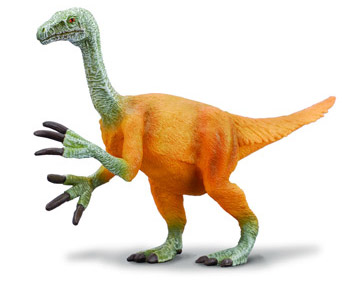
Nothronychus shows the features that characterise this particular group of dinosaurs.  The small head, with leaf-shaped teeth in the jaws (indicating a plant-eating diet), a long neck, powerful arms with the three-fingered hands and long claws.  The body was quite stocky and these animals although members of the Theropoda (saurischian dinosaurs), have a swept back hip girdle more reminiscent of the plant eating ornithischian group.

An Illustration of Nothronychus

Nothronychus

Nothronychus illustrated.

Picture credit: Everything Dinosaur

Discovered in the Western USA

Nothronychus would have been up to 6 metres long and represents the first member of this group to be found outside Asia.  Two partial specimens have been discovered in the western USA.  Nothronychus means “sloth like claws”, as the scientists that named and described this animal thought that it resembled a ground sloth with its upright stance, big belly and enormous claws.

CollectA have added several therizinosaur models to their model range, these figures can be found here: CollectA Age of Dinosaurs Popular Models.

Scientists still debate about the taxonomic position of this bizarre and unusual group, although most artists depict these animals covered in simply proto-feathers, indicating warm-blooded creatures with a need to keep insulated.  They really are most peculiar animals and as such many a palaeontologist has remarked that they are like a dinosaur designed by a committee.

27 11, 2008

Rare Prehistoric Crocodile Fossils Discovered in Switzerland

By |2024-04-15T13:15:27+01:00November 27th, 2008|Categories: Dinosaur and Prehistoric Animal News Stories, Main Page, Palaeontological articles|0 Comments

Switzerland – Famous for Cuckoo Clocks, Army Knives and now Jurassic Crocodiles

The village of Courtedoux in the district of Porrentruy, Switzerland may be hundreds of metres above sea-level today, but rocks dating from the Jurassic show that this area was once part of a shallow, tropical sea full of dangerous marine reptiles such as prehsitorc crocodiles.

For much of the Jurassic period (206 – 144 million years approximately), Europe was covered in warm, shallow seas that teemed with ancient life.  Swimming amongst the ammonites, belemnites and ichthyosaurs was a species of marine crocodile, the remains of one such specimen have been found near the village of Courtedoux.

Prehistoric Crocodiles

A team of researchers have announced the discovery of a 150 million-year-old fossil of an ancient crocodile, a genus called Metrioryhnchus, the first time that such a specimen has been found in Switzerland.

The area around Courtedoux is well-known for its dinosaur and other ancient fossils.  In fact fossilised trackways of Diplodocus-like footprints have been found nearby, along with a total of nearly 4,000 vertebrate fossils , all dating from the Jurassic period.  The foot prints indicate that the geology of this area has strata deposited in terrestrial as well as marine environments.  The area has been thoroughly researched over the years but new discoveries are being made all the time, such as this new crocodile.

Fossils of Metriorhynchus have been found in the UK, France and in South America (Metriorhynchus potens).

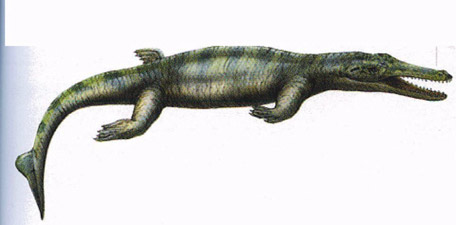
A distant relative of modern crocodiles this animal had adapted to an almost entirely marine existence, perhaps females only returned to land to lay eggs, like marine turtles.  The limbs had evolved into four strong flippers and the tail had broadened and flattened out to provide propulsion through the water.

This marine crocodile grew to lengths of over 3 metres and the many needle-like teeth in the narrow jaws indicate that it was a specialised fish and cephalopod eater.  Perhaps it fed on the many different types of ammonite and belemnite that shared its habitat.

An Illustration of Metriorhynchus

Picture credit: Illustrations of Prehistoric Animals of South America

Metriorhynchus

Metriorhynchus is pronounced met-ree-oh-rink-us, the name means “moderate snout”.  This particular fossil, found in the Porrentruy district in the west of Switzerland is dated to approximately 150 million years ago, although other fossil finds of this particular genus of marine crocodile have been dated from as early as 165 million years ago (Bathonian faunal stage).

Porrentruy district is in the canton of Jura, the Jurassic period is named after the Jura Mountains that cover much of this region.  It was the French chemist Alexandre Brongniart who named the Jurassic.

Scientists believe that this type of marine reptile was an opportunistic feeder, catching ammonites and belemnites as well as being capable of snatching pterosaurs as they swooped low over the sea.

ammonites and belemnites are cephalopods, related to squid and cuttlefish.  As a group these type of creatures are extremely important to scientists as ammonite and belemnite fossils can help to identify the relative age of widely separated areas of sedimentary rock.

Fossils of these creatures are very common and particularly diverse, scientists can use the different types of ammonite/belemnite fossil found in layers of rock to work out the sequence in which the sediments were laid down and thus, the relative age of the rock deposits.  This process is known as biostratigraphy – using key fossils to date rocks.

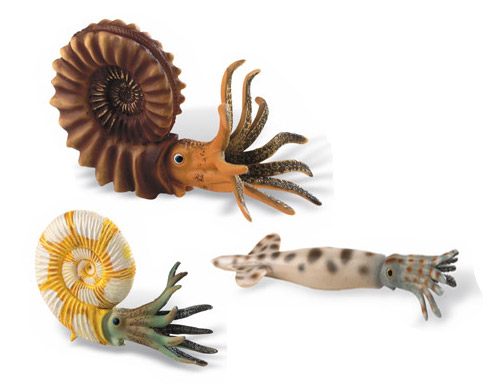
A Metriorhynchus Meal – Ammonites and Belemnites

Prehistoric crocodile sea food.

Picture credit: Everything Dinosaur

The picture above shows two ammonites and a belemnite, these nektonic (means they live above the sea floor), cephalopods would have been the stable food of Metriorhynchus and other marine crocodiles.

For dinosaur toys and games, plus prehistoric models including accurate models of ammonites and belemnites visit Everything Dinosaur’s model section on their website: Dinosaur and Prehistoric Animal Models.

Scientists have been able to build up a detailed picture of the ecosystem within these shallow, Jurassic seas that covered much of Europe during this period.  As well as marine crocodiles, there were many different types of ichthyosaur and plesiosaur.  At the top of the food chain, the top predators were the huge pliosaurs.  These animals were marine reptiles, a number of fierce meat-eating genera are known, perhaps the most famous is Liopleurodon.  This enormous predator, has been claimed by some sources to be the largest carnivore to have ever existed on the planet.

A number of species of Liopleurodon are known, but whether they really did reach lengths in excess of 25 metres as some scientists and journalists have claimed is still open to debate.   With their crown of front teeth, some of which exceeded 18 inches in length they would have been formidable hunters and a 3 metre Metriorhynchus would have been no match for this mighty pliosaur.

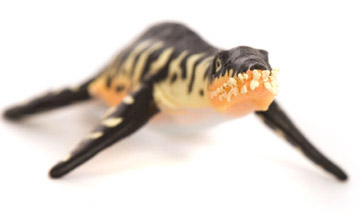
Close up of a Liopleurodon (the business end)

The fearsome Liopleurodon.

Picture credit: Everything Dinosaur

To view the model of Liopleurodon (Liopleurodon ferox) and other marine reptiles in the CollectA Prehistoric Life model series: CollectA Age of Dinosaurs.

26 11, 2008

Filling Christmas Stockings with Super Dinosaur Toys and Gifts

By |2024-04-15T13:46:12+01:00November 26th, 2008|Categories: Everything Dinosaur News and Updates, Everything Dinosaur Newsletters, Main Page, Press Releases|0 Comments

Go Easy on Your Budget this Christmas (Christmas 2008 made Easy)

Everything Dinosaur team members make some suggestions about dinosaur toys and gifts for the forthcoming festive season.

Fill a Christmas Stocking for £20.00 

Everything Dinosaur logo.

Dear Customers,

Less than 25 shopping days to Christmas, so why not take it easy on yourself (and the family budget) and let Everything Dinosaur take the stress out of Christmas shopping for Dinosaurs toys and gifts.

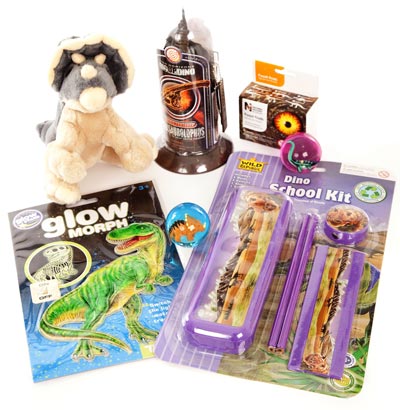
Fill a stocking with “Spino” our exclusive, cute and cuddly dinosaur hat, T. rex and Triceratops glow in the dark bedroom stickers, a metal pencil case, with dinosaur eraser, pencil and pen, plus our 2009 dinosaur calendar – all this for just £20.40 including packing and postage to anywhere in the U.K.

All Nine Items for just £20.40 Including Postage*

Fill a Christmas Stocking – Excellent Value

Value for Christmas.

* post and packing within UK (second class post)

Cost of all nine items @ £17.37 plus post and packing @ £3.03 = £20.40

See for yourself: The Everything Dinosaur Website.

Dinosaur Toys and Gifts

Whether it is nieces, nephews, sons, daughters or grandchildren you don’t have to spend a fortune to make their Christmas with educational and thoughtful dinosaur themed gifts.

Our staff (parents, teachers and dinosaur experts) appreciate that sometimes it can be difficult to browse whilst the little ones are around so why not contact us in the evenings – we are working until 10pm (GMT) most nights (including weekends) so why not give us a call or drop us an email:

Contact: Email Everything Dinosaur.

We would be happy to provide advice and assistance, when it comes to dinosaur stocking fillers.

So that’s some of the Christmas shopping sorted out, quick, convenient and excellent value for money too.  If you are looking for dinosaur toys and dinosaur themed gifts, Everything Dinosaur has it covered.

Go to Top