All about dinosaurs, fossils and prehistoric animals by Everything Dinosaur team members.
2 10, 2014

From Dinosaur Arms to the Wings of Birds

By |2023-03-16T16:42:48+00:00October 2nd, 2014|Categories: Dinosaur Fans, Main Page, Palaeontological articles|0 Comments

New Study Helps to Explain How Dinosaurs Got their Wings

Most scientists now agree the feathers originated in the Dinosauria and that Aves (birds) are descendants from a group of bipedal, very bird-like dinosaurs that make up a portion of a larger group of dinosaurs known as the Theropoda.  In essence, the birds we know today evolved from dinosaurs (specifically the Maniraptora).  However, despite a lot of fossil evidence to indicate that the birds are closely related to and descended from the Dinosauria there have been one or two areas that have led to some confusion.

Take for example, the wrist bones.

Dinosaurs

The numerous wrist bones in dinosaurs and their relatively immobile wrists evolved over time into the highly flexible wrists with fewer bones that scientists see today in living birds.  The wrist bones in birds helps to manage the forces involved in the movements of the wing in flight.  They also permit the wings to be folded back when the bird is not flying, so how the wrist bones of dinosaurs evolved into the specialised and highly modified wrist bones of birds has been the subject of much debate.

The Evolution of a Wrist Designed for a Wing
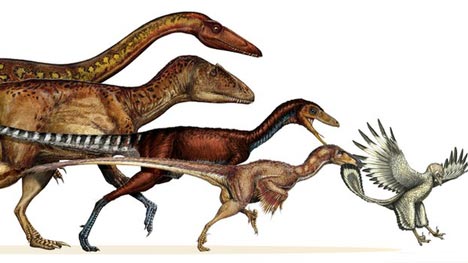
The evolution of a wrist bone adapted to flight.

The evolution of a wrist bone adapted to flight.

Picture credit: Davide Bonadonna

A new study by a team of scientists based at the Universidae de Chile (University of Chile), Santiago, Chile and published in the academic journal PLOS Biology may have solved this palaeontological puzzle.

Nine into Four Does Go

Let’s start with a very simple explanation of the problem.  Scientists studying living species, in this case birds and specifically ducks, chickens, lapwings, finches and budgerigars that were used in this study, can examine in minute detail the living organism.  They can also study embryos to see how the bones in the wrist are formed.  The scientists can also study the wrist bones and embryos of reptiles such as caiman to provide data on the wrist bones and embryonic growth of other types of archosaurs.

The Archosauria

The Archosauria is the division of Reptilia that contains the dinosaurs and crocodiles, it is from the archosaurs that the birds evolved.  These scientists can see how the anatomy of an animal develops.  Techniques such as cell and molecular biology studies can reveal all sorts of information with regards to how the wrists of extant (living organisms) form.  Palaeontologists, on the other hand, (no pun intended) only have a very incomplete fossil record to study.  So scientists are using different data sources to study wrist bone evolution.

Research to help identify the wrist bones in dinosaurs and the corresponding bones in the wrists of birds draws data from two radically different sources:

  • cell biology, extant organisms and embryology
  • fossils of birds, fossils of dinosaurs, studies of the bones of extinct animals

This new study shows how the modern bird wrist with its four bones, arranged in an approximate square shape corresponds to the nine bones found in non-avian dinosaurs.  The team have looked at how dinosaur wrists evolved and report on previously undetected evolutionary processes including loss, fusion and in one case, a re-evolution of a bone once lost in the Dinosauria.

A Critical Advance in Understanding

This new study effectively combined these two areas of research.  The laboratory run by Alexander Vargas (University of Chile) and lead author of the study, developed a new method of looking at specific proteins in the embryos and produced three-dimensional maps to demonstrate how the wrist bones formed.  This new method has been named whole-mount immunostaining.  It allows scientists to observe skeletal development in embryos much better than before.  At the same time, the research team re-examined the fossils of dinosaurs and prehistoric birds in a bid to tie the two strands of research together.

The Semilunate Bone

Back in the 1960s the palaeontologist John Ostrom, re-ignited the bird/dinosaurs debate by proposing that fearsome, sickle-clawed predators such as Deinonychus (D. antirrhopus) were agile, active animals and very bird-like.  He proposed that the semilunate bone, one of the four bones making up the square-shaped arrangement of bones in a modern bird’s wrist had actually formed from the fusing of two bones present in dinosaur fossils, such as those bones found in the wrists of dinosaurs like Deinonychus and its relatives.  This new technique, confirms that Ostrom was right.

Deinonychus Part of the Dinosaurs to Birds Story
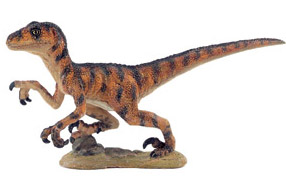
A fearsome Deinonychus dinosaur

A fearsome Deinonychus dinosaur

Picture credit: Everything Dinosaur

Whole-mount immunostaining and the mapping of cartilage formation and proteins in the embryos of birds, allowed the scientists to confirm that the semilunate in Aves does form from as two separate cartilages which fuse and ossify into a single bone, proving that Ostrom was very probably on the right track nearly fifty years ago.

Dr Vargas explained:

“These findings eliminate persistent doubts that existed over exactly how the bones of the wrist evolved and iron out arguments about wrist development being incompatible with birds originating from dinosaurs.”

This research has helped scientists to work out how the nine bones found in the wrists of some theropod dinosaurs gradually evolved into the four bones seen in modern birds.  In addition, this study produced a surprise, a result that was not expected.  A small bone present in the wrists of a group of dinosaurs known as the Sauropoda, disappeared in the bipedal theropods, but re-evolved when some theropods began to fly.

Sauropods and Theropods are Closely Related

Sauropods and theropod dinosaurs are closely related.  They represent the two types of dinosaur that make up the Saurischia (lizard-hipped dinosaurs).  Sauropods walked on all fours and had a small bone in their wrist called the pisiform that had a function in their four-legged, quadrupedal stance.  Theropod dinosaurs were essentially bipeds (walking on their hind limbs).  The arms of these dinosaurs were no longer used for walking but for catching and subduing prey.

Over millions of years the pisiform bone was lost from the wrists of the two-legged theropods.  However, the authors of this study discovered that the pisiform had reappeared in early birds, probably as an adaptation for flight, where this small wrist bone permits the transmission of force on the down-stroke of a wing beat whilst restricting flexibility on the up-stroke phase of a wing beat.

The Evolution of the Wrist from Dinosaurs to Birds
From

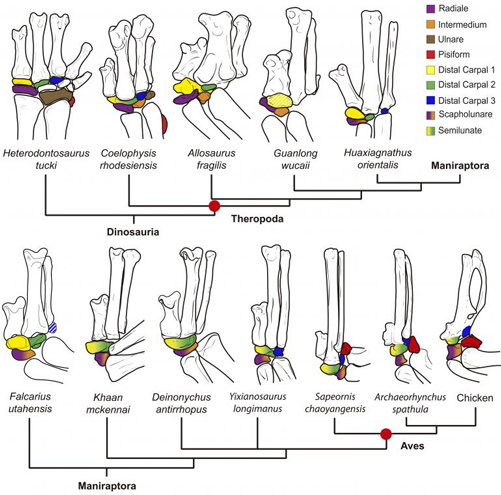
From dinosaurs to birds ( Dinosauria – Theropoda – Maniraptora – Aves)

Picture credit: PLOS Biology

The chart shows the colour coded bones and how they changed over time.  For example, the pisiform bone (red) can be found in the Early Jurassic ornithopod Heterodontosaurus (not a theropod) and in the Late Triassic theropod Coelophysis.  This bone is lost in later theropods such as Allosaurus and Guanlong but evolves again in primitive birds such as Sapeornis.  Sapeornis was about the size of a seagull, it seems to have been a strong flyer.  It lived during the Early Cretaceous.

The colour coded chart also shows how the square-shaped arrangement of bones in a modern bird such as the chicken evolved, with the fusion of the distal carpal 1 and the distal carpal 2 bones (yellow and green).  In the maniraptoran Falcarius, a member of the Therizinosauroidea and not a direct ancestor of birds, these two bones are distinct.  However, in those maniraptorans believed to be more closely related to the birds, indeed, the ancestors of Aves, dinosaurs such as Khaan, Deinonychus and Yixianosaurus these two carpals become fused to form the semilunate found in the wrists of modern birds.
1 10, 2014

Win with Everything Dinosaur in a Free Contest

By |2024-05-04T13:57:19+01:00October 1st, 2014|Categories: Dinosaur Fans, Everything Dinosaur News and Updates, Main Page, Press Releases|14 Comments

Competition Time Again with Everything Dinosaur (Competition Closed)

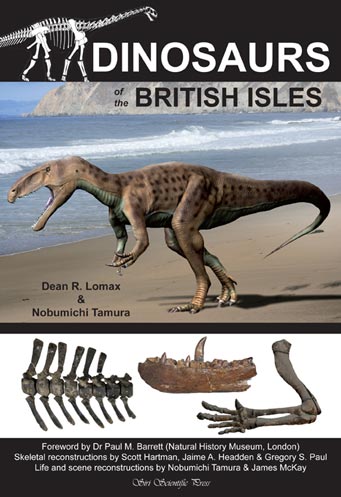
It’s competition time again with Everything Dinosaur and we have a signed copy of a fantastic new book all about British dinosaurs to win.  To celebrate the publication of “Dinosaurs of the British Isles” one of the authors of this amazing account about all things Dinosauria, palaeontologist Dean Lomax, has autographed a copy from the very first print run.  Everything Dinosaur is going to give this away to one lucky dinosaur fan.

For dinosaur models and figures: Dinosaur Figures and Models.

Everything Dinosaur

Please Note – this competition is now closed.

The Front Cover of “Dinosaurs of the British Isles”

A comprehensive guide to British dinosaurs over 400 pages.

Picture credit: Siri Scientific Press

“Dinosaurs of the British Isles”

This unique publication catalogues all the major dinosaur fossil discoveries from the British Isles.  With a foreward from Dr Paul Barrett of the Natural History Museum, Dean and his fellow author Nobumichi Tamura provide a comprehensive account on the dinosaurs of the entire British Isles.  With hundreds of photographs, detailed skeletal reconstructions and vivid life illustrations this is a “must have” for every dedicated dinosaur fan, fossil collector and budding palaeontologist.

Competition Details

So our competition is this, if you were to discover a new species of dinosaur in the UK – what name would you call it?  That’s right, we want you to come up with a name for a new species of British dinosaur!

To enter our “name a British dinosaur” competition, a chance to win this truly unique account of the dinosaurs of the British Isles, all you have to do is “Like” Everything Dinosaur’s FACEBOOK page, then leave a comment with your suggested name for a new British dinosaur on the picture of the front cover of  the book (shown above).

Click the logo to visit our Facebook page and to give our page a "like".
Click the logo to visit our Facebook page and to give our page a “like”.

Everything Dinosaur on FACEBOOK: “LIKE” Our Facebook Page and Enter Competition.

We will draw the lucky winner at random and the British dinosaur name competition closes on Friday, 31st October 2014.  Good luck to everyone and we can’t wait to see what British dinosaur names you come up!

Terms and Conditions of Name a British Dinosaur Competition

Automated entries are not permitted and will be excluded from the draw.

Only one entry per person.

The prize is non-transferable and no cash alternative will be offered.

The Everything Dinosaur name a British dinosaur competition runs until Friday, October 31st 2014.

Winner will be notified by private message on Facebook or email.

Prize includes postage and packing.

For full terms and conditions contact: Email Everything Dinosaur.

To read Everything Dinosaur’s Review of “Dinosaurs of the British Isles”: “Dinosaurs of the British Isles”. Reviewed.

Can’t wait to get hold of this book!  “Dinosaurs of the British Isles” can be ordered from Siri Scientific Press: Siri Scientific Press.

PLEASE NOTE THIS COMPETITION IS NOW CLOSED

27 09, 2014

New Armoured Dinosaur from New Mexico

By |2023-03-16T16:03:53+00:00September 27th, 2014|Categories: Dinosaur and Prehistoric Animal News Stories, Main Page|5 Comments

Ziapelta sanjuanensis From New Mexico but Closely Related to Canadian Ankylosaurs

For some strange reason, the ankylosaurs don’t seem to be held in quite the same awe as the horned dinosaurs by most members of the public.  We at Everything Dinosaur have our own theory about this.  The horned dinosaurs are much easier for the lay person to recognise.  There is the spectacular spiked frill of Styracosaurus, the peculiar nasal boss of Pachyrhinosaurus, a dinosaur genus which came to greater prominence with the “Walking with Dinosaurs in 3-D” movie.  Then there is of course, the most famous horned dinosaur of all – Triceratops (three horned face).

The Ankylosauridae

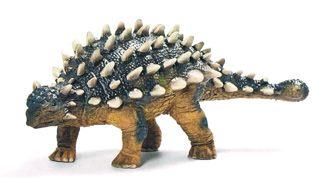
Members of the Ankylosauridae tend to have the same basic body plan.  They have broad rumps, bony clubs on the end of their tails and of course, all that body armour.  Model makers often find it difficult to distinguish different armoured dinosaurs.  For example, the Saichania replica made by Schleich, to the uninitiated, resembles Ankylosaurus.

The Saichania Model made by Schleich

Saichania means "beautiful"

Saichania means “beautiful”.

Picture credit: Everything Dinosaur

When it comes to films and television documentaries, the ankylosaurs are rarely given star billing.  So today, in our own small way, we are going to champion the Late Cretaceous armoured dinosaurs by discussing the newest member of their family – Ziapelta, from the San Juan Basin of north-western New Mexico.  The fossils of Ziapelta consist of elements of the skull and incomplete neck rings of spiky bone and fragments of the famous, scaly Ankylosauria body armour (osteoderms).

Discovered in 2011

The material was discovered in 2011 by Robert Sullivan, subsequently excavated by Dr Sullivan and colleagues and then stored at the New Mexico Museum of Natural History and Science.  Once extracted from its silt and sandstone matrix, the scientists had enough fossil evidence to assign these fossils to a new genera.  A thorough exploration of the surrounding area produced no further post-cranial material.  It seems the head and neck of this armoured dinosaur were separated from the rest of the body prior to burial.  How this came about, one can only speculate.

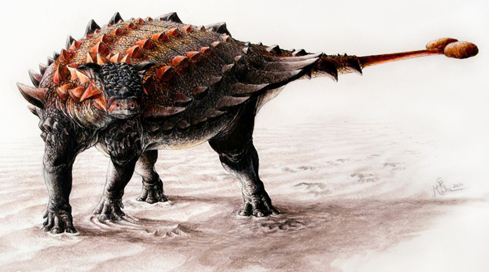
Ziapelta sanjuanensis

The fossils were collected from the De-na-zin Member of the Kirtland Formation which as been dated to around 74 to 72 million years ago.  At perhaps as much as six metres long, the herbivorous Ziapelta would have been a very formidable adversary for even the largest tyrannosaurid.

An Illustration of Ziapelta (Z. sanjuanensis)

New Armoured Dinosaur from New Mexico

New armoured dinosaur from New Mexico.

Picture credit: Sydney Mohr

To the lay person, the spiky-looking Ziapelta might just look like any other Ankylosauridae, so let’s explain why the skull and neck material have allowed scientists to erect a new genus of armoured dinosaur.  Firstly, elements of the skull have been found, the skull morphology (shape) and composition can be very helpful when looking to identify an animal new to science, dinosaurs included.  Co-author of the scientific paper, which is published in the on line academic journal PLOS One, Victoria Arbour commented:

“The horns on the back of the skull are thick and curve downwards and the snout has a mixture of flat and bumpy scales – an unusual feature for an ankylosaurid.”

Closely Related to Canadian Ankylosaurids

Dr Arbour (University of Alberta) is a renowned expert on all things ankylosaur, she was invited to examine the fossils along with PhD student Mike Burns (University of Alberta).  The scientists concluded that unlike the armoured dinosaur Nodocephalosaurus kirtlandensis, which is also known from the San Juan Basin and is believed to be related to Asian genera of the Ankylosauridae, Saichania for example, Ziapelta was more closely related to the ankylosaurids of Canada.

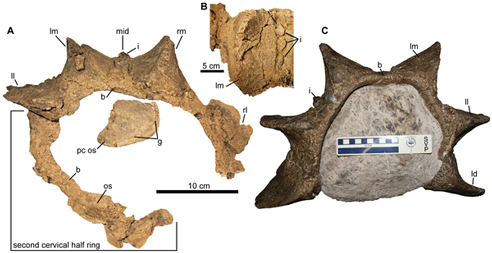
The Formidable Spiky Cervical Rings of Ziapelta

Bony and spiky neck armour of Ziapelta.

Bony and spiky neck armour of Ziapelta.

Picture credit: PLOS One

Dr Arbour stated:

“Bob Sullivan, who discovered the specimen, showed us pictures and we were really excited by both its familiarity and its distinctiveness.  We were pretty sure right away we were dealing with a new species that was closely related to the ankylosaurs we find in Alberta.”

Unusual Features

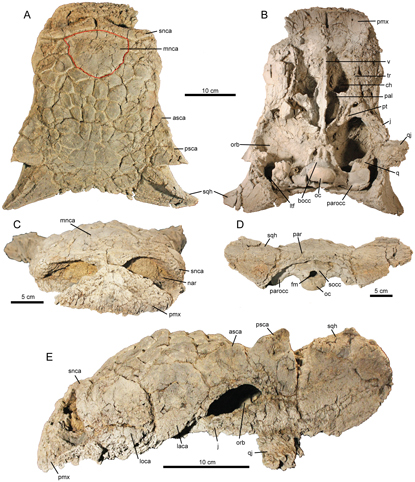
Ziapelta has another unusual feature that distinguishes it from other ankylosaurids, a feature that we at Everything Dinosaur find quite endearing considering the size and fearsome nature of these reptiles.  The layout of the scales that make up the top of the skull are often very distinctive.  In the case of Ziapelta, it has a large triangular-shaped scale on the tip of its snout, in contrast to many other ankylosaurids which have a six-sided scale on their snouts

Views of the Skull Fossil of Ziapelta (Z. sanjuanensis)

Views of the skull fossil material of Ziapelta.

Views of the skull fossil material of Ziapelta.

Picture credit: PLOS One

The photograph above shows various views of the holotype skull material, A – dorsal view (view from the top), B = ventral view (viewed from underneath), C = anterior view (view from the front), D = occipital view (viewed from the rear) and finally E – left lateral view (view of the left side of the skull).  In photograph A, we have highlighted in red the outline of that large triangular scale on the snout (referred to as mnca – median nasal caputegulum to use the formal scientific term).

Dr Arbour put it very succinctly stating:

“There’s also a distinctive large triangular scale on the snout, where many other ankylosaurids have a hexagonal scale.”

Specialising in Studying Ankylosaurs

The University of Alberta scientist has specialised in studying ankylosaurs, especially those specimens which are known from the Late Cretaceous of North America.  Back in 2013, Everything Dinosaur reported on Dr Arbour’s research into the Ankylosauridae which was helping to redefine this family of dinosaurs.

To read more about this research: When is a Euoplocephalus a Euoplocephalus?

Ankylosaurid fossils make up a small, but significant proportion of the Dinosauria fossil assemblage of southern Alberta, but to date, no ankylosaurid material has been found in the Horseshoe Canyon Formation (lower parts of this formation, the Strathmore and the Drumheller Members) of Alberta.  These rocks are roughly the same age as the strata in which the fossils of Ziapelta were found.  This New Mexico armoured dinosaur is helping palaeontologists to plug a gap in the record of ankylosaurid fossils known from North America.

Dr Arbour explained:

“The rocks in New Mexico fill in this gap in time, and that’s where Ziapelta occurs.  Could Ziapelta have also lived in Alberta, in the gap where we haven’t found any ankylosaur fossils yet?  It is possible, but in recent years there has also been increasing evidence that the dinosaurs from the southern part of North America – New Mexico, Texas and Utah, for example, are distinct from their northern neighbours in Alberta.”

There is a lot of evidence to support the idea of “dinosaur provinciality” in North America.  It seems that although the overall mix of dinosaurs was about the same in the regions, the actual genera that made up the dinosaur populations differed markedly.  How or why these distinct faunas came about remains something of a mystery.  The discovery of Ziapelta may help to add more pieces to the picture as palaeontologists strive to solve this puzzle.

25 09, 2014

New Research Suggests Multicellular Life Started Earlier

By |2023-03-16T15:56:05+00:00September 25th, 2014|Categories: Dinosaur and Prehistoric Animal News Stories, Educational Activities, Main Page, Palaeontological articles|0 Comments

Evidence Suggests Multicellular Life 60 Million Years Earlier than Previously Thought

Researchers from the Virginia Tech College of Science in collaboration with counterparts from the Chinese Academy of Sciences have published new data on one of the most fundamental and significant changes that occurred in the history of life on our planet.  At some time during the Proterozoic Eon, multicellular life forms evolved.  These organisms evolved from single-celled entities and in a paper published in the academic journal “Nature”, the researchers propose that multicellular life forms evolved some sixty million years earlier than previously thought.

Multicellular Life

The team suggest that they have found fossil evidence of complex multicellularity in strata dating from around 600 million years ago, although microscopic fossils are known in Precambrian strata from several locations around the world (Australia, South Africa as well as China), this new research is helping to clarify some long-standing interpretations of micro-fossils.

Professor of Geobiology at the Virginia Tech College of Science, Shuhai Xiao explained the significance of this new fossil discovery:

“This opens up a new door for us to shine some light on the timing and evolutionary steps that were taken by multicellular organisms that would eventually go on to dominate the Earth in a very visible way.  Fossils similar to the ones in this study have been interpreted previously as bacteria, single-cell eukaryotes, algae and transitional forms related to modern animals such as sponges, sea anemones, or bilaterally symmetrical animals.  This paper lets us put aside some of those interpretations.”

The Origins of Complex Life

It has long been known that simple, multicellular organisms evolved before more complex ones, such as red algae and sponges.  If a biological hierarchy existed (and most scientists believe that this is the case), then at some point in the past, single-celled organisms began to evolve into much larger, more complicated multicellular organisms.  The trouble is, with the paucity of the fossil record and the difficulties involved in interpreting Ediacaran fauna there is a lot of debate amongst biologists and palaeontologists as to when the solo living cells began to fuse into more cohesive, complex forms.

Evidence of Complex Multicellular Organisms from the Doushantuo Formation

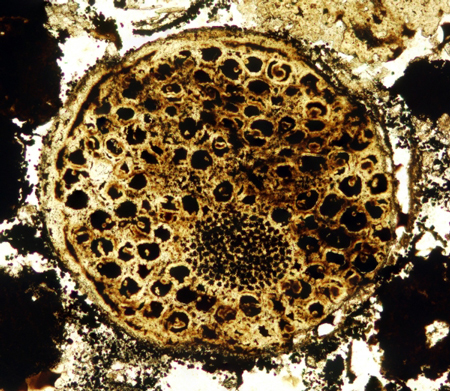
Evidence of multicellular structures in 600 million year old rocks.

Evidence of multicellular structures in 600-million-year-old rocks.

Picture credit: Virginia Tech College of Science

The researchers examined microscopic samples of phosphorite rocks from the Doushantuo Formation in Guizhou Province (south, central China).  This formation represents extensive marine sediments that were deposited from around 635 million years ago to around 550 million years ago.  They preserve a unique record of microscopic life (Metazoan life – animals) that existed during the Ediacaran geological period, the period in Earth’s history defined as immediately before the Cambrian and that marks the end of the Precambrian or the Proterozoic Eon.

What is an Eukaryote?

The scientists were able to identify a number of three-dimensional multicellular fossils that show signs of cell-to-cell adhesion, cells potentially performing different functions and programmed cell death.  These qualities are all found in complex eukaryotes, the organisms that dominate visible life on Earth to day, the fungi, animals and plants.  Eukaryotes range in size from single-celled amoebas to giant sequoias and blue whales.  We (H. sapiens) belong to the Domain Eukarya.   Eukaryote cells are complex, they have a distinct nucleus surrounded by a membrane.  The nucleus contains most of the genetic material.  The nucleus itself is a specialised area of the cell, it is referred to as an organelle.  Eukaryote cells have a number of specialised areas within them (other organelles as well as a nucleus).

Professor Xiao and his colleagues admit that these are not the first multicellular fossils found, nor are they probably the oldest, but the exceptional preservation permits the researchers to draw certain conclusions.  For example, it had been previously thought that these multicellular characteristics had started to develop much later in Earth’s history, perhaps as recently as 545 million years ago, a time shortly before the great Cambrian explosion.

What was the Cambrian Explosion?

The Cambrian explosion refers to the period in Earth’s history around 545 to 542 million years ago when there was a sudden burst of evolution as recorded by extensive fossil discoveries.  A wide variety of organisms, especially those with hard, mineralised body parts first appear.

This new research may help to shed some light on when multicellularity arose, but the reasons for this significant change remain unclear.  The complex multicellularity shown in these Chinese fossils is not consistent with that seen in simpler forms such as bacteria.  The scientists note, that whilst some earlier theories can be disregarded these three-dimensional structures can be interpreted in many ways and more research is required to construct the complete life cycle of these ancient organisms.

In summary, these fossils may show some affinity towards the stem-groups that led to the first members of the Kingdoms we know as Animalia, Fungi and Plantae, but much more data is needed to establish a more thorough phylogenetic relationship.

21 09, 2014

“Big Nose” Dinosaur – New Hadrosaur Species Described

By |2023-03-16T15:02:23+00:00September 21st, 2014|Categories: Dinosaur and Prehistoric Animal News Stories, Dinosaur Fans, Main Page|0 Comments

Rhinorex condrupus – “King of the Dinosaur Noses”

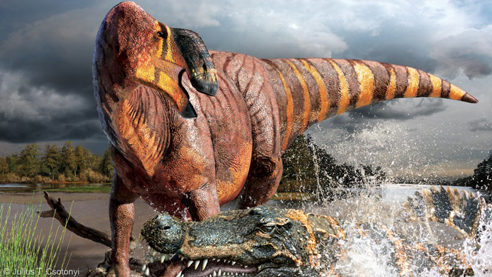
A team of researchers from Brigham Young Museum of Palaeontology and North Carolina State University (North Carolina Museum of Natural Sciences) have described a new type of duck-billed dinosaur, one with an enormous “conk”.   Duck-billed dinosaurs are well-known for sporting elaborate crests, even combs after recent research into the Edmontosaurus genus, but roaming the estuarine habitat of Utah around 75 million years ago was Rhinorex, a duck-billed dinosaur whose genus name translates as “Nose King”.

The “Nose King”

An Illustration of Rhinorex (R. condrupus)

"King nose" is surprised by a Cretaceous crocodilian.

“King Nose” is surprised by a Cretaceous crocodilian.

Picture credit: Julius Csotonyi

Terry Gates, a post-doctoral researcher with North Carolina Museum of Natural Sciences and North Carolina State University, collaborated with Rodney Scheetz (Brigham Young), to analyse the skull of a specimen that had been excavated from the Book Cliffs area of east-central Utah in the 1990s.  This strata forms part of the Neslen Formation which consists of a series of sedimentary layers of rock representing both marine and terrestrial environments.

Rhinorex condrupus

The specimen had been studied as associated with the fossil skull bones, were some very well preserved skin impressions.  However, it was only when the scientists constructed the skull that they realised they had a new species on their hands.

Commenting on their findings, which are reported in the Journal of Systematic Palaeontology, Terry Gates stated:

“We had almost the entire skull, which was wonderful, but the preparation was very difficult.  It took two years to dig the fossil out of the sandstone it was embedded in.  It was like digging a dinosaur skull out of a concrete driveway.”

Incomplete Skeleton

Although the skeleton is far from complete, unique morphologies of the skull indicate that this is a new species of duck-billed dinosaur,  a member of the Hadrosauridae family.  The dinosaur has been named Rhinorex condrupus.  The name translates as “king nose buried in the cliffs”, the genus name makes reference to the unique shape of the nasal bones and premaxilla.  These bones indicate that this plant-eating dinosaur had a large, fleshy nose.

Whilst it is difficult to estimate the exact size of this dinosaur from the fossil bones that have been collected, comparisons with the closely related Gryposaurus and Kritosaurus give a maximum length of around nine metres, with a body weight in excess of three tonnes.  The sandstone sediments represent a low lying, swampy, estuarine environment and to date, Rhinorex is the only substantial hadrosaur fossil known from this locality.

Terry Gates explained:

“We have found other hadrosaurs from the same time period [Campanian faunal stage] but located about two hundred miles further south.  They may have been adapted to a different environment.  This discovery gives us a geographic snapshot of the Cretaceous and helps us to place contemporary species in their correct time and place.”

In essence, “King Nose” helps to fill a gap in the hadrosaurid family tree.

Hadrosaur Diversity

Many different types of duck-billed dinosaur existed during the later years of the Cretaceous, scientists have found fossils of hadrosaurids in almost all the Upper Cretaceous fossil bearing terrestrial formations in western North America.  Although the vast majority of these fossils are far from complete, they suggest that the varied Hadrosauridae family evolved as each genus occupied a relatively small geographical area.

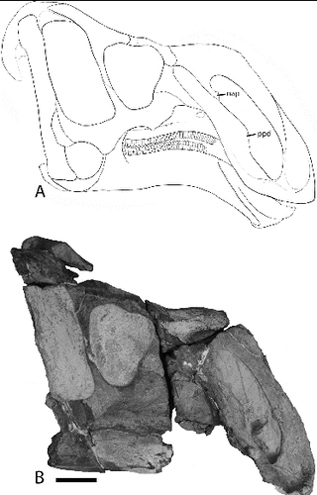
The Reconstructed Skull of R. condrupus

The line drawing shows the reconstructed skull from the fossil bones (scale bar 5cm).

The line drawing shows the reconstructed skull from the fossil bones (scale bar 10cm).

Image credit: Journal of Systematic Palaeontology

The line drawing (A) is labelled with the autapomorphies (unique characters or traits) that distinguish this dinosaur as a new genus, namely the hook-like structure (nap) nasal anteroventral process and the expansion of bone located posteroventrally on the premaxilla (ppd).

Why Such a Big Nose?

The large and fleshy snout remains a bit of a puzzle.  It may not be related to an enhanced sense of smell.

Post-doctoral student Terry postulated:

“The purpose of such a big nose is still a mystery.  If this dinosaur is anything like its relatives then it likely did not have a super sense of smell, but maybe the nose was used as a means of attracting mates, inter-herd recognition or perhaps it supported a large plant-smashing beak.  We are already sniffing out answers to these questions.”

It certainly would have looked a little odd with its enlarged naris.  However, when you consider the weird and wonderful saurolophines, Parasaurolophus with its enormous, backward sweeping head crest, Edmontosaurus regalis with a fleshy comb on its head and Tsintaosaurus which may have superficially resembled a unicorn, then we think Rhinorex would have fitted right in.

For models and replicas of hadrosaurs and other Late Cretaceous prehistoric animals: PNSO Museum Quality Age of Dinosaurs Figures.

15 09, 2014

Pterosaur Named after Avatar Dragon

By |2023-03-16T14:03:39+00:00September 15th, 2014|Categories: Dinosaur and Prehistoric Animal News Stories, Dinosaur Fans, Main Page|0 Comments

Ikrandraco avatar – New Species of Cretaceous Pterosaur Described

An international team of palaeontologists have described a new species of flying reptile that lived in what is now China during the Cretaceous period, about 120 millions years ago, and named it after the flying dragon-like creatures from the 2009 movie blockbuster directed by James Cameron – Avatar.  The fossils, which have both been laterally compressed, were found at two separate sites, around fifteen miles apart, although one is smaller than the other, they have both been assigned to a single new species – Ikrandraco avatar, the name translates as “Ikran dragon from Avatar”.

Ikrandraco avatar

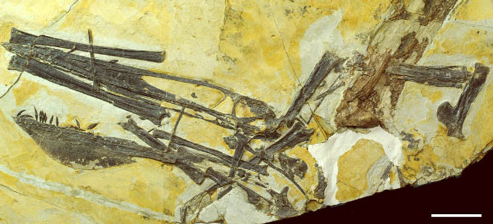
One of the Newly Described Pterosaur Fossils

White scale bar =

White scale bar = 5cm.

Picture credit: Scientific Reports/Xiaolin Wang et al

Both fossils come from the Jiufotang Formation of north-eastern China (Liaoning Province), although the exact stratigraphic location for both specimens has been difficult to determine.  The larger of the two specimens indicates a wingspan in excess of 2.4 metres, making this flying reptile slightly larger than a Golden Eagle.  The lower jaw had a distinct, semi-circular crest on its anterior portion, it has been suggested that a large “hook” at the back of this structure helped to support either an enlarged throat or a pouch, broadly similar to that seen in extant Pelicans.

A Joint Chinese and Brazilian Research Team

The joint Chinese and Brazilian research team that studied the fossil material and published the scientific paper on the new discoveries, propose that this pterosaur probably fed on small fish.  It may have flown over the water catching prey by skimming its lower jaw into the water.  Once the jaw connected with a fish, it snapped shut and the fish was stored in the throat pouch prior to swallowing.

This type of feeding, a skimming over the water surface to collect fish approach has been proposed before for members of the pterosaur family.  To read an article written by Everything Dinosaur team members back in 2007, click on the link here: Pterosaur Feeding Habits – Could they Skim Surface Waters for Fish?

New Pterosaur Species

Dr Alexander Kellner of the Federal Univervisty (Rio de Janeiro, Brazil), one of the senior authors of the academic paper and an authority on Cretaceous pterosaurs commented:

“Ikrandraco didn’t have a crest on the top of its elongated head as many pterosaurs did.  Behind the lower jaw crest was a hook-like structure that appears to have been the anchor point for the throat pouch.”

The Jiufotang Formation is a member of the extensive Jehol Group and scientists have been able to build up an detailed picture of the environment that existed in this part of the world in the Early Cretaceous.  Although the exact age of the Jiufotang Formation is still debated, most observers now believe that the majority of the strata was laid down in the Early Cretaceous (Aptian faunal stage).

Early Cretaceous Pterosaur

A spokesperson from Everything Dinosaur stated:

“It is now thought that the highly fossiliferous rocks of this part of the world were laid down around 120 million years ago.”

Ikrandraco avatar exhibits a number of anatomical characteristics that suggest it was a piscivore.  For example, the teeth in the jaw are small, sharp and pointed, ideal for grabbing and holding slippery fish.  The unusual blade-like crest on the lower jaw reminded the scientists of the crests seen on the dragon like creatures in the 2009 movie Avatar.

Most flying reptile fossils have been found in marine strata.  However, over the last twenty years or so an increasing amount of pterosaur fossil material has been found in rocks that were laid down inland.  A number of different pterosaur types co-existed in this part of China around 120 million years ago, intriguingly, these reptiles shared the air with a large number of primitive, enantiornithine birds.

A Tropical Paradise

The habitat was a tropical paradise, with verdant forests and a great many, large bodies of freshwater that teemed with fish.  Fossils found in this region include feathered dinosaurs (saurischian as well as ornithischian), early mammals, frogs, turtles, fish and birds.

Commenting on the habitat, Dr Xiaolin Wang of the Chinese Academy of Sciences, a co-author of the scientific paper stated:

“It [Ikrandraco] lived in a warm region teeming with life that included feathered dinosaurs, birds, mammals and frogs along with a variety of trees and other plants.”

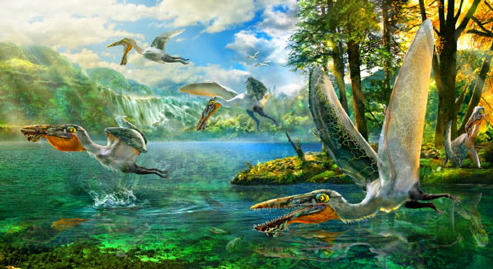
An Artist’s Impression of Ikrandraco avatar (Early Cretaceous of North-eastern China)

A flock of Ikrandraco Pterosaurs "fishing".

A flock of Ikrandraco Pterosaurs “fishing”.

Picture credit: Chuang Zhao

Examining Skull and Jaw Crests in the Pterosauria

Of the 130 or so genera of pterosaur described to date, a  number of them are known to have had skull or jaw crests.  These crests were either made of bone or formed by a combination of bone and soft tissue.  However, Ikrandraco avatar is unique in that it only had a crest on its lower jaw (mandible).  There is no evidence of a crest on the skull or upper jaw.  Up until now, blade-like crests were known exclusively in the Anhangueria family and in Cimoliopterus cuvier with such crests also noted in Ludodactylus sibbicki (although the evidence of a blade-like crest in this species is debated).

The researchers also note that Cearadactylus atrox (an ornithocheirid from Brazil), also possessed a crest, but only on the front portion of the upper jaw (the premaxilla).  The crest configuration of a crest on the skull but none on the mandible is much more common in the Pterosauria.  In essence, skull crests are far more common than crests on the jaws and a single, lower jaw crest in a species was unheard of until Ikrandraco came along.

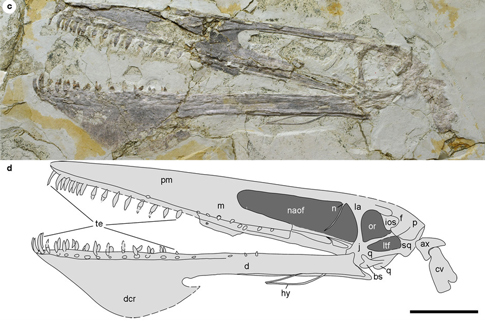
The Second Specimen of Ikrandraco avatar

Scale bar = 5cm

Scale bar = 5cm.

Picture credit: Scientific Reports/Xiaolin Wang et al

The photograph and line drawing above shows the second referred specimen of I. avatar.  The crest on the lower jaw with its distinctive “hook” at the back (labelled dcr – dentary crest) can clearly be made out.

Closely Related Species

As the specimens were found around fifteen miles apart, it could be that these two fossils represent different, but closely related species.  However, the researchers discounted this as both specimens were preserved in a left lateral view and although flattened, the team did not record any observable anatomical differences.  Both specimens revealed evidence of a unique, hook-like structure at the back of the blade-like crest.  This could have served as an anchor point for soft tissues that made up either an extended throat or a pouch.

The presence of throat sacs (pouches) in pterosaurs has been proposed on numerous occasions.  The suggestions have been made for Late Jurassic species from the famous Solnhofen deposits of southern Germany.  It has been suggested that both Rhamphorhynchus and Pterodactylus had pouches.  In all previously described cases, the pouch starts at the posterior ventral part of the mandible and extends until the level of the third or fourth neck bones (cervical vertebrae).

A Pouch Like a Pelican?

Due to the difficulties of preservation of such structures, their properties, size and shape are disputed.

Some palaeontologists have proposed that these pouches were similar to those seen in extant Pelicans, others have used the more neutral term of “loose extensible skin”.  These protagonists argue that this gullet structure might have helped them swallow larger prey items whole, as seen in modern day Ostriches, for example.

It is interesting to note that the inspiration for the scientific name came from the movie Avatar. Next year sees the release of Jurassic World, the fourth movie in the extremely successful Jurassic Park franchise.  Although a closely guarded secret, the film is very likely to include a super-sized, apex predator with a large number of teeth.  We at Everything Dinosaur confidently predict that whatever the film makers come up with, it will one day be the inspiration behind the naming of another prehistoric animal that is new to science.

For scale models of pterosaurs and other Early Cretaceous prehistoric animals: CollectA Deluxe Pterosaur and Prehistoric Animal Models.

13 09, 2014

Ancient Mammal Named after Mick Jagger in New Research Paper

By |2024-05-02T10:24:33+01:00September 13th, 2014|Categories: Dinosaur and Prehistoric Animal News Stories, Main Page|0 Comments

Jaggermeryx naida – “Jagger’s Water Nymph”

It resembled something akin to a skinny hippopotamus crossed with a long-legged pig and spent most of the time in the warm, freshwaters of tropical North Africa, but the biggest claim to fame for a newly described member of the Anthracotheres (extinct family of hoofed mammals), is that it has been named after the lead singer of the Rolling Stones.

Sir Mick Jagger is famous for his big mouth and lips and it seems these are traits he shared with Jaggermeryx naida, which roamed the ancient waterways of Egypt some 19 million years ago (Burdigalian faunal stage of the Miocene epoch).  The name means “Jagger’s water nymph” and we will avoid any references to the Rolling Stone’s front man and his age.

Jaggermeryx naida

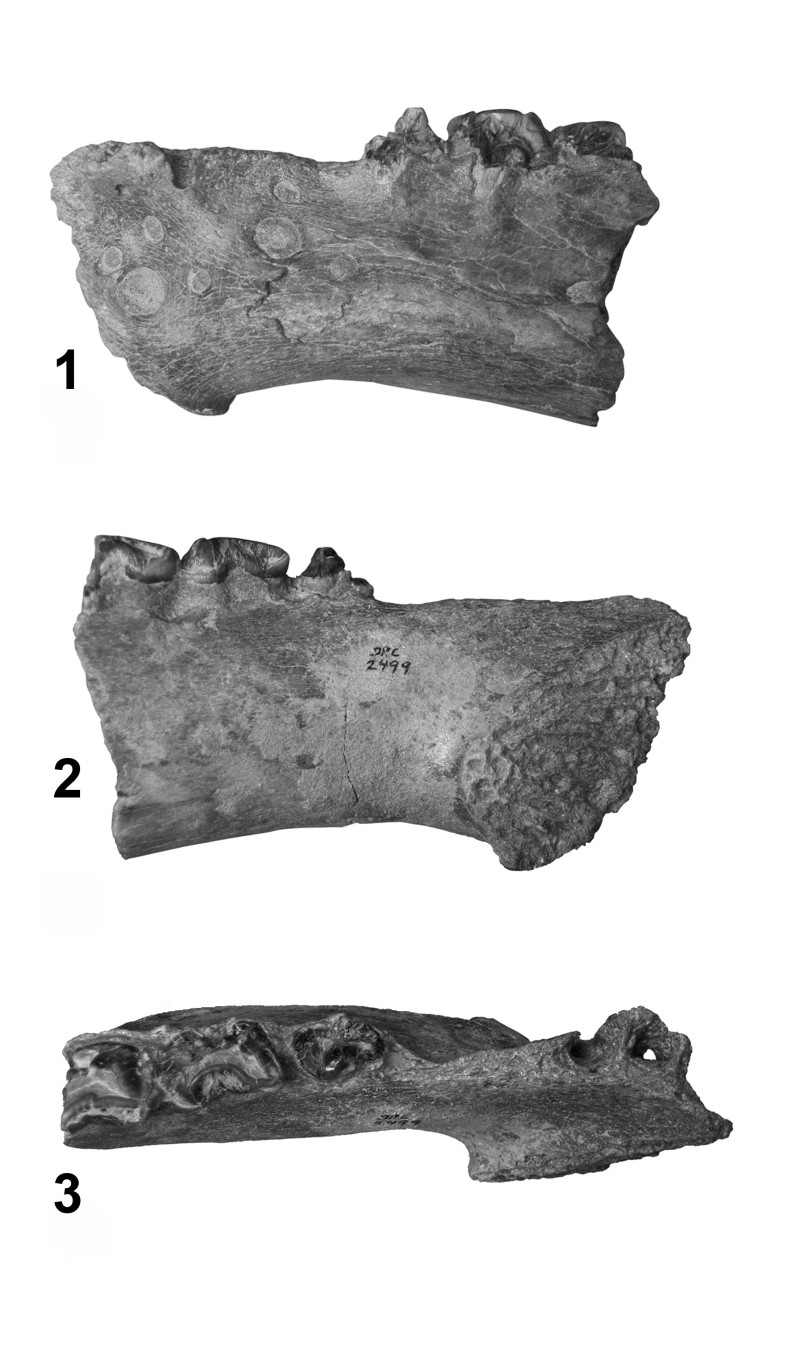
Views of the Jaw Fragment of J. naida

Various views of the fossil material.

Various views of the fossil material.

Picture credit: Greg Gunnell (Duke Lemur Centre)

The picture above shows views of the jawbone fragment that led to the identification of this new species of hoofed mammal.  Picture 1 is a view of inside of the jaw (medial), picture 2 shows the same fossil but in lateral view (outside of the jaw) and picture 3 shows the same fossil viewed from the top (dorsal) view.

Ancient Hoofed Mammal

An international team of scientists have been carefully excavating an area of the Qattara Depression (north-western Egypt).   Although the Qattara depression forms part of the Libyan desert today and it is famous for its dunes, salt lakes and arid terrain (it was the setting of the 1958 film “Ice Cold in Alex”), back in the Miocene epoch, much of North Africa was covered in lush swamplands and a number of Anthracotheres thrived.

The paper reporting on the excavation of the Anthracothere specimens has been published this week in the academic “Journal of Paleontology”, (note the American form of spelling).

The site, known as Wadi Moghra has provided the highest diversity of Anthracothere fossils when compared to other locations of Miocene aged deposits.  A spokesperson from Everything Dinosaur commented that at least six different types of these hoofed mammals are now known to have been living in this part of the world nineteen million years ago.

Associate Professor Ellen Miller, of Wake Forest University (North Carolina), one of the co-authors of the scientific paper stated:

“We imagine its lifestyle was like that of a water deer, standing in water and foraging for plants along the river bank.”

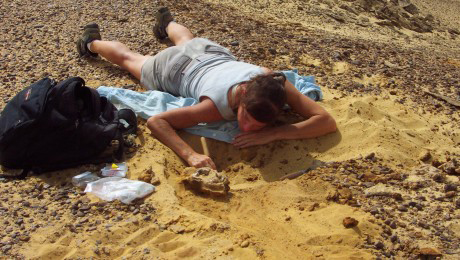
 Ellen Miller (Wake Forest University) at Work Examining Fossil Material at the Site

Often palaeontology can involve lying down on the job.

Often palaeontology can involve lying down on the job.

 Picture credit: Wake Forest University

The “Jagger” Connection

The site has revealed a number of vertebrate fossils, not just artiodactyls (even-toed mammals), but the fossilised remains of catfish, turtles and a number of water birds have also been found.   The fossil jaw fragments showed a series of eight holes.  These have been interpreted as having been the sites of large nerves that fed information back to the brain from the lower lip and snout.  Jaggermeryx naida probably had large lips (just like the Rolling Stones singer) and a super-sensitive lower lip and snout.  These adaptations would have enabled this herbivore to forage for nutritious plants in the muddy waters of this ancient Egyptian landscape.

A sensitive lower lip and snout.

A sensitive lower lip and snout.

Picture credit: Wake Forest University

Fossils Found in 1918

Associate Professor Miller added that the first fossils of this animal that they have described were found back in 1918, but at the time it was not recognised that these fossils represented a new type of Anthracothere.

She commented that when the team asked fellow researchers had they seen similar looking bones elsewhere:

“When people kept telling us no, we knew we were really on to something.  They’ve [Jaggermeryx naida] have been around for nearly a century, we just didn’t know what they were.”

Mick Jagger is not the first celebrity to have a prehistoric animal named after him.   Many famous people have been honoured in this way.  For example, last summer (June 2013), Everything Dinosaur reported on the fact that an Eocene lizard had been named after Jim Morrison (lead singer of the Doors).  Earlier in 2013, we reported on a new type of Cambrian arthropod being named after the actor Johnny Depp.

To read about the Eocene lizard named after Jim Morrison: Rock Star Honoured.

To read about the Cambrian invertebrate named in honour of Johnny Depp: Film Star Honoured by Having Arthropod Fossil Named After Him.

12 09, 2014

Spinosaurus “Four Legs are Better than Two”?

By |2023-03-16T13:58:25+00:00September 12th, 2014|Categories: Dinosaur and Prehistoric Animal News Stories, Dinosaur Fans, Main Page, Palaeontological articles|3 Comments

Spinosaurus – Steps into the Spotlight (Once Again)

And so, the long awaited paper that re-evaluates the fossil data on the Spinosaurus genus and specifically S. aegyptiacus was published in the academic journal “Science” yesterday.  Time to open a new chapter on this, one of the most enigmatic, mysterious and bizarre of all the known Theropoda.  Since the paper’s submission in the summer, there has been a lot of debate in scientific circles with regards to what this new study will show.  The paper’s title “Semi-aquatic Adaptations in a Giant Predatory Dinosaur”, is almost an understatement, when this is contrasted with the lurid headlines we have seen from a large number of media outlets.

Re-examining What We Thought We Knew About Spinosaurus

In very brief summary, the dedicated team of international researchers have re-assessed the known fossil material on Spinosaurus.  They have been able to track down the location in Morocco from which a number of Spinosaurus bones were excavated and sold via a fossil dealer.  The team have then re-examined this site and found further material.  Their efforts has led to a considerable re-think in terms of what this animal looked like and how it moved.  This new study interprets Spinosaurus as a sixteen-metre- plus dinosaur, that considered itself more at home in the water than on land.  Although capable of terrestrial locomotion, unlike every other large theropod, a new rendering sees Spinosaurus as an obligate quadruped.  Here is a meat-eating dinosaur that walked on all fours.

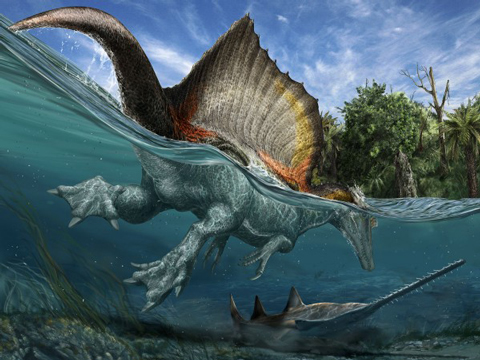
A Semi-Aquatic Obligate Quadruped – Spinosaurus

Very much at home in the water.

Very much at home in the water.

Picture credit: Davide Bonadonna, Nizar Ibrahim, Simone Maganuco

Spinosaurus

In the picture above, a web-footed Spinosaurus pursues a prehistoric swordfish, known as Onchopristis.  Earlier studies and research based on other members of the Spinosauridae suggest that fish may have made up a substantial proportion of their diet.  Instead of perching on the river bank, attempting to claw fish out of the water like some form of giant, prehistoric Grizzly bear, an ecological niche trumpeted by ourselves to the CGI team helping with the rendering of Spinosaurus for an episode of the BBC television series “Planet Dinosaur” back in 2011, this latest interpretation goes a lot further.

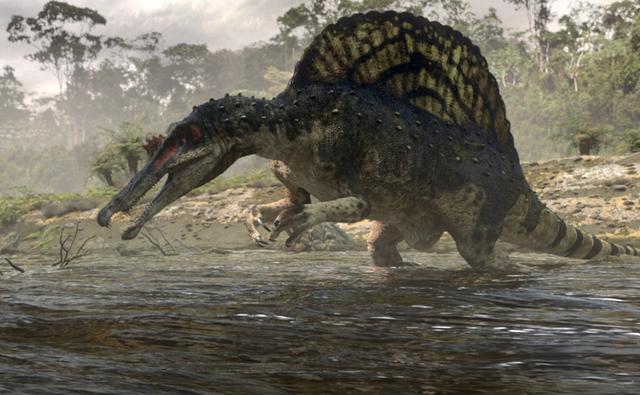
Beyond “Planet Dinosaur” – The Transformation of Spinosaurus aegyptiacus

From paddler to swimming the "evolving" image of Spinosaurus.

From paddler to swimming the “evolving” image of Spinosaurus.

Picture credit: BBC

Building Up a New Picture

Having re-visited what records and remaining photographs that exist of the original Stromer material excavated from the Western desert of Egypt around a 100 years ago, the dedicated research team then set about mapping previously known Moroccan finds including jaw bone fossils that had been discovered in the mid 1970s.  To this eclectic mix they added information obtained from the fossils from the newly “rediscovered” Moroccan site, which itself makes up what is now known as the neotype for Spinosaurus aegyptiacus.

A neotype is a specimen that is deemed to represent a species in the absence of the holotype material that has either been lost or destroyed.  Add a pinch of material not known from the Spinosaurus genus but described from related animals baryonychids, spinosaurids and so forth, combined with a soupcon of inferred parts of the anatomy as the bones are not known at all in the fossil record and you have a “composite” view of the animal.

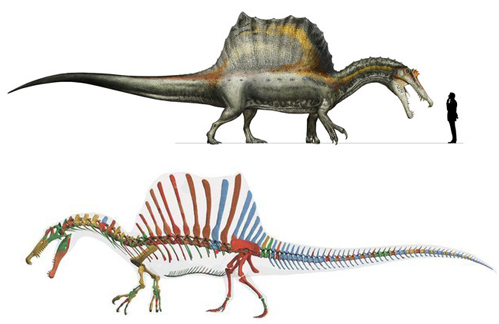
The Latest Interpretation of Spinosaurus (S. aegyptiacus)

Life-size reconstruction and supplemental figure

Life-size reconstruction and supplemental figure.

Picture credit: Davide Bonadonna (top) Ibrahim et al (bottom)

The illustration (top), depicts Spinosaurus as a dinosaur that walked on four legs, in this new study the centre of gravity is positioned further forward, the pelvic girdle is estimated to have been much smaller and the hind limbs with their robust but very short femur  reflect the adaptations of a paddler more than that of a bipedal walker.

The picture below, referred to by a colleague as the “Spinosaurus colour chart” is a figure from the scientific paper’s supplementary data.  The colour coded bones illustrate the composite nature of this digital reconstruction.

The “Spinosaurus Colour Chart” Key

RED = the neotype fossils (FSAC-KK 11888)

ORANGE = the original bones from Stromer’s expeditions

YELLOW = isolated fossil material ascribed to Spinosaurus spp. from the same geological Formation as the neotype (Kem Kem Formation)

GREEN = scaled up bones derived from better known spinosaurids

BLUE = additions to help complete the skeleton based on no known fossils but derived from adjacent bones in the digital restoration

Applauding the Efforts of an International Research Team

We at Everything Dinosaur applaud the efforts of the international team responsible for this new reconstruction.  A revaluation of the known Spinosaurus fossil material has been long overdue and this is the first time that palaeontologists have been able to relocate the bones from a private fossil collection to the actual site where they were excavated.  We commend the team for their perseverance.

Taking a Different Perspective

However, as with all good science, a number of counterpoints have already been made.

Scott Hartman, addresses these concerns in his web log: There’s Something Fishy About Spinosaurus.

Scott, with a background in anatomy, and an expert in skeletal reconstructions, makes a number of excellent points in his article.

Spinosaurus

The dinosaur referred to as Spinosaurus aegyptiacus was one of the last of the Spinosauridae.  There is a British connection to this story.  One of the spinosaurids used in the comparative study was Baryonyx (B. walkeri).  When this dinosaur, whose bones were found in a Surrey clay pit, was formally described back in 1986 it was depicted as a semi-aquatic dinosaur, fish scales found in the body cavity suggested that fish made up at least a portion of its diet.

Commenting on the New Research

Commenting on this new research, Dean Lomax, (Honorary Visiting Scientist: School of Earth, Atmospheric and Environmental Sciences, The University of Manchester) and author of the recently published “Dinosaurs of the British Isles” which includes extensive information on the Baryonyx fossil finds, stated:

“The new discovery is very interesting as it potentially confirms what had been suspected for quite some time, that Spinosaurus lived a semi-aquatic lifestyle.”

For further information on the book “Dinosaurs of the British Isles” by Dean Lomax and Nobumichi Tamura, which includes some fantastic skeletal drawings by Scott Hartman visit: Siri Scientific Press.

This new paper, marks a new chapter in the story of Spinosaurus, but it’s not the end of the story that’s for sure.  Ironically, although Stromer originally depicted S. aegypticacus as a biped, we recall that in the distant past (the 1970s), Spinosaurus had previously been thought of as a dinosaur that walked on all fours.

An Illustration of Spinosaurus from 1976

Spinosaurus as a terrestrial quadruped.

Spinosaurus as a terrestrial quadruped.

Picture credit: Giovanni Caselli (from the book “The Evolution and the Ecology of the Dinosaurs” by L. B. Halstead)

We suspect there are going to be a few more twists and turns in the Spinosaurus story.

11 09, 2014

What Happens when an Ichthyosaur Dies?

By |2023-03-16T13:53:49+00:00September 11th, 2014|Categories: Dinosaur and Prehistoric Animal News Stories, Dinosaur Fans, Main Page|0 Comments

Scientists Explore the Miniature Ecosystem Created by an Ichthyosaur Carcase

It has been known for some time that when cetaceans (whales and dolphins) die and their corpses settle on the seabed, the carcase can sustain a diverse ecosystem for many years, even decades with the largest individuals.  Palaeontologists had long suspected that the corpses of marine reptiles that patrolled the seas of the world long before the whales evolved, would have played a similar role, but until now this area of marine reptile research had not been that thoroughly investigated.

Studying Decay

Stepping up to this challenge, scientists from the Natural History Museum (London) and the Centre for Research in Earth Sciences (Plymouth University) set about mapping the evidence preserved on the fossilised bones and surrounding matrix of an ichthyosaur skeleton found in southern England.

The team concluded that although there was evidence for a succession of community feeding phases, phases which are very similar to those found in association with cetacean remains deposited in shallow water, the fossilised communities differed from those associated with whale carcases deposited in deep water environments.  One phase, consisting of the establishment of a community feeding on inorganic compounds such as methane and sulphides (known as the “sulphophilic phase”) seemed to be absent according to this fossil study.

Exploring the “After Life” of an Ichthyosaur

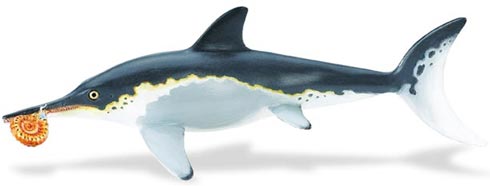
Ichthyosaurus Model (Carnegie Collectibles)

Ichthyosaurus model (Carnegie Collectibles).

Picture credit: Everything Dinosaur/Safari Ltd

Ichthyosaur

Ichthyosaurs were a very diverse group of marine reptiles that evolved in the Early Triassic and survived up until the Late Cretaceous (Olenikian faunal stage of the Early Triassic to Turonian faunal stage of the Late Cretaceous).  Although, ichthyosaurs had the same basic, streamlined body plan, a number of families are now recognised and these reptiles, only distantly related to the Dinosauria are regarded by many palaeontologists as amongst the best adapted of all the reptiles to a marine existence.

The specimen studied was a highly disarticulated Ophthalmosaurus fossil, from Dorset.  The fossil represents a three-metre-long individual from the upper part of the Ringstead Clay Member of the Sandsfoot Formation, Late Oxfordian faunal stage.  We estimate that this specimen is approximately 157-156 million years old (Jurassic).  The carcase came to rest on a shallow sea bed, the bones became scattered over an area of several square metres before final burial.  The break-up of the skeleton was probably caused by a combination of scavenging and the action of currents, possibly high energy water flows as a result of storm activity.

Trace Fossil Evidence

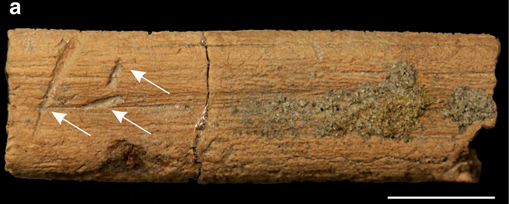
The researchers identified a wealth of trace fossil evidence indicating feeding on the carcase by scavengers as well as evidence of organisms grazing on the bones themselves.  Marks made by the teeth of fish were identified and the “star-shaped” feeding scratches from the ichnospecies Gnathichnus pentax were found.

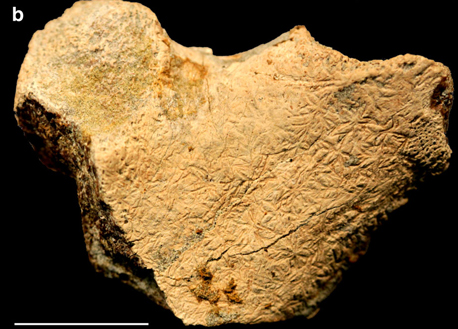
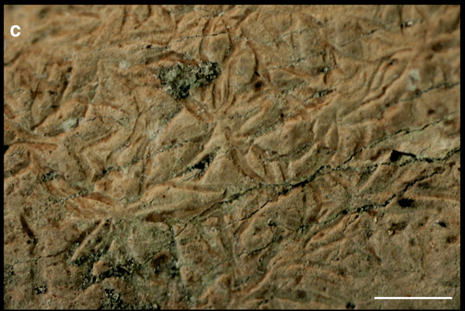
An ichnospecies is an organism only known from trace fossil evidence. The strange five-pointed, star shapes etched over many of the fossilised reptile bones are very similar to the patterns made by living sea urchins with their five-toothed feeding apparatus.  Scientists have interpreted these star-shaped patterns on the bones as evidence of grazing by a prehistoric sea-urchin (echinoid), G. pentax. It would have been feeding on mats of algae that had formed.

Trace Fossil Evidence on the Ophthalmosaurus Bones

Rib showing sharp, narrow grooves (white arrows) probably left by the scavenging action of small fishes.

Rib showing sharp, narrow grooves (white arrows) probably left by the scavenging action of small fishes.

Picture credit: Nature Communications

The picture above shows a close up of an Ophthalmosaurus rib bone showing signs of having been scavenged by small fish. The arrows indicate potential bite mark evidence (scale bar = 0.5cm).

Evidence of Grazing on the Fossilised Bones by Echinoids (Sea Urchins)

G. pentax ichnospecies on a fragment of fossil rib.

G. pentax ichnospecies on a fragment of fossil rib.

Picture credit: Nature Communications

The photograph above (b) shows the tell-tale grazing pattern of the ichnospecies Gnathichnus pentax on one of the fossilised bones (scale bar = 1cm).

A Close up of the Star-Shaped Feeding Pattern

Scale bar = 0.2cm.

Scale bar = 0.2cm.

Picture credit: Nature Communications

The Mesozoic Equivalent of a Whale Fall Incident

Commenting on the study, Richard Twitchett (Natural History Museum), one of the research paper’s co-authors stated:

“This is the first time anybody has described the ecological succession in the Mesozoic equivalent of a whale fall in detail.”

When an extant whale dies and its body sinks to the seabed,  scientists have identified a number of distinct and sometimes overlapping ecological phases.  First, scavengers remove the flesh and other soft tissues from the carcase.  Then snails and the charmingly named bone-eating, snot-flower worms (Osedax genus) feast on the blood and the fluids from the decomposing remains.

The last phase sees the hard parts such as the bones themselves being digested by microbes which feed on the fats (lipids) stored in the bones.  Tube worms live off the microbes and the likes of the bone-eating snot-flower worms persist.

Feeding by Scavengers

When the insides of the Ophthalmosaurus’s bones were examined under powerful microscopes further evidence of feeding by scavengers was found.  A number of tiny, fossilised molluscs were discovered.  These are associated with the same ecological community phase now associated with the bone-eating, snot-flower worms.  However, there was no sign of the “sulphophilic stage”, in which oxidised inorganic compounds such as sulphides and methane, derived from microbial activity as the fats inside the bones are broken down are consumed by a chemosynthetic community.  The chemosynthetic community found on the carcases of whales in deep water (greater than two hundred metres) consists of free-living bacteria and bivalves (for example, the genus Beggiatoa).

Evidence of Microscopic Scavenging Activity within the Fossilised Bone

Close-up of the bioeroded area where microborings are perpendicular to the external bone surface

Close-up of the bioeroded area where microborings are perpendicular to the external bone surface

Picture credit: Nature Communications

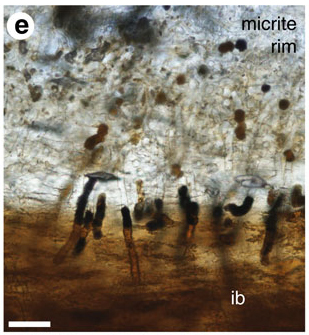
The picture above (e) shows a highly magnified section of ichthyosaur bone (ib) and the adjacent micrite rim represents a fine-grained calcite layer formed by the action of microbes boring into the substrate.

Mats of Microbes

Instead, the ichthyosaur’s bones were colonised by mats of microbes which attracted sea urchins and other grazing invertebrates.  The bones also became the home for a number suspension feeders, such as oysters that cemented themselves to the remains of the skeleton, forming a miniature “reef phase” as described by the scientists.  The remains were eventually buried entombing the remnants of the ecosystem that had been established to exploit the last resources from the dead animal.

When large cetaceans perish, a reef phase is less likely to occur as most carcases settle in deeper water and the ubiquitous bone-eating snot-flowers rapidly destroy the skeleton.  The researchers conclude that shallow-water ichthyosaur falls do provide a range of ecosystem opportunities to other organisms similar to the ones seen in studies of dead whales and dolphins.  However, it seems such shallow water corpses do not support any specialised chemosynthetic communities.

9 09, 2014

New Species of Titanosaur Named – Rukwatitan bisepultus

By |2023-03-16T13:45:00+00:00September 9th, 2014|Categories: Dinosaur and Prehistoric Animal News Stories, Dinosaur Fans, Main Page|0 Comments

Rukwatitan bisepultus – A Rare African Giant

Titanosaurs are a bit like buses, you wait for ages and then two of them come along together.  No sooner did we complete our synopsis on the research on the colossal Dreadnoughtus schrani, a newly described titanosaur from south-western Patagonia, then we have the opportunity to discuss another new species, this time from Africa.  This new titanosaur, named Rukwatitan bisepultus may not be quite as big as the newly described Dreadnoughtus but we at Everything Dinosaur estimate that fossils excavated from a hazardous cliff face in a steep quarry represent a dinosaur that was around ten metres long, or possibly much bigger.

Comparisons with the fossil bones from the Malawisaurus indicate that this titanosaur could have exceeded sixteen metres in length.  This herbivore would have been able to survey its floodplain home from a height of approximately four metres.

Rukwatitan bisepultus

An Artist’s Impression of the New Titanosaur (Rukwatitan bisepultus)

New genus of Titanosaur described from Tanzania.

New genus of titanosaur described from Tanzania.

Picture credit: Mark Witton

Studying Titanosaurs

But with titanosaurs, size isn’t everything.  Rukwatitan may not be a record breaker in terms of its body mass but its discovery is perhaps more significant than the fossils of the South American giants.  This is only the fourth genus of titanosaur discovered in Africa* and the palaeontologists at the University of Ohio, who excavated the fossils out of the cliff over two field seasons, are confident that their find will help scientists to understand more about the global distribution and the diversity of the titanosaurids as well as helping to piece together more data on the evolution of sub-Saharan dinosaurs.

A Silhouette of Rukwatitan bisepulutus Showing Fossils Found

Scale bar = 1 metre

Scale bar = 1 metre

Picture credit: Eric Gorscak (Ohio University)

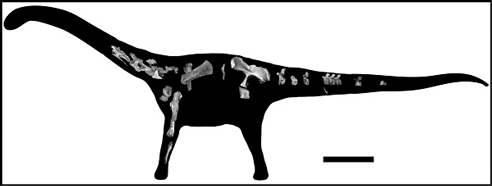
The picture above shows a bauplan of the new titanosaur and the position of the fossil bones that were found in relation to the body plan.

Titanosaurs are wide-bodied sauropods that probably evolved sometime in the Late Jurassic and survived until the Cretaceous mass extinction event.  They are the only sauropods known to have survived into the Late Cretaceous, but only in South America did these animals make up a significant proportion of the herbivorous megafauna, elsewhere, the ornithopods dominated.  When compared to other types of Sauropoda, titanosaurs tended to have wider bodies, due to the more robust and larger pectoral area (chest).  The limbs were strong and stocky, often the front limbs were longer than the hind limbs.

The spinal column was more flexible than in diplodocids, perhaps helping them to rear up more easily.  The heads were small, proportionately smaller than other types of sauropod.  Titanosaurs were geologically widespread and their fossils have been found on all the continents including Antarctica.  A number of sub-families have been identified and some of the titanosaurids are amongst the largest, terrestrial vertebrates known to science.

To read about the Antarctica fossil find (2011): Titanosaurs of the Antarctic.

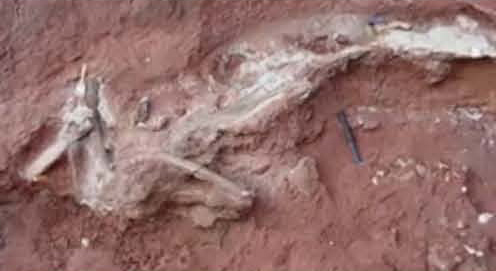
The fossils were found in the Rukwa Rift Basin area of south-western Tanzania (hence the genus name).  Scientists from Ohio University in collaboration with several other universities have carried out a number of excavations from the Red Sandstone Group deposits, that form part of the Galula Formation.  Fossils of turtles, crocodilians and primitive mammals have also been found in the formation, as well as dinosaur remains.  The fossil bearing strata is believed to have been laid down approximately 100 million years ago (Late Albian faunal stage of the Cretaceous).

The Fossils were Excavated from a Steep Cliff Face

The fossils were excavated from a steep cliff.

The fossils were excavated from a steep cliff.

Picture credit: Patrick O’Connor (Ohio University)

The vertebrates associated with the Galula Formation have shown some unique anatomical features indicating that the floodplain environment which is represented by these sandstone deposits may have been separated from other parts of Gondwana, permitting a unique fauna to evolve.  Last year, scientists from Ohio University reported the discovery of a new type of crocodilian (Rukwasuchus yajabalijekundu) that was different from other crocodilians found in deposits of the same geological age but from further north.

Some of the Fossils Exposed after Excavation

Fossil material exposed.

Fossil material exposed.

Picture credit: Ohio University

One of the authors of the scientific paper, published in the “Journal of Vertebrate Palaeontology”, Patrick O’Connor (Professor of Anatomy at Ohio University) stated:

“There may have been certain environmental features, such as deserts, large waterways and/or mountain ranges that would have limited the movement of animals and promoted the evolution of regionally distinct faunas.  Only additional data on the faunas and the palaeo-environments from around the continent will let us further test such hypotheses.”

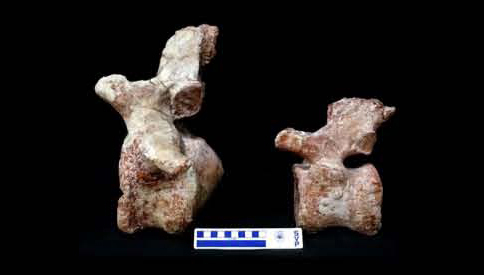
Two Caudal Vertebrae (Tail bones) from the Site

A number of caudal vertebrae including several articulated vertebrae have been found.

A number of caudal vertebrae including several articulated vertebrae have been found.

Picture credit: Ohio University

* Team members have had a go at naming the four genera of African titanosaurs currently described, here we go:

  1. The basal titanosaur from Tanzania (Upper Tendaguru Formation) – Janenschia robusta (Late Jurassic)
  2. The Lithostrotian titanosaur from Malawi (unknown formation) Malawisaurus dixeyi (Cretaceous)
  3. The basal Lithostorian titanosaur? Rukwatitan bisepulutus (described above)
  4. The Lithostrotian titanosaur from Egypt (Bahariya Formation) Paralititan stromeri (Late Cretaceous)

To read the acclaimed article written by Everything Dinosaur on the newly discovered titanosaur Dreadnoughtus: New Titanosaur from South-Western Patagonia.

Go to Top