All about dinosaurs, fossils and prehistoric animals by Everything Dinosaur team members.
30 10, 2014

First Pictures of New CollectA Prehistoric Animal Models Released

By |2023-03-17T15:13:26+00:00October 30th, 2014|Categories: Dinosaur Fans, Everything Dinosaur News and Updates, Everything Dinosaur Products, Main Page, Press Releases|2 Comments

New for 2015 First Pictures of CollectSA’s New Prehistoric Animal Models

A few days ago, Everything Dinosaur announced the list of prehistoric animal models that had been cleared for production and sale in 2015 by CollectA.   The list has been very well received by model collectors and dinosaur fans and it is great to see so many replicas being added to the CollectA range.  We can now reveal more details and show pictures of the models that will be part of the first releases next year.

CollectA Prehistoric Animal Models

The full list of models (cleared so far) is:

Here is what CollectA will be bringing out and Everything Dinosaur will be stocking next year.

Medusaceratops (trend for ceratopsians continues)
Daxiatitan – Chinese titanosaur
Nasutoceratops (what did we say about ceratopsians and trends)?
Xiongguanlong (Early Cretaceous tyrannosaur)
1:40 scale Pliosaurus (marine reptiles rock)!
1:40 Acrocanthosaurus (articulated lower jaw)
1:40 Feathered T. rex (articulated lower jaw)
1:4 scale pterosaur with moving jaw – Guidraco (Supreme range)
Moropus (knuckle-walker – Chalicothere)
Deluxe Smilodon (replacing the earlier not-to-scale Smilodon model)
Deluxe Daeodon (Entelodont)
Temnodontosaurus (an ichthyosaur)

Xiongguanlong

The first five prehistoric animals to be introduced are the Xiongguanlong (pronounced “shyong-gwan-long”), a primitive member of the tyrannosaur family.  Then there is Medusaceratops, Nasutoceratops, two lovely horned dinosaurs.  The Deluxe Pliosaurus is also one of the first to be manufactured and then fifth, last but not least, is the spectacular model of the huge dinosaur called Daxiatitan.

Xiongguanlong (tyrannosauroid) Dinosaur
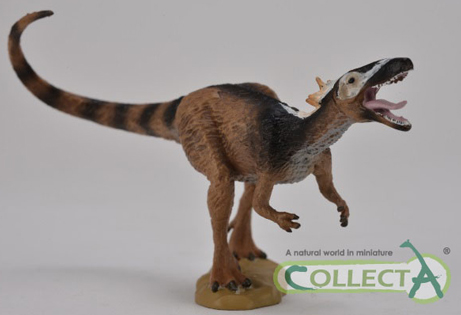
An agile, fearsome dinosaur.

An agile, fearsome dinosaur.

Picture credit: CollectA/Everything Dinosaur

Formally named and described in January 2010, this long-snouted predator provided evidence that even in the Early Cretaceous some types of tyrannosaurid were growing into large predators.  At an estimated five metres in length, this dinosaur (X. baimoensis) represents one of the larger of the early tyrannosaurs.  Evidence of a shaggy coat of feathers has been provided by the model makers and it is pleasing to note that the three-fingered hand (basal trait of the tyrannosaurids) has been reflected in this model.

Medusaceratops from CollectA
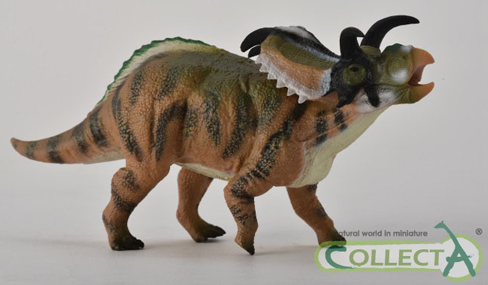
Named after the Greek Gorgon Medusa who had snakes for hair.

Named after the Greek Gorgon Medusa who had snakes for hair.

Picture credit: CollectA/Everything Dinosaur

CollectA Age of Dinosaurs Medusaceratops

This dinosaur, like Xiongguanlong was also formally named and described in 2010.  The extensive horns, lumps and bumps (epoccipitals) on this dinosaur’s neck shield were spectacular, these have been lovingly re-created in the CollectA replica.  They may have had a defensive function but they also served as “bling” to help attract a mate and for display (probably).

To read Everything Dinosaur’s article on the discovery of Medusaceratops: A New Horned Dinosaur from Montana.

Medusaceratops was a member of the chasmosaurine group of horned dinosaurs.  The second major group, the centrosaurines is represented by Nasutoceratops.

CollectA Nasutoceratops Dinosaur Model

Basal Centrosaurine dinosaur.

Basal centrosaurine dinosaur.

Picture credit: CollectA/Everything Dinosaur

Nasutoceratops

This mean and moody figure contrasts well with the Medusaceratops replica.  Nasutoceratops would have been slightly smaller than Medusaceratops, it roamed the swamps and lowlands on the western shores of that great inland sea that divided the Americas (the Western Interior Seaway).  One species has been assigned to this genus (Nasutoceratops titusi).  The very large and broad muzzle can be clearly seen on the CollectA replica.  We shall see how this model compares to the Safari Ltd Nasutoceratops which is also due out in early 2015.

Here is the article that we wrote announcing this dinosaur’s discovery: Large Nose, Horn Face.

The first of the new Deluxe replicas due out next year is the model of the ferocious marine predator Pliosaurus.

CollectA Deluxe Pliosaurus Replica
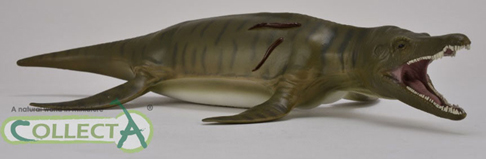
Collecta Pliosaurus model.

CollectA Pliosaurus model.

Picture Credit: CollectA/Everything Dinosaur

We like the details around the jaw, the evidence of “battle damage” as a result of feeding from parasitic Lampreys on the flank and the beautiful colouration.  These are going to be exciting times for model collectors who have an affinity for marine reptiles.

Last but not least comes a replica of the Chinese titanosaur Daxiatitan.  We have to confess that Chinese titanosaurs is not our strong suit, probably because of the fragmentary fossil finds coupled with those complex names derived from regional dialects.  Daxiatitan binlingi is known from fragmentary fossils, including several huge cervical vertebrae (neck bones) and a femur.

Daxiatitan binlingi

Based on comparative studies with other basal titanosaurs, it has been estimated that this huge dinosaur could have reached lengths in excess of thirty metres.  It had a very long, straight neck and it probably fed on the very tops of the trees, although its giraffe-like pose is still debated.  It certainly had a wide body and Daxiatitan is just one of a number of titanosaurs known from the Hekou Group  in the Lanzhou Basin of Gansu Province (north-western, China).  The fossils of this dinosaur have helped researchers from the Chinese Academy of Sciences to piece together more information with regards to the evolution of titanosaurids.

The CollectA Daxiatitan Dinosaur Model
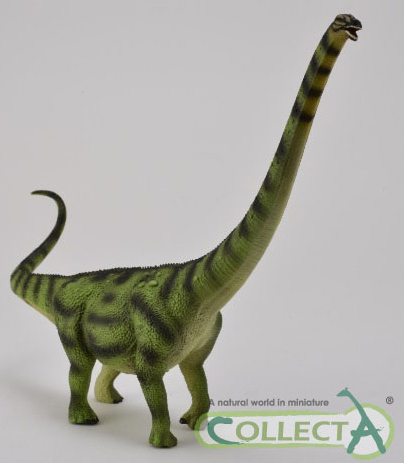
Perhaps up to 30 metres in length?

Perhaps up to 30 metres in length?

Picture Credit: CollectA/Everything Dinosaur

This is a very well crafted replica, that reflects what is known from the fossil record with regards to basal titanosaurs.

To view Everything Dinosaur’s range of CollectA prehistoric life figures and replicas: CollectA Prehistoric Life Figures.

For the Deluxe range of scale models: CollectA Deluxe Prehistoric Life Models.

We look forward to posting up more information about CollectA’s 2015 range shortly.
29 10, 2014

Determining the Extinction Date of Megalodon

By |2023-03-17T15:04:40+00:00October 29th, 2014|Categories: Dinosaur and Prehistoric Animal News Stories, Main Page|0 Comments

C. megalodon Extinct by 2.6 million Years Ago

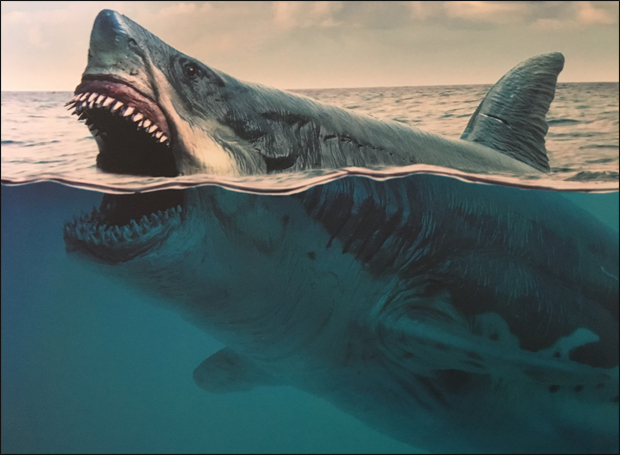
The giant prehistoric shark known as Megalodon (C. megalodon) has certainly attracted a lot of scientific attention in recent years.  This predatory shark, believed to be the largest, carnivorous shark to have ever existed, might have reached lengths in excess of sixteen metres.  Bodyweight estimates vary, but a number of scientists have calculated weights around the twenty tonnes mark.  With a mouth that could gape nearly 3 metres wide, this fish would have been capable of swallowing an extant Great White shark (C. carcharias) whole!

Megalodon Still Exists?

Some fishermen, such as those who fish the waters off South Africa have claimed that Megalodon still exists, but a team of researchers from the University of Zurich and Florida University have used a statistical technique to provide the best estimate yet of the extinction of this apex marine predator.

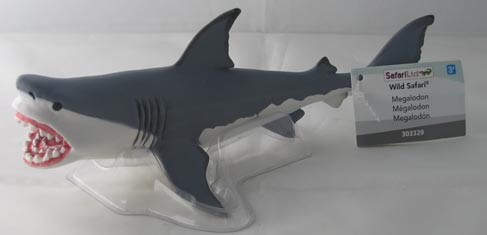
Safari Ltd Introduced a Model of the Giant Shark Known as Megalodon this Year

Fearsome marine predator.

Fearsome marine predator.

Picture credit: Everything Dinosaur

To view the range of Safari Ltd prehistoric animal models: Safari Ltd. Prehistoric World Figures.

Megalodon Extinction

Writing in the on line journal PLOS One (Public Library of Science), the researchers Catalina Pimiento (Department of Biology, University of Florida) and Christopher Clements, (Institute of Evolutionary Biology and Environmental Studies, Zurich University), used a statistical analysis to calculate the approximate time of the extinction of these predators.

By developing a better understanding of the time of the extinction, the research team are able to map the consequences of the extinction of an apex predator on the marine ecosystem.  Using a mathematical technique called Optimal Linear Estimation (OLE) the scientists have calculated that around 2.6 million years ago C. megalodon became extinct.  This is the first time the extinction of C. megalodon has been quantitatively assessed.

A total of fifty-three fossils of this ancient shark were used in this study, but this number was reduced to forty-two for the statistical assessment, as eleven of the fossil specimens gave the researchers less confidence over their actual age.

Optimal Linear Estimation

Optimal Linear Estimation is used for mapping the extinction of modern species, but with the abundant and widespread fossil record of Megalodon, mainly the large number of fossilised teeth associated with this species, the team were able to apply this mathematical method to calculate the time when the very last of these magnificent creatures lived.

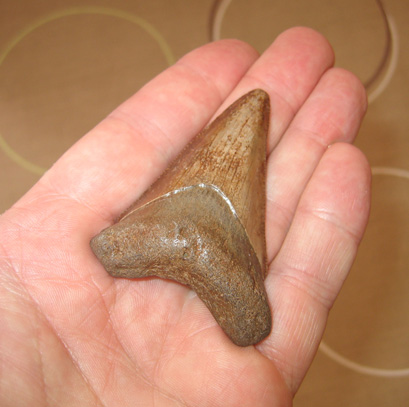
Fossilised Tooth from C. megalodon

A large fossil tooth from a Carcharodon megalodon.

A large fossil tooth from a Carcharodon megalodon. Picture credit: Everything Dinosaur.

 Picture credit: Everything Dinosaur

Although the team admit that their calculations are subject to margins of error, this work represents a refinement on previous estimates of the extinction of this shark species.  Why this apex predator became extinct remains a mystery

Megalodon Fossil Material from the Miocene

Most Megalodon fossil material dates from around 16 to 11.6 million years ago (Miocene Epoch) with some further fossils known from the Pleistocene Epoch, although a lot of the fossil material associated with Pleistocene deposits were not included in this particular study.  With a more accurate extinction date established, the researchers can then assess the impact of the removal of a large predator from the marine environment on other genera including cetaceans.

The date of 2.6 million years ago marks the border between the Pliocene and Pleistocene Epochs, it was after this point that the baleen whales began to increase in size and to evolve into the many giant forms alive today.

Did Whales Flourish When Megalodon Became Extinct?

As marine mammals are thought to have made up a substantial part of the bus-sized shark’s diet, although there is no conclusive evidence to suggest Megalodon fed on large whales, if Megalodon died out, did this trigger the flourishing of the baleen whales?

Commenting on the research, Catalina Pimiento stated:

“When we calculated the time of Megalodon’s extinction, we noticed that the modern function and gigantic sizes of filter feeder whales became established around that time.  Future research will investigate if Megalodon’s extinction played a part in the evolution of these new classes of whales.”

Megalodon is a prime candidate for this sort of statistical analysis, due to the relative abundance and widespread distribution of its fossilised teeth.  It is hoped that this technique can be applied to other extinct species to plot more accurately the impact of a single species extinction on the wider ecosystem.

The PNSO Megalodon Model

Brilliant artwork on the PNSO Megalodon model cover sleeve.

The amazing, colourful sleeve artwork on the PNSO Megalodon figure.

Note

Following a taxonomic revision this prehistoric shark is now known as Otodus megalodon.

28 10, 2014

Zaraapelta nomadis In Praise of Victoria Arbour

By |2023-03-17T14:57:31+00:00October 28th, 2014|Categories: Dinosaur and Prehistoric Animal News Stories, Dinosaur Fans, Main Page|0 Comments

 New Species of Ankylosaurid Named – Zaraapelta nomadis

There are lots of female scientists all helping to make a significant contribution within their chosen specialist fields.  In palaeontology, many of the world’s top researchers are female, the gender imbalance in the sciences is slowly being altered as more and more women take up the opportunities offered by a career in academia.  When it comes to the Dinosauria, we at Everything Dinosaur, have remarked on numerous occasions how the ankylosaurids and research into these heavily armoured ornithischians seems to be overshadowed by studies focused on the ceratopsian and the hadrosaurs.  So it is doubly pleasing to write about the naming of a new species of ankylosaur, one that has been named by Victoria Arbour (University of Alberta).

Victoria Arbour and Ankylosaurids

Victoria’s research into Late Cretaceous ankylosaurids has been featured in a number of our blog articles over the years, she has established herself as the “go to person”, when it comes to studies into this particular branch of the armoured dinosaur family tree.

The new species has been named Zaraapelta nomadis.  It is known from a nearly complete skull (missing the snout), from the Baruungoyot Formation of Mongolia.  The fossil specimen was discovered in 2000 A.D. during an expedition to the Gobi Desert which was led by Professor Phil Currie (University of Alberta).  The genus name is a combination of the Mongolian and the Greek for “hedgehog shield”, whilst the species name honours, the Mongolian company Nomadic Expeditions which has played a pivotal role in helping scientists to explore the Gobi Desert for dinosaur fossils.

Zaraapelta nomadis

Thanks to the work of post-doctoral researchers like Victoria, scientists are beginning to work out that there were a number of different types of ankylosaurid present in the region that was to form the Nemegt and Baruungoyot rock formations.  Similar research has revealed a number of different ankylosaur genera present in North America (Dinosaur Park Formation).  It seems likely that there was almost as much diversity in the ankylosaurids as there was in the ceratopsians and hadrosaurs.

Zaraapelta was certainly a very prickly customer, the new species has been erected as the skull shows some unique morphology.  For example,  behind the eye sockets and over the rear of the skull there is extensive ornamentation, lots of bumps and lumps of bone, to us, this dinosaur reminds us of a giant thorny devil lizard (Moloch horridus).  At the back of its skull there were distinctive horns with a prominent ridge along the top, the holotype specimen is being kept at the Mongolian Palaeontological Centre, located at Ulaanbaatar.

A Spectacular Skull

The skull of Zaraapelta is even more spectacular than the other Mongolian armoured dinosaurs, the likes of Saichania (S. chulsanensis) and Tarchia (T. kielanae).  In a paper published in the “Zoological Journal of the Linnean Society”, the research team, that included Professor Phil Currie and Demchig Badamgarav (Mongolian Academy of Sciences), provide a phylogenetic analysis of ankylosaurids from the Gobi desert.  The scientists concluded that Z. nomadis was probably most closely related to Tarchia kielanae.

An Illustration of Zaarapelta nomadis

Dinosaur with a very spiky head.

Dinosaur with a very spiky head.

Picture credit: University of Alberta/Danielle Dufault

Elaborate and Distinctive Ornamentation

Doctor Arbour explained that the elaborate and distinctive ornamentation on the skulls of these ankylosaurs may have evolved as a way to show off in order to attract a mate.  Head crests and extensive skull ornamentation in the ceratopsian and hadrosaurs are associated with display as well as for defence (in the case of the horned dinosaurs), but this idea is not generally applied to ankylosaurids.

Victoria stated:

“You can think of bone being an expensive item for your body to maintain.  Bone requires lots of nutrients and metabolic energy to create and so that investment needs to pay off in some way.  Maybe ankylosaurs had this bumpy ornamentation for protection, but another good explanation is that the horns and bumps on their skulls showed that they were a good mate to choose, in the same way that Peacocks use their tail feathers.”

The Holotype Fossil Material of Zaraapelta nomadis

Left lateral view (top) and dorsal view (bottom).  Scale bars = 10cm

Left lateral view (top) and dorsal view (bottom). Scale bars = 10cm.

Picture credit: University of Alberta

Examining Previously Named Mongolian Ankylosaurs

In addition to naming the new ankylosaur Zaraapelta, this study also re-examined previously named ankylosaurs from Mongolia and found support for “resurrecting” a species that had been discarded by earlier workers.  The science of naming organisms, called taxonomy, is more fluid than many people might realise, Arbour notes.  Sometimes, researchers might determine that two species names represent only one actual species, in which case the name that was created first has priority (senior synonym).

This was the case for an ankylosaur called Tarchia kielanae, which was eventually thought to be the same kind of ankylosaur as Tarchia gigantea.  But new information from recent dinosaur discoveries, including this study, suggests that Tarchia kielanae might be a separate species after all, so the name has been brought back into scientific literature.

Just as the phylogenetic analysis of ankylosaurids has changed, so it is all change for Dr Arbour, next month she is taking up a new position as a post-doctoral researcher at the North Carolina Museum of Natural Sciences.

We wish her well in her new role and we look forward to writing about her future research.

For models and replicas of ankylosaurids and other dinosaurs, visit Everything Dinosaur’s award-winning website: Everything Dinosaur.

27 10, 2014

Rare Plesiosaur Vertebrae from Lyme Regis

By |2024-05-04T18:05:32+01:00October 27th, 2014|Categories: Dinosaur and Prehistoric Animal News Stories, Dinosaur Fans, Main Page|0 Comments

Plesiosaur Vertebrae United!

Having been on the Cumbrian coast last week as the last vestiges of hurricane Gonzalo battered the UK, our thoughts turned to elsewhere in the UK where strong winds and high tides might also be damaging the coastline.  One area we considered to be under particular threat was the Jurassic coast of Dorset.  The cliffs around Lyme Regis are very unstable and adverse weather conditions could lead to further rock falls and mud slides.

Plesiosaur Vertebrae

Ironically, our chum Brandon Lennon sent us some amazing pictures over the weekend of plesiosaur dorsal vertebrae that had been found in the Lyme Regis area.  Not only is this fossil specimen very beautiful, but it seems behind every string of articulated vertebrae there is an interesting story…

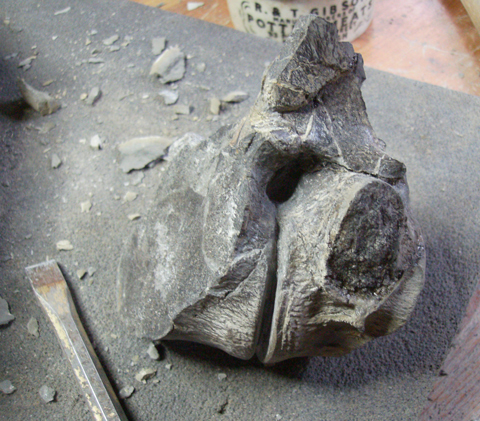
Whilst visiting Lyme Regis for the Fossil Festival (May 2014), enthusiastic fossil hunter Chris East decided to try his luck and explore the beach west of Lyme Regis (Monmouth).  He found a Birchi nodule with signs of a fossilised bone encased within it.  Birchi nodules are rounded, calcareous concretions that can be found deposited in a thin layer above the shales with beef strata.  They are often associated with fossils, particularly ammonites such as Microderoceras birchi.  Finding evidence of a bone, he thought it best if this specimen was professionally prepared and cleaned.  A very sensible idea, as once the rock had been cleaned and carefully prepared the nodule was seen to contain a row of beautifully preserved and articulated plesiosaur vertebrae.

Plesiosaurs

Plesiosaurs were a diverse group of marine reptiles that thrived during the Jurassic and Cretaceous.  There were two main types, the long-necked forms (plesiosaurs) and the closely related, short-necked forms commonly referred to as pliosaurs.

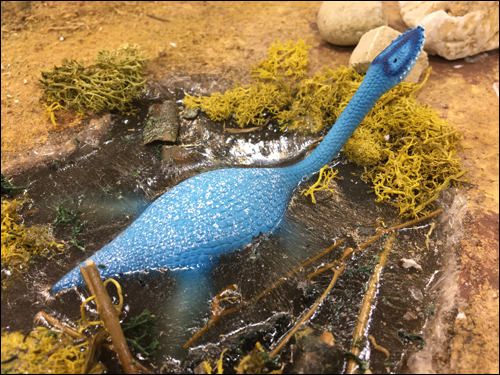
An Illustration of a Typical Jurassic Plesiosaur (Schleich Plesiosaurus Model)

Schleich Plesiosaurus model.

The Schleich Plesiosaurus model on display. Picture credit: Everything Dinosaur.

The picture (above) shows a plesiosaur replica.  To view models and replicas of plesiosaurs and other prehistoric animal figures: Schleich Dinosaurs and Other Prehistoric Animals.

Fossils of plesiosaurs from Lyme Regis are much rarer than ichthyosaurs, discovering this set of articulated vertebrae is an exceptionally rare find indeed.  Whilst in Lyme Regis earlier this month, Chris took the opportunity to show the vertebrae fossils to local fossil expert Brandon Lennon.  To Chris’s great surprise Brandon, on hearing where the Birchi nodule had been found, was able to add to his specimen.

From the Same Specimen

Fossil expert Brandon, who regularly takes guided fossil walks onto Monmouth beach, had identified some plesiosaur bones whilst exploring a recent mudslip on Monmouth beach.  Brandon was able to confirm that the isolated bones did come from the same individual plesiosaur as the bones found by Chris East some months before.

The Plesiosaur Vertebrae Found by Brandon Lennon

Fossil specimen found by Brandon Lennon.

Fossil specimen found by Brandon Lennon.

Picture Credit: Brandon Lennon

Thanks to one local man’s expertise, the plesiosaur fossil material was re-united.

The row of Articulated Plesiosaur Vertebrae

A row of 8 Plesiosaur vertebrae with associated ribs fragments.

A row of 8 Plesiosaur vertebrae with associated ribs fragments.

Picture credit: Brandon Lennon

Finding Treasures

The beaches around the Dorset town of Lyme Regis can still yield such treasures. Storms over the winter months are likely to expose yet more fossil finds, however, we would urge caution as the frequent rock falls and mudslips from the unstable cliffs coupled with dangerous tides make this part of the coast no place for the inexperienced fossil hunter.  Our best advice is to go on a guided fossil walk with a local expert.  A fossil expert, such as Brandon Lennon, can show visitors the best (and safest) places to find fossils, you never know, you might just find a vertebra or two from a marine reptile.

For information on guided fossil walks: Lyme Regis Fossil Walks.

23 10, 2014

Deinocheirus – Done and Dusted (For Now At Least)

By |2023-03-17T11:51:26+00:00October 23rd, 2014|Categories: Dinosaur and Prehistoric Animal News Stories, Dinosaur Fans, Main Page|2 Comments

Solving the Mystery of “Peculiar Terrible Hand”

Back in November 2013, team members at Everything Dinosaur wrote about of the most intriguing reports to come out of the annual Society of Vertebrate Palaeontology meeting that had just come to an end in Los Angeles.  As the dust settled and the researchers made their way home, here was a chance to reflect on the remarkable work done to help finally resolve a fifty year mystery.  What type of dinosaur was Deinocheirus?

Huge fossilised forelimbs and shoulder bones, discovered by a joint Polish/Mongolian expedition to the Gobi desert in 1965 had fascinated scientists for nearly half a century.  The arms were massive, measuring some 2.6 metres in length (including shoulder blades) and each hand ended in three-fingers, each finger tipped with an enormous, curved claw which in one case was over twenty centimetres long.

Deinocheirus Dinosaur

Based on these huge arms and a few other scraps of fossil bone, most palaeontologists agreed that the fossils represented a giant form of ornithomimid, a member of the “Bird  Mimic” group of theropod dinosaurs.  Although the arms were much bigger, they did resemble the arms and hands of agile, fast running ornithomimids such as Struthiomimus and Dromiceiomimus.  A formal announcement was made about the discovery in 1966, and Deinocheirus “Terrible Hand” was described based on this holotype material in 1970.

This was the cue for every dinosaur book publisher to include a picture of the fossil material in virtually every dinosaur book produced in the seventies and eighties, although very few attempts to illustrate the dinosaur were actually made if we recall correctly.

The Holotype Fossils of Deinocheirus (Deinocheirus mirificus)

Fearsome arms of Deinocheirus

Fearsome arms of Deinocheirus.

Professor Zofia Kielan-Jaworowska

The woman in the photograph is Professor Zofia Kielan-Jaworowska, the scientist who led the 1965 expedition.  Although the limbs have been repositioned and remounted since this picture was taken, it does provide a very good impression of the scale of those fossilised limbs.

Writing in the journal “Nature” the scientists behind the paper presented at the conference last year have revealed more about the “enigma” that is the ornithomimosaur Deinocheirus mirificus.  Turns out that this bizarre theropod is even more amazing than previously imagined.  In the journal, the scientists describe two new specimens of Deinocheirus that were discovered in the same formation (Nemegt Formation) as the original holotype material.

More Complete Fossil Remains

These much more complete fossil remains have enabled the researchers which include Phil Currie (University of Alberta), Yuong-Nam Lee and Hang-Jae Lee (Geological Museum, Korea Institute of Geoscience and Mineral Resources) as well as Pascal Godefroit (Royal Belgian Institute of Natural Sciences), to build up a comprehensive picture of what this dinosaur looked like, where it lived and what it ate.

A New Interpretation of Deinocheirus (D. mirificus)

A bizarre looking Theropod after all.

A bizarre looking theropod after all.

Picture credit: Yuong-Nam Lee/Korea Institute of Geoscience and Mineral Resources

It is certainly the largest member of the Ornithomimosauria known to science, with an estimated length of around 11 metres, several tonnes in weight and standing about as tall as a modern-day Giraffe, but it was no vicious super predator.  Studies of the feet and hind legs indicate that this animal was probably a slow walker, one with a huge pot belly to boot.  A pot belly?  This dinosaur had an expanded pelvis with strong muscle attachments.  It probably had a large gut to help it digest the tough plant material that it ate.

Edentulous Jaws

The skull measures over a metre in length, but there were no teeth in the deep jaws.  Indeed, over a 1,000 gastroliths have been found in association with the fossils, along with fish remains in the body cavity indicating that this animal was probably a mega-omnivore, eating plants, but also insects, small animals and fish.

Deinocheirus lived next to a large river.  Seventy million years ago, this part of Mongolia resembled the Upper Nile.  The broad, wide toes with their blunt claws were ideally suited to assist this animal when walking over soft mud. It probably wandered into the river to feed on soft water plants, to catch the occasional fish and to avoid the attentions of the tyrannosaur Tarbosaurus.  However, evidence that Tarbosaurus fed on Deinocheirus has been preserved on some of the bones.

Scavenged by Tarbosaurus?

Whether or not the bite marks and feeding gouges that have been identified indicate that Tarbosaurus predated on these large bipeds, or whether these marks were made as a result of scavenging a carcase remains unclear.  However, the deep, “U-shaped” wishbone of this dinosaur and those big shoulder bones suggest that this ponderous giant could inflict some serious damage should any unwary tyrannosaurid venture too close to those huge arms.

This dinosaur had a number of unique skeletal features, it had a pygostyle (fused vertebrae on the end of the tail), like a bird and a much thicker tail than its smaller ornithomimid relatives.  Perhaps one of the most intriguing features are the large number of tall neural spines.  The dorsal and sacral vertebrae have flat, blade-like extensions (neural spines).  To us, these spatulate spines resemble the bones seen in the humps of Bison.

A Sail-like Structure or Perhaps a Large Hump

Deinocheirus could have had a sail-like structure on its back, or maybe even a large hump.  It has been suggested that the hump, originally reported upon in 2013, could have been exaggerated. These neural spines could have supported a network of ossified tendons to help support this dinosaur’s huge gut and heavy tail.

An Illustration of Deinocheirus (D. mirificus)

PNSO Deinocheirus model.

The PNSO Jacques the Deinocheirus dinosaur model has an articulated jaw. Picture credit: Everything Dinosaur.

Picture credit: Everything Dinosaur

To view the PNSO range of dinosaur models: PNSO Dinosaur Models.

Deinocheirus Models

The model making company CollectA introduced a 1:40 scale replica of the mysterious Deinocheirus back in 2012.  At the time, we commended them for bringing out a model of this dinosaur when so very little of the total skeleton had been studied and described.  With the information regarding the hump, we at Everything Dinosaur amended our scale drawing to give an impression of a small hump over the pelvis, but the latest illustrations really emphasis the hump or sail on this animal’s back.

Ironically, CollectA gave their Deinocheirus model feathers, no evidence of feathers on the original holotype material or indeed on the more recently discovered fossils have been found, but it is thought that a number of ornithomimids were indeed, feathered.

An Illustration of the CollectA Deinocheirus Model (2012)

Scientists speculate that Deinocheirus was covered in simple feathers.

Scientists speculate that Deinocheirus was covered in simple feathers.

As lead author of the scientific paper, Yuong-Nam Lee states the researchers were just as surprised as anyone when they put the complete dinosaur together based on the three main specimens that had been found to date.

Yuong-Nam Lee went on to add:

“The discovery of the original specimen almost half a century ago suggested that this was an unusual dinosaur, but did not prepare us for how distinctive Deinocheirus is.  A true cautionary tale in predicting forms from partial skeletons.”

To view Everything Dinosaur’s origin article on this research, published in November 2013: A Helping Hand for Deinocheirus.

To view the range of CollectA scale models available including the 1:40 replica of Deinocheirus: CollectA Deluxe Prehistoric Life Replicas.

22 10, 2014

New Prehistoric Times Issue 111 Reviewed

By |2024-05-04T18:07:37+01:00October 22nd, 2014|Categories: Dinosaur Fans, Magazine Reviews, Main Page|1 Comment

A Review of Prehistoric Times (Issue 111) Autumn 2014

Summer may be over for us in the Northern Hemisphere and for the UK the clocks go back next week heralding some months when nights are going to be longer than days.  However, perfect fireside reading has arrived in the nick of time, in the shape of the latest edition of the quarterly magazine “Prehistoric Times” and once again it is jam packed with interesting articles, fantastic artwork and features.

“Prehistoric Times”

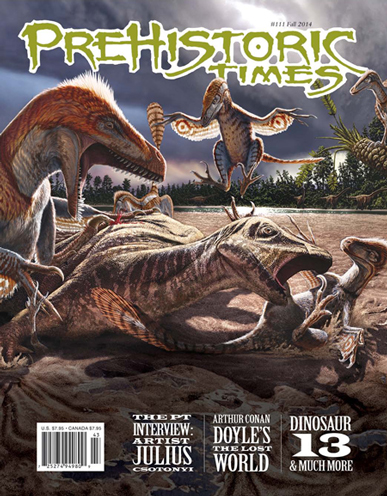
Decorating the front cover is a beautiful rendering of a Cretaceous fight scene between an unfortunate Hippodraco (iguanodontid) and a mob of Utahraptors.  This artwork was created by the very talented Julius Csotonyi and inside this issue there is a super interview with the palaeo-artist and a review of his new book “The Palaeoart of Julius Csotonyi” by Julius and Steve White.  Everything Dinosaur team members were sent a copy of this hardback a few months ago, it really is an excellent book showcasing the talents of a remarkable artist.

Julius Csotonyi Interviewed

The interview with Julius conducted by “Prehistoric Times’s” editor Mike Fredericks, is supported by lots of illustrations which show the range of prehistoric animals and time periods covered by Julius in his new publication.  The scene featuring several Late Cretaceous herbivores demonstrating “dietary niche partitioning” is my personal favourite, although my nephew likes the eyeball-plucking raptor best – still that’s kids for you.

The Front Cover Artwork (Prehistoric Times Issue 111)

Prehistoric Times magazine.

Prehistoric Times magazine.

Picture credit: Prehistoric Times

Baryonyx Featured

One of the featured prehistoric animals is Baryonyx and there are oodles (scientific term), of great illustrations sent in by readers on this member of the Spinosauridae and we greatly appreciated the article by Phil Hore on this theropod.  We too, like Phil, have speculated on how many fossil specimens ascribed to prehistoric crocodiles in the past may well turn out to be evidence of widely dispersed spinosaurids.  Special mention to our chum Fabio Pastori for a simply stunning Baryonyx drawing.

The magazine has a bit of an “English theme” running through it.  Dinosaur discoveries of southern England are documented in another article, which features the artwork of John Sibbick and there is a well written piece by John Lavas that discusses the impact of Sir Arthur Conan Doyle’s “Lost World”, a novel that we are informed has not been out of print since its publication back in 1912.  Bringing things right up to date, our review of “Dinosaurs of the British Isles” is featured, a book which documents and catalogues the Dinosauria known from these shores.

How to Draw Dinosaurs with Tracy Lee Ford

Tracy Lee Ford continues his series on how to draw dinosaurs by discussing integumental coverings – feathers, quills and bristles on the Dinosauria.  He makes some excellent points and it is great to see a piece that features one of our favourite dinosaur discoveries of recent times, Kulindadromeus zabaikalicus.  This little feathered, plant-eating dinosaur makes another appearance in the Palaeo News section, along with updates on the Spinosaurus quadruped/bidped debate, giant prehistoric birds, a newly described Archaeopteryx specimen and a short report on Dreadnoughtus schrani .  Dreadnoughtus is important as a large number of bones have been found, helping palaeontologists such as Dr Kenneth Lacovara (Drexel University), to estimate the body mass of this huge titanosaur.  This dinosaur discovery adds a whole new dimension to body mass estimations using femora radii.

Everything Dinosaur wrote a short article on this discovery, it was favourably commented upon by the scientists behind the research paper and we basked in the glory of being praised by the researchers (for a few days at least).

To read more about “Prehistoric Times” and to subscribe: Prehistoric Times Magazine.

The Battat “Terra” Model Range

Dan LoRusso is interviewed about his work on the Battat “Terra” model range and there is a special feature on the bizarre, sabre-toothed Thylacosmilus.  The “English” theme is re-visited once again with a fascinating article penned by Allen A. Debus which examines the way palaeontology was depicted in the popular press of the 19th century, the list of references at the end of this article is especially helpful.

To view replicas and figures of prehistoric animals: Dinosaur and Prehistoric Animal Models and Figures.

Amongst the many other features and news stories is an interview with Todd Miller, the director of the film all about the controversy surrounding the Tyrannosaurus rex named “Sue”, the thirteenth documented T. rex dinosaur discovery hence the film’s title “Dinosaur 13”.  We had the very great pleasure of meeting Pete Larson in London just a few weeks before the film’s August 15th premier.  Pete chatted about the documentary and Everything Dinosaur did some work on behalf of the media company responsible for the distribution of this excellent film in the UK back in the summer.

Ah well, summer may be over but at least we have another super edition of “Prehistoric Times” to keep us occupied over those long autumn evenings.

20 10, 2014

Those Plucky and Remarkable Placoderms

By |2024-05-04T18:30:07+01:00October 20th, 2014|Categories: Dinosaur and Prehistoric Animal News Stories, Main Page, Palaeontological articles|0 Comments

Armoured Fish Made a Significant Contribution to Vertebrate Evolution

The placoderms were a hugely diverse and very successful group of fishes, whilst they lasted. For in terms of this groups’ persistence, in geological terms they make a relative short appearance in the history of life on Earth.  As a group the placoderms were around for approximately sixty-five million years, not a bad innings but nothing like the longevity of other types of fish such as the sharks, rays and certain actinistians, the Coelacanth for example.  The placoderms, or to be more correct, the Class Placodermi first evolved in the Late Silurian and they disappear from the fossil record at the end of the Devonian Period.

Placoderms

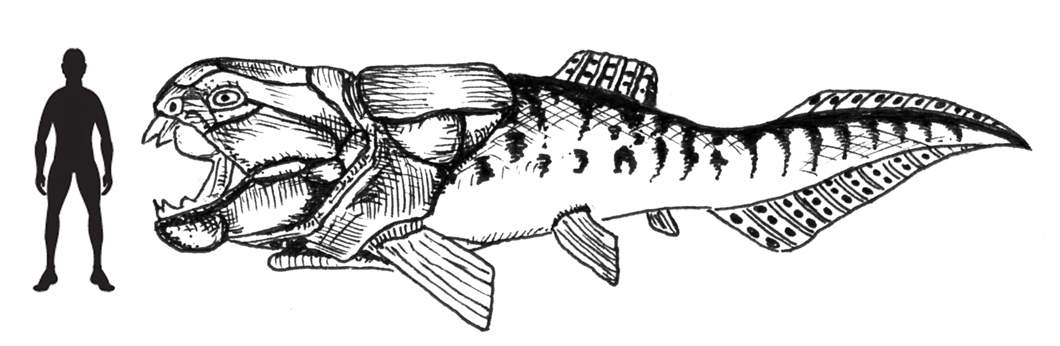
Perhaps the most famous placoderm is the giant predator Dunkleosteus.  Several species are known and with some specimens estimated to have reached lengths of around ten metres or more, at the time, (Dunkleosteus lived towards the end of the Devonian something like 370 – 360 million years ago), this fish would have been one of the largest vertebrates ever to have evolved.

Dunkleosteus – An Illustration

Fearsome marine predator of the Late Devonian.

Fearsome marine predator of the Late Devonian.

Picture credit: Everything Dinosaur

Dunkleosteus

Dunkleosteus may have looked like a typical placoderm with its head and thorax covered in articulated armour plate, but the Placodermi, it turns out are being seen as one of the most important group of vertebrates to have existed  It is not just because they evolved into the likes of Dunkleosteus, regarded by many as the world’s first, vertebrate, super-predator, but this group of armoured fishes seems to have achieved a number of “firsts” in terms of the Chordata (animals with a spine or spine-like structure in their bodies).

PNSO have added a replica of a Dunkleosteus to the mid-size model series. To view this range: PNSO Prehistoric Animal Figures.

Firstly, palaeontologists have found a number of fossils that suggest that early members of the Placodermi were amongst the first types of vertebrate to evolve a jaw.  Recently, Everything Dinosaur wrote a short article about a remarkable fossil discovery form China which reveals some remarkable features: A Jaw Dropping Discovery.

In addition, although the majority of placoderms seemed to have been poor swimmers, with most of them living close to the bottom, a number of families were active and nektonic, indeed these types of fish were the first to evolve paired pelvic fins, a fishy equivalent of legs, although not connected with the spine.  Paired pelvic fins are an anatomical feature found in most types of extant fish today.

Plucky Placoderms

Those plucky placoderms may have been amongst the first types of animal to develop teeth.  Recently a team of scientists from Australia and Bristol University studying fossilised remains of placoderms from Western Australia found evidence of the first types of teeth, teeth with a structure very similar to our own.  To read more about this: The Origins of a Toothy Grin.

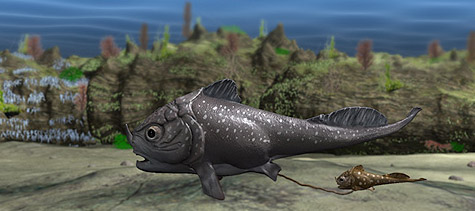
Fossils from the same rocks (Go Go Formation) western Australia gave palaeontologists a remarkable insight into the reproductive strategies of many types of ancient fish.  One species of placoderm, known from just a single fossil specimen represents the oldest example of a vertebrate capable of giving birth to live young (viviparity). Materpiscis attenboroughi was a small, bottom of the reef dwelling fish whose fossilised remains preserved in a limestone nodule showed evidence of an embryo and an umbilical cord.  This was evidence of internal fertilisation within the fossil record and the oldest known case of viviparity.

Materpiscis attenboroughi – A Remarkable Placoderm

Materpiscus means "Mother Fish".

Materpiscus means “Mother Fish”.

Picture credit: Museum Victoria

The remarkable Placodermi may have just added another evolutionary “first” to their string of impressive attributes.   A scientific paper published in the journal “Nature” provides details on a fossil discovery that hints at the very first example of copulation amongst vertebrates.  The international team of researchers that led the study into the antiarch (an-tee-arc) placoderm called Microbrachius dicki state that this was the earliest animal known from the fossil record to stop reproducing by spawning (external fertilisation).

Materpiscus attenboroughi

Professor John Long (Flinders University, South Australia), was the lead author of the academic paper.  The Professor, a renowned expert on Devonian fishes had earlier worked on Materpiscus attenboroughi.  The fossils of M. dicki are relatively common.  This small freshwater placoderm grew to about ten centimetres in length and lived around 385 million years ago.

Professor Long Explains the Key Points of the Research

Studying Placoderms and other Devonian fish.

Studying placoderms and other Devonian fish.

Picture credit: Flinders University

Commenting on the research, Professor Long stated:

“We have defined the very point in evolution where the origin of internal fertilisation in all animals began.  That is a really big step.”

A Peculiar “L-shaped” Appendage

A close inspection of a fossil revealed that one of the Microbrachius specimens had a peculiar “L-shaped” appendage.  Further study revealed that this was the male fish’s genitalia.

The Professor pointed out:

“The male had large bony claspers, These are the grooves that they used to transfer sperm into the female”.

On the other hand, the females had a small bony structure at the rear that helped to lock the male organ in place during mating.  Constrained by the anatomy, the fish probably had to mate side by side, a sort of “square dance position” as described by the researchers.

An Illustration Showing the Proposed Mating Position of M. dicki

Mating "square dance" style.

Mating “square dance” style.

Picture credit: Flinders University/Nature

However, copulation using this method does not seem to have stayed around for very long in these Devonian fish.  As fish evolved, they reverted back to external fertilisation (spawning), whereby male and females release sperm and eggs respectively into the water and fertilisation relies more on chance.  It took several more millions of years before the ancestors of today’s sharks and rays evolved copulation.

The Placodermi may be most famous for the likes of Dunkleosteus, but scientists are beginning to realise that these strange, armoured fish may have contributed much more to the evolution of the vertebrates than just the first, back-boned  super-predator!

19 10, 2014

Nosing Around Dinosaurs with a New Study

By |2024-05-04T18:30:40+01:00October 19th, 2014|Categories: Dinosaur and Prehistoric Animal News Stories, Main Page|0 Comments

New Study Sniffs Out Details of the Pachycephalosaur Nose

A study into the nasal passages conducted by a team of scientists from Ohio University suggests that certain types of dinosaur used their complicated noses to help cool their brains as well as to enhance their ability to smell.  A new study has got to grips with the noses of dinosaurs.

The Noses of Dinosaurs

The study, which focused on specimens from the Pachycephalosauridae family (the bone-heads), involved the development of computer models derived from CT scans of fossilised skulls in order to map the airflow in and out of a dinosaur’s snout.  Palaeontologists have known for some time that a number of different types of dinosaur had very complex nasal passages.  The nasal region although mostly associated with breathing (respiration), also plays an important role in helping to define and enhance a creature’s sense of smell.  In addition, the ability to bring in air at an ambient temperature into the skull may have a function in helping the brain to keep cool.

In the Late Cretaceous of North America, Pachycephalosaurs may have had small brains in their heavily armoured skulls but they did not want them to cook inside those thick heads.

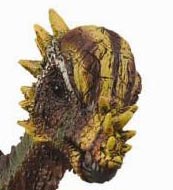
A Model of a Typical Member of the Pachycephalosauridae Family

Nosing around the nasal passages of dinosaurs.

Nosing around the nasal passages of dinosaurs.

Picture credit: Everything Dinosaur

Lead author of the research, which has just been published in the academic journal “The Anatomical Record”, Jason Bourke (Ohio University) states:

“Figuring out what’s going on in their [dinosaurs] complicated snouts is challenging because noses have so many different functions.  It doesn’t help that all the delicate soft tissues rotted away millions of years ago.”

Examining the Nasal Passages

In order to gain an appreciation of the nasal passages of long extinct dinosaurs, the team examined the snouts of extant relatives of the Dinosauria, namely birds, crocodiles and other reptiles including lizards.  The study of fossil skulls of pachycephalosaurs was supported by lots of dissections, blood-vessel injections to map blood flow as well as CT scans.  The researchers also relied upon computer models that provided a three-dimensional analysis of airflow.

A technique more commonly applied to the study of airflow in the aerospace industry, a technique called computational fluid dynamics was used to better understand how extant animals such as Alligators and Ostriches breathe.

As PhD student Jason Bourke explained:

“Once we got a handle on how animals breathe today, the tricky part was finding a good candidate among the dinosaurs to test our methods.”

The team turned to a family of bird-hipped dinosaurs known as the pachycephalosaurs, the bone-headed dinosaurs.  These particular dinosaurs were chosen as a number of specimens were readily available to study in the United States/Canada and skulls attributed to several genera were known.   The thick skulls with their ornamentation may have been used  by these relatively small dinosaurs for head-butting or visual displays.  The skull bones, some of which are several inches thick, has helped to preserve details of the nasal passages which the scientists were able to map and analyse in great detail.

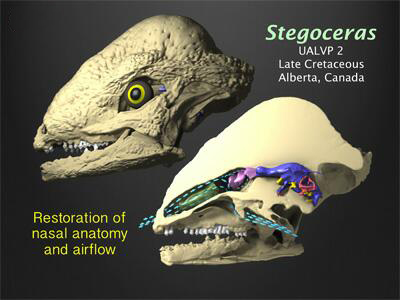
Getting Up a Dinosaur’s Nose

Airflow in the nasal passages in the Pachycephalosaur Stegosaurus validum is mapped.

Airflow in the nasal passages in the Pachycephalosaur Stegoceras validum is mapped.

Picture credit: Ohio University/The Anatomical Record

Studying Stegoceras

One pachycephalosaur that was studied was Stegoceras (S. validum) and the researchers were able to show that some of the airflow that they mapped would have carried odours to the olfactory region, helping to improve this dinosaur’s sense of smell.  In addition, the team tried to piece together the shape of the nasal concha, otherwise known as the turbinates, that help to direct and manage airflow through the nasal passage.  This small bone, superficially resembles a sea shell (hence the name) and the fossil evidence supports the presence of such a bone but it is not found in the Dinosauria fossil record (as far as we at Everything Dinosaur know).

As the researchers point out, there is the bony ridge preserved on pachycephalosaur skulls that indicate its presence and when airflow models were created, the best and most efficient ones produced included a turbinate structure within the model.

Commenting on the research results, Jason Bourke stated:

“We don’t really know what the exact shape of the respiratory turbinate was in Stegoceras, but we know that some kind of baffle had to be there.”

Study co-author Ruger Porter (Ohio University), pointed out that turbinates may well direct air to the olfactory region, but they might have also played another critical role, helping to cool the brain or at least helping to conserve moisture that might have been lost during exhalation.

Porter pointed out:

“The fossil evidence suggests that Stegoceras was basically similar to an Ostrich or an Alligator.  Hot arterial blood from the body was cooled as it passed over the respiratory turbinates and then that cooled venous blood returned to the brain.”

Endothermic Implications?

Whether this new research supports the theory that these dinosaurs were warm-blooded (endothermic) is being debated, but it does suggest there was more going on within dinosaur’s noses than scientists had previously thought.  It is hoped that the research team will be able to apply their analytical methods to other types of dinosaur such as the Thyreophora (armoured dinosaurs), known for their notoriously complex nasal passages.  This research may also provide answers to the questions concerning the bizarre shape of many crests found in lambeosaurine dinosaurs (duck-billed dinosaurs).

For models and figures of dinosaurs and other prehistoric creatures: CollectA Prehistoric Life Models and Figures.

16 10, 2014

Giant Kangaroos Made for Walking

By |2023-03-17T08:13:47+00:00October 16th, 2014|Categories: Dinosaur and Prehistoric Animal News Stories, Main Page|0 Comments

Giant Sthenurine Kangaroos Probably Walked Rather Than Hopped

The Pleistocene prehistoric fauna of Australia may not quite be as embedded into the public’s consciousness as the Woolly Mammoths, Cave Bears and Sabre-toothed cats that represent examples of European Pleistocene prehistoric animals, but if anything, ancient “Aussies” were even more amazing than the shaggy coated examples typical of the fauna of the western hemisphere.

Giant Kangaroos

In a new study, published in the on line academic journal PLOS One (Public Library of Science), a team of researchers propose that ancient, giant Australian Kangaroos were walkers rather than hoppers, making up part of a prehistoric fauna that was truly astonishing.

The Kangaroos in question are the heavy-weight members of the Sthenurinae (the short-faced kangaroos).  A sub-family of the Macropodidae (means “big feet”), the family to which all Kangaroos belong.  Following a rigorous comparative analysis, the research team conclude that these large animals, some of which stood over two metres tall, did not hop but were adapted to a pedestrian lifestyle, these animals were walkers.

Sadly, like most of Australia’s mega fauna these herbivores became extinct and did not make it into the Holocene.  The last of the Sthenurinae died out about 30,000 years ago, shortly before the last of the Neanderthals in western Europe.

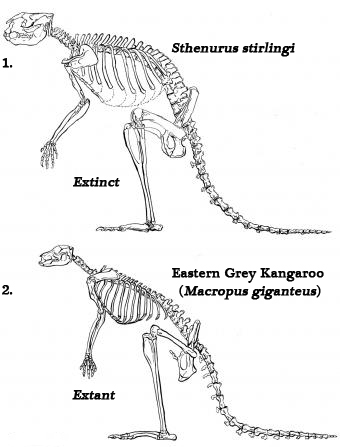
A Comparison Between an Extant Sthenurinae Kangaroo (Sthenurus stirlingi) and a Large Extant Species

Both these types of Kangaroo can stand up to two metres tall.

Both these types of Kangaroo can stand up to two metres tall.

Picture credit: Wells and Tedford, 1995.  Original artist Lorraine Meeker, American Museum of Natural History, with additional annotation from Everything Dinosaur

Extinction Theories

As for reasons for their extinction, that question remains to be answered, however, it is thought that the presence of man on the continent from around 60,000 years ago had a severe impact on the fauna of Australia.  Giant Short-faced Kangaroos such as Simosthenurus occidentalis (short-faced, strong tail, western Kangaroo), known from fossils found in south-western Australia, probably could not move very quickly and could be caught by human hunters.  The use of fire could also have devastated their forest habitats leaving these browsers with little food.

The research team was led by Professor Christine Janis, (Professor of Ecology and Evolutionary Biology at Brown University, Rhode Island, USA).  Over one hundred comparative measurements were made, comparing the skeletons of living and extinct Kangaroo and Wallaby types.  For Professor Janis, her eureka moment occurred in 2005.  She was examining the bones of a mounted skeleton of a sthenurine Kangaroo in a Sydney museum when she noticed how inflexible the spine looked when compared to a modern-day counterpart.  The professor began to wander whether these Pleistocene roos moved in the same way as extant Kangaroos.

Extinct Sthenurines

Working in collaboration with the papers co-authors, Borja Figuerido of the University of Malaga (Spain) and Karalyn Kuchenbecker, a former undergraduate at Brown University, the Professor spent several years examining the fossilised remains of extinct Kangaroos to determine their method of locomotion.  In the published account of their studies, the team hypothesise that in their motion the extinct sthenurines were very different from large Kangaroos found today.  The scientific paper is intriguing entitled: “Locomotion in Extinct Giant Kangaroos: Were the Sthenurines Hop-Less Monsters?”.

Extant Kangaroos can hop very quickly and utilise this unique form of motion to cover vast distances very efficiently.  They can also move about on all fours as their front limbs are capable of helping to support bodyweight, an anatomical characteristic absent in the larger members of the Sthenurinae.  The tail of many members of the Macropodidae is also able to bear weight, providing additional support for many Kangaroos and Wallabies.  The use of the tail as a fifth limb has been referred to as a “pentapedal” stance.  Extinct Kangaroos such as Sthenurus stirlingi seem to lack the flexible spine need to make leaps and bounds.  Their anatomy seems best suited to putting one foot in front of the other – a walking Kangaroo!

Sthenurines had proportionally bigger hip and knee joints.  The shape of the pelvic area differs significantly as well (see diagram above).  The sthenurines had a broad and flared pelvis that would have allowed for proportionally much larger gluteal muscles than other Kangaroos.  Those muscles would have allowed them to balance weight over just one leg at a time, as do the large gluteals of humans during walking.

One Massive Toe

Unlike modern Kangaroos with their four-toed feet, the extinct sthenurines had just one, massive toe on the end of each foot.  The research team conclude that when the anatomy of all the Macropodidae is considered, the “weird” ones are the extant species that hop.  They are very lightly built for their size and their preferred method of locomotion may not be typical for the group as a whole.  A bit like using the Cheetah as a template for all Felidae motion.

Commenting on the research Professor Janis stated:

“If it is not possible in terms of biomechanics to hop at very slow speeds, particularly if you are a big animal and you cannot easily do pentapedal locomotion, then what do you have left?  You have to move somehow.”

An over reliance on walking, which is not as efficient as hopping, might explain the demise of these Kangaroos about 30,000 years ago.  These animals might have been easier to catch so humans took a toll on the population.  Or as the climate became more arid, these walking Kangaroos were not able to migrate far enough to find new sources of food.

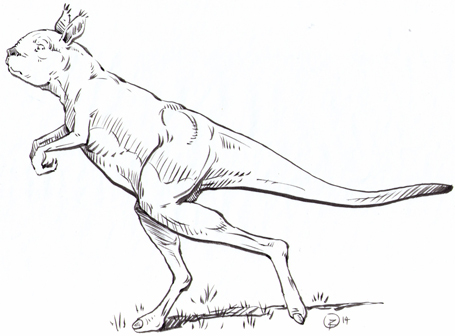
An Artist’s Impression of a Short-Faced Kangaroo

Short-faced Kangaroo a pedestrian.

Short-faced Kangaroo a pedestrian.

Picture credit: Brian Regal

The research team admit that more evidence is required to back up their anatomical study.  Ideally, if a set of “walking Kangaroo” tracks could be discovered, that would add considerable weight to their hypothesis.

9 10, 2014

Indonesian Cave Paintings Change Ideas About the Origin of Art

By |2023-03-16T18:44:12+00:00October 9th, 2014|Categories: Dinosaur and Prehistoric Animal News Stories, Main Page|0 Comments

Oldest Prehistoric Cave Art in the World Perhaps – An Indonesian Cave Art Exhibition

The human ability to think in abstract terms is often cited as one of the key differences between our species and those in the rest of the animal kingdom.  Our love of art and visual depiction can be traced back to the Late Palaeolithic but the thought that since cave paintings are confined to France and Spain, therefore art began in Europe, has been challenged thanks to an amazing discovery on the Indonesian island of Sulawesi.

A joint Australian and Indonesian team of anthropologists have uncovered a series of ancient human hand stencils and paintings of animals in seven cave sites in the southern portion of Sulawesi island.  Although a rural location, these caves (Karst Maros) had been visited by a number of tourists and backpackers, but until now nobody knew just how old some of the paintings were.

Cave Paintings

Archaeologists and palaeoanthropologists had long been puzzled by the appearance in southern Europe around 40-35 thousand years ago of a rich and varied range of artwork, including rock paintings and carved figures, but the absence or scarcity of similar art found elsewhere in the world.  Homo sapiens migrated into southern Asia and the Far East but little evidence of any form of culture in terms of works of art has been left behind on these migration routes.

Using a dating method that is based on the radioactive decay of uranium to thorium in small mineral growths that had formed on the paintings, the scientists were able to determine the minimum age of the paintings.  One hand stencil has been dated to circa 39,900 years ago, making it the oldest human hand print known to science.  A painting of a wild pig, an animal probably hunted by these ancient humans, has been dated to at least 35,400 years ago.  The artwork and images had been created by using red ochre, the materials and painting techniques used seem to be very similar to those found in caves of a similar age in western Europe.

Symbolic Explosion

Commenting on the significance of this study, Maxine Aubert of Griffith University (Queensland), one of the researchers stated:

“It was previously thought that Western Europe was the centre piece of a symbolic explosion in early human artistic activity such as cave painting and other forms of image making, including figurative art, around 40,000 years ago.”

This new research suggests that the rock art traditions seen on Sulawesi are at least as old as the oldest known European art.   One of the implications of this new study is that it has now been demonstrated that humans were producing very similar types of rock art by 40,000 years ago but at opposite ends of the Pleistocene Eurasian world.

Faded Artwork

The artwork is very faded in the photographs, so we have circled in green the rock art in the images that was studied.  It is feared, that just like the cave art in some European caves, modern pollution could damage these ancient Indonesian drawings.

To read an article about the damage being done to cave paintings in Europe due to rising levels of fungi: Cave Paintings Might Be Lost Forever.

The scientists hope to use this radioactive dating technique to accurately date other rock art sites in Asia and Australia.  By doing this they hope to better understand human migration and the movement of abstract ideas through the ancient population as it migrated eastwards.

Visit Everything Dinosaur’s award-winning website: Visit Everything Dinosaur.

Go to Top