All about dinosaurs, fossils and prehistoric animals by Everything Dinosaur team members.
22 11, 2014

Wonderful Dinosaur Illustrations from India

By |2023-03-17T21:38:28+00:00November 22nd, 2014|Categories: Dinosaur and Prehistoric Animal Drawings, Dinosaur Fans, Everything Dinosaur News and Updates, Main Page, Press Releases|0 Comments

Young Fans Send in their Dinosaur Drawings to Everything Dinosaur

It is always a pleasure to receive drawings of prehistoric animals from fans of dinosaurs.  We get lots and lots sent into our offices from all over the world.  We are always pleased to receive these illustrations and it amazes us how diverse the drawings are.  Dinosaurs dominate, we receive numerous dinosaur drawings from fans of prehistoric animals, but we get pictures of ichthyosaurs and pterosaurs as well as artwork depicting scenes from the Palaeozoic as well as the Mesozoic.  In addition, our post bags and emails also contain drawings of prehistoric mammals, Woolly Mammoths and Sabre-toothed cats being particularly popular.

Here are some examples sent in to Everything Dinosaur from India.

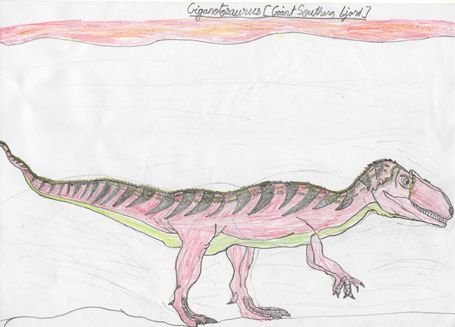
A Drawing of the Fearsome Carnivore Giganotosaurus

A colourful dinosaur drawing from India.

A colourful dinosaur drawing from India.

Picture credit: M. V. Eashwar

Dinosaur Drawings

The illustrator has correctly stated that the name Giganotosaurus means “giant southern lizard”.  We have printed out this artwork and pinned it onto one of our warehouse walls, so that everyone in the company can see when they are in the warehouse looking for dinosaur toys and games.

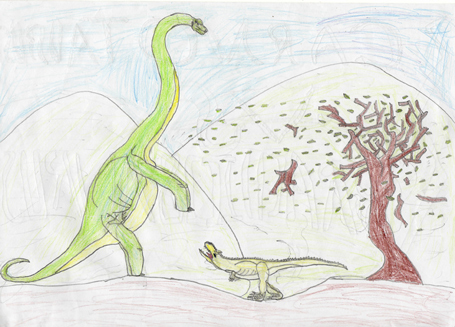
A Rearing Sauropod Defends Itself from Attack

A rearing Sauropod.

A rearing sauropod.

Picture credit: M. V. Eashwar

Dinosaurs Fighting

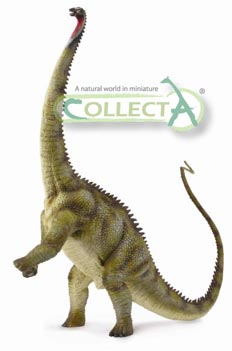
Another interesting drawing, one depicting a fight between two dinosaurs.  The green, long-necked dinosaur reminds us of the “Rearing Diplodocus” model in the CollectA not-to-scale model range.

The CollectA Rearing Diplodocus Dinosaur Model

Model was introduced in 2013.

The rearing Diplododocus dinosaur model was introduced in 2013.

Picture credit: Everything Dinosaur

To view the range of CollectA Prehistoric Life models in stock: CollectA Prehistoric Life/Prehistoric World Figures.

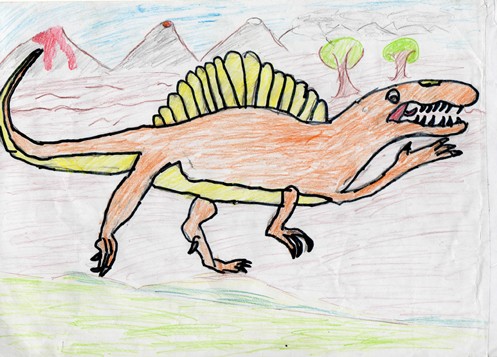
We really enjoy viewing all the wonderful prehistoric animal drawings that get sent into our offices, the one below shows an illustration of the huge, fish-eating dinosaur known as Spinosaurus, (thanks for this Shivesh).

A Drawing of the Mighty Spinosaurus

A fantastic drawing Shivesh!

A fantastic drawing Shivesh!

Picture credit: Shivesh

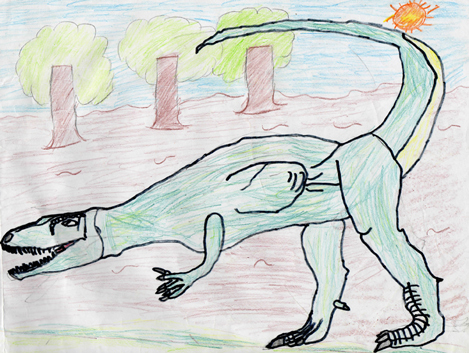
Pictures of Carnivorous Dinosaurs

When it comes to the dinosaurs, we tend to get a lot of pictures showing carnivorous dinosaurs, including the likes of Allosaurus and Tyrannosaurus rex.  We have posted up a wonderful drawing of a meat-eating dinosaur, this time coloured predominately sky blue.

Dinosaur Drawings in November (Dinovember)

Fearsome Theropod dinosaur.

Fearsome theropod dinosaur.  Everything Dinosaur receives lots of dinosaur drawings from fans of prehistoric animals.

Picture credit: M. V. Eashwar

The dinosaur in the picture above seems to be on the prowl, perhaps it is stalking potential prey.  We at Everything Dinosaur really enjoy seeing all these wonderful prehistoric animal illustrations.  Our thanks to all the budding, young (and not so young), palaeoartists that take the time and trouble to send them into us.

Thanks.

17 11, 2014

Rocks and Dinosaurs at St Mary’s Catholic Primary School

By |2023-03-17T21:06:42+00:00November 17th, 2014|Categories: Educational Activities, Main Page, Teaching|0 Comments

Year 2 and Year 3 Study Dinosaurs and Fossils

Pupils at St Mary’s Catholic Primary School enjoyed a visit from Everything Dinosaur today.  The visit of a dinosaur and fossil expert was scheduled to take place as Key Stage 1 pupils were starting a topic on dinosaurs and Key Stage 2 classes were beginning a science topic all about rocks, fossils and soils.

The children in Wharfe class (all the classes are named after rivers), had been considering whether a dinosaur would make a good pet.  They had looked at eggs and put up notes on their topic wall about animals that laid eggs.

Identifying Which Animals Lay Eggs

Which animals lay eggs?

Which animals lay eggs?

Picture credit: Everything Dinosaur

The visitor from Everything Dinosaur was able to provide quite a bit of evidence about dinosaurs and their suitability for a pet.  Identifying how much a Triceratops probably ate by looking at the jaws and teeth, convinced most of the children that some of the biggest dinosaurs known would not make good pets.  Under the tutelage of the class teacher Mrs Conroy, the children would be learning about living and non-living things, with a focus on life in the past.  One of the learning objectives for this part of the Autumn term was for the children to consider what living things require in order to survive and flourish.

Developing Vocabulary

There was a big emphasis on developing a scientific vocabulary, our dinosaur expert helped the class by assisting them when it came to identifying what some prehistoric animals ate and the terms used to describe these types of prehistoric creatures.

To read more about Everything Dinosaur’s huge range of dinosaur and prehistoric animal themed toys and gifts: Dinosaur Toys and Dinosaur Gifts.

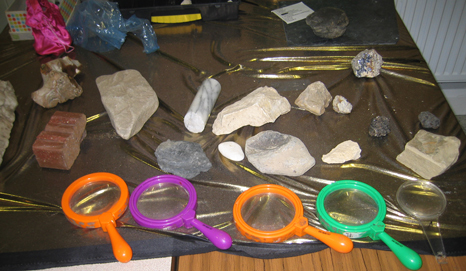
Year 3 (Swale class), had been learning about different types of rocks and their properties.  Mrs Hunt, the teacher was excited to learn about the local geology and all about the rocks that form Swaledale.  The children loved handling the fossils and taking part in the experiments to demonstrate petrification processes such as permineralisation.  On a table in the classroom, the children had lots of rocks to explore and to learn about.  The eager pupils were keen to show the Everything Dinosaur expert their fossils and he was happy to tell them all about these specimens, the class particularly liked learning about “Devil’s toenails”.

Lots of Rocks for Year 3 to Examine

A very full "rock table".

A very full “rock table”.

Picture credit: Everything Dinosaur

Having left each class with one of Everything Dinosaur’s “pinkie palaeontologist challenges”, we shall see how the children get on and we are all excited to hear the results.

16 11, 2014

To Clone or Not to Clone a Woolly Mammoth

By |2023-03-17T21:05:29+00:00November 16th, 2014|Categories: Dinosaur and Prehistoric Animal News Stories, Main Page, Press Releases|0 Comments

Documentaries on Woolly Mammoth Autopsy and Cloning Possibilities

Two documentaries focusing on the study of a remarkably well preserved female Woolly Mammoth carcase are due to be shown in the UK and the United States towards the end of this month.  Channel 4 (UK) will show “Woolly Mammoth: The Autopsy” on Sunday, November 23rd at 8pm.  Stateside viewers will be able to see a similar documentary entitled “How to Clone a Woolly Mammoth”, it will air on the Smithsonian Channel on November 29th.

Cloning a Woolly Mammoth

The 40,000-year-old star of the show, is “Buttercup” a mature female Woolly Mammoth.  The frozen carcase was discovered back in 2013, when a research team from the Research Institute of Applied Ecology, the Russian Geographical Society and the North Eastern Federal University was exploring the remote Lyakhovsky islands, part of the Novosibirsk archipelago, situated in the Eastern Siberia Sea in the search for Woolly Mammoth fossil remains.

Scientists found that entombed within the ice, much of the front part of this Mammoth’s body was intact.  This was one of the best preserved specimens ever discovered and the television programme makers examine what these remains can tell us about these long extinct creatures and then the programmes discuss the prospect of scientists producing a clone.

Woolly Mammoth “Blood”

When the body cavity of the Mammoth was examined, in places where it had begun to slightly thaw, a thick, red liquid could be encouraged to flow out of the flesh.  At the time this was described as “blood”. Although it may have contained constituents of blood, the television documentaries will explain in more detail what this was.  However, one thing that the field team could be confident about, this one of the best preserved Woolly Mammoths ever found.  Having a strong stomach is needed for this sort or work.  A nose peg/face mask is recommended, once the body starts to warm up, decomposition and putrefaction are not far away.

Woolly Mammoth

Returning a Woolly Mammoth, a species that has not been seen on this Earth for thousands of years, back from the dead.  This might sound like the stuff of science fiction, but the cloning of a Woolly Mammoth (Mammuthus primigenius), is a distinct possibility although probably not for at least another thirty or forty years – just a blink in geological time.

To read about the discovery of the Mammoth that is now called “Buttercup”: A Woolly Mammoth with Fresh Blood?

Should the Woolly Mammoth be Resurrected?
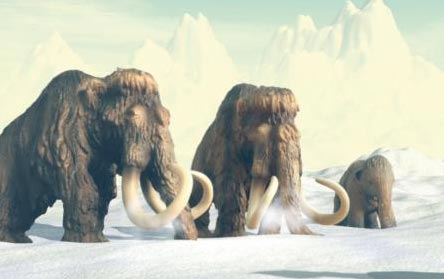
Will the Woolly Mammoth return?

Will the Woolly Mammoth return?

Picture credit:  Everything Dinosaur

Mired in a Bog

It is likely that this elephant became mired in a bog and she probably succumbed to exhaustion, although an attack from predators is not ruled out as much of the rear portion of the skeleton has been lost and that which remains shows feeding damage.   Whether this was post-mortem, we at Everything Dinosaur are unable to say.

Whilst we at Everything Dinosaur are very much in favour of the study of these Siberian giants.  After all, actually examining the slowly thawing out flesh of such a creature provides science with so much more information than just the bones. We remain concerned about the moral and ethical issues involved in any cloning process.  True, scientists from Harvard University and from South Korea’s Sooam Biotech Research Foundation are trying to just that, to bring a Woolly Mammoth back by cloning, although both teams are going about it in slightly different ways.

To Resurrect the Mammoth

We feel that certain questions have to be asked, for example, what contribution to overall genetic research would such a project make?  Indeed, is it right to focus on trying to resurrect the Mammoth when more resources could be directed at trying to save critically endangered flora and fauna that are still around.

We imagine a scenario, whereby, many Indian elephant females are subjected to experimentation and if a clone could be created, then there is the problem of surviving the lengthy gestation if a successful implanting into the womb of a surrogate mother could be achieved.

The Life of a Baby Mammoth

Perhaps, if the baby could survive to term, then there is the birth itself, or most likely a Caesarean section, as no commercial company would want to lose their “genetic investment” at this late stage.  If the baby survives, boy or girl (gender will probably be determined for it), then it could end up being rejected by what would already be a traumatised mother.  If the calf lives, we suspect there may be a number of unforeseen medical issues (as has been the case in the cloning a number of extant animals), then what sort of life would this young Woolly Mammoth have.

Could we See a Baby Woolly Mammoth in a Zoo in 2050?
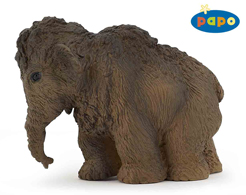
Baby Woolly Mammoth - the New Lyuba?

Baby Woolly Mammoth – the New Lyuba?

Picture credit: Everything Dinosaur

For models and replicas of Woolly Mammoths and other prehistoric creatures: Papo Models and Prehistoric Animal Figures.

Possibly rejected by its own mother and never able to be part of a herd, this elephant, highly social by instinct, part of a species that had a childhood almost as long as a human’s childhood, would be totally isolated and alone.  It would have no references, no role models, no benchmark.  It would be a Woolly Mammoth or something resembling a Mammoth (depending on the proportion of Indian elephant DNA involved), but it would not know how to behave or act like a Mammoth.

The Realities of Resurrecting a Mammoth

We at Everything Dinosaur foresee a heart-breaking scene in a zoo, perhaps in the not too distant future, whereby, a shaggy, rough coated elephant is paraded in front of crowds of visitors to the great satisfaction and economic benefit to the institution that owns this genetic wonder.  For the animal itself, it would most probably be doomed to live an entirely unnatural existence with none of the social interactions that these elephants would crave.  Just as we have captured Orcas and displayed them at theme parks and we are now only being to understand the trauma we put these magnificent creatures through.

Cloning One Day Possible?

Being able to explore the flesh and blood of a long dead creature is of great importance to science.  We accept that one day in future the cloning of a Mammoth may indeed be possible.  But just because we can do something doesn’t make it right to do.  To clone a Mammoth would involve a tremendously dedicated team of scientists who would be pushing at the boundaries of our understanding of genetics, but just as with the study of the carcase itself, when it comes to the moral and ethical implications, a strong stomach will be required.

Let’s hope that the documentaries examine the ethical dimensions of cloning such as a creature as well as providing more information on how these ancient creatures lived and died.


15 11, 2014

A Fishy Dinosaur Tail from South-western Alberta

By |2023-03-17T20:56:39+00:00November 15th, 2014|Categories: Dinosaur and Prehistoric Animal News Stories, Main Page|0 Comments

Fishermen Spot Duck-Billed Dinosaur Fossil in the Castle River

Palaeontologists at the Royal Tyrrell Museum (Alberta, Canada), have a new hadrosaur specimen to study, thanks to a pair of keen-eyed fishermen who spotted the fossilised remains of an 80-million-year-old dinosaur whilst on an angling trip to the Castle River in the extreme south-west of Alberta.

Hadrosaur Specimen

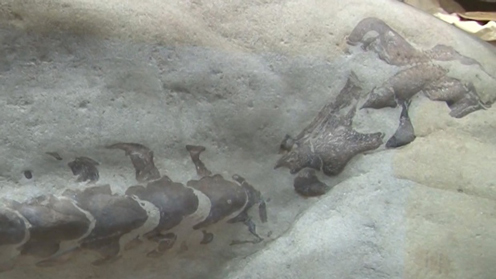
Back in August, a father and son fishing trip on the river was interrupted when the son, spotted the brownish/black outline of some bones exposed on the surface of a huge boulder that had been washed into the middle of the Castle River.  Last year, the south-west of Alberta experienced some of the worst flooding in living memory.

The devastation caused by the extensive flooding had a silver lining for vertebrate palaeontologists as a number of fossils were swept into river systems. This hadrosaur specimen, which consists of a partial skull, articulated cervical vertebrae and bones from the upper portion of the chest, could represent an entirely new species.

The Fossilised Bones are Entombed Inside a Sandstone Boulder

The exposed skull (top right) and the articulated neck vertebrae.

The exposed skull (top right) and the articulated neck vertebrae.

Picture credit: Royal Tyrrell Museum

Hadrosaurs

Hadrosaurs, or more specifically dinosaurs that belong to the Superfamily known as the Hadrosauroidea, were bird-hipped, herbivores that had horny beaks and batteries of teeth to help them cope with tough vegetation.  Known from the Cretaceous to the very end of the Age of Dinosaurs, these reptiles, also referred to as the duck-billed dinosaurs were amongst the most speciose of all the known types of dinosaur and they were particularly numerous and diverse during the Campanian and Maastrichtian faunal stages of Late Cretaceous North America.

Commenting on the significance of this discovery, the Curator of Dinosaurs at the Royal Tyrrell Museum, Dr Donald Henderson explained that the unusual location of this fossil find, just a few miles from the border with British Columbia, makes this specimen extremely important.

He stated:

“It is one of the reasons we were so keen to get it, every time we find something different in another part of the province, it’s something important.  This means we could be finding new dinosaurs in the extreme south-west of Alberta.”

Duck-billed Dinosaur Fossil

A helicopter was called in to airlift the one tonne boulder onto a low-loader for transport up to Drumheller, where the museum is based.  The specimen will then be carefully prepared in the museum’s laboratory.  Field workers did search the rest of the river bed and along the banks in the immediate vicinity of the fossil in a bid to find other parts of the skeleton, but to no avail.  Last year’s floods may have delivered this partial specimen but the remainder would have most likely been washed away.

It is rare for such a specimen, to be preserved in this manner.  The sandstone rock in which the fossil is entombed is extremely hard, the resistance of this rock to erosion helped preserve the fossil, although extracting the fossilised bones from the surrounding matrix will be a very difficult and time consuming job due to the tough matrix.

Entombed in Hard Sandstone

Dr Henderson added:

“It’s in really, really hard sandstone, otherwise it would have been smashed up a long time ago.  It’s [the fossil specimen] sort of coiled up inside, at the time of its death, the neck and head curled back and the body was swept away in a river of sand. “

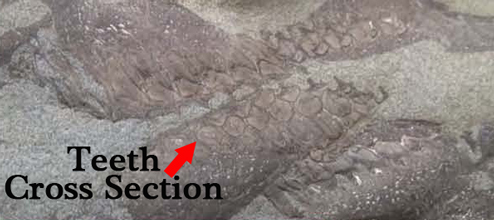
A Close up of the Skull Showing the Rows of Teeth in the Jaws

Erosion has led to the skull and jaws being cross-sectioned to reveal internal details.

Erosion has led to the skull and jaws being cross-sectioned to reveal internal details.

Picture credit: Royal Tyrrell Museum

A spokesperson from Everything Dinosaur said, that the actions of the fishermen should be praised.  It is important for members of the public to alert museums when they come across something unexpected and unusual.  The fossil is probably preserved in three-dimensions, the hard sandstone protecting the bones, normally such bones are crushed, flattened and smashed.  Palaeontologists might be able to learn a great deal about Late Cretaceous ornithischian dinosaurs as a result of this fossil discovery.

11 11, 2014

A “Brummie-saurus” a Sensational Dinosaur Statue

By |2024-05-04T18:33:06+01:00November 11th, 2014|Categories: Educational Activities, Main Page, Teaching|0 Comments

Birmingham School Children Learn All About Dinosaurs and Fossils

It was an early start today for an Everything Dinosaur team member as they set off to visit a school in Birmingham (West Midlands), to work with the Year 3 classes who had just started their topic on dinosaurs and fossils.  The focus for the day was to help each class get to grips with working scientifically and to support the intended learning outcomes of the teaching team.

Dinosaurs and Fossils

One of the things we had been asked to do was to help explain what the world looked like during the time of the dinosaurs and how the location of land masses has changed.  Time for us to bring in some of our collection of Permian plant fossils, specifically fossils of various glossopterids to assist us with this aspect of our work.  A map of the world stuck onto the wall of the dance studio where we were based for the day came in very handy.

Lower Key Stage 2 Children

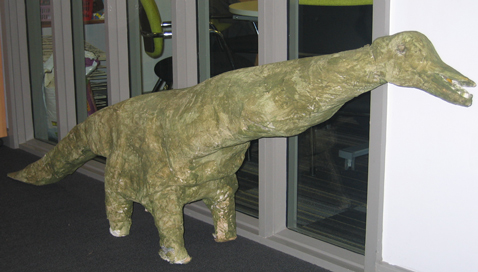
This is the first time a dinosaurs and fossils topic had been introduced at the lower Key Stage 2 level at this school, however, our sharp-eyed photographer spotted a wonderful paper mache sauropod that was lurking in a corridor.  Apparently, this dinosaur had been part of a art project a few years ago.  It was certainly a very striking sculpture.

Diplodocus Inspired Artwork on Display at School

A school's very own version of "Dippy".

A school’s very own version of “Dippy”.

Picture credit: Everything Dinosaur 

We conducted various experiments (hopefully, our experiment with 3PW will demonstrate tomorrow how fossils can form), we were asked some amazing questions by the budding young scientists and we set each class one of our “palaeontologist challenges” as part of the extension activities.

Our dinosaur expert got some lovely feedback from the children.

“I loved learning all about dinosaurs” – AB

“It was fantastic!” – AM

One of the Year 3 teachers told us:

“The children’s reaction to the workshop was fantastic.  They were all engaged and amazed by the facts and the artefacts!”

Volcanoes in the Dance Studio

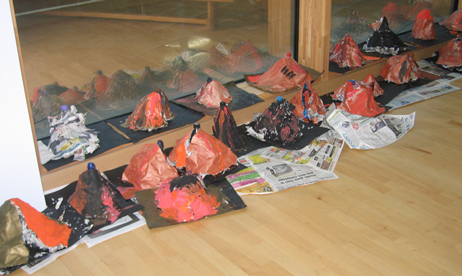
The dance studio, where we set up for the day, was also the place where a number of volcano models that had been built by children at the school were being stored.  We felt very much at home.

Models of Volcanoes Built by School Children

Geology on display in the dance studio.

Geology on display in the dance studio.

Picture credit: Everything Dinosaur

To see the huge range of dinosaur themed toys and gifts available from Everything Dinosaur: Dinosaur Toys and Gifts.

As part of the agreed extension activities, we set up a little bit of work for the children which links into their ICT studies this term.  We can’t wait to see the results.  Perhaps these Birmingham based school children will design their very own dinosaur, could we have a “Brummie-saurus” on our hands?

9 11, 2014

Researchers Report on Cretaceous Trace Fossils From Angola

By |2023-03-17T17:30:59+00:00November 9th, 2014|Categories: Dinosaur and Prehistoric Animal News Stories, Dinosaur Fans, Main Page|0 Comments

Important Prehistoric Animal Tracks Discovered in Angola

Amongst the many exciting news stories that have come out of the annual Society of Vertebrate Palaeontology meeting held this week in Berlin, is the report from the Paleo Angola Project about the discovery of extensive vertebrate tracks preserved in sediment that now makes up part of a diamond mine in north-eastern Angola.

A New Frontier for Palaeontology

Angola is one of the new frontiers for palaeontology.  This vast, yet underdeveloped country in southern Africa is believed to contain a number of Mesozoic aged, highly fossiliferous deposits and it is likely that any dinosaur fossils excavated from this country are likely to be species new to science.

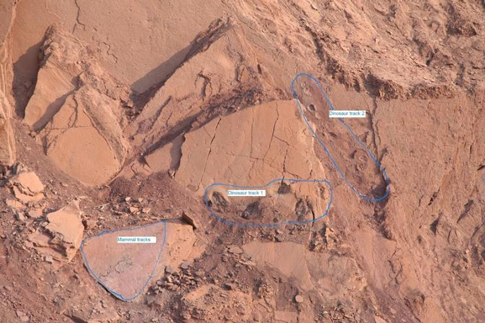
Researchers Map the Trace Fossil Locations

Mapping the fossil locations.

Mapping the fossil locations.

Picture credit: Paleo Angola Project

The picture above shows an aerial view of some of the trace fossils with their locations highlighted by the research team.  Dinosaur tracks are highlighted in the centre and on the right of the photograph, whilst the mammalian tracks can be seen highlighted towards the bottom left portion of the picture.

Angolan Fossil Exploration

To read an article from Everything Dinosaur about Angolan fossil exploration: Angola Starts to Share its Fossil Secrets.

In a report to the Society of Vertebrate Palaeontology, researchers from the Paleo Angola Project described a location in the silt and sand deposits that represents a lacustrine (lake) environment dating from approximately 118 million years ago (Aptian faunal stage).  Approximately, seventy distinct footprints have been identifed so far.  These trace fossils represent footprints made by sauropod dinosaurs, crocodiles and a relatively large prehistoric mammal.  The mammal print is particularly intriguing.

Most mammals during this part of the Cretaceous were very small, no bigger than rats, but the five-toed print measuring more than three centimetres across indicates that a mammal the size of a Bedlington Terrior dog or a North American Raccoon.  The scientists stated that the tracks were probably made over a substantial period of time, as the lake dried out over several seasons.

A Close Up and Line Drawing of a Single Mammalian Print

Five digits can be clearly seen.

Five digits can be clearly seen.

Picture credit: Paleo Angola Project

Studying the Mammalian Track

The mammalian track suggests that in at least this part of Africa, mammals were much larger than previously thought.  The mammal track has been described as “a very rare find.”

Working out what kind of mammal left the rare footprints may not be possible, after all, no body fossils have been found.

Commenting on the discovery, Marco Marzola, one of the palaeontologists with the Paleo Angola Project explained:

“We cannot narrow down to a species but we can say what they [the footprints] do belong to.  They were made by an exceptionally large mammal, that we can say for sure.”

Cretaceous Trace Fossils

In the same location, eighteen sauropod tracks have been discovered, the Paleo Angola Project team have already named and described one giant, long-necked dinosaur that once roamed Angola.  The fossils of this dinosaur were found in marine sediments.  It is likely that the corpse floated out to sea and there is evidence preserved on the fossilised bones of feeding from sharks, that were scavenging the carcase.

To read about the discovery of Angola’s first dinosaur: Angolatitan – Dinosaur that Ended Up as Fish Food.

Praising the action of the consortium which owns the diamond mine (Catoca mine, the fourth largest diamond mine in the world), the scientists said that the mine owners stopped all activity at the mine to allow the researchers to map and plot the trace fossils.  The mine owners put the promotion of vertebrate palaeontology in Angola ahead of their own desire to make money.

8 11, 2014

Ankylosaurs with Air Conditioning as New Research is Published

By |2024-05-04T18:33:45+01:00November 8th, 2014|Categories: Dinosaur and Prehistoric Animal News Stories, Dinosaur Fans, Main Page|0 Comments

Complicated Nasal Passages Helped Keep Ankylosaurs Cool

Animals have a number of ways of controlling their body temperatures and cooling down.  Some warm-blooded animals like kangaroos and antelopes seek shade during the heat of the day.  Elephants cover themselves with mud or take a cooling dip.  Dogs pant and humans sweat, but how did the heavily armoured dinosaurs keep cool?  These “living tanks” with their huge, armoured bodies could have been in danger of overheating as they wandered around in the Mesozoic.

Ankylosaurs with Air Conditioning

A new paper suggests that their complicated nasal passages not only would have helped these animals with their sense of smell, but they would have acted as very efficient heat transfers.

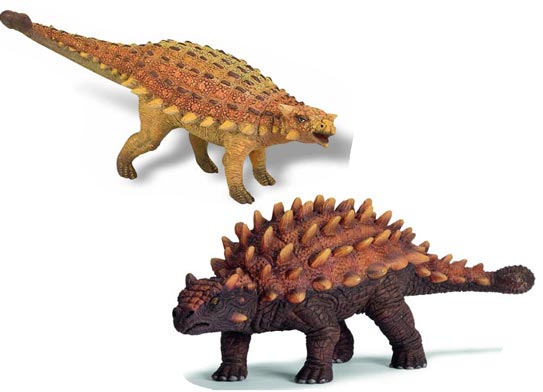
Ankylosaurids with Built in Air Conditioning

Armoured dinosaur models.

Armoured dinosaur models.

Picture credit: Everything Dinosaur

A team of scientists based at Ohio University used CAT scans of ankylosaurid cranial material to map the anatomy of the complex nasal passages in two different North American ankylosaur species.  The team then modelled the air flow in three dimensions using a computer programme that interpreted the CAT scan data.  Palaeontologist Jason Bourke, one of the authors of the scientific paper stated that the complex nasal passages would have given the inhaled air more time to warm up to body temperature by drawing heat way from blood vessels in the nasal cavity.  This would have helped cool the blood and in turn this would have cooled vital organs such as the brain.

Brain Size in Ankylosaurids

The brain of even the largest ankylosaurids was extremely small when compared to their body size.  The dinosaur experts at Everything Dinosaur regularly compare the brain of a large ankylosaur such as Euoplocephalus tutus to the size of a child’s fist.  The nasal passages would have helped to keep the brain in its heavily armoured skull cool and stable.

Mammals and birds use scroll-shaped bones called conchae, otherwise known as turbinates to warm air that is breathed in, but the armoured dinosaurs seem to have achieved the same result with a completely different anatomical configuration.

Transferring Heat Whilst Breathing

Commenting on the study, Jason Bourke stated:

“There are two ways that animal noses transfer heat while breathing.  One is to pack a bunch of conchae into the air field, like most mammals and birds do, it is spatially efficient.  The other option is to what lizards and crocodiles do and simply make the nasal airway much longer.  Ankylosaurs seem to have taken this second approach to the extreme.”

Doctor Lawrence Witmer (Ohio University), who was also involved in this research explained:

“Our team discovered these “crazy-straw” airways several years ago, but only recently have we been able to scientifically test hypotheses on how they functioned.  By simulating airflow through these noses, we found that these stretched airways were effective heat exchangers.  They would have allowed these multi-tonne beasts to keep their multi-ounce brains from overheating.”

Complext Nasal Passages

Ohio University researchers had previously studied the complex nasal passages of another group of ornithischian dinosaurs – the pachycephalosaurs.

To read this earlier article: Nosing Around Pachycephalosaurs.

Just like noses in humans, (Homo sapiens) ankylosaurid noses are likely to have served more than one function.  As the complex nasal passages helped condition the air that was breathed in and out, water may have been removed from exhaled breath helping these dinosaurs to retain water, important when you live in arid environments.  In addition, the convoluted passageways may have added resonance to the low-pitched sounds this dinosaur made.  The nose could have amplified these sounds acting as a resonator, making the noises made by ankylosaurs  heard over greater distances.

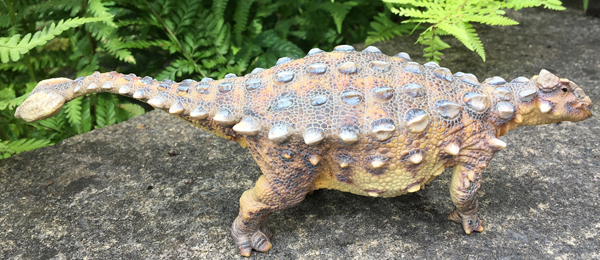
A Model of an Ankylosaurus

PNSO Ankylosaurus "Sede".

“Sede” the Ankylosaurus dinosaur model.  A PNSO “Age of Dinosaurs” replica.

Picture credit: Everything Dinosaur

The model (above) is “Sede” the Ankylosaurus from PNSO. To view the range of PNSO prehistoric animal models and figures in stock: PNSO Age of Dinosaurs.

6 11, 2014

Year 2 Pupils Learn All About Dinosaurs

By |2023-03-17T17:13:16+00:00November 6th, 2014|Categories: Educational Activities, Main Page, Teaching|0 Comments

Dinosaur Workshop at Liverpool Primary School

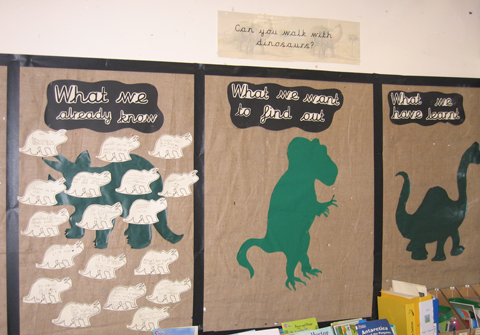
School children at Anfield Infants School enjoyed a visit from Everything Dinosaur this week, as Year two pupils studied dinosaurs and fossils.  The school children had just started their topic and they had lots of amazing questions about prehistoric animals, which we did our best to answer.  The dedicated teaching team had prepared a comprehensive scheme of work and they had posted up a huge K-W-L chart in each of the Year 2 classrooms (high flyers, bright sparks and whizz kids).

Dinosaurs

What fantastic and imaginative names for the classes!

The K-W-L Chart Prepared as Part of the Term Topic

Learning all about dinosaurs and fossils.

Learning all about dinosaurs and fossils. Year 2 pupils learn about dinosaurs.

Picture credit: Everything Dinosaur/Anfield Infants

The K-W-L concept helps teachers to plan a topic and to check learning.  It consists of three areas, firstly, the children brainstorm and say what they think they know about dinosaurs and fossils.  During the brainstorming session, statements might be identified that provide the teacher with information as to what the children would like to find out about prehistoric animals.

The third area highlights what the children have learned at the end of the topic.  This helps reinforce learning and allows the teacher to check understanding.

K-W-L Chart

A different dinosaur denotes each section of the K-W-L chart with the initial brainstorming session indicated by a Triceratops. The second element of the K-W-L chart features a Tyrannosaurus rex, whilst the final section (what the children have learned from the topic), is denoted by a sauropod (long-necked dinosaur).

The Everything Dinosaur team member, as part of the dinosaur workshop, challenged the classes to carry out some extension activities and promised to follow up any questions that the children emailed into the company as part of uniting this topic with their ICT studies.

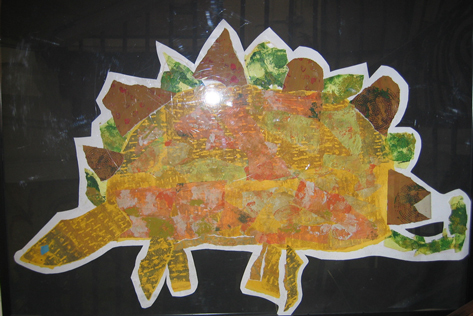
Lots of Prehistoric Animal Inspired Artwork on Display Throughout the School

Stegosaurus inspired artwork.

Stegosaurus inspired artwork.

Picture credit: Everything Dinosaur

To read more about Everything Dinosaur’s huge range of dinosaur toys and gifts: Dinosaur Toys and Gifts.

5 11, 2014

Egg Shape Could Explain Survival of Birds into the Cenozoic

By |2023-03-17T17:07:07+00:00November 5th, 2014|Categories: Dinosaur and Prehistoric Animal News Stories, Dinosaur Fans, Main Page|0 Comments

New Study Suggests Egg Shape Might Hint at Clues to Survival

Eggs come in many different shapes and sizes.  There are large ones, small ones, those that are more rounded, others that can be more ovoid in shape and so on.  However, a new study, conducted by evolutionary biologists at Lincoln University (UK), suggests that egg shape could have been a factor in why some birds survived the Cretaceous extinction event, whilst other types of bird and the Dinosauria did not.

New Research

The research published in the on line journal of the Royal Society, looks at the geometry of eggshells and highlights morphological differences between the eggs of birds and those of their extinct, but very close relatives, the theropod dinosaurs.

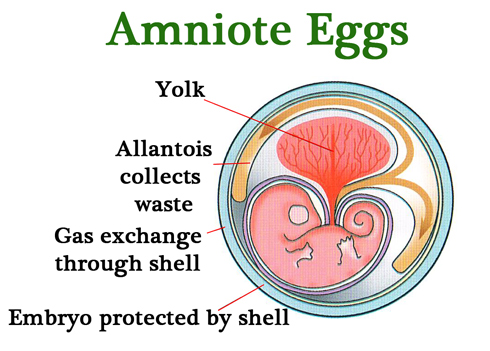
Birds, Reptiles and Mammals are linked as all these types of creature are descended from Carboniferous tetrapods that evolved an ability to reproduce from an egg that was contained within a semi-permeable eggshell.  These early terrestrial animals were no longer dependent on the presence of water in order to breed and reproduce successfully.  These types of eggs are called amniotic eggs.

A Diagram Showing the Structure of an Amniotic Egg

The growing embryo is protected by a semi-permeable egg shell.

The growing embryo is protected by a semi-permeable egg shell.

Picture credit: Everything Dinosaur

Amniote Eggs

Safe from drying out, the embryo inside the egg is further protected by a robust, internal membrane called the amnion.  It is the evolution of the amniote egg that permitted tetrapods to conquer all terrestrial environments.

In this new study, the research team noted that there were notable differences between the eggs of birds that survived the Cretaceous mass extinction event that took place around sixty-five million years ago, and the shape of the eggs of those creatures that become extinct.  Although, the fossil record is far from complete when it comes to preserving evidence of eggs and reproductive strategies, the results suggest that early birds from the Mesozoic laid eggs that had different shapes to those of modern birds.

It is possible that egg morphology indicates different physiologies or different rates of embryonic development and this may have implications when it comes to surviving a mass extinction event, such as that which led to demise of around 70% of all terrestrial life, including all the non-avian dinosaurs.

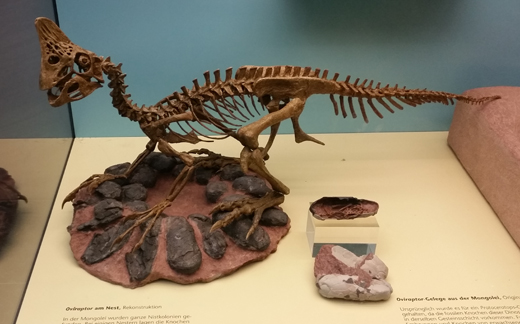
Could Theropod Egg Shape Have Doomed the Dinosauria?

An Oivraptor fossil with nest.

An Oviraptor (theropod) dinosaur sitting on her nest.

Picture credit: Everything Dinosaur

Egg Shape

One of the authors of this new paper, Dr Charles Deeming (School of Life Sciences, Lincoln University) explained:

“These results indicate that egg shape can be used to distinguish between different types of egg-laying vertebrates.  More importantly they suggest Mesozoic bird eggs differ significantly from modern day bird eggs, but more recently extinct Cenozoic birds do not.  This suggests that the range of egg shapes in modern birds had already been attained in the Cenozoic.”

Comparing Extinct and Extant Egg Shapes

As extant amniotic eggs vary considerably in size and shape and this variety reflects different patterns of egg formation and development, then the variation seen in the fossil record of eggs may also reflect different patterns of egg formation, egg development and even nesting behaviour.

Dr Deeming commented:

“From a biological perspective, it is self-evident that different egg shapes by birds, both past and present, might be associated with different nesting behaviours or incubation methods.  However, hardly any research has been carried out on this topic and fossil data are insufficient to draw firm conclusions.  We hope that future discoveries of associated fossil eggs and skeletons will help refine the general conclusions of this work.”

Other Factors to Consider

Although there might be a link between eggshell shape and the ability to survive the Cretaceous mass extinction, it is likely that a lot of other factors contributed to the survival of one group of vertebrates whilst others died out.  The eggshell shape itself may be a part of the story, but palaeontologists are confident that dinosaurs, including many theropod dinosaurs engaged in complex nesting behaviours, brooded eggs on nests and invested a great deal of time and effort in raising the next generation.

A spokesperson from Everything Dinosaur stated:

“Although the fossil record for eggs and nesting sites is extremely fragmentary, there is evidence to suggest that members of the Dinosauria exhibited altricial and precocial behaviours.  How one group of birds, the Neornithines were able to dominate the Aves remains uncertain, more research in this area is needed.  However, this data adds a fresh perspective and it is certainly intriguing.” 

Dr Deeming advised that this new paper does not provide all the answers, but it hints at the tantalising possibility that eggshell morphology could have been an contributory factor in the extinction of the dinosaurs.  Dr Deeming and this paper’s co-author Dr Marcello Ruta (Lincoln University), are continuing their investigations.  The scientists intend to explore how highly variable amounts of yolk (food for the embryo) and albumen (egg white) could possibly effect egg shape.

For models and replicas of prehistoric animals including dinosaurs: Dinosaur Models and Prehistoric Animal Figures.

3 11, 2014

Tracing the Origins of the Ichthyosaurs

By |2023-03-17T16:43:51+00:00November 3rd, 2014|Categories: Dinosaur and Prehistoric Animal News Stories, Dinosaur Fans, Main Page|0 Comments

Short Snouted Basal Ichthyosauriform from the Lower Triassic of China

It had long been predicted, but until now one of the enduring mysteries of the marine reptiles had remained unsolved.  One of the most successful clades of marine vertebrates ever to have existed were the ichthyosaurs , reptiles that form the Order Ichthyosauria (fish lizards), also known as the Ichthyopterygia (fish flippers).  These animals thrived in the seas and oceans for much of the Mesozoic but unlike other types of back-boned animals that had adapted to a life in water, no fossils of transitional forms showing a link with terrestrial ancestors had been found.

Ichthyosaur Origins

However, this week a team of researchers led by scientists from the University of California have published a paper detailing the discovery of an amphibious ichthyosaur, an animal that, although adapted to a life in the sea was still capable of clambering about on land.  This specimen is believed to represent a transitional form, between the Ichthyosauria and their terrestrial ancestors.

Writing in the science Journal “Nature”, the researchers document a nearly complete specimen (just the end of the tail is missing), of a forty-centimetre-long, amphibious reptile that is probably part of a group of animals that were the ancestors of the nektonic ichthyosaurs, widely regarded by many palaeontologists as the most well-adapted to a marine existence of all the reptiles.

The Fossil Specimen that Indicates a Transitional Form

Cartorhynchus

Picture credit: University of California – Davis/Professor Motani

Commenting on the research, lead author Professor Ryosuke Motani (University of California, Department of Earth and Planetary Sciences) stated:

 “But now we have this fossil showing transition.  There’s nothing that prevents it from coming onto land.”

From Anhui Province

Professor Motani and his colleagues uncovered the fossil specimen in eastern China (Anhui Province) from Lower Triassic strata believed to date from around 248 million years ago (Olenikian faunal stage).  Unlike the long-snouted fully marine ichthyosaurs this animal, which has been named Cartorhynchus lenticarpus, had a short snout, its bones were also heavier, traits associated with fully terrestrial ancestors.

Cartorhynchus lenticarpus

Unlike later ichthyosaurs, the flippers were large in proportion to the body size and the wrists flexible.  These features helped this creature crawl around on land, in a similar way to extant seals.  C. lenticarpus means “truncated snout with flexible wrists”, an apt name for this little reptile that spent part of its life on land.  During the early part of the Triassic, eastern China was covered by a shallow tropical sea, there were numerous small islands, the whole area resembled the Caribbean today.  The isolated islands with their limited resources probably acted as a spur for vertebrate evolution.  There was plenty of food in the sea but it was a question of being able to reach it, this probably led to the evolution of reptiles that were more at home in water than their ancient ancestors.

The researchers also had to consider the implications of the Permian mass extinction event on the evolutionary pressures that these animals were under.  Just four million years earlier, planet Earth had undergone the most devastating extinction event known in the history of our planet.  More than 95% of all life on Earth died out.

A spokesperson from Everything Dinosaur explained:

“Extinction events mean the inevitable demise of many genera and families.  However, for those organisms able to survive, such events open up a whole range of new opportunities and often there is a “burst” of evolution as animals and plants adapt to take advantage of vacated niches and new resources.”

Scientific Collaboration

Collaborating with the University of California were scientists from the Chinese Academy of Sciences, Peking University, Anhui Geological Museum, the University of Milan, and the Field Museum (Chicago).  As a basal Ichthyosauriform has been discovered in China, and the most primitive true ichthyosaurs are also known from Triassic rocks from this region, then it is likely that the Ichthyosauria evolved in this part of the world.  This clade then radiated out and occupied a number of ecological niches including apex predatory positions before dying out in the Late Cretaceous.

Later ichthyosaurs were agile, swimmers, although the end of the tail is missing, scientists speculate that Cartorhynchus lenticarpus was probably a relatively poor swimmer.  It probably hunted soft bodied animals and arthropods in coastal waters.

For replicas and figures of ichthyosaurs and other marine reptiles: CollectA Age of Dinosaurs Popular Figures.

Go to Top