All about dinosaurs, fossils and prehistoric animals by Everything Dinosaur team members.
7 09, 2015

Helping to Inspire Young People to Study Earth Sciences

By |2023-04-05T14:16:26+01:00September 7th, 2015|Categories: Educational Activities, Famous Figures, Main Page, Teaching|0 Comments

A Role Model for Young People – Dr Victoria Arbour

With the changes to the England’s national curriculum for schools and the greater emphasis on scientific working, team members at Everything Dinosaur often get asked to provide information about inspirational scientists to help enthuse and motivate young people.  With many schools adopting dinosaurs or the “Jurassic Forest” as a term topic and with rocks and fossils part of the curriculum at Key Stage 2, the number of requests for advice is on the increase.

The Pioneer Mary Anning

The story of Mary Anning (1799-1847), the Dorset woman of “she sells sea shells on the seashore” fame is highly appropriate.  Mary’s contribution to palaeontology and geology is well-documented, as is sadly, her shabby treatment by the male dominated academia of the 19th century.  For those teachers, homeschoolers and educationalists who want to inspire their pupils looking at the role of a scientist working today, then the work of Dr Victoria Arbour and her research on armoured dinosaurs is worth exploring.

Dr Victoria Arbour  (Vertebrate Palaeontologist)
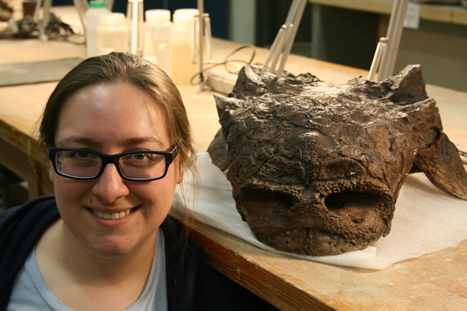
Victoria next to a skull of a Euoplocephalus tutus (University of Alberta)

Victoria next to a skull of a Euoplocephalus tutus (University of Alberta)

Picture credit: Angelica Torices

Studying Ankylosaurs

Here is a short biography of Dr Arbour, in her own words (mostly):

I’m one of those kids that never grew out of their “dinosaur phase”.  I have been interested in palaeontology as far back as I can remember.  I knew that I wanted to pursue palaeontology as a career, or find an interesting field of science related to palaeontology.  So far, so good: I’m currently working as a postdoctoral researcher at the North Carolina Museum of Natural Sciences and North Carolina State University in Raleigh, North Carolina (United States).  Prior to this, I did my MSc and PhD degrees at the University of Alberta in Edmonton, Alberta, (Canada).

My home town is Halifax, (Nova Scotia, Canada) and I studied for my BSc degree in Earth Sciences and Biology at Dalhousie University (Halifax, Nova Scotia).

Nannofossils Studied

Taking a break from her studies in the summer, Victoria spent some time identifying calcareous nannofossils (coccoliths and coccospheres et al) from the Scotian Slope, an area off the coast of the Canadian province.  However, whilst at university, Victoria helped to study the first dinosaur fossils that had ever been collected in British Columbia.  These were from a small plant-eating dinosaur, but unfortunately the remains were too fragmentary to figure out exactly what species it was.

Now based in North Carolina, Dr Arbour focuses on the Dinosauria and her office is situated in a very inspiring location.  She continues:

Every day I walk past a Tyrannosaurus skeleton to get to my office, and my office is part of the exhibits at the museum, which means I get to see people enjoying that same Tyrannosaurus as much as I do.  In the summers I head out to the field to dig up dinosaurs in places like Utah, Alberta, and even sometimes Mongolia!  The rest of the time, I’m thinking about ankylosaurs, the armoured dinosaurs with lots of spikes.

Why the Ankylosauridae?

I’ve always liked ankylosaurs (well, I’ve always liked all dinosaurs!), but I became particularly interested in them when I started to think about what kind of project I wanted to do for my MSc thesis.  I kept seeing pictures in books of armoured dinosaurs using their tail clubs to defend themselves from predators, and I wondered if there was a way we could figure out if they could have done that.  So, some of the first projects I worked on looked at how fast and hard these dinosaurs could swing their tail into something, and what would happen to the tail when they smashed it into another object.

Teachers have no need to worry about whether or not all that can be discovered about dinosaurs will have been documented by the time their young charges are ready to choose further education options.

New Dinosaurs and Perhaps New Ankylosaurs Too

New dinosaurs are being named and described all the time.  For example, in a few days, Everything Dinosaur will be writing a short article on the very latest armoured dinosaur to be described – Horshamosaurus a member of the Ankylosauria clade, but a polacanthid, an armoured dinosaur that once roamed around West Sussex (southern England).

The Ankylosauria is Turning Out to be a Very Diverse Clade
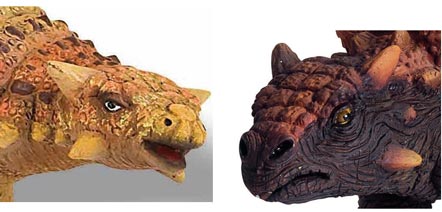
Close inspection of the dinosaur models

Lots of armoured dinosaurs to study.

Picture credit: Everything Dinosaur

When asked why she specialises in studying the armoured dinosaurs, Victoria replied:

“The sneaky thing about science is that as you try to answer one question, you end up with more than you started with!  One thing led to another, and I’ve been studying lots of different aspects of ankylosaur biology – like how many species there were, how they moved between continents, and how their tail clubs evolved – and I still have lots of questions left to answer about these cool dinosaurs.”

For further information about Everything Dinosaur’s outreach work: Email Everything Dinosaur.
6 09, 2015

Amazing Dinosaur Footprint Discovered In British Columbia

By |2023-12-12T08:42:24+00:00September 6th, 2015|Categories: Dinosaur and Prehistoric Animal News Stories, Dinosaur Fans, Main Page|0 Comments

Tyrannosaur Footprint Found in British Columbia

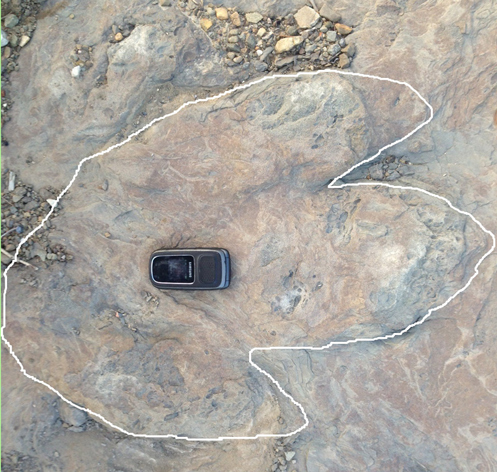
Palaeontologists and ichnologists (scientists who study trace fossils including footprints), are examining the preserved impression of a three-toed footprint made by a large dinosaur during the Late Cretaceous.  The single print measures fifty-nine centimetres long and it may have been made by a substantial tyrannosaurid.

Dinosaur Footprint

The footprint was found approximately ten kilometres from the small settlement of Tumbler Ridge.  Something like fifteen tyrannosaur footprints have been discovered to date, from locations as far apart as New Mexico, Alberta and Mongolia, but this is the ninth print to have been reported from British Columbia.  The print was found by Carina Helm, a geography student at the University of British Columbia who was out working in the area with her father.  The track was found on August 20th.

Explaining the circumstances behind the discovery, Carina explained:

“My dad and I were returning in the evening from repairing boardwalks on one of the hiking trails, when I told him I knew of some big exposed rock slabs.  We worked out that these were maybe from an age that could feature dinosaur tracks, so we decided to make a detour to have a look.”

The father and daughter team did not have to search for long to find the fossil.

The Three-Toed Dinosaur Footprint

The white line helps to show the outline of the track.

The white line helps to show the outline of the track.

Picture credit: The Helm Family

Commenting on the Dinosaur Footprint Discovery

Looks like mobile phones have lots of uses, for example, the phone in the picture helps to show scale.

Carina added:

“The very first rock I went to, right beside the road, had this huge track-shape on it with three toes.  I thought, surely, that is too big to be a footprint?  I showed it to my dad and next thing he was on his cell-phone to Rich McCrea telling him about the find.”

The Peace Region Palaeontology Research Centre

Rich McCrea, is one of the palaeontologists at the The Peace Region Palaeontology Research Centre (P.R.P.R.C.), based in Tumbler Ridge.  This institute was founded in 2003 to help excavate, preserve and showcase the vertebrate body and trace fossils associated with this part of the Canadian Province.  Most of the footprints alleged to have come from large theropods that have been found in this region have come from remote, difficult to access locations.  In contrast, this new find was close to a road and is much more accessible.

A Likely Tyrannosaurid Track

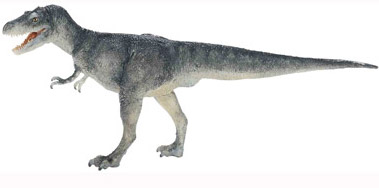
Rich and colleague Lisa Buckley were able to confirm that this track was most likely made by a tyrannosaurid.  Although the print measures fifty-nine centimetres long, the foot that made it would actually have been bigger, the tip of the longest toe and its claw impression have been eroded away.  When asked to speculate the type of tyrannosaur that might have made this track, the P.R.P.R.C. palaeontologists have suggested that this track could  have been made by an Albertosaurus.

A Model of an Albertosaurus (Large, Late Cretaceous Tyrannosaur)

Albertosaurus (Carnegie Collectibles)

Albertosaurus (Carnegie Collectibles – Safari Ltd).

Picture credit: Everything Dinosaur

To view the range of prehistoric animals made by Safari Ltd: Safari Ltd Dinosaur Models.

Outlining how the scientists concluded that this was indeed the footprint of a tyrannosaur, Rich McCrea stated:

“It can sometimes be a challenge to identify the maker of a single print, especially one that has been weathered by the elements.  Even with the tips of the digits (the claw impressions), eroded away, the footprint found by Carina Helm still possesses characteristics that make it identifiable as the product of a meat-eating (theropod) dinosaur.  In addition to the morphological features of the footprint, which bears great similarity to the ones discovered in the Autumn of 2011 and subsequently ascribed to the ichnospecies Bellatoripes fredlundi, the size of the print and the age of the rocks it was found in provide further evidence that the track-maker was a tyrannosauroid.”

A Problem Fossil

This fossil is posing a bit of a problem for the Tumbler Ridge Museum Foundation, the organisation that established the P.R.P.R.C., the fossil is close to a road and therefore it could be vandalised or stolen.  Attempts could be made to remove the specimen, but this too, presents problems.  The slab of rock containing the print is large and transporting the fossil to Tumbler Ridge would present quite a logistical challenge.

Young Carina is proving to have quite a knack for finding trace fossils, earlier in the Summer, she was part of a team that found two other trackways preserved in much older rocks in the Tumbler Ridge area.

5 09, 2015

New Study Suggests Chelonia Evolved from Diapsids

By |2024-02-25T07:38:06+00:00September 5th, 2015|Categories: Dinosaur and Prehistoric Animal News Stories, Dinosaur Fans, Main Page, Palaeontological articles|0 Comments

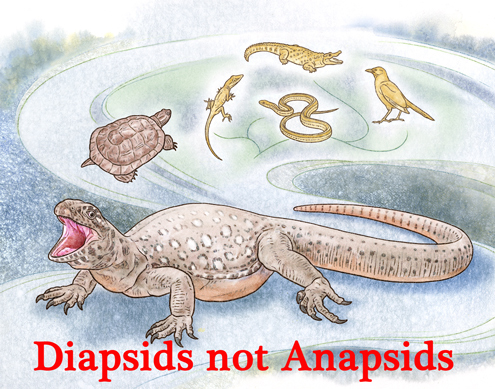
Turtles and their Kin Diapsids Not Anapsids

A study into an ancestral form of the Chelonia (turtles, tortoises and terrapins) has revealed that the skull had a pair of holes in it just behind the eye.  So what, you might say, but this is a big deal, a very big deal, as it means that the history of the reptiles and any subsequent cladograms (family trees), constructed will have to be fundamentally changed.  This new research using the skulls of 260-million-year-old South African Permian reptiles suggests that turtles and their kin are not anapsid reptiles but that this group evolved from diapsids.  The Chelonia evolved from diapsids.

Chelonia – Very Ancient Reptiles

Unravelling the history of the Reptilia is a very complicated process.  However, a tenet in helping to establish evolutionary relationships between different types of reptile is the anatomy of their skulls.  It is differences in the number of holes found in the skull behind the eye socket that has helped palaeontologists to understand more about how the first reptiles evolved from amphibians.  Skull anatomy has been used to map the radiation of different forms of reptile, those that led to the birds, crocodiles and the dinosaurs and those who took a different evolutionary line eventually leading to mammals.

A New Scientific Study

Some of this may have to be re-examined in the light of new research conducted by Dr Gaberiel Bever (Honorary Research Associate at Witwatersrand University and scientist at the New York Institute of Technology) with co-author of the scientific paper, just published in “Nature”, Dr Tyler Lyson of the Denver Museum of Nature and Science.  Three-dimensional models of the skull of the ancestral turtle, a primitive reptile named Eunotosaurus have revealed that this reptile was a diapsid, suggesting that the tortoises and turtles evolved from diapsids and not from what are thought to be more primitive reptiles with anapsid skulls.

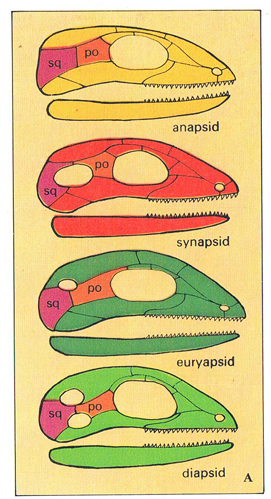
Four Basic Types of Reptile Skull

anapsid, synapsid, euryapsid and diapsid

Anapsid, synapsid, euryapsid and diapsid

Picture credit: Before the Ark/BBC

Attempting to Unravel the Phylogeny

A traditional method of attempting to unravel the phylogeny of early reptiles is to examine the layout of the bones in the skull.  There are four basic skull patterns for reptiles (living and extinct forms):

  • Anapsid – the most simple skull type with the skull bones only having holes for the eyes and the nostrils. Up until this research was published, turtles, tortoises and terrapins were thought to belong to this group.
  • Synapsid – has one hole behind the eye socket on either side of the skull between the squamosal and the postorbital skull bones (sq and po), the lower opening when compared to diapsids.
  • Euryapsid – has one hole behind the eye socket above the squamosal and the postorbital skull bones (sq and po), the upper opening when compared to diapsids.
  • Diapsid – has two holes behind the eye socket on either side of the skull (lower and upper openings in the skull between the squamosal and postorbital bones.

Helping in the research effort involved using CT scans and computer modelling techniques to produce three-dimensional images of the fossil skulls, were Yale University’s Daniel Field and Bhart-Anjan Bhullar (Assistant Professor, Department of Geology & Geophysics).

From the Famous Karoo Basin

The fossilised skulls come from the famous Karoo Basin and are assigned to an ancient ancestor of modern turtles called Eunotosaurus africanus, Everything Dinosaur reported on the significance of these fossils in terms of tracing the evolutionary history of the turtle family back in 2013.

To read more about E. africanusHow the Turtle Got Its Shell.

Commenting on their research Dr Gaberiel Bever stated:

“Eunotosaurus is a critical link connecting modern turtles to their evolutionary past.”

Chelonia Evolved from Diapsids.

Dr Bever and his co-workers examined high-resolution images created by computer tomography (CT scans).  Their research revealed the complex anatomy of the Permian skulls and supports the theory that animals like Eunotosaurus are indeed the ancestors of today’s tortoises, terrapins and turtles.  Once the skull anatomy had been mapped, the team re-drew the cladogram of the Reptilia based on their findings.

Dr Bever explained:

“Using imaging technology gave us the opportunity to take the first look inside the skull of Eunotosaurus.  What we found not only illuminates the close relationship of Eunotosaurus to turtles, but also how turtles are related to other modern reptiles.”

A key finding of the study was that Eunotosaurus had a pair of openings set behind the eyes. Eunotosaurus was a diapsid.

The Chelonia Are More Closely Related to Other Reptiles Than Previously Thought

Eunotosaurus a diapsid reptile.

Eunotosaurus a diapsid reptile.

Picture credit: Witwatersrand University with additional annotation by Everything Dinosaur

Were the Ancestors of Turtles Diapsids?

This suggests that the ancestors of the turtle lineage were not very primitive anapsids, with skulls similar to those found in amphibians, they were diapsids and therefore the turtle family is more closely related to crocodiles, lizards, snakes, birds and dinosaurs than previously thought.

The holes behind the eye socket served to lighten the skull to help make it more manoeuvrable.  The jaw muscles were able to lengthen and flex to a greater degree, this would have given Eunotosaurus a more powerful and quicker bite than modern tortoises and their kin.

Explaining the significance of this study Dr Bever stated:

“We can now draw the well-supported and satisfying conclusion that Eunotosaurus is the diapsid turtle.”

In linking turtles to their diapsid ancestry, the skull of Eunotosaurus also reveals how the evidence of that ancestry became obscured during later stages of turtle evolution.

“The skull of Eunotosaurus grows in such a way that its diapsid nature is obvious in juveniles but almost completely obscured in adults.  If that same growth trajectory was accelerated in subsequent generations, then the original diapsid skull of the turtle ancestor would eventually be replaced by an anapsid skull, which is what we find in modern turtles.”

Re-drawing the Reptile Cladogram – Chelonia Evolved from Diapsids

This new study means that the reptile cladogram will have to be re-drawn.  This research helps to cement the phylogenetic relationships between different reptile groups, but the researchers admit that this study is not the end of the matter, merely a beginning.

Witwatersrand University Professor Bruce Rubidge, who has been leading the collaborative effort to explore the rich vertebrate fossil assemblage of the Karoo Basin, explained that although the focus of the research had been on piecing together evidence to outline the diverse fauna of the Middle and Late Permian, their work had implications for studying modern reptiles too.

He stated:

“This is a major step towards understanding the interrelationships of reptiles.  Also of great significance is that Eunotosaurus, which is known only from South Africa, is a critical transitional form in the origin of tortoises and this finding indicates that the tortoise lineage had its origins in Gondwana.”

Dr Bever summarised the way forward for the research team:

“There is still much we don’t know about the origin of turtles or which of the other diapsid groups form their closest cousin?  What were the ecological conditions that led to the evolution of the turtle’s shell and the anapsid skull?  How much of the deep history of turtle evolution can be discovered by studying the genes and developmental pathway of modern turtles.”

One thing that is for sure, most of the published works on the phylogenetic relationships between the Reptilia (alive and extinct) have just become in need of an update.

Visit Everything Dinosaur: Everything Dinosaur.
4 09, 2015

A Tale of Ancient Tails in the Ankylosauridae

By |2023-04-05T14:00:29+01:00September 4th, 2015|Categories: Dinosaur and Prehistoric Animal News Stories, Dinosaur Fans, Main Page|0 Comments

How Did the Ankylosaur Get Its Club Tail?

Dinosaurs as “Living Tanks”

Ankylosaurs are often described as “living tanks” these quadrupeds seemed to have taken body armour to the extremes with some specimens such as Saichania from Asia and the Late Cretaceous North American ankylosaurids Euoplocephalus and Ankylosaurus even having armoured eyelids.  They were a very diverse and widespread group of ornithischian dinosaurs, in every sense of the world.  True, ankylosaur fossils have been recorded from China, Mongolia, Canada, the United States, Australia and there have even been fragmentary bones attributed to an ankylosaur found near Folkestone (Kent, England).

In addition, these animals have very wide pelvic regions in proportion to the rest of their robust bodies.  The wide pelvis is an adaptation to accommodate a large gut.

Heavily Armoured Dinosaurs with a Long Evolutionary History

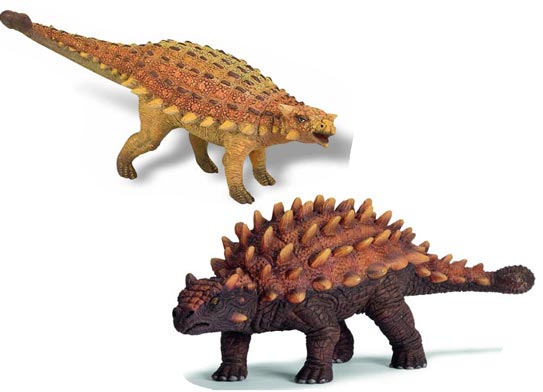
Armoured dinosaur models.

Armoured dinosaur models.

Picture credit: Everything Dinosaur

Most children can describe these herbivores, they may be very well known members of the Dinosauria, with an albeit brief appearance in the film “Jurassic World” adding to their popularity, however, a mystery surrounding the Ankylosauridae may finally have been solved.

How Did the Ankylosaur Tail Club Evolve?

By mapping the evolutionary history of these armoured dinosaurs from their Jurassic origins through to the very end of the Cretaceous the answer as to how some members of the Ankylosauridae developed that distinctive tail club may have finally been resolved.

According to research published in the academic publication “The Journal of Anatomy”, the fused tail came first and the bony club evolved later. Postdoctoral researcher Victoria Arbour (North Carolina State University and the North Carolina Museum of Natural Sciences), authored the report, a study she started when at the University of Alberta under the tutelage and guidance of renowned palaeontologist Professor Phil Currie.

Studying the Ankylosauridae Family

Victoria has spent a large part of her career studying the Ankylosauridae and she is viewed by Everything Dinosaur team members as the “go to” person when it comes to the ankylosaurids.

For example, back in October 2014, Everything Dinosaur reported on a new species assigned to the Ankylosauridae named by Victoria – Zaraapelta (Z. nomadis), fossils of which were found during an expedition to Mongolia led by Professor Currie.

To read more about Zaraapelta: Zaraapelta – In Praise of Victoria Arbour.

This new study involved examining the fossilised remains of some of the earliest known ankylosaurids, dinosaurs like the Chinese Liaoningosaurus from Yixian County, Liaoning Province (north-eastern China), as well as many Late Cretaceous forms.  An ankylosaur’s tail is composed of a handle and a bony knob.  The knob is comprised of fused osteoderms, a special kind of bone formed in the skin.  The handle is represented by the distal end of the tail (caudal vertebrae) that support the weight of the knob.

Commenting on the Study

Victoria explained:

“In order for an ankylosaur to be able to support the weight of a knob and swing it effectively, the tail needs to be stiff, like an axe handle.  For that to occur, the vertebrae along the tail had to become less flexible, otherwise the momentum generated by the knob’s weight could tear muscle or dislocate vertebrae.”

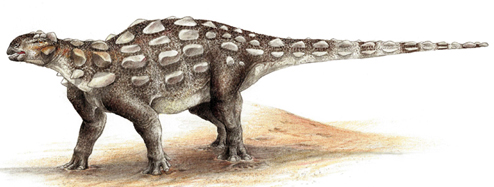
Gobisaurus – A 90-Million-Year-Old Ankylosaur

Tracing the tale of the Ankylosaurus tail.

Tracing the tale of the Ankylosaurus tail.

Picture credit: Sydney Mohr

A Tale of Tails

Other ankylosaurids included in the analysis were Gobisaurus (Turonian faunal stage of the Cretaceous) and Pinacosaurus from the younger Campanian faunal stage of the Cretaceous.

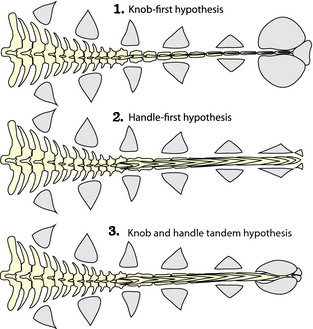
Three Ways in Which the Ankylosaurid Tail Could Have Evolved

There are three ways in which the bony club and the fused, stiffened tail could have evolved:

  1. Bony club first – early ankylosaurids would show evidence of osteoderms forming and enveloping the end of the tail
  2. Handle first – primitive members of this family would have overlapping or fused tail bones
  3. The club and handle could have evolved simultaneously, if this was the case, then Early Cretaceous ankylosaurids would show both anatomical features, perhaps with tails getting stronger and tail clubs getting heavier over time

How Did the Ankylosaurs Get their Unusual Tails?

Three different theories of ankylosaurid tail evolution.

Three different theories of ankylosaurid tail evolution.

Picture credit: Journal of Anatomy

Comparative Analysis

The comparative analysis revealed that by the Early Cretaceous, ankylosaurids had begun to develop stiff tails with fused caudal vertebrae.  The bony knob feature did not appear in the fossil record until the Late Cretaceous.

Dr Arbour concluded:

“While it’s possible that some of the species could still have developed the handle and knob in tandem,” it seems most likely that the tail stiffened prior to the growth of the osteoderm knob, in order to maximise the tail’s effectiveness as a weapon.”

The upshot of this conclusion is that ankylosaurs used their tails as defensive weapons first and then only later did the heavy club on the tail evolve.   Commenting on this work a spokesperson from Everything Dinosaur stated:

“This is a fascinating study, one can speculate that the bony club tail evolved in response to the emergence of bigger and more dangerous theropod predators such as the tyrannosaurids that could be regarded as the apex terrestrial predators in the Northern Hemisphere towards the end of the Mesozoic.”

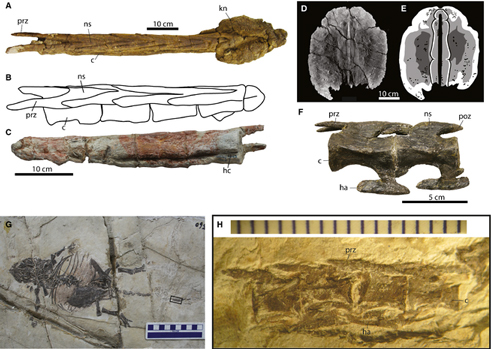
The Tail Bones of Ankylosaurs

Caudal anatomy of Ankylosaurs.

Caudal anatomy of ankylosaurs.

Picture credit: Journal of Anatomy

Tail Clubs

The picture above shows (A) an oblique dorsal view of the tail club of Dyoplosaurus acutosquameus from Canada, the fossils of which are around 76 million years old (Campanian).  This is typical of the derived Ankylosaurine tail  with a fused tail and a bony club.  Gobisaurus (G. domoculus) line drawing is (B) a left lateral view of this earlier ankylosaurid’s tail showing fusing of the bones.

Picture (C) shows the same fossil specimen as (B), but this time viewed from the other side, the deep groove running along the bottom is the haemal canal.  X-ray (D) and the interpretive drawing (E) are from an ankylosaur tail from Alberta, the last tail bone is small and rounded when compared to the long distal caudal bones.  Picture (F) shows two tail bones from Mymoorapelta maysi, a basal member of the Ankylosauria known from the Late Jurassic of the United States.

Typical of Nodosaurids and Basal Ankylosaurs

This anatomy is typical of nodosaurids and other basal ankylosaurs, the prezygapophyses (forward projecting points of bone located on the neural arch of the vertebrae), overlap the adjacent vertebrae by about 25% of the centrum (the main part of the vertebra situated below the neural arch).  In contrast, picture (G) shows the fossilised remains of Liaoningosaurus (L. paradoxus) which dates from the Aptian faunal stage making the fossil some 120 million years old.  The boxed area in (G) is highlighted and magnified (H).  In Liaoningosaurus the prezygopophyses overlap the preceding vertebra by at least 50% including a much more fused and stiffened tail, more typical of later ankylosaurids.

Ankylosaur Tail Club

 This research has provided new evidence to help scientists understand the evolution of ankylosaurid tails.  Fossils from China such as those of Liaoningosaurus suggest that the mechanism to support a tail club may have evolved at least forty million years before it was taken to extremes by the Late Cretaceous ankylosaurs such as Euoplocephalus and Pinacosaurus.  Early ankylosaurids evolved the handle first, those distal ossified osteoderms came later.

For models and replicas of armoured dinosaurs and other prehistoric creatures: PNSO Age of Dinosaurs.

3 09, 2015

The Mighty Daeodon a Fantastic Prehistoric Animal

By |2024-05-05T14:47:17+01:00September 3rd, 2015|Categories: Dinosaur Fans, Everything Dinosaur Products, Main Page, Photos of Everything Dinosaur Products|0 Comments

Enigmatic Entelodonts – The Mighty Daeodon

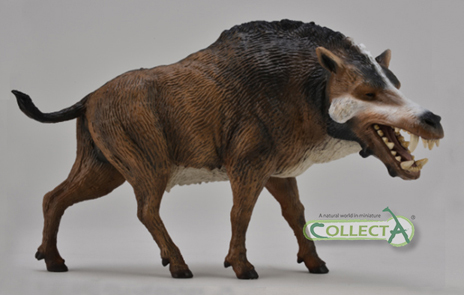
If prizes were given for the ugliest animals to have lived on Earth, then the Entelodontidae would probably find themselves somewhere on the podium.  These hoofed mammals (artiodactyls) have been nicknamed “terminator pigs”, a reference to the fact that these brutish animals come from the same branch of the hoofed mammals, the ungulates, as pigs, however, recent research suggests that the eight or nine genera that make up the Entelodontidae family are probably more closely related to hippos and whales.  However, a Daeodon model (member of the Entelodontidae), has been produced.

The Mighty Daeodon

With evolutionary roots somewhere in the middle Eocene epoch, the largest of the entelodonts could have reached lengths in excess of three metres and weighed as much as three Steinway grand pianos.

Fossilised footprints and bone bed discoveries suggest that these omnivores lived in small family groups and that during the Oligocene and the early part of the Miocene epoch, they became adapted to open, savannah-like habitats.  The long legs would have helped them cover large territories as well as helping them to adapt to a pursuit hunting habit.  The strong neck muscles helped support a skull that in some species was over a metre long.  The thickly enamelled teeth and those large fangs located on both the upper and lower jaws would have given this prehistoric mammal a devastating bite.

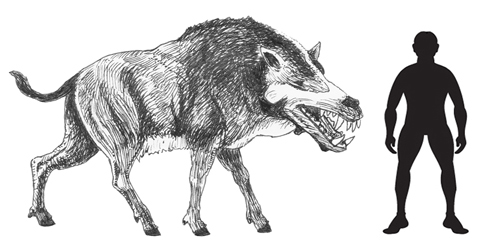
One of Nature’s “Unloved Ones” – A Daeodon

One of the "ugly ones".

One of the “ugly ones”. An illustration of the entelodont Daeodon.  Everything Dinosaur discusses the CollectA Daeodon model.

Picture credit: Everything Dinosaur

Everything Dinosaur

At Everything Dinosaur, we describe the larger entelodonts, animals such as Daeodon shoshonensis, from the Early Miocene of North America as “walking waste disposal units”.  With their muscular bodies, fearsome features and cloven hooves they may not have won many beauty contests but they were very well adapted and the entelodonts seemed capable of eating almost anything from fallen fruit, tree bark and grubs to scavenging the bodies of dead animals.

They may have been very effective hunters, but their enormously strong jaws and powerful, crushing teeth were capable of breaking bones – giving them access to parts of a carcase such as the nutritious bone marrow, that most other scavengers such as Hyaenodons could not reach.

To view the range of prehistoric mammal models available from Everything Dinosaur: Models of Prehistoric Mammals.

Daeodon Model

Many of the fossil skulls of large entelodonts show evidence of extensive pathology.  Smashed eye sockets, crushed cheek bones, puncture wounds running down the long snout, these are quite common.  Palaeontologists have puzzled over how these facial injuries could have occurred and most believe, that these injuries were inflicted by other entelodonts, perhaps in fights over social dominance, or disputes over mates or food.  In one, well documented example, it seems that one entelodont managed to clamp its jaws across the skull of another.  The bite marks preserved in the maxilla and dentary are in some instances over five centimetres deep.  Despite this extensive damage, the attacked entelodont survived.

The CollectA Daeodon Replica

Daeodon model.

Available from Everything Dinosaur.
Picture credit: Everything Dinosaur

Models of entelodonts are rare, but fortunately, CollectA introduced a 1:20 scale replica of a Daeodon (entelodont) this year (2015).  The hand-painted model shows fantastic detail and it measures over sixteen centimetres long.  It is a wonderful figure and although these mammals are often regarded as one of nature’s unloved ones, the Daeodon figure, with its white face markings is certainly striking.

To view the complete range of Deluxe CollectA models: CollectA Deluxe Prehistoric World.

2 09, 2015

Exclusive Dinosaur Britain Programme – Part 2 Reviewed

By |2024-05-05T14:46:49+01:00September 2nd, 2015|Categories: Dinosaur Fans, Main Page, TV Reviews|0 Comments

A Review of Dinosaur Britain – Part 2

The second part of Maverick TV’s “Dinosaur Britain” aired on terrestrial television last night (ITV1).  Once again, presenter Ellie Harrison was joined by palaeontologist and author Dean Lomax on an exploration of Britain’s dinosaur fauna.  However, unlike the first programme with its emphasis very much on English dinosaurs, the two, intrepid investigators travelled into Scotland and Wales to help reveal some of the ancient animals that roamed these parts of the British Isles.

Dinosaurs from Britain

Plucky Ellie, who had coped with a very claustrophobic slate mine in programme one, was tasked with manning a row boat on Loch Ness.  No Nessie to be seen, but an opportunity to introduce the idea that whilst dinosaurs dominated terrestrial habitats during the Mesozoic, the seas surrounding the land masses that were ultimately to become Britain, once teemed with marine reptiles such as plesiosaurs.

This had been touched upon in the first part of this two-part documentary series, when the idea of ichthyosaurs feeding on the carcases of drowned armoured dinosaurs was discussed and it was good to see the storyline brought up to the present when on the beach at Lyme Regis, the presenters were shown ichthyosaur vertebrae and a small bone, potentially from an Early Jurassic plesiosaur.

Dinosaur Britain – Fossil Hunting in the UK

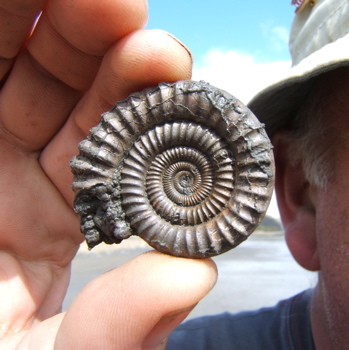
A Typical Ammonite - but not all types of this Cephalopod had coiled shells

A typical Jurassic ammonite from Lyme Regis (Arnioceras – we think).

The Diversity of British Dinosauria

If the objective of the television programmes was to demonstrate the diversity of British Dinosauria and to encourage people to try fossil hunting for themselves, then appetites were certainly whetted when some of the children’s fossil finds were shown, Ellie Harrison seemed genuinely excited to have found some belemnite guards.

Back to the dinosaurs and viewers were treated to a view of a sauropod wandering around Edinburgh, part of a segment that explained the importance of the Isle of Skye in terms of its contribution to our understanding of the dinosaurs of the Jurassic.

Steve Brusatte, (University of Edinburgh) enthusiastically introduced more dinosaur fossils from the British Isles.  Steve is an American and we teased him last night when tweeting about seeing him discussing dinosaurs from this side of the Atlantic, when it is usually the dinosaurs known from the United States that tend to grab all the attention.  Dr Brusatte took our gentle teasing in good spirit and he reminded us that it is because of British dinos that Steve has such a fantastic job!

The Isle of Skye

On the Isle of Skye, Dean explained to Ellie that the tri-dactyl footprint he had located on the beach was very much a case of “walking with dinosaurs” and this led to a viewing of a tiny dinosaur footprint, less than two centimetres in diameter.  The fossilised print was discovered in Score Bay (Isle of Skye) and is thought to be the smallest dinosaur footprint ever found in Europe.  Slightly bigger prints were revealed on a visit to a beach on the southern side of the Isle of Wight.

These tracks were made by iguanodonts, we suspect that the ones shown were examples of the natural casts from the foreshore of Hanover Point.  Cue an opportunity to introduce all-round good guy Darren Naish (vertebrate palaeontologist and science writer), who outlined some of the pathology found on the fossilised bones of the huge predator Neovenator and this dinosaur’s potential prey the ornithopod Mantellisaurus atherfieldensis.

Mantellisaurus atherfieldensis

The resulting CGI showed the Neovenator accumulating all its injuries in just a few seconds as it pursued its victim, a little unlikely, but the important message here for the viewer, so eloquently relayed by Darren, is that the fossilised remains of long extinct animals can provide scientists with an insight into potential predator/prey interactions.

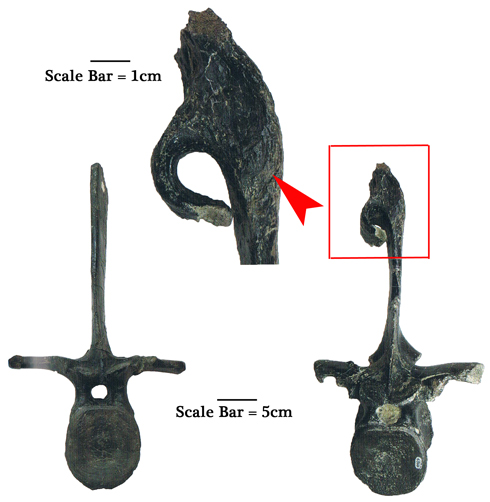
Interpreting the Evidence – Dorsal Vertebrae Assigned to M. atherfieldensis

Forensic examination of dinosaur bones can help to tell the story of the lives of long extinct animals.

Forensic examination of dinosaur bones can help to tell the story of the lives of long extinct animals.

Picture credit: “Dinosaurs of the British Isles”

Dorsal Vertebrae

The picture above shows two fossil back bones (dorsal vertebrae) from the ornithopod Mantellisaurus found in association with the theropod Neovenator (N. salerii).  The bone on the left shows normal morphology with a tall, rectangular shaped neural spine.  The bone on the right shows a traumatic injury on the neural spine (see inset).   Bone re-growth in the area indicates that this iguanodontid lived for some time after this injury.

These pictures come from the excellent “Dinosaurs of the British Isles” book written by Dean Lomax and Nobumichi Tamura.  This book provides a comprehensive overview of the dinosaurs of the entire British Isles and is highly recommended.

To learn more about “Dinosaurs of the British Isles” and to purchase: “Dinosaurs of the British Isles”.

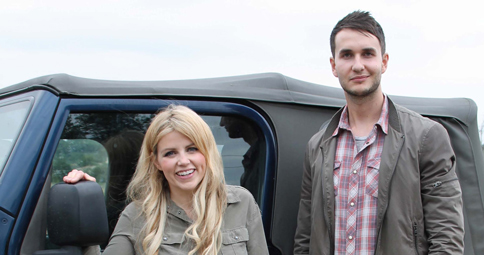
Presenters Ellie Harrison and Dean Lomax

Dean guides Ellie through a dinosaur dominated Britain.

Programme two – features Cetiosaurus, Proceratosaurus, Iguanodontids, stegosaurs, Neovenator and even little Echinodon is depicted.

Picture Credit: ITV

Dinosaur Britain

Just one small point that was noted by a colleague, many of the measurements provided for the dinosaurs were given in feet.  Old timers like the staff at Everything Dinosaur are well used to this, but with this programme aimed at a family audience including children, would very young viewers appreciate the size and scale of these prehistoric beasties when imperial measurements were used in some cases?  Perhaps not, although the CGI showing the armoured Dacentrurus wandering the galleries of the Natural History Museum and the tiny Echinodon attacking a sandwich at least gave viewers an opportunity to gauge size for themselves.

Earliest Members of the Tyrannosauroidea

Time to introduce one of the earliest members of the Tyrannosauroidea clade, Proceratosaurus a very distant relative of the famous Tyrannosaurus rex.  Ms Harrison was surprised to learn that this three metre long theropod once roamed around her home county of Gloucestershire.

To conclude the second programme, the viewer was brought right up to date and introduced to the very latest dinosaur to be added to the compendium of British dinosaurs.  Found in Lower Jurassic rocks at Lavernock Point (Vale of Glamorgan, Wales), Dr Dave Martill (University of Portsmouth), showed off a remarkable fossil discovery, the partial skeleton of a small, agile meat-eating dinosaur that might turn out to be the oldest dinosaur specimen ever found in Jurassic aged strata.  It was pleasing to see plenty of feathered Theropods throughout the two programmes.

A few days ago, Everything Dinosaur reported on the finding of more fossil bones associated with this specimen: Putting the Welsh Theropod on a Firmer Footing.

Dinosaurs Awaiting Discovery

It seems that there are more dinosaurs awaiting discovery in the rocks of the British Isles.  Thanks to Maverick TV the British public has gained an appreciation of our rich dinosaur heritage.  A quick nod to the schedulers, the earlier start time of 8pm would have been appreciated by mums and dads.  Showing the programme an hour earlier than the first episode would have permitted more children to stay up and watch.

Commenting on Dinosaur Britain

Let’s leave the last word to Dean, who summed up this two-part documentary succinctly:

“Despite Britain playing a pivotal role in the development and understanding of dinosaurs and palaeontology worldwide, in a modern capacity Britain has somewhat been overlooked.  Personally, I feel that Dinosaur Britain is a huge opportunity to put us on the map for dinosaur discoveries, tell the unique story it has and most importantly enthuse people of all ages to learn more about British palaeontology.  Who knows, Dinosaur Britain may just be the very programme that inspires future British palaeontologists.”

Well said.

31 08, 2015

A Special Dinosaur Britain Programme – Part 1

By |2024-05-05T14:43:17+01:00August 31st, 2015|Categories: Dinosaur Fans, Main Page, TV Reviews|0 Comments

Dinosaur Britain – Part 1 – Quick Review

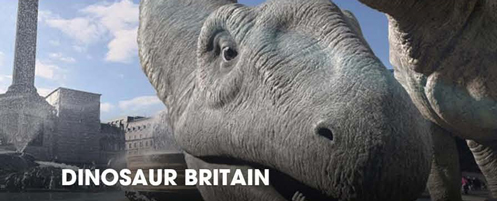
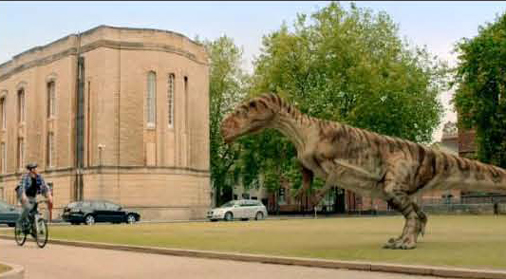
The Oxford University Museum of Natural History might not be the same again after one of its most famous items in the collection, the Megalosaurus bucklandii came to life and pursued a cyclist down the high street.  Just one of the scenarios acted out tonight in the very informative “Dinosaur Britain” which was aired on ITV1 this evening.  This was the first part in a two-part documentary made by Maverick TV which sets out to explore the rich dinosaur heritage of the British Isles.

Dinosaur Britain – Bank Holiday Family Entertainment

Bringing British dinosaurs to life!

Bringing British dinosaurs to life!

Picture credit: Maverick TV

Aimed very much at a family audience, the first programme sees presenter Ellie Harrison going on a tour of the United Kingdom to learn about some of the amazing dinosaurs that once roamed this part of the world.  Even today, we at Everything Dinosaur estimate that, one in twenty of all the dinosaurs known to science is represented by fossils found in the British Isles, that’s about one hundred different species and what an eclectic bunch they are.

Dinosaur Britain

Ellie is guided on her tour of Britain’s dinosaurs by our chum Dean Lomax, a palaeontologist who has recently written an excellent book entitled “Dinosaurs of the British Isles”, so he is ably qualified to assist Ms Harrison on her quest to learn about these amazing reptiles.

For further information on “Dinosaurs of the British Isles”: Siri Scientific Press.

After a close encounter with Baryonyx in the Natural History Museum, Ellie meets up with a Megalosaurus, which does look a little out of place scavenging a council bin for a quick snack.  After all, Oxfordshire has changed quite a bit in the 167 million years ago since Megalosaurus was around.

Megalosaurus on the Prowl

A new hazard for cyclists around the Oxford area.

A new hazard for cyclists around the Oxford area.

Picture credit: Maverick TV

Crystal Palace Dinosaurs

Then it’s to South London to view the Crystal Palace dinosaur sculptures and to hand feed an Iguanodon, the CGI permitting viewers to see for themselves how our interpretations of the Dinosauria have changed since the time of the Great Exhibition.  Britain’s own “raptor” Nuthetes destructor, the name means “destroyer monitor”, makes an appearance, strangely enough at Stonehenge, although the fossils were found on the Isle of Purbeck (Dorset), cue more running for Dean and Ellie.  Good to see feathers on our turkey-sized dromaeosaurids.

Perhaps, for us the best part of the programme concerned the Early Jurassic armoured dinosaur Scelidosaurus.  The fossil specimen, part of the Bristol Museum and Art Gallery collection is truly remarkable and who better to talk to about it than David Sole, the Dorset fossil collector who discovered the fossils back in 2000.  Professor Mike Benton is our guide at the Bristol Museum, he explains how this beautiful dinosaur fossil came to be preserved in such an amazing articulated state.

Scelidosaurus Model

Claim to fame for Everything Dinosaur, we supply the Scelidosaurus models for the Museum’s shop.

Scelidosaurus Model

A model of a Scelidosaurus.

A model of a Scelidosaurus.

Picture credit: Everything Dinosaur

To read more about Scelidosaurus: Britain’s Most Complete Dinosaur Fossil Discovered to Date.

A Dedicated Television Series “Dinosaur Britain”

The programme blended dinosaur facts and entertainment quite well in our opinion.  The focus for part one was very much on English dinosaurs, expect other parts of the British Isles to get more of a look in with the second programme which is scheduled to be shown tomorrow at 8pm.

Our congratulations to the programme makers, it is good to see that “British dinosaurs” are getting a share of the limelight.

The Scelidosaurus model shown is part of the CollectA Deluxe model range: CollectA Deluxe Prehistoric World Models.

31 08, 2015

Will We Ever Know All the Dinosaurs?

By |2023-04-05T13:03:34+01:00August 31st, 2015|Categories: Dinosaur and Prehistoric Animal News Stories, Dinosaur Fans, Main Page|0 Comments

How Good is the Fossil Record of the Dinosaurs

With something like 1,200 different genera of dinosaur now described, our knowledge of the Dinosauria has increased a great deal, especially over the last twenty years or so.  Many different types of dinosaur have been discovered and we at Everything Dinosaur try to keep a database using this blog.  For example, since the beginning of July, we have written articles about a newly discovered, very bird-like oviraptorid from southern China (Huanansaurus ganzhouensis), North America’s latest ceratopsian discovery (Wendiceratops), the new dromaeosaurid from Liaoning Province (Zhenyuanlong suni) and most recently, the basal sauropod Pulanesaura from South Africa.

How Good is the Dinosaur Fossil Record?

Just over the weekend, we reported on a giant horned dinosaur skull from South Dakota that might well turn out to be a new species of ceratopsian, albeit, one that would be very closely related to Triceratops.

However, will palaeontologists ever be able to create a definitive list of all the dinosaurs?  What percentage of the Dinosauria will ever be known?  Scientists at Bristol University have set about trying to find out by assessing just how good the fossil record for the dinosaurs actually is.

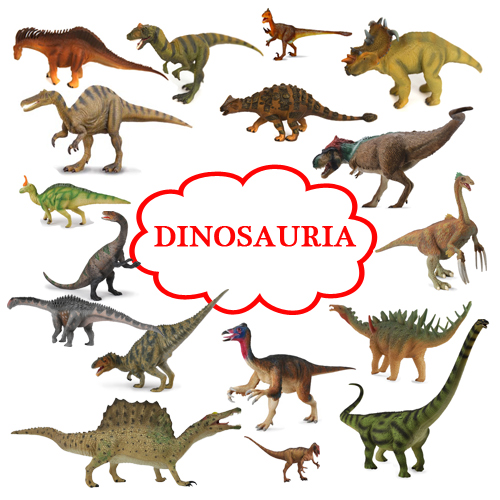
So Many Different Types of Dinosaurs Described

So many different types of dinosaur.

So many different types of dinosaur.

Picture credit: Everything Dinosaur

Trying to Calculate How Good the Dinosaur Fossil Record Is

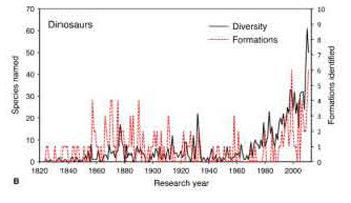
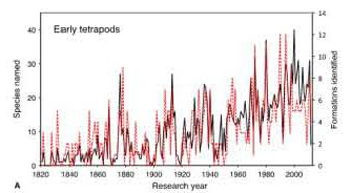
Professor Mike Benton of the University of Bristol, set out to assess how good the fossil record is for the Dinosauria and for early tetrapods in a bid to answer the question as to whether the fossil record adequately represents the patterns of diversity of animals through time.  A number of other authors have attempted to assess the quality of the fossil record and in this new study, published in the journal “Palaeontology”, the journal of the Palaeontological Association, Professor Benton set out to plot how the knowledge of dinosaurs has been accumulated since the first scientific description (Megalosaurus) back in 1824.

The research does not provide a definitive answer with regards to how representative the vertebrate fossil record actually is, but this study does suggest caution needs to be taken when using some popular methods to try and remove bias from the known fossil record of the Dinosauria as well as the other Tetrapods included in the analysis.

Plotting the Number of New Species Named Against the Number of Newly Discovered Fossil Bearing Formations

Number of species against number of new fossil bearing formations.

Number of species against number of new fossil bearing formations.

Graph credit: Bristol University

Professor Benton Comments

Professor Benton explained:

“In the past ten years, many palaeontologists have tried to find the true pattern of evolution by using measures of sampling to estimate where the fossil record is well known or poorly known.  But it turns out that many of the popular methods are not doing what they are supposed to.”

The Bristol-based palaeontologist plotted the history of research into the Dinosauria from 1820 to the present day.  He logged the number of new species described and how the patterns of discovery match the patterns of discovery of new geological formations.  He noted that the patterns of discovery are closely linked, one or two new dinosaurs for each fossil-bearing geological formation that is newly explored.

More Fossil Bearing Geological Formations Discovered = More Dinosaurs Described

If there is a significant link between the number of dinosaurs described and the number of new geological formations discovered then how does this connection work?  This link can be explained in two ways:

  1. Rock formation discoveries drives dinosaur fossil finds
  2. Dinosaur fossil finds drives the discovery of new fossil-bearing formations

The usual view is that (1) is correct, that rocks drive fossil finds.  Palaeontologists are keen to find new dinosaur species, but the new species could only be found if they explored new rock formations around the world.  It could be argued that our ability to discover new types of dinosaurs (or any fossil group for that matter) is dependent on the availability of suitable rock formations to explore.

Plotting the Link between Early Tetrapod Discoveries and Rock Formations

Early Tetrapod discoveries 1820-2015.

Early tetrapod discoveries 1820-2015.

Graph credit: Bristol University

The graph above shows the same relationship in early tetrapod fossil discoveries from 1820 to the present day, but if there is a causal relationship between fossil finds and formations then how does this relationship work?

Fossil Record

The opposite view is that fossil discoveries drives the search for new rock formations.  Palaeontologists set out to look for new dinosaurs in a very focused and disciplined way.  When new dinosaurs are found they would often add a new dinosaur-bearing formation to the known list.  In this case, the limiting factor is not simply the availability of suitable rock formations to explore because scientists do not search systematically but they go straight to areas when they hear there are bones to be excavated.

Professor Benton added:

“I have been worried for a while that some of the popular correction methods actually make things worse.  By removing the numerical signal of the formations, localities or collections they were actually removing a huge amount of real information, and producing a resulting curve that is meaningless.  The fossil record is clearly incomplete, and it is clearly biased by many factors, but many of the supposedly “corrected” diversity curves we have seen recently may actually be further from the truth than the raw data.”

A New Analysis

This new analysis does not provide us with a definitive answer as to the diversity of the Dinosauria, or indeed, for any other fossil group of vertebrates.  However, we can infer from what we already have discovered that there are very probably a lot of weird and wonderful dinosaurs yet to be found.  It is not possible to state that we, after 195 years of research (1820 to 2015), have identified 10%, 50% or even 1% of all the types of dinosaurs that have ever existed, such statements by their very nature are likely to be invalid.

This new research does provide a clearer picture of why there is such a close correlation between dinosaur species numbers with formations, localities or collections.  The numbers of all four are connected because they are all telling much the same story, they are measuring the same history of life on Earth and our knowledge.  Professor Benton concludes that it is not possible to isolate one or other of these measures and then try to use it as an independent yardstick for sampling.

New Dinosaurs Will Be Discovered

There is one certainty, well, it’s almost a certainty.  New types of dinosaur will be discovered in the future and if the graph developed by Professor Benton is anything to go by, a lot of new dinosaurs (at least compared to the historical data), will be discovered in the next few years and Everything Dinosaur will do its best to blog about them.

For models and replicas of dinosaurs and prehistoric animals: Prehistoric Animals and Dinosaur Figures.

Everything Dinosaur acknowledges the help of a Bristol University press release in the compilation of this article.

30 08, 2015

Stem Acrodontan Lizard – The First of Its Kind from South America

By |2023-04-05T12:54:23+01:00August 30th, 2015|Categories: Dinosaur and Prehistoric Animal News Stories, Dinosaur Fans, Main Page|0 Comments

Revising Lizard Evolution in Gondwana

The Squamata (lizards and snakes), might be the most diverse and specious of all the extant reptiles but their evolutionary history remains a mystery.  The preservation potential of these reptiles can vary dependent on the characteristics of the ancient ecosystems which they inhabited.  In addition, the small size of many of the early species of lizard and snake makes finding fossilised bones and other clues as to the history of this Order all the more difficult.

However, a team of scientists including Tiago R. Simões (Dept of Biological Science, University of Alberta), have published a paper in the journal “Nature Communications” that sheds light on the evolution of the iguanas and their near relatives.

Studying the Iguanians

The family of extant reptiles known as the iguanians (iguanas and agamids) are one of the most diverse and widespread type of lizard today.  However, like other types of lizard, their evolutionary origins are uncertain.  There are two main divisions within this family, firstly there is a sub-group called the acrodonts, these lizards have no root or socket to their teeth and the teeth are attached to the top of the jaw bones.  In the other sub-group, the pleurodonts they do not have roots on their teeth either, but instead the teeth attach to the inside portion of the jaw.

Acrodont iguanians are confined to the Old World, while pleurodont iguanians are found only in the Americas.  A newly described fossil however, breaks this pattern.  The international team of scientists have published a paper on a Late Cretaceous acrodont iguanian, the oldest known New World acrodont iguanian.

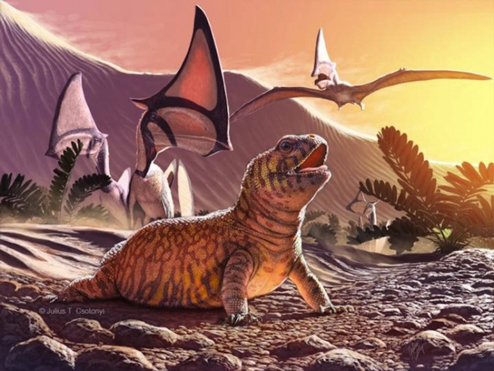
An Illustration of the First New World Acrodont Iguanian – G. sulamericana

The fossils date from around 80 million years ago.

The fossils date from around 80 million years ago.

Picture credit: Julius Csotonyi

Gueragama sulamericana

The fossils, including the holotype material, a partial lower jaw come from the Goio-Erê Formation, exposed near Cruzeiro do Oeste, in Paraná State, southern Brazil.  Fossils found in this locality represent an arid, very dry environment dominated by pterosaurs and large dinosaurs.  However, scurrying around the hot, desert-like environment was a short, rather stubby lizard.  It has been named Gueragama sulamericana, which translates from the local dialect and Portuguese as “ancient agama from South America”.

The discovery of these fossils of an ancient, New World acrodont means that in the distant past, lizards with the acrodont dentition had a worldwide distribution and were very probably widespread across the ancient landmass of Gondwana.

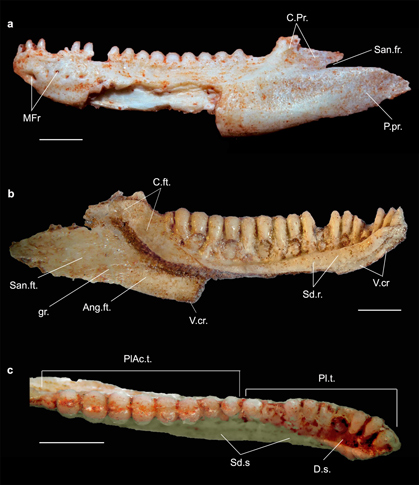
The Holotype Jaw Fossil (Various Views)

An ancient toothy lizard.

An ancient toothy lizard.

Picture credit: Universidade do Contestado, Santa Catarina, Brazil.

Scale bar in the picture = 2 mm.

Fossil Discovery Raises Questions

A number of questions have been raised with this discovery, for example, if only the pleurodont iguanians are found in the New World today, then what happened to the acrodonts that once lived in this part of the world too?

Lead author of the scientific paper, Tiago R. Simões stated:

“It becomes clear acrodontan iguanians migrated throughout the southern continents much earlier than previously thought (actually reaching regions where they do not inhabit today) by the order of tens of millions of years.”

This new research extends the fossil diversity of Late Cretaceous Brazil and suggests that the arid deserts of this part of the world may have supported a greater range of lizards than previously thought.  The scientists hope to find more lizard fossils, including material representing Gueragama so that they will be better able to understand the evolution and radiation of the stem acrodontans.

As for the date given to the G. sulamericana fossil material, we at Everything Dinosaur estimate these fossils to be more than 80 million years of age.  The strata which makes up this part of the Goio-Erê Formation is believed to date from the Turonian to the early Campanian faunal stages of the Late Cretaceous (90-80 million years ago, approximately).

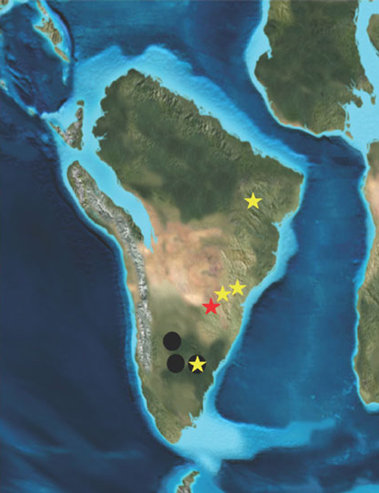
Late Cretaceous South America

South America in the Late Cretaceous

South America in the Late Cretaceous

Picture credit: Nature Communications

Fossil Finds in South America

Between the Aptian/Albian faunal stages and the Campanian faunal stage of the Cretaceous, sphenodontians were thought to be the dominate animals filling the iguanian niche.  Sphenodontian fossils have been found in northern Patagonia, in the provinces of Chubut (Tres Cerros), Río Negro (Los Alamitos, Cerro Tortuga, Cerro Bonaparte and La Buitrera) and Neuquén (El Chocón), these discoveries are represented by black circles on the map above.

Lizards were present in the state of Ceará in north-eastern Brazil (Araripe Basin), as well as in the south-eastern/southern states of Minas Gerais (Peirópolis), São Paulo (Marília and Presidente Prudente) and Paraná (Cruzeiro do Oeste), and in the province of Río Negro (Cinco Saltos and La Buitrera), Argentina, represented by yellow stars on the map. The red star indicates the type locality of G. sulamericana in southern Brazil.

Recently, Everything Dinosaur reported on another Brazilian Squamata fossil discovery.  Spotted by chance on a tour of a German museum, scientists have identified the first example of a four-footed snake, an animal believed to be a transitional creature between limbed lizards and true snakes.

To read this article: Fossil Snake with Four Limbs Described.

29 08, 2015

Super-sized Ceratopsian Skull Might be New Species

By |2023-04-05T12:49:09+01:00August 29th, 2015|Categories: Dinosaur and Prehistoric Animal News Stories, Dinosaur Fans, Main Page|0 Comments

Horned Dinosaur Skull Found in South Dakota Might Be New Species

The small town in Buffalo in the north-west of South Dakota was so named as back in the 19th century vast herds of buffalo (American bison), roamed across this part of the world.  However, another type of horned animal has got local townsfolk excited, one that would have dwarfed even the largest of today’s hoofed giants, a very-well preserved partial skull and jaws of a huge horned dinosaur which might turn out to be a new species.

Acquired from a Fossil Collector

Fossil collector and dealer Alan Detrich purchased the dinosaur skull found in Harding County from another fossil collector John Carter back in 2012, but it has taken more than two and a half years to prepare the specimen ready for sale.  When the fossil skull and lower jaw were first excavated it was thought that the bones represented a very large specimen of Triceratops (T. horridus).  However, with the fossil completely exposed, Alan along with Neal Larson (Larson Paleontology Ltd) who was tasked with preparing the fossil, believe that this could be a brand new species of horned dinosaur.

Over the last fifteen years or so, a number of new North American horned dinosaurs have been named and described, however, if proved to represent a new species, this dinosaur skull could be heralded as one of the most spectacular dinosaur discoveries of all, the nasal horn alone measures nearly forty-five centimetres long and the skull itself is over 1.82 metres in length.

Ceratopsian Skull

Commenting on the unusually large nasal horn, Alan Detrich stated:

“They are [Triceratops nose horns] usually half that size and the skull is eight feet long, which would be a monster skull for a Triceratops.”

Neal Larson, the founder of Larson Paleontology Unlimited and a co-founder of the Black Hills Institute of Geological Research with his brother Pete Larson, who coincidently is also working on a centrosaurine specimen at the moment, was given the task of trying to prepare the specimen.  It took over 1,000 pain-staking hours to carefully excavate the fossil from its iron siderite matrix.  The preparation work was extremely difficult, as despite the robust nature of the fossil bones, the matrix with its iron component (iron carbonate) was extremely hard.

A Ceratopsian Exhibit at a Museum (Triceratops)

Triceratops Fossil on Display

A cast of a Triceratops skeleton on display at the Naturmuseum Senckenberg (Natural History Museum – Frankfurt). On the left a wall mounted example of a Plateosaurus can be seen.  Is the Buffalo skull a new species?

Picture credit: Everything Dinosaur

For articulated models of ceratopsians and other dinosaurs: Beasts of the Mesozoic Articulated Dinosaur Models.

A Large Centrosaurine Skull

A spokesperson from Everything Dinosaur exclaimed:

“It’s only when you see a person stood next to the beautifully preserved skull that you can really appreciate just how big the animal actually was.  This is certainly one of the largest centrosaurine skulls that we have seen.”

For Neal, who holds a degree in geology and has been excavating fossils for some forty years now, the ceratopsian skull represented a tough challenge given the hardness of the surrounding matrix.

He stated:

“I immediately had my suspicions this was something new because of the size and placement of the nasal horn.  They’re usually in the middle of the nose, not the front and it’s twice as large as most of them.  On top of that, the frill at the top of the skull curves upward. They usually lay back.”

Ceratopsian Skull Could Represent a New Species

The skull has a strange ridge under the jaw, something that is not seen in Triceratops skull material.  Mr Detrich is now trying to find a museum to house this specimen, preferably in the United States, potential buyers for this huge dinosaur skull are currently being contacted.

The Ceratopsians of North American seem to have evolved into a very diverse range of forms during the Late Cretaceous.  Some of the skulls of these herbivorous dinosaurs were truly immense.  As a clade, the ceratopsians are considered to have the largest skulls in proportion to the rest of their bodies of any known vertebrate.  A few years ago, Everything Dinosaur reported on the discovery of another enormous horned dinosaur skull, this time from Alberta, Canada, a dinosaur that was believed to be an ancestor of Triceratops.

To read about this fossil discovery: Enormous Skull of Eotriceratops Discovered.

Go to Top