All about dinosaurs, fossils and prehistoric animals by Everything Dinosaur team members.
7 07, 2017

JurassicCollectables Reviews the Papo Cryolophosaurus

By |2023-08-04T10:34:19+01:00July 7th, 2017|Categories: Dinosaur Fans, Everything Dinosaur videos, Main Page, Product Reviews|0 Comments

Papo Cryolophosaurus Video Review (JurassicCollectables)

Dinosaur model reviews are coming in thick and fast from JurassicCollectables.  Today, we share their latest video review, a look out the new for 2017, Papo Cryolophosaurus dinosaur model.  The Papo Cryolophosaurus is the last of the Papo dinosaur figures to be introduced this year, but it has been well worth the wait as the paint scheme and detailing on this figure is exquisite.

The New for 2017 Papo Cryolophosaurus – Video Review by JurassicCollectables

Video credit: JurassicCollectables

Papo Cryolophosaurus – Frozen Crested Lizard

Found on the slopes of Mount Kirkpatrick at an altitude of around 4,000 metres Cryolophosaurus (C. elloitti), an Early Jurassic dinosaur is one of the most unusual of all the Theropoda.  The first fossils of this dinosaur were discovered during an expedition at the end of 1990/early 1991, during the Antarctic summer.  The genus name was inspired by that remarkable bony crest and the fossil site location – the genus name translates as “frozen crested lizard”.

In this short video (duration 4:49), the narrator talks about the beautiful bony ridges on the skull that gave this dinosaur its name.  The commentary includes details of the washes used to create such a glossy looking dinosaur.  Although, during the time of Cryolophosaurus Antarctica was a considerable distance away from the South Pole, the climate would still have been harsh, but not as extreme as today.

The Cryolophosaurus material comes from the Hanson Formation, several other vertebrates are known from the Lower Jurassic strata. Cryolophosaurus shared its chilly forested world with pterosaurs, prosauropods and sauropods, cynodonts (mammal-like reptiles) and several other types of theropod.

Intriguingly, these rocks have yet to be fully mapped and explored and a number of fossil finds (including dinosaur remains) have yet to be formally described.

A Detailed Video Description

In the JurassicCollectables video review, the narrator provides a detailed description of this skilfully made dinosaur model.  Particular attention is given to the skull sculpt including the detail on the inside of the mouth and the folds of skin on the neck, before the video shows the scales and other osteoderms that have been carefully crafted into the figure.

The JurassicCollectables YouTube channel has lots of Papo model videos, plus reviews of many other new for 2017, prehistoric animal figures.  It is a “go to” site for many dinosaur fans and model collectors.

To visit the Everything Dinosaur YouTube channel: Everything Dinosaur on YouTube.

The video review of the Papo Cryolophosaurus may have only been posted up for a few hours but it has already attracted over 3,600 views.

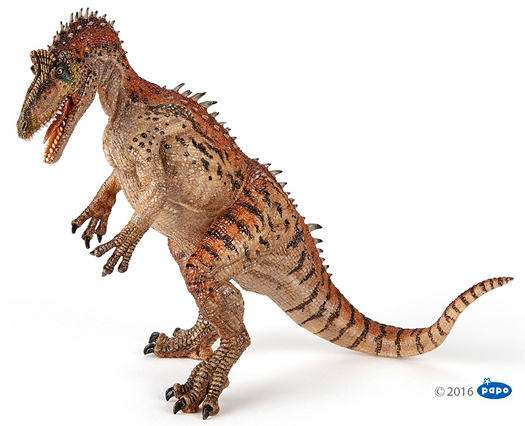
The Papo Cryolophosaurus Dinosaur Model

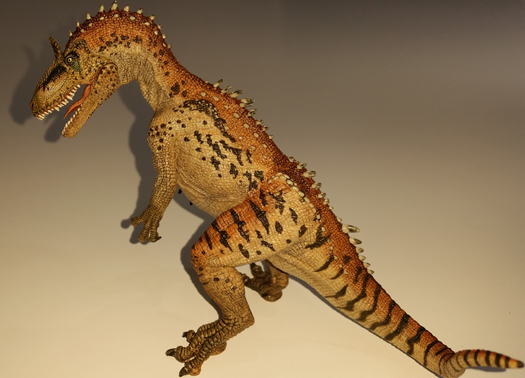
Papo Cryolophosaurus dinosaur model.

The Papo Cryolophosaurus dinosaur model. Picture credit: Everything Dinosaur.

Picture credit: Everything Dinosaur

Just like the narrator, we have a couple of these Papo replicas on one of our shelves in the office.  It is the favourite new for 2017 Papo model of “Tyrannosaurus Sue”!  We are looking forward to the rest of the new for 2017 Papo replicas, the Cave Bear, Dimorphodon and the roaring Smilodon figures will be in stock soon.

To view the range of Papo prehistoric animal models available from Everything Dinosaur: Papo Dinosaur and Prehistoric Animal Models.

The Papo Cryolophosaurus Dinosaur Model

Papo Cryolophosaurus.

The Papo Cryolophosaurus dinosaur model.

Visit the award-winning Everything Dinosaur website: Everything Dinosaur.

6 07, 2017

Tyrannosaurs Roamed Late Cretaceous Japan According to New Study

By |2024-04-01T14:07:34+01:00July 6th, 2017|Categories: Dinosaur and Prehistoric Animal News Stories, Dinosaur Fans, Main Page|0 Comments

Large Theropod Tooth Indicates Tyrannosaurs Roamed Japan

Researchers have identified a single, shed theropod tooth that indicates that large tyrannosaurs roamed the land that we now know as Japan some 80 million years ago.  The single tooth is very characteristic of a member of the Tyrannosauridae family, however, it is not possible to identify a specific genus based on such fragmentary evidence.

This has not stopped the speculation, with some sources suggesting that the tooth might have come from a dinosaur which was very similar to Gorgosaurus, which is one of the better known Late Cretaceous tyrannosaurs, although, as far as we at Everything Dinosaur think, Gorgosaurus lived several million years later and is only known from North America.

The Single Broken Theropod Tooth – Potential Japanese Tyrannosaur

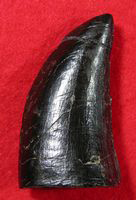
Lateral view of the Japanese tyrannosaur tooth.

The tyrannosaur tooth (Japan).

Picture credit: Goshoura Cretaceous Museum

A Fossil Find on Amakusa Island

In October 2014, a research team from the Fukui Prefectural Dinosaur Museum in collaboration with colleagues from the Goshoura Cretaceous Museum was exploring a series of Upper Cretaceous exposures in the Amakusa archipelago (Kumamoto Prefecture), a tooth from a theropod was found.  In a press release, a spokesperson from the Goshoura Cretaceous Museum, which is run by the Amakusa city government, explained that the single tooth is believed to have come from either the upper left jaw or the lower right jaw of a carnivorous dinosaur.

The tooth morphology is typical of a tyrannosaur, it has serrations running down the sides of the tooth, very similar to those of dinosaurs in the Tyrannosauridae family.  It is slightly recurved and has a characteristic robust appearance and a classic oval or “D” shape when seen in cross-section.

A View of the Underside of the Tooth – A Typical Tyrannosaur Tooth Shape

The Japanese tyrannosaurid tooth (ventral vew)

Ventral view of the tyrannosaurid tooth (view from underneath).

Picture credit: Goshoura Cretaceous Museum

A Shed Tyrannosaur Tooth from Japan

Only the crown has been found.  No roots have been found in association with the tooth, so it is very likely a shed tooth.  Dinosaurs replaced teeth throughout their lives.  Palaeontologists have calculated that a tooth in the jaws of Tyrannosaurus rex probably lasted less than two years.  The dental enamel on the tooth is quite well preserved and the fossil measures 4.2 cm long, 2.5 cm wide (at the bottom) and it is 1.6 cm thick.  Based on the size of the tooth, scientists have estimated that the tyrannosaur that lost this tooth could have measured over seven metres in length.  The original length of the tooth (crown plus root) is estimated at around 5.6 cm long.

The tooth would have been quite sizeable, but this is not the largest theropod tooth ever found in Japan.  In 2008, Everything Dinosaur reported the discovery of a much older dinosaur tooth that measured more than eight centimetres in length.

To read about this fossil discovery: Largest Meat-Eating Dinosaur Tooth Found in Japan.

The serrations (denticles) are quite prominent and measure about 0.3 mm in size.  In the press statement, it was stated that the tooth was found in exposures related to the Ikusagaura stratum of the Himenoura Group (Upper Cretaceous – Campanian faunal stage).

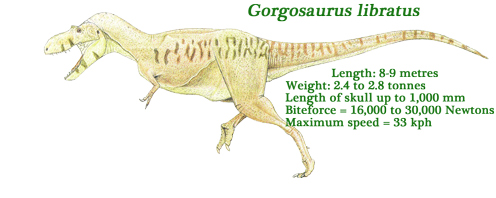
An Illustration of a Typical Gorgosaurus (G. libratus Member of the Tyrannosauridae)

Gorgosaurus libratus illustrated.

Faster and slightly more nimble when compared to the biggest Albertosaurus dinosaurs.

Picture credit: Everything Dinosaur

A Tyrannosaur Tooth from Japan

Commenting on the fossil find, a team member from Everything Dinosaur stated:

“Dinosaur fossils from Japan are exceptionally rare and most material is extremely fragmentary.  The finding of this single tooth does indicate that during the latter stages of the Late Cretaceous, this part of the world was home to large tyrannosaurs similar to those found in similar aged rocks in North America and elsewhere in Asia.”

Earlier this year, (April 2017), Everything Dinosaur reported on the discovery of the most complete dinosaur skeleton ever found in Japan.  The fossilised remains of a hadrosaur were discovered on the Japanese island of Hokkaido.  The fossils were found in marine strata, it is likely that the corpse of this herbivorous dinosaur was washed out to sea – an example of a “bloat and float” form of taphonomy.

To read an article about this discovery: Japan’s Most Complete Dinosaur Discovery.

A Mounted Skeleton of a Gorgosaurus (Late Cretaceous Tyrannosaur)

A Gorgosaurus on display.

Gorgosaurus fossil display.

Picture credit: Manchester University

Visit the Everything Dinosaur website: Everything Dinosaur.

5 07, 2017

Madagascar’s Mighty-mouthed Croc Described in New Paper

By |2024-05-08T20:37:57+01:00July 5th, 2017|Categories: Dinosaur and Prehistoric Animal News Stories, Dinosaur Fans, Main Page|0 Comments

Razanandrongobe sakalavae – Terror of the Middle Jurassic

A team of French and Italian palaeontologists have pieced together a more than decade-long puzzle and as a result, have come face to face with one of the most nightmarish prehistoric animals imaginable.  New research on fossils found in north-western Madagascar has led scientists to describe a giant, terrestrial crocodile with immensely strong teeth and bone-crushing jaws.  The new species, the largest and oldest Notosuchian described to date, may well have filled the apex predatory niche in this part of the southern, super-continent Gondwana.  The super-sized croc, named Razanandrongobe sakalavae (pronounced Ray-zan-an-dro-go-bay sack-ah-lar-vey), had teeth reminiscent of the robust teeth of a Late Cretaceous tyrannosaur.

Indeed, an examination of the denticles (serrations) on the teeth preserved in the left dentary fragment and partial right premaxilla are strikingly similar to the serrations on a T. rex tooth.

A Reconstruction of the Deep Skull of Razanandrongobe sakalavae
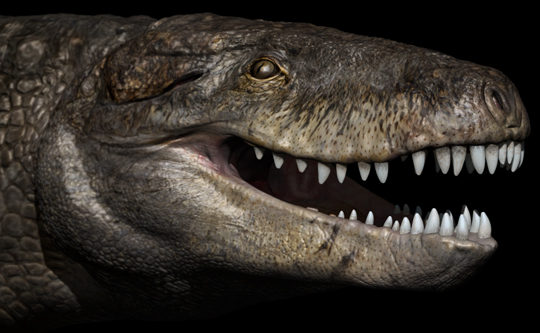
The fearsom Razanandrongobe.

Razanandrongobe skull.

Picture credit: Fabio Manucci

Archosauria incertae sedis

In 2006, three palaeontologists (Simone Maganuco, Cristiano Dal Sasso and Giovanni Pasini), published a scientific paper that described a large predatory archosaur from the Mahajanga Basin of Madagascar.  The animal was named based on a fragmentary right maxilla and seven isolated teeth.  It is not unusual to have a new genus established based on such incomplete remains, however, what kind of reptile these fossils represented was very much open to debate.  Could it have been a crocodylomorph or perhaps a carnivorous dinosaur?  A new taxon was erected Razanandrongobe sakalavae, in the 2006 paper.

It was suggested that the fossils might represent the largest predatory animal known from the Bathonian faunal stage of Jurassic Madagascar and that it could have been durophagous – feeding on hard materials like the bones of other vertebrates.  Such was the paucity of the fossil material, that although the species name entered scientific literature, it was referred to as “Archosauria incertae sedis”, which means it was a member of the Archosauria, but where it belonged in this large and extremely diverse clade was anyone’s guess.

More Fossils – More Skull Material

Writing in the academic journal “PeerJ” the same researchers, in collaboration with Guillaume Fleury (Muséum d’Histoire Naturelle de Toulouse, France), have described more cranial material including an almost complete right premaxilla, a portion of left lower jaw bone (dentary), plus a partial maxilla complete with unerupted teeth and a single, very large broken tooth.  In addition, a further five skull bones, that were, most likely collected from the same location are also assigned to R. sakalavae.  These fossils have ruled out Theropoda, Razanandrongobe was definitely from the Crurotarsi archosauriforms and as such, it has affinities with today’s crocodilians.

However, phylogenetic analysis assigns Razanandrongobe to the Notosuchia and as such, it was very distantly related to Kaprosuchus from the Late Cretaceous of Niger, a terrestrial predator that readers of this blog and collectors of Papo and Safari Ltd prehistoric animal models might be familiar with.  As several sauropods are known from the same stratigraphy, this “super-croc” has been depicted scavenging on the carcass of long-necked dinosaur.

Razanandrongobe sakalavae Feeding on a Sauropod Carcass (Archaeodontosaurus)
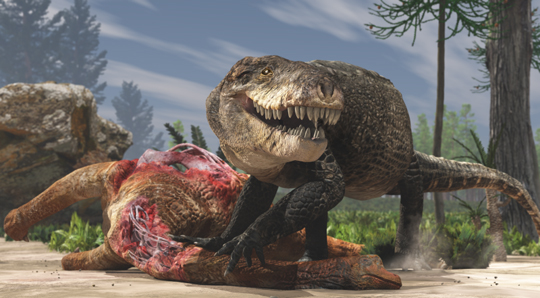
Razanandrongobe feeding on a dinosaur (Razanandrongobe sakalavae).

Razanandrongobe feeding on a sauropod carcass.

Picture credit: Fabio Manucci

The illustration above depicts the deep-snouted terrestrial Razanandrongobe scavenging on the carcass of a sauropod.  We speculate that the artist has depicted an Archaeodontosaurus as the victim.  Archaeodontosaurus is known from fossils that came from the same region of Madagascar.  Ironically, we think at Everything Dinosaur, this Middle Jurassic sauropod was named on the basis of isolated teeth and a fragment of jawbone, just like R. sakalavae.

Razanandrongobe sakalavae

Although distantly related to living crocodiles, Razanandrongobe moved very differently.  Its legs were longer and it walked with a much more erect stance.  It may even have been capable of bipedalism, although analysis of the postcranial skeleton would be the only way to confirm this.

As to the size of this 165 million-year-old crocodile, that is very difficult to say.   However, this animal nick-named “Razana”, has been estimated at around seven metres in length.  This measurement has been calculated by comparing the Razanandrongobe fossil material with better-known and more complete baurusuchids, another type of Notosuchian from South America.

Estimating the Size of Razanandrongobe sakalavae
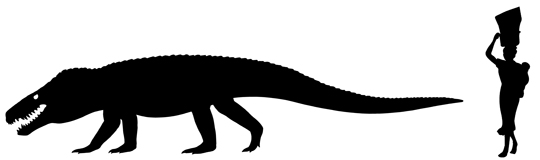
Estimating the size of Razanandrongobe sakalavae scale drawing.

Estimating the size of Razanandrongobe sakalavae.

Picture credit: Natural History Museum (Milan)

Razanandrongobe may have been about as big as a modern Saltwater crocodile (Crocodylus porosus), but on those powerful erect limbs it would have stood much higher, perhaps around 1.6 metres high at the hips.  Its weight has been estimated at 800 to 1,000 kilogrammes.

Visit the award-winning Everything Dinosaur website: Everything Dinosaur.

“Giant Lizard Ancestor from the Sakalava Region”

Razanandrongobe sakalavae translates from the local dialect and Latin and means “giant lizard ancestor from the Sakalava region”, Sakalava relating to the ethnic group that inhabits the Mahajanga region, where the fossil material was found.

It is thanks to the additional fossil fragments, the majority of which indicating that they represent the same individual whose fossils were described back in 2006, that the research team have been able to “flesh out the bones” and provide a more detailed picture of this monster.  In essence, the paper clarifies features on the holotype material that confirms that the fossils do not represent any type of dinosaur, it establishes Razanandrongobe as a member of the Notosuchia and as such it is by far the oldest Notosuchian so far described.  It is the first Jurassic Notosuchian and its fossils are some 42 million years older than other members of this crocodilian Suborder.

The Mounted Fossils (with some casts) Reconstructing the Front of the Jaws of R. sakalavae 
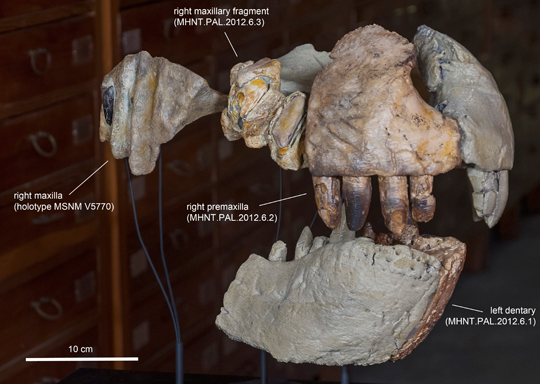
R. sakalavae  skull reconstruction.

Razanandrongobe sakalavae  skull reconstruction.

Picture credit: Natural History Museum (Milan)

The picture above shows the reconstructed anterior portion of the skull and jaws of Razanandrongobe with the fossil material and casts shown in life position.

Cristiano Dal Sasso (Natural History Museum of Milan) commented:

“Like these and other gigantic crocs from the Cretaceous “Razana” could outcompete even theropod dinosaurs, at the top of the food chain.”

Very little is known about the origins and the early evolution of the Notosuchia, this Madagascan fossil material represents the first Jurassic fossils related to this Sub-order.  Razanandrongobe has extended the evolutionary history of the Notosuchia by more than forty million years and as such, it has established a ghost lineage that, hopefully further fossil finds will help to fill in.

Speaking about the implications for the evolution of these types of terrestrial crocodiles, co-author of the PeerJ paper, Simone Maganuco (Natural History Museum of Milan), stated:

“These fossils represent a further signal that the Notosuchia originated in southern Gondwana.”

Predator or Scavenger?

Although nothing can be discounted, it is likely that, just like the majority of scavengers today, Razanandrongobe was an active hunter.  It probably hunted dinosaurs and other large vertebrates.  However, it was also very probably an opportunist, if it found a carcass it would have fed upon it.  After all, dead animals don’t fight back and a corpse represents a free lunch, so long as you can defend it from other hungry carnivores.

The powerful jaws and strong teeth lead to the idea that this crocodile was durophagous.  It was able to consume parts of the carcass that other predators including most theropod dinosaurs, could not.  This ability to exploit such a food source could have been key to this type of predator’s evolutionary success.

The Papo Kaprosuchus Model – A Distant Relative of Razanandrongobe
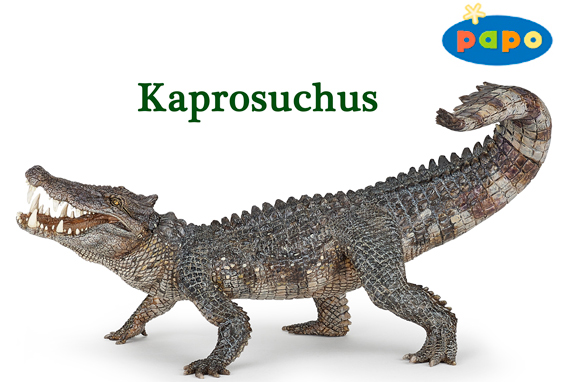
Papo Kaprosuchus model.

A spectacular Papo Kaprosuchus.

Picture credit: Everything Dinosaur

The picture (above) shows the Papo Kaprosuchus model.

To view the range of Papo prehistoric animal figures: Papo Prehistoric Animal Models.

4 07, 2017

JurassicCollectables Reviews the Rebor Carnotaurus

By |2023-07-29T15:40:59+01:00July 4th, 2017|Categories: Dinosaur Fans, Everything Dinosaur videos, Main Page|0 Comments

A Video Review of the Rebor Carnotaurus “Crimson King”

The latest JurassicCollectables video to be posted is a review of the spectacular “Crimson King”, the Rebor Carnotaurus (C. sastrei), 1:35 scale dinosaur model.  Rebor has continued to set the standard when it comes to 1:35 scale theropods and this new Carnotaurus joins Acrocanthosaurus, Ceratosaurus, Yutyrannus, Utahraptor, T. rex, Velociraptor and Deinonychus in the Rebor replica range.

JurassicCollectables Reviews the “Crimson King”

Video credit: JurassicCollectables

The Rebor Carnotaurus Model

In this short review, (the video lasts a fraction over six minutes), viewers are given the opportunity to have a really good look at this skilfully modelled South American dinosaur.  The narrator discusses various aspects of this dinosaur model.  For example, he points out the care and attention to detail revealed by the sculpted roof of the mouth and that amazing coloured tongue.  The articulated jaw and front limbs are demonstrated and the lava field base is also shown and commented upon.

To view the Rebor Carnotaurus replica “Crimson King” and the entire Rebor prehistoric animal model range: Rebor Dinosaur and Prehistoric Animal Replicas.

Carnotaurus – “Meat-eating Bull”

When the fossilised remains of a single, individual specimen was discovered in the mid 1980s, palaeontologists were very puzzled.  This theropod from Argentina, was unlike any other dinosaur that scientists had described at the time.  It ended up being assigned to its own family, the Abelisauridae, along with Abelisaurus (A. comahuensis).  The skin impressions, found in association with the Carnotaurus specimen, provided the researchers with some of the best-preserved dinosaur skin samples that had been discovered.

The blunt snout and the thin lower jaw suggested that this dinosaur had a unique hunting strategy.  The skull seemed too lightly built to cope with struggling prey, however, at an estimated eight metres in length, Carnotaurus was very probably an apex predator, although it can’t be ruled out that this dinosaur was a specialised scavenger, relying on the kills of other dinosaurs.  In the JurassicCollectables video, the Rebor Tenontosaurus corpse (Ceryneian Hind) is used to provide scale for the figure.

The Rebor Carnotaurus “Crimson King” Figure

Rebor Carnotaurus dinosaur model the "Crimson King".

Rebor Carnotaurus. Picture credit: Everything Dinosaur.

Picture credit: Everything Dinosaur

The genus name was erected as this dinosaur has two prominent horns above its eyes.  These horns stuck out sideways and reminded the scientists of the horns of a cow.  It is not known what these horns were for, it has been speculated that they could have shown maturity, or perhaps they played a role in visual displays.  Another theory put forward is that these horns protected the eyes during intraspecific combat.

The Rebor 1:35 Scale Carnotaurus Dinosaur Model (C. sastrei)

Rebor Carnotaurus dinosaur model.

Rebor “Crimson King” Carnotaurus dinosaur model.

Picture credit: Everything Dinosaur

Papo Brown Tyrannosaurus rex

The very informative JurassicCollectables video review also features the Papo Brown Tyrannosaurus rex model (standing T. rex figure), this replica is also used to provide scale and the Rebor Carnotaurus works very well alongside this Papo model.  Look out for “off colour Alan”, who makes his regular appearance.  A JurassicCollectables dinosaur model review would not be complete without an appearance of this figure!

To view the Papo dinosaur model range: Papo Dinosaur Models.

JurassicCollectables have a wonderful YouTube channel stuffed full of prehistoric animal model reviews and other very informative videos, including reviews of the Rebor Acrocanthosaurus replica and the Rebor Cerberus Clan (Deinonychus dinosaurs).

Visit the YouTube channel of Jurassic Collectables here: JurassicCollectables on YouTube don’t forget to subscribe to the JurassicCollectables channel, after all, some 55,000 dinosaur and prehistoric animal model fans already have!

Visit the Everything Dinosaur website: Everything Dinosaur.

2 07, 2017

Pterosaurs Are Not Dinosaurs – A Helpful Explanation

By |2024-04-01T10:27:05+01:00July 2nd, 2017|Categories: Dinosaur Fans, Educational Activities, Main Page, Teaching|0 Comments

Pterosaurs are not Dinosaurs

Perhaps the single most distressing thing we see during our visits to schools to delivery dinosaur and fossil themed workshops are the inaccuracies in teaching resources.  Many of the downloads and other learning resources that teaching teams rely on are simply wrong.  It is not the fault of the teachers, it is laziness on the part of the providers.

At Everything Dinosaur, we do all that we can to help educate and inform and we provide lots of lesson plans, dinosaur themed resources, teaching materials and so forth.  The Everything Dinosaur website provides help to teaching professionals and home educationalists.  There is a helpful blog crammed full of examples of good teaching practice when it comes to learning about life in the past.  In addition, we try our best to provide assistance and helpful advice.

The Everything Dinosaur website: Everything Dinosaur.

Inaccurate Dinosaur Themed Teaching Resources in Schools

Triceratops mistakes!

Triceratops? Not very good quality teaching resources. Picture credit: Everything Dinosaur.

Picture credit: Everything Dinosaur

The photograph above shows a typical dinosaur themed teaching resource that we come across in school.  We admit, that at Everything Dinosaur we do make mistakes from time to time “to err is human” and all that, but it is almost easier to state what is scientifically accurate in the picture above than to list the errors.  These are the sorts of dinosaur themed teaching materials that are used to help educate and inform.   We have serious concerns about the standards of such teaching materials.

Pterosaurs are not Dinosaurs

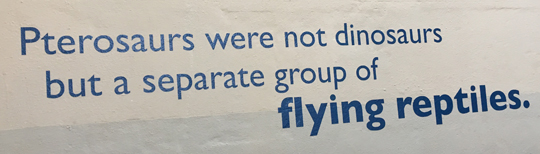
One of the commonest mistakes we find concerns the confusion as to what exactly is and what exactly is not a dinosaur.  At the “Dinosaurs of China” event at Wollaton Hall, one of the most significant items of information in the entire exhibition can be found painted onto a wall in one of the first-floor galleries leading to some of the exquisite feathered dinosaur fossils.

Pterosaurs Are Not Dinosaurs

Flying reptiles (Pterosauria) were not dinosaurs.

Pterosaurs are not dinosaurs. Picture credit: Everything Dinosaur.

Picture credit: Everything Dinosaur

The Pterosauria were not dinosaurs (members of the Dinosauria) but a separate, related order of flying reptiles.

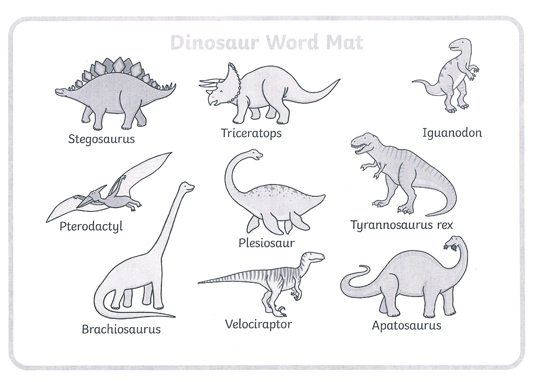
Everything Dinosaur team members have lost count of the number of times pterosaurs and for that matter, marine reptiles, have been included as dinosaurs.  Most children, with a degree of pre-knowledge, will be able to point out the errors in dinosaur themed “word mats” such as the one that we have posted below.

A Dinosaur Word Mat – Can You Spot the Mistakes?

A dinosaur word mat for schools with lots of mistakes.

A dinosaur word mat supplied by a school resources company – can you spot the mistakes?  Picture credit: Everything Dinosaur.

Picture credit: Everything Dinosaur

Providing Dinosaur and Fossil Themed Teaching Resources

During our latest school visit, we provided the teaching team (Reception and Key Stage 1), with Mary Anning themed resources, a pronunciation guide, a dinosaur geography exercise to help reinforce learning about the seven continents and a dinosaur song that we had written for use with Foundation Stage 2.  We were happy to help and these were all given away free.

For further information on Everything Dinosaur’s work in schools and to enquire about teaching resources: Contact Everything Dinosaur

1 07, 2017

Amazing Dinosaurs of China Exhibition Starts Today

By |2024-04-01T10:26:39+01:00July 1st, 2017|Categories: Dinosaur and Prehistoric Animal News Stories, Dinosaur Fans, Main Page, Press Releases|0 Comments

Dinosaurs of China Exhibition Opens

Six years in the planning, but finally the great day has arrived!  “Dinosaurs of China – Ground Shakers to Feathered Flyers” opens today, a once in a lifetime opportunity to get up close to some of the most remarkable, amazing and significant dinosaur fossils ever found.  Based in the beautiful Wollaton Hall, (Nottingham), with a complementary exhibit located at the nearby Lakeside Arts Centre, this not-to-be-missed exhibition runs from today until October 29th.

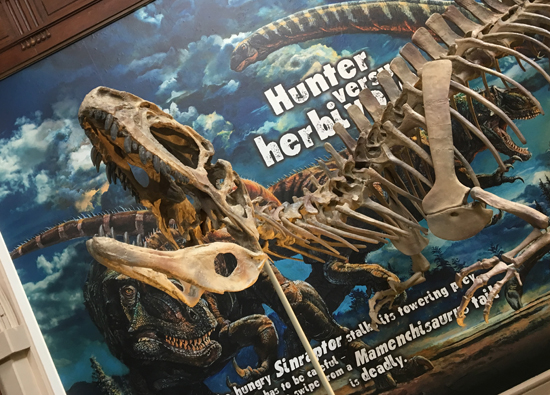
Ground Shakers like Sinraptor Welcome Visitors to the Exhibition

Sinraptor mounted skeleton.

Sinraptor dongi – fearsome Chinese theropod.  Picture credit: Everything Dinosaur.

Picture credit: Everything Dinosaur

For models and replicas of Chinese dinosaurs and other prehistoric animals: Dinosaur and Prehistoric Animal Models.
Evolution – Challenging Perceptions

This cleverly constructed exhibition features a total of twenty-six prehistoric species, plus a wealth of other exhibits and artefacts that tells the story of how one group of dinosaurs – the Maniraptora, evolved into the birds that live alongside us today.  There are lots of helpful information panels to help guide visitors and look out for the astonishing artwork that accompanies the fossils created by the famous Chinese palaeoartist Zhao Chuang.

Dr Adam Smith (Nottingham Natural History Museum and Exhibition Curator) and his team have skilfully contributed to the informative story-telling aspect of the exhibition by including a selection of fossils and other objects from the Nottingham Natural History Museum’s own collection – no mean feat in itself, as the museum is one of the largest dedicated natural history museums in the UK with over 750,000 items, including some 40,000 fossils.

Broadcaster and Naturalist Chris Packham with Dr Adam Smith Welcoming Visitors at the Press Day

The opening of the Dinosaurs of China exhibition.

Chris Packham and Dr Adam Smith speaking welcoming visitors at the press day. Picture credit: Everything Dinosaur.

Picture credit: Everything Dinosaur

With a lifelong passion for palaeontology, television presenter Chris Packham commented that he felt like “a kid in a sweet shop”.  For Chris, ground shakers such as the huge Mamenchisaurus skeleton, the tallest dinosaur exhibit ever seen in the UK, are simply awesome, but the real jaw-dropping moments are when you can get to see some of the exquisitely preserved fossils of feathered dinosaurs.  These remarkable fossils, most of which are more than 100 million-years-old, provide the “smoking gun”, as Chris so elegantly phrased it, linking the birds to the Dinosauria.

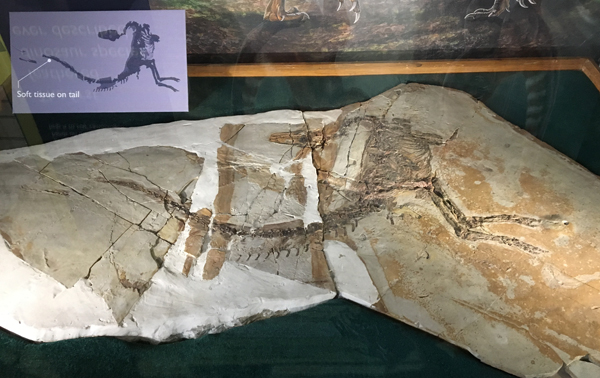
Sinosauropteryx – The First Feathered Dinosaur Ever Described

Sinosauropteryx fossil material.

Sinosauropteryx on display – the first feathered dinosaur described.  Picture credit: Everything Dinosaur.

Picture credit: Everything Dinosaur

To view the PNSO Dinosaur model range: PNSO (China) Age of Dinosaurs Models.

Discovery – A History of Chinese Palaeontology

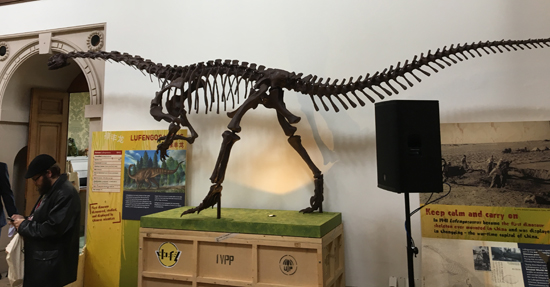
It is a case of “East meets West” with the Dinosaurs of China exhibition.  Some 250 different types of dinosaur have been named from Chinese fossils and several important specimens are on display, such as Lufengosaurus, the first dinosaur from China to be scientifically described.

One of the key themes of the Dinosaurs of China exhibition is to tell the story of Chinese palaeontology.  Thanks to the dedicated efforts of institutions such as the Beijing-based, Institute of Vertebrate Palaeontology and Palaeoanthropology (IVPP), a partner in this Anglo-Chinese joint-venture, visitors will be able to learn how our knowledge of prehistoric animals has been enriched thanks to amazing Chinese fossil discoveries.

Lufengosaurus – Early Jurassic Herbivore

Lufengosaurus huenei exhibit.

Lufengosaurus – the first Chinese dinosaur to be scientifically described.  Picture credit: Everything Dinosaur.

Picture credit: Everything Dinosaur

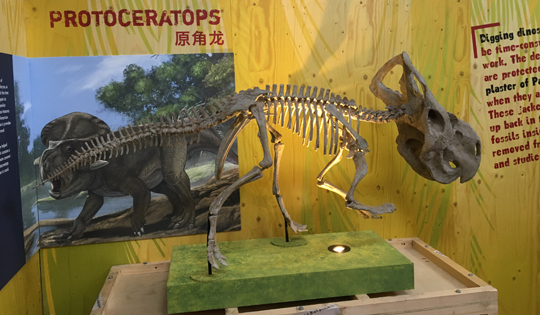
Several of the specimens featured are relatives of much better-known dinosaurs from North America.  American dinosaurs such as Triceratops may have a bigger profile with the general public  than their Asian ancestor Protoceratops, but to a palaeontologist, it is “first horned face” from Mongolia, that is the by far the most significant in terms of the amount of fossil material to study.  Protoceratops is the favourite dinosaur amongst Everything Dinosaur team members and it’s great to see it included as part of this most enjoyable exhibition.

Protoceratops – “The Sheep of the Cretaceous”

Protoceratops specimen.

Protoceratops – the favourite dinosaur amongst Everything Dinosaur team members.  Picture credit: Everything Dinosaur.

Picture credit: Everything Dinosaur

Dinosaurs of China – A Journey Through Time

Parents of young dinosaur fans will, no doubt, be informed that the majority of dinosaurs found on the ground floor date from the Jurassic.  In contrast, the exhibits found on the first floor feature Cretaceous prehistoric animals.  The displays have been carefully laid out so that the visitor is taken on a journey through geological time.  There is a transition from the Jurassic through to the Cretaceous, this helps to reinforce the idea that dinosaurs evolved into a myriad of different forms.

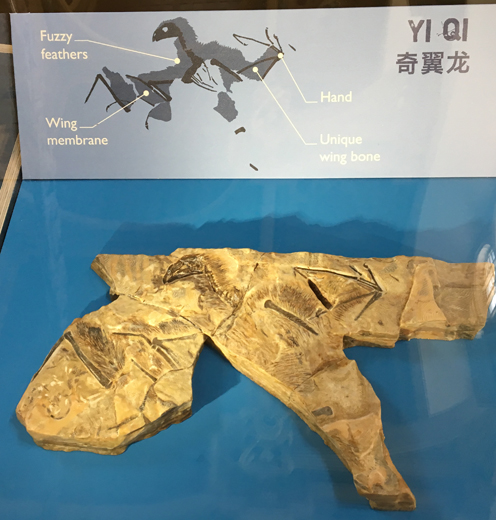
Check out the amazing Microraptor specimen and visitors will learn that this four-winged reptile was not the only flying dinosaur.  Take for example, the most recently described animal in the exhibition, the bizarre Yi qi (pronounced ee-chee), which was named just two years ago.  The three-dimensional replica on display preserves astonishing detail about this little Theropod.  The pigeon-sized Yi qi had downy feathers like a young bird, but wings that resembled those of a bat.  It probably was an accomplished glider.

The Three-dimensional Printed Replica of Yi qi

Yi qi Chinese dinosaur.

The bat-like theropod Yi qi. Picture credit: Everything Dinosaur.

Picture credit: Everything Dinosaur

To read more about Yi qi a dinosaur with webbed wings like a bat: Yi qi the Dinosaur that thought it was a Bat!

A spokesperson from Everything Dinosaur stated:

“This is a once in a lifetime opportunity to see fossils that have never been outside of Asia before.  “Ground Shakers to Feathered Flyers”, simply cannot be missed and it’s a real feather in Nottingham’s cap to be able to host such a prestigious exhibition.”

Visit the Everything Dinosaur website: Everything Dinosaur.

30 06, 2017

New Research Outlines the Origin of Filter Feeding in Whales

By |2024-04-01T10:25:37+01:00June 30th, 2017|Categories: Dinosaur and Prehistoric Animal News Stories, Dinosaur Fans, Main Page|0 Comments

Coronodon havensteini – An Important Transitional Fossil

The classification and evolutionary history of whales has been a source of fascination for many scientists.  It was the famous Swedish biologist, Carl Linnaeus, who in 1758, defined whales as mammals and not fish.

Charles Darwin speculated on the origins of whales (Cetacea), if we at Everything Dinosaur recall correctly, Darwin proposed that whales and their smaller cousins, the dolphins and porpoises had a terrestrial ancestor, but the exact evolutionary history of this diverse group of vertebrates has yet to be fully unravelled.  Step forward, the newly described Coronodon havensteini, the premolars and molars of this Oligocene-aged toothed whale have provided tantalising evidence suggesting how filter feeding in whales evolved.

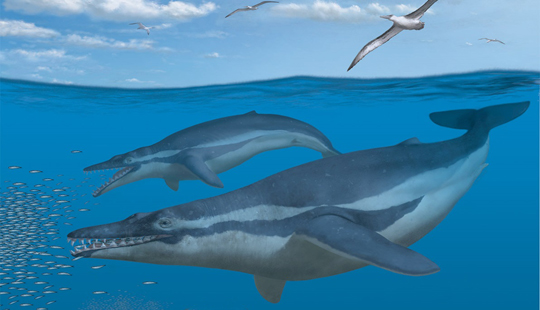
Coronodon havensteini Hunting Fish

C. havensteini feeding.

An illustration showing two Coronodon havensteini specimens chasing a school of small fish.

Picture credit: Alberto Gennari

The picture above depicts a scene off the south-eastern United States some thirty million years ago (Oligocene).  A pair of Coronodon pursue a shoal of fish, whilst above, some toothed birds (Pelagornis sandersi), circle in the hope of picking off any injured fish that come to the surface.

Different Types of Whale – Different Types of Feeding

Although, all whales share a common ancestor, a terrestrial ancestor with teeth that hunted prey (raptorial behaviour), over the fifty million years or so, since the first ancestral whales, three main feeding strategies have evolved.

  1. Odontoceti – the toothed whales the most specious component of the Cetacea consisting of Sperm whales, the Beluga, dolphins, Orcas and porpoises.
  2. Suction feeders – within the Odontocetes, a number of genera have utilised their large, broad jaws and big skulls to help them suck prey into their mouths.  Examples include many of the beaked whales and the bizarre Narwhal.
  3. Mysticeti – the baleen whales, much less diverse and specious when compared to the Odontoceti, these are the filter feeders and as such, they include the largest vertebrates to have ever existed, leviathans like the Blue whale (Balaenoptera musculus) and the Humpback (Megaptera novaeangliae).

Whilst scuba diving in South Carolina’s Wando River on the hunt for sharks’ teeth, geologist Mark Havenstein came across the well-preserved skull of an ancient toothed whale, one that seems to be a transitional fossil between raptorial toothed whales and the evolution of filter feeding cetaceans.

The Evolution of Baleen – Keratinous Sieves

Scientists from the Mace Brown Museum of Natural History, Charleston, South Carolina (where the holotype material currently resides), along with colleagues from the New York Institute of Technology College of Osteopathic Medicine (New York), prepared and restored the fossil, a subsequent study of the teeth indicates that this prehistoric whale, named Coronodon havensteini was starting out on an evolutionary path that would eventually lead to functional filter feeding.

The Restored Skull of the Oligocene Whale Coronodon havensteini

The restored skull of Coronodon.

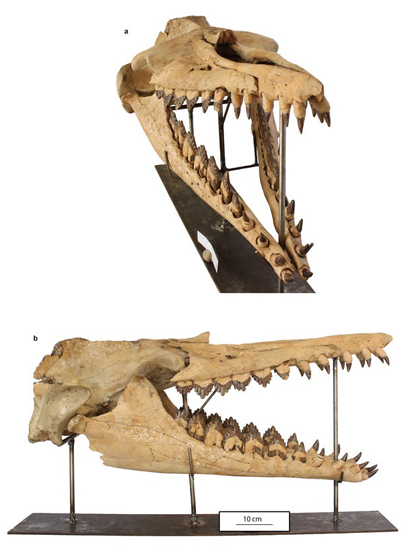
Two views of the restored Coronodon skull (a) oblique anterior view and (b) right lateral view.

Picture credit: Geisler et al (Current Biology)

Coronodon havensteini

Writing in the academic journal “Current Biology”, the researchers propose that Coronodon represents the most basal member of the baleen whales (Mysticeti) found to date.  The teeth at the front of the jaws are conical, pointed and demonstrate procumbent dentition (the teeth in the front of the jaw point forward, ideal for spearing slippery fish).  These teeth indicate a piscivorous diet, that Coronodon actively hunted its prey (raptorial behaviour).  However, a detailed analysis of the huge molars at the back of the jaws revealed something remarkable.

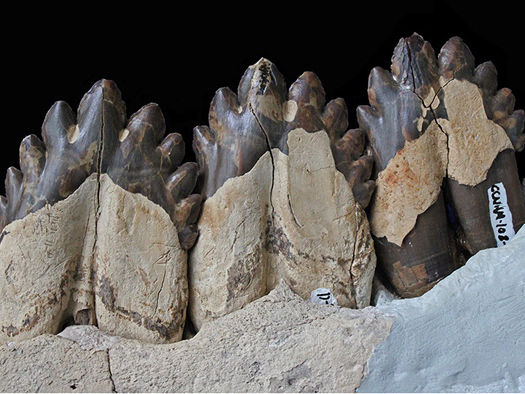
The molars show very little signs of wear from shearing or cutting up food, instead these teeth may have served as simple sieves to sift out smaller prey items from seawater.  The broad, multi-cusped molars frame narrow slits and wear patterns on the cusps indicate a role in filter feeding.

This suggests that the Mysticeti evolved their baleen plates whilst they retained their teeth and that baleen did not evolve in the mouths of Odontocetes that specialised in suction feeding and as a result, lost their teeth.

The Specialised “Filtering Teeth” of Coronodon havensteini

Coronodon havensteini molars.

The molars of C. havensteini acted as simple filters.

Picture credit: Geisler et al (Current Biology)

Commenting on the implications for their discovery, lead author of the research paper, Associate Professor Dr Jonathan Geisler (College of Osteopathic Medicine, New York Institute of Technology), stated:

“The transition from teeth to baleen is widely contested, but our research indicates that ancient toothed whales relied on the spaces between their complex and enormous teeth for filtering.  It appears that over millions of years, the teeth were retained until baleen became sufficiently large and complex to take over the role of filter feeding.”

Giant Filter Feeders

The newly erected genus name Coronodon comes from the Greek for “crown tooth”, a reference to the multi-cusped molars that indicate filter feeding.  The species name honours Mark Havenstein who found the holotype.  The researchers suggest that later lineages of ancestral Mysticetes relied on specialised molars to act as functional sieves with baleen evolving in the mouth too.  At some point in the evolution of these whales a “tipping point” was reached with a shift from mostly teeth to mostly baleen in the jaw.

The bristle-like baleen of extant filter feeding whales is made from keratin, it hangs from the upper jaw and acts like a giant sieve, straining out tiny food particles such as krill.

The researchers conclude that Coronodon havensteini lends weight to the idea that filter feeding was preceded by raptorial, predatory behaviour and that suction feeding evolved separately.

The scientific paper: “The Origin of Filter Feeding in Whales” by Jonathan H. Geisler, Robert W. Boessenecker, Mace Brown, Brian L. Beatty published in the journal “Current Biology”

Visit the Everything Dinosaur website: Everything Dinosaur.

29 06, 2017

JurassicCollectables Reviews the New Mojo Fun Red Hunting T. rex

By |2024-04-01T10:25:06+01:00June 29th, 2017|Categories: Dinosaur Fans, Everything Dinosaur Products, Everything Dinosaur videos, Main Page, Product Reviews|0 Comments

Mojo Fun Red Hunting T. rex Reviewed by JurassicCollectables

In a first for the YouTube channel of JurassicCollectables, a video review of a Mojo Fun dinosaur model has been posted up.  The figure reviewed is the new for 2017, Mojo Fun red hunting Tyrannosaurus rex and in this brief video (it lasts around four minutes), dinosaur fans are given a guided tour of one of the newest models in the Mojo Fun “Prehistoric & Extinct” range.

Reviewing a Mojo Fun Dinosaur Model

The company was founded in 2009 and the range of figures and replicas has grown steadily ever since.  Today, there are over thirty models in the Mojo Fun “Prehistoric & Extinct” series and it is fitting for JurassicCollectables to start their association with this company by producing a video review of one of the hunting T. rex dinosaur models, as these figures are proving to be very popular with Everything Dinosaur’s customer base.

Although, this video review focuses on “red”, a number of Papo dinosaurs feature, helping to provide a useful comparison.  Also, look out for a regular appearance by “off-colour Alan”, he even tries riding on the back of the Mojo Fun model.

The Mojo Fun Hunting T. rex (Red) Video Review by JurassicCollectables

Video credit: Jurassic Collectables

A Dinosaur Video Review

In the short video, the narrator guides the viewer through the details that can be seen on this carefully sculpted replica.  These videos are a great way for dinosaur model fans to learn about new collections.  JurassicCollectables takes great care to show the figure from numerous angles.  It is really helpful to have a 360-degree view.

JurassicCollectables have a brilliant YouTube channel crammed full of prehistoric animal model reviews and other very informative videos.  They have just achieved 55, 000 subscribers, that’s a fantastic achievement, our congratulations to the team.

Visit the YouTube channel of JurassicCollectables here: JurassicCollectables on YouTube , Everything Dinosaur recommends that dinosaur model fans subscribe to the JurassicCollectables channel.

The Mojo Fun “Prehistoric & Extinct” Hunting Tyrannosaurus rex Model

Mojo hunting Tyrannosaurus rex. A Mojo Fun dinosaur model.

Mojo hunting T. rex dinosaur model.

Mojo Fun Prehistoric and Extinct Figures

Mojo Fun has produced several Tyrannosaurus rex figures, the range includes a juvenile T. rex plus a 1:40 scale version, along with a green painted, hunting T. rex figure.

To see these Tyrannosaurs and the rest of the Mojo Fun “Prehistoric and Extinct” range at Everything Dinosaur: Mojo Fun Prehistoric and Extinct Animals.

In the JurassicCollectables video, the narrator explains the colour scheme on the figure and highlights the fine details of the skin texture.  It certainly is a fearsome looking dinosaur with its huge jaws and vicious teeth.

Our thanks to JurassicCollectables for this super video review and we look forward to viewing more Mojo Fun model reviews in the near future.

To read Everything Dinosaur’s article published earlier this month announcing the arrival of the new Mojo Fun range: Everything Dinosaur Adds Mojo Fun Models.
For a recently published article that challenges the idea of a feathered T. rexHas a Dinosaur Shed its Feathers?

Visit the Everything Dinosaur website: Everything Dinosaur.

28 06, 2017

The New Rebor Carnotaurus Dinosaur Model Reviewed

By |2024-04-01T10:24:36+01:00June 28th, 2017|Categories: Dinosaur Fans, Everything Dinosaur Products, Main Page, Photos of Everything Dinosaur Products, Product Reviews|0 Comments

Rebor “Crimson King” Carnotaurus Model Reviewed

Rebor’s latest addition to their 1:35 scale model range is the “Crimson King”, a replica of Carnotaurus (C. sastrei), a large carnivorous dinosaur from the Late Cretaceous of Argentina.  The model has an articulated lower jaw and is supplied with its own base, a representation of a lava field.

The Rebor Carnotaurus Figure “Crimson King”

The Rebor Carnotaurus dinosaur model.

The Rebor Carnotaurus dinosaur model “Crimson King”. Picture credit: Everything Dinosaur.

Picture credit: Everything Dinosaur

Abelisaurids versus Tyrannosaurids

Carnotaurus is a member of the dinosaur family called the Abelisauridae.  In fact, it was the discovery of the Carnotaurus holotype material, a partial skeleton of a single individual that led to the reaffirmation of this new dinosaur family.

South American scientists, trying to build up their knowledge about strange Upper Cretaceous carnivorous dinosaurs of Argentina had not discovered anything like Carnotaurus before, so this thin-snouted, lightly built, horned carnivore was assigned to its own unique theropod family along with Abelisaurus (A. comahuensis).  Since then, a number of abelisaurids have been described from Africa, including Madagascar, elsewhere in South America and also, potentially from Europe (Tarascosaurus).

In general terms, towards the end of the Cretaceous, the tyrannosaurids were the dominant, apex predators in the Northern Hemisphere, whereas in the Southern Hemisphere, it seems to have been the Abelisauridae that held sway.

Congratulations to Rebor

Rebor are to be congratulated for introducing another type of theropod dinosaur into their scale model range.  The head is quite beautifully painted and there are lots of details to admire.  The jaw can be a little difficult to open, but a quick “dunk” in a cup of hot water should heat up the plastic enough to allow free movement.  Once the jaw is opened that marvellous painted tongue can be seen.  It reminds us of the tongue of a lizard.

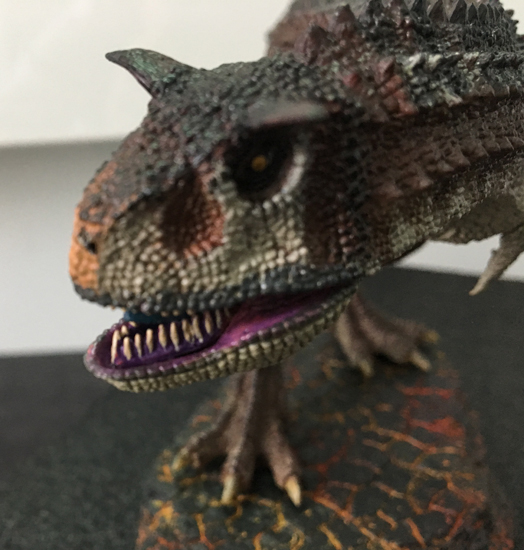
A Close View of the Head and Jaws of the Rebor Carnotaurus Model

The Rebor Carnotaurus dinosaur model.

The Rebor “Crimson King” Carnotaurus replica.  Picture credit: Everything Dinosaur.

Picture credit: Everything Dinosaur

In the picture above, you can clearly make out the horns over the eye-socket, the anatomical feature that was the inspiration for the Carnotaurus genus name – “meat-eating bull”.  As with Rebor, the skull has some lovely details and we like the skin texture, after all, the original Carnotaurus fossil material had skin impressions associated with it.

To view the entire Rebor model range, including the “Crimson King” dinosaur model: Rebor Prehistoric Animal Replicas.

Wonderful Skin Texture on the Rebor Model

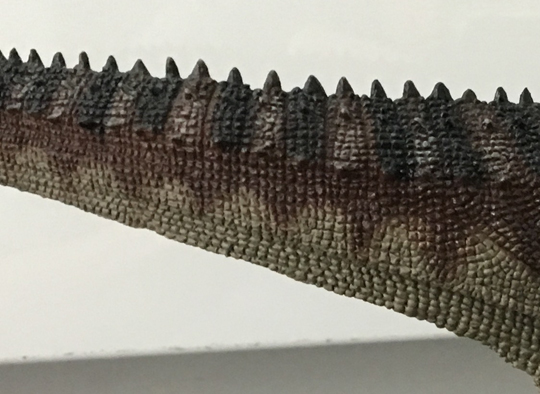
A lot of care has gone into the sculpting of this dinosaur model.  The skin impressions found indicate that this dinosaur had a scaly skin, covered in irregular scales, Rebor has taken considerable care to reproduce an appropriate skin tone and texture.

A Close View of the Tail of the Rebor Carnotaurus

The tail of the Rebor Carnotaurus.

The Rebor “Crimson King” tail (right lateral view).  Picture credit: Everything Dinosaur.

Picture credit: Everything Dinosaur

Fast Theropod Dinosaur

Research undertaken (Currie and Persons, 2011), suggests that the tail was adapted to permit a larger, more powerful musculature than that found in other equally sized theropods.  This built on earlier research which looked at the biomechanics of the Carnotaurus hind limbs.  These studies support the idea that this dinosaur was a fast runner, perhaps capable of bursts of speed in excess of fifty kilometres an hour (thirty mph).  The legs of this Rebor replica certainly look powerful and the model is very stable on its well sculpted toes.

A Lean and Powerful Apex Predator (Carnotaurus sastrei)

Rebor Carnotaurus dinosaur model the "Crimson King".

Rebor Carnotaurus.  Picture credit: Everything Dinosaur.

Picture credit: Everything Dinosaur

The Rebor “Crimson King” is a very welcome addition to the range of Rebor prehistoric animal replicas.  It is often the little details that impress the team members here at Everything Dinosaur.  For example, on the base there is an illustration of the skeleton of Carnotaurus.   The cervical vertebrae are beautifully drawn.   It is these little touches that endears the Rebor range to dinosaur fans and model collectors alike.

The Base of the Rebor Carnotaurus Dinosaur Model (“Crimson King”)

The base of the Rebor "Crimson King".

The base of the Rebor Carnotaurus replica with a geological ruler to provide scale.  Picture credit: Everything Dinosaur.

Picture credit: Everything Dinosaur

Visit the Everything Dinosaur website: Everything Dinosaur.

27 06, 2017

Smallwood Academy Study Dinosaurs as Part of Exciting Term Topic

By |2024-04-01T10:24:09+01:00June 27th, 2017|Categories: Educational Activities, Main Page, Teaching|0 Comments

Dinosaur Drawings and Super Spelling

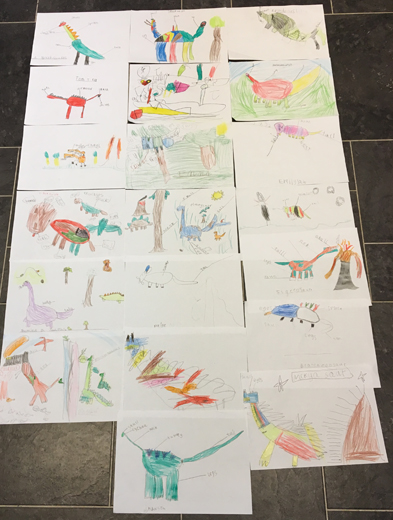
A day of dinosaur workshops with the Key Stage 1 children and the Reception class at Smallwood CofE Primary Academy in Cheshire and what a busy day it was too.  Under the enthusiastic tutelage of the dedicated teaching team, the children in Ash, Elm and Willow classes have been learning all about prehistoric animals and famous fossil hunters such as Mary Anning.

Several of the children had brought in their own fossil finds to show their classmates.  The children’s splendid fossils are not quite as big as the “gigantic”, “giant”, “humongous” Jurassic ammonites that our dinosaur expert took into school.  However, we are sure that the fossils that the children brought in will help to enrich this exciting term topic.  After explaining how fossils formed, there was lots of fossil handling and plenty of opportunities for the pupils to try out some super describing words.

Ash Class (Year 1) Design Dinosaurs

Year 1 dinosaur designs.

Year 1 children design dinosaurs.  Picture credit: Everything Dinosaur.

Picture credit: Everything Dinosaur

Extension Activities

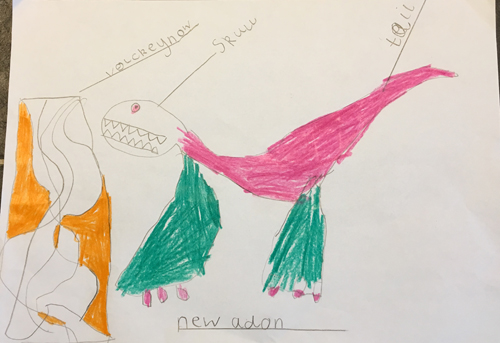
One of the extension activities involved challenging the class to design their own prehistoric animals.  Could the pupils label the body parts including the skull?  Could they come up with a name to describe their very own dinosaur?  Having worked with the Key Stage 1 classes in the morning, during the lunch break, our dinosaur expert was handed a selection of the drawings from the budding young palaeontologists in Ash class (Year 1) – what a colourful collection of dinosaurs!

A Pink and Green Dinosaur from Florence

A colourful dinosaur design.

Florence (Ash class) designed a very colourful dinosaur.  Picture credit: Everything Dinosaur.

Picture credit: Everything Dinosaur

New Dinosaur Discoveries

At Everything Dinosaur, we keep a register of newly described and named dinosaurs.  On average, a new dinosaur is named every three weeks and so far around 1,200 different genera have been erected – there are certainly lots of amazing dinosaurs to help inspire the children with their very own dinosaur designs.  We even emailed over to the teaching team a fact sheet and scale drawing of one dinosaur (Maiasaura), could the children work out from the drawing and fact sheet what Maiasaura ate?

Aimee Drew an “Apartesarrs”

A long-necked dinosaur drawaing.

A beautiful dinosaur drawing from Aimee.

Picture credit: Everything Dinosaur

For dinosaur toys and games: Dinosaur Toys and Gifts.

Amazing Questions

Elm class (Year 2), had thought of some brilliant questions to ask and in the afternoon, we met up with the enthusiastic Reception class (Willow) and our dinosaur expert was introduced to Oliver – Willow’s resident dinosaur expert.

A very big thank you to the children for producing such a wonderful collection of dinosaur drawings and our thanks to the teaching team at Smallwood CofE Primary Academy for inviting Everything Dinosaur into the school.

Visit the Everything Dinosaur website: Everything Dinosaur.

Go to Top