All about dinosaurs, fossils and prehistoric animals by Everything Dinosaur team members.
17 07, 2017

The Excellent Dinosaurs of China Exhibition Reviewed

By |2024-04-01T14:06:04+01:00July 17th, 2017|Categories: Dinosaur and Prehistoric Animal News Stories, Dinosaur Fans, Educational Activities, Main Page, Teaching|6 Comments

A Review of the Dinosaurs of China Exhibition by Thomas Clarke-Williams

Budding young palaeontologist and all-round dinosaur enthusiast Thomas, very kindly sent in a review with photographs of The Dinosaurs of China exhibition to Everything Dinosaur.

Thomas Outside the Splendid Wollaton Hall

Thomas Clarke-Williams at Wollaton Hall.

Thomas, all ready to explore the Dinosaurs of China exhibition.

Picture credit: Thomas Clarke-Williams

Here is his review….

The Dinosaurs of China exhibition, at Wollaton Hall and Nottingham Lakeside Arts is an amazing, informative, fun, enjoyable and a one-off experience that I highly recommend for all ages.  I particularly enjoyed the Mamenchisaurus and Sinraptor skeletons as they give you a fantastic insight to how big some dinosaurs really were.  It was a nice touch to add a mirror next to the towering display so people can become fully immersed with the size of the whole animal.  I also like how you can go up to the banisters and look down on most of the Mamenchisaurus and the Sinraptor, it adds to the shock and awe of how large these dinosaurs really were.

The Enormous Mamenchisaurus on Display
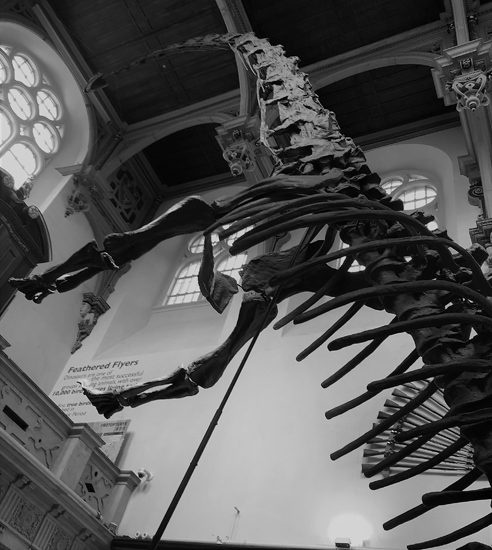
Mamenchisaurus on display.

The rearing Mamenchisaurus dinosaur exhibit.

Picture credit: Thomas Clarke-Williams

The art on the walls and in the book, was captivating and amazing to look at.  It helped you to imagine these dinosaurs were alive and moving around, just like they did millions of years ago.  One helpful feature to viewers was the information plaque next to each exhibit.  They included a variety of important facts which were then repeated in the books.

Spectacular Artwork Helps to Bring the Dinosaurs to Life

Artwork by Zhao Chuang (PNSO).

Amazing artwork by Zhao Chuang (PNSO).

Picture credit: Thomas Clarke-Williams

View the PNSO Age of Dinosaurs model range: PNSO Age of Dinosaurs.

Something that I did notice is that the Dilophosaurus sinensis and the Alxasaurus are housed in a separate building.  Unfortunately, this separate building is not labelled very clearly in my opinion, and some people, such as myself, missed this part of the exhibition entirely.

Nottingham Lakeside Arts – Well Worth a Visit

All I can say is, when you go, make sure not to miss the Nottingham Lakeside Arts building, it’s well worth visiting.  I also recommend going simply because the exhibition organisers connected the displays at Wollaton Hall with the exhibition displays for a fun experience where you’re constantly switching between modern day and prehistoric times which adds to the experience.  The paleoart used for each exhibit was beautifully done and helps the viewers to see what the dinosaurs may have looked like when they were alive.

Helpful Information Panels Throughout the Exhibition
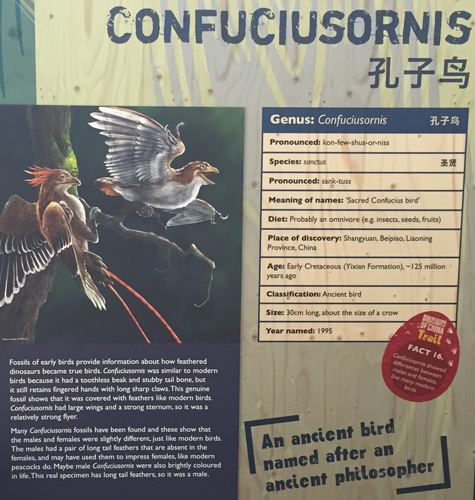
Confuciuosornis information panel

Helpful and informative display panels throughout the exhibition.

Picture credit: Thomas Clarke-Williams

The book, which you can pick up and buy from the entrance to the exhibition, is packed with detail and amazing art of the creatures.  The front cover shows the world where Microraptor and Sinornithosaurus lived, which gives a great insight into the lives of dinosaurs right from the start.  Some of the really in-depth facts are missed but it’s only minor as the average person does not need to know all the “nitty gritty stuff” like how a type specimen of Dilong is possibly a juvenile, or the fact that Linheraptor is actually smaller than Velociraptor.  But these minor details are insignificant to the overall presentation of the exhibition.

Birds from the Mesozoic in the Dinosaurs of China Exhibition

Using Chinese and Asian Dinosaurs is, in my opinion, the best way of getting people to understand how dinosaurs evolved into birds, as many of the dinosaurs at the exhibition have feathers and some could even glide.  I also like the inclusion of three Mesozoic-aged birds Yanornis, Confuciusornis and Protopteryx.  A pterosaur (Wukongopterus), was used to show the differences between the two lineages.

Genuine Fossil of a Prehistoric Bird
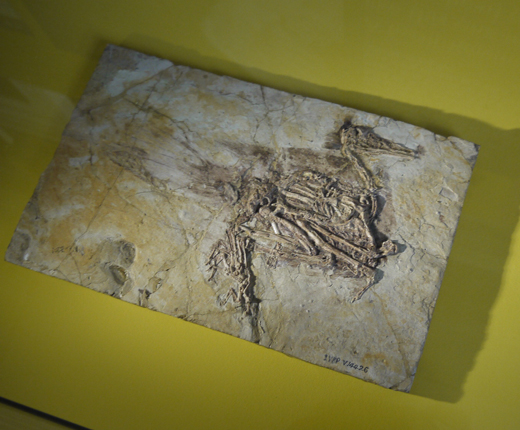
Yanornis fossil on display.

A genuine fossil of a Cretaceous bird (Yanornis martini).

Picture credit: Thomas Clarke-Williams

Another useful feature that was included on both the information boards, and in the book, tells you how to pronounce the names.  For example, “Yi qi” is pronounce ‘ee chee’.  Another helpful feature was the inclusion of what the name actually means.  A point that may prove interesting to viewers is the comparison on the wall and in the book of some of the Chinese dinosaurs to some American and European dinosaurs.  The fact that Lufengosaurus is included helps people viewing the exhibition to get a good view of where titans such as Mamenchisaurus came from, the dinosaurs they used to dwarf, and it makes you wonder how a 5 to 9-metre-long dinosaur turned into a 23-metre-long one!

Towering Over You the Giant Mamenchisaurus Skeleton
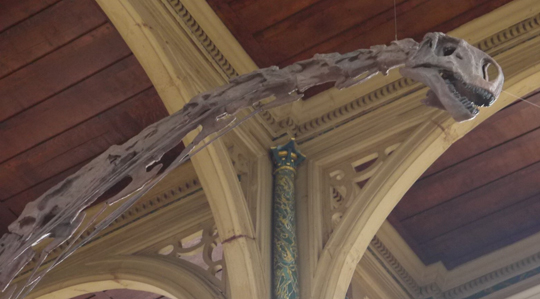
Mamenchisaurus on display.

The head and neck of the immense Mamenchisaurus.

Picture credit: Thomas Clarke-Williams

More Theropod Dinosaurs Please

Personally, I would have liked for a wider selection of dinosaurs to be on display but that’s just me!  I would have liked the awesome and terrifying Yutyrannus and Sinotyrannus to have been there together as they are large, fearsome, but interesting and in the case of Yutyrannus, beautifully feathered.  Both Chinese tyrants would have made for an excellent exhibit with the two locked in a fierce rivalry with one another.

The Dinosaurs of China Exhibition

It would have also been cool if Therizinosaurus made an appearance too, since he is quite popular with his huge claws that would have made for another amazing exhibit.  The theme used for the event sums up what the exhibition is about perfectly, “Ground shakers to feathered flyers”, the transition between prehistoric dinosaurs into modern day ones.  The inclusion of the fake Archaeoraptor fossil is a fun learning experience showing what some people are capable of doing to fossils.  The fake fossil has the tail of Microraptor, the legs of an unknown animal, and the head and body of a Yanornis, a complete hybrid!

In conclusion, The Dinosaurs of China Exhibition was a great, amazing and enjoyable learning experience for the whole family to enjoy and immerse themselves in and a one-off experience too.  To miss the exhibition would be a real shame, so come to Nottingham to Wollaton Hall and Nottingham Lakeside Arts as fast as you can to meet some of the amazing dinosaurs of Mesozoic China before it’s too late!

Meet Some Amazing Dinosaurs!
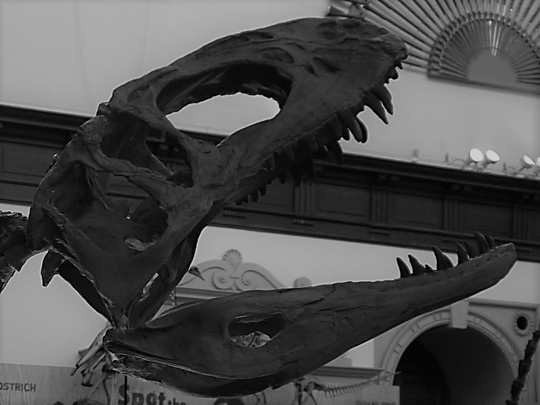
Sinraptor - Theropod dinosaur.

The powerful jaws of Sinraptor.

Picture credit: Thomas Clarke-Williams

Written by: Thomas Clarke-Williams

Visit the Everything Dinosaur website: Everything Dinosaur.

16 07, 2017

A Unique Tupuxuara Illustration

By |2024-04-01T14:05:28+01:00July 16th, 2017|Categories: Dinosaur Fans, Educational Activities, Everything Dinosaur Products, Main Page, Teaching|0 Comments

Flying Reptile Fan Asks for a Tupuxuara Scale Drawing

In our bulging email inbox this week, we received a request from an avid fan of prehistoric animals for some more information about the large Early Cretaceous pterosaur called Tupuxuara.  We don’t get too many requests related to this, one of the more bizarre members of the Pterosauria, but as ever, our hard-working team members were happy to oblige.  A scale drawing accompanied by a fact sheet on this flying reptile, fossils of which are known from north-eastern Brazil, was promptly sent out.  We were happy to send out the information and a Tupuxuara scale drawing.

A Scale Drawing of the Bizarre Crested Tupuxuara (T. leonardii)

A scale drawing of Tupuxuara

Tupuxuara scale drawing.  Picture credit: Everything Dinosaur.

Picture credit: Everything Dinosaur

How to Pronounce Tupuxuara

This flying reptile was named after a spirit figure in the folklore of the people who live in the area of Brazil where the fossils come from.  Our emailer wanted clarification on how to pronounce the name of this prehistoric animal.  As far as we are aware, this pterosaur is pronounced “Too-pooh-hwar-ah”.  There are several species assigned to this genus, the second species to be named T. leonardii honours Father Giuseppe Leonardi, who did much to improve our understanding of the fossils associated with the Araripe Basin of Brazil.

Tupuxuara is popular amongst model collectors and we have received some super pictures of the Papo Tupuxuara model being used in various prehistoric animal dioramas.

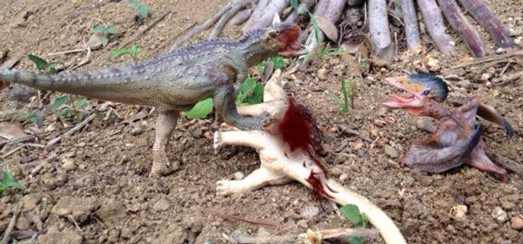
Tupuxuara in a Prehistoric Scene

Tupuxuara diorama.

Tupuxuara confronts a Carnotaurus.

Picture credit: Rodriguez

This member of the Thalassodromidae family of pterosaurs, was quite a sizeable beast.  Some of the largest specimens had wingspans in excess of four metres. As to what this flying reptile ate, this is open to speculation but palaeontologists have suggested various diets including fruit eating (frugivore) or even scavenging the kills of dinosaurs.  The picture above shows a Tupuxuara challenging a large Theropod (Carnotaurus) over the carcass of a Titanosaur.  This is a fascinating model composition and it demonstrates how popular Tupuxuara is with dinosaur fans and model collectors.

Papo have produced a Tupuxuara replica, to see this model as well as the complete range of Papo prehistoric animal figures available from Everything Dinosaur: Papo Dinosaurs and Prehistoric Animal Models

At Everything Dinosaur, we try our best to help all those people who contact us.  We try to answer all the questions and queries that we receive quickly and in full.  We respond to all those emails, letters and phone calls that require a reply.

Visit our award-winning website: Everything Dinosaur.

15 07, 2017

Outstanding and Excellent Feefo Reviews Come Thick and Fast

By |2024-04-01T14:06:57+01:00July 15th, 2017|Categories: Dinosaur Fans, Everything Dinosaur News and Updates, Main Page, Press Releases|0 Comments

4.9 Stars for Everything Dinosaur

Everything Dinosaur keeps on picking up rave reviews from customers.  We have received hundreds of FEEFO service and product reviews since our new website was able to accommodate the FEEFO review platform a few months ago.  Over the last four months or thereabouts, Everything Dinosaur has established and maintained a top FEEFO rating, both for our customer service and also for our products.

Everything Dinosaur FEEFO Reviews

Feefo service rating for Everything Dinosaur 100%.

Everything Dinosaur’s current service rating (June 2017) = 100%.

Picture credit: Everything Dinosaur

The company has received over 160 customer service reviews and Everything Dinosaur is currently rated 4.9 out of 5 stars.

The Latest Customer Feefo Reviews

Ryan H. wrote:

“Everything Dinosaur has the greatest selection of dinosaur models, as well as great customer service.  I have ordered from them at least half a dozen times, and will continue to do so.  Mike and Sue are very friendly, and always give prompt and courteous responses to any inquiries I ever have.”

We even received several emoji “thumbs up” – our thanks to Ryan.

Aphisit simply said:

“Good product and good service”.

Whilst Gastón provided the following feedback:

“Great transaction… They were friendly with me, every time that I buy something with them, they sent me the items fast and carefully.  Until today I haven’t been disappointment with the service…. Thanks!!!”

A spokesperson from Everything Dinosaur commented:

“We are truly grateful for all the feedback that we receive, especially from those customers who don’t have English as a first language.  We are really chuffed to be awarded such consistently high marks by our customers for our service and for our dinosaurs.”

Visit the award-winning Everything Dinosaur website: Visit Everything Dinosaur.

14 07, 2017

The New Conquering the Earth Schleich T. rex

By |2023-08-07T10:20:52+01:00July 14th, 2017|Categories: Dinosaur Fans, Everything Dinosaur News and Updates, Everything Dinosaur Products, Main Page, Product Reviews|0 Comments

Conquering the Earth Schleich T. rex Dinosaur Model

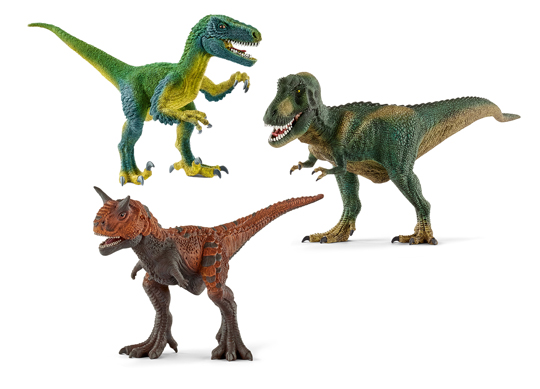
The three new Schleich models have just arrived.  These dinosaurs, come from the company’s “Conquering the Earth” replica range.  The models are Tyrannosaurus rex, a Carnotaurus and a model of a Velociraptor.  These are all dinosaurs that the Germany-based company has modelled on previous occasions.  For example, several Velociraptor figures are currently available and Schleich’s history of making Carnotaurus and T. rex replicas can be traced all the way back to the early days of the long retired “Saurus” series.  In this blog post we take a closer look at the Schleich T. rex dinosaur model.

Just in Stock at Everything Dinosaur – Three New Schleich Dinosaurs

Dinosaur models from Schleich.

Three new dinosaur figures from Schleich.

Schleich Dinosaurs – Tactile, Creative Play

Over the last few years, Schleich have largely focused on producing very colourful dinosaur models, which are stylistic and aimed at young dinosaur model fans.  An emphasis has been placed on creating models that have textured skins and a distinctive tactile quality.  The models have earned praise from teachers and home educationalists as these dinosaurs are great for kinaesthetic-themed sensory play.

At Everything Dinosaur, our teaching team have recommended a number of these replicas to one-to-one teachers and teaching assistants to help children learn more about the properties of materials through sensory exploration.  The big broad feet provide no stability problems and these models are very useful for helping children to develop their co-ordination and manipulating skills.

To read an article about the merits of a Schleich Brachiosaurus dinosaur model when it comes to sensory play: The Tactile Nature of the Schleich Brachiosaurus Model.

A nod is given in the direction of some of the latest research, hence the feathers on the forearms of the latest Velociraptor figure.  All the models are robust and sturdy and they stand up well to even the most enthusiastic play of your typical Foundation Stage or Key Stage 1 young palaeontologist.

The Schleich T. rex Dinosaur Model

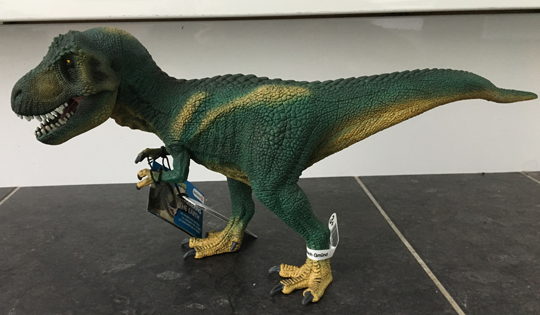
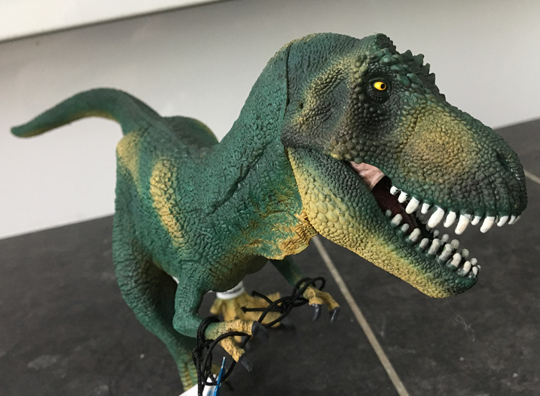
The Schleich Conquering the Earth Tyrannosaurus rex Dinosaur Model

Schleich T. rex dinosaur model.

The Schleich Conquering the Earth T. rex dinosaur model. Picture credit: Everything Dinosaur.

Picture credit: Everything Dinosaur

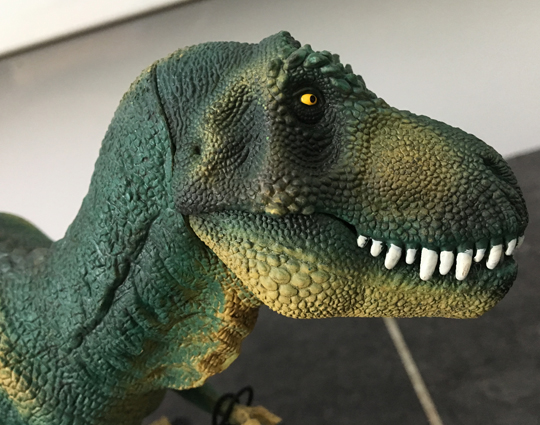
The picture below shows a close-up view of the head of the Schleich Conquering the Earth T. rex replica.

Conquering the Earth Schleich Tyrannosaurus rex Dinosaur Model (Summer 2017)

Schleich Conquering the Earth T. rex model.

A close look at the head of the Schleich Conquering the Earth T. rex dinosaur model. Picture credit: Everything Dinosaur.

Picture credit: Everything Dinosaur

The picture above shows the different textures on the skin of this dinosaur model.  All three of these recently introduced replicas have articulated lower jaws.

To view the range of Schleich prehistoric animal figures available from Everything Dinosaur: Schleich Dinosaurs and Prehistoric Animals.

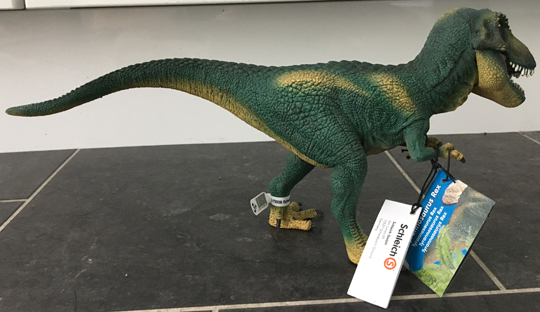
Another View of the Schleich Conquering the Earth Dinosaur Model (T. rex)

Schleich T. rex dinosaur model.

Conquering the Earth Schleich T. rex model. Picture credit: Everything Dinosaur.

Picture credit: Everything Dinosaur

Flashes of Yellow in the Schleich T. rex dinosaur model

The model has been painted in a dark green colour.  However, the underside is a pale daffodil yellow and this colour scheme is also reproduced around the articulated lower jaw and on the feet.  There is a subtle line of osteoderms running along the back of this dinosaur and down to the base of the tail.

Coming Right At You!  Schleich Conquering the Earth T. rex Model

The Schleich new for 2017 T. rex dinosaur model.

Conquering the Earth Schleich T. rex. Picture credit: Everything Dinosaur.

Picture credit: Everything Dinosaur

Visit the award-winning company website: Everything Dinosaur.

13 07, 2017

A Whale of a Time at the Natural History Museum

By |2023-08-07T10:05:12+01:00July 13th, 2017|Categories: Animal News Stories, Dinosaur and Prehistoric Animal News Stories, Dinosaur Fans, Main Page|0 Comments

Turning our Attention to Mantellisaurus

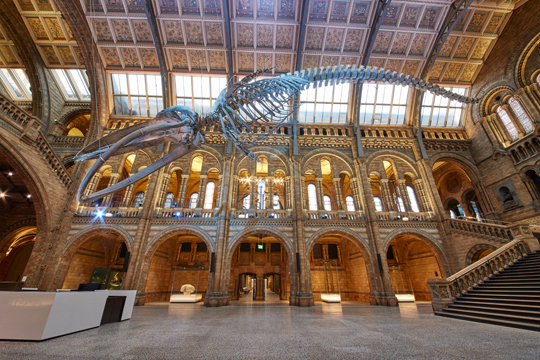
All change at the Natural History Museum in London with the refurbished main gallery (the Hintze Hall), opening to the public tomorrow.  Suspended over the hall, and replacing the Diplodocus cast (Dippy), will be “Hope” a 25.2-metre-long skeleton of a female Blue Whale (Balaenoptera musculus) symbolising the Museum’s focus on conservation and the natural world.

Ready to Greet Millions of Visitors – The Blue Whale Skeleton (Hintze Hall)

Blue Whale skeleton.

The female Blue Whale skeleton at the London Natural History Museum.

Picture credit: The Trustees of the Natural History Museum, London

A Conservation Success – So Far

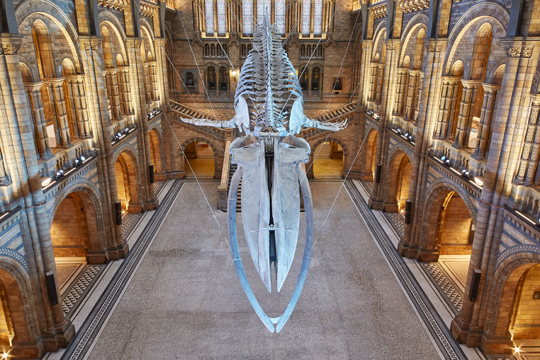
The whale skeleton, some 4.5 tonnes and all 221 bones of it, had previously been on display in the mammals gallery of the museum but it had been partially hidden from public view.  Newly restored and augmented, thanks to some subtle 3-D printing to supplement the bones in the right flipper, this spectacular exhibit is depicted plunging towards the main gallery entrance as if the leviathan is attempting to scoop up visitors.  The Blue Whale helps to highlight a conservation success story.  Fifty years ago, the Blue Whale population had plummeted to just a few hundred and this, the largest animal known to have existed, was on the verge of extinction.  International conservation efforts to help preserve and support populations of baleen whales have paid off, at least in the case of Balaenoptera musculus with an estimated 20,000 individuals swimming the oceans of the world today.  Still this represents less than one tenth of the estimated Blue Whale population at the beginning of the 19th century.

A Spectacular Pose for “Hope” the Blue Whale Skeleton

The Blue Whale exhibit.

The Blue Whale exhibit (Hintze Hall).

Picture credit: The Trustees of the Natural History Museum, London

A Nod to Whale Evolution

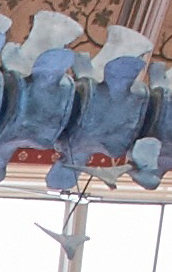
Visitors to the gallery, may miss a tiny pair of bones located under the massive spinal column of the beast.  If you look up around the mid-point of the spine you might just be able to make out two tiny triangular bones, supported by wires underneath a vertebra.  These are the remains of the hip bones and hind limbs.  These bones are not visible in the living animal, they serve no real purpose anymore, except to prove that whales are descended from four-legged, terrestrial animals.  In fact, whales (Cetacea), belong in the Order Artiodactyla, the even-toed hoofed mammals and molecular studies suggest their nearest land-living relatives today are the Hippopotamuses (hippos and whales are grouped into the Whippomorpha).

Proof that Whales are Descended from Terrestrial Mammals

Hind limbs of the blue whale.

Evidence of the hind limbs of the Blue Whale.

Picture credit: The Trustees of the Natural History Museum, London

Lorraine Cornish, the Museum’s Head of Conservation, exclaimed:

“Hope is the only blue whale skeleton in the world to be hung in the diving lunge feeding position.  Suspending such a large, complex and historical specimen from a Victorian ceiling was always going to be challenging, but we were determined to show her in as lifelike position as possible and we are thrilled that the result is truly spectacular.”

Wonder Bays – Look out for Mantellisaurus

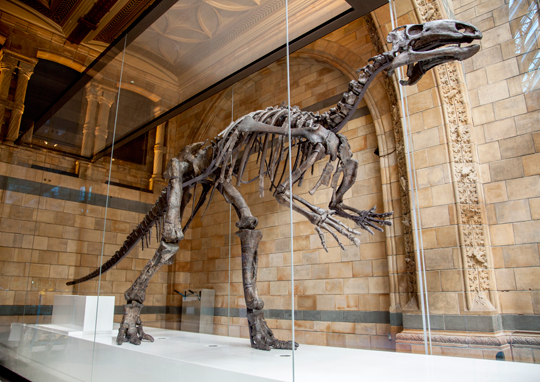
“Dippy” may have gone but the Hintze Hall will be home to one dinosaur at least.  In one of the side bays a mounted skeleton of the iguanodontid Mantellisaurus (M.atherfieldensis) has been put on display.

A Nod to Gideon Mantell – Mantellisaurus

Mantellisaurus on display.

Mantellisaurus on display in the Hintze Hall.

Picture credit: The Trustees of the Natural History Museum, London

The mounted Mantellisaurus specimen represents one of the most complete dinosaur specimens excavated from the UK.  At Everything Dinosaur, we think the specimen is NHMUK R5764, if it is, this is the holotype and it was discovered in 1914, by a local fossil collector called Reginald Hooley whilst he was exploring several, large shale blocks near Atherfield Point (Isle of Wight).  During his lifetime, Sir Richard Owen, the anatomist who helped found what is now called the Natural History Museum, did a great deal to denigrate the work of his contemporary Gideon Mantell.

Dinosaur fans as well as distinguished palaeontologists we think, will approve of the Museum’s recognition of Mantell’s contribution to the nascent study of dinosaurs.  Owen’s statue might look down on the exhibits, but the mounted skeleton, once assigned to the Iguanodon genus, now stands proudly on the eastern side of the Hintze Hall and it bears the name of one of the other great contributors to early palaeontology.

We look forward to visiting the Museum in the near future.  We will marvel at the spectacular Blue Whale nodding its head in our direction as we walk in, but in turn we will stand before the Mantellisaurus and nod our heads in recognition of the work of Gideon Mantell who did much to shine a light, where before there was only darkness.

Everything Dinosaur acknowledges the assistance of a media release from the London Natural History Museum in the compilation of this article.

Visit the Everything Dinosaur website: Everything Dinosaur.
12 07, 2017

New Research Highlights Feathered Dinosaurs from Iran

By |2024-02-25T07:39:19+00:00July 12th, 2017|Categories: Dinosaur and Prehistoric Animal News Stories, Dinosaur Fans, Main Page|0 Comments

Tracksites Suggested Jurassic Troodontids in Iran

Iranian scientists in collaboration with researchers from China and the United States, have published details of a remarkable set of fossilised dinosaur footprints that provide tantalising evidence of the presence of fast-running, potentially feathered dinosaurs from the Middle Jurassic of Iran.

Troodontid-like Dinosaurs

The tell-tale, two-toed tracks are consistent with the sort of tracks associated with dinosaurs that are assigned to the Eumaniraptora clade (also referred to as the Paraves).  Dinosaurs such as dromaeosaurids and troodontids are characterised by having an enlarged, sickle-shaped claw on the second toe of each foot.  In a number of species, this claw is raised, so any footprints preserved, show just two toes in contact with ground (didactyl tracks), such tracks have been never been reported before from Iran and pre-Cretaceous tracks of this nature are exceptionally rare.

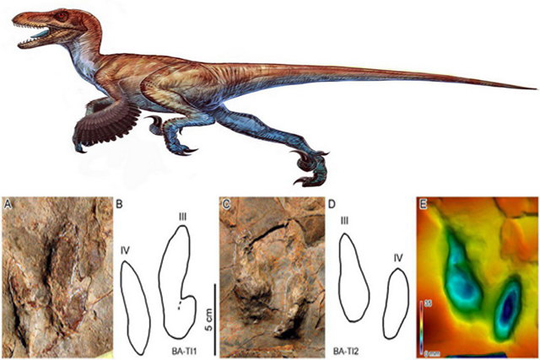
Evidence of Two-Toed Tracks from Iran – An Illustration of a Typical Dromaeosaurid Dinosaur

Two-toed dinosaur tracks reported from Iran.

Dinosaur tracks from Iran.

The picture above shows two of the tracks with accompanying line drawings and a digital analysis of track reference BA-T12 that shows the topographical outline of the track when transposed as a hyporelief print.  A illustration of a typical Eumaniraptoran dinosaur running on just two toes of each foot is shown above the prints.  Note the presence of feathers on the forearm in the illustration.

Didactyl Prints from the Middle Jurassic

Reporting in the academic journal “Historical Biology”, the researchers, which include Lida Xing (China University of Geosciences) and corresponding author Nasrollah Abbassi (University of Zanjan, Iran), along with Martin Lockley (University of Colorado), report the discovery of a small number of footprints preserved in sandstone from the Dansirit Formation in the Alborz Mountains (northern Iran).  The sediments laid down in this area, close to the city of Baladeh, have been dated to the Middle Jurassic based on the extensive plant fossils that have been found in this locality.

As a number of fossils have been found elsewhere in the world, notably China, that reveal these types of dinosaurs to be feathered, it can be inferred that these Iranian dinosaurs too, might have had feathers.  The scientists speculate that these tracks could have been made by a troodontid-like dinosaur.

Two-toed Dinosaur Tracks

Two-toed dinosaur trackways have been discovered at several sites, but as far as we at Everything Dinosaur are aware, nearly all of them are reported from much younger, Cretaceous-aged strata.  For example, Dr Martin Lockley, a specialist in ichnofossils (footprints and tracks), has reported didactyl prints from the western United States.

To read more about this discovery: Raptor Tracks from Colorado.

For an article published in 2007 about tracksites that suggest pack behaviour in “raptors”: Chinese Dinosaur Tracks Indicate Pack Behaviour in Theropod Dinosaurs.

Commenting on the importance of these fossils, Associate Professor Nasrollah Abbasi stated that this discovery was significant for two main reasons, first, it proves that Iran was home to feathered dinosaurs in the past, and second, it sheds some light on the behaviour of these two-toed dinosaurs.

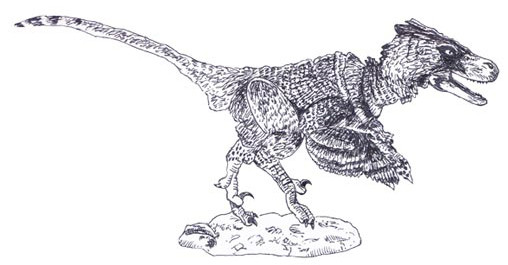
An Illustration of a Typical “Raptor” Dinosaur

Adasaurus mongoliensis illustrated.

An illustration of the dromaeosaurid Adasaurus. Picture credit: Everything Dinosaur.

Picture credit: Everything Dinosaur

The illustration (above) shows a typical dromaeosaurid dinosaur.  The drawing was inspired by a figure from the Beasts of the Mesozoic model range.

To view this range: Beasts of the Mesozoic Models.

Aalenian-Bajocian of the Middle Jurassic

The research team report that the tracks superficially resemble footprints attributed to small deinonychosaurian dinosaurs known mainly from the Cretaceous of Asia.  They comment that the relative lengths of digits III and IV are atypical of deinonychosaurids, especially dromaeosaurids, but they could potentially have come from a troodontid-like dinosaur.  The research team conclude that the possibility of small, cursorial Middle Jurassic deinonychosaurids cannot be ruled out.  However, the researchers are very aware of the problems associated with confirming the presence of these types of dinosaurs from the Aalenian-Bajocian faunal stages of the Middle Jurassic.  If these tracks were made by these types of dinosaurs, this would demonstrate that dromaeosaurids or troodontid-like dinosaurs lived some 175 million years ago.

Reports of two-toed (didactyl) prints that date from before the Cretaceous remain exceptionally rare and such trace fossils predate all known deinonychosaurian body fossil occurrences.

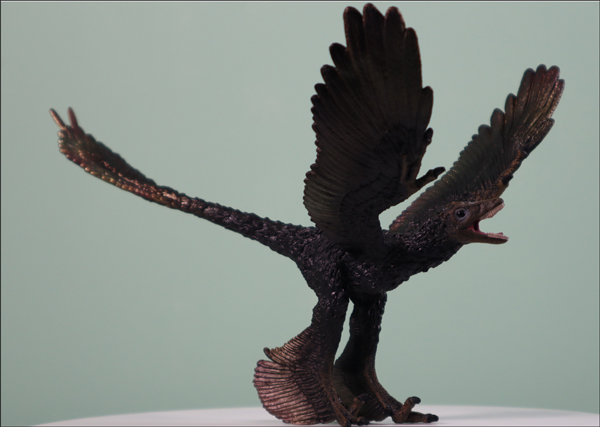
A Model of a Member of the Dromaeosauridae (Microraptor)

The new for 2020 CollectA Deluxe 1:6 scale Microraptor dinosaur model.

The CollectA Deluxe 1:6 scale Microraptor dinosaur model.  Scientists report trace fossils potentially from troodontid-like dinosaurs. Picture credit: Everything Dinosaur.

Picture credit: Everything Dinosaur

Visit the Everything Dinosaur website: Everything Dinosaur.

11 07, 2017

Explosive Radiation of Bird Species After Dinosaur Demise

By |2023-08-07T09:35:43+01:00July 11th, 2017|Categories: Dinosaur and Prehistoric Animal News Stories, Dinosaur Fans, Main Page|0 Comments

Birds Evolved Very Rapidly after Cretaceous Mass Extinction

The discovery of the fragmentary remains of a tiny bird is helping scientists to piece together the evolution of modern types of bird.  It seems that the Aves (birds), were very quick off the mark after the demise of the dinosaurs and the flying reptiles at the end of the Cretaceous*, within a few million years of the extinction event, the ancestors of most types of today’s birds had evolved.

Palaeontologists had been aware of the rapid evolution and radiation of the Mammalia after the end Cretaceous extinction event, but the birds too underwent a speedy period of evolution to exploit the environmental niches vacated by extinct organisms.  Writing in the Proceedings of the National Academy of Sciences – USA (PNAS), researchers describe the discovery of a new species of fossil bird from New Mexico.  As the oldest known tree-dwelling bird species amongst modern bird groups, the fossils of this nuthatch-sized creature support the theory that birds underwent an explosive period of evolution in the aftermath of the dinosaur extinction.

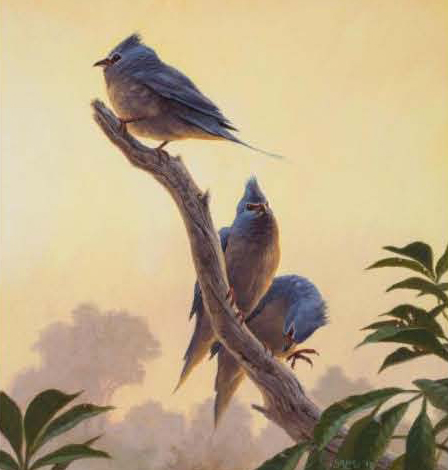
An Illustration of the Newly Described Early Paleogene Bird – Tsidiiyazhi abini

Tsidiiyazhi abini life reconstruction.

Life reconstruction of Tsidiiyazhi abini.

Picture credit: Sean Murtha

The Significance of Tsidiiyazhi abini

Scientists from the Bruce Museum (Connecticut), the Chinese Academy of Sciences and the New Mexico Museum of Natural History and Science (Albuquerque, New Mexico) have published a paper detailing the discovery of the fragmentary remains of a bird from the from the Nacimiento Formation of New Mexico.

The fossils date from 62.221 to 62.517 million years ago (Late Danian faunal stage of the Palaeocene Epoch), less than four million years after the extra-terrestrial impact event in the Yucatan Peninsula that marked the extinction of around seventy percent of all terrestrial life forms.  The bird has been named Tsidiiyazhi abini, the name being derived from the local Navajo (Diné Bizaad) and it translates as “little morning bird”.  At Everything Dinosaur, we have checked with the Bruce Museum to ensure we can relate the correct pronunciation, our apologies to any native Navajo speakers, but we think the name is pronounced – “City-ya-zee ah-bin-ih, with a focus on a “dee” sound in “City” rather than an emphasis on the “Tee” syllable.

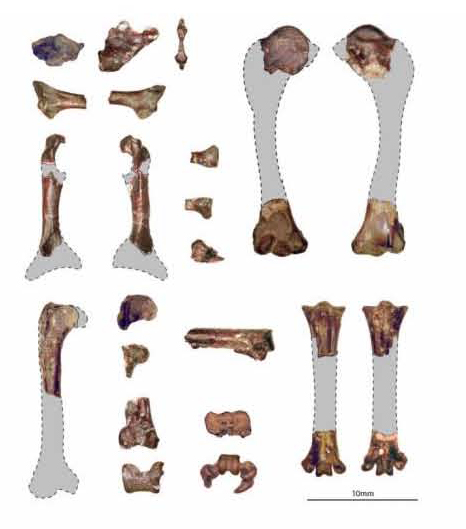
Tiny Fragmentary Fossils Tell the Story of Bird Evolution

Tsidiiyazhi abini fossils.

Fragmentary fossils including limb bones.

Picture credit: PNAS

Supporting Evidence from “Molecular Clocks”

Palaeontologists are aware of the growing evidence from molecular studies into evolutionary relationships that suggests the birds diverged and evolved rapidly after the K-Pg extinction.

Unfortunately, the fossil record of birds is exceptionally poor.  Very few fossils of birds are known from the Early Palaeocene.  These animals tend to be small, their bones are delicate and the arboreal environment all tend to greatly reduce any fossilisation potential.  The New Mexico fossil find is highly significant as T. abini has been assigned to the Sandcoleidae family, an extinct basal family of stem mousebirds (Coliiformes).   The discovery of Tsidiiyazhi pushes the minimum divergence ages of as many as nine additional major neoavian lineages into the earliest Palaeocene, suggesting a very rapid evolution of Aves after the Cretaceous mass extinction.

Thanks to developments in genetics, scientists can study the evolutionary relationships of living organisms by comparing details of their genetics.  A time when two, now distinct and separate but related organisms shared a common ancestor can be calculated using the idea that the molecules which form genes accumulate mutational changes in a clock-like, constant rate over geological time.

Researchers can use the changes in genetics of an organism to plot the approximate time when these species diverged from a common ancestor.  The “molecular clock” data points to a period of rapid evolution for the Aves just a few million years after the extinction of the dinosaurs, fossil finds, such as the fragmentary fossils of Tsidiiyazhi abini provide further evidence to support this idea.  In essence, the ancestors of all the major groups of modern birds we see today, had already evolved just a few million years after the last dinosaur (non-avian dinosaur) died.

Fossil Hunting – It’s a Family Affair

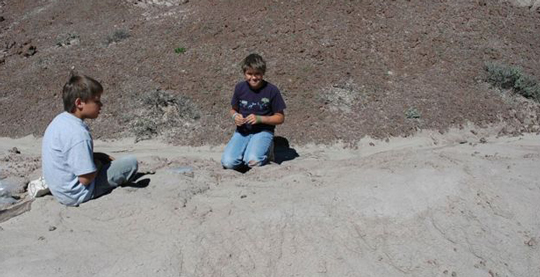
The tiny fossil bones were found by eleven-year-old twins Taylor and Ryan Williamson, the sons of Dr Tom Williamson, a palaeontologist specialising in the study of Palaeocene vertebrates based at the New Mexico Museum of Natural History and Science, who co-authored the scientific paper.  Mousebirds are only found in sub-Saharan Africa today, however, these fossils help to confirm that these gregarious, fruit and seed eaters were much more geographically widespread in the past.  Analysis of the delicate foot bones show that Tsidiiyazhi abini had evolved specialisations of the foot that let it reverse its fourth toe to better grasp and hold onto branches.

Twins Ryan and Taylor Williamson Found the Fossil Remains

Tsidiiyazhi abini fossil site.

Twins Ryan and Taylor Williamson found the bones of the Palaeocene bird Tsidiiyazhi abini.

Picture credit: Dr Tom Williamson (New Mexico Museum of Natural History and Science)

Tsidiiyazhi abini Adapted to Life in the Trees

The ability to reverse the fourth toe is referred to as semizygodactyly, this is an adaptation for life in the trees and the fossils of Tsidiiyazhi provides evidence that many groups of birds arose just a few million years after the K-Pg extinction event and had already begun to evolve specialisations of the foot bones to allow them to exploit different ecological niches.

The scientific paper: “Early Paleocene Landbird Supports Rapid Phylogenetic and Morphological Diversification of Crown Birds after the K–Pg Mass Extinction” by Daniel T. Ksepka, Thomas A. Stidham, and Thomas E. Williamson published in the Proceedings of the National Academy of Sciences of the United States of America.

*Note

It is a common misconception that only the Dinosauria, marine reptiles and the Pterosauria were casualties of the mass extinction event that marked the end of the Cretaceous.  Several other types of terrestrial vertebrate also suffered extinctions including the Aves and Mammalia.  Many kinds of primitive bird along with different genera of mammals died out either at or shortly after the K-Pg boundary.  Marine ecosystems were also badly affected and in addition, several families of plants did not survive this extinction.

10 07, 2017

New Swiss Fossil Discovery Solves Triassic Reptile Mystery

By |2024-04-01T14:18:50+01:00July 10th, 2017|Categories: Dinosaur and Prehistoric Animal News Stories, Dinosaur Fans, Geology, Main Page|0 Comments

The Marine Reptile That Wasn’t –  Eusaurosphargis dalsassoi

A team of scientists from Zurich University and the University of Oxford have resolved a scaly, fourteen-year mystery concerning a small reptile that lived some 241 million years ago in the Middle Triassic.  The little diapsid named Eusaurosphargis dalsassoi has had quite a chequered history, but thanks to a remarkable fossil find, palaeontologists have a much better idea of what this reptile looked and equally importantly where it lived.  This animal was very much at home on land and not a marine reptile as previously thought.

An Illustration of Eusaurosphargis dalsassoi

Eusaurosphargis dalsassoi.

Eusaurosphargis dalsassoi illustrated.

Picture credit: Beat Scheffold, Palaeontological Institute and Museum, University of Zurich

Fossil Discovery in 2003

Named from a single, disarticulated specimen found in marine strata on the Swiss-Italian border some fourteen years ago Eusaurosphargis was thought at first to be some form of fish, after all, the fossil was found in rocks formed from sediment laid down in a shallow lagoon.

Once the skeleton had been prepared, the fossil material was identified as a diapsid reptile and the taphonomy suggested that this was a reptile that lived in the sea.  Taphonomy is the study of the fossilisation process.  It concerns everything that happens to an organism from death until the time when, if serendipity permits, its fossil is discovered.  A new fossil find, this time from the Grisons Mountains (Graubünden canton of Switzerland), a much more complete and articulated specimen, has revealed the true nature of Eusaurosphargis, it was definitely a land-lubber and as such has a superficial similarity to the extant girdled lizards (Cordylidae) of southern Africa.

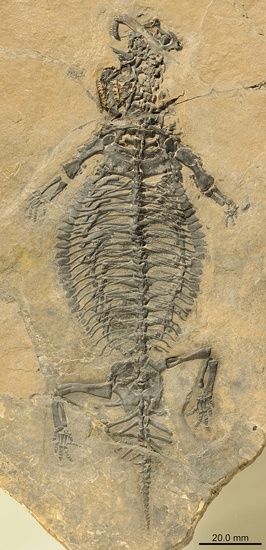
A Beautifully Well-Preserved Fossil Proves Eusaurosphargis was Terrestrial

Eusaurosphargis fossil.

The articulated fossil skeleton of Eusaurophargis.

Picture credit: Torsten Scheyer, Palaeontological Institute and Museum, University of Zurich

No Sign of Marine Adaptations

The Swiss specimen measures around twenty centimetres in length and as such, it represents a juvenile.

However, the skeleton shows a flange of osteoderms on the side of the body along with a number of bony scales on its back.  The sprawling limbs show no signs of adaptation for a swimming lifestyle and the tail is very short, so short, that in water it would not have provided much propulsion.  This fossil, excavated from the Prosanto Formation near Ducanfurgga at an altitude of 2,740 metres, strongly supports the idea that this was a terrestrial animal.

Writing in the academic journal “Scientific Reports”, the Anglo-Swiss team of researchers led by Torsten Scheyer, a palaeontologist at the University of Zurich, and James Neenan from the Oxford University Museum of Natural History have concluded that the carcass was washed off a nearby island into the sea basin and became embedded in the finely layered marine sediments after death.

Convergent Evolution

Commenting on the superficial resemblance between the Triassic Eusaurosphargis and modern-day members of the Cordylidae family, Dr Scheyer explained:

“This is a case of convergent development as the extinct species is not closely related to today’s African lizards.”

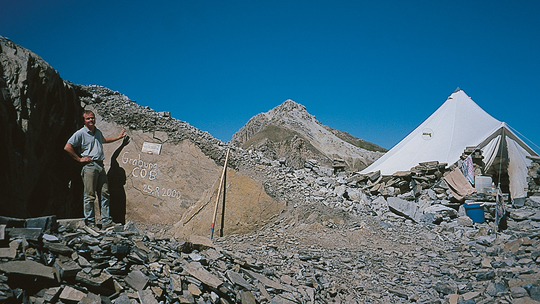
The Site of the Fossil Discovery – in the Middle of a Mountain Range

Triassic reptile fossil site.

The location of the Eusaurosphargis fossil discovery.

Picture credit:  Christian Obrist

The Irony of the Phylogeny of Eusaurosphargis dalsassoi

Based on this new, and much better-preserved fossil material, the research team were able to conduct a more detailed phylogenetic study of E. dalsassoi to establish where, in the extremely diverse Diapsida this little reptile should be nested.  The phylogenetic analysis indicates that its closest relatives were marine reptiles, animals such as ichthyosaurs.  Eusaurosphargis may even be the sister taxon to Helveticosaurus, a Middle Triassic marine reptile, fossils of which, also come from Switzerland.

9 07, 2017

The Fourth Denisovan (Further Research)

By |2024-04-01T14:08:10+01:00July 9th, 2017|Categories: Dinosaur and Prehistoric Animal News Stories, Main Page|0 Comments

The Fourth Denisovan

Further research into the astonishing Denisova Cave (Altai Mountains, Siberia, Russia), by an international team of scientists, has produced another tantalising piece of evidence regarding the enigmatic ancient humans known as the Denisovans.  Scientists have uncovered a broken tooth, a shed molar from a young girl and this single tooth fossil is evidence of only the fourth member of the Denisovans, such is the paucity of the fossil record associated with these archaic hominins.

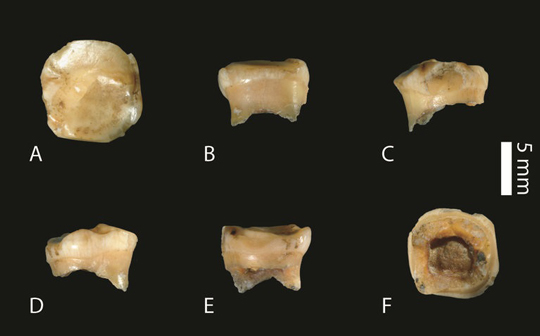
Views of the Shed Denisovan Molar – Genetic Analysis Confirms that this Tooth was Lost by a Little Girl

Tooth from a Denisovan child.

The molar from a Denisovan child.

Picture credit: Bence Viola (University of Toronto)

The Significance of the Denisova Cave

Fossil evidence for the Denisovans, a sister group of Neanderthals recently identified on the basis of genetic analysis had been limited to just three specimens.  All these fossils come from excavations of the Denisova Cave in the Altai Mountains.  Writing in the academic journal “Science Advances”, researchers including scientists from the Department of Evolutionary Genetics, at the Max Planck Institute for Evolutionary Anthropology (Leipzig, Germany), describe the discovery of a fourth fossil, a molar tooth lost by a female Denisovan.

The tooth, which was from the lower jaw comes from a deeper stratigraphic layer than most of the other Denisovan ascribed material.  The location of the fossil find, in conjunction with an analysis of the mitochondrial DNA retrieved from the tooth, reinforces the idea that the Denisovans were present in this part of the remote Altai region for many thousands of years.

Viviane Slon, a PhD student at the Max Planck Institute and lead author of the study commented:

“We only have relatively little data from this archaic group, so having any additional individuals is something we are very excited about.”

The rock layer that contained the tooth is believed to between 128,000 to 227,000 years old.  The research team stress in the scientific paper the need to identify other potential Denisovan sites so that more information can be gathered and then compared to the fossil remains from the Denisova Cave.

To read an earlier article about the Denisovans: Denisovan Cave Material Hints at Mystery Human Species.

8 07, 2017

A Time for Digging Up Dinosaurs

By |2023-08-07T07:36:31+01:00July 8th, 2017|Categories: Dinosaur and Prehistoric Animal News Stories, Dinosaur Fans, Geology, Main Page, Palaeontological articles|0 Comments

Field Teams Prepare to Explore Northern Latitudes

High summer in the Northern Hemisphere, most teaching programmes may have come to an end but for many palaeontologists, this is their busiest time of year.  The months of July and August represent the best times to explore some of the more remote and difficult to access vertebrate fossil sites.  Take for example, Dr Anthony Fiorillo from the Perot Museum of Nature and Science (Dallas, Texas).  He and his colleagues are busy organising field work in the Aniakchak National Monument (Alaska), area in a bid to learn more about polar dinosaurs.

The summer months represent the only time that scientists have to work at such remote and inaccessible sites, as the weather for once, is on their side.  Palaeontologists will be taking advantage of the near 24-hours of daylight in northern latitudes to further explore the unique prehistoric environments that for most of the year are simply inaccessible.

Dinosaurs of Northern Latitudes

The Late Cretaceous exposures in Alaska provide a record of life at very high latitudes as the age of dinosaurs was drawing to a close.  Just like the herds of migratory herbivorous dinosaurs, which would have fed around the clock, the scientists will be taking advantage of the very long days to get as much work done as possible.  The field team hope to revisit a number of locations in the Aniakchak National Monument in a bid to collect more data on the hundreds of dinosaur tracksites that have been discovered.

These tracks and individual dinosaur footprints provide a unique insight into the ancient palaeofauna, an opportunity to further explore the lives of polar dinosaurs.  In 2014, Everything Dinosaur wrote an article summarising some of the work undertaken by Dr Fiorillo and his colleagues as they interpreted a substantial number of duck-billed dinosaur tracks.  These trace fossils helped the researchers to better understand how these giant, herbivorous dinosaurs moved around in herds: Duck-Billed Dinosaurs Moved Around in Herds just like Elephants. Over the years, researchers from the Perot Museum of Nature and Science have made a very important contribution to research into dinosaur populations that lived (and seemed to thrive) at high northern latitudes.

Commenting on the significance of their work, Dr Fiorillo stated:

“At the start of every one of these expeditions, the adrenaline is pumping.  We are so excited to get back out there.  I fully expect that we will find dozens of footprints and we will learn a little bit more about the environment in which these dinosaurs lived.”

Nanuqsaurus hoglundi and Pachyrhinosaurus perotorum

Staff at the Perot Museum of Nature and Science, along with their collaborators from other institutions have been instrumental in helping to improve our understanding of the polar dinosaurs and the palaeoenvironment.  For example, a third species of Pachyrhinosaurus (P. perotorum) has been erected thanks to Alaskan fossil discoveries.

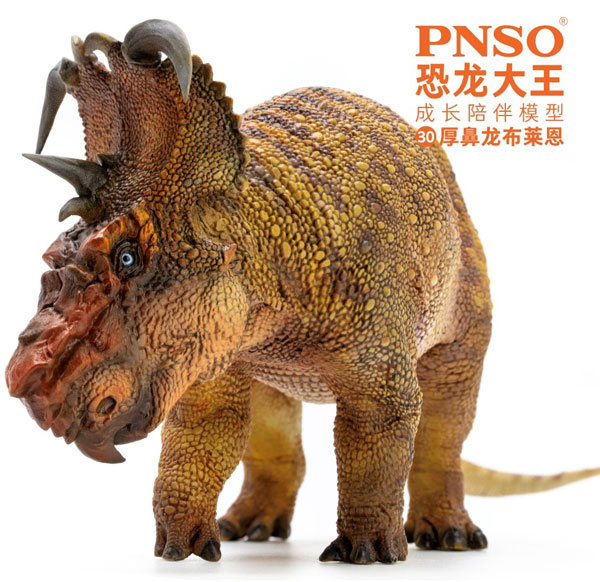
A Model of the Horned Dinosaur Pachyrhinosaurus

PNSO Pachyrhinosaurus dinosaur model.

PNSO Brian the Pachyrhinosaurus dinosaur model.

The picture (above) shows a Pachyrhinosaurus dinosaur model from the PNSO range.

To view this range of prehistoric animal figures: PNSO Age of Dinosaurs.

Alaskan Dinosaurs

With all that plant food and the long summer days, Alaska might have been a paradise, albeit a chilly one for plant-eating dinosaurs.  However, they did have to contend with some particularly nasty predators, over-sized dromaeosaurids for example and perhaps, even more surprisingly a “polar” tyrannosaur.  In 2006, a research team led by Dr Anthony Fiorillo and his colleague Dr Ronald Tykoski, also from the Perot Museum of Nature and Science discovered the fossils of a carnivorous dinosaur that was later named Nanuqsaurus hoglundi.

To read more about this fossil discovery: An Update on “Polar Bear Lizard”.

We wish all field teams every success and we hope that they have a safe, rewarding and very satisfactory field season.

To read more about the discovery of Pachyrhinosaurus perotorum an article first published in 2011: A New Species of Pachyrhinosaurus is Announced.

Go to Top