All about dinosaurs, fossils and prehistoric animals by Everything Dinosaur team members.
27 07, 2017

Everything Dinosaur Exclusive Customer Newsletter July 2017

By |2024-04-22T11:48:37+01:00July 27th, 2017|Categories: Dinosaur Fans, Everything Dinosaur Newsletters, Everything Dinosaur Products, Main Page, Photos of Everything Dinosaur Products, Press Releases|0 Comments

Everything Dinosaur Newsletter July 2017

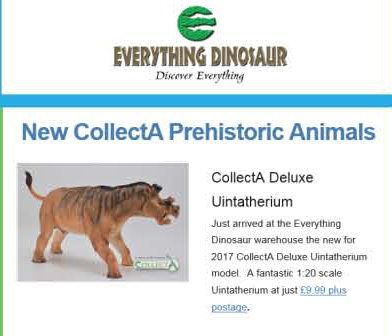
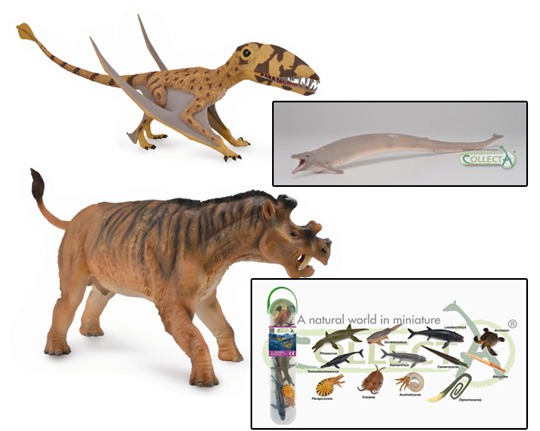
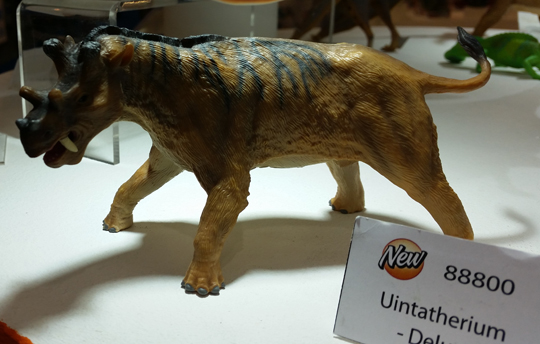
A great way to keep up to date with all the developments at Everything Dinosaur is to subscribe to the company’s newsletter.  The July issue introduced new CollectA models as well as the latest Schleich “Conquering the Earth” dinosaurs.  The new CollectA Deluxe 1:20 scale Uintatherium is one of the most eagerly anticipated, new for 2017 replicas and stocks of this Eocene mammal replica are now in Everything Dinosaur’s warehouse, but thanks to our company newsletter, supplies are already beginning to run low, such has been the demand for this model.

The Everything Dinosaur July 2017 Newsletter Features the CollectA Uintatherium

CollectA Deluxe 1:20 scale Uintatherium model.

CollectA Deluxe Uintatherium.  Picture credit: Everything Dinosaur.

Picture credit: Everything Dinosaur

CollectA Supreme Deluxe Dimorphodon

Hot on the hooves of the Uintatherium, comes the CollectA Supreme Deluxe Dimorphodon model.  This is bound to prove to be popular amongst fans of flying reptiles and this huge model will make a terrific centrepiece to any model collection.

New Pterosaur Replica in the July Newsletter

CollectA Deluxe Dimorphodon model.

CollectA Supreme Deluxe Dimorphodon model.  Picture credit: Everything Dinosaur.

Picture credit: Everything Dinosaur

There are opportunities to subscribe to the Everything Dinosaur newsletter when placing an order with us, but guests and other visitors to the Everything Dinosaur website can subscribe by travelling down the home page and filling in the simple form on the bottom right of the screen.

Scroll Down the Everything Dinosaur Homepage to Find the E-News Subscription Form

Subscribe to the Everything Dinosaur newsletter.

Scroll down the Everything Dinosaur home page to find the subscription area.  Picture credit: Everything Dinosaur.

Picture credit: Everything Dinosaur

Visit Everything Dinosaur’s website here: Everything Dinosaur.

Schleich Conquering the Earth Dinosaurs

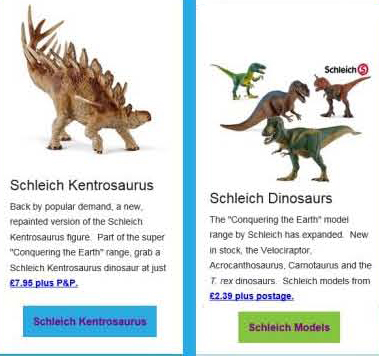
Our latest newsletter also featured a number of new Schleich dinosaurs including the Carnotaurus, Velociraptor, Acrocanthosaurus and T. rex.  All these new Schleich models have articulated lower jaws and they are ideal for robust, creative play.

Schleich Conquering the Earth Dinosaurs in the July Newsletter

Conquering the Earth Schleich dinosaurs.

New for 2017 Schleich dinosaurs.  Picture credit: Everything Dinosaur.

Picture credit: Everything Dinosaur

Fans of herbivorous dinosaurs were not neglected, we made sure to include some further information and links about the new Schleich Kentrosaurus model (seen above, pictured on the left).

To view all the Schleich dinosaurs and prehistoric animal models currently in stock at Everything Dinosaur: Schleich Prehistoric Animals and Dinosaurs.

CollectA Basilosaurus and he CollectA Mini Prehistoric Marine Animals Set

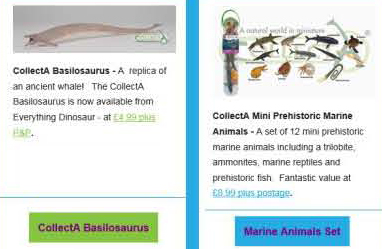
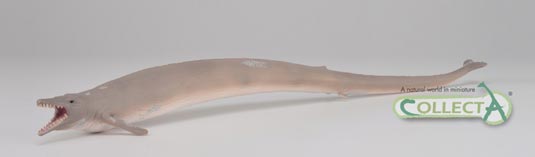
Also, newly arrived are the CollectA Basilosaurus model and the set of mini prehistoric marine animals.   Fans of prehistoric whales finally have a Basilosaurus within the CollectA range.

All at Sea with the CollectA Basilosaurus and the CollectA Mini Prehistoric Marine Animals

CollectA mini prehistoric marine animals and Basilosaurus.

CollectA Basilosaurus and mini prehistoric marine animals set.  Picture credit: Everything Dinosaur.

Picture credit: Everything Dinosaur

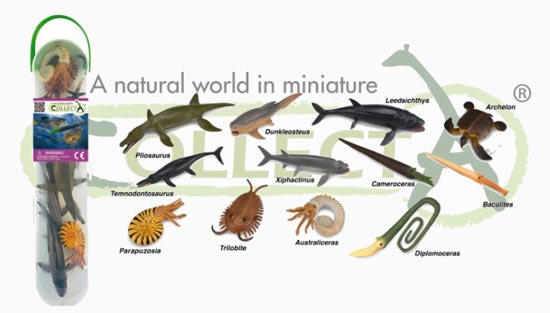
The nautical theme continues with the introduction of the CollectA mini prehistoric marine animals, a set of twelve replicas representing some of the amazing marine fauna that once existed in the seas and oceans of our planet.  What fantastic news for model makers and fans of prehistoric dioramas.  For example, a trilobite can be added to a marine model scene that features Dunkleosteus, or Mosasaurus can be chasing ammonites in a Cretaceous model diorama!

The CollectA Mini Prehistoric Marine Animals Set

CollectA mini prehistoric marine animals set.

The CollectA mini prehistoric marine animals set.

To view the CollectA mini prehistoric marine animals set, the Basilosaurus and the rest of the not to scale CollectA range: CollectA Prehistoric Life Collection.

For the CollectA Deluxe/Supreme range including the CollectA Deluxe Uintatherium and the fantastic CollectA Dimorphodon: CollectA Deluxe Prehistoric Animal Models.

Everything Dinosaur recently wrote a helpful guide to the animals represented in the CollectA mini prehistoric marine animals set.  To read this article: A Guide to the CollectA Mini Prehistoric Marine Animal Set.

26 07, 2017

Unravelling the Mysteries of Complex Life

By |2023-08-08T09:33:09+01:00July 26th, 2017|Categories: Dinosaur and Prehistoric Animal News Stories, Main Page, Photos/Pictures of Fossils|0 Comments

First Non-Destructive Internal Images of Rangea

Travel back in time far enough and the distinction between what is a plant and what is an animal becomes blurred.  For a palaeontologist, unravelling the mysteries of the origins of multi-cellular life is daunting.  Firstly, when examining the few fossils of multi-cellular organisms known from rocks laid down in the Proterozoic Eon, what strikes you is the paucity of the fossil record, in essence there is very little fossil evidence to study. Secondly, some of the lifeforms represented are so bizarre that there is nothing alive today that can begin to provide scientists with any hints as to structure, form, lifestyle or behaviour.

However, an international team of scientists, writing in the journal of “Precambian Research”, have conducted a remarkable assessment on three-dimensionally preserved Ediacaran fossils and they have shed light on the evolution of complex life.  The organism in question is Rangea, a bizarre fern-like animal/plant/? that did not possess bilateral symmetry like us, or indeed radial symmetry like starfish and sea urchins, but a fractal structure, like nothing alive today.

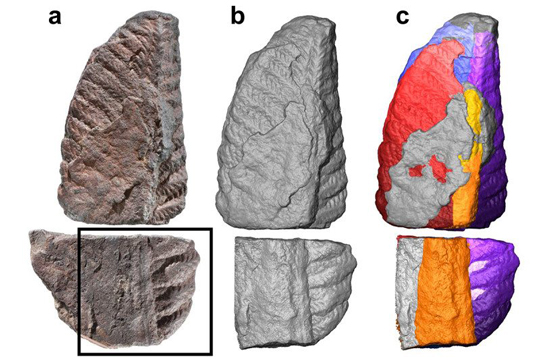
The Fossil and Internal/External Scans of a Three-dimensionally Preserved Rangea Specimen

Fossil and scans of bizarre Precambrian life form.

The fossil (a), an external scan (b) and an internal scan (c) of the Ediacaran organism Rangea.

Picture credit: Precambrian Research

The picture above shows the fossil (a), a computer-generated model of the external structure (b) and a computer-generated model of the internal structure of Rangea (c).

High Resolution X-ray Micro-computed Tomography

At Everything Dinosaur, we suspect that the fossil specimens come from rocks laid down in shallow, marine sediments that make up the Nama Group in southern Namibia.  Rangea is known from this location and has also been reported from other Ediacaran-aged sites in Australia and Russia.  The Namibian material is remarkable as the fossils are typically moulds and casts of the fern-like structures, preserved in ironstone nodules, which despite representing lifeforms that existed somewhere between 540 and 580 million years ago, have not been squished and deformed to a huge extent as a result of the fossilisation process and the enormous time these fossils have existed in the strata.

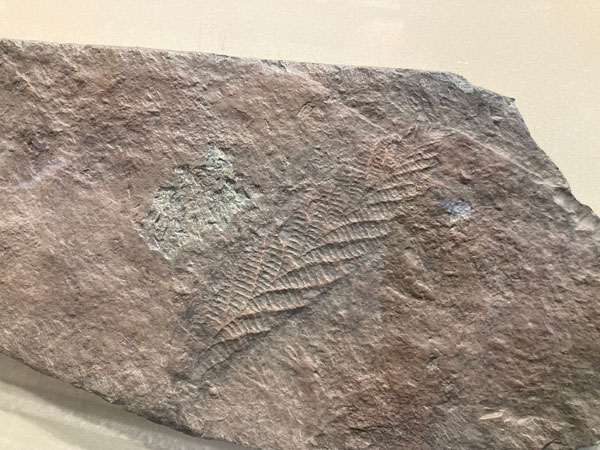
The scientists used high resolution X-ray micro-computed tomography (microCT) to investigate the 3-D internal morphology of these exceptional fossils.  This is the first non-destructive internal imaging of Rangea.  Ranging from a few centimetres to tens of centimetres in length, the soft-bodied Rangeomorphs (a natural taxon, established to help classify these frond-like, fractal organisms), are perhaps best known to fossil fans in the UK as organisms similar in structure to Charnia, named and described from a single fossil specimen found in Charnwood Forest, Leicestershire by a school boy in 1957.

A Specimen of a Fern-like, Soft-bodied Charnia

Pre-Cambrian life form Charnia.

A Charnia fossil on display at the Manchester Museum. Picture credit: Everything Dinosaur.

Picture credit: Everything Dinosaur

Analysing the Results of the Pre-Cambrian Fossil Study

Lead author of the study, Dr Alana Sharp (School of Science and Technology, University of New England, New South Wales, Australia) and her colleagues think that all six fronds may have been inflated like long balloons, they may have touched each other creating a large surface area for the passive absorption of nutrients which sustained the organism.  It had been thought that these fronds, regarded as some form of feeding structure, were flat.

Dr Sharp commented:

“Our work supports a lifestyle of absorption of nutrients through membranes inflated to the maximum, increasing the surface area across which these organisms seemed to feed.”

Soft Bodies but Stone Hearts

The CT scans also revealed something else about Rangea.  It had a cone-shaped channel running vertically up its central trunk.  The lower part of this channel seems to have been filled with sediment that has a different composition from that seen in the rest of the fossil.  The researchers have concluded that this was probably present in the organism when it was alive, helping to prevent it from buckling or being compressed.  The sediment acted like internal scaffolding for Rangea, a sort of primitive skeleton.  These findings support the idea that Rangea was benthic (lived on the sea floor) and that it was probably sessile (attached to the sea floor and immobile).

Despite these remarkable computer-generated images, one big mystery remains, as Dr Sharp explains.

“They may or may not be animals, we can’t say from this study.  But they are the first of the truly large, multi-cellular organisms that radiated broadly before the first true animals evolved.”

The Scientific Paper: “First non-destructive Internal Imaging of Rangea, an Icon of Complex Ediacaran Life” by Alana C. Sharp, Alistair R. Evans, Siobhan A. Wilson and Patricia Vickers-Rich, published in the journal “Precambrian Research”.

Visit the Everything Dinosaur website: Everything Dinosaur.

25 07, 2017

Eureka! We Have a New Fossil Spider

By |2024-04-22T11:49:01+01:00July 25th, 2017|Categories: Dinosaur and Prehistoric Animal News Stories, Main Page, Photos/Pictures of Fossils|0 Comments

Maevia eureka – Miocene Spider

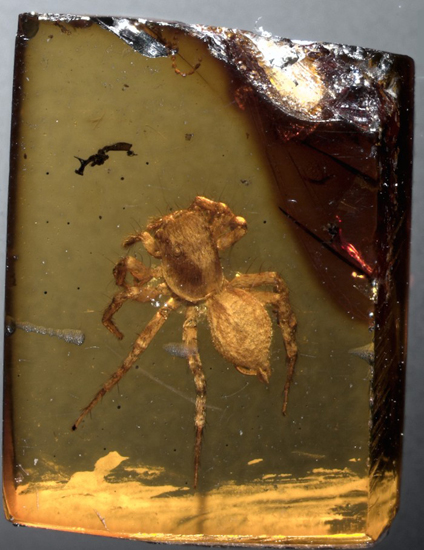
Researchers have described a new fossil species of jumping spider found embedded in a piece of amber that dates from the early-mid Miocene.  The beautifully preserved specimen was collected from lignite-sandstone sediments that date from between 23 and 15 million years ago.  The little spider has been assigned to the Salticidae (jumping spiders) and it close resembles living species of jumping spider such as Maevia poultoni which is also found in the New World.

The Newly Described Miocene Spider M. eureka Preserved in Amber

Maevia eureka specimen.

Preserved in amber M. eureka.

Picture credit: PeerJ

The First Jumping Spider Species Described from Chiapas Amber

The specimen was found near to the town of Totolapa in Chiapas, south-western Mexico.  Writing in the academic, peer-reviewed journal “PeerJ”, the authors Francisco Riquelme​, (Universidad Autónoma del Estado de Morelos, Jojutla, Morelos, Mexico) and Miguel Menéndez-Acuña (Universidad Autónoma del Estado de Morelos, Cuernavaca, Morelos, Mexico), conclude that this fossil represents the first jumping spider species to be described from Chiapas amber.

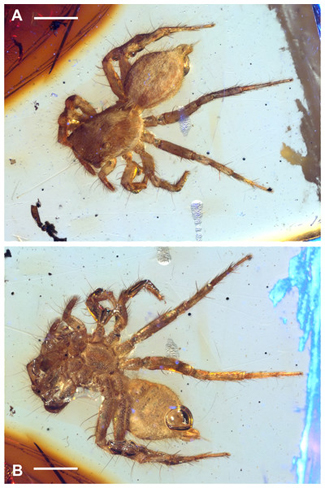
Dorsal and Ventral Views of Maevia eureka

Maevia eureka fossil.

Preserved in amber M. eureka.

Picture credit: PeerJ

The picture above shows two views of the fossil spider (A) dorsal view, seen from the top down and (B) ventral view, seen from underneath.  The scale bar equals 1 mm.  The fossil marks the southernmost record of the Maevia genus in North America.  The story of its discovery explains the trivial name “eureka”.  The amber piece containing the fossil was found by chance as field team members were digging a latrine.

Visit the Everything Dinosaur website: Everything Dinosaur.

24 07, 2017

New CollectA Models in Stock

By |2023-08-08T09:08:17+01:00July 24th, 2017|Categories: Dinosaur Fans, Everything Dinosaur News and Updates, Everything Dinosaur Products, Main Page, Photos of Everything Dinosaur Products, Press Releases|0 Comments

Dimorphodon, Uintatherium, Basilosaurus and Mini Prehistoric Marine Animals Arrive

The final batch of new for 2017, CollectA prehistoric animal models has arrived and what a splendid collection they are!  CollectA had introduced their new dinosaurs earlier in the year, so this final set of 2017 models does not contain any “terrible lizards”, just a group of well-crafted models that are going to delight collectors.

In Stock at Everything Dinosaur the Latest CollectA 2017 Prehistoric Animal Models

Marine prehistoric animals, Basilosaurus, Uintatherium and the CollectA Dimorphodon model.

The latest CollectA models (2017).

CollectA Dimorphodon with Movable Jaw

It is great to see CollectA introducing another replica of a large pterosaur into their “Deluxe” range.  The Dimorphodon will sit proudly next to the Guidraco figure, a model that was introduced back in 2015, to much acclaim.  Everything Dinosaur team members have been in discussion with leading expert on the Pterosauria Mark Witton recently, like Mark, we think that this Early Jurassic flying reptile may well have lived in an arboreal environment and not on the coast as depicted in many illustrations.  The team at CollectA, think this was the case also, as they chose to illustrate their new CollectA Dimorphodon in a terrestrial setting.

Dimorphodon Probably Lived Inland in Forests

CollectA catalogue 2017.

The CollectA 2017 catalogue features the Dimorphodon model on the front.  Picture credit: Everything Dinosaur.

Picture credit: CollectA/Everything Dinosaur

Dinosaur fans and model collectors can request a CollectA catalogue from Everything Dinosaur.  To view the extensive range of CollectA prehistoric animal models and figures: CollectA Prehistoric Life Model Range.

The CollectA Deluxe Uintatherium

The CollectA Deluxe Uintatherium model is one of our favourite replicas to be released this year.  We have followed the development of this prehistoric mammal figure very closely.  Although, Uintatherium was one of the largest land animals of the Eocene Epoch and is well represented in the fossil record of North America, very few replicas of Uintatheres have been produced.  Measuring a fraction under nineteen centimetres long, this is an excellent 1:20 scale model of “Uintah Beast”.

The New for 2017 CollectA Deluxe Uintatherium

Uintatherium model by CollectA.

CollectA Uintatherium model. Picture credit: Everything Dinosaur.

Picture credit: Everything Dinosaur

CollectA Basilosaurus

Fans of the “Walking with Beasts” television series have waited a long time for a model of the giant, toothed whale Basilosaurus and CollectA have certainly delivered with this thirty-six-centimetre long model, complete with colonies of barnacles on its skin.

The CollectA Basilosaurus Model

An early whale model - CollectA Basilosaurus

The CollectA Basilosaurus model.

Although this model is much bigger than many of the replicas in the CollectA Deluxe scale model series, it is not actually part of that model range.  The size of the model, merely reflecting the actual size of this early whale.  Males may have reached lengths in excess of eighteen metres (females were slightly smaller), based on these measurements, we estimate that the CollectA Basilosaurus is around 1:50 scale.

The CollectA Box of Mini Prehistoric Marine Animals

Model makers and diorama builders are in for a real treat with the addition of the set of mini prehistoric marine animals from CollectA.  The set of twelve figures, ranging from a trilobite, ammonites, prehistoric fish and marine reptiles, are ideal for use in prehistoric landscapes, adding variety and colour to any marine diorama.  Our personal favourite is the replica of the Late Cretaceous sea turtle Archelon, but look out also for the Leedsichthys and the Xiphactinus.

The CollectA Box of Mini Prehistoric Marine Animals

CollectA mini prehistoric marine animals set.

The CollectA mini prehistoric marine animals set.

New CollectA Models

Visit the award-winning Everything Dinosaur website: Everything Dinosaur.

Plans are well advanced for the 2018 models and in the autumn, Everything Dinosaur will publish news about the next set of prehistoric animal models, but for the meantime, let’s enjoy the arrival of this, the last batch of new for 2017 CollectA replicas.

To view the range of CollectA Deluxe prehistoric animals: CollectA Deluxe Prehistoric Life.

23 07, 2017

Following the Footsteps of Chinese Dinosaurs

By |2023-08-08T07:50:12+01:00July 23rd, 2017|Categories: Dinosaur and Prehistoric Animal News Stories, Dinosaur Fans, Main Page|0 Comments

Dinosaur Tracksites Identified in Guizhou Province

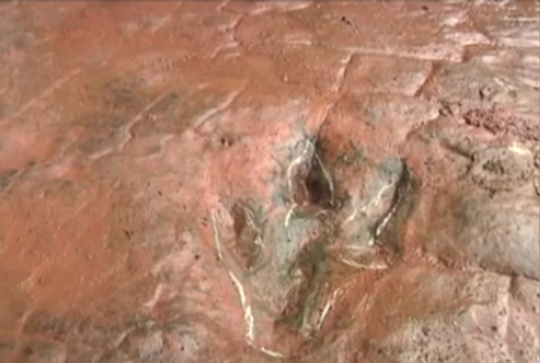
Everything Dinosaur has received media reports from several Chinese news agencies reporting the discovery of extensive dinosaur tracks in Guizhou Province (south-western China).  A total of sixty-eight tracks have been identified from sediments exposed in a river valley close to Tongmin Town.  The largest of the prints is estimated to be nearly fifty centimetres long.

Yesterday, a field team consisting of palaeontologists from the China University of Geosciences and Guizhou Provincial Museum arrived at the site to map the tracks and to conduct a full survey of the trace fossils.  In a press statement, Assistant Professor Xing Lida, (China University of Geosciences, Beijing), commented that three types of trace fossil (ichnofossils) had been recorded, suggesting that the tracks were made by three different types of dinosaur.  A preliminary assessment suggest that one type of track was made by a plant-eating ornithopod, whilst the other two tracks were made by theropod dinosaurs.

One of the Theropod Tracks from the Site

Theropod track.

One of the theropod tracks identified by Chinese scientists.

Picture credit: CBS/China University of Geosciences 

The photograph above shows one of the theropod footprints.  The researchers have highlighted the track and indicated the toes along with the claw impressions.

Xing Lida stated:

“About three types of dinosaurs passed by here.  The rock surface is quite flat and the footprints head to different directions, which means a group of dinosaurs might have come here often for water and food 100 million years ago.”

Improving Knowledge on the Late Cretaceous Chinese Dinosaurs

The tracks were made in the soft mud surrounding a lake (a potential lacustrine environment), although it is not possible to tell exactly when the impressions were made in terms of which dinosaurs passed by and when, the tracks are helping Chinese researchers to better understand the dinosaur fauna of this part of the world some 100 million years ago (Cenomanian faunal stage of the Late Cretaceous).

An in-depth analysis of the tracks is to be undertaken.  The research team are confident that they will be able to measure the stride length and calculate the velocity of the dinosaurs (estimation of walking speed).

These tracks are significant, as Assistant Professor Xing explained:

“The dinosaur footprints here are well-preserved compared with those in other places in China.  It would be easy to calculate the length and the speed of the dinosaurs and to know what they did in this place 100 million years ago, according to their footprints.”

In 2016, Chinese media reported the discovery of a series of dinosaur tracks at a location approximately 120 miles to the south-west of the Tongmin Town site (Bijie).  These tracks, represent four individual dinosaurs and the strata that they were formed in, now part of a cliff, is also around 100 million years old.  These tracks were made as dinosaurs traversed the soft, sticky mud adjacent to a lake (another potential lacustrine environment).

It is hoped that data from these two locations, representing contemporaneous fauna will help scientists to gain a better understanding of which types of dinosaurs lived in southern China during the early Late Cretaceous.

Visit the award-winning Everything Dinosaur website: Everything Dinosaur.

22 07, 2017

Painting Backgrounds for Dinosaur Dioramas

By |2023-08-08T07:45:04+01:00July 22nd, 2017|Categories: Dinosaur Fans, Educational Activities, Main Page|0 Comments

Jurassic Park III Backdrop Completed

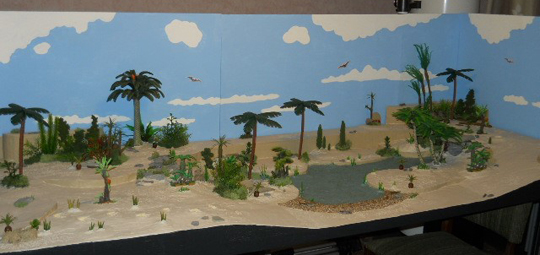
Talented model maker and dinosaur model enthusiast Robert Townsend has completed the backgrounds to his huge prehistoric animal diorama that he has been building.  The project entitled “Jurassic Park III”, has been meticulously planned and Robert’s care and attention to detail is reflected in the skilfully painted backdrop that he has created.

Background Boards in Place and Painted

Background painted for dinosaur diorama.

The beautifully painted backdrop to a prehistoric landscape.

Picture credit: Robert Townsend

A Careful Choice of Colour Scheme

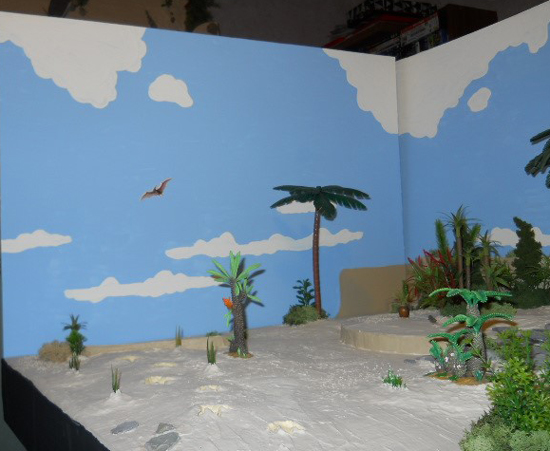
The background boards are constructed of stiff, but very lightweight foam and have been painted sky blue with various cloud shapes.   The use of longer, thinner cloud shapes in the centre of the diorama and at a lower height, helps to draw the viewer into the prehistoric landscape and assists in giving the backdrop a sense of perspective.  Choice of materials for a backdrop of this nature can be tricky, for example, wooden panels can be used but they can add considerable weight to the model and there can be problems securing them to base.  The foam boards would have been easier to fix into place, but painting them proved to be more difficult than anticipated.

Robert explained:

“As the paint dried they [the foam boards] had the annoying habit of curling up and had to be repeatedly bent back and flattened out again by laying them face down on my dinner table and placing heavy objects on then to flatten them out again.”

Light Foam Boards were used in the Backdrop Construction

Background for dinosaur diorama.

Backdrop for dinosaur diorama.

Picture credit: Robert Townsend

Adding Pterosaurs

Some flying reptile stickers, given to Robert by Everything Dinosaur, were utilised in the background making process, providing points of interest within the sky.  Robert wants to hang some flying reptile models within the diorama and asked our team members for advice on how best to go about this.  We find that fishing line is very useful for this purpose.  Very fine lines of less than one- pound breaking strain can be purchased from most tackle shops, or if you have a friend that enjoys angling, they are usually happy to donate a metre or two of line for this purpose.  Fishing line tends to be stronger than cotton, it is easier to tie and is less conspicuous.

Painting a Dinosaur Diorama

Robert asked:

“Will the threads show on any pictures that I might take?”

Sadly, even the most carefully tied, finest threads will show, however, their presence can be mitigated by a careful selection of photo angle to minimise any intrusion and the relatively simple, blue background would make any lines quite easy to photoshop out of any pictures.  Thankfully, model making companies such as CollectA and Papo have recently introduced excellent pterosaur models in terrestrial poses, after all, even the most capable flyers would spend a proportion of their time on the ground.

To view the Papo model range: Papo Dinosaur and Prehistoric Animal Models.

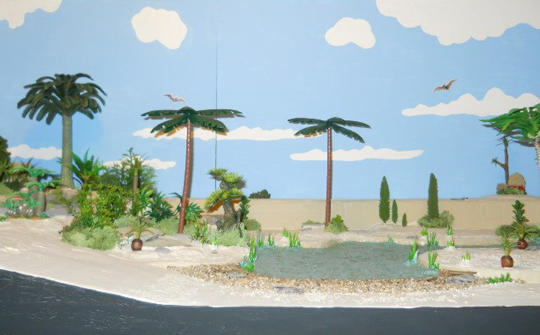
All It Needs Now are Prehistoric Animals

Prehistoric landscape ready for dinosaurs.

Diorama is ready to be populated by prehistoric animals.

Picture credit: Robert Townsend

To view the CollectA pterosaurs in their Prehistoric Life model range: CollectA Prehistoric Life models.

A Large Scale Dinosaur Diorama

The size of the prehistoric landscape gives Robert plenty of options when it comes to depicting prehistoric animals.  He intends to create a series of mini-scenes within the landscape, with the animals indulging in a number of different behaviours such as herding, nesting, hunting, fighting, drinking at the water hole and feeding.

We look forward to seeing Robert’s “Jurassic Park III” complete with its prehistoric animal residents.

Visit the Everything Dinosaur website: Everything Dinosaur.

21 07, 2017

A Guide to the CollectA Mini Prehistoric Marine Animals Set

By |2023-08-08T07:37:15+01:00July 21st, 2017|Categories: Dinosaur Fans, Everything Dinosaur Products, Main Page, Teaching|0 Comments

A Guide to the CollectA Mini Prehistoric Marine Animals Set

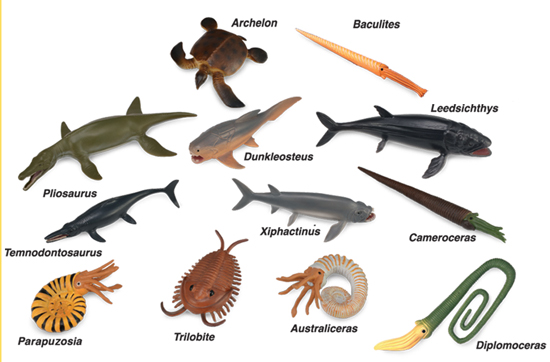
With CollectA having introduced another set of miniature figures into their “Prehistoric Life” model series, team members at Everything Dinosaur thought it would prove helpful to model makers if they listed the twelve replicas within the new CollectA mini prehistoric marine animals set.  This information might be helpful to creators of prehistoric animal dioramas so that they can put the correct model within the context of the geological time period that they are trying to replicate.

The New for 2017 CollectA Mini Prehistoric Marine Animals Set

The CollectA mini prehistoric marine animals.

The CollectA mini prehistoric marine animals set.

CollectA Mini Prehistoric Marine Animals Contents and Details

The twelve replicas that make up this set are certainly an eclectic bunch.  The model set consists of six vertebrates and six invertebrates.  We have listed them in alphabetical order and provided some details about the prehistoric animal each replica represents.

  • Archelon – known from Upper Cretaceous deposits (Campanian faunal stage), of the United States.  One of the largest turtles known to science, it lived approximately 80 million years ago in the Western Interior Seaway.  Archelon means “ruling turtle”.
  • Australiceras –  known from Australia (Queensland), fossils of this ammonite have been found in Early Cretaceous rocks (Aptian faunal stage 125 – 112 million years ago).  The name translates as “southern horn”.
  • Baculites – a straight shelled member of the ammonite Order from the Late Cretaceous (Cenomanian faunal stage to the Maastrichtian).   This mollusc had a worldwide distribution, but most of the named species are associated with the Campanian faunal stage of the Western Interior Seaway.  The name translates as “walking stick rock”.
  • Cameroceras –  a giant member of the orthocones (Cephalopoda – related to squid, cuttlefish, octopi and ammonites). It evolved in the mid Ordovician some 470 million years ago and was widespread. One the largest molluscs to have ever lived, size estimates of around six to nine metres have been stated.  These giants, survived into the Silurian, although the end Ordovician extinction did dramatically reduce the number of genera.  The last Cameroceras died out around 430 million years ago.  The name translates as “chambered horn”.
  • Diplomoceras –  a large Late Cretaceous ammonite with a bizarrely shaped shell.  Diplomoceras had a world-wide distribution and the very biggest individuals had shell lengths (unwound) of more than three metres.  The name translates as “double horn”.
  • Dunkleosteus – a giant placoderm fish from the Late Devonian (370-360 million years ago).  Fossils are known from North America, Morocco, Belgium and Poland.  Dunkleosteus may have reached lengths of around ten metres.  The name translates as “Dunkles bones”, honouring Dr David Dunkle (Cleveland Museum of Natural History).

Everything Dinosaur Website

All these figures and many more can be found on the award-winning Everything Dinosaur website.

To visit the website: Everything Dinosaur.

  • Leedsichthys – possibly the largest fish that has ever lived, with some scientists estimating the size of Leesdichthys at over 22 metres.  This leviathan lived during the Middle Jurassic and fossils have been found in England, France, Germany and Chile.  The name translates as “Leeds’s fish” and honours the British palaeontologist Alfred Leeds.
  • Parapuzosia – a genus of giant ammonite from the Late Cretaceous (Cenomanian to Campanian faunal stages).  Most fossil shells are less than one metre in diameter but a few specimens have been found with shells in excess of three metres wide.  World-wide distribution.  The name translates as “near to Puzosia”, reflecting its taxonomic affinity to the genus Puzosia.
  • Pliosaurus – A genus of Late Jurassic (155 to 147 million years ago), marine reptile.  A hypercarnivore and apex predator growing to more than ten metres in length.  The name translates as “more lizard” and this model makes a great representation of a juvenile.
  • Temnodontosaurus – known from the Early Jurassic (200-189 million years ago), of Europe.  This member of the Ichthyosauria grew to around ten metres long and probably weighed between one and two tonnes.  The name translates as “cutting-tooth lizard”.
  • Trilobite – an extinct group of arthropods that were entirely marine and lived from the Early Cambrian to the end-Permian extinction event (545 million to 251 million years ago).  Numerous Phyla have been identified and something like 20,000 species have been named and described.  Trilobita were ubiquitous and have a world-wide distribution.  The name translates as “three-lobed” as these invertebrates had three distinctive parts that made up their body plan.  The model represents the genus Olenoides, known from the Cambrian of Canada (Burgess Shale).
  • Xiphactinus –  one of the largest known bony fish, reaching lengths of up to six metres.  Fossils are known from Upper Cretaceous deposits of North America (Western Interior Seaway), but fossils of this predatory fish have also been reported from Australia.  Xiphactinus lived from approximately 88 to 66 million years ago.  The name translates as “sword ray”.

The CollectA Mini Prehistoric Marine Animal Set

The CollectA Mini Prehistoric Marine Animals Set

CollectA mini prehistoric marine animals set.

The CollectA mini prehistoric marine animals set.

Picture credit: Everything Dinosaur

Last year, when Everything Dinosaur announced that CollectA was introducing this innovative model set, we were able to have a chat to the designer Anthony Beeson.

Anthony told us:

“These are of course, not to scale but can be used in play and dioramas along with our other models as immature animals where we have already produced models of the same species.  The new models include the giant ammonite Parapuzosia and the little trilobite Olenoides serratus and other prehistoric fish and cephalopods that I thought might be enjoyable and educational.  I always particularly liked the elegantly uncurled Australiceras after coming across fossils at Dinosaur Isle museum on the Isle of Wight.”

To view the CollectA mini prehistoric marine animals set and the rest of the CollectA “Prehistoric Life” model range: CollectA Prehistoric Life.

20 07, 2017

New Prehistoric Times Issue 122 Reviewed

By |2024-01-01T16:25:03+00:00July 20th, 2017|Categories: Dinosaur Fans, Magazine Reviews, Main Page, Prehistoric Times|0 Comments

Prehistoric Times (Summer 2017) Reviewed

Time for another “Prehistoric Times” magazine review and this issue (summer 2017), is as packed as a palaeontologist’s rucksack after a successful day of fossil hunting!  The front cover features a rearing Sauropod image, one of the amazing prehistoric scenes created by the remarkable John Gurche, a paleoartist, whose work has adorned many museums around the world and numerous dinosaur books.  Inside, John provides an insight into how he started his career at the Smithsonian Institute and his involvement with Steven Spielberg and “Jurassic Park”.  The concluding part of this most informative article will be featured in issue 123.

The Front Cover of Prehistoric Times (Summer 2017)

Prehistoric Times (issue 122)

The front cover of Prehistoric Times (summer 2017).

Picture credit: Mike Fredericks

Prehistoric Times One Hundred Not Out

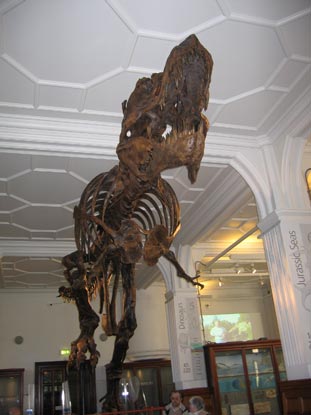
Regular contributor Tracy Lee Ford reaches a landmark with issue 122.  Inside the magazine, readers will discover his 100th, “How to Draw Dinosaurs” article.  It is part one, of a series that looks at pathology preserved in fossils – everything from fused metatarsals to the damage caused by a stegosaur’s thagomizer.  Everything Dinosaur congratulates the author on reaching this milestone and a special thank you for taking the time and trouble to include some excellent images showing the damaged skull of the tyrannosaur known as “Stan”.

The Cast of the Tyrannosaurus rex (Stan) BHI3033 on Display at Manchester Museum

Tyrannosaurus rex cast skeleton on display

Estimates of up to 9 tons in weight

Picture credit: Everything Dinosaur

Edmontosaurus and Kronosaurus

Phil Hore delves into the deep blue sea to discuss the fearsome predator Kronosaurus and takes us back onto land (Laramidia) to update readers on the large, Late Cretaceous Hadrosaur Edmontosaurus.  Both articles incorporate lots of reader submitted artwork, it is fascinating to see how the concept of a soft “comb” on Edmontosaurus has been adopted by numerous artists.  Amongst our favourites is the stylised illustration of Edmontosaurus sent in by Meg Bernstein, the skeletal drawing showing head and neck movement by John Sibbick and the beautifully detailed composition of Kronosaurus by long-time customer of Everything Dinosaur Luis Rey.

Prehistoric Times magazine is the magazine for fans of prehistoric animals and dinosaur models.  Published four times a year, it’s a great way to stay in touch with developments in the world of dinosaurs and prehistoric animals.

For further information about the magazine and to subscribe: Prehistoric Times Magazine.

The First Dinosaur Films

Long before John Gurche’s collaboration with Steven Spielberg, prehistoric animals had already featured in numerous dinosaur films and an article by Sylvia Czerkas tells the story of one of the early pioneers of dinosaurs in the movies, Major Herbert M. Dawley.  One of the great things about “Prehistoric Times” is the breadth of the articles for example, in addition to the regular book reviews, updates on palaeontology, replica news, classifieds and such like, Allen A. Debus expounds on the developments in how ancient landscapes are depicted and editor Mike Fredericks, even manages to find room to squeeze in a couple of drawings from Allen’s grandson Tyler.

The pictures in the magazine include one of the spectacular artworks by John Gurche.

Our thanks to all the contributors and a special mention to Steve Kelley for the extremely well-written article on his collection of Aurora Prehistoric Scenes kits.  That’s a fantastic collection you have their Steve and a very special thank you for including the “Jungle Swamp” images.

Visit the Everything Dinosaur website: Everything Dinosaur.

19 07, 2017

Albertavenator – Something to Get Your Teeth Into

By |2023-07-29T12:08:07+01:00July 19th, 2017|Categories: Dinosaur and Prehistoric Animal News Stories, Dinosaur Fans, Main Page|0 Comments

Albertavenator curriei – Implications for the North American Troodontids

World-famous Canadian palaeontologist Phil Currie has been honoured by having a new species of North American troodontid Albertavenator curriei, named after him.  Phil Currie has been at the forefront of vertebrate palaeontology for a long time now and it is great to see that his fellow scientists have honoured his contribution to the science in this way.  However, whilst other media outlets have focused on this accolade, in this article, we look at the what this means when it comes to identifying other small “raptor-like” dinosaurs from their teeth and fossilised jaws.

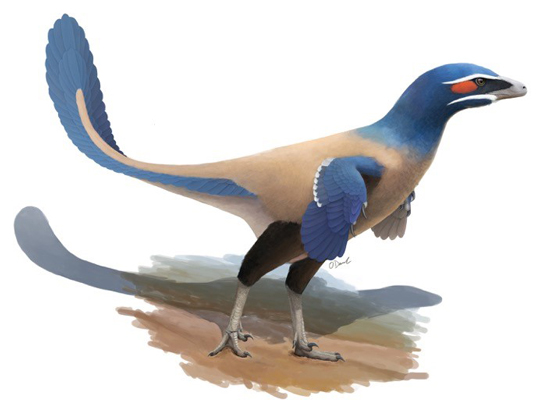
An Illustration of the Newly Described Troodontid Albertavenator curriei

Albertavenator curriei.

An illustration of the newly named Albertavenator curriei.

Picture credit: Oliver Demuth

“Currie’s Alberta Hunter”

This new dinosaur species has been described from fragmentary skull elements found in the Horseshoe Canyon Formation (Horsethief Member).  Albertavenator roamed this part of Canada some 71 million years ago (Early Maastrichtian faunal stage of the Late Cretaceous).

The name translates as “Currie’s Alberta hunter”.  Professor Currie has had a number of dinosaurs named after him already, including a member of the tyrannosaur family (Teratophoneus curriei), fossils of which come from Utah.  Albertavenator is the second dinosaur from Alberta named in honour of Professor Currie.  Epichirostenotes curriei, a bird-like maniraptoran theropod assigned to the Caenagnathidae family, fossils of which also come from the Horseshoe Canyon Formation, carries his name.

Palaeontologist Phil Currie

Phil Currie has made a tremendous contribution, not only to the Royal Tyrrell Museum at Drumheller, but also to the recently opened (September 2015), Philip J. Currie Museum located to the west of the town of Grande Prairie (Alberta).  In a career spanning five decades, Professor Currie has established himself as one of the world’s most-respected dinosaur experts.  He has won numerous awards, including in 2012, the prestigious Explorers Medal.

To read more about this award: Phil Currie is Honoured by the Explorers Club.

Award-winning and Highly Respected Palaeontologist Phil Currie

Palaeontologist Phil Currie.

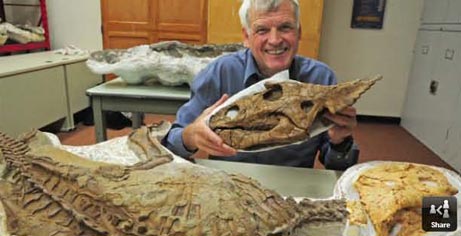
Palaeontologist Phil Currie with a juvenile Pachyrhinosaurus specimen.

Picture credit: Bruce Edwards (from a video interview)

Albertavenator curriei

Researchers thought that the fossil bones belonged to a species of Troodon, fossils assigned to this genus have been found all over North America from the Dinosaur Provincial Park and Judith River Formations to Alaska, New Mexico and as far south as Texas.  Analysis of the frontal bones (bones from top of the skull), revealed that this dinosaur was different, its skull was shorter and more robust when compared to numerous Troodon skull specimens.

The difference in the shape of the bones was not put down to different growth stages or deformation of the bones during fossilisation, there were enough distinguishing features to establish a new dinosaur genus.

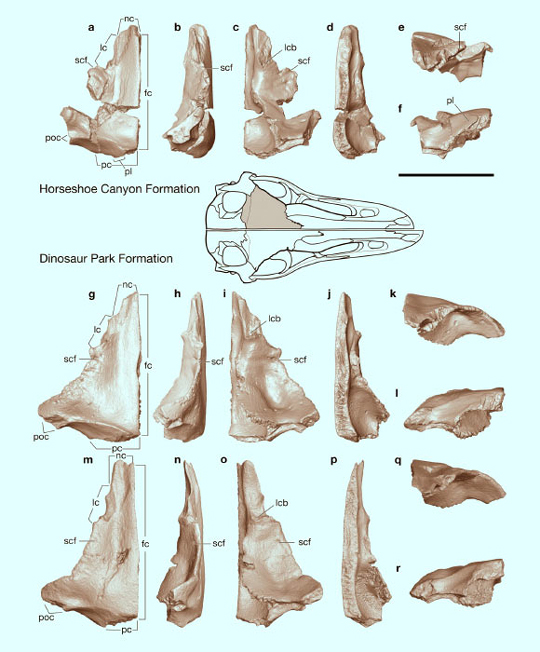
Comparing the Skull Bones of A. curriei and Troodon inequalis

Troodontid skull bone comparison.

Comparing the skull bones of Albertavenator to Troodon.

Picture credit: Canadian Journal of Earth Sciences (Evans et al)

The picture above shows the skull bones (frontals) of Albertavenator curriei from the Horseshoe Canyon Formation (top) compared to comparable material assigned to Troodon inequalis from the Dinosaur Provincial Park Formation (bottom).  Abbreviations: fc – frontal midline contact, lc – lacrimal contact with frontal, lcb – lacrimal buttress, lsc – laterosphenoid contact with frontal, nc – nasal contact with frontal, or – orbital rim, pc – parietal contact with frontal, pl – parietal lappet, poc – postorbital contact with frontal, scf – supraciliary foramen.

Note: the scale bar = 1 cm.

Delicate Bones of Albertavenator curriei

Lead author of the scientific paper, published in the Canadian Journal of Earth Sciences, Dr David Evans (Royal Ontario Museum), stated:

“The delicate bones of these small, feathered dinosaurs are very rare.  We were lucky to have a critical piece of the skull that allowed us to distinguish Albertavenator as a new species.  We hope to find a more complete skeleton of Albertavenator in the future, as this would tell us so much more about this fascinating animal.”

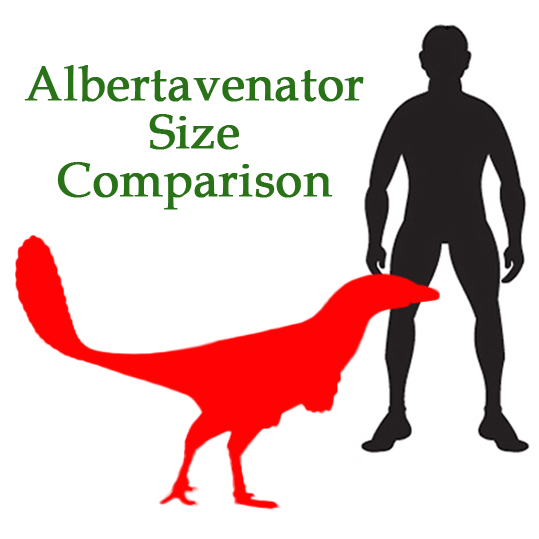
Albertavenator is estimated to have weighed about sixty kilogrammes and measured around two metres in length.

A Scale Drawing of Albertavenator (A. curriei)

Albertavenator scale drawing.

A size comparison with a human compared to Albertavenator.  Picture credit: Everything Dinosaur.

Picture credit: Everything Dinosaur

To view articulated models of dromaeosaurs and other dinosaurs: Beasts of the Mesozoic Figures.

Rare Troodontid Fossil Material – What About the Teeth?

Much of the fossil material used to describe this new species was found in the early 1990s.  The naming of Albertavenator is yet another example of a new genus being erected from further study of dinosaur fossils within a museum’s collection, in this case the Royal Tyrrell Museum.  Substantial troodontid body fossils are rare from strata that are dated to the Maastrichtian faunal stage of the Cretaceous, the exception to this are the copious amounts of teeth that have been assigned to this genus.

The researchers note that jawbone shape and the teeth associated with a relatively complete dentary (lower jaw), from the Horseshoe Canyon cannot be distinguished from lower jaws and teeth found in the Dinosaur Park Formation.  If the dentary and teeth from the Horsethief Member of the Horseshoe Canyon Formation prove to belong to A. curriei, then isolated teeth and jaws are no longer able to be allocated to one, specific dinosaur genus – Troodon.  If the teeth and jaws of a dinosaur like Albertavenator cannot be distinguished from the teeth and jaws of Troodon, then these fossils are unusable for identifying dinosaur genera.

Identifying Dinosaur Genera

Co-author of the study, Derek Larson (Assistant Curator of the Philip J. Currie Dinosaur Museum), explained:

“This discovery really highlights the importance of finding and examining skeletal material from these rare dinosaurs.”

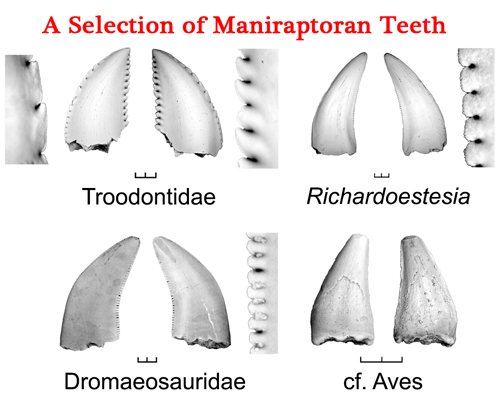
Typical Maniraptoran Teeth

Maniraptora tooth morphology.

Troodontid teeth are characterised by their large serrations.

Picture credit: Everything Dinosaur

The picture above shows a selection of different dinosaur teeth, troodontid teeth can be identified by their over-sized serrations (large denticles).  However, the identification of a new species of troodontid in the Late Cretaceous of North America means that isolated teeth cannot be ascribed specifically to the Troodon genus.  It is very likely that Albertavenator is just one of a number of small theropods that lived in Canada, the small theropod dinosaur diversity in the latest Cretaceous of North America is likely to have been underestimated.

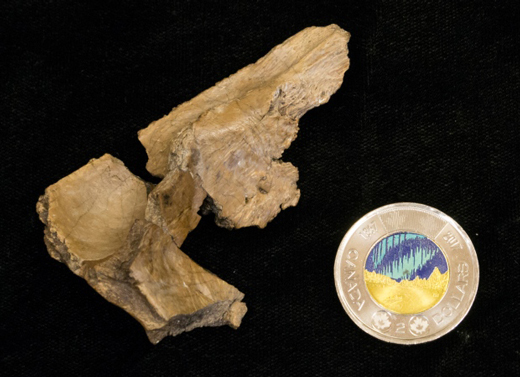
Skull Bones Assigned to Albertavenator curriei

Albertavenator skull fragment.

Dinosaur skull fragment (A. curriei) – coin provides scale.

Picture credit: Canadian Journal of Earth Sciences (Evans et al)

The scientific paper:
“A New Species of Troodontid Theropod (Dinosauria: Maniraptora) from the Horseshoe Canyon Formation (Maastrichtian) of Alberta, Canada.” by D. C. Evans, T. M. Cullen, D. W. Larson, and A. Rego, published in the Canadian Journal of Earth Sciences.

Visit the Everything Dinosaur website: Everything Dinosaur.

18 07, 2017

New Research Suggests that T. rex is Not a Fast Runner!

By |2024-04-01T14:04:56+01:00July 18th, 2017|Categories: Dinosaur and Prehistoric Animal News Stories, Dinosaur Fans, Main Page|1 Comment

T. rex Slow Coach Once Again

Palaeontologists have long debated the potential running speeds of big, theropod dinosaurs.  Indeed, the question as to whether bipedal giants like Tyrannosaurus rex, Giganotosaurus, Mapusaurus and Carcharodontosaurus could run at all has been muted.  Thanks to some new research from Manchester University, a better understanding of dinosaur locomotion could be within our grasp.

New T. rex Study Suggests Giant Theropods Could Not Run Fast
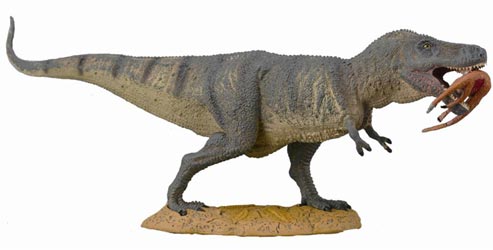
T. rex model with prey.

The “prey” is an unfortunate Struthiomimus.  T. rex not a fast runner.

The picture shows a Tyrannosaurus rex with an ornithomimid (Struthiomimus), in its mouth.  This new study concludes that there is no way that a T. rex could pursue and catch such a fleet-footed dinosaur as an “ostrich mimic”.  In this case, perhaps this hypercarnivore stumbled across the carcass of a Struthiomimus, we can expect the “hunter versus scavenger” debate to be re-ignited as a result of these research findings.

The model in the image is from the CollectA Prehistoric Life range.

To view this range: CollectA Age of Dinosaurs Prehistoric Life Models.

If T. rex Tried to Run Fast it Could Break its Legs!

According to lead author of this new, scientific paper, Professor Bill Sellers (School of Earth and Environmental Sciences), T. rex could not run, it was just too large and heavy.  Tyrannosaurus rex was unable to pursue prey at high speeds – no chance of catching Jeff Goldblum et al in the famous jeep chase in Stephen Spielberg’s ground-breaking “Jurassic Park”.  In addition, this new research suggests that T. rex walking speed was limited, had it tried to quicken its pace, it was in danger of breaking its legs.

This new study means that scientists will have to reconsider how T. rex might have behaved. We at Everything Dinosaur know, that the BBC are bringing out a new documentary on the “Tyrant Lizard King”, this is due to be shown at Christmas.  Will this new research change the script?

New Biomechanical Study of Tyrannosaurus rex Locomotion Limits Dinosaur Velocity
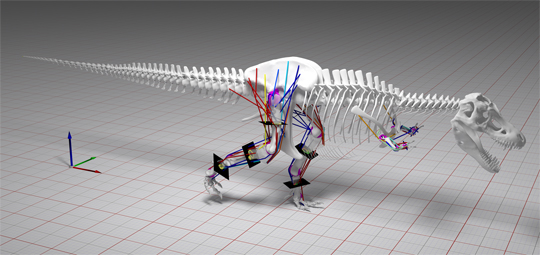
New study suggests T. rex could not run.

New research suggests T. rex couldn’t run.

Picture credit: University of Manchester

The Gait and Biomechanics of the World’s Most Famous Dinosaur

The research team used a combination of two separate biomechanical assessment techniques coupled with sophisticated computer programming to model locomotion results.  The biomechanical techniques, known as multibody dynamic analysis (MBDA) and skeletal stress analysis (SSA), in conjunction, create a new, more accurate assessment of T. rex and its cursorial abilities.

The size and weight of an adult T. rex means that it could not move at high speed, its leg bones would have buckled under its own colossal weight.  N8 High Performance Computing (HPC), was used to create a three-dimensional model of the skeleton and to assess the forces involved as this giant predator was put through its paces.  Running did not end well for the T. rex,  had this monster survived to the present day, it seems that most of us humans could have easily out run it.  The paper, published in the academic journal “PeerJ”, suggests a top speed of around 12.5 mph (20 km/hour) for Tyrannosaurus rex.

Not Capable of Running Fast

Previous studies, that predicted running speeds of up to 45 mph for very big theropods have been de-bunked.  Running at such a speed would have placed “unacceptably high skeletal loads” on the animal, T. rex would have broken its legs had it attempted to sprint.

Professor Sellers explained:

“The running ability of T. rex and other similarly giant dinosaurs has been intensely debated amongst palaeontologist for decades.  However, different studies using differing methodologies have produced a very wide range of top speed estimates and we say there is a need to develop techniques that can improve these predictions.   Here we present a new approach that combines two separate biomechanical techniques to demonstrate that true running gaits would probably lead to unacceptably high skeletal loads in T. rex.”

Tyrannosaurus rex – A Lumbering Giant
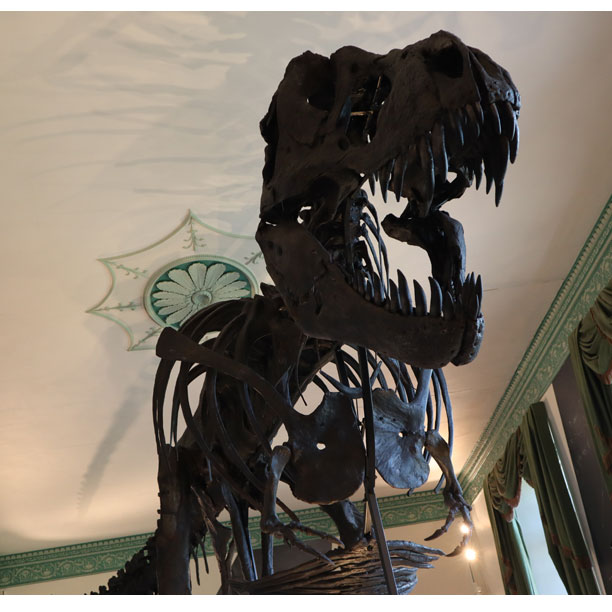
Titus the T.rex exhibit. A T. rex skeleton on display.

The spectacular Titus the T. rex exhibit at Wollaton Hall.  Tyrannosaurus rex a lumbering giant.  Picture credit: Everything Dinosaur.

Picture credit: Everything Dinosaur

Challenging Perceptions about T. rex

This new study challenges the way in which T. rex and similarly sized theropods could have behaved.  High-speed chases were out of the question.  It is likely that these predators were limited to walking speeds, a direct contradiction to the fast-moving, highly cursorial depiction seen in some movies and postulated by other researchers.  The University of Manchester team may have concentrated on the largest tyrannosaurid, but this research has implications for other super-sized theropods too.  The scientists conclude that other large, bipedal dinosaurs, predators such as Giganotosaurus, Mapusaurus and Acrocanthosaurus were also slow coaches.

Acrocanthosaurus Too – Likely to be a Slow Coach
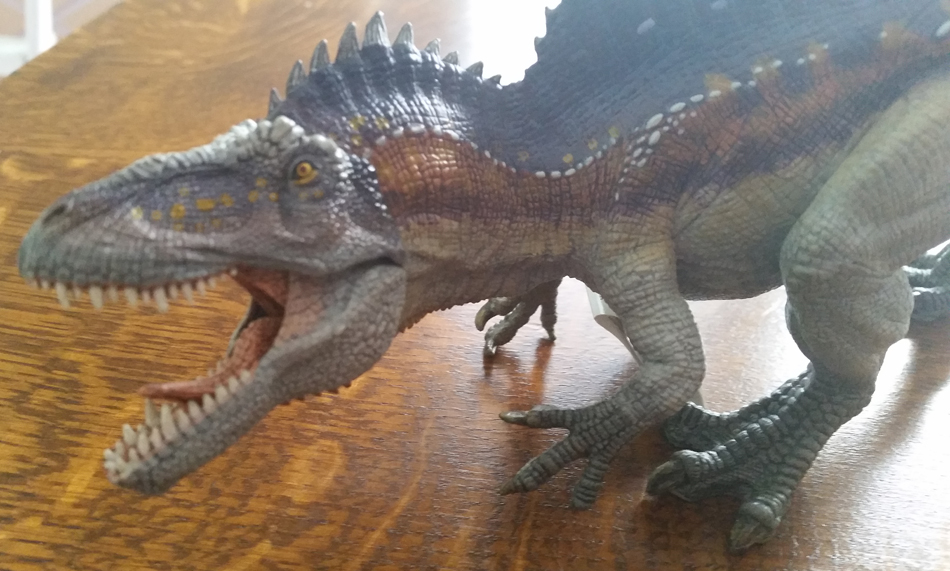
A view of the Papo Acrocanthosaurus dinosaur model.

Papo Acrocanthosaurus dinosaur model. Picture credit: Everything Dinosaur.

Picture credit: Everything Dinosaur

Professor Sellers added:

“Tyrannosaurus rex is one of the largest bipedal animals to have ever evolved and walked the earth.  So, it represents a useful model for understanding the biomechanics of other similar animals. Therefore, these finding may well translate to other long-limbed giants so but this idea should be tested alongside experimental validation work on other bipedal species.”

This is not the first time MBDA and SSA methodologies have been used to measure the walking and running ability of dinosaurs.  However, it’s the first time they have been used in conjunction to create a more accurate picture of potential locomotion.

The professor concluded:

“Our previous simulations of theropod bipedal running did not directly consider the skeletal loading but these new simulations do calculate all the forces in the limb bones and these can be used directly to estimate the bone loading on impact.”

The Research Implications

If Tyrannosaurus rex and other large theropods were essentially limited to walking, then this study directly contradicts those arguments for a more athletic, active lifestyle for these huge carnivores.  Unable to pursue prey, this suggests that a fully-grown Tyrannosaurus rex may have been an ambush predator or perhaps entirely reliant upon a durophagous existence, crunching the bones and feeding on the carcasses of dead dinosaurs.

This study suggests that palaeontologists may have to change their views on the effects of body size and shape as large, bipedal dinosaurs grow.  Earlier research has suggested that the torso became longer and heavier, whereas the limbs became proportionately shorter and lighter as T. rex grew.  These changes would mean that the running abilities of T. rex would also change as the animal matured, with adults likely to be less agile than younger, lighter individuals.

Could a Large Theropod Really Run Fast?
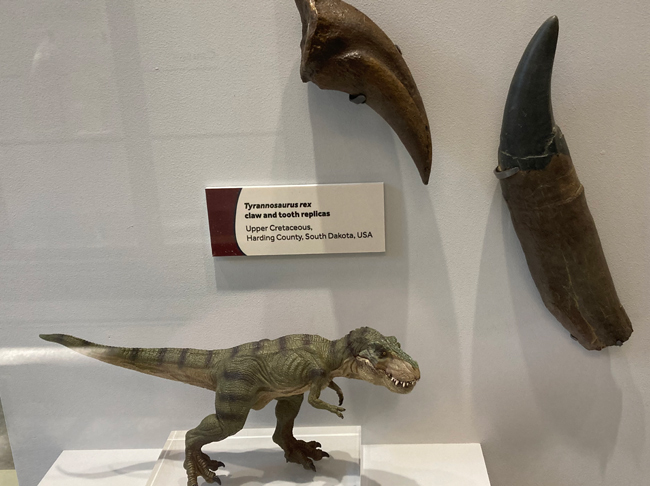
Papo running T. rex

A Papo green running Tyrannosaurus rex model on display next to a replica of a T. rex tooth and a T. rex claw. An exhibit at the Manchester Museum of Natural History. Picture credit: Everything Dinosaur.

If this dinosaur was limited to a walking speed, then images of T. rex as an agile, active predator could be highly inaccurate.

This new paper, is likely to spark a debate once more about the lives of these iconic prehistoric animals.  A spokesperson from Everything Dinosaur commented:

“The problem is, whilst we have large quadrupeds to study, animals such as elephants and rhinos, there is simply no extant equivalent of a huge, bipedal dinosaur!  This might be fortunate from a personal preservation perspective, but for palaeontologists, this poses a huge problem when it comes to considering how these creatures moved.  Sophisticated biomechanical studies such as this one from Manchester University, provide probably the best chance we have when it comes to unravelling the mysteries of dinosaur locomotion.”

The scientific paper: “Investigating the Running Abilities of Tyrannosaurus rex Using Stress-constrained Multibody Dynamic Analysis” by William I. Sellers, Stuart B. Pond, Charlotte A. Brassey, Philip L. Manning, and Karl T. Bates

To read a selection of other articles looking at the running abilities of various dinosaurs:

T. rex Could Run at Nearly Eighteen Miles per Hour!

Argentinosaurus Walks Again.

How Fast Could T. rex Run?

Dinosaurs at the Movies – the Anomalies of “Jurassic Park”.

Visit the award-winning Everything Dinosaur website: Everything Dinosaur.

Go to Top