All about dinosaurs, fossils and prehistoric animals by Everything Dinosaur team members.
16 08, 2017

New Damselfly Species Honours Sir David Attenborough

By |2024-05-06T16:16:24+01:00August 16th, 2017|Categories: Dinosaur and Prehistoric Animal News Stories, Main Page, Photos/Pictures of Fossils|0 Comments

Mesosticta davidattenboroughi – Sir David’s Cretaceous Damselfly

Broadcaster, naturalist and all-round good guy, Sir David Attenborough has been honoured yet again by having a newly described species named after him.  This time, it is a new species of Cretaceous damselfly discovered in a piece of Burmese amber (burmite).  Fossils of insects are extremely rare and the fossil record for this extremely important Class of arthropods has been significantly enriched thanks to the preserved insect remains found in fossilised tree resin.

A Picture of the Holotype Specimen – Mesosticta davidattenboroughi
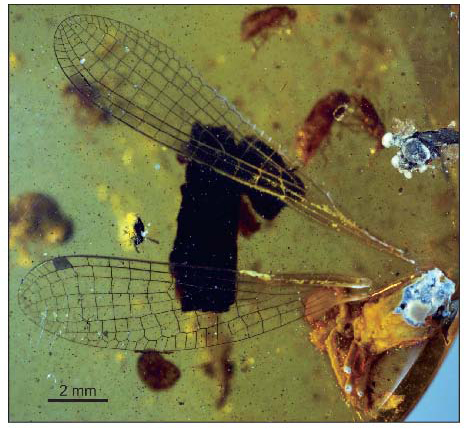
Mesosticta davidattenboroughi Cretaceous damselfly in amber.

Mesosticta davidattenboroughi sp. nov., holotype, NIGP164541, photograph of specimen.

Picture credit: Journal of Systematic Palaeontology

Sir David Attenborough is Honoured

The remains of this winged insect were discovered in the Hukawng Valley of Kachin Province, northern Myanmar, an area famed for its amber deposits.  Details of some remarkable fossils have recently been published, for example, back in 2016 Everything Dinosaur blogged about the discovery of a partial tail from a feathered dinosaur in burmite.  As recently as June (June 2017), we wrote about the finding of the remains of a primitive bird, a hatchling that had become entombed and preserved.

To read the article about the discovery of the dinosaur tail: The Tale of a Dinosaur Tail.

For the article on the baby bird fossil: Watch the Birdie! Enantiornithine in Amber.

Mesosticta davidattenboroughi

The full, binomial scientific name for the new species, belonging to a group more commonly known as shadowdamsels, is Mesosticta davidattenboroughi.  The researchers decided to name the new species after David Attenborough because of his long-standing appreciation of dragonflies, and to celebrate his recent 90th birthday, which he celebrated in May 2016.

Co-author of the scientific paper, Professor Edmund A. Jarzembowski commented:

“Dragonflies in amber are extremely rare and the recent discoveries by my Chinese colleagues are a new window on the past.  It is tradition in taxonomy [the naming of a new species] to contact the person concerned.  Sir David was delighted because he is not only interested in the story of amber, but also a president of the British Dragonfly Society.”

The fossil itself is extremely well preserved as it is encased in yellow transparent amber and includes a complete set of wings.  With the aid of photo technology, the scientists were able to digitally enhance and build a clear three-dimensional image of the new species, showing that it differed from previously described fossils, Mesosticta had quite stubby, short wings when compared to other Mesozoic species.

Images of the Forewings of Mesosticta davidattenboroughi
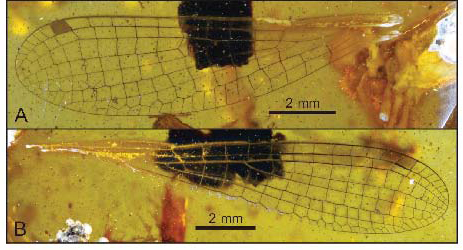
Mesosticta davidattenboroughi forewing images.

Mesosticta davidattenboroughi sp. nov., holotype, NIGP164541. A, photograph of left forewing; B, photograph of right forewing.

Picture credit: Journal of Systematic Palaeontology

Lead author of the scientific paper, Daran Zheng (Nanjing Institute of Geology and Palaeontology, Chinese Academy of Sciences), stated:

“Mesosticta davidattenboroughi is quite unique because we have uncovered a new species and it confirms the previous attribution of Mesosticta to the Platystictidae.  It is the first fossil group of modern platystictid damselflies and documents the appearance of Platystictidae as early as middle Cretaceous.”

A Poor Fossil Record

Finding insect remains in amber is not unusual, however, this family of damselflies are very poorly recorded in the fossil record and as a result this discovery from northern Myanmar is especially significant.

Mesosticta davidattenboroughi is just the latest in a long line of animals which have been named in honour of Sir David Attenborough:

Silurian Arthropod honours Sir David Attenborough: Fossil Named after Sir David Attenborough.

Kitten-sized marsupial lion named after Sir David Attenborough: Attenborough’s New Kitty.

The scientific paper: “Mesostictinae subfam. nov., an archaic group of platystictid damselflies (Odonata: Zygoptera) from mid-Cretaceous Burmese amber” by Daran Zheng, Bo Wang, André Nel, Edmund A. Jarzembowski, Haichun Zhang & Su-Chin Chang published in the Journal of Systematic Palaeontology.

Read the full article online: Scientific Paper.

Visit the Everything Dinosaur website: Everything Dinosaur.
15 08, 2017

Everything Dinosaur Stocks Sensational PNSO Age of Dinosaurs

By |2024-05-07T15:35:34+01:00August 15th, 2017|Categories: Dinosaur Fans, Everything Dinosaur News and Updates, Everything Dinosaur Products, Main Page, Photos of Everything Dinosaur Products, Press Releases|0 Comments

PNSO Age of Dinosaurs Model Range Available from Everything Dinosaur

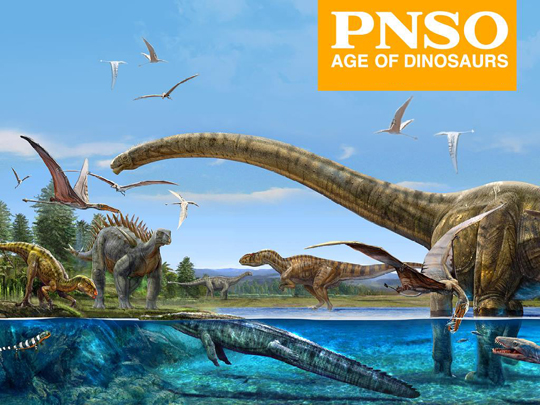
Everything Dinosaur now stocks the PNSO Age of Dinosaurs model range and what a fantastic selection of prehistoric animals it is!  These museum quality replicas and beautifully crafted toys cover a wide selection of ancient creatures, there is a T. rex and Triceratops of course but the PNSO Age of Dinosaurs series also encompasses armoured dinosaurs such as Chungkingosaurus, prehistoric whales such as Basilosaurus and fearsome, mega-mouthed sharks like Megalodon.

The PNSO Age of Dinosaurs Model Range

PNSO Age of Dinosaurs.

PNSO Age of Dinosaurs model range.

Picture credit: PNSO/Yiniao Sci-Art

Twenty-four Dinosaur Toys to Accompany Your Growth

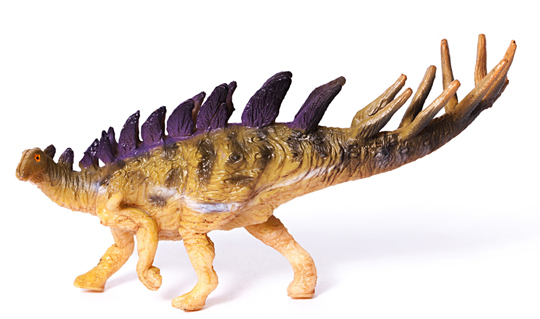
The range includes a selection of small prehistoric animal models, each one with its own unique species name such as “Aaron the little Tyrannosaurus”, Jonas the little Archaeopteryx and “Sethi the little Kentrosaurus”.

Sethi the Little Kentrosaurus – Dinosaur Toys that Accompany Your Growth

PNSO Age of Dinosaurs Kentrosaurus.

PNSO Age of Dinosaurs Kentrosaurus model.

Picture credit: PNSO/Yiniao Sci-Art

The picture above shows the Kentrosaurus dinosaur model figure, part of a series of twenty-four little prehistoric animals.  This range also includes some fantastic Chinese armoured dinosaurs including Wuerhosaurus (Xana the little Wuerhosaurus) and a Tuojiangosaurus (Rahba the little Tuojiangosaurus).

To view the range of PNSO Age of Dinosaurs available from Everything Dinosaur: PNSO Age of Dinosaurs.

Everything Dinosaur Comments

A spokesperson from Everything Dinosaur commented:

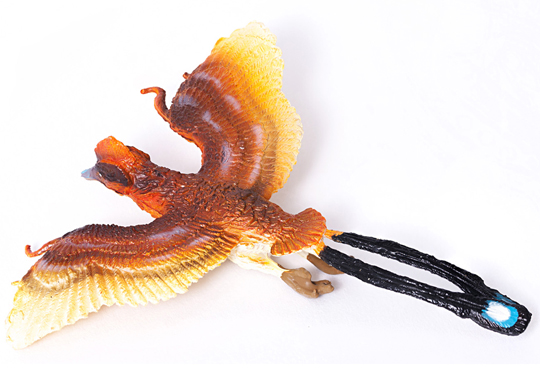
“The PNSO product range aims to inform and to educate and contains a huge variety of prehistoric animal models, both big and small.  It is wonderful to see replicas of some of the amazing dinosaurs from China incorporated into this product range and it’s not just dinosaurs too, there are ichthyosaur models such as Himalayasaurus to collect and even a Confuciusornis!”

The PNSO Age of Dinosaurs Confuciusornis Model

PNSO Age of Dinosaurs Confuciusornis model.

Confuciusornis model (PNSO Age of Dinosaurs).

Picture credit: PNSO/Yiniao Sci-Art

A Cretaceous Bird Named after a Chinese Philosopher

Many Confuciusornis fossils have been found in the Liaoning Province (north-eastern China) and fossils of these early birds (they belong to a group called the Enantiornithines), have helped palaeontologists to work out how maniraptoran feathered dinosaurs evolved into birds.  We are sure that the great Chinese philosopher and teacher Confucius would have approved of these prehistoric animal replicas, helping to inform and educate about China’s remarkable fossil record.

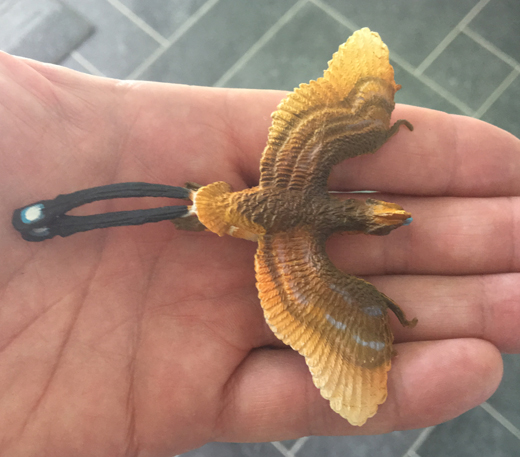
Male birds were slightly different from the females, just like many extant species of birds today.  The males had a pair of long tail feathers, the females lacked these adornments.  The PNSO Dinosaurs of China Confuciusornis model is therefore a male bird.  The long tail feathers played no role in powered flight, they probably were used in visual displays as the males attempted to attract a mate.

A Bird in the Hand – The PNSO Confuciusornis Model

PNSO Confuciusornis model. Cretaceous birds.

“A bird in the hand”, the Confuciusornis model from PNSO. Picture credit: Everything Dinosaur.

Picture credit: Everything Dinosaur

Marine Monsters and Museum Quality Dinosaur Replicas

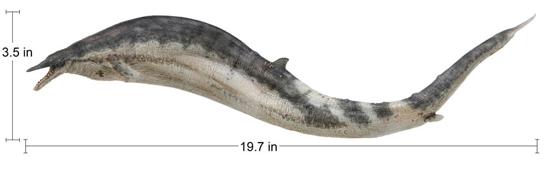
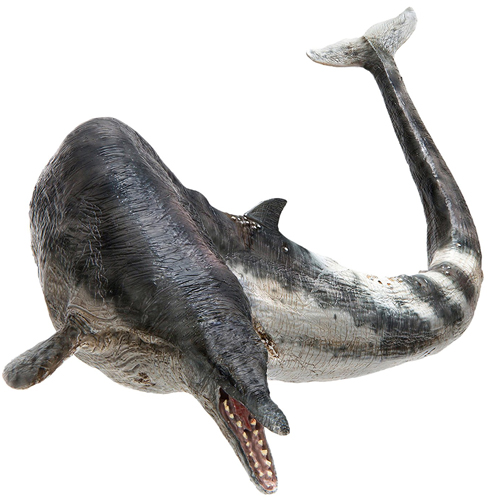
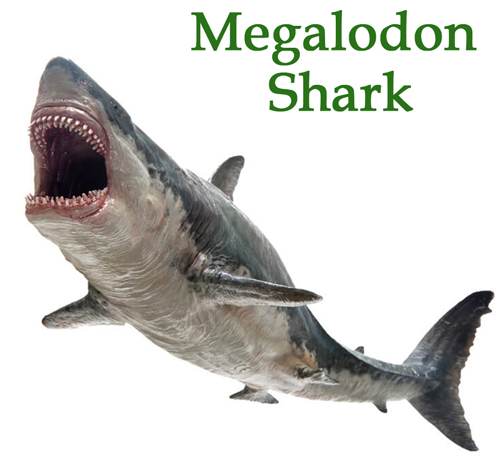
As well as family favourites such as Triceratops and Tyrannosaurus rex, the larger models include spectacular models of sea monsters.  There is a serpentine Basilosaurus replica, that at around half a metre in length, makes a brilliant centrepiece to any model collection.  We must also mention the fantastic Megalodon (O. megalodon) replica, the detail on this giant shark figure is stunning.

The PNSO Age of Dinosaurs Basilosaurus Model

PNSO Age of Dinosaurs Basilosaurus replica. A PNSO Basilosaurus model.

The PNSO Age of Dinosaurs Basilosaurus model.

Picture credit: PNSO/Yiniao Sci-Art

Swimming alongside the Basilosaurus in the PNSO Age of Dinosaurs model collection (but not necessarily in the same geological record), is the hugely impressive Megalodon shark model.

PNSO Age of Dinosaurs Megalodon Shark Model

Megalodon replica from the PNSO Age of Dinosaurs range.

PNSO Age of Dinosaurs Megalodon model.

Picture credit: PNSO/Yiniao Sci-Art

To view the range of prehistoric animals: PNSO Dinosaur Models and Figures.

View the Everything Dinosaur website: Everything Dinosaur.
14 08, 2017

Beautiful Basilosaurus Illustrated

By |2024-05-09T08:39:08+01:00August 14th, 2017|Categories: Dinosaur and Prehistoric Animal Drawings, Dinosaur Fans, Main Page|0 Comments

A Drawing of the Early Predatory Whale Basilosaurus

Basilosaurus was one of the first, large whales to evolve.  This animal named “regal reptile”, the first species of which was named and described by Richard Owen (Basilosaurus cetoides), in 1839, has grown in popularity amongst fans of prehistoric animals.

Basilosaurus appeared in an episode of the “Walking with Beasts” television series made by the BBC, (episode two “Whale Killer”).  With CollectA recently introducing a replica of this placental mammal, collectors have the opportunity to add an early cetacean to their model collection.   Everything Dinosaur has commissioned drawings of Basilosaurus.  In the light of the adding of the PNSO range of models to Everything Dinosaur’s huge product portfolio, we have posted up a PNSO inspired Basilosaurus drawing, one that has not been published on this blog that often.

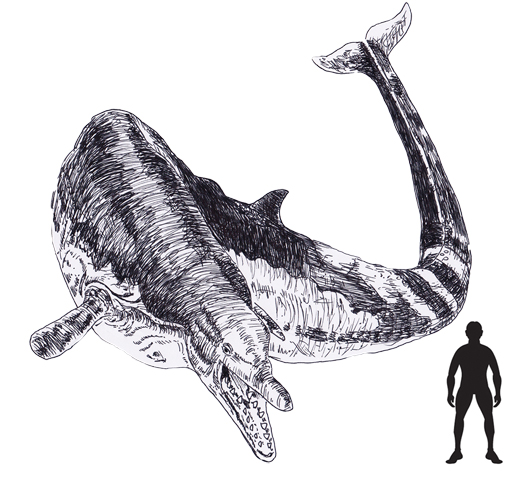
An Illustration of the Giant Prehistoric Whale Basilosaurus

PNSO Basilosaurus illustration.

An illustration of Basilosaurus.  Picture credit: Everything Dinosaur.

Picture credit: Everything Dinosaur

Basilosaurus

Although this fearsome carnivore, superficially resembled the toothed whales that are around today.  Basilosaurus was an evolutionary dead end, when Basilosaurus became extinct some 36 million years ago, towards the end of the Eocene Epoch, it left no descendants.  The drawing above is based on the PNSO Age of Dinosaurs Basilosaurus replica.

The PNSO Age of Dinosaurs Basilosaurus Replica

The PNSO Basilosaurus replica.

The Basilosaurus replica (PNSO).

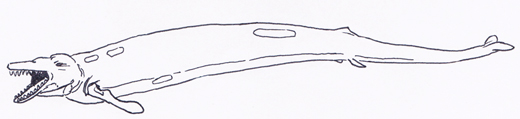
In addition to this illustration, Everything Dinosaur also commissioned a line drawing of the CollectA Basilosaurus replica.  Both of these drawings were commissioned to support our work producing data sheets and fact sheets about prehistoric animals.

The picture above shows the PNSO Basilosaurus model.  It is huge.

To view the PNSO range: PNSO Age of Dinosaurs.

The Illustration of the CollectA Basilosaurus Model (Everything Dinosaur)

CollectA Basilosaurus illustration.

The CollectA Basilosaurus model. Picture credit: Everything Dinosaur.

Picture credit: Everything Dinosaur

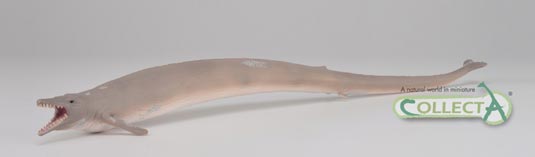
Compare the line drawing of the CollectA Basilosaurus model, with a picture of the actual CollectA Basilosaurus (seen below).

The CollectA Basilosaurus Model

An early whale model - CollectA Basilosaurus

The CollectA Basilosaurus model.

To view the range of CollectA prehistoric animal figures in the not-to-scale Prehistoric Life range: CollectA Prehistoric Life Age of Dinosaurs.

To view the range of CollectA scale models: CollectA Deluxe Prehistoric Animal Figures.

13 08, 2017

The New Papo Cave Bear Model is Reviewed

By |2024-05-09T08:39:59+01:00August 13th, 2017|Categories: Dinosaur Fans, Everything Dinosaur Products, Main Page, Photos of Everything Dinosaur Products, Product Reviews|5 Comments

A Review of the New for 2017 Papo Cave Bear Model

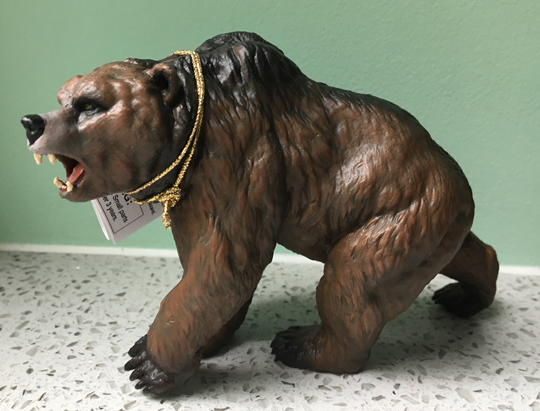
The Papo Cave Bear model is now in stock at Everything Dinosaur.  This eagerly anticipated Papo replica arrived at our warehouse today and team members at Everything Dinosaur have been busy checking inventory and putting models to one side for those customers who requested that we reserve one for them.  It really is a splendid model and it is great to see the French manufacturer extend their model range by including a prehistoric mammal, especially since the recent retirement of their popular Woolly Rhino (Coelodonta) figure.

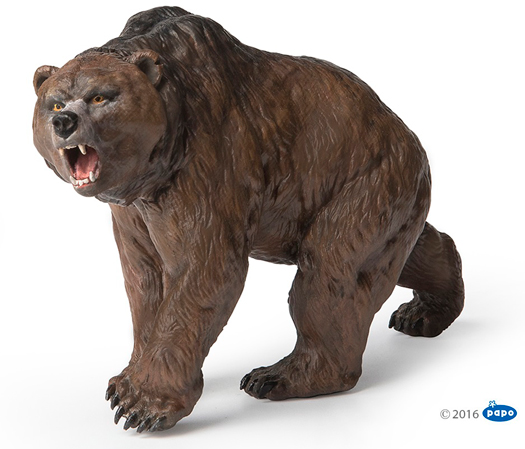
The Papo Cave Bear Model is Now in Stock at Everything Dinosaur

The new for 2017 Papo Cave Bear model.

Lateral view of the Papo Cave Bear model. Picture credit: Everything Dinosaur.

Picture credit: Everything Dinosaur

Cave Bear (Ursus spelaeus)

Cave bears shared a common ancestor with the modern Brown bear (Ursus arctus) and they evolved around 300,000 years ago and survived until the late Middle Palaeolithic of the Stone Age, (around 40,000 years ago).  The last Cave bears existed in the Caucasus mountain range, but these large bears once roamed an area of Europe from southern Russian to southern England.  Everything Dinosaur is not aware of Cave bear fossils having been found in Ireland, although the Brown bear is known to have existed in Ireland.

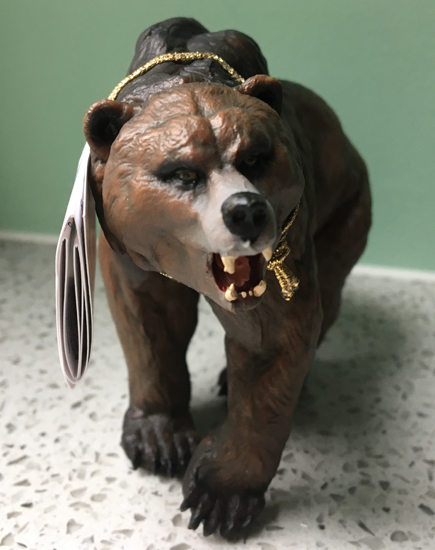
A View of the Beautifully Sculpted Snout and Skull of the Papo Cave Bear

Papo Cave Bear replica.

A anterior view of the Papo Cave Bear model.  Picture credit: Everything Dinosaur.

Picture credit: Everything Dinosaur

The Papo Cave Bear Model

The picture above shows a close-up view of the Papo Cave Bear model.  Cave bears can be distinguished from modern Brown bears as they tended to be larger and more powerfully built.  The skull has a distinctive slope down to the bridge of the long muzzle, this feature can be clearly made out in the excellent Papo replica.  The large canines are prominent and each of the incisors at the front of the jaws have been individually painted, the paint work on the model is really good and we like the darker colouration along the back, giving the impression of a thicker coat on this part of the animal’s body.

The limb bones of Cave bears were of slightly different proportions when compared to their modern cousins.  The limbs on the Papo figure give an impression of huge power and strength, the Cave bear was a formidable animal best avoided by people, recent studies have suggested that there was very little ecological interaction between Neanderthals and Homo sapiens and Cave bears, they may have used the same rock shelters and caves but at different times in history.  A number of carved artefacts and paintings have led some anthropologists to suggest that these large mammals were revered by our ancestors.

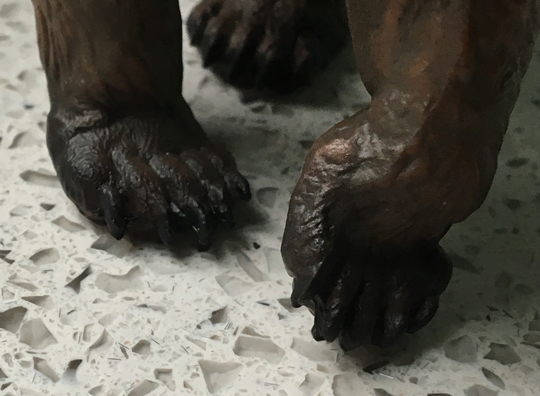
A Close-up View of the Large, Powerful Paws of the Papo Cave Bear Figure

The huge paws of the Papo Cave Bear model.

The large paws of the Papo Cave Bear model.

Picture credit: Everything Dinosaur

To view the new for 2017 Papo Cave Bear model and the rest of the Papo prehistoric animal range available from Everything Dinosaur: Papo Dinosaurs and Prehistoric Animal Models.

Cave Bear and Other Prehistoric Animal Models

Measuring a fraction under fourteen centimetres in length and standing some eight and half centimetres high at those muscular shoulders, this is an excellent Pleistocene-aged mammal model, one that works well in scale with several Woolly Mammoth replicas including the Papo Woolly Mammoth models as well as the CollectA Neanderthal figures.

The Papo Cave Bear Model (New for 2017)

The Papo Cave Bear Model.

A powerful Cave Bear model from Papo.

The remaining new for 2017 Papo models, the Sabre-toothed cat and the Dimorphodon replica should be available next month (September 2017).

Visit the award-winning Everything Dinosaur website: Everything Dinosaur.
12 08, 2017

A New Giant Dinosaur Gets a Name (Patagotitan mayorum)

By |2024-05-09T08:40:44+01:00August 12th, 2017|Categories: Dinosaur and Prehistoric Animal News Stories, Dinosaur Fans, Main Page|0 Comments

Patagotitan mayorum – 69 Tonnes of Titanosaur

This week has seen the long-awaited publication of a scientific paper on the super-sized titanosaur fossils that Everything Dinosaur blogged about in May 2014.  Writing in the “Proceedings of the Royal Society B (Biology)”, the researchers, which included José L. Carballido and Diego Pol (Museo Paleontológico Egidio Feruglio, Trelew, Argentina), have described this new dinosaur and given it a formal scientific name.  Patagotitan mayorum translates as “the Mayo family Patagonian Titan”.

Patagotitan may already be familiar to readers, as this fossil discovery was documented in a BBC television programme narrated by Sir David Attenborough back in 2016.  Indeed, a life-size cast of this dinosaur has been on display at the American Museum of Natural History (New York) for nearly eighteen months.

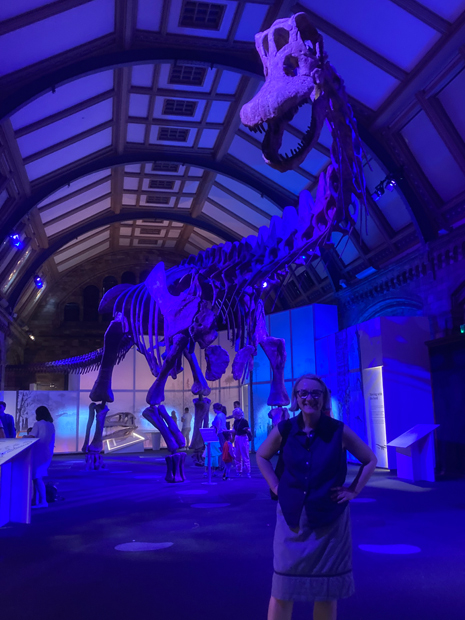
The Life-size Mounted Exhibit of the Newly Named Titanosaur (Patagotitan mayorum)

Patagotitan skeleton on display.

Sue from Everything Dinosaur poses in front of the colossal Patagotitan skeleton which is being exhibited at the Natural History Museum (London). Picture credit: Everything Dinosaur.

Picture credit: Everything Dinosaur

Patatotitan mayorum – Size is not Everything

Most of the media sources that have covered this announcement have focused on the estimated weight of Patagotitan.  When first studied, the body weight estimate of this beast, (represented by the fossilised remains of at least seven individuals) was put at 77 tonnes.  The researchers have down-sized Patagotitan somewhat in the scientific paper, but at a reported 69 tonnes, this is still an immensely heavy beast, potentially close to the theoretical limit for a body weight of a terrestrial animal.

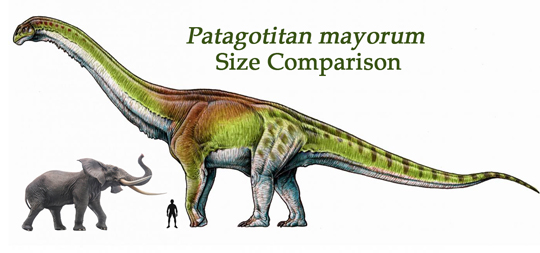
Patagotitan mayorum – A Size Comparison

Patagotitan size comparison.

Patagotitan mayorum size comparison with an adult African elephant and a human for scale.

Picture credit: G. Lio/Everything Dinosaur

With an estimated body length of 37 metres and a weight of 69 tonnes, Patagotitan can lay claim to the title of the largest land living animal to be described to date based on substantially complete fossil remains.

To read an article on the initial excavation of the titanosaur fossil bones: Biggest Dinosaur of all – a New South American Contender.

For an article providing information on the BBC documentary: Attenborough and the Giant Dinosaur.

An Unprecedented Quantity of Titanosaur Fossil Material

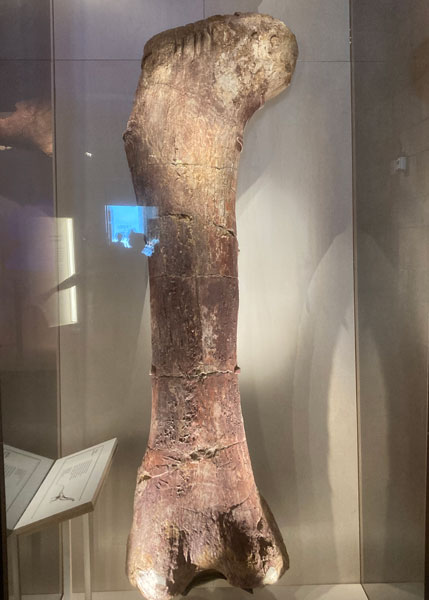
The species’ scientific name was inspired by the region where this new species was discovered, Argentina’s Patagonia (Patago); by its strength and huge size (titan), and by the Mayo family, on whose ranch the fossils of this new sauropod species were discovered.  The substantial amount of fossil material including a celebrated 2.4-metre-long femur was discovered in three distinct layers, representing flood plain deposits.  The researchers have concluded that these large herbivores must have been regular visitors to this area, perhaps this was on a migration route.  The water flow was unable to dislodge most of the fossil bones, their sheer bulk allowing the remains to be preserved relatively “in situ”, although in a disarticulated state.

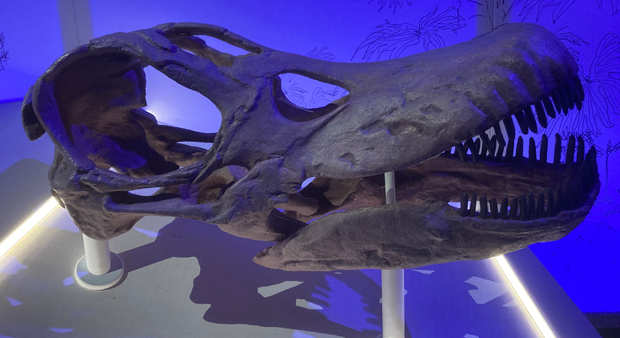
The Life-size Cast of Patagotitan mayorum at the American Museum of Natural History (New York)

A replica of the skull of Patagotitan

A replica of the skull of Patagotitan on display. Picture credit: Everything Dinosaur.

Picture credit: Everything Dinosaur

For models and replicas of titanosaurs and other other sauropods: CollectA Deluxe Scale Models.

Estimating the Body Weight of Giant Titanosaurs

The Titanosauria clade represents the most disparate group, in terms of body size of all known sauropods.  Some of the smallest members of the Sauropodmorpha are represented by titanosaurs such as the five-metre long Magyarosaurus from Romania, whilst this clade also contains giant animals like Argentinosaurus, Alamosaurus, Dreadnoughtus and the newly described Patagotitan.  Calculating the body weight of an extinct animal, even one with numerous fossil bones to study, is a challenging task, body weight has to be inferred using a variety of methods.

Dr José Luis Carballido (Museum of Paleontology Egidio Feruglio) explained:

“We compared the remains of Patagotitan mayorum with all the species that could be related to it, not only in terms of size, but also those that lived at the same time or had certain features in common.  Among them we included species such as Argentinosaurus, Puertasaurus and Futalognkosaurus, which are other giant species of dinosaurs from Argentina.”

A Phylogenetic Study

The researchers undertook a phylogenetic study and concluded that the majority of the giant titanosaurs of Patagonia belong to a single lineage.  This suggests that gigantism within the Titanosauria evolved only once and not multiple times.  The scientists conclude that all the truly huge dinosaurs were related to each other and form a natural group – the Lognkosauria.

Dr Diego Pol added:

“This group of giants probably emerged by the end of the Lower Cretaceous (Patagotitan mayorum would be the oldest) and had survived until the middle Late Cretaceous between 100 and 85 million years ago.”

Patagonia – A Paradise for Titanosaurs such as Patagotitan mayorum

Titanosaurs diversified and radiated around Gondwana during the middle Early Cretaceous and as a group they survived right up to the end of the Cretaceous, but in Patagonia during the early Cenomanian faunal stage some species obtained enormous sizes the reasons for an evolutionary pressure to grow so big are unclear.

Dr Pol commented:

“About 100 million years ago, a subgroup of titanosaurs really went crazy in body size.  There must be something in the environment, in how much resources and food was available, in the climate, something must have allowed this fantastic size.  All these contenders for the heavyweight championship of dinosaurs, they all lived in same place, in the same time…understanding why and how these animals evolved into such a fantastic size is the million-dollar question.”

The Enormous Fossilised Femur of Patagotitan mayorum

Patagotitan mayorum - the giant fossil femur.

The giant fossilised femur of Patagotitan mayorum on display. Picture credit: Everything Dinosaur.

Picture credit: Everything Dinosaur

Links to the Rinconsauria

In addition, the scientists consider this super-sized lineage of titanosaurs a sister group to the Rinconsauria, a clade of titanosaurs also known from Argentina which are regarded as basal to the group, or at least retaining primitive traits.  The Rinconsauria, which includes Rinconsaurus caudamirus and Aeolosaurus were not giants themselves, in fact, this clade includes some of the smallest South American titanosaurs described to date.

For the time being the moniker used to describe this huge dinosaur when it was being excavated – “enormosaurus” is redundant, that is until the next huge sauropod fossil find!

The scientific paper: “A New Giant Titanosaur Sheds Light on Body Mass Evolution Among Sauropod Dinosaurs” by José L. Carballido, Diego Pol, Alejandro Otero, Ignacio A. Cerda, Leonardo Salgado, Alberto C. Garrido, Jahandar Ramezani, Néstor R. Cúneo, Javier M. Krause published in “The Proceedings of the Royal Society B”.

Visit the award-winning website of Everything Dinosaur: The Everything Dinosaur Website.

11 08, 2017

JurassicCollectables Reviews the New “Spring-heeled Jack”

By |2024-05-07T15:35:00+01:00August 11th, 2017|Categories: Dinosaur Fans, Everything Dinosaur Products, Everything Dinosaur videos, Main Page|0 Comments

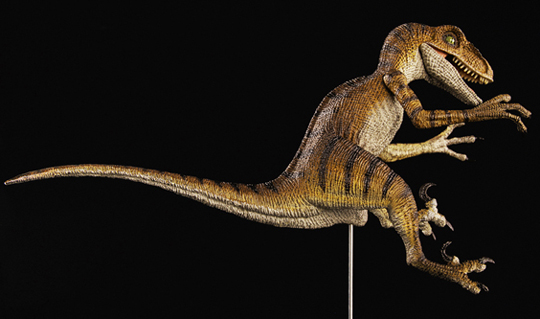
A Video Review of the Rebor Leaping Velociraptor “Spring-heeled Jack”

JurassicCollectables have been hard at work again and their latest video to be posted is a review of the amazing “Spring-heeled Jack”, the Rebor Velociraptor, 1:18 scale dinosaur model.  Rebor has continued to set the standard when it comes to introducing “retro raptors” and this new Velociraptor joins “Winston, Stan” and “Alex DeLarge” in the Rebor replica range.

A Rebor Velociraptor Reviewed

JurassicCollectables Reviews “Spring-heeled Jack”

Video credit: JurassicCollectables

In this brief video review, (it lasts just over six and a half minutes), viewers are given the opportunity to have a really good look at this skilfully modelled Late Cretaceous theropod.  The narrator discusses various aspects of “Spring-heeled Jack”, named after a strange being from English folklore that was first reported 180 years ago.  For example, the video looks at the base of the model in detail and demonstrates the articulated jaw and the forelimbs that can be set in various positions.

To view the Rebor 1:18 scale replica “Spring-heeled Jack”, the counterpart model “Alex DeLarge” and the entire Rebor prehistoric animal model range: Rebor Dinosaur and Prehistoric Animal Replicas.

“Jurassic Park” and Rebor Velociraptors

With the ground-breaking dinosaur movie “Jurassic Park”, hitting cinema screens in 1993, Velociraptors were up front and centre when it came to the prehistoric animals featured.  We won’t open up the debate on the size of the “raptors” in the film, suffice to say, thanks to this movie and the work of Stan Winston, the American film and television special make-up and special effects master, a whole new generation of young dinosaur fans was created.

The Velociraptors in the Rebor replica range, pay tribute to the contribution played in the portrayal of dinosaurs by Stan Winston, that’s why a number of the models in this range carry his moniker.  The leaping “Spring-heeled Jack” is reminiscent of the leaping Velociraptors from the Jurassic Park film franchise.

The Rebor Velociraptor “Spring-heeled Jack” Replica

Rebor "Spring-heeled Jack" one of the Rebor Velociraptors.

Rebor 1:18 scale Velociraptor “Spring-heeled Jack”.

The genus name means “speedy robber or speedy thief” and the JurassicCollectables video review shows these dynamic models in all their beauty.

Compared with the Rebor Tyrannosaurus rex and the Rebor Carnotaurus Models

Our thanks to those clever people at JurassicCollectables for including in this video review comparisons with the Rebor Tyrannosaurus rex replica (King T. rex) and the recently reviewed Rebor Carnotaurus figure “Crimson King”.  Off-colour Alan even gets in on the action, he is shown riding on the back of the leaping Velociraptor and the figure looks really good next to “Spring-heeled Jack”, very reminiscent of the scene from the first Jurassic Park” movie where big-game hunter, Robert Muldoon meets his demise.

JurassicCollectables have a brilliant YouTube channel crammed full of prehistoric animal model reviews and other very interesting and informative videos, including reviews of the aforementioned Rebor Carnotaurus replica and the Rebor “King T. rex“.

Visit the YouTube channel of Jurassic Collectables: JurassicCollectables on YouTube , please remember to subscribe to the JurassicCollectables channel, after all, some 50,000+ dinosaur and prehistoric animal model fans can’t be wrong!

Visit the award-winning Everything Dinosaur website: Everything Dinosaur.
10 08, 2017

New Monster Jurassic Crocodile Honours Motorhead’s Frontman

By |2024-05-08T20:38:51+01:00August 10th, 2017|Categories: Dinosaur and Prehistoric Animal News Stories, Dinosaur Fans, Main Page|0 Comments

Lemmysuchus obtusidens – Named after Lemmy from Motorhead

On December 28th 2015, the English heavy-metal musician, Lemmy, the founder of Motörhead and doyen of the metal-music genre passed away.  Since that day, many scientists who were fans of Lemmy’s music have sought out ways to honour him*.  It seems that tracks such as “Bomber”, “Overkill”, “Louie Louie” and the iconic “Ace of Spades” are very popular with academics and scientists from a number of disciplines and this week, hard-drinking, hard-living Lemmy, was honoured by having a particularly nasty Jurassic teleosaurid crocodile named after him.  Say hello to Lemmysuchus obtusidens, the newest member of the Teleosauridae, the name means “Lemmy’s blunt-toothed crocodile”.

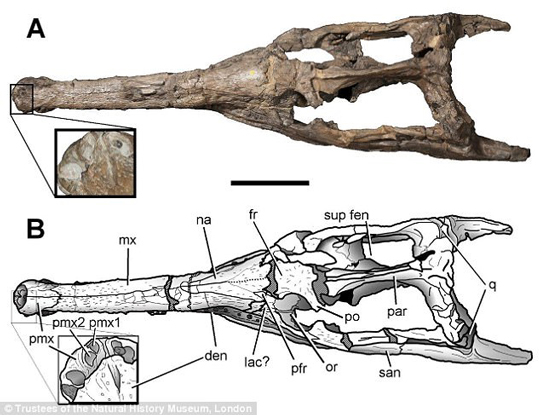
Lemmysuchus obtusidens

Dorsal View of the Skull of Lemmysuchus obtusidens

Skull fossil and line drawing.

Skull fossil and accompanying line drawing of Lemmysuchus.

Picture credit: Trustees of the Natural History Museum, London

From a Clay Pit Near Peterborough

The fossil material now assigned to this new genus was excavated in 1909 from a clay pit near the town of Peterborough (Cambridgeshire), several specimens were collected from the Middle Jurassic strata (Callovian faunal stage).  It was incorrectly catalogued and assigned to a different species, several cladistic and anatomical reviews later and the blunt-snouted, blunt-toothed teleosaurids have undergone a significant revision and fossil material formerly assigned to Steneosaurus obtusidens has ended up in need of a new taxa hence the establishment of Lemmysuchus within the academic literature.

One of the authors of the scientific paper, which has just been published in the Zoological Journal of the Linnean Society, Michela Johnson (University of Edinburgh), described Lemmysuchus:

With a metre-long skull and a total length of 5.8 metres, it would have been one of the biggest coastal predators of its time.”

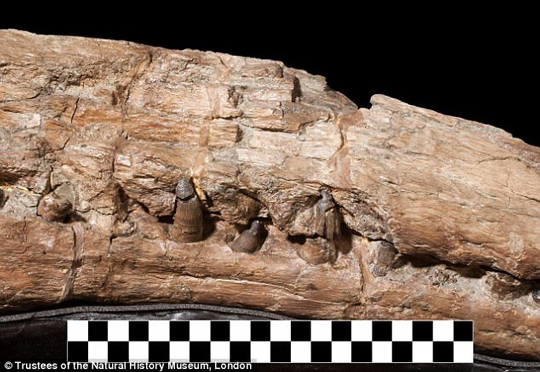
A Close View of the Jaw Showing the Robust Teeth

The jaw of Lemmysuchus.

Part of the jaw of Lemmysuchus showing the robust teeth.

Picture credit: Trustees of the Natural History Museum, London

Lemmysuchus – Durophagous or Macrophagous Diet

In contrast to several other Middle Jurassic teleosaurids, Lemmysuchus had a broad snout and large, robust teeth, this suggests that this substantial crocodylomorph had a different diet to its relatives.  Most teleosaurids were fish-eaters and their jaws, teeth and skulls show adaptations to a piscivorous diet.  The jaws of Lemmysuchus indicate that this reptile might have dined on turtles or other hard-shelled creatures such as ammonites.

It could have made short work of any small marine reptile carcass that it found, it could even have been an active predator of other marine reptiles.

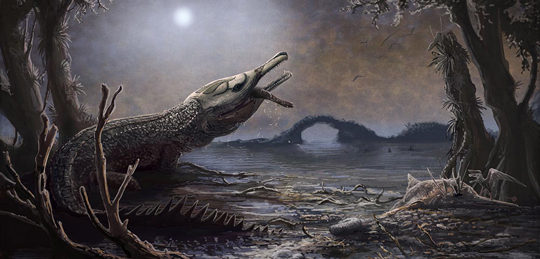
A Nasty Crocodile from the Middle Jurassic of England

A illustration of the Jurassic teleosaurid Lemmysuchus.

Lemmysuchus obtusidens illustration.

Picture credit: Mark Witton

Paleoartist Dr Mark Witton has recreated the terrifying world of Lemmysuchus obtusidens.  The beautiful reconstruction shows a large Lemmysuchus feeding on a plesiosaur, whilst rhamphorhynchoid pterosaurs scavenge the remains of an ichthyosaur that has been washed ashore.

Subtle Nods to Lemmy and to John Martin

The atmospheric image created by Mark Witton, includes a subtle hint towards one of the pieces of artwork associated with Motörhead.  The pattern on top of the crocodylomorph’s skull is a homage to the “snaggletooth” logo that adorned a number of album covers.  In addition, this stunning artwork, depicting a European shoreline some 164 million years ago, pays tribute to one of the earliest depictions of ancient marine reptiles, an illustration by John Martin for the seminal publication “Great Sea Dragons”, by Thomas Hawkins, which was first printed back in 1840.

John Martin depicted a savage, violent seascape dominated by great serpent-like creatures.  Having noted the serpentine archway in Dr Witton’s illustration, Everything Dinosaur contacted Mark and enquired how this archway came to be included.

Mark explained:

“The archway in the background is a nod to the serpentine creature in the background of John Martin’s classic 1840 illustration “The Sea-Dragons as They Lived”.  Much of the right side of the image is a tribute to this work, as is the fact that virtually all the animals in my painting are savage and predatory.  We know that the Jurassic didn’t have any serpentine creatures like those imagined by Martin, so I had to improvise a little by changing his animal to a rock feature and landmass (the adjacent island is where the second ‘hump’ of his creature would be).”

Mark added:

“I decided to homage his work because, in a lot of ways, 19th century palaeoart is not dissimilar to iconography associated with the harder side of rock music, to which Lemmysuchus has an obvious connection.  Both are a bit silly in how dark and aggressive they are so, though stemming from very different cultures, they’re actually artistic bedfellows.”

“Great Sea Dragons” Illustration by John Martin circa 1840

"Great Sea Dragons" illustration by John Martn

The 1840 illustration of marine reptiles and pterosaurs by John Martin.

Talented paleoartist Mark has recently published a new work, highlighting his illustrations and providing an insight into the process or imagining and then recreating prehistoric scenes.  The book is entitled “Recreating an Age of Reptiles”, it is highly recommended.

To read a review of “Recreating an Age of Reptiles”A Review of “Recreating the Age of Reptiles”.

Dr Witton added:

“It was quite fun bringing three very different influences together for this painting: the science of the animal itself; the aggressive, dark imagery associated with Motörhead and the influence of old school palaeoart.”

Lemmy from Motörhead (Ian Fraser Kilmister)

Co-author Lorna Steel, (Dept. of Earth Sciences, Natural History Museum), proposed that the fearsome crocodylomorph should be named after her late musical hero.

Dr Steel stated:

“Although Lemmy passed away at the end of 2015, we’d like to think that he would have raised a glass to Lemmysuchus, one of the nastiest sea creatures to have ever inhabited the Earth.”

*In early 2016, a petition was organised to get the discoverers of the recently named, super-heavy element 115 Ununpentium, to change its name to Lemmium.  Despite attracting a reported 100,000 signatures the bid to place the heavy metal music pioneer onto the Periodic Table failed.  Still it’s not every day that you get a bone-crushing, Jurassic marine crocodile named after you.

Visit the award-winning Everything Dinosaur website: Everything Dinosaur.
9 08, 2017

Everything Dinosaur Newsletter Rebor and More!

By |2023-08-10T08:07:12+01:00August 9th, 2017|Categories: Everything Dinosaur News and Updates, Everything Dinosaur Newsletters, Everything Dinosaur Products, Main Page|0 Comments

Everything Dinosaur Newsletter Rebor and More!

Subscribers to the Everything Dinosaur customer newsletter were treated to some privileged information last week when they got notice of the arrival of the new Rebor 1:18 scale Velociraptor replicas “Spring-heeled Jack” and “Alex Delarge”.  Many customers had already taken advantage of the company’s no hassle, no obligation product reservation service and they knew that these dinosaur models had been set aside for them.  Once the newsletter had been received, the orders for these two beautiful Velociraptor replicas started to come in.

The Pair of Rebor Leaping Velociraptors Feature in the Latest Everything Dinosaur Customer Newsletter

Everything Dinosaur customer newsletter.

Rebor Velociraptor models feature in the latest Everything Dinosaur newsletter. Picture credit: Everything Dinosaur.

Picture credit: Everything Dinosaur

To view the full range of Rebor replicas available from Everything Dinosaur: Rebor Replicas and Models.

The Everything Dinosaur Newsletter

Our next newsletter is due out shortly, there is just so much going on at the moment, it really is quite difficult for our team members to keep up with the exciting developments.

If blog readers would like to subscribe, then all you have to do is to drop us an email: Contact Everything Dinosaur.

Rebor “Spring-heeled Jack” and the Rebor Velociraptor “Alex Delarge”

Rebor "Spring-heeled Jack" and "Alex Delarge" Velociraptor replicas.

Rebor “Spring-heeled Jack” and “Alex Delarge” Velociraptor models. Picture credit: Everything Dinosaur.

Picture credit: Everything Dinosaur

The stunning Rebor 1:18 scale Velociraptor models are sold as a pair and they are also available separately.  Each model has an articulated lower jaw and the arms can be placed in various positions.  The dinosaurs measure around twenty centimetres in length and when put on the larger of the two metal rods that come with these figures, the model stands some twenty-five centimetres in the air.

Carnotaurus and Cards

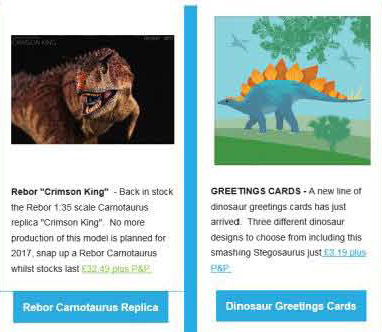
The Everything Dinosaur customer newsletter also permits us to update subscribers when new stocks of existing models arrive as well as letting people know about new products.  The early August newsletter confirmed that fresh supplies of the popular Rebor “Crimson King” – Carnotaurus sastrei had arrived.  The company’s initial stock having sold out very quickly, however, with a new batch of abelisaurs safely put into the warehouse, fans of Rebor could acquire this theropod replica.  In addition, this newsletter allowed us to highlight a new range of dinosaur themed gift and greetings cards that had just arrived in stock.

The Rebor Carnotaurus Replica “Crimson King” and Dinosaur Cards

Everything Dinosaur Newsletter (August 2017).

Everything Dinosaur’s newsletter features a variety of dinosaur themed products. Picture credit: Everything Dinosaur.

Picture credit: Everything Dinosaur

The dinosaur themed greetings cards feature three very famous dinosaurs, these dinosaurs are Diplodocus, Tyrannosaurus rex and as shown in the snippet from our customer newsletter (above), a very colourful Stegosaurus.  Each card is blank inside so that you can write your own message and there is a surprise inside each card too – a pop-up prehistoric animal, that we are sure will delight the recipient.  Dinosaur themed greetings and gift cards can be found in the huge party section of Everything Dinosaur’s website: Dinosaur and Fossil Replicas/Educational Toys.

Everything Dinosaur plans to publish more newsletters over the next few weeks and months, helping to keep our ever-growing customer base informed about the company and its product range.

Visit the award-winning Everything Dinosaur website: Visit Everything Dinosaur.

8 08, 2017

A Beautiful Customised CollectA Deluxe Dimorphodon

By |2024-05-09T08:32:15+01:00August 8th, 2017|Categories: Dinosaur and Prehistoric Animal News Stories, Dinosaur Fans, Everything Dinosaur Products, Main Page, Photos of Everything Dinosaur Products|0 Comments

Customised CollectA Deluxe Dimorphodon

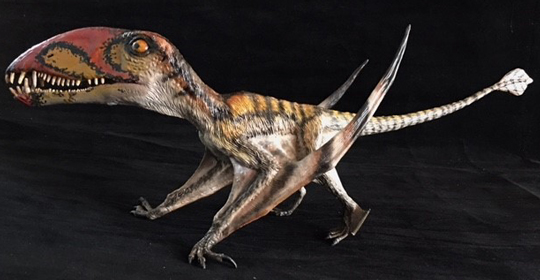
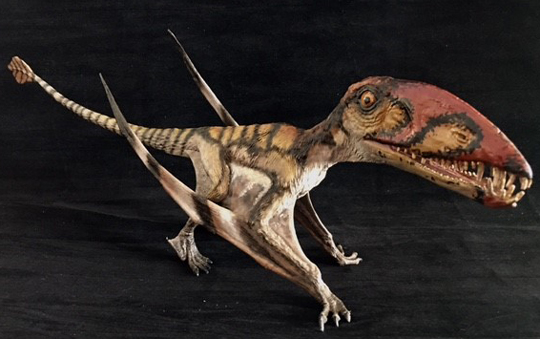
At Everything Dinosaur, it is always a pleasure to hear from our customers.  We get sent lots of photographs of customised models, collectors having taken a model and given it a unique paint job.  Sometimes subtle changes are made to the body plan as well.  Take for example, Elizabeth who is a long-time collector of prehistoric animal replicas.  When CollectA introduced a large replica of the flying reptile Dimorphodon, Elizabeth jumped at the chance of acquiring it and then commissioned talented model maker Martin Garratt to re-paint the pterosaur, providing her with a marvellous centrepiece for her model collection.

The Repainted CollectA 1:40 Scale Dimorphodon Model

A repainted CollectA Dimorphodon model.

The repainted CollectA Dimorphodon replica.

Picture credit: Marilyn (UMF models)

Exquisite Dimorphodon Figure

Dimorphodon is known from the Early Jurassic of England (fossils found at Lyme Regis by Mary Anning) and a second species has been described from Mexico.  It was a member of the rhamphorhynchoid “Ram-for-rink-oid” pterosaurs, a sub-order of the Pterosauria characterised by their long tails, with most genera having teeth but lacking a bony crest.  The term rhamphorhynchoid helps to distinguish early pterosaurs from later forms (Pterodactyloidea), although the term is beginning to fall out of favour with palaeontologists due to the difficulties of defining newly described Jurassic species using this grouping.

With a wingspan of around 1.4 metres and weighing approximately 1.5 kilogrammes, this pterosaur was no giant and many early illustrations of this flying reptile placed it in a coastal environment, however, a number of scientists including the eminent pterosaur expert Dr Mark Witton, have suggested that this strong-legged, big-headed fellow was probably more at home in forests away from sea.

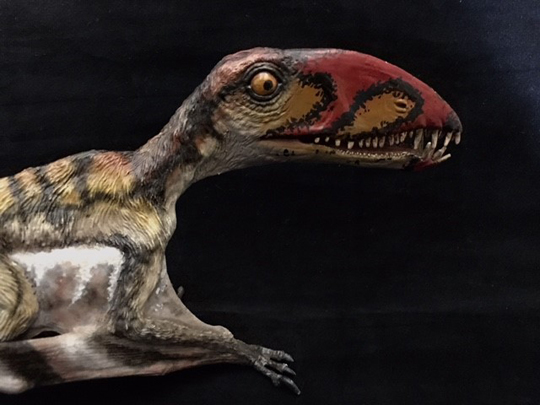
A Closer View of the Wonderful Paintwork by Martin Garratt

CollectA Deluxe Dimorphodon repainted.

A closer view of the beautifully painted snout.

Picture credit: Marilyn (UMF Models)

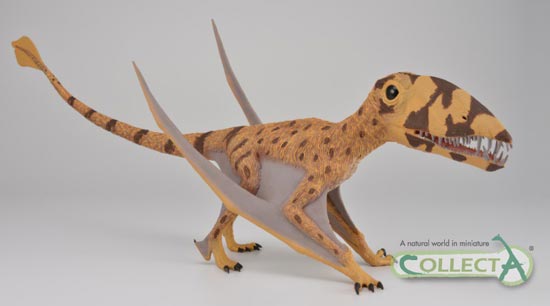
The CollectA Deluxe Dimorphodon Replica

CollectA Dimorphodon pterosaur model.

The CollectA Dimorphodon model with a movable lower jaw.

Picture credit: Everything Dinosaur

The CollectA Deluxe Dimorphodon Replica

Measuring a fraction under thirty-eight centimetres in length the CollectA Supreme Deluxe Dimorphodon (part of the CollectA Deluxe Prehistoric Life Collection), is a strong candidate for customisation.  The model even has an articulated lower jaw, making access to the inside of the mouth easier for painting.  The sands and browns of the original paint scheme have been replaced by much more dynamic and vibrant palate in Martin’s interpretation.  The “leopard spots” have been replaced by “tiger stripes” and the finished repainted model is superb.

Commenting on her commission, CollectA model fan Elizabeth stated:

“I have always been a great admirer of John Sibbick’s work (and several of his original paintings hang on my walls).  I have a soft spot for John’s painting of Dimorphodon that adorns pages 70-71 of Wellnhofer’s book “The Illustrated Encyclopedia of Pterosaurs” (1991) and I asked Martin if he would do something along those lines.”

The Artwork of John Sibbick

We at Everything Dinosaur are also great fans of John Sibbick’s amazing artwork.  Team members were asked to write the press releases that accompanied the Royal Mail British prehistoric animal stamps that John was commissioned to paint.  The Dimorphodon illustration has been reproduced on numerous occasions, to illustrate both Dimorphodon macronyx and the sub-order of pterosaurs as a whole.  For example, the Dimorphodon painting that inspired the colour scheme on the CollectA Dimorphodon can be found on page 172 of “The Concise Dinosaur Encyclopedia” published in 2004 by Kingfisher.

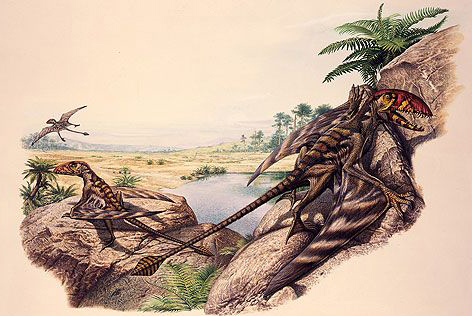
The Illustration by John Sibbick that Inspired the CollectA Dimorphodon Repaint

Dimorphodon illustration (John Sibbick).

Dimorphodon male and female by John Sibbick.

Picture credit: John Sibbick

The picture above shows the John Sibbick artwork, the Dimorphodon on the right of the image is probably a male, the repainted CollectA model has been inspired by such illustrations and the resulting figure after Martin Garratt’s makeover is a truly unique and stunning model.

The Repainted CollectA Deluxe Dimorphodon

CollectA Deluxe Dimorphodon repainted.

A repainted CollectA deluxe Dimorphodon replica.

Picture credit: Marilyn (UMF Models)

A Comment from Everything Dinosaur

A spokesperson from Everything Dinosaur commented:

” We always enjoy seeing how the models and replicas that we supply are customised by their owners.  We have known Martin and Marilyn at UMF Models for a number of years and we do get asked by our customers to send purchases direct to them for modification and personalisation.  Elizabeth’s Dimorphodon figure is fantastic and it just goes to show what can be achieved when a good, anatomically accurate production figure is repainted by a top-quality model maker and artist.”

See more of UMF Models on their Facebook page: Martin Garratt/UMF Models on Facebook.

To view the CollectA Deluxe Dimorphodon and the other figures in the CollectA Deluxe range: CollectA Deluxe Prehistoric Life Model Range.

Visit the Everything Dinosaur website: Everything Dinosaur.
7 08, 2017

The “Jaws” of the Early Triassic

By |2023-08-09T07:35:08+01:00August 7th, 2017|Categories: Dinosaur and Prehistoric Animal News Stories, Main Page, Photos/Pictures of Fossils|0 Comments

Birgeria americana – Big Mouthed Fish of the Early Triassic

Birgeria americana – the jaws of the Early Triassic.

The end-Permian mass extinction event is widely regarded as the most devastating extinction known from the Phanerozoic Eon.  An estimated 57% of all marine families died out, virtually all the corals became extinct and ecosystems were effectively destroyed.  Notable casualties were the Trilobita, sea-scorpions (eurypterids) and many kinds of fish.  Life on land did not fare any better with many groups of amphibians and reptiles perishing.

Recently, some evidence has emerged that ecosystems bounced back remarkably quickly after this catastrophic event.  Further evidence of a speedy recovery comes in the form of a large fossilised skull from a new species of predatory marine fish discovered by palaeontologists from the University of Zurich during field work in Nevada.

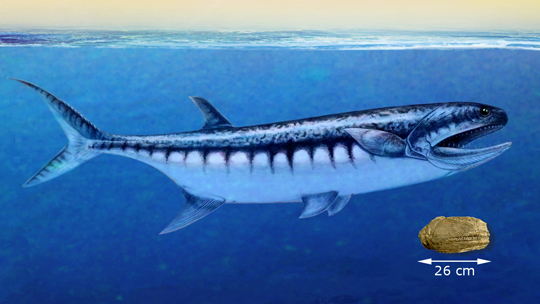
Birgeria americana –A Top Marine Predator of the Early Triassic

Birgeria americana illustration.

A reconstruction of Birgeria americana with the fossil skull (bottom right).

Picture credit: Nadine Bösch

The new species has been named Birgeria americana, a member of the ray-finned fishes (Actinopterygii) and fossils of this genus are mostly associated with Middle Triassic, much younger rocks, but the lineage can be traced back into the Late Permian.  Intriguingly, most species are much smaller, less than a metre in length, Birgeria americana in contrast, was a relatively giant, measuring around 1.72 to 1.85 metres long.

The “Jaws” of the Early Triassic

Recovered from rocks that have been dated to less than one million years after the end Permian extinction event, the discovery of such a large, voracious predator came as something of a surprise to the researchers.

Lead author of the study, recently published in the “Journal of Paleontology”, Dr Carlo Romano (Palaeontological Institute and Museum, University of Zurich) stated:

“The surprising find from Elko County in north-eastern Nevada is one of the most completely preserved vertebrate remains from this time period ever discovered in the United States.”

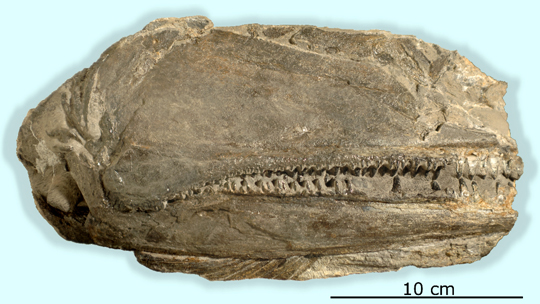
The new species has been described on the basis of a twenty-six-centimetre-long partial skull and jaws.  The jaws contain three parallel rows of robust, sharp teeth, the largest of which were up to two centimetres long.  This formidable dentition was further reinforced by several small teeth inside the mouth.

The Fossil Skull of B. americana

Birgeria americana fossilised skull and jaws.

The fossilised skull of Birgeria americana.

Picture credit: University of Zurich

Hunting Like a Great White Shark

The research team postulate that this species of super-sized Birgeria hunted in a similar fashion to the extant Great White Shark (Carcharodon carcharias).  Prey fish were pursued and then bitten, resulting in massive blood loss for the victim.  The unfortunate prey was then swallowed whole.  The partial skull, preserved in a limestone nodule, was excavated from Lower Triassic beds close to Winecup  Ranch in Elko County (Nevada).  The area is famous for its Triassic vertebrate fossils including early ichthyosaurs.

Prior to this discovery, researchers had assumed that ancient equatorial regions were too hot for vertebrates to survive during the Early Triassic (Nevada was close to the equator during the Early Triassic), the discovery of such a large, obvious predator suggests a rich and diverse food chain existed even at low latitudes.

Finds such as the newly discovered Birgeria species and the fossils of other vertebrates now show that marine hypercarnivores existed shortly after the end-Permian mass extinction.  The existence of bony fish close to the equator, where Nevada was located some 250 million years ago, indicates that the temperature of the sea was a maximum of 36°C.  The eggs of today’s bony fish cannot develop normally at constant temperatures above 36°Celsius.

Ecosystems Recovering After a Mass Extinction Event

Dr Romano added:

“The vertebrates from Nevada show that previous interpretations of past biotic crises and associated global changes were too simplistic.  Despite the severity of the extinctions of that time and intense climatic changes, the food webs were able to redevelop faster than previously assumed.”

For an article on fossil finds from China, providing further evidence of marine biota recovery following the end-Permian mass extinction: Window into an Ancient Marine Ecosystem.

The scientific paper: “Marine Early Triassic Actinopterygii from Elko County (Nevada, USA): Implications for the Smithian Equatorial Vertebrate Eclipse” by Carlo Romano, James F. Jenks, Romain Jattiot, Torsten M. Scheyer, Kevin G. Bylund, and Hugo Bucher published in the Journal of Paleontology.

Visit the Everything Dinosaur website: Everything Dinosaur.
Go to Top