All about dinosaurs, fossils and prehistoric animals by Everything Dinosaur team members.

Articles, features and stories with an emphasis on geology.

6 07, 2014

What Kind of Prehistoric Animal was Urvogel?

By |2023-03-14T08:49:54+00:00July 6th, 2014|Categories: Dinosaur Fans, Geology, Teaching|0 Comments

Explaining about Archaeopteryx

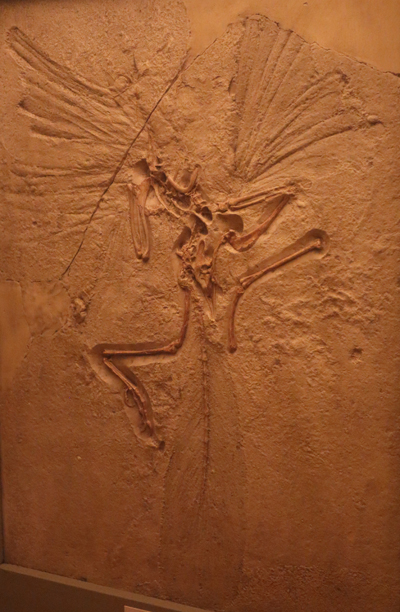
Earlier this week, Everything Dinosaur was emailed by a young dinosaur fan who asked about a prehistoric animal named Urvogel.  She had come across it whilst learning about the famous fossil site of Solnhofen in southern Germany.  The word “Urvogel” is German and it means “first bird”, it refers to Archaeopteryx (A. lithographica), the fossils of which are synonymous with the finely grained limestone beds of the Solnhofen quarries.

Urvogel

A Cast of a Fossil Specimen of the  Ancient “Dino-Bird” Archaeopteryx

Archaeopteryx fossil cast

Archaeopteryx fossil cast. Picture credit: Everything Dinosaur.

Picture credit: Everything Dinosaur

Studying Archaeopteryx

Palaeontologists now know that this creature, fossils of which show a transitional form between theropod dinosaurs and birds, was probably not the first bird to evolve.  However, when a spectacular fossil discovery was announced in 1861, Archaeopteryx became the first feathered fossil of its kind to be formerly studied and its fossils caused a sensation, as only two years before Charles Darwin had published “The Origin of Species” that outlined the case for evolution and natural selection.

The Solnhofen limestone deposits are finely grained and they outcrop in an east to west belt north of Munich and south of Nuremberg.  Hundreds of fossils of invertebrates have been found and the vertebrate fauna preserved includes over fifty types of fossil fish, around thirty reptiles (pterosaurs, marine reptiles, dinosaurs and crocodiles).  The Solnhofen deposits are regarded as a Lagerstätte.  This is a German phrase from the words Lager (which means storage) and Stätte (which means place).  It refers to a deposit of sedimentary strata that contains a lot of fossil material that is exceptionally well preserved.

During the Late Jurassic, shallow tropical lagoons and small islands stretched all the way from Portugal in the south through France and into southern Germany.  Coral reefs formed in the tropical seas and these reefs split the coastline up forming a series of isolated lagoons.  These lagoons were cut off from the sea and also from terrestrial run off.

The salinity levels rose in the lagoons and the water may have become oxygen deficient.  This made the mud on the bottom of these lagoons almost devoid of life so any animal or plant remains that drifted into the lagoon was not consumed by scavengers.  The almost stagnant waters had little current so the remains of corpses were not broken up.  Organisms buried by the soft, carbonate muds and formed as fossils in the finely grained sediment therefore have exceptional details preserved and many of these body fossils are almost complete.

PNSO offers a wide range of prehistoric animal models including a replica of Urvogel (Archaeopteryx).  To view the PNSO model range: PNSO Age of Dinosaurs Models.

29 06, 2014

Two Hundred Years of Ichthyosaurs

By |2023-03-13T20:29:43+00:00June 29th, 2014|Categories: Dinosaur and Prehistoric Animal Drawings, Dinosaur and Prehistoric Animal News Stories, Dinosaur Fans, Geology, Palaeontological articles|2 Comments

200th Anniversary of the First Ichthyosaur Scientific Paper

This week saw the 200th anniversary of the first scientific description of an animal that was later named as an ichthyosaur.  On June 23rd 1814, Sir Everard Home published the first account of the Lyme Regis ichthyosaur that had been found a few years earlier by the Anning family (Mary and her brother Joseph).  The paper was published by the Royal Society of London, it had the catchy title of “Some Account of the Fossil Remains of an Animal More Nearly Allied to Fishes than any Other Classes of Animals”.

In the account, Sir Everard Home, an anatomist who held the distinguished position of Surgeon to the King, attempted to classify the fossilised remains of what we now know as a “Fish Lizard”.  Reading the paper today, one can’t help but get a sense of utter confusion in the mind of the author.

Ichthyosaur

Sir Everard, had one or two secrets and although two hundred years later, it is difficult to place in context what was behind the paper, after all, at the height of the Napoleonic war there was intense rivalry between the French and English scientific establishments, an assessment of this work in 2014 does little to enhance Sir Everard’s academic reputation.

A Model of an Ichthyosaur and One of the Plate Illustrations from the Scientific Paper
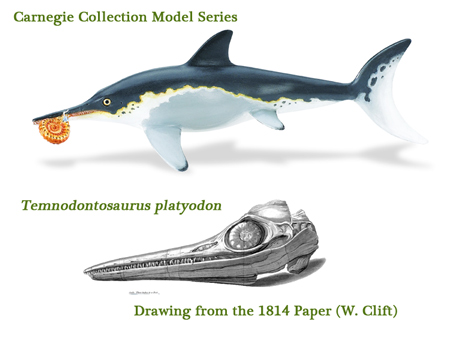
The illustration from the paper and a model interpretation of a "Fish Lizard"

The illustration from the paper and a model interpretation of a “Fish Lizard”.

Picture credit: Safari Ltd top and the Royal Society (William Clift) bottom

Back to those secrets.  Whilst notable figures in the history of palaeontology such as the Reverend William Buckland was corresponding with Georges Cuvier, the French anatomist and widely regarded as “the founder of modern comparative anatomy”, against a back drop of war between Britain and France, in a bid to understand the strange petrified remains found on England’s Dorset coast, Sir Everard raced into print, to be the first to describe this creature.  Just like today, if you are the first to do something than fame and fortune can await.  Trouble is, Sir Everard, by a number of accounts, was relatively incompetent.  He was also a cheat!

Nascent Palaeontology

In 1771, when the young Everard was a teenager, his sister married John Hunter, an extremely talented surgeon and anatomist who had already built a reputation for himself as being one of the most brilliant scientists of his day.  He was able to learn a great deal from his brother-in-law and this coupled with his wealthy background soon propelled the ambitious Everard to the forefront of London society.  However, the much older John Hunter died suddenly from a heart attack in 1793 and it has been said that Everard used his brother-in-laws untimely death to his distinct advantage.

Having removed  “a cartload” of John Hunter’s unpublished manuscripts from the Royal College of Surgeons in London, Everard began publishing them but under his own name.  This alleged plagiarism enhanced the young surgeon’s reputation and led to his steady rise in scientific circles, permitting Everard to gain the fame and good standing amongst his peers that he so craved.  Such was his desire to keep his plagiarism a secret, that it is believed that he burnt Hunter’s original texts once they had been copied out.  So enthusiastic was he to get rid of the evidence that on one occasion he set fire to his own house.

And so to the published account of the ichthyosaur.  Sir Everard explained his willingness to examine the fossilised remains by writing:

“To examine such fossil bones, and to determine the class to which the animals belonged comes within the sphere of enquiry of the anatomist.”

Describing Fossil Remains

In the paper, Sir Everard describes the fossil remains in some detail, although his descriptions lack the academic rigour found in other papers later published by Cuvier, Mantell and Owen.  The author states that the fossil material was found in the Blue Lias of the Dorset coast between Charmouth and Lyme Regis, the fossil discovery having been made after a cliff fall.  The paper claims that the skull was found in 1812 with other fossils relating to this specimen found the following year.  The role played by the Annings in this discovery is not mentioned by Home.  This assertion itself, may be inaccurate.

Many accounts suggest it was Joseph Anning who found the four-foot-long skull in 1811, as to whether Mary was present at the time, we at Everything Dinosaur remain uncertain.  Although Mary and Joseph together are credited by many sources for finding other fossil bones related to this specimen in 1812.

The potential mix up in dates, pales when the rest of Sir Everard’s paper is reviewed.  At first, the idea that these bones represent some form of ancient crocodile is favoured.  Embryonic teeth ready to replace already emerged teeth were noticed.

However, to test this theory one of the conical fossil teeth was split open.  He mistook evidence for an embryonic tooth ready to replace a broken tooth in the jaw as an accumulation of calcite and hence, Everard wrongly concluded that this creature was not a reptile.  The sclerotic ring of bone around the eye reminded the anatomist of the eye of a fish, but when the plates were counted that make up this ring of bone (13), he commented that the fossil may have affinities with the bird family as this number of bones is found only in eyes of birds.

Anatomy Like a  Fish

The position of the nostrils and the shape of the lower jaw is considered to be very like those seen in fish.  The freshwater Pike is mentioned, although there are other parts of the skeleton that seem to confuse Sir Everard still further.  The shoulder blades both in their shape and size are reported as being similar to those found in crocodiles, part of the fossil material is even compared to the bones of a turtle.

One of the Illustrative Plates from the Original Paper
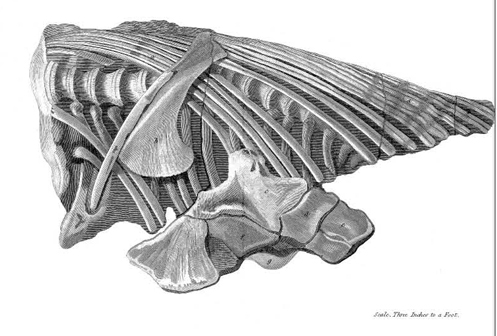
One of the illustrations by William Clift.

One of the illustrations by William Clift.

Paper credit: Royal Society (William Clift)

The paper concludes by stating:

“These particulars, in which the bones of this animal differ from those of fishes, are sufficient to show that although the mode of its progressive motion has induced me to place it in that class, I by no means consider it wholly a fish, when compared with other fishes, but rather view it in a similar light to those animals met with in New South Wales, which appear to be so many deviations from ordinary structure, for the purpose of making intermediate connecting links, to unite in the closest manner the classes of which the great chain of animated beings is composed.”

Our baffled author had described a few years early the Duck-billed Platypus (Ornithorhynchus anatinus) after specimens were brought back from eastern Australia.  Sir Everard is referring to the Platypus when he writes of “those animals met with in New South Wales”.

A Pilloried Paper

Much of the French scientific establishment (and a significant number of British scientists) pilloried this paper.  The difference being, the French who were at war could do it openly, however, in Britain, such was the power and influence of Sir Everard Home, no one dared challenge his assumptions openly.

It was perhaps because of Sir Everard’s influence and strong standing within the Royal Society, that the Reverend William Buckland along with the Reverend Coneybeare supported by up and coming geologists such as Henry de la Beche published a rival scientific paper on the Annings’s discovery in the journals of the Geological Society.  This paper correctly identified that the fossils were reptilian.

Sir Everard, although ridiculed by other academics continued to work on the puzzling ichthyosaur specimens.  Five years after his 1814 paper, he thought he had finally solved the mystery as to this strange creature’s anatomical classification.  A new vertebrate to science, referred to as a “Proteus” had been described by a Viennese doctor some years earlier.  This was a blind, amphibian of the salamander family (Proteus anguinus) that lived in freshwater streams and lakes deep in caves.  Sir Everard mistakenly concluded that the Lyme Regis fossils were a link between the strange Proteus and modern lizards.  From then on he referred to the 1814 specimen as a “Proteosaurus”.  However, this name never was accepted by scientific circles as the moniker Ichthyosaurus (Fish Lizard) had been erected a year earlier by Charles Konig of the British Museum where the Ichthyosaur specimen resided.

Ironically, as our knowledge of the ichthyosaur Order has grown over the years, so the Lyme Regis specimen has been renamed.  It is no longer regarded as an Ichthyosaurus, as the fossils indicate a creature more than five metres in length, much larger than those animals that make up the Ichthyosaurus genus today.  In the late 1880s it was renamed Temnodontosaurus (cutting tooth lizard).  The Lyme Regis specimen, studied all those years earlier by Sir Everard Home, was named the type specimen with the species name Temnodontosaurus platyodon.

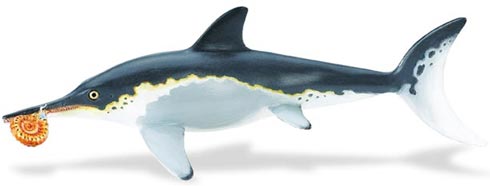
A Close up of the Head of a Typical Ichthyosaur
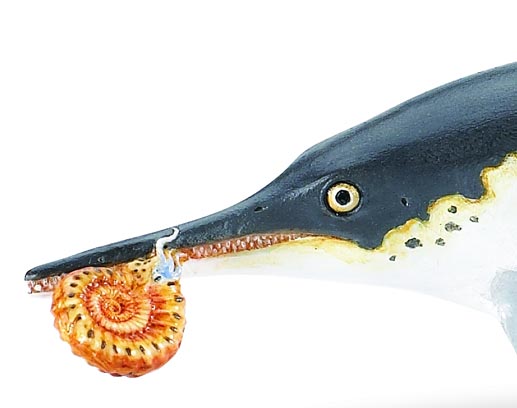
An Icththyosaurus with an Ammonite that it has caught.

An Ichthyosaurus with an ammonite that it has caught.

Picture credit: Safari Ltd

For models and replicas of marine reptiles and other prehistoric creatures: Wild Safari Prehistoric World Models.

The 1814 paper might say more about the petty rivalries and snobbery that dogged British scientific circles than it adds to our knowledge of the Ichthyosauria.  However, there is one final point to be made.  Accompanying the notes were brilliant illustrations of the fossil material, carefully and skilfully prepared by the naturalist William Clift.

The child of a poor family from Devon, William had shown a talent for art from a young age.  His illustrative skills were noticed by one of the local gentry, a Colonel whose wife happened to know Anne Home, the sister of Everard who had married John Hunter.  When John Hunter was looking for an apprentice to help classify and catalogue his growing collection of specimens at the Royal College of Surgeons, Clift was recommended.  He quickly rose to prominence and despite being hampered by the removal of many of John Hunter’s manuscripts by Everard, Clift’s reputation grew and grew.  His daughter, Caroline Ameila Clift married Professor Richard Owen (later Sir Richard Owen), the anatomist who is credited with the naming of the Dinosauria and the establishment of the Natural History Museum in London.


24 06, 2014

Famous K/T Boundary gets UNESCO World Heritage Status

By |2023-03-13T20:13:49+00:00June 24th, 2014|Categories: Educational Activities, Geology, Main Page, Teaching|0 Comments

Stevns Klint Awarded UNESCO World Heritage Status

The World Heritage Committee, meeting in Doha (Qatar) have granted World Heritage status to a number of new sites and locations.  These awards are given to reflect the cultural or natural heritage that such sites and locations represent.  They are important to humanity and therefore it is imperative that their value is acknowledged.

Stevns Klint

One such site is the nine-mile-long cliffs at Stevns Klint, on the Danish island of Sjaelland.  These fossil rich cliffs record the K/T boundary, (Cretaceous – Tertiary).  As a result, this site is extremely important to palaeontologists and geologists.  The cliffs have preserved an exceptional fossil record showing a complete succession of fauna and micro-fauna that charts the extinction event and the subsequent recovery of life on Earth.

An exceptional fossil record is visible at the site, showing the complete succession of fauna and micro-fauna charting the recovery after the mass extinction.  Tertiary aged limestone deposits overlie much softer, older Cretaceous chalk deposits.  Sandwiched between the two distinct rock types is a thin, ash grey coloured band with high levels of the rare Earth element iridium.  This is the ash layer that is associated with the Chicxulub impact event that occurred approximately 66 million years ago.  It marked the end of the dinosaurs and the extinction of something like 50% of all life.

Cretaceous and Tertiary Marine Fossils

This part of the Danish coast is a popular tourist destination.  It lies twenty-five miles south of Copenhagen on the east coast of Sjaelland and many types of Cretaceous and Tertiary marine fossils can be seen at the local museum.  This site is one of three known in the world that exhibit the iridium anomaly.  This anomaly helped form the basis of the extraterrestrial impact theory proposed by Walter and Louis Alvarez in 1980.

The exposed succession is around forty-five metres thick.  It shows the stratigraphic evolution from Maastrichtian (Upper Cretaceous) across the K/T boundary into the very early Tertiary (Danian faunal stage of the Palaeogene).  A huge amount of research has been undertaken in this area.  Studies into the micro-fauna, palaeontology, geochemical changes, sediment deposition and sea level changes are just some of the research that has taken place recently.  The Stevns Klint locality is defined as the type location for the classification of the Danian faunal stage. It joins such famous fossil locations as the Jurassic Coast of East Devon and Dorset and the Messel Quarry near Frankfurt (Germany) as a UNESCO World Heritage site.

Our congratulations to everyone involved in nominating this wonderful location.

Visit Everything Dinosaur’s award-winning website: Visit Everything Dinosaur.

12 06, 2014

World Cup – Brazil Fantastic Geology

By |2023-03-13T18:20:11+00:00June 12th, 2014|Categories: Dinosaur Fans, Geology, Main Page|0 Comments

World Cup in Brazil Starts Today

Today, the twentieth FIFA World Cup is due to kick off in Brazil.  Heralded as a football festival, thirty-two teams will battle it out over the next month or so for bragging rights as to which country has the best football team in the world, of course there is the prize money too, something like $35 million USD for the winners.

The World Cup

As well as its football, Brazil is famed for its amazing fauna and flora, each year, football tournaments not withstanding, it attracts an ever increasing number of eco-tourists keen to explore the spectacular Amazon, the wetlands of the Pantanal or the Atlantic rainforest.

The geology of Brazil is also fascinating.  As one of the largest countries in the world by area, it is not surprising that virtually every major geological time period from the Phanerozoic is represented.  In the Everything Dinosaur blog, news stories and articles about Brazilian extinct and extant fauna  feature nearly fifty times.  Perhaps the most famous geological formation is the Santana Formation, which is found in the north-east of the country.

Fantastic Geology

The Santana Formation dates from the Cretaceous, this Formation along with the older Crato Formation has provided a vast array of vertebrate fossils.  Fossils excavated from the Santana Formation show exquisite levels of preservation.  For example, stomach contents in fossil fish have been identified and both representatives of the Dinosauria and the Pterosauria have been found.   The fossil rich deposits are regarded as a Lagerstätte (an area with a huge amount of well-preserved fossil material).

To read an article about the discovery of a new genus of pterosaur from Brazil: New Genus of Cretaceous Flying Reptile from Brazil.

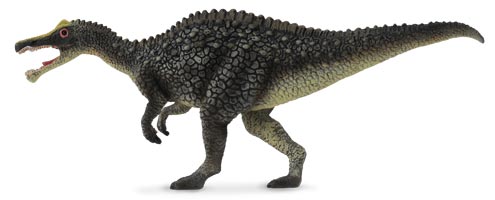
A number of huge spinosaurids are known from the Cretaceous-aged strata of Brazil.  There is the fearsome Irritator (I. challengeri).

A Model of the Brazilian Dinosaur Irritator

The dinosaur known as Irritator.

The dinosaur known as Irritator.

Picture credit: Everything Dinosaur

The spinosaurid model shown above is a replica of Irritator challengeri from the CollectA Prehistoric Life model range.  To view this range on Everything Dinosaur’s website: CollectA Prehistoric World/Life Models.

A Formidable Theropod

Reaching lengths in excess of eight metres, Irritator was a formidable theropod, but it may not have been the largest spinosaur to be classed as a “boy from Brazil”.  Back in 2011, team members at Everything Dinosaur reported on the discovery of a fragment of jawbone found in Maranhao State that indicated the existence of a truly colossal spinosaur.  This dinosaur was named Oxalaia quilombensis.

To read an article about this fossil discovery: Giant Spinosaur from Brazil.

Best of luck to all the teams in the tournament, hope the fans enjoy themselves and perhaps in between the matches, a few of them might take the time to visit some of the museums in the country and to appreciate the rich geological heritage of Brazil.

5 06, 2014

A Remarkable Forty-Six Ichthyosaur Fossils Discovered in Chile

By |2024-05-02T06:14:26+01:00June 5th, 2014|Categories: Dinosaur and Prehistoric Animal News Stories, Geology, Palaeontological articles|1 Comment

Retreating Glacier Reveals Ichthyosaur Graveyard

A team of German and Chilean researchers have just about finished cataloguing, mapping and recording one of the densest assemblies of ichthyosaur fossils ever found.  Scientists from Heidelberg University and the State Museum of Natural History, Karlsruhe, in collaboration with colleagues from a number of scientific institutions in Chile, have identified a total of forty-six, complete or near complete specimens of Early Cretaceous ichthyosaurs (fish-lizards).  The fossils represent at least four species, with juveniles, pregnant females and other adult ichthyosaurs having been identified.

Ichthyosaur Fossils

All the ichthyosaur fossils represent ophthalmosaurids and the site is being heralded as the most important location discovered to date in South America that records a marine ecosystem that existed around 140 to 132 million years ago.

One of the Many Ichthyosaur Fossils Found at the Site

Fossilised remains of Early Cretaceous Ichthyosaur

Fossilised remains of Early Cretaceous ichthyosaur.

Picture credit: W. Stinnesbeck

In the picture above, the geological hammer provides scale and to the left of the picture elements of a limb and the small pebble-like bones that make up a flipper can clearly be seen.  The back-bones and ribs can also be made out.  The ichthyosaur specimen has been identified as Platypterygius hauthali.

Discovered as Glacier Retreated

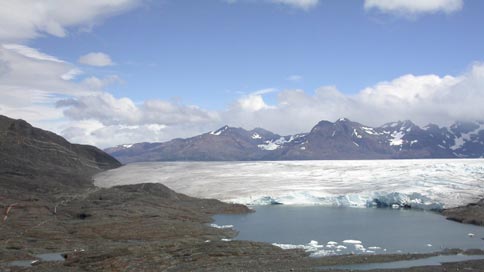
The fossils were found as a glacier retreated in the Torres del Paine National Park, southern Chile.  The retreat of the glacier (Tyndall glacier) revealing the fossils could be a case of global warming providing palaeontologists with benefits, affording them a unique insight into an ancient marine ecosystem.  Some of the ichthyosaurs are so well preserved that skin tissue imprints have been found, along with the remains of embryos within the body cavity of female ichthyosaurs.  Such is the concentration of “fish lizard” remains, that the Tyndall glacier location has been heralded as amongst the prime fossil Lagerstätten for Early Cretaceous marine reptiles worldwide.

The Remote and Beautiful Tyndall Glacier (southern Chile)

Retreating glacier reveals fossil remains.

Retreating glacier reveals fossil remains.

Picture credit: W. Stinnesbeck

Fast-swimming, Predatory Marine Reptiles

Ichthyosaurs were an Order of fast-swimming, nektonic and predatory marine reptiles with dolphin-shaped bodies.  They evolved in the Early Triassic and survived into the Late Cretaceous, eventually dying out as a group around eighty million years ago.  It is now thought ophthalmosaurid ichthyosaurs like most other ichthyosaurs, were viviparous, that is, the females retained fertilised eggs inside their body, until the embryos were sufficiently well developed to be born directly into the sea.

A Model of a Typical Ichthyosaur

Ichthyosaurus Model (Carnegie Collectibles)

Ichthyosaurus model (Carnegie Collectibles).

Picture credit: Safari Ltd

The first fossils were discovered in 2004 as scientists were mapping the retreat of the glacier.  It has taken a total of three major field expeditions for all the ichthyosaur material exposed at the site to be mapped and catalogued.  An academic paper detailing the research has been published in the scientific journal “The Bulletin of the Geological Society of America”.

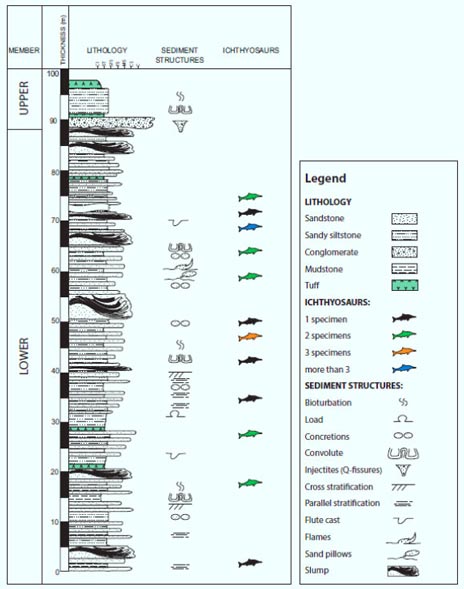
Alongside, the remains of the reptiles, the research team found ammonites, belemnites, bivalves and marine fish fossils.  In addition, there were plant fossils also preserved.  The ichthyosaurs were not found at the same level in the strata, but scattered throughout the Formation Member at several levels indicating mass mortality events occurring in this marine ecosystem from time to time.

A Diagram Representing the Deposition of the Strata and Indicating the Location of Ichthyosaur Fossils

Evidence of mass mortality events in the ecosystem.

Evidence of mass mortality events in the ecosystem.

Picture credit: W. Stinnesbeck

Interpreting the Geology

The joint German and Chilean research team have interpreted the geology of this location thus:

The gregarious ichthyosaurs lived and hunted along the north-eastern edge of a deep sea that then separated the Antarctic continent from the southern tip of South America.  Cold water rising up from the depths of a deep underwater canyon provided nutrients to sustain a large population of primary producers such as plankton.  These were fed upon by large shoals of bony fish and belemnites.  The ichthyosaurs in turn hunted the fish and the cephalopods.

With the rifting of the sea floor as geological forces gradually extended the Atlantic Ocean, there were a great number of earthquakes.  Some of these earthquakes were powerful enough to set off underwater avalanches that swept marine organisms down the steep slopes into the deeper water.  This led to the formation of several “ichthyosaur graveyards”.

Commenting on the significance of this discovery, one of the lead authors of the research paper, Professor Dr Wolfgang Stinnesbeck, Institute of Earth Sciences (Heidelberg University) stated:

“Occasionally, high energy turbiditic mudflows sucked down everything in their reach, including ichthyosaurs.  Inside the suspension flows, the air-breathing reptiles lost orientation and finally drowned.  They were instantly buried in the abyss at the bottom of the canyon.”

The speed of burial and the lack of oxygen in the mud layers permitted the exceptional degree of preservation.

The professor went added:

“The deposit is Early Cretaceous in age [Valanginian to Hauterivian faunal stage] and forms part of a deep water sequence located in the Rocas Verdes Basin, a straight separating Antarctica and South America from Late Jurassic to Early Cretaceous times.

23 05, 2014

Volunteers Required to Help Protect Scotland’s Unique Fossil Heritage

By |2024-04-12T15:43:03+01:00May 23rd, 2014|Categories: Dinosaur and Prehistoric Animal News Stories, Dinosaur Fans, Geology, Main Page, Palaeontological articles|2 Comments

Action Taken to Safeguard Fossils In Scotland

The Isle of Wight off the coast of southern England might be regarded by some as Britain’s “Dinosaur Isle” but the United Kingdom does in fact have several contenders for this accolade.  Travel north of the border into Scotland to the Inner Hebrides and you might find the residents of the Isle of Skye taking issue with such claims.  However, the island’s rich fossil heritage has been under threat with unscrupulous fossil collectors damaging important scientific sites in their quest to obtain rare vertebrate specimens.

Everything Dinosaur team members reported on the sad case of “fossil vandalism” back in 2011: Important Fossil Site is Vandalised.

Safeguarding Steps

Steps are being taken to help protect Scotland’s fossil heritage and local people on the Inner Hebrides are being asked to volunteer as wardens to help watch over and safeguard sites that are important to geology and palaeontology.  The Isle of Skye may seem like an unlikely place to find dinosaurs and fossils of other Mesozoic vertebrates, but back in the Jurassic, this part of the world was joined up with the land mass that was later to become the western United States.  Rocks laid down in the Middle Jurassic are exposed on the Isle of Skye and in the U.S. States such as Utah, Colorado and Wyoming – parts of America famed for their Jurassic aged dinosaur fossils.

‘To view Everything Dinosaur’s article explaining the importance of the Isle of Skye and its links to the western United States: Question!  What do the Isle of Skye and the State of Wyoming have in Common?

Fossil Heritage

Scotland did introduce a national fossil hunting code back in 2008.  Most fossil hunters and amateur palaeontologists follow this code when collecting fossils, however, there are those who simply see an opportunity to hack into the relatively deserted cliffs and gullies on Scottish islands in a bid to find fossilised bones of vertebrates which then can be sold to private collectors.  A public meeting was held at Portree (Isle of Skye), this week which involved representatives from Scottish National Heritage (SNH), National Museums Scotland, The Hunterian Museum and the Highland Council with the aim of setting up a network of wardens to help record and protect important fossil sites.

With a managed approach to these important fossil sites, it is hoped that more fossil collectors will visit Scotland, especially the Isle of Skye and neighbouring islands, boosting tourism and the local economy.

Important Geology

Skye and the nearby island of Raasay have a rich geological heritage spanning the last three billion years of Earth’s history.  Fossil remains of plants and animals record the evolution of life .  They also record the fascinating journey of the area we now know as Skye and Raasay, as it drifted for hundreds of millions of years across the face of the Earth, from once being part of America to now being part of the western edge of Europe.

Comments on the Plan

Commenting on the plan to form local action groups to protect the beaches, Dr Colin MacFadyen of Scottish National Heritage stated:

“Skye and Raasay have a fantastic fossil heritage, and kids and amateur fossil hunters should be encouraged to collect.  But at the same time something has to be done about irresponsible collecting and to reduce examples where people for whatever reasons damage fossil localities and important fossils.   This is where the local community can get involved and help secure their threatened natural heritage.  Local action may ensure that rare fossil finds are rescued, recorded and saved for the nation.  The public meeting in Portree will encourage local people to play an important part in safeguarding and promoting an internationally significant asset.”

Dr Nick Fraser, Keeper of Natural Sciences at National Museums Scotland commented:

“We are excited by the opportunities to work together to bring Skye’s remarkable fossil heritage into greater prominence.  This is a precious resource which, with support from the wider community, will benefit generations of islanders.”

Everything Dinosaur Comments

A spokes person from Everything Dinosaur explained the importance of the Isle of Skye fossil sites, stating:

“Only a few places in the world have exposed strata dated to the Middle Jurassic that contain vertebrate body and trace fossils preserved within them.  The Isle of Skye is one such location and the fossils found here and on neighbouring islands have helped palaeontologists to understand more about the fauna and flora of our planet around 170 million years ago.  It is vitally important that such fossil bearing sites are protected, whilst at the same time striking a balance to help encourage tourism to boost the economy.”

Everything Dinosaur acknowledges the contribution of a press release from Scottish National Heritage in the compilation of this article.

Visit Everything Dinosaur’s award-winning website: Everything Dinosaur.

16 05, 2014

Identifying the First Americans

By |2023-03-13T10:16:58+00:00May 16th, 2014|Categories: Dinosaur and Prehistoric Animal News Stories, Geology, Main Page|0 Comments

“Naia” – The Water Nymph Provides Clues to the First Americans

To a palaeontologist, the Yucatan peninsula of Eastern Mexico is a fascinating part of the world, for it was here something like sixty-six million years ago, that an extra-terrestrial body crashed into the Earth which contributed to the Cretaceous mass extinction event leading to the demise of the dinosaurs.

In addition, the amazing geology of the area, essentially extensive limestone deposits that over millions of years have been hollowed out in places by the action of water to create an enormous network of caverns, yields secrets of much more recent times – the remains of creatures and people that lived in America during the last Ice Age.

The First Americans

The discovery of the remains of a teenage girl who fell to her death in a cave between 12,000 and 13,000 years ago are helping archaeologists to piece together the story of how the Americas came to be populated.

The skeleton, nick-named “Naia” by the scientists, (the name means water nymph), represents the oldest genetically intact human known from the Western Hemisphere.  The water nymph epithet is apt, as the when the Ice Age began to give up its icy grip on the continent around 10,000 years ago, the caves quickly became inundated with water and much of this subterranean world was submerged, including the cavern where the bones of this young girl were found.

The picture above shows Divers Susan Bird (in blue) and Alberto Nava (in yellow) carefully transporting the skull to an underwater turntable so that it can be photographed from various angles to make a three-dimensional image of the human remains.  Details of the research into mitochondrial DNA (mtDNA) extracted from a tooth have been published in the academic journal “Science”.  Mitochondrial DNA is passed down the maternal line, from mother to daughter.

Examining the Mitochondrial DNA

The mitochondria are the “factory” areas in cells with a membrane, these convert chemical energy into food substances that can be utilised by the body.  By mapping the genetic information and identifying markers within it, the girl’s ancestry can be compared with those of Native American Indian populations, helping scientists to determine how North America came to be inhabited, by whom and when.  It also permits researchers to look more closely at the genetic relationships between today’s Native American population and the first inhabitants of this continent.

The data supports the hypothesis that Ice Age humans who crossed from Asia into the Americas did in fact give rise to the modern Native American Indians.  This means that tribes people today can trace their origins back to the very first settlers who migrated from Asia into Alaska via the landmass called Beringia that linked these two continents together.  The date when people first crossed over from Asia to America is hotly debated amongst palaeoanthropologists.

Some scientists suggest that migrations began as recently as 15,000 years ago.  With the discovery of the human remains in eastern Mexico and their dating to circa 12,000 – 13,000, this suggests that either modern humans spread very rapidly south, or that migrations may have started much earlier.

The Ice Ages led to the locking up of vast quantities of water in ice sheets.  Global sea levels fell and Asia and the Americas were linked.  A land bridge existed between the north-eastern tip of Siberia and the State of Alaska (Beringia), the ancestors of “Naia” crossed this land bridge and the Americas were colonised.

A Young Girl

The girl, believed to have been around fifteen or sixteen years of age when she died, probably fell in the cave.  The pelvis is shattered, the break suggests this was an injury caused from a fall and not the distortion of fossil material as a result of the fossilisation process.  Scientists have speculated that the girl may have fallen a considerable distance, having entered the cave looking for a source of water.  The divers also found a collection of other bones that represent prehistoric animals, some of which “Naia” would have been familiar with.

Prehistoric Animal Bones

The divers found the remains of giant ground sloths, sabre-toothed cats, cave bears and a Gomphothere (extinct type of elephant).  Around twelve thousand years ago, this part of Mexico was much more arid than it is today, some of the caves would have held freshwater in them, and the girl may have been part of a group of gatherers looking for fresh water supplies.  Measuring under 1.5 metres tall and slightly built, the girl fell into a pit which is over thirty metres deep in places.  The bell-shaped cave, now flooded is so dark and claustrophobic that the divers refer to it as “Hoyo Nero” – the black hole.

For models and replicas of prehistoric mammals including prehistoric elephants: CollectA Deluxe Scale Replicas and Figures.

Archaeologist, James Chatters (Applied Paleoscience [American spelling]), one of the leaders of the research team stated that the cavern represented “a time capsule of the environment and human life at the end of the Ice Age.”

The origins of the first Americans has been a source of controversy for some time.  The date when the first, nomadic, hunter-gatherers crossed from Beringia remains unclear, evidence collected from early human settlements found in north-eastern Siberia (Ushki Lake and Berelekh) when compared to later human settlements in North America (Tuluaq Hill, Bluefish Caves and Swan Point) suggest that the crossings of Beringia may have taken place between 26,000 and 18,000 years ago.

However, the discovery of “Naia” has confused academics as the girl had skull characteristics that distinguish her from modern Native Americans.  For instance, the skull is narrower and this and the other anatomical differences led researchers to propose that the first people of the New World might represent an earlier migration from a different part of the world, than the true forebears of today’s modern Native Americans.

Analysis of the mtDNA extracted from a wisdom tooth identifies the girl as belonging to the same Asian-derived genetic lineage as those of modern Native Americans.  The tooth along with bone samples was used to provide an estimate of the age of the human material.

The genetic data, although far from comprehensive suggests that the physical facial and skull differences between the first New World inhabitants and today’s Native American population probably arose due to evolutionary changes after the first migrants had crossed over from Beringia.

The study was led by the Mexican Government’s National Institute of Anthropology and History supported by the National Geographic Society.  In addition, to the human remains the researchers are keen to put the prehistoric mammal fossil discoveries on display once they have been prepared.

In terms of human migration, the arrival of our species in America happened relatively recently.  Homo sapiens (if we accept the “out of Africa” theory), has been steadily spreading out from Africa for the last 130,000 years or so.

To read an article about the recent discovery of a H. sapiens skull in Laos that is helping to map the progress of the earliest settlers in Asia: Laos Man and the Spread of Humans into South-East Asia.

6 05, 2014

Palaeontologists Fear for Safety of Red Rock Canyon Dinosaur Tracks

By |2023-09-03T09:35:04+01:00May 6th, 2014|Categories: Dinosaur and Prehistoric Animal News Stories, Geology, Main Page|0 Comments

Recently Discovered Dinosaur Tracks May be Damaged or Stolen Before they are Studied

Scientists fear that recently discovered Early Jurassic dinosaur tracks might be damaged before they can be studied.

Located in southern Nevada, just twenty-five miles from the bustling city of Las Vegas, the Red Rock  Canyon National Conservation Area provides a peaceful haven for campers and walkers amongst spectacular sandstone buttes and rock formations.  This State Park covers nearly 200,000 acres and up until recently its main claims to fame include being the preferred filming location for several westerns and for sandstone petroglyphs created by native Indians.

“Jurassic Park”

However, this arid place was once home to a range of Early Jurassic dinosaurs and palaeontologists fear that the footprints these ancient creatures left behind could be either damaged or even stolen before they have been properly studied.

The Park attracts over one million visitors a year and back in 2010, three hikers reported finding dinosaur tracks whilst out trekking in the Park.  At first these reports were dismissed, but a scientific investigation confirmed the trace fossil find and the announcement of the discovery was made public in the autumn of 2011.

Dinosaur Tracks

As many as ten locations within Red Rock Canyon have been identified as having preserved prehistoric tracks, five of these sites represent the footprints made by a small, bipedal dinosaur, these prints, once made in soft, wet sand are now preserved in the location’s famous sandstone deposits.

Pictures show a set of three-toed dinosaur prints preserved in the sandstone rock of the Park.  The picture has been taken as if the dinosaur which made these tracks was walking towards the camera.  The species is not known, but it is presumed to have been around two to three metres in length and probably carnivorous.

Early Jurassic Prints

At this time in the Early Jurassic, there was a significant radiation of different types of dinosaur and a number of new types of dinosaur evolved.  Palaeontologists and the National Park’s staff are keen to protect these trace fossils, they hope to keep most of the locations secret, at least until they have been mapped, recorded and properly studied.  However, with a million visitors a year to contend with, the threat of damage to the delicate prints or even theft is always on their minds.

In the neighbouring stage of Utah, Everything Dinosaur team members recently reported on the theft of a dinosaur footprint from near the town of Moab.  The thief has subsequently been caught but the fossil has yet to be found.  A trail date has been set for July 7th.

To read more about this incident of fossil theft: Dinosaur Footprint Stolen in Utah.

Commenting on just how fragile these ancient tracks can be, University of Nevada (Las Vegas), palaeontologist Josh Bonde stated:

“Even well-intentioned folks going out to take a look can harm the site by walking on or nearby the tracks.  The formation the tracks are preserved in is not a very rigid rock and it is notorious for easily falling apart.”

Studying the Tracks

The initial 2010 discovery, once confirmed, triggered a number of similar finds in the Park.  Bureau of Land Management officials would prefer visitors not to go out deliberately looking for more signs of dinosaurs having walked this way.  Most of the known prints are not on designated trails and some of them are in more remote and unsafe locations.

A spokes person for the Bureau explained:

“We really want visitors to stay on designated trails” to minimise damage to all of the Park’s sensitive natural and cultural resources.”

Picture show a close up of a single dinosaur footprint.  Two of the three toes that this little dinosaur walked on can clearly be made out.  Such fossil finds are extremely significant and team members at Everything Dinosaur have been studying a set of similar tracks found in southern Utah, near the town of St George.

To read more about the St George trace fossils: Important Dinosaur Trace Fossil Discovery in Utah.

University of Nevada Leading the Research

The University of Nevada (Las Vegas) was recently awarded a $25,000 USD (£14,800 GBP), by the Bureau of Land Management to study the fossilised tracks in the Red Rock Canyon region.  High resolution cameras will be used to photograph the prints and even LiDAR (light detection and range), a three-dimensional laser mapping system has been proposed.  LiDAR would record the prints in very fine detail without causing any damage to the prints themselves.  It is likely that the study will take more than twelve months to complete.

Staff at the Red Rock Canyon State Park, are hopeful that once completed this study could form the basis of a permanent display located in the Park’s visitor centre.

However, there is the ever-present risk of theft and staff have urged visitors to be on the look out for any suspicious activity.  With high prices being paid for dinosaur fossils at auction, there has been a number of thefts reported in recent years.  A spokesperson from Everything Dinosaur added:

“As the tracks are preserved in coarse grained sandstone, any attempts to lift the prints by untrained individuals would most probably result in the prints being damaged to such an extent that they would have no commercial value.  There are very strict laws in the United States concerning damage to or theft of such precious artefacts.  Any one caught committing such an act of wanton vandalism can expect to face very severe penalties.”

The Bureau of Land Management requests that anyone who finds what they believe could be dinosaur tracks or other fossils in the Park, calls 702-515-5000 and reports their discovery.  They advise taking careful note of the location and photographing the finds.  The Bureau also is quick to remind visitors to the Park that it is illegal to dig up or collect fossils on public land without a permit.

It is likely that more dinosaur tracks await discovery in the Lower Jurassic sandstone, known as Aztec sandstone, that outcrops this part of the western United States.  Hikers and other  tourists can play their part by looking out for such fossils but are reminded to report their finds and to not to attempt to dig or in anyway remove the fossils.

Visit Everything Dinosaur’s website: Everything Dinosaur.

3 05, 2014

Dinosaur Footprints Set Out on a Tour of New Zealand

By |2023-03-13T07:49:22+00:00May 3rd, 2014|Categories: Dinosaur and Prehistoric Animal News Stories, Geology, Main Page|0 Comments

New Zealand’s Very Own “Walking with Dinosaurs”

Dinosaur fossils are exceptionally rare in New Zealand, despite this remarkable and very beautiful country being home to some flora and fauna that can definitely be thought of as being prehistoric.  For example, there is the Tuatara (Sphenodon punctatus), which belongs to an otherwise extinct reptilian group called the Rhynchocephalians and this little reptile is found nowhere else in the world.  The country can also boast some of the finest examples of cycad groves (Cycadales) on the planet.

Dinosaur Footprints

However, evidence for dinosaurs having lived in New Zealand, which formed part of the huge southern super-continent of Gondwana has been hard to find.  Very few body fossils have been discovered and trace fossils such as dinosaur tracks are even rarer, but for GNS Science* geologist Greg Browne, the next few months sees some Titanosaur footprints that he found forming part of a touring exhibition that aims to educate New Zealanders about their prehistoric heritage.

GNS Science was founded in 2006 it was formerly known as the Institute for Geological and Nuclear Science Ltd.

The exhibition entitled “Dinosaur Footprints: A Story of Discovery” will open at the prestigious Auckland War Memorial Museum in June before touring the country.  The footprints, the first evidence of such dinosaurs having lived on what is now known as South Island were found in sedimentary rocks north-west of the town of Nelson.  At first, scientists were unsure whether the strange marks in the rocks represented the tracks of giant plant-eating dinosaurs, but the circular footprints, some of which are over sixty centimetres in diameter have been confirmed as being the tracks produced by a long-necked dinosaur referred to as a titanosaur.

Titanosaur

To read an article on the footprints published by Everything Dinosaur: Dinosaur Tracks from New Zealand.

Visitors to the exhibition will be able to learn all about the fossil discovery, the prints have been identified from more than half a dozen locations and they stretch over an area of around ten kilometres.  Replicas and casts of the prints will be on display and artist Dave Gunson has created a watercolour illustration depicting a pair of giant titanosaurs roaming across a Late Cretaceous, sandy beach, the moment in time when the trails were formed.

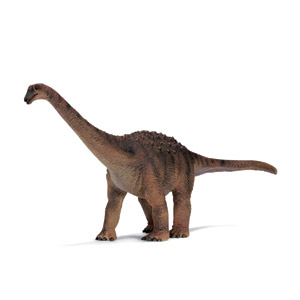
An Illustration of a Typical Titanosaur – Saltasaurus

Saltasaurus

Saltasaurus – a typical titanosaur.

Picture credit: Everything Dinosaur

The Titanosaurids

The titanosaurids were the last group of sauropod dinosaurs to evolve and although the Sauropoda seemed to have gone into decline in the Northern Hemisphere as the Cretaceous progressed, titanosaurs made up a significant proportion of the herbivorous biomass on the southern continents.  This group of long-necked dinosaurs persisted until the very end of the Cretaceous.

For models and replicas of titanosaurs and other prehistoric animals: Wild Safari Prehistoric World Models.

Although Greg Browne and his team are not able to identify the genus that made the tracks, the footprints vary in diameter and indicate that the dinosaurs ranged in size from about two metres to more than six metres in length.  These animals were probably moving as a herd and chose to walk close to the shore as this would have been an easier and probably safer route than attempting to move as a group through the forest that was located further inland.  The roughly circular prints probably represent a single species.

The current tour Itinerary is as follows:

  • Auckland War Memorial Museum 13th June until July 27th
  • Rotorua Museum 6th September until October 12th
  • New Zealand National Aquarium, Napier over Labour Weekend – from January 11th 2015
  • Puke Ariki, New Plymouth 17th January until March 22nd
  • Nelson Provincial Museum from July through to September 2015

A spokesperson from Everything Dinosaur commented that is was great to hear that the story of  these enigmatic and extremely rare footprints was going to reach a wider audience.  He encouraged New Zealanders to attend, to have the opportunity to get up close to the evidence for dinosaurs roaming New Zealand seventy million years ago.  It was also important for the work of sedimentologists such as Greg Browne to receive wider public recognition.

It is likely that more venues will be added to the tour schedule.

17 04, 2014

Rare Ichthyosaur Fossil Discovered at Lyme Regis

By |2024-04-12T18:29:10+01:00April 17th, 2014|Categories: Dinosaur and Prehistoric Animal News Stories, Dinosaur Fans, Everything Dinosaur videos, Geology|0 Comments

New Ichthyosaur Fossil Discovery at Lyme Regis

Yesterday, team members at Everything Dinosaur received news that a beautifully preserved ichthyosaur specimen had been discovered at Lyme Regis.  Our chum Brandon, a local fossil expert from Dorset, sent us some pictures and a video which illustrate the exciting discovery.   The specimen was discovered on the beach to the east of the town of Lyme Regis, near to where the council have been working to strengthen the cliff area and to improve the town’s coastal defences.

Video Footage of the Ichthyosaur Discovery

Video credit: Brandon Lennon

 The video shows the block which contains the fossil specimen, vertebrae can be clearly seen along with some of the rib bones, the skull is only partially exposed.  The dig team will cut the block away from the surrounding material and carefully transport the specimen away so that it can be prepared and examined in detail.  From the video, the bones don’t look too compressed or deformed and although some of the distal elements of the skeleton are probably missing, this particular ichthyosaur looks relatively complete.

Ichthyosaur Fossil

It is a little difficult to get our bearings just from the video and the photographs that we have received but we think the specimen was discovered in the Blue Lias of the Church Cliffs section of beach, immediately east of Lyme Regis.

The Location of the Fossil Discovery

The location of the fossil find.

The location of the fossil find.

Picture credit: Brandon Lennon

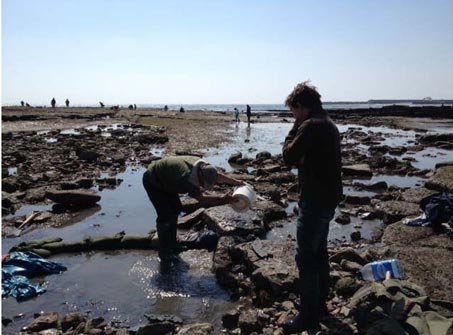
Water is carefully removed from around the fossil matrix, sand bags will be put in position to help keep the fossil material protected and then the dig team will map the exposed bones and work out the best way to cut and remove the stone block.

The Fossil Material is Carefully Examined

Icthyosaur fossil find April 2014.

Ichthyosaur fossil find April 2014.

Picture credit: Brandon Lennon

Exposing the Specimen

Carefully the specimen is exposed and then the layout and orientation of the fossil material is studied.  Consideration needs to be given to the tide times as the specimen will be covered once the tide turns.

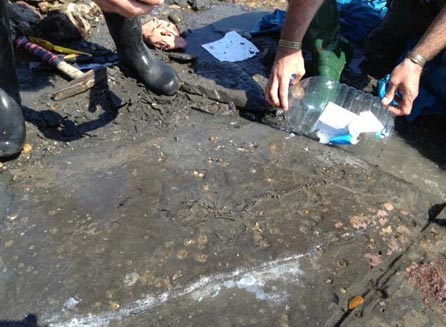
A Close up of the ichthyosaur Fossil

The vertebrae can be clearly made out.

The vertebrae can be clearly made out.

Picture credit: Brandon Lennon

The hand in the photograph helps to provide scale.  The ichthyosaur is lying with its head facing towards the bottom right and the tail up towards the top left of the photograph.  The vertebrae can be clearly seen in the picture.  It is certainly a member of the Ichthyosauria Order, but it is very difficult to assign a species name to the specimen at this stage just having the short video and the photographs to study.  As a guess, it might be an example of Ichthyosaurus breviceps, however, it is best to wait until the fossil material has been more thoroughly prepared before any precise identification can be made.

The Ichthyosauria were an Order of fast-swimming, nektonic and (as far as we know entirely marine), predatory marine reptiles with dolphin-shaped bodies.  As a group, these highly specialised reptiles evolved in the Early Triassic and thrived throughout the Jurassic and for much of the Cretaceous, before finally becoming extinct around 80 million years ago.

For models and replicas of ichthyosaurs and other Mesozoic marine reptiles: CollectA Age of Dinosaurs Popular Models.

A Typical Jurassic Ichthyosaur Model

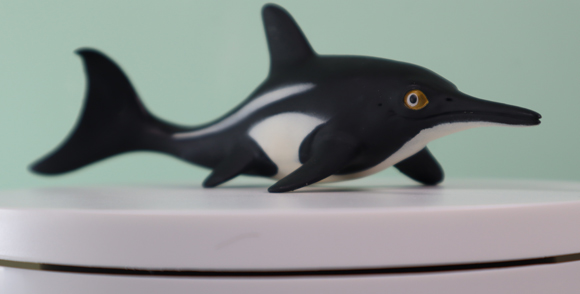
An Ichthyosaurus model

The Ichthyosaurus model (Wild Safari Prehistoric World) ready to take its turn on the Everything Dinosaur turntable. Picture credit: Everything Dinosaur.

Lyme Regis is an amazing place to visit and a fossil hunting trip to the beach is highly recommended, although we at Everything Dinosaur would advise that you take advantage of the local knowledge of a fossil hunting expert so that you can get the most from your visit.

To read more about guided fossil walks: Guided Fossil Walks (Lyme Regis).

We look forward to hearing more about this exciting fossil find and no doubt there will be more marine reptile discoveries made over the next few months.

Go to Top