All about dinosaurs, fossils and prehistoric animals by Everything Dinosaur team members.

Articles, features and stories with an emphasis on geology.

22 03, 2015

Spring Low Tides Uncover Rare French Dinosaur Footprints

By |2024-05-05T09:35:27+01:00March 22nd, 2015|Categories: Dinosaur and Prehistoric Animal News Stories, Geology, Main Page|0 Comments

The Dinosaur Footprints at Veillon Beach (Vendée)

The low tides brought about as a result of the spring equinox has exposed a remarkable series of Early Jurassic trace fossils, giving residents of the town of Talmont-Saint-Hilaire the chance to go “Walking with Dinosaurs”.  The exceptional low tides on France’s North Atlantic coast have revealed 200-million-year-old footprints as well as ripple marks preserved in the mudstone and sandstone which were laid down at the very beginning of the Jurassic (Hettangian faunal stage).

Dinosaur Footprints

The site represents an estuary, or shallow bay area and this was criss-crossed by many different types of dinosaurs.  Hundreds of footprints have been recorded, a large number have been removed to prevent further damage by erosion, but at very low tides, especially in the spring when the seaweed and algae growth is not extensive, many three-toed prints can still be seen.

Discovered in 1963

The site was discovered in 1963 by a local engineer and chemist Gilbert Bessonnat, but it was not until March 1965 when a team of French palaeontologists mapped the area in earnest that the full significance of the location was revealed.  The mapping project begun on March 19th that year, taking advantage of the very low tide associated with the spring equinox, allowed the scientists to discover what has turned out to be the largest single concentration of dinosaur ichnofauna in the whole of France.

Dinosaur trace fossils from the Lower Jurassic are exceptionally rare, the site is protected and no fossil collecting is allowed.  After all, the sandstones and mudstones preserved here record terrestrial life shortly after the End Triassic extinction event, those footprints were made some fifty million years before the likes of Stegosaurus and Diplodocus and other iconic Jurassic dinosaurs roamed the Earth.

A Dozen Ichnospecies

In all, about a dozen different ichnospecies have been identified, including large and small theropods.  Some footprints may not represent dinosaurs, for example, some trace fossils have been assigned to the Order Rauisuchia and ascribed to the Postosuchus genus (a type of ancient, terrestrial crocodylomorph).  Ichnospecies associated with the site include: Eubrontes veillonensis tentatively described as a megalosaur, Talmontopus tersi which could be a bipedal ornithischian dinosaur and several dinosaurs assigned to the coelophysids (ichnogenus Grallator).

It seems that low tides on the North Atlantic coast of France, are providing scientists with a unique opportunity to learn about life in the Early Jurassic, well at least over the spring and autumn equinox anyway.

For dinosaur and prehistoric animal models: Dinosaur Models and Prehistoric Animal Figures.

5 03, 2015

The Very Complicated Human Family Tree Revealed by New Discoveries

By |2024-05-04T22:01:59+01:00March 5th, 2015|Categories: Dinosaur and Prehistoric Animal News Stories, Geology, Palaeontological articles|0 Comments

New Research and New Discoveries Shed Light on our Ancestry

If anyone has had an opportunity to trace their family tree, then they know that given the wealth of data around today, a few clicks of the keyboard can provide a great deal of information about your family.  However, when it comes to tracing the origins of the “human family”, the evolution of our own species, then things are much more tricky.  New research published today in the journal “Nature” is helping to unravel the complicated journey that hominins have taken, a journey that eventually saw the emergence of our species, Homo sapiens sometime around 220,000 years ago.

Homo habilis

Using a fossilised very human-like partial jawbone found at Ledi-Geraru, (Ethiopia), which has been dated to around 2.8 million years ago, in addition with already described material, an international team of scientists have reconstructed the skull of the early hominin Homo habilis (handy man) and looked at the ancestry of this species.  The research team included scientists from the University College London, in collaboration with the National Museums of Tanzania and the Max Planck Institute for Evolutionary Anthropology (Leipzig, Germany).

This new research helps to establish the human lineage and to determine what makes H. habilis so distinctive from the early Australopithecines such as the famous “Lucy” fossil –  A. afarensis which ironically, was discovered not too far from where the 2.8 million year old hominin lower jaw was found.  However, the fossils of “Lucy” are much older.  The partial skeleton of “Lucy” has been dated to around 3.2 million years ago.

The Famous “Lucy”

To read more about an exhibition that features the remarkable preserved remains of “Lucy”: Pictures from an Exhibition.

The first fossils of “handy man”, Homo habilis were described in 1964.  They consisted of a distorted lower jaw, hand bones and a highly fragmented braincase, all representing the bones of a single individual.  These fossils were catalogued as Olduvai hominin (OH7).   The rarity of early human bones, along with the very distorted remains associated with the earliest evidence of H. habilis made determining the unique characteristics and features of this species extremely difficult.

However, this research team utilised state-of-the-art computerised tomography and sophisticated computer modelling to unscramble the distorted remains and to piece together a reconstruction of the skull and jaws of Homo habilis.

The Human Family Tree

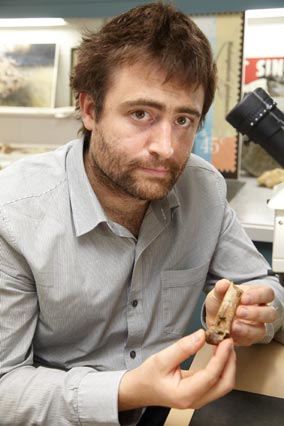
The question that has puzzled palaeoanthropologists since the scientific description of Homo habilis and the subsequent discovery of more Australopithecine fossil remains was, could the likes of “Lucy” have evolved into the very first human-like creatures? Professor Brian Villmoare (University of Nevada), believes that the discovery of this 2.8 million year old jaw bone, complete with five teeth helps to confirm this hypothesis.

The Fossilised Jaw Bone (2.8 million years old)
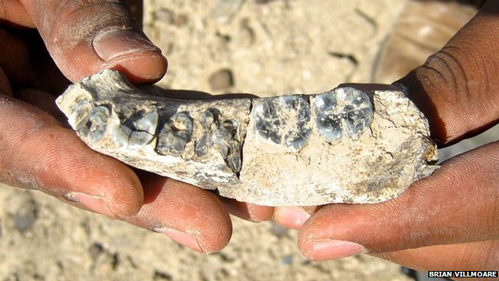
Something for the palaeoanthropologists to get their teeth into.

Something for the palaeoanthropologists to get their teeth into.

Picture credit: Brian Villmoare (University of Nevada)

The problem is this, the fossil record between the time period when “Lucy” and her kin were alive and the emergence of Homo erectus (with its relatively large brain and human-like body proportions), some two million years ago, is extremely sparse.  What has been found, is also very fragmentary, making tracing evolutionary links difficult.  The ancient human-like jawbone is highly significant.  The molar teeth are much smaller and less robust than those of other hominins known from the fossil record.  It is the size of the jaws and the teeth wherein that helps scientists to distinguish more human-like species from those which are more ape-like.

Commenting on the significance of this fossil find, scientists have stated that this new discovery pushes back the human evolutionary line by some 400,000 years or so.  The fossilised jawbone with its mix of primitive and more advanced traits makes it a candidate for a transitional species between the Australopithecines and the human family tree.

The Digital Reconstruction of the Skull and Jaws of Homo Habilis
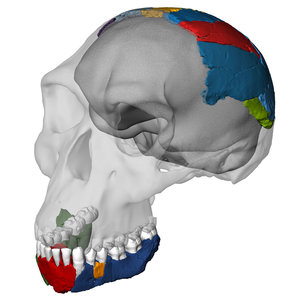
The digitally mapped and reconstructed skull of H. habilis.

The digitally mapped and reconstructed skull of H. habilis.

Picture credit: University College London

“Handy Man”

The “handy man” fossil material having undergone its computer modelling reveals new information about the jaw shape.  The computer having reassembled the distorted jaw described in 1964, to provide a more accurate reflection of the living bone.  The research published in “Nature” suggests that Homo habilis has older evolutionary roots than previously thought.  This research supports the idea that many different types of Homo species existed in Africa between 2.1 and 1.6 million years ago.

Climate change, leading to a much drier, deforested habitat may have led to a spurt in evolutionary experimentation as species adapted to the new environment and exploited new niches in the changing ecosystem.  The modelled lower jaw reveals primitive traits such as seen in Australopithecine fossil material, but it also has more advanced features, distinguishing H. habilis from its contemporary Homo rudolfensis.

The potential transitional link between hominins and Australopithecines remained elusive until the University of Nevada discovery of the 2.8 million year old jawbone.  The fossil, known as LD 350-1 is an excellent candidate for the ancestor of Homo habilis and other early hominins.

 Commenting on the fossil jawbone discovery, Dr Villmoare stated:

“LD 350-1 reveals that many of the anatomical patterns we see in two million year old Homo were established much earlier in the evolution of the genus.  At 2.8 million years ago we see relatively evolved Homo traits in combination with other, much more primitive anatomical features, a result that is particularly interesting in light of the shape of the OH7 reconstruction.”


3 03, 2015

A Trip to the Bathonian

By |2023-03-24T17:13:22+00:00March 3rd, 2015|Categories: Educational Activities, Geology, Teaching|0 Comments

The Bathonian Stage of the Middle Jurassic

Just like a book is divided up into chapters so geological time is divided up into a series of units.  There are Eons, Eras, Periods, Epochs, and faunal stages, these are the typical units of division when it comes to exploring the geological timescale.  A point reinforced when a team member from Everything Dinosaur made a visit to Somerset recently.

The Geological Timescale

Descending order of size for the units of the geological timescale (deep time):

  • Eon for example, the Phanerozoic (visible life) from 542 mya to the present day.
  • Era for example, the Mesozoic, from 251 mya to 66 mya) or thereabouts.
  • Period, for example, the Jurassic (199 mya to 145 mya) approximately.
  • Epochs, for example, the Middle Jurassic (175 mya -161 mya) approximately.
  • Stages or Ages such as the Bathonian (167.7 mya to 164.7 mya) approximately.

We mention this, as whilst working with Year 6 children and their teachers in the Bath area, we explained that the limestone rocks in their part of the world, were used as building materials and have been quarried for centuries.  Many of the buildings around the school, and the walls of the school were constructed using these limestones.  These limestones are the preserved remains of the shells of ancient sea creatures, that lived during the Jurassic.

Bathonian Faunal Stage

The Bathonian faunal stage was named after the spa town of Bath and the limestone found in this part of south-western England.  It was included in scientific literature as early as 1843.  A number of ammonite species are recognised from this Middle Jurassic strata and they help to provide a biostratigraphic profile and assist with relative ageing of the rocks.  Bathonian rocks have provided a number of dinosaur fossil remains including sauropods, armoured dinosaurs, meat-eaters and even a distant relative of the most famous dinosaur of all Tyrannosaurus rex (Proceratosaurus).

Typical Bathonian Limestones used as Local Building Materials

A faunal stage of the Middle Jurassic named after the spa town of Bath.

A faunal stage of the Middle Jurassic named after the spa town of Bath.

It was a nice moment to ask the school children did they want to see something from the Jurassic?  When they all said yes, we simply asked them to look out of the window.

For replicas and models of Jurassic prehistoric animals and other extinct creatures: Dinosaur and Prehistoric Animal Models.

11 02, 2015

Fossil Hunting Down Under

By |2023-03-24T06:51:32+00:00February 11th, 2015|Categories: Dinosaur and Prehistoric Animal News Stories, Geology, Main Page, Palaeontological articles|0 Comments

Local Fossil Hunters Get the Chance to Work with Professionals

On Sunday 22nd February amateur fossil hunters will get the chance to visit one of the state of Victoria’s most important fossil sites and get advice from leading palaeontologists.  Museum Victoria is holding a special event at the historic Beaumaris Bay fossil site.  The sandstone cliffs preserve evidence of marine fauna from Australia’s prehistoric past.  Many types of shark teeth have been discovered along with the fossilised bones of a number of marine vertebrates.

The day will involve talks from professional fossil hunters Dr Erich Fitzgerald (Museum Victoria), Professor Tim Flannery and Professor John Buckeridge of RMIT University (Melbourne).  Local amateur fossil hunters will also have the chance to have their finds identified by these experts.

Fossil Hunting Down Under

Commenting on the special, interactive day dedicated to fossil collecting, Dr Erich Fitzgerald (Senior Curator of Vertebrate Palaeontology, Museum Victoria) stated:

“There is simply no better place to find fossils in Melbourne than Beaumaris.  They have helped us paint a rich portrait of what Victoria was like millions of years ago.  The abundance of fossils of large marine animals, especially sharks and whales, suggests that between 6 and 5 million years ago the coastal waters of Victoria were far richer in nutrients than they are today.”

But fossil hunting is not just for professional scientists, as most professional scientists are happy to admit.  Fossils are being eroded out of the sandstone cliffs all the time and if it was not for the dedicated community of local fossil hunters, many potentially significant finds could be severely abraided by wave action or lost all together before a professional palaeontologist got the chance to explore the area.

Dr Fitzgerald Leading the Fossil Hunting Efforts

Dr Fitzgerald leading the fossil discoveries.

Five million year old giant bird fossil fossil held by Dr Fitzgerald.

Picture credit: Museum Victoria / Photographer: Jon Augier

Discovering New Fossils

Dr Fitzgerald added:

“In Museum Victoria’s collection there are thousands of stunning fossils from Beaumaris, many collected by enthusiastic members of the public with a keen interest in palaeontology.  The public can provide an extremely valuable insight from their fossil discoveries, which would potentially not have been uncovered otherwise.”

Back in 2012, Everything Dinosaur reported on the discovery of a fossilised leg bone found in the Beaumaris Bay area that was identified as belonging to a new genus of “toothed” marine bird.

To read more about this discovery: Giant “Toothed” Birds Once Soared over Southern Australia.

With such a huge country to explore, Everything Dinosaur has predicted on numerous occasions that this continent will provide palaeontologists with a number of new fossil discoveries, even new types of dinosaur.  Members of the public who participate in sensible, careful fossil hunting and who are sensitive to the environment and wish to work within the fossil hunting code can make a huge contribution to the Earth sciences.

Everything Dinosaur acknowledges the support of Museum Victoria in the preparation of this article.

24 01, 2015

Casting Doubts on Global Firestorms

By |2023-03-23T07:41:16+00:00January 24th, 2015|Categories: Dinosaur and Prehistoric Animal News Stories, Geology, Main Page, Palaeontological articles|0 Comments

Extraterrestrial Impact May Not Have Caused Global Firestorms

The debate over the consequences of the extraterrestrial impact that took place around sixty-six million years ago continues with the publication of pioneering new research that investigates whether or not the Yucatan impact caused extensive firestorms on a global scale.  It is now widely believed that at least one huge object from outer space crashed into Earth which very probably contributed to the mass extinction event that marks the end of the Cretaceous.  This is perhaps the most famous of all the mass extinction events recorded in the Phanerozoic fossil record, as no significant quantities of dinosaur fossils are found in younger strata.

Mass Extinction Event

The end Cretaceous mass extinction event saw the demise of the Dinosauria, the pterosaurs, most of the marine reptiles and a number of other significant casualties.  It had been thought  that a consequence of the impact was a series of huge fires that ravaged the Earth, destroying much of the plant-life on the planet.  Plenty of evidence for this catastrophic event has been cited, for example, large amounts of carbon preserved in strata at the K-T boundary, believed to be the preserved remains of such conflagrations.

In 2013, for example Everything Dinosaur published an article on this blog citing research which suggested that intense heat in the atmosphere did indeed cause huge fires: Cretaceous Mass Extinction Study Provides Evidence of Global Firestorm.

A “Fern Spike”

Scientists have also recorded evidence of a “fern spike” that occurred immediately after the extinction event.  Large numbers of fossilised fern spores have been recorded (microfossils), in contrast to a very low level of other plant remains such as pollen from flowering plants being recorded.  Ferns are quick to re-colonise an area after a devastating volcanic eruption.  The “fern spike” data was taken as supporting evidence for the massive destruction of much of the planet’s green matter.

To read more about the “fern spike” research: Humble Ferns – Evidence to Support the Impact Theory.

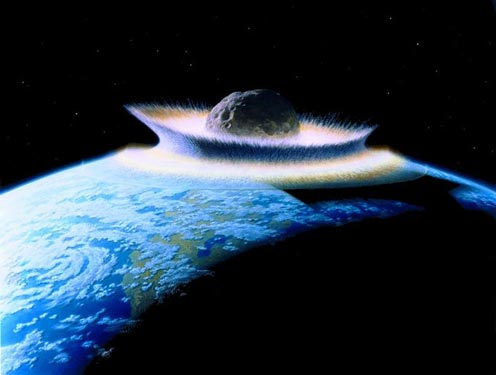
Did the Extraterrestrial Impact Cause Global Firestorms?

Cataclysmic impact event.

Cataclysmic impact event, but was there a global firestorm?

Picture credit: Don Davis commissioned by NASA

Global Firestorms

However, a team of UK based researchers (University of Exeter, Imperial College London and the University of Edinburgh), have challenged the idea of world-wide fires.  The scientists recreated the massive energy released from the impact event and they found that the blistering heat near the impact site was too short-lived to ignite living plants.  The scientists conducted a series of experiments using pulses of heat and writing in the Journal of the Geological Society, the team conclude that close to the actual impact, the heat wave would have lasted less than a minute, too short a time to set fire to living plants.

However, using computer models they discovered that the effects of the blast would have been felt as far away as New Zealand, some 12,000 kilometres from the site of the explosion.  The further away from the blast centre, the less intent the heat wave, but it would have been longer lasting.  In New Zealand, the heat blast would have lasted for around seven minutes, long enough to ignite living plant material.

Living Plants Not Ignited

Experiments conducted suggest that dry and dead plant matter could be set alight, but live plants such as conifer needles were not ignited.

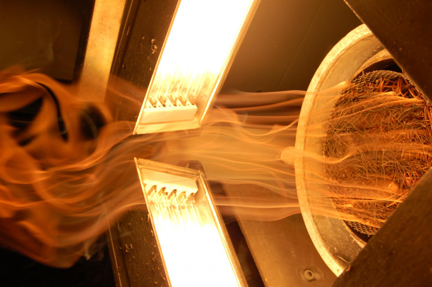
Having a Blast with Heat Wave Experiments

Global firestorm study.

Global firestorm study.

Picture credit: University of Exeter

The picture above shows the fire propagation apparatus recreating the impact induced thermal pulse at the Cretaceous/Palaeogene (K-T boundary).  Halogen lamps are delivering the intense, thermal radiation.

Commenting on the study, Dr Claire Belcher (Earth System Science group in Geography at the University of Exeter) stated:

“By combining computer simulations of the impact with methods from engineering we have been able to recreate the enormous heat of the impact in the laboratory.  This has shown us that the heat was more likely to severely affect ecosystems a long distance away, such that forests in New Zealand would have had more chance of suffering major wildfires than forests in North America that were close to the impact.  This flips our understanding of the effects of the impact on its head and means that palaeontologists may need to look for new clues from fossils found a long way from the impact to better understand the mass extinction event.”

The Impact on Flora and Fauna

Fauna and flora populations are generally resistant to localised fire events, animals can hide or hibernate/enter aestivation and the seeds of plants can survive the intense heat of forest fires.  Some plants even rely on seasonal fires to help them spread.  Based on these assumptions, it can be suggested that wildfires on their own are unlikely to be directly responsible for extinctions.  However, large dinosaurs which were unable to run very far, or shelter may have suffered terribly from such fires.

Dr Rory Hadden from the University of Edinburgh added:

“This is a truly exciting piece of inter-disciplinary research.  By working together engineers and geoscientists have tackled a complex, long-standing problem in a novel way.  This has allowed a step forward in the debate surrounding the end Cretaceous impact and will help geoscientists interpret the fossil record and evaluate potential future impacts.  In addition, the methods we developed in the laboratory for this research have driven new developments in our current understanding of how materials behave in fires particularly at the wildland-urban-interface, meaning that we have been able to answer questions relating to both ancient mass extinctions at the same time as developing understanding of the impact of wildfires in urban areas today.”

Everything Dinosaur would like to thank Exeter University for the use of a press release that enabled this article to be compiled.

Visit Everything Dinosaur’s website: Visit Everything Dinosaur.

13 01, 2015

Scotland’s Very Own Special Ichthyosaur

By |2024-05-04T19:22:43+01:00January 13th, 2015|Categories: Dinosaur and Prehistoric Animal News Stories, Geology, Main Page|0 Comments

Dearcmhara shawcrossi – An Ichthyosaur from the Isle of Skye

No it’s not a dinosaur, contrary to some media reports.  It certainly is not “Nessie”, but it does mark the culmination of a tremendous effort by Scottish palaeontologists to collate and study marine reptile fossils that have been found in Scotland.  A new species of ichthyosaur (marine reptile), has been described from fossils found on the Isle of Skye.

The “wee beastie” has been named Dearcmhara shawcrossi, the name comes from the Scottish Gaelic for marine lizard and the trivial name honours amateur fossil hunter Brian Shawcross who found the creature’s fossils at Bearreraig Bay in 1959.  Bearreraig Bay is part of a highly fossiliferous coastline which can be found on the eastern side of the island.  As far as we at Everything Dinosaur know, this is the first marine reptile to be given a Gaelic name, Dearcmhara is pronounced “jark vara”.

 A Model of an Ichthyosaur (Fish Lizard)

An Ichthyosaurus Model

An Ichthyosaurus model.

Picture credit: Everything Dinosaur

Scotland’s Very Own Ichthyosaur (D. shawcrossi)

Around 170 million years ago, much of the Isle of Skye was underwater.  A shallow sea separated the landmasses of Europe and North America, this sea formed when rifts in the Earth’s crust led to the break-up of the super- continent Laurentia.  Marine reptiles like Dearcmhara shawcrossi were part of a diverse ecosystem, Dearcmhara grew to around 4.5 metres in length, motor boat size as described by Dr Steve Brusatte (University of Edinburgh School of GeoSciences), who led the study.

Fossil Vertebra of the Newly Described Species

Most likely a dorsal vertebra from Dearcmhara.

Most likely a dorsal vertebra from 

Picture credit: BBC News

 Dr Steve Brusatte (holding the fossil in the photograph) went onto comment:

“During the time of the dinosaurs, the waters of Scotland were prowled by big reptiles the size of motor boats.  Their fossils are very rare, and only now, for the first time we’ve found a new species that was uniquely Scottish.”

The Isle of Skye

The Isle of Skye is a very important part of the world to palaeontologists.  Exposures along the shoreline and inland are strata that was laid down during the Middle Jurassic.  There are very few places in the world where such rocks are exposed and this makes any fossil discovery from the island very significant indeed.

Recently, Everything Dinosaur wrote about a new initiative to try and protect the island’s geological heritage in the wake of fears that unscrupulous fossil dealers might want to remove rare and valuable fossil bones of plesiosaurs and ichthyosaurs.

To read the article: Action Taken to Safeguard Scotland’s Fossils.

The discovery of a new species of Scottish ichthyosaur is just part of a collaborative effort being undertaken by researchers from the University of Edinburgh, the Hunterian Museum, the National Museums of Scotland, Staffin Museum (Isle of Skye) and Scottish National Heritage to try and catalogue significant vertebrate fossil finds.

A spokesperson from Everything Dinosaur commented:

“Without the donation made by local fossil enthusiast Brian Shawcross, this new species of ichthyosaur would not have been recognised.  This goes to show how important amateur fossil collectors can be when it comes to learning about life in the past.”

To read an article that explains the importance of the Isle of Skye from a palaeontological perspective: Scotland’s Mid Jurassic Heritage.

Everything Dinosaur acknowledges the assistance of a media release from the University of Edinburgh in the compilation of this article.

7 12, 2014

His and Her Trilobites – Beautiful Fossils

By |2024-02-25T08:01:39+00:00December 7th, 2014|Categories: Dinosaur Fans, Everything Dinosaur News and Updates, Geology|0 Comments

Dorset Fossil Expert Sends Everything Dinosaur Trilobites

For Brandon Lennon, fossil expert and ammonite polisher supreme, this time of year is very busy as he prepares for the public Lyme Regis fossil walks which start again on Saturday 14th February.  February 2015, may seem a long way off, but for someone who spends his time studying the extensive fossil beds on this part of Dorset coast, it is merely a blink in geological time away.  Over the winter months, Brandon will be examining tide tables, looking at where rock falls and mud slides occur and plotting the best walks for those members of the public lucky enough to join him on his fossil finding adventures.

Fossil Hunting During the Winter

Brandon Lennon – Looking Forward to More Fossil Collecting in 2015

Exciting Plesiosaur Fossil Discovery

Exciting plesiosaur fossil discovery.

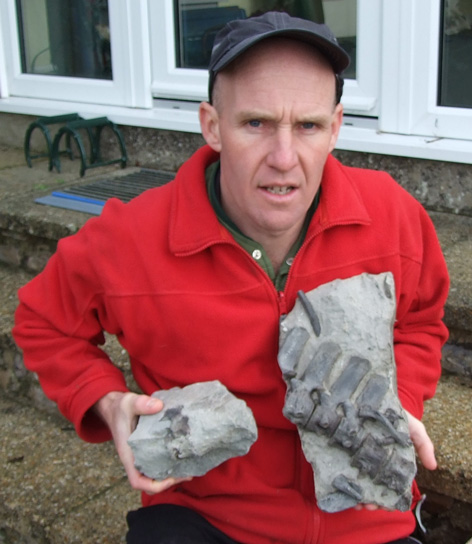
Plesiosaur Vertebrae

The picture above shows Brandon, with some beautifully preserved vertebrae from a Plesiosaurus, a marine reptile, fossils of which can be found eroding out of the cliffs on some parts of the Dorset coast.  Next year, marks the 200th anniversary of the publication of the world’s first extensive geological map.  The map that plotted the geology of England, Wales and parts of Scotland was created by the surveyor William Smith, (1769-1839), nick-named “strata Smith”, as it was Smith who used knowledge about which types of fossils could be found in which types of rock to plot the depositional sequence of strata.

The Geology of the Dorset Coast

This map, with its catchy title “A Delineation of the Strata of England and Wales with part of Scotland*, is regarded by many scientists and cartographers as one of the most important and significant maps ever created, it has even been dubbed “the map that changed the world”.  The geology of the Dorset coast is included, it forms one of fifteen sections that when combined produce the geological map.  Brandon and his father (a retired geologist), would be able to recognise the underlying geology as identified by Smith all those years ago.

Being able to identify the best places to look when it comes to finding fossils is a key skill for a leader of guided fossil walks and Brandon has more than twenty years experience in the role.

For further information on Guided Fossil Walks in the Lyme Regis area: Lyme Regis Fossil Walks.

Trilobite Fossils

Brandon’s extensive interests are not confined to Jurassic aged sediments.  The other day, he kindly sent Everything Dinosaur a couple of trilobite specimens to add to our arthropod fossil collection.  Most vertebrate palaeontologists, when quizzed, will openly admit to having a passion for all things Trilobita.  These entirely marine relatives of crustaceans, insects and spiders, evolved during the Cambrian and survived right up to the End Permian mass extinction event.

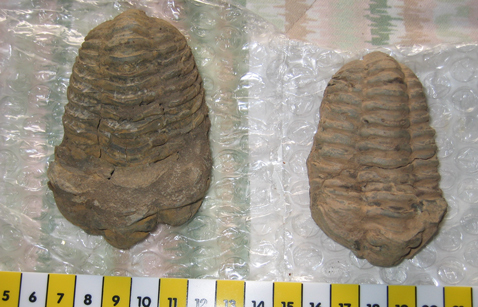
Trilobites come in all shapes and sizes and the two specimens sent to us by Brandon are fine examples of the genus Calymene (the genus name means “beautiful crescent” and it is pronounced kal-im-minny).  These particular fossils probably come from Morocco and date from the Late Ordovician, making them approximately 270 million years older than the strata explored by Brandon and the groups he takes out on his fossil walks.

We have nick-named the trilobites “Mike and Sue”.

Trilobite Fossils Sent to Everything Dinosaur by Brandon Lennon

"Mike and Sue" - the Trilobites.

“Mike and Sue” – the trilobites.

Picture credit: Everything Dinosaur

To read more about Brandon’s fossil hunting adventures including an article on ammonite polishing: Fossil Experts Demonstrate Their Skills.

*In Georgian times, in nascent scientific circles, there was a trend to give extremely long titles to publications.  It seems a case of don’t use one word when five words would do instead.  The full title of the 1815 geological survey map is:

“A  Delineation of the Strata of England and Wales with part of Scotland, exhibiting the collieries and mines, the marshes and fen lands originally overflowed by the sea, and the varieties of soil according to the variations in the substrata, illustrated by the most descriptive names by W. Smith.”

Visit Everything Dinosaur’s award-winning website: Everything Dinosaur.

19 11, 2014

Recommended Special Christmas Reading for Dinosaur Fans

By |2024-05-04T18:52:06+01:00November 19th, 2014|Categories: Book Reviews, Dinosaur Fans, Geology, Palaeontological articles, Press Releases|0 Comments

“Dinosaurs of the British Isles” – An Ideal Christmas Gift

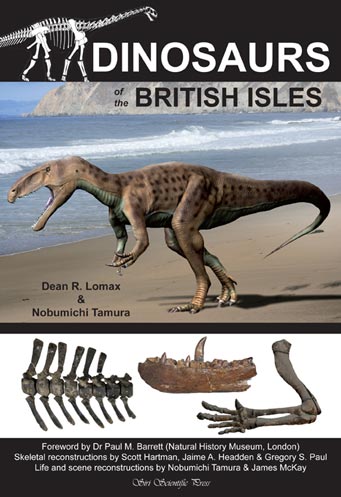
Not sure what to buy a budding palaeontologist for Christmas, well, Everything Dinosaur recommends “Dinosaurs of the British Isles” by Dean Lomax and Nobumichi Tamura (Siri Scientific Press).  This book provides a comprehensive guide to the dinosaur discoveries that have been made in the United Kingdom and it takes the reader from the Triassic through to the Late Cretaceous, cataloguing all the various dinosaurs in geochronological order.

“Dinosaurs of the British Isles”

The Front Cover of Dinosaurs of the British Isles

A comprehensive guide to British dinosaurs over 400 pages.

A comprehensive guide to British dinosaurs over 400 pages.

Picture credit: Siri Scientific Press

A Comprehensive Overview

Dean and Nobumichi have painstakingly compiled a comprehensive review of all the major dinosaur fossil finds and this book is aimed at the general reader as well as at fossil collectors and dinosaur fans.  Southern England and the Isle of Wight may be globally significant locations when it comes to Early Cretaceous dinosaurs, but readers may be surprised to find that the sandstones in Morayshire (Scotland) have provided tantalising clues to life on the super-continent Pangaea during the Triassic and the oldest dinosaur tracks can be spotted at Barry in the Vale of Glamorgan (south Wales).

Amazing Prehistoric Creatures

The authors are to be commended, as they provide a fascinating introduction to the Dinosauria, their classification and the emergence of palaeontology as a science.  This all follows a well-written foreword by Dr Paul Barrett, a highly respected academic and vertebrate palaeontologist at the Natural History Museum (London).  With the Dinosauria well and truly introduced, it is time to meet some of the amazing prehistoric creatures that once roamed the British Isles.  For example, at least three types of tyrannosaurid may once have roamed across this part of the world.  There’s the Proceratosaurus (P. bradleyi) whose fossilised remains, come from Gloucestershire, the fearsome, five-metre long Juratyrant, a terror of the Late Jurassic whose fossilised remains have been discovered near Swanage (Dorset) and Eotyrannus (E. lengi), represented by a partial skeleton found on the Isle of Wight.

 Documenting the Theropoda of the British Isles

A potential Compsognathidae?

A potential Compsognathidae?

Picture credit: Siri Scientific Press

Impressive Sauropods from Britain

It is not just the meat-eaters that palaeontologist Dean Lomax has documented in collaboration with California based, palaeoartist Nobumichi Tamura.  The United Kingdom boasts some very impressive (and gigantic) herbivorous dinosaurs too. This book also provides a comprehensive account of the huge sauropods that once stomped across the British Isles, many of which rivalled the long-necked dinosaurs of North America in terms of size.

To visit the website of Siri Scientific Press to learn more about “Dinosaurs of the British Isles”: Siri Scientific Press.

Author Dean Provides a Scale for Cetiosaurus

A belly up view of "Whale Lizard".

A belly up view of “Whale Lizard”.

Picture credit: Dean Lomax

The full colour photographs are very informative and support the text extremely effectively.  This is a rare example of a book that will appeal to serious academics as well as to the general reader.  “Dinosaurs of the British Isles” provides a fascinating introduction to the Dinosauria, before moving on to describe every dinosaur species represented by the known fossil record from this part of the world in great detail.

Highly recommended.

“Dinosaurs of the British Isles” by Dean Lomax and Nobumichi Tamura is available from Siri Scientific Press (Siri Scientific Press), length 414 pages, ISBN: 978-0-9574530-5-0.

3 09, 2014

Fresh Rockfalls at Monmouth Beach (Lyme Regis Provides an Important Update)

By |2024-05-02T10:44:44+01:00September 3rd, 2014|Categories: Dinosaur and Prehistoric Animal News Stories, Dinosaur Fans, Geology, Photos/Pictures of Fossils|0 Comments

Warnings for Fossil Hunters at Lyme Regis

The cliffs that surround the picturesque town of Lyme Regis in Dorset on England’s famous “Jurassic Coast” are very treacherous.  Rockfalls and landslips are a relatively common occurrence and team members at Everything Dinosaur, have done much to help inform and to warn visitors to the area of the potential hazards.  Fossil collecting or simply exploring the beaches can be a lot of fun, but the recent cliff fortification and shore stability measures put in place by the local council will not solve the problem of the unstable geology of the area.

Fresh Rockfalls

The cliffs are composed of relatively loose sediment, that when saturated after heavy rain or somewhat dried out after a prolonged spell without too much precipitation, are prone to rockfalls.  It is always advisable to stay well away from the base of the cliffs, fossil collecting on a falling tide helps, as this gives an increasing distance between the sea and the cliffs.

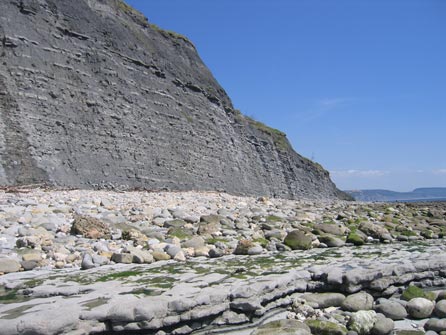
Dangerous Cliffs at Lyme Regis

Good idea to go fossil collecting on a falling tide and to keep away from the steep cliffs.

Good idea to go fossil collecting on a falling tide and to keep away from the steep cliffs. Picture credit: Everything Dinosaur.

Picture credit: Everything Dinosaur

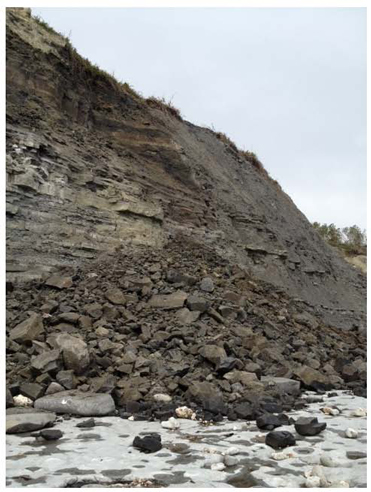
Recently, we were sent some photographs by Lyme Regis fossil expert, Brandon Lennon.  The photographs showed fresh rockfalls that had taken place on Monmouth beach (to the west of Lyme Regis).  Brandon explained that he had observed a number of cliff falls this year and that he expected more to occur as the autumn weather sets in.   This particular rockfall had occurred on that area of the beach famous for its extensive ammonite and nautiloid fossils preserved within the blue lias limestones – an area known as the “Ammonite Pavement” or the “Ammonite Graveyard”.

Recent Rockfall at Monmouth Beach

Rockfall onto the Ammonite Pavement on Monmouth Beach.

Rockfall onto the Ammonite Pavement on Monmouth Beach.

Picture credit: Everything Dinosaur

A supervised, fossil collecting walk is one of the best ways to explore the beaches around Lyme Regis, for further information on such tours: Fossil Walks in the Lyme Regis Area.

Perhaps if you are lucky enough to go on a field trip with Brandon to Monmouth beach, you might be able to hear the theories that have been proposed to help explain why so many large ammonite fossils are found together at this spot.

Everything Dinosaur was sent a beautiful piece of fossilised wood from nearby Portland.  The specimen still had the bark preserved on it and when polished in section, growth rings could still be made out. We think that the fossil represents an Araucaria spp. (monkey puzzle tree).  This fossilised wood dates from the Upper Jurassic.  Fossil wood can occasionally be found on the beaches of Lyme Regis and nearby Charmouth, but this is usually much older dating mainly from the Lower Jurassic.

A Polished Section of Fossilised Wood

A polished section of fossilised wood.

A polished section of fossilised wood.  Picture credit: Everything Dinosaur.

Picture credit: Everything Dinosaur

Remember if fossil collecting, be careful out there.

For replicas of iconic animals from the “Dorset Coast”: Models of Fossils and Learning Materials.

22 07, 2014

Evolution and Extinction of the African Carcharodontosauridae

By |2023-03-14T10:05:14+00:00July 22nd, 2014|Categories: Dinosaur Fans, Everything Dinosaur videos, Geology, Main Page, Palaeontological articles|0 Comments

“Shark Toothed Lizard” – The Rise and Fall of Carcharodontosaurus

The Carcharodontosaurus genus currently consists of two species, the first of which Carcharodontosaurus saharicus  (originally called Megalosaurus saharicus), is known from fossil material found in North Africa.  The second species, named and described in 2007, was erected following fossil finds, including skull material from the Echkar Formation of Niger, this species is known as C. iguidensis.  Although both species are known from fragmentary material and a few isolated teeth, differences in the shape of the upper jaw and the structure of the brain case enabled scientists to confidently establish Carcharodontosaurus iguidensis as a second, distinct species.

An Illustration of a Typical Carcharodontosaurid Dinosaur

Fearsome "Shark Lizard"

Fearsome “Shark Lizard”. Picture credit: Everything Dinosaur.

Picture credit: Everything Dinosaur

Carcharodontosaurus

Carcharodontosaurus means “shark-toothed lizard”,  a reference to the fact that the teeth of this huge carnivore, reminded scientists of the teeth of sharks belonging to the Carcharodon genus of sharks, such as the teeth of the Great White Shark (C. carcharias).  It is ironic that this terrestrial predator should be named after a marine carnivore, as changing sea levels very probably influenced the evolution of these dinosaurs and may have ultimately led to their extinction, at least from Africa.

To view Everything Dinosaur’s range of CollectA dinosaur models including a 1:40 scale Deluxe Carcharodontosaurus: CollectA Deluxe Prehistoric Life Replicas.

Pronounced – Car-car-oh-dont-toe-sore-us, the oldest dinosaur currently assigned to the Carcharodontosauridae family is Veterupristisaurus (Vet-ter-roo-pris-tee-sore-us).  This dinosaur was named and described in 2011, although the fossil material was discovered over seventy-five years ago.   The fossils come from the famous Tendaguru Formation of Tanzania, it lived during the Late Jurassic and the trivial name V. milneri honours the now retired Angela Milner who worked at the Natural History Museum (London).

A Cretaceous Predator

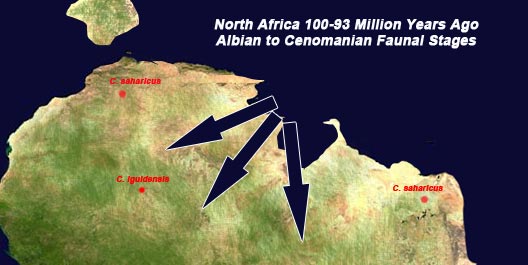
Carcharodontosaurus lived during the Cretaceous (Late Albian to mid Cenomanian faunal stages).  During this time, the great, southern super-continent called Gondwanaland continued to break up and as sea levels rose, so populations of dinosaurs became separated by the inflow of sea water.

Rising Sea Levels Influence Dinosaur Evolution

Rising sea levels but off dinosaur populations.

Rising sea levels isolated dinosaur populations. Picture credit: Everything Dinosaur.

Picture credit: Everything Dinosaur

Communities became isolated and this may have provided a boost to the evolution of new species.  The map shows the approximate location of fossil material associated with C. saharicus and C. iguidensis.  Populations of carcharodontosaurids may have become cut-off from each other and this gave rise to new species of Carcharodontosaurus.  This may help to explain the abundance of super-sized predators that lived in this part of the world during the Cretaceous.

Both species of Carcharodontosaurus shared a common ancestor, but their separation led to the evolution of two, distinct species.  This natural process is called allopatric speciation.

Sadly for the mega fauna that inhabited the coastal swamps and verdant flood plains of North Africa, rising sea levels in the later stages of the Cenomanian led to the destruction of much of this habitat.  The loss of habitat probably led to the demise of the ecosystem and the vulnerable apex predators such as the carcharodontosaurids and the spinosaurids became extinct.

To read an article on the discovery of C. iguidensisNew Giant Meat-Eating Dinosaur from Africa.

Go to Top