All about dinosaurs, fossils and prehistoric animals by Everything Dinosaur team members.

Dinosaur and prehistoric animal themed articles, features and stories.

13 06, 2019

Never Smile at a Texan Prehistoric Crocodile

By |2023-12-25T06:36:29+00:00June 13th, 2019|Categories: Dinosaur and Prehistoric Animal News Stories, Dinosaur Fans, Main Page, Palaeontological articles|0 Comments

Scolomastax sahlsteini – A Fearsome Cretaceous Crocodile Critter

The Woodbine Formation of eastern Texas has provided palaeontologists with another crocodyliform to study.  The strata represent sediments laid down in a river delta system during the early stages of the Late Cretaceous (Cenomanian faunal stage).  The vertebrate fossils found include dinosaurs, turtles, lungfish and several different types of crocodile including the fearsome Deltasuchus (D. motherali), that was named and described in 2017: Deltasuchus – A Dinosaur Crunching Crocodile.

Joining the list of crocodiles known from this location is Scolomastax sahlsteini, a much smaller animal that probably specialised in hunting fish and other small vertebrates.  Its discovery reinforces the idea that there was niche partitioning in crocodyliforms associated with these sediments, that is, each genus focused on catching different types of prey and therefore avoided direct interspecific competition.

A Life Reconstruction of Scolomastax sahlsteini
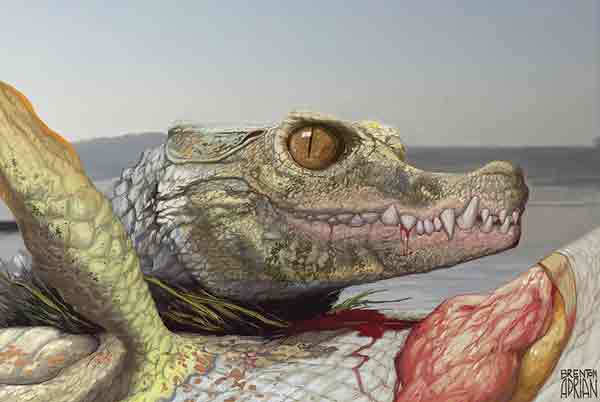
Life reconstruction - Scolomastax.
Scolomastax a life reconstruction.

Picture credit: Brenton Adrian (University of Tennessee)

An Insight into the Cretaceous Ecosystem of Appalachia

Scolomastax sahlsteini lived approximately 96 million years ago.  It has been described from a partial jawbone and this species differs from other prehistoric crocodyliforms associated with this fossil location in having a shortened mandible, reduced tooth count, heterodonty (teeth of different shapes), a dorsally expanded surangular and enlarged attachments for powerful jaw muscles.

Scolomastax sahlsteini

Scolomastax may have been not much bigger than a dwarf crocodile (Osteolaemus spp.), the smallest living crocodile species, but at around 1.5 metres in length, it had a formidable bite and was probably best avoided.  Writing in the academic journal “The Anatomical Record”, the researchers conclude that Scolomastax may have specialised in eating shellfish, or turtles (durophagous diet).  Scolomastax may even have been an omnivore, supplementing its diet with plant material.  The fossils from this location (the Arlington archosaur Site), have provided palaeontologists with an insight into the fauna of the eastern part of the North America (Appalachia).

Commenting on the significance of the discovery, one of the co-authors of the scientific paper, Stephanie Drumheller-Horton, a palaeontologist at the University of Tennessee stated:

“People sometimes think that crocs haven’t changed much since the age of dinosaurs, but that just isn’t true.  This little croc has several weird features that make us think it ate hard prey items and maybe even plants. We don’t have anything like it alive in the world today.”

A Geographical Puzzle

Co-author, Associate Professor Alan Turner (Stony Brook University), added:

“S. sahlsteini is part of a group of early croc relatives called paralligatorids.  Most members of this group are from Asia, but we are starting to have a few examples of them from Texas.  This helps us understand how groups were dispersing between Asia and North America prior to the closing of the Western Interior Seaway, the inland sea that split North America in two.”

The genus name means “pointed stake jaw”, whilst the species epithet honours long-time volunteer Arthur Sahlstein, who found the fossil jawbone.  A phylogenetic analysis places this new genus within the Eusuchia, specifically a member of the Paralligatoridae and a sister taxon to Paralligator gradilifrons, which is known from Upper Cretaceous rocks of the Gobi Desert (Mongolia).

Scolomastax sahlsteini extends the record of paralligatorids into the Late Cretaceous (Cenomanian faunal stage) of North America.  The jawbone fossil represents the first appearance of this clade on the poorly known landmass of Appalachia, supporting a biogeographic connection between North America and Asia in the Early Cretaceous prior to development of the Western Interior Seaway.  The authors of the paper conclude that further analysis of the Paralligatoridae family is required in order to determine appropriate phylogeny.

The scientific paper: “An Enigmatic Small Neosuchian Crocodyliform from the Woodbine Formation of Texas” by Christopher R. Noto, Stephanie K. Drumheller, Thomas L. Adams and Alan H. Turner published in The Anatomical Record.

Everything Dinosaur acknowledges the assistance of a press release from the University of Tennessee (Knoxville) in the compilation of this article.

The Everything Dinosaur website: Everything Dinosaur.
12 06, 2019

CollectA Caiuajara Gets a Special Makeover

By |2023-12-25T06:28:17+00:00June 12th, 2019|Categories: Adobe CS5, Dinosaur Fans, Everything Dinosaur Products, Main Page, Photos of Everything Dinosaur Products|0 Comments

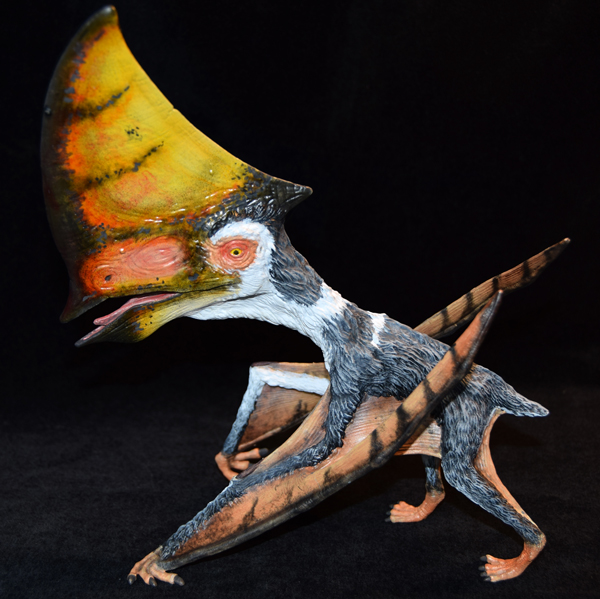
CollectA Caiuajara Pterosaur Model Gets Customised

Our thanks to dinosaur and prehistoric animal model collector Elizabeth who sent into Everything Dinosaur some photographs of her recent CollectA pterosaur purchase that she has had customised by a professional model maker and artist.  The pterosaur figure is the recently introduced (spring 2019), CollectA Supreme Deluxe Caiuajara model.  This figure has been highly praised by collectors and fans of prehistoric animals, but when placed in the hands of a professional model maker this figure can be customised and elevated to a higher level.

The CollectA Deluxe Caiuajara Pterosaur Model After the Makeover

A customised CollectA Caiuajara model.
The CollectA Deluxe Caiuajara pterosaur figure (custom painted).

Picture credit: Elizabeth

Caiuajara Model Custom Painted

At Everything Dinosaur, we tend to get a lot of pictures of models that have been custom painted or altered by their owners in some way.  We marvel at how clever and creative these people are.    The CollectA Deluxe Caiuajara figure is very impressive, but the professional model maker (Martin Garratt),  has created a truly unique piece, one that would not be out of place in a museum collection.  Our congratulations to Martin for his excellent work and our thanks to Elizabeth for sharing images of the commission.

The Everything Dinosaur website: Everything Dinosaur.
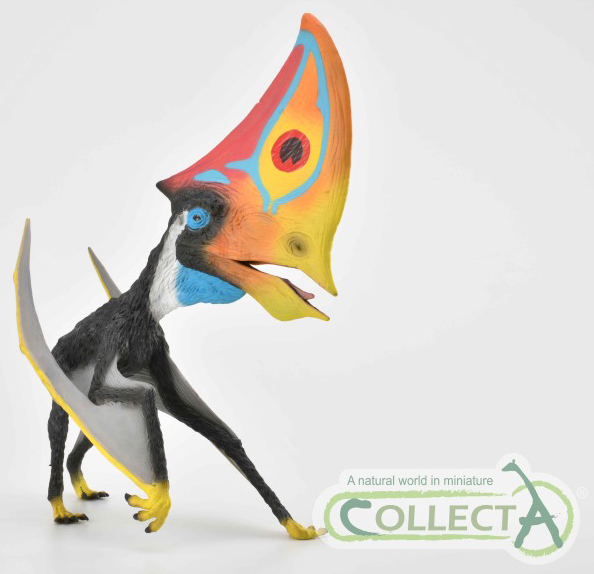
The CollectA Deluxe Caiuajara (Out of the Box)

CollectA Deluxe Caiuajara with moveable jaw.
The Age of Dinosaurs Deluxe Caiuajara pterosaur figure with a moveable jaw.

Colour Vision and Feathers

Recent research has suggested that members of the Pterosauria may have been feathered in a similar way as dinosaurs.  There is growing evidence to indicate that the common ancestor of the dinosaurs and pterosaurs may have evolved a coat of simple feathers to help this active animal keep warm.

To read an article outlining the latest evidence that supports the idea that feathers first evolved in the Early Triassic: Feathers Came First Then Birds Evolved.

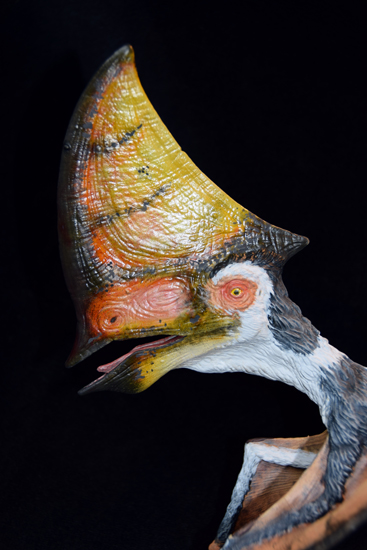
A Closer View of that Beautifully Detailed Head Crest

Customised Caiuajara.
CollectA Caiuajara has been customised.

Picture credit: Elizabeth

A Pterosaur Starting Point

When it comes to customising a figure or model, it is very important to work with a highly accurate and well-made model in the first place.  If the figure has approximately the right proportions and has an intriguing pose that is anatomically accurate, then this permits the model maker the opportunity to really enhance the figure to create something truly unique.

Standing around twenty-four centimetres high, the CollectA Deluxe Caiuajara is quite sizeable and it has provided the model maker with lots of scope to really bring out the model’s features.  Martin’s choice of colour scheme is very effective and the use of starkly contrasting colours highlights that colour was most important to these flying reptiles and supports the idea that these active animals had colour vision.

The Model Maker has chosen a Vivid Colour Palette and Used a High Gloss Wash to Bring out Details

CollectA Deluxe Caiuajara (customised).
A customised CollectA Caiuajara model.

Picture credit: Elizabeth

A spokesperson from Everything Dinosaur commented:

“Our thanks to Elizabeth for sharing these photographs with us, this figure will make a marvellous addition to her model collection.”

To view the CollectA Caiuajara figure and the rest of the models in the CollectA Deluxe range: CollectA Deluxe Prehistoric Life.

10 06, 2019

Jurassic June – Revealing Our Favourite Artwork

By |2023-12-25T06:15:44+00:00June 10th, 2019|Categories: Dinosaur and Prehistoric Animal Drawings, Dinosaur Fans, Photos|0 Comments

Jurassic June – Favourite Artwork

Lots of things happening at Everything Dinosaur at the moment.  We have something like thirty new models coming into stock over the summer and early autumn, plus of course, we are busy with all our teaching activities and school visits.  However, there is time to post up one of our favourite pieces of prehistoric themed artwork in “Jurassic June”.

“Jurassic June”

Amazing Jurassic June Artwork – Capturing Prehistoric Scenes

Artwork by Zallinger.
Beautiful and detailed drawings of dinosaurs and other prehistoric animals.

Picture credit: Rudolph F. Zallinger)

“Dinosaurs and Other Prehistoric Reptiles”

The beautiful illustration (above), comes from one of our favourite dinosaur books, “Dinosaurs and Other Prehistoric Reptiles” written by Jane Werner Watson and illustrated by the amazingly talented Rudolph F. Zallinger.  First published in 1966 (we think this is correct), the office copy dates from the early 1970s and is in pride of place on our office bookshelves.  Although this book is somewhat outdated in terms of its details and the dinosaurs themselves do not represent current scientific thinking, the illustrations of ancient prehistoric landscapes and the animals that inhabited them are simply stunning.

The illustration depicts a swift Ornitholestes hunting a pair of early birds, a scene depicting the Late Jurassic.  The artwork within this book, by Rudolph F. Zallinger, helped to capture the imaginations of countless children and to enthuse them about dinosaurs and life in the past.  Everything Dinosaur team members were no exception.

The Everything Dinosaur website: Everything Dinosaur.
4 06, 2019

A New Dinosaur is Described! Have you Herd of Fostoria dhimbangunmal?

By |2024-05-11T17:05:47+01:00June 4th, 2019|Categories: Dinosaur and Prehistoric Animal News Stories, Dinosaur Fans, Main Page, Photos/Pictures of Fossils|0 Comments

Australia’s Newest Dinosaur Fostoria dhimbangunmal – A Gem of a Fossil Discovery

A team of scientists from the University of New England (New South Wales, Australia), in collaboration with the Australian Opal Centre, have announced the discovery of yet another Aussie dinosaur.  The dinosaur has been named Fostoria dhimbangunmal (pronounced Foss-taw-ree-ah dim-baan-goon-mal) and it has been identified from a series of opalised fossils representing a number of individual animals excavated from an opal mine near Lightning Ridge (New South Wales).

Fostoria dhimbangunmal

The herbivorous dinosaur, which would have measured around 5-6 metres in length when fully grown, has been classified as an iguanodontid and phylogenetic analysis based on a recently published data set positions Fostoria as the sister taxon to a clade of Gondwanan iguanodontians that includes Anabisetia saldiviai, Talenkauen santacrucensis (both from Argentina) and arguably, Australia’s most famous ornithopod –  Muttaburrasaurus langdoni.

A Life Reconstruction of Fostoria dhimbangunmal

Fostoria dhimbangunmal life reconstruction.
A life reconstruction of a Fostoria dhimbangunmal.

Picture credit: James Kuether

Evidence of a Herd of Plant-eating Dinosaurs

The fossil material has been opalised and it represents the remains of at least four different animals of different sizes/ages preserved in a monodominant bone bed excavated from the underground opal mine.  Opalised individual fossils of dinosaurs have been found in this part of New South Wales before, but it is remarkable that so many body fossils have been opalised in this case.

Lead author of the scientific paper, published in the  “Journal of Vertebrate Paleontology”, Dr Phil Bell (University of New England), stated that he was stunned by the sheer number of bones that had been found.  He explained:

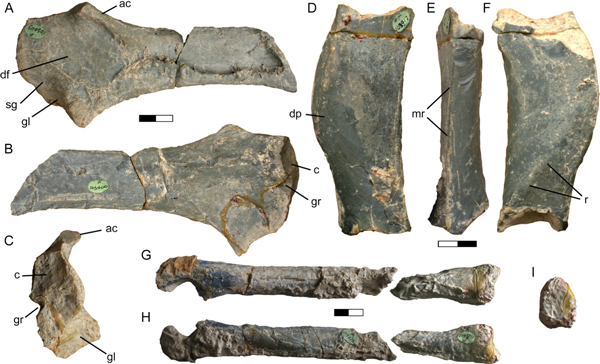
“We initially assumed it was a single skeleton, but when I started looking at some of the bones, I realised that we had four scapulae (shoulder blades) all from different sized animals.”

Finding these fossils in the same place suggests that these are the remains of a group of dinosaurs that travelled together, as such, this is the first instance of a “herd of dinosaurs” being discovered in Australia.

Fossil Material – Elements from the Forelimb and Shoulder Girdle

Fostoria dhimbangunmal fossil bones (shoulder girdle and forelimb).
Fostoria forelimb and shoulder girdle elements.

Picture credit: Journal of Vertebrate Paleontology

The picture (above), shows views of a left scapula (A, B and C).  Views of the left humerus (D, E and F) along with views of the left radius (G, H and I), scale bar = 2 cm.

The First Partial Skull of a Dinosaur from New South Wales

Most parts of the body are represented by the fossils, including elements from the skull such as the quadrate and other fossil bones that make up the braincase.  The frontal bones have enabled the researchers to compare the skull roof of Fostoria to other iguanodontids and hypsilophodontids which has helped with classification.

Fossils of Fostoria dhimbangunmal Exposed

In situ - Fostoria dhimbangunmal fossils.
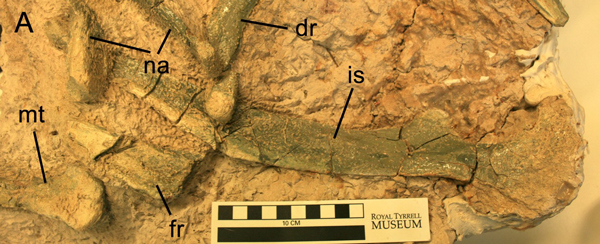
Fostoria dhimbangunmal fossils photographed in situ.  Key (mt) – metatarsal, (is) ischium, (na) neural arches from vertebrae, (fr) unidentified fragment and (dr) dorsal rib.

Picture credit: Journal of Vertebrate Paleontology

Honouring Robert Foster

The genus name honours opal miner Robert Foster, who discovered the bonebed in the 1980s.  The species name comes from the language of the Yuwaalaraay, Yuwaalayaay, and Gamilaraay peoples, after the Sheepyard opal field where the bonebed is located.  Scientists and field team volunteers from the Australian Museum in Sydney helped excavate the fossils, but the bones remained unstudied until donated to the Australian Opal Centre by Robert’s children Gregory and Joanne Foster back in 2015.

A View of an Opalised Toe Bone (F. dhimbangunmal)

An opalised toe bone of Fostoria dhimbangunmal.
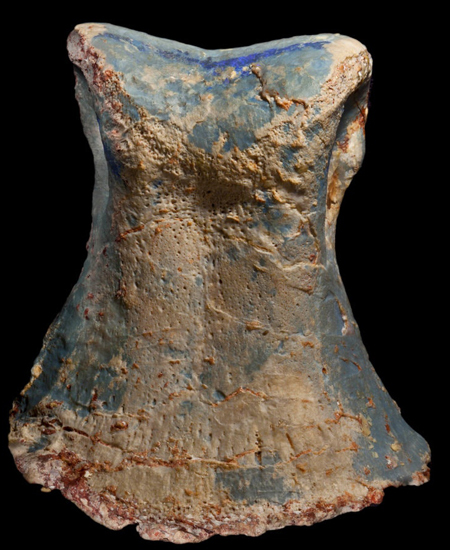
An opalised toe bone of the newly described dinosaur Fostoria (F. dhimbangunmal).

Picture credit: Robert A. Smith/Australian Opal Centre

Commenting on the significance of these fossils, palaeontologist and special projects officer, Jenni Brammall of the Australian Open Centre said:

“Fostoria has given us the most complete opalised dinosaur skeleton in the world.  Partial skeletons of extinct swimming reptiles have been found at other Australian opal fields, but for opalised dinosaurs we generally have only a single bone or tooth or in rare instances, a few bones.  To recover dozens of bones from the one skeleton is a first.”

An Important Gondwanan Representative of the Iguanodontians

Although most palaeontologists believe that the iguanodontid dinosaurs were very speciose and diverse during the Early Cretaceous, fossils representing iguanodontids from southern latitudes, what would have been the super-continent of Gondwana, are quite rare.  For example, until Fostoria was described, only one Australian iguanodontid dinosaur – M. langdoni, was known.  Fostoria dhimbangunmal extends the temporal range of these types of dinosaurs in Australia to the Cenomanian (early Late Cretaceous).  It and Muttaburrasaurus are the only iguanodontians known from the eastern margin of the inland sea, the Eromanga Sea, whereas the group is conspicuously absent from the contemporaneous ornithopod-dominated ecosystems of the Australian-Antarctic rift valley in Victoria.

To read about a recent ornithopod addition to the biota of the Australian-Antarctic rift valley: New Australian Ornithopod Described – Galleonosaurus dorisae.

The scientific paper: “Fostoria dhimbangunmal, gen. et sp. nov., a new iguanodontian (Dinosauria, Ornithopoda) from the mid-Cretaceous of Lightning Ridge, New South Wales, Australia” by Phil R. Bell, Tom Brougham, Matthew C. Herne, Timothy Frauenfelder and Elizabeth T. Smith published in the Journal of Vertebrate Paleontology.

Visit the Everything Dinosaur website: Everything Dinosaur.
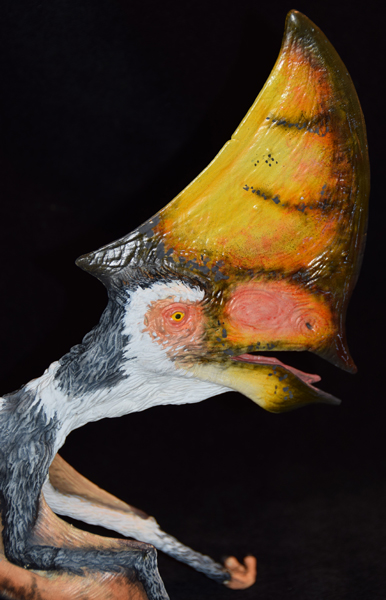
3 06, 2019

Exciting Mojo Fun Prehistoric Mammals

By |2023-12-24T20:31:39+00:00June 3rd, 2019|Categories: Adobe CS5, Dinosaur Fans, Everything Dinosaur Products, Main Page, Photos of Everything Dinosaur Products|0 Comments

Mojo Fun Prehistoric Mammals

The excellent “Prehistoric & Extinct” model range (Mojo Fun), contains a lot of dinosaur figures but today, we focus on a couple of prehistoric mammal models.  We have praised this model range before, congratulating the company for producing figures of recently extinct creatures such as the Quagga of southern Africa and the Tasmanian Tiger (Thylacine).  The range includes a number of other prehistoric mammals, replicas of some creatures that became extinct millions of years ago and not just within the last 150 years or so as in the case of the Thylacine and the Quagga.

A Scene Featuring Mojo Fun Prehistoric Mammals

A landscape featuring Mojo Fun prehistoric mammal models.
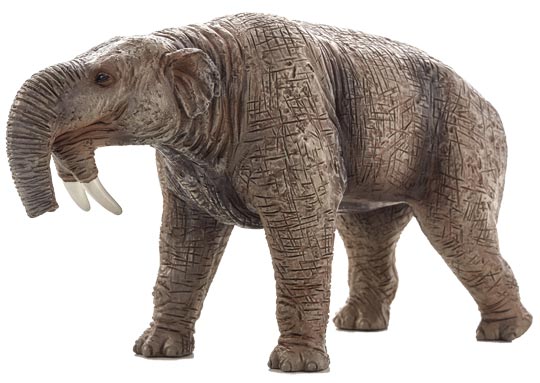
Mojo Fun prehistoric mammals (Hyaenodon gigas and Deinotherium).

Picture credit: Mojo Fun

Hyaenodon gigas and Deinotherium

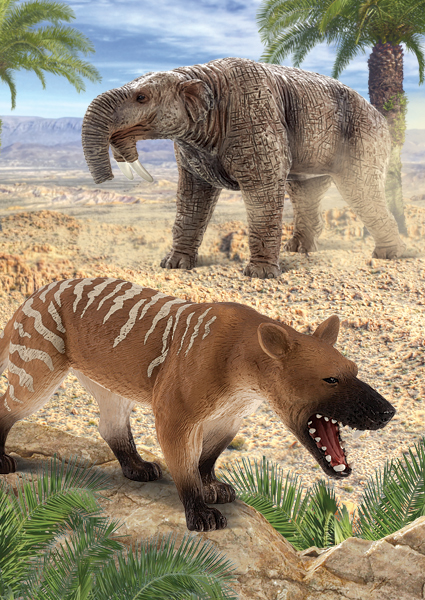
The picture (above), depicts the fearsome Hyaenodon gigas one of the largest members of the Hyaenodontidae family (foreground).  Some fossil specimens indicate that this cursorial mammal could have weighed as much as 500 kilograms.   The large, elephant-like animal in the background is a Deinotherium, a very popular Mojo Fun prehistoric animal figure amongst collectors, after all, not that many replicas of “gigantic, terrible beast” have been produced.

The Mojo Fun Deinotherium Model

New colour Mojo Fun Deinotherium 2018.
Mojo Fun Deinotherium (new colour 2018).  A new colour variant of this popular prehistoric animal replica was introduced last year.

Wide Temporal and Geographical Ranges

Mojo Fun have taken great care in the creation of their promotional image.  A spokesperson from Everything Dinosaur commented:

“It is always a pleasure to post up images depicting prehistoric animal models from the various ranges that we support.   We have some more images kindly supplied by Mojo Fun of some of their new for 2019 prehistoric animals, we are looking forward to posting up these images to, when the figures come into stock.”

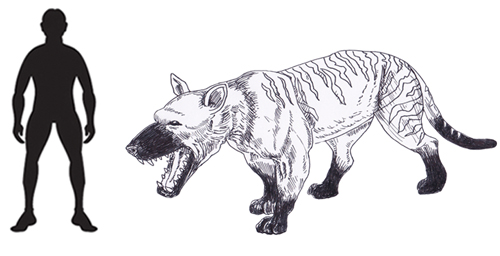
A Hyaenodon gigas Scale Drawing Based on the Mojo Fun Hyaenodon Figure

Hyaenodon gigas scale drawing.
A scale drawing of the giant, carnivorous mammal Hyaenodon gigas.

Picture credit: Everything Dinosaur

Fossils of both Hyaenodon and Deinotherium genera have a wide geographical and temporal distribution.  H. gigas is known from the Lower Oligocene of south-eastern Mongolia, so it lived long before the first members of the Deinotheriidae evolved and certainly before the first members of this elephant family left Africa and became more widespread.  However, as the Deinotherium genus is believed to have existed from the Miocene to the Pliocene Epoch and as some hyaenodonts persisted until the Late Miocene, it is possible that species of Deinotherium would have been contemporaneous with some of the last members of the Hyaenodontidae.

An interaction between a member of the Deinotheriidae and a carnivorous hyaenodont could have taken place.

To view the range of Mojo Fun models stocked by Everything Dinosaur: Mojo Prehistoric and Extinct Animal Models.

1 06, 2019

Update on the Limited-edition Papo Spinosaurus

By |2023-12-24T20:23:22+00:00June 1st, 2019|Categories: Adobe CS5, Dinosaur Fans, Everything Dinosaur News and Updates, Everything Dinosaur Products, Main Page, Photos of Everything Dinosaur Products|1 Comment

Update on the Limited-edition Papo Spinosaurus

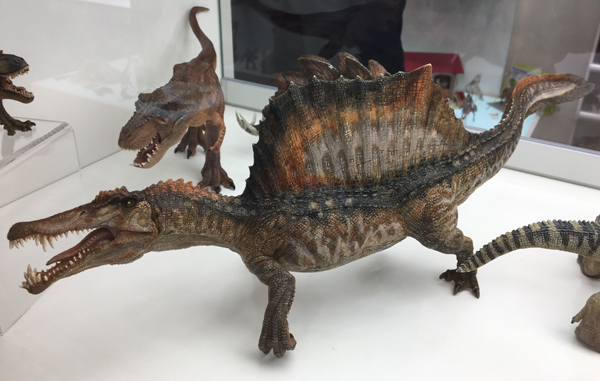
The limited-edition Papo Spinosaurus model has been delayed and the original launch date for this eagerly awaited dinosaur figure has been put back with a release date now estimated at August/September.  Everything Dinosaur remains heavily committed to this figure and by delaying this figure by a few weeks, this does permit both Papo and ourselves to ensure a successful roll out of other new for 2019 Papo models such as the Gorgosaurus, the new colour variant Stegosaurus and the Pentaceratops model.

Latest news:  Now likely to be in stock in October.

Papo Spinosaurus Figure Delayed

Spinosaurus dinosaur model from Papo
The awesome Papo Spinosaurus dinosaur model.  Delayed until August/September 2019. Picture credit: Everything Dinosaur.

Picture credit: Everything Dinosaur

Technical Issues

Technical issues have been cited as the reason for the delay.  With such an eagerly anticipated dinosaur figure, we are confident that design team at Papo and the production staff would be wanting to create the very best, most detailed model possible and therefore it may be sensible to take a little longer with the production process and the design of the special box that this figure will be presented in.

Everything Dinosaur team members have been involved in detailed discussions concerning the boxing of this figure.  As a business, we are trying to cut down on single use cardboard as part of our environmental policy, aiming to maintain our excellent record when it comes to recycling cardboard and paper.  However, a spokesperson from Papo’s senior management commented that the gift box “really highlights the premium value of this limited-edition item” and added that “it’s also a good protection against shocks during the shipment.”

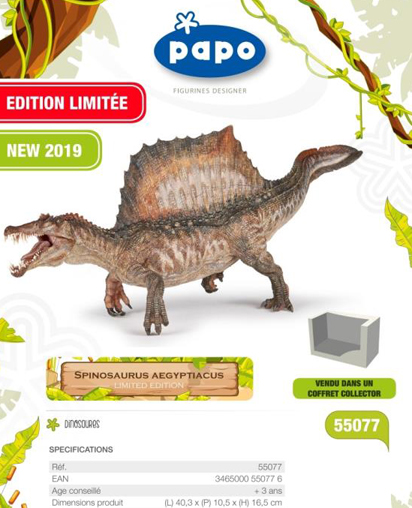
Papo Spinosaurus aegyptiacus Part of the French Technical Document

Papo Spinosaurus en Francais,
Papo limited-edition Spinosaurus, technical document.  The model has been delayed a release date is now expected August/September 2019.  The design of the gift box can be seen on the right.

Same Papo Spinosaurus Model – New Delivery Date

Team members at Everything Dinosaur are hopeful that the first production samples will be ready for inspection in late July.  The expected delivery of models ready for sale to the wider public should be August/September, if Everything Dinosaur receives further information and updates, these will be published on this blogsite as well as on the company’s various social media platforms.

The Papo Spinosaurus (S. aegyptiacus) Dinosaur Model is Expected August/September

Papo Spinosaurus model due August/Septermber 2019.
The Papo Spinosaurus (S. aegyptiacus) dinosaur model is now expected August/September. Picture credit: Everything Dinosaur.

Picture credit: Everything Dinosaur

A spokesperson from Everything Dinosaur stated:

“All those people who are on Everything Dinosaur’s priority reserve list will still be offered a model, nothing has changed for them in terms of being guaranteed the chance to purchase this limited edition figure.”

The spokesperson went onto add:

“We have a meeting with Papo in a couple of weeks’ time, we hope to receive further information and if there is any additional news regarding this model or indeed any of the other new for 2019 figures such as the Papo Pentaceratops, the Gorgosaurus or the new colour variant Stegosaurus, we shall be sure to pass this information onto our customers”.

To view the range of Papo prehistoric animal models and figures available from Everything Dinosaur: Papo Dinosaurs and Prehistoric Animal Figures.

Update – now likely to be in stock in October 2019.

31 05, 2019

The Encyclopedia of Dinosaurs – The Theropods

By |2023-12-22T13:55:58+00:00May 31st, 2019|Categories: Adobe CS5, Book Reviews, Dinosaur Fans, Main Page|2 Comments

The Encyclopedia of Dinosaurs – The Theropods Reviewed

Ask a layperson to name a dinosaur and it is very likely that names such as Tyrannosaurus rex and Velociraptor will be volunteered, these dinosaurs are members of the Theropoda, one of three great groups that make up the Dinosauria.  However, these two meat-eating dinosaurs are not typical of this group, there is a lot more to the theropods than meets the eye.  The beautifully illustrated “Encyclopedia of Dinosaurs The Theropods”, aimed at general readers as well as students and academics, helps to flesh out the story of the Theropoda and is essential summer reading for dinosaur enthusiasts.

The English Language Version of “The Encyclopedia of Dinosaurs The Theropods”

Encyclopedia of Dinosaurs The Theropods"
The “Encyclopedia of Dinosaurs The Theropods” (front cover).

Details on 750 Members of the Theropoda

Written by Rubén Molina-Pérez and Asier Larramendi, the founders and scientific directors of Eofauna Scientific Research, this volume contains over three thousand records giving facts and detailed information on over 750 theropod species.  Indeed, it is claimed that every single theropod dinosaur described before 2016 is included, this book reflects an enormous amount of research into what is, the most diverse and speciose of this suborder of dinosaurs.

Hundreds of Theropod Dinosaurs are Featured in the Book

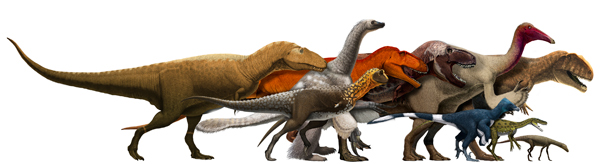
Diverse Theropoda.
The diverse and speciose suborder of the Dinosauria (Theropoda).

Stunning Full-colour Illustrations

Crammed full of full-colour reconstructions and illustrations  by Andrey Atuchin and Sante Mazzei, this book, within the portfolio of the Natural History Museum (London), is not laid out like most dinosaur books.  For example, each record has bibliographic references, permitting the reader the opportunity to explore the topic area in more detail.  Divided into eight sections the “Encyclopedia of Dinosaurs The Theropods” provides a comprehensive overview including information on extant theropods (birds), trackways, fossil eggs, biomechanics, trace fossils – even the sprinter Usain Bolt gets a mention!

Lots of Amazing Dinosaur Facts are Revealed and Can be Checked by Readers Thanks to the Bibliography

Chilesaurus ilustrated.
Chilesaurus – the slowest herbivorous theropod known to science.

Theropod Anatomy

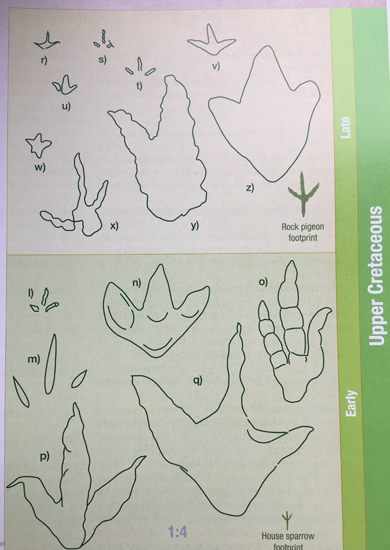
The geography of ancient continents is outlined and the distribution of different types of theropod highlighted.  There is an excellent section dedicated to theropod anatomy, along with a chapter dedicated to footprints “Testimony in Stone”.

Examples of Theropod Tracks (Extant and Extinct)

Line drawings illustrationg theropod footprints.
The ichnology of theropod footprints.

Records, Records and More Records

Records, Records and More Records Associated with the Theropoda

Throughout this book’s 288 pages, there are lots and lots of facts about the Theropoda listed including a graphical record of valid dinosauromorphs and theropods named and described up to 2016.  Look out for the snippet about how a fault in Triassic rock was mistaken for the huge footprint of a meat-eater, or the colourful illustration showing different types of dinosaur egg compared to a basketball.  Readers can expect to find the latest information about iconic dinosaurs such as Tyrannosaurus rex, Velociraptor osmolskae and Spinosaurus aegyptiacus.

Facts and Figures About the Largest Theropod – Spinosaurus aegyptiacus

Spinosaurus aegyptiacus illustrated.
Spinosaurus aegyptiacus.  Could this be the largest theropod of all?

Intriguingly, it has been revealed that the authors had wanted to include all the Dinosauria in a single encyclopedia.  Such a project is too much of an undertaking for a single volume, so in the future books focusing on the ornithischians and the sauropodomorphs and their close relatives might be produced.

A spokesperson from Everything Dinosaur commented:

“This is an excellent book, that has been lovingly crafted by a dedicated team of researchers and artists.  It provides a comprehensive overview of what is arguably one of the most successful type of tetrapod to have ever evolved.  We are delighted that this book is now available in English and we are happy to recommend it.”

“Encyclopedia of Dinosaurs The Theropods”

Title: “Encyclopedia of Dinosaurs The Theropods”

ISBN: 978 0 565 09497 3

Price: Around £30.00 (GBP)

Format: Hardback (298 mm x 241 mm)

Publication: This month (May 2019)

Size: 288 pages approximately

Subject classification: Natural History/Dinosaurs

BIC and BISAC codes WNA/YNNA and  1) NAT007000 2) SCI054000

For further information about dinosaur themed educational resources: Contact Everything Dinosaur.

30 05, 2019

Two New Theropod Dinosaurs from Thailand

By |2023-12-22T13:47:58+00:00May 30th, 2019|Categories: Dinosaur and Prehistoric Animal News Stories, Dinosaur Fans, Main Page, Palaeontological articles, Photos/Pictures of Fossils|0 Comments

Phuwiangvenator yaemniyomi and Vayuraptor nongbualamphuensis

Two new species of theropod dinosaur have been described from partial fossil remains excavated from strata associated with the Sao Khua Formation of north-eastern Thailand.  It is likely that both these meat-eating dinosaurs have affinities with the Megaraptora and their discovery lends weight to the idea that the Megaraptoridae and their near relatives probably originated in Asia.

The dinosaurs have been named Phuwiangvenator yaemniyomi and Vayuraptor nongbualamphuensis, Phuwiangvenator has been described as a megaraptoran whilst the exact taxonomic position of Vayuraptor remains uncertain, although the authors of the scientific paper suggest that it too was a member of the clade of dinosaurs with long-snouts, highly pneumatised skeletons and with large claws.

Bones in Approximate Life Position from the Right Foot of P. yaemniyomi

Bones from the foot of Phuwiangvenator yaemniyomi.
Bones and claws from the right foot of Phuwiangvenator yaemniyomi with an accompanying line drawing.

Picture credit: Samathi et al

Lower Cretaceous Theropod Dinosaurs

The fossils were found nearly twenty-five miles apart, but the strata in which the fragmentary fossil material was found is contemporaneous and dated to the upper Barremian stage of the Lower
Cretaceous.

The first identified specimens of P. yaemniyomi were found by Preecha Sainongkham, a team member at the Phu Wiang Fossil Research Centre and Dinosaur Museum back in 1993.  The Phu Wiang Mountain region is highly fossiliferous and numerous vertebrate fossils representing the fauna of a low-lying, inland, lacustrine environment have been discovered over the years.  The first dinosaur bone known from Thailand was found in 1976, a scrappy bone fragment that was assigned to the Sauropoda.  This fossil was found by Sudham Yaemniyom, who was at the time a geologist with the country’s Department of Mineral Resources, Bangkok.  The species name of Phuwiangvenator yaemniyomi honours his contribution to the geology and palaeontology of Thailand.

Phuwiangvenator is the larger of the two theropods, it is believed to have measured around 5.5 to 6 metres in length.  It is known from dorsal and sacral vertebrae plus elements of the hind limbs and feet.  All the fossil material was found within the same bedding plane and within an area of just 5 square metres.

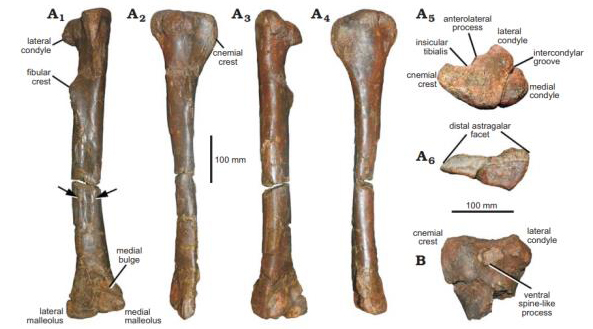
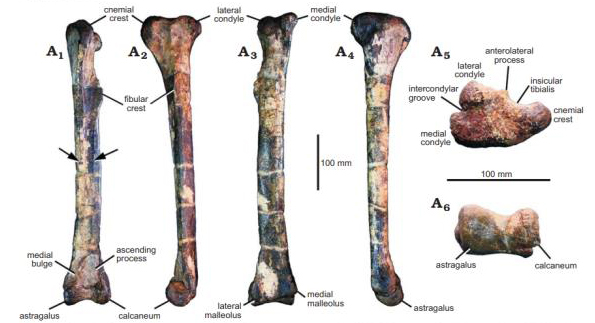
Views of the Right Tibia (A1 – A6) and a Proximal View of the Left Tibia (P. yaemniyomi)

Phuwiangvenator yaemniyomi bones from the lower leg.
Right tibia (A) in various views with a proximal view (B) of the left tibia – Phuwiangvenator yaemniyomi.

Picture credit: Samathi et al

Vayuraptor nongbualamphuensis – Raptor of the Wind God

The fossils associated with Vayuraptor were found in 1988.  It is known from a left tibia and ankle bones.  The genus name is from the Sanskrit for “Vayu”, a God of the Wind and the Latin term “raptor”, which means thief.  Analysis of the single lower leg bone indicates that like Phuwiangvenator, this dinosaur was a fast-running, cursorial predator.  The fossils of both dinosaurs are now part of the extensive dinosaur fossil collection at the Sirindhorn Museum in Kalasin Province.  This museum houses the largest collection of dinosaur fossil bones in north-eastern Thailand.

Analysis of the Tibia Suggests that Vayuraptor was a Fast Runner

Ankle and lower leg bone Vayuraptor.
Vayuraptor nongbualamphuensis views of the left tibia and ankle (A5 and A6).

Picture credit: Samathi et al

Megaraptora Originated in Asia

The establishing of at least one of these dinosaurs as a member of the Megaraptora clade, possibly both, helps to support the hypothesis that in south-eastern Asia during the Early Cretaceous, it was the Megaraptora that were diverse and playing the role of apex predators.  This is in contrast to other ecosystems elsewhere in the world, that were dominated by different kinds of theropod dinosaur.  A basal member of the Megaraptora, Fukuiraptor kitadaniensis is known from the Lower Cretaceous (Barremian) of Japan, these two dinosaurs are also (most likely), from the Barremian.  Their identification supports the idea that these fast running, lightly built predators evolved in Asia.

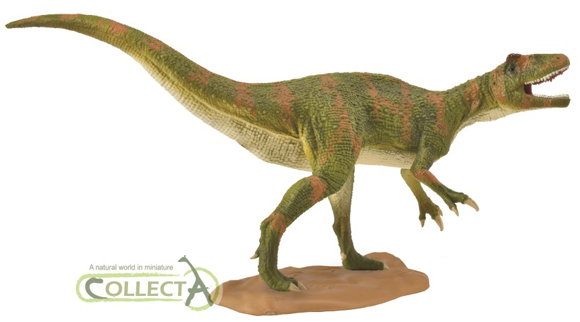
A Model of the Basal Megaraptoran  Clade – Fukuiraptor

CollectA Fukuiraptor dinosaur model.
CollectA Fukuiraptor model.  It is likely that Phuwiangvenator yaemniyomi and Vayuraptor nongbualamphuensis were similar to Fukuiraptor kitadaniensis.

The picture (above) features a CollectA Fukuiraptor model.

To view the range of not-to-scale CollectA prehistoric animals: CollectA Prehistoric Life Models and Figures.

An Early Cretaceous Heyday for the Megaraptorans

Fossils of this type of meat-eating dinosaur have been reported from the Barremian to the Aptian faunal stage of the Early Cretaceous.  The authors of the scientific paper, published in the scientific journal “Acta Palaeontologica Polonica”, note that several specimens of megaraptoran dinosaurs have been recorded from the Aptian of Australia and one reported from the later Albian faunal stage of South America.  Megaraptorans are known from the Late Cretaceous but seem to indicate that by around 90 million years ago, “megaraptors” had a more limited range and seem to have been confined mostly to South America.

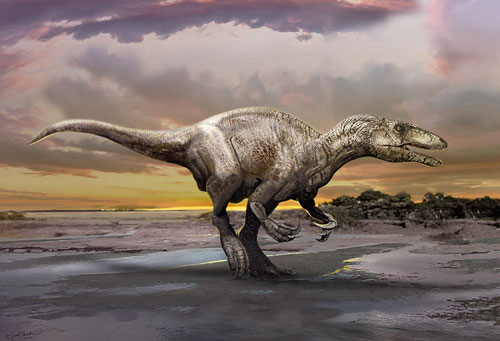
A Typical Illustration of a Member of the Megaraptoridae Family of Theropod Dinosaurs

Roaming Patagonia 80 million years ago
A leggy, Late Cretaceous carnivore (Murusraptor).  Roaming Patagonia around 80 million years ago.  By the Late Cretaceous the Megaraptoridae may have been less widespread and more provincial.

Picture credit: Jan Sovak (University of Alberta)

Commenting Upon the Theropod Dinosaurs

A spokesperson from Everything Dinosaur commented:

“The identification of these theropod remains that had been known about for more than twenty-five years, has been partially resolved.  Hopefully, more fossil material associated with the Vayuraptor genus will be found in Thailand so that it too can be more definitively placed within the Megaraptora clade.  Given the extent of the fossil discoveries made from the Phu Wiang Mountain region thus far, it is highly likely that more new dinosaurs will be named and described from Thailand in the future.”

To read an article about a Late Cretaceous member of the Megaraptoridae family from South America that was reported upon in 2018: A New Member of the Megaraptoridae from the Late Cretaceous of South America (Tratayenia rosalesi).

The scientific paper: “Two new basal coelurosaurian theropod dinosaurs from the Lower Cretaceous Sao Khua Formation of Thailand” by A. Samathi, P. Chanthasit and P. Martin Sander published in  Acta Palaeontologica Polonica.

Visit the Everything Dinosaur website: Everything Dinosaur.
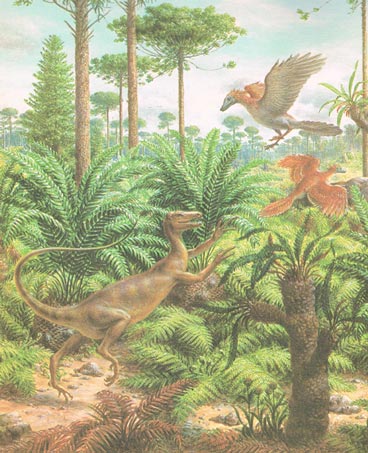
28 05, 2019

Everything Dinosaur and the Rebor Dinosaur Foetuses

By |2023-12-22T13:29:53+00:00May 28th, 2019|Categories: Dinosaur Fans, Everything Dinosaur News and Updates, Everything Dinosaur Products, Main Page, Photos of Everything Dinosaur Products, Press Releases|0 Comments

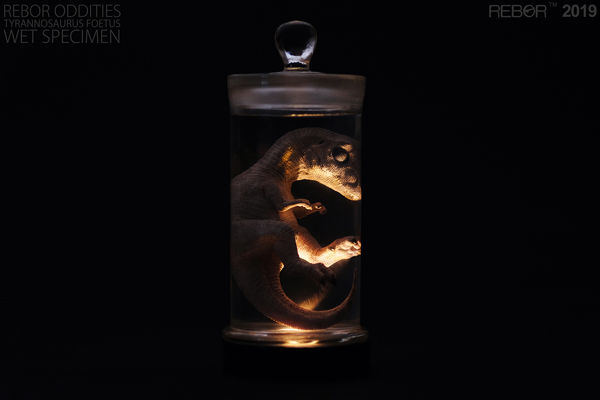
Rebor Oddities Tyrannosaurus and Velociraptor Foetus Replicas

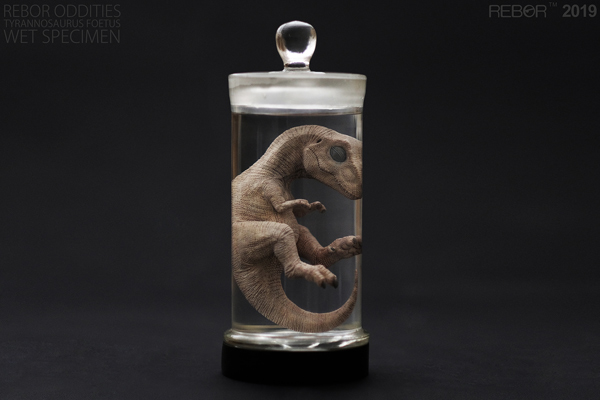
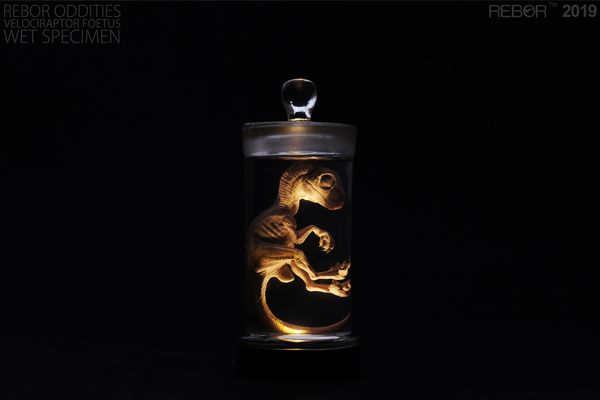
Everything Dinosaur will be stocking the pair of Rebor Oddities dinosaur foetus replicas (Tyrannosaurus and Velociraptor).  These highly unusual dinosaur figures are expected to arrive in stock at Everything Dinosaur’s warehouse in July and today, the UK-based mail-order company has formally announced that it will be stocking them.

Coming into Stock at Everything Dinosaur the Rebor Oddities Tyrannosaurus Foetus

The Rebor Oddities Tyrannosaurus foetus.
Rebor Oddities Tyrannosaurus foetus.

Rebor Foetuses – Wet Specimens

Ever since Michael Crichton’s highly influential novel “Jurassic Park” was first published (1990), subsequently made into a film three years later, fans of dinosaurs have been trying to get hold of replicas of pre-hatched dinosaurs as envisaged by the scientists at the bioengineering company InGen run by industrialist and billionaire John Hammond.  The clever design team at Rebor have come up with their own take on this concept, portraying the foetuses of two iconic Late Cretaceous theropods Velociraptor and a representative of the Tyrannosaurus genus.

The Rebor Oddities Velociraptor Foetus Model

The Rebor Oddities Velociraptor foetus.
Rebor Oddities Velociraptor foetus.

Each skilfully crafted model is displayed in its own storage jar.  The purchaser can add water to represent the fluid in which the specimen would have been kept in.  Both models reflect what is known about dinosaur embryos and show distal growth, although neither Velociraptor or any member of the Tyrannosaurus genus is represented in the fossil record by material representing a pre-hatched or recently hatched individual.

Priority Reservation Lists are Open

Priority reservation lists have been opened for both of these new Rebor Oddities replicas.  Dinosaur fans who had already requested to join the Rebor Dilophosaurus model reserve list “Green Day” and “Oasis”, that are due to be introduced prior to these two foetus models, have already been offered the chance to join Everything Dinosaur’s priority reserve lists.

A spokesperson for the company commented:

“These two foetus replicas from Rebor are likely to sell out fast, so we thought it fair to offer the chance to join our VIP reserve list for these two models, to those collectors who had already contacted us about the new Rebor Dilophosaurus dinosaur replicas.”

To join Everything Dinosaur’s priority reserve list for the Rebor Oddities Foetus figures: Email Everything Dinosaur to join our Reserve List for the Rebor Oddities – don’t forget to let us know which model(s) you want.

To read about the two new Rebor Dilophosaurus dinosaur models coming into stock shortly: Rebor Announces New Dilophosaurus Models.

Tale of the Tape – Rebor Oddities

The Rebor Oddities range provides collectors with the opportunity to acquire more unusual prehistoric animal figures and replicas.  These types of models tend to sell out quickly and can rapidly become difficult to obtain.  Everything Dinosaur will be bringing into stock a limited number of these new Rebor Oddities.  As for their sizes, the Tyrannosaurus figure is slightly larger than the Velociraptor replica, a probable true reflection on the size of these dinosaur embryos from back in the Late Cretaceous.

  • Rebor Oddities Tyrannosaurus foetus replica measuring  22.5 cm x 9 cm from the top of the jar to the base.
  • Rebor Oddities Velociraptor foetus replica measuring 18 cm x 7. 5 cm from the top of the jar to the base.

These figures are likely to be highly sought after, demand for them could outstrip supply and at the moment, based on current estimates, a July delivery date at Everything Dinosaur’s warehouse is forecast.

The Rebor Oddities Tyrannosaurus Foetus Replica is the Slightly Bigger of the Two Figures

Rebor Oddities Tyrannosaurus foetus.
The Rebor Oddities Tyrannosaurus foetus.

Visit the award-winning Everything Dinosaur website: Everything Dinosaur.
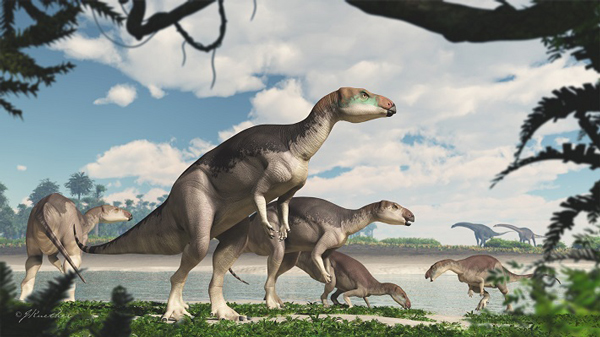
All Lit Up and Ready to Hatch – The Rebor Oddities Velociraptor Figure

Rebor Oddities Velociraptor foetus
The Rebor Oddities Velociraptor foetus.

Simply email Everything Dinosaur to join our reserve list for these exciting new Rebor figures, to see the current range of Rebor replicas in stock at Everything Dinosaur: Rebor Replicas and Figures.

27 05, 2019

Beautiful Postcards of Ichthyosaurs

By |2023-12-22T13:23:39+00:00May 27th, 2019|Categories: Adobe CS5, Dinosaur Fans, Main Page, Photos/Pictures of Fossils|0 Comments

Postcards of Ichthyosaurs

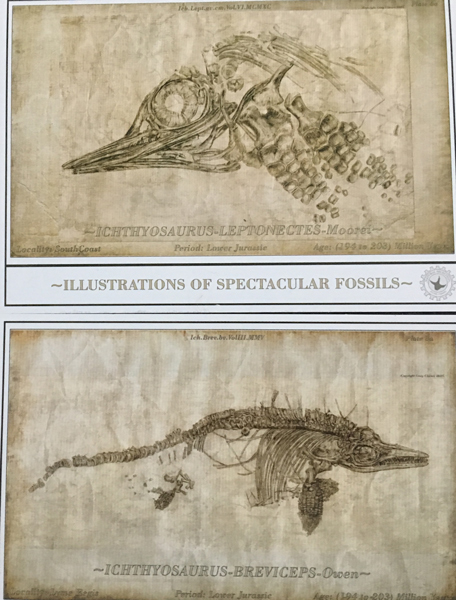
A team member at Everything Dinosaur found some beautiful postcards that feature spectacular British fossils, in this case ichthyosaurs, in one of our offices the other day.  We thought we would share a picture of the prehistoric themed postcards on our blog.

A Pair of Prehistoric Postcards Featuring Different Species of Ichthyosaur

Postcards showing Ichthyosaurs.
Postcards that illustrate spectacular British fossils – Ichthyosaurus.

Picture credit: Everything Dinosaur

The postcards come from a range of “natural selection prints”, illustrations of spectacular fossils from the UK.  They depict scientific illustrations that we think accompanied the description of the species when it was erected.

Ichthyosaurus moorei (Leptonectes moorei)

The postcard (top) shows a plate from the scientific paper that led to the erection of the species Ichthyosaurus moorei.  The holotype material associated with this animal comes from Seatown on the Dorset coast (Jurassic Coast).  However, as our knowledge of the Ichthyosauria as improved, so fossils associated with I. moorei have been reassigned and placed outside the Ichthyosaurus genus.  There are enough distinctive characteristics (autapomorphies), to permit an erection of a separate genus.  The genus Leptonectes moorei was established in 1999.

Ichthyosaurus breviceps

I. breviceps is another species of marine reptile, despite being named a long time ago, in 1881 by Richard Owen (later Sir Richard Owen), it has remained a member of the Ichthyosaurus genus.  This type of Ichthyosaurus is also associated with the Jurassic Coast of Dorset.  Its fossils are relatively rare when compared to the contemporaneous I. communis.  It is characterised by its relatively short, but robust snout.  The shape of the jaw suggests that this marine reptile may have fed on different kinds of food compared to other “fish lizards”, it may have been more of a generalist eating a wider variety of prey, an example of niche partitioning within the biota associated with the Lower Jurassic.

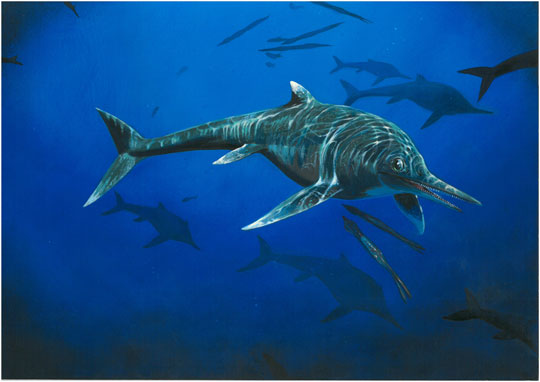
An Illustration of a Typical Ichthyosaur – W. massarae

Wahlisaurus massarae illustrated
An illustration of the ichthyosaur known as Wahlisaurus massarae, which was named and described back in 2016.  Research into the Ichthyosauria is on-going and existing specimens can be reassigned to different species or even different genera as more data becomes available.

Picture credit: James McKay

To view models of prehistoric animals including marine reptiles: Wild Safari Prehistoric World Models.

Go to Top