All about dinosaurs, fossils and prehistoric animals by Everything Dinosaur team members.

Fossil finds, new dinosaur discoveries, news and views from the world of palaeontology and other Earth sciences.

12 10, 2019

A New Basal Carcharodontosaurian the King of Siam – Siamraptor suwati

By |2024-05-11T17:14:38+01:00October 12th, 2019|Categories: Adobe CS5, Dinosaur and Prehistoric Animal News Stories, Dinosaur Fans, Main Page, Photos/Pictures of Fossils|0 Comments

New Basal Carcharodontosaurian from Thailand – Siamraptor suwati

A team of scientists from Thailand and Japan have announced the discovery of a new species of meat-eating dinosaur from the Early Cretaceous of north-eastern Thailand.  The dinosaur has been named Siamraptor suwati and around 115 million years ago, this eight-metre-long theropod would have been the “King of Siam”.

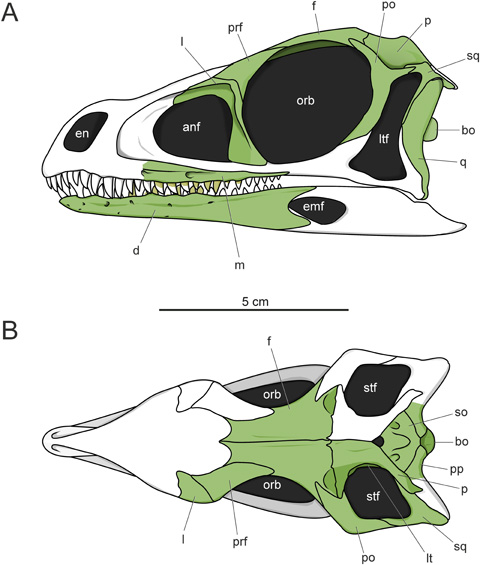
An Illustration of the Skull of the Newly Described Carcharodontosaurian Theropod Siamraptor suwati

Line drawing of skull and skeletal material of Siamraptor.
An illustration of the skull of Siamraptor showing the placement of the known cranial material.

Picture credit: Chokchaloemwong et al (PLOS One)

Providing an Insight into the Early Evolutionary History of the Carcharodontosauria

The Carcharodontosauria “shark-toothed lizards”, represent a group of theropod dinosaurs that were both temporally and geographically widespread during the Mesozoic.  Some of these dinosaurs were giants, comparable to the largest tyrannosaurids.  For example, the genus Carcharodontosaurus is known from the Cenomanian faunal stage of the Late Cretaceous of North Africa, some of the larger fossil specimens indicate a length in excess of thirteen metres.

Then there are the giants from South America, dinosaurs such as Tyrannotitan, Mapusaurus and Giganotosaurus, however, little is known about the evolutionary history of the Carcharodontosauria clade.  Writing in the on-line academic journal PLOS One, the researchers state that the discovery of Siamraptor will provide an important insight into the early evolutionary history of the Carcharodontosauria.

A Silhouette of Siamraptor Showing Position of Known Fossil Material
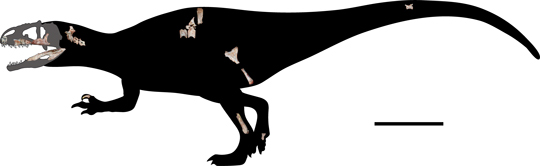
Known fossil material of Siamraptor (scale bar = 1 metre).
A silhouette showing the position of known fossil material for Siamraptor. Scale bar = 1 metre.  The fossils found represent at least four individuals.  Skull material has been scaled up to fit the diagram.

Picture credit: Chokchaloemwong et al (PLOS One)

The Significance of Siamraptor suwati

The fossil material comes from the Khok Kruat geological formation (part of the Khorat Group), in Khorat, north-eastern Thailand an area that has been explored extensively by the Japan-Thailand Dinosaur Project (JTDP) team.  The age of the strata from which the Siamraptor fossil material comes is not known, however, pollen fossil analysis and biostratigraphical indicators support an Early Cretaceous age (Aptian faunal stage).

The Location of the Fossil Discovery and a Stratigraphical Column for the Khorat Group

Stratigraphic column (Khorat Group) and the location of the Siamraptor fossils.
The location of the theropod fossil discovery and a stratigraphic column of the Khorat Group.

Picture credit: Chokchaloemwong et al (PLOS One)

The picture (above), shows (A) a map of the Nakhon Ratchasima Province of north-eastern Thailand and (B) a distribution map of the Khok Kruat Formation in the area.  Picture (C) shows an enlargement of the area where the Siamraptor fossil material was found.  The red star in (C) indicates the fossil quarry.  A stratigraphical column of the Khorat Group is provided (D) and (E) shows a photograph of the dig site.

A Basal Member of the Carcharodontosauria

Two phylogenetic analyses indicate that Siamraptor was a basal member of the Carcharodontosauria.  This taxon is the first definitive evidence of carcharodontosaurian theropods in south-eastern Asia.  The fossil material, although very fragmentary and representative of four individual dinosaurs is also amongst the best preserved theropod fossil material known from this part of Thailand.

The presence of Siamraptor in north-eastern Thailand indicates an extension of the record in the Laurasian landmasses during the earliest stage of the evolutionary history of the Carcharodontosauria.

Three Premaxillae Elements Representing Siamraptor suwati
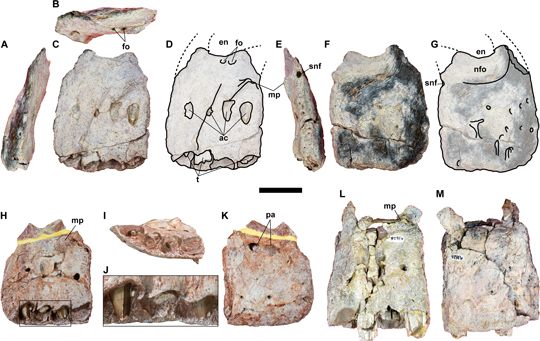
Fossils (right premaxillae) with accompanying line drawings - Siamraptor.
Three right premaxillae fossils with accompanying line drawings (Siamraptor).

PicturecCredit: Chokchaloemwong et al (PLOS One)

The fossil material includes elements from the jaws, parts of the skull, vertebrae, elements from the hips and hind limbs and a single claw from the hand.  With the formal naming of this dinosaur it reveals that the carcharodontosaurids had spread to Asia as well as Europe and Africa by the Early Cretaceous.

The Fossil Manual Ungual (NRRU-F01020018) – Siamraptor suwati

Views of the manual ungual of Siamraptor.
The manual ungual of Siamraptor suwati.  Note scale bar = 5 cm.  H = lateral view whilst (I) is a palmar view.  Key – pr = plaster reconstruction, vg = vascular groove and ft = flexor tubercle.

Picture credit: Chokchaloemwong et al (PLOS One)

The genus name translates as “robber from Siam”, whilst the species name honours Mr. Suwat Liptapanlop for his financial support of the fieldwork undertaken in Thailand.

The scientific paper: “A new carcharodontosaurian theropod (Dinosauria: Saurischia) from the Lower Cretaceous of Thailand” by Duangsuda Chokchaloemwong, Soki Hattori , Elena Cuesta, Pratueng Jintasakul, Masateru Shibata and Yoichi Azuma published in the on-line, open access journal PLOS One.

The Everything Dinosaur website: Everything Dinosaur.
7 10, 2019

New Pterosaur Species Described from Liaoning Province

By |2023-12-31T06:55:10+00:00October 7th, 2019|Categories: Dinosaur and Prehistoric Animal News Stories, Dinosaur Fans, Main Page, Photos/Pictures of Fossils|0 Comments

Nurhachius luei – A New Species of Early Cretaceous Pterosaur from China

A team of international researchers including scientists from the Chinese Academy of Sciences, the University of Copenhagen and the Fur Museum (both Denmark), along with colleagues based in Brazil, have named a new species of istiodactylid pterosaur from the Liaoning Province of north-eastern China.  This new flying reptile has been named Nurhachius luei, it is the second species in the Nurhachius genus to be announced after the type species Nurhachius ignaciobritoi, which also hails from the Jiufotang Formation, was named and described in 2005.

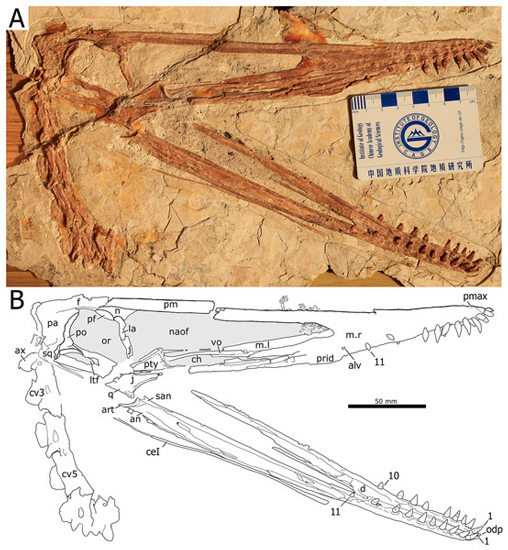
The Holotype Specimen of Nurhachius luei

Holotype specimen of Nurhachius luei with an accompanying line drawing.
The holotype specimen of Nurhachius luei with an accompanying line drawing.  Note scale bar = 5 cm.

Picture credit: PeerJ

Pterosaur Species Described from Cranial Material and Neck Bones

More than twenty different pterosaur species have been described to date from fossils associated with the Jiufotang Formation of China.  Although, the date of these extensive deposits is controversial, it is thought that Nurhachius luei lived during the Aptian faunal stage of the Cretaceous (125 – 113 million years ago).

The Istiodactylidae family are thought by many palaeontologists to represent the first lineage of the Pterodactyloidea.  They evolved sometime in the Late Jurassic and their thin bone walls, reduced tails, absence of a fifth toe and elongated hand bones (metacarpals), provided the anatomical “blueprint” for all subsequent types of pterosaur.  In essence, these “new” types of flying reptile replaced the long-tailed rhamphorhynchids and their relatives.

Four pterosaur genera and five species (all represented by a single specimen), have been referred to the Istiodactylidae.  Three of the genera are associated with Liaoning deposits, whilst the remaining genus Istiodactylus (I. latidens), the first to be studied at the very beginning of the 20th century, hails from the Early Cretaceous Vectis Formation of the Isle of Wight.

Nurhachius luei

A few years ago (2011), a jaw tip found in Canada was interpreted as being from an istiodactylid pterosaur.  This pterosaur was named Gwawinapterus beardi.  It seemed both geographically and temporally removed from all the other known members of the Istiodactylidae and a revised description was published in 2012.  Gwawinapterus was actually a fish, it just happened to have closely spaced teeth that superficially resembled the dentition of istiodactylid pterosaurs.

To read more about Gwawinapterus beardiA New, Unique Species of Canadian Pterosaur is Described.

The scientific paper: “Nurhachius luei, a new istiodactylid pterosaur (Pterosauria, Pterodactyloidea) from the Early Cretaceous Jiufotang Formation of Chaoyang City, Liaoning Province (China) and comments on the Istiodactylidae” by Xuanyu Zhou​, Rodrigo V. Pêgas​, Maria E.C. Leal and Niels Bonde published in the academic journal PeerJ.

For pterosaur models and figures: The Everything Dinosaur Website.

5 10, 2019

The First Skeletal Remains of Phoebodus (Prehistoric Shark)

By |2023-05-01T18:36:39+01:00October 5th, 2019|Categories: Dinosaur and Prehistoric Animal News Stories, Main Page, Photos/Pictures of Fossils|0 Comments

The First Skeletal Remains of Phoebodus (Prehistoric Shark)

Morocco might be famous for its trilobite fossils, but this North African country has a very rich fossil heritage, one that covers a lot more fauna than just arthropods.  Take for example, the discovery of the first ever skeletal material associated with the ancient shark Phoebodus.  A team of scientists, including researchers from the University of Zurich (Switzerland) and the University of Chicago, have published a paper describing fossil material from a shark that was previously only known from its teeth (only three teeth in total).

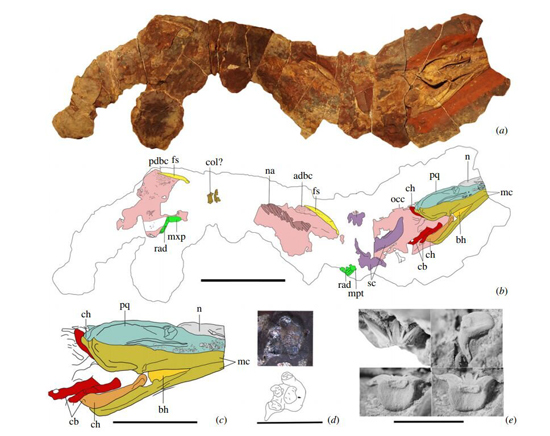
Skeletal Fossil Material (Cranial and Postcranial) – Phoebodus saidselachus

Phoebodus saidselachus, views of a tooth and line drawings.

Phoebodus saidselachus sp. nov., (a–d) PIMUZ A/I 4712 and (e) PIMUZA/I 4656.  (a) Ferruginous nodule containing cranial and postcranial remains; (b) drawing, scale bar, 200 mm; (c) detail of visceral skeleton, scale bar, 100 mm; (d) tooth, scale bar, 5 mm; (e) tooth (various views).

Picture credit: Proceedings of the Royal Society B. (Linda Frey and Christian Klug – University of Zurich)

Phoebodus saidselachus

The fossil material was found in the Atlas Mountains of Morocco, the fossil is remarkably well preserved considering that the skeleton of the animal was comprised of soft cartilage and not hard bone.  Around 370 million years ago, this part of north Africa was covered by a warm, shallow tropical sea.  The researchers were able to identify several skulls and parts of another species of Phoebodus from the same fossil deposits.  Writing in the academic journal the “Proceedings of the Royal Society B”, the scientists were able to provide a full description of Phoebodus and speculate on what this small shark might have preyed upon.

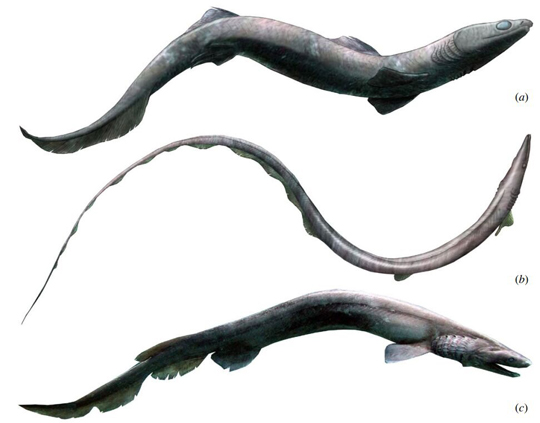
Speculating on the Body Plan of Phoebodus saidselachus

Possible life reconstruction of P. saidselachus.

Possible body reconstruction of (a) P. saidselachus sp. nov., Late Devonian, (b) T. gracia [11], Early Carboniferous, and (c) picture of the extant frilled shark Chlamydoselachus anguineus.

Picture credit: Proceedings of the Royal Society B.

What Did Phoebodus Look Like?

The researchers note that sharks like Phoebodus went extinct in an early part of the Carboniferous, a very long time before many of its features evolved in other modern sea creatures.  The fossil reveals an eel-like body (anguilliform), a specialised braincase, a hyoid arch and elongated jaws.    These features corroborate a likely close taxonomic relationship with the Carboniferous shark species Thrinacodus gracia (shown above in the picture (b).

A Similarity to Living Sharks

In addition, the fossilised material suggests a similarity between the long extinct Phoebodus genus and the living frilled shark Chlamydoselachus anguineus.  The teeth of P. saidselachus are very similar to the teeth of the frilled shark.   They are rounded and pointy and Phoebodus may have hunted and fed in the same way as frilled sharks.  The research team also noted that the ancient shark resembles a modern gar (family Belonidae), as well.   Whilst gars are not closely related to sharks, they might make a plausible marker for inferring behaviour in Late Devonian shark genera.

Now that palaeontologists have a better understanding of what Phoebodus actually looked like, this material and the other fossilised skulls found at this Moroccan locality can help them to map the radiation of the earliest elasmobranchs and to infer what sort of ecological niches in the ancient marine ecosystem they occupied.

Visit Everything Dinosaur’s website: Everything Dinosaur.

3 10, 2019

Most Complete Pterosaur Specimen Found in Australia to Date

By |2023-12-30T20:08:57+00:00October 3rd, 2019|Categories: Dinosaur and Prehistoric Animal News Stories, Main Page, Palaeontological articles, Photos/Pictures of Fossils|0 Comments

Ferrodraco lentoni – The “Iron Dragon”

The fossil record for pterosaurs “down under” is extremely poor.  Only around twenty very fragmentary specimens are known.  However, a team of scientists, including researchers from the Australian Age of Dinosaurs Museum (Winton, Queensland), have announced the discovery of a new species of flying reptile, what is more, the new species named Ferrodraco lentoni represents the most complete pterosaur known from Australia.

The Holotype Skull and Mandible of Ferrodraco lentoni

Ferrodraco lentoni holotype skull and jaw.
Ferrodraco lentoni holotype skull and mandible AODF 876. (A) dorsal view; (B) anterior view; (C) left lateral view; (D) ventral view; (E) right lateral view with line drawings (F and G).

Picture credit: Scientific Reports

A Close Neighbour of Savannasaurus elliottorum

Local farmer Bob Elliott discovered the specimen eroding out of a bank adjacent to a small creek on Belmont Station in early 2017, the fossilised remains, although fragmentary, represent a type of flying reptile known as an ornithocheirid, a family of pterosaurs with a global distribution, with specimens known from the Americas, Europe, North Africa, Asia and with two Queensland representatives already – Aussiedraco and Mythunga.  Bob Elliott took some of the fossils to the experts at the Australian Age of Dinosaurs Museum and a field team was despatched to excavate the rest of the material.

The pterosaur fossil material includes parts of the skull, the tips of the jaws, five partial vertebrae, limb bones and around forty isolated and broken teeth.  The pterosaur fossils were found less than five miles from the site of the  Savannasaurus elliottorum quarry.  Savannasaurus was a huge sauropod dinosaur, it was discovered in 2005 and formally described in 2016.  To read about Savannasaurus: Titanosaurs Crossing Continents Savannasaurus elliottorum.

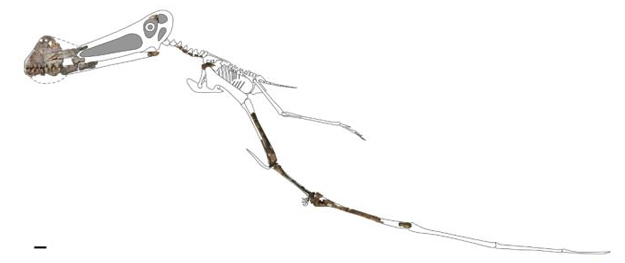
A Skeletal Reconstruction of Ferrodraco lentoni (based on Tropeognathus mesembrinus)

Reconstruction of Ferrodraco lentoni.
Skeleton reconstruction of Ferrodraco lentoni, scale bar 5 cm.

Picture credit: Scientific Reports – based on an illustration by Mark Witton

Ferrodraco lentoni – Named after the Late Mayor of Winton

The genus name is a reference to the ironstone preservation of the holotype specimen, and the Latin “draco” (dragon).   The species name honours former Winton Shire mayor Graham Thomas “Butch” Lenton, in recognition of his years of service to the Winton community and his strong support for the Australian Age of Dinosaurs Natural History Museum.

Ferrodraco is estimated to have lived some 96 million years ago and it is thought to have had a wingspan of around four metres.  Corresponding author for the scientific paper, published in the journal Scientific Reports, Adele Pentland, a PhD student at the Australian Age of Dinosaurs Museum, commented:

“Ferrodraco would have been an apex aerial predator around 96 million years ago.  At this time the Winton region was on the southern shores of an inland sea and was globally positioned about where Victoria’s southern coastline is today.”

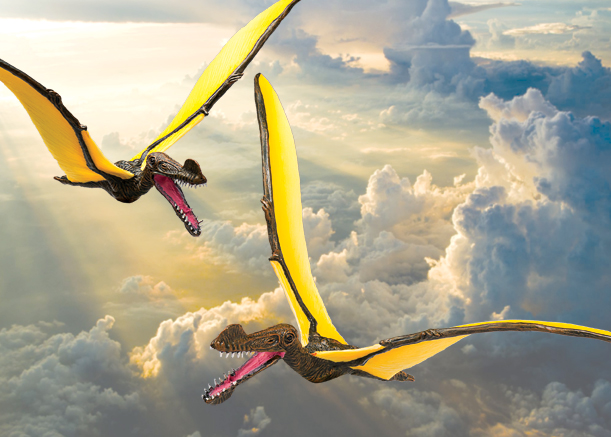
A Life Reconstruction of Ferrodraco lentoni (Based on Tropeognathus mesembrinus)

Mojo Fun Tropeognathus.
A life reconstruction of Ferrodraco lentoni based on the Mojo Fun model of T. mesembrinus.

The picture (above) shows a pterosaur model from the Mojo Fun range.

To view this range of prehistoric animal figures: Mojo Fun Prehistoric and Extinct Figures.

The scientific paper: “Ferrodraco lentoni gen. et sp. nov., a new ornithocheirid pterosaur from the Winton Formation (Cenomanian–lower Turonian) of Queensland, Australia” by Adele H. Pentland, Stephen F. Poropat, Travis R. Tischler, Trish Sloan, Robert A. Elliott, Harry A. Elliott, Judy A. Elliott and David A. Elliott published in Scientific Reports.

The Everything Dinosaur website: Everything Dinosaur.
27 09, 2019

New Study Concludes End Cretaceous Mass Extinction Event Disrupted Oceans for Millions of Years

By |2023-12-30T17:27:38+00:00September 27th, 2019|Categories: Dinosaur and Prehistoric Animal News Stories, Main Page, Palaeontological articles|0 Comments

New Study Examines the Impact of End Cretaceous Mass Extinction Event

A team of researchers, including scientists from Bristol University and the University of Southampton have published a new study looking at the impact of the extra-terrestrial Chicxulub impact event that devasted life on Earth 66 million years ago.

The non-avian dinosaurs may be the most famous victims of this mass extinction, but this study examined the consequences of a near instantaneous collapse of ocean food webs.  The plankton, the base of the ocean ecosystem, as primary produces, were disrupted for around 1.8 million years.  It then took a further 8 million years for global species numbers to fully recover.

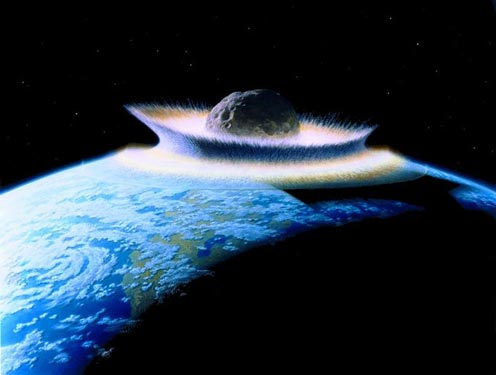
End Cretaceous Extinction Event Disrupted the World’s Oceans for Millions of Years

Earth impact event.
Cataclysmic impact event that led to the extinction of the dinosaurs, but the bolide impact devastated global oceanic ecosystems that subsequently took millions of years to recover.

Picture credit: Don Davis (Commissioned by NASA)

Major Oceanic Food Web Instability

Writing in the journal “Nature”, the research team, which also included scientists from the University of California, University College London and the Institute for Geoscience, Goethe-Universität Frankfurt (Germany), found that while the plankton in the oceans showed the first signs of ecological recovery almost immediately, these early communities of microscopic organisms were highly unstable and cell sizes unusually small.

With the collapse of the plankton population, the loss of these primary produces in the food chain would have devasted the vast majority of the other organisms in the ecosystem, resulting in their demise and in a lot of cases, their extinction.

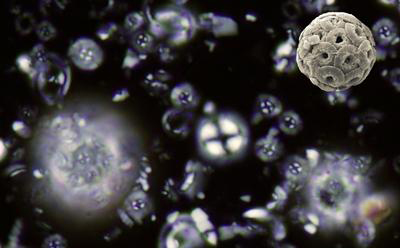
Microscopic Nannoplankton Fossils

Fossils - Nannoplankton.
Microscopic Nannoplankton fossils.

Picture credit: University of Southampton/University College London ( Samantha Gibbs/Paul Bown)

The “Reboot” of a Global Ecosystem

The research team plotted the changes in the fossil plankton record by studying the number and composition of calcareous nannoplankton fossils deposited over a period of 13 million years.  A “snapshot” of the population was mapped at intervals of approximately 13,000 years.  Cell size, abundance and species diversity were all recorded.  In total more than 700,000 fossils were studied.  This scientific paper has provided a remarkable insight into how a global marine ecosystem “reboots”.

As much today as in the past, the marine ecosystem is dependent on plankton at its base and this study highlights the risks posed by diversity loss which may result in highly unstable communities, loss of important ecosystem functions and the long timescales of recovery.  Important lessons to learn as we enter a period of extensive, global climate change.

Reducing Biodiversity

Co-author of the paper, palaeobiologist Dr Samantha Gibbs “University of Southampton” commented:

“Losing species today runs the risk of eliminating key creatures in ecosystems.  What we’ve demonstrated from this fossil record is that function is achieved if you have the right players fulfilling key roles.  Today, by reducing biodiversity, we are running the risk of losing our critical ecosystem players, many of whose importance we don’t yet fully appreciate.”

Everything Dinosaur acknowledges the assistance of a press release from the University of Southampton in the compilation of this article.

The scientific paper: “Diversity decoupled from ecosystem function and resilience during mass extinction recovery” by Sarah A. Alvarez, Samantha J. Gibbs, Paul R. Bown, Hojung Kim, Rosie M. Sheward and Andy Ridgwell published in the journal Nature.

The Everything Dinosaur website: Everything Dinosaur.
25 09, 2019

New Study Suggests a Stiff Skull Helped T. rex Crush Bones

By |2023-12-30T17:16:15+00:00September 25th, 2019|Categories: Dinosaur and Prehistoric Animal News Stories, Dinosaur Fans, Main Page, Palaeontological articles|0 Comments

Stiff Skull Helped T. rex Crush Bones

Numerous research papers have been published about those monstrous jaws and huge skull of Tyrannosaurus rex.  Many of the studies have examined the biomechanics in a bid to better understand the bite forces that this Late Cretaceous terror could generate.

It is widely accepted that T. rex had a bone crushing bite, but just how it managed to crush the bones of a Triceratops or an unfortunate Edmontosaurus without damaging itself, has puzzled palaeontologists.  A new study, published in the journal “The Anatomical Record”, suggests that the T. rex skull was much stiffer than previously thought, much more like a crocodile skull or that of a hyena than a scaled-up, flexible bird skull.

New Study Suggests T. rex Had a Stiff Skull

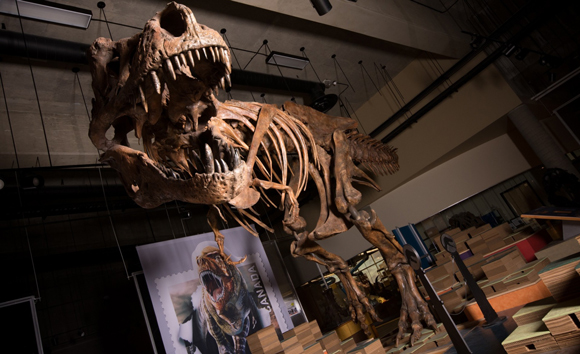
"Scotty" the Tyrannosaurus rex.
A reconstruction of the skeleton of “Scotty” the T. rex.  Regarded as the heaviest specimen of T. rex known to science.   A new study suggests that like other bone-crushing tetrapods, the skull was functionally akinetic.

Picture credit: Amanda Kelley

Studying the Skull of Tyrannosaurus rex

One of the co-authors of the study, Kaleb Sellers of the Missouri University School of Medicine explained:

“The T. rex had a skull that’s about six feet long, five feet wide and four feet high and bites with the force of about six tons.  Previous researchers looked at this from a bone-only perspective without taking into account all the connections, ligaments and cartilage that really mediate the interactions between the bones.”

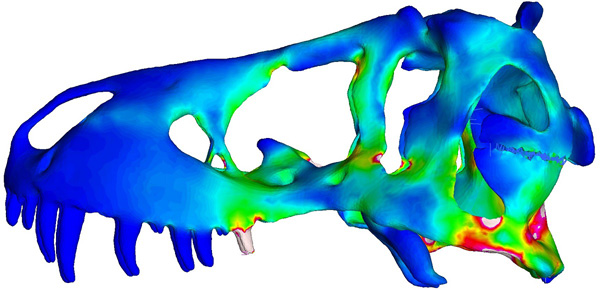
Computer Generated Models Examined Stresses in the Upper Skull with a Focus on the Palatal Area

T. rex skull stress test.
Computer generated models were created to assess the stresses placed on an adult T. rex skull.

Picture credit: University of Missouri

Looking at the Roof of the Mouth (Palatal Area)

The scientists, which included Kevin Middleton of the Missouri University School of Medicine, M. Scott Echols of The Medical Centre for Birds, Lawrence Witmer of Ohio University and Julian Davis (University of Southern Indiana), used a combination of anatomical study, computer modelling and biomechanical analysis assessing the skulls of a gecko and a parrot to examine how the skull of this apex Late Cretaceous predator was adapted to deliver such powerful bites.

Casey Holliday, from the University of Missouri, who also helped to write the scientific paper commented:

“Dinosaurs are like modern-day birds, crocodiles and lizards in that they inherited particular joints in their skulls from fish — ball and socket joints, much like people’s hip joints — that seem to lend themselves, but not always, to movement like in snakes.  When you put a lot of force on things, there’s a trade-off between movement and stability.  Birds and lizards have more movement but less stability.  When we applied their individual movements to the T. rex skull, we saw it did not like being wiggled in ways that the lizard and bird skulls do, which suggests more stiffness.”

A Functionally Akinetic Skull

Tyrannosaurus rex is considered to have one of the strongest bites of any terrestrial tetrapod.  There are lots of scientific papers and other literature that document this evidence.  Over the years, Everything Dinosaur have produced many articles on this subject area, including a blog post that summarised research published in “Biology Letters” – T. rex had a Bite More Powerful than any Other Land Animal.

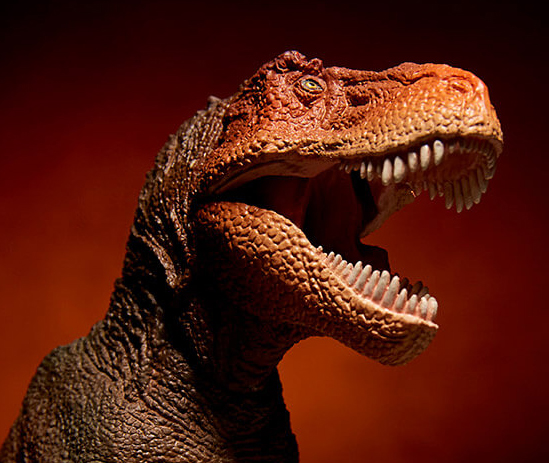
The Skull and Jaws of Tyrannosaurus rex

A close-up view of a Kaiyodo Sofubi Toy Box Tyrannosaurus rex "classic" colour.
A close-up view of the head of the Kaiyodo Sofubi Toy Box T. rex “classic” colouration.  T. rex is famous for its huge and powerful jaws.

Picture credit: Everything Dinosaur

Everything Dinosaur stocks a huge range of tyrannosaur models.

To view models and replicas on the company’s website: Dinosaur and Prehistoric Animal Figures.

Tyrannosaurus rex – A Biomechanical Paradox

The skull of T. rex has been regarded as quite flexible by palaeontologists, that is, it exhibits a degree of cranial kinensis.  The joints in the skull are quite mobile and flexible in relation to each other and the animal’s braincase.  This contradicts with what is seen in many extant tetrapods who are known to have a powerful, bone smashing bite.

Alligators and hyenas for example, have relatively robust and inflexible skulls, when compared to the skull of a bird or a lizard.  If the T. rex skull was flexible but still capable of delivering an enormous bite force, this is a biomechanical paradox, it defies a logical explanation.  Furthermore, the greatest bite forces measured for crocodilians and hyenas (ourselves for example too), are detected towards the back of the jaws, whereas, in Tyrannosaurus rex, the largest bite forces that have been calculated are recorded at the front of the jaws.

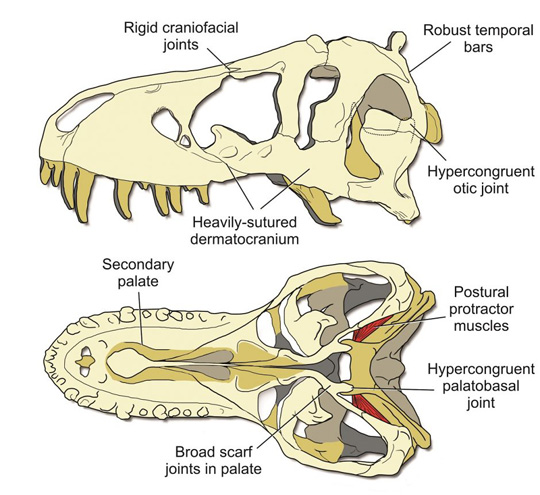
This New Analysis Suggests that the T. rex Skull was Functionally Akinetic

T. rex upper skull diagram.
Lateral and ventral views of a T. rex skull. The skull may have been more robust and stiffer than previously thought.

Picture credit: University of Missouri

The researchers identified a number of adaptations in the cranium of T. rex to support the idea that the skull was not as flexible as previously thought.  The scientists postulate that the skull was functionally akinetic (much stiffer than previously surmised).

Research that Provides a Better Understanding of Our Own Joints and Bones

This study will help palaeontologists to better understand the function of tyrannosaurid skulls and the researchers postulate that their findings can help advance human and veterinary medicine.

The study, “Palatal biomechanics and its significance for cranial kinesis in Tyrannosaurus rex”, was published in The Anatomical Record.  Authors include Kevin Middleton of the Missouri University School of Medicine; M. Scott Echols of The Medical Centre for Birds; Lawrence Witmer of Ohio University and Julian Davis of University of Southern Indiana.

Everything Dinosaur acknowledges the assistance of a press release from the University of Missouri in the compilation of this article.

The Everything Dinosaur website: Everything Dinosaur.

24 09, 2019

Dust from a Giant Asteroid Collision Caused Ordovician Ice Age According to New Study

By |2023-12-30T17:09:32+00:00September 24th, 2019|Categories: Dinosaur and Prehistoric Animal News Stories, Geology, Main Page, Palaeontological articles|0 Comments

Global Climate Change in the Ordovician Caused by Dust from a Giant Asteroid

Scientists have been aware for some time that during the Middle Ordovician, our planet endured a prolonged but gradual period of global cooling.  The average temperature on Earth fell and this opened up new ecological niches that permitted those animals and other organisms around at the time to adapt and to become more specious.

The cause of this world-wide ice age, one that started around 466 million years ago, is a mystery, but a team of scientists writing in the journal “Science Advances” think that they may have found the answer.  They postulate that the global cooling was triggered by huge amounts of dust deposited in the atmosphere from an extraterrestrial asteroid collision.

An Enormous Impact in Outer Space

Colliding asteroids in outer space.
An artist’s impression of an extraterrestrial asteroid impact.  Excessive amounts of dust in the atmosphere may have contributed to global cooling.

Picture credit: Don Davis, Southwest Research Institute

Dust from Outer Space

The Earth’s atmosphere is constantly bombarded by extraterrestrial space dust, but normally it only makes up a tiny proportion of all the dust in the atmosphere.  Most of these tiny particles come from other sources such as volcanoes, forest fires, fine sand grains from deserts, pollution or from sea salt.  However, the research team, which included scientists from the University of Chicago and Sweden’s Lund University postulate that the break-up of a 93-mile-wide asteroid in the asteroid belt between Mars and Jupiter led to the deposition of much more than just the normal background dosage of space dust.

Large amounts of dust would have interrupted the filtering of solar radiation to the surface of our planet and led to a period of dramatic global cooling.

Philipp Heck (University of Chicago), one of the co-authors of the paper published in “Science Advances” explained:

“Normally, Earth gains about 40,000 tons of extraterrestrial material every year.  Imagine multiplying that by a factor of a thousand or ten thousand.  Our hypothesis is that the large amounts of extraterrestrial dust over a timeframe of at least two million years played an important role in changing the climate on Earth, contributing to cooling.”

Giant Asteroid has Global Impact

If large amounts of ice were formed due to this cooling effect, then sea-levels would have fallen as evidenced by the geological record of strata that was formed during this time in Earth’s turbulent history.  Falling sea levels would have changed ecosystems, potentially opening up new environments for organisms to exploit.

Lead author of the research paper, Birger Schmitz of Sweden’s Lund University added:

“Our results show for the first time that such dust, at times, has cooled Earth dramatically.  Our studies can give a more detailed, empirical-based understanding of how this works, and this in turn can be used to evaluate if model simulations are realistic.”

Searching for the Evidence

The researchers analysed Ordovician rocks looking for rare Earth particles that could be associated with cosmic dust.  Tiny micrometeorites collected from Antarctica were used to provide a base level of normal cosmic deposition.  Evidence of rare helium isotopes along with other rare Earth metals confirmed that dust deposits were extraterrestrial in nature.

The Middle Ordovician cooling period could therefore have been caused by this excessive dust.  The amount of water in the Earth’s oceans influences the way that rocks on the seabed form, and the rocks from this time period show signs of shallower oceans, an indication that some of the Earth’s water was trapped in glaciers and sea ice.  Schmitz and his colleagues are the first to show that this ice age correlates with the extra dust in the atmosphere.

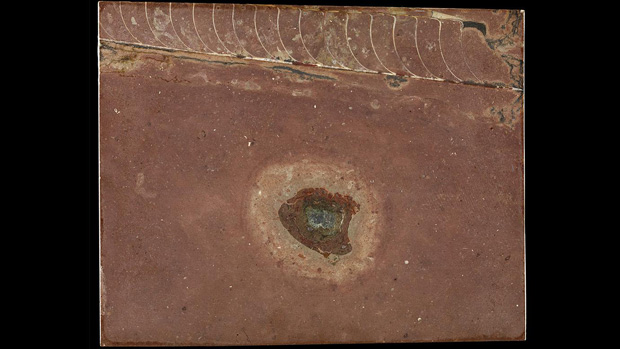
A Fragment of a Meteorite Preserved in Ordovician-aged Rock (Note the Orthocone Fossil)

Fragment of a meteorite preserved in sandstone dating from the Ordovician. Note the orthocone fossil (above).
A fragment of a meteorite preserved in red sandstone dating from the Ordovician.  Note the orthocone fossil (above).

Picture credit: John Weinstein/Chicago Field Museum

Gradual Climate Change Could Have Benefitted Life on Earth

Whilst the authors note that sudden and dramatic climate change can be very detrimental to ecosystems, the Middle Ordovician cooling could have proved to have been extremely beneficial.

Associate Professor Heck argues:

“In the global cooling we studied, we’re talking about timescales of millions of years.  It’s very different from the climate change caused by the meteorite 65 million years ago that killed the dinosaurs, and it’s different from the global warming today—this global cooling was a gentle nudge.  There was less stress.”

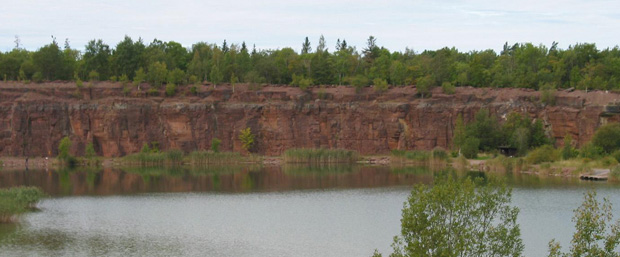
Rocks from Southern Sweden Record the Dramatic Increase in Cosmic Dust

The grey horizontal line marks the deposition of the cosmic dust from the asteroid collision in outer space.
These are cliffs made of sedimentary rock that was once an ancient seabed.  The grey horizontal line in the rock shows where the dust from the asteroid collision fell.  These deposits provide “smoking gun” evidence of the outer space asteroid collision.

Picture credit: Philipp Heck (University of Chicago)

Everything Dinosaur acknowledges the assistance of a press release from the University of Chicago in the compilation of this article.

Visit the Everything Dinosaur website: Everything Dinosaur.
20 09, 2019

Japan’s Greatest Fossil Dinosaur Gets a Name

By |2023-12-30T15:13:19+00:00September 20th, 2019|Categories: Dinosaur and Prehistoric Animal News Stories, Dinosaur Fans, Main Page, Palaeontological articles, Photos/Pictures of Fossils|0 Comments

Kamuysaurus japonicus – Japan’s Newest Dinosaur

Earlier this month, a scientific paper was published providing details of Japan’s most complete dinosaur fossil known to science.  The dinosaur, a member of the Hadrosauridae, has been named Kamuysaurus japonicus, with the Rugby World Cup starting today in the “land of the rising sun”, we thought it appropriate to feature this new species of Late Cretaceous duck-billed dinosaur in today’s blog post.

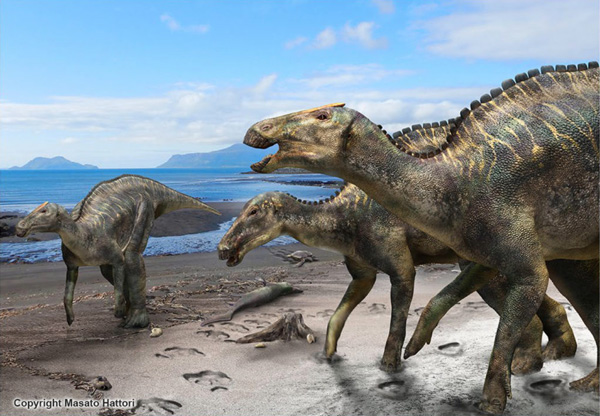
A Life Reconstruction of the Newly Described Japanese Dinosaur Kamuysaurus japonicus

Kamuysaurus life reconstruction.
A herd of Kamuysaurus wander along a beach.   In the illustration by Masato Hattori, a trio of Kamuysaurus wander across a beach some 72 mya, the fossilised remains, representing a single animal was discovered in marine strata.

Picture credit:  Kobayashi Y., et al, Scientific Reports

Kamuysaurus japonicus

The fossils come from the part Cretaceous to Palaeocene-aged Hakobuchi Formation, specifically from outcrops close to the town of Mukawa on the island of Hokkaido.  Despite the semi-articulated and nearly complete nature of the fossil material, some bones are heavily damaged and show signs of extensive bioerosion (damage caused by marine invertebrates boring into the bones), prior to burial.  The strata associated with the fossil material has yielded ammonites, mosasaurs and the remains of a sea turtle, it is correlated to the lowest Maastrichtian (faunal stage).

At Everything Dinosaur, we have followed the research into this new species of duck-billed dinosaur with eager anticipation.  We first wrote about this fossil discovery some years ago, when tail bones discovered eroding out of a hillside hinted at a very special dinosaur fossil find:  Japan’s Most Complete Dinosaur Discovery.

Assigned to the Edmontosaurini Clade

In the current study, a group of researchers led by Professor Yoshitsugu Kobayashi of the Hokkaido University Museum conducted comparative and phylogenetic analyses on 350 bones and 70 taxa of hadrosaurids, which led to the discovery that the dinosaur belongs to the Edmontosaurini clade and is closely related to Kerberosaurus unearthed in Russia and Laiyangosaurus from China.  This herbivorous dinosaur was named after the indigenous people of Hokkaido, the specific name refers to Japan.  It translates as “the deity of Japanese dinosaurs”.

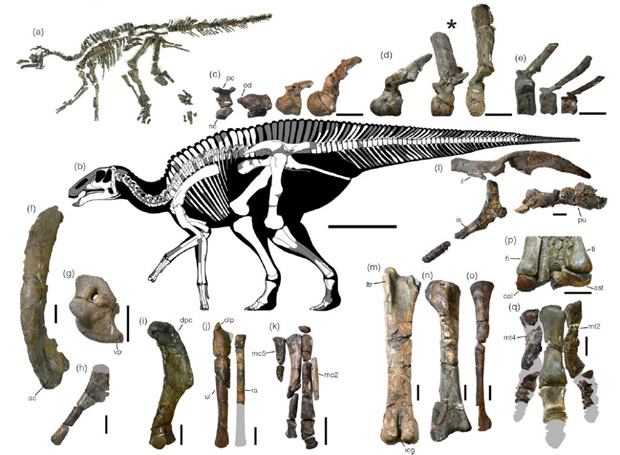
The Holotype Skeleton of Kamuysaurus

Holotype specimen of Kamuysaurus.
Holotype skeleton of Kamuysaurus japonicus (a). Reconstructed skeleton showing recovered elements in white (b).  Its unique characteristics include the anterior inclination of neural spines of the sixth to twelfth dorsal vertebrae.

Picture credit: Kobayashi Y., et al Scientific Reports

Unique Characteristics

The researchers found that Kamuysaurus has three unique characteristics that are not shared by other dinosaurs in the Edmontosaurini clade: the low position of the cranial bone notch, the short ascending process of the jaw bone, and the anterior inclination of the neural spines of the sixth to twelfth dorsal vertebrae.  The histological analysis revealed that the animal was a fully grown adult at least nine years of age and it measured 8 metres in length with a body mass of around 4,000 kilograms.

The frontal bone, a part of its skull, has a big articular facet connecting to the nasal bone, possible evidence that Kamuysaurus may have had a crest.  The crest, if it existed, is believed to resemble the thin, flat crest of Brachylophosaurus subadults, whose fossils have been unearthed in North America.

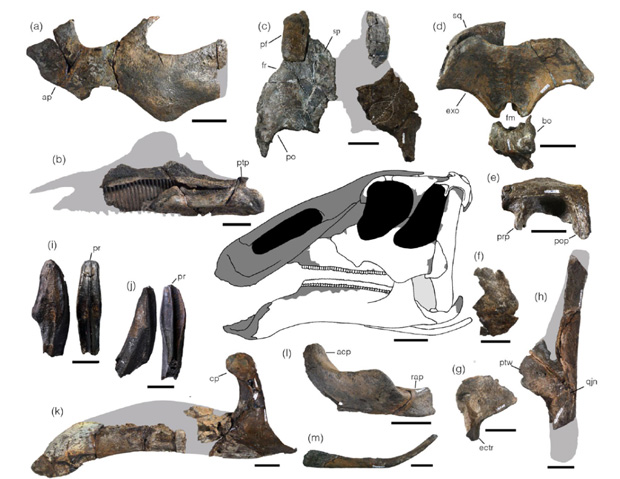
Selected Skull Elements of Kamuysaurus japonicus

Selected skull elements of Kamuysaurus.
Selected skull elements of Kamuysaurus japonicus.  Its unique characteristics include the low position of the cranial bone notch (quadratojugal notch, qjn) and the short ascending process of the jaw bone (surangular, acp)

Picture credit: Kobayashi Y., et al Scientific Reports

The Origins of the Edmontosaurini

The study also shed light on the origin of the Edmontosaurini clade and how it might have migrated.  Its latest common ancestors spread widely across Asia and North America, which were connected by what is now Alaska, allowing them to travel between the two continents.  Among them, the clade of Kamuysaurus, Kerberosaurus and Laiyangosaurus inhabited the Far East during the Campanian faunal stage, the fifth of six ages of the Late Cretaceous, before evolving independently.

CollectA have added a replica of this Japanese dinosaur to their Age of Dinosaurs model range.

The CollectA Age of Dinosaurs K. japonicus Figure

The CollectA Kamjysaurus (lateral view).
Individual scales on the flanks and along the tail can be made out and the skin folds add to the realism of the figure. Picture credit: Everything Dinosaur.

Picture credit: Everything Dinosaur

To view the CollectA prehistoric life model range: CollectA Age of Dinosaurs/Prehistoric Life Models.

Kamuysaurus a Creature of the Coast?

The research team’s analyses pointed to the possibility that ancestors of hadrosaurids and its subfamilies, Hadrosaurinae and Lambeosaurinae, preferred to inhabit areas near the ocean, suggesting the coastline environment was an important factor in the diversification of the hadrosaurids in its early evolution, especially in North America.

Everything Dinosaur acknowledges the assistance of a press release from Hokkaido University in the compilation of this article.

The “A New Hadrosaurine (Dinosauria: Hadrosauridae) from the Marine Deposits of the Late Cretaceous Hakobuchi Formation, Yezo Group, Japan” by Yoshitsugu Kobayashi, Tomohiro Nishimura, Ryuji Takasaki, Kentaro Chiba, Anthony R. Fiorillo, Kohei Tanaka, Tsogtbaatar Chinzorig, Tamaki Sato and Kazuhiko Sakurai published in the journal Scientific Reports.

The Everything Dinosaur website: Everything Dinosaur.
19 09, 2019

Saturnalia Gets Its Head Examined

By |2023-12-30T14:59:35+00:00September 19th, 2019|Categories: Dinosaur and Prehistoric Animal News Stories, Dinosaur Fans, Main Page, Photos/Pictures of Fossils|0 Comments

New Study Suggests Saturnalia Had a Small Head

The South American sauropodomorph Saturnalia (S. tupiniquim) lived some 233 million years ago.  As dinosaurs go, this 1.4 metre long animal might not be regarded as a superstar of the Dinosauria, it is not likely to be offered a starring role in any new instalment of the Jurassic Park movie franchise, but for palaeontologists, Saturnalia is a very significant dinosaur indeed.  Described twenty years ago, the skeleton of this little dinosaur demonstrates both sauropod and theropod traits and as such, any additional information gleaned about it can cause quite considerable shock waves in palaeontological circles.

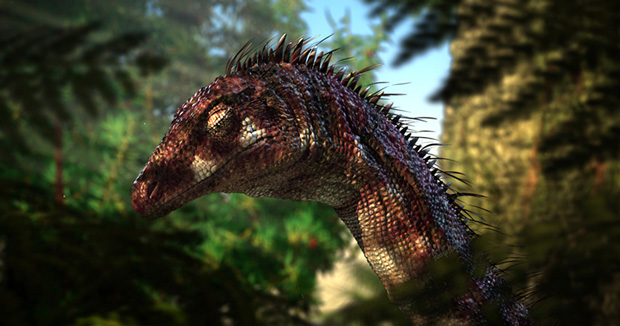
A Life Reconstruction of Saturnalia tupiniquim

A life reconstruction of Saturnalia.
New study on the skull Saturnalia suggests it had a disproportionately small head.

Picture credit: Rodolfo Nogueira

New Study Published in the Journal PLOS One

Scientists from the Universidade de São Paulo in collaboration with a colleague from the Universidade Federal de Santa Maria have published a new study of the skull shape and size of Saturnalia in the on-line academic journal PLOS One.  The research team conclude that Saturnalia had a skull less than 10 centimetres in length, quite small in relation to the size of the animal.  Because it had a long neck and a small, lightweight skull, Saturnalia may have been able to move its head very quickly, helping it to secure tiny, elusive prey.  This idea is also supported by a study of the teeth of this dinosaur and brain shape inferred from an analysis of the skull bones.

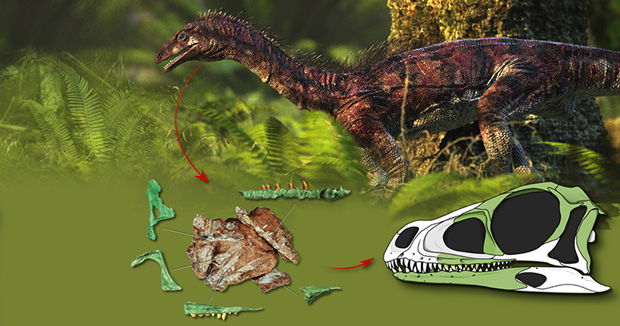
The Skull of Saturnalia

Analysing the skull of Saturnalia.
The skull of Saturnalia was examined using computerised tomography.  The picture shows the skull elements that were subjected to the CT scan and a line drawing shows a lateral view of the proposed skull of Saturnalia (known fossil elements in green).

Picture credit: Rodolfo Nogueira

Saturnalia with a Reduced Skull

Computerised microtomography was used to assess the shape and structure of the delicate skull fossils still entombed inside their rock matrix.  This non-destructive technique enabled the research team to reconstruct the skull of this dinosaur and to identify the reduced skull.

One of the authors of the scientific paper, Mario Bronzati, postdoctoral fellow at the Department of Biology at the Ribeirão Preto School of Philosophy, Sciences and Letters (Universidade de São Paulo, Brazil) commented:

“It was very difficult to remove the fossil from the sediment in which it was trapped.  Doing so in the traditional way by scraping the sediment could break these bones because they were so fragile.”

Although numerous papers on Saturnalia tupiniquim have been published, little was known about the morphology of the skull.  The three-dimensional images that were created as a result of this analysis provided the researchers with the opportunity to study the head of this dinosaur in detail and the reconstruct the skull of this Late Triassic dinosaur.

A Diagram Showing the Skull of Saturnalia

Saturnalia skull diagram.
A diagram of the skull of Saturnalia (lateral view and dorsal view).

Picture credit: PLOS One

Studying the Skull of Saturnalia

The skull is disproportionately small when compared to the size of the dinosaur’s body.  It is thought that Saturnalia was carnivorous, eating small prey items  such as lizards, mammals and insects, but the consumption of plants cannot be ruled out.  The reduced skull is a characteristic of the Sauropodomorpha lineage and demonstrated in later sauropods such as Diplodocus and Brachiosaurus.  The specialisation of the skull and neck of Saturnalia has implications for the evolution of these lizard-hipped dinosaurs as later forms became entirely herbivorous.

Skull reduction significantly reduced the biomechanical contraints for the development of long necks, in turn, longer necks permitted access to food resources that were unreachable for other plant-eating dinosaurs.  This would have helped to provide a competitive advantage and might explain why later sauropods grew to such large sizes.  Thus, the idea that skull reduction was first acquired in a likely predatory member of the sauropodomorph lineage (i.e. Saturnalia) implies a scenario where a trait related to one habit (faunivory) was crucial for the evolution of a completely different lifestyle (herbivory) in a subsequently different selection regime.

Visit the Everything Dinosaur website: The Everything Dinosaur Website.

15 09, 2019

Protodontopteryx ruthae – Toothed Terror of the Waipara Greensand

By |2023-12-30T09:19:26+00:00September 15th, 2019|Categories: Dinosaur and Prehistoric Animal News Stories, Main Page, Palaeontological articles, Photos/Pictures of Fossils|0 Comments

Scientists discover one of the oldest “toothed” bird species in the Waipara Greensands

The remarkable fossil site located on the banks of the Waipara River north of the town of Canterbury on New Zealand’s South Island has provided palaeontologists with an amazing record of life during the Palaeocene Epoch, when the climate of New Zealand was very different than it is today.

Protodontopteryx ruthae

Soaring above the tropical coastline some 62 million years ago was a gull-sized, bony-toothed bird which has been named Protodontopteryx ruthae.  Classified as a member of the Pelagornithidae, a family of huge seafaring birds, characterised by bony outgrowths along their jaws that served as teeth, the discovery of Protodontopteryx suggests that these birds originated in the Southern Hemisphere and not in the Northern Hemisphere as previously thought.

A Life Reconstruction of the Newly Described Pelagornithid Protodontopteryx ruthae

Life reconstruction of Protodontopteryx.
Protodontopteryx life reconstruction.  A flock of Protodontopteryx flies over a pair of prehistoric penguins.  Both types of bird are believed to have fed on fish.

Picture credit: Derek Onley

The Oldest and Smallest Member of the Pelagornithidae to be Described

Writing in the journal “Papers in Palaeontology”, the research team, which included scientists from Canterbury Museum, describe Protodontopteryx which is oldest member of the Pelagornithidae to be described to date.  It is one of the oldest named Neornithes (modern birds), known to science.

Examining the Fossil Remains of P. ruthae

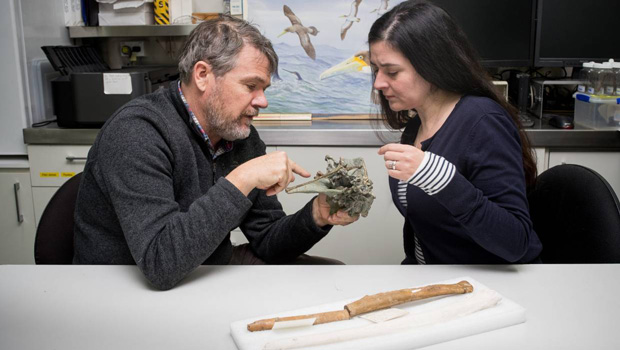
Examing the Protodontopteryx fossil at Canterbury Museum.
Curators at Canterbury Museum and co-authors of the scientific paper, Dr Paul Scofield (left) and Dr Vanesa De Pietri (right) examine the Protodontopteryx fossil in a laboratory.

Picture credit: Canterbury Museum

While its descendants were some of the biggest flying birds ever, with wingspans of more than 5 metres, Protodontopteryx was only the size of an average gull.  Like other members of its family, the seabird had bony, tooth-like projections on the edge of its beak.

Its discovery provides further evidence of the remarkable biota that existed in this part of the world just a few million years after the Cretaceous mass extinction event that saw the demise of the non-avian dinosaurs.  Recently, Everything Dinosaur team members blogged about another bird fossil excavated from the Waipara Greensand, a giant 1.6 metre high prehistoric penguin: Monster Penquin from the Palaeocene of New Zealand.

Discovered in 2018

Amateur palaeontologist Leigh Love found the partial Protodontopteryx skeleton last year at the Waipara Greensand fossil site.  The bird was named Protodontopteryx ruthae after Love’s wife Ruth, a token of his appreciation for her tolerance and support as he pursued his decades-long passion for fossil collecting.  Fellow amateur Alan Mannering prepared the bones, and a team comprising Love, Mannering, Canterbury Museum Curators Dr Paul Scofield and Dr Vanesa De Pietri and Dr Gerald Mayr (Senckenberg Research Institute and Natural History Museum in Frankfurt, Germany), described Protodontopteryx.

Commenting on the implications regarding the likely origin of pelagornithids Dr Scofield stated:

“While this bird was relatively small, the impact of its discovery is hugely significant in our understanding of this family.  Until we found this skeleton, all the really old pelagornithids had been found in the Northern Hemisphere, so everyone thought they’d evolved up there.  New Zealand was a very different place when Protodontopteryx were in the skies.  It had a tropical climate – the sea temperature was about twenty-five degrees [Celsius] so we had corals and giant turtles.”

An Unexpected Discovery

Dr Mayr added that the discovery was:

“Truly amazing and unexpected.  Not only is the fossil one of the most complete specimens of a pseudotoothed bird, but it also shows a number of unexpected skeletal features that contribute to a better understanding of the evolution of these enigmatic birds.”

Later pelagornithid species evolved to soar over oceans with some species having wingspans in excess of six metres.  Protodontopteryx’s skeleton suggests it was less suited for long-distance soaring than later pelagornithids and probably covered much shorter ranges.  Its short, broad pseudoteeth were likely designed for catching fish.  Later species had needle-like pseudoteeth which were likely used to catch soft-bodied prey like squid.

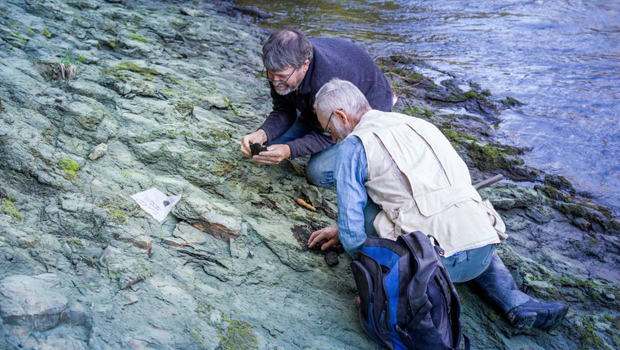
The Fossil Site where the Remains of Protodontopteryx was Discovered

Research team members at the site of the fossil discovery.
Paul Scofield and amateur palaeontologist Leigh Love examine a section of riverbank on the Waipara River, near where the Protodontopteryx fossil was found.

Picture credit: Canterbury Museum

Dr De Pietri added:

“Protodontopteryx was less adapted to sustained soaring than other known pelagornithids, we can now say that pseudoteeth evolved before these birds became highly specialised gliders.”

Protodontopteryx ruthae a Basa; Pelagornithid

These types of bird once dominated the oceans of the world, but the last of their kind died out some 2.5 million years ago.  A number of fossil discoveries from the remarkable Waipara Greensand will be put on display at Canterbury Museum, in a new exhibition tracing the evolutionary history of the fauna and flora of New Zealand.  The exhibition is due to open later this year.

Everything Dinosaur acknowledges the assistance of a press release from Canterbury Museum in the compilation of this article.

The scientific paper: “Oldest, Smallest And Phylogenetically Most Basal Pelagornithid, From The Early Paleocene Of New Zealand, Sheds Light On The Evolutionary History Of The Largest Flying Birds” by Gerald Mayr, Vanesa L. De Pietri, Leigh Love, Al Mannering and R Paul Scofield published in Papers in Palaeontology.

Visit the Everything Dinosaur website: Everything Dinosaur.
Go to Top