All about dinosaurs, fossils and prehistoric animals by Everything Dinosaur team members.

About Mike

Mike runs Everything Dinosaur, a UK-based mail order company specialising in the sale of dinosaur and prehistoric animal models, He works alongside Sue, and between them they have become the "go to guys" for museum quality prehistoric animal models and figures. An avid fossil collector and reader of dinosaur books, Mike researchers and writes articles about palaeontology, fossil discoveries, research and of course, dinosaur and prehistoric animal models.
24 01, 2022

The Muscles of Thecodontosaurus Provide Clue to Super-sized Sauropods

By |2024-10-15T16:53:56+01:00January 24th, 2022|Categories: Dinosaur and Prehistoric Animal News Stories, Dinosaur Fans, Main Page, Palaeontological articles, Photos/Pictures of Fossils|0 Comments

New research into the musculature of the early sauropodomorph Thecodontosaurus antiquus has helped scientists to understand the evolutionary transition from agile bipeds to super-sized quadrupedal sauropods. Writing in the open-access, on-line journal “Royal Society Open Science”, scientists from the University of Bristol have reconstructed the limb musculature of Thecodontosaurus. Their reconstruction shows that this Late Triassic dinosaur was an agile, biped but it already had some anatomical adaptations which would permit its descendants to grow to huge sizes.

Thecodontosaurus study.

Thecodontosaurus fossil block with life reconstruction in the background. Picture credit: Simon Powell/University of Bristol.

Picture credit: Simon Powell/University of Bristol

Bristol’s Dinosaur

Thecodontosaurus (T. antiquus) fossils are known from Upper Triassic rocks exposed around the city of Bristol in England. During the Late Triassic, this region consisted of an archipelago surrounded by a warm tropical sea. Hundreds of fragmentary fossils representing many individuals are known, most of these fossils are housed at the Bristol City Museum and Art Gallery. Thecodontosaurus is believed to have measured up to 2.5 metres in length, however, its long, thin tail made up more than 50% of its entire body length.

It weighed around twenty kilograms, but it was part of the Sauropodomorpha clade of lizard-hipped dinosaurs that were to evolve into giants during the Jurassic and Cretaceous. Famous dinosaurs such as Diplodocus and Brachiosaurus from the Jurassic as well as Cretaceous leviathans such as Patagotitan and Alamosaurus.

Thecodontosaurus

Thecodontosaurus was the first Triassic genus of dinosaur to be named and described (1836).

Thecodontosaurus limb muscles

Researchers have examined tell-tale muscle scars associated with Thecodontosaurus limb bones to reconstruct the musculature of this Late Triassic dinosaur. Picture credit: Gabriel Ugueto.

Picture credit: Gabriel Ugueto

Lead author of the paper, PhD student at the University of Bristol Antonio Ballell commented:

“The University of Bristol houses a huge collection of beautifully preserved Thecodontosaurus fossils that were discovered around Bristol. The amazing thing about these fossilised bones is that many preserve the scars and rugosities that the limb musculature left on them with its attachment.”

These features on the bones permit palaeontologists to infer the shape, size and anatomical position of the musculature of the animal. For example, the muscles associated with the limbs can be reconstructed and the dinosaur’s anatomy can be further refined by comparing the computer models generated with the anatomy of extant relatives such as crocodiles and birds.

Co-author of the study Professor Emily Rayfield (University of Bristol), added:

“These kinds of muscular reconstructions are fundamental to understand functional aspects of the life of extinct organisms. We can use this information to simulate how these animals walked and ran with computational tools.”

Palaeontologists Continuing to Learn from Thecodontosaurus Fossils

Thecodontosaurus was one of the first dinosaurs to be formally named and described but palaeontologists can still learn a lot from its fossils. For example, thanks to the considerable volume of T. antiquus material, the research team were able to build the entire forelimb and hindlimb musculature. This is the first time scientists have been able to reconstruct the limb musculature of an early-branching sauropodomorph.

The analysis of the limb muscles of T. antiquus confirm that it was a fast-running, agile biped. The forelimbs were probably not used in locomotion but were very effective at grasping objects such as potential prey. The anatomy of the lithe Thecodontosaurus is in stark contrast to the later sauropods which became obligate quadrupeds.

The researchers determined that key traits of later sauropod-line dinosaurs had already evolved in this early genus.

“From an evolutionary perspective, our study adds more pieces to the puzzle of how the locomotion and posture changed during the evolution of dinosaurs and in the line to the giant sauropods. How were limb muscles modified in the evolution of multi-ton quadrupeds from tiny bipeds? Reconstructing the limb muscles of Thecodontosaurus gives us new information of the early stages of that important evolutionary transition.”

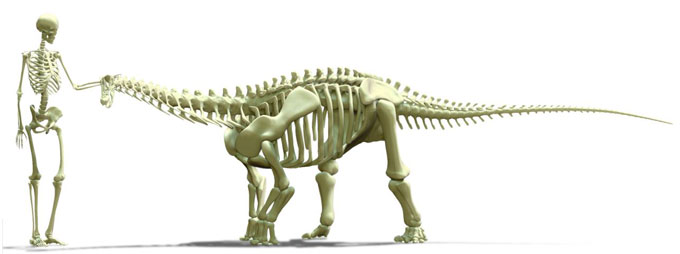
Patagotitan skeleton on display at the London Natural History Museum.

The enormous body of the titanosaur dwarfs visitors. Picture credit: Everything Dinosaur.

Picture credit: Everything Dinosaur

Everything Dinosaur acknowledges the assistance of a media release from the University of Bristol in the compilation of this article.

The scientific paper: “Walking with early dinosaurs: appendicular myology of the Late Triassic sauropodomorph Thecodontosaurus antiquus” by Antonio Ballell, Emily J. Rayfield and Michael J. Benton published in Royal Society Open Science.

Visit the Everything Dinosaur website: Everything Dinosaur.

23 01, 2022

New Prehistoric Times Issue 140 Reviewed

By |2024-10-15T16:48:11+01:00January 23rd, 2022|Categories: Adobe CS5, Dinosaur and Prehistoric Animal Drawings, Dinosaur Fans, Magazine Reviews, Main Page|0 Comments

The winter edition (issue 140) of “Prehistoric Times” is a bumper issue with over 60 pages crammed full of articles, features and illustrations. Talented artist Mark Hallett provides the front cover for the magazine, an illustration entitled “Predator’s Moon”. It features a bear-dog (Amphicyon lydekkeri) crunching on some bones. Mark provides a guide to the bear-dogs inside and provides more artwork on these enigmatic mammals.

Collectors of “Prehistoric Times” will recall that Mark also provided the artwork for the front cover of issue 138 (Neanderthal woman).

Issue 140 of Prehistoric Times

Prehistoric Times issue 140 (winter 2022) the front cover illustration by Mark Hallett.

Picture credit: Mark Hallett

Neovenator and Megalictis

Phil Hore provides articles for the featured prehistoric animals in this issue. There is a piece on the Lower Cretaceous theropod from England – Neovenator (N. salerii), its inclusion ties in well with the palaeo news section, as lots of British research and English dinosaur discoveries are reported. There is also a special feature on the ferocious North American mustelid Megalictis with lots of reader artwork incorporated into it.

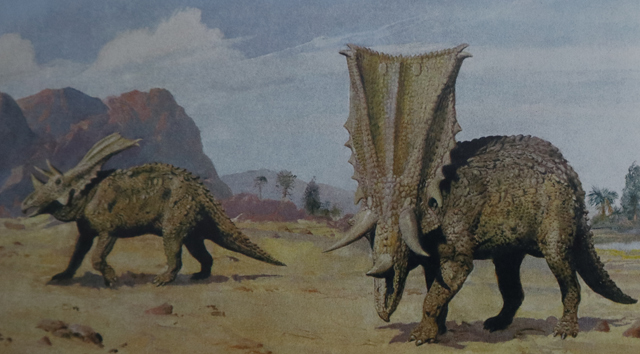
Jon Lavas continues his long-running history of the work of renowned Czech artist Zdeněk Burian. In issue 140, the focus is on Burian’s illustrations of ceratopsians and there are some truly iconic illustrations provided.

Styracosaurus illustration (Burian 1941).

The classical depiction of Styracosaurus albertensis by Burian (1941). The illustration depicts two horned dinosaurs emerging into a clearing. This image has inspired many other artists and box art packaging designers. Picture credit J. R. Lavas.

Picture credit J. R. Lavas

Tracy Lee Ford contributes part 2 of his in-depth analysis of dinosaur integumentary coverings (feathers). It includes a glossary of scientific terms and some beautifully detailed illustrations. On the subject of beautiful illustrations, palaeoartist Emily Willoughby is interviewed and the article includes an array of stunning images depicting feathered dinosaurs.

Randy Knol profiles some of the latest prehistoric animal model releases and magazine editor Mike Fredericks has been kept busy with new models and reviews of the latest books. Take a look at the “Mesozoic Media” section of the magazine, it includes a review of “Dinopedia: A Brief Compendium of Dinosaur Lore” by Tetrapod Zoology author Darren Naish from the University of Southampton.

The review concludes by stating that this book is “highly recommended as a handy reference guide for all your dinosaur questions.”

Dinopedia front cover illustration

The front cover of Dinopedia features a horned dinosaur. Picture credit: Everything Dinosaur.

Picture credit: Everything Dinosaur

Visit the award-winning Everything Dinosaur website: Dinosaur Models.

Prehistoric Coins, 3-D Printed Dinosaurs and “The Beast of Busco”

The magazine contains an article discussing the history of prehistoric animals depicted on coins written by Brian Novak. Model maker Sean Kotz provides a step-by-step guide to creating a unique Neovenator model from a 3-D print and Matt Howard provides an entertaining account of the giant turtle nicknamed “The Beast of Busco”.

There is some wonderful reader submitted artwork, special mentions to Samuel Pickens and John Sibbick for their Neovenator illustrations, for M. Elliot Massion for the Megalictis grabbing a goose as well as the Neovenator lurking behind a teapot. The Woolly Rhino painting by Jacek Major and the Edmontosaurus annectens by Sergey Krasovskiy are also impressive.

Pastorama Dimetrodon image

There is a lot to get your teeth into when examining the latest edition of “Prehistoric Times” issue 140. This black and white photograph is from an article that looks at the World’s Fair. Picture credit: Don Glut.

Picture credit: Don Glut

There is a lot to praise in the latest issue of “Prehistoric Times”.

To learn more about this magazine and to subscribe: “Prehistoric Times”.

22 01, 2022

Preparing for a New Nothosaurus

By |2024-10-14T13:25:30+01:00January 22nd, 2022|Categories: Adobe CS5, Dinosaur and Prehistoric Animal Drawings, Dinosaur Fans, Everything Dinosaur News and Updates, Everything Dinosaur Products, Main Page, Press Releases|0 Comments

The new for 2022 Schleich Nothosaurus model will soon be in stock at Everything Dinosaur and team members have been busy preparing a fact sheet all about this Triassic marine reptile. We research and write an information sheet on virtually every prehistoric animal model that we stock. The Nothosaurus fact sheet will be sent out with our sales of the Schleich model.

Schleich Nothosaurus model

The new for 2022 Schleich Nothosaurus marine reptile model.

Several Species of Nothosaurus Have Been Described

Several species of Nothosaurus have been named and scientifically described, although the taxonomy and exact composition of this genus is still debated. The type species, is N. mirabilis, named from fossils found in Middle Triassic rocks from Germany. It is estimated to have been up to four metres in length, although it shared its marine habitat with considerably larger nothosaurs such as Nothosaurus giganteus, which like the recently described Nothosaurus zhangi (2014), from China may have reached lengths of around seven metres, making these fish-eaters from the Triassic bigger than an extant Saltwater crocodile (C. porosus).

Nothosaurus drawing.

The illustration of Nothosaurus commissioned by Everything Dinosaur for use in the company’s Nothosaurus fact sheet. Picture credit: Everything Dinosaur.

Picture credit: Everything Dinosaur

A spokesperson from Everything Dinosaur commented:

“The Nothosaurus fact sheet will be sent out with the new Schleich model. Collectors will be aware that there is a small, blue nothosaur figure included in the Wild Safari Prehistoric World prehistoric sea life toob, but it is still great to see another replica of this important Triassic marine reptile incorporated within a manufacturer’s model range. We congratulate Schleich for introducing this figure. It is the only non-dinosaur model announced by Schleich for 2022 in their Dinosaurier range.”

Nothosaurus scale drawing.

Nothosaurus scale drawing. The largest nothosaurs are estimated to have measured around 4 metres in length. Picture credit: Everything Dinosaur.

Picture credit: Everything Dinosaur

A Piscivore

The jaws were lined with forward projecting and interlocking needle-sharp teeth, ideal for catching slippery prey such as small fish, although larger individuals may have hunted smaller marine reptiles.

Schleich Nothosaurus

The Schleich Nothosaurus marine reptile model with (top) a close-up view of the head.

The Schleich Nothosaurus model is due into stock at Everything Dinosaur shortly (January 2022), to view the range of Schleich models and figures available from Everything Dinosaur: Schleich Dinosaurs.

A Nothosaurus Model

A spokesperson for the UK-based mail order company stated that they were delighted to see this marine reptile model added to the Schleich portfolio.

The spokesperson added:

“This new figure will help children to understand the diversity of marine reptiles that lived during the Mesozoic.  We congratulate Schleich for introducing a Nothosaurus model.”

Visit the award-winning Everything Dinosaur website: Dinosaur Toys and Gifts.

21 01, 2022

Adding Exclusive Videos to our Website

By |2024-10-14T12:45:17+01:00January 21st, 2022|Categories: Adobe CS5, Dinosaur Fans, Everything Dinosaur News and Updates, Everything Dinosaur Products, Everything Dinosaur videos, Main Page, Photos of Everything Dinosaur Products, Press Releases|0 Comments

The Everything Dinosaur website is being constantly updated.

Everything Dinosaur team members conduct regular reviews of our website: Everything Dinosaur.

Our website has been praised for its ease of use, visitors find it easy to navigate and it is designed to be very customer friendly. However, we do not intend to rest on our laurels and as we believe in continuous improvement, we are working with our IT specialists and top consultants to provide an even greater customer experience.

One of the things we are testing is the addition of short product videos to our website. We already provide lots of images of the prehistoric animal themed items that we sell, but a video showcasing the product can often help customers to understand the model better. For example, we can show articulated jaws, flexible tails and poseable arms. If a video shows a team member holding the figure, then viewers can instantly get an idea of the model’s size.

Everything Dinosaur YouTube video showcase.

Everything Dinosaur’s YouTube channel will include more short product videos, each one less than a minute in length that will highlight product features and showcase the prehistoric animal figure. Picture credit: Everything Dinosaur.

Picture credit: Everything Dinosaur

Improving an Award-winning Website

This month (January 2022), Everything Dinosaur was awarded the Feefo Platinum Trusted Service award, the highest accolade for customer service. The company’s commitment to helping customers is at the very heart of our business and creating videos of products we sell should help to inform and to educate our website visitors.

Visit the award-winning website: Everything Dinosaur.

We want to provide showcases for the range of prehistoric animal models that we stock. Actual footage of the replica shot by us. Shortly, we will post up a video that looks at the Rebor Smilodon populator Stray Cat in the plain colour variant and we would like your views. The video will be up in a couple of days – we would love to hear what you think of this method of showcasing prehistoric animal models.

Rebor Smilodon populator showcase video.

The Rebor Smilodon populator 1/11th scale model is the subject of our pilot video in our “video showcase” project. Picture credit: Everything Dinosaur.

Picture credit: Everything Dinosaur

Commenting on the Proposed Everything Dinosaur Website Developments

A spokesperson from Everything Dinosaur commented:

“Unlike many companies, which do not physically stock items but rely on them being despatched to customers from China, we actually bring prehistoric animal models into our own warehouse. We have access to the replicas and we can shoot videos using the actual models rather than just relying on images that the manufacturer sends out. We can then give our customers much more visual information about a particular product and produce videos that show the figure from every angle.”

YouTube subscribers will be given the opportunity to have an exclusive first view of the Rebor Smilodon video. Team members at Everything Dinosaur will be asking for feedback and comments prior to the video going live on the Everything Dinosaur website.

To subscribe to Everything Dinosaur on YouTube: Subscribe to Everything Dinosaur on YouTube.

View the range of Rebor models and figures in stock: Rebor Figures.

20 01, 2022

New Schleich Amargasaurus Model

By |2024-10-14T12:37:29+01:00January 20th, 2022|Categories: Adobe CS5, Dinosaur Fans, Everything Dinosaur News and Updates, Everything Dinosaur Products, Main Page, Photos of Everything Dinosaur Products, Press Releases|0 Comments

The new for 2022 Schleich Amargasaurus dinosaur model has arrived at our warehouse and is now in stock at Everything Dinosaur. This is the first of five new prehistoric animal figures from Schleich expected to arrive and it is a fantastic figure of a South American sauropod.

Schleich Amargasaurus dinosaur model

The model measures around 25.5 cm long, the head is approximately 7 cm off the ground and the height of the neural spines on the neck is around 10.5 cm.

An Impressive Size for a South American Sauropod

The figure is considerably chunkier than other Amargasaurus replicas and like many Schleich models it is pleasing to handle and quite tactile. No doubt this figure will prove popular in creative and imaginative play. The model measures around 25.5 cm in length, although because of the slight bend in the tail the figure is actually a little bigger. The head is approximately 7 cm off the ground and that magnificent double line of neural spines, complete with the thin flap of skin running between the spines is around 10.5 cm high.

As with other members of the Dicraeosauridae family of sauropods the external nares (nostrils), were located on the top of the skull. It is pleasing to note that the Schleich Amargasaurus dinosaur model reflects this anatomical feature found in the actual fossil material.

Close-up view of the Schleich Amargasaurus dinosaur model

A close-up view of the new for 2022 Schleich Amargasaurus model. A stunning model of a sauropod from South America.

In Stock at Everything Dinosaur

Team members have been busy checking over the models, before booking them into stock and allocating them a bay in our warehouse. Whilst examining the figures, discussion turned to the correct term that would be applied to describe a herd of these Early Cretaceous dinosaurs. We are not sure whether a collective noun for a group of Amargasaurus dinosaurs has ever been coined. As the original scientific paper was written in Spanish, perhaps a word from this language to describe a group of these long-necked dinosaurs might be appropriate.

Could a group of amargasaurs be described as an ensamblaje (assemblage)?

Schleich Amargasaurus dinosaur models

We are not sure what the collective noun is for a group of Amargasaurus dinosaur models. Some of the recently arrived Schleich Amargasaurus dinosaur models are set aside ready for checking over before they are added to the stock. Picture credit: Everything Dinosaur.

Picture credit: Everything Dinosaur

To view the range of Schleich models and figures in stock at Everything Dinosaur: Schleich Dinosaurs.

Visit the user-friendly Everything Dinosaur website: Dinosaur Toys.

19 01, 2022

Everything Dinosaur Receives the Special Feefo Platinum Trusted Service Award

By |2024-10-14T12:26:19+01:00January 19th, 2022|Categories: Adobe CS5, Dinosaur Fans, Everything Dinosaur News and Updates, Main Page, Press Releases, Product Reviews|0 Comments

Everything Dinosaur has won the Feefo Platinum Trusted Service award. This is the third year that this top award has been given by Feefo and Everything Dinosaur has won it three years in a row.

The Trusted Service Awards are unique as they are based purely on feedback from real customers. This means they are a true reflection of commitment to outstanding customer service. The Platinum Trusted Service award is the highest accolade that can be awarded to a company by Feefo.

Everything Dinosaur wins award.

Everything Dinosaur is a Trusted Service Awards winner!

Outstanding Customer Service

Feefo have given Platinum Trusted Service awards to businesses who have achieved Gold standard for three consecutive years. To receive a Gold Trusted Service award, businesses must have collected at least 50 reviews with a Feefo service rating of between 4.5 and 4.9 between 1st January 2021 and 31st December 2021.

Everything Dinosaur have received a certificate to commemorate this fantastic achievement, an award earned when businesses were under extraordinary pressure due to the problems caused by the COVID-19 pandemic.

Everything Dinosaur wins the Platinum Trusted Service Award

Everything Dinosaur’s certificate confirming the Platinum Trusted Service Award.

A spokesperson from Everything Dinosaur commented:

“We are very pleased to have received this award from Feefo. This accolade reflects our commitment to our customers and it also recognises how hard we have been working in exceptionally difficult circumstances.”

Feefo 2022 Awards.

Everything Dinosaur wins the Platinum Service Award.

Congratulating Everything Dinosaur on their continued success, Kim Burgess, (Head of Customer Success at Feefo), stated:

“The Trusted Service Awards recognise companies who go above and beyond to provide the very best customer experience. I’m so impressed by how our customers have overcome the challenges of the past two years. Particular congratulations to our Platinum Trusted Service winners. It’s an extremely tough challenge.”

Everything Dinosaur would like to thank all of those thousands of customers who have left a Feefo review about us. We read them all and we are truly humbled to have been honoured in this way.

Our thanks to you all.

The award-winning Everything Dinosaur website: Dinosaur Toys.

18 01, 2022

Menucocelsior arriagadai – from Southern Argentina

By |2024-10-14T12:21:48+01:00January 18th, 2022|Categories: Adobe CS5, Dinosaur and Prehistoric Animal News Stories, Dinosaur Fans, Main Page, Photos/Pictures of Fossils|0 Comments

Scientists writing this month in the journal “Cretaceous Research” have formally described a new genus of Late Cretaceous titanosaur from Patagonia. The dinosaur has been named Menucocelsior arriagadai based on a series of tail bones (caudal vertebrae) and fragmentary limb bones including a right humerus and a left fibula, found in sediments associated with the Allen Formation (Maastrichtian stage of the Upper Cretaceous).

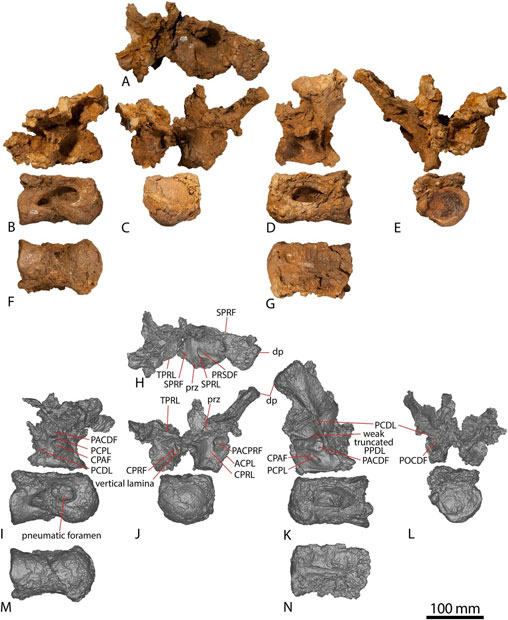
Views of Menucocelsior arriagadai tail bones.

Views of Menucocelsior arriagadai tail bones. Autapomorphies in the caudal vertebrae permitted the erection of a new titanosaur genus. Picture credit: Rolando et al.

A Titanosaur that “Jumped the Gun”

The announcement concerning the naming of a new titanosaur genus was made last year (2021), Menucocelsior was one of several new titanosaur genera named in 2021. However, the formal, scientific paper that erected the genus was published this month in the January edition of “Cretaceous Research”.

To read Everything Dinosaur’s article from December 2021 that outlined the new titanosaurs named and described over the previous twelve months: New Titanosaur Species Described from South America – Arrudatitan.

Menucocelsior arriagadai scale drawing.

A scale drawing of M. arriagadai. Although only known from caudal vertebrae a size estimate has been made based on more complete and better known South American titanosaurs. It is estimated that Menucocelsior arriagadai measured around 8-10 metres in length. Picture credit: Everything Dinosaur.

Picture credit: Everything Dinosaur

A Late Cretaceous Titanosaur Paradise

Although only known from very incomplete and fragmentary material, the fossilised remains assigned to M. arriagadai do not demonstrate a close taxonomic relationship with any other, previously described titanosaur. The site where the fossils were found Salitral Ojo de Agua in Río Negro Province has also yielded the fossilised bones of at least three other species of titanosaurs and other contemporary fossil sites in the Allen Formation have provided evidence of numerous other titanosaurs along with hadrosaurs.

Researchers have concluded that the environment must have been extremely productive to support such a large number of mega herbivores. It has been proposed that the titanosaurs evolved different feeding strategies to avoid excessive competition for food resources (niche partitioning). Perhaps these animals were selective browsers, specialising in feeding from the branches of trees, whilst the hadrosaurs were bulk-feeders, targeting ground vegetation.

The genus name is derived from the indigenous Mapuche language for a large watering hole, which describes the fossil site. The specific or trivial name honours the Arriagada family, the owners of the land where the fossils were found.

The scientific paper: “The sauropod record of Salitral Ojo del Agua: An Upper Cretaceous (Allen Formation) fossiliferous locality from northern Patagonia, Argentina” by Mauro Aranciaga Rolando, Jordi A. García Marsà, Federico L. Agnolín, Matías J. Motta, Sebastián Rozadilla, and Fernando E. Novas published in Cretaceous Research.

17 01, 2022

PNSO to Introduce a New Styracosaurus Model

By |2024-10-14T12:14:17+01:00January 17th, 2022|Categories: Dinosaur Fans, Everything Dinosaur News and Updates, Everything Dinosaur Products, Main Page, Press Releases|0 Comments

PNSO will be adding a replica of the horned dinosaur Styracosaurus to their mid-size model range. The figure should be in stock at Everything Dinosaur in March (2022). The PNSO Anthony the Styracosaurus model is another member of the Centrosaurinae subfamily of horned dinosaurs to be added to the PNSO portfolio. The Styracosaurus joins Jennie the Centrosaurus, Brian the Pachyrhinosaurus, Perez the Machairoceratops and A-Qi the Sinoceratops.

PNSO Anthony the Styracosaurus

The spectacular PNSO Styracosaurus dinosaur model is expected to be in stock at Everything Dinosaur in March 2021.

Styracosaurus albertensis

Named and scientifically described by the famous Canadian palaeontologist Lawrence Lambe in 1913, Styracosaurus with its stunning array of spikes and its single, large nose horn is regarded as one of the most spectacular dinosaurs known to science. Model fans and collectors will be excited to see the figure.

PNSO Anthony the Styracosaurus (anterior view)

The PNSO Anthony the Styracosaurus (anterior view).

PNSO Anthony the Styracosaurus Dinosaur Model

Whilst PNSO does not normally state a scale for the figures in their mid-size model range, an approximate scale for this dinosaur model can be calculated. The model measures 18 cm long from the end of its tail to the tip of its snout. Size estimates vary for S. albertensis, but fully grown adults are thought to have measured around 5.5 metres in length. Based on these measurements, team members at Everything Dinosaur have postulated that this model’s scale is approximately 1:30.

PNSO Anthony the Styracosaurus model measurements

The Styracosaurus model measures 18 cm long and the tips of those impressive head shield spikes are around 10 cm off the ground.

Posters, Booklet and a QR Code

The PNSO Anthony the Styracosaurus model will be supplied with a full-colour, 64-page booklet as well as posters. A QR code on the product packaging links to a brief video that outlines how the figure was developed. The posters and booklet help to highlight the fabulous artwork of the very talented Chinese palaeoartist Zhao Chuang.

PNSO Anthony the Styracosaurus

The new for 2022 PNSO Styracosaurus model is supplied with a 64-page full, colour booklet, posters and a QR code that once scanned directs you to a short video that explains how the model was made.

A Spectacular Dinosaur Model

Commenting on the introduction of the spectacular Styracosaurus dinosaur model, a spokesperson from Everything Dinosaur stated that PNSO had rapidly built an excellent reputation for making beautiful horned dinosaur models.

The spokesperson added:

“This is a very welcome addition to the PNSO horned dinosaurs model range.  We looking forward to bringing this Styracosaurus figure into stock.”

Visit the Everything Dinosaur website: Dinosaur Toys and Models.

PNSO Anthony the Styracosaurus model.

The PNSO Anthony the Styracosaurus dinosaur model depicted in dorsal view.

To view the range of PNSO dinosaur and prehistoric animal models in stock at Everything Dinosaur: PNSO Age of Dinosaurs Models and Figures.

16 01, 2022

Dating the Mammal Tree of Life

By |2024-10-14T12:06:57+01:00January 16th, 2022|Categories: Animal News Stories, Dinosaur and Prehistoric Animal News Stories, Dinosaur Fans, Main Page, Palaeontological articles|0 Comments

Recently published research has answered an important question regarding the timing of the evolutionary origins of modern types of placental mammals such as the Carnivora, the rodents and the primates. Once the non-avian dinosaurs vanished some 66 million years ago, placental mammals rapidly evolved and diversified to fill many of the niches in ecosystems vacated by the extinct members of the Dinosauria.  Researchers have shed light on the tree of life.

Researching the Mammalian Tree of Life

The research team who included scientists from Queen Mary University of London, Cambridge University, University College London, the University of Bristol and Imperial College London used a new and fast Bayesian statistical approach to plot the timeline of mammal evolution. The data generated confirms the hypothesis that although the first placental mammals evolved in the Mesozoic, it was only after the KPg extinction event that marked the end of this Era and the beginning of the Cenozoic, some 66 million years ago, that the ancestors of today’s modern placental mammal groups evolved.

Mammal tree of life.

The research team used a new and rapid Bayesian statistical approach to plot the timeline of mammal evolution. The data generated confirms the hypothesis that although the first placental mammals evolved in the Mesozoic, it was only after the KPg extinction event that marked the end of this Era and the beginning of the Cenozoic, that the ancestors of today’s modern placental mammal groups evolved. Picture credit: Mario dos Reis Barros and Sandra Alvarez-Carretero.

Picture credit: Mario dos Reis Barros and Sandra Alvarez-Carretero

Analysing the Mammalian Genomic Dataset

Writing in the academic journal “Nature”, the scientists used a novel Bayesian statistical method to analyse an enormous mammal genomic dataset, in a bid to plot more precisely the timeline of the evolution of modern mammals. They conclude that the ancestors of these modern groups postdate the KPg extinction event.

The Bayesian analysis had to be robust, not only to handle the genetic data from almost 5,000 mammal species and 72 complete genomes but also to accommodate and account for uncertainties within the huge amount of data being processed.

Tracing the Mammal Family Tree

Tracing the mammalian family tree. Picture credit: Luo Laboratory.

Picture credit: Luo Laboratory

Tackling a Contentious Topic in Evolutionary Biology

Commentating on the significance of this study, one of the co-authors of the paper, Professor Philip Donoghue (Bristol University) stated:

“The timeline of mammal evolution is perhaps one of the most contentious topics in evolutionary biology. Early studies provided origination estimates for modern groups deep in the Cretaceous, in the dinosaur era. The past two decades had seen studies moving back and forth between post- and pre-KPg diversification scenarios. Our precise timeline settles the issue.”

The statistical method developed for this study can be used to help resolve other controversial areas of research that require the detailed analysis of huge amounts of data. The scientists are confident that this technique can be applied to even grander projects such as the Earth BioGenome project which aims to plot a reliable evolutionary timescale for the development of life on Earth.

Everything Dinosaur acknowledges the assistance of a media release from the University of Bristol in the compilation of this article.

The scientific paper: “A Species-Level Timeline of Mammal Evolution Integrating Phylogenomic Data” by Sandra Álvarez-Carretero, Asif U. Tamuri, Matteo Battini, Fabrícia F. Nascimento, Emily Carlisle, Robert J. Asher, Ziheng Yang, Philip C. J. Donoghue and Mario dos Reis published in the journal Nature.

Visit Everything Dinosaur’s website: Everything Dinosaur.

15 01, 2022

William Reviews a Wonderful Mastodon Model

By |2024-10-14T11:59:41+01:00January 15th, 2022|Categories: Dinosaur Fans, Everything Dinosaur Products, Main Page, Photos of Everything Dinosaur Products, Product Reviews|0 Comments

Our thanks to prehistoric animal model fan and collector William who sent into Everything Dinosaur his detailed review of the Safari Ltd Wild Safari Prehistoric World Mastodon figure. Here is William’s review of this prehistoric elephant model, which was first introduced in 2018.

Wild Safari Prehistoric World Mastodon model.

The Wild Safari Prehistoric World Mastodon model.

Mammut americanum – Sculpted by Doug Watson

As with most of his previous model reviews, William starts by commenting on the head. He states that the Mastodon has a lower, flatter skull than mammoths and extant elephants. He comments that the Wild Safari Prehistoric World Mastodon has well defined, dark orange eyes with black pupils and nicely sculpted eye lids. The model is shown with its mouth open, the tongue can be seen but there is no second set of tusks in the lower jaw as found in other types of ancient proboscidean. The ears are small and reflect theories on thermoregulation (heat dispersal and conservation) in these large-bodied mammals.

Details on the trunk are highlighted. The figure has its trunk raised, either to sniff the air or bellow a challenge to a rival. William praises the trunk commenting that in life it would have been used to pluck foliage and branches as well as having a role as a tactile, sensory organ. The reviewer states that living elephants have 40,000 muscles in their trunk and are capable of lifting over 700lbs. He speculates that Mastodons may have had stronger trunks.

Scale Drawing American Mastodon.

American Mastodon scale drawing. Picture credit: Everything Dinosaur.

Picture credit: Everything Dinosaur

William observes that the prominent tusks are of a natural ivory colour and held low. They model has flexible tusks with no sharp tips, so these protrusions do not represent a hazard and are unlikely to cause injury.

Visit Everything Dinosaur’s award-winning website: Everything Dinosaur.

Reviewing the Body and the Coat of the Mastodon Figure

William explains that the short, robust and muscular build of Mammut americanum was unlikely to lead to confusion with coeval mammoth species. The American Mastodon was ideally suited to its temperate forest environment. He provides size estimates and concludes that bulls were much larger than cows, as seen in living elephant species.

When discussing the coat, William states that it “is one of the finest sculpted I have ever seen, only surpassed by Eofauna’s Steppe Mammoth figure.”

The Wild Safari Prehistoric World Mastodon is a marvel to touch and to hold thanks to the exquisite details of the model’s coat. He states that it is refreshing to see this as with mammoths’ hair colour would have varied between individuals and William speculates that perhaps, every once in a while, a genetic abnormality would permit an albino variant to be born.

Strong Legs

William praises the strong legs and highlights the detailing such as the toenails. He comments that these large animals would have traversed temperate woodlands and conifer forests, eating a wide variety of plant material in order to satisfy their huge appetites. He completes his model review by stating that the model has a rich auburn colour with a dark wash that has been skilfully applied to highlight the skin folds and the muscles under the skin.

American mastodon lower jaw.

An American mastodon lower jaw with teeth preserved in situ. Picture credit: Everything Dinosaur.
Picture credit: Everything Dinosaur

American Mastodon Fact File

To conclude his review of the model, William provided some additional information regarding this species, commenting that in 1705 in the New York village of Claverack a Dutch settler whilst out working dug up a large tooth, the first of many found over next two centuries. William briefly outlines the evolutionary history of the prehistoric elephant lineage and explained that it was the French naturalist Georges Cuvier who erected the genus.

William explained that these elephants ranged from Alaska/Canada in the north down to central Mexico, but there is no fossil evidence of these animals ever having reached South America. Most scientists believe that the last of the Mastodons perished along with much of the American megafauna around 10,000 years ago, although these huge herbivores may has survived until as recently as 4,000 years ago, in isolated pockets.

He states that the Wild Safari Prehistoric World American Mastodon is a great addition to his model collection and he adds that he received the figure with a fast despatch and delivery from Everything Dinosaur. It arrived in 100% perfect condition. William also praised the customer service of Everything Dinosaur.
To see the range of Safari Ltd prehistoric animal models in stock at Everything Dinosaur: Wild Safari Prehistoric World Models.

Go to Top