All about dinosaurs, fossils and prehistoric animals by Everything Dinosaur team members.
About Mike
Mike runs Everything Dinosaur, a UK-based mail order company specialising in the sale of dinosaur and prehistoric animal models, He works alongside Sue, and between them they have become the "go to guys" for museum quality prehistoric animal models and figures. An avid fossil collector and reader of dinosaur books, Mike researchers and writes articles about palaeontology, fossil discoveries, research and of course, dinosaur and prehistoric animal models.
Last month, Everything Dinosaur received another thirty-seven 5-star customer service reviews. Every customer review received was a 5-star review. The team members at Everything Dinosaur are very grateful for all the customer feedback they receive, every review and comment is independently verified by the independent ratings company Feefo.
The consistently high customer service provided by Everything Dinosaur has permitted this award-winning mail order company to continue to maintain its Trusted Platinum Customer Service status.
Everything Dinosaur wins the Platinum Service Award.
Here is a typical Feefo review received recently, our thanks to James for taking the time and trouble to send into Feefo his comments.
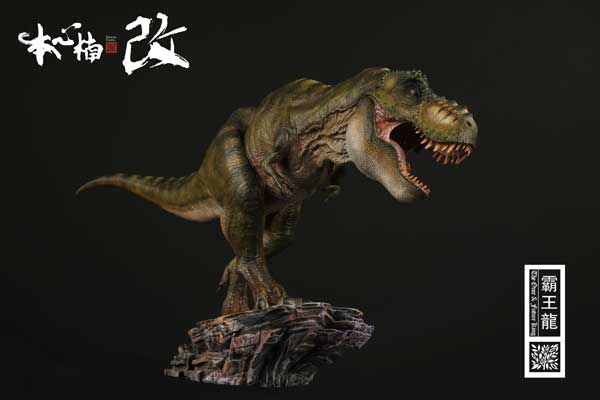
“If you’re looking for anything dinosaur related, there is nowhere better than Everything Dinosaur. These guys are passionate about what they do, and this comes across from the moment you buy your item to the moment it arrives, with multiple updates from their team. They even go as far as to send a detailed info sheet on the dinosaur you have bought, with cool little facts you may not have known about the Dino you hold in your hands (in this case it was Nanmu’s fantastic T. rex) – a great touch! Overall, a fantastic company who set a great example of what a retailer should be. Thanks guys!”
The Nanmu Studio Jurassic Series Once and Future King with Base. This was the model purchased by dinosaur model collector James.
You are most welcome James, look out for some more Nanmu Studio prehistoric animal models and figures coming into stock at Everything Dinosaur next month (June 2022).
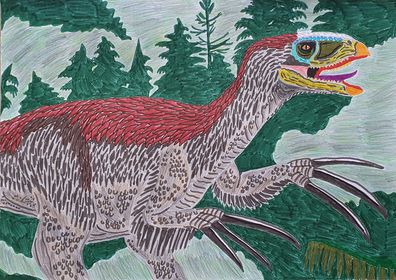
Our thanks to young Caldey for sending into Everything Dinosaur a wonderful illustration of the therizinosaur that features in the forthcoming film “Jurassic World – Dominion”. This eagerly anticipated movie, rumoured to be the last in the “Jurassic Park/Jurassic World” franchise is due to have its world premiere on June 10th (2022).
Therizinosaur
Team members at Everything Dinosaur are looking forward to seeing the film in the cinema, Everything Dinosaur had a small role in helping the production team. We suspect that lots of dinosaur fans and model collectors will be looking forward to this film’s release.
Caldey has chosen to illustrate the therizinosaur, complete with its impressive manual unguals (claws). The therizinosaurus makes an appearance in the last film in the “Jurassic Park/Jurassic World” franchise “Jurassic World – Dominion”. Picture credit: Caldey.
Picture credit: Caldey
“Jurassic World” – Therizinosaur
Numerous different types of theropod have adorned this film franchise, from the iconic Tyrannosaurus rex, the frill-necked dilophosaurs and the over-sized Velociraptors from the first film “Jurassic Park” that was released in the summer of 1993 to Spinosaurus, Carnotaurus and hybridised forms such as Indominus. A therizinosaur makes its appearance in “Dominion” and it has appeared in the trailer for the film, which has been viewed on YouTube more than fifty million times.
A spokesperson from Everything Dinosaur commented:
“We congratulate Caldey for her excellent therizinosaur illustration. It is such a splendid drawing. We enjoy receiving dinosaur illustrations and it never ceases to amaze us how talented some of these young artists are.”
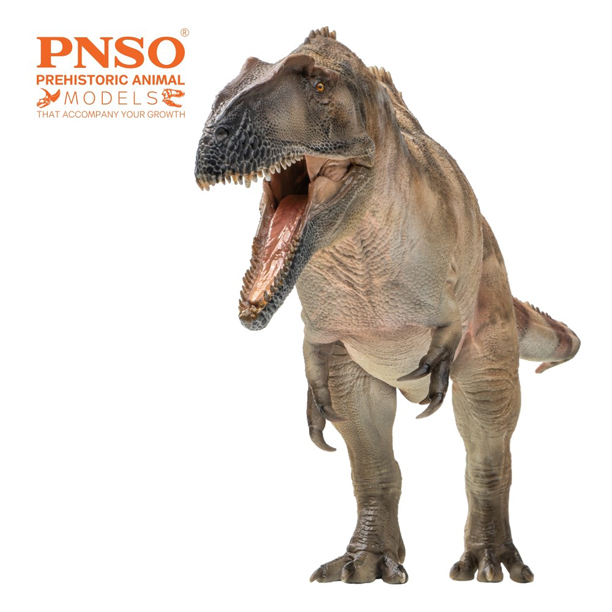
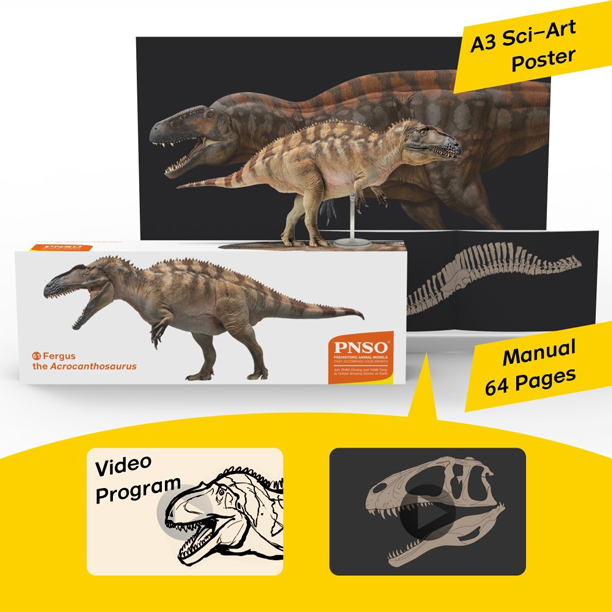
PNSO will be adding a replica of the fearsome North American theropod Acrocanthosaurus (A. atokensis) to their mid-size prehistoric animal model range. Pictures of this exciting new figure have been revealed and Everything Dinosaur can announce that this model should be in stock next month (June 2022). Team members at Everything Dinosaur are looking forward to receiving the PNSO Fergus the Acrocanthosaurus dinosaur model into stock.
PNSO Fergus the Acrocanthosaurus has an articulated lower jawand it measures over 32 cm in length.
Acrocanthosaurus atokensis
Rumours had been circulating for some time within the dinosaur model collecting community that PNSO was due to add a replica of this super-sized, Early Cretaceous carcharodontosaurid to its already extensive model range. Everything Dinosaur can now reveal that this figure will be available in the early summer.
PNSO Fergus the Acrocanthosaurus has an articulated lower jaw.
A spokesperson from Everything Dinosaur commented:
“We are delighted to announce that an Acrocanthosaurus is being added to the PNSO model range. The company has expressed an ambition to dramatically increase the range of models that it offers and over the last two years or so, we have seen Allosaurus, Yutyrannus, Carnotaurus, Qianzhousaurus, Carcharodontosaurus and Tarbosaurus replicas added to their range and now we have a fantastic model of an Acrocanthosaurus joining the PNSO portfolio too.”
PNSO Fergus the Acrocanthosaurus in anterior view.
PNSO Fergus the Acrocanthosaurus Model Measurements
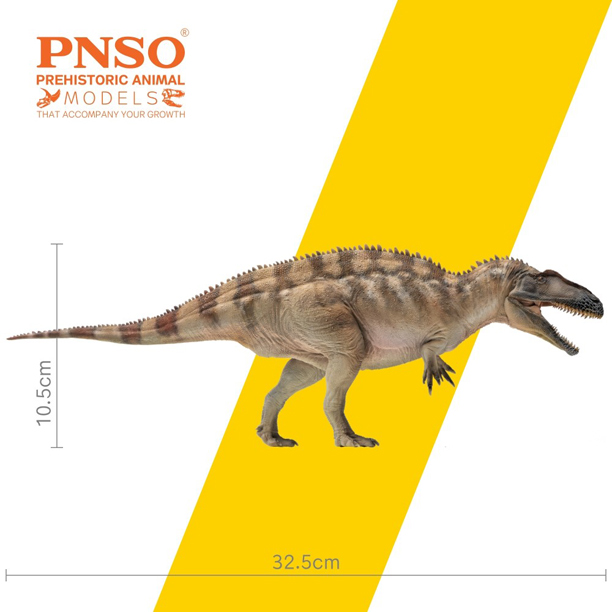
The PNSO Fergus the Acrocanthosaurus model measures an impressive 32.5 cm in length and the figure stands around 10.5 cm tall. Although PNSO does not declare a scale for its mid-size models, based on Acrocanthosaurus having an estimated size of 12 metres, team members at Everything Dinosaur have stated that this figure is in approximately 1:37 scale.
PNSO Fergus the Acrocanthosaurus dinosaur model measurements. This new for 2022 figure measures 32.5 cm in length and it stands around 10.5 cm high.
Acrocanthosaurus Accessories
This amazing Acrocanthosaurus (A. atokensis) comes complete with a full-colour, 64-page illustrated booklet, posters inspired by the fossil material and highlighting the artwork of Zhao Chuang. PNSO have also prepared a short video explaining how the figure was developed which can be accessed by a QR code.
The model is supplied with a clear plastic support stand, a 64-page, full-colour booklet and colour poster. A QR code on the packaging links to a short video that explains how the figure was made.
The PNSO Fergus the Acrocanthosaurus dinosaur model. A fabulous Acrocanthosaurus atokensis replica by PNSO.
Our thanks to prehistoric animal fan and model collector William who sent into Everything Dinosaur a review of his recently purchased Eofauna Konobelodon atticus figure.
William wrote to Everything Dinosaur commenting on how well packaged his parcel had been. The Konobelodon atticus is the fourth prehistoric figure released by Eofauna and he praised the scientific accuracy of this exciting range.
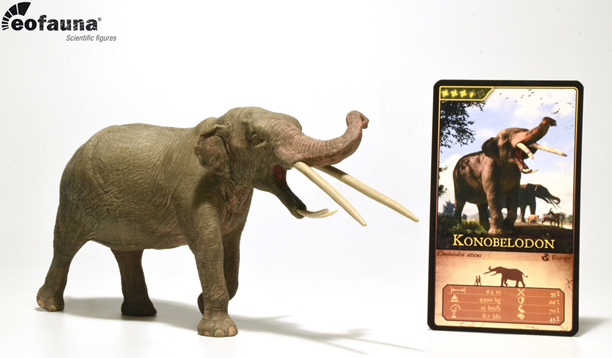
The stunning Eofauna Konobelodon model measures 23 cm long and stands approximately 11 cm high.
Konobelodon Reviewed
William began his review by explaining that the skull was longer and lower than those of modern elephants. He compared the Konobelodon head to other extinct proboscideans such as mastodons and gomphotheres. He highlighted the position of the eyes and the orbits set deeper and protected by a ridge of bone.
William summarised how these prehistoric elephants got their nickname “Shovel-Tuskers” and postulated that due to the observed pattern of wear on the tusks, the lower tusks were probably used to rasp the trunks of trees in order to feed on the bark.
William praised the trunk on the Eofauna model, commenting that it looked very natural and with the tip of the trunk swaying to the left it gave the impression that this elephant was either feeding or drinking.
The reviewer added:
“As with all the Eofauna Proboscidea no detail is missed on the mouth from pink tongue to the tusks and the nasal openings. There are two, beautiful, pale yellow eyes that even in miniature form seem to portray the Proboscidea as having wisdom and compassion.”
The Eofauna Scientific Research Konobelodon figure is in approximately 1:35 scale. Originally named in 1857, Konobelodon atticus has had a long and complicated taxonomic history. William praises this figure for its scientific accuracy.
Roaming the Savannah or Forest
The body is described as being long and robust, typical of the Amebelodontinae. William points out that old illustrations of this animal depicted it as a sprawling hippo-like swamp dweller. The Eofauna Scientific Research replica is a modern interpretation, this model would not be out of place roaming a savannah or forest.
William stated:
“This is all down to Eofauna’s painstaking research to create the perfect accurate model.”
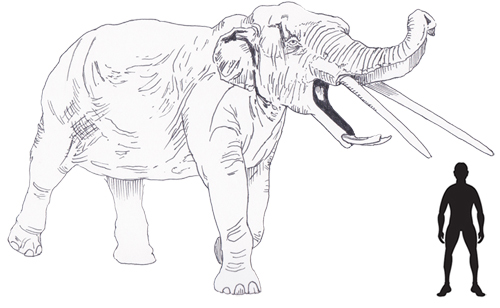
A scale drawing of the Late Miocene prehistoric elephant Konobelodon atticus. Picture credit: Everything Dinosaur.
William remarked that the model’s colour scheme was similar to the colouration seen today in extant Asian elephants with a mixture of splashes of pink and fleshy tones on the ears, chest, forehead and trunk.
The toenails have had the same pink and grey wash applied and the tuft of black hair on the end of the tail was singled out for comment by the reviewer.
William provided the model’s measurements:
Scale: 1/35. Height: 4 inches. Length: 9 inches.
A short history of the discovery of the first Konobelodon fossil material was provided encompassing the role played in the discovery by the historian John Finlay, soldiers in the army of the Bavaria that occupied Greece and how the fossils came to the notice of the German palaeontologist Johan Andreas Wagner.
Epoch: Miocene 15–10 million years ago. Geographical Range: North America, Europe and China. Weight: 9-10 Tons. Height: 12-13 Feet. Length: 26 Feet.
The new for 2022 Eofauna Konobelodon atticus model is supplied with a data card and Everything Dinosaur will also provide a product fact sheet with sales of this figure.
William concluded his review by stating that in his opinion the Eofauna Konobelodon prehistoric elephant model was a “masterpiece” and he praised Everything Dinosaur for their excellent customer service and the swift delivery of his order.
Our thanks to William for sending into Everything Dinosaur his Eofauna Konobelodon model review.
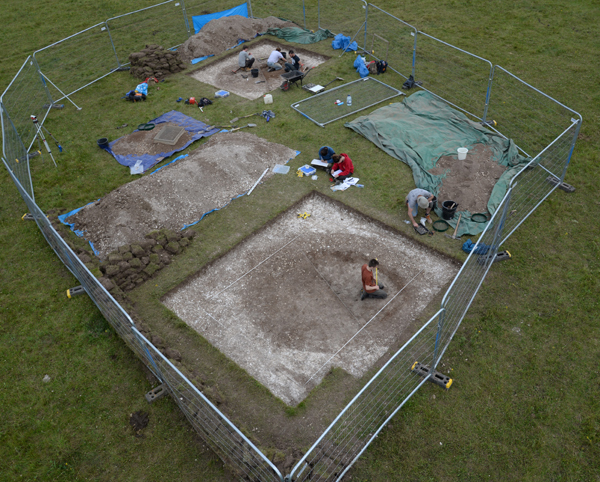
Researchers from the University of Birmingham and Ghent University (Belgium), have identified hundreds of possible large prehistoric pits and thousands of smaller ones at the heart of the ancient Stonehenge landscape. This discovery challenges our understanding of land use through time at this famous UNESCO World Heritage site, the most intensively investigated prehistoric monument in the world.
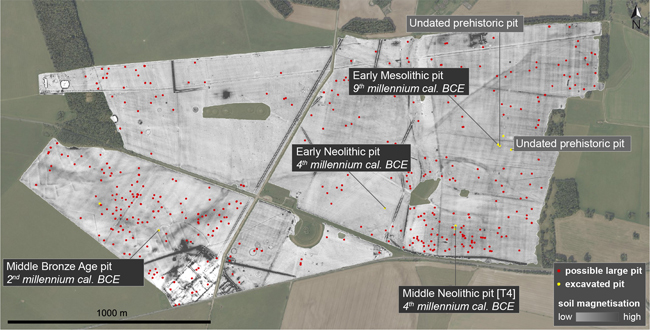
Hundreds of possible prehistoric pits detected in the landscape, indicating those that have been validated and excavated, plotted on a magnetic soil map from Stonehenge. Picture credit: De Smedt et al.
The Oldest Evidence of Land Use at Stonehenge
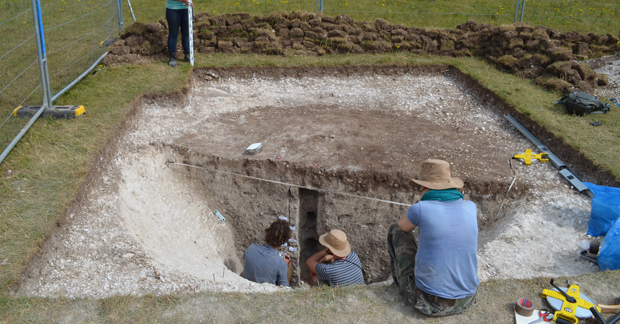
Writing in the academic “Journal of Archaeological Science”, the researchers report the discovery of a substantial pit, more than four metres wide and two metres deep excavated into chalk bedrock. Estimated to have been constructed over 10,000 years ago it stands out as the most ancient trace of land use yet discovered at Stonehenge. This prehistoric pit bears witness to hunter-gatherers roaming the landscape during the early Mesolithic, when Britain was re-inhabited after the last Ice Age. This is only one of many new sites and unexpected patterns of prehistoric activity detected at Stonehenge by the Ghent-Birmingham study team.
An overview of the excavation work. Picture credit: University of Ghent/University of Birmingham.
Unique Research
In a unique piece of research, extensive, electromagnetic induction surveying was combined with borehole analysis and twenty exploratory archaeological excavations. These revealed the extensive sub-surface pits.
Philippe De Smedt, Associate Professor at Ghent University and co-author of the scientific paper commented:
“Geophysical survey allows us to visualise what’s buried below the surface of entire landscapes. The maps we create offer a high-resolution view of subsurface soil variation that can be targeted with unprecedented precision. Using this as a guide to sample the landscape, taking archaeological ‘biopsies’ of subsurface deposits, we were able to add archaeological meaning to the complex variations discovered in the landscape.”
Four Hundred Large Pits
The project team identified over four hundred potential large pits (each over 2.5 metres in diameter), of which six were excavated in the course of the project, ranging in date from the Early Mesolithic (c.8000 BCE) to the Middle Bronze Age (c.1300 BCE).
While each of these sites adds to our knowledge of prehistoric activity in the Stonehenge landscape, the Mesolithic pit stands out as exceptional. The size and shape of the pit suggest it was probably dug as a hunting trap for large game such as aurochs, red deer and wild boar. Dating to 8200-7800 BCE, it is not only one of the earliest of the very few Mesolithic sites near Stonehenge (predating, for instance, the Blick Mead occupation site 1.5 kms away), it is also the largest known Early Mesolithic pit feature in north-western Europe.
Collecting environmental samples in the Mesolithic pit. Picture credit: University of Ghent/University of Birmingham.
Everything Dinosaur acknowledges the assistance of a media release from the University of Birmingham in the compilation of this article.
The scientific paper: “Novel Insights into Prehistoric Land Use at Stonehenge by Combining Electromagnetic and Invasive Methods with a Semi-Automated Interpretation Scheme” by De Smedt, Philippe, Paul Garwood, Henry Chapman, Koen Deforce, Johan De Grave, Daan Hanssens and Dimitri Vandenberghe published in the Journal of Archaeological Science.
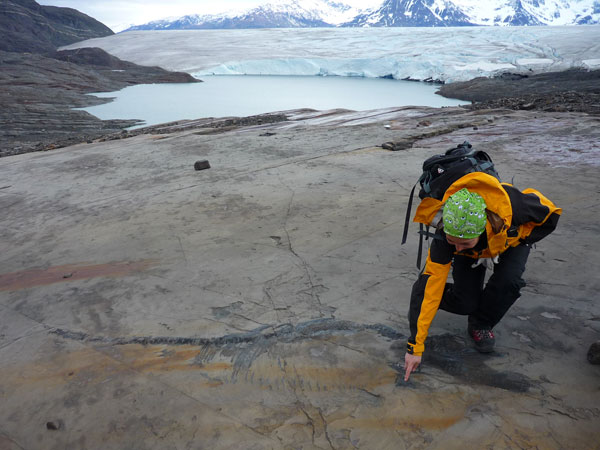
As the glaciers that comprise the Southern Patagonian Ice Field in Chile retreat, some of the rocks exposed have revealed an astonishing array of ichthyosaur fossils. A resilient and dedicated team of scientists have been working to map this hugely significant site and to extract the marine reptile fossil material so that these remarkable specimens can be studied in more detail.
Dr Judith Pardo-Pérez (University of Magallanes), shows the ichthyosaur specimen exposed by the retreating Tyndall Glacier. Picture credit: Alejandra Zúñiga.
Picture credit: Alejandra Zúñiga
Finding and Rescuing “Fiona” the Pregnant Ichthyosaur
An expedition to the remote Tyndall Glacier located in the Torres del Paine National Park, led by Dr Judith Pardo-Pérez from the University of Magallanes (Punta Arenas, southern Chile), has recovered the country’s first complete ichthyosaur fossil. Nicknamed “Fiona” the four-metre-long specimen represents the remains of a pregnant female, complete with several ichthyosaur embryos.
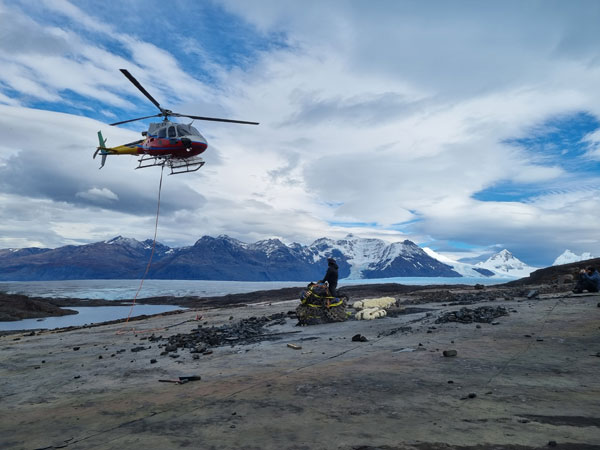
“Fiona” was discovered in 2009, during an earlier expedition to this remote area of Chilean Patagonia. A team of dedicated researchers which included Jonatan Kaluza from Fundación de Historia Natural Félix de Azara and CONICET (Argentina), biologist and palaeontological excavator Héctor Ortiz from the Chilean Antarctic Institute and the University of Chile and renowned ichthyosaur expert Dr Dean Lomax (Visiting Scientist at The University of Manchester), braved the harsh conditions in March and April to ensure the safe removal of the specimen. The intact female ichthyosaur remains were airlifted using a helicopter. It is hoped that further analysis of this remarkable specimen will confirm it as a new ichthyosaur genus.
A helicopter prepares to airlift the pregnant ichthyosaur specimen. Picture credit: The University of Manchester.
Picture credit: The University of Manchester
The First Female Palaeontologist to Lead a Major Expedition to Patagonia
Dr Judith Pardo-Pérez has visited the Tyndall fossil site more than ten times since the initial discovery in 1997 and completed her PhD on the ichthyosaurs found in the area. Thanks to funding from the Chilean National Agency for Research and Development (ANID), a team of top scientists could be put together to allow the fossils preserved in an ancient Cretaceous seabed to be studied in detail.
Dr Pardo-Pérez, is the first female palaeontologist to lead a major expedition in Patagonia.
Part of the Tyndall Ichthyosaur Team discuss excavating a section of a fossil specimen. Picture credit: The University of Manchester.
Picture credit: The University of Manchester
Collecting these hugely important marine reptile fossils, was no easy task. The Tyndall Glacier site could only be reached by a 10-hour hike or horse ride and the team had to endure difficult weather conditions including high winds and snowstorms whilst excavating the fossils from the extremely hard sediment.
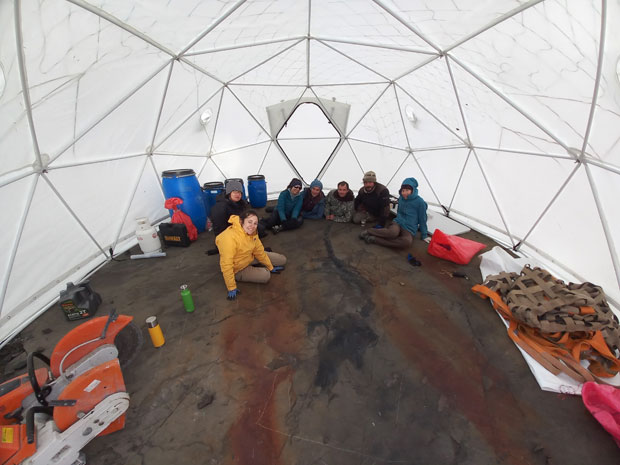
To combat the 90 kph winds, heavy rain and snow, a hangar was built over “Fiona” so that the team could continue to work despite the harsh weather. Circular saws and heavy-duty excavation tools were used to free the fossils from the bedrock.
A hanger was erected over the 4-metre-long ichthyosaur fossil so the scientists could continue working on the specimen despite the extreme weather conditions. Picture credit: The University of Manchester.
Picture credit: The University of Manchester
The Most Abundant and Best-preserved Cretaceous Ichthyosaur Deposit Known
Despite the constant threat of pumas, the team have ensured that this exceptional female specimen has been made available for further analysis and study. It is the only known specimen of a pregnant female of Valanginian-Hauterivian age (between 129 and 139 million years old from the Early Cretaceous).
Commenting on the importance of the specimen, Dr Pardo-Perez Pérez stated:
“At four metres long, complete, and with embryos in gestation, the excavation will help to provide information on its species, on the palaeobiology of embryonic development, and on a disease that affected it during its lifetime.”
In addition to “Fiona” a further twenty-three new ichthyosaur specimens were discovered by the expedition team, making the Tyndall Glacier site perhaps the most abundant and best-preserved early Cretaceous ichthyosaur deposit in the world.
Dr Judith Pardo-Pérez and Dr Dean Lomax examining the best-preserved skull of an ichthyosaur found at the Tyndall Glacier site. Whilst assisting on-site, Dr Lomax found new specimens including the skull of a juvenile ichthyosaur.Picture credit: The University of Manchester.
Picture credit: The University of Manchester
An Ichthyosaur Graveyard
The fossils consist of adults, juveniles and very young ichthyosaurs, they can provide scientists with information on breeding behaviour as well as helping to plot the radiation of new ichthyosaur genera following the end-Jurassic extinction event.
Dr Lomax explained:
“The fact that these incredible ichthyosaurs are so well preserved in an extreme environment, revealed by a retreating glacier, is unlike anywhere else in the world. The considerable number of ichthyosaurs found in the area, including complete skeletons of adults, juveniles, and new-borns provides a unique window into the past. The international collaboration helps to share this exceptional ichthyosaur graveyard with the world and, to a large extent, to promote science.”
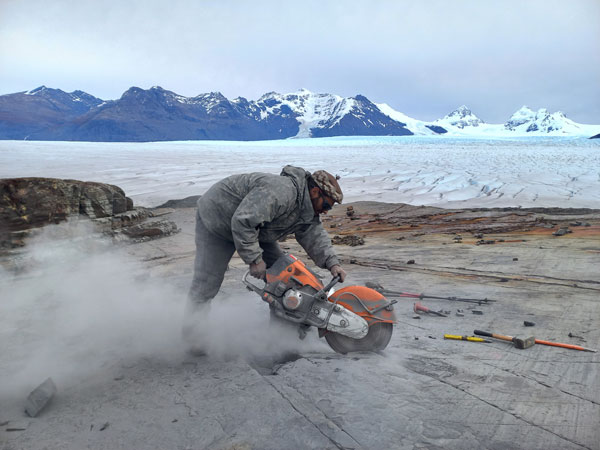
Jonatan Kuluza, palaeontological technician at the Fundación de Historia Natural Félix de Azara and CONICET (Argentina), uses a circular saw to cut out an ichthyosaur specimen. Picture credit: The University of Manchester.
Picture credit: The University of Manchester
Dr Lomax added:
“The weather was so extreme that we could not get to the ichthyosaur site every day and had to remain in camp. On those days when the team could reach the site, they documented the ichthyosaurs and other fossils and discovered new specimens. Amazingly, on average, two ichthyosaurs were found every day.”
Protecting and Preserving the Remaining Specimens
The female ichthyosaur nicknamed “Fiona”, will be prepared and studied at the Río Seco Natural History Museum in Punta Arenas. It is hoped that the beautifully preserved specimen will go on public display.
The priority for Dr Pardo-Pérez and her collaborators is to try to preserve as many specimens as possible. The remoteness of the site and the difficult working conditions will hamper any attempts to preserve and protect these remarkable specimens.
Outlining some of the problems facing the team, the doctor stated:
“We have almost a hundred ichthyosaurs in the Tyndall Glacier fossil deposit and many of them, unfortunately, will never be excavated, due to the difficulty of access, being in risk areas [cliff edge], and lack of funds. The ichthyosaurs that will not be excavated need protection and consolidation in situ, as the erosion to which they are being subjected on a daily basis is destroying them.”
Everything Dinosaur acknowledges the assistance of media release from The University of Manchester in the compilation of this article.
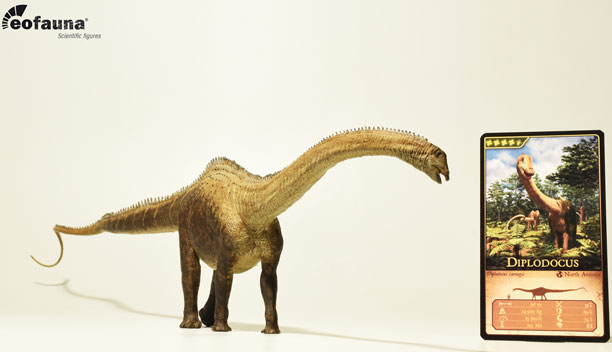
Our thanks to dinosaur fan and model collector William who sent into Everything Dinosaur a review of the new for 2022 Eofauna Scientific Research Diplodocus carnegii model. William commented that the model arrived within 24-hours of placing the order and it was perfectly and expertly wrapped, being supplied in a strong cardboard box to protect the model in transit.
The new for 2022 Eofauna Diplodocus carnegii dinosaur model is supplied with a beautifully illustrated collector’s card. Everything Dinosaur team members helped with the hang tag and labelling for the new Eofauna Diplodocus.
The Second Sauropod from Eofauna Scientific Research
In William’s review he pointed out that the Diplodocus carnegii model was the second sauropod figure to be released by Eofauna following the introduction of their Atlasaurus figure in 2019. He praises the typically small diplodocid head, highlights the skin wrinkles and suggests that some palaeontologists think that sauropods had beaked lips to help them shear vegetation. William states that the beak keratin on the model is painted black which contrasts nicely with the inside of the mouth which is painted pink.
He highlights the dermal spines and comments upon the dermal bumps that are depicted over the large body.
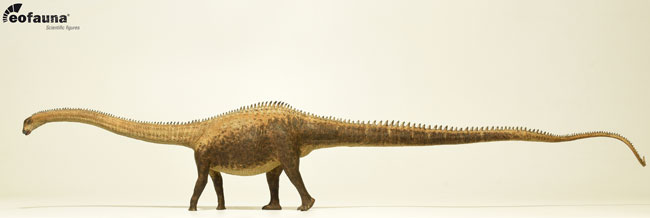
The Eofauna Diplodocus carnegii model measures around 60 cm in length and stands 11 cm tall. It is a 1/40th scale model.
A Terrific Torso
The reviewer reflects on the scientifically accurate sculpt of D. carnegii, from the finely rendered legs with the toenails well painted, including the more prominent inner toe claw on all four, compact, sturdy feet (digit I). William states that:
“Never will you see such a long model from the tip of the neck to the end of its deadly tail tip.”
The complex colour scheme complete with its counter shading is discussed in William’s review and he praises the design team at Eofauna for their depiction of this iconic dinosaur.
William added:
“When you view the model from a side profile you see a pleasing, warm, earthy palette of hues just right for this Dippy.”
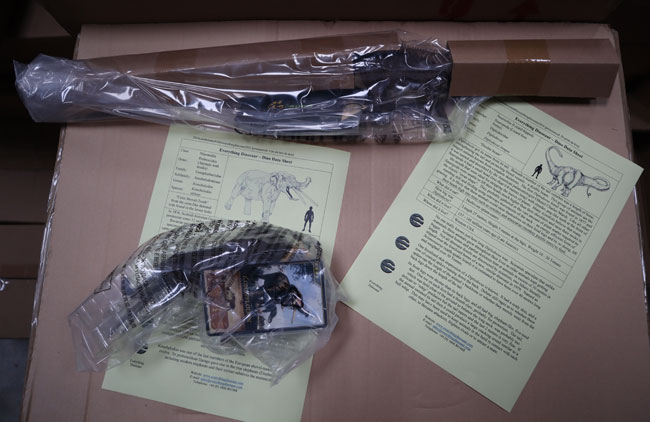
The Eofauna Diplodocus (top) and the Eofauna Konobelodon (bottom) with their fact sheets. Picture credit: Everything Dinosaur.
The reviewer comments that this figure is in 1/40th scale and measures between 24 and 25 inches in length and stands around 4 inches tall. He explains that this Diplodocus species is associated with the Morrison Formation (Upper Jurassic).
Diplodocus Biography
In concluding his review, William kindly provided some additional notes about this remarkable sauropod genus. Explaining that the genus was erected by the American palaeontologist Othniel Charles Marsh in 1878.
Weight: 15-20 Tonnes. Height: 16 feet high at the hip. Length: 88 feet. Neck length: 20-21 feet.
Ending his model review William kindly praised Everything Dinosaur stating:
“May I take a moment and thank the entire team of Everything Dinosaur.”
He is excited about future model introductions and is looking forward to hearing news of 2023 model releases from Eofauna Scientific Research.
Today, May 8th, is the birthday of Sir David Attenborough. The naturalist, broadcaster and campaigner is ninety-six years of age and his enthusiasm for the natural world continues to shine through in the myriad of projects with which he is currently involved.
Sir David Attenborough veteran naturalist and broadcaster. Today, May 8th (2022) is his 96th birthday. Many Happy Returns Sir David!
Prehistoric Planet
Sir David’s energy and enthusiasm for the natural world shows no sign of deteriorating despite him being just a few years short of his centenary. For example, he is the narrator of a new five-part, nature documentary television series about dinosaurs that will premiere on Apple TV+ on May 23rd (2022) entitled “Prehistoric Planet”.
Produced by the BBC Studios Natural History Unit with visual effects by Moving Picture Company, the television series will be shown over five consecutive nights examining different dinosaur dominated environments during the Cretaceous.
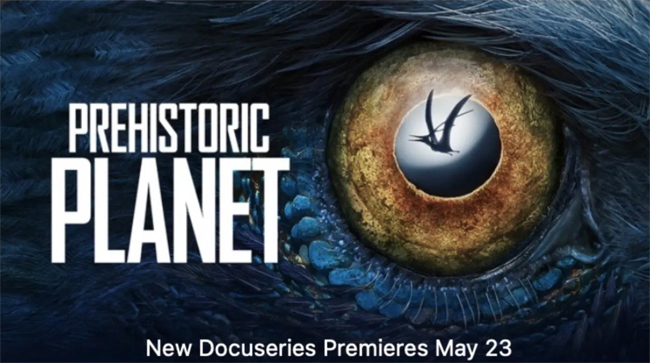
The television series “Prehistoric Planet” starts on May 23rd (2022). The programmes are narrated by Sir David Attenborough. Picture credit: Apple TV+.
The veteran broadcaster has become an active campaigner raising awareness about climate change, global warming and the impact of our species on the planet. He remains as busy as ever, but we at Everything Dinosaur hope he takes a little time out of his busy schedule today to enjoy his birthday.
Our congratulations to collector and model maker Hugh who sent into Everything Dinosaur a picture of the base that he had made for his recently acquired Nanmu Studio Brachiosaurus “Watchman” figure.
The recently introduced Nanmu Studio Jurassic Series Brachiosaurus figures are very impressive dinosaur models. With a head height of around 43 cm, these imposing sauropods tend to dominate collector’s display cabinets, Hugh has customised his model providing it with a unique, skilfully created base, complete with footprint impressions and vegetation.
The talented dinosaur fan and model collector Hugh has created an impressive display base for his recently acquired equally impressive Nanmu Studio Jurassic Series Brachiosaurus “Watchman” figure. Picture credit: Hugh.
Picture credit: Hugh
Nanmu Studio Jurassic Series Brachiosaurus
As well as making a display base for the Nanmu Studio Jurassic Series Brachiosaurus, talented model maker Hugh has created bases for other figures in his collection, such as Eofauna prehistoric elephants and the Rebor 1/11th scale gorilla replica, which Hugh used to create his own personal tribute to the movie monster “King Kong”.
Model maker Hugh has given his Rebor Gorilla figure a well-proportioned display base. The plinth works well with the gorilla model and the dinosaur skull is an additional feature that provides a sense of scale to the cleverly composed piece. Picture credit: Hugh.
Picture credit: Hugh
A spokesperson from Everything Dinosaur commented:
“We are extremely impressed with Hugh’s work. Team members enjoy looking at the pictures of model collections submitted by our customers and we have been most impressed with the display bases that Hugh has designed and created for his figures. We congratulate him, the display figures that he has created have provided him with a unique model collection.”
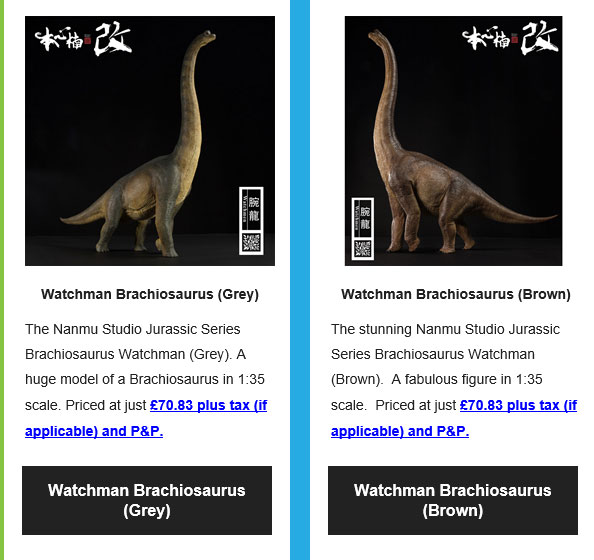
The two Nanmu Studio Brachiosaurus dinosaur models feature in the latest Everything Dinosaur newsletter. Watchman grey (left) and Watchman brown (right). Picture credit: Everything Dinosaur.
A new species of Triassic marine reptile has been described following the discovery of superbly preserved fossils in Yunnan Province (south-western China). Named Honghesaurus longicaudalis it is a member of the Pachypleurosauroidea and it possessed the longest tail of any known pachypleurosaur.
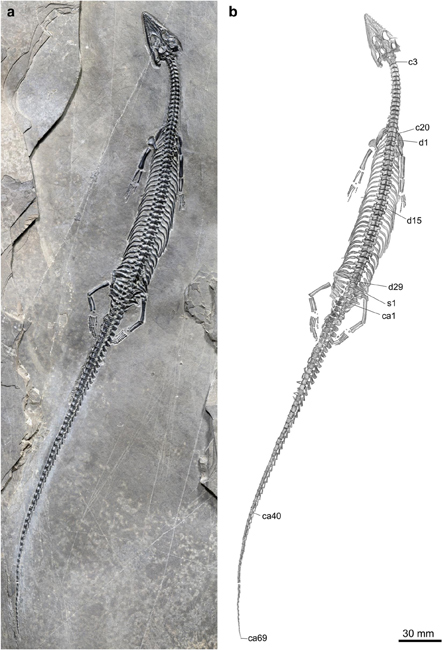
The holotype fossil (IVPP V30380) of the newly described Honghesaurus longicaudalis. Photo (a) and line-drawing (b) of whole specimen. c, cervical vertebra; ca, caudal vertebra; d, dorsal vertebra; s, sacral vertebra. Picture credit: Xu et al.
Picture credit: Xu et al
Writing in the academic journal “Scientific Reports”, the researchers from the Chinese Academy of Sciences, in collaboration with colleagues from the Zhejiang Museum of Natural History and Guizhou University, describe a complete skeleton in the collection of the Institute of Vertebrate Palaeontology and Palaeoanthropology, Chinese Academy of Sciences (specimen number IVPP V30380). The stunning fossil material comes from marine deposits associated with the Guanling Formation and it is estimated to be around 244 million years of age (Anisian stage of the Middle Triassic).
The Tale of a Very Long Tail
Remarkably, the tail of H. longicaudalis contains 69 caudal vertebrae, far more than any other known pachypleurosaur, other pachypleurosaurs commonly have no more than 58 caudal vertebrae. Humans in comparison have just 33 vertebrae in their skeleton. The researchers conclude that this extremely long tail (making up more than fifty percent of the entire body length), in combination with the animal’s long trunk made Honghesaurus extremely manoeuvrable in water. The scientists also speculate that the exceptionally long tail and body helped this marine reptile to conserve energy as it swam.
Skull and mandible of Honghesaurus longicaudalis (IVPP V30380). Photo before (a) and after (b) dusted with ammonium chloride. (c) Line- drawing. (d) Reconstruction in dorsal view. an, angular; ar, articular; at, atlas; ax, axis; c, cervical vertebra; den, dentary; en, external naris; eo, exoccipital; f, frontal; j, jugal; m, maxilla; n, nasal; op, opisthotic; p, parietal; pat, proatlas; pm, premaxilla; po, postorbital; pof, postfrontal; prf, prefrontal; pt, pterygoid; q, quadrate; sa, surangular; so, supraoccipital; sq, squamosal; stf, supratemporal fossa. Picture credit: Xu et al.
Picture credit: Xu et al
The Dispersal of the Pachypleurosaurs
The holotype and currently only known specimen of H. longicaudalis (IVPP V30380) measures 47.1 cm in length. Most pachypleurosaurs were of a similar size although phylogenetic analysis suggests that Honghesaurus was closely related to the much larger Wumengosaurus delicatomandibularis, which had an estimated body length of 1.3 metres.
Pachypleurosaurs are regarded as basal members of the Superorder Sauropterygia, which includes placodonts and the plesiosaurs. The research team postulate that the discovery of Honghesaurus demonstrates the diverse morphology of the Pachypleurosauridae and lends weight to the idea that these marine reptiles originated in Europe and dispersed along the Tethys Ocean in a westerly direction giving rise to new forms in the eastern Tethys Ocean.
The best-known of all the pachypleurosaurs is Keichousaurus. It is also known from south-western China although from geologically younger deposits than the strata that yielded the single specimen of Honghesaurus.
The picture (above) shows a PNSO Keichousaurus model. To view the range of PNSO prehistoric animal models: PNSO Age of Dinosaurs Figures.
The scientific paper: “A long-tailed marine reptile from China provides new insights into the Middle Triassic pachypleurosaur radiation” by Guang-Hui Xu, Yi Ren, Li-Jun Zhao, Jun-Ling Liao and Dong-Hao Feng published in Scientific Reports.