

A hillfort in County Wicklow (Ireland) has been declared the largest known nucleated prehistoric settlement in the British Isles by researchers from Queen’s University Belfast. The study, published by Cambridge University Press, has won the prestigious Prehistoric Society’s James Dyer prize for 2025. The research centres around a series of ancient hillforts known as the Baltinglass hillfort cluster.
The research team proposes that the site is Ireland’s earliest proto-town. This settlement is two thousand years older than the Viking towns that were thought to present the oldest known settlements in Ireland. The study, funded by UK Research and Innovation, the Natural Environment Research Council and the Prehistoric Society also highlights a possible water cistern at the site. If confirmed, this would represent the first feature of its kind synonymous with an Irish hillfort.
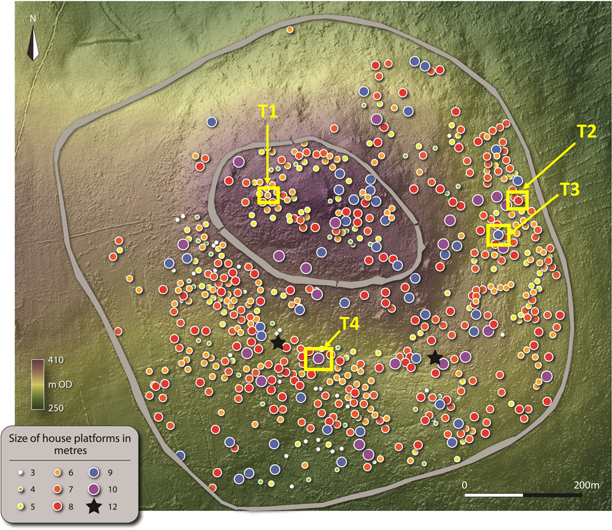
Photogrammetry map of location of roundhouse footprints at Brusselstown Ring as part of a study into the Baltinglass Hillfort cluster. Picture credit: Queen’s University Belfast.
Picture credit: Queen’s University Belfast
The “Baltinglass Hillfort Cluster”
A group of prehistoric hillforts known as the “Baltinglass hillfort cluster” has been studied by archaeologists for decades. These settlements, located in the beautiful and verdant Wicklow County form a “necklace” of thirteen forts. Seven of these settlements are substantial and described as major hillforts. Over the years numerous enclosures and evidence of occupation have been identified. These settlements date from the early Neolithic to the late Bronze Age (circa 3700–800 BC).
Within this cluster, Brusselstown Ring has previously been identified as one of the largest hillforts in Ireland, comprising two large ramparts on neighbouring hill summits – a highly unusual formation in Ireland, Britain or continental Europe. The site covers an area of 41.9 hectares in total.
The Queen’s University-led study examined existing archaeological data from Brusselstown Ring. In addition, new fieldwork was undertaken. Survey work carried out revealed 288 potential dwellings. However, aerial reconnaissance identified at list six hundred topographical anomalies consistent with prehistoric house platforms. Project team members combined existing data with their own findings to locate nearly a hundred potential roundhouses within the inner enclosure. Furthermore, evidence of around five hundred more was discovered proximal to the inner enclosure.
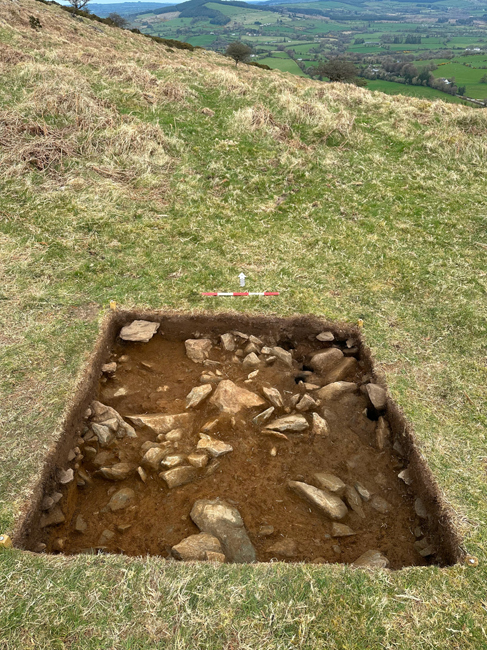
A test trench with hearth feature, signalling prehistoric habitation at the Baltinglass Hillfort cluster. Picture credit: Queen’s University Belfast.
Picture credit: Queen’s University Belfast
Substantial Settlements
Even if not every one of the anomalies represents a dwelling, this would still make it the largest nucleated prehistoric settlement in the British Isles. For comparison, only a handful of other sites have more than a few dozen roundhouse footprints and not all of them are enclosed, according to lead author of the research project, Dr Dirk Brandherm from Queen’s University Belfast.
Dr Brandherm (School of Natural and Built Environment) confirmed that the fieldwork would continue. However, if a water cistern is confirmed this would be a significant discovery.
Dr Brandherm stated:
“There has been extensive survey work at the site over the past two decades, but critical questions regarding the date, development and function of both the enclosing elements and the internal settlement remained unanswered, which is why we embarked on this new series of excavations. Our discoveries challenge previous conceptions of prehistoric settlement organisation, showing a level of social complexity, community cohesion, and regional importance not fully recognised before.”
Studies like this help to enrich our understanding of human populations and activity during the Stone Age and into the Bronze Age. They provide insights into how settlements were established, on social interaction and landscape use.
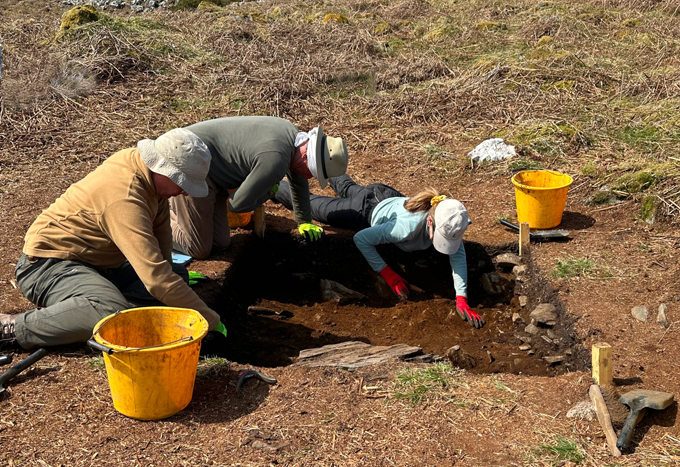
Researchers from Queen’s University Belfast during recent excavations. Picture credit: Queen’s University Belfast.
Picture credit: Queen’s University Belfast
Radiocarbon Dating Confirms the Age of the Sites
Researchers employed sophisticated radiocarbon dating to assess the age of the sites. The data suggests occupation at the Brusselstown Ring during the Late Bronze Age, between c.1210 and 780 BC. Previously, the Vikings had been credited with having founded the first towns in Ireland. Some house platforms thought to have been erected by Viking settlers date from the Iron Age (circa 750 to 400 BC). However, this new study demonstrates that settlements in County Wicklow are much older.
Commenting on the significance of this research Dr Brandherm added:
“I very much hope that this new knowledge will not only add to our knowledge but help us preserve Brusselstown Ring as a site of major national and international heritage importance, connecting us to the island of Ireland’s deep past. It also opens avenues for further research into prehistoric societal development, helping to fill gaps in archaeological and historical records.”
Everything Dinosaur acknowledges the assistance of a media release from Queen’s University Belfast in the compilation of this article.
The multi-award-winning Everything Dinosaur site: The Everything Dinosaur Website.




Leave A Comment