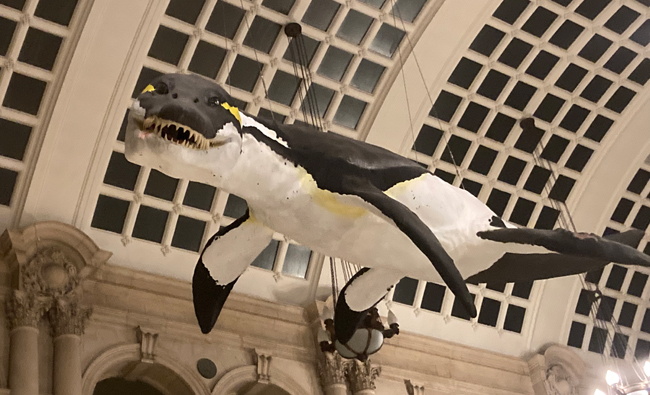
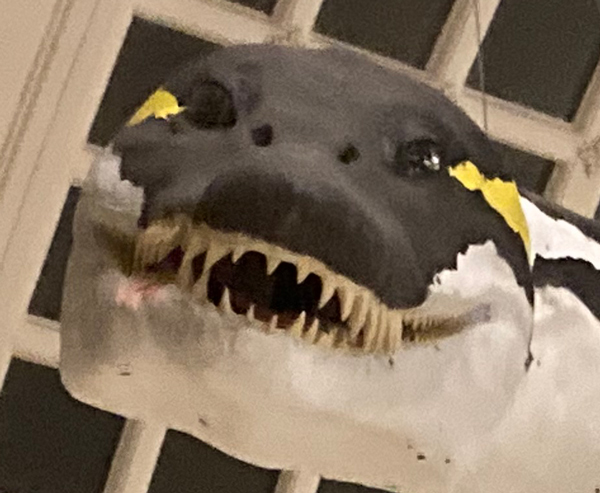
Earlier this week, team members at Everything Dinosaur attended an event at the Bristol Museum and Art Gallery and whilst we were there, we took the opportunity to take some pictures of “Deadly Doris” the nickname given to the life-size Pliosaurus replica which is suspended from the Museum’s ceiling.
The life-size replica of the pliosaur (P. carpenteri) suspended from the ceiling at the Bristol Museum and Art Gallery. Pliosaurus carpenteri was formally named and described in 2013 (Benson et al). Picture credit: Everything Dinosaur.
Everything Dinosaur attended a special evening opening of the Museum to celebrate the life and works of Anthony Beeson, who sadly passed away earlier this year. Fans of dinosaur models will know of Anthony through his work with CollectA helping to design the prehistoric animal figures in the award-winning “Prehistoric World” model range.
However, Anthony was a true polymath with a huge range of interests and a very wide circle of friends. He was an expert on Greek and Roman art and architecture, a skilled painter, an archivist of the Association for Roman Archaeology, an author and the former art librarian at Bristol City Libraries.
He often talked about the fossils and other exhibits on display at the Bristol Museum and Art Gallery and although the museum was officially closed, we were able to take some photographs of the life-size replica of the “Westbury pliosaur” that is suspended from the ceiling in the Museum’s main atrium.
We were given the opportunity to say a few words to the audience who had gathered to show their appreciation for Anthony, as the pliosaur replica nicknamed “Deadly Doris” looked on.
A close-up view of the pliosaur that is suspended above the ground floor at the Bristol Museum and Art Gallery (Bristol, England). The life-size replica was nicknamed “Deadly Doris”. Picture credit: Everything Dinosaur.
The partial remains of an eight-metre-long pliosaur were discovered in Lower Kimmeridge clay sediments at Westbury (Wiltshire) in 1994. The fossils representing a single animal, included a skull and jaws that were nearly two metres in length. The pliosaur was formally named and described in 2013 (Benson et al) as Pliosaurus carpenteri. The fossils are on display at the Bristol Museum and Art Gallery and artist Tony Hitchcock was commissioned to produce a life-size replica as part of the marine reptile exhibit.
As we gave our speech about Anthony and his contribution to the CollectA range, “Deadly Doris” looked down on proceedings. We are sure Anthony would have approved and been delighted with a pliosaur in attendance.
An international team of scientists have unearthed the remains of Africa’s oldest dinosaur skeleton. The fossils represent a sauropodomorph, which has been named Mbiresaurus raathi. The fossils were excavated from Pebbly Arkose Formation exposures in Mashonaland Central Province, Zimbabwe. This basal sauropodomorph and the associated vertebrate fauna discovered to date is helping scientists to better understand the dispersal and distribution of early dinosaurs and their contemporaries.
A life reconstruction of the sauropodomorph Mbiresaurus raathi (foreground) with examples of the Zimbabwean biota of the Upper Triassic Pebbly Arkose Formation. Two rhynchosaurs (front right) are not disturbed by the as yet, unnamed herrasaurid dinosaur pursuing a cynodont (back right). An aetosaur observes the goings on from the opposite bank (left). Picture credit: Andrey Atuchin.
Mbiresaurus raathi
The research team led by palaeontologists from Virginia Tech in collaboration with colleagues from the Natural History Museum of Zimbabwe, the Universidade de São Paulo, (São Paulo, Brazil) and the Chipembele Wildlife Education Centre, (Mfuwe, Zambia) have explored the extensive Upper Triassic sandstone exposures of the Pebbly Arkose Formation. As well as finding the nearly complete and articulated sauropodomorph specimen (M. raathi), the team have been documenting the vertebrate fauna associated with these 230-million-year-old deposits.
The first evidence of Africa’s oldest dinosaur known to science was found during fieldwork in 2017. Two years later, the team returned to excavate more of the specimen and to work on the fossilised remains of an as yet, unnamed theropod dinosaur discovered nearby.
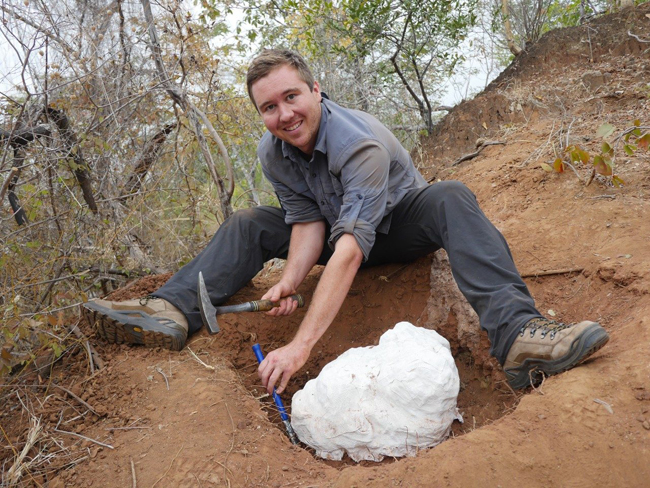
Christopher Griffin in 2017, carefully excavating part of the Mbiresaurus raathi skeleton, wrapped in a plaster field jacket. Picture credit: Stephen Tolan for the Paleobiology & Geobiology Research Group at Virginia Tech.
The holotype (NHMZ 2222) consists of a considerable portion of the entire skeleton including skull material. A second specimen (NHMZ 2547), representing a larger individual was discovered in close proximity to the holotype. The research team estimate that Mbiresaurus was around two metres in length and weighed approximately 25 kilograms.
Christopher Griffin holds in his hand portion of the lower jaw of Mbiresaurus in Virginia Tech’s Derring Hall. Picture credit: Zach Murphy for the Paleobiology & Geobiology Research Group at Virginia Tech.
Commenting on the significance of this dinosaur discovery, field team member Christopher Griffin, who graduated in 2020 with a PhD in geosciences from the Virginia Tech College of Science, stated:
“The discovery of Mbiresaurus raathi fills in a critical geographic gap in the fossil record of the oldest dinosaurs and shows the power of hypothesis-driven fieldwork for testing predictions about the ancient past.”
Documenting the Early Dinosauria
South America is regarded by many palaeontologists as the cradle of dinosaur evolution. As far as scientists are able to deduce; based on the fossil record, the dinosaur dynasty began with the evolution of small, agile meat-eaters in South America. However, as landmasses at the time mostly consisted of a single, super-sized continent (Pangaea), it is perfectly feasible to propose that the Dinosauria arose elsewhere and spread across Pangaea.
Herrerasaurus – potentially an early, carnivorous dinosaur from the Upper Triassic Ischigualasto Formation of north-western Argentina. The evolutionary origins of the Dinosauria remain ambiguous, it is hoped that further exploration of the Upper Triassic (Carnian) deposits of the Pebbly Arkose Formation will help palaeontologists to better understand dinosaur evolution and dispersal. Picture credit: Everything Dinosaur.
Dr Griffin added:
“These are Africa’s oldest-known definitive dinosaurs, roughly equivalent in age to the oldest dinosaurs found anywhere in the world. The oldest known dinosaurs, from roughly 230 million years ago, the Carnian Stage of the Late Triassic, are extremely rare and have been recovered from only a few places worldwide, mainly northern Argentina, southern Brazil, and India.”
Sterling Nesbitt, an associate professor at the Department of Geosciences at Virginia Tech and co-author of the scientific paper published this week in the journal “Nature”, explained that basal sauropodomorphs such as Mbiresaurus demonstrate how the early evolutionary history of the Dinosauria is being rewritten with every new discovery.
Some of the 2019 expedition team photographed in Harare (Zimbabwe), prior to the fieldwork. From left are Kudzie Madzana, Edward Mbambo, Sterling Nesbitt, George Malunga, Christopher Griffin, Darlington Munyikwa. Picture credit: by Zach Murphy for Virginia Tech.
An Ancient Triassic Biota
The Carnian-aged fossils are providing scientists with evidence of a diverse reptilian biota which co-existed with the earliest dinosaurs. The fieldwork has revealed evidence of cynodonts, aetosaurs (armoured archosaurs more closely related to crocodylians than to the archosaur lineage that led to the birds and the dinosaurs), and rhynchosaurs.
The team also unearthed fossilised remains of an as yet, unnamed theropod dinosaur (herrerasaurid). These archaic animals are similar to the biota associated with contemporaneous deposits found in South America and India.
Sterling Nesbitt (left) and Christopher Griffin excavate the fossilised remains of an as yet, unnamed herrerasaurid dinosaur in 2019. Picture credit: Murphy Allen for Virginia Tech.
What’s in a Name?
The genus name Mbiresaurus is from the local Shona language for the name of the district “Mbire” where the fossils were found and from the Greek for lizard. The species name honours palaeontologist Michael Raath for his pioneering work studying vertebrate fossils found in Zimbabwe. The research team conclude that Mbiresaurus was probably bipedal and from an analysis of its small, serrated teeth, it was probably herbivorous although omnivory cannot be ruled out.
A New Theory on the Early Dispersal of the Dinosauria
The researchers have postulated a new theory on dinosaur dispersal. As Africa was once part of the colossal super-continent Pangaea, the distribution and dispersal of the Dinosauria was constrained by climatic conditions across the landmass.
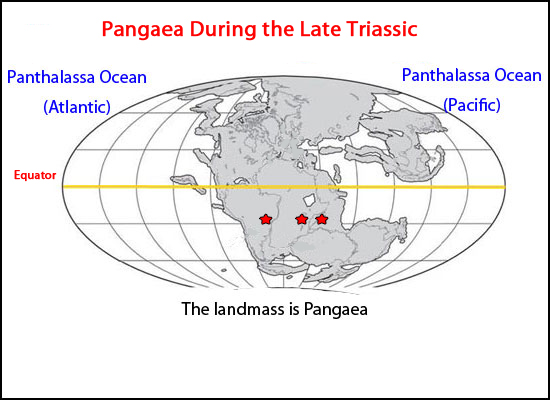
The central portion of Pangaea was dominated by extremely arid environments. These deserts acted as a barrier, the earliest dinosaurs were restricted to southern Pangaea. Only later in their evolutionary history, during a period of climate change resulting in a much wetter climate (Carnian Pluvial Event) did the Dinosauria disperse worldwide.
The fossils from the Upper Triassic deposits of northern Zimbabwe from a geographical bridge between contemporaneous fossil bearing deposits in India and southern Brazil. The red stars demonstrate the link between the three locations with Zimbabwe in the centre. Picture credit: Everything Dinosaur.
The research team deliberately targeted Zimbabwe for fieldwork as the northern part of the country would have been located at roughly the same latitude as southern Brazil and India during the Late Triassic.
They conclude that the distribution of the first dinosaurs is correlated with palaeolatitude-linked climatic barriers, and dinosaurian dispersal to the rest of the super-continent was delayed until these barriers were removed. The distribution of the earliest members of the Dinosauria remained restricted by the climatic conditions that prevailed in southern Pangaea.
An Exciting Development for Palaeontology in Zimbabwe
The discovery of a nearly complete specimen of one of the earliest dinosaurs known to science provides a major boost to the Natural History Museum of Zimbabwe and demonstrates that palaeontologists from southern Africa have a major role to play in obtaining evidence about early dinosaur evolution.
Michel Zondo, a curator and fossil preparator at the Natural History Museum of Zimbabwe commented:
“The discovery of the Mbiresaurus is an exciting and special find for Zimbabwe and the entire palaeontological field. The fact that the Mbiresaurus skeleton is almost complete, makes it a perfect reference material for further finds. It is the first sauropodomorph find of its size from Zimbabwe, otherwise most of our sauropodomorph finds from here are usually of medium- to large-sized animals.”
Everything Dinosaur acknowledges the assistance of a media release from Virginia Tech in the compilation of this article.
The scientific paper: “Africa’s oldest dinosaurs reveal early suppression of dinosaur distribution” by Christopher T. Griffin, Brenen M. Wynd, Darlington Munyikwa, Tim J. Broderick, Michel Zondo, Stephen Tolan, Max C. Langer, Sterling J. Nesbitt and Hazel R. Taruvinga published in Nature.
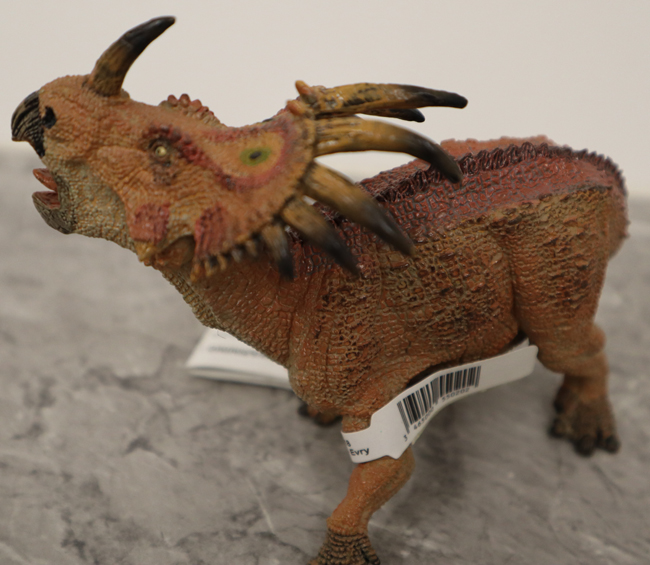
Everything Dinosaur has been able to source a limited quantity of the now retired red Papo Styracosaurus dinosaur model. This rare figure is available (whilst stocks last).
Everything Dinosaur have been able to obtain some Papo red Styracosaurus dinosaur models. This model has been retired, but Everything Dinosaur has been able to source some figures from the factory. Available whilst stocks last. Picture credit: Everything Dinosaur.
Picture credit: Everything Dinosaur
Red Papo Styracosaurus
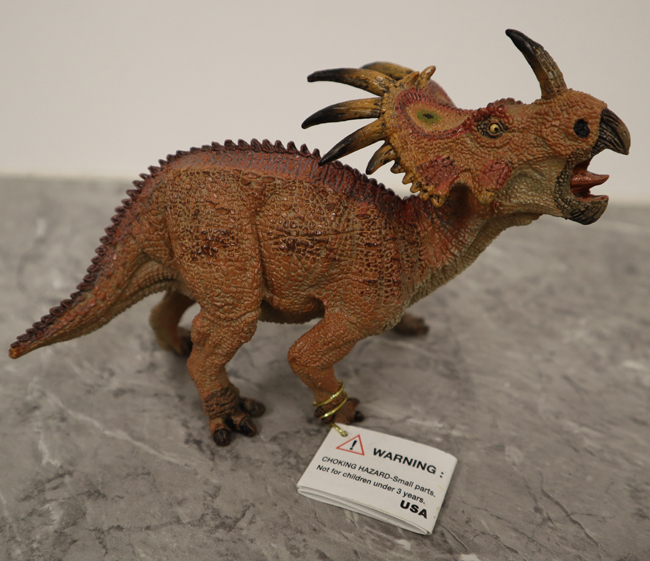
The Papo red Styracosaurus has been retired. Production stopped a while ago, however, the dedicated team members at Everything Dinosaur were able to source a few models with the collaboration of their chums at Papo.
The Papo red Styracosaurus dinosaur model (right lateral view). Picture credit: Everything Dinosaur.
Picture credit: Everything Dinosaur
Originally introduced into the Papo “Les Dinosaures” range back in 2011, this popular horned dinosaur figure is being replaced by a green colour variant. A spokesperson from Everything Dinosaur stated that as model collectors themselves, they can understand how customers feel if a model is retired and out of production before they have had the chance to add it to their collection.
The spokesperson explained:
“We have worked tirelessly to source a limited number of these rare red Styracosaurus figures. We have done this to help and support our customers. We have also ensured that although this figure is rare, we have not put it on-line at a ridiculous price, we know how other platforms rapidly raise their prices once they realise a model is out of production.”
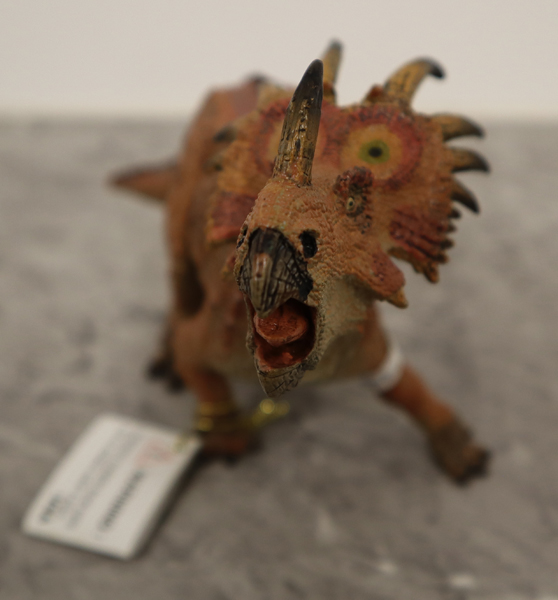
Papo red Styracosaurus in anterior view. Picture credit: Everything Dinosaur.
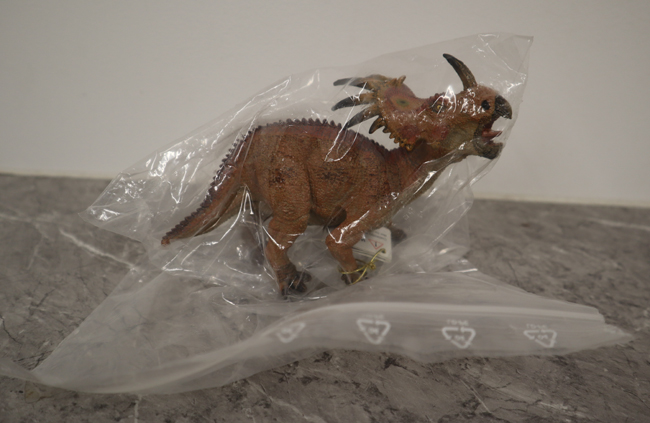
The Papo red Styracosaurus figure will be supplied by Everything Dinosaur in a clear, re-sealable plastic bag. This is different from the normal Papo packaging and reflects the fact that only a few of these replicas were at the factory. Each model is contained in its own re-sealable and therefore re-useable plastic packaging.
The Papo red Styracosaurus in its plastic bag. The model is out of production but Everything Dinosaur has been able to obtain a limited quantity. Please note as the models are rare, they are supplied in special plastic bags, which can be re-used if required – a bonus! The Papo red Styracosaurus model is available whilst stocks last. Picture credit: Everything Dinosaur.
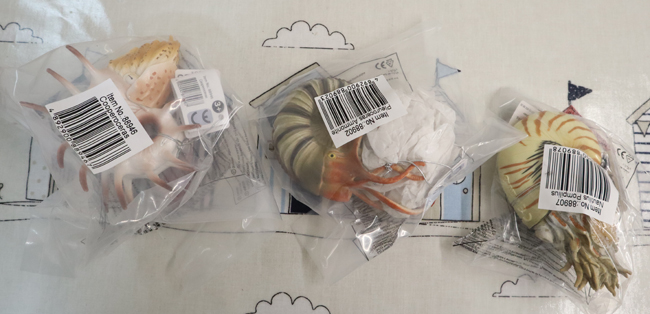
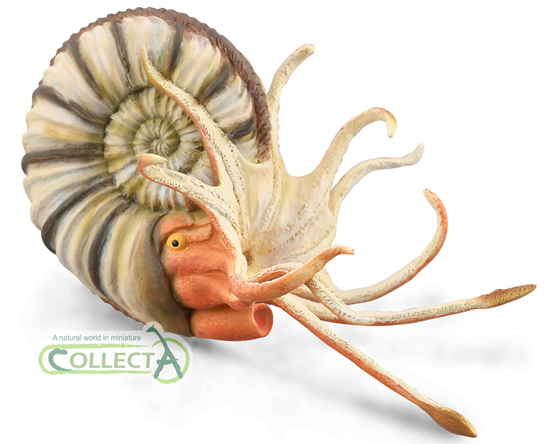
Time to praise CollectA for adding some superb replicas of prehistoric cephalopods to the “Prehistoric Life” model collection including a Pleuroceras ammonite, a nautilus and a Cooperoceras replica.
A terrific trio of CollectA cephalopod figures. The new for 2022 Palaeozoic nautiloid Cooperoceras (left), the Pleuroceras ammonite model (centre) and a replica of the extant Nautilus pompilius (right). Picture credit: Everything Dinosaur.
The picture (above) shows the bizarre Palaeozoic nautiloid Cooperoceras (left). The CollectA Pleuroceras ammonite (centre) a replica of a geographically widespread ammonite known from Lower Jurassic strata and on the right is a replica of the extant, chambered nautilus N. pompilius, which is distantly related to Cooperoceras.
Marvellous Molluscs
The Cephalopoda (cephalopods) are a class within the huge Mollusca phylum. The cephalopods which include extant squid, cuttlefish and octopi as well as extinct forms such as ammonites and indeed belemnites, only make up a small proportion of the genera within the Mollusca. The most successful molluscs in terms of the number of species and habitat range are the gastropods (slugs and snails). It has been calculated that more than three-quarters of all the molluscs known to science are members of the Gastropoda class. The Mollusca phylum is itself, the second largest phyla within the Kingdom Animalia (the largest being the Arthropoda).
Still, that is enough musing about invertebrate taxonomy for now, it is just great to be able to stock a fabulous selection of cephalopod models, including this trio of CollectA cephalopods.
CollectA Age of Dinosaurs Popular Size Pleuroceras ammonite model. One of several excellent replicas of extinct cephalopods in the CollectA “Prehistoric Life” model series.
CollectA Age of Dinosaurs “Prehistoric Life” Figures
A spokesperson from Everything Dinosaur praised CollectA for producing such a wide range of prehistoric animal figures. The cephalopod models have proved particularly popular with fossil collectors, they have been able to add a replica of the living animal to their fossil display cabinets.
Back in June (2022), Everything Dinosaur team members wrote about the “White Rock spinosaurid”*, what could turn out to be the biggest predatory dinosaur found to date in Europe. At the time, many media outlets mistakenly reported that these fossils, found on the Isle of Wight, represented “Europe’s biggest dinosaur”. Not true, the remains of what could be the largest dinosaur ever discovered in Europe are being excavated in a Portuguese back garden.
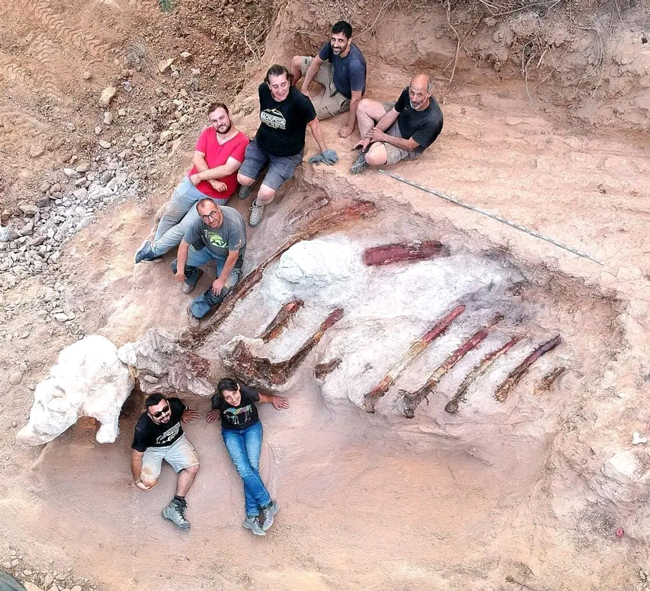
Field team members pose next to the exposed ribs of the sauropod. Picture credit: Instituto Dom Luiz (Faculty of Sciences of the University of Lisbon, Portugal).
Giant Sauropod
The first fossils were uncovered in 2017 when the property owner in the city of Pombal, in the Leiria District, central Portugal, began construction work in the garden. The strata in this area of Portugal were laid down approximately 150 million years ago (Upper Jurassic) and the fossils are from a sauropod, a long-necked, long-tailed herbivore that could have measured more than 25 metres long.
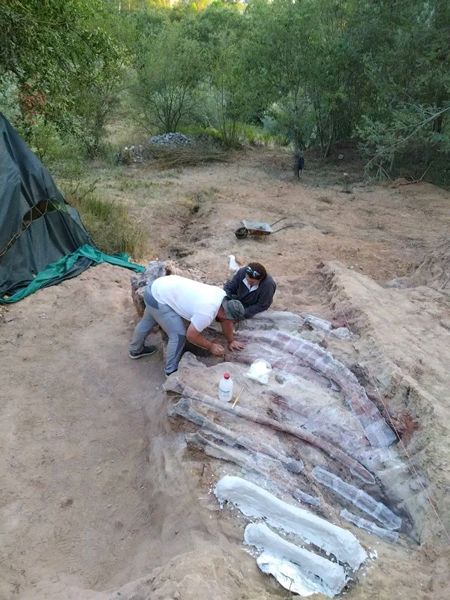
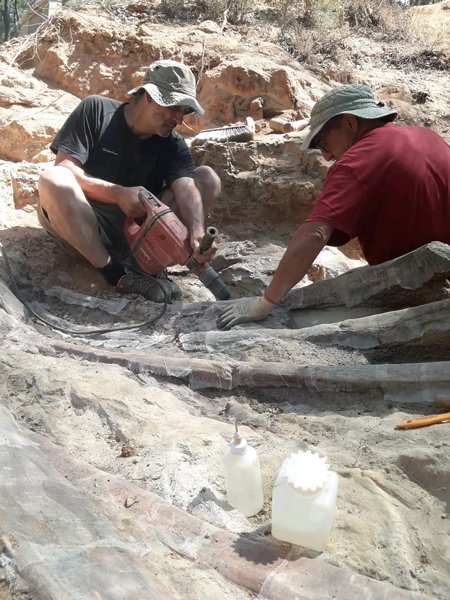
Working to expose the sauropod ribs. Picture credit: Instituto Dom Luiz (Faculty of Sciences of the University of Lisbon, Portugal).
A joint Spanish/Portuguese field team have been working to expose, stabilise and remove the fossilised bones. In the picture above, two ribs have been coated in plaster and burlap in preparation for their removal from the site.
A European Brachiosaurid
Tentatively described as a member of the Brachiosauridae family, parts of the backbone and ribs have been excavated so far. The bones were found in virtually their original articulated and anatomical position.
Elisabete Malafaia, post-doctoral researcher at the Faculty of Sciences of the University of Lisbon and member of the field team excavating the giant bones stated that it was extremely unusual to find all the ribs of a sauropod, almost entirely intact. The skeleton was found in the position that the dinosaur probably died in, no post-mortem transport of the corpse took place.
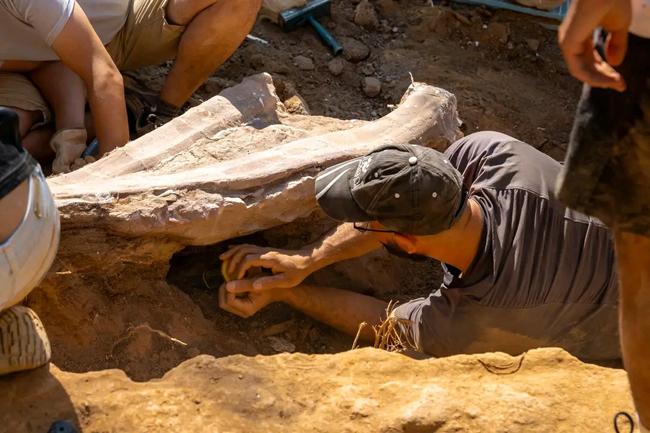
Removing sediment around the ribs. Picture credit: Instituto Dom Luiz (Faculty of Sciences of the University of Lisbon, Portugal).
The field team are optimistic that more bones remain buried, including the skull. To find an almost complete skeleton of this type of dinosaur would be a truly remarkable discovery with the potential to provide scientists with an enormous amount of data on Late Jurassic sauropods.
A Member of the Macronaria
The Neosauropoda clade, a sub-group within the Sauropoda is divided into two sub-clades. The Diplodocoidea and the Macronaria. The Macronaria are distinguished by having a large nasal (external naris), the diameter of the nasal opening exceeding the diameter of the eye socket (orbit). Brachiosaurids and the titanosaurs, which thrived during the Cretaceous, represent some of the biggest land animals to have ever existed.
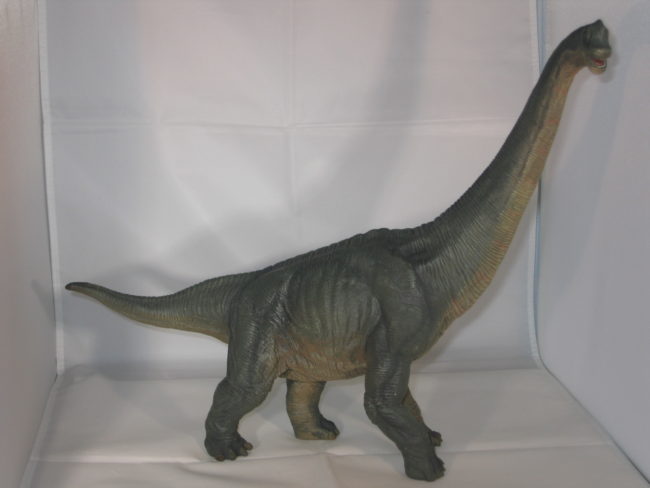
A replica of a typical brachiosaurid (Brachiosaurus altithorax). Picture credit: Everything Dinosaur.
It has been speculated that the head height of the Portuguese sauropod could be as much as 12 metres, that would make this dinosaur tall enough to look over a three-storey house!
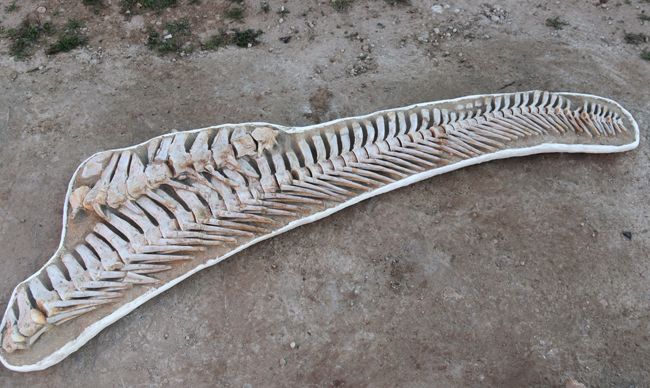
The giant ribs of the sauropod. Picture credit: Instituto Dom Luiz (Faculty of Sciences of the University of Lisbon, Portugal).
Years of Laboratory Work Ahead
Dinosaur fans will have to be patient and wait for a formal scientific description. It is likely to take several years to fully prepare and study the huge, fossilised bones, of what is probably a new dinosaur species. A spokesperson from Everything Dinosaur commented that this was an amazing fossil find and that this Portuguese discovery could rival some of the sauropod fossils found in the roughly contemporaneous Morrison Formation of the western United States.
Carefully removing matrix surrounding the sauropod bones. Picture credit: Instituto Dom Luiz (Faculty of Sciences of the University of Lisbon, Portugal).
Everything Dinosaur contacted the Faculty of Sciences of the University of Lisbon media team to request images for this blog post, we acknowledge their assistance in the compilation of this article. The University’s press team kindly responded, supplied images and wrote:
“Obrigada pelo interesse neste trabalho. Partilho aqui algumas imagens com boa resolução.”
This translates as “thank you for your interest in this work, here are some high-resolution images for you.”
We look forward to hearing more about this remarkable discovery and the eventual naming and scientific description of a huge sauropod from a Portuguese garden.
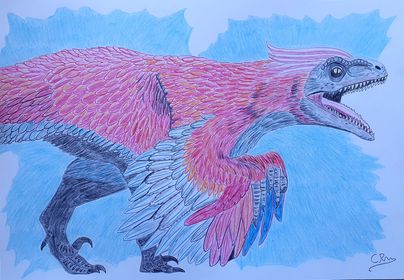
Our thanks to Caldey who sent into Everything Dinosaur her illustration of the ferocious, crimson coloured Pyroraptor that featured recently in the film “Jurassic World Dominion”.
The fearsome Pyroraptor from the recent film Jurassic World Dominion which was released in the UK earlier in the summer (2022). Picture credit: Caldey.
Pyroraptor olympius
Formally named and scientifically described in 2000 (Allain and Taquet), this theropod dinosaur is known from fragmentary fossil material including teeth found in south-eastern France and eastern Spain. When described it was assigned to the Dromaeosauridae, but the limited fossil material associated with this genus makes a definitive taxonomic assessment difficult. Recent phylogenetic assessments have placed Pyroraptor within the dromaeosaurid sub-family the Unenlagiinae. However, some palaeontologists have proposed that unenlagiines with their characteristic long and slender snouts, might represent an entirely different family of theropods and therefore should not be classified within the Dromaeosauridae.
Caldey has chosen to echo the Pyroraptor as seen in the recent movie. It is depicted as a formidable predator with powerful jaws. In the film, this feathered “raptor” was revealed to be an accomplished swimmer.
Our thanks to Caldey for sending into Everything Dinosaur her Pyroraptor drawing.
An international team of researchers have uncovered the remains of a huge mosasaur, one that was adapted to hypercarnivory and was an apex predator in the shallow seas of North Africa around 66 million years ago. In addition, the scientists have unearthed remains of other marine vertebrates that shared this giant’s habitat. Acid damage on the bones suggest that these animals were prey and ingested by mosasaurids potentially this new leviathan named Thalassotitan atrox.
Thalassotitan atrox
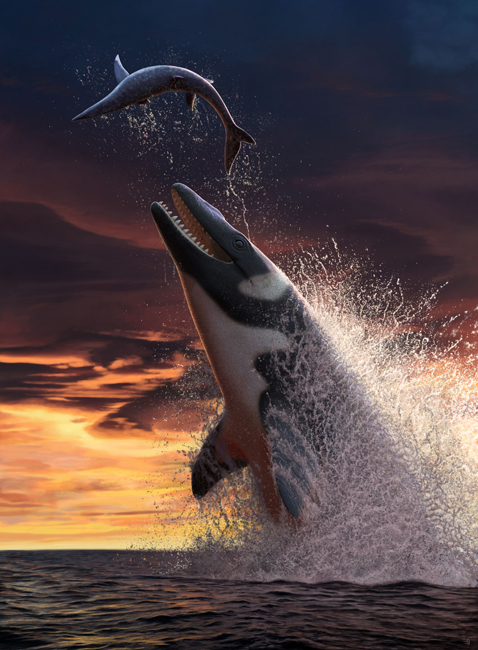
Thalassotitan life reconstruction. Picture credit: Andrey Atuchin.
Late Cretaceous Marine Giant
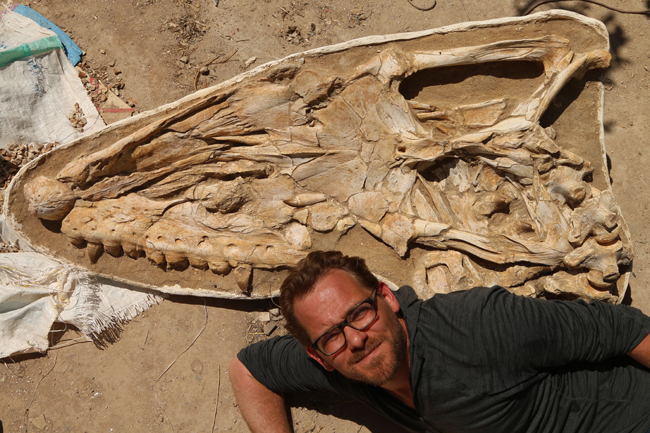
The remains of this Late Cretaceous marine giant, including a 1.4-metre-long-skull were excavated from the Upper Cretaceous, phosphatic beds of the Ouled Abdoun Basin (northern Morocco). High sea levels created a shallow, tropical sea that teemed with life in North Africa and at the very end of the Cretaceous, approximately 66 million years ago (Maastrichtian faunal stage of the Cretaceous), the 9-metre-long Thalassotitan was the apex marine predator.
Dr Nick Longrich poses next to the skull of Thalassotitan which is in its protective field jacket. Picture credit: University of Bath.
A Contemporary of Tyrannosaurus rex
Thalassotitan atrox was a mosasaur, which are extinct members of the largest order of reptiles the Squamata. As such, Thalassotitan was more closely related to snakes and lizards than it was to archosaurs such as crocodilians and the Dinosauria. However, it was a contemporary of Tyrannosaurus rex and like T. rex it was a hypercarnivore, attacking and feeding upon other large vertebrates.
An Apex Predator
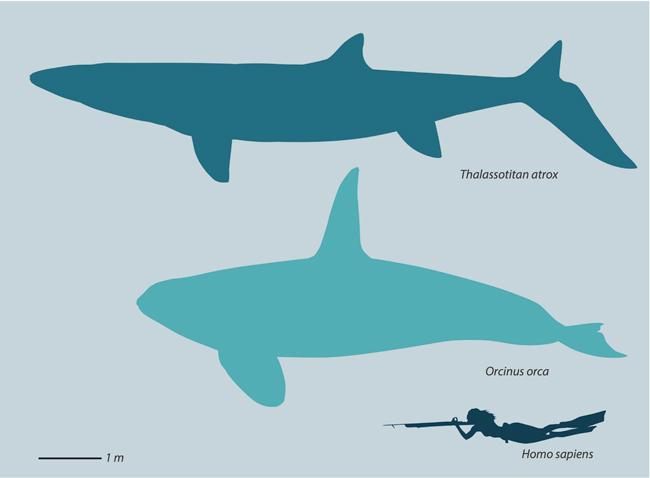
The massive jaws and robust, conical teeth suggest that Thalassotitan was an apex predator, filling a similar environmental nice as Orcas (Orcinus orca) and the Great White shark (Carcharodon carcharias) in extant marine ecosystems. The research team, who included Dr Nick Longrich, Senior Lecturer from the Milner Centre for Evolution at the University of Bath and lead author on the study, published in the journal Cretaceous Research, postulate that the acid-etched fossilised bones of other vertebrates found in the same deposit might represent prey ingested by mosasaurids, likely Thalassotitan.
Thalassotitan compared in size to an Orca and a diver. Picture credit: University of Bath.
Thalassotitan’s large teeth are often broken and show extensive signs of wear, with some teeth in the jaws worn down to the root. Piscivory (fish-eating) would not have caused this damage, the scientists conclude that this is evidence to support the theory that Thalassotitan was an apex predator.
Dr Longrich commented:
“Thalassotitan was an amazing, terrifying animal. Imagine a Komodo Dragon crossed with a great white shark crossed with a T. rex crossed with a killer whale.”
Thalassotitan’s Potential Victims
The scientists comment that possible remains of Thalassotitan’s victims may have been found. Fossils from the same beds show damage from acid, perhaps evidence of their partial digestion in the stomach of Thalassotitan before the bones and teeth were regurgitated. Fossils with this particular damage include large predatory fish, a sea turtle, a half-metre-long elasmosaurid (plesiosaur) skull, and jaws and skulls of at least three different mosasaur species.
Dr Longrich explained the significance of the acid etched fossil bones and teeth stating:
“It’s circumstantial evidence. We can’t say for certain which species of animal ate all these other mosasaurs. But we have the bones of marine reptiles killed and eaten by a large predator and in the same location, we find Thalassotitan, a species that fits the profile of the killer – it’s a mosasaur specialised to prey on other marine reptiles. That’s probably not a coincidence.”
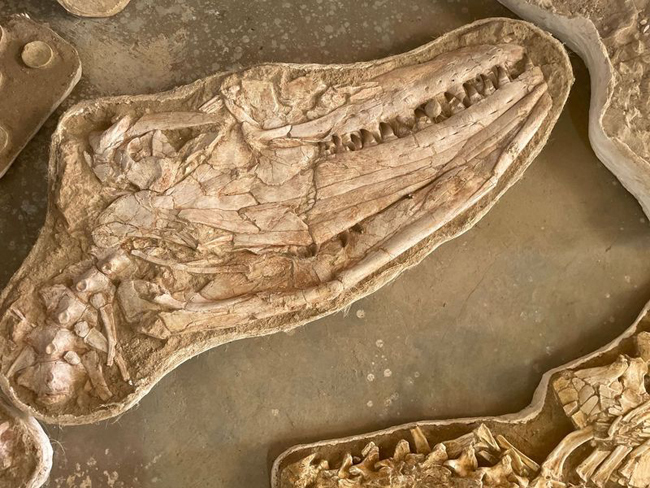
Thalassotitan fossil material. The skull is shown in right lateral view. Picture credit: University of Bath.
Mosasaurids Not in Decline Immediately Prior to their Extinction
The discovery of T. atrox along with the other dozen or so mosasaurid genera identified from fossils found in the Ouled Abdoun Basin suggests that mosasaurs continued to diversify and fill new niches until their extinction at the end of the Cretaceous. These marine lizards probably filled ecological niches vacated by the recently extinct ichthyosaurs and they may have out-competed plesiosaurs. The mosasaurs were probably not in decline prior to the end-Cretaceous extinction event.
Co-author of the scientific paper, Professor Nour-Eddine Jalil (Muséum National D’Histoire Naturelle, Paris), added:
“The phosphate fossils of Morocco offer an unparalleled window on the paleobiodiversity at the end of Cretaceous. They tell us how life was rich and diversified just before the end of the ‘dinosaur era’, where animals had to specialise to have a place in their ecosystems. Thalassotitan completes the picture by taking on the role of the megapredator at the top of the food chain.”
A Threat to Other Marine Animals and to Other Thalassotitans
Extensive pathology associated with the fossilised remains of Thalassotitan indicate that these large mosasaurs sustained injuries as a result of combat. Injuries not only sustained through predation but also during intra-specific combat – fights with members of their own species. The skull and jaws show signs of injury. Other mosasaur fossils have similar pathology, but in Thalassotitan these wounds were exceptionally common, suggesting frequent, intense fights over feeding grounds or mates.
Merciless Sea Monster
Although not the largest mosasaurid described to date, specimens from the Tylosaurus and Hainosaurus genera indicate body lengths in excess of twelve metres, Thalassotitan was a formidable predator, and this is emphasised by the binomial scientific name chosen by the research team. The genus name is from the Greek for “sea monster” or “sea titan” and the species name means “cruel or merciless”
Phylogenetic analysis recovers Thalassotitan as a close relative of Prognathodon currii and P. saturator within the Mosasauridae tribe the Prognathodontini. Prognathodon is represented by numerous species all known from the end of the Cretaceous (Campanian to Maastrichtian faunal stages). Prognathodon species are characterised by very robust skulls, with powerful jaws.
More Discoveries Waiting to be Made
Dr Longrich and his colleagues stressed the importance of the prehistoric animal fossils from the Upper Cretaceous of Morocco and hinted that further exciting discoveries are likely to be made.
Thalassotitan caudal vertebrae prepared for transport. Picture credit: University of Bath.
He stated:
“There’s so much more to be done. Morocco has one of the richest and most diverse marine faunas known from the Cretaceous. We’re just getting started understanding the diversity and the biology of the mosasaurs.”
The extensive, Upper Cretaceous phosphate beds of the Ouled Abdoun Basin have proved palaeontologists with more than a dozen species of mosasaurid to study. Many of these mosasaurs show anatomical adaptations that permitted them to exploit different niches in the ecosystem (niche partitioning). For example, Gavialimimus (G. almaghribensis) had a long, narrow jaw lined with interlocking teeth suggesting that this mosasaur specialised in hunting small fish. In contrast the recently described Pluridens serpentis had disproportionately small eyes, suggesting that this mosasaurid either hunted at depth or within murky water.
Everything Dinosaur acknowledges the assistance of a media release from the University of Bath in the compilation of this article.
The scientific paper: “Thalassotitan atrox, a giant predatory mosasaurid (Squamata) from the Upper Maastrichtian Phosphates of Morocco” by Nicholas R. Longrich, Nour-Eddine Jalil, Fatima Khaldoune, Oussama Khadiri Yazami, Xabier Pereda-Suberbiola, and Nathalie Bardet published in Cretaceous Research.
Today, is the first day of industrial action by the Communication Workers Union (CWU) which will have an impact on the postal services of Royal Mail. Everything Dinosaur team members have put in place measures to protect customers and to minimise the disruption to parcel collection and deliveries.
However, despite our best efforts, there will be delays to UK deliveries and as overseas parcels handled by Royal Mail will also be affected, our customers outside the UK will also face delays in receiving their parcels.
Everything Dinosaur team members have taken steps to help minimise disruption for customers, but due to industrial action UK and overseas deliveries of parcels will be subject to delays. Picture credit: Everything Dinosaur.
Four Days of Industrial Action Planned
The CWU has called on its members who collect, sort and deliver parcels and letters to take strike action. Four days of industrial action have been announced, starting with today (26th August). Further strike action is planned for Wednesday 31st August, with two further strikes scheduled for September (8th and 9th of September).
Royal Mail has released the following statement:
“We’re really sorry for the disruption that this strike action is likely to cause to you. We want to reassure you we will do everything we can to minimise disruption and get our services back to normal as quickly as possible. Royal Mail has well-developed contingency plans, but they cannot fully replace the daily efforts of its frontline workforce. We will be doing what we can to keep services running, but customers should expect significant disruption.”
A spokesperson from Everything Dinosaur confirmed that the UK-based mail order company was not expecting any collections by Royal Mail today. Parcels would still be packed and prepared for collection, but with the Bank Holiday Monday, the earliest deliveries could be sent out would be Tuesday 30th August.
Staff would be working over the weekend and during the Bank Holiday to ensure that as many parcels as possible could be sent out on Tuesday 30th August.
It is hoped that some collection services would be able to take place as Royal Mail management adjusts to the industrial action, but delays to parcel deliveries were inevitable.
Royal Mail has issued advice to its customers stating that it was sensible to “post items as early as possible in advance of the strike dates”. This would help to minimise the disruption.
Industrial action at the Port of Felixstowe could have an impact on the availability of goods, including Everything Dinosaur’s range of prehistoric animal models and figures in the crucial sales period leading up to Christmas.
Recently, staff at Felixstowe Port, one of the busiest ports in Europe, started industrial action in a dispute over pay. If the dispute is not resolved and further strike action follows, this could have an impact on the range of items available and inventory in the vital retail period – quarter 4.
The Port of Felixstowe manages more than 4 million TEUs (Twenty-foot Equivalent Units) per year, including prehistoric animal models and figures destined for Everything Dinosaur’s UK warehouse. Picture credit: Port of Felixstowe.
The Port of Felixstowe
The Port of Felixstowe is the UK’s biggest and busiest container port, and one of the largest in Europe. It handles over 4 million TEUs (Twenty-foot Equivalent Units) per year, around 2,000 container ships, including some of the biggest vessels afloat, unload at Felixstowe each year. The port is a vital component of Britain’s commercial infrastructure. If industrial action continues into the autumn, then this could cause significant disruption to already stretched supply chains in the lead up to Christmas.
All sorts of sectors of the UK economy could be affected including legal importers of prehistoric animal models and figures such as Everything Dinosaur.
A spokesperson from the UK-based company commented:
“We continue to monitor the situation and we are working closely with our freight forwarding contacts to mitigate the impact of any disruption to supplies and minimise any inconvenience for our customers.”
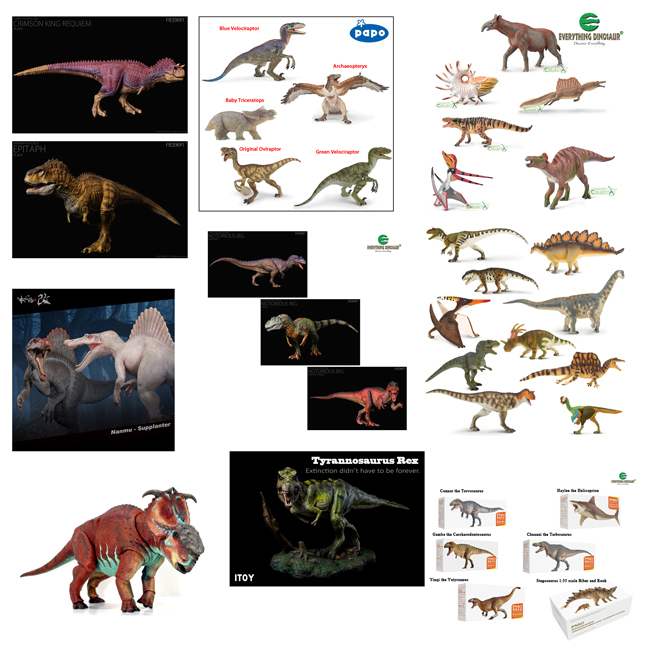
Examples of the huge range of dinosaur and prehistoric animal models and figures stocked by Everything Dinosaur. Picture credit: Everything Dinosaur.
Shop Early for Christmas
Whilst alternative ports are a possibility, continued and prolonged industrial action at Felixstowe could have a knock-on effect for the UK supply chain and result in a shortage of products available in shops. Commentators have advised that customers shop early for Christmas as one way of minimising the potential impact of these strikes.
The spokesperson from Everything Dinosaur explained that as the company had their own warehouse, they had been able to build up considerable stock of prehistoric animal models and figures as well as dinosaur toys. It was stressed that deliveries to the warehouse were still taking place.
The Port of Felixstowe is Britain’s biggest and busiest container port, and one of the largest in Europe. Amongst the huge volumes of goods handled by the Port, there are shipping containers with dinosaur and prehistoric animal models shipped into the UK by Everything Dinosaur. Picture credit: Port of Felixstowe.
The Everything Dinosaur spokesperson added:
“We do have shipments arriving at Felixstowe and there are shipments already scheduled and further ones being planned. We have been able to build up our inventory and we currently have thousands of items in stock which should provide some reassurance to our customers.”
Everything Dinosaur acknowledges the assistance of the Head of Corporate Affairs at the Port of Felixstowe in the compilation of this article.
Earlier this year, (spring 2022), PNSO announced that they would be adding a 1:35 scale replica of an adult Torosaurus and juvenile to their scientific art series. The PNSO Aubrey and Dabei Torosaurus models are in stock and have been proving to be very popular amongst dinosaur fans and model collectors.
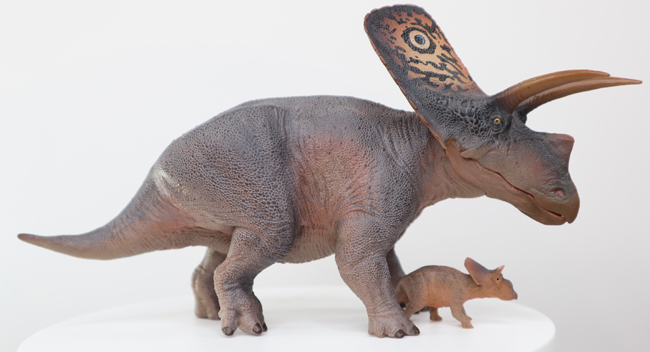
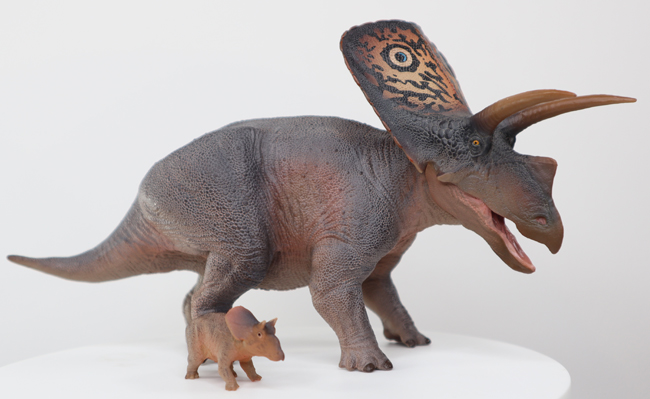
PNSO Torosaurus dinosaur models in 1:35 scale – Torosaurus Aubrey and Dabei. The baby Torosaurus figure stands close to the adult which is offering protection to the young horned dinosaur. Picture credit: Everything Dinosaur.
Torosaurus Figures in 1/35th Scale
The Torosaurus pair (Aubrey and Dabei) are part of the highly successful 1:35 scale scientific art models series from PNSO. Torosaurus is the second ceratopsian to be featured after the initial introduction of the Triceratops figure (Doyle).
Aubrey, the adult Torosaurus measures an impressive 23 cm in length. The beautiful headshield with its stunning eyespots over the fenestrae stands over 12 cm off the ground. The baby Torosaurus (Dabei) measures approximately 5.5 cm long.
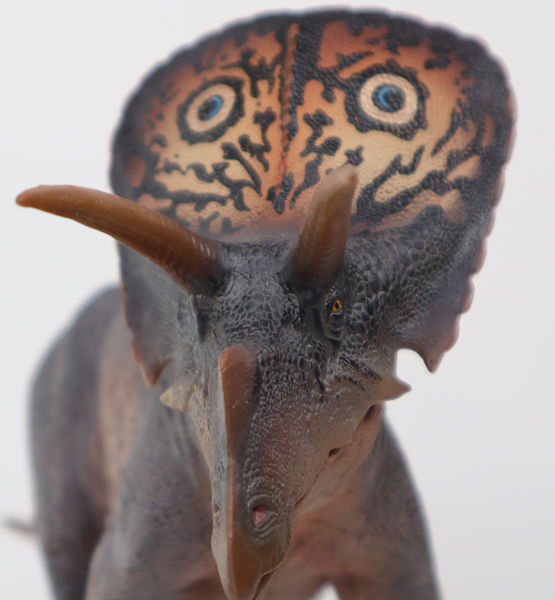
The PNSO Torosaurus 1:35 scale dinosaur model (Aubrey) shown in anterior view. The headshield eyespots and spectacular colouration of this figure are highlighted. Picture credit: Everything Dinosaur.
Torosaurus latus
Torosaurus (T. latus) was formally named and described in 1891 (Othniel Charles Marsh), and is one of the largest, and youngest of the chasmosaurine horned dinosaurs known to science. Fossils have been ascribed to this genus from Upper Cretaceous deposits from both the USA and Canada, although the identification of some of these specimens as Torosaurus fossils remains controversial.
Compared to the closely related Triceratops, fossils of Torosaurus are much rarer.
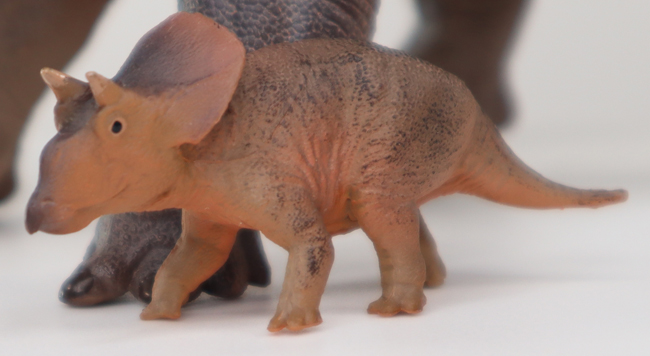
A close-up view of the baby Torosaurus model included in the PNSO model set. Behind Dabei the front foot of Aubrey can be seen, it provides a scale for this juvenile Torosaurus model. Picture credit: Everything Dinosaur.
Twenty Scientific Art Posters
The PNSO Aubrey and Dabei Torosaurus models are supplied with a 48-page, fully illustrated booklet, 7 drawing cards and twenty scientific art posters featuring the two dinosaur figures.
The PNSO Torosaurus pair (Aubrey and Dabei) shown in right lateral view. Picture credit: Everything Dinosaur.
PNSO have earned a deserved reputation for the breadth and depth of their prehistoric animal model range. To view the wide range of PNSO figures available from Everything Dinosaur: PNSO Age of Dinosaurs Models and Figures.