All about dinosaurs, fossils and prehistoric animals by Everything Dinosaur team members.
9 05, 2020

Reconstructing a Late Cretaceous Ecosystem

By |2024-02-19T09:17:37+00:00May 9th, 2020|Categories: Dinosaur and Prehistoric Animal News Stories, Dinosaur Fans, Main Page|0 Comments

Reconstructing a Dinosaur Dominated Ecosystem

A team of international researchers including scientists from the Royal Ontario Museum (Toronto, Canada), have provided a new perspective on the palaeoenvironment of western North America during the Late Cretaceous.  An extensive study mapping stable isotopes identified in fossilised teeth has provided the research team with detailed information on how some dinosaurs co-existed in a floodplain environment on the landmass of Laramidia around 75 million years ago.

Many Different Types of Dinosaur are Associated with the Late Cretaceous of Laramidia

Dinosaur dominated ecosystem of Laramidia.
A large variety of different types of dinosaur co-existed on Laramidia.  Ornithischian dinosaurs such as ankylosaurs, ceratopsians, hadrosaurs as well as saurischian dinosaurs such as dromaeosaurs, ornithomimids and tyrannosaurs.  They shared their tropical environment with turtles and numerous types of crocodilian. Scientists reconstruct a Late Cretaceous ecosystem.

Picture credit: Danielle Dufault (Royal Ontario Museum)

Niche Partitioning in the Dinosauria

Palaeontologists had puzzled over how so many different types of large tetrapod could co-exist together and it had been thought that extensive niche partitioning between species must have been taking place.  Niche partitioning describes the natural selection process whereby different species reduce competition amongst themselves by becoming more specialised and adopting specific roles within an ecosystem.  They become adapted to a particular niche and by doing this competition between species is reduced.

Niche Partitioning Between Ceratopsids and Hadrosaurids
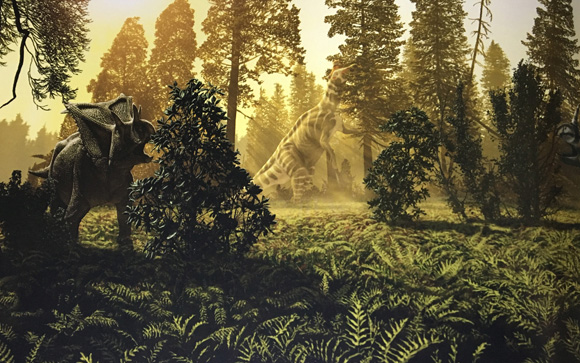
The fauna and flora of Alberta 75 million years ago
Alberta around 75 million years ago (Dinosaur Park Formation).  This part of the western North American landmass (Laramidia), was home to a large number of different types of dinosaur including a number of ceratopsians and duck-billed dinosaurs.  It had been suggested that niche partitioning permitted these mega-herbivores to co-exist with each type of plant-eating dinosaur specialising on feeding upon different types of vegetation.

Picture credit: Julius Csotonyi

Stable Isotope Analysis Used to Reconstruct a Late Cretaceous Ecosystem

Researchers from the Royal Ontario Museum in collaboration with colleagues from the Field Museum in Chicago (USA), compared the compositions of stable isotopes identified in the fossilised teeth of different dinosaur taxa.  Stable isotopes are naturally occurring varieties of chemical elements such as oxygen and carbon that don’t alter and change into other elements over time. When water and food is consumed the stable isotopes of the elements that make up these resources (for example, nitrogen, carbon and oxygen), are passed on to the animal’s tissues including their teeth enamel.

Lead author of the research paper, published by the Geological Society of America, Dr Thomas Cullen (University of Toronto/Royal Ontario Museum), stated:

“Differences in the sources of water and types of food being consumed, as well as the physiology of the animal itself and the habitats they live in, will all result in small differences in the relative amounts of the stable isotopes of a given element, for example, carbon-13 versus carbon-12, present in their body tissues.  Measuring the ratios of the different isotopes of elements such as carbon or oxygen in tissues like tooth enamel gives us a unique window into the diet and habitat of an animal which has been extinct for millions of years.”

One of the Largest Studies of its Type Conducted

This research is one of the largest studies of its kind conducted on a dinosaur dominated ecosystem.  Over 350 isotopic measurements from 17 different taxa from fossils representing the Campanian fauna of Alberta.  Uniquely, this ancient data set was then compared and contrasted with measurements from 16 living species sampled from a modern coastal wetland in Louisiana, which closely resembles the climate conditions with northern Laramidia during the Late Cretaceous.

One of the co-authors of the study, Dr David Evans (Royal Ontario Museum), commented:

“Most of the time when these types of studies are done, the size of the dataset is much smaller and doesn’t take into consideration how dinosaur ecosystems compared to modern ones.  Louisiana was the perfect place to use as a comparison with the dinosaur communities we studied.  The environmental conditions were probably quite similar, and a number of the animals there probably had similar lifestyles to those found in dinosaur ecosystems.  That gives us a great deal of control when exploring our data.”

Typical Dinosaur Biota from the Campanian Faunal Stage of Northern Laramidia
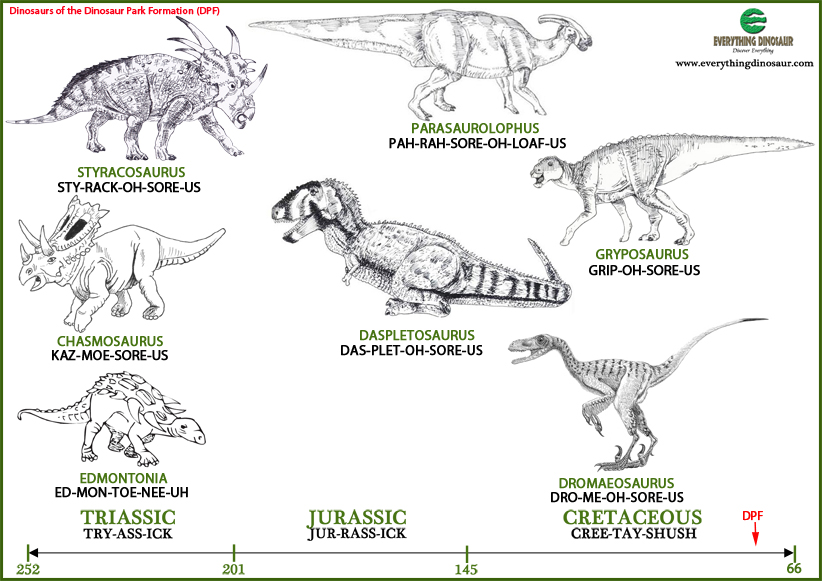
Dinosaur Park Formation dinosaurs.
Typical dinosaur fauna of the Dinosaur Park Formation (Alberta, Canada).  A typical dinosaur dominated fauna associated with the study. Picture credit: Everything Dinosaur.

Picture credit: Everything Dinosaur

For models and replicas of Late Cretaceous dinosaurs and other prehistoric creatures: PNSO Age of Dinosaurs Models and Figures.

Challenging Existing Theories

The team’s results challenge existing theories about niche partitioning and habitat exploitation.  For example, it had been suggested that the horned dinosaurs tended to congregate in coastal areas, whereas hadrosaurids preferred inland habitats.  The stable carbon and oxygen isotope ranges for these large herbivores were found to strongly overlap, providing direct evidence against different types of mega-herbivore segregating.

Large herbivores did not appear to be separating across different habitats.  The researchers conclude that these animals may have been doing something different to avoid interspecific competition.  Perhaps herds of horned dinosaurs moved around the region in a different pattern compared to the herds of duck-billed dinosaurs.  In this way, they may have avoided being in the same part of the habitat at the same time, or perhaps they were feeding on different parts of the same plants.

With the high levels of carbon dioxide in the atmosphere, the high average temperatures of 16-20 degrees Celsius and the extended daylength at certain times of the year due to the high latitude, competition for food might have been somewhat less intense than it is in modern ecosystems.

Extensive Vertebrate Fossil Deposits Have Helped to Inform Scientists About Ancient Ecosystems
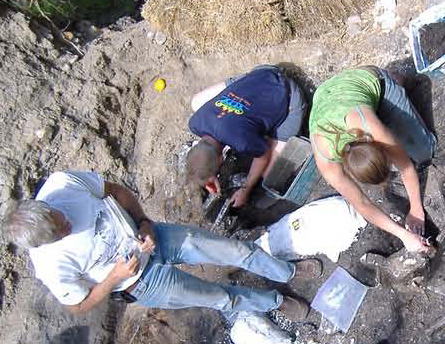
Excavating an Edmontosaurus.
Extensive bonebeds and other fossil deposits have helped to inform scientists about the ancient ecosystem.

Picture credit: Victoria Arbour

Results Helping to Understand the Implications of Global Warming

The isotope analysis enabled the scientists to accurately estimate the climate in this northern Laramidian palaeoenvironment.  By using an approach that combined average oxygen isotope compositions from the sampled species, new estimates of mean annual temperatures for the region could be made.  The team found that 75-million years ago, this area of southern Alberta to northern Montana had a mean annual temperature of about 16-20 °Celsius, a stark contrast to the current range of about 5-7 °Celsius that is experienced today.

Dr Cullen explained:

“Dinosaurs lived in a weird world: broad-leafed and flowering plants were much less common, it was warm enough in high latitudes to support crocodilians, CO2 in the atmosphere was higher than it is today, and there was little to no ice at the poles.  It’s not like anything we as humans have any direct experience with, but it may be the direction we are headed, so it’s critical that we understand how ecosystems and environments function under those sorts of conditions so we can better prepare ourselves for the future.”

Gaining a Better Understanding of a Late Cretaceous Ecosystem

The scientists conclude that that this approach is a simple and effective method that enables accurate palaeoenvironmental reconstruction.  These results indicate that dinosaur niche partitioning was much more complex than previously thought.  This study can provide a framework for future research on dinosaur-dominated Mesozoic floodplain communities.

The scientific paper: “Large-scale stable isotope characterization of a Late Cretaceous dinosaur-dominated ecosystem” by T.M. Cullen, F.J. Longstaffe, U.G. Wortmann, L. Huang, F. Fanti, M.B. Goodwin, M.J. Ryan and D.C. Evans published by the Geological Society of America.

The Everything Dinosaur website: Everything Dinosaur.
8 05, 2020

Happy Birthday Sir David Attenborough

By |2024-02-19T09:04:19+00:00May 8th, 2020|Categories: Animal News Stories, Famous Figures, Main Page, TV Reviews|0 Comments

Happy Birthday Sir David Attenborough

Today, May 8th, is Sir David Attenborough’s birthday.  Sir David Attenborough has enjoyed the best part of seventy years as a broadcaster, narrator and television presenter.  His energy and enthusiasm for the natural world shows no sign of deteriorating despite him being just six years short of his centenary.  Over recent years, the veteran broadcaster has become an active campaigner raising awareness about climate change, global warming and the impact of our species on the planet.

Sir David Attenborough

He remains as busy as ever, with the BBC producing a new five-part television series narrated by Sir David, highlighting how natural forces such as ocean currents, seismic activity, sunshine and volcanoes contribute to maintaining a sustainable natural world.  A source close to Everything Dinosaur has stated that the series is entitled “A Perfect Planet”.

Sir David Attenborough

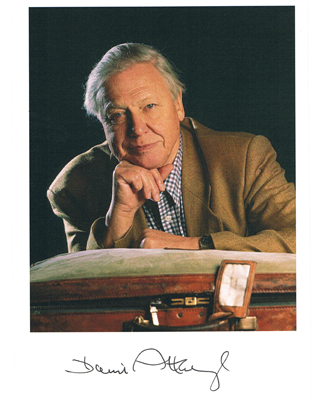
Sir David Attenborough.
A gentleman and a scholar.  Sir David Attenborough is 94 years old today.

Many Happy Returns

The television programmes will also highlight how some animals such as snub-nosed monkeys, wolves and bears are having to adapt as the world around them changes.  Birdlife from the Galapagos islands including vampire finches will also feature in the series.

Commenting on the significance of these programmes, Sir David stated that:

“To preserve our perfect planet we must ensure we become a force for good”.

The fifth and final episode will look at how our species has impacted upon the environment and the billions of other organisms that share our world.

Sir David added:

“Our planet is one in a billion, a world teeming with life.  But now, a new dominant force is changing the face of Earth: humans”.

Team members have been lucky enough to have corresponded with Sir David Attenborough, he remains as enthusiastic as ever and passionate about conservation.  Many happy returns Sir David, stay safe, keep well.

Sir David Attenborough – A Nonagenarian Passionately Campaigning to Raise Awareness About Climate Change

Sir David Attenborough
Sir David Attenborough veteran naturalist and broadcaster.  An active campaigner raising awareness about climate change and global warming.

Picture credit: BBC

7 05, 2020

Missing Fossil Collecting Making Plans for the Future

By |2024-02-19T08:59:52+00:00May 7th, 2020|Categories: Everything Dinosaur News and Updates, Main Page, Photos/Pictures of Fossils|2 Comments

Missing Fossil Collecting

Everything Dinosaur team members had lots of plans for fossil collecting expeditions over the late spring and summer months.  Like lots of people at the moment we have had to postpone these activities (COVID-19).  Instead, team members are busy planning some projects and fieldwork for the late autumn and for 2021.

Missing Fossil Collecting

A Lot of Plans for Fieldwork are Having to be Redrawn

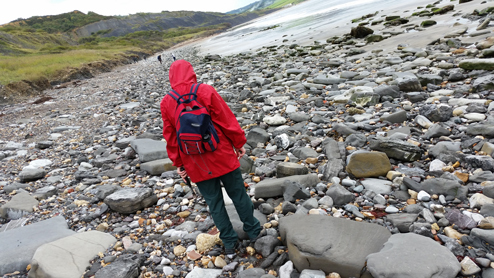
Prospecting for fossils (Lyme Regis) - Lagerstätte.
Looking for fossils at Lyme Regis. Plans for fieldwork are suspended. Picture credit: Everything Dinosaur.

Picture credit: Everything Dinosaur

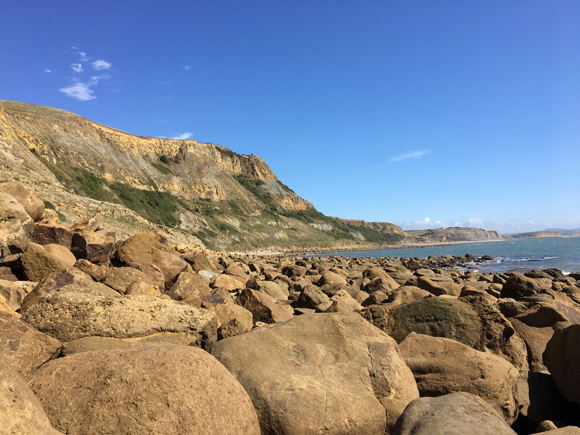
A point often overlooked when discussing fossil collecting as a hobby, is that if fossils were not found and collected, many important specimens would be lost to the elements.  Fossils eroding out of the cliffs along the Dorset coast for example, they could easily be lost to the sea as there are very few visitors permitted to the “Jurassic Coast” at the moment.

With Many Countries in Lockdown Fossil Finding Expeditions for Many People are not Possible at the Moment

Heading east from Lyme Regis to Burton Bradstock.
The view towards West Bay and Burton Bradstock.  Much of the “Jurassic Coast” is devoid of visitors at the moment (COVID-19). Picture credit: Everything Dinosaur.

Picture credit: Everything Dinosaur

Museums Closed Too

Important research work has also had to be postponed or suspended.  Researchers wanting to access museum specimens will probably have to wait until these institutions and other academic bodies such as universities can function properly with a full complement of staff.

Access to Museum Collections is Restricted for the Time Being

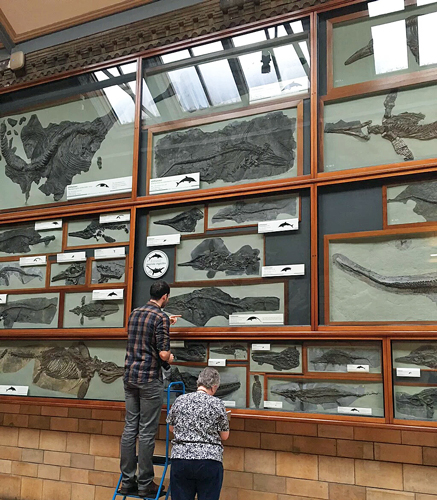
Dean Lomax and Judy Massare examining Ichthyosaur specimens.
Dean Lomax and Judy Massare examining Ichthyosaur specimens in the marine reptile gallery at the Natural History Museum (London) as part of their research into the Ichthyosauria.

Picture credit: Dean Lomax

For models of marine reptiles and other prehistoric animals: Prehistoric Animal Models and Figures.

Keeping Ourselves Occupied

Everything Dinosaur team members have lots to keep them occupied.  Ironically, a few weeks before the lockdown came into effect, we were at the London Natural History Museum undertaking some project work ourselves.  We visited various parts of the museum including the marine reptiles gallery, although if you know that part of the museum quite well, it is not only the marine reptile specimens that are on display, we were there for the ichthyosaurs, the Metriorhynchidae (marine crocodyliforms) as well as one other very important fossil specimen that is located there but we won’t mention this…

The Marine Reptiles Gallery at the London Natural History Museum

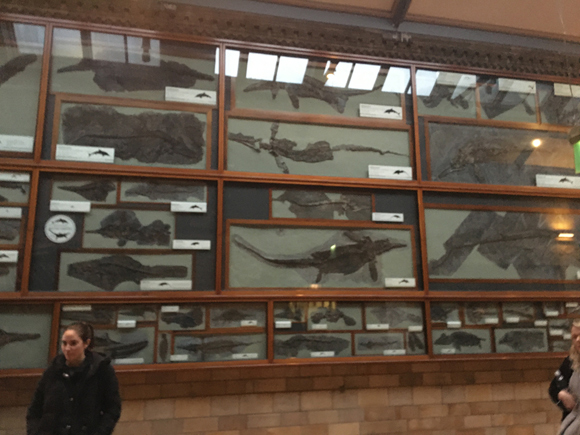
Marine reptiles gallery at the London Natural History Museum.
The famous marine reptiles gallery at the London Natural History Museum. Picture credit: Everything Dinosaur.

Picture credit: Everything Dinosaur

Visit the award-winning Everything Dinosaur website: Everything Dinosaur.

6 05, 2020

“Raptors” Did Not Hunt in Packs According to New Study

By |2024-02-18T14:12:58+00:00May 6th, 2020|Categories: Adobe CS5, Dinosaur and Prehistoric Animal News Stories, Dinosaur Fans, Main Page|3 Comments

New Study Challenges Dromaeosaurids Hunting in Packs

The “Jurassic Park/Jurassic World” movie franchise certainly spawned new generations of dinosaur fans.  It could be argued that these extremely successful films, may have influenced the career choices of would-be scientists.  All very well and good, but one of the problems associated with the films and with the original book “Jurassic Park” written by Michael Crichton, concerns the “raptors”, those fast running, social pack hunters the size of Deinonychus but in this franchise referred to as Velociraptors.

Popular media has depicted these “raptors” as highly social, intelligent animals capable of working together to attack and bring down prey, but what scientific evidence is there to back-up the on-screen abilities of these dinosaurs?

Studying Isotopes in Dinosaur Teeth

Since it is very rare for the fossil record to preserve behaviour, scientists have had to employ some ingenious lines of research in order to gain an insight into the behaviour of dinosaurs.  For example, researchers from the University of Wisconsin, the University of Oklahoma and the Sam Noble Museum (Oklahoma), set about analysing differences in stable carbon isotopes within Deinonychus teeth.  Differences in the composition of these stable isotopes in teeth from young dinosaurs when compared to the isotopes found in the teeth of adults, would indicate a different diet.

If the adults had a different diet compared to the younger animals then this would contradict the idea of these dinosaurs being social and hunting in packs.

They conclude that Deinonychus probably did not hunt in a co-operative, co-ordinated manner.  These “raptors” were probably not complex, social hunters.

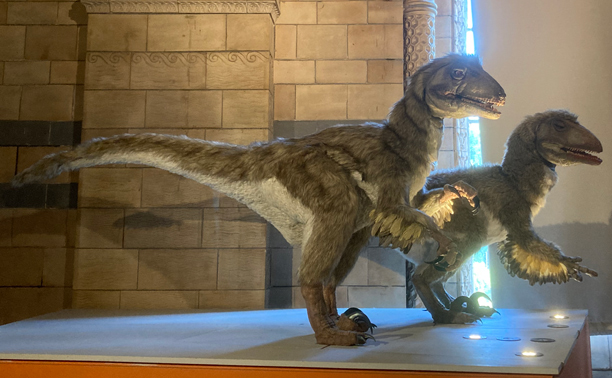
Life-size Deinonychus Replicas on Display

Life-size Deinonychus replicas on display.
Life-size Deinonychus replicas on display at the London Natural History Museum. Picture credit: Everything Dinosaur.

Picture credit: Everything Dinosaur

Laying a Ghost – Highly Intelligent, Pack Hunting “Raptors”

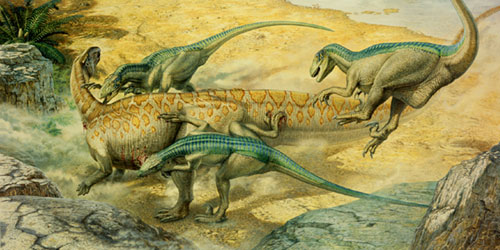
The idea of pack hunting in dromaeosaurids pre-dates “Jurassic Park”, it was first proposed to explain the co-occurrence of Deinonychus (D. antirrhopus) and the iguanodontian Tenontosaurus (T. tilletti).  Around a fifth of all Tenontosaurus remains are found in association with D. antirrhopus.  It has been proposed that Deinonychus hunted the larger Tenontosaurus and as numerous fossil specimens of Deinonychus have been found with Tenontosaurus remains it was suggested that this was evidence of pack hunting behaviour amongst members of the Dromaeosauridae.

A Pack of “Raptors” (Deinonychus) Attack a Tenontosaurus

Deinonychus attacking Tenontosaurus.
A pack of Deinonychus attacking the herbivore Tenontosaurus.  Pack hunting behaviour inferred from fossil evidence.

Picture credit: John Sibbick

Dromaeosaurs Probably Not Pack Hunters

The depiction of dromaeosaurs as pack hunters is problematic as sophisticated hunting strategies are rarely observed in living archosaurs such as crocodiles and birds.   Palaeontologists have considered that perhaps Deinonychus was more analogous to extant reptilian predators such as the Komodo dragon (V. komodoensis), where there seems to be no co-ordinated attack strategy, instead an attack by an individual may instigate mobbing behaviour which would bring down the prey.

Lead author of the study, published in Palaeogeography, Palaeoclimatology, Palaeoecology, Dr Joseph Frederickson (University of Wisconsin), explained:

“The evidence for this behaviour [pack hunting], however, is not altogether convincing.  Since we can’t watch these dinosaurs hunt in person, we must use indirect methods to determine their behaviour in life.  Though widely accepted, evidence for the pack-hunting dinosaur proposed by Yale University palaeontologist John Ostrom is relatively weak.  The problem with this idea is that living dinosaurs (birds) and their relatives (crocodilians) do not usually hunt in groups and rarely ever hunt prey larger than themselves.  Further, behaviour like pack hunting does not fossilise so we can’t directly test whether the animals actually worked together to hunt prey.”

Social Pack Hunters versus Mob Hunters

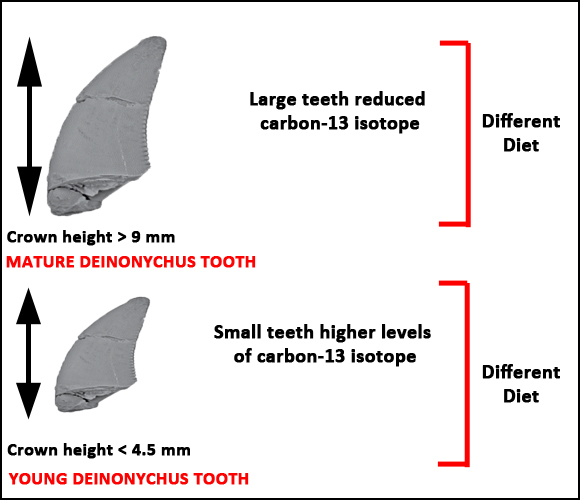
In order to test the likelihood of Deinonychus being a social pack hunter or whether these dinosaurs simply mobbed victims in an uncoordinated manner, the researchers looked at evidence for dietary changes preserved in the stable carbon isotopes found in fossilised Deinonychus teeth of various sizes.  The team analysed tooth carbonate from teeth less than 4.5 mm tall (crown height less than 4.5 mm) and compared the carbon isotopes found to those from much larger teeth (crown height greater than 9 mm). 

The smallest teeth studied were the relatively most enriched with carbon-13 isotope, whilst the largest teeth used in the study had depleted levels.  These results suggest that juvenile Deinonychus consumed different prey than older members of this species.

Analysis of Stable Isotope Carbon-13 in the Teeth of Deinonychus Sheds Doubt on the Social Hunter Hypothesis

Isotope analysis of dinosaur teeth.
Deinonychus teeth – carbon-13 isotope analysis.  Tooth samples collected from the Lower Cretaceous Cloverly (Montana) and Antlers (Oklahoma) formations when analysed for carbon-13 levels suggest a dietary shift as Deinonychus matured.  This challenges the social, pack hunter hypothesis. Picture credit: Everything Dinosaur.

Picture credit: Everything Dinosaur

Testing the Teeth of Other Prehistoric Animals as Well as Deinonychus

Teeth from goniopholidid crocodilians as well as the teeth of Tenontosaurus tilletti were also tested.  The crocodilian results mirrored those found for Deinonychus.  If goniopholidid had the same behaviours of extant crocodilians then, just like their modern counterparts, these reptiles went through a distinct dietary transition as they grew.  If the teeth of Deinonychus show very similar results to the crocodilians, then, the implication is that just like crocodiles today, this “raptor” was probably not a complex social hunter it is unlikely that its hunting behaviour was comparable to the pack hunting behaviour of wolves or lions.

Still, the prospect of being mobbed by a gang of agile, three-metre-long, predatory dinosaurs remains unappealing.

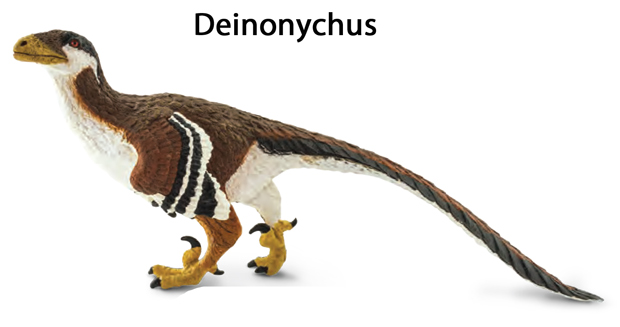
A Model of a Deinonychus Dinosaur (D. antirrhopus)

The new for 2020 the Wild Safari Prehistoric World Deinonychus dinosaur model.
New for 2020 the Wild Safari Prehistoric World Deinonychus dinosaur model.  Evidence suggests that Deinonychus was not a social, sophisticated pack hunter.

The picture (above) depicts the recently introduced Wild Safari Prehistoric World Deinonychus model.

To view this model range: Wild Safari Prehistoric World Figures and Models.

The scientific paper: “Ontogenetic dietary shifts in Deinonychus antirrhopus (Theropoda; Dromaeosauridae): Insights into the ecology and social behavior of raptorial dinosaurs through stable isotope analysis” by J.A. Frederickson, M. H. Engel, R.L. Cifelli published in Palaeogeography, Palaeoclimatology, Palaeoecology.

The Everything Dinosaur website: Everything Dinosaur.
5 05, 2020

CollectA Deluxe Woolly Mammoth “Turntable Tuesday”

By |2024-02-19T08:39:25+00:00May 5th, 2020|Categories: Adobe CS5, Dinosaur Fans, Everything Dinosaur Products, Everything Dinosaur videos, Main Page, Photos of Everything Dinosaur Products, Product Reviews|0 Comments

“Turntable Tuesday” CollectA Deluxe Woolly Mammoth

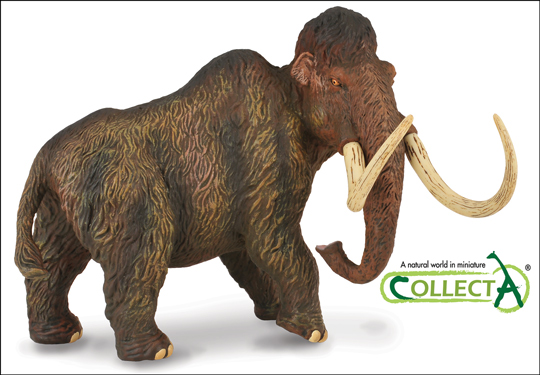
It’s “Turntable Tuesday” at Everything Dinosaur and time to give another prehistoric animal figure in our extensive range, a spin.  Today, we have selected one of the most underrated models in the CollectA Deluxe Prehistoric Life model range – the 1:20 scale Woolly Mammoth.  It is time this fabulous figure of an iconic Ice Age animal got put into the spotlight.

“Turntable Tuesday”

“Turntable Tuesday” – The CollectA Deluxe 1:20 Scale Woolly Mammoth

Video credit: Everything Dinosaur

CollectA Deluxe 1:20 Scale Woolly Mammoth (Mammuthus primigenius)

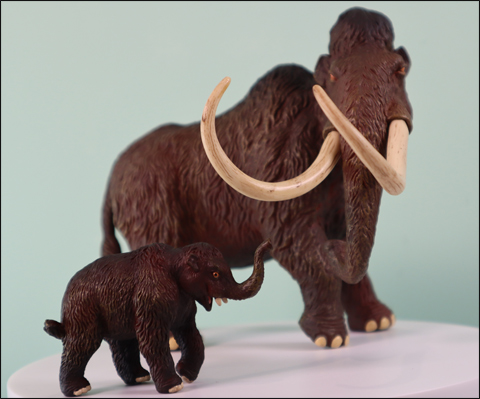
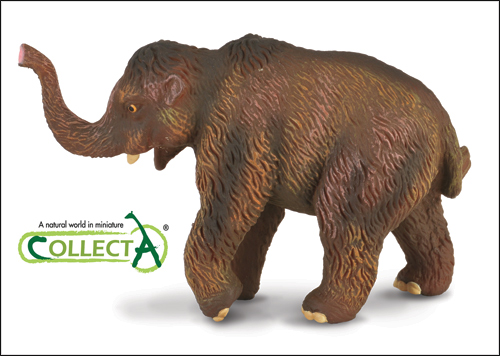
Lots of prehistoric animal ranges include a Woolly Mammoth figure (M. primigenius).  It seems that as soon as a manufacturer starts to extend a range beyond the Dinosauria, the Woolly Mammoth comes into consideration.  The CollectA 1:20 scale replica was introduced back in 2009 along with the Woolly Mammoth calf, which coincidentally, makes a short appearance in our video.  Interestingly, although no scale declaration was ever made for the calf model, these models were originally given sequential catalogue and production numbers.  They do work very well together in terms of scale.

CollectA Woolly Mammoth Models

CollectA Woolly Mammoth models.
The CollectA Deluxe Woolly Mammoth model in 1:20 scale and the CollectA Prehistoric Life Woolly Mammoth calf. Picture credit: Everything Dinosaur.

Picture credit: Everything Dinosaur

A Woolly Mammoth on the Turntable

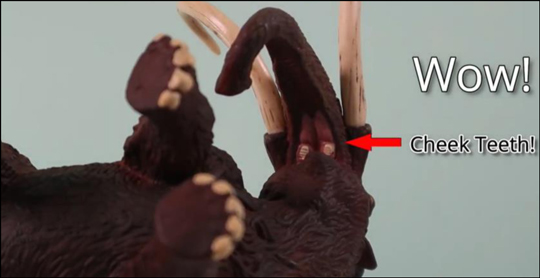
Our short video showcasing these excellent replicas lasts around one minute fifty seconds.  Using a turntable to display the models we can permit viewers an all-round view of the figure.  We did have to place the adult Mammoth on its back so that we could show the beautifully sculpted teeth in the upper jaw.  Those tusks (upper incisors), are beautifully weathered too.

The Everything Dinosaur Video Highlights Some of the Details on the Ice Age Models

Highlighting details on the CollectA Deluxe Woolly Mammoth model.
The Everything Dinosaur video highlights the details in the upper jaw. Picture credit: Everything Dinosaur.

Picture credit: Everything Dinosaur

Model Measurements – Are They 1:20 Scale Woolly Mammoth Models?

The CollectA Deluxe adult Woolly Mammoth measures around 20 cm long and that magnificent head is approximately 15 cm off the ground.  Different species were different sizes and as with extant elephants today, the males were much larger than the females.  Scientific measurements based on Mammuthus primigenius suggest an adult body size of around 3.5 metres to 4 metres in length, so this figure is indeed in approximately 1:20 scale.

The CollectA Deluxe Woolly Mammoth Replica

The CollectA Deluxe Woolly Mammoth replica.
CollectA Deluxe Woolly Mammoth replica.

The CollectA Woolly Mammoth Calf

CollectA Woolly Mammoth calf.
CollectA Prehistoric Life Woolly Mammoth calf model.

Visit the Everything Dinosaur website: The Everything Dinosaur Website.

The Woolly Mammoth video can be found on Everything Dinosaur’s YouTube channel, please subscribe, you can find the channel here: Everything Dinosaur on YouTube.

To view the CollectA Deluxe range of prehistoric animals: CollectA Deluxe Prehistoric Life Models.

To view the CollectA Woolly Mammoth calf and the rest of the figures in the Prehistoric Life range: CollectA Prehistoric Life.

4 05, 2020

A New Dinosaur Called Stellasaurus – “Star Lizard”

By |2024-02-19T07:34:10+00:00May 4th, 2020|Categories: Adobe CS5, Dinosaur and Prehistoric Animal News Stories, Dinosaur Fans, Main Page, Palaeontological articles, Photos/Pictures of Fossils|0 Comments

Stellasaurus ancellae – Missing Link from the Two Medicine Formation of Montana

A new species of horned dinosaur has been described based on fossil material from the famous Two Medicine Formation of north-western Montana.  The new species named Stellasaurus ancellae is a possible missing link in the evolutionary transition of Centrosaurinae dinosaurs from Styracosaurus to one of the last of the horned dinosaurs known to science – Pachyrhinosaurus.

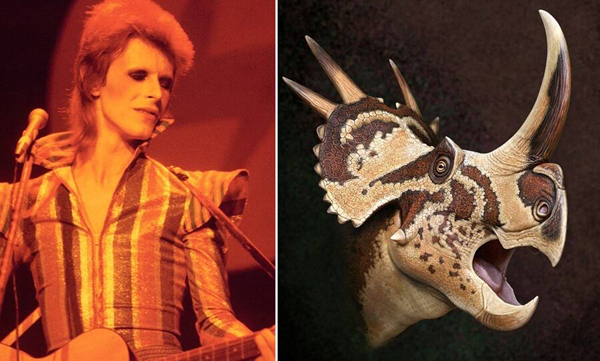
Stellasaurus means “star lizard”, reflecting the ornate star-shaped head crest and in honour of British rock/pop star David Bowie, famous for his flamboyant appearance and his hit single “Starman” which was released on April 28th 1972, almost 48 years to the day that the Stellasaurus scientific paper was published in Royal Society Open Science.

United by a Flamboyant Appearance David Jones AKA David Bowie and “Star Lizard” AKA Stellasaurus

Two flamboyant characters David Bowie and Stellasaurus.
David Bowie (left) and Stellasaurus ancellae (right).

Picture credit: Getty Images and Andrey Atuchin

Stellasaurus ancellae

Just like the career of David Bowie, Stellasaurus has had to wait a while before becoming famous.  The fossil material now assigned to Stellasaurus was discovered in 1986, near the town of Cut Bank in Montana, close to the USA/Canadian border.  The discovery was made by Carrie Ancell.  It remained catalogued but not studied in the Museum of the Rockies (Montana), vertebrate fossil collection.

The contribution of Carrie Ancell, now a senior preparator at the Museum of the Rockies, has been recognised as the species name honours her.  Carrie Ancell has played a significant role in developing our understanding of northern Laramidian centrosaurines.  She discovered and prepared MOR 492, the holotype specimen of Stellasaurus ancellae, as well as the holotype of Achelousaurus horneri, and co-discovered the holotype of Einiosaurus procurvicornis.

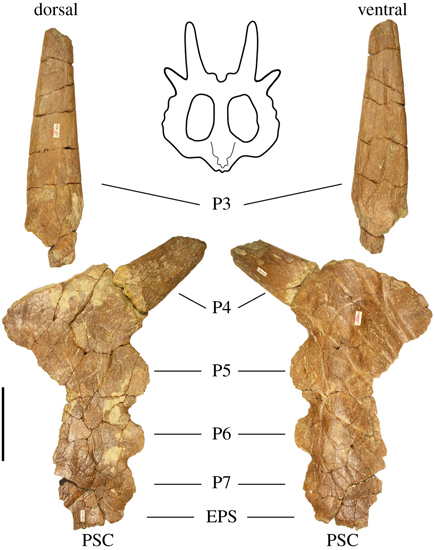
Views of the Holotype Fossil Material of Stellasaurus ancellae

Holotype fossil material for Stellasaurus ancellae
Left lateral parietal bar of Stellasaurus ancellae holotype MOR 492 in dorsal and ventral views.   The line drawing has been reproduced from a PLOS One article (Evans and Ryan).  Note scale bar on left equals 10 cm.

Picture credit: Wilson et al/Royal Society Open Science

Reviewing the Centrosaurinae Fossil Material from the Two Medicine Formation

A review of cranial material, specifically the ornamentation associated with the neck frill (parietal processes), previously assigned to the centrosaurine Rubeosaurus ovatus resulted in the identification of this new taxon.  However, this assessment could mark the demise of R. ovatus as the researchers, which include John Wilson of Montana State University, conclude that only what was the holotype fossil, a partial parietal specimen number USNM 11869, can be attributed Rubeosaurus.  This could spell the end for Rubeosaurus.  When USNM 11869 was first described it was assigned to a new species of Styracosaurus (S. ovatus).

Thus, this new paper proposes that the genus Rubeosaurus is now no longer valid and that Styracosaurus ovatus is the sister taxon to Styracosaurus albertensis and Stellasaurus marks a missing link in centrosaurine evolution between Styracosaurus and Einiosaurus procurvicornis.

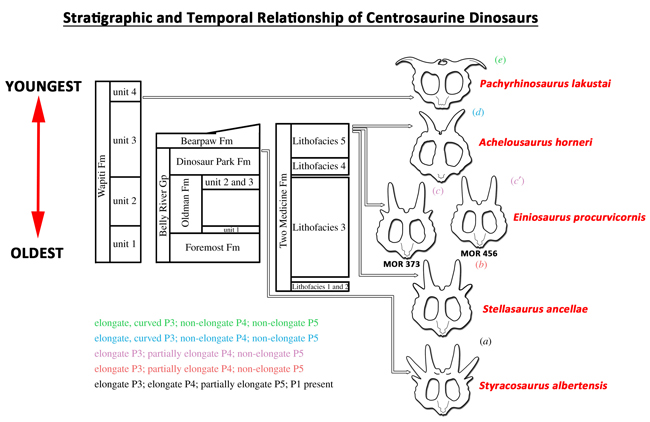
A Stratigraphical and Temporal Assessment of Late Cretaceous Centrosaurines Based on Two Medicine Formation Fossil Material *

The centrosaurine lineage from Styracosaurus to Pachyrhinosaurus.
Stratigraphic and temporal relationship between Two Medicine Formation centrosaurine taxa. * Pachyrhinosaurus lakustai fossil material is not from the Two Medicine Formation but from the younger unit 4 sediments of the Wapiti Formation of Canada.

Picture credit: Wilson et al/Royal Society Open Science

A Missing Link Amongst the Centrosaurinae

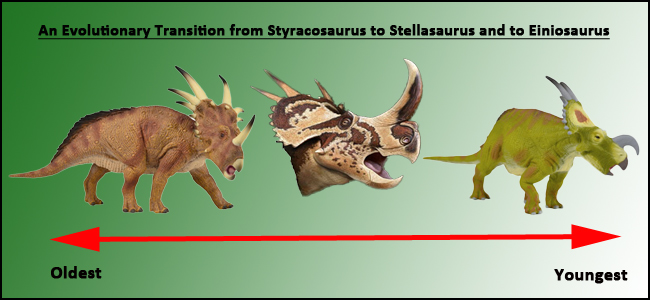
The researchers postulate that Stellasaurus represents a missing link in the centrosaurine family tree.  The fossils of Stellasaurus are believed to be around 75 million years old.  From a stratigraphical perspective, they are younger than Styracosaurus albertensis fossils, but older than fossils assigned to Einiosaurus.  That flamboyant head shield with its various lumps and bumps could reflect a transitional stage between the headshield morphology of Styracosaurus and that of Einiosaurus.  It is suggested that Stellasaurus was preceded by Styracosaurus and that Styracosaurus evolved into Stellasaurus.  In addition, Einiosaurus evolved from Stellasaurus.

A Transitional Process – One Horned Dinosaur Leading Directly to Another Species of Horned Dinosaur

Anagenesis amongst centrosaurines.
Anagenesis within centrosaurine dinosaurs.  Stellasaurus evolved from Styracosaurus and Einiosaurus evolved from Stellasaurus.

Picture credit: Everything Dinosaur/Andrey Atuchin

Anagenesis in the Centrosaurinae

Commenting upon the importance of this new research, lead author John Wilson stated:

“The ornamental horns and spiky frills on the skulls of these animals are what changed the most through evolution.  The new species has skull ornamentation which is intermediate.  This gives us evidence these species are members of a single, evolving lineage – this type of evolution is called anagenesis.”

The Phylogeny of the Centrosaurinae from Statistical Analysis Undertaken by the Research Team

Phylogeny of the Centrosaurinae based on Bayesian analysis.
Phylogeny of the Centrosaurinae clade of the Ceratopsidae based on Bayesian statistical analysis mapped against a temporal range.  Styracosaurus ovatus (formerly Rubeosaurus ovatus), is placed as the sister taxon to Styracosaurus albertensis, whilst Stellasaurus is mapped between S. albertensis and Einiosaurus procurvicornis.

Picture credit: Wilson et al/Royal Society Open Science

The scientific paper: “A new, transitional centrosaurine ceratopsid from the Upper Cretaceous Two Medicine Formation of Montana and the evolution of the ‘Styracosaurus-line’ dinosaurs” by John P. Wilson, Michael J. Ryan and David C. Evans published in Royal Society Open Science.

The Everything Dinosaur website: Everything Dinosaur.
3 05, 2020

Preparing for the New Caviramus

By |2024-02-19T07:27:32+00:00May 3rd, 2020|Categories: Adobe CS5, Dinosaur Fans, Everything Dinosaur News and Updates, Everything Dinosaur Products, Main Page, Photos of Everything Dinosaur Products|0 Comments

Preparations Underway for the CollectA Caviramus Pterosaur Model

At the end of November last year (2019), Everything Dinosaur revealed that CollectA would be introducing a replica of the bizarre Late Triassic pterosaur Caviramus.  This 1:2 scale model, along with the rest of the remaining new for 2020 CollectA prehistoric animals, have been delayed (coronavirus outbreak), but team members at Everything Dinosaur have still been busy making preparations for this model’s arrival.

Arriving in 2020 (Later on in the Year) The CollectA Supreme Caviramus Pterosaur Model

CollectA Caviramus model with an articulated jaw.
The bizarre Late Triassic pterosaur Caviramus (CollectA Caviramus model).

Caviramus schesaplanensis

Of all the pterosaurs known to science (there are around 130 genera), arguably the most bizarre but poorly known are those from the Late Triassic and into the latter stages of the Early Jurassic (Toarcian stage), that have been tentatively grouped together as “Campylognathoidids”.  Caviramus is one such member, assigned by several authors, although there is very little agreement amongst pterosaur experts how the various associated genera are related to each other, or indeed, how they fit into the wider Pterosauria.

The grouping consists of around half a dozen or so assorted genera, most of which have been found in Europe.  European members include Austriadactylus, Carniadactylus, Eudimorphodon, Campylognathoides, Caviramus and Raeticodactylus.

Named and described in 2006 (Fröbisch and Fröbisch), from a partial lower jaw found on the western slope of the Schesaplana mountain in Switzerland, Caviramus schesaplanensis was soon joined by another species (C. filisurensis), following the scientific description in 2008 of a much more complete skeleton found in contemporaneous deposits.

As if to highlight the complexities of trying to phylogenetically plot these strange flying reptiles, Caviramus filisurensis was placed in its own genus Raeticodactylus when it was described (Rico Stetcher).  However, other researchers challenged this placement and comparisons with the jawbone of C. schesaplanensis led to claims that the two pterosaur fossils represented the same species or at least they were congeneric (belonging to the same genus).

Recent Studies

A more recent study (2014), concluded that these two, closely related pterosaurs should be placed in the Raeticodactylidae family and that Raeticodactylus was the sister genus of Caviramus.  This phylogenetic assessment remains controversial, as indeed does the placement of all the “campylognathoidids” within the Pterosauria.  In our fact sheet that will accompany sales of the CollectA Supreme 1:2 scale Caviramus replica, we hope to provide a little more information about this Triassic flying reptile.

Everything Dinosaur’s Fact Sheet Illustration of Caviramus

Carivramus pterosaur scale drawing.
A scale drawing of the bizarre pterosaur Caviramus (C. schesaplanensis). Picture credit: Everything Dinosaur.

Picture credit: Everything Dinosaur

Visit the Everything Dinosaur website: Everything Dinosaur.
From the Upper Triassic Kössen Formation

With their complex, multi-cusped teeth, large eyes, down-turned lower jaw tips and proportionately long wing fingers, the “Campylognathoidids” represent one of the earliest radiations of the Pterosauria.  In common with most other early pterosaurs Caviramus was relatively small, with an estimated wingspan of around 1.2 metres, giving it a wingspan roughly comparable to the Common Buzzard (Buteo buteo).  However, what Caviramus ate is entirely unknown.  Wear and scratches observed on teeth along with studies of jaw morphology suggest that these flying reptiles were capable of processing their food in their mouths to some degree – chewing, an anatomic trait unique within the Pterosauria.

What Caviramus ate is very much open to speculation.  It probably was a generalist feeding on plant material, invertebrates, small vertebrates and possibly carrion.  Studies of the potential aerial abilities of Caviramus indicate that it may have flown but relied on gliding to an extent.

Problems with Dating Caviramus schesaplanensis Fossils

The fossilised partial lower jaw assigned to C. schesaplanensis comes from the Kössen Formation.  Its age is uncertain due to problems over accurately dating the strata.  The sediments represent a lagoonal environment that overtime, became a more open marine ecosystem but the absence of any obvious zonal fossils such as ammonites or conodonts makes accurate dating very difficult.  The strata are regarded as Late Norian to Early Rhaetian in age.  Based on this, our team members conclude that Caviramus was taking to the air around 210-206 million years ago.

To read our post in which we introduced the new for 2020 CollectA Supreme Caviramus replica: New for 2020 – CollectA Models (Part 5).

Everything Dinosaur’s short video announcing new for 2020 CollectA figures including Caviramus: A Guide to the New CollectA Models (Part 5).

Our team members hope to post up more information about the new for 2020 CollectA figures including when they might be in stock.

To view Everything Dinosaur’s existing range of CollectA scale models: CollectA Deluxe Replicas.

2 05, 2020

Spinosaurus – An Enormous River Monster

By |2024-02-18T15:58:37+00:00May 2nd, 2020|Categories: Dinosaur and Prehistoric Animal News Stories, Dinosaur Fans, Main Page, Palaeontological articles, Photos/Pictures of Fossils|0 Comments

Spinosaurus an Aquatic Dinosaur

A team of international researchers including scientists from Leicester University, the University of Portsmouth and the University of Detroit Mercy, have published a paper in the academic journal “Nature” that concludes that the giant theropod Spinosaurus was indeed an aquatic animal.

Studying Spinosaurus

In the autumn of 2014, a paper was published in the journal “Science” entitled “Semiaquatic adaptations in a giant predatory dinosaur”.  Spinosaurus was depicted as an obligate quadruped very much at home in the water.  In this latest publication, three of the authors involved in the earlier study, Nizar Ibrahim of the University of Detroit Mercy, Cristiano Dal Sasso and Simone Maganuco from the Natural History Museum of Milan (Italy), have collaborated with numerous other researchers in the analysis of Spinosaurus aegyptiacus tail bones.

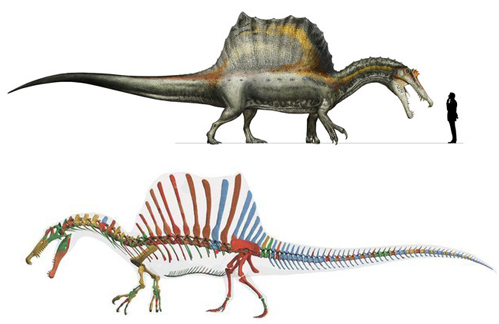
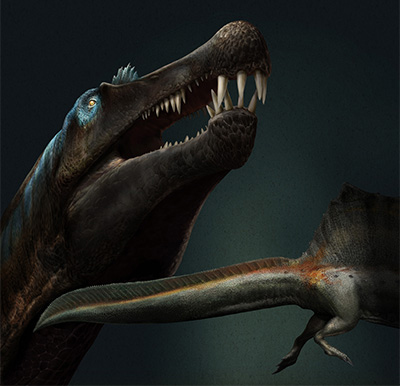
The tail of Spinosaurus was unlike any other known theropod.  The fossil tail bones, indicate that the tail was wide, flexible and fin-like.  It seems very well adapted to propelling this huge dinosaur through water.  The researchers conclude that this is unambiguous evidence for an aquatic propulsive structure in a member of the Dinosauria.  In other words, Spinosaurus was very much at home in the rivers, swamps and lakes of the Cretaceous of northern Africa.  Here is one dinosaur that took to the water.

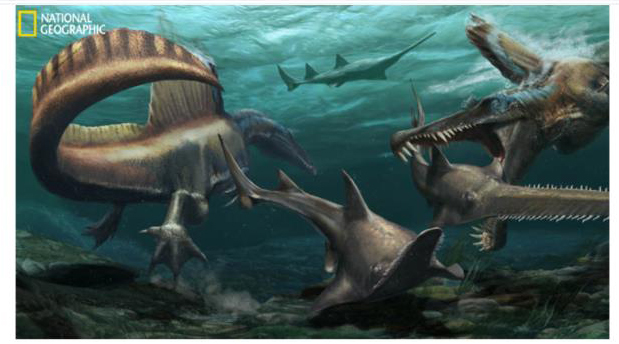
Life Reconstruction of Spinosaurus (S. aegyptiacus) 2020

Swimming Spinosaurus 2020
A pair of spinosaurids hunting the giant, prehistoric sawfish Onchopristis.

Picture credit: Davide Bonadonna/National Geographic

The beautiful illustration (above), depicts Spinosaurus hunting the 8-metre-long sawfish (Onchopristis).  A partial fossil jaw found in 1975 (MSNM V4047), attributed to Spinosaurus had a vertebra thought to have come from an Onchopristis embedded within it.  Although, the vertebra is thought to have become lodged after the Spinosaurus died, it demonstrated that Spinosaurus and this giant prehistoric fish were contemporaneous.

Not All Dinosaurs were Entirely Terrestrial

Unlike a lot of Kem Kem fossil material from Morocco, the Spinosaurus specimen, which was discovered in 2015, with the tail section found in 2018, consists of numerous associated bones.  Most of the vertebrate fossils found within these deposits are isolated, but these caudal vertebrae with their tall neural spines and elongated chevrons, have permitted the researchers to reconstruct the tail and to test its swimming capabilities using robotic flapping apparatus that was built to model the tail’s morphology and motion. 

The researchers conclude that the tail of Spinosaurus was long, strong, flexible and ideal for propelling this monster through water.  It is likely that these fossils will provide much more information on the enigmatic Spinosaurus, as the material represents the most complete theropod dinosaur found to date in northern Africa.

The Reconstructed Spinosaurus – Obligate Quadruped with a Typical Theropod Tail (circa 2014)

Life-size reconstruction and supplemental figure from the autumn 2014 scientific paper.

Picture credit: Davide Bonadonna (top) Ibrahim et al (bottom)

A Reconstruction of Spinosaurus aegyptiacus 2020

Swimming Spinosaurus (2020)
View of the crocodile-like snout of Spinosaurus and the new interpretation of the tail.

Picture credit: Davide Bonadonna/National Geographic

The Tail of a Tail

Note the differences in the shape of the tail between the 2014 reconstruction and the very much more fin-like 2020 reconstruction.  The tail of Spinosaurus aegyptiacus has been described as resembling that of a giant crested newt.

Co-author of the scientific paper, Dr David Unwin (University of Leicester), commented:

“The Spinosaurus’ fin-like tail is a game changing discovery for us that fundamentally alters our understanding of how this dinosaur lived and hunted – it was actually a ‘river-monster’.  As well as its tail, many other features of this dinosaur, such as the high position of the nostrils, heavy bones, short legs and paddle-like feet point to a life spent in the water rather than on land.   Not only did dinosaurs dominate the land and take to the air as birds, they even went back into the water and became the top predators there as well.”

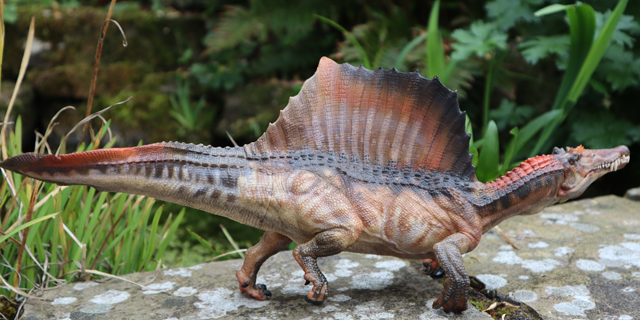
The Papo Limited-edition Spinosaurus Model (2019)

Historically, some types of dinosaurs were associated with aquatic environments, for example, Jurassic sauropods and duck-billed dinosaurs such as Corythosaurus and Lambeosaurus.  However, these ideas have now been abandoned by most scientists and the Dinosauria is regarded as almost entirely terrestrial.  Recent studies have suggested that the enigmatic spinosaurids, dinosaurs such as Oxalaia, Irritator, Siamosaurus and Ichthyovenator along with Suchomimus, Baryonyx et al, may have been semi-aquatic.  This newly published paper demonstrates that Spinosaurus aegyptiacus possessed a number of anatomical adaptations indicating an aquatic habit.  In 2019, Papo introduced a new, limited-edition figure of Spinosaurus, depicting this animal as a semi-aquatic, obligate quadruped.

The Papo Limited-edition Spinosaurus Figure (2019)

Papo Limited Edition Spinosaurus Model.
The Papo limited-edition Spinosaurus dinosaur model (2019).  This Papo replica depicted Spinosaurus with a fin-like tail, ironically, this shape of tail has now been proposed by vertebrate palaeontologists. Picture credit: Everything Dinosaur.

Picture credit: Everything Dinosaur

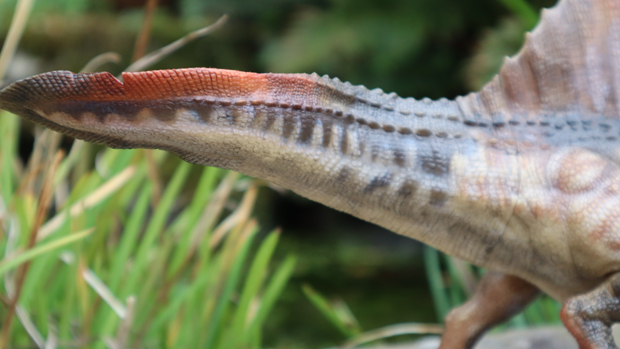
A Close-up View of the Thick Tail Adapted for Swimming of the Papo Spinosaurus

Papo Limited Edition Spinosaurus tail.
The tail of the Papo limited-edition Spinosaurus dinosaur model (2019). Picture credit: Everything Dinosaur.

Picture credit: Everything Dinosaur

Implications for Other Members of the Spinosauridae

Spinosaurus aegyptiacus was one of the last of the spinosaurids.  The authors of the scientific paper postulate that other members of the Spinosauridae are thought to have had aquatic adaptations which suggests a substantial invasion of aquatic environments by this clade of theropods.

Our congratulations to the scientists for their research into this fascinating theropod, we look forward to further papers being published as the Spinosaurus material from the Moroccan site continues to be excavated.  Our congratulations to Papo, for producing a fantastic replica, that although might not depict the dinosaur as exactly as some palaeontologists might, but they do seem to have produced a tail that reflects the newly published scientific data.

A review of the 2014 paper: Spinosaurus 2014 Scientific Paper Review.

To see the Papo range of prehistoric animal models including the limited edition Spinosaurus: Papo Dinosaurs and Prehistoric Animal Models.

The scientific paper: “Tail-propelled aquatic locomotion in a theropod dinosaur” by Nizar Ibrahim, Simone Maganuco, Cristiano Dal Sasso, Matteo Fabbri, Marco Auditore, Gabriele Bindellini, David M. Martill, Samir Zouhri, Diego A. Mattarelli, David M. Unwin, Jasmina Wiemann, Davide Bonadonna, Ayoub Amane, Juliana Jakubczak, Ulrich Joger, George V. Lauder and Stephanie E. Pierce published in the journal Nature.

Visit the Everything Dinosaur website: Everything Dinosaur.
1 05, 2020

The First Fossil Frog from Antarctica

By |2024-02-18T15:48:33+00:00May 1st, 2020|Categories: Animal News Stories, Dinosaur and Prehistoric Animal News Stories, Main Page, Photos/Pictures of Fossils|0 Comments

The First Fossil Frog from Antarctica

A researcher from the Swedish Museum of Natural History in collaboration with colleagues from the University of Fribourg (Switzerland) and the Instituto Antártico Argentino based in Buenos Aires (Argentina), has published a scientific paper which provides details of the first fossil frog to have been found on the continent of Antarctica.

A Fossil Frog from Seymour Island

The fossils, consisting of a partial ilium and a bone from the skull which were found in Eocene-aged deposits on Seymour Island, resemble an extant lineage of frogs known as helmeted frogs (family Calyptocephalellidae). Until this discovery, no Cenozoic ectothermic continental tetrapods (amphibians and reptiles), had been documented from Antarctica.  The tiny frog fossils suggest that around 40 million years ago, climatic conditions at high latitudes in the southern hemisphere were still mild enough to support “cold-blooded” amphibians.

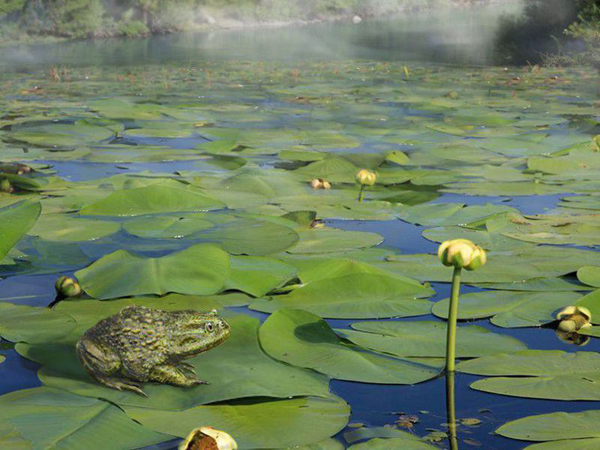
A Life Reconstruction of the Helmeted Frog Found on the Antarctic Peninsula (Seymour Island)

Fossil frog described from Antarctica.
Life reconstruction of the frog genus described from the Eocene of Antarctica.

Picture credit: Pollyanna von Knorring / Swedish Museum of Natural History

Studying Eocene Freshwater Habitats

Writing in the academic, on-line journal “Scientific Reports”, the researchers conclude that some Eocene freshwater habitats in Antarctica provided habitats that were favourable for cold-blooded (ectothermic) vertebrates such as frogs.  Antarctica was much milder than it is today, the warmest months of the year averaging around 13 degrees Celsius whilst temperatures in the winter would have dropped to below an average of 4 degrees Celsius.  Frogs were present in freshwater ecosystems at a time in the history of Antarctica where ice sheets had formed in upland areas towards the interior of the continent.

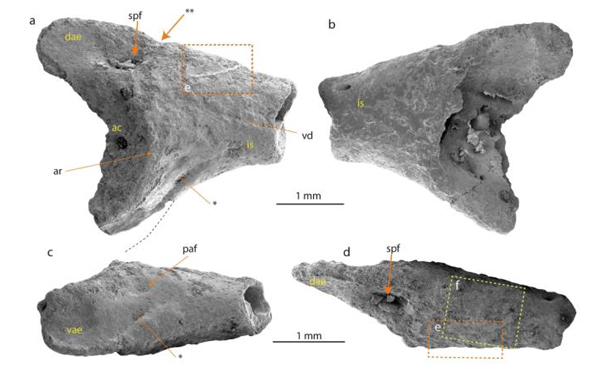
Views of the Fragmentary Ilium from Seymour Island

Frog ilium from the Antarctic.
Ilium (NRM-PZ B282) of Calyptocephalella sp. from Seymour Island, Antarctica.  Ilium in lateral (a), medial (b), ventral (c) and dorsal (d) views.  Scale bar equals 1 mm.

Picture credit: Swedish Museum of Natural History

The Discovery of Fossil Frog Remains

The fossil frog remains were collected during three joint Argentinian-Swedish expeditions to Seymour Island in the southern hemisphere summers 2011–13.  The bone fragments were concentrated from dry-sieved sediment samples. The closest living relatives of the Eocene specimen are limited to the Chilean Andes (Calyptocephalellidae).  With the discovery of the fossils on Seymour Island, the researchers conclude that these types of helmeted frog were much more widespread across what remained of Gondwana during the Eocene.

The material is housed in the palaeozoological collection of the Swedish Museum of Natural History, Stockholm.

The scientific paper: “First fossil frog from Antarctica: implications for Eocene high latitude climate conditions and Gondwanan cosmopolitanism of Australobatrachia” by Thomas Mörs, Marcelo Reguero and Davit Vasilyan published in Scientific Reports.

The Everything Dinosaur website: Everything Dinosaur.
30 04, 2020

What Makes “Crazy Beast” So Crazy

By |2024-02-18T13:37:38+00:00April 30th, 2020|Categories: Dinosaur and Prehistoric Animal News Stories, Dinosaur Fans, Main Page, Photos/Pictures of Fossils|0 Comments

The Very Strange Adalatherium hui

This week, has seen the publication in the journal “Nature” of a scientific paper describing a new species of bizarre mammal from the Late Cretaceous of Madagascar.  Named Adalatherium (A. hui), this cat-sized animal shared its island home with a variety of predators such as abelisaurid dinosaurs, crocodilians and snakes.  At an estimated three kilograms, Adalatherium was no giant, but the fossilised remains, which represent a near complete skeleton of an individual, indicate that this mammal was not yet fully mature when it died and as such, it is one of the largest members of the crown group of mammals described from Upper Cretaceous material.

Adalatherium hui

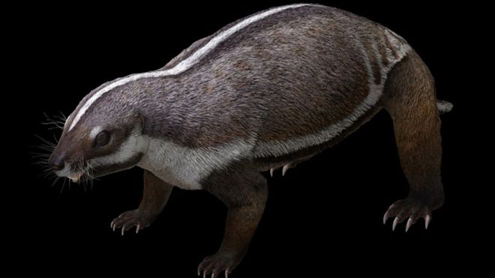
A Life Reconstruction of Adalatherium (A. hui)

Adalatherium life reconstruction.
A life reconstruction of Adalatherium hui.

Picture credit: Reuters

Madagascar became isolated from the rest of Gondwana around 88 million years ago.  Animals on the island were effectively marooned and many pursued a different evolutionary route compared to related forms on the rest of the super-continent.  Classified as a member of the Gondwanatheria, an extinct group of mammaliaforms confined to the southern hemisphere and up until now, only known from isolated teeth and fragmentary bones, the Adalatherium lineage developed an unusual and unique set of characteristics never seen before in a tetrapod.

“Crazy Beast”

The backbone has more vertebrae than any other Mesozoic mammal and one of its rear leg bones (tibia) was bowed.  How this animal moved around is a bit of a mystery, but the authors of the scientific paper suggest that this animal lived in burrows (fossorial).  The snout shows a mixture of primitive and very advanced anatomical traits.  Adalatherium had more foraminia, small holes in the nasal cavity that served as passageways for nerves and blood vessels, than any other mammal extinct or living today.

The snout was probably extremely sensitive and covered in whiskers, they may have helped it find its way about underground.  One foramen (hole for nerves or blood vessels), at the top of the snout has no know parallel with any other mammal.

These strange characteristics inspired the researchers to name this animal “crazy beast” from the local Malagasy and from the Greek.

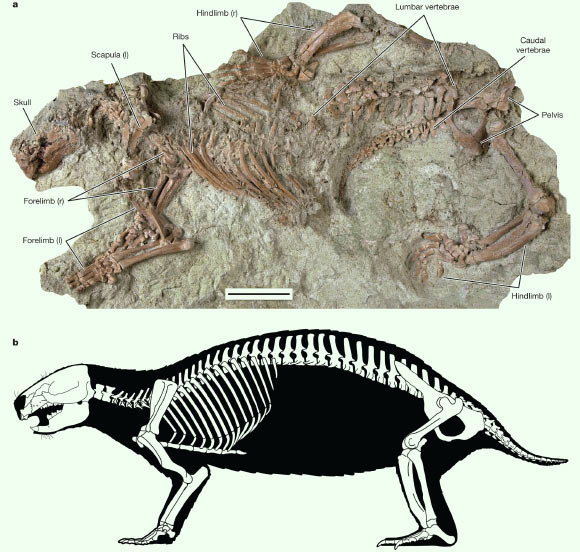
The Preserved Skeleton of Adalatherium and Accompanying Line Drawing

Adalatherium fossil material and interpretative line drawing.
The articulated remains of Adalatherium hui and an accompanying line drawing.  Note scale bar in (a) equals 5 cm.

Picture credit: Krause et al.

Adalatherium hui – Bending and Breaking a Lot of Rules

Corresponding author, Dr David Krause (Denver Museum of Nature and Science), commented:

“Knowing what we know about the skeletal anatomy of all living and extinct mammals, it is difficult to imagine that a mammal like Adalatherium hui could have evolved, it bends and even breaks a lot of rules.”

Dr Krause is no stranger to bizarre prehistoric animals from Madagascar.  In 2008, Everything Dinosaur wrote a blog post about the “frog from Hell”, a research team led by Dr Krause had discovered the fossilised remains of a giant frog that inhabited the Late Cretaceous of Madagascar.

To read more about this: Beelzebufo ampinga – a frog that could jump continents!

The scientific paper: “Skeleton of a Cretaceous mammal from Madagascar reflects long-term insularity” by David W. Krause, Simone Hoffmann, Yaoming Hu, John R. Wible, Guillermo W. Rougier, E. Christopher Kirk, Joseph R. Groenke, Raymond R. Rogers, James B. Rossie, Julia A. Schultz, Alistair R. Evans, Wighart von Koenigswald and Lydia J. Rahantarisoa published in the journal Nature.

Visit Everything Dinosaur’s website: Everything Dinosaur.
Go to Top