All about dinosaurs, fossils and prehistoric animals by Everything Dinosaur team members.
24 03, 2011

Sabre-Toothed Vegetarian from the Late Permian

By |2023-03-07T08:01:57+00:00March 24th, 2011|Categories: Animal News Stories, Dinosaur and Prehistoric Animal News Stories, Dinosaur Fans, Main Page|2 Comments

Dagger-Toothed Vegetarian Reptile from the Late Permian of Brazil

Researchers reporting in the scientific journal “Live Science” have announced the discovery of a bizarre vegetarian reptile, with large upper canine teeth making it look a little like a miniature Sabre-toothed cat.  The animal formally named as Tiarajudens eccentricus was about the size of an Alsatian, it was a plant-eater, as other teeth in the fossilised jaws are clearly adapted for crushing plant matter, but the large, prominent canines represent a palaeontological puzzle for scientists.

A number of animals in the fossil record show large sabre-like teeth, the Sabre-toothed cats (Smilodon) are perhaps the best known but other groups such as the gorgonopsids evolved oversized, dagger-like teeth.  Most of these creatures were entirely carnivorous, however, herbivores with enlarged teeth are known.  For example, the two-metre-long dicynodont Dinodontosaurus had an enlarged upper tooth either side of its top jaw.  These teeth would not have been very useful in feeding, perhaps the teeth, which resemble tusks had a display function.

Tiarajudens eccentricus

The upper teeth each measure over 14 centimetres in length, research leader Juan Carlos Cisneros of the University of Piaui in north-eastern Brazil, stated these animals may have used their teeth to intimidate rivals or to attract a mate.  The teeth could also be used in threat gestures to scare of any potential predators.

This new genus has been compared to the extant Musk Deer (genus Moschus), which also has a pair of large, tusk-like teeth but is entirely herbivorous.

Dr Juan Carlos Cisneros, a specialist on Permian and Triassic Tetrapods stated that when discovering animals like this:

“Shows us how nature is extremely creative in providing solutions for several life tasks.”

In the picture showing a ventral view of the left side of the skull, a long, dagger-like tooth can be clearly seen, along with peg-like teeth from the premaxilla.  The large orbit, (eye socket) indicates that vision was a very important sense for this small member of the Anomodontia.

The research team state that the palate of the mouth was studded with teeth, allowing for rapid replacement of lost teeth an adaptation to a diet of tough, fibrous leaves.

Dr Juan Carlos Cisnero went onto add:

“It looks like a combination of different animals and it takes some time to believe it when you this animal in front of you.  It has the incisors of a horse, which are very good for cutting and pulling plants, the big molars of a capybara [large rodent] for grinding and the canines of a sabre-toothed cat.”

To view models and replicas of Triassic and Permian prehistoric animals: CollectA Deluxe Prehistoric Life Models.
23 03, 2011

Rare Ankylosaur Fossil Turns up in Alberta’s Oil Sands

By |2023-01-17T07:54:35+00:00March 23rd, 2011|Categories: Dinosaur and Prehistoric Animal News Stories, Main Page|2 Comments

Oil Worker Digs up Armoured Dinosaur

An oil worker using a mechanical excavator to clear debris in preparation for more crude oil extraction in the vast oil sands field of Alberta (Canada), has unearthed a rare ankylosaur fossil.  A surprising find, as the sediments that the fossil was found in were laid down in a marine environment.  Occasionally, fossils of ammonites and shellfish are found, but to discover a dinosaur fossil, is extremely unusual.

Ankylosaur Fossil

Scientists have speculated that the carcase of the ankylosaur was probably washed out to sea by a flood event.  The heavy armour on the back would have acted as “keel” for the corpse and the body would have floated for some time, buoyed up by gas contained in the stomach and other internal organs.  Eventually the body would have ruptured, the gas would have escaped and the remains of this armoured dinosaur would have sunk to the bottom of the sea.  Over time, the body would have been covered with sediments and 110 million years later the fossilised ankylosaur was dug up by the surprised oil worker.

The Albertan oil sands, are a huge area of tar and sand which is mined for its crude oil deposits. The sediments were laid down in the Cretaceous and represent a marine environment.  Around ten years ago, the fossil of an ichthyosaur (marine reptile), was found in this strata, but to discover a dinosaur in these sediments is most unusual but not completely unknown.  For example, in the marine Jurassic strata of Dorset, the fossils of an earlier armoured dinosaur have been discovered- Scelidosaurus.

The Albertan fossil, may represent a new genus of ankylosaur, commenting on the discovery Donald Henderson, the curator at the Royal Tyrrell Museum (Alberta) stated:

“We’ve never found a dinosaur in this location.  Because the area was once sea, most finds are invertebrates such as clams and ammonites.”

Researchers have estimated that this dinosaur would have measured in excess of five metres long and would have been at least 2 metres wide.

A Typical Model of an Ankylosaur

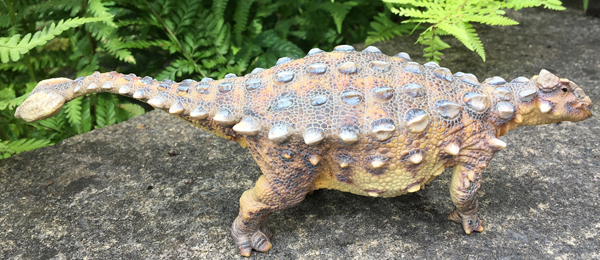
PNSO Ankylosaurus "Sede".

“Sede” the Ankylosaurus dinosaur model. Typical ankylosaur model.  Picture credit: Everything Dinosaur.

Picture credit: Everything Dinosaur

The ankylosaur model (above) is “Sede” from PNSO. To view the PNSO range: PNSO Age of Dinosaurs Figures.

Photographs show some of the preserved scutes (body armour), the pen provides a scale for the photograph.

Dr Henderson added:

“It is pretty amazing that it survived in such good condition.  It is also the earliest partially complete dinosaur that we have from this province [Alberta].”

The fossil is very well preserved and is almost three-dimensional, not having suffered too much compression as the layers of sediments built up on top of the remains.

The ankylosaur was found by a Suncor Energy excavator operator, who ironically had visited the Royal Tyrrell Museum just the week before.

Dr Henderson suggested that the worker had been thinking about dinosaurs and was therefore able to spot the unusual rock that was dug out of the ground:

“Maybe his mind was subconsciously prepared.”

The energy company has suspended excavation work to permit scientists to fully explore the site so that other fossil elements can be safely removed and shipped to the Royal Tyrrell for preparation.

22 03, 2011

Amazing Age of Dinosaurs Animatronic Dinos arrive at the London Natural History Museum

By |2024-04-21T10:04:35+01:00March 22nd, 2011|Categories: Dinosaur and Prehistoric Animal News Stories, Main Page|0 Comments

Tarbosaurus, Camarasaurus and Gallimimus the Star Attractions

With a substantial part of the permanent dinosaur galleries at the London Natural History Museum being closed for refurbishment this summer, dinosaur fans can have their insatiable thirst for all things Dinosauria quenched with a trip to a new exhibition which is due to open at the museum next  month.

The exhibition entitled “Age of the Dinosaur” combines specimens from the museum’s extensive fossil collection with video, computer generated images as well as live-size, animatronic dinosaurs such as Tarbosaurus, the giant long-neck Camarasaurus and the speedy Gallimimus.

Dinosaur Galleries

Staff at the museum are busy settling the animatronic models into their new home, in readiness for the exhibition opening on April 22nd.  Visitors will be transported back to realistic Jurassic and Cretaceous settings to experience sounds, smells and sights from the Mesozoic.  The lifelike dinosaurs have been supplied by the Japanese animatronic manufacturer Kokoro based in Tokyo.  Plans to ship some of the models had been interrupted as a result of the recent devastating earthquake and tsunami that hit the north of Japan.

The Tarbosaurus, a close relative of Tyrannosaurus rex is one of the highlights of the tour, and this particular theropod will be on display along with models of smaller meat-eaters such as Oviraptor and Velociraptor.

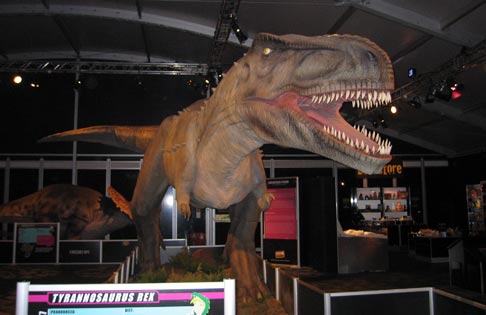
An Animatronic Tyrannosaurus rex on Display

T. rex on display. Dinosaurs Unleashed.

Ferocious T. rex. An animatronic dinosaur on display.  Picture credit: Everything Dinosaur.

Picture credit: Everything Dinosaur

Interpretation Developer at the Natural History Museum, Georgina Bishop commented as the large exhibits were carefully wheeled into place:

“Everyone loves dinosaurs, don’t they? Complete with sounds, scenery and scientific specimens, Age of the Dinosaur gives visitors the chance to really experience the land of these giants – a must for any budding dinosaur experts.”

The exhibition runs until September 4th.

For models and replicas of many of the prehistoric animals that will feature in the dinosaur galleries: Dinosaur and Prehistoric Animal Models.

21 03, 2011

Comparing Sauropods to Vacuum Cleaners using New Research

By |2024-04-21T10:06:36+01:00March 21st, 2011|Categories: Dinosaur and Prehistoric Animal News Stories, Main Page, Palaeontological articles|2 Comments

New Study Extols the Virtue of Having a Long-Neck for Sauropods

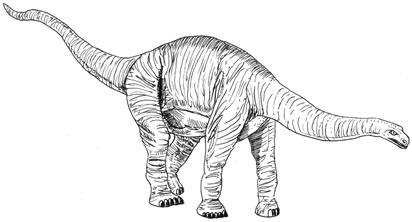
A team of UK based researchers have calculated that sauropods such as Apatosaurus and Nigersaurus evolved long-necks so that they could reach a lot of plant food material without having to move very far.  This new study has calculated that the long necks of these herbivores enabled them to gather a great deal of food without having to expend a lot energy.  Think of a Diplodocus as a thirty metre long feeding platform.

Sauropods

The scientists have compared the long-necks of sauropods to the long, extension nozzle fitted to post war vacuum cleaners, devices to help housewives and their partners cope with having to lug a heavy machine around the house.

The long necks of these highly successful group of lizard-hipped dinosaurs, taken to extremes by the enormously long neck of the sauropod Mamenchisaurus for example, resemble the solution that designers came up with when they realised that early vacuum cleaners were too cumbersome to manoeuvre easily around a room.  The fitting of a long, extension hose permitted the user to reach more area of the carpet, without having to move the heavy suction machine and the bag.

In a study led by Professor Graeme Ruxton (Glasgow University) and Dr David Wilkinson at Liverpool John Moores University, animals such as the Late Jurassic Brachiosaurus would have used 80% less energy foraging for food when its neck reached nine metres from its torso than if the neck was only six metres long.

Long-necked Dinosaurs – Nature’s Vacuum Cleaners

Picture credit: Everything Dinosaur

With a 6-metre-long neck, the heavy Brachiosaurus could only have reached food immediately beneath or above it and would have had to move to reach more, but a longer neck gave the creature the ability to feed on vegetation further away while standing still.

Sauropod Models and Replicas

For models and replicas of sauropods such as Nigersaurus, Apatosaurus and Brachiosaurus, take a look at the Wild Safari Prehistoric World model range: Safari Ltd. Wild Safari Prehistoric World Models.

A lot of work has already been undertaken by researchers as they try to understand the anatomy of sauropods, creatures that were the largest type of land animal ever to evolve, with some species reaching lengths in excess of thirty metres.  In the study, published in the scientific journal “Biology Letters” the researchers state:

“We draw an analogy here with the cylinder vacuum cleaners that were commonplace in households in industrialised countries from the 1950s to the 1970s.  Because the machinery required to create suction was large and heavy, the main body of the vacuum cleaner was positioned by the user in a central location within a room.  The user then moved the light head-part at the end of a long tube across the surrounding carpet.

This is certainly an interesting comparison, one that helps to explain the “feeding platform” concept favoured by many palaeontologists.  Over recent years more fossils of Jurassic and Cretaceous sauropods have been discovered, indicating just how diverse this basic long-necked body plan became.

For example, the bizarre sauropod Nigersaurus (from Niger in Africa) has been nicknamed the “Mesozoic Lawnmower”, to read more about this peculiar long-necked dinosaur click the link below:

Nigersaurus: Nigersaurus – the dinosaur that grazed like a cow.

20 03, 2011

Frogspawn (March 2011) an Important Update

By |2024-04-21T10:05:37+01:00March 20th, 2011|Categories: Animal News Stories, Main Page|0 Comments

Exciting News – First Pictures of Frogspawn from the Office Pond

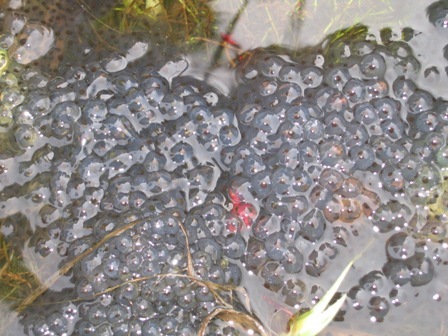
Team members at Everything Dinosaur  have spotted the first frogspawn in the office pond.  Quietly, without wishing to disturb any frogs that may also be spawning, we have taken a photograph of the frogspawn.

Frogspawn in the Office Pond

Frogspawn in the Office Pond

Frogspawn in the pond.

Picture credit: Everything Dinosaur

A picture of this year’s frogspawn in the office pond.  We look forward to observing the development of the eggs.

20 03, 2011

Suspected Man-Eater Caught in Queensland

By |2023-01-16T08:00:07+00:00March 20th, 2011|Categories: Animal News Stories, Main Page|0 Comments

Crocodile Suspected of Attack on Fisherman is Caught

A three-metre-long Saltwater crocodile suspected of attacking fisherman Todd Bairstow has been caught in a trap say Australian Wildlife Rangers.  A spokesperson for the Department of Environment and Resource Management (DERM) said the crocodile was caught using a trap set at Trunding Creek, near where Todd Bairstow, clung to mangroves as a large Saltwater crocodile attempted to drag him to his death from the bank where he had been fishing.

Saltwater Crocodile

The DERM staff are now attempting to confirm that this was the crocodile responsible for the attack.  Mr Bairstow has undergone a number of operations and has had to suffer protracted and painful sessions to clean his wounds caused by the highly infectious crocodile bites.  The captured crocodile has been transferred to a secure facility near Weipa for assessment and will then be taken to a zoo or a crocodile farm.

To read Everything Dinosaur’s blog post about the crocodile attack: Man Survives Crocodile Attack.

Visit Everything Dinosaur’s award-winning website for models of crocodiles and alligators and these replicas do not bite!

The Everything Dinosaur website: Everything Dinosaur.

19 03, 2011

Crocodile found in Middlesbrough

By |2023-01-16T07:53:33+00:00March 19th, 2011|Categories: Animal News Stories, Main Page|0 Comments

Spectacled Caiman found in Middlesbrough

Police seized a baby crocodile in a raid on an industrial unit in Middlesbrough (north-east England).  The crocodile, actually a Spectacled Caiman (Caiman crocodylus) is currently being checked over by vets.  Caimans are a group of small crocodiles that share the same characteristics of their larger cousins the crocodiles and alligators.  Many Spectacled Caimans are imported into the U.S. for the pet trade, it may be that this particular animal may have been brought over from the United States.

This caiman was being kept as a pet by a thirty year old, exotic animal enthusiast from Middlesbrough.  At only two feet long, the baby, known as “fluffy” may not be a man-eater but they still possess a powerful bite and could be capable of taking off a finger if a handler was not careful.  As an adult, Spectacled Caiman reach lengths of up to 2.5 metres in length, and although they rarely attack land mammals and people they are highly dangerous.

For more sensible purchases, take a look at the crocodile models and figures available from Everything Dinosaur: Everything Dinosaur.

Crocodile Found in Middlesbrough

A man has been arrested on suspicion of keeping a dangerous wild animal without a licence.  A spokesperson for the National Wildlife Crime Unit which worked alongside Cleveland Police in this case, commented:

“The Spectacled Caiman has been seized and removed through the animal reception centre at Heathrow airport, where they will find a more appropriate home for it.”

The spokesperson (Andy McWilliam) went on to add:

“There are people who want to keep animals like these, but they need to have a licence, as there is a risk.  They need to pay for the licence, have their premises inspected by the local authority and meet significant standards so the animal is safe and cannot escape.”

Although not particularly endangered, many caimans are hunted illegally in the wilds of South America for their skins which are used to make handbags and other fashion items.  The eggs and young of these ancient creatures are also highly prized and once hatched these animals can be sold as pets.

A number of zoos and wildlife parks keep these animals as part of a world-wide conservation effort, indeed some Caimans kept in captivity are believed to learn their names and respond to them when they are called.  To read more about Caimans in captivity: Crocodiles Respond to their Own Names when Called.

18 03, 2011

Frogspawn in the Office Pond Spotted

By |2022-12-20T22:51:16+00:00March 18th, 2011|Categories: Animal News Stories, Everything Dinosaur News and Updates, Main Page|0 Comments

We have Frogspawn in our Office Pond

The frogs have been busy in the office pond, on Wednesday and Thursday we were able to count up to seven frogs in the pond, but no spawn until this morning.  We have just spotted the first batch of spawn, which must have been laid last night, despite the clear skies leading to a drop in air temperature to just above freezing.

When we compare notes from previous years, the frogs have spawned two days earlier this year than they did in 2010.  So far we have not seen as many frogs in the pond as last year but we are confident that more spawning will take place and that we may well end up with as much frogspawn as we did last year.  This is the fourth year in a row that we have had frogs spawning in our office pond.

17 03, 2011

New Giant Sauropod – Angolatitan – Ancient Fish Food

By |2023-03-07T14:29:54+00:00March 17th, 2011|Categories: Dinosaur and Prehistoric Animal News Stories, Dinosaur Fans, Main Page|0 Comments

Scientists Announce Discovery of a New Sauropod Species

As Angola is opened up to permit exploration of its diverse geology, so scientists are being given the opportunity to study the fossilised remains of the ancient flora and fauna of this huge African country.  Angola is perhaps one of the last places on Earth that has yet to be fully explored in terms of its geology and this has led to a number of new prehistoric animal discoveries, the latest of which is the formal announcement of a new giant sauropod species.

Angolatitan adamastor

The new dinosaur, a member of the Sauropoda (long-necked dinosaurs) has been named Angolatitan adamastor.  The name means “Angola giant”, the species name refers to a mythical sea creature from Portuguese legend.  Although, only a partial forelimb has been found to date, scientists are confident that this creature represents a new species of sauropod.

Team members at Everything Dinosaur wrote an article outlining the possibilities of many new dinosaur discoveries from this African country, to read this article and to learn more about the work being undertaken in Angola by palaeontologists: Angola Starts to Share its Fossil Secrets.

Upper Cretaceous Fossils

The paper on this new species of herbivorous dinosaur, the latest titan to be found in Africa was published in the scientific journal “The Annals of the Brazilian Academy of Science”.  The fossilised bones, longer than an adult man, were found in marine strata dating from approximately 90 million years ago (Turonian faunal stage).  Scientists think that the carcase of this animal was washed out to sea and its body was scavenged by marine reptiles and predatory fish such as sharks.  Indeed, a number of fish bones and shark teeth were found in association with the fossil dinosaur bones.

Commenting on the naming of this new species, Matthew Bonnan, a sauropod expert at Western Illinois University (United States) stated that the research team’s claim to have discovered a new species is entirely justified.

Dr Bonnan said:

“I think they’ve been very careful, the more people and places that we involve in science, the better off we all are.”

Pictures show palaeontologist Octavio Mateus who has been prominent in an number of important Angolan excavations, standing next to the scapula and the humerus of this new giant dinosaur providing scale.

Angolan Dinosaur Research

He went onto add how this new discovery could help palaeontologists understand how sauropods adapted to different environments stating that it was “really cool” to see research coming out of Angola.  Given the huge size of this country and the early reports from palaeontologists we have received about other dinosaur hunting “hot spots”, it is very likely that many more new dinosaur genera will be discovered.

For models and replicas of titanosaurs and other prehistoric animals: CollectA Age of Dinosaurs Scale Models.

16 03, 2011

A Review of the CollectA Ankylosaurus Model (1:40 scale)

By |2023-03-07T08:04:47+00:00March 16th, 2011|Categories: Everything Dinosaur Products, Main Page, Product Reviews|0 Comments

CollectA Ankylosaurus Model Review

CollectA have added a 1:40 scale model of the Late Cretaceous armoured dinosaur Ankylosaurus to their scale model range.  This range has increased over the last two years and includes a number of dinosaur and prehistoric animal models, including T. rex, Brachiosaurus and a number of other armoured dinosaurs such as Stegosaurus and Hylaeosaurus. Today, we review the CollectA Ankylosaurus model.

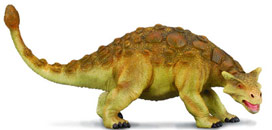
A Picture of the Collecta Deluxe Ankylosaurus Replica

Picture credit: Everything Dinosaur

The model measures twenty-five centimetres in length and stands nearly 10 centimetres tall at the shoulder.  The tail club is shown in mid swing and the animal seems to be bellowing, perhaps warding off an attack from a predatory Tyrannosaurus rex.  The model is well painted and the detail quite fine on what is a large model of an Ankylosaurus.

CollectA Ankylosaurus Model

Purchases of the CollectA Deluxe Ankylosaurus made from Everything Dinosaur’s award-winning website will also include an Ankylosaurus fact sheet, researched and written by team members.

To view the CollectA range (Collecta Deluxe Dinosaurs) and other dinosaur models: CollectA Deluxe Prehistoric Life Models.
Go to Top