All about dinosaurs, fossils and prehistoric animals by Everything Dinosaur team members.
22 09, 2008

Animals in Armour – The Successful Trilobite

By |2022-12-08T12:52:26+00:00September 22nd, 2008|Categories: Dinosaur and Prehistoric Animal News Stories, Educational Activities, Everything Dinosaur News and Updates, Main Page|0 Comments

The Trilobite – An Arthropod with a Tremendous Fossil Record

Insects are regarded as the most diverse of all the animal classes on planet Earth.  To date something like 1,000,000 different species have been recognised and it has been estimated that there may actually be 30 million different species of insect around today.  These numbers are truly astronomical, especially when some members of staff at Everything Dinosaur remember estimates for the total biodiversity for all animal species on this planet being put at around 2 million species as recently as the mid-1970s.

The Trilobite

However, the class Insecta makes up just part of a remarkable phylum – the Arthropoda, a phylum that can be traced back to the Cambrian and in all likelihood these animals and their ancestors made up a great portion of the life that existed during the Cryptozoic, that vast eon of time, otherwise known as the Precambrian when there was life on Earth but it has left few traces in the fossil record.

Arthropods have evolved to fill a vast array of environmental niches, with types of arthropod found in most habitats – in water and on land.  Crustaceans, such as crabs, lobsters, barnacles and shrimps, along with all insects, scorpions, mites, spiders and millipedes are all members of this phylum.  A number of extinct types of arthropod are represented in the fossil record.  The most important extinct group are the Trilobita. These armoured animals evolved in the Early Cambrian and survived until the end of the Palaeozoic.  As a class, Trilobita finally died out around 250 million years ago, at the end of the Permian period, when approximately 90% of all life forms became extinct.

Ten Orders of Trilobita

Ten orders of Trilobita are recognised at present, although the taxonomic classification and phylogeny of trilobites is frequently reviewed and debated.  Despite the extensive fossil record of these animals, (their exoskeletons are partly comprised of calcite and this coupled with their marine existence gives them a high potential for preservation as fossils), there are still gaps in our knowledge regarding the evolutionary relationship between different orders.

An Illustration of a Typical Trilobite
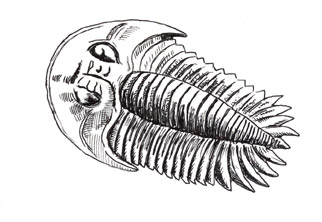
Picture credit: Everything Dinosaur

Approximately, 20,000 species of trilobite are known, they are regarded as the standard bearer for the entire fossil record represented by Palaeozoic strata, although as a group the Trilobita were at their most diverse and abundant in the early Palaeozoic.  All but one order of trilobites were extinct by the end of the Devonian, and by the end of Permian only two families of trilobite remained with a number of other families dying out in the mid Permian.  Changes in climate, rising sea levels and the evolution of efficient predators such as sharks have all been put forward as theories to explain the demise of the trilobite.

A Replica of a Trilobite
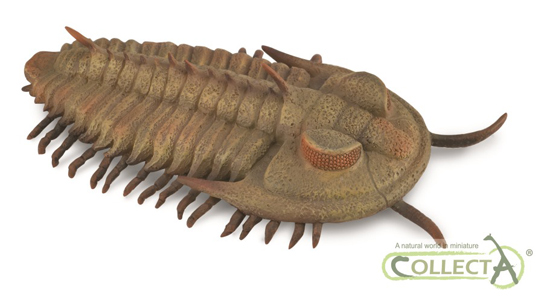
CollectA Redlichia rex trilobite.

CollectA Redlichia rex trilobite model.

CollectA offers a range of replicas of iconic fossil animals including a trilobite: CollectA Prehistoric Life Models and Figures.

They were certainly a remarkable and highly diverse group of animals and their importance in biostratigraphic processes as well as the assistance of their fossils in the relative dating of strata should not be underestimated.

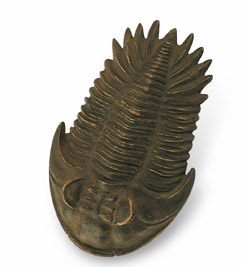
We have recently introduced a model of a typical trilobite to our range.  This makes an excellent addition for the serious model collector or for school/home study.

A Model of a Trilobite
Picture credit: Everything Dinosaur

To view the fossil replicas in stock at Everything Dinosaur as well as a huge range of prehistoric animal models and figures: Dinosaur Models and Prehistoric Animal Figures.
21 09, 2008

Strange Place to Hear Wedding Bells – Kents Cavern

By |2023-02-25T18:30:54+00:00September 21st, 2008|Categories: Dinosaur and Prehistoric Animal News Stories, Main Page|0 Comments

Couple decide to Tie the Knot in Kents Cavern

For Gilly Woodland and Alan Duckworth, deciding where to have their marriage ceremony was no easy choice, what with the relaxing of UK legislation to allow other buildings and sites of interest to be licensed to hold civil wedding ceremonies.  One such location to benefit from these changes is Kents Cavern in Devon.

Kents Cavern

However, these two Torquay residents (Devon) have opted for the nearby ancient cave system of Kents Cavern, believed to be one of the oldest human-inhabited locations ever found in the UK.  Evidence gathered by the Ancient Human Occupation of Britain (AHOB) project indicates that human species lived in the cave as far back as 450,000 years ago.

A fragment of jawbone found within the cave recently has been controversially identified as Neanderthal and dated to approximately 45,000 years ago.  This rare and precious find is the oldest fossil evidence of Neanderthal habitation of the United Kingdom

Ms Woodland, 49, a media marketing manager, and Mr Duckworth, 38, a network design manager, will marry in the candlelit civil ceremony on Sunday, October 4th.

Gilly commented: “We wanted a blank canvas where we could design our own wedding. You can put together exactly what you want.”

A Wedding in a Cave

The 85 guests will be ferried to the caves complex by vintage bus before going underground for the ceremony.

“There will be a civil wedding in one cave, then a cocktail party with a 25 piece orchestra, Spectrum Music, playing in the other,” said Ms Woodland. “We will come up for air for a dinner at ground level, then go underground again for more live music.”

Although the caverns are massive you never forget you are in a cave – and there is the slight risk of being dripped on by a stalactite.

For the guests, Ms Woodland and her fiancé it will certainly be a night to remember.  Perhaps the large cave system at Kents Cavern has hosted similar important events and ceremonies in the past when our human ancestors held their own festivities, marking a successful hunt or the return of the warmer Summer weather.  The cave system has yielded some remarkable fossil finds.  As well as the human remains, the fossilised bones of Cave bears, Mammoths and Woolly Rhinos have been found.  Even evidence of Sabre-toothed cats has been discovered in the cave system.

Everything Dinosaur might not be able to promise wedded bliss for the couple, but we hope this special occasion goes smoothly and the UK-based mail order company does stock a wide range of prehistoric mammal models including Woolly Mammoths and Sabre-toothed cats: Models of Prehistoric Mammals.

We wish the couple well, and hope that the event goes off brilliantly for them.  One thing is for sure, when you hold a wedding ceremony underground you don’t have to worry about the rain!

20 09, 2008

Large Tyrannosaurus rex Model (Special Natural History Museum Figure)

By |2024-04-15T12:14:45+01:00September 20th, 2008|Categories: Everything Dinosaur News and Updates, Everything Dinosaur Products, Main Page, Photos of Everything Dinosaur Products|0 Comments

Large T. rex Model (Natural History Museum of London)

Designed by the one of the Museum’s leading researchers, Dr Paul Barrett of the Natural History Museum was instrumental in helping to introduce a range of scale prehistoric animal models including a T. rex model, sales of which help support the Natural History Museum of London.  We have been involved in these particular models since their inception and have waited eagerly for new additions to be added to the range.  We remember looking at the first models as they came out, all of them at the time were presented in card packaging desgined to fold out and provide information on the animal concerned.  Plans were in place to introduce pterosaurs and marine reptiles, but the range has remained largely the same since they were first introduced.

T. rex Model

One of the suppliers/manufacturers of these models went into receivership sometime ago and we have been speaking to the new owner of the rights to the moulds.  There has been talk of new packaging and we have voluntered some information to help with the gathering of dinosaur merchandise data, so it seems fitting that we should now add to our extensive range the only product from this particular stable that we have not stocked before.

The large Tyrannosaurus rex model has just been added to our shop after coming through our product approvals process.  We are very familiar with this particular model of T. rex.  It has been painstakingly modelled, reflecting the latest available data on tyrannosaurs from the fossil record.

Large Tyrannosaurus rex Model

Picture credit: Everything Dinosaur

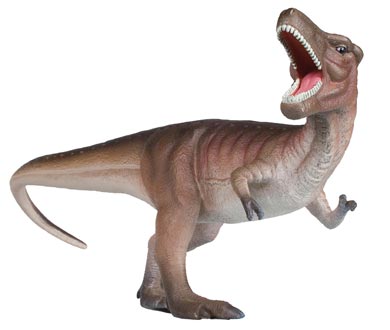
The model shows T. rex in a typical ferocious pose with jaws wide open.  It measures 42 cm long officially but once the curvature of the tail is considered it is really over 50 cm long.  This particular T. rex model stands 20 cm high and is beautifully painted.  Naturally, our dinosaur experts send out a T. rex fact sheet with everyone supplied.

The model is a great collectors item but also has been designed for robust play, so young dinosaur fans should feel quite at home with it.

To view a range of dinosaur models: Dinosaur and Prehistoric Animal Models.

19 09, 2008

Fossil Thefts from Utah – Important News

By |2024-04-15T12:15:22+01:00September 19th, 2008|Categories: Dinosaur and Prehistoric Animal News Stories, Dinosaur Fans, Main Page|0 Comments

Internet Blamed for increase in Fossil Thefts

Officials from the American Bureau of Land Management (BLM) are blaming the Internet and the web auctions for an increase in vertebrate fossil thefts from public land in the United States.

Federal officials from the BLM in conjunction with the local law enforcement agencies are investigating another incident of stealing fossilised dinosaur bones in what has been termed a “brazen theft” from what was thought to be a secret location in Central Utah where a team of scientists were excavating a number of specimens.

Sadly, such incidents are becoming increasingly common as amateurs and other fossil prospectors try to extract fossils, either for their own collections but more likely to sell on at a huge profit.

Experts say the raid on the Utah location is another glaring example of fossil theft, a widespread problem in the age of the Internet, where auction sites and specialist forums for fossil sales are common place.

Speaking on behalf of the BLM, paleontologist Scott Foss said, “the theft like this, it happens quite a bit. And when it does, it’s very tragic.”

Foss doesn’t want us to say where the theft occurred.  However, he was prepared to meet reporters at a separate location, where a team of scientists are working on another dinosaur discovery.  At this site, he explained to journalists how the palaeontologists carefully excavate the precious fossils and then protect them with burlap and plaster jackets to protect the exposed parts of the fossil from bad weather and as preparation for lifting and removal.

Commenting on the fossil theft Mr Foss stated: “the thieves found some of these jackets. Whether it was malicious or just curiosity, they removed the jackets.  Some bones were stolen and some of the bones that were left behind were vandalised”.

What would somebody do with stolen dinosaur bones? Sadly there are plenty of people around ready to pay large sums of money to get their hands on a rare specimen.  For Foss, he had heard of fossils being sold for up to $20,000.

Fossils are commonly sold on eBay, on private collector Web sites, and sites run by commercial companies. But the BLM suspects much of the merchandise is stolen from public land.

Under U.S. legislation, collecting fossils is allowed on public land for personal use if the fossils are remnants of plants, such as petrified wood, or of invertebrate animals, such as trilobites, ammonites or belemnites.

However, collecting with the sole intention of selling is not allowed.

For dinosaur-related fossils on public land, even dinosaur footprints, it’s against the law to collect them at all.

“Vertebrate fossils cannot be sold legally if they came from public lands. There are no exceptions to that rule,” Foss said.

The BLM says many Internet buyers either don’t realise or don’t care that they’re encouraging theft of treasures owned by the public.   Such acts not only deny scientists the opportunity to carefully remover and study a fossil, but also deny the public from ever seeing that fossil on display.

On private land there are no laws against collecting and selling fossils.  Buying fossils on sites such as EBay can be fraught with problems, especially for the unwary.  Although there are a number of genuine and legitimate retailers, our own team members at Everything Dinosaur have come across incidents of fossils not turning out to be quite what they seem.  Crocodile teeth have been readily passed off as Spinosauridae and some of the descriptions given have at the very least been very misleading.

Thieves can expect harsh punishments from the U.S. if they are caught and the same can be said for the dealers and sellers too.

Everything Dinosaur sells a range of models that represent iconic animals from the fossil record, including dinosaur models: Dinosaur Models.

18 09, 2008

Celebrating 150 Years of Palaeontology in the United States

By |2023-02-25T20:15:22+00:00September 18th, 2008|Categories: Dinosaur and Prehistoric Animal News Stories, Main Page|0 Comments

Remembering Hadrosaurus foulkii the first major Dinosaur Find Researched in the USA

This year marks the 150th anniversary of the discovery and description of the first major dinosaur find in the United States (Hadrosaurus foulkii).  In 1858, the distinguished anatomist Dr Joseph Leidy of the University of Pennsylvania examined a series of large fossil bones that had been unearthed at Haddonfield, New Jersey on the United States east coast.

A number of other fossil bones and teeth had come to light earlier, for example, Leidy himself was sent some fossil teeth found in Montana in 1855, but this was the first time a large deposit of fossil bones, seemingly belonging to one animal had been found.

Dr Leidy was aware of the discoveries of dinosaur remains in Europe and he named and described the bones as belonging to a new type of dinosaur “a great extinct herbivorous lizard” that “may have been in the habit of browsing, sustaining itself, kangaroo-like, in an erect position on its back extremities and tail”.

This dinosaur was named Hadrosaurus foulkii in honour of the amateur naturalist William Parker Foulke who had discovered the fossils.

This was the first dinosaur to be named and described in the United States, although other names for isolated fossil bones and teeth had been used by American scientists for some time – a classic being the now defunct Trachodon.

It was Leidy who first put forward the hypothesis that hadrosaurs like Hadrosaurus were amphibious – swimming animals that either lived in and around marshes or lakes, or fled into them if they had been threatened by a predator.

A number of events are planned to commemorate this momentous event, although the genus Hadrosaurus is debated in some circles and it can be regarded as not valid.  Unfortunately, the specimen excavated in 1858 lacked a skull, and the lack of a skull (key diagnostic in classifying hadrosaurines), means that it cannot be classified with certainty.  This explains why Hadrosaurus foulkii is often omitted from text books.

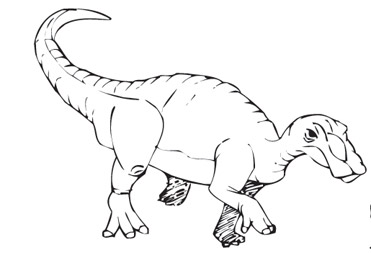
Hadrosaurus was typical of the hadrosaurines – the flat-headed duck-billed dinosaurs, if they possessed head crests they were very small, unlike their flamboyant relatives the lambeosaurines with their extravagant crests such as seen on dinosaurs like Parasaurolophus and lambeosaurus.

An Illustration of a Typical Hadrosaurine Duck-Billed Dinosaur like Hadrosaurus

Picture credit: Everything Dinosaur

The lack of a skull, did not stop the enterprising American scientific community putting this find on display.  In 1868, this fossil was put on exhibit at the Philadelphia Academy of Natural Sciences.  Helping in the construction of this exhibit was the English sculptor Benjamin Waterhouse Hawkins, who had been employed by Sir Richard Owen to create the Crystal Palace dinosaur models for the Great Exhibition in 1851.

To read more about the work of Benjamin Waterhouse Hawkins:  The Central Park Mystery.

Hadrosaurus may remain a nomen dubium, but the skeleton remains on display to this day.

Everything Dinosaur stocks a wide range of prehistoric animal models including replicas of hadrosaurs and lambeosaurs.  For example, the CollectA Age of Dinosaur Popular range contains many duck-billed dinosaur figures: CollectA Age of Dinosaurs Popular Range.

17 09, 2008

Another new Dinosaur Species Discovered in Australia

By |2022-12-07T07:53:11+00:00September 17th, 2008|Categories: Dinosaur and Prehistoric Animal News Stories, Main Page, Palaeontological articles|0 Comments

Two Tonnes of Dinosaur Bones likely to yield a new Species

Australian palaeontologists are confident that two tonnes of recently excavated dinosaur bones may lead to the identification of a new species of Australian dinosaur.  Australia is proving to be one of the “hot-spots” for new dinosaur discoveries with 2008 being a particularly fruitful year for the excavation of dinosaur fossils from this vast country – as predicted in Everything Dinosaur’s 2008 palaeontology prediction list for 2008.

To view the article on Everything Dinosaur predictions: New Year Predictions for 2008.

A recent expedition to a remote dig site in the west of Queensland led to the discovery of the new fossils, dated to the mid Cretaceous period.  The area the team were exploring has proved to be a successful dinosaur hunting ground in the past with the fossilised remains of a large sauropod dinosaur having been found.

Amateur paleontologist David Elliott, from the Australian Age of Dinosaurs Institute which organised the expedition, said the new bones were considered as too small to belong to a sauropod (large long-necked dinosaur).

He went onto comment on the chances of these fossils representing a species new to science as being “very, very likely simply because of the rarity of Australian dinosaurs”.

“There is very little in the way of Australian dinosaurs that have been scientifically described and because of the isolation of Australia… most Australian fauna are very different to others around the world,” he added.

For much of pre-history the land masses that were to make up the southern continents were joined together to form a single super-continent called Gondwanaland.  By the middle of the Cretaceous period this land mass had begun to break up.  South America, India and Africa were separated and Australia was joined to Antarctica by a series of tenuous and temporary land bridges that may have been severed during periods of rising sea levels, isolating the fauna and flora of Australia.  The formation of the South-east Indian ridge (a mid-ocean spreading ridge, formed at the edge of a tectonic plate), began the opening up of a sea channel between Australia and Antarctica.  Australia was slowly pushed northwards as new ocean floor was created by undersea volcanic activity and this floor spread out on either side of the ridge.

Australia is still continuing its northward progress today, and in millions of years time will collide with New Guinea.  The isolating of Australia during the mid Cretaceous permitted many unique types of dinosaurs and other animals to evolve.

It is for this reason that the Australian scientists are confident that the new fossils will prove to be a new species.  The expedition leaders estimate that there is a further eight months preparation work in the laboratory ahead of them before they can come to a clear conclusion as to just what they have dug up.

Everything Dinosaur stocks a large range of prehistoric animal models including lots of models of dinosaurs, fossils of which come from Australia: Dinosaur and Prehistoric Animal Models.

16 09, 2008

Update on Lystrosaurs – the Age of the Prehistoric Pig

By |2022-12-07T07:49:47+00:00September 16th, 2008|Categories: Dinosaur and Prehistoric Animal News Stories, Dinosaur Fans, Main Page|0 Comments

The Porcine Era – Lystrosaurs Ruled the World

An article recently published in the UK shed further light into the dominance of the lystrosaurs in the Early Triassic after much of the terrestrial life had been wiped out by the Permian mass extinction.  The cause of this mass extinction event is not clear, but the devastation it caused at the end of the Permian is very evident from the fossil record.  Approximately 57% of marine families, especially those from low latitudes became extinct.  Virtually all types of coral died out and reef life was decimated.  The trilobites, those wonderful arthropods that had been around since the Cambrian, disappeared as did the last of the eurypterids (sea-scorpions).  Sea lilies, brachipods, bivalves and gastropods suffered huge losses.  On land; things were not much better as many groups of amphibians and reptiles also perished.  Scientists estimate that 70% of all vertebrate genera living on land went extinct.

To read a related article on the Permian extinction and its effect on diaspid evolution and the development of the dinosaurs: Dinosaur Divergence – Long before the end of the Triassic.

Lystrosaurs were dicynodonts, short-tailed synapsid reptiles whose descendants were eventually to give rise to the mammals.  Typically, these type of animals had short skulls, with a deep, powerful jaw, high nostrils and broad but stumpy limbs.  This particular group of animals seems to have recovered very quickly following the Permian extinction event and rapidly diversified to become the dominant large, terrestrial life form.

There is evidence to suggest that these animals were mainly herbivorous (although other species may have been ominvores).  The presence of tusks in the strong jaws, coupled with the strong forelimbs indicate that these animals may have dug up roots and even excavated burrows and dens.  Perhaps this subterranean existence helped these animals survive the Permian extinction event.

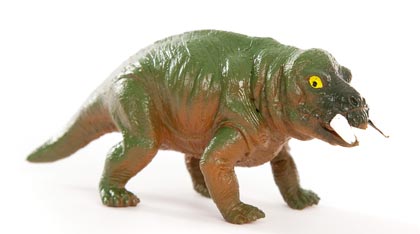
It has been speculated that lystrosaurs were able to hibenate or enter into a period of dormancy (estivation).  This behaviour would have helped these relatively large animals survive a severe dry season for example.  Some species of these mammal-like reptiles grew into giants.  Fossils of Placerias, excavated from the petrified forest area of Arizona indicate animals as large as 3 metres long and weighing over 1,000 kilogrammes.

Placerias model.

A replica of the large dicynodont Placerias.

Picture credit: Everything Dinosaur

However, most of these types of animals went extinct themselves at the end of the Triassic, losing their “dead clade walking” tag as applied by many palaeontologists.  The cynodonts themselves as a group survived until the end of the Jurassic.

Mystery still surrounds the causes of the Permian extinction and no doubt many more papers will be published examining the potential causes and the effects on fauna and flora.  One thing is for sure, the Lystrosaurs with their jaws adapted for eating plants seized on the evolutionary opportunity and rapidly filled the ecological spaces vacated by extinct animals.  It has been estimated that these animals were so successful that something like 50% of all large land animals were lystrosaurs 240 million years ago.

To read a related article shedding light on a new theory regarding the Permian mass extinction: Can snails and oysters provide a clue to mass extinction events?

The CollectA Deluxe range includes a replica of a lystrosaur plus an archosaur that may have been the dominant predator in the environment.  To view the CollectA Deluxe range of figures: CollectA Deluxe Scale Prehistoric Animal Models.

15 09, 2008

Blogging on a Beautiful Belemnite

By |2024-04-15T12:17:18+01:00September 15th, 2008|Categories: Educational Activities, Main Page|0 Comments

Belemnites – an Introduction to the Joys of Fossil Hunting

For many people a fossilised rostrum of a belemnite found on the shoreline, washed out of Mesozoic marine sediments is their first fossil find.  The bullet shaped fossils are easy to distinguish and often occur in large concentrations within fossil bearing strata.

Belemnites are extinct cephalopods, related to the ammonites and although they superficially resemble squid they are more closely related to extant cuttlefish.  Many hundreds of different species are known, most are classified according to subtle differences in the shape of the rostrum (otherwise known as the guard).  Guards can be quite pointed, rounded or almost blunt at the rear end and it is these differences that enable scientists to identify various genera.  The word belemnite (pronounced Bell-em-night), is derived from the Greek for dart or javelin.  Looking at the fossilised calcite guards of these animals it is quite easy to see why.

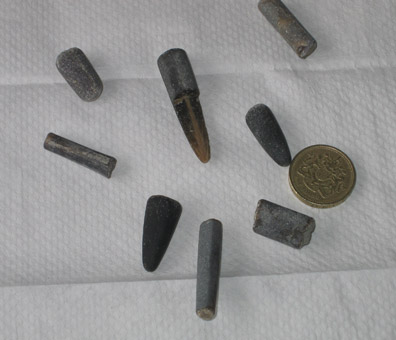
Various Belemnite Fossilised Rostra from Southern England

Picture credit: Everything Dinosaur

The picture above shows various belemnite guards collected by Everything Dinosaur team members at Charmouth on the Dorset coast and at Ravenscar near Whitby on the Yorkshire coast.  The pound coin is shown for scale (I wonder if I will get it back)?

The large belemnite fragment in the centre has been split to show the calcite internal structure.  These types of fossils are very robust and are often transported away from their original sediments, washed out of marls and ending up in gravel beds and such like.  Belemnite fossil fragments such as these have been known to turn up in Quaternary dated river gravel sediments.

Belemnite

The numerous fossil belemnite guards we placed in the fossil hunting trays at our recent exhibition at the World Museum at Liverpool, proved extremely popular.  With many young people able to take home their own fossil of a belemnite guard.  Due to their abundance in some marine strata, belemnites can also be used by palaeontologists and geologists to date layers of rock, but ammonites often prove more effective key fossils as they have more diverse forms.  Certainly, the basic belemnite body plan seems to have been a very successful design as these animals evolved few variants on this body plan throughout late Palaeozoic right through to the end of the Mesozoic.

Unlike ammonite remains, scientists have been able to find preserved soft body tissue of belemnites and we therefore have a very good idea of what they actually looked like.  In very fine grained sediments in Wiltshire (England), and at the famous lithographic limestone beds of Solnhofen in Germany a number of fossils of belemnites have been found with traces of their soft body parts visible.  Solnhofen is particularly famous for fossils of the ancient bird Archaeopteryx, but this part of southern Germany has produced a huge number of fossils both vertebrate and invertebrates are represented.  The main fossil bearing strata are around the towns of Eichstatt, Kelheim and Solnhofen and to date some 360 different species of belemnites have been identified along with numerous fossil plants and vertebrates including fish, crocodiles, turtles, ichthyosaurs, pterosaurs and even dinosaurs.

The Late Jurassic of Europe

During the Late Jurassic much of this part of Europe was covered by shallow seas and the Solnhofen deposits represent the bed of a shallow, still lagoon.  The bed of this lagoon could not support life, so that if animals and plants were washed out into the water, they sank to the bottom and were not scavenged, permitting almost intact specimens to be preserved.  The very fine sediments and the still, anaerobic conditions enabled a great deal of detail to be preserved such as the arms and other soft tissues of belemnites that must have been washed into the lagoon from the open sea.

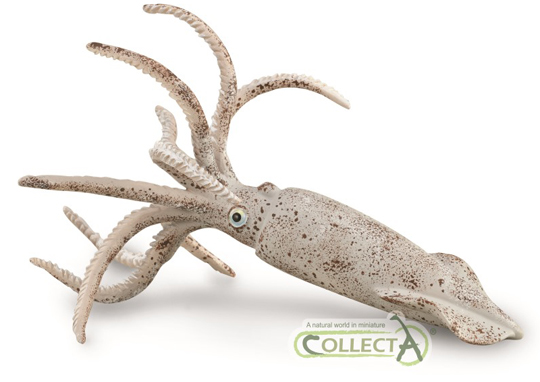
It is from these fossils that scientists have calculated that belemnites had ten equally sized arms, with hooks to grab and secure prey on them.  They had beak-like mouths, large eyes and there is some fossil evidence to suggest they possessed ink sacs like modern squid.

A Replica of a Belemnite

CollectA Belemnite model.

CollectA Age of Dinosaurs Popular Size Belemnite model.

To view a model of a Jurassic belemnite and other prehistoric animal invertebrate replicas in the CollectA model range: CollectA Prehistoric Animal Models and Figures.

Belemnites were preyed upon by a number of animals including small marine crocodiles, pliosaurs and ichthyosaurs.  Indeed, many small ichthyosaur fossil skeletons have hundreds of belemnite hooks preserved in the area where the stomach would have been.  It is thought that these animals vomited up the indigestible parts of the belemnite.

14 09, 2008

Rare Schleich Prehistoric Animal Models

By |2024-04-15T12:17:53+01:00September 14th, 2008|Categories: Dinosaur Fans, Everything Dinosaur Products, Photos of Everything Dinosaur Products|0 Comments

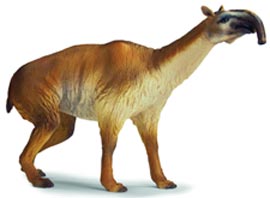
The Schleich Macrauchenia Model

Time to pay tribute to one of our all time favourite prehistoric animal models, the Schleich Macrauchenia replica, which is part of the Schleich prehistoric animal models range.  This hand-painted model was part of a set produced by Schleich of Germany which also featured a Woolly Mammoth, Glyptodon, Smilodon, a Cave bear and a Woolly Mammoth calf.

The Schleich Macrauchenia Replica

The Macrauchenia Prehistoric Animal model by Schleich

The Macrauchenia Prehistoric Animal model by Schleich.

Picture credit: Everything Dinosaur

We think the species name that inspired this particular replica might have been Macrauchenia patachonica.  ‘The name Macrauchenia means “big Llama or big neck”.  The last of these magnificent herbivores died out in South America around twenty thousand years ago, the Schleich Macrauchenia model became extinct somewhat more recently.

To view Everything Dinosaur’s range of Schleich models and other replicas and figures stocked by the UK-based company: Dinosaur and Prehistoric Animal Models.

13 09, 2008

Ice Age Mammals make their Debut

By |2022-12-07T07:24:34+00:00September 13th, 2008|Categories: Educational Activities, Everything Dinosaur News and Updates, Main Page, Press Releases|0 Comments

Ice Age Mammal Models now Available

Animals that lived during the last Ice Age, the so called “megafauna” of the Pleistocene epoch, the Ice Age mammals, are almost as popular as dinosaurs.  In fact a number of animals such as Sabre-toothed cats, Mammoths and Woolly Rhinos frequently appear in our regular surveys amongst young people regarding favourite creatures from the past.

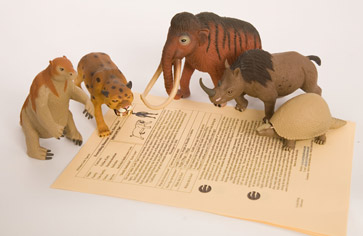
Designers from the London Natural History museum and team members at Everything Dinosaur have brought some of these animals back to life with the introduction of a range of prehistoric mammals that are now available to purchase as individual models as well as in a set.

As well as a large model of a Woolly Mammoth, a Woolly Rhino and of course the fearsome Sabre-toothed cat (Smilodon), the set also includes a Megatherium (giant ground sloth) and the bizarrely armoured, gigantic Glyptodon.  Both the Megatherium and Glyptodon represent animals that lived in the Americas.

The Set of Five Mammal Models

Picture credit: Everything Dinosaur

To view prehistoric mammal models and other replicas available from Everything Dinosaur: Prehistoric Animal and Dinosaur Models.

Beautifully designed and painted to show exquisite detail, these accurate prehistoric mammal models are great for creative play or school study.  Each model is supplied with its own animal fact sheet, produced by the experts at Everything Dinosaur.

We are currently living in what is termed the Quaternary Period of geologic time. This period began about 1.8 million years ago, but it is divided up into two epochs, the Pleistocene and the Holocene.  During the Quaternary ice ages, cold adapted species such as the Woolly Rhino and Mammoths evolved.  The Pleistocene period lasted until 10,000 years ago, when a sudden thaw occurred and the world’s climate warmed up dramatically.  This change took no more than fifty years to come about and resulted in several extinctions.  It is due to this sudden climate change that the Quaternary has been divided into two distinct epochs.

Since this period of rapid warming, the Earth’s climate has been more stable than during any other 10,000 year interval in at least the last 200,000 years.  Handy if you are the sole surviving species of hominid and you are just beginning to increase in numbers.

Go to Top