All about dinosaurs, fossils and prehistoric animals by Everything Dinosaur team members.
2 10, 2008

How to Pronounce Coelophysis

By |2023-02-25T17:07:27+00:00October 2nd, 2008|Categories: Dinosaur and Prehistoric Animal Drawings, Dinosaur Fans, Main Page|0 Comments

Pronouncing “Hollow Form” The Agile Coelophysis

The Late Triassic theropod whose fossils have been famously found at the Ghost Ranch quarry (New Mexico, United States) causes one or two problems for young dinosaur fans when it comes to pronunciation.  Coelophysis is pronounced “See-low-fy-sis”, it might be spelt with a “C” but in reality, the “C sound” is soft and “See-low-fy-sis” is how this dinosaur should be pronounced.

One of the most successful dinosaurs of the Late Triassic, the brain of this dinosaur was larger than its reptilian ancestors and it had keen senses, making this three metre long theropod a formidable hunter.  As for its diet, it would have been capable of catching and eating a range of small animals including insects, small reptiles, amphibians and fish.  It was very probably a generalist carnivore eating a wide range of prey items.

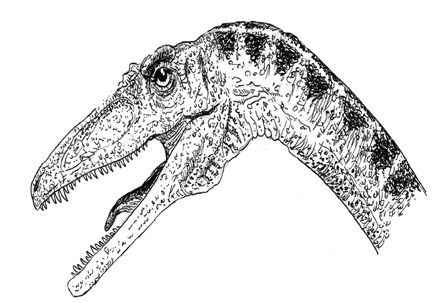
An Illustration of Coelophysis (C. bauri)

Coelophysis of the Late Triassic.

Coelophysis of the Late Triassic.

Picture credit: Mike Fredericks

Coelophysis

The name means “Hollow Form”, a reference to this dinosaur’s hollow and light limb bones.  Note the needle-like teeth in the long, narrow jaws.

Everything Dinosaur stocks a large range of prehistoric animal models including Safari Ltd which includes a replica of Coelophysis: Safari Ltd. Wild Safari Prehistoric World.

1 10, 2008

Wonderful Positive Feedback from Everything Dinosaur Customers

By |2024-04-15T12:28:56+01:00October 1st, 2008|Categories: Dinosaur Fans, Everything Dinosaur News and Updates, Press Releases|0 Comments

High Google Shopping Rating 4.9 out of 5 for Everything Dinosaur

Keeping customers happy is very important to the team members at Everything Dinosaur.  Every day we receive lots of positive comments and reviews from satisfied customers who have purchased dinosaur toys and games. The Google shopping rating is currently at 4.9 out of 5 giving us one of the highest ratings of any retailer in our field, we are justly proud of this fact.  For every order we send out in the UK we provide a FREEPOST envelope and a feedback form so customers can send in their comments and feedback to us.  We get about sixty percent of these feedback forms returned which is a very high percentage.

Some of the comments and feedback we have received from customers:

Bec the Great wrote about the Cuddlekins Pachycephalosaurus:

“It’s nice that you can get an unusual dinosaur like Pachycephalosaurus as a couch toy. This dinosaur is really soft and really cute.  When people come to visit us even the big kids can’t keep their hands off him!  He makes a great mascot.”

Jenna commented on the huge range of dinosaur models Everything Dinosaur stocks:

“Nice to see a variety of models, not just the obvious ones available.  I am  very happy.”

Angel Gomez wanted to leave some feedback about the Natural History Museum Diplodocus dinosaur model:

“The dinosaurs are well designed. They look great.  In addition, the package includes dino’s information.  Unbeatable.”

The Natural History Museum Diplodocus Dinosaur Model
Natural History Museum Diplodocus.

Natural History Museum Diplodocus.

Picture credit: Everything Dinosaur

It is always a pleasure to hear from our customers and every single letter, email, fax and feedback that requires a response receives a reply.  We greatly appreciate the feedback, comments and reviews provided by our customers.

To see the range of dinosaur themed toys and gifts available from Everything Dinosaur: Visit Everything Dinosaur.

30 09, 2008

Fantastic Compliments Received from Everything Dinosaur’s Customers

By |2024-04-15T12:31:25+01:00September 30th, 2008|Categories: Dinosaur Fans, Everything Dinosaur News and Updates, Main Page, Press Releases|0 Comments

Isaac’s Mum says Thanks

At Everything Dinosaur we are always delighted to hear from our customers.  With thousands of satisfied customers all over the world we get a lot of emails, letters and feedback forms, all of which are carefully reviewed by team members and every one that requires a reply is responded to.

Feedback from Customers

Recently, mum of four year old Isaac (a budding young palaeontologists by all accounts), sent us this complimentary email about Everything Dinosaur’s customer service.

Isaac’s mum (Claire) wrote:

“Many thanks for your confirmation of order email.  Isaac’s (my four year old), parcel arrived yesterday beating a delivery for daddy which was ordered a week before!  Excellent service and even better the smile on Isaac’s face when he opened his parcel to find his new dinosaur friends.”

It is always a pleasure to hear from our customers, glad to be of service to Isaac and his mum.

The Everything Dinosaur Corporate Logo

Everything Dinosaur

Everything Dinosaur logo

Picture credit: Everything Dinosaur

Visit Everything Dinosaur’s user-friendly and award-winning website: Visit Everything Dinosaur.

29 09, 2008

Create your own Dinosaur Museum with Fossil Skeleton Kits

By |2023-02-25T18:29:44+00:00September 29th, 2008|Categories: Everything Dinosaur News and Updates, Main Page, Press Releases|0 Comments

Everything Dinosaur Introduces Fossil Model Kits

Build your own mini natural history museum with a set of prehistoric animal skeleton models that have the texture of real fossil bone.  These new kits have been designed to allow young palaeontologists to turn their bedrooms or home study area into a dinosaur fossil gallery just like a real museum.  These are a great product idea to help encourage dinosaur crafts for kids.

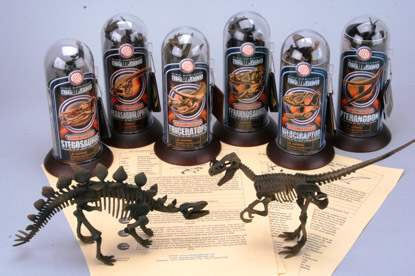
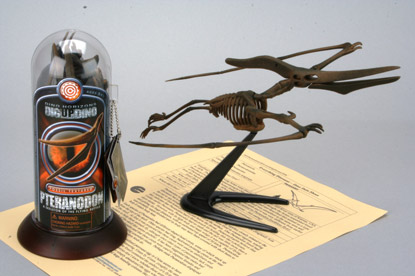
Each snap together kit comes complete with handbook, assembly instructions and a Everything Dinosaur fact sheet on the prehistoric animal represented.  The set consists of six different models – Triceratops, Stegosaurus, an unusual model of a Velociraptor, Parasaurolophus, Pteranodon and of course a Tyrannosaurus rex.

The Model Prehistoric Animal Fossil Kits

Picture credit: Everything Dinosaur

A Stegosaurus Model with a Velociraptor Figure

The picture shows the Stegosaurus model with the model that represents dromaeosaurs (Velociraptor).  Each model comes in its own plastic test tube and when fully assembled the models are approximately 20 cm in length.  The texture of the model gives a fossilised bone effect to give the display authenticity.  You can build up your own collection of dinosaur skeleton models.

To view the range of products available from Everything Dinosaur: Visit Everything Dinosaur.

Prehistoric Animal Skeleton Models

It is always a pleasure to see a pterosaur represented in these types of series and in this case it is a Pteranodon (P. longiceps).  Most pterosaur exhibits in museums are hung from ceilings or roof beams but in this case a handy stand is supplied so that the Pteranodon model can be displayed.

The Pteranodon Fossil Skeleton

Picture credit: Everything Dinosaur

To view a Pteranodon model, along with other prehistoric animal replicas and dinosaur figures: Dinosaur, Pterosaur and Prehistoric Animal Models.

A spokesperson from the award-winning, mail order company Everything Dinosaur commented:

“These dinosaur and prehistoric animal skeleton models have proved to be extremely popular with young dinosaur fans.”

28 09, 2008

Huge “Mother Goose” of the Palaeogene

By |2023-02-25T20:05:52+00:00September 28th, 2008|Categories: Dinosaur and Prehistoric Animal News Stories, Main Page|0 Comments

Don’t Try this Goose for Christmas

A paper detailing the research done on a skull of a giant ancestor of geese and ducks has just been published in the scientific journal “Palaeontology”.  The skull represents a genus of large sea-going bird (Darsornis emuinus) that had a lifestyle similar to the wandering albatrosses of today, but it was much bigger, soaring over what was to become Kent, Essex and London approximately 50 million years ago.

The giant goose-like bird is estimated to have had a wingspan in excess of 5 metres, much larger than any bird today, but not quite matching the South American Argentavis magnificens – a giant, condor-like creature from the Neogene.  However, this giant ancestor of modern geese, scientific name Darsornis emuinus but affectionately called “Mother Goose” by the German researchers studying the fossil did have a beak full of tooth-like projections indicating that like Argentavis this bird also was a carnivore.

Darsornis emuinus

A fossil skull was discovered on the Isle of Sheppey, a small island off the northern coast of Kent in the Thames estuary.  During the early Cenozoic, much of Europe was far warmer than it is today and southern England was bordered by a warm, shallow tropical sea.  Fossils of crocodiles, turtles, ancient mammals and many birds have been found, but not many are as spectacular as this fossil skull belonging to a bird the size of a small plane.

The fossil remains of this incredible bird were studied by a joint team of scientists from the Senckenberg Research Institute and the Natural History museum in Frankfurt.  Darsornis is thought to have had a similar lifestyle to the albatross of today, which spends most of its life at sea and is a master at using thermals and air currents to remain airborne with minimum effort.

The huge wings would have helped Darsornis glide effortlessly above the tops of waves looking for squid or fish at the surface.  The beak with its sharp projections could then be used to grab these slippery animals plucking them from the water.  The teeth-like structures would have prevented the prey from escaping.  A similar lifestyle and feeding habit has been suggested for the giant pterosaur Pteranodon, but this reptile never evolved teeth to help it grab prey, its ancestors had teeth but this large flying reptile lost them.

Adaptations to Help Darsornis Fly

Like Pteranodon, Darsornis had other adaptations to help it fly:

Dr Meyr, a spokesperson for the research team commented: “They had lightweight bones so despite their great size they were not very heavy. I think they were capable of soaring and gliding – though they would probably have needed strong winds to take off.  By today’s standards these were pretty bizarre animals, but perhaps the strangest thing about them is that they had sharp, tooth-like projections along the cutting edges of the beak”.

The scientists have described the 25 cm long beak of this bird as resembling a crocodile’s jaw.

Some early birds had enamel teeth but these were lost about 100 million years ago, yet birds like Darsornis developed them again, this time made from bone and possibly covered with a layer of keratin, the biological material used for the beak. Dr Meyr believes that the 60 to 80 teeth in the beak, were developed to help the prehistoric bird keep a grip of the fish and squid it would have snatched from the sea.

No living birds have true teeth – which are made of enamel and dentine – because their distant ancestors did away with them more than 100 million years ago, probably to save weight and make flying easier,” the doctor commented.

Related to Extant Ducks and Geese

When the bird died it sank to the bottom of the sea, perhaps, getting stuck in the water and being so big it would have found it difficult to take off again without favourable winds.  It was preserved after becoming covered in sediment. It was discovered about five years ago by a private collector but has only now been fully analysed.   Although the bird had a similar lifestyle to the albatross, analysis of its remains has shown that its closest relatives, living or extinct, are ducks and geese.

Everything Dinosaur offers an extensive range of prehistoric animal models and figures.  To visit the models section of the UK company’s website: Dinosaur and Prehistoric Animal Models.

27 09, 2008

Helpful Customer Reviews Sent to Everything Dinosaur

By |2024-04-13T08:41:08+01:00September 27th, 2008|Categories: Everything Dinosaur News and Updates, Everything Dinosaur Products, Press Releases, Product Reviews|0 Comments

Customers Provide Feedback to Everything Dinosaur

Everything Dinosaur team members receive lots of positive comments about the quality of the dinosaur themed toys and models that we sell on line and also about our customer service.  As a small team, we all work very hard to help our customers and to get their orders packed and despatched as quickly as possible.  We really ought to publish on this blog more of the many hundreds of customer comments, thank you letters and such like that we receive, we just don’t have time to do this.  However, we always make sure that all those letters, emails and feedback forms that require a reply are responded to – it’s just part of our commitment to customer service.

Below we have published a few of the customer reviews that we have received recently:

  • Great soft toy and speedy delivery
“Thanks for preparing and sending out my soft toy so quickly.  Really nice dino-toy and great service.”
  • Fantastic service
“I ordered on Wednesday afternoon, product arrived on Thursday morning.  Fantastically quick service.”
  • Excellent!
“A great service, excellent communication, fantastically quick delivery time and products good quality.”
  • Such a simple and clever gift idea
“Thanks for your recommendation, the gift card and tooth was just what I was looking for and so inexpensive to send abroad to my nephew.  Really appreciated your product suggestion, I know he will be absolutely thrilled.”
To see the range of dinosaur themed toys and prehistoric animal models available from Everything Dinosaur, visit the company’s website: Visit Everything Dinosaur.
26 09, 2008

The Incredible Link between Dinosaurs and Birds

By |2024-04-13T08:39:48+01:00September 26th, 2008|Categories: Dinosaur and Prehistoric Animal News Stories, Dinosaur Fans, Main Page|0 Comments

The Dinosaurs and Birds

Providing sufficient evidence to permit most scientists to conclude that birds evolved from small, bipedal, theropod dinosaurs is considered by some academics to be the most important achievement of Dinosauria palaeontology.  Many people might consider the work on the the theory that birds are descended from dinosaurs to be a modern concept, however, the similarity between the anatomies of birds and dinosaurs was first commented on over 140 years ago.

Dinosaurs and Birds

The English anatomist T. H. Huxley in the 1860s pointed out many common characteristics between the dinosaur fossils found and the fossil of Archaeopteryx that had come to light in the limestone strata of Solnhofen, Germany.  In 1861, a complete fossil skeleton of Archaeopteryx was discovered, the feathers could clearly be seen surrounding the animal and it was Sir Richard Owen who organised the purchase of this specimen for what was to become the Natural History Museum – for the huge sum in those days of £600.

For Huxley, a profound supporter of Darwin’s theories as advocated in his book “The Origin of Species”, published in 1859, this Archaeopteryx fossil was evidence of a missing link between reptiles and birds.

However, for much of the 20th century the idea that dinosaurs were the direct ancestors of birds fell out of favour with academics.   It was not until John Ostrom, an American palaeontologist published his work on the dromaeosaur Deinonychus in 1969 that the idea was revived.  Deinonychus fossils had been known since the 1930s but nobody had got around to properly studying them.  Ostrom depicted Deinonychus as an agile, active hunter, turning upside down the consensus view that dinosaurs were slow and clumsy.  Ostrom noted the many bird-like features within the anatomy of this fierce predator.

With the amazing discoveries in the 1990s (and they are continuing), from China, most notably Liaoning Province in the northern part of that country, the theory that birds are living descendants of dinosaurs is widely accepted.  The accepted link between birds and dinosaurs has altered our perception of these animals generally.  Modern reconstructions of dinosaurs show them as agile, active animals with social hierarchies and behaviours  thought impossible just a few decades ago.

Feathers and dinosaurs are now accepted and more evidence is being uncovered all the time to support this concept.  Recent work on other North American dromaeosaur fossils has led scientists to believe that many types of dinosaur, even young tyrannosaurs were possibly feathered.

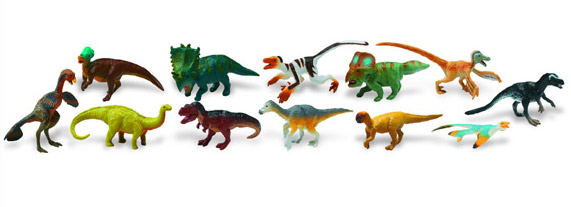
The American Museum of Natural History produced a dinosaur tube full of feathered dinosaurs accompanied by other unusual models such as Protoceratops.  The models are well designed and feature animals available in larger form from the Carnegie Dinosaur Collection series, but these little models are a testament to how far the scientific study of dinosaurs has come since Huxley.

To view the models: Dinosaur and Prehistoric Animal Models.

Typical Models from the Feathered Dinosaur Tube

Feathered dinosaur models.

Picture credit: Everything Dinosaur

25 09, 2008

The Remarkable Contents of a Dinosaur’s Stomach – Eats, Shoots and Leaves (apologies to Lynne Truss)

By |2024-04-15T12:13:28+01:00September 25th, 2008|Categories: Dinosaur and Prehistoric Animal News Stories, Dinosaur Fans, Main Page, Palaeontological articles|0 Comments

Examination of Hadrosaurine Stomach Contents

Occasionally an animal is so well preserved that extraordinary amounts of information can be gleaned from the fossil.  One such example is the wonderfully well preserved fossil of a duck-billed dinosaur from the Judith River Formation of Montana, USA.

An analysis of the probable gut contents from this fossilised dinosaur reveal that its diet at the time of its demise consisted mainly of leaves.  The leaves had been well-chewed, with many of the pieces less than 5 mm in size.

Brachylophosaurus

The fossil is of a hadrosaurine duck-billed dinosaur called a Brachylophosaurus (Brachylophosaurus canadensis) an immature sub-adult that would have grown to a length in excess of 7 metres – not bad on a diet made up of leaves.  This dinosaur fossil, in common with a number of other articulated specimens has been given a nick-name.  It is known affectionately as “Leonardo” although the sex of the animal is unclear.  The Brachylophosaurus got this nickname as  when the fossil hunting expedition found it in the summer of 2000, close by carved on a rock was some graffiti – “Leonard Webb loves Geneva Jordon 1916”.

The fossil record indicates that brachylophosaurs were relatively rare compared to other hadrosaurine hadrosaurs.  Only a few specimens have been found compared to the many hundreds of fossils of other hadrosaurs found in Upper Cretaceous strata of the Western USA and Canada.

Brachylophosaurus means “short-crested lizard”, the crest implied in the scientific name consisted of a flat plate on the top of the head.  This duck-billed dinosaur did not have much of a duck-bill either, rather than the typical broad duck-like bill of a typical hadrosaur, the horny beak of Brachylophosaurus was down-turned and flattened from side to side.  Perhaps this is indicative of an adaptation for a particular type of browsing or other feeding behaviour.  Further analysis of the gastric tract may provide more information about the type of plant material this animal ate.

Other dinosaur fossils have been analysed to establish diet, but finding fossil evidence of this nature is extremely rare.  The analysis of the gastric tract was carried out by Justin Tweet, a graduate student at the University of Colorado, working in conjunction with other students and supervising palaeontologists.

Hadrosaurine Stomach Contents

The team focused on trying to analyse the constituents of the fossil in the area believed to represent the gut of the animal.  Microscopic study identified quantities of pollen, this could then be examined to reveal the types of plants this dinosaur had been eating.  Although pollen grains are very small, they are abundant and exceedingly resistant to decay.  Fossil pollen grains can be released from rock by dissolving the matrix in hydrofluoric acid.  This powerful acid, in a high concentration is capable of etching glass, but the fossilised pollen survive this process and can be studied to indicate the plants that were being eaten, as different plants have different shaped and sized pollen grains.

It seems that “Leonardo” had grazed on a variety of plants including flowering plants and ferns.  Pollen could also enter the gut if it had been ingested as the animal drank, and indeed there are other contaminants associated with this particular fossil.  Only about 12% of the fossil material studied is organic, the rest is clay and grit, which possibly entered the animal’s digestive tract as the body was covered, or perhaps this indicates that Brachylophosaurus was a low browser and picked up soil and other debris as it pulled out plants with its strong jaws, although the relatively high concentration of inorganic matter would cast doubt on this theory – surely this dinosaur was not that messy an eater!

The dentition of these dinosaurs is very formidable with rows of self-sharpening teeth and a jaw mechanism that allowed the tooth surfaces to grind together, an excellent way to break down tough vegetation.  With the plant matter partially broken up this was then swallowed and the strong acidic gastric juices and microbes inside the gut would have continued the digestion process.

In the picture above, the rib bones can be made out along with impressions of the dinosaur’s skin.  Much of the skin of this dinosaur is also preserved, and this has revealed more information about Brachylophosaurus and its way of life.  The skin around the shin and ankle is especially thick, perhaps acting as protection as the animal made its way through the undergrowth.

The discovery of “Leonardo” has certainly helped palaeontologists learn more about this unusual dinosaur, even gaining an insight into its diet.  It also led to the discovery of another hadrosaur fossil in the same location, when a media co-ordinator found a new fossilised dinosaur at Leonardo’s site when rehearsing a visit to view the excavation of the original specimen.

To read an article about this second discovery: Media co-ordinator discovers dinosaur!

Leonardo will be put on display shortly at the Houston Museum of Natural Science in a special exhibit entitled “Dinosaur Mummy C.S.I. (Cretaceous Science Investigation), a homage to the popular U.S. TV franchise C.S.I. about forensic teams helping to solve crimes.

Ironically, for a Late Cretaceous dinosaur believed to be somewhere around 80 million years old, there was a delay of one week before the exhibition could start.  Power cuts caused by hurricane Ike had were the reason for the delay, but fortunately none of the precious museum specimens were damaged.

Members of the public will be able to see this remarkable fossil for themselves and discover more about the on-going research surrounding this superbly well-preserved specimen.  Scientists have suggested that the fossil evidence indicates a diet of leaf matter, almost the title of Lynne Truss’s book about having a zero tolerance to punctuation.

Here is a dinosaur the eats shoots and leaves, leaving us evidence of its diet in the fossil record.

Everything Dinosaur supplies a wide range of hadrosaurine dinosaur models from the figures and replicas section of its award-winning website: Dinosaur and Prehistoric Animal Models.

24 09, 2008

“Chicken sized” Dinosaur Discovered In Alberta

By |2022-12-08T13:00:30+00:00September 24th, 2008|Categories: Dinosaur and Prehistoric Animal News Stories, Dinosaur Fans, Main Page|0 Comments

Small Dinosaur – A possible Termite Eater from the Cretaceous (Alberta, Canada)

Details of the research undertaken to identify and describe a new type of North American dinosaur has just been published in the scientific journal “Cretaceous Research”.  This dinosaur, at only 75 cm long and standing less than a metre tall is claimed to be the smallest dinosaur every discovered in North America.

This new species has been named Albertonykus borealis (northern clawed beast of Alberta), the fossils of this animal were discovered in the Red Deer formation of Alberta and it is believed to have been a fast running, insectivore with a similar lifestyle to the alvarezsaurids – dinosaurs such as Mononykus and Shuvuuia from Asia.

North American Dinosaur

The 70-million-year-old bones (Maastrichtian faunal stage), were found during an expedition to the Red Deer region to excavate the fossils of an Albertosaurus in 2002.  The leader of that dig, Philip Currie removed the tiny fossil bones that had been found in association with the larger tyrannosaur and put them into storage at the Royal Tyrrell Museum in Drumheller.  There the bones remained until University of Calgary palaeontologist Nick Longrich discovered them in one of the many storage draws and begun to work out just what sort of animal the bones represented.

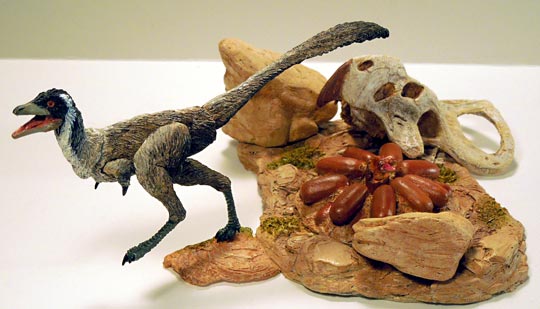
A Model Set Featuring a Typical Member of the Alvarezsauridae

Desert Accessory Pack (Beasts of the Mesozoic)

The amazing desert accessory pack featuring a replica Mononykus (Beasts of the Mesozoic).

The Beasts of the Mesozoic Range

The picture (above) shows a replica of the alvarezsaurid dinosaur Mononykus from the: Beasts of the Mesozoic Model Range.

We know from experience that one of the best places to find a new species of dinosaur is not out in the field but in the storage areas of museums.  For example, we once calculated that given the dinosaur material stored in plaster jackets at the Royal Tyrrell Museum, it would take our team hundreds of years to prepare them all.

In the journal article, the two authors describe the specimen and use the strong forelimbs, “s” shaped, flexible neck, agile long necks and pick-like claws as evidence to indicate a diet of insects such as termites and other burrowing creatures depicting a lifestyle similar to modern-day anteaters and pangolins.

The small dinosaur looks like a creature from a Dr Seuss book, said Longrich, who called the findings “pretty cool.”

“We’ve never seen one this far north. Before this we only had two bones from this type of animal ever seen in North America and now we’ve got almost a dozen bones, most of them from one site,” he added.

“So it doesn’t give us a perfect idea of what the animal looked like but it gives us a much better idea.”

This little dinosaur has been depicted in the illustration above using its shortened forelimbs to dig into tree stumps and fallen logs in search of insects such as termites.  Albertonykus is depicted with a covering of downy feathers, this is in recognition of analysis of alvarezsaurid fossils from Mongolia that show traces of the chemical beta keratin which is found in feathers.  A downy coat would help insulate this small, active animal and keep it warm.

Nick Longrich believes this discovery is important as it sheds light on the existence of smaller dinosaurs in the Red Deer River formation.  It is very likely that small dinosaurs such as Albertonykus made up a large portion of the dinosaur fauna.  However, it is the large bones of the bigger animals that have a greater preservation potential.  Small delicate bones are less likely to be fossilised and indeed, many small carcases are eaten by predators.

This dinosaur is believed to a member of the Alvarezsauria, a group of small, bipedal dinosaurs with stunted forelimbs and reduced digits.  The alvarezsaurid fossils from Mongolia have been dated to between 80 and 75 million years ago (Campanian faunal stage).  The Alberta remains have been dated to approximately 70 million years ago.  Although, it is not possible to build a relationship diagram based on these remains the presence of Albertonykus in younger strata may indicate that like the tyrannosaurs, the dinosaur ancestors of Albertonykus migrated into North America from Asia.

The dinosaurs found in Mongolia are estimated to be about 75 to 80 million years old, while the Alberta version is about 70 million years old.

23 09, 2008

The Bizarre Looking but Amazing Amargasaurus

By |2024-04-15T12:14:06+01:00September 23rd, 2008|Categories: Everything Dinosaur Products, Main Page|0 Comments

Amargasaurus – A Diplodocid that may have been a bit of a Show Off

We have recently been looking at some drawings and designs of dragons and other mythical creatures. Many dinosaurs looked bizarre, for example Amargasaurus, and the comment was made about how fanciful these animals looked with their wings, spines, spikes and frills.  The designers had really gone to town letting their imaginations run riot to produce prototypes for a model series.

However, sometimes the truth can be stranger than fiction and a number of prehistoric animals including dinosaurs are believed to have had bizarre ornamentation, spines, frills and crests.

Scientists are still unsure as to the exact purpose of many of these odd appendages, but the fossil record is clearly as capable of revealing any number of bizarre and odd looking animals, a match for the imagination of the sculptors and artists behind many of the dragon models.  Unless we have interpreted the fossil evidence incorrectly, these strange features evolved as they gave the animals an advantage in some way.

Amargasaurus

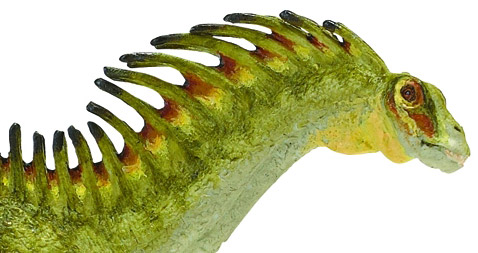
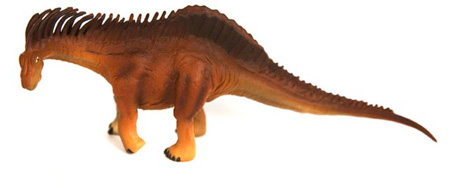
An example of a dinosaur with a bizarre appearance is Amargasaurus (Amargasaurus cazaui), a diplodocid dinosaur related to the better known (and larger) Diplodocus.  This sauropod had a disproportionately short neck when compared to other members of this group of dinosaurs but its most striking feature were the rows of spines and spikes that ran along the body from behind the neck to the end of the tail, although spines on the tail is conjecture as the only specimen of this animal discovered to date lacked a tail.  Some of our Amargasaurus dinosaur models show lots of amazing detail.

The Bizarre Looking Amargasaurus

Picture credit: Everything Dinosaur

The spines are extensions of the vertebrae, what they were used for is unknown, although several theories have been put forward.  The spines may have supported a sail-like structure which may have been used for communication amongst herd members or for temperature regulation.  A sail may have helped this animal warm up quickly in the morning and, by facing towards the noon sun, exposing only a minimum part of their body’s surface area, they may have been able to regulate their temperature during the hottest part of the day.

A large sail-like structure on the neck would have inhibited movement of the neck, not a good idea if you are a browsing herbivore.  It has been suggested that any sail on the neck did not cover the full expanse of the spines, but in reality the tops of the spines were tipped with horn and were actually defensive spikes to protect a vulnerable part of this animal.  An examination of the skull and teeth of Amargasaurus in conjunction with an examination of the length of the neck vertebrae permits us to speculate that this animal browsed on low-lying vegetation.  With its head craned towards the ground to eat, it would make sense to have spikes on the neck to prevent a predator grabbing the neck in a surprise attack.

Amargasaurus – A Diplodocid from South America

Amaragasaurus Replica (Dinosaur Toys).

Picture credit: Everything Dinosaur

To view the range of sauropod models available from Everything Dinosaur including Amargasaurus figures: Dinosaur and Prehistoric Animal Models.

The Carnegie model from the dinosaur collectibles series measures an impressive 22 cm long and this particular hand-painted model was awarded the seal of excellence for creative play by the U.S. based Creative Child Magazine.

Go to Top