

A remarkable new sauropod dinosaur discovery is the focus of a recent paper published in the open access journal “PeerJ”. The study introduces Bicharracosaurus dionidei, fossils of which herald from Upper Jurassic deposits from the Cañadón Calcáreo Formation of southern Argentina. This research captures attention. Not only does it describe a new species, but it also reshapes how scientists understand sauropod evolution in the Southern Hemisphere.
Sauropod Evolution
Much of what we know about sauropod evolution comes from studying fossils from the Northern Hemisphere. Less is known about sauropod evolution and radiation in the Southern Hemisphere. Hence, the discovery of a new sauropod species from southern Argentina is especially significant. In March 2001, farmer Dionide Mesa reported the discovery of some dinosaur vertebrae. Fieldwork commenced the following year and by 2011 much of the fossil material had been removed. However, more neck bones (cervical vertebrae) were excavated in 2018.
In total, more than thirty vertebrae, ribs and parts of the pelvis were found. The material dates from the Upper Jurassic (Oxfordian to Kimmeridgian faunal stages). Palaeontologists estimate this sauropod fossil material to be approximately 155 million years old. The fossils probably represent a mature, adult specimen. Estimates suggest that this dinosaur measured between fifteen to twenty metres in length.
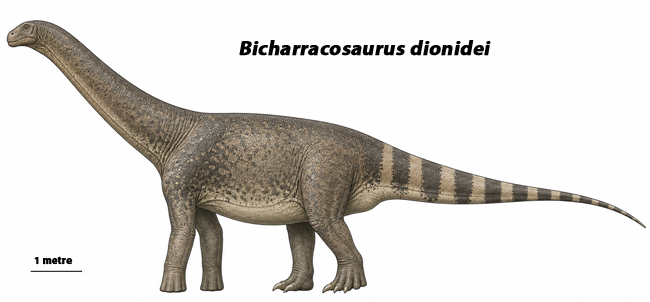
Bicharracosaurus dionidei life reconstruction and scale drawing. Picture credit: Everything Dinosaur (AI assisted).
Picture credit: Everything Dinosaur (AI assisted)
Bicharracosaurus dionidei
What makes Bicharracosaurus dionidei particularly interesting is its unusual mix of sauropod traits. For example, the dorsal vertebrae are similar to the dorsal vertebrae of diplodocids. However, some fossil bones are reminiscent of the bones of brachiosaurids such as the giant Giraffatitan brancai from the Late Jurassic of Tanzania. This combination of autapomorphies is unexpected. Consequently, the research team conducted a detailed phylogenetic analysis. The results were inconclusive. The overall evidence supports a position of Bicharracosaurus within Macronaria with several analyses and diagnostic characters suggesting brachiosaurid affinities. Bicharracosaurus sits in a somewhat uncertain evolutionary position.
Intriguingly, if the brachiosaurid affinity proves to be correct, then Bicharracosaurus dionidei would be the first member of the Brachiosauridae from the Jurassic of South America.
A Sauropod Puzzle
Several sauropods have been described from fossil material associated with the Cañadón Calcáreo Formation. For instance, Tehuelchesaurus benitezii which was named and described in 1999 (Rich et al). Tehuelchesaurus is thought to be a macronarian like Bicharracosaurus. However, whilst Bicharracosaurus shows a combination of sauropod characteristics (diplodocid and brachiosaurid), Tehuelchesaurus is thought to be a member of the Camarasauridae family.
Despite some similarities between Bicharracosaurus and Tehuelchesaurus benitezii fossil material, only in some of the phylogenetic results were these two species recovered as closely related. Whereas in most analyses, Tehuelchesaurus formed a clade with Janenschia robusta, a sauropod from the Late Jurassic of Tanzania. In addition, several diagnostic characters of Bicharracosaurus are absent in Tehuelchesaurus and vice versa. The results also show that other putative macronarian taxa have incongruent positions depending on the dataset. These inconsistencies are hindering understanding of the early evolution of the Macronaria.
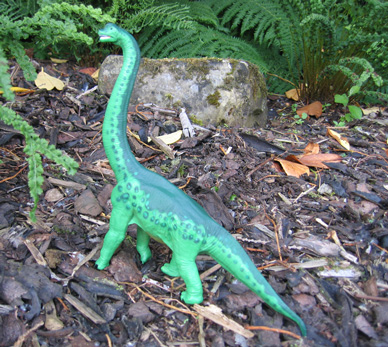
A model of a typical member of the Brachiosauridae family. The Wild Safari Prehistoric World Brachiosaurus dinosaur model. Picture credit: Everything Dinosaur.
Picture credit: Everything Dinosaur
The image (above) shows a model of a Brachiosaurus.
For models and replicas of sauropods, including brachiosaurids, diplodocids and other dinosaurs: Dinosaur Models and Dinosaur Toys.
The Naming of Bicharracosaurus dionidei
The taxonomic affinity of this new dinosaur species remains uncertain. It demonstrates that early macronarian evolution was more complicated than previously thought. Until now, scientists relied heavily on fossils from North America and Europe. In contrast, southern continents such as South America and Africa were underrepresented. As a result, evolutionary models may have been biased. Thanks to this newly described sauropod, palaeontologists have the opportunity to test existing ideas and refine theories. However, it does suggest that sauropod diversity in Gondwana was greater than expected.
The genus name comes from a Spanish term meaning “big animal”. Meanwhile, the species name honours Dionide Mesa, in recognition of the original fossil discovery.
Overall, this study provides fresh insight into one of the most iconic dinosaur groups. It highlights the importance of Southern Hemisphere sauropod fossils. At the same time, it reveals how much there is still to learn. Each new discovery has the potential to challenge established ideas. In this case, Bicharracosaurus dionidei offers a fascinating glimpse into the complex early evolution of macronarian sauropods.
The scientific paper: “Bicharracosaurus dionidei, gen. et sp. nov., a new macronarian (Dinosauria, Sauropoda) from the Late Jurassic Cañadón Calcáreo Formation of Argentina and the problematic early evolution of macronarians” by Alexandra Reutter, José Luis Carballido, Guillermo José Windholz, Diego Pol and Oliver W.M. Rauhut published in PeerJ.
The multi-award-winning Everything Dinosaur website: Dinosaur and Scientifically Accurate Prehistoric Animal Models.

Leave A Comment