All about dinosaurs, fossils and prehistoric animals by Everything Dinosaur team members.
Photographs and pictures of products featured on the Everything Dinosaur website. Everything Dinosaur a UK based retailer of dinosaur models, toys and games. This category features pictures of products that are or were on the company’s website.
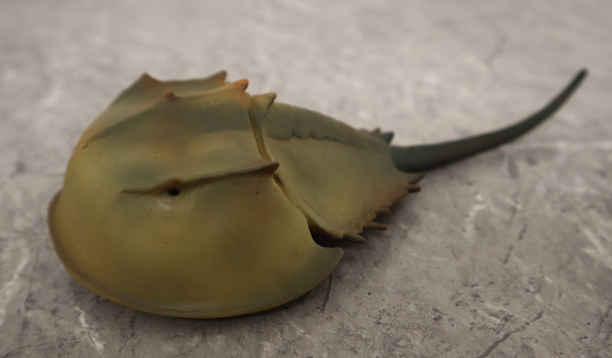
In 2020, CollectA introduced a Horseshoe crab model. These animals are members of the Limulidae family. This model of an ancient invertebrate is extremely detailed. The Horseshoe crab lineage has a fossil record that dates back to the Ordovician. Team members were asked to take some photographs of the figure for a palaeontology related project.
CollectA Horseshoe crab in lateral view. Picture credit: Everything Dinosaur.
Picture credit: Everything Dinosaur
The CollectA Horseshoe Crab Model
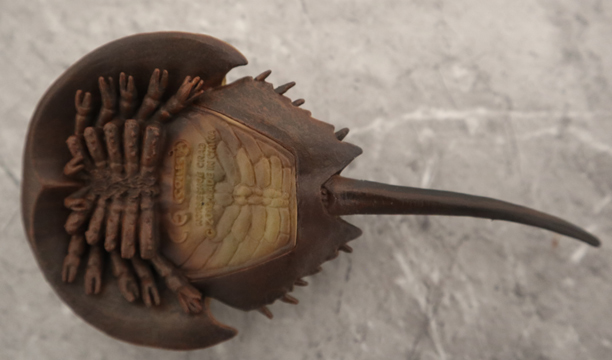
The model is very detailed, and the paint scheme makes this replica look extremely realistic. However, it is on the underside where the care and dedication of the design team really shows.
The CollectA Horseshoe crab model in ventral view (view of the underside). Picture credit: Everything Dinosaur.
The small chelicerae (modified claws) are bent towards the mouth. These appendages pass food into the mouth. The walking legs show the bifurcated end segments, and the rear “pusher” leg is clearly visible. The design team have included a vent at the base of the long, pointed telson.
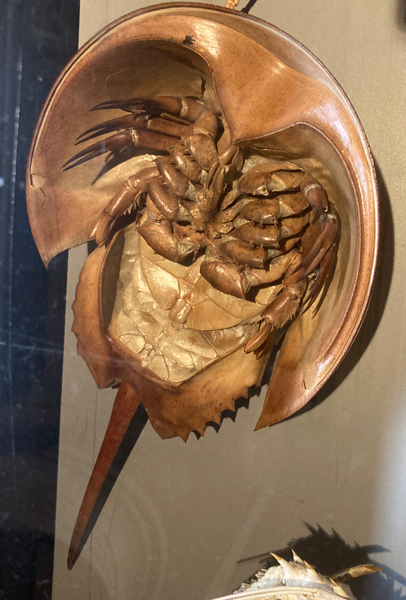
An Atlantic Horseshoe crab in ventral view (view of the underside). Picture credit: Everything Dinosaur.
Picture credit: Everything Dinosaur
The picture (above) shows an Atlantic Horseshoe crab (Limulus polyphemus) in ventral view. It is on display at the London Natural History Museum.
CollectA Age of Dinosaurs Popular Size Horseshoe crab figure. The model measures 15 centimetres in length and the width of the carapace is 7.7 cm approximately.
In horseshoe crabs, the head and thorax are fused. This structure is called the prosoma. It is also sometimes referred to as the cephalothorax. The cephalothorax is covered in a hard, protective carapace.
With the publication of the scientific paper announcing the discovery of Eoneophron infernalis, we at Everything Dinosaur thought we would take a closer look at the Caenagnathidae. The Caenagnathidae family (pronounced seen-nag-nay-thid-ay), are part of the Oviraptorosauria clade of maniraptoran theropod dinosaurs. They are closely related to the oviraptorids (Oviraptoridae family).
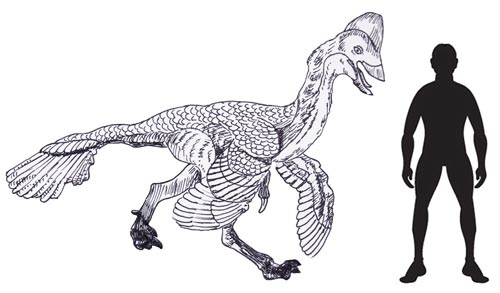
A scale drawing of a dinosaur (Anzu wyliei). This dinosaur is a member of the Caenagnathidae family, and its fossils come from the Hell Creek Formation (Maastrichtian faunal stage of the Late Cretaceous). Picture credit: Everything Dinosaur.
The Maniraptora clade consists of coelurosaurian dinosaurs and is defined as including the birds and the non-avian dinosaurs more closely related to them than to Ornithomimus velox. As well as containing the Oviraptorosauria, this clade also includes several other groups such as the dromaeosaurids, the Troodontidae family and the therizinosaurs.
The Oviraptorosauria clade* is comprised of the Caudipteridae family and two closely related dinosaur families the Caenagnathidae and the Oviraptoridae that together are classified as the Caenagnathoidea. The Oviraptorosauria are united by having very bird-like skeletons, with highly pneumatised bones. In addition, the rostrum is very short, and these dinosaurs have beaks. The beak is often, but not always edentulous (no teeth). These dinosaurs were all probably feathered.
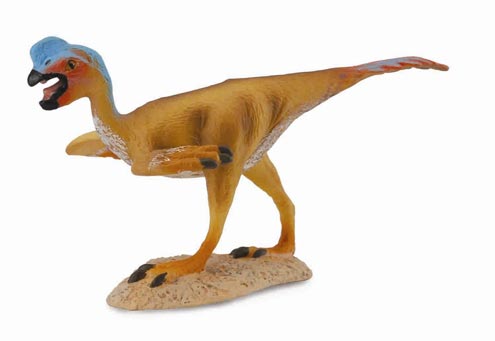
An Oviraptor dinosaur model (CollectA Age of Dinosaurs).
The image (above) depicts an Oviraptor model from the CollectA Age of Dinosaurs range.
The Caenagnathidae Family and Eoneophron infernalis
The family Caenagnathidae, together with its closely related sister family the Oviraptoridae, comprises the superfamily Caenagnathoidea. Virtually all known members of this superfamily are confined to the Late Cretaceous. Taxonomically the Caenagnathidae is defined as Chirostenotes pergracilis and all other theropods more closely related to it than they are to Oviraptor philoceratops.
Most of these dinosaurs tend to be quite small. As a result, they are probably underrepresented in the fossil record. For example, Anzu wyliei was thought until recently to be the only caenagnathid from the Hell Creek Formation. However, there are probably at least three caenagnathids present in Hell Creek strata, including the recently named Eoneophron infernalis.
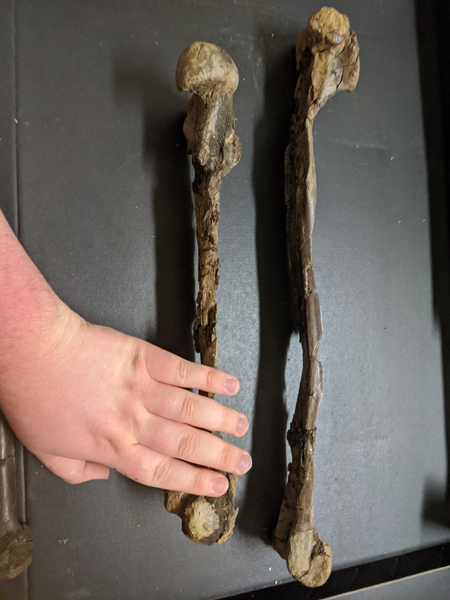
The femur (left) and right tibia (right) of Eoneophron. Picture credit: Kyle Atkins-Weldman.
Caenagnathids Not Closely Related to Ostriches
The Caenagnathidae family was originally erected by Raymond Martin Sternberg (1940), the son of the pioneering palaeontologist Charles Mortram Sternberg. Raymond Martin Sternberg thought that these dinosaurs were flightless birds. He erected the Caenagnathidae family which translates as “recent jaws”. It was mistakenly thought that these theropods were closely related to the Palaeognathae “old jaws” bird family. Extant palaeognath birds include the flightless Kiwi, the Ostrich and the Rhea as well as volant forms such as Tinamou birds. It is now known that the Caenagnathidae family of non-avian dinosaurs are not closely related to palaeognaths.
Caenagnathids are confined to the Late Cretaceous of Asia and North America. They tend to have small heads, long necks and short tails.
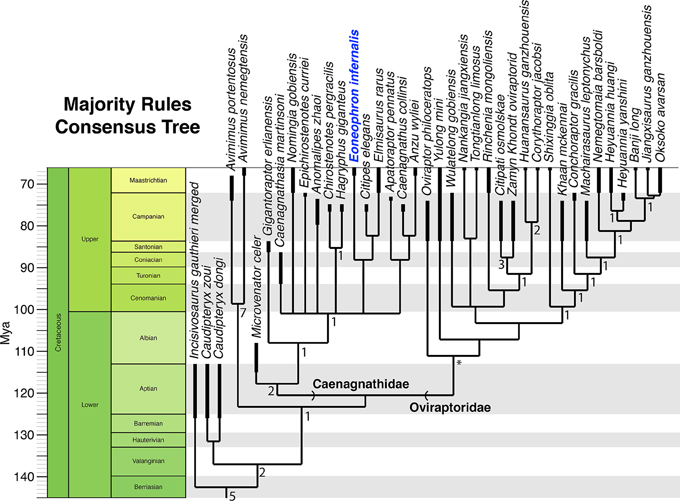
Time-calibrated Oviraptorosauria clade consensus tree showing the position of Eoneophron infernalis. Picture credit: Atkins-Weltman et al.
Challenging Phylogenetic Assessment
Whilst the fragmentary nature of most caenagnathid specimens makes phylogenetic assessment challenging, in the recent Eoneophron infernalis paper the researchers undertook a time-calibrated phylogenetic analysis of the Oviraptorosauria. Eoneophron was placed as a sister taxon to Citipes elegans and Elmisaurus rarus.
The difficulties involved in classifying oviraptorosaurs is exemplified by this placement. Although skeletal similarities between these three dinosaurs exist, there is a lack of comparable fossil material to study. Citipes elegans is geologically older. Its fossils come from the Dinosaur Provincial Park Formation of Alberta (Campanian faunal stage of the Late Cretaceous). In contrast, Elmisaurus rarus probably predates Eoneophron infernalis by a couple of million years. It too is from the Maastrichtian faunal stage of the Cretaceous. However, E. rarus fossils come from the Nemegt Formation of Mongolia.
A revision of already described specimens coupled with improved fossil sampling should help palaeontologists to gain a better understanding of the taxonomy of the Oviraptorosauria and specifically the enigmatic Caenagnathidae.
The Oviraptorosauria clade* also includes some other theropods regarded as basal members of this clade. For example, Incisivosaurus gauthieri from the Early Cretaceous of China.
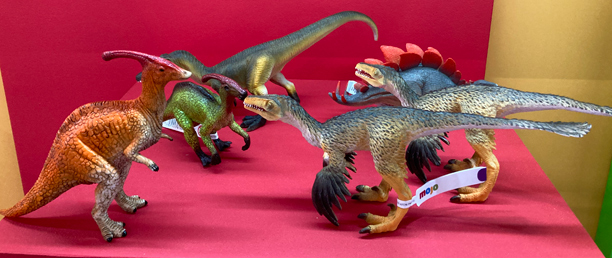
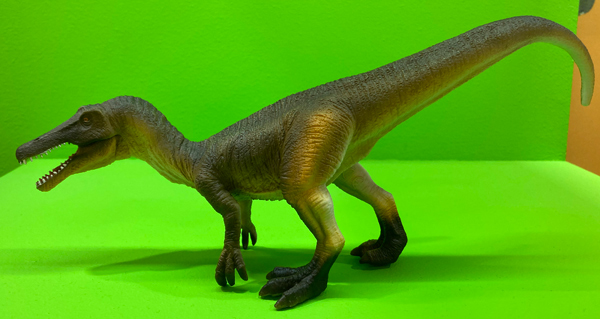
Everything Dinosaur team members had the opportunity to view the five new Mojo Fun repaints for 2024 at the recent Spielwarenmesse trade fair in Germany. The repainted dinosaur models will be in stock at Everything Dinosaur soon. The five figures include the Parasaurolophus (biped and quadruped stance), the Baryonyx, Troodon and a Stegosaurus.
The five repainted Mojo Fun dinosaur models for 2024. The standing Parasaurolophus (left) and the Parasaurolophus in the quadrupedal pose (mid left). The repainted Baryonyx is at the back and the Stegosaurus repaint is also at the back (back right). A pair of Troodon repaints can be seen (right). Picture credit: Everything Dinosaur.
Whilst there are new dinosaur models scheduled for 2025, the 2024 offering consists of five repainted figures. The Mojo Fun repaints for 2024 are listed below:
Standing Parasaurolophus.
Quadrupedal Parasaurolophus.
Stegosaurus.
Troodon with an articulated jaw.
Baryonyx with an articulated jaw.
The repainted Mojo Fun Baryonyx figure for 2024. This figure has a muted colour scheme compared to the original Mojo Fun Baryonyx. The articulated jaw has been retained. Picture credit: Everything Dinosaur.
Picture credit: Everything Dinosaur
A spokesperson from Everything Dinosaur commented:
“We had the opportunity to see the new Mojo Fun repaints at the recent Spielwarenmesse in Germany. We were particularly impressed with the paint schemes. The Baryonyx and the Troodon figures are our personal favourites.”
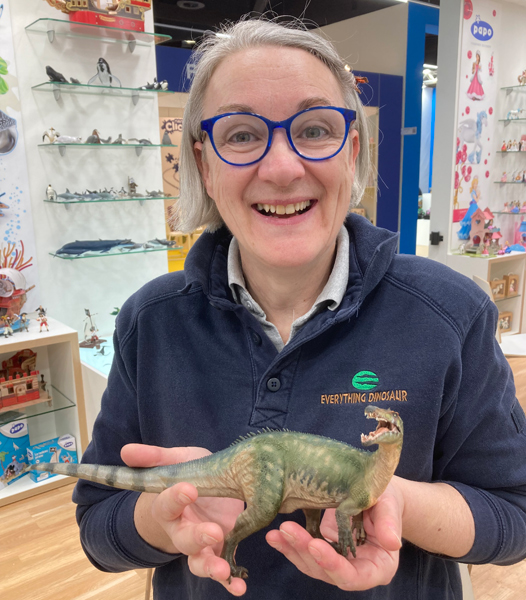
Everything Dinosaur team members were given the opportunity to handle the prototype for the new Papo Suchomimus dinosaur model. This new Papo dinosaur was on display at the Spielwarenmesse (Nuremberg, Germany). It is one of three new Papo dinosaur models due to be released this year (2024). The Papo Suchomimus is scheduled to be in stock in quarter 4 of 2024.
Sue Judd (Everything Dinosaur) carefully holding a prototype of the new for 2024 Papo Suchomimus. Picture credit: Everything Dinosaur.
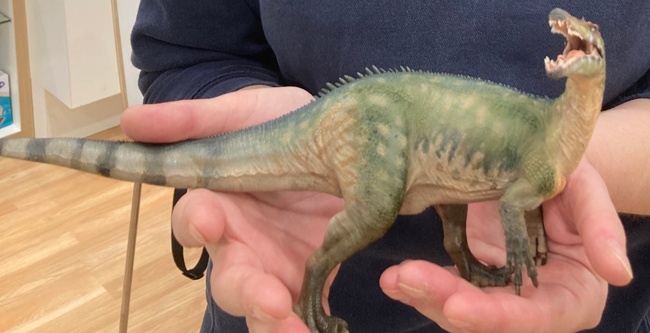
This new spinosaurid figure is going to be available after the Papo Corythosaurus and the Ampelosaurus models. It is likely to be available in the latter part of the year. The model at the tradeshow was not an actual production figure. It is a prototype that will assist with the painting guide required for when these models are made at scale.
A close-up view of the Papo Suchomimus dinosaur prototype model. Picture credit: Everything Dinosaur.
Picture credit: Everything Dinosaur
Everything Dinosaur
Sue Judd from Everything Dinosaur commented:
“This new Suchomimus figure is stunning! We were given the opportunity to handle all three new for 2024 Papo dinosaurs. However, this Suchomimus model is very precious as it is effectively the prototype. It really is a beautiful model, and we hope our photographs do it justice.”
The Papo Suchomimus model is scheduled to be in stock at Everything Dinosaur towards the end of 2024. We hope our photographs have whetted the appetites of Papo fans and model collectors.
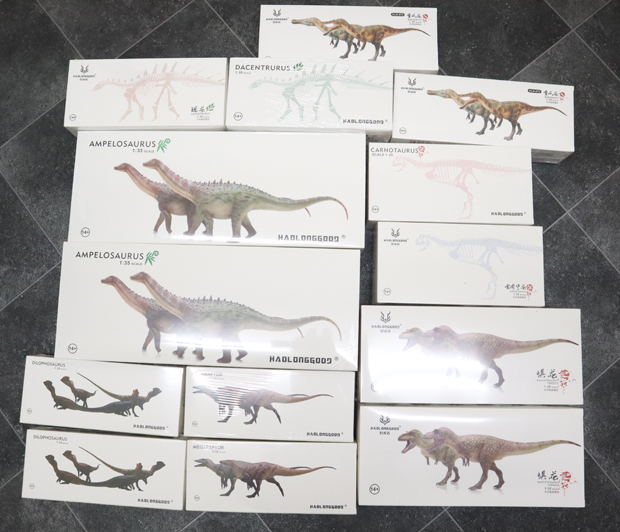
Team members at Everything Dinosaur took a photograph of the fourteen new Haolonggood dinosaur models that recently arrived at the company’s warehouse. The new figures represent five theropods, one armoured dinosaur (Dacentrurus) and a titanosaur. The titanosaur is Ampelosaurus, which is also the largest figure in this recently arrived stock.
Fourteen new Haolonggood dinosaur models arrived at Everything Dinosaur’s warehouse recently. Picture credit: Everything Dinosaur.
The fourteen figures represent seven dinosaur genera. The photograph showing the boxes together provides collectors with an impression of the size of the models relative to each other. The titanosaur figure (Ampelosaurus atacis) is the largest. The tyrannosaur figure Daspletosaurus (D. torosus) is the second largest.
Here is the full list of the Haolonggood figures in the photograph:
Dacentrurus – Xuning.
Dacentrurus – Lingzhen.
Carnotaurus – Li Zhong.
Carnotaurus – Zhou Tong.
Daspletosaurus torosus – Wu Song.
Daspletosaurus torosus – Lu Zhi Sheng.
Ampelosaurus – Sun Er Niang.
Ampelosaurus – Zhang Qing.
Dilophosaurus – Wang Ying/Hu San Niang.
Dilophosaurus – Sun Xin/Gu Da Sao.
Megaraptor – Shi Qian.
Megaraptor – Duan Jing Zhu.
Baryonyx – Shan Ting.
Baryonyx – Wei Ding Guo.
Haolonggood have established themselves rapidly in the dinosaur model collecting market. They have already built up an extensive product range. Everything Dinosaur is looking forward to highlighting new Haolonggood figures in the near future.
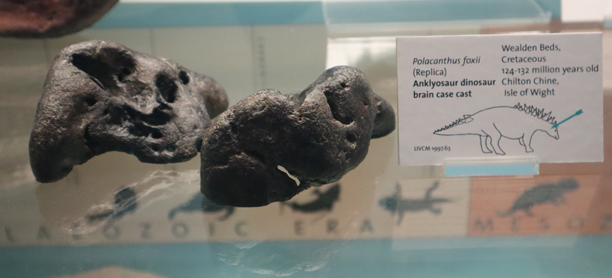
In the Liverpool World Museum there are several exhibits that feature dinosaur fossils. One display case includes two, worn fossils which are described as Polacanthus foxii fossil material. The fossil material has a rounded appearance. According to the display label these fossils are from the Wealden Beds exposed at Chilton Chine on the Isle of Wight. They are described as casts (copies) of a Polacanthus braincase. The actual fossils probably came out of the cliffs and were exposed on the beach for some time prior to their discovery. These fossils were rolled around the beach and attrition caused their rounded and weathered appearance.
However, these fossils, or their copies may not represent Polacanthus foxii.
Casts of Polacanthus fossils. Fragmentary and eroded replica armoured dinosaur fossils on display at Liverpool Museum. These fossils have been assigned to Polacanthus foxii. Picture credit: Everything Dinosaur.
Picture credit: Everything Dinosaur
Labelling Polacanthus Fossils
The Wealden Group covers several million years of deposition. To date, armoured dinosaurs named and scientifically described from the Wealden Group include Hylaeosaurus, the recently named Vectipelta and Polacanthus.
The fossils, although labelled as Polacanthus, may not represent that taxon. Fossils from the Isle of Wight attributed to Polacanthus may actually represent multiple, as yet unnamed taxa.
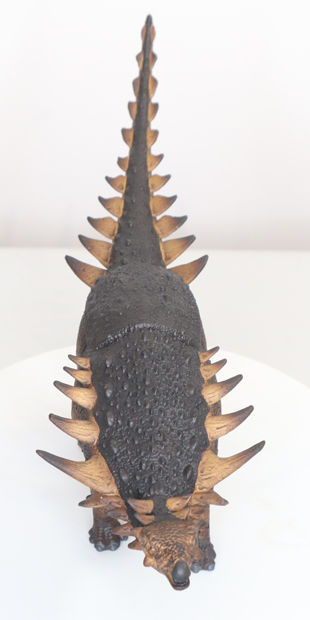
The picture (above) shows the new for 2024 CollectA Deluxe Polacanthus model. This figure is based on the Polacanthus foxii holotype material. It is a modern interpretation of the known fossil material.
Vectipelta for example, is only distantly related to both Hylaeosaurus and Polacanthus foxii.
It is unlikely that all the fossil material ascribed to the Polacanthus taxon displayed in museums actually represents P. foxii, or indeed any other possible species as yet unassigned to the Polacanthus genus.
Our thanks to a dinosaur model fan who sent in a review of the recently introduced PNSO Yangchuanosaurus “Dapeng” into Everything Dinosaur. William emailed to praise this new PNSO theropod figure and explained that this was the second Yangchuanosaurus figure from PNSO. This replica represents the enormous species Y. magnus.
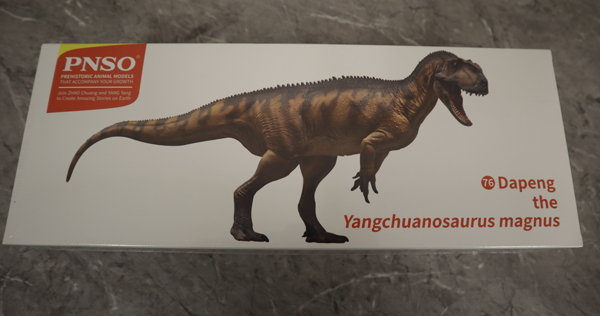
The packaging of the recently introduced PNSO Yangchuanosaurus model “Dapeng”. Picture credit: Everything Dinosaur.
Picture credit: Everything Dinosaur
PNSO Yangchuanosaurus “Dapeng”
The reviewer described this new PNSO figure as “truly a Jurassic terror of China’s ancient past.”
The genus was first erected in 1978 (Dong Zhiming et al). A large theropod skeleton had been discovered during the construction of a dam in Sichuan Province. This dinosaur was estimated to have measured around eight metres long. It was named Yangchuanosaurus shangyouensis. In 1983, a second, considerably larger specimen was uncovered (specimen number CV 00216). It was initially thought to represent a new species and the taxon Yangchuanosaurus magus was erected. Further analysis revealed that the anatomical differences observed in the two skeletons were the result of ontogenetic variation. This larger skeleton is now thought to represent and older, more mature Yangchuanosaurus shangyouensis.
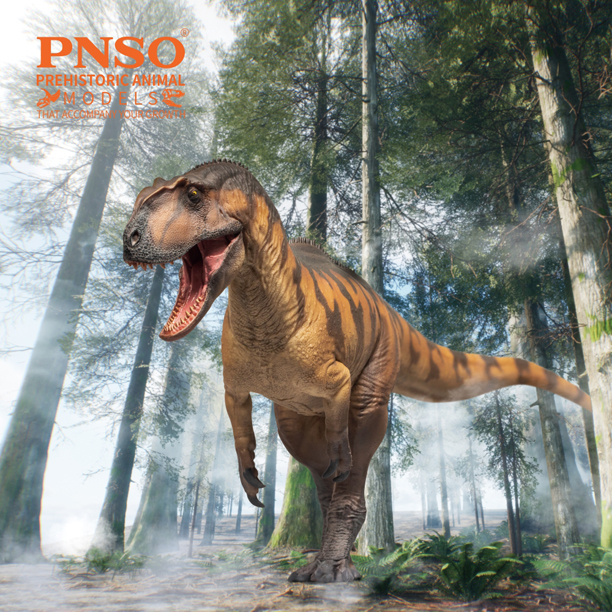
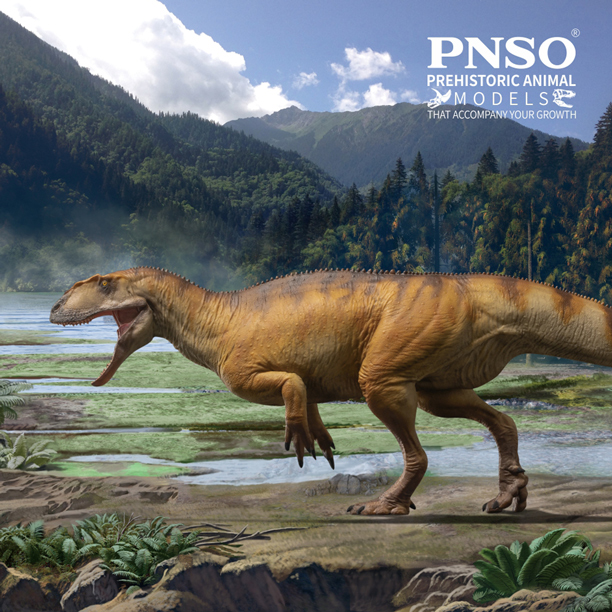
The Yangchuanosaurus dinosaur model (Dapeng) from PNSO.
Two PNSO Yangchuanosaurus Figures
The reviewer summed up the two PNSO Yangchuanosaurus figures stated that “Dapeng” represented the larger species Y. magnus or to put it another way the “old man” of “Dayong”.
William expressed his delight at being able to purchase this figure and commented:
“It is privilege to add this great beast to my collection.”
William concluded his Yangchuanosaurus “Dapeng” review by thanking Everything Dinosaur team members for their assistance. He highlighted the company’s excellent customer service and provided an example. Last year, William ordered a pair of PNSO Megalosaurus models, he was emailed by Everything Dinosaur just to make sure he did want the two figures. Team members were concerned in case William had ordered an extra Megalosaurus model by mistake. Once the order had been checked and verified it was despatched without delay.
Our thanks to William for his PNSO Yangchuanosaurus model review.
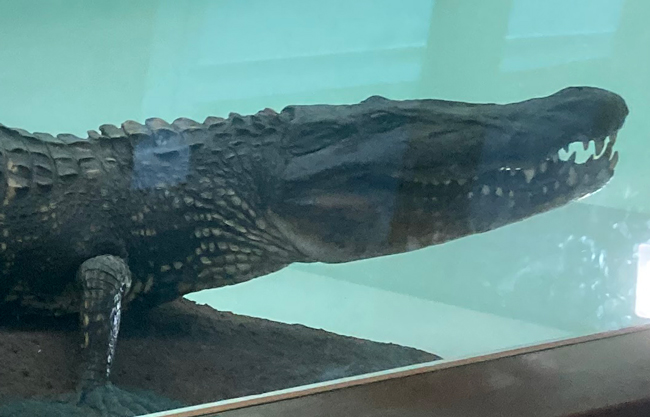
Team members at Everything Dinosaur photographed a stunning Nile crocodile specimen on display at the London Natural History Museum. The Nile crocodile (Crocodylus niloticus) is the largest freshwater predator in Africa. Males can grow up to six metres in length and weigh more than a tonne. As such, the Nile crocodile can be considered as the second-biggest extant reptile. Only the Estuarine crocodile (Crocodylus porosus) is larger.
The head of a stuffed crocodile specimen (Nile crocodile) on display at the London Natural History Museum. Picture credit: Everything Dinosaur.
Picture credit: Everything Dinosaur
The stuffed crocodile specimen measures more than three metres in length. It is part of an exhibit that highlights the diversity of vertebrates found on Earth today. It is exhibited alongside a Crocodylus niloticus skeleton.
The Nile Crocodile (Crocodylus niloticus)
Phylogenetic analysis has revealed that this African crocodile is more closely related to American crocodiles such as the Orinoco crocodile and the Cuban crocodile than it is to other African crocodile species. Several subspecies of Crocodylus niloticus have been proposed.
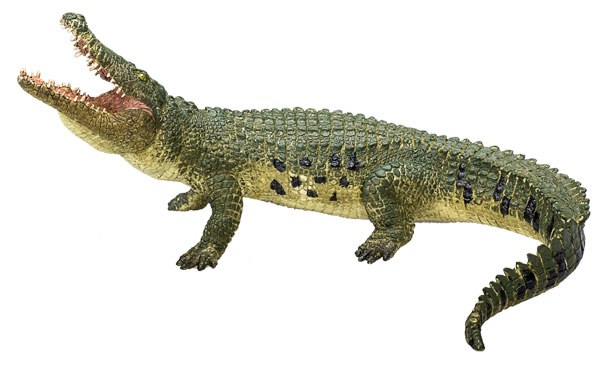
A model of a crocodile with an articulated lower jaw. The model is based on the African crocodile species Crocodylus niloticus.
The picture (above) features the Mojo Fun crocodile figure. This detailed model has an articulated jaw.
To view the range of Mojo Fun figures available from Everything Dinosaur: Mojo Fun Models.
A Man-eater
These crocodiles are estimated to kill many hundreds of people each year. The total number of attacks on humans is unknown as many attacks are unreported. Nile crocodiles tend to be much more aggressive than many other crocodilians. However, these crocodiles live in close proximity to human populations throughout most of their range. As contact is more frequent, this may explain why the number of Nile crocodile attacks remains disproportionately high. Most attacks on humans are made by crocodiles that exceed three metres in length. However, smaller crocodiles, animals less than two metres in length are capable of overpowering children.
A number of programmes are in place to help reduce the threat of crocodile attacks, by providing alternative access to water through the construction of wells and safe water gathering places. It is hoped that educating local fishermen about crocodile behaviour can reduce the risk of attack.
Commenting on the museum crocodile exhibit a spokesperson from Everything Dinosaur stated:
“The exhibit looks at the evolutionary history of vertebrates. The reptile section is particularly interesting with many stuffed specimens on display.”
Our thanks to Caldey who sent into Everything Dinosaur a festive photo of a Styracosaurus model. The figure, part of the Beasts of the Mesozoic range, is ready for the big day. Just three more sleeps until the 25th of December. Just three more blog posts to compose. The colourful, creative image certainly helps us to get ready for the festive fun.
Our thanks to Caldey who sent into Everything Dinosaur a wonderful Christmas dinosaur decorated with tinsel and bows. It is a very stylish Styracosaurus model.
Picture credit: Caldey
Beasts of the Mesozoic Styracosaurus Model
The horned dinosaur in the photograph is the Beasts of the Mesozoic Styracosaurus model.
A spokesperson from Everything Dinosaur thanked Caldey for sending in her delightful seasonal photograph and stated:
“The Styracosaurus model certainly looks very festive. It is ready for the holidays. It was a clever idea to use a Styracosaurus, the spikes on the frill are ideal for hanging tinsel and bows.”
Our thanks once again to Caldey for her stylish Styracosaurus image.
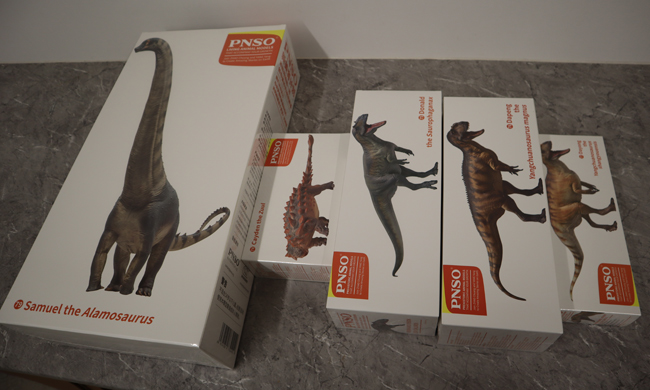
Five new PNSO dinosaur models are in stock at Everything Dinosaur. A shipment of PNSO prehistoric animal figures has arrived at our warehouse. Team members have been busy contacting customers about these five new PNSO dinosaur models.
The five new PNSO dinosaur models in stock at Everything Dinosaur. Samuel the Alamosaurus (far left), Cayden the Zuul (left), Donald the Saurophaganax (centre) and the two PNSO Yangchuanosaurus figures (right). Picture credit: Everything Dinosaur.
Picture credit: Everything Dinosaur
The image (above) shows the five new PNSO dinosaur models. The giant Alamosaurus figure is far left, next is the only ornithischian in the group, Cayden the Zuul. The new Saurophaganax figure (Donald) is in the centre. The two new Yangchuanosaurus figures (Dapeng and Dayong) are on the far right.
The five new models have been laid out in chronological order. Models of geologically older dinosaurs are on the right. The geologically youngest model, the Alamosaurus is on the far left of the photograph.
A spokesperson from Everything Dinosaur explained that as well as showing the packaging, the photograph provided an opportunity to highlight the substantial differences in the age of the dinosaurs represented by the figures.
Dapeng the Yangchuanosaurus magnus*Nomen dubium – the validity of this species has been questioned. Fossils probably date from the Middle to Late Jurassic.
Dayong the Yangchuanosaurus shangyouensis – Middle to Late Jurassic.
Donald the Saurophaganax – Late Jurassic.
Cayden the Zuul – Late Cretaceous (Campanian faunal stage).
Samuel the Alamosaurus – Late Cretaceous (Maastrichtian faunal stage).
The superb PNSO Dayong the Yangchuanosaurus is a new theropod figure in the company’s mid-size model series.
Dating the Age of Yangchuanosaurus Fossil Specimens
Several taxa have been assigned to the Yangchuanosaurus genus. The geological age of fossils ascribed to this genus is extensive. For example, some fossils ascribed to Yangchuanosaurus have been dated to the very Early Cretaceous (Berriasian faunal stage).