All about dinosaurs, fossils and prehistoric animals by Everything Dinosaur team members.

Pictures of fossils, fossil hunting trips, fossil sites and photographs relating to fossil hunting and fossil finds.

28 12, 2020

Favourite and Popular Blog Posts of 2020 (Part 2)

By |2024-01-02T06:54:20+00:00December 28th, 2020|Categories: Adobe CS5, Dinosaur and Prehistoric Animal News Stories, Dinosaur Fans, Geology, Main Page, Palaeontological articles, Photos, Photos/Pictures of Fossils, Press Releases|0 Comments

Favourite Blog Posts of 2020 (Part 2)

Everything Dinosaur team members conclude their review of their favourite blog articles of 2020 by looking at articles and news stories that were posted up between July and December.  With the best part of 180 posts to choose from selecting our favourite six for this period was quite tricky.  The ones we have selected demonstrate the broad range of topics we cover on the Everything Dinosaur weblog.

To view our earlier article about our favourite posts in the first half of the year: Favourite Blog Posts of 2020 (Part 1).

July – “Lizard Born of Fire”

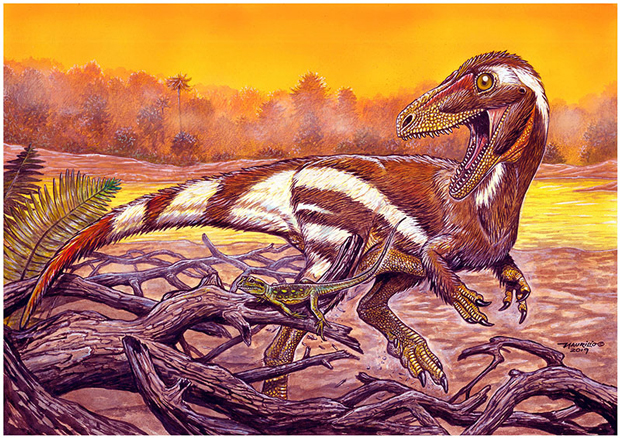
We might have been in the middle of a global pandemic but Everything Dinosaur team members kept up their blogging reporting upon tiny theropod eggs from Japan, a revision of Dilophosaurus and a number of new dinosaurs.  Our favourite post of the month concerned the scientific description of Aratasaurus museunacionali, a basal member of the Coelurosauria from Brazil.  The genus name translates as “lizard born of fire”, a reference to the terrible fire that ripped through the National Museum of Brazil where the fossil specimen was kept.

A Life Reconstruction of the Basal Member of the Coelurosauria Aratasaurus museunacionali

Aratasaurus museonacionali illustration.

Aratasaurus museonacionali life reconstruction.

Picture credit: Museu Nacional

To read more about A. museunacionaliAratasaurus museunacionali A Lizard Born of Fire.

August – Oculudentavis khaungraae Not a Stem Bird

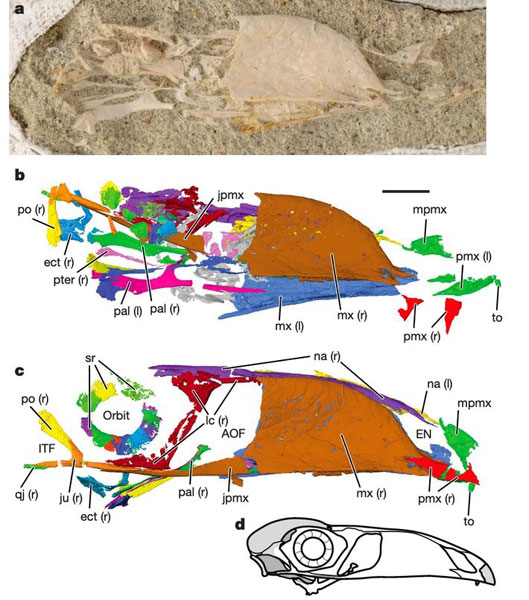
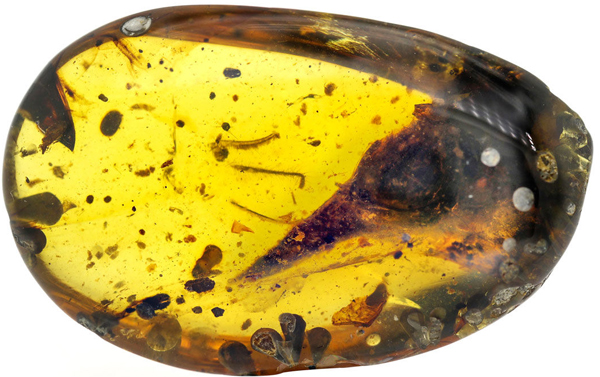
The controversy over the naming of the smallest dinosaur based on a skull preserved in amber from northern Myanmar rumbled on.  In August, a paper was published that refuted claims that the tiny skull of the animal named Oculudentavis khaungraae was that of an archosaur.  A month earlier (July 2020), the original scientific paper describing this remarkable fossil was retracted.

The Tiny Fossil Skull Preserved in Amber from Myanmar – But is it a Dinosaur?

Oculudentavis khaungraae skull in amber.

Tiny fossil skull preserved in amber (Oculudentavis khaungraae).

Picture credit: Lida Xing et al (Nature)

To read more about O. khaungraaeSmallest Dinosaur Preserved in Amber a Lizard.

September: Doctor Who Meets a Trilobite

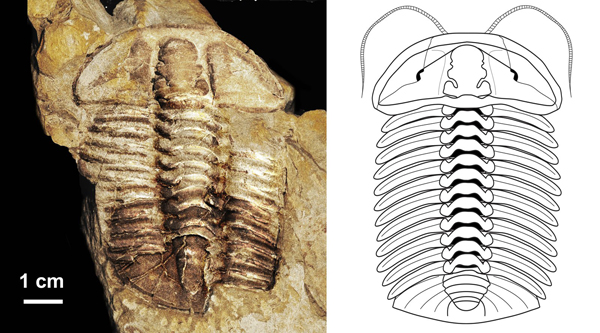
The Oxford University Museum of Natural History celebrated its 160th birthday, the Monsters of the Deep exhibition opened in the midst of the chaos caused by COVID-19 and Euparkeria got a makeover. Our favourite post of September concerned a new species of trilobite (Gravicalymene bakeri) from Tasmanian that was named after Doctor Who actor Tom Baker.

A Photograph of a Gravicalymene bakeri Trilobite Fossil with Line Drawing

Gravicalymene bakeri trilobite fossil.

Gravicalymene bakeri trilobite fossil with line drawing.

Picture credit: Australian Museum

To read more about “Doctor Who and the Trilobites”: Newly Described Species of Trilobite Named after Doctor Who Actor.

October – It’s a Dog’s Life

In October we reported on the mapping of the genome of the Scimitar-toothed cat Homotherium latidens, discussed a new species of mosasaur from Morocco and the diet of pterosaurs, but our favourite article concerned the research into ancient dog DNA.  The study suggested that the diversity observed between dogs in different parts of the world today originated when all of mankind were hunters and gatherers.

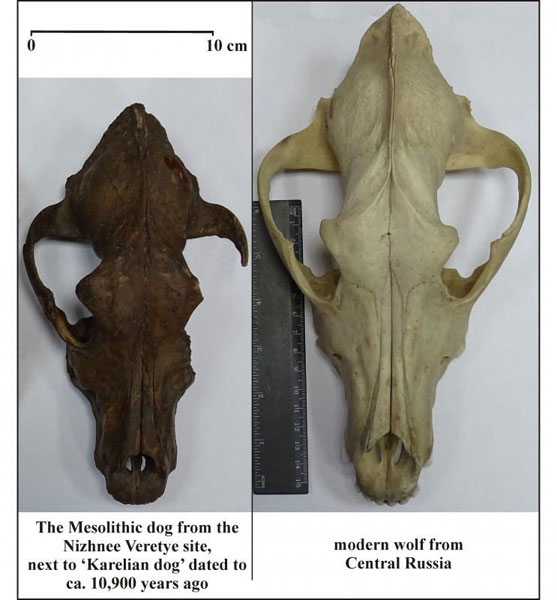
Mapping Ancient Doggy DNA

Mapping ancient dog DNA.

Mesolithic dog skull (left) compared to wolf skull (right).

Picture credit: E. E. Antipina (Institute of Archaeology of the Russian Academy of Sciences)

To read the article: DNA Study Highlights Ancient Relationship Between Humans and Dogs.

November – Dinosaurs from the Emerald Isle

In November, Everything Dinosaur celebrated publishing its 5,000 blog post, discussed Kholumolumo a dinosaur from an African rubbish dump, looked at seal evolution and got to grips with the earliest Paranthropus robustus skull described to date.

Our favourite post concerned the first dinosaur remains reported from Ireland, not just one dinosaur but two!

First Evidence of Dinosaurs from Ireland

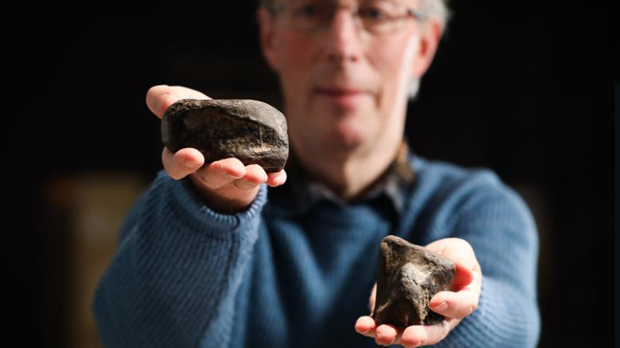
Dr Mike Simms holds the two precious fossils.

Dr Mike Simms (National Museums Northern Ireland) holds the theropod tibia on the left and the thyreophoran femur on the right.

Picture credit: The University of Portsmouth

To learn more about the Irish dinosaurs: The First Dinosaur Remains from Ireland.

For dinosaur and prehistoric animal models: Dinosaur Figures and Prehistoric Animal Models.

December – Thalassodraco etchesi Swims into View

As the year closed, in the final month of 2020 we looked at how interactive “I-books” were helping to explain archaeology, examined a very flashy new dinosaur (U. jubatus), the first sauropod dinosaur from Switzerland (Amanzia greppini) and studied Parasaurolophus pathology.

Our favourite post concerned the establishment of a new species of Late Jurassic ichthyosaur after the discovery of fossil bones by the wonderful Dr Steve Etches MBE, the founder of the amazing Etches Collection museum in Dorset.

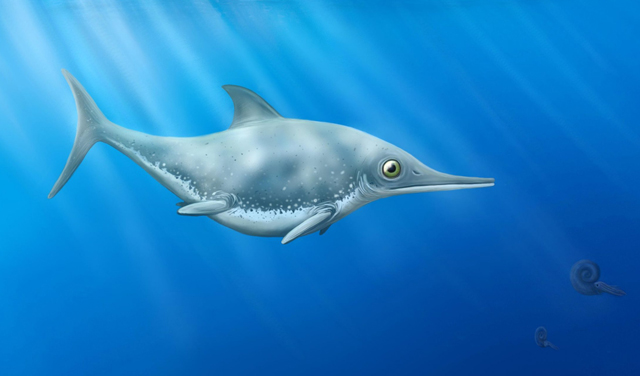
A Life Reconstruction of the Newly Described Thalassodraco etchesi

Thalassodraco etchesi life reconstruction.

A life reconstruction of the newly described Late Jurassic ichthyosaur Thalassodraco etchesi.

Picture credit: Megan Jacobs/University of Portsmouth

To read more about Thalassodraco etchesi: A New Taxon of Late Jurassic Ichthyosaur is Described.

This concludes our review of the blog posts that we have researched and written up over the last twelve months.  Which one is your favourite?

Hopefully, this is your favourite dinosaur website: Everything Dinosaur.

27 12, 2020

Favourite and Popular Blog Posts of 2020 (Part 1)

By |2024-01-02T06:54:49+00:00December 27th, 2020|Categories: Adobe CS5, Dinosaur and Prehistoric Animal News Stories, Dinosaur Fans, Geology, Main Page, Palaeontological articles, Photos, Photos/Pictures of Fossils, Press Releases|0 Comments

Favourite Blog Posts of 2020 (Part 1)

At Everything Dinosaur, we try and post up an article on this blog site every single day.  This can be quite a challenge considering all our other activities and projects.  However, as a result of our work on this weblog we have managed to compile a huge amount of information, articles and features chronicling (for the most part), advances in the Earth sciences and new fossil discoveries along with research into the Dinosauria.

This year, Everything Dinosaur’s blog has passed the 5,000 articles benchmark.  Here is a selection of our own favourite news stories that we have covered in the first six months of 2020 (January to June).

January – A New Allosaurus Taxon

In January, a new species of North American Allosaurus was added to the pantheon of dinosaurs known from the famous Morrison Formation of the western United States.  Allosaurus jimmadseni honours the sadly departed James H. Madsen Jr. Utah’s inaugural state palaeontologist.  The famous Allosaurus specimen MOR 693 “Big Al” was reassigned to this new species.

A Pack of Allosaurus (A. jimmadseni) Attack a Luckless Juvenile Sauropod

Allosaurus jimmadseni a new Allosaurus taxon is described.

A pack of allosaurs (A. jimmadseni) attacking a juvenile sauropod.

Picture credit: Todd Marshall

The January Allosaurus article: A New Species of Allosaurus.

February – The “Father of Argentinian Palaeontology” – José Bonaparte

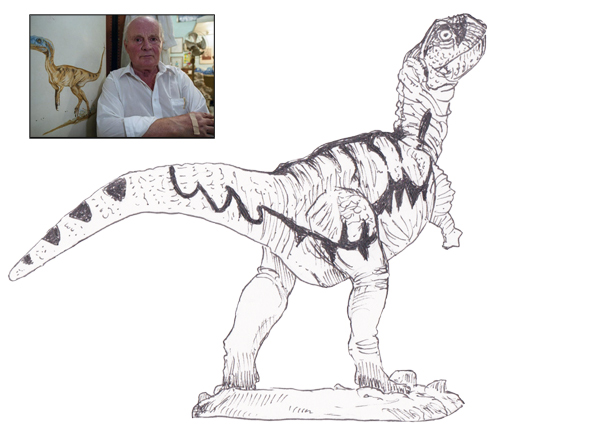
On the 18th February José Bonaparte, regarded by many as the most influential vertebrate palaeontologist of the 20th century passed away.  Respected and admired, José helped to develop and train a whole new generation of Earth scientists.  He was also responsible for naming and describing a large number of new dinosaurs including Abelisaurus, hence our illustration of that South American theropod (below).

José Bonaparte and a Drawing of One of the Many Dinosaurs He Named and Described (Abelisaurus comahuensis)

Lamenting the death of José Bonaparte (February 2020).

José Bonaparte (inset) and a drawing of one of the dinosaurs he named in his long and distinguished career Abelisaurus (A. comahuensis).

Picture credit: Télam/Everything Dinosaur

To read more about José Bonaparte: José Bonaparte – The Founding Father of Palaeontology in Argentina.

March – Telling the Time Back in the Cretaceous

As the COVID-19 pandemic took hold, team members at Everything Dinosaur were distracted by some remarkable research undertaken by scientists from the University of Ghent and the Vrije Universiteit Brussel.

A study of the growth rings preserved on the fossilised shells of Cretaceous bivalves permitted the researchers to calculate that 70 million years ago, the day length was approximately thirty minutes shorter and a year on Earth was around a week longer than it is today.

To read this article: Telling the Time Back in the Cretaceous.

April – Homo erectus at Home in Africa

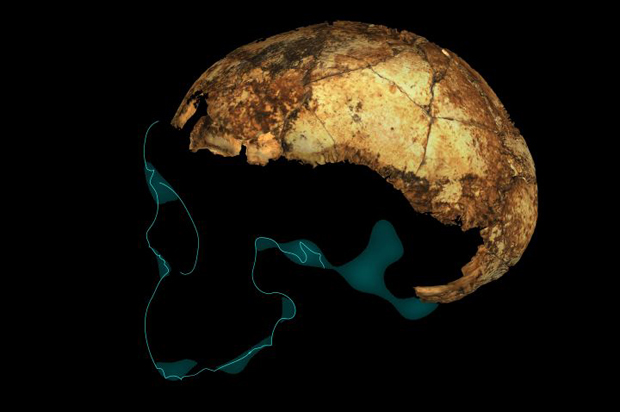
The remarkable Drimolen fossil hominin site in South Africa, provided palaeoanthropologists with likely confirmation that the hominin H. erectus did indeed evolve in Africa and not Asia.  A carefully and painstakingly reconstructed fossil skull (DNH 134), found in this area – regarded as the “Cradle of Humankind”, suggests that Homo erectus existed some 100,000 to 200,000 years earlier than previously realised.

We still have a lot to learn about our own evolution.

Homo erectus Evolved in Africa

Partial H. erectus cranium from the Drimolen Fossil Hominin site.

The partial H. erectus cranium from the Drimolen Fossil Hominin site.

Picture credit: La Trobe University (Australia)

To learn more about the origins of Homo erectusH. erectus Originated in Africa.

May – Lots of Pterosaurs

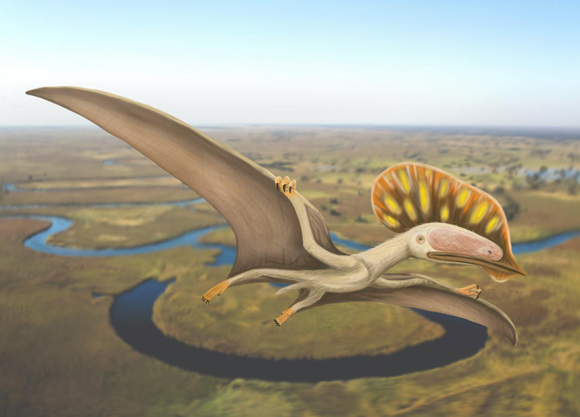
A jawbone found on the Isle of Wight was identified as a new species of tapejarid pterosaur.  The flying reptile, named Wightia declivirostris which translates as “slanting beak from the Isle of Wight” was one of several new pterosaur species described in 2020.

A Life Reconstruction of the Early Cretaceous Pterosaur Wightia declivirostris

Wightia declivirostris from the Isle of Wight

A life reconstruction of the newly described tapejarid from the Lower Cretaceous of the Isle of Wight (Wightia declivirostris).

Picture credit: Megan Jacobs (University of Portsmouth)

To read more about Wightia declivirostrisA New Terrific Tapejarid.

We have a lot more to learn about the Pterosauria too.

For models and replicas of pterosaurs and other prehistoric animals: Wild Safari Prehistoric World Figures.

June – Fossilised Stick – Provides a Surprise

A fossil discovered more than fifty years ago and regarded as little more than a “fossilised stick” has proved to be a new species of Late Devonian plant and it will help scientists to better understand the flora of the ancient landmass of Gondwana.

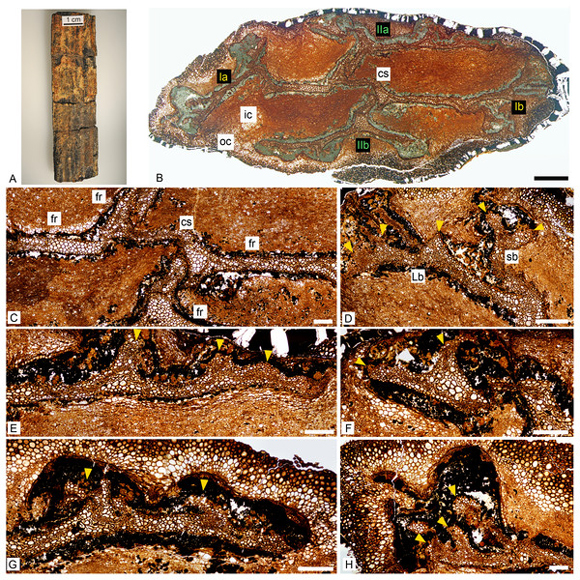
The specimen was found by amateur geologist John Irving whilst exploring the banks of the Manilla River in Barraba (New South Wales, Australia).  A study in the open-access journal PeerJ identifies the newly named Keraphyton mawsoniae and proposes that it has a similar structure to primitive horsetails and ferns.  The fossil which looks so unremarkable on the outside, once studied in cross-section, has provided a unique window into the plant life on Earth around 360 million years ago.

Not Much to Look at on the Outside but Inside a Treasure Trove of Information for Palaeobotanists

Keraphyton mawsoniae fossil.

The newly described Keraphyton mawsoniae a fern-like land plant from the Late Devonian of Australia.

Picture credit: Champreux et al (PeerJ)

To read more about K. mawsoniaeFossil Stick Proves to be New Species of Ancient Plant.

This selection represents some of our favourite blog posts from the first six months of 2020, which one is your favourite post?

We will conclude this review of the news stories we have covered on this blog in part 2.

In the meantime, visit the Everything Dinosaur website: Everything Dinosaur.
15 12, 2020

One Very Flashy New Dinosaur – Ubirajara jubatus

By |2023-10-28T18:02:25+01:00December 15th, 2020|Categories: Dinosaur and Prehistoric Animal News Stories, Dinosaur Fans, Main Page, Palaeontological articles, Photos/Pictures of Fossils|3 Comments

Ubirajara jubatus – One Very Flashy Dinosaur

A new genus of feathered dinosaur Ubirajara jubatus has been described.

News about the discovery of a species of feathered dinosaur has now become relatively commonplace.  Yet, it is worth remembering that it was just twenty-four years ago, back in 1996, that the first, non-avian dinosaur species with evidence of fuzzy feathers was described.  Named Sinosauropteryx this lithe meat-eater literally “rocked” scientists as the long-awaited proof of feathered dinosaurs was revealed to the world.  Sinosauropteryx was a compsognathid, a team of researchers, including scientists from the University of Portsmouth have described another feathered dinosaur, this new feathered theropod is a compsognathid too, but with a more elaborate and spectacular integumentary covering.

Ubirajara jubatus

The newly described Ubirajara jubatus is the first Gondwanan non-avian theropod with preserved filamentous integumentary structures.  It is also the first non-maniraptoran possessing elaborate integumentary structures that were most likely used for display.

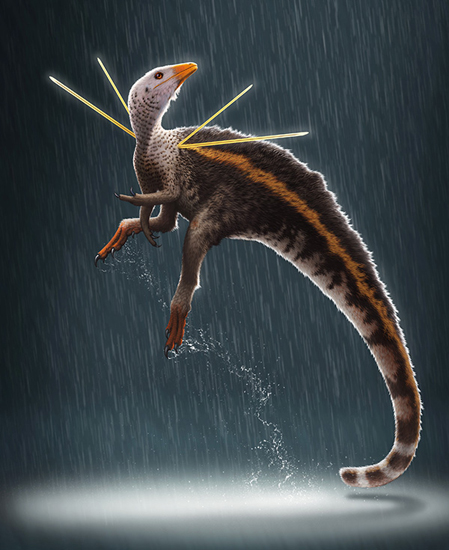
A Life Reconstruction of the Newly Described Brazilian Compsognathid Ubirajara jubatus

Ubirajara jubatus life reconstruction.
Ubirajara jubatus life reconstruction by the very talented palaeoartist Bob Nicholls.

Picture credit: Bob Nicholls/Paleocreations

Dressed to Impress

Described as the most elaborately dressed-to-impress dinosaur described to date, the research team co-led by Professor David Martill and researcher Robert Smyth (University of Portsmouth), propose that U. jubatus will shed new light on how birds evolved elaborate display structures.

This chicken-sized dinosaur possessed a mane of long bristles running down its back and stiff ribbons projecting out and back from its shoulders, a combination of features never seen before in the fossil record.

The scientific paper has been published in the journal of Cretaceous research and involved a collaboration between the University of Portsmouth and the appropriately named Professor Dino Frey at the State Museum of Natural History, Karlsruhe, Germany, who discovered the new species while examining fossils in Karlsruhe´s collection and Héctor E. Rivera-Sylva of the Departamento de Paleontología, Museo del Desierto in Saltillo, Mexico.  The fossil was authorised by the Brazilian authorities for export some time ago, but was only recently studied.

Bizarre Integumentary Structures

The bizarre integumentary structures must have had a purpose, whilst the body covering may have originally evolved to provide insulation, the stiff ribbons on either side of the shoulders were probably used for display, perhaps to attract a mate, deter a rival or to frighten a potential predator.

Professor Martill commented:

“We cannot prove that the specimen is a male, but given the disparity between male and female birds, it appears likely the specimen was a male, and young, too, which is surprising given most complex display abilities are reserved for mature adult males.  Given its flamboyance, we can imagine that the dinosaur may have indulged in elaborate dancing to show off its display structures.”

Not Scales or Fur

The ribbons are not fur or scales, they are not feathers in the modern sense, as seen on an extant bird.  They appear to be structures unique to this animal.

Mr Smyth added:

“These are such extravagant features for such a small animal and not at all what we would predict if we only had the skeleton preserved.  Why adorn yourself in a way that makes you more obvious to both your prey and to potential predators?  The truth is that for many animals, evolutionary success is about more than just surviving, you also have to look good if you want to pass your genes on to the next generation.”

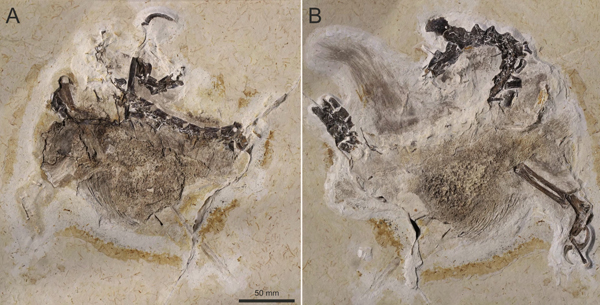
The Holotype of Ubirajara jubatus Preserved as a Slab and Counter Slab

Holotype of Ubirajara jubatus preserved as slab and counter slab.
The holotype of Ubirajara jubatus preserved as slab and counter slab.  Note scale bar = 50 mm.

Picture credit: Smyth et al /Cretaceous Research

From the Lower Cretaceous (Aptian) Crato Formation of North-eastern Brazil

Fossil discoveries starting with the ground-breaking Sinosauropteryx specimen that was described in 1996 have fundamentally changed our understanding of the phylogenetic relationships between birds and dinosaurs as well as the origin and evolution of feathers.  A variety of elaborate integumentary coverings and structures are now known from the Theropoda and from ornithischian dinosaurs too.  They have been linked to behaviours including egg incubation, mating displays and thermoregulation.

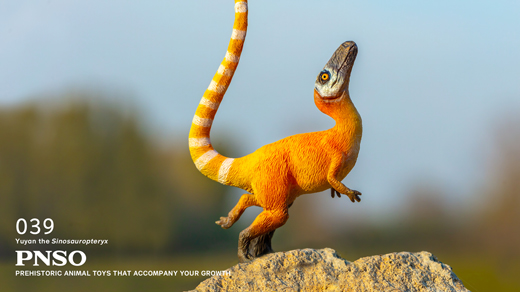
The Colourful PNSO Model of the Chinese Compsognathid Sinosauropteryx

PNSO Sinosauropteryx dinosaur model.
PNSO Yuyan the Sinosauropteryx dinosaur model.  The PNSO model of the compsognathid Sinosauropteryx.

The picture (above) shows a PNSO Sinosauropteryx dinosaur model.

To view the range of PNSO models and figures: PNSO Age of Dinosaurs Models.

Within the Theropoda, such features have only been previously recorded within the Maniraptoriformes, a theropod clade which includes birds and is defined as “the most recent common ancestor of the ostrich mimic Ornithomimus and Aves (birds) and all descendants of that common ancestor.”

The majority of theropods preserving integumental structures come from the Upper Jurassic and Lower Cretaceous of China or the Upper Jurassic of southern Germany and all are of Laurasian origin.  Ubirajara jubatus from the Lower Cretaceous (Aptian) Crato Formation of north-eastern Brazil, is the first non-maniraptoran possessing elaborate integumentary structures that were most likely used for display.

Ubirajara jubatus the First Non-avian Theropod with Preserved Filamentous Structures

It is also the first non-avian theropod with preserved filamentous integumentary structures to have been described from the southern hemisphere landmass of Gondwana.

The researchers compare Ubirajara to living birds stating that many modern Aves are famed for their exotic and colourful plumage along with their complex displays that are used to win mates.  Male peacocks with their stunning tails and male birds of paradise are examples of this.

Ubirajara jubatus (pronounce You-bi-rah-jar-rah jew-bay-tus), lived approximately 110 million years ago (Aptian faunal stage of the Early Cretaceous).  The genus name is derived from the local Tupi dialect and translates as “lord of the spear”, whilst the trivial or specific name is from the Latin for “mane” a reference to the integumentary covering on its back.

Able to Raise its Hackles Like a Dog?

The mane running down its back is thought to have been controlled by muscles allowing it to be raised, in a similar way a dog raises its hackles or a porcupine raises its spines when facing a threat. Once the danger had passed, Ubirajara could lower its mane close to the skin allowing this little dinosaur to move quickly through the undergrowth without getting tangled up.

Professor Martill explained:

“Any creature with movable hair or feathers as a body coverage has a great advantage in streamlining the body contour for faster hunts or escapes but also to capture or release heat.”

The unique body plan of Ubirajara with its long, flat, stiff shoulder ribbons of keratin, each with a small sharp ridge running along the middle, described by the authors as “enigmatic” might have looked cumbersome, but in reality they were located on the body in such a way as not to impede movement allowing Ubirajara to preen, hunt, move around and display unencumbered.

The scientific paper: The scientific paper: “A maned theropod dinosaur from Gondwana with elaborate integumentary structures” by Robert S. H. Smyth, David M. Martill, Eberhard Frey, Héctor E. Rivera-Sylva and Norbert Lenz published in Cretaceous Research.  This paper was withdrawn in July 2022.

Visit the Everything Dinosaur website: Everything Dinosaur.com

7 12, 2020

Two New South American Titanosaurians

By |2024-05-12T09:31:15+01:00December 7th, 2020|Categories: Dinosaur and Prehistoric Animal News Stories, Dinosaur Fans, Main Page, Palaeontological articles, Photos/Pictures of Fossils|0 Comments

Two New South American Titanosaurians

The last type of sauropod to have lived were the Titanosauria, a clade consisting of a variety of taxa that were geographically widespread.  Fossils of titanosaurs have been found on every continent.  These long-necked herbivores seem to have been particularly successful in South America, with some of the largest tetrapods of all time – Argentinosaurus, Patagotitan and Dreadnoughtus known from this continent.

A team of scientists based in Argentina recently published a paper describing two new South American titanosaurs from the province of La Rioja located in the north-west of that country.  The dinosaurs named Punatitan coughlini and Bravasaurus arrierosorum, help to fill a gap between the types of titanosaurs associated with Patagonia and south-western Brazil, the two main locations associated with Titanosauria fossil discoveries from South America.

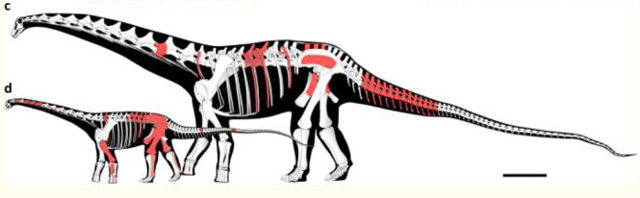
Skeletal Drawings Punatitan coughlini (c) and (d) Bravasaurus arrierosorum

Punatitan coughlini (c) and (d) Bravasaurus arrierosorum. Fossil material shown in red. Scale bar = 1 metre.
Punatitan coughlini (c) and (d) Bravasaurus arrierosorum.  Known fossil material shown in red. Scale bar = 1 metre.

Picture credit: Hechenleitner et al (Communications Biology)

Dinosaurs from the Andes – Titanosaurs Demonstrate Philopatry

The fossil material representing three individuals was found in the Upper Cretaceous red beds of the Quebrada de Santo Domingo locality in the Andes of La Rioja province.  In addition, a large number of titanosaurian egg clutches and eggshells were recovered.  Such was the abundance of eggshell found that this location is regarded as one the largest dinosaur nesting sites known in the world.  These fossils help to support the theory that these types of dinosaurs returned to the same, favoured nesting area year after year, the titanosaurs demonstrated philopatry (the tendency of an organism to habitually return to the same location, usually to breed or to nest).

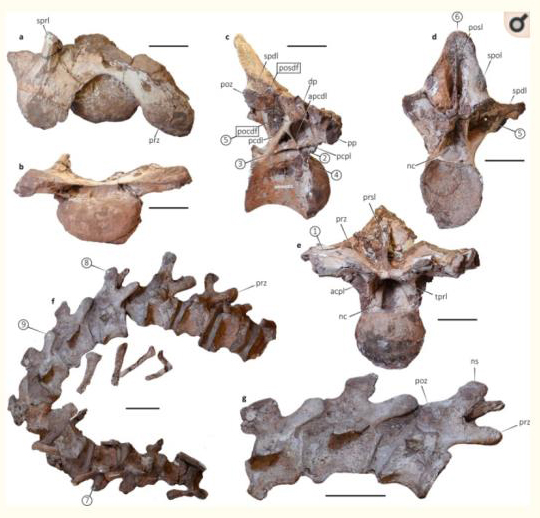
Cervical and dorsal vertebrae of Punatitan coughlini

Cervical and dorsal vertebrae of the recently described titanosaur Punatitan coughlini.
Cervical and dorsal vertebrae of Punatitan coughlini.

Picture credit: Hechenleitner et al (Communications Biology)

Limb Bones Associated with Bravasaurus arrierosorum

Limb bones of Bravasaurus arrierosorum.
Limb elements of Bravasaurus arrierosorum.

Picture credit: Hechenleitner et al (Communications Biology)

Titanosauria Phylogenetic Analysis

A phylogenetic analysis undertaken by the research team suggests that both Bravasaurus and the much larger Punatitan have affinities with both Patagonian and Brazilian titanosaurs.  The discovery of these two genera, both classified within the sub-clade of the Rinconsauria, supports the hypothesis of a close relationship between titanosaurian faunas in South America during the Late Cretaceous.

Titanosaur Palaeogeographical Distribution and Phylogeny

Titanosaur phylogeny and palaeogeographical distribution.
Titanosaur palaeogeographical distribution and phylogeny plotted against temporal distribution.  Both Punatitan and Bravasaurus have been assigned to the sub-clade Rinconsauria and they show a link between southern and northern populations of South American titanosaurs.

Picture credit: Hechenleitner et al (Communications Biology)

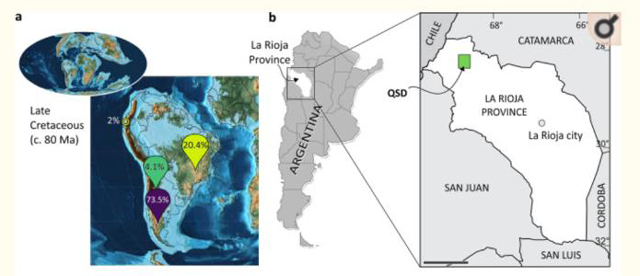
The Site of the Fossil Discoveries and Plotting the Location of Titanosaurs in South America

Percentage diversity of Cretaceous titanosaurian sauropods.
Percentage diversity of Cretaceous titanosaurian sauropods in three main regions of South America: Patagonia (purple), north-western Argentina (green), and south-west Brazil (yellow).  The yellow ring corresponds to the record of the saltasaurid titanosaurian Yamanasaurus in Ecuador.  Location of the discoveries in La Rioja Province are shown in (b) and (c).

Picture credit: Hechenleitner et al (Communications Biology)

The scientific paper: “Two Late Cretaceous sauropods reveal titanosaurian dispersal across South America” by E. Martín Hechenleitner, Léa Leuzinger, Agustín G. Martinelli, Sebastián Rocher, Lucas E. Fiorelli, Jeremías R. A. Taborda, and Leonardo Salgado published in Communications Biology.

Visit the Everything Dinosaur website: Everything Dinosaur.
5 12, 2020

A New Tyrannosauroid from Northern China

By |2024-05-12T09:05:15+01:00December 5th, 2020|Categories: Dinosaur and Prehistoric Animal News Stories, Dinosaur Fans, Main Page, Photos/Pictures of Fossils|0 Comments

A New Tyrannosauroid from Northern China – Jinbeisaurus wangi

Over the last two years or so, there have been a number of exciting dinosaur discoveries.  Some amazing dinosaur fossils have been found and scientifically described, but sometimes mere scraps of bone, just fragmentary remains can be enough to set the pulses of vertebrate palaeontologists racing.  Take for example, the new genus of Late Cretaceous tyrannosaur from northern China that was formally described back in April.  At around 5-6 metres in length Jinbeisaurus wangi, may not be the largest carnivorous dinosaur known from Upper Cretaceous deposits from Asia, but it does represent the first theropod to be described from the Chinese province of Shanxi.

Jinbeisaurus wangi

An initial assessment led to the jaw bones, partial pubis (bone from the hip) and incomplete dorsal and cervical vertebrae, being assigned to the Tarbosaurus genus, but unique characteristics associated with the shape and proportion of the maxilla led to erection of a new species.

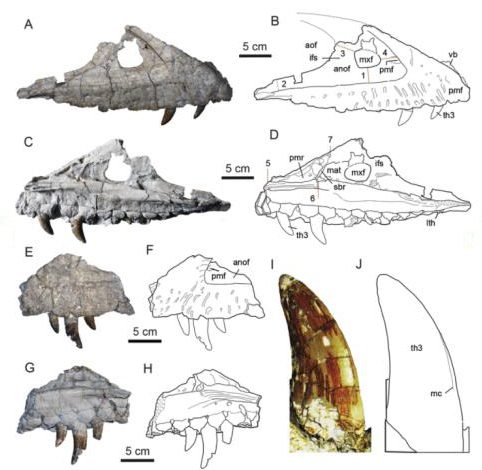
The Genus Has Been Erected Based on Autapomorphies Identified in the Jaws

Views of the maxillae of J. wangi.

Views of J. wangi maxillae and accompanying line drawings.  The photograph (above) shows photographs of the upper jaw bones (maxillae), plus a close-up view of a single tooth.

Picture credit: Xiao-Chun Wu et al (Cretaceous Research)

Not a Juvenile Tarbosaurus

The scientific paper describing Jinbeisaurus (pronounced jin-bay-sore-us), was published in late 2019 in the journal “Cretaceous Research”, although it had originally been submitted in the spring, only to be revised before final publication.  When the fossil material was found near the city of Yangjiayao, Tianzhen County, Shanxi Province, in northern China, it was suggested that the bones could represent a juvenile Tarbosaurus.  This new dinosaur, J. wangi adds to the known diversity of tyrannosauroids in Asia and represents the first theropod to have been discovered in Shanxi Province, although isolated teeth representing carnivorous dinosaurs are known from the area.

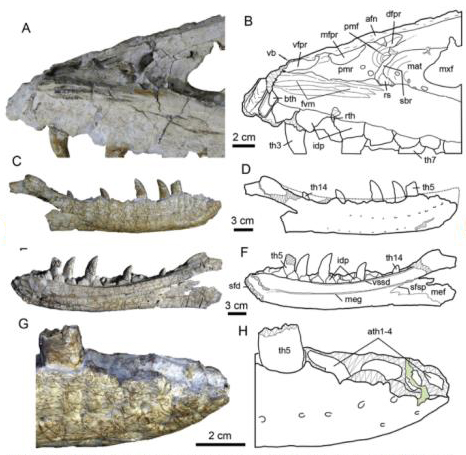
Views of the Upper and Lower Jaw Bones of J. wangi

Views of the upper and lower Jaw of J. wangi with accompanying line drawings.

Views of the upper and lower Jaw of J. wangi with accompanying line drawings.

Picture credit: Xiao-Chun Wu et al (Cretaceous Research)

Estimated to have measured around 5-6 metres long, Jinbeisaurus wangi is regarded as more derived than Suskityrannus (S. hazelae) a tyrannosauroid from New Mexico named earlier in 2019.

To read Everything Dinosaur’s post about Suskityrannus: Getting a Glimpse of a Late Cretaceous Tyrannosauroid.

The scientific paper: “A new tyrannosauroid from the Upper Cretaceous of Shanxi, China” by Xiao-Chun Wu, Jian-Ru Shi, Li-Yang Dong, Thomas D. Carr, Jian Yi and Shi-Chao Xu published in Cretaceous Research.

Visit the Everything Dinosaur website: Dinosaur Toys and Models.

4 12, 2020

The Amazing Atopodentatus unicus for Fossil Friday

By |2024-05-12T09:26:06+01:00December 4th, 2020|Categories: Adobe CS5, Dinosaur Fans, Everything Dinosaur News and Updates, Everything Dinosaur Products, Main Page, Photos of Everything Dinosaur Products, Photos/Pictures of Fossils|0 Comments

Atopodentatus unicus for Fossil Friday

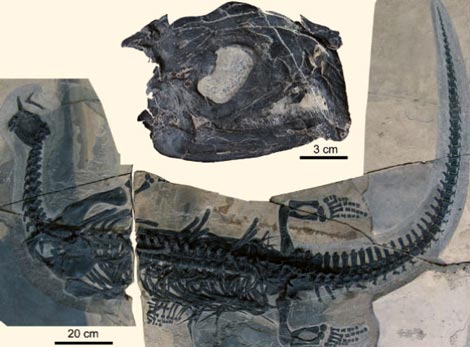
Aware of the hastag “#FossilFriday”, it seems appropriate that we should post up a picture of a fossil on Friday, as we approach the busiest time of year for the packing and despatching of models and figures that have been inspired by the fossil record.  Team members at Everything Dinosaur have chosen to post up a photograph of the bizarre, marine reptile, known from the Middle Triassic of south-western China called Atopodentatus.  It seems appropriate that with all the amazing fossils that are in museum collections around the world, we should post a photograph of one of the strangest Mesozoic vertebrates known to science.

The Fossilised Remains of Atopodentatus unicus

Atopodentatus fossils.
Bizarre Triassic marine reptile!   The beautifully preserved and articulated remains of Atopodentatus unicus from Yunnan Province in south-western China.  Note the close-up view of the strange skull and jaws, that were originally interpretated as being a zipper-like feeding apparatus.  Further fossil discoveries made two years after the initial description of this marine reptile, revealed that Atopodentatus had jaws shaped like a hammerhead.

Picture credit: Long Cheng/Wuhan Institute of Geology and Mineral Resources

Note

Scale bar in main photograph equals 20 centimetres, scale bar for close-up of skull equals 3 centimetres.

Named in 2014 (Long Cheng et al), Atopodentatus had jaws shaped like a hammerhead, superficially similar to that seen in an extant Hammerhead shark.  Unlike the shark, Atopodentatus is believed to have been herbivorous.  It used its comb-like teeth to rasp away at rocks, feeding on algae and seaweed.

When the scientific paper was published, it was noted that Atopodentatus represents the oldest known record of herbivory within marine reptiles.

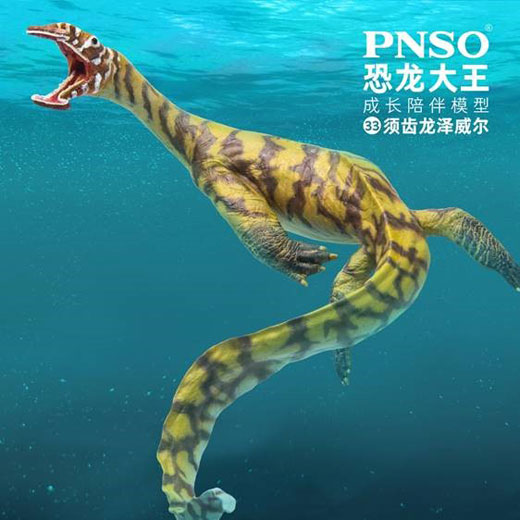
Chinese model and figure manufacturers PNSO will be introducing a mid-size replica of this strange animal.  This figure will be in stock at Everything Dinosaur in a few weeks (estimated to be in stock by the end of December 2020).  It is great to see PNSO adding a second replica of the bizarre Atopodentatus to their model range.

PNSO Have Made Another Model of the Strange Chinese Marine Reptile Atopodentatus (A. unicus)

PNSO Zewail the Atopodentatus model.
PNSO Zewail the Atopodentatus marine reptile model.  This figure, along with numerous other PNSO mid-size models will be in stock at Everything Dinosaur very soon (late December 2020).  The model displays that unique jaw structure which is unknown in any other reptile.

It therefore seems appropriate to post up pictures of the Middle Triassic record-breaker Atopodentatus unicus for Fossil Friday.

To view the range of PNSO prehistoric animal models and figures in stock at Everything Dinosaur: PNSO Age of Dinosaurs Models and Figures.

The user-friendly Everything Dinosaur website: Dinosaur Models and Toys.

2 12, 2020

The Pathology of an Iconic Parasaurolophus

By |2023-11-20T07:19:43+00:00December 2nd, 2020|Categories: Adobe CS5, Dinosaur and Prehistoric Animal News Stories, Dinosaur Fans, Main Page, Photos/Pictures of Fossils|1 Comment

An Unlucky Parasaurolophus – ROM 768

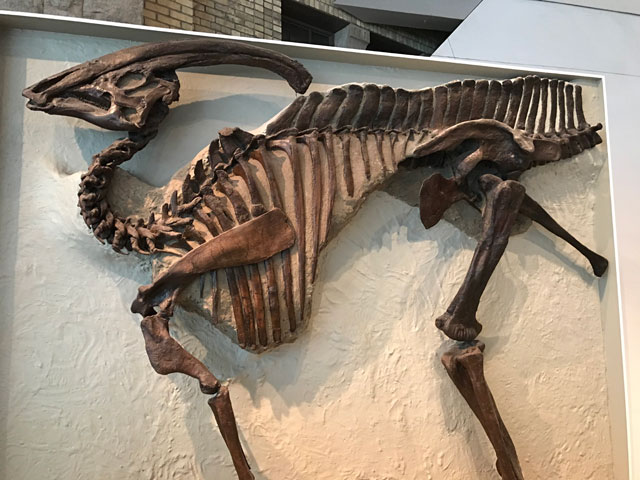
A study of the holotype of the iconic duck-billed dinosaur Parasaurolophus (P.walkeri) has revealed that some of these dinosaurs led very tough lives.  Tell-tale evidence preserved in the fossilised bones suggest that this particular specimen ROM 768, suffered a major trauma, but survived, at least for a little while after the incident.

PhD student Filippo Bertozzo from the School of Natural and Built Environment at Queen’s University Belfast, examined the skeleton of the Parasaurolophus which has been on display at the Royal Ontario Museum (Canada).  The articulated specimen (ROM 768), represents the almost complete remains of an adult animal, only elements from the lower limbs and the tail are missing.

The fossils were discovered in 1920 in Upper Cretaceous sediments exposed along the Red Deer River of southern Alberta.  The material represents the first fossils of the genus Parasaurolophus to be reported and studied.

The Iconic Parasaurolophus Skeleton on Display at the Royal Ontario Museum (ROM 768)

Parasaurolophus skeleton (P. walkeri) on display
The holotype Parasaurolophus skeleton (ROM 768) on display at the Royal Ontario Museum (Canada).

Picture credit: Queen’s University Belfast

Parasaurolophus – Injured by a Falling Tree

The morphology of the dinosaur’s neck had long intrigued scientists and scientific illustrators.  Once thought to have a graceful, swan-like neck most palaeontologists now think that Parasaurolophus had a thick, bulky neck, one capable of supporting that huge, hollow crest for which this dinosaur is famous for.

Student Filippo explained:

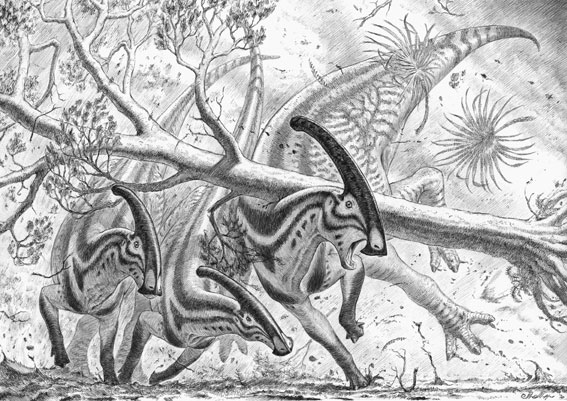
“Our research using paleopathological markers, which help us study the diseases of ancient humans and fossil animals, means we are now fairly certain how this iconic dinosaur would have really looked.  The ROM 768 suffered numerous injuries which suggest a major incident of trauma before its death and we think a heavy object such as a tree may have fallen on top of the animal, perhaps during a storm.”

A Dramatic Incident for One Particular Dinosaur

Traumatic accident for a Parasaurolophus.
Is this how a Parasaurolophus got an injured neck?

Picture credit: Supplied by Queen’s University Belfast

Reconstructing the Neck of an Ornithischian Dinosaur

The research has shown that members of the Ornithopoda, including duck-billed dinosaurs, iguanodonts and other related genera were prone to a number of injuries and diseases.

Commenting on ROM 768, the PhD student added:

“Damage to the muscles resulted in a disc-shaped overgrowth on the tip on the bony part of one its vertebrae in its neck.  We interpreted the disc as a secondary enlargement of the base of the nuchal ligament, a large elastic structure that supports the neck and the head.  This enabled us to reconstruct the anatomical structure of the neck, revealing that it was strong and muscular to support its head.”

The study of the iconic Parasaurolophus specimen revealed broken bones in the pelvis, ribs and spine.  The scientists also found evidence of a lesion in the mouth that may have been caused as a result of a heavy object falling on the animal.

The injuries show signs of healing, demonstrating how tough and resilient these types of dinosaurs were.  The Parasaurolophus (ROM 768), survived for several months or perhaps some years after the traumatic event.

Professor Eileen Murphy, a bioarchaeologist in Queen’s, stated:

Palaeopathology has been a relatively neglected aspect of palaeontology until recent years.  The study of ROM 768 clearly demonstrates the value of this approach for reconstructing the quality of life of dinosaurs and the threats from the natural environment they may have faced on a daily basis.”

Everything Dinosaur acknowledges the assistance of a media release from Queen’s University Belfast in the compilation of this article.

Visit the Everything Dinosaur website: Everything Dinosaur.
1 12, 2020

The First Sauropod from Switzerland

By |2023-10-30T13:36:02+00:00December 1st, 2020|Categories: Dinosaur and Prehistoric Animal News Stories, Dinosaur Fans, Geology, Main Page, Palaeontological articles, Photos/Pictures of Fossils|0 Comments

Amanzia greppini – The First Sauropod Described From Switzerland

Badly distorted and disarticulated dinosaur bones found in the 1860s in north-western Switzerland have led to the establishment of a new genus of European sauropod.  Amanzia greppini, described from an assortment of fragmentary fossil material, representing four individuals is the first sauropod to be described from fossil remains found in Switzerland.  The fossils come from Upper Jurassic strata which form part of the Reuchenette Formation, they were discovered in a limestone quarry in the Basse Montagne, near the city of Moutier.

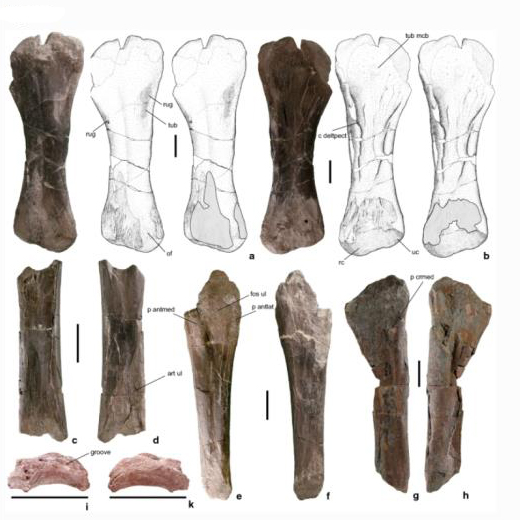
Limb Bones of Amazia greppini from the Late Jurassic of Switzerland

Forelimb bones associated with Amanzia greppini and interpretative drawings.
Forelimb bones associated with Amanzia greppini and interpretative drawings. Right humerus in (a) posterior and (b) anterior view with line drawings showing preserved cartilage outlined in grey.  Left radius in (c) anterior and (d) posterior view.  Left ulna in anterior view (e) and posterior view (f).  Right ulna in anterior view (g) and anterior view (h).  Views of an ungual phalanx.  Note scale bar = 5 cm.

Picture credit: Schwarz et al (Swiss Journal of Geosciences)

The bones had been sold to a private collector, but the Swiss geologist Jean-Baptiste Greppin was notified of the find and identified the assortment of distorted and crushed bones as the remains of dinosaurs. In the early 20th century these remains were associated with the English sauropod Cetiosauriscus stewarti known from fossils found in Cambridgeshire.  However, an extensive review of the Swiss fossil material conducted by Daniela Schwarz (Museum für Naturkunde, Berlin) and co-workers resulted in a new genus being erected earlier this year.

Kimmeridgian versus Callovian

The researchers who re-visited the Swiss sauropod remains identified a number of unique autapomorphies (distinctive traits) to distinguish their fossils from those of C. stewarti.  In addition, the Swiss dinosaur was much smaller, with an estimated maximum length of around ten metres compared to the proposed fifteen metres for Cetiosauriscus.  The scientists, which included Philip Mannion (University College London), Oliver Wings (University Halle-Wittenberg in Germany) and Christian Meyer (University of Basel), found differences in the caudal vertebrae (tail bones) as well as difference in the shape and proportions of the femur, humerus and coracoid.

A discrepancy in the geological age between C. stewarti and the Swiss fossil material was also noted.  Fossils of Cetiosauriscus stewarti come from strata associated with the Callovian faunal of the Middle Jurassic, whilst the fossils of Amanzia greppini come from geologically younger deposits laid down during the Kimmeridgian faunal stage (Late Jurassic).

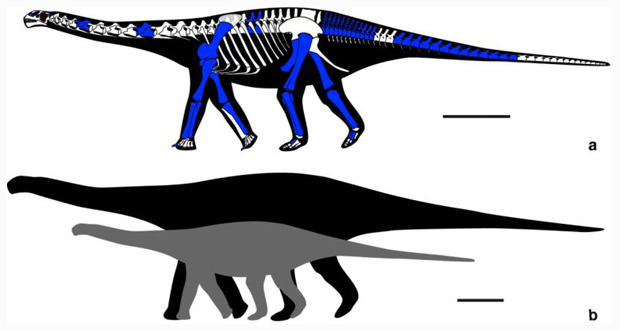
Skeletal Reconstruction of Amanzia greppini and Size Comparison with the Geologically Older Cetiosauriscus stewarti

Amanzia skeletal drawing and size comparison with Cetiosauriscus stewarti.
Skeletal reconstruction of A. greppini.  Known fossil elements shown in blue.  As much information is missing from the incomplete skeletal material, the dorsal vertebrae, the proportions and morphology of the cervical vertebrae and the skull were modified from Camarasaurus.  Scaled silhouette drawings (b) of Cetiosauriscus stewarti (in black) and A. greppini (in grey) demonstrating the significant size difference between the two taxa.  Note scale bar = 1 metre.

Picture credit: Schwarz et al (Swiss Journal of Geosciences)

Honouring a Famous Swiss Scientist

The genus is named in honour of the well-known Swiss geologist Amanz Gressly (1814–1865) who introduced the term “facies” to describe rock types with different characteristics and discovered the first dinosaur fossil from Switzerland in 1856.  The trivial or specific name pays tribute to Jean-Baptiste Greppin, who was the first person to identify the jumbled remains from the quarry as coming from a member of the Dinosauria.

In addition, to the sauropod bones, a single, worn tooth from a sauropod was discovered.  This tooth (specimen number NMB M.H. 451), has been assigned to A. greppini.  Bones from an ancient marine crocodylomorph and a broken theropod tooth were also found in association with the sauropod remains.  Based on the matrix material and the study of ostracod fossils found at the quarry, the scientists concluded that the carcass of Amanzia, was buried in a shallow, temporary lake close to the sea.

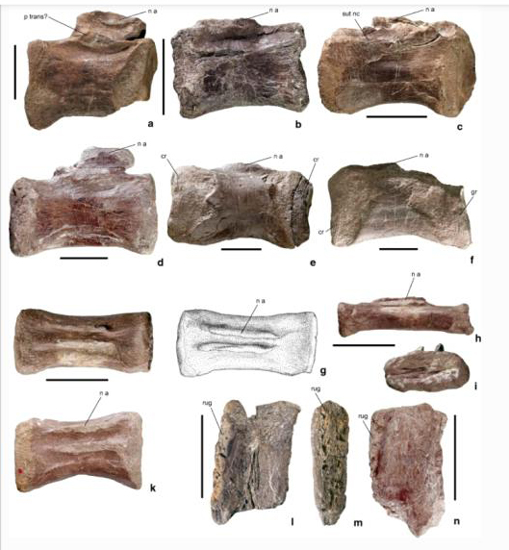
Middle and Posterior Caudal Vertebrae with Accompanying Line Drawing (A. greppini)

Middle and posterior caudal vertebrae of A. greppini.
Middle and posterior caudal vertebrae of A. greppini with interpretative line drawing.  Note scale bar = 5 cm.  Differences in the length : height ratios between these bones and those tail bones associated with Cetiosauriscus stewarti helped to identify the Swiss fossil material as that of a new genus.

Picture credit: Schwarz et al (Swiss Journal of Geosciences)

More European Sauropods to Come

When this research was published in the Swiss Journal of Geosciences earlier this year (February 2020), the researchers concluded that the first Swiss sauropod taxon helped to demonstrate the diversity of the sauropods known from the Late Jurassic of Europe.  The exact placement of Amanzia greppini within the Sauropoda remains controversial, the authors speculated that it might be a sister taxon to the Neosauropoda or a member of the Turiasauria, a geographically and temporally widespread group of sauropods with a number of European genera such as Cardiodon, Losillasaurus, Zby and Turiasaurus.

They concluded that more fossil discoveries and the reassessment of sauropod fossils held in museum collections would lead to the naming of many more European sauropod genera.

The scientific paper: “Re-description of the sauropod dinosaur Amanzia (“Ornithopsis/Cetiosauriscus”) greppini n. gen. and other vertebrate remains from the Kimmeridgian (Late Jurassic) Reuchenette Formation of Moutier, Switzerland” by Daniela Schwarz, Philip D. Mannion, Oliver Wings and Christian A. Meyer published in the Swiss Journal of Geosciences.

Visit the award-winning Everything Dinosaur website: Everything Dinosaur.
28 11, 2020

Falcatakely forsterae – A Strange Bird from the Late Cretaceous of Madagascar

By |2024-03-19T12:47:23+00:00November 28th, 2020|Categories: Dinosaur and Prehistoric Animal News Stories, Dinosaur Fans, Main Page, Palaeontological articles, Photos/Pictures of Fossils|0 Comments

Small Skull of Fossil Bird Has Big Implications (Falcatakely forsterae)

A team of international researchers including scientists from Ohio University, Stony Brook University (New York) and University College London have published a scientific paper describing a new type of enantiornithine bird (Falcatakely forsterae) from the Late Cretaceous of Madagascar.

Named Falcatakely, this crow-sized early avian offers a new perspective on the evolution of face and beak shape in the ancestral group leading to modern-day birds.

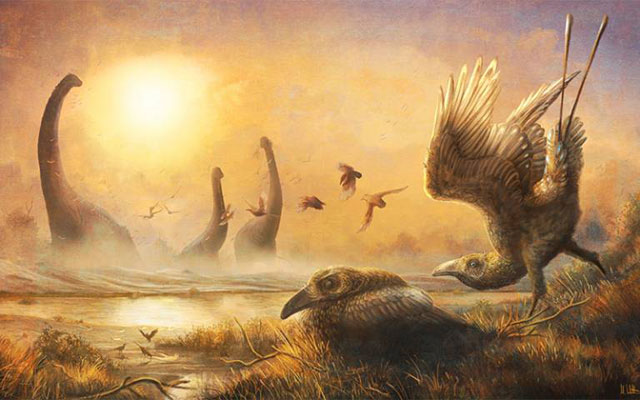
A Life Reconstruction of Falcatakely forsterae in the Late Cretaceous of Madagascar Surrounded by Other Archosaurs

Falcatakely forsterae life reconstruction.
A pair of Falcatakely birds are about to be disturbed an approaching group of titanosaurs.

Picture credit: Mark Witton

A Mesozoic Toucan?

Although palaeontologists are aware of a wide range of Mesozoic birds such as enantiornithines and hesperornithiforms which vary in size, flight adaptations and lifestyles, they all exhibit relatively conservative patterns of beak shape and development.  Modern birds (neornithines), such as the finches studied by the famous naturalist Charles Darwin, show a huge range of beak morphologies, all associated with different feeding and behavioural ecologies.  Falcatakely forsterae bucks this trend for birds from the Late Cretaceous, it has a beak morphology unlike other Mesozoic birds, one that is superficially similar to that of extant toucans.

Falcatakely forsterae, a combination of Latin and Malagasy words inspired by the small size and the scythe-like shape of the beak, which represents a completely novel face shape in Mesozoic birds.

Co-author of the scientific paper Dr Ryan Felice (University College London), explained how the study of birds have helped many scientists understand the subtleties of convergent evolution:

“Ever since Charles Darwin’s observations of Galapagos finches with differently-shaped beaks, birds have shaped our understanding of evolution through natural selection.  This new discovery tells us even more about how the predecessors of modern birds evolved, by showing how different forces in different places can contribute to similar traits in distantly related animals.”

Falcatakely forsterae

Described from a single skull specimen which had remained uncatalogued for several years since its discovery in 2010, lead author Patrick O’Connor (Ohio University) and his colleagues used high resolution CT scans to build up a picture of the skull and beak.

The Skull of Falcatakely forsterae with CT Scans and Interpretative Line Drawing

Falcatakely skull, scans and line drawing.
The skull of Falcatakely (top) with two diagrams from CT scans and an interpretative line drawing.

Picture credit: O’Connor et al

Bird fossils are rare.  Their light fragile bones tend not to fossilise well.  Bird skulls are especially rare, but although crushed, the powerful CT scans have been able to reveal many unique features of the bones and the beak.  For example, the researchers were able to identify a single preserved tooth in the premaxilla, probably one of several teeth lining the beak of this resident of north-western Madagascar some 68 million years ago.

Everything Dinosaur acknowledges the assistance of a media release from the University of Ohio and University College London in the compilation of this article.

The scientific paper: “Late Cretaceous bird from Madagascar reveals unique development of beaks” by Patrick M. O’Connor, Alan H. Turner, Joseph R. Groenke, Ryan N. Felice, Raymond R. Rogers, David W. Krause and Lydia J. Rahantarisoa published in Nature.

Visit the Everything Dinosaur website: Everything Dinosaur.
25 11, 2020

First Dinosaur Remains from Ireland

By |2023-11-24T14:25:58+00:00November 25th, 2020|Categories: Dinosaur and Prehistoric Animal News Stories, Dinosaur Fans, Main Page, Palaeontological articles, Photos/Pictures of Fossils|0 Comments

First Dinosaur Remains from Ireland

Scientists from the University of Portsmouth, National Museums of Ireland and Queen’s University Belfast have confirmed that fossils found by the late Roger Byrne on the east coast of County Antrim (Northern Ireland), are dinosaur bones.  These are the only dinosaur bones known from the island of Ireland.  Roger Byrne donated a number of specimens to Ulster Museum but they had not been closely studied, a scientific paper published in the Proceedings of the Geologists’ Association remedies that and confirms that two of the pieces are dinosaurian and although they were found at the same location, they represent bones from two different dinosaurs.

Lead Researcher Dr Mike Simms Holding the Two Dinosaur Fossil Bones

Dr Mike Simms holds the two precious fossils.
Dr Mike Simms (National Museums Northern Ireland) holds the theropod tibia on the left and the thyreophoran femur on the right.

Picture credit: The University of Portsmouth

Dinosaur Bones

Lead author of the research Dr Mike Simms stated:

“This is a hugely significant discovery.  The great rarity of such fossils here is because most of Ireland’s rocks are the wrong age for dinosaurs, either too old or too young, making it nearly impossible to confirm dinosaurs existed on these shores.  The two dinosaur fossils that Roger Byrne found were perhaps swept out to sea, alive or dead, sinking to the Jurassic seabed where they were buried and fossilised.”

Lias Group Exposures

The two fossil bones found by the Roger Byrne, a schoolteacher and avid fossil collector, come from Lower Jurassic strata exposed in Islandmagee.  They had been suspected of representing dinosaur bones, although they were found in marine deposits.  A detailed analysis of their histology and shape indicated that two of the pieces that Roger donated were indeed the bones of dinosaurs.  Originally, it had been thought that the bones represented a single type of dinosaur but the research team were surprised to discover that they represent bones from two very different types.

One specimen has been interpreted as the proximal end of the left femur of a basal thyreophoran ornithischian.  It has been tentatively assigned to Scelidosaurus, a primitive armoured dinosaur, fossils of which are known from Dorset (southern England) and date from the Sinemurian to the Pliensbachian faunal stages of the Early Jurassic.  The strata from which the femur fragment was found dates from slightly earlier, both the fossil bones are around 200 million years old.

A Model of the Early Armoured Dinosaur Scelidosaurus

CollectA Scelidosaurus model.
A model of a Scelidosaurus.  The CollectA Deluxe 1:40 scale Scelidosaurus model.

Picture credit: Everything Dinosaur

The picture (above) shows the CollectA Deluxe Scelidosaurus figure.

To view the CollectA Deluxe range of prehistoric animals: CollectA Deluxe Prehistoric Life Models.

Evidence of a Meat-eating Dinosaur

The second fragment of bone has been identified as the proximal part of the left tibia of an indeterminate neotheropod, perhaps a member of the averostran-line similar to Sarcosaurus, or a megalosauroid.  Sarcosaurus fossils are associated with Lower Jurassic strata (Hettangian-Sinemurian faunal stages), of England.  Together, the two fossil dinosaur bones represent the first dinosaur remains reported anywhere in Ireland and some of the west westerly in Europe.

An Illustration of Sarcosaurus

Sarcosaurus drawing.
Sarcosaurus scale drawing.  A speculative drawing of the Early Jurassic theropod Sarcosaurus.  It is not known whether this dinosaur had head crests like the distantly related Dilophosaurus. Picture credit: Everything Dinosaur.

Picture credit: Everything Dinosaur

The researchers used high-resolution, three-dimensional replicas to confirm the identity of the items donated by Roger Byrne.

University of Portsmouth researcher Robert Smyth explained:

“Analysing the shape and internal structure of the bones, we realised that they belonged to two very different animals.  One is very dense and robust, typical of an armoured plant-eater.  The other is slender, with thin bone walls and characteristics found only in fast-moving two-legged predatory dinosaurs called theropods.”

An Illustration of the Fossil Bones from County Antrim

Illustrations of the dinosaur bones from County Antrim.
Drawings of the dinosaur fossil bones by the late Roger Byrne and incorporated into the scientific paper.  Illustrations e, f, k and l are views of the theropod partial tibia and d, e are illustrations of the partial femur assigned to Scelidosaurus.  Note scale bar 5 cm.

Picture credit: Roger Byrne/National Museums of Ireland

Very Important Fossil Discoveries

Despite their fragmentary and weathered nature, these fossils are extremely important as they date from the Hettangian stage of the Early Jurassic, shortly after the End Triassic extinction event when the Dinosauria start to diversify and become more widespread.  Very few dinosaur fossils are known from this stage of the Early Jurassic, so Roger’s fossils are globally significant.

One of the other items donated by Roger Byrne probably represents an element from the skull or jawbone from a large marine reptile, perhaps an ichthyosaur or a pliosaur, whilst a polygonal-shaped piece was determined not to be a fossil at all, but a piece of Palaeocene basalt, similar to that found at the famous Giant’s Causeway on the northern coast of County Antrim.

Scelidosaurus a Beachcomber?

Commenting on the number of Scelidosaurus fossils associated with marine deposits, Professor Martill (University of Portsmouth), suggested:

“Scelidosaurus keeps on turning up in marine strata, and I am beginning to think that it may have been a coastal animal, perhaps even eating seaweed like marine iguanas do today.”

The fossils were on display at the Ulster Museum during the “Dippy on Tour” exhibition in 2018, but it is hoped that these important fossil bones will be able to go on permanent display once the COVID-19 restrictions are lifted.

Everything Dinosaur acknowledges the assistance of a media release from the University of Portsmouth in the compilation of this article.

The scientific paper: “First dinosaur remains from Ireland” by Michael J. Simms, Robert S.H. Smyth, David M. Martill, Patrick C. Collins and Roger Byrne published in the Proceedings of the Geologists’ Association.

Visit the Everything Dinosaur website: Everything Dinosaur.
Go to Top