All about dinosaurs, fossils and prehistoric animals by Everything Dinosaur team members.
7 04, 2008

Deinonychus – a new Interpretation inspired by Ostrom

By |2023-02-25T07:53:40+00:00April 7th, 2008|Categories: Dinosaur and Prehistoric Animal News Stories, Main Page|0 Comments

“Terrible Claw” – that was not so Terrible

In 1931, the great American fossil hunter Barnum Brown discovered the bones of a small, agile predatory dinosaur in Wyoming (Western USA).  The animal was named Daptosaurus, it means “active lizard”.  Unfortunately, despite being aware that this was a new genus of dinosaur, Barnum Brown never actually got round to describing this new dinosaur, and as a result Daptosaurus was not recognised by the wider scientific community.

Deinonychus – A New Interpretation

John Ostrom, another American palaeontologist, uncovered more fossilised bones of Daptosaurus in 1964 and he went onto name and describe the animal as Deinonychus in 1969, on year after Barnum Brown had sadly passed away.  So far, something approaching a dozen specimens have been found, including the remains of Deinonychus individuals next to a Tenontosaurus (a large hypsilophodontid herbivore), a rare example of predator and prey being found together.

The work of John Ostrom and other researchers led many scientists to see dinosaurs in a different light.  Instead of being depicted as slow, lethargic cold-blooded reptiles many began to be interpreted as active, agile and bird-like.

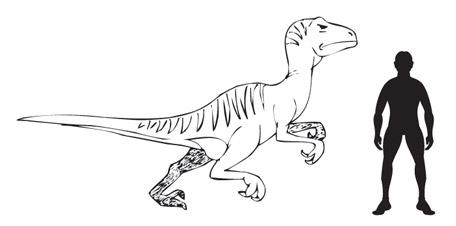
Deinonychus remains have been found in Early Cretaceous strata of Montana, Oklahoma and Wyoming.  The animal grew to a length of approximately 3 metres and might have weighed as much as 80 kilogrammes.  The head was 2.5 metres off the ground.   From the group of Deinonychus fossils (and recent trackway evidence), it has been suggested that this animal, a member of the Dromaeosauridae, lived and hunted in packs.

To read more about recent finds of dromaeosaur trackways: Evidence of Pack Behaviour in “Raptors” unearthed in China.

More dromaeosaur trace fossil news: Two-toed footprints found in Korea – Evidence of Dromaeosaurs in Korea.

The second toe of the four on the hind foot did not touch the ground.  Instead it was held aloft as it had the large sickle-shaped claw on the end.  Scientists like Ostrom speculated that this was probably the primary weapon used by this fierce little hunter.  The claw could have been swung forward and used to slash its victims.  However, recent studies by a team from the University of Manchester and other groups has cast some doubt over this hypothesis.  Although the point of the claw was relatively sharp the curved surface of the claw was not so sharp.

The force needed to slash away at the tough hide of a dinosaur would have been immense.  It now seems that this claw may have served more as a grappling hook, allowing a pack of Deinonychus to mob a larger dinosaur, jumping on it using their claws to get a purchase and to help bring the animal down.

An Illustration of Deinonychus (D. antirrhopus)
Picture credit: Everything Dinosaur

Close analysis of the jaws of dromaeosaurs including Deinonychus indicate that they were very strong.  Large muscles positioned towards the rear of the skull indicates that they could be opened very wide (wider than the 70 degrees permitted by the jaws of a lion).  Perhaps the jaws could have opened wide enough to bite down onto the windpipe and suffocate large prey animals – a form of predation favoured by many big cats today.

The Beasts of the Mesozoic range of articulated dinosaur models features several dromaeosaurid dinosaurs.  To view this popular range of collectable dinosaur figures: Beasts of the Mesozoic Dinosaur Figures.
6 04, 2008

Exciting Frog Blog Week 4 – Tadpoles Starting to Hatch

By |2024-04-12T08:40:15+01:00April 6th, 2008|Categories: Animal News Stories, Educational Activities, Everything Dinosaur News and Updates, Main Page|1 Comment

The Tadpoles have Started to Hatch

Great excitement this week in the pond as the tadpoles have begun to hatch.  The first signs of movement were detected on Wednesday morning.  This was on the 2nd of April, just 17 days after the spawn was laid.  Given the quite cold weather that we had been experiencing we were surprised how quickly the tadpoles developed.  However, it is worth noting that despite the cold weather and the chilly pond water, the spawn had been laid in a central position in the pond and this allowed the spawn to get what sun there was for most of the day.  Also, the jelly swells and becomes buoyant thus permitting the spawn to stay at the surface, again helping to warm the eggs.  Sat on their bed of pond-weed (Elodea) the spawn has been fairly quick to develop.

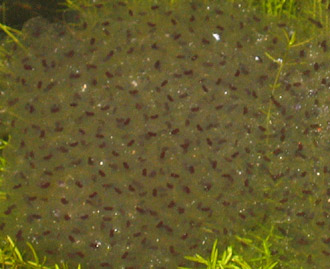
The Latest Picture of the Frog Spawn

Picture Credit: Everything Dinosaur

Tadpoles Starting to Hatch

By Wednesday lunchtime, team members were taking turns to watch the spawn, every now and then a little tadpole would move slightly, either curling or uncurling.  By Friday the movements had become stronger and more frequent.  The embryos had assumed a more tadpole-like shape and could be seen moving inside the egg membrane.

The first hatchlings were observed on Saturday afternoon (5th April).  The tadpoles have developed a definite head end (a round bulge) and a basic tail.  However, it will be a few days before they are swimming freely.

At this stage, the muscular and circulation systems are developing, the gill arches either side of the head are now forming.  The tadpoles hatch at around the time these gills are able to function.  The eyes and mouth are not fully developed and there is an adhesive organ present on the top of the head.  This permits the tadpole to attach itself to pond weed and remain there until further changes have taken place.

Spotting the External Gills

If you can get close enough and look very carefully at a tadpoles head from the top downwards (called a dorsal view by scientists), you should be able to see two small tiny bumps, one on each side of the head.  These are the external gills and they should be visible for about 12 days or so.  Over this period a fold of skin known as the operculum develops on the first branchial arch just in front of the external gills.  It grows backwards until the external gills are covered.  The eyes and mouth begin to develop.

The operculum does not close up completely, a single hole (called a spiracle) remains on the left side of the body.  Water is taken in through the newly formed mouth, passes over the internal gills and is expelled through this spiracle.  By this time the mouth should have developed definite jaws and the adhesive organ on top of the head should have almost completely disappeared.

The digestive system should have expanded (for the first few days after hatching the tadpoles live on the remains of the yolk from the egg – this can be seen as a bulge in their tummies).  Soon the tadpoles will have acquired the ability to swim and they will have started their journey towards becoming frogs – metamorphosis.

Frog Observed

Only one frog has been observed in the pond during daylight hours.  We think this is a male, it has been seen around the spawn and some of us have jokingly speculated that this might be the “expectant father” waiting for his babies to hatch.  We know that many species of amphibian demonstrate some care for their offspring.  For example, male Midwife toads (Alytes obstetricans) gather up the eggs once they have been fertilised and they carry them around on their back legs, but we are not aware of any paternal instinct being demonstrated by Common Frogs (R. temporaria).

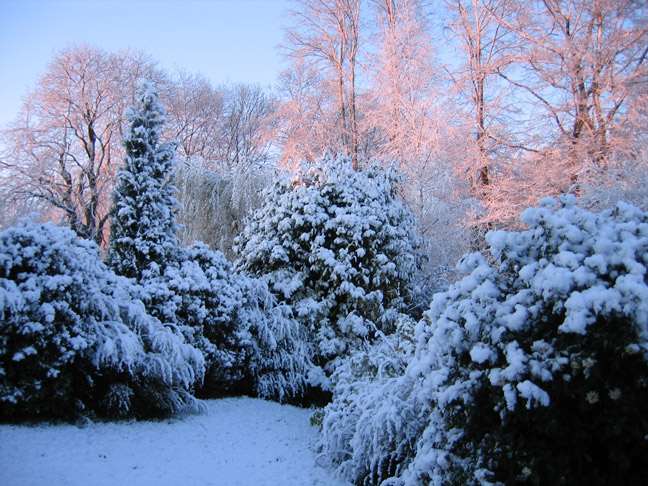
Much of the country has been covered in a blanket of snow, this morning.  Typical of the British weather, no snow in winter and then on the 5th April we get some.  This picture was taken of the area behind the office this morning.

Oh to be in England now that April’s Here!

Picture credit: Everything Dinosaur

5 04, 2008

Review of the New Pop-up Facts Dinosaurs

By |2024-04-12T08:30:22+01:00April 5th, 2008|Categories: Book Reviews, Main Page|0 Comments

Pop-up Facts Dinosaurs (Review)

Time to step back to the Mesozoic (Age of Reptiles) and meet some of the amazing animals the lived during the Triassic, Jurassic and the Cretaceous.

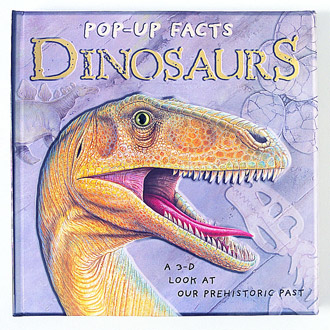
The Front Cover of Pop-Up Facts Dinosaurs

Picture credit: Everything Dinosaur

To view the range of toys, models, learning materials and games available: Visit Everything Dinosaur.

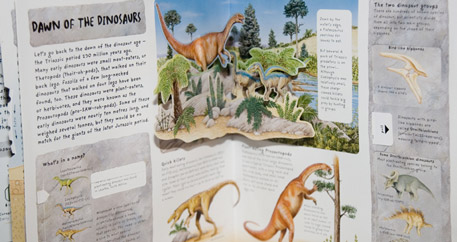
A hardback book that is beautifully illustrated contains lots and lots of facts and information about dinosaurs and other prehistoric animals.  Young readers can wonder at the huge plant-eating sauropods that pop out of the page at you, examine fossil evidence of the colossal meat-eating dinosaurs and study marine reptiles as well as pterosaurs.  Page after page of truly impressive pop-ups, packed with fascinating facts, tabs to pull, flaps to lift and wheels to turn.  Even the front cover which depicts a theropod dinosaur in 3-D relief has a dinosaur eye that looks straight back at the reader.

Recommended for young dinosaur fans aged 5+ a super, dinosaur book, crammed with facts and very educational, this is a great example of a book about dinosaurs for kids.

An Example of the Fact Filled Pop-up Pages

Picture credit: Everything Dinosaur

Visit Everything Dinosaur’s Homepage: Everything Dinosaur.

4 04, 2008

Mammoths in the Cinema

By |2022-11-14T07:35:39+00:00April 4th, 2008|Categories: Dinosaur and Prehistoric Animal News Stories, Main Page|0 Comments

Mammoths in the Cinema – 10,000 B.C. and all That

No prehistoric movie or television series seems complete without at least one Mammoth being included.  Now that CGI has come to the fore, depicting these large elephants with their long shaggy fur coats is not too much of a problem.  Although we have been told by technicians and CGI operators that getting the fur to look realistic on screen is quite a challenge, at least with dinosaurs (feathered ones excepted), the computer experts are not encumbered with these skin features and dinosaurs are to some extent a little easier to re-create.

Mammoths in the Cinema

From studies of the exceptionally well preserved Mammoths from Siberia, scientists have a fairly good understanding of how the hair on these creatures looked.  The coat consisted of two basic layers, a coarse outer layer of guard hairs and an undercoat that helped insulate these animals from the cold.  This is a typical adaptation to cold, harsh environments seen in many mammal species, both extinct and extant (around today).

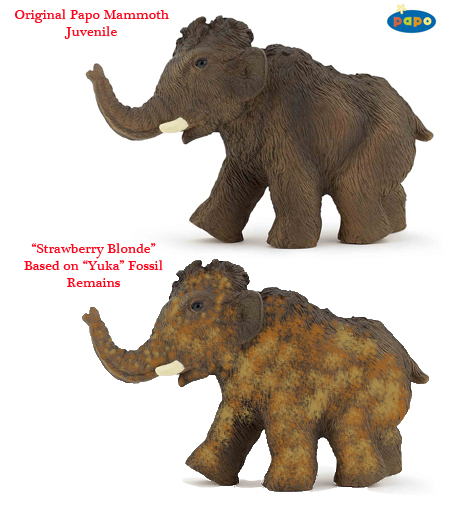
The outer guard hairs were up to six times thicker than human hair and in large specimens some of these hairs grew to over a metre in length.  This outer coat provided effective water-proofing.  The inner coat was made up of thinner, softer and far shorter hairs this coat helped provide insulation and keep out the cold.  The coat colour in Mammoths varies with some dark brown whilst others appear almost reddish/orange in colour.  We have the frozen carcases of Siberian Mammoths to largely thank for providing us with a Mammoth colour chart.

Frozen Mammoth Carcases Provide a Guide to Mammoth Colouration

Mammoth coat colours.

Strawberry blonde Mammoth from Everything Dinosaur.

Picture credit: Everything Dinosaur

The picture (above) shows a model of a Papo juvenile Woolly Mammoth that has been altered digitally to show variation in colour. To view the Papo range: Papo Prehistoric Animal Models.

Many of the models Everything Dinosaur supplies are hand-painted.  Each model has tiny variations which is very appropriate given that the structure and format of every Mammoth’s coat would have been slightly different – just as the hair on our heads is different from person to person.

To see a model of Woolly Mammoth and other prehistoric animal figures: Prehistoric Animal Models.

The degree of hairiness varied with the Mammoth species, Columbian types (Mammuthus columbi) were less hairy than the Woolly types (M. primigenius), perhaps an adaptation to a slightly less harsh climate.  It is likely that Mammoths had a spring moult to produce a lighter summer coat.

Their heavy coats were not their only source of insulation, many Mammoth fossils have revealed a fat layer up to 10 cm thick just below the skin surface.  This would have provided exceptional insulation, an example of adaptation to colder climates and a food store inside the animal to help it overcome leaner times.

3 04, 2008

Man saves Wife from Crocodile

By |2023-02-25T08:14:41+00:00April 3rd, 2008|Categories: Animal News Stories, Main Page|0 Comments

Husband saves Wife from a Saltwater Crocodile Attack

A husband and wife had a lucky escape from a crocodile attack in a remote part of the Australian outback.  The couple were swimming in a small creek whilst holidaying in an area 100 miles southwest of Darwin in Australia’s Northern Territory.

Saltwater Crocodile Attack

The attack was from a Saltwater, otherwise known as an Estuarine crocodile (Crocodylus porosus).  These animals are the largest species of crocodile on the planet and the heaviest of all the reptiles around today.  Adult males can reach lengths in excess of 20 feet and weigh up to 1 Tonne.  The largest Estuarine recorded was shot in Sumatra, Indonesia in 1978, it was reputed to be over 28 feet long and weighed more than 1300 kilogrammes.

The woman suffered leg and hand injuries but things could have been much worse had it not been for the bravery of her partner, who jumped on the 8 foot crocodile’s back in the successful rescue.  Acting like a real-life “Crocodile Dundee” the man leaped onto the reptile and this forced the crocodile to let the woman go.

The wife was taken to the Royal Darwin Hospital to have her wounds treated, a spokesman for the hospital commented: “the husband’s very swift and diligent actions have saved the day”.

This is the fourth crocodile incident that has been reported in recent weeks from the Northern Territory.  A few days earlier police were forced to open fire on a crocodile as it closed in on a swimmer who had accepted a dare to swim to an offshore crocodile trap.  A crocodile attacked a boat of tourists in the same area and in January a man rescued his colleague from a crocodile but accidentally shot his unlucky co-worker in the process.  Well, if it is not your day, it’s not your day!

Many parts of the Northern Territories have seen an increase in the number of Saltwater crocodiles, now that hunting has been largely banned.  Unfortunately, these aggressive predators are very capable of attacking people and once above 8 foot in length they are officially classed as man-eaters.  There has been a call for a controlled cull in order to reduce the number of large crocodiles in the area.

To read more about the problems caused by the growing population of Estuarine crocodiles in the Northern Territory: Invasion of the Crocodiles.

2 04, 2008

The Tuatara has a Surprise in its Genes

By |2022-11-14T07:29:22+00:00April 2nd, 2008|Categories: Animal News Stories, Main Page|0 Comments

The Tuatara is the fastest-known Evolving Animal

A team of researchers have identified the rare New Zealand Tuatara as the fastest evolving animal yet to be fully studied, at least at the molecular level.

The Tuatara (Sphenodon punctatus) belongs to an otherwise extinct reptilian group called the Rhynchocephalians.  These reptiles are characterised by the presence of a beak-like upper jaw.  Although the origin of this particular group of reptiles can be traced back to the Early Triassic, just one genus (one species) remains today.   To estimate the rate of evolution taking place within a species the research team studied DNA samples taken from ancient Tuatara remains dating from approximately 8,000 years ago and compared them to samples taken from living Tuatara.

New Zealand Tuatara

The scientists found that although these little reptiles have remained largely unchanged physically over very long periods of evolution, they are evolving, at a molecular level faster than any other animal yet examined.

“What we found is that the Tuatara has the highest molecular evolutionary rate that anyone has measured,” commented researcher David Lambert from the Allan Wilson Centre for Molecular Ecology and Evolution in New Zealand.

Many scientists have hypothesised  that molecular evolution would be fastest in animals whose physical form, or morphology, also evolved swiftly.  The Tuatara findings dispute this, perhaps indicating that there is no relationship between the rate of molecular change and the rate of physical change in a species. This small reptile, now confined to a few small islands of the coast of New Zealand (but also recently introduced to the New Zealand mainland once again), closely resembles the extinct reptile Homoeosaurus which dates from the Early Jurassic (180 million years ago).

David Lambert and his team have studied molecular change in a number of animals, extinct and extant populations, including Adelie penguins, foxes, lions, horses and the Cave Bear (Ursus spelaeus).  Of these animals, the Tuatara has a faster rate of DNA evolution.   The information will assist scientists as they try to conserve this endangered species and provide guidance as to future areas of study.  How helpful this rapid molecular evolution has been to the Tuatara genus has yet to be determined.  These animals are reputed to be extremely long lived with estimated life spans of between 100 and 300 years.

Living in Burrows

The reason why the Tuatara has survived at all is more down to luck than judgement.  These small lizard-like animals live in burrows and are relatively slow moving, their populations are soon overwhelmed if predatory mammals such as rats are introduced into their habitats.  The fact that New Zealand was isolated from other land masses before land mammals become abundant probably resulted in the survival of this species, the speedy DNA of the Tuatara had nothing to do with this species survival.

The Tuatara remains severely threatened, this representative of an ancient reptile order cannot compete against introduced animals such as rats and cats.  Indeed, even when these predators have been eliminated from the Tuataras few remaining strongholds, they may still face extinction.  As global temperatures rise this is affecting the balance of males and female Tuataras being hatched from eggs.  The warmer climate has meant that more eggs are hatching as males (temperature seems to be a determinant factor in deciding the sex of Tuatara offspring).  Fewer females in the population could lead to a critical decline in the breeding population.

To read more about attempts to re-introduce the Tuatara to the New Zealand mainland: Living Fossil helped back to New Zealand mainland.

1 04, 2008

Dinosaur Death Throes – Not what they Seem

By |2022-11-14T07:27:36+00:00April 1st, 2008|Categories: Dinosaur and Prehistoric Animal News Stories, Educational Activities, Main Page, Palaeontological articles|2 Comments

Dinosaur Death Throes – Not what they Seem

One of the questions we were asked recently was why do all meat-eating dinosaurs seem to fossilise in the same way?  A young dinosaur fan had pointed out that a picture in his dinosaur book showed two Coelophysis skeletons one of which had its neck and head curved backwards over the spine with the tail curling back on itself.  In the same book, there was a picture of a Compsognathus fossil with the head and neck also curved over the back.  How could these two dinosaurs have died in the same way?

Dinosaur Death Throes

We are familiar with these exhibits, the Coelophysis probably come from the famous Ghost Ranch deposits of New Mexico, where over 100 individual skeletons of this early Triassic theropod have been discovered.  The Compsognathus example probably relates to the nearly complete Solnhofen specimen from southern Germany.  This fossil was discovered in the lithographic limestone deposits in the same area as the first Archaeopteryx fossils.  Compsognathus was a resident of the Jurassic, Coelophysis the Triassic, how could these two animals separated by millions of years have died in virtually the same posture?  Indeed, when some of the Archaeopteryx fossils are studied, then they too show the head typically arched backwards over the spine.  The tail does not curve round to any real extent, perhaps the tails of these early birds were too ossified to permit such movement, or maybe it is to do with the conditions of fossilisation at the southern German sites.

This phenomenon is not restricted to just some dinosaurs, a large number of articulated theropod (meat-eaters) fossils show this trait.  Such postures are also seen in pterosaur fossils and birds.  As we have driven along on our travels in the USA and elsewhere we have observed birds that have hit car windscreens and been killed.  As the carcase dries out under the hot sun, the neck often adopts a curving posture.

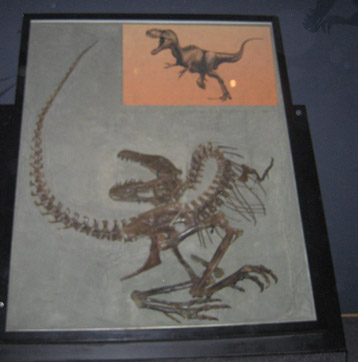
An Exhibit of an Articulated Albertosaurus skeleton (Royal Tyrrell Museum)

Picture credit: Everything Dinosaur

The picture above shows a typical example of an articulated theropod fossil with the head and tail curving towards each other.

Most scientists believe that this common posture is caused by either one or a combination of two factors of post-mortem processes (after death).  The first of these processes involves muscle contractions causing the neck and tail to bend over.  Secondly, the posture could be caused by the the drying out of tendons and ligaments within the body as it remains exposed to the sun.  Whether it is due to rigor mortis or the desiccation of the body, both possibilities indicate that these bodies must have remained intact on the ground for sometime before finally being buried.

Examples from the Natural World

These are valid explanations, borne out from our own observations of roadkill in hot climates, however, having visited Africa on numerous occasions we also note how rare it is for dead animals to lay undisturbed without attracting the attention of scavengers.  One of our colleagues remembers working in the Masai Mara of Kenya when they had the misfortune to come across the body of a mature hippopotamus that had died only a few metres away from a small oasis which was being studied so that local elephant movements could be plotted.

Over the next few days, the pungent aroma of the rotting beast attracted a number of scavengers including hyenas, lions, marabou storks as well as vultures and the resident Nile crocodile.  It was not long before the remains of the hippo and been well and truly taken to pieces.  There were plenty of scavengers around in the Mesozoic, why were many of the bodies of the theropods not disturbed by other animals looking for an easy meal and the remains scattered about?

Another intriguing explanation for this death pose has recently been put forward.  There are certain conditions, most closely associated with warm-blooded animals such as mammals and birds that can lead to this posture.  A posture that is adopted when the animal is very much alive.  One such condition is opisthotonos, this can lead to animals adopting a very rigid posture with the head and tail curving towards each other.  This severe arching is caused by irritation of the membranes surrounding the brain or the spinal cord.  In humans this condition is associated with meningitis in infants.  Opisthotonos can also occur if there is brain damage (most notably the cerebellum), or any form of brain impairment leading to disruption to the nervous system.

There is some evidence of face biting amongst tyrannosaurs (another theropod), could many meat-eaters have suffered brain injuries when competing with other dinosaurs, this might have resulted in the condition that led to the “death pose” posture.

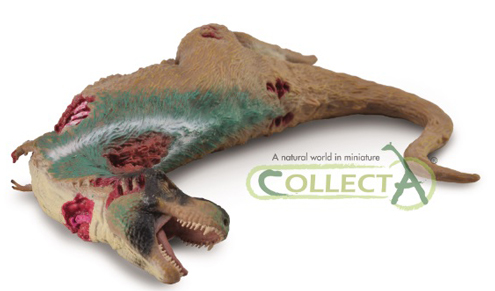
A Model of A T. rex Carcass

Dinosaur death throes

T. rex corpse.  An example of dinosaur death throes.

The picture (above) shows a model of a T. rex carcase, with the figure in the typical “death” position.  This model is part of the CollectA Age of Dinosaurs Popular range: CollectA Age of Dinosaurs Popular Range.

As this disorder is most commonly associated with higher animals (mammals and birds), which are warm-blooded could this theory if true, also lend weight to the hypothesis that dinosaurs, at least the active, hunting, theropods were endothermic?

31 03, 2008

The New Young Explorers Kit – Dinosaurs

By |2024-04-12T08:46:08+01:00March 31st, 2008|Categories: Educational Activities, Everything Dinosaur News and Updates, Main Page|0 Comments

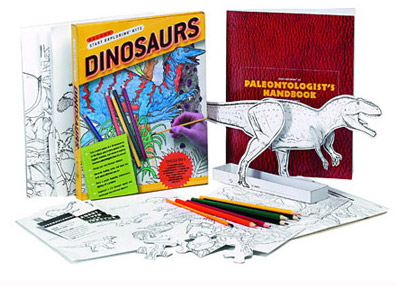
Start Exploring Dinosaurs Activity Pack

Uncover some of the secrets about dinosaurs and other prehistoric animals with this fun-filled and educational “Explore Dinosaurs Activity Pack”.   This new Dinosaur themed kit contains lots and lots of activities, there is a giant Tyrannosaurus rex poster, the chance to design your own dinosaur stickers, make dinosaur trading cards and even the opportunity to come up with your own new species of prehistoric animal.

Young Explorers Kit

The kit comes in a handy box and contains everything required to complete the tasks, including paint brush, watercolour pencils, pencil sharpener and even an eraser (to help make your mistakes extinct).  This American designed set even comes complete with a 16 page palaeontologist’s handbook with lots of information and facts about dinosaurs.

The Start Exploring – Discover Dinosaurs Activity Kits

Picture credit: Everything Dinosaur

In total there are 11 different posters featuring a variety of monsters from the Mesozoic, on test with our families and focus groups this kit has proved very popular.  Favourite items included the giant Tyrannosaurus rex poster to colour in – great for bedroom walls and the 3-D model of a meat-eater.  Art supplies are included in the kit, so it is a kind of self-contained activity centre of  young palaeontologists, there is even a little booklet that advises on different art techniques to try.  It is a great addition to the Everything Dinosaur toys and gifts range.

To see the kit and other craft items: Visit Everything Dinosaur.

30 03, 2008

Frog Blog – Week 3 – Our Little Black Commas

By |2022-11-11T22:20:01+00:00March 30th, 2008|Categories: Animal News Stories, Educational Activities, Everything Dinosaur News and Updates, Main Page|0 Comments

Frog Blog – Week 3 – Little Black Commas

Our frog spawn in the office pond is approximately 2 weeks old and despite the very bad weather we have experienced in the last few days there are signs that things are beginning to happen.  The weather has been quite cold, although it is hard to say that it has been unseasonal, with the early Easter it is easy to forget that we are still in March and on the whole the winter has been relatively mild.

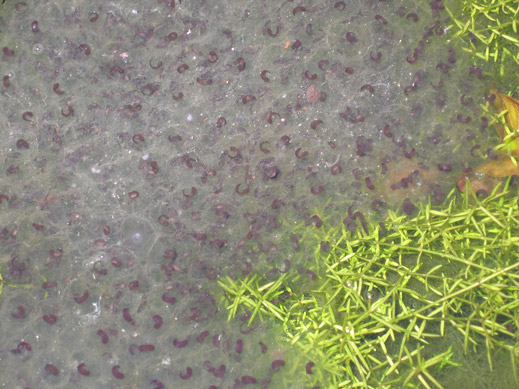
Only one warm sunny day over the last week, we have had heavy rain and blustery showers but fortunately not too many bonfires from the construction workers nearby polluting the water with ash drifting into the pond.  The water temperature remains cold but a close examination of the frog spawn shows that the little black dots we started with inside their protective jelly are beginning to change.  The majority of them are showing some definition, we have a lot of “little black commas”, the eggs are showing signs of development and we can see the start of a defined head end and a tail.

A Close up of the Frog Spawn

Picture credit: Everything Dinosaur

Despite the cold weather the spawn is beginning to change, the picture shows that the embryos are developing, becoming more elongated and showing signs of progress.  We suspect that the water temperature will still be determining the rate of development, perhaps the warmer weather forecast for next week will help the spawn to hatch in the next 10 days or so.

Only one adult frog has been observed in the pond during office hours.  Ironically, it has taken to sitting next to the frog spawn using the surround pond week (Elodea) to support its weight.  We were a little concerned about this frog, normally frogs confine themselves to the margins of the pond, where there is more cover.  However, this frog, (we think it is a male), seemed quite happy to sit amongst the pond week in the centre of the pond.

Some of us started to speculate that this was the father, checking on his family to be, but this was probably a bit too fanciful for the more rational members of the team.  Amphibians do adopt many strategies when it comes to looking after and raising their young.  It is not just the so called higher forms of life, the mammals and birds that adopt a benevolent attitude to their offspring.

28 03, 2008

Estimating the Size of Smilodon (Sabre-Tooth Cats)

By |2022-11-11T22:16:12+00:00March 28th, 2008|Categories: Dinosaur Fans, Everything Dinosaur News and Updates, Main Page|7 Comments

Estimating the Size of Sabre-Tooth Cats

With the Roland Emmerich directed film 10,000 B.C. proving popular with UK cinema audiences over the Easter holidays, staff at Everything Dinosaur have seen a resurgence in queries and questions related to prehistoric mammals.

Woolly mammoths and Sabre-tooth cats (Smilodon spp.) tend to be the most popular of all the now extinct mega fauna of the Cenozoic, the fact that these animals play a prominent role in this new film will no doubt add to their popularity.  Certainly both animals are very enigmatic, although the size of these prehistoric beasts tends to be taken a little bit out of proportion by the Hollywood special effects teams.

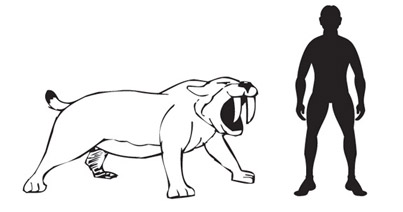
Take the fearsome Sabre-Tooth cat for example, the best known and most researched species would be S. fatalis and the two sub-species from North America.  The superbly preserved remains removed from the La Brea tar pits have provided a huge amount of fossil evidence.  This fierce predator was not the largest of the Smilodon species.  Smilodon populator of South America, is believed to have been a little larger, perhaps exceeding 1.2 metres at the shoulder.

The impression re-produced below gives a rough idea of the scale of  the largest Smilodon species when compared against a human (not that we would recommend anyone attempting to get too close to one of these creatures)!

A Sketch Illustrating the Size of the large Smilodon (S. populator) compared to a Person

Picture credit: Everything Dinosaur

Smilodon

The largest Smilodon would have been about the size of a male African lion (Panthero leo), but up to 300 kilogrammes in weight, making them much more heavy set than the largest of the big cats around today.

When it comes to the “top dogs” in the cat family the Panthero genus (lions) may have the last laugh, several extinct sub-species of Panthero leo may have been even larger than the biggest Smilodon.  It seems that those “big cats” such as S. populator, belonging to the sub-family of Machairodontinae, had some pretty strong competition from other members of the Felidae. Take for example the American lion (Panthero leo atrox), a contemporary of Smilodon fatalis, this fearsome beast is estimated to have been about the same height and weight of the largest of the Smilodon genus but less compact, perhaps reaching lengths in excess of 2.5 metres.

American Lion

Although the American lion is known from the La Brea fossil deposits, relatively few remains have been found when compared to other carnivores such as the Dire wolves (C. dirus) and Smilodon fatalis. Perhaps the lack of fossils indicates that there were relatively fewer lions within the ecosystems that the fossil record represents, or maybe the American lion had a different hunting strategy and preferred habitat that took it away from La Brea.  Perhaps the American lion was just a little too smart to get caught in the tar pits.

Ironically the largest carnivore from the La Brea deposits is not a member of the Felidae at all.  The Short-faced bear (Arctodus simus), was the largest carnivorous animal around the area of La Brea towards the end of the Pleistocene.  A massive animal 1.5 metres high at the shoulder, capable of raising itself to a height of 3 metres or more and weighing perhaps as much as 800 kilogrammes, if a member of the Felidae stumbled across one of these bears, it would be better off getting out of its way.  The Short-faced bear is reputed to have been the largest bear to have ever existed.  Compared to modern brown bears its limbs were much longer and it had a short, broad muzzle (hence its name).  The jaws were extremely powerful and this animal would have had an awesome bite.

Little is known about the behaviour and habits of the Short-faced bear.  Chemical analysis of fossilised bones indicate a predominately carnivorous diet, but whether this bear was an active hunter of a scavenger is unknown.  It was certainly capable of chasing off both Smilodon fatalis and the American Lion in order to take over a recent kill.

Everything Dinosaur stocks an extensive range of prehistoric mammal figures: Prehistoric Mammal Figures.

Go to Top