All about dinosaurs, fossils and prehistoric animals by Everything Dinosaur team members.
17 05, 2015

Kronosaurus – Down on the Farm

By |2023-03-29T08:34:48+01:00May 17th, 2015|Categories: Dinosaur and Prehistoric Animal News Stories, Dinosaur Fans, Main Page|0 Comments

Queensland Farmer Discovers Kronosaurus Jaw Fossil

A Queensland farmer, out spraying weeds on his farm near Nelia in the north-western part of the State, has unearthed the fossilised remains of the lower jaw of a huge marine reptile known as a Kronosaurus.  Although the jaw measures 1.6 metres long, it came from a sub-adult, most of the teeth may be missing, but this is one of the best preserved pliosaur jaws found anywhere in the world.

Kronosaurus

Robert Hacon of Euroba Station, was taking advantage of the recent rains that have occurred in this drought hit part of Australia to spray some prickly Acacia plants when he noticed some shiny objects in amongst the weeds.  At first, he dismissed them thinking that they were fossilised mussel shells, which are relatively common in this part of the world, evidence to support the idea that much of the land mass we call Australia was part of a warm, tropical, shallow sea back in the Early Cretaceous.

However, curious to find out exactly what the objects were, he returned to the spot a few minutes later and discovered that the recent downpour had exposed a near complete lower jaw bone of a huge marine reptile.

Dr Timothy Holland (Kronosaurus Korner) Poses Next to the Fossil Jaw
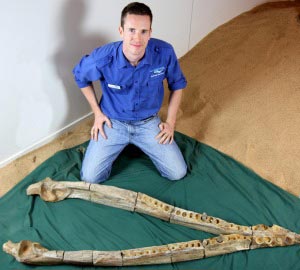
Dr. Timothy Holland provides a scale next to the massive Kronosaurus jaw.

Dr Timothy Holland provides a scale next to the massive Kronosaurus jaw.

Picture credit: Patricia Woodgate

An Apex Marine Predator

The first fossils of this apex, marine predator were discovered in Queensland in 1889.  At the time, the fragmentary remains were identified as a type of ichthyosaur, but in 1924 they were reassigned to the short-necked Suborder  of the Plesiosauria, the Pliosauroidea.

Most of the fossil material related to the two species of Kronosaurus so far described, have been crushed, severely weathered and distorted, but pliosaurid specialist, Dr Timothy Holland of Kronosaurus Korner, a museum that exhibits a number of marine reptile fossils found in Queensland, stated that this specimen was one of the best found to date.

An Illustration of Kronosaurus (K. queenslandicus)

A fantastic replica of the huge marine reptile Kronosaurus.

A fantastic replica of the huge marine reptile Kronosaurus.

Picture credit: Everything Dinosaur

The picture above shows a superb model of the marine reptile Kronosaurus (Safari Ltd).  This replica is part of the now retired Carnegie Collectibles model series.

To see more prehistoric animals in the Safari Ltd model range: Wild Safari Prehistoric World Models and Figures.

Fossil Donated to the Kronosaurus Korner Museum

The fossilised jawbones have been donated to the Kronosaurus Korner museum, they will shortly be put on display to the public.

Commenting on the fossil find, Dr Holland stated:

“The scary thing is that this creature wasn’t even an adult when it died, it still had a lot of growing to do.  We are thrilled to display the specimen, it’s a timely reminder of Australia’s rich geoheritage and I marvel to think what else lies waiting to be found.”

The skull of this ancient marine reptile made up about a quarter of the animal’s entire body length, a spokesperson from Everything Dinosaur commented on the excellent state of preservation and estimated that the total length of the animal would have been approximately seven metres.

A Close up of the Beautifully Preserved Jaw Bones
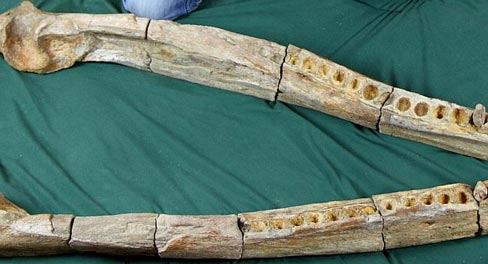
Some teeth can still be seen in the rounded sockets.

Some teeth can still be seen in the rounded sockets.

Picture credit: Patricia Woodgate

Strong Jaws

Posterior parts of the jaw are up to eighteen centimetres thick, indicating that this powerful predator had very strong jaws.  It was most likely the top predator in the marine environment, eating fish, cephalopods and other reptiles.

Over the last few years, Everything Dinosaur has reported on a number of marine reptile fossil finds from Queensland, Australia.  Some of these fossils turn up in very unexpected places, such as the case of ichthyosaur fossil bones being found in the vegetable patch of a school.

To read more about this amazing discovery: Marine Reptile Fossils Found at School.

In Everything Dinosaur’s fossil and palaeontology predictions for 2015, we predicted that there would be some exciting new dinosaur discoveries reported from Australia.  This is certainly an exciting fossil find, but Kronosaurus was not a member of the Dinosauria.  Still, more than half of the year to go so we have plenty of time left to be proved right (just for once).

To see the full list of Everything Dinosaur’s predictions: Everything Dinosaur’s Palaeontology and Fossil Predictions for 2015.
16 05, 2015

The Prehistoric Animals of Jurassic World – Indominus rex

By |2023-03-29T08:26:59+01:00May 16th, 2015|Categories: Dinosaur Fans, Main Page, Movie Reviews and Movie News|0 Comments

The Making of Indominus rex – “Fierce or Untameable King”

The back story to the forthcoming film “Jurassic World” goes something like this.  With the death of Dr John Hammond the founder of InGen in 1997, (according to the film franchise timeline), the corporate giant Masrani began negotiations to acquire the company and within twelve months InGen was part of the Masrani conglomerate.  A plan to develop and reopen the “Jurassic Park” attraction was put forward shortly afterwards and in around 2000, the go ahead was given to create a dinosaur led attraction on the island of Isla Nublar.

“Jurassic World”

The attraction, known as “Jurassic World” was built between the years 2002 and 2004, construction materials alone are estimated to have been around $1.2 billion USD.  To give readers an appreciation of the costs of developing the new attraction, the construction of the new Wembley stadium (London), completed in 2007, cost around $2 billion USD in total.  The development of “Jurassic World” was a huge and ambitious undertaking for Masrani, the decision to go ahead with the project coincided with Masrani Global Corporation’s NASDAQ market debut (2000), the theme park was seen as a “flagship” enterprise for the organisation.  With many new shareholders to impress, the park had to be a success and when it opened in June 2005, it proved to be a huge hit, attracting 98,120 visitors in the first month alone.

Masrani – Ten Years of Making Dinosaurs

A decade of dinosaurs.

A decade of dinosaurs.

Picture credit: Masrani

The Need to Build Bigger and Better Attractions

Anyone who has ever played the video game “Theme Park”, (which was originally released in 1994, just a year after the original Jurassic Park movie hit cinema screens), knows that the rides and the park itself needs to be constantly refreshed and updated to keep visitor numbers up.  With visitor numbers at “Jurassic World” beginning to fall or at best plateau, in the last two to three years, investors began to grow concerned.  Revenue from ticket sales, merchandise and other income streams were not growing as strongly as they once were, this prompted Masrani’s Chief Operations Officer, Richard Wiesner, to describe the 2013 results for “Jurassic World” as merely acceptable, despite profits from the theme park exceeding 20 million USD that financial year.

Acceptable Profits

Richard Wiesner stated:

“The world has seen what we have to offer, but they aren’t in awe as they once used to be.  We need to change that.  You can’t expect the world’s greatest theme park to merely rely on the same attractions.  We need to be proactive, thinking of bigger and better things.”

Putting things in perspective, EuroDisney (Paris) over the same period posted a loss of 78 million Euros, but apparently Masrani wanted bigger and better…

Dr Henry Wu’s Contribution

The chief scientist at InGen, Dr Henry Wu, one of the world’s leading geneticists, had successfully combined the DNA of a number of plant species to create the “Wu flower” (Karacosis wutansis) back in 1997.  As one of the architects of the prehistoric animals in the failed “Jurassic Park” experiment, Wu was installed as one of the lead scientists to genetically engineer a whole new generation of dinosaurs for the new attraction “Jurassic World”.  InGen remained a separate company within the Masrani portfolio and one can only speculate on where their genetic research took them, but in response to the call to create bigger and more exciting attractions, it was Dr Wu and his team who were given the task of developing a hybridised dinosaur.

The project to create a genetically engineered, hybridised dinosaur is believed to have started in late 2012.  This was to be an entirely new species, one that had genetic traits from a variety of theropod dinosaurs combined with other extant (living species) – the Indominus rex project was begun.

Indominus rex

The Group’s Chief Executive Officer Simon Masrani announced in 2014, that the company had been able to successfully engineer a new type of dinosaur.  Once the news story broke, on line ticket sales to the park “skyrocketed”, it looks like 2015 is going to be a very big year for “Jurassic World”.  The dinosaur has been named Indominus rex (fierce or untameable king), note, we at Everything Dinosaur prefer to spell untameable with an extra “e”.  The new dinosaur attraction is due to open this summer and we all know that this is going to end very badly.

As Owen Grady (played by Chris Pratt) states:

“You just went and made a new dinosaur, probably not a good idea”

New Dinosaur on the Block – Indominus rex

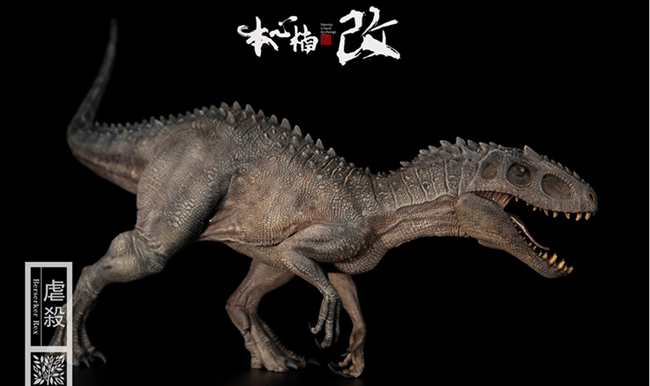
Nanmu Studio Indominus Berserker Rex

A model of a genetically designed dinosaur. Inspired by InGen?

Nanmu Studio have introduced a range of prehistoric animal figures paying tribute to dinosaurs seen in cinema releases: Nanmu Studio Models.

If Dr Wu’s brief had been to create a bigger, more dangerous, fiercer and more intelligent dinosaur, then the project does seem to have achieved its goal.  We at Everything Dinosaur don’t know quite how the genome for this new theme park attraction was put together, originally there were two creatures, but one was eaten by the other.  I. rex does indeed look to be a mix of different meat-eating dinosaurs, with osteoderms resembling those seen on abelisaurids (Carnotaurus, Majungasaurus and Rugops are mentioned)  and the Late Jurassic Ceratosaurus, three-fingered hands of an allosaurid, but with much larger and more highly recurved claws, there is probably a bit of T. rex and a pinch of dromaeosaurid in there too.

Indominus rex – Dinosaur Attraction Due to Open in Summer 2015

A forthcoming attraction.

A forthcoming attraction.

Picture credit: Universal Studios

A New Hybrid Dinosaur

In the pre-launch publicity for the attraction, it is stated that this new hybrid can run up to speeds of 30mph (48kmh), within the confines of its enclosure and that I. rex can roar as loudly as 140-160db, the sound created when a Boeing 747 jet takes off.  At around twelve metres, that is a phenomenal growth rate, much faster than the estimated growth rate for any other large theropod.  Amongst all that dinosaur DNA, to obtain such a rapid growth rate, we speculate that some song-bird genes much have been thrown into the mixer, after all, blackbirds for example, can reach almost adult size in just a few weeks.  Although the growth rate of various members of the Theropoda are not that well understood, ontogenic studies have suggested it was actually prey such as ornithopods that grew much more quickly.

To read about a study into dinosaur growth rates: Duck-billed Dinosaurs Grew Up Fast to Avoid Tyrannosaurs.

Awaiting the Film Release

Just how big this dinosaur could grow can only be speculated.  We suspect that in the forthcoming film this dinosaur will meet its demise, how this happens is one of the most closely guarded secrets in the history of the film franchise.  Could Indominus rex fight Tyrannosaurus rex?  Would a Spinosaurus (the big villain in Jurassic Park III), become involved somehow?  Like millions of dinosaur fans around the world we shall have to wait until the second week of June to find out.

15 05, 2015

The Chinese Pompeii – Dinosaur Fossils Can be Confusing

By |2023-03-29T08:22:26+01:00May 15th, 2015|Categories: Dinosaur and Prehistoric Animal News Stories, Geology, Main Page|0 Comments

Death of Dinosaurs in the Early Cretaceous of China (Lujiatun Unit of the Yixian Formation)

At Everything Dinosaur we define science as the “search for truth” and one of the fundamental principles of scientific working is the examination and assessment of evidence which leads to conclusions being drawn and theories put forward.  However, different scientists can examine the similar evidence and come to contrasting conclusions.  Let’s illustrate this point by looking at two scientific papers published recently that both seek to explain the remarkable degree of fossil preservation seen in a sequence of Lower Cretaceous strata laid down in north-eastern China.  Let’s explore the mystery of the “Chinese Dinosaur Pompeii”.

Chinese Pompeii

Last year, a team of international researchers led by Associate Professor of Palaeontology and Stratigraphy at Nanjing University, Baoyu Jiang published a paper that concluded the remarkably well-preserved dinosaur, bird and mammal fossils that form part of the Jehol Biota were created “Pompeii-style” by pyroclastic flows.  A pyroclastic flow is an immense, fast-moving cloud of extremely hot gas and dust that can occur with some types of volcanic eruption.  It would have swept everything before it and killing instantly any unfortunate animal or plant that was in the way.

The research team cited evidence such as criss-crossed cracks on the edges of fossilised bones, evidence of heat stress, microscopic debris showing plant remains that had been blackened by being exposed to very high temperatures prior to fossilisation and hollow bones filled with fine quartz grains, tell-tale signs of a pyroclastic flow.  Although the fossils are some 120 million years old, the same evidence can be found in the bodies of citizens of Pompeii who perished when this Roman town was engulfed by a pyroclastic flow which erupted from Vesuvius back in 79 AD.

Evidence of Sudden and Dramatic Death – Caught in Pyroclastic Flows

Evidence for pyroclastic flows from the Jehol Biota.

Evidence for pyroclastic flows from the Jehol Biota.

Picture credit: Baoyu Jiang

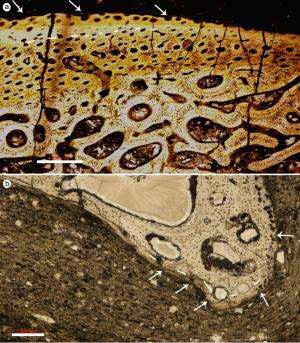
The picture above shows photomicrographs (photographs of images produced under a microscope), showing thin sections of fossilised bone of two relatively common vertebrate fossils from the strata that was investigated.

Psittacosaurus and Confuciusornis

The pictures show a dinosaur, Psittacosaurus and a thin section of the bone fossil from an ancient bird, Confuciusornis (top Psittacosaurus spp. and bottom Confuciusornis spp.).  The white arrows indicate missing bone material and cracks can be seen at both the dorsal and ventral edges of the bone.  This evidence supports the idea that the bones were subjected to intense heat, such as that found in volcanic pyroclastic flows.

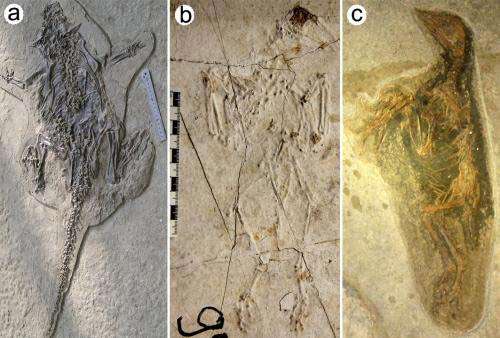
Victims of a Pyroclastic Flow?

a).

a = Psittacosaurus, b and c = Confuciusornis fossil material

Picture credit: Baoyu Jiang

Note the position of the limbs in the photographs of the fossils (above), particularly those fossils representing the bird Confuciusornis.  The pose is like that of a boxer.  This pose results from the shortening of muscles and tendons that occurs postmortem and this boxer-like box has been cited as further evidence to support the idea of mass mortality as a result of a pyroclastic event.

Conflicting Views as to How these Fossils were Formed

Associate Professor Baoyu Jiang and his colleagues have studied the flora and fauna preserved in the Lower Cretaceous deposits for many years.  It had been known for some time that volcanoes were active in the area at around this time in the Cretaceous, testament to the frequent eruptions were the many layers of fine, volcanic ash that could be identified in the rock layers.

The paper citing pyroclastic flows as the reason for the remarkable, often three-dimensional preservation of vertebrates led to considerable debate amongst scientists at the time of its publication.  Now another paper has been written, which argues that the fossils of the Lujiatun Member of this Formation do not owe their existence to violent clouds of hot ash, rocks and dust travelling at hurricane speeds, but are the result of slightly more gentle, (but equally dramatic), deposition forces.

Choked with Volcanic Ash

A team of scientists from Bristol University in association with the IVPP (Institute of Vertebrate Palaeontology and Palaeoanthropology – Beijing) and University College, Dublin have reassessed the “Chinese Pompeii” deposits and their fieldwork suggests that the fossils were transported in water which was choked with volcanic ash, rather than have the fossils forming as a result of sudden airborne ash fall.

A New Study Suggests Vertebrates such as Psittacosaurus were Buried by Ash that was Deposited by Water

Overcome by ash carried in water flows not pyroclastic flows.

Overcome by ash carried in water flows not pyroclastic flows.

Picture credit: Bristol University Press Release

The fossils of the Jehol Biota come from the Lower Cretaceous Yixian and Jiufotang Formations.  Both freshwater and terrestrial creatures are found in the same horizons and some scientists have interpreted these deposits as evidence for mass mortality events.  The research group that included the Bristol-based team, set out to explore the events and mechanisms that led to the exceptional preservation.  By analysing in microscopic detail the sediments and residual fossils from the Lujiatun Member (the vicinity of Lujiatun village) and comparing the strata to fossils in the collections of Chinese museums, the scientists concluded that the beautifully preserved specimens of the Lujiatun Unit are not the result of one single, massive catastrophe caused by a volcanic eruption.

Fossil-bearing Sediments were Remobilised and Deposited by Water

Their study suggests that the fossil-bearing sediments were remobilised and deposited by water.  If this is the case, the psittacosaurs, other dinosaurs, primitive mammals and birds for example, were not wiped out by one huge, airborne delivery of volcanic ash, but in multiple flood events which carried very high loads of ash and other debris from volcanoes sweeping all before them and burying the unfortunate animals and plants.

One of the problems that occurs when trying to conduct a study such as this, is that many of the fossils in museum collections have been found by local farmers who then sell on the fossil material.  Not very accurate excavation records are kept and therefore it is often extremely difficult to match up a museum specimen with the actual horizon from which it originated.

Buried by Sediments

Commenting on the research, lead author of the scientific paper that has just been published in the journal of “Palaeogeography, Palaeoclimatology, Palaeoecology”, PhD student Chris Rogers of Bristol University said:

“Without stratigraphic information of the fossils in the field, it was impossible to accurately establish a mode of death for these animals.  Once we established proper placement of these fossils in the sedimentary sequence it became clear that these animals had been buried by sediments that were deposited by water and not by volcaniclastic flows.”

It is likely that the debate over the nature of the Jehol Biota will rumble on (just like a pyroclastic flow), this is an example of groups of scientists building on each other’s work to better understand how certain fossils are formed.  However, they were formed, the Jehol Biota provides palaeontologists with a unique insight into the flora and fauna of this part of the world back in the Early Cretaceous, a time when the Aves were rapidly diversifying and there were important revisions undergoing in both the Mammalia and Reptilia.

For models and replicas of Confuciusornis and other prehistoric creatures: PNSO Age of Dinosaurs Models.

14 05, 2015

Crocodiles Just Want to Have Fun

By |2023-03-28T08:23:24+01:00May 14th, 2015|Categories: Animal News Stories, Main Page|1 Comment

Play Behaviour Reported in Crocodilians

Ask someone to name an animal that plays and they are very unlikely to suggest an alligator, however, in a new study conducted by a psychology professor at the University of Tennessee, its seems that crocodiles indulge in play behaviours and they quite enjoy it too. In the first study of its kind, Vladimir Dinets, a research assistant professor at the University’s Department of Psychology, has published a paper in the quarterly academic journal “Animal Behavior and Cognition”, the paper examines the evidence for play behaviour that has been observed in crocodilians (alligators, crocodiles, caimans and the gharials), not creatures that most people would associate with the word “fun”.

Crocodiles and Play

According to the Vladimir, over the ten years or so he has spent studying these reptiles, he has observed lots of play behaviour, including playing in water jets, toying with objects, surfing waves and riding on the backs of other crocodilians.  This type of research is important as it helps to shed light on how animals develop and provides an insight into the evolution of intelligence, after all, play and social interactions as a result of play behaviours are more commonly associated with mammals such as primates.  To generate more data, Vladimir conducted an informal survey of crocodile and alligator-themed groups on social media and raised the case for fun loving crocodiles at various conferences.

His results show that play behaviour in crocodilians is not uncommon, but it remains very poorly understood and there has been virtually no formal research conducted in this field.  Behaviour specialists have identified three basic types of play related to animals and all three types have been observed in various species of these toothy creatures with fearsome reputations.  Ironically, the amount of play indulged in by crocodilians may be under reported, reasons for this are that many crocodiles are most active at night when observation is difficult, some observers doubt their own observations, thinking that what they have seen may have a more credible explanation, whilst some witnesses may believe that their claims will not be taken seriously.

Main Types of Play Behaviour

  • Locomotor play – defined as intense or sustained movements, often without any apparent reason or stimulus.  For example captive, young American alligators repeatedly sliding down chutes into water, a hatchling caiman deliberately propelling itself across a pool using a jet of water flowing from the bottom of its concrete enclosure, or a 2.5 metre long Estuarine crocodile “surfing” waves off a beach in Australia.
  • Social play – defined as a pair of crocodiles (or more), indulging in play together, examples given included a pair of Cuban crocodiles in captivity with the male giving “piggyback rides” around the pool, the female being carried on the back of the male as he swam around.  Two young Black caimans chasing each other around in circles and reference to a “short sequence of film of two sibling Nile crocodiles tussling with each other in what looked like play behaviour” – a reference to personal communications between Vladimir Dinets and Dr Darren Naish (Honorary Research Fellow at the School of Earth & Environmental Sciences, University of Portsmouth).
  • Play with objects – defined as playing with toys, interacting with various objects.  This is the most common form of play observed by zookeepers and staff responsible for looking after these reptiles in captivity.  Indeed, many zoos now toss in various objects such as robust floats and balls to provide a stimulus.

There has even been cases of interspecific play behaviour reported.  Vladimir cites the example of an American alligator interacting with a river otter (Big Cypress National Preserve, Florida).

It seems there may be a softer more playful side to these creatures, after all, as far as we at Everything Dinosaur are aware only about eight species are proven man-eaters.

A Strong Bond with Humans

There is also some evidence to suggest that crocodilians can form a strong bond with humans.  Back in 2011, Everything Dinosaur wrote a brief article about two Dwarf caimans from the Blue Planet Aquarium in Cheshire that seemed to respond to their pet names, coming when called.

To read more about this: Crocodilians Respond to Their Own Names.

However, there are a number of documented cases of crocodiles and people becoming playmates.  In the published paper, the story of an American crocodile called Pocho and its relationship with Gilberto “Chito” Shedden is recounted.  “Chito” rescued the crocodile and became its keeper, the crocodile was soon tamed and so strong was the bond between them that “Chito” would often swim with the crocodile.

Various play behaviours were observed, including the crocodile indulging in mock charges, it sneaking up behind “Chito” as if to try to startle him and in return the reptile accepted being caressed, hugged, rotated in the water and kissed on the snout.  This unique relationship continued for twenty years, until Pocho apparently died of old age.  The two became celebrities in their native Costa Rica and were even the subject of a documentary made by Roger Horix “The Man Who Swims With Crocodiles”.

Play Behaviour in Crocodilians

Dinets’ study builds on previous work undertaken by colleague  Professor Gordon Burghardt (Department of Psychology and the Department of Ecology and Evolutionary Biology).  It was Professor Burghardt who defined the concept of “play” in a way that allows it to be recognised in species not previously seen as playful or capable of play-like behaviours.  This new study supports the hypothesis that play behaviours are almost universal in “intelligent” animals, those capable of complex, flexible behaviour.  The research can help scientists to further explore the link between the evolution of more complex behaviour and even intelligence through playful activity.

Vladimir stated:

“Hundreds of thousands of crocodilians are now kept in captivity in zoos, commercial farms and breeding centres set up for endangered species.  Providing them with toys and other opportunities for play makes them happier and healthier.”

Did Dinosaurs Play Too?

This leads on to the question that if play is observed in animals such as crocodilians and we know that birds indulge in play too, then this has consequences for the Dinosauria.  It may be very difficult to prove given the limitations of the fossil record when it comes to preserving behaviour, but it can be speculated or even asserted that dinosaurs played as well.  Cavorting camarasaurs, or ticklish tyrannosaurs, now that’s a thought…

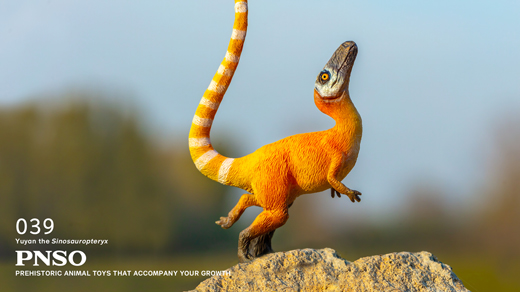
PNSO Sinosauropteryx dinosaur model.

PNSO Yuyan the Sinosauropteryx dinosaur model. Did dinosaurs play too?

For dinosaur models, games and toys: Everything Dinosaur.

13 05, 2015

Retracing the Beak of Birds to the Snout of Dinosaurs

By |2023-03-28T08:12:21+01:00May 13th, 2015|Categories: Dinosaur and Prehistoric Animal News Stories, Dinosaur Fans, Educational Activities, Main Page, Palaeontological articles, Teaching|0 Comments

Reverse Genetic Engineering to Produce a Dinosaur Snout

A team of scientists based in the United States have tweaked the developmental processes that take place in chicken embryos to re-engineer the snouts of their dinosaur ancestors.  The research team led by University of Yale palaeontologist, Bhart-Anjan S. Bhullar and developmental biologist Arhat Abzhanov (Harvard University), have produced the first bird embryos that possess a snout similar to a dinosaur’s nose rather than a beak.  The chicken embryos developed palatial bones and a jaw configuration that resembles that seen in the fossil record, specifically in the Dromaeosauridae, a group of dinosaurs that are closely related to modern Aves.

Bird Embryos Possess a Snout Similar to a Dinosaur Snout

The dromaeosaurs, sometimes referred to as the “raptors” belong to the Suborder Theropoda.  They are part of a clade of agile dinosaurs that reduced their tails, lost their teeth and evolved into Aves (birds).  Typical dromaeosaurids are Velociraptor, Deinonychus and the recently named Saurornitholestes sullivani.

To read an article about the newly described Saurornitholestes sullivaniSniffing Out a New Dinosaur Species.

As the Yale University press release states: “Just don’t call them Dino-chickens!”

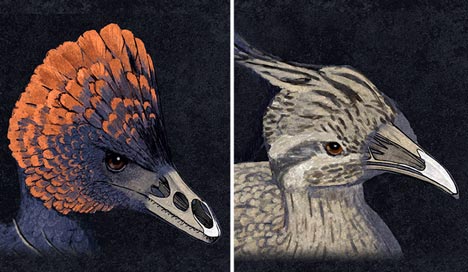
Tweaking the Beak from Dromaeosaurs to Modern Birds

From the Dinosauria (left) to the beaks of modern Aves (right).

From the Dinosauria (left) to the beaks of modern Aves (right).

Picture credit: John Conway

Manipulating Chicken Embryos

The scientists were not in the business of trying to create a living dinosaur.  Manipulation of chicken embryos has taken place for several years, all part of research to help the understanding of how molecular processes affect the development of organisms.

Commenting on this research, which has just been published in the journal “Evolution”, lead author Dr Bhart-Anjan S. Bhullar (Department of Organismic and Evolutionary Biology, Yale) stated:

“Our goal here was to understand the molecular underpinnings of an important evolutionary transition, not to create a “dino-chicken” simply for the sake of it.”

Researching Cranial Development

For the young doctor, this is all part of his on-going research into cranial development in very young animals.  It is not part of a concerted effort to bring back the Dinosauria, a sort of “Jurassic Park from the embryo upwards”, as explained by a spokesperson from Everything Dinosaur.

There are a huge variety of bird beaks, from the curved, tearing and cutting beaks of eagles, to the sophisticated sieves of flamingos.  The beak is an essential component of avian anatomy and the researchers are trying to unravel how the beak evolved from its reptilian ancestry.  A quantitative analysis of fossils closely associated with the origins of birds was undertaken along with a study of extant animals including lizards, crocodiles and birds.

How the Beak of Birds Evolved

This examination allowed the scientists to develop a hypothesis as to how the bird beak may have evolved from the Dinosauria and the developmental stages that were involved.

The team identified that both major living lineages of birds, the abundant Neognathae (which includes virtually all species of extant birds) and the much rarer  Palaeognathae (which comprises the Tinamou family of birds from South and Central America plus the flightless ratites – cassowary, ostrich, kiwi, rhea, for example), differ from reptiles that are not closely related to birds and from mammals in that they have a unique, median gene expression zone of two different facial development genes early in embryonic development.  This median gene expression had previously only been identified in chicken embryos.

Turning Back the Evolutionary Clock

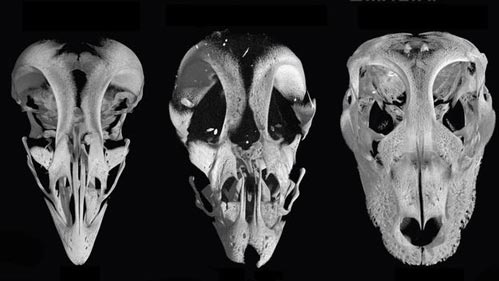
In order to have an embryo revert to its ancestral state, before the beak as it were, the gene expression for beak formation in the young chicken had to be turned off.  Microscopic beads coated in a molecule inhibiting substance were used to inhibit the activity of the proteins produced by the bird specific, median signalling zone in the chicken embryos.  This led the embryo to revert back to its reptilian ancestry with a more dinosaur-like snout forming and surprisingly, the palatine bone in the root of the mouth was also altered.

Changing the Faces of Embryos (Modified Chicken Embryo with Snout)

Normal chick (left), modified chicken embryo (centre), alligator embryo (right)

Normal chick (left), modified chicken embryo (centre), alligator embryo (right)

Picture credit: Evolution

Unexpected Changes

Dr Bhullar was surprised by the additional changes seen in the palatine bone, he stated:

“This was unexpected and demonstrates the way in which a single, simple developmental mechanism can have wide-ranging and unexpected effects.”

Commenting on the research, Professor Michael Benton (Bristol University), someone who knows a great deal about bird evolution, explained that this new study shows that the beak of birds develops very different from the snouts, noses and jaws of reptiles.  A different set of genes are involved.

He stated:

“That’s what proves the beak is a real adaptation or “thing”, not just a slightly different nose shape”

Why Dinosaur Snouts and Bird Beaks?

Intriguingly, although the fossil record for bird evolution is far from complete, the fantastically well preserved bird fossils of Lower Cretaceous deposits from China, specimens of Confuciusornis for instance, show that by around 125 million years ago the toothless beak had evolved.

Why the beak came about remains a point of significant debate, however, one of the most often cited reasons for a lighter, toothless structure is that as birds became more efficient fliers and spent more time in the air, the loss of a heavy, bony jaw lined with teeth was just one of a number of anatomical adaptations that occurred to help improve powered flight.

A Model of the “Early Bird” Confuciusornis sanctus from China

PNSO Age of Dinosaurs Confuciusornis model.

Confuciusornis model (PNSO Age of Dinosaurs).

Picture credit: Everything Dinosaur

The picture (above), depicts the PNSO Confuciusornis replica. There are a number of feathered prehistoric animal models in the PNSO range: PNSO Age of Dinosaurs.

Important Implications

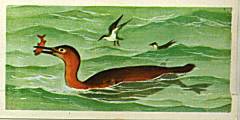
The American based researchers are confident that their work has important implications for other geneticists and for palaeontologists.  For example, if a single molecular mechanism was responsible for this transformation, there should be a corresponding, linked transformation in the fossil record.  The flightless, man-sized Hesperornis, a genus of prehistoric bird known from the Late Cretaceous of North America could demonstrate that link.

An Illustration of Hesperornis (Traditional View)

Hesperornis catching a fish.

Hesperornis catching a fish.

Picture credit: Everything Dinosaur/Brooke Bond

Dr Bhullar said:

“This is borne out by the fact that Hesperornis, discovered by Othniel Charles Marsh of the Yale Peabody Museum of Natural History, which is a near relative of modern birds that still retains teeth and the most primitive stem avian with a modern-looking beak in the form of a fused, elongate premaxillae, also possesses a modern bird palatine bone.”

The premaxillae are the bones that form the tip of the upper jaw (anterior portion) of most animals, but are enlarged and fused to form the beak of birds.

Finding a Hypothetical Developmental Path

Moving forward, the quantitative analysis to establish a proposed hypothetical developmental path of a lineage of animals which could be tested by inhibiting the behaviour of proteins in embryos can be probably be used to investigate a wide range of underlying developmental mechanisms in organisms.

The dinosaur/bird link is now well established, a theory once proposed by the likes of Henry Govier Seeley back in the 1880’s is widely accepted.  Back in 2013, Everything Dinosaur reported on research from an international team of scientists, including researchers from the Royal Veterinary College (London), that looked at how the posture of birds was derived from the gait of small, cursorial dinosaurs.

To read more about this study: The Birds Have the Dinosaurs to Thank for their Crouching Gait.

Everything Dinosaur notes the support of Yale University in the compilation of this article.

12 05, 2015

Sniffing Out a New Dinosaur Species

By |2023-03-27T08:02:37+01:00May 12th, 2015|Categories: Dinosaur and Prehistoric Animal News Stories, Dinosaur Fans, Main Page|0 Comments

Saurornitholestes sullivani – Don’t Turn Your Nose Up When It Comes To The Dromaeosaurids

Steven Jasinski, a PhD student at the University of Pennsylvania (Department of Earth and Environmental Science), has identified a new species of North American dromaeosaur, one that may have had a very keen sense of smell.  Saurornitholestes sullivani was not the largest predator known from that ecosystem, but with its sharp senses, grasping arms, turn of speed, large claws and jaws full of dagger-like teeth it was very probably a formidable hunter.

 Saurornitholestes sullivani 

Steven made the discovery whilst studying cranial elements (skull fossils) that had been assigned to the genus Saurornitholestes but to another species, (S. langstoni).  Up until now, Saurornitholestes langstoni was the only species assigned to this genus, now there are two.  This is yet another example of a new dinosaur species being erected from a reassessment of previously described fossil remains.  The Saurornitholestes genus was established in 1978, following the description of a partial skeleton discovered in Alberta (Canada).  Although, no complete or near complete fossil specimen has been found to date, fossil material from both the Judith River Formation (Montana) and the Dinosaur Provincial Park Formation (Alberta) have been assigned to this genus.

The huge number of broken teeth found, indicate that this dinosaur was probably one of the most common predators in this part of North America approximately 75 million years ago (Campanian faunal stage).

An Illustration of a Pair of S. sullivani Attacking a Juvenile Parasaurolophus

Fearsome predator of the Late Cretaceous.

Fearsome predator of the Late Cretaceous.

Picture credit: Mary P. Williams

 The picture above depicts a pair of feathered dinosaurs attacking a juvenile duck-billed dinosaur.

A Feathered Dinosaur

Although no evidence of feathers have been found preserved alongside fossil material assigned to this genus, it is likely, that this small, agile dinosaur was feathered.  A report on Saurornitholestes sullivani has been published in the New Mexico Museum of Natural History and Science bulletin.

The fossil material was originally found by American palaeontologist Robert Sullivan in 1999, when a field team was exploring the Bisti/De-Na-Zin Wilderness in northern New Mexico.  The fossils were initially described as Saurornitholestes langstoni and represented the southernmost location for this species.

Differences in Skull Anatomy

However, Steven Jasinski conducted a comparative analysis of these fossils with those of S. langstoni from Montana and Alberta and he observed a number of differences in skull anatomy.  When the brain shape and volume was calculated, the student noted that the proportion of the brain dedicated to interpreting and analysing smells was unusually large.  The enlarged olfactory bulb indicates that this two-metre-long dinosaur had a powerful sense of smell.

Jasinski commented:

“This feature [enlarged olfactory bulb] means that Saurornitholestes sullivani had a relatively better sense of smell than other dromaeosaurid dinosaurs including Velociraptor, Dromaeosaurus and Bambiraptor.  This keen olfaction may have made S. sullivani an intimidating predator as well.”

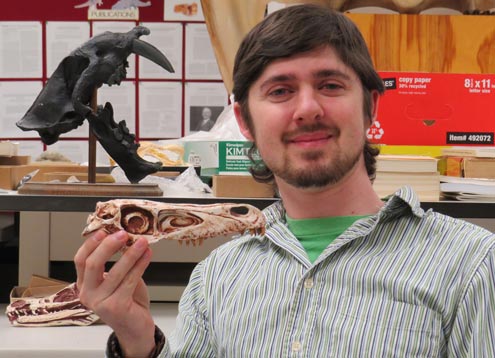
 Steven Jasinski Holding a Replica of the Skull and Upper Jaw of S. sullivani

Student Steven Jasinski.

Student Steven Jasinski.

Picture credit: University of Pennsylvania

The picture above shows Steven holding a replica of the fossil material, the large eye socket (orbit) also suggests that this little hunter had keen eyesight.

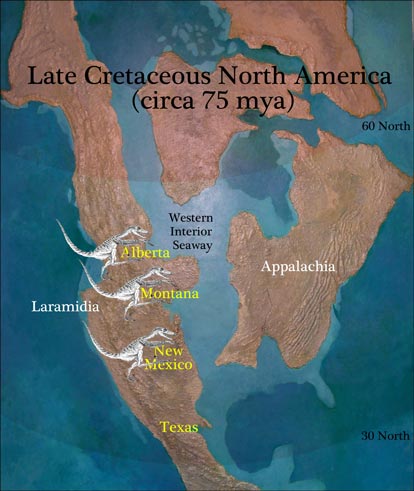
Saurornitholestes sullivani from Southern Laramidia

At the time S. sullivani lived, North America was split into several parts separated by an inland sea (the Western Interior Seaway).  This dinosaur lived on the landmass known as Laramidia.  S. sullivani represents the only named dromaeosaur from the Late Cretaceous of southern Laramida, but the wealth of micro-fossil evidence, consisting of broken teeth suggests that there may have been several different species of dromaeosaur inhabiting the floodplains on the eastern shores of Laramidia.

Although a distinct species, Saurornitholestes sullivani was very closely related to S. langstoni.  Finding two distinct species of this genus hundreds of miles apart supports the hypothesis that distinct but closely related megafaunal communities existed on Laramida (supporting the concept of ethnicity within the Dinosauria of Late Cretaceous North America).

Approximate Location of Saurornitholestes Fossil Material from Laramidia

Saurornitholestes fossil material mapped.

Saurornitholestes fossil material mapped.

An Exceptional Sense of Smell

Having an exceptional sense of smell would have helped this agile dinosaur to sniff out potential prey.  Although, in the illustration above Saurornitholestes is depicted attacking a duck-billed dinosaur, it may not have hunted large prey.  The sense of smell could have helped this dinosaur, that probably measured around one metre high at the hips, to sniff out mammals living in burrows or to find lizards and other small creatures in the undergrowth.  In addition, an acute sense of smell could have helped Saurornitholestes find carrion that it could then scavenge.

The Beasts of the Mesozoic series of articulated models includes Saurornitholestes figures: Beasts of the Mesozoic Articulated Models.

9 05, 2015

It was a Worm’s World Back in the Cambrian

By |2023-03-27T07:48:07+01:00May 9th, 2015|Categories: Dinosaur and Prehistoric Animal News Stories, Main Page, Palaeontological articles|0 Comments

Palaeontologists Name New Species of Ottoia Worm – Burgess Shale Creatures

Whilst many a television documentary or published article on the fauna of the Burgess Shale focuses on the nektonic predators (actively swimming creatures above the sea floor), such as the formidable Anomalocaris, lurking in the soft mud of the sea floor itself was another very nasty hunter, one that left an extremely rich fossil record.  The most abundant type of creature preserved in the Burgess Shale is a type of worm, a member of the Phylum Priapulidae and now thanks to a detailed study of the teeth, hooks and spines on this tubular predator, scientists have discovered a method of identifying new species and also of determining just how abundant these creatures actually may have been.

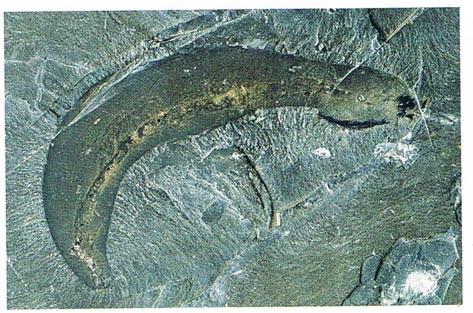
An Ottoia Fossil (Burgess Shale)

An Ottoia fossil (Burgess Shale).

An Ottoia fossil (Burgess Shale).

Burgess Shale Creatures

Ottoia fossils from the Burgess Shale of British Columbia (Canada), measure just a few centimetres in length and they are one of the few types of creature preserved in those 505 million year old sediments that can be associated with a living animal group, the entirely marine priapulids.  At least fifteen hundred specimens have been excavated from the Burgess Shale deposits.  These creatures may have lived in “U” shaped burrows and ambushed other creatures that wandered or swam to close to the burrow’s entrance.  It could grab food with a proboscis, an extendible mouth which was equipped with tiny hooks and lined with teeth and spines.

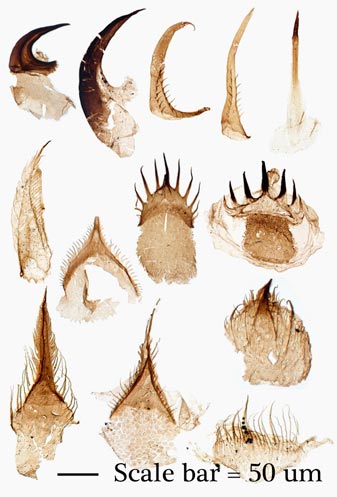
The team of scientists from Cambridge University and the University of Leicester, writing in the on line Journal “Palaeontology” used a variety of techniques to examine micro-fossils to identify different types of teeth from Ottoia  It is from this analysis that the team discovered that the most common type of priapulid associated with the Burgess Shale, Ottoia prolifica, actually represented two species.

Prehistoric Worms

As a result of this research, a new species of Ottoia worm has been identified in the Burgess Shale deposits – Ottoia tricuspida.  O. tricuspida has been so named as it has distinctive, three-pronged teeth.  Using various microscopy techniques to examine the tiny teeth recovered from drill cores and from other samples, the scientists propose that subtle variations in the teeth could help to identify more species in Cambrian biota and in addition, as the teeth are more likely to be preserved than the soft bodies of these creatures, the teeth could help to establish how widespread such worms were in the Cambrian geological period.

The Ottoia Genus

Ottoia prolifica was named by Charles Doolittle Walcott in 1911.  Walcott,  an American invertebrate palaeontologist, discovered the Burgess Shale deposits in the Canadian Rockies back in 1909.  These bands of mudstone and shale are very rich in fossils.  The frequency of Ottoia fossil material might not be anything to do with the abundance of these types of animals in the biota, the numbers found could reflect the fact that these animals lived in soft sediment.  If one of these worms died in their burrow, then they could set in motion the fossilisation process.  The soft mud would act as an excellent medium to promote the preservation of creatures that lived in the sediment.

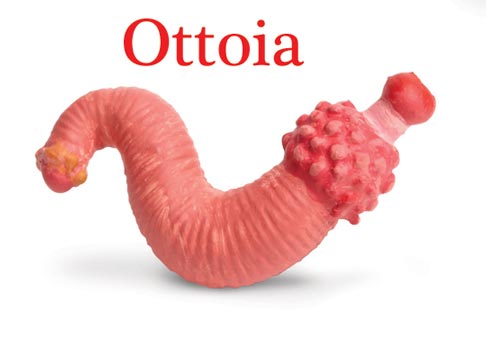
A Model of Ottoia (Safari Ltd Cambrian Life Toob)

A model of Ottoia (Safari Ltd Cambrian Life Toob).

A model of Ottoia (Safari Ltd Cambrian Life Toob).

Safari Ltd have a wonderful model of Ottoia in the Cambrian Life Toob.  This Toob contains a set of eight prehistoric animals that represent the bizarre fauna of the Cambrian explosion.

To view this Toob and other prehistoric animal model sets: Wild Safari Prehistoric World Models.

A Teeth, Hooks and Spines Associated with Ottoia spp.

The variety of fossil teeth, spines and hooks associated with Ottoia spp.

The variety of fossil teeth, spines and hooks associated with Ottoia spp.

Picture credit: Palaeontology Journal

7 05, 2015

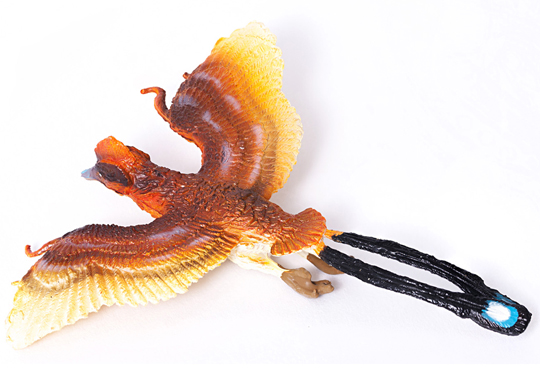
Early Birds Winding Back the Clock According to New Study

By |2024-05-05T13:37:03+01:00May 7th, 2015|Categories: Dinosaur and Prehistoric Animal News Stories, Dinosaur Fans, Main Page|0 Comments

Early Birds from the Early Cretaceous

Researchers from the Chinese Academy of Sciences have published information about a new species of ancient bird which suggests that the clade of Aves that produced today’s modern feathery friends, the Ornithuromorpha was around at least five million years earlier than previously thought.  The new species comes from strata that is estimated to have been laid down around 130.7 million years ago (Barremian faunal stage of the Early Cretaceous).  This new type of early bird, named Archaeornithura meemannae has been described from two beautifully preserved fossils (mostly, see below), discovered in the Protopteryx horizon, part of the Huajiying Formation (Sichakou basin, Fengning County, Hebei, north-eastern China).

 Archaeornithura meemannae

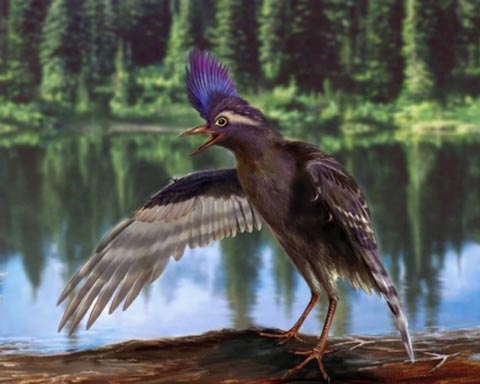
 Archaeornithura meemannae – A Very Early Bird

Archaeornithura meemannae - believed to adapted for wading.

Archaeornithura meemannae – believed to adapted for wading.

Picture credit: Institute of Palaeontology and Palaeoanthropology (Beijing)

The picture shows an artist’s illustration of this little bird that measured around fifteen centimetres in length.  The fossil has been preserved in fine-grained volcanic sediments and much of the plumage surrounding the delicate bones can still be seen.  Sadly, the skull and neck bones are not well preserved in either specimen and the researchers have been unable to confirm whether this bird had teeth in its jaws or not.  However, writing in the academic journal “Nature Communications”, the scientists identify this creature as the earliest known example of the Ornithuromorpha, the branch of the bird Order that led to the Neornithes (modern birds).

The previous earliest known example of a member of the Ornithuromorpha dates from rocks around 125 million years ago, this fossil too, was found in China.

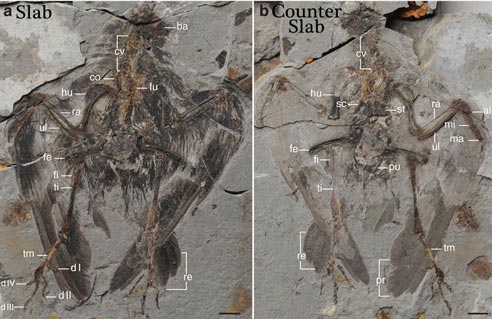
The Holotype Fossil of  Archaeornithura meemannae

The slab and counter slab showing the holotype.

The slab and counter slab showing the holotype.

Picture credit: Nature Communications

Early Birds

The picture above shows the slab (left) and the counter slab (right) of the holotype fossil, which like the second specimen is part of the vertebrate fossil collection at the Tianyu Museum of Nature (Shandong Province, China).

These early birds should feel very much at home at the museum, as it houses one of the most extensive collections of vertebrate fossil material excavated from Lower Cretaceous sediments in the world.  The binomial name Archaeornithura meemannae comes from the Greek “Archae” for ancient and “Ornithura”, so the genus name means “ancient Ornithuromorph”.  The species name honours Dr Meemann Chang in recognition of her work in the study of the Jehol Biota.

The environment of this part of north-eastern China during the Early Cretaceous was one of a sub-tropical climate, dominated by extensive forests interspersed by numerous large bodies of fresh water. The absence of feathers on the legs of A. meemannae and the long legs has led to speculation that this bird may have lived in a lacustrine habitat and been adapted to a wading life-style.

Little is known about the skull, so the diet can only be guessed at, but perhaps this ancient bird ate insects or pecked at water plants.  Although the research team cannot be certain, it has been stated that this early bird was not that interested in catching worms, as the proverb goes,  but it probably was a herbivore.

Ancient Bird

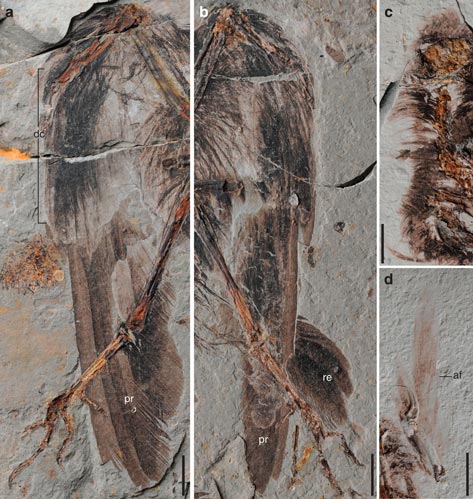
The Remarkably Well-Preserved Plumage (Wings)

A close up of the feathers on the wings.

A close up of the feathers on the wings.

Picture credit: Nature Communications

The picture above shows:

a). Left wing main slab holotype

b). Right wing main slab holotype

c). Feathers on the remnants of the head and neck

d). Alular feathers on the left digits with one very clearly visible wing claw.

Feather Adaptations

Alular feathers are found on the leading edge of the wings of birds (they are also associated with the limbs of some feathered dinosaurs, we think).  They help direct air over the upper surface of the wing, thus improving control and lift.  More primitive birds such as the confuciusornithids lack these feather adaptations.  Ornithuromorpha are believed to have comprised about half of the bird species that lived during the Mesozoic, the descendants of some of these birds from the Ornithuromorpha clade survived the Cretaceous mass extinction and evolved into modern birds.

The other major bird clade of the Mesozoic Era was the Enantiornithes, although common, this group died out and are not directly ancestral to modern birds.

Co-author of the study Wang Min (Chinese Academy of Sciences) stated:

“The new fossil represents the oldest record of Ornithuromorpha.  It pushed back the origination date of the Ornithuromorpha by at least five million years.”

To the casual observer, if you had travelled back in time to view Archaeornithura meemannae, it would have looked very similar to modern wading birds, except for the small claws visible on its wings.

The Chinese scientists conclude that by around 130 million years ago a number of avian lineages had already evolved and that it was quite likely that the Aves rapidly diversified during the early part of their evolutionary history.

PNSO have included models of several feathered theropods in their “Age of Dinosaurs” replica range: PNSO Age of Dinosaurs Models.

6 05, 2015

Dinosaurs and More Dinosaurs in 2015

By |2023-03-27T07:29:38+01:00May 6th, 2015|Categories: Dinosaur and Prehistoric Animal News Stories, Dinosaur Fans, Main Page, TV Reviews|0 Comments

“Dinosaur Britain” Documentary Commissioned by ITV

By now it could not possibly have escaped your notice that “Jurassic World”, the fourth in the “Jurassic Park” movie franchise opens next month (June 12th).  Another teaser trailer has just been put out and the film is certainly one of the most eagerly awaited cinema events of this year.  However, you don’t have to visit Isla Nublar to view dinosaurs, travel back in time and “dear old blighty” was home to a huge range of prehistoric animals including three types of tyrannosaurs*.

New Television Documentary

The very first scientific descriptions of dinosaurs in the early to mid 19th century were all based upon fossil discoveries made in the UK.  To mark the United Kingdom’s contribution to this sub-division of vertebrate palaeontology, ITV has commissioned the production company Maverick Television to transport Britain back to the Mesozoic to depict how this part of the world was once home to a myriad of prehistoric animals.

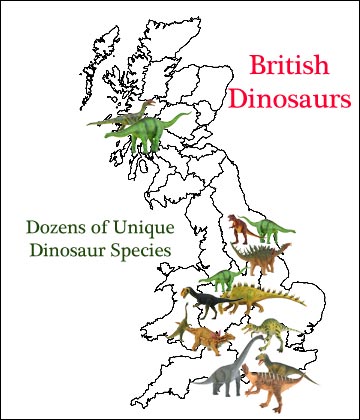
“Dinosaur Britain” A New Television Documentary

soo

Different dinosaurs and approximate locations.

Picture credit: Everything Dinosaur

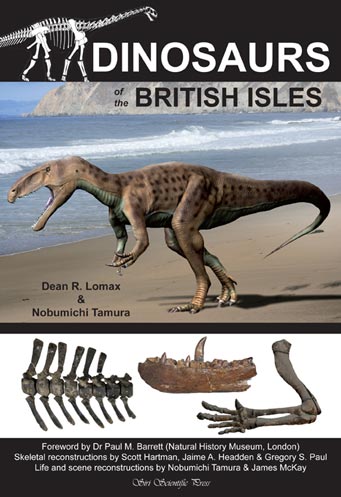
Over one hundred different species of dinosaur have been identified so far from fossils found in the British Isles.  This includes those three tyrannosaurs as mentioned above* [Eotyrannus lengi (Isle of Wight), Proceratosaurus bradleyi (Gloucestershire) and Juratyrant langhami (Dorset)].  Back in 2014, Everything Dinosaur reported on the first formal survey of British dinosaurs undertaken by a group of scientists, which included the very talented Darren Naish, a vertebrate palaeontologist from the University of Portsmouth.  In August of last year, we reviewed the excellent “Dinosaurs of the British Isles”.  This book provided a comprehensive guide to the different types of Dinosauria that once roamed around Britain.

Dinosaur Britain

To read Everything Dinosaur’s review of “Dinosaurs of the British Isles by Dean Lomax and Nobumichi Tamura: “Dinosaurs of the British Isles” Reviewed.

“Dinosaurs of the British Isles”

A comprehensive guide to British dinosaurs over 400 pages.

A comprehensive guide to British dinosaurs over 400 pages.

Picture credit:  Siri Scientific Press

For further information on this fantastic book and to order a copy: Siri Scientific Press.

Britain = Dinosaur Island

Not entirely accurate as for much of the Mesozoic, this part of the world was underwater and when dry land did occur in the past, it formed part of a much larger continental landmass, but that’s not the point, for the last eight thousand years or so, Britain has been an island and there is a wealth of dinosaur and other prehistoric animal fossils to be found in the British Isles, so much so, that it has inspired the commissioning of a new two-part television documentary series.

ITV has commissioned Maverick Television (creators of programmes such as “Embarrassing Bodies” and television make-over shows such as “How to Look Good Naked”), to make two, one-hour long documentaries examining the types of different dinosaur that existed in the British Isles.  Everything Dinosaur understands that the working title for this series is “Dinosaur Britain” and CGI techniques will be used to place ancient creatures in modern-day settings.  So if you fancy seeing an iguanodont wandering around Kent or a Megalosaurus taking a stroll through the centre of Oxford then this new television series might just float your boat!

Attempting to Educate Viewers

Director of Factual Output for ITV, Richard Klein has ordered the programmes which will attempt to educate viewers not only on the types of dinosaur that once existed in the UK, but also to provide information about the habitats and ecosystems of the UK during the Age of the Dinosaurs.  Dinosaur fans can expect lots of hunting and fighting sequences too.

A spokesperson from Everything Dinosaur stated:

“Britain has a rich fossil heritage, of which the Dinosauria makes up only a small part.  However, with more than one hundred different dinosaurs identified from fossils found in the British Isles, documentary makers have a huge cast list to choose from.  Giants like Pelorosaurus and Brachiosaurs to fearsome predators like Becklespinax and Megalosaurus, which was the first dinosaur to be scientifically named and described.”

At the time of writing we are not sure when these programmes will be shown, but one thing is for sure, with all the hyperbole surrounding “Jurassic World”, we can expect dinosaurs to have a much bigger media footprint (even bigger than usual), over the next couple of years.

To view the CollectA Prehistoric Life range with its assortment of models representing “British Dinosaurs”: CollectA Prehistoric Life Models.

5 05, 2015

Great Work from Great Wood Primary School

By |2023-03-27T07:26:25+01:00May 5th, 2015|Categories: Educational Activities, Main Page, Teaching|0 Comments

Year 2 Learn All About Dinosaurs in the Great Outdoors – Dinosaur Workshop

It was certainly an interesting morning when Everything Dinosaur visited the two classes of Year 2 at Great Wood Primary School (Morecambe).  The children had just started learning all about prehistoric animals as part of their term topic “Jurassic Forest”.  One of our fossil experts visited the school as part of the planned scheme of work to help inspire and enthuse children and teachers alike.  Unfortunately, the fire alarm sounded part way through the first session and the whole school had to be evacuated.

Dinosaur Workshop

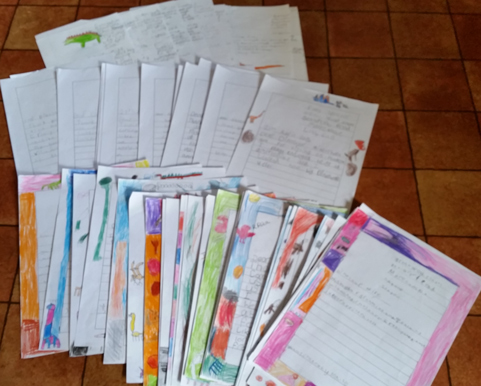
However, it was a sunny day, so undaunted, we were able to continue by moving everything outside.  With the minimum of fuss, the pupils in Mrs Parkin’s class settled themselves down in the playground  and we were able to deliver a second workshop.   Everything Dinosaur’s “Dinosaur Mike” challenged the two classes (2T with Mrs Todd and 2P with Mrs Parkin), to send in thank you letters as part of an agreed extension activity to help encourage the children with their composition and sure enough, at the end of last week, we received a large envelope which contained letters and some very colourful dinosaur drawings.

 A Wonderful Set of Letters Sent in by Year 2

Letters and drawings sent in by children at Great Wood Primary.

Letters and drawings sent in by children at Great Wood Primary.

Picture credit: Everything Dinosaur

Dinosaur Workshop at Great Wood Primary School

Writing a thank you letter to Everything Dinosaur is a good way for the teaching team to check learning following a recount activity.  This composition exercise helps young learners practice sentence sequencing, planning their writing, as well as spelling and the layout and format of a letter.  The children can also read their letters out aloud as part of a further teaching activity within the class.

Examples of Thank You Letters Received by Everything Dinosaur

Super examples of letter writing from the children.

Super examples of letter writing from the children.

Picture credit: Everything Dinosaur

Thank you Eva and Zak for your lovely letters.

Thank You Letters and Drawings

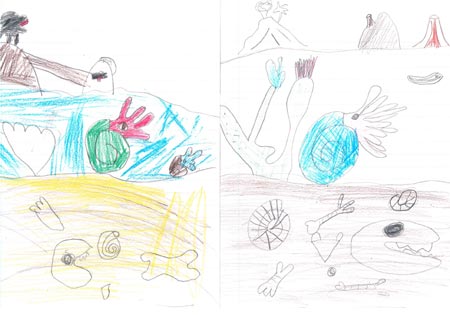
Some children had taken the opportunity to draw pictures of fossils and prehistoric animals on the back of their thank you letters.  We were impressed with the drawings and we shall pin some of these up onto our warehouse notice board.

Year Two Sent in some Colourful Drawings

Can you spot the Ammonites?

Can you spot the ammonites?

Picture Credit: Everything Dinosaur

Super writing from Izzy and Mae with two lovely drawings too.

To learn more about the team members at Everything Dinosaur: About Us.

So Many Letters for Us to Read!

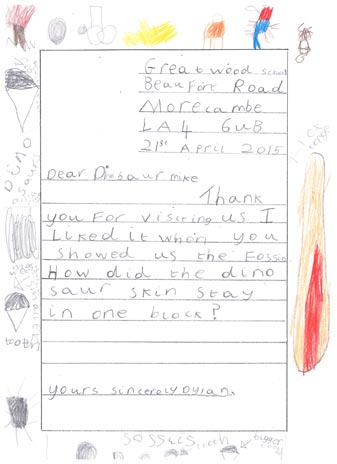
An example of one of the letters we received, thank you Dylan.

An example of one of the letters we received, thank you Dylan.

Picture credit: Everything Dinosaur

Dinosaur Mike commented:

“Once it was realised that the fire alarm going off was due to building work being undertaken around the school, the teaching team and administration staff at Great Wood Primary soon got all the children organised.  After the fire drill procedures had been carried out, we were able to continue the dinosaur themed workshop outside.  Fortunately, it was sunny and not too cold.  We were able to adjust our lesson plan and continue working.  We do appreciate that, just like the teachers, we sometimes have to be very flexible.”

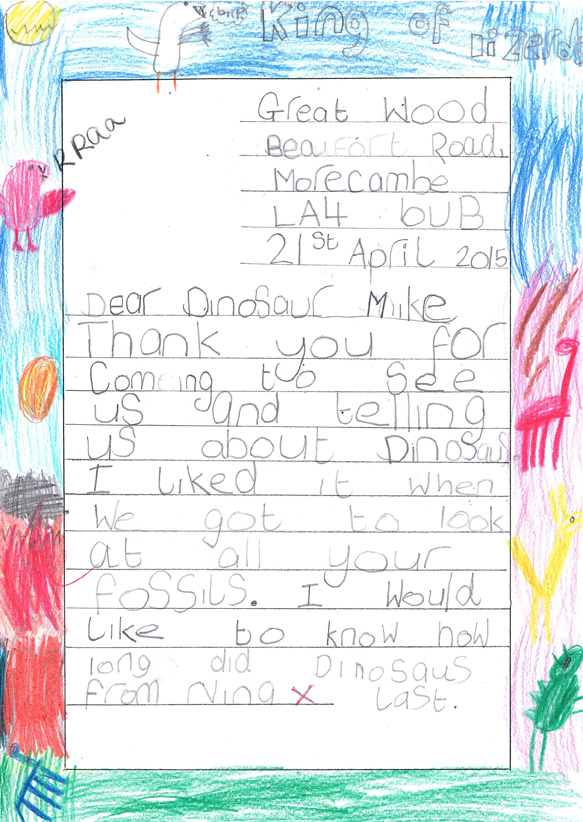
Nina’s Very Bright and Cheerful Thank You Letter

We were sent lots of very colourful letters.

We were sent lots of very colourful letters.

Picture credit: Everything Dinosaur

How Long Did the Dinosaurs Last?

Nina asked “How long did the dinosaurs last?”  The first dinosaurs evolved perhaps as early as 240 million years ago, the last of the Dinosauria died out 66 million years ago.  That’s a really good question, well done Nina.

Our thanks to 2T and 2P for sending us some wonderful examples of writing.

Everything Dinosaur stocks a wide range of dinosaur themed toys and games: Dinosaur Themed Toys and Games.

Go to Top