All about dinosaurs, fossils and prehistoric animals by Everything Dinosaur team members.

Articles, features and stories with an emphasis on geology.

28 12, 2013

Paying Tribute to the Remarkable Dr Bill Birch (Museum Victoria)

By |2024-05-02T06:56:35+01:00December 28th, 2013|Categories: Dinosaur and Prehistoric Animal News Stories, Famous Figures, Geology|0 Comments

“Old Rocker” Set for Retirement

The turn of the year might be a time for new beginnings, but for one member of the Museum Victoria’s dedicated staff, the last day of December marks retirement after forty years as a curator.  The Museum’s (Museum Victoria, based in Melbourne, Victoria, Australia), longest serving employee, Senior Curator for Geosciences Dr Bill Birch is going to be leaving the museum, but the dedicated geologist will still be making a contribution to Victoria’s geological heritage.

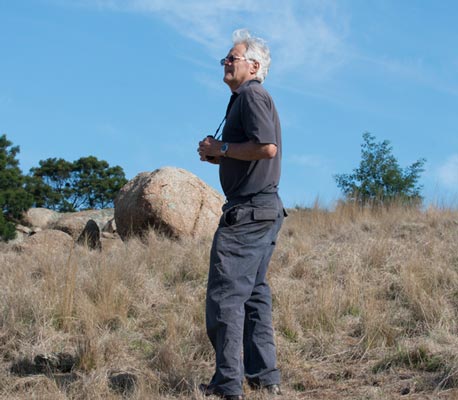
Dr Bill Birch

Very few visitors to a museum fully appreciate the hard work and sheer effort that goes into maintaining exhibits, looking after collections and managing departments.  With the news of Dr Birch’s retirement, we at Everything Dinosaur, who do a lot of work with museums and other institutions around the world, wanted to take time out to pay tribute to all the enthusiastic and long-serving members of museum staff who do so much to help with public outreach and education.

Dr Bill Birch Set to Retire on December 31st
After forty years service Dr. Bill Birch retires.

After forty years service Dr Bill Birch retires.

Picture credit: Museum Victoria

A Long and Successful Career

Dr Birch’s career at the Museum began in January 1974.  One of his first tasks was to update the historical geological collections and to apply modern approaches to curating as well as expanding the material held at the Museum via field trips, donations and acquisitions.  As well as assembling an extensive inventory of Victoria’s diverse geological make-up, he has built the international component of the collections through expeditions to Greenland, Siberia, Pakistan, and Canada.

He regards those collecting excursions as some of many highlights of those forty years, alongside the Dynamic Earth exhibition, which opened in Melbourne Museum in 2010.

Commenting on the highly successful exhibition, Dr Birch stated:

“Before then, very few of our best specimens were on display for the public to see.  That exhibit has put some of our discoveries and acquisitions front and centre.”

Thanks to his efforts, in collaboration with colleagues, the Melbourne based museum has established a strong, world-wide reputation for geological research.  Bill, himself has written several books, had many hundreds of academic papers published and the Museum Victoria has more than forty “type” specimens of new minerals that Dr Birch helped to formally describe amongst its much expanded collections.

With a life-long passion for geology, Bill describes never having felt unhappy about going to work and states that the Museum’s collections “became the foundation of my working life”.

Dr Bill Birch on the Hunt for More Specimens
Dedicated geologist set to retire.

Dedicated geologist set to retire.

Picture credit: Museum Victoria

One of the great joys about geology (and palaeontology for that matter), is that you are never too young or too old to get involved.  Official retirement might beckon after forty years of dedicated service, but for Dr Birch there is still so much work for him to do.  He is expecting to work up to three days a week on further research as an Honorary Research Associate and Emeritus Curator with Museum Victoria.

Today, we pay tribute to all the those hard working, enthusiastic people, like Dr Bill Birch, who have contributed so much over a their long careers in the Earth Sciences.

Have a long and happy retirement.

3 10, 2013

Conditions at Lake Urmia shed Light on Palaeozoic Environments

By |2023-02-24T10:31:14+00:00October 3rd, 2013|Categories: Dinosaur and Prehistoric Animal News Stories, Geology, Palaeontological articles|2 Comments

Salt Lake in northwestern Iran Mirrors Permian Environmental Crisis

Observations made as environments change today can sometimes provide scientists with valuable insights when it comes to studying the fossils of extinct creatures.  Studies into the way climate change affects animals and plants can provide researchers with helpful information when it comes to interpreting fossil evidence.  One such example of this concerns comparisons being made by scientists as Lake Urmia in northwestern Iran dries up to the plight of an ancient ecosystem that was to form part of South America.

Lake Urmia

For Iranian biologist Amin Khaleghparast and Dr Graciela Piñeiro (from Uruguay), breeding stress observed amongst Lake Urmia’s Flamingo population might be mirroring stress amongst a population of ancient Parareptiles as their environment changed.  Lake Urmia was the third largest salt water lake on Earth, and the largest body of salty water in the entire Middle East.  However, over the last fifty years or so the volume of the Lake has been much reduced.  Dams constructed across the rivers that feed Lake Urmia, the increasing demand for water for agriculture and the impact of severe droughts have reduced the Lake to a fraction of its former size.

The Flamingos are filter feeders and rely on brine shrimp (Artemia urmiana) as a food source.  As the water volume of the Lake is reduced, much of what was formerly open water is changing into a salt marsh.  This has led to a reduction in suitable habitat for the Flamingos and a decline in brine shrimp numbers.  With the drying up of Lake Urmia the scientists have witnessed a severe decrease in Artemia populations which has had dire consequences for other animals further up the food chain, including the Lake’s Flamingos.  Many Flamingos have failed to breed, a number of eggs have been aborted and a substantial number of Flamingo hatchlings have died.

Drawing Parallels with the Permian

The scientists have drawn parallels between these observations and a similar situation that may have affected a population of reptiles, (mesosaurs) in South America some 280 million years ago.

To read a short article on the drying up of Lake Urmia: The Ecological Crisis at Lake Urmia.

Dr Piñeiro and her colleagues produced an academic paper, published in 2012 (International Journal of Paleobiology), that highlighted the discovery of a number of Mesosaurus fossils including amniotic embryos, some of the earliest evidence yet of reptile embryos and possible viviparity (live birth) in the Reptilia Class.  Intriguingly, the discovery of an isolated embryo might suggest breeding stress in the population that led to the abandonment of this egg or a possible miscarriage.

Mesosaurs

Mesosaurs such as Mesosaurus were small aquatic reptiles that lived during the Permian.  They had elongated jaws lined with very fine, needle-like teeth that would have helped them to strain arthropods such as brine shrimps out of the water in which they lived.  These reptiles were perhaps the first group of amniotes to adapt to living in marine habitats.  Although mesosaurs are descended from terrestrial reptiles, their long, flexible bodies, paddle-like tails and webbed digits indicate adaptations to a nektonic, marine lifestyle.  These reptiles had thickened ribs which palaeontologists believe was an adaptation to help these small animals counteract their own buoyancy and helped them to remain underwater.

Mesosaurus Specimens
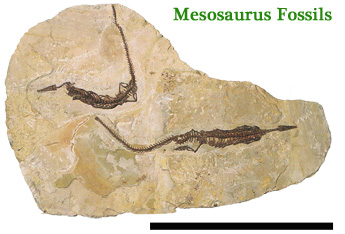
Ancient reptiles adapted to marine environments.

Ancient reptiles adapted to marine environments.

Picture credit: Everything Dinosaur

The scale bar in the picture is approximately seventy-five centimetres long.

Permian Reptilian Fauna

Although, these animals were not the most spectacular looking of the Permian reptilian fauna, their fossils, which have been found in Uruguay, Brazil as well as in western Africa helped to reaffirm the theory of continental drift first proposed by the German meteorologist Alfred Wegener.   Wegener observed that the coastline of west Africa fitted neatly into that of South America’s east coast, even though the Atlantic Ocean separated these two landmasses.  He proposed that some time in the past these two continents had been joined together.  His observations were supported by fossil evidence of creatures such as the mesosaurs which have been found in rocks on now widely separated continents.  Mesosaurs were unlikely to be capable of crossing such vast bodies of water as today’s oceans, so such fossils supported the idea that some time back in ancient history South America and Africa were joined together.  Such evidence helped to establish the theory of plate tectonics (continental drift).

The Fossil Record Provides Supporting Evidence for Plate Tectonics
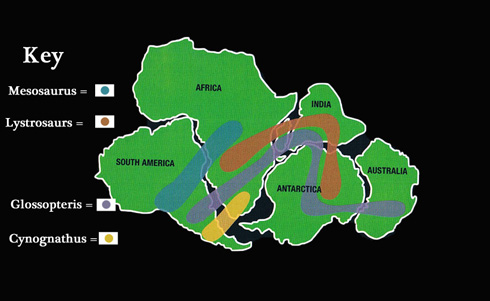
Fossils support evidence of plate movements.

Fossils support evidence of plate movements.

Plate Tectonics

The diagram above shows where fossils of Mesosaurus, lystrosaurs (a terrestrial dicynodont), Cynognathus (a terrestrial cynodont) and Glossopteris (a pteridosperm [seed fern]) have been found.  These discoveries provide supporting evidence for the theory of these disparate land masses once being joined into a super-continent.

In the Carboniferous, a group of terrestrial animals evolved that would eventually dominate vertebrate life on our planet. These were the amniotes a group that includes mammals, birds and reptiles today.  The early amniotes evolved a unique way of protecting embryos inside their eggs.  Amniotic eggs have a semi-permeable shell that protects the egg from drying out.  An internal membrane known as the amnion surrounds the yolk and the embryo, this effectively means that the free-swimming larval stage seen in the Amphibia could be dispensed with.  Later synapsid amniotes evolved the ability to retain embryos internally thus affording the embryo greater protection (as seen in extremis in marsupial and placental mammals today).

Amin Khaleghparast and Dr Graciela Piñeiro postulate a relationship between an ancient salt lake in Pangea and Lake Urmia:

“There is it some similarity between intense evaporation of the ancient Great Salt Lake where Mesosaurus lived and conditions that lead to the drying Lake Urmia, a great salt lake in northwestern Iran, turning large part of it into a salt marsh in last decade. Like Flamingos filter-feed on brine shrimp (Artemia urmiana) in the salt lake, Mesosaurus filter-fed on an extinct group of crustaceans (Pygocephalomorpha) in waters poorly oxygenated and highly saline during the Early Permian. With the drying Lake Urmia,unfortunately, we witnessed severe decrease of Artemia, Flamingos’ abortion, death of many Flamingo young and at last Flamingo migration.”

Mesosaur Fossil Discovery

The discovery of an isolated fossilised embryo could demonstrate that the population of mesosaurs was under environmental pressure as their habitat changes.  According to the scientists this fossil could represent “either a miscarried embryo or an aborted egg”.

The bodies of the animals perished in hypersaline conditions, the degree of preservation is exceptional.  This can be explained by the fact that hypersaline states are associated with very low concentrations of oxygen which in turn creates an environment in which bacteria, responsible for the decomposition of organic matter cannot act.  These amniotic mesosaur embryos provide some of the earliest evidence yet of reproduction biology of vertebrates preserved in the fossil record.  In some specimens, the absence of a recognisable eggshell in association with articulated well-preserved embryos within an adult suggest that mesosaurs may have been viviparous or at least that they laid eggs in an advanced state of development.

Mesosaurus Embryo Fossils – Did they Face the Same Fate as Lake Urmia’s Flamingos?
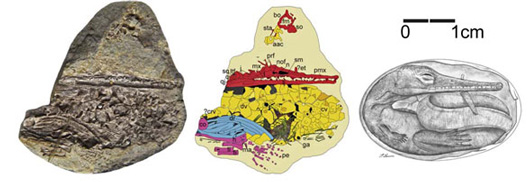
Sharing the same fate as Lake Urmia's Flamingos?

Sharing the same fate as Lake Urmia’s Flamingos?

The picture above shows on the left the fossil of the meosaurus embryo curled up within its amniotic membrane (no egg shell preserved).  The middle component shows a stylised tracing of the fossil, with a life-size drawing of the Mesosaurus embryo on the right.

To read more about the South American fossil discoveries: Early Evidence of Viviparity from South America.

Everything Dinosaur acknowledges the help of Amin Khaleghparast in the compilation of this article and for pointing out the relationship between Lake Urmia and the drying up of shallow seas in the Carboniferous.


10 09, 2013

In Praise of Local Geology Societies and Groups

By |2023-02-23T08:35:48+00:00September 10th, 2013|Categories: Everything Dinosaur News and Updates, Geology|0 Comments

The Essex Rock and Mineral Society- Recognising the Contribution of Local Societies

When lecturing in schools, universities and other educational establishments the point is often made by team members at Everything Dinosaur, that geology and palaeontology are subjects not just for professional scientists and academics.  Many important discoveries and valued contributions to science have been made by people who would never dream of describing themselves as scientists.

Their enthusiasm, patience and dedication leads to exciting finds and fresh insight, we are very lucky in the United Kingdom to have a large number of local societies consisting of volunteers and enthusiasts who devote a significant part of what spare time they have to their passion for geology and fossils.

The Essex Rock and Mineral Society

One such society is the Essex Rock and Mineral Society (ERMS) and Bob, a long standing member of this group, was in contact with Everything Dinosaur a few days ago, taking the time and trouble to update us on the Society’s activities and plans.  The ERMS was formed in 1967 and boasts members from all over Essex, Kent and London, the Society even has a member based in Canada.  Bob a former police officer, recalls how he first became involved with the ERMS when on duty late one night in 1987.

“Whilst serving at Harold Hill police station, I was working a ‘late’ shift one day when I encountered some people loading a car with boxes at the rear of a community hall which appeared to be shut.  This was not to my liking and upon investigation I became aware that it was members of the Essex Rock and Mineral Society packing away material after holding one of their monthly meetings.  As a result of that contact, an invitation was extended to attend one of their meetings so I attended their next meeting and consequently became a member of the society.”

Local Geology Societies

The Society now meets once a month, on the evening of the 2nd Tuesday of each month.  A pre-determined lecture programme is prepared and speakers are invited from all kinds of institutions to provide a talk (with plenty of time for questions no doubt), on a geology related subject.  For example, the June meeting focused on the exploration of Mars by the Curiosity Rover with the speaker, one of the editors from the magazine formerly known as the “Sky at Night”, providing a highly entertaining and illuminating presentation summarising the current research that is taking place on the red planet.

Fossil collectors have the chance to bring in their latest fossil finds and get friendly advice and support, the Society even organises a number of field trips each year.

Essex may not be the first place people think of when it comes to the location of important fossil discoveries, but the geology of this county is fascinating.  Much of the county has “drift” deposits those moraines and riverine deposits left by glaciers or by river channels.  Underlying these surface deposits are older geological features with the oldest exposures dating from the Late Cretaceous.  These chalk deposits are a testament to the time when much of the United Kingdom and Europe was covered by a shallow, tropical sea.

Areas of coastal cliff in Essex are viewed as being some of the most significant in terms of climatology studies.  For instance, the cliffs at Walton-on-the-Naze are internationally recognised for providing data on global cooling, evidence set in the rocks of the beginning of an Ice Age.  Visitors to these cliffs, can see for themselves how the fossil shells preserved in the layers of strata change the higher up the cliffs you go.  Warm water species are replaced by cold water species – signs of global cooling.

It may sound rather odd to the casual observer, but as Everything Dinosaur team members will testify ,when surrounded by numerous dinosaur fossils being mapped on a Canadian dig site, the conversation often reverts to the sites of important palaeontological interest back home in the UK and places like Walton-on-the Naze and the extensive shark teeth beds of Herne Bay are discussed, we can see the look of envy in the eyes of our colleagues.

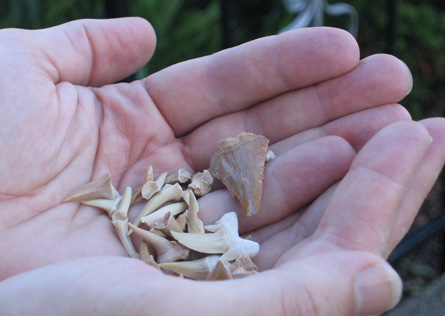
Shark Teeth Can be Collected in Huge Numbers from Parts of Britain’s South-East Coast

A successful fossil hunt.

A successful fossil hunt.

Picture credit: Everything Dinosaur

Visit Everything Dinosaur’s award-winning website: Everything Dinosaur

Rock and Mineral Shows

One of the highlights for the ERMS is their annual “Rock, Mineral and Fossil Show” which is held at the North Romford Community Centre (Essex).  This “very sociable show” is open to the public, it takes place in February and gives local enthusiasts and professional dealers one of the first opportunities of the year to showcase their discoveries made over the autumn and winter months.  Lots of displays and other items with a geology theme – minerals, rocks, crystals and of course loads of fossils to see.

Many of the fossils on display at the annual show will be specimens from the famous “London Clay”.  This geological feature consists largely of mud and silts deposited into tropical, estuarine environments during the Palaeogene.  London Clay exposures can be found throughout Essex and many important vertebrate and plant fossils have been found.  Fossils of fish, crocodiles, sea snakes, primitive mammals, turtles and a large number of fossilised seeds and other plant material has enabled scientists to build up an detailed picture of life in the Essex area around 55 million years ago.

The Contribution of Society Members

Organisations such as the ERMS provide a valuable contribution to science.  Society members can and have made significant contributions to the professional world in geology.   In the 1990’s three ERMS  members, including ex police officer Bob,  found previously unknown species of fossil crabs which were thus new to science.  The specimens have been described and named and are now all in official museum collections.

For Bob and his associates, the ERMS has provided an enormous sense of community, life-long friendships forged as a result of a common interest in geology and studying ancient life.

Bob puts it very succinctly:

“This society provides ordinary people with an opportunity to experience an aspect of natural history that is frequently overlooked by the general media.  My membership has been a most pleasurable experience in my life that has given me opportunities to see and do things that I would have never considered otherwise.  The subject itself and the friendships I have made in this society have given me a desire to experience the natural history of our planet in greater depth than would otherwise have been possible .”

We have taking time out of our busy schedules to pay tribute to the vast number of enthusiasts, fossil collectors and amateur geologists who help make the sciences of palaeontology and geology what they are today.  The Essex Rock and Mineral Society is a typical example and we wish everyone involved with this splendid institution the very best for the future and we look forward to hearing more about their work and their fossil discoveries.

To learn more about the Essex Rock and Mineral Society, (actual website address: www.erms.org), visit their website: The Essex Rock and Mineral Society.

4 09, 2013

Oldest Known Terrestrial Animal from Gondwanaland – A Sting in the Tail

By |2023-02-22T13:38:14+00:00September 4th, 2013|Categories: Dinosaur and Prehistoric Animal News Stories, Geology, Palaeontological articles|0 Comments

A tourist to the south eastern tip of what was to become the continent of Africa 350 million years ago would have had to watch where they were treading as scorpions were lurking amongst the primitive plants.  We know this because Dr Robert Gess from the Evolutionary Studies Institute at the University of Witswatersrand (Johannesburg), has discovered the fossilised exoskeleton of one such creature.  This unique specimen, a new species named Gondwanascorpio emzantsiensis represents the oldest known terrestrial animal from the super-continent of Gondwana discovered to date.

Gondwanascorpio emzantsiensis

Fossils of terrestrial animals are known from the super-continent of Laurasia, but this is a first for the ancient landmass that dominated the Southern Hemisphere during the Late Devonian and into the Carboniferous.

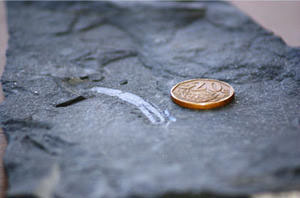
A Photograph showing the Scorpion’s Pincers (Gondwanascorpio emzantsiensis)

Coin provides scale
Coin provides scale.

Picture credit: University of Witwatersrand

Oldest Known Terrestrial Animal

Commenting on his fossil find, Dr Gess stated that early life arose in the sea and that colonisation of the land took place much later on in the history of life on Earth.  This process is believed to have begun back in the Silurian geological period, approximately 420 million years ago, although some palaeobotanists have suggested that microscopic spores preserved in Ordovician strata indicate that plant life was established on land even earlier.

Once plants had become established on land in significant numbers, then detritus and plant eating invertebrates followed, animals such as primitive arthropods.  By the Late Silurian, around 415 million years ago, terrestrial food chains were much more complex with apex predators such as mites, scorpions and early spiders feeding on the herbivorous invertebrates.  By the Late Devonian, some 365 million years ago, the first vertebrates (tetrapods) had ventured out onto land.

The First Tetrapods

Some palaeontologists believe that the first vertebrates were established on land some 390 million years ago, click the link below to read an article published by Everything Dinosaur in 2010, that provides details of a remarkable fossilised trackway studied by Polish scientists: Tetrapods Venture onto Land Thirty-Five Million Years Earlier.

Fossils found in Palaeozoic strata that represent the land mass of Laurasia, a super-continent the straddled much of the northern hemisphere in the Devonian, suggest that this landmass was inhabited by a diverse and abundant group of invertebrates.  Laurasia and Gondwana were separated by an ocean over a thousand miles across at its widest extent.

Evidence of the earliest colonisation of land animals has until now come only from the Northern Hemisphere continent of Laurasia (land that was to form North America, parts of Europe and Asia), and there has been no evidence that Gondwana was inhabited by land living invertebrate animals at that time, however, the discovery of this Southern Hemisphere scorpion suggests that Gondwana too, had its fair share of creepy crawlies.

An Invertebrate Predator on Land

The discovery of an invertebrate predator leads to the assumption that there were other invertebrates present that this creature would have fed upon.  This new species has been named Gondwanascorpio emzantsiensis.

Dr Gess stated:

“For the first time we know for certain that not just scorpions, but whatever they were preying on were already present in the Devonian.  We now know that by the end the Devonian period Gondwana also, like Laurasia, had a complex terrestrial ecosystem, comprising invertebrates and plants which had all the elements to sustain terrestrial vertebrate life that emerged around this time or slightly later.”

The Witpoort Formation

The fossil fragments were found in black carbonaceous shale which represents a marine lagoon and an estuarine environment.  The fossiliferous material is from the Witpoort Formation (Witteberg Group) at a location known as Waterloo Farm, near Grahamstown, South Africa.  Other organic material identified includes traces of algae, terrestrial plants, small fish, a sea scorpion (Eurypterid) and a number of molluscs.  All the fossil material ascribed to G. emzantsiensis consists of two-dimensional compressions in which all the original organic material has been replaced by secondary metamorphic mica.  The mica has largely been altered to chlorite during the uplifting of the strata.  The Witpoort Formation strata at the Waterloo Farm location were laid down towards the end of the Devonian (Famennian faunal stage), approximately 360 million years ago.

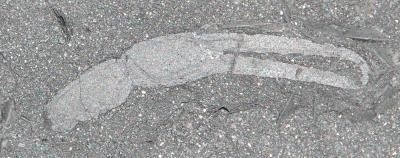
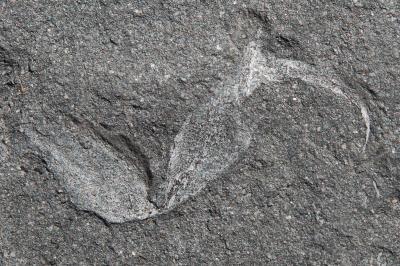
A Close up of the Preserved Pincers

The fossil shows a pincer of the terrestrial scorpion.
The fossil shows a pincer of the terrestrial scorpion. Picture credit: University of Witwatersrand.

Picture credit: University of Witwatersrand

The Discovery of a Palaeozoic Scorpion

The fossil material represents the first discovery of a Palaeozoic scorpion from Gondwana.  In the scientific paper, published in the academic journal “African Invertebrate”, the researchers note that this fossil find is extremely unusual as it comes from rocks deposited at a far higher latitude (much closer to the South Pole), than that at which extant or fossil scorpions are known to have occurred.  The authors suggest that this discovery may suggest that the climate in the southern hemisphere during the Late Devonian was much more uniform than it is today.  Temperatures at high latitudes may have been much higher than they are today.

Gondwanascorpio emzantsiensis Possessed a Powerful Sting

Gondwanascorpio sting
Scorpion had a powerful sting. Picture credit: University of Witwatersrand.

Picture credit: University of Witwatersrand

Devonian Ecosystems

The scientists report that the presence of this scorpion from Gondwana, one that is similar to already described Laurasian taxa is consistent with the growing body of evidence that suggests globally comparable terrestrial ecosystems by the end of the Devonian.  Gondwanascorpio, as the oldest terrestrial animal from Gondwana and its fossil material along with progymnosperm plant material (Archaeopteris) that has also been described from fossils found at Waterloo Farm, suggests that marine marginal ecosystems may have been very similar across the world during the Late Devonian.  It has been speculated that this uniformity may have been a consequence of the increasing proximity of Laurasia to Gondwana as the deep ocean that once separated these super-continents began to close up.

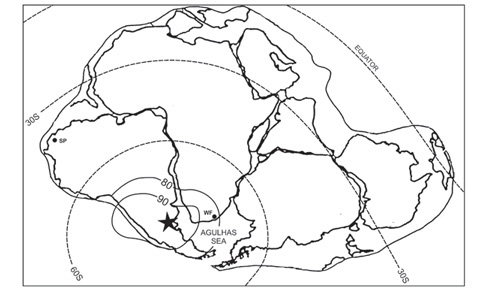
The Location of the Waterloo Farm Site Mapped onto a Late Devonian Map of Gondwana

Waterloo Farm site (South Africa)
Map showing the location of the Waterloo fossil site. Picture credit: University of Witwatersrand.

Picture credit: University of Witwatersrand

The map above shows a reconstruction of the super-continent of Gondwana with the South Pole represented by a large black star.  The Waterloo Farm location is marked by the symbol “WF”.  The map shows the position of landmasses towards the end of the Devonian/early Carboniferous.  The Waterloo Farm deposits are coastal and close to the South Pole.

Everything Dinosaur acknowledges the assistance of a media release from the University of Witwatersrand in the compilation of this article.

For models and replicas of Palaeozoic creatures: CollectA Prehistoric Life Replicas.

23 08, 2013

Important Dinosaur Fossil Site Threatened by Floods

By |2023-02-22T07:50:10+00:00August 23rd, 2013|Categories: Dinosaur and Prehistoric Animal News Stories, Geology|0 Comments

Dinosaur Fossil Sites in Heilongjiang Province Flooded

The important dinosaur excavation sites located at the foot of mountains in Jiayin County, Heilongjiang Province (north-eastern China), are in danger of being irreparably damaged as flood waters have covered much of the area where palaeontologists and field scientists have been working.  All four dinosaur dig sites have been immersed in flood waters since the Heilong river burst its banks last week.  The water levels, a record high for this part of China, could damage the delicate fossil material, cause exposed fossils to break up and others to be washed away in sediments.

Dinosaur Fossil Site

The strata in this part of China has revealed a number of important Mesozoic vertebrate fossils, some found nowhere else on Earth.  A fossil record of a rich ecosystem could be seriously damaged, with much material lost forever.

Ironically, much of the fossil material was deposited in the region as a result of the action of river water and periodic flooding, now nature seems bent on taken back what it once gave.  A spokes person has stated that the losses caused by the flooding would be “inestimable”.

Investment in Flood Defences

Over the last few years, the state has invested in a number of flood defences and water management systems near the fossil sites, but dikes built to arrest any flood waters have not been able to cope with the volume of water.  Flooding has also inundated the nearby Heilong River Basin Museum.  Water first entered the building on Saturday August 17th and parts of the first floor of the museum are now under over a metre of water.  Staff and volunteers have been working hard to remove artefacts and specimens to the second floor in order to prevent further damage.

The museum was built on an island in the river, but no one envisaged such high water levels.  Some parts of the Heilong River Basin are now covered in several metres of water and the authorities are concerned that water levels could rise further leading to more damage to the Province’s infrastructure and the important fossil rich strata of the area.

Floods and Typhoon Hit China

Chinese state media has reported that at least 105 people have died and a further 115 are missing after floods and a typhoon hit parts of China.  Heavy rain in the north-east of the country has been falling since Wednesday of last week and this has caused substantial flooding and devastation.  Typhoon Utor hit southern China, making landfall in Guangdong Province and this has caused devastation and at least a further 22 people have lost their lives.

Described as some of the worst flooding seen in living memory, volunteers, officials and state workers are working hard to strengthen flood defences in those parts of the country affected.

13 08, 2013

Neanderthals Made the First Specialised Bone Tools In Europe

By |2023-02-21T16:58:18+00:00August 13th, 2013|Categories: Dinosaur and Prehistoric Animal News Stories, Geology, Palaeontological articles|0 Comments

Neanderthals Shaped Animal Bones So That They Could Work Leather

For many thousands of years, modern humans (Homo sapiens) and Neanderthals (Homo neanderthalensis) lived in western Europe, it is not known how much interaction there was between these two species of hominids.  Neanderthals, far from being the slow-witted, ape-men of Victorian literature were very well adapted to living in cold climates, skilled tool makers and very capable hunters. In Neanderthal fossil sites dated to near the time when this species became extinct, a few thousand years after the arrival of modern humans in western Europe, tools and other objects have been found that are very similar to those found in contemporaneous fossil sites of modern humans.

Neanderthals

Neanderthals show behaviours similar to those associated with modern humans and have similar fine tools, such as small stone blades and bone implements.

Evidence of Neanderthals Being Skilled Leather Workers

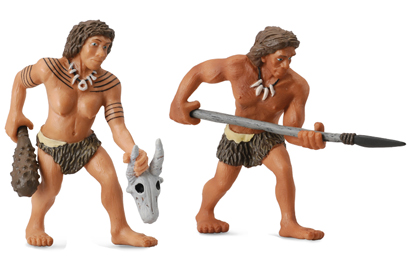
CollectA Neanderthal Models.

Human and Neanderthal genetic research. Evidence suggests that Neanderthals were skilled leather workers and therefore able to make clothes.

The picture (above) shows two CollectA Neanderthal models, to view these replicas (whilst stocks last): CollectA Prehistoric Life Figures.

Sophisticated Behaviours

It had been thought that much of these sophisticated behaviours inferred from artefacts found at Neanderthal fossil sites, had been developed as a result of contact between Neanderthals and our own species.  Modern humans arrived in western Europe around 40,000 years ago and it is after this date that such sophisticated tools turn up in Neanderthal dig sites.

In a new study, published in the academic journal the Proceedings of the National Academy of Sciences (USA), a team of researchers report the discovery of specialised bone tools previously only associated with Homo sapiens that date from a Neanderthal site that is at least 50,000 years old  – before (so it is thought),  the arrival of modern man in western Europe.  This suggests that Neanderthals did not learn sophisticated tool making skills from us, they may have developed such technologies themselves.

Tools Made from Animal Bones

Co-author of the study, Zenobia Jacobs of the University of Wollongong (New South Wales, Australia) stated that the tools were polishing tools made from animal bones.  These “lissoir” tools were used to work the hides of animals and the Neanderthal bone tools predate similar discoveries made in western Europe by about 10,000 years.

The tools were found in south-western France and the University of Wollongong has been engaged in a major project to assess Neanderthal and early human European cultures.  This new study, forms just part of the University’s research.

This discovery implies that the two hominid species either learned how to work animal skins separately, or modern humans may have picked up the skills required from the Neanderthals.  Dr. Jacobs suggests that it may have been the later, with modern humans learning from Neanderthals.

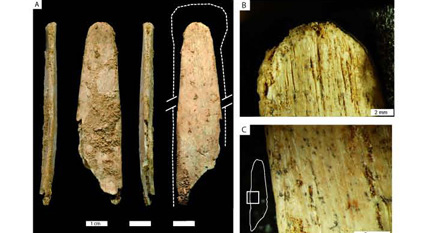
The Bone Tools Discovered at the Site in South-western France

Bone tools shaped by Neanderthals for working animal skins.

Bone tools shaped by Neanderthals for working animal skins.

Picture credit: Proceedings of the National Academy of Sciences

Picture A shows a bone tool, the dotted line shows the original shape of the bone before it was sculpted and shaped into a tool for use in leather work.  The close up images of the bones show evidence of wear as seen in modern lissoir tools used today in the fashion industry.

Used to Prepare Animal Hides

Dr Jacobs said the tools were used to smooth and burnish deer hides and make them water resistant.  They were identically shaped to plastic lissoir tools used today by top fashion houses.  The specialised bone tools  have microscopic wear patterns preserved on them, the wear is consistent with the use of lissoir in modern times to obtain supple, lustrous, and more impermeable hides.

The discovery contradicts theories that Neanderthals were “cognitively challenged dead-ends” who had been supplanted by Homo sapiens because they were stupid, Dr Jacobs said.  Neanderthals have also been found to have had the genetic and anatomical features necessary for speech.

Dr Jacobs added:

“I don’t think they were stupid at all.  They were probably quite capable of inventing all sorts of things that modern humans would like to claim as their own.”

Smart Neanderthals

Dr Jacobs commented that  it had long been believed that humans began behaving in a modern fashion, characterised by the use of symbols, when they reached Europe.

“Now it’s generally accepted that we probably had those abilities over the last 100 to 150 thousand years,” the doctor stated.

While it is not clear why Homo sapiens displaced the Neanderthals, Dr Jacobs said there had been plenty of interbreeding and most people now had between 2.5 per cent and 4 per cent of Neanderthal DNA in their genes.

She quipped:

“Maybe those leather workers are the ones with more Neanderthal genes.”

As these finds clearly predate the oldest known age for the use of similar objects in Europe by anatomically modern humans, they could also be evidence for cultural diffusion from Neanderthals to modern humans.

2 08, 2013

Ice Cores Provide Important Clue to American Megafauna Extinction (New Research is Published)

By |2024-04-29T14:54:11+01:00August 2nd, 2013|Categories: Dinosaur and Prehistoric Animal News Stories, Geology|0 Comments

Greenland Ice Cores Indicate Extra-terrestrial Impact in North America

One of the great mysteries surrounding the Ice Age mammalian fauna, the likes of the Mastodons, Mammoths and Sabre-toothed cats is their relatively rapid and sudden extinction in North America.  The demise of these large, prehistoric animals seems to coincide with the demise of the North American “Clovis” people.  A period of dramatic climate change has long been suspected.

Climate Change

Approximately, 12.900 years ago North America experienced a dramatic and rapid cooling.  This climate change probably led to the extinction of the North American megafauna and the collapse of the Clovis culture.  A number of theories have been proposed to explain why this period of sudden cooling took place.  For example, around this time, it is believed that the giant glacial melt water lake known as Lake Agassiz discharged vast amounts of freshwater into the Arctic Ocean.

This lake, which at its greatest extent covered an area of nearly twice the size of the United Kingdom, discharged such a volume of water that ocean currents were disturbed and this contributed to the rapid climate change.

An Extra-terrestrial Impact

It has also been proposed that there was an extra-terrestrial impact, however, this idea has been disputed.  However, new research from Harvard University, a study of ice cores taken from Greenland that date to around 12,900 years ago adds weight to the asteroid/meteorite/comet impact theory.  The American scientists found more than one hundred times the expected level of platinum in the ice cores, apparently deposited around 12,900 years ago.

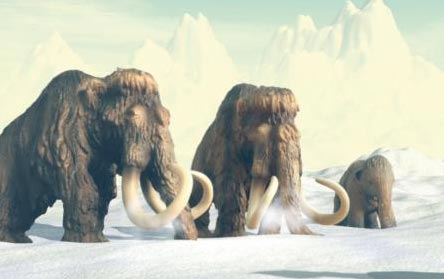
Did an Extra-terrestrial Impact Event Spell Doom for North American Megafauna?

Will the Woolly Mammoth return?

Will the Woolly Mammoth return?

Picture credit: Everything Dinosaur

The picture (above) shows some Woolly Mammoth models, for models and replicas of Ice Age animals including Woolly Mammoths (whilst stocks last): Papo Prehistoric Animal Models and Figures.

New Data

This new data, published in the academic journal “The Proceedings of the National Academy of Sciences”, seems to support the hypothesis that an impact tipped the climate into a much colder phase.

New platinum measurements were made on ice cores that allow conditions 13,000 years ago to be determined at a time resolution of approximately +/- five years or so.  The hundred times spike in platinum levels coincides with a rapid cooling of the environment as indicated from oxygen isotope measurements, the start of a climatic period known as the “Younger Dryas”.

The “Younger Dryas”

The “Younger Dryas” started and finished abruptly, and is one of a number of shorter periods of climate change that appear to have occurred since the last glacial maximum of around 20,000 years ago.  Each end of the “Younger Dryas” period may have involved very rapid changes in temperature as the climate system reached a tipping point, with suggestions that dramatic changes in temperature occurred over as short as time-scale as a decade or so.  Such dramatic climate changes would have led to the collapse of many ecosystems with much of the mammalian mega-fauna becoming extinct as a result.

This new paper, provides support to the extra-terrestrial impact theory, observations of microscopic grains of diamond and the mineral lonsdaleite found in North American lake sediments also support the hypothesis of a possible meteorite impact.  Similar deposits were found in the area surrounding the Tunguska impact event of 1908.

No Impact Crater Evidence

Although no evidence of an actual impact crater has yet to be found, if a sizeable impact did occur, then debris thrown into the atmosphere could have influenced the climate and helped to cause the rapid global cooling.  Sudden climate change would have put environments and ecosystems under huge stress and ultimately a number of extinctions would have resulted.

14 07, 2013

Lyme Regis Rare Ammonite Polishing Dates Announced

By |2024-04-29T14:15:37+01:00July 14th, 2013|Categories: Dinosaur and Prehistoric Animal News Stories, Everything Dinosaur News and Updates, Geology|0 Comments

Fossils Fans Get the Chance to Get “Hands On” with Ammonite Activities

Visitors to the picturesque seaside resort of Lyme Regis, on southern England’s famous Jurassic coast, will get the chance to polish their own ammonite fossil, at special events organised by Lyme Regis Museum being held throughout the summer holidays.

Lyme Regis

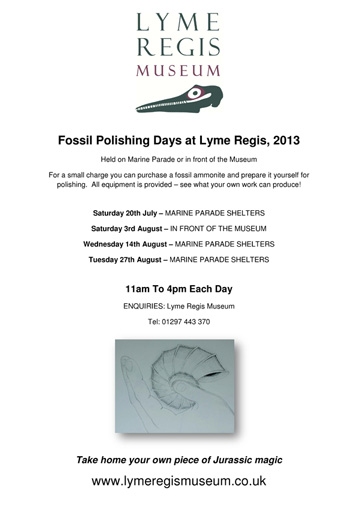
Ammonites are an extinct group of cephalopod molluscs that lived in chambered shells.  Their fossils are associated with much of the strata that can be found along the famous World Heritage Site of the “Jurassic Coast”, for the chance to learn more about these amazing creatures and to polish your own ammonite fossil, see the poster below:

Ammonite Polishing Days Announced

Fancy being a palaeontologist, studying Ammonites?

Fancy being a palaeontologist, studying ammonites?

Picture credit: Lyme Regis Museum/Brandon Lennon/Everything Dinosaur

Ammonite Fossil Polishing

For a small fee, fossil enthusiasts and tourists can purchase their own ammonite fossil and prepare it just like a real palaeontologist.  Polishing the fossil reveals the amazing and very beautiful internal structure of the fossil.  The first fossil polishing event is taking place this weekend (Saturday July 20th).   The event starts at 11am and will run until 4pm that afternoon.

A spokesperson from Everything Dinosaur commented:

“These events give members of the public the opportunity to carry out their own fossil polishing and to learn about these extinct marine creatures that are so important to the science of palaeontology.”

Other dates are:

Saturday 3rd August, Wednesday 14th August and the final ammonite fossil polishing event this summer is scheduled for Tuesday 27th August, the day after the Bank Holiday.

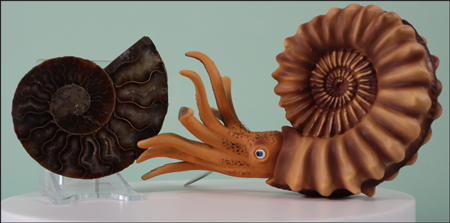
A Replica of an Ammonite and a Polished Ammonite Fossil

The Bullyland ammonite model next to a polished section of an ammonite fossil.
The Bullyland ammonite model is often used in museum displays to depict the living animal next to fossil material. Picture credit: Everything Dinosaur.

Picture credit: Everyting Dinosaur

To view replicas of prehistoric animals including the ammonite figure (whilst stocks last): Bullyland Prehistoric World Models and Figures.

7 07, 2013

The Unique Fossil Heritage of Iran

By |2024-04-12T08:53:05+01:00July 7th, 2013|Categories: Dinosaur and Prehistoric Animal Drawings, Geology, Palaeontological articles|2 Comments

Local Farmer Finds Spectacular Ammonite Fossil

With team members at Everything Dinosaur making frequent visits to the “Jurassic Coast” of Dorset on various expeditions you would think that looking at ammonite fossils would become rather “run of the mill” for us, however, I don’t think that any of us will ever lose our fascination for these creatures.  Even the smallest fossil find, perhaps a pyritised Promicroceras spp. from Charmouth, or an example of Arnioceras from further along the coast is greeted with excitement.  There is a real buzz when you first see a fossil, that moment of realisation that you are the first person to see evidence of that living creature for some 180 million years or so.

The Joy of Fossil Hunting

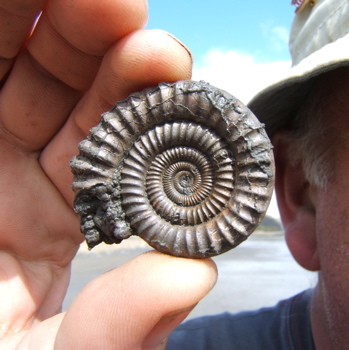
A Typical Ammonite - but not all types of this Cephalopod had coiled shells

A typical ammonite – but not all types of this cephalopod had coiled shells.

Each time we visit Lyme Regis, and get out onto the beaches to search for fossils we meet people who are first time visitors to the area.  We are always happy to answer their questions and provide advice on where to look, we even give most of our fossil finds away, especially to the Mums and Dads so that their children can take something “special” away with them.

The Dorset Coast

To get the best out of a visit to the Lyme Regis and Charmouth areas, we recommend going on an organised fossil walk with one of the local experts and guides.  The cliffs are particularly dangerous, and under the expert guidance and tutelage of a professional fossil collector visitors can be safe and they get the chance to learn about the geology and the fossils that can be found.

To read more about organised fossil walks at Lyme Regis: Lyme Regis Fossil Walks.

However, ammonite fossils are not restricted to the southern coast of England.  These extinct relatives of squid, cuttlefish and octopi are distributed world wide in Mesozoic aged rocks.  We were intrigued to read about the discovery of a large ammonite specimen by an Iranian farmer in the north-eastern province of North Khorassan.  Early reports state that this fossil is approximately 70 million years old (Upper Cretaceous).

The province of North Khorassan in Iran borders Turkmenistan, although fossils from this area have been known about for centuries, some parts of this region remain relatively unexplored and there are many more thousands of fossils awaiting discovery.

Ammonite Fossil

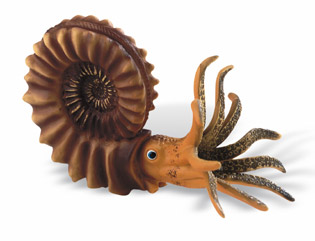
The fossil shows the shell of the ammonite, these creatures are rarely found as fossils with their soft parts preserved.  The animal lived in the outermost chamber of its shell.  Ammonites were pelagic (living above the ocean floor) and like other cephalopods they were active swimmers (nektonic), propelling themselves along by squirting water out of a siphon.  As the ammonite grew, it extended its coiled, tubular shell outwards, laying down new chamber walls behind it. These chambers contained a mixture of gas and water which the animal used to control its buoyancy.  As ammonite fossils are abundant and widely distributed these fossils are used by geologists as zone fossils in the correlation of strata (bio-stratification).

A Model of an Ammonite Showing the Soft Tissues

A model showing an Ammonite.

A model showing an Ammonite.

Picture credit: Everything Dinosaur

Everything Dinosaur team members wrote an article a couple of years ago about the discovery of marine reptile fossils in Iran, much of the fossil material from this region could represent new species.

To read about the discovery of Plesiosaurus fossils in Iran: Plesiosaur Fossils from Iran.

Local farmer Morteza Hemmati, discovered the large ammonite fossil, an internal mould of the shell of the ten-tentacled creature whilst digging.  The fossil which weighs around fifteen kilogrammes is very well preserved and it probably made its way up to the surface as a result of erosion.  The fossil looks to be in excellent condition, and where there is one ammonite fossil there is a strong possibility of a lot more being found in the area.

Let’s  hope that this specimen gets donated to a local museum or university so that it can be preserved and then studied.  Perhaps, it may even be put on public display so that local people can learn more about the geology of their province.

To view Everything Dinosaur’s range of replica fossils including models of ammonites: Models of Ammonites and other Prehistoric Animals.

6 07, 2013

Loch Ness Monster Myth Solved – It was the Faults Fault

By |2023-02-18T21:17:41+00:00July 6th, 2013|Categories: Animal News Stories, Dinosaur and Prehistoric Animal News Stories, Dinosaur Fans, Geology|2 Comments

Sightings of Loch Ness Monster Explained by Geological Fault

Italian geologist Luigi Piccardi claims that activity along a fault line that runs beneath the Scottish Highlands could be responsible for a spate of “Nessie” sightings in the 1930s the reignited the myth of there being a monster in Loch Ness.  Loch Ness itself, was formed around twelve thousand years ago and its dark, cold, peaty waters are more than seven hundred feet deep in places.

Loch Ness Monster

The geologist has postulated that a fault line that runs for 62 miles beneath the Scottish Highlands could be responsible for sightings of “Nessie”.  Loch Ness lies over the Great Glen Fault, a line of weakness in the strata that once marked the boundary between two continents back in the Devonian.  Erosion during the Quaternary led to the formation of many deep basins which after the ice retreated at the end of the last Ice Age, left large bodies of water trapped in these basins, one such body of water became Loch Ness.

Occasional Tremors Mistaken for Monster

As a researcher at the CNR – the Institute of Geosciences and Earth Resources, based in Bologna, ( Italy), Luigi claims that although the fault is now very inactive, occasional tremors would cause surface distortions on the Loch and these could be mistaken for a monster.

The Great Glen Fault was relatively active in the 1920s and 1930s and this led to numerous reports of a strange beast lurking in the Loch’s deep waters.  A number of photographs were taken, apparently showing a large animal with a serpentine head.  The most famous of these, a picture known as the “surgeon’s photograph”, was allegedly taken by a London gynaecologist Dr Robert Kenneth Wilson.  This photograph, showing an image of a head and a long, swan-like neck was taken in 1934.  It caused a sensation when first published but over recent years the photograph has been discredited and many believe that it is a clever fake.

However, the geologist points out that as the Great Glen Fault was particularly active in the 1920s and 1930s the majority of reported sightings could be attributed to disturbances caused by Fault movements.

He stated:

“There are various effects on the surface of the water that can be related to the activity of the Fault.  We know that this was a period [1920-1930] with increased activity of the Fault. In reality, people have seen the effects of the earthquakes on the water.”

“Nessie” as the monster is affectionately known, is thought by some people to be a plesiosaur, a type of marine reptile from the Mesozoic with a small head, long neck, large body and four flippers.  The plesiosaurs are believed to have become extinct at the very end of the Cretaceous geological period around sixty-five million years ago.

A Typical Plesiosaur – Is this Nessie?

Nessie or the consequences of a geological fault?

Nessie or the consequences of a geological fault?

Picture credit: Everything Dinosaur

British Government Believed in Nessie

Recently released records indicate that the British Government believed in the existence of a monster in the Loch.  Intriguingly, there are a number of large lakes in the Northern Hemisphere which are associated with monster legends.  This phenomenon is not just linked to the Scottish Highlands but Ireland, Sweden, Norway, the United States and Canada all over their own “Lake Monsters”.

To view an article on the British Government’s views on “Nessie”: British Officials Believed in the Loch Ness Monster.

Sightings do still occur and this summer visitors to the Loch will be busy scanning the surface of the water to see if Nessie raises its head out of the depths.  The last photograph, showing a brownish hump in the water, perhaps a monster or as many people have suggested an upturned rowing boat, was snapped in 2010.  With the advent of cameras and film recorders in phones, photographs of suspected monsters are likely to increase once again, as tourists visiting various lakes in the northern hemisphere take snap-shots of the so called beasties.

A spokesperson from Everything Dinosaur stated:

“One could imagine a large vertebrate living in the vast, largely unexplored depths of the Pacific or Indian Oceans, but it is difficult to imagine a viable population of air breathing, marine reptiles remaining hidden in a body of water such as Loch Ness.  It [Loch Ness] may hold as much water in it as all the freshwater lakes of England and Wales combined, but I really doubt the existence of any large creatures that could be called monsters lurking in Loch Ness.”

Do you believe in the Loch Ness Monster?

To view the range of plesiosaur models and replicas in stock at Everything Dinosaur: Prehistoric Animal Models including Sea Monsters.

Go to Top