All about dinosaurs, fossils and prehistoric animals by Everything Dinosaur team members.

Dinosaur and prehistoric animal themed articles, features and stories.

12 07, 2019

New Theropod Dinosaur from the Late Triassic of Switzerland

By |2023-12-26T08:13:16+00:00July 12th, 2019|Categories: Dinosaur and Prehistoric Animal News Stories, Dinosaur Fans, Main Page, Palaeontological articles, Photos/Pictures of Fossils|0 Comments

Notatesseraeraptor frickensis – A Mixture of Coelophysid and Dilophosaurid Characteristics

A new European theropod dinosaur from the Late Triassic of Switzerland has been named and described this week.  This is big news, as very little is known about Late Triassic theropods that roamed Europe more than 200 million years ago, only a handful have been described to date, just four species.  The dinosaur has been named Notatesseraeraptor frickensis (No-tah-tess-er-ray-rap-tor frick-ensis), the genus name derives from the Latin “nota” meaning feature and “tesserae”, a Latin term to describe tiles used to create a mosaic, a reference to the mixture of anatomical features (dilophosaurid and coelophysoid) identified in the fossil bones

The trivial name honours the Swiss town of Frick, where the fossils were found.

The Body Plan, Known Fossil Material and a Skeletal Reconstruction of N. frickensis
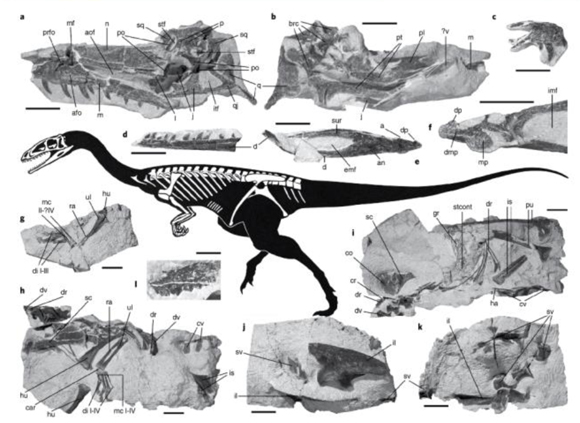
Skeletal anatomy of Notatesseraeraptor frickensis
The silhouette shows the body plan of Notatesseraeraptor, known fossil material and pictures of the blocks that make up the holotype specimen.

Picture credit: Nature: Ecology and Evolution

Lizard-eating Dinosaur

The partially articulated specimen was collected in 2006 from the famous Gruhalde clay pit in the town of Frick (Aargau Canton, northern Switzerland).  This clay pit has yielded large numbers of Plateosaurus fossils, although Notatesseraeraptor layer is located above the classic Plateosaurus bone beds.  The strata are from the middle part of the Gruhalde Member of the Klettgau Formation and represents Late Triassic (end-Norian) sediments.  The fossils associated with N. frickensis include a nearly complete skull, articulated forelimbs, vertebrae, hip bones and ribs.  The body cavity revealed the remains of a Clevosaurus, a lizard-like rhynchocephalian, distantly related to the extant Tuatara of New Zealand.  It is likely that the Clevosaurus remains represent this dinosaur’s last meal.

The Skull of Notatesseraeraptor frickensis
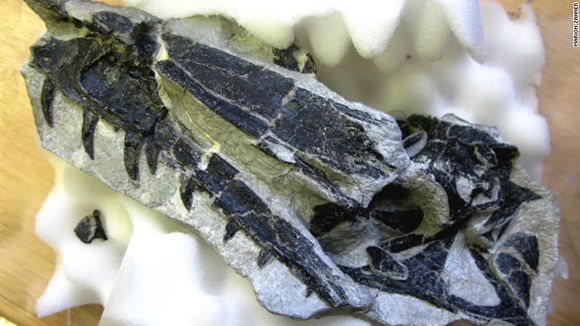
Notatesseraeraptor frickensis cranial material.
A view of the skull and upper jaw (Notatesseraeraptor frickensis).  Around 90% of the cranial fossil material was recovered.

Notatesseraeraptor frickensis A Carnivorous Dinosaur Reported from Switzerland

Around 90% of the skull material was excavated, giving Notatesseraeraptor one of the most complete carnivorous dinosaur skulls known from before the Late Jurassic.   Although, our knowledge of early theropod dinosaurs has improved greatly since the turn of the century, thanks mainly to fossil discoveries from North and South America, very little is known about the evolution and radiation of Late Triassic/Early Jurassic European theropods, their fossil record is notably sparse.  This new theropod species is the first meat-eating dinosaur to be described from Switzerland.

Notatesseraeraptor displays a mix of characteristics typically seen either in coelophysids or in dilophosaurids.  A phylogenetic analysis suggests that it is a member of the Neotheropoda clade with affinities to Dilophosaurus of the Early Jurassic and that Notatesseraeraptor is a basal member of that line of theropods that led to the Averostra (a group, of carnivorous dinosaurs that includes the ceratosaurs).

The Late Triassic/Early Jurassic European Theropods

The nearly complete skull will help palaeontologists to better understand the evolutionary relationships between different types of Late Triassic/Early Jurassic theropod dinosaur.  The fossil specimen suggests a sub-adult with a length of between 2.6 to 3 metres, but this is speculation based on comparative analysis with dinosaurs such as Coelophysis and Tawa as the length of the tail of Notatesseraeraptor is not known.

A Life Reconstruction of a Typical Coelophysid Dinosaur (Coelophysis bauri)
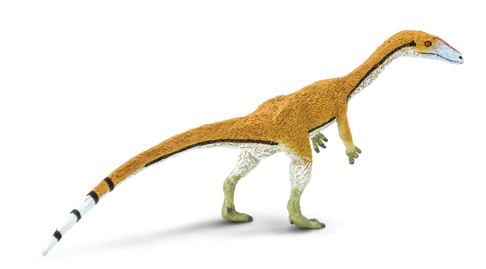
Coelophysis model.
A life reconstruction of Coelophysis bauri.

The picture (above) shows a Coelophysis model from Safari Ltd.

To view this model range: Wild Safari Prehistoric World.

The three previously described species of Late Triassic European theropod are:

  • Liliensternus liliensterni – named in 1934 (von Huene) from the Middle and Late Norian of Germany
  • Procompsognathus triassicus – named in 1913 (Fraas) also from the Middle to Late Norian of Germany
  • Lophostropheus airelensis named in 1993 known from slightly younger rocks (Late Rhetian to Hettangian – Late Triassic to possibly Early Jurassic)

With the exception of a few scraps of bone associated with Liliensternus skull material and the recently described  Dracoraptor hanigani from south-Wales, no other skull material has been found relating to a neotheropod dinosaur from the Late Triassic/Early Jurassic  in the whole of Europe.
11 07, 2019

Terrestrial Bird-like Dinosaur is the Oldest Known from North America

By |2023-12-26T08:05:44+00:00July 11th, 2019|Categories: Adobe CS5, Dinosaur and Prehistoric Animal News Stories, Dinosaur Fans, Main Page, Palaeontological articles, Photos/Pictures of Fossils|0 Comments

Hesperornithoides miessleri – Helping to Map Out the Bird Family Tree

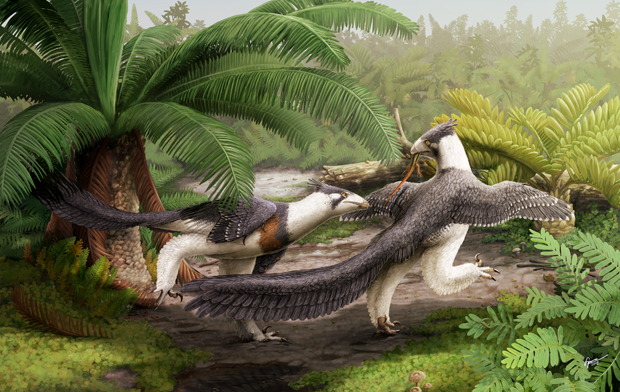
A joint team of British and American palaeontologists have announced the discovery of a new species of dinosaur that roamed the Late Jurassic of Wyoming.  The specimen consisting of both cranial and postcranial material lived around 150 million years ago and it has been tentatively placed within the troodontid branch of the Paraves part of the Theropoda.  It could help scientists to better understand the evolutionary relationships between feathered dinosaurs and true birds and it raises intriguing questions as to when powered flight evolved within the Dinosauria.

The little dinosaur, estimated to have measured less than a metre in length (single known specimen is either an adult or a sub-adult), has been named Hesperornithoides miessleri.

A Life Reconstruction of the Newly Described Dinosaur H. miessleri

Hesperornithoides miessleri - life reconstruction.
A life reconstruction of Hesperornithoides miessleri.

Picture credit: Gabriel Ugueto

Hesperornithoides miessleri – An Inhabitant of Wetlands

Writing in the academic journal PeerJ, the authors which include scientists from the University of Manchester, report the taphonomy of the fossil material suggests that this dinosaur was an inhabitant of wetland environments for at least a portion of its life history.  The fossil material was actually discovered back in 2001, whilst excavation work was being carried out on the fossil material associated with Supersaurus.

The fossil comes from Converse County (Wyoming), from strata making up the middle portion of the famous Morrison Formation.  The fossil-bearing strata from the “Jimbo Quarry” has been variously dated to the Oxfordian and Tithonian ages of the Jurassic.

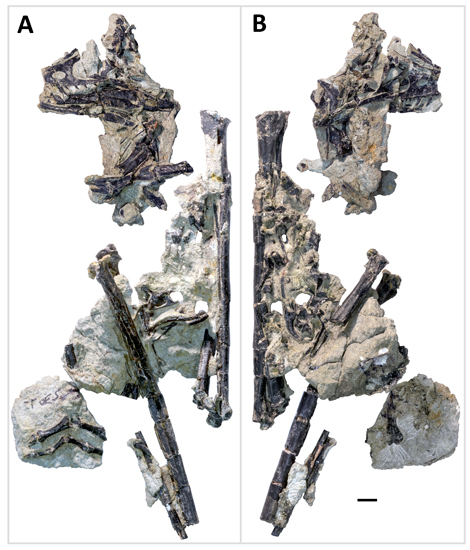
Full Skeleton of Hesperornithoides miessleri

Known fossil material associated with Hesperornithoides miessleri.
Hesperornithoides fossil material “left” (A) and “right” (B) sides of the blocks after final preparation (B).  Scale bar = one cm.

Picture credit: Levi Shinkle

A Resident of the Famous Morrison Formation

The Morrison Formation is famous for its vertebrate fossils, including many examples of dinosaurs, such as Allosaurus, Ceratosaurus, Diplodocus, Brontosaurus and Camarasaurus.  The carnivorous Hesperornithoides is the smallest dinosaur described to date from Wyoming.

Palaeontologist Bill Wahl  (Wyoming Dinosaur Centre), a co-author of the scientific paper, recalled how excited the field team were when they uncovered the block containing the partially articulated bones.

He stated:

“We were removing a ledge of overburden rock and found, unfortunately with a shovel, some tiny, delicate bones poking out.  We immediately stopped, collected as much of the bones as possible and spent the next few days frantically searching for more.  Only after some of the bones were cleaned did we realise that we had found something spectacular.”

Hesperornithoides miessleri – Donated to the Big Horn Basin Foundation

In 2005, the fossil specimen was donated to the Big Horn Basin Foundation, a research and education-based not-for-profit organisation that was merged with the Wyoming Dinosaur Centre back in 2016.  This is how Hesperornithoides miessleri came into the Wyoming Dinosaur Centre’s fossil collection.  The fossil, now known as WYDICE-DML-001, was nicknamed “Lori”  and was examined by Dean Lomax (University of Manchester) and co-author of the study back in 2008, a successful crowdfunding campaign permitted extensive research to be undertaken.

Dean commented:

“I remember the first time I laid my eyes on this little dinosaur.  Even back then, I knew it was a significant discovery.  But, it wasn’t until 2015 when our dino team formed and we began to study ‘Lori’ in much more detail than ever before.”

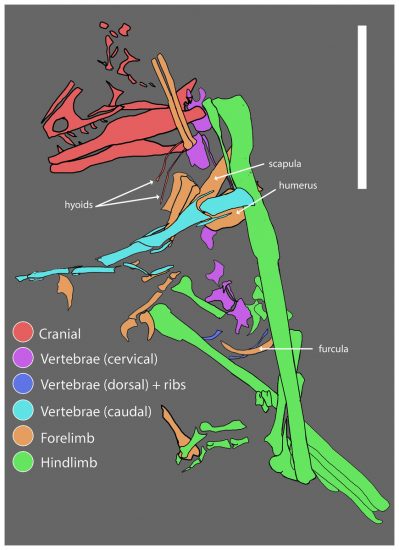
Reconstructed Quarry Map of “Lori” (Hesperornithoides miessleri)

A quarry map of the fossil material asociated with Hesperornithoides.
Association of skeletal elements assembled from 3-D scans of specimen blocks prior to final mechanical preparation.

Picture credit: PeerJ

Visit the website of the British palaeontologist Dr Dean Lomax: British Palaeontologist Dr Dean Lomax.

Found on Private Land

The specimen was found on private land owned by the Miessler family.  The trivial name honours their help, support and assistance in bringing this little theropod to the attention of the scientific community.  The genus name is a combination of “Hesper”, referring to its discovery in the American West and “ornis” a nod to its very bird-like anatomy.

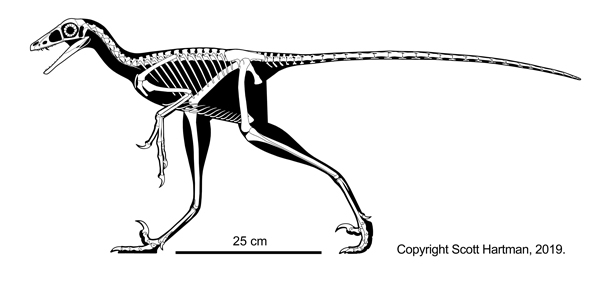
A Reconstruction of the Skeleton of Hesperornithoides miessleri

Hesperornithoides miessleri skeleton reconstruction.
Skeletal Reconstruction Hesperornithoides miessleri (scale bar = 25 cm).

Picture credit: Scott Hartmann

A Key Conclusion of the Study

A key conclusion of the scientific paper relates to the origin of powered flight within the Dinosauria.  Hesperornithoides was very probably entirely terrestrial.  It could not fly, but it has a very bird-like body, suggesting that many features associated with an avian anatomy evolved in dinosaurs that lived out their lives on the ground.  It is the oldest dinosaur of this type, known from more than just teeth fossils from North America.  The terrestrial and flightless lifestyle is consistent with the base of Paraves, and with the base of paravian subclades, suggesting that avian flight evolved within the Avialae, most likely in the Late Jurassic or Early Cretaceous.

For models and replicas of dromaeosaurs and other dinosaurs: Beasts of the Mesozoic Dinosaur Models.

Lead author of the paper and PhD student at the University of Wisconsin-Madison, Scott Hartman stated:

“We wanted to expand the dataset used to test dinosaur-bird relationships, so we added hundreds of new species and tens of thousands of new characters.  We found that Lori is a primitive member of a group of dinosaurs that includes Troodon, but perhaps more importantly we discovered that the smaller details of the family tree of bird-like dinosaurs isn’t quite as resolved as some researchers would claim.”

Scott Hartman continued:

“For example, it only takes a few changes in the dataset for Hesperornithoides to be found as a closer relative of Velociraptor than of Troodon.  One robust finding we did come up with is that even as the interrelationships changed, the primitive members of all these groups were non-flying ground dwelling dinosaurs.  That means that some small relatives of Velociraptor such as Microraptor that looks like it could have glided evolved this separately from the modern bird family.”

Hesperornithoides Cranial Material

Fossil material and accompanying line drawings Hesperornithoides.
Hesperornithoides cranial material and interpretative line drawings.

Picture credit: Levi Shinkle

The scientific paper: “A new paravian dinosaur from the Late Jurassic of North America supports a late acquisition of avian flight” by Hartman, S., Mortimer, M., Wahl, W. R., Lomax, D. R., Lippincott, J. and Lovelace, D. M and published in PeerJ.

Everything Dinosaur acknowledges the help of a media release from the University of Manchester in the compilation of this article.

The Everything Dinosaur website: Everything Dinosaur.

9 07, 2019

Wild Safari Prehistoric World Parasaurolophus

By |2023-12-26T07:48:31+00:00July 9th, 2019|Categories: Adobe CS5, Dinosaur Fans, Main Page, Photos, Photos of Everything Dinosaur Products|0 Comments

Wild Safari Prehistoric World Parasaurolophus

Safari Ltd have published a series of images depicting some of the latest introductions in the Wild Safari Prehistoric World model range.  Today, we feature the Parasaurolophus, a dinosaur that has been depicted several times over the history of Safari Ltd models.  The latest incarnation of Parasaurolophus, was introduced in 2017, one of thirteen prehistoric animal models launched by the U.S.-based company that year.

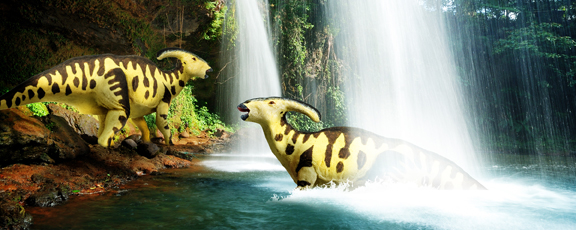
The Wild Safari Prehistoric World Parasaurolophus Dinosaur Model

Wild Safari Prehistoric World Parasaurolophus dinosaur model.
A pair of Parasaurolophus cooling off in the Late Cretaceous of North America.

Picture credit: Safari Ltd

To view the Safari Ltd range of prehistoric animal figures: Wild Safari Prehistoric World Models.

Parasaurolophus walkeri

Known from numerous very nearly complete and partial skeletons, Parasaurolophus was geographically widely distributed (Alberta to New Mexico – possibly), it is known from the Late Cretaceous (Campanian faunal stage), although there are some unverified reports that this dinosaur may have persisted into the Maastrichtian faunal stage of the Cretaceous.  It is easily recognisable for its long, backward pointing head crest.

Despite the amount of fossil material scientists have to study, the exact size of this herbivorous dinosaur remains open to speculation, with some estimates putting this dinosaur’s maximum length at more than ten metres.  Measurements of the femur (thigh bone), indicate that this duck-billed dinosaur may have weighed more than three tonnes.  Several species have been assigned to the Parasaurolophus genus, perhaps the best known of which is Parasaurolophus walkeri, mainly because this Parasaurolophus species had the more spectacular crest compared to other species in this genus.

Parasaurolophus walkeri – Scale Drawing

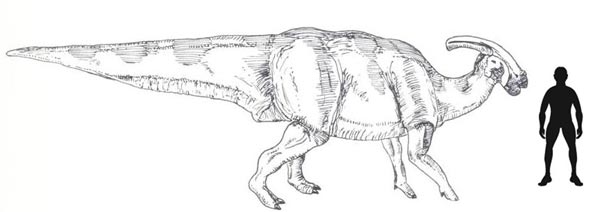
Scale drawing Parasaurolophus walkeri.
A crested, duck-billed dinosaur.  A scale drawing of the Late Cretaceous lamebeosaurine dinosaur Parasaurolophus walkeri.  Note the thick-set upper legs and the wide tail.  Recent studies indicate that this facultative biped was very robust. Picture credit: Everything Dinosaur.

Picture credit: Everything Dinosaur

The website of Everything Dinosaur: Everything Dinosaur.

8 07, 2019

Preparing for New PNSO Models

By |2023-12-26T06:36:48+00:00July 8th, 2019|Categories: Adobe CS5, Dinosaur and Prehistoric Animal Drawings, Dinosaur Fans, Everything Dinosaur News and Updates, Everything Dinosaur Products, Main Page, Photos of Everything Dinosaur Products|0 Comments

Preparing for PNSO Models

Team members at Everything Dinosaur have been kept very busy preparing for the arrival of the latest delivery of PNSO dinosaur and prehistoric animals at the company’s warehouse.  The shipment will contain a number of new PNSO models including Lucas the Giganotosaurus, Lucio the Amargasaurus and the battling pair of Dayong the Yangchuanosaurus and Xiaobei the Chungkingosaurus.  In preparation for the arrival of a Yangchuanosaurus replica, we have commissioned a scale drawing as well as researching and writing a fact sheet about this theropod from the Middle Jurassic of south-western China.

A Scale Drawing of the Middle Jurassic Chinese Theropod – Yangchuanosaurus (Y. shangyouensis)

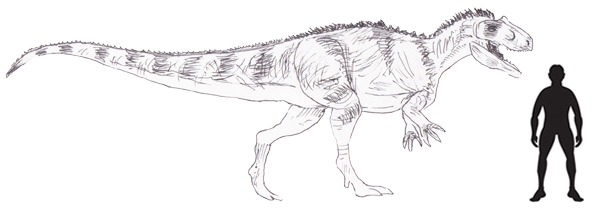
Scale drawing of Yangchuanosaurus shangyouensis
A scale drawing of Yangchuanosaurus shangyouensis. Picture credit: Everything Dinosaur.

Picture credit: Everything Dinosaur

PNSO Dinosaur and Prehistoric Animal Models

PNSO have created a range of different prehistoric animal models and figures.  They have a small prehistoric animal model range, (toys that accompany your growth), which currently has forty-eight figures within it and then there are the larger PNSO models (some of them are huge).  These models are promoted as the “Age of Dinosaurs” model range but not all of them are dinosaurs.  For instance, PNSO recently introduced a large model of the ichthyosaur Ophthalmosaurus, joining substantial models of Basilosaurus and the ferocious Megalodon (Carcharocles megalodon).

Naturally, Everything Dinosaur has produced fact sheets for all these replicas and all these fact sheets include a scale drawing.

An Illustration of the Early Jurassic Sauropod Mamenchisaurus

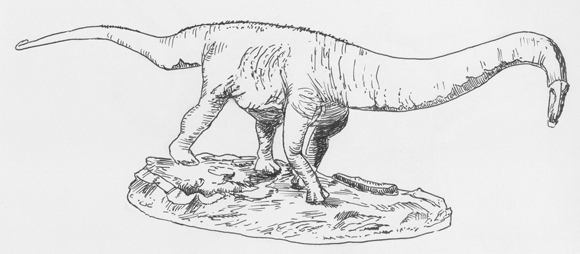
An illustration of the long-necked dinosaur (sauropod) Mamenchisaurus
Mamenchisaurus drawing.  An illustration commissioned as Everything Dinosaur prepares a fact sheet on this dinosaur. Picture credit: Everything Dinosaur.

Picture credit: Everything Dinosaur

PNSO Dayong the Yangchuanosaurus and Xiaobei the Chungkingosaurus

The latest shipment of PNSO models will include the Dayong the Yangchuanosaurus and Xiaobei the Chungkingosaurus diorama.  Construction projects in Sichuan Province have unearthed a variety of different types of dinosaur.  These fossil finds rival the amazing Morrison Formation of the western United States, although the Chinese rocks are older.  Numerous sauropods and stegosaurs have been described and two distinct biotas identified.

The Dayong the Yangchuanosaurus and Xiaobei the Chungkingosaurus

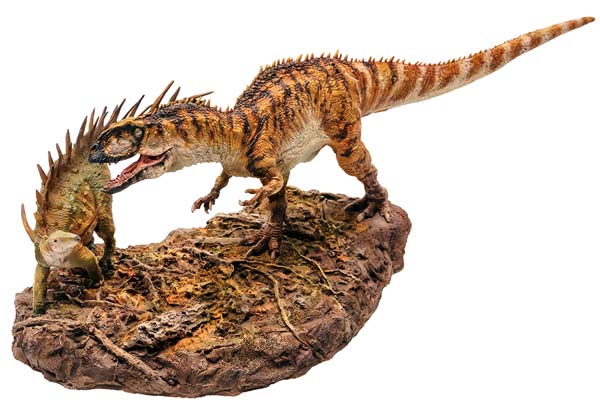
PNSO Yangchuanosaurus and Chungkingosaurus dinosaur diorama.
PNSO dinosaur diorama “Dayong” the Yangchuanosaurus battles “Xiaobei” the Chungkingosaurus.

A spokesperson from Everything Dinosaur commented:

“We are expecting a large shipment of PNSO models.  It is going to be a very busy couple of weeks for our warehouse team, what with all these new PNSO figures coming into stock along with deliveries from Papo, Mojo Fun, CollectA and Safari Ltd.  We planned to provide at least fifty new models this year, we are well on target to achieve this and in fact, with all these new additions, this target is going to be exceeded.  These are exciting times for dinosaur fans and model collectors.”

To view the PNSO Age of Dinosaurs range available from Everything Dinosaur: PNSO Age of Dinosaurs.

The Everything Dinosaur website: Everything Dinosaur.

6 07, 2019

Rebor Dilophosaurus Figures “Green Day” and “Oasis” are in Stock

By |2023-12-26T06:20:59+00:00July 6th, 2019|Categories: Dinosaur Fans, Everything Dinosaur News and Updates, Everything Dinosaur Products, Photos of Everything Dinosaur Products, Press Releases|0 Comments

Rebor Dilophosaurus Figures “Green Day” and “Oasis” are in Stock

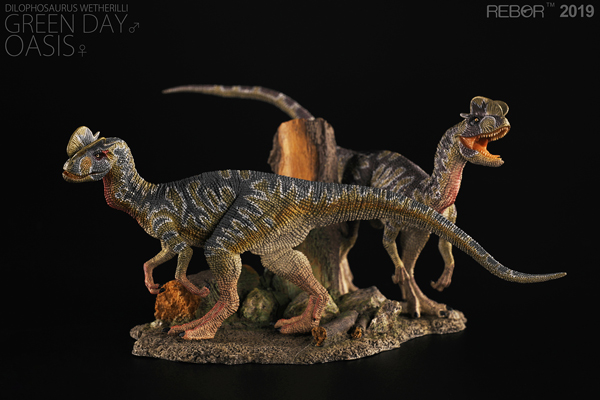
The two new Rebor Dilophosaurus figures “Green Day” and ” Oasis” are in stock at Everything Dinosaur.  These are the latest additions to the impressive Rebor range of scale model prehistoric animal replicas and Everything Dinosaur team members have been busy contacting dinosaur model fans on the company’s priority reserve list to ensure customers are aware of the arrival of these two exciting dinosaur figures.

In Stock at Everything Dinosaur – Rebor Dilophosaurus Models “Green Day” and “Oasis”

Rebor Dilophosaurus models "Green Day" and "Oasis"
The Rebor Dilophosaurus replicas “Green Day” and “Oasis”.  Spectacular Rebor prehistoric animal figures in stock at Everything Dinosaur.

Rebor Dilophosaurus Dinosaur Models

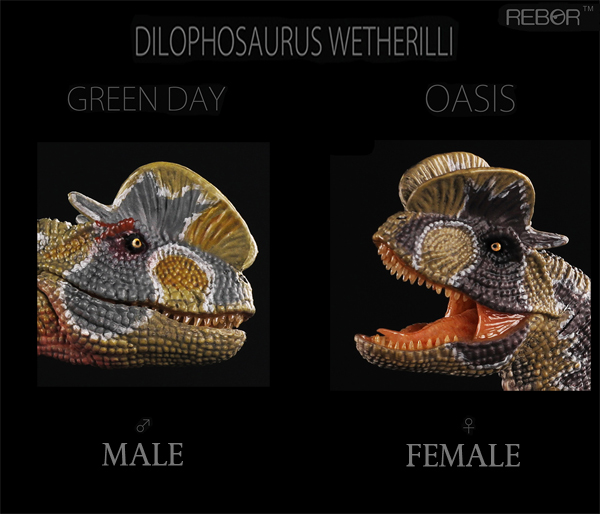
The Rebor models can be purchased separately, or as a pair from Everything Dinosaur.  Each model has an articulated lower jaw, a flexible, bendy tail and articulated forelimbs.  Subtle variations in the paint scheme of each model highlight the perceived differences between the male figure “Green Day” and the female “Oasis”.  In an earlier blog article, Everything Dinosaur posted up information on how collectors can customise their Dilophosaurus figures by adding a colourful ruff, an adornment inspired by a very famous movie.

To read Everything Dinosaur’s article featuring the Dilophosaurus dinosaur ruff: Dinosaur Ruffs.

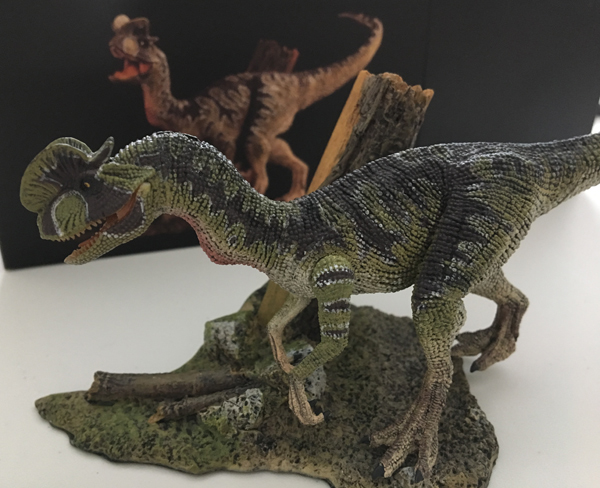
The Rebor Dilophosaurus Dinosaur Model “Oasis”

Rebor Dilophosaurus "Green Day".
The Rebor Dilophosaurus model “Oasis”. Picture credit: Everything Dinosaur.

Picture credit: Everything Dinosaur

Beautiful Display Pieces

These beautiful display pieces are provided with their own bases and the models can be put together to make a two dinosaur replica diorama.  The male Dilophosaurus model “Green Day” measures over 23 centimetres in length and the female figure “Oasis” is comparable in size.  They are certainly stunning prehistoric animal models and their bases are very detailed too.

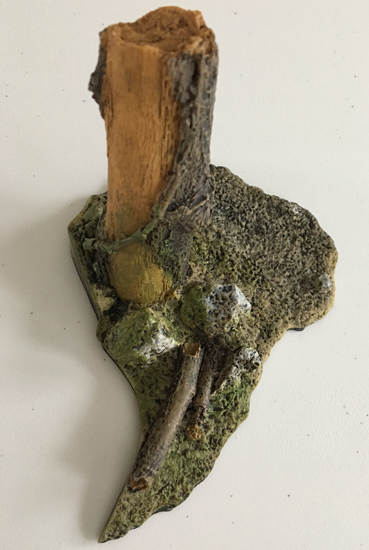
The Base for the Female Dilophosaurus Features an Early Jurassic Tree Stump

Rebor Dilophosaurus "Oasis" - display base.
The base for the Rebor Dilophosaurus figure “Oasis”. Picture credit: Everything Dinosaur.

Picture credit: Everything Dinosaur

Visit the Everything Dinosaur website: Everything Dinosaur.

It is the different sized bases that explains the difference in the packaging sizes.  The Rebor Dilophosaurus “Oasis” model is supplied in a larger box.

A spokesperson from Everything Dinosaur commented:

“These two new Dilophosaurus models are just the latest in a number of theropod models that have been added to the range.  The Rebor range includes tyrannosaurs, Carnotaurus, Compsognathus, Ceratosaurus, Acrocanthosaurus and of course, lots of dromaeosaurids, colloquially known as the “Raptors”.  We are delighted to be able to add these Dilophosaurus models to our inventory.”

To view the Rebor Dilophosaurus dinosaur models and the other figures in the Rebor range available from Everything Dinosaur: Rebor Dinosaurs and Prehistoric Animals.

4 07, 2019

Celebrating New Schleich and CollectA Models

By |2023-12-26T06:01:03+00:00July 4th, 2019|Categories: Adobe CS5, Dinosaur Fans, Everything Dinosaur News and Updates, Everything Dinosaur Newsletters, Everything Dinosaur Products, Main Page, Press Releases|0 Comments

Newsletter Features New Schleich and CollectA Prehistoric Animals

New prehistoric animal models and figures are coming into stock at Everything Dinosaur at an express pace.  Our latest newsletter features another seven new figures, four from Schleich and three from CollectA in what will be a stunning summer of new model additions to our ranges.  It is going to be a very busy time for our team members but we have made contingency plans to ensure that orders get despatched super quick!

The Early July CollectA Newsletter Features New CollectA and Schleich Prehistoric Animal Figures

A Schleich Elasmotherium and a Schleich juvenile Giganotosaurus
The early July Everything Dinosaur newsletter features new Schleich and CollectA prehistoric animal models.  The new for 2019 CollectA Deluxe Elasmotherium and the Schleich juvenile Giganotosaurus are in stock. Picture credit: Everything Dinosaur.

Picture credit: Everything Dinosaur

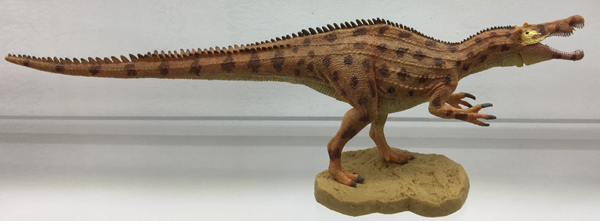
At the end of last year, Everything Dinosaur team members predicted that 2019 would see a further fifty prehistoric animal models added to the company’s already impressive range.  The new CollectA models are the “Prehistoric Life” Fukuiraptor, the CollectA Deluxe Elasmotherium and the 1:40 scale Deluxe Baryonyx.  The four new Schleich figures comprise, a Plesiosaurus and three dinosaurs, namely Dracorex, Diabloceratops and a juvenile Giganotosaurus.

Exciting New Prehistoric Animal Models from CollectA and Schleich

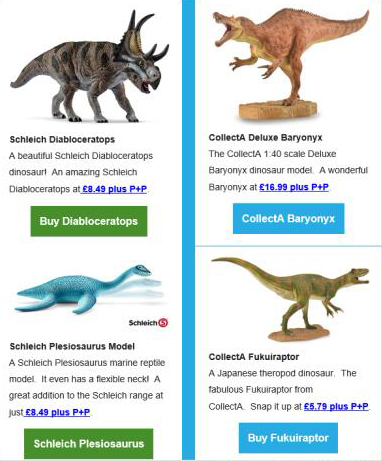
Schleich and CollectA models feature in the newsletter.
The early July Everything Dinosaur newsletter features new CollectA and Schleich prehistoric animal models.  The models are the Schleich Diabloceratops (top left), the CollectA Deluxe 1:40 scale Baryonyx (top right), the Schleich Plesiosaurus (bottom left) and the CollectA Fukuiraptor (bottom right). Picture credit: Everything Dinosaur.

Picture credit: Everything Dinosaur

To view the range of Schleich prehistoric animal models available from Everything Dinosaur: Schleich Dinosaurs and Prehistoric Animal Models

All Prehistoric Animal Models Supplied with a Fact Sheet

Everything Dinosaur has prepared fact sheets for all seven of these new models.  Customers purchasing these figures from Everything Dinosaur will be sent a fact sheet with their purchase.  The fact sheet includes a scale drawing of the prehistoric animal along with fascinating facts and snippets of information.

A spokesperson from Everything Dinosaur commented:

“For virtually every prehistoric animal figure we sell, we supply a fact sheet about that animal.  We take care to research these long extinct creatures and then we produce an A4-sized fact sheet which is then sent out with model purchases.  We are currently working on a further three new fact sheets so that we can provide these sheets when other new models come into stock.”

The Schleich Dracorex Dinosaur Model and Please “Like” our Facebook Page

Schleich Dracorex and please "like" us on Facebook.
The Schleich Dracorex (left) and a request for newsletter subscribers to please “like” us on Facebook. Picture credit: Everything Dinosaur.

Picture credit: Everything Dinosaur

The Schleich Dracorex

The North American Dracorex (D. hogwartsia) is the last of the new models to be featured.  Measuring over nineteen centimetres in length this is a beautifully detailed model of a pachycephalosaur.  Our newsletter subscribers have also been asked to “like” Everything Dinosaur’s Facebook page.  Our Facebook page is followed by a large number of dinosaur fans and our posts reach thousands of enthusiasts every week.  We currently have a total of over 6,400 genuine page likes which makes us extremely proud.  We hope to get to 6,500 Facebook page likes by the end of this month.

To view the CollectA Baryonyx and the Deluxe Elasmotherium model: CollectA Deluxe Prehistoric Life Models.

For the CollectA Fukuiraptor figure, a stunning model of a dinosaur from the Lower Cretaceous of Japan: CollectA Prehistoric Life.

The Everything Dinosaur website: Everything Dinosaur.

3 07, 2019

New CollectA Deluxe Baryonyx – Articulated Jaw

By |2023-12-26T05:55:25+00:00July 3rd, 2019|Categories: Adobe CS5, Dinosaur Fans, Everything Dinosaur Products, Everything Dinosaur videos, Main Page, Photos of Everything Dinosaur Products, Product Reviews|0 Comments

The CollectA Deluxe Baryonyx – Articulated Jaw

We have been asked by dinosaur fans and model collectors to post up more pictures and information about some of the new for 2019 prehistoric animal models that have come into stock at Everything Dinosaur.  Our team members are happy to acquiesce and we have recently posted up onto our Facebook, Instagram and Pinterest pages pictures of some of the new Schleich and CollectA figures.  One of the questions we have been asked is whether or not the new CollectA Deluxe Baryonyx dinosaur model (1:40 scale), has an articulated jaw.  Yes, it does, we even shot a short video to demonstrate this.

The CollectA Deluxe Baryonyx

Demonstrating the Articulated Lower Jaw (CollectA Deluxe 1:40 scale Baryonyx Dinosaur Model

Video credit: Everything Dinosaur

A Short Baryonyx Video

In this short, YouTube video (it lasts around 20 seconds), we show the CollectA Baryonyx and we demonstrate the lower jaw.  This is a carefully crafted dinosaur figure and the jaw reflects the dentition associated with baryonychid dinosaurs and the upper jaw has that distinctive “notch” that is associated with the holotype fossil material retrieved from a Surrey clay pit (Weald Clay Formation), after the initial fossil discovery in 1983.

A Close View of the Head and Jaw of the CollectA Baryonyx Dinosaur Model

The CollectA Deluxe 1:40 scale Baryonyx dinosaur model.
CollectA Deluxe 1:40 scale Baryonyx dinosaur model.  A close-up view of that carefully sculpted skull and the articulated lower jaw. Picture credit: Everything Dinosaur.

Picture credit: Everything Dinosaur

To view the CollectA Deluxe Baryonyx dinosaur model and the rest of the figures in the CollectA Deluxe Prehistoric Life range: The CollectA Deluxe Prehistoric Life Range.

Details on the Base

In order to best represent the anatomical proportions of this dinosaur, the design team at CollectA opted to place this 2019 version of Baryonyx on a base.  However, the base is far from just a support for the model, it has been beautifully sculpted and shows lots of detail.  For example, there are some plant fronds to be found on the base and the effect is to indicate that the Baryonyx is walking along a muddy, slippery riverbank, an environment in which this semi-aquatic dinosaur would have been very much at home.

A Close-up View of the Base of the CollectA Baryonyx Dinosaur Model

A close-up view of the base of the new for 2019 CollectA Baryonyx model.
Close-up view of the base of the new for 2019 CollectA Baryonyx model. Picture credit: Everything Dinosaur.

Picture credit: Everything Dinosaur

Webbed Feet – Baryonyx

Although it is difficult to spot on the actual model, the design team at CollectA were keen to give the impression of webbed feet on this dinosaur.  Palaeontologists have speculated that this theropod may have had webbing between its toes, an adaptation to help it to move around in its aquatic environment.

The award-winning Everything Dinosaur website: Everything Dinosaur.

2 07, 2019

The New Prehistoric Times Magazine

By |2023-12-26T05:50:13+00:00July 2nd, 2019|Categories: Adobe CS5, Dinosaur Fans, Magazine Reviews, Main Page|0 Comments

Prehistoric Times Magazine On the Way!

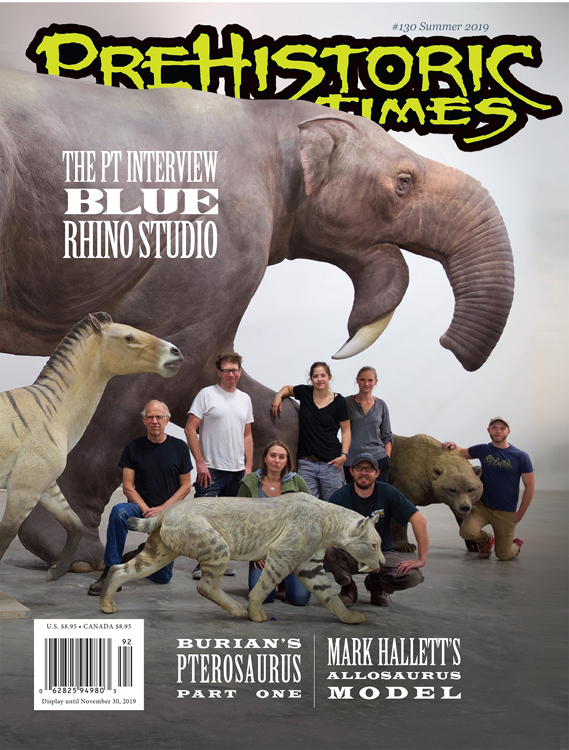
The next edition of the quarterly magazine “Prehistoric Times” is on the way.  This magazine will be arriving at our offices shortly.   Editor and chum, Mike Fredericks sent us an image of the front cover of the next issue.

“Prehistoric Times”

Prehistoric Times Issue (130)

The front cover of "Prehistoric Times" magazine - summer 2019.
“Prehistoric Times” magazine issue 130.

Picture credit: Mike Fredericks

An Eclectic Collection of Prehistoric Animals

The eye-catching front cover features an eclectic mix of prehistoric animals, all life-sized models made by the hugely talented sculptors and artists at Blue Rhino Studios (Minnesota, USA).  The staff at Blue Rhino Studios have worked with museums and attractions all over the world.  Established in the 1990s the company has become a leader in state-of-the-art prehistoric mammal, pterosaur and dinosaur figures.  Issue 130 (summer 2019), will feature an interview with Blue Rhino team members.

Readers can expect articles on Allosaurus and the enigmatic prehistoric rhinoceros Elasmotherium, as well as a continuation of the long-running series by John Lavas highlighting the contribution of the Czech illustrator Zdeněk Burian.  From the front cover details, we can see that this edition will also include an interview with the American artist Mark Hallett, a leading light in dinosaur and prehistoric animal illustrations.

Our thanks to the editorial team at “Prehistoric Times” magazine for giving us this preview.

The Everything Dinosaur website: Everything Dinosaur.

1 07, 2019

New CollectA 2019 Models in Stock

By |2023-12-26T05:46:31+00:00July 1st, 2019|Categories: Adobe CS5, Dinosaur Fans, Everything Dinosaur News and Updates, Everything Dinosaur Products, Main Page, Photos of Everything Dinosaur Products, Press Releases|0 Comments

CollectA Elasmotherium, Baryonyx and Fukuiraptor

The last of the scheduled 2019 model releases from CollectA are now in stock at Everything Dinosaur.  The trio of prehistoric animal figures are the 1:20 scale Deluxe Elasmotherium model, the 1:40 scale Baryonyx and the prehistoric life Fukuiraptor model.  What an impressive set of prehistoric animal figures they make!

Just Arrived!  The CollectA Deluxe 1:20 Scale Elasmotherium Model

The CollectA Deluxe 1:20 scale Elasmotherium model.
CollectA Deluxe 1:20 scale Elasmotherium model. Picture credit: Everything Dinosaur.

Picture credit: Everything Dinosaur

The CollectA Deluxe Elasmotherium Model

This is an excellent replica of this enigmatic member of the Rhinocerotidae family, a creature that has been nicknamed the “Siberian Unicorn”.  The design team at CollectA have emphasised the animal’s long legs and depicted it in an almost trotting pose.   A coat of rough shaggy hair generously covers the figure, although the presence of a shaggy coat, or indeed any hair whatsoever can only be inferred as the fossil record does not actually provide any substantive proof of the Elasmotherium having a dense coat. 

The nature of the horn (if indeed it possessed one), is also largely speculative but CollectA have been careful to depict their Elasmotherium using the scientific literature as a guide.  Measuring around 26 centimetres in length and that horn standing some 15 cm tall, this is a most impressive model.

To purchase the CollectA Elasmotherium and the rest of the new for 2019 CollectA Deluxe prehistoric animal models: CollectA Deluxe Prehistoric Life Models.

The CollectA Fukuiraptor

From a prehistoric animal known from relatively recent and abundant fossil material from a wide area, to a dinosaur that is mostly known from a single quarry site representing strata laid down in the Early Cretaceous of Japan (Kitadani Formation).  Little is known about Fukuiraptor kitadaniensis.  It has been assigned to the Megaraptora clade but prior to this it was thought to be a derived allosauroid when first named and described nineteen years ago (Azuma, Yoichi; Philip J., Currie (2000). “A new carnosaur (Dinosauria: Theropoda) from the Lower Cretaceous of Japan”.  In an initial scientific study published in 1995,  it was thought that Fukuiraptor had affinities towards the Dromaeosauridae.

The New for 2019 CollectA Prehistoric Life Fukuiraptor

The CollectA Fukuiraptor dinosaur model (CollectA Prehistoric Life 2019).
The new for 2019 CollectA Prehistoric Life Fukuiraptor dinosaur model. Picture credit: Everything Dinosaur.

Picture credit: Everything Dinosaur

Fukuiraptor had large hands and powerful grasping fingers armed with strongly curved claws.   These features are well represented in this new dinosaur model.  CollectA have been keen to add more dinosaurs from Asia to their model range and Fukuiraptor has been one of the most eagerly anticipated models of 2019.

The CollectA Deluxe 1:40 scale Baryonyx Dinosaur Model

The third member of this impressive trio is the CollectA Deluxe Baryonyx dinosaur model (1:40 scale replica).  This model has an articulated jaw that has been designed to replicate the distinctive baryonchid dentition.  Since Baryonyx is associated with aquatic environments the design team at CollectA have given their model subtle webbing between the toes.

The New for 2019 CollectA Deluxe Baryonyx Dinosaur Model

CollectA Deluxe Baryonyx dinosaur model (2019).
CollectA Deluxe Baryonyx model. Picture credit: Everything Dinosaur.

Picture credit: Everything Dinosaur

To view the CollectA Baryonyx and the rest of the CollectA prehistoric animal and dinosaur models: CollectA Dinosaurs and Prehistoric Animal Figures.

The Everything Dinosaur website: Everything Dinosaur.

30 06, 2019

Dinosaur “Ruffs” Given Away for Free

By |2023-12-25T22:03:14+00:00June 30th, 2019|Categories: Adobe CS5, Dinosaur Fans, Everything Dinosaur News and Updates, Main Page, Photos of Everything Dinosaur Products|0 Comments

DIY Dinosaur “Ruffs”

Our chums at Rebor have provided a little challenge to dinosaur fans and model collectors.  As this is the last day of “Jurassic June”, we thought it would be fun to see what those clever and creative people at Rebor have got up to.  It seems that they have produced some artwork for collectors to help them customise the next set of Rebor prehistoric animal figures that are due to come into stock.

Ruffs for the Rebor Dilophosaurus Figures

Here is an image of the artwork that Rebor has provided:

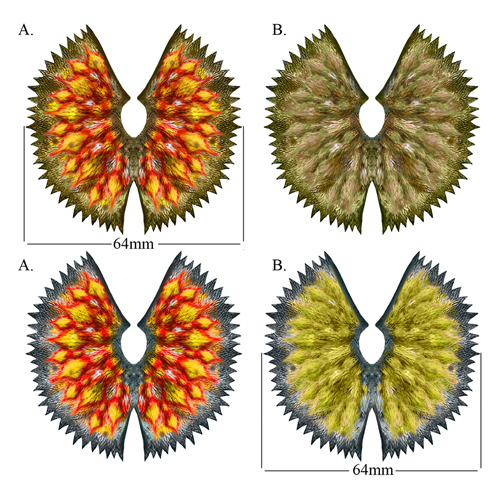
Colourful Dinosaur Frills to Customise Dinosaur Models

Two frills from Rebor.
A pair of frills to thrill Rebor model collectors.

Picture credit: Rebor

Fans of Rebor collectables will know that the next models to be introduced are a pair of Dilophosaurus dinosaurs (Dilophosaurus wetherilli).  These magnificent models, nick-named “Oasis” and “Green Day” are coming into stock at Everything Dinosaur in the next few days.  Team members will be emailing all those customers on our priority reserve list when these dinosaurs arrive.

Rebor models and replicas: Rebor Replicas and Figures.

Rebor Replicas – Dilophosaurus Dinosaurs (“Green Day” and “Oasis”

Rebor Dilophosaurus models "Green Day" and "Oasis"
The Rebor Dilophosaurus replicas “Green Day” and “Oasis”.

An Early Jurassic Predator

Dilophosaurus was an Early Jurassic, carnivorous dinosaur, so it is appropriate to feature this dinosaur as “Jurassic June” draws to a close.  We suspect that the frills could be used to adorn the necks of these beautiful figures, but we couldn’t possibly comment further.  After all, Dilophosaurus may be one of the most extensively studied of all the theropods known from the Lower Jurassic, but there is no fossil evidence to indicate that these predators had neck frills that could be “flashed” as part of a visual display.

Rebor Have Produced a Male and Female Dilophosaurus Figure

Rebor Dilophosaurus replicas compared.
Comparing the Rebor Dilophosaurus replicas “Green Day” and “Oasis”. Picture credit: Everything Dinosaur.

Picture credit: Everything Dinosaur

A Male and Female Dilophosaurus

The Rebor models depict a male and female Dilophosaurus.  There are subtle variations in the paint scheme used for each model to highlight the differences.  For example, the male “Green Day” has crimson markings on the bony crest over the eye (orbit).  Most palaeontologists are comfortable with the idea that these archosaurs, like living archosaurs today (birds and crocodilians), had excellent colour vision.  Visual signals may have been very important to the Dinosauria.

As to whether Dilophosaurus had an expandable neck ruff, is very much speculation, there is no fossil evidence to support such an idea.  However, popular culture such as books, films and television programmes have helped set up notable preconceptions in the minds of the public and who are we to challenge such views.

There is a reptile alive today that has a neck ruff, it is the neck-frilled lizard (Chlamydosaurus kingii), native to northern Australian and Papua New Guinea.  This relatively large lizard, can when frightened, extend a large ruff of skin out from its neck to produce a startling display, designed to intimidate attackers.  The neck frill usually lies folded against the animal’s neck, but by flexing its jaws and gaping, this lizard can engage cartilage supports that extend the skin folds out to produce a mock threat display that makes it look much more fearsome than the lizard actually is.

Prehistoric Animals were Show Offs

Just like many animals today, it is quite likely that visual display was very important to the extinct non-avian dinosaurs.  Back in 2010, Everything Dinosaur reported on the publication of a study by an international team of researchers which examined the fossil record to find evidence of visual display structures that probably had a primary function in sexual selection and attracting mates.

To read more about this research: Prehistoric Animals May Have Been Show Offs.

Rebor model fans might be able to work out what influenced Rebor’s decision to produce these accessories to help customise their models.  These colourful additions will be available from Everything Dinosaur free of charge, just drop us an email requesting the dinosaur frills and we will be happy to email them out.

To request these dinosaur frills: Email Everything Dinosaur.

Helpful Instructions

  1. Once you have the download, print it out using a colour printer.
  2. Carefully cut out each of the four sections.
  3. Glue part A and part B back-to-back so that there is colour showing on the front and on the rear of the ruff.
  4. Trim them until you are happy with their look, then use them to customise your Rebor models, for example, you could carefully manoeuvre the ruffs onto the tail, onto a limb or anywhere else on the model for that matter.

The Everything Dinosaur website: Everything Dinosaur.

Go to Top