All about dinosaurs, fossils and prehistoric animals by Everything Dinosaur team members.

About Mike

Mike runs Everything Dinosaur, a UK-based mail order company specialising in the sale of dinosaur and prehistoric animal models, He works alongside Sue, and between them they have become the "go to guys" for museum quality prehistoric animal models and figures. An avid fossil collector and reader of dinosaur books, Mike researchers and writes articles about palaeontology, fossil discoveries, research and of course, dinosaur and prehistoric animal models.
17 11, 2021

New for 2022 Papo Prehistoric Animal Models Announced

By |2024-08-26T16:27:31+01:00November 17th, 2021|Categories: Adobe CS5, Dinosaur Fans, Everything Dinosaur News and Updates, Everything Dinosaur Products, Main Page, Photos of Everything Dinosaur Products, Press Releases|2 Comments

The new for 2022 Papo prehistoric animal models have been announced. There will be two new models, a Protoceratops along with a Mosasaurus and a new colour variant of the Papo Styracosaurus dinosaur model. The first of these new figures is scheduled to be in stock at Everything Dinosaur in the second quarter of next year.

The new for 2022 Papo models in the “Les Dinosaures” range:

  • A new colour variant of the Papo Styracosaurus (scheduled for quarter 2 of 2022).
  • A replica of the early horned dinosaur Protoceratops (scheduled for quarter 3 of 2022).
  • A marine reptile model – Mosasaurus (scheduled for quarter 4 of 2022).
Papo Styracosaurus dinosaur model (new colour variant)
The new for 2022 Papo Styracosaurus colour variant. This is the first new Papo dinosaur model scheduled for 2022, it is due to be available in quarter 2 2022.

Papo Styracosaurus (New Colour Variant)

The first model to be announced by Papo for 2022 is a new colour variant of the Styracosaurus dinosaur which originally came out in 2011. The muted tones and emphasis on the greens, junipers and moss colours have been well received by dinosaur fans and model collectors. The sculpt is essentially the same as the 2011 version, the new model measures 16 cm in length, it is the same size as the original Papo Styracosaurus figure.

Although no official announcement has been made about retirements from the Papo range, with the arrival of the new Styracosaurus colour variant in quarter 2 of next year, team members at Everything Dinosaur expect the original Styracosaurus to be withdrawn from production.

Papo Styracosaurus dinosaur model.
The original Papo Styracosaurus model was released in 2011.
Papo Protoceratops dinosaur model.
The new for 2022 Papo Protoceratops dinosaur model. This model is scheduled to be available in quarter 3 of 2022.

Papo Protoceratops Dinosaur Model

Next year marks the centenary of the discovery of the dinosaur fossils in the Gobi Desert by an American led expedition that resulted in the naming and scientific description of “First Horned Face”. To commemorate this expedition and to honour the significant contribution to palaeontology made by the scientists, Papo is bringing out a replica of Protoceratops (P. andrewsi).

The Papo Protoceratops is scheduled to arrive at Everything Dinosaur’s warehouse some time in quarter 3 of 2022.

Papo Mosasaurus model
The new for 2022 Papo Mosasaurus model, complete with its dorsal fin. We think that this figure is reminiscent of the giant mosasaur seen in the “Jurassic World” film franchise.

Papo Mosasaurus Marine Reptile Model

The third model that has been announced, the only non-dinosaur, is a model of the Late Cretaceous marine reptile Mosasaurus.

Papo has a Tylosaurus and a Plesiosaurus replica in the “Les Dinosaures” range and the Mosasaurus will, no doubt, be welcomed by fans of the “Jurassic World” movie franchise. The Mosasaurus replica is similar to the giant Mosasaurus associated with the films “Jurassic World” and its sequel “Fallen Kingdom”. The artwork created by Papo to illustrate their new for 2022 figure, pays homage to a poster used to promote “Jurassic World when it came out in 2015.

Everything Dinosaur team members are aware of rumours circulating that Papo was to introduce a Kronosaurus model in 2022. We can assure our customers and social media followers that this rumour is not true, there will only be three prehistoric animal models introduced by Papo next year.

The Mosasaurus figure is due to be in stock at Everything Dinosaur in quarter 4 of 2022.

The Papo Mosasaurus model and company artwork.
The Papo Mosasaurus model and accompanying artwork. The illustration reflects a scene from the hugely successful “Jurassic World” film.

In Stock at Everything Dinosaur in 2022

It is good to see that Papo are able to get some prehistoric animal figures out in 2022. Like many companies the on-going issues of the global pandemic and the chaos with logistics and production has made the making of new dinosaur and prehistoric animal figures particularly challenging.

Papo Styracosaurus new colour variant due out quarter 2 2022.

Papo Protoceratops due out quarter 3 2022.

Papo Mosasaurus due out quarter 4 2022.

To view the current range of Papo prehistoric animal models and figures currently in stock at Everything Dinosaur: Papo Dinosaurs and Prehistoric Animal Models.

The Everything Dinosaur website: Dinosaur Toys.

16 11, 2021

Defining Foliodont Teeth Some Helpful Information

By |2024-05-12T07:01:11+01:00November 16th, 2021|Categories: Adobe CS5, Dinosaur Fans, Main Page, Palaeontological articles, Photos/Pictures of Fossils|0 Comments

One of the terms that you might come across when reading about different types of dinosaur dentition (their teeth) is the term foliodont. Foliodont is from the Latin and it translates as “leaf tooth”, the term is used to describe teeth that have a leaf-shaped crown. For example, armoured dinosaurs (Thyreophora), have leaf-shaped teeth.

The diagram below, shows typical stegosaur teeth (A and B) and typical ankylosaur teeth (C, D) from Maidment et al (2008).

Examples of Thyreophoran teeth (stegosaur and ankylosaur)
Examples of thyreophoran teeth. Teeth of stegosaurs (A, B) and ankylosaurs (C, D) showing typical foliodont characteristics. The leaf-shaped teeth come from (A) Paranthodon, an Early Cretaceous stegosaur from South Africa, whilst B is from Stegosaurus armatus from the Morrison Formation of the western USA. The ankylosaur tooth (C) is from Sauropelta edwardsorum from the Cloverly Formation of the USA and (D) is from Edmontonia rugosidens from the Upper Cretaceous deposits of the Horseshoe Canyon Formation (Canada). Scale bar for (A, B) equals 0.5 cm, whilst scale bar for (C, D) equal 1 cm. Picture credit: Maidment et al.
Small stegosaur tooth from the dentary.
Small, relatively unworn tooth of an indeterminate stegosaur from the Teete locality in (A) occlusal, (B) labial and (C) lingual views. These teeth in labial and lingual view can be described as foliodont. Picture credit: Skutschas et al

Beware of Wear

Unfortunately, perfectly preserved and entire teeth are exceptionally rare. Worn, broken teeth are much more common, either as a result of the shedding of teeth when the thyreophoran was alive or as a result of distortion during the fossilisation process (taphonomy). This can lead to difficulties when trying to assign isolated teeth fossils to a particular family or genus.

Whilst general characteristics of tooth morphology can be discerned from a fragmentary, partial specimen and some idea of diet can be surmised, identifying the taxon represented is extremely difficult.

For example, worn teeth discovered in the Arctic circle indicate that stegosaurs were present in Siberia during the Early Cretaceous, at what was a high palaeolatitude, but in the absence of more substantial fossil material little more about the dinosaurs present can be discerned.

To read our blog post about Arctic stegosaurs: Studying Stegosaurs that Lived in the Arctic Circle.

15 11, 2021

A New Species of Sauropodomorph Called Issi saaneq – “Cold Bone” from Greenland

By |2024-05-12T07:01:47+01:00November 15th, 2021|Categories: Adobe CS5, Dinosaur and Prehistoric Animal News Stories, Dinosaur Fans, Main Page, Palaeontological articles, Photos/Pictures of Fossils|0 Comments

This month has seen another new species of sauropodomorph named and described. Issi saaneq (pronounced is-y sa-ah-neq), roamed what is now eastern Greenland around 214 million years ago (Late Triassic), this new dinosaur has been named based on two fossil skulls believed to represent one juvenile and one older animal possibly a sub-adult. Ascribed to the Plateosauridae family and showing affinities to South American sauropodomorphs I. saaneq helps to extend our understanding of the evolution and development of these important early dinosaurs.

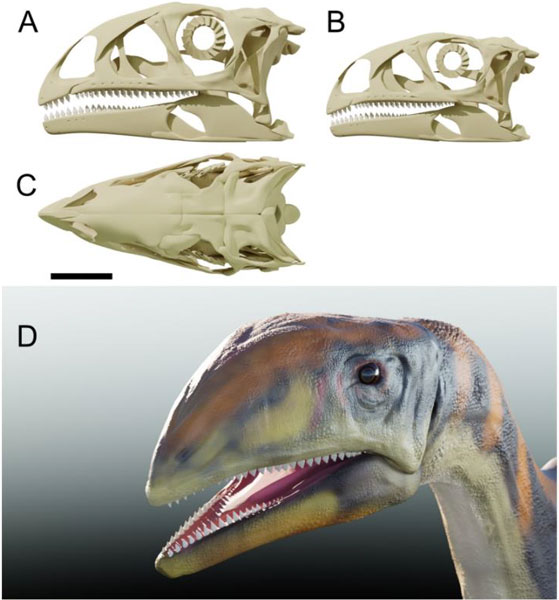
Computer generated models of skulls and a life reconstruction of Issi saaneq.
A image showing digital interpretative reconstruction of the skulls NHMD 164741 and NHMD 164758 and living representation of Issi saaneq. A digital interpretative reconstruction of the skull NHMD 164741 in left lateral view (A). Digital interpretative reconstruction of the smaller skull NHMD 164758 in left lateral view (B). Digital interpretative reconstruction of skull NHMD 164741 in dorsal view (C). Living representation of Issi saaneq (D). Scale bar = 50 mm.

Originally Assigned to Plateosaurus

The skull fossils were found in the early 1990s, during excavations of sediments representing lake shore deposits that make up part of the of the Malmros Klint Formation in Jameson Land, Greenland. The larger skull was found in 1991, the smaller skull, now believed to represent the same species was found subsequently along with numerous other fossils including skull material that has yet to be catalogued and described.

The two skulls (specimen numbers NHMD 164741 and NHMD 164758), are now part of the vertebrate fossil collection of the Natural History Museum of Denmark. Postcranial material was also found in association with the smaller skull (NHMD 164758) and this could have come from the same animal, but these bones have also not yet been examined in detail.

When first found, it was thought that these fossils were examples of Plateosaurus (P. engelhardt which is now regarded as nomen dubium with fossil material assigned to P. trossingensis). As several new sauropodomorphs had been described in recent years, the researchers were able to tap into the wealth of new fossil data and confidently assign the skulls to a new genus.

Commenting on the significance of the find, lead author of the scientific paper, published in the journal “Diversity”, Doctor Victor Beccari (Universidade Nova de Lisboa), stated:

“The anatomy of the two skulls is unique in many respects, for example in the shape and proportions of the bones. These specimens certainly belong to a new species.”

Photograph of the skulls NHMD 164741 and NHMD 164758
Photograph of the skulls NHMD 164741 and NHMD 164758 (A) NHMD 164741 in left lateral view and (B) NHMD 164758 in left lateral view. The smaller skull (NHMD 164758) represents a juvenile, whilst the larger skull (NHMD 164741) represents an older juvenile or a young adult. Picture credit: Beccari et al.

“Cold Bone” – Issi saaneq

Issi saaneq is the first non-avian dinosaur to be named from fossils found in Greenland. The name comes from the local Inuit language, with “issi” meaning cold and “saaneq” meaning bone. This is a reference to the harsh and very unpleasant weather conditions associated with the fossil site. The bones of this dinosaur were cold to the touch and the field team were often “frozen to the bone” as they worked in the extremely chilly conditions.

Jameson Land and the Issi saaneq fossil site
Location map of Jameson Land, central east Greenland (A), the Issi saaneq quarry is circled in red and indicated by the number 2. Photograph of the outcrop from which the fossil material was excavated (B). The conditions endured by the various field teams were extremely challenging and harsh.

Affinities with South American Sauropodomorphs as well as Plateosaurus

Phylogenetic assessment indicates that Issi saaneq has affinities to Brazilian plateosaurids such as Macrocollum (M. itaquii) and the European Plateosaurus, being recovered as the sister clade of Plateosaurus in this study. It is the northernmost record of a Late Triassic sauropodomorph.

To read Everything Dinosaur’s blog post about the naming and scientific description of Macrocollum itaquii: How Did Some Dinosaurs Get Long Necks?

The discovery of Issi saaneq expands the known geographical range of these dinosaurs and broadens our knowledge about the evolution of the Sauropodomorpha.

The scientific paper: “A New Sauropodomorph Dinosaur from the Late Triassic (Norian) of Jameson Land, Central East Greenland” by Victor Beccari, Octávio Mateus, Oliver Wings, Jesper Milàn and Lars B. Clemmensen published in Diversity.

14 11, 2021

The Remarkable Artwork of Luke du Toit

By |2024-08-26T16:12:00+01:00November 14th, 2021|Categories: Adobe CS5, Dinosaur and Prehistoric Animal Drawings, Dinosaur Fans, Main Page|0 Comments

Everything Dinosaur customer and prehistoric animal fan Luke du Toit combines his skills as an artist and graphic designer to create stunning dinosaur themed artworks. Take for example, this very colourful Dilophosaurus illustration shown below.

Dilophosaurus illustrated.
A colourful Dilophosaurus artwork created by talented artist and graphic designer Luke du Toit. Picture credit: Luke du Toit.

Mesozoic Art

Mesozoic Art was started by Luke back in 2016, he has been selling his unique creations to fans of prehistoric animals and palaeoart all over the world from his company’s website.

Commenting on why dinosaurs have inspired him so much, Luke explained:

“I have a deep love and obsession for dinosaurs and have been drawing them since I was 5 years old. Their variety of different shapes, sizes and colours really tap into my imagination. The fact that dinosaurs existed and are now not readily available for us to access make them almost mythical in nature. For me, they are a great source of creative expression. “

Parasaurolophus artwork.
A striking Parasaurolophus illustration. The duck-billed dinosaur is surrounded by a border of flowering plants (angiosperms). Flowering plants would have been familiar to this Late Cretaceous herbivore. Picture credit: Luke du Toit.

Inspired by the “Jurassic Park” Movie Franchise

Based in Pretoria, South Africa, Luke uses a variety of reference sources to inspire his illustrations. In particular, he is a big fan of the “Jurassic Park” movie franchise and a number of the iconic dinosaurs from that famous film franchise feature in his artwork.

Velociraptor Blue by Luke du Toit
An illustration of Velociraptor Blue inspired by the “Jurassic Park” movie franchise. Artwork entitled “Clever Girl” by South African graphic designer and artist Luke du Toit. Picture credit: Luke du Toit.

Each detailed illustration is meticulously drawn, then scanned and turned into an electronic file before being digitally redrawn and then coloured.

“My artwork looks equally beautiful in a child’s bedroom, a study as well as an art piece in a living room or even a “Man Cave” setting,” commented the talented artist.

Triceratops artwork
A striking illustration of the horned dinosaur Triceratops. Picture credit: Luke du Toit.

Take a look at the Mesozoic Art website to see the full portfolio of artwork and illustrations of the artist.

Visit the Everything Dinosaur website: Everything Dinosaur.

13 11, 2021

Everything Dinosaur’s Next Video – New CollectA Models (Part 2)

By |2024-08-26T16:08:40+01:00November 13th, 2021|Categories: Adobe CS5, Dinosaur Fans, Everything Dinosaur News and Updates, Everything Dinosaur videos, Main Page, Press Releases|0 Comments

Everything Dinosaur’s next YouTube video will feature the second batch of new CollectA prehistoric animal models for 2022 that have been recently announced. The video will provide more details on the bizarre Palaeozoic nautiloid Cooperoceras and the super-sized Late Triassic predator Smok wawelski (pronounced Smock var-vel-ski).

New for 2022 CollectA models (part 2).
The second batch of CollectA models have been announced (2022), the archosaur Smok wawelski from Poland and the armoured nautiloid Cooperoceras from North America and Europe. These exciting prehistoric animal figures will feature in the next Everything Dinosaur YouTube video.

The second set of prehistoric animal models are due to be in stock at Everything Dinosaur early 2022, however, a spokesperson for the UK-based mail order company confirmed that there was no date yet as to when these figures might be available. However, a promise was made to keep dinosaur fans and model collectors informed of progress with regular updates and posts on the company’s social media pages.

Everything Dinosaur YouTube Video (CollectA Models Part 2)
Everything Dinosaur’s next YouTube video will focus upon the new for 2022 CollectA Deluxe 1:20 scale Smok wawelski and the CollectA Cooperoceras nautiloid model. Picture credit: Everything Dinosaur

Picture credit: Everything Dinosaur

New CollectA Models

Everything Dinosaur stocks a large range of prehistoric animal figures including CollectA. There are CollectA dinosaurs, marine reptiles and other prehistoric animals. The CollectA model range also includes prehistoric mammals and pterosaurs.

View the CollectA Age of Dinosaurs range: CollectA Age of Dinosaurs Popular Range.

View CollectA scale models: CollectA Deluxe Models.

Everything Dinosaur on YouTube

A spokesperson from Everything Dinosaur also stated that their next CollectA video should be up on the company’s YouTube channel in a few days.

The Everything Dinosaur YouTube channel has thousands of subscribers. It contains model reviews, prehistoric animal and dinosaur news stories, fossil discoveries as well as features on product development and model collecting advice and tips.

We recommend that you subscribe to Everything Dinosaur on YouTube.

Everything Dinosaur on YouTube: Everything Dinosaur’s YouTube channel.

12 11, 2021

New CollectA Models 2022 (Part 2)

By |2024-08-26T16:07:19+01:00November 12th, 2021|Categories: Adobe CS5, Dinosaur Fans, Everything Dinosaur News and Updates, Everything Dinosaur Products, Main Page, Photos of Everything Dinosaur Products, Press Releases|3 Comments

New CollectA Models 2022 (Part 2)

Today, team members at Everything Dinosaur announce the second set of new for 2022 CollectA prehistoric animal models. Although, due to all the various issues caused by the global pandemic, CollectA, like most manufacturers will introduce fewer figures than usual next year, they are certainly setting extremely high standards.

The two new for 2022 figures we announce today are:

  • CollectA Deluxe Smok wawelski with an articulated jaw (1:20 scale)
  • CollectA Prehistoric Life Cooperoceras

Scheduled for delivery in early 2022, Everything Dinosaur will keep model collectors informed about shipments.

New for 2022 CollectA models (part 2).
The second batch of CollectA models have been announced (2022) the archosaur Smok wawelski from Poland and the armoured nautiloid Cooperoceras from North America and Europe.

Smok wawelski – A Polish Dragon!

CollectA will be adding a replica of the Late Triassic predator Smok wawelski to their model range next year. Fans of the CollectA range will know that in 2020, a 1:20 scale replica of the giant, Polish dicynodont Lisowicia bojani was introduced. Fossil remains of a large carnivore were also found at the same site. The bonebed in southern Poland close to the village of Lisowice, also revealed the presence of a five-metre plus archosaurian meat-eater. Named and described in 2011, Smok wawelski is the largest terrestrial predator known from the Late Triassic of central Europe.

CollectA Deluxe Smok wawelski.
The new for 2022 CollectA Deluxe Smok wawelski replica reflects the view that this large Late Triassic predator was not a theropod dinosaur.

A Taxonomic Puzzle

When first studied, it was thought that the fossilised remains represented a theropod dinosaur. The braincase had several anatomical traits reminiscent to those seen in the skulls of allosaurids. Subsequent fossil discoveries have thrown doubts on whether Smok is a dinosaur. It may not belong to the dinosaur/bird lineage of the Archosauria at all, Smok could be a member of the Rauisuchidae, or perhaps a prestosuchid from the crocodile branch of the Archosauria. Designer Anthony Beeson has opted to depict this powerful predator as a quadruped, a member of the crocodile lineage of archosaurs. The 1:20 scale model has an articulated jaw.

CollectA Deluxe Smok wawelski model.
The new CollectA Deluxe 1:20 scale Smok wawelski has an articulated lower jaw.

CollectA Cooperoceras

The second new for 2022 CollectA figure we announce today, is a beautiful model of the bizarre nautiloid Cooperoceras. A spiky cephalopod distantly related to the living nautilus. CollectA have made several replicas of iconic Palaeozoic invertebrates in recent years. For example, in 2020 the company added a model of a nautilus to their model range (N. pompilius). The introduction of Cooperoceras adds to the list of important zonal fossil models made by CollectA. These replicas represent Palaeozoic and Mesozoic invertebrates, fossils of which assist with the dating of strata (biostratigraphy).

CollectA Cooperoceras
The new for 2022 CollectA Cooperoceras model continues the company’s fine tradition for creating replicas of important Palaeozoic invertebrates.

Cooperoceras was an early nautiloid with a shell measuring 4 inches (101.6 mm) long and 3 inches (76 mm) high.

The genus and type species C. texanum was erected by the American geologist Arthur K. Miller in 1945 following an extensive period of fossil collecting in the Glass Mountains and the Sierra Diablo of western Texas undertaken by several scientists in a bid to better understand the diversity of Permian-aged nautiloids which were very poorly known in comparison to the contemporary ammonites.

Originally thought to have been confined to the Permian, in 1977, a new species of Cooperoceras was named and described (C. milleri) from much older deposits (Shumway Limestone Formation of the Mattoon Formation, Illinois). This discovery suggests that these types of nautiloids were present in the Late Carboniferous.

Explaining how Cooperoceras (Cooper’s horn) came to be added to the CollectA portfolio, designer Anthony Beeson stated:

“It had an amazing and tactile open coiled shell with flattened sides and sporting recurvant hollow spines on its outer edge which was the reason that I wanted to do a model of it. I think it may be popular with children. It lived in the shallow seas over what is now Texas and Illinois, and the Urals in Europe.”

Model Measurements

  • CollectA Deluxe 1:20 scale Smok wawelski with an articulated jaw length 27 cm, height 8.5 cm.
  • CollectA Cooperoceras nautiloid model length 11 cm, height of shell 8.3 cm.

These figures are scheduled to be in stock at Everything Dinosaur in the early part of 2022. Due to the current difficulties with logistics and global shipping, we are not able to give a precise date as to when these figures will be available. Team members will do all they can to update customers with regards to availability.

To view the range of CollectA Deluxe models, including the Lisowicia bojani model in stock at Everything Dinosaur: CollectA Deluxe Prehistoric Animals.

To view the CollectA Prehistoric Life models, including the invertebrate figures: CollectA Prehistoric Life.

11 11, 2021

New Iguanodontid from the Isle of Wight

By |2024-08-26T16:05:43+01:00November 11th, 2021|Categories: Adobe CS5, Dinosaur Fans, Main Page, Palaeontological articles, Photos/Pictures of Fossils|0 Comments

Hot on the heels of the announcement of two new spinosaurids* from the Isle of Wight, a scientific paper has been published today (11th November 2021), that announces the discovery of a new genus of iguanodontid from the same stretch of coastline on the island.

The dinosaur has been named Brighstoneus simmondsi and it suggests that there are probably several different iguanodontids still awaiting discovery in the Wealden Group strata. The genus Iguanodon had been regarded as a taxonomic waste basket, extensive revision has taken place and several new genera have been erected, but in general terms, Wealden Group iguanodontian fossil material was classed into the gracile, lightly built Mantellisaurus (M. atherfieldensis) and more robust fossil bones usually classified as Iguanodon (I. bernissartensis), although other genera such as Barilium dawsoni and Hypselospinus fittoni are also known from southern England.

Analysis of fossils originally found near the village of Brighstone on the Isle of Wight in 1978 have proved sufficiently different from other iguanodontid fossil material to warrant the establishment of a new genus.

Brighstoneus (top) compared to Mantellisaurus (bottom).
Brighstoneus (top) with its more bulbous snout compared to Mantellisaurus (below). Picture credit: John Sibbick.

A Collaboration between the London Natural History Museum and the University of Portsmouth

Writing in the academic publication the Journal of Systematic Palaeontology, researchers from the London Natural History Museum in collaboration with the University of Portsmouth describe this new species of ornithopod and highlight the unique anatomical traits that merited the erection of a new dinosaur genus. An assessment of the dentition, including a count of the teeth present in the jaws indicated that these fossils represented something new. Careful analysis of the nasal bone by Dr Jeremy Lockwood (University of Portsmouth) and one of the authors of the scientific paper, revealed that Brighstoneus probably had a prominent, bulbous snout.

Brighstoneus simmondsi nasal and maxilla with skull drawing
The nasal and maxilla bones of Brighstoneus simmondsi with accompanying line drawings. The shape of the nasal bone suggests that this iguanodontid had a bulbous snout. Picture credit: Dr Jeremy Lockwood.

Explaining why the fossils represent a new dinosaur species, Dr Jeremy Lockwood stated:

“For me, the number of teeth was a sign. Mantellisaurus [M. atherfieldensis] has 23 or 24, but this has 28. It also had a bulbous nose, whereas the other species have very straight noses. Altogether, these and other small differences made it very obviously a new species.”

Honouring Brighstone Village and the Finder of the Fossils

Estimated to have measured around 8 metres in length and weighing around 900 kilograms, Brighstoneus simmondsi can be regarded as a mid-sized iguanodontid. The genus name honours the village of Brighstone, close to where the fossils were found and the species name is in tribute to Mr Keith Simmonds who found the fossils back in 1978.

Brighstoneus model
The CollectA drinking Mantellisaurus modified to resemble Brighstoneus simmondsi with its more bulbous snout.

The discovery of this new species following a reassessment of previously described fossil material suggests that there were far more iguanodontian dinosaurs in the Early Cretaceous of the UK than previously thought, and that simply assigning specimens from this period to either Iguanodon or Mantellisaurus is over simplified.

Dr Lockwood added:

“We’re looking at six, maybe seven million years of deposits, and I think the genus lengths have been overestimated in the past. If that’s the case on the island, we could be seeing many more new species. It seems so unlikely to just have two animals being exactly the same for millions of years without change.”

Co-author of the paper, Dr Susannah Maidment (London Natural History Museum), stated:

“The describing of this new species shows that there is clearly a greater diversity of iguanodontian dinosaurs in the Early Cretaceous of the UK than previously realised. It’s also showing that the century-old paradigm that gracile iguanodontian bones found on the island belong to Mantellisaurus and large elements belong to Iguanodon can no longer be substantiated.”

Fossil Bones Showing Unusual Pathology

A dorsal bone, which Everything Dinosaur team members believe was previously ascribed to Mantellisaurus but now assigned to this new genus shows some unusual pathology. The top of the neural spine is deformed and twisted over. It is not known how this trauma occurred but analysis of the bone surrounding the injury suggests that this dinosaur lived for some time after this injury took place.

B. simmondsi dorsal vertebra showing pathology.
Brighstoneus simmondsi dorsal vertebra showing pathology on the neural spine. Picture credit: Dr Jeremy Lockwood.

Highlighting the significance of the Isle of Wight in terms of vertebrate palaeontology, Dr Lockwood commented that there were probably many more dinosaur discoveries going to be made in southern England.

To read Everything Dinosaur’s recent blog post about the naming of two new Isle of Wight spinosaurids*: Two New Spinosaurids from the Isle of Wight.

Compton Bay (Isle of Wight)
Dr Jeremy Lockwood walking along the beach at Compton Bay. Picture credit: Dr Jeremy Lockwood.

The scientific paper: “A new hadrosauriform dinosaur from the Wessex Formation, Wealden Group (Early Cretaceous), of the Isle of Wight, Southern England” is published in the Journal of Systematic Palaeontology.

10 11, 2021

The New Eofauna Konobelodon atticus

By |2024-05-11T22:56:47+01:00November 10th, 2021|Categories: Adobe CS5, Dinosaur Fans, Everything Dinosaur News and Updates, Everything Dinosaur Products, Main Page, Photos of Everything Dinosaur Products, Press Releases|0 Comments

The next prehistoric animal model to be added to the Eofauna Scientific Research range is a fabulous model of the ancient elephant Konobelodon atticus, the figure is in 1:35 scale and is Eofauna’s first “shovel-tusker” model.

The figure is scheduled to be in stock at Everything Dinosaur early in 2022 (estimated arrival time at the UK warehouse – February 2022).

Eofauna Konobelodon atticus
The new for 2022 Eofauna Konobelodon atticus model is supplied with a data card and Everything Dinosaur will also provide a product fact sheet with sales of this figure.

Konobelodon atticus

Konobelodon was an enormous amebelodontid, one of the very last of its kind. Several species have been described since the first fossils associated with this genus were studied in the mid-19th century. It is characterised by its pair of huge, flattened tusks in its lower jaw and its extremely long pair of straight tusks in its upper jaw. The model represents Konobelodon atticus, fossils of which were first discovered in Greece (Late Miocene deposits).

Eofauna Scientific Research Konobelodon atticus
The stunning Eofauna Konobelodon model measures 23 cm long and stands approximately 11 cm high.

Konobelodon atticus was originally named Mastodon atticus by the German palaeontologist and zoologist Johann Andreas Wagner in 1857. The extensive, Miocene-aged deposits at Pikermi on the Attica peninsular of Greece, were discovered by Bavarian soldiers, part of the army of the Bavarian prince Otto, who ruled Greece for thirty years from 1832 until he was deposed in 1862. Fossils of large mammals were exposed on the surface and this attracted German field teams from various institutions and universities to excavate and study the fossil material

More than 40 mammal species were named following these excavations. A large, left maxilla (upper jawbone), that was described by Wagner led to the erection of the species Mastodon atticus, in the mistaken belief that this prehistoric elephant was closely related to other European elephant fossils that had been studied by the influential French anatomist Georges Cuvier, who first used the term “Mastodon” to describe fossil elephants in 1806.

Mastodon atticus?

Wagner, who was a professor at the University of Munich, published a series of comprehensive treatises on the Pikermi field work on behalf of the University and in 1857 he erected the species Mastodon atticus, in the publication Neue Beiträge zur Kenntniss der fossilen Säugthier-Überreste von Pikermi (New Contributions to the Knowledge of the Fossil Mammalian Remains of Pikermi).

Eofauna Konobelodon model
The Eofauna Scientific Research Konobelodon figure is in approximately 1:35 scale.

A Revision of Prehistoric Elephant Taxonomy

Thought to be closely related to the taxon Amebelodon, a second species was named in 1990 based on fossils found in Florida. It was considered to be a sub-genus of Amebelodon (Konobelodon britti). Phylogenetic analysis failed to resolve the taxonomic position of Konobelodon fossil material within the Amebelodon genus and a re-assessment of the phylogeny was undertaken in 2014, resulting in the establishment of Konobelodon as a distinct genus. Notable differences in the European K. atticus and the American K. britti resulted in both being declared separate, but related species. A third species of Konobelodon (K. robustus), was named and scientifically described in 2016, based on fossils found in north-western China (Linxia Basin).

Konobelodon model
Originally named in 1857, Konobelodon atticus has had a long and complicated taxonomic history.

Eofauna Konobelodon atticus

A waitlist has been set up on the Everything Dinosaur website (it can be accessed by clicking the second link below), if the waitlist button is not visible, log into your Everything Dinosaur account or create an account to access the waitlist option.

You are welcome to reserve an Eofauna Konobelodon atticus figure by emailing Everything Dinosaur: Email Everything Dinosaur.

A spokesperson from Everything Dinosaur confirmed that this exciting prehistoric elephant model would be in stock at Everything Dinosaur in early 2022.

To view the range of Eofauna prehistoric animal figures currently in stock at Everything Dinosaur: Eofauna Scientific Research Models.

9 11, 2021

Rare Triceratops Skeleton on Display

By |2024-05-09T08:46:38+01:00November 9th, 2021|Categories: Adobe CS5, Dinosaur Fans, Geology, Main Page, Palaeontological articles, Photos/Pictures of Fossils|0 Comments

Triceratops might be one of the most recognisable of all the dinosaur genera, but we still have a lot to learn about this Late Cretaceous ornithischian and perennial favourite amongst dinosaur fans. Several musuems have a Triceratops skeleton on display. It might be a famous resident of the Hell Creek Formation, but Triceratops remains have also been reported from other North American geological formations too, all of which date from the very last faunal stage of the Cretaceous – the Maastrichtian.

Triceratops on Display
A cast of a Triceratops skeleton on display at the Naturmuseum Senckenberg (Natural History Museum – Frankfurt). On the left, a wall mounted example of a Plateosaurus can be seen. Picture credit: Everything Dinosaur.

Picture credit: Everything Dinosaur

The Natural History Museum range includes several ornithischian figures including Triceratops (whilst stocks last): London Natural History Museum Dinosaur Models.

Where Have Triceratops Fossils Been Reported From?

Team members at Everything Dinosaur have tried to compile a list of the geological formations, other than the famous Hell Creek Formation, from which Triceratops fossil material has been excavated.

Here is our list:

  • Scollard Formation (south-western Alberta, Canada).
  • Frenchman Formation (Saskatchewan, Canada).
  • Evanston Formation (Wyoming, USA).
  • Lance Formation (Wyoming, USA).
  • Laramie Formation (Colorado, USA).
  • Denver Formation (Colorado, USA).
Triceratops fossil mount.
“Three-horned face” Part of an exhibit at the Natural History Museum of Los Angeles County (USA).

Two Formally Recognised Species

Scientifically described and named back in 1889 (T. horridus – Marsh), several species have been assigned to the Triceratops genus over the years, many of which were based on highly fragmentary and poorly preserved fossil remains. Today, only two species are formally recognised, Triceratops horridus and the geologically younger Triceratops prorsus.

Intriguingly, fossils from the Hell Creek Formation suggest that there are probably other species of Triceratops awaiting formal recognition. Triceratops horridus is known from the lower portion of the Hell Creek Formation and T. prorsus from the upper portion, there is a distinct, transitional, intermediate form of Triceratops reported form the middle portion of this geological formation. The fossils associated with these strata probably represent an as yet, unnamed and undescribed new species of “three-horned face”.

Stratigraphic placement of Hell Creek Formation Triceratops.
Stratigraphic placement of Hell Creek Formation Triceratops reveals trends in cranial morphology, helping to confirm species. Picture credit: Scannella et al.

For an article that looks at the evolutionary relationship between the two, formally recognised species of Triceratops: How Triceratops Got its Horns and Beak.

To read Everything Dinosaur’s blog post from 2018, that examines the ceratopsian family tree and looks at the taxonomic relationship between the Triceratops genus and other Late Cretaceous horned dinosaurs: A Horned Dinosaur Family Tree.

8 11, 2021

Permian Beetles Provide Pointers to Remarkable Ecosystem Collapse

By |2024-08-26T15:56:32+01:00November 8th, 2021|Categories: Dinosaur and Prehistoric Animal News Stories, Dinosaur Fans, Main Page, Palaeontological articles, Photos/Pictures of Fossils|0 Comments

The COP26 conference continues to dominate the news. Countries are striving to find the commitments required to limit global warming to 1.5 degrees Celsius to mitigate the worst effects of global warming. Could the humble beetle provide a clue as to the consequences if the world’s leaders can’t find agreement?

A new study published in eLife this week, looked at beetle fossils, specifically those wood-eating (xylophagous) beetles, it seems the mass extinction event that took place around 252 million years ago devastated these insects. If the huge and diverse Coleoptera are not invulnerable to global climate change, then what chance does the last line of hominins have in the current climate crisis?

Permian beetle fossils and line drawings.
Examples of Permian beetles including fossilised wings and carapaces with (B and D) life reconstructions. Picture credit: Nanjing Institute of Geology and Palaeontology of the Chinese Academy of Sciences (NIGPAS).

The Mass Extinction Event at the End of the Permian

The end-Permian mass extinction event, led to the collapse of global marine and terrestrial ecosystems. It has been estimated that around 95 percent of all life on Earth died out. The ecological response of insects (Insecta), to this catastrophe is poorly understand. A team of scientists have reviewed the fossil record of wood-eating beetles associated with the Permian and Triassic and they have concluded that the collapse of forest ecosystems led to a dramatic decline in these beetles. Furthermore, xylophagous beetles may have been responsible for the decrease of oxygen concentrations in the Permian.

Dominated by Xylophagous Beetles

The fossil record may show some bias towards wood-eating beetles when compared to the preserved remains of other types of beetle with different diets, but in this new study the research team, which included scientists from Nanjing Institute of Geology and Palaeontology and Centre for Excellence in Life and Palaeoenvironment, the University of California and the London Natural History Museum, discovered that xylophagous beetles dominated the Coleoptera during the Early Permian.

Studying Permian Beetles

As different types of beetle evolved, their dominance declined until the end-Permian mass extinction event when the number of species collapsed. The lack of coal seams dating from around 252-247 million years ago, are a testament to the loss of forest habitats. New xylophagous beetles appeared widely in the early Middle Triassic, which is consistent with the restoration of forest ecosystems

Plotting the decline of wood-eating beetles.
Simplified phylogeny of Coleoptera (A) from the Early Permian to Middle Triassic. Thick lines indicate the known extent of the fossil record. The branches representing stem groups are shown in red. The ‘dead clade walking’ pattern is symbolised by the dashed line. Genus percentage of wood-eating groups from the Early Permian to Middle Triassic (B). Yellow graded band represents the “coal gap” a time when forest ecosystems collapsed. Picture credit: Zhao et al.

A Decrease in Atmospheric Oxygen

The concentration of oxygen in the atmosphere, peaked during the Carboniferous, but began to decline during the Permian. It is thought that the evolution of Permian terrestrial herbivores including wood-consuming beetles may have limited the transport and long-term burial of terrestrial organic compounds in marine sediments, resulting in less organic carbon burial and attendant declines in atmospheric oxygen.

Today, we are seeing a dramatic fall in the number of different types of insect. The loss of pollinators on world food supply has been well documented, however, xylophagous insects have been largely neglected in studies of the current extinction crisis. This research may help scientists to better understand future changes in insect diversity and abundance and the consequences of such developments as the world faces global environmental change.

Everything Dinosaur acknowledges the assistance of a media release from the Chinese Academy of Sciences in the compilation of this article.

The scientific paper: “Early evolution of beetles regulated by the end-Permian deforestation” by Xianye Zhao, Yilun Yu, Matthew E Clapham, Evgeny Yan, Jun Chen, Edmund A Jarzembowski, Xiangdong Zhao and Bo Wang published in eLife.

The Everything Dinosaur website: Prehistoric Animal Toys.

Go to Top