All about dinosaurs, fossils and prehistoric animals by Everything Dinosaur team members.
About Mike
Mike runs Everything Dinosaur, a UK-based mail order company specialising in the sale of dinosaur and prehistoric animal models, He works alongside Sue, and between them they have become the "go to guys" for museum quality prehistoric animal models and figures. An avid fossil collector and reader of dinosaur books, Mike researchers and writes articles about palaeontology, fossil discoveries, research and of course, dinosaur and prehistoric animal models.
Today, is the first day of industrial action by the Communication Workers Union (CWU) which will have an impact on the postal services of Royal Mail. Everything Dinosaur team members have put in place measures to protect customers and to minimise the disruption to parcel collection and deliveries.
However, despite our best efforts, there will be delays to UK deliveries and as overseas parcels handled by Royal Mail will also be affected, our customers outside the UK will also face delays in receiving their parcels.
Everything Dinosaur team members have taken steps to help minimise disruption for customers, but due to industrial action UK and overseas deliveries of parcels will be subject to delays. Picture credit: Everything Dinosaur.
Four Days of Industrial Action Planned
The CWU has called on its members who collect, sort and deliver parcels and letters to take strike action. Four days of industrial action have been announced, starting with today (26th August). Further strike action is planned for Wednesday 31st August, with two further strikes scheduled for September (8th and 9th of September).
Royal Mail has released the following statement:
“We’re really sorry for the disruption that this strike action is likely to cause to you. We want to reassure you we will do everything we can to minimise disruption and get our services back to normal as quickly as possible. Royal Mail has well-developed contingency plans, but they cannot fully replace the daily efforts of its frontline workforce. We will be doing what we can to keep services running, but customers should expect significant disruption.”
A spokesperson from Everything Dinosaur confirmed that the UK-based mail order company was not expecting any collections by Royal Mail today. Parcels would still be packed and prepared for collection, but with the Bank Holiday Monday, the earliest deliveries could be sent out would be Tuesday 30th August.
Staff would be working over the weekend and during the Bank Holiday to ensure that as many parcels as possible could be sent out on Tuesday 30th August.
It is hoped that some collection services would be able to take place as Royal Mail management adjusts to the industrial action, but delays to parcel deliveries were inevitable.
Royal Mail has issued advice to its customers stating that it was sensible to “post items as early as possible in advance of the strike dates”. This would help to minimise the disruption.
Industrial action at the Port of Felixstowe could have an impact on the availability of goods, including Everything Dinosaur’s range of prehistoric animal models and figures in the crucial sales period leading up to Christmas.
Recently, staff at Felixstowe Port, one of the busiest ports in Europe, started industrial action in a dispute over pay. If the dispute is not resolved and further strike action follows, this could have an impact on the range of items available and inventory in the vital retail period – quarter 4.
The Port of Felixstowe manages more than 4 million TEUs (Twenty-foot Equivalent Units) per year, including prehistoric animal models and figures destined for Everything Dinosaur’s UK warehouse. Picture credit: Port of Felixstowe.
The Port of Felixstowe
The Port of Felixstowe is the UK’s biggest and busiest container port, and one of the largest in Europe. It handles over 4 million TEUs (Twenty-foot Equivalent Units) per year, around 2,000 container ships, including some of the biggest vessels afloat, unload at Felixstowe each year. The port is a vital component of Britain’s commercial infrastructure. If industrial action continues into the autumn, then this could cause significant disruption to already stretched supply chains in the lead up to Christmas.
All sorts of sectors of the UK economy could be affected including legal importers of prehistoric animal models and figures such as Everything Dinosaur.
A spokesperson from the UK-based company commented:
“We continue to monitor the situation and we are working closely with our freight forwarding contacts to mitigate the impact of any disruption to supplies and minimise any inconvenience for our customers.”
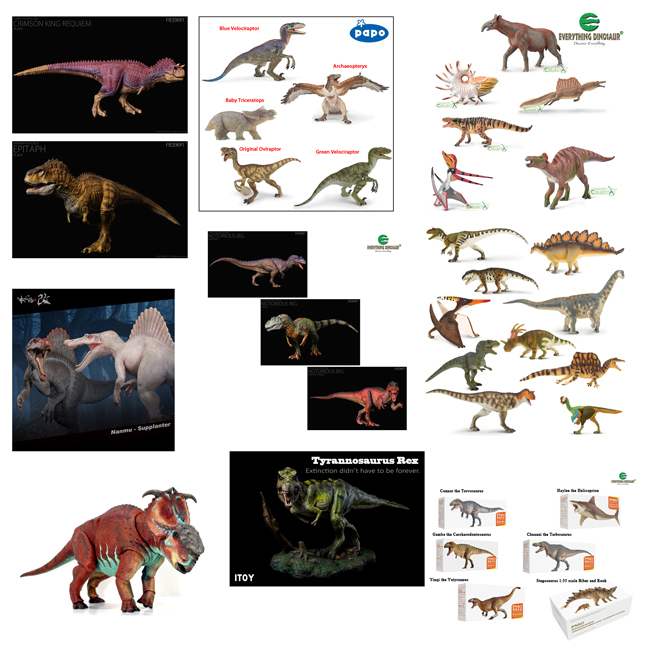
Examples of the huge range of dinosaur and prehistoric animal models and figures stocked by Everything Dinosaur. Picture credit: Everything Dinosaur.
Shop Early for Christmas
Whilst alternative ports are a possibility, continued and prolonged industrial action at Felixstowe could have a knock-on effect for the UK supply chain and result in a shortage of products available in shops. Commentators have advised that customers shop early for Christmas as one way of minimising the potential impact of these strikes.
The spokesperson from Everything Dinosaur explained that as the company had their own warehouse, they had been able to build up considerable stock of prehistoric animal models and figures as well as dinosaur toys. It was stressed that deliveries to the warehouse were still taking place.
The Port of Felixstowe is Britain’s biggest and busiest container port, and one of the largest in Europe. Amongst the huge volumes of goods handled by the Port, there are shipping containers with dinosaur and prehistoric animal models shipped into the UK by Everything Dinosaur. Picture credit: Port of Felixstowe.
The Everything Dinosaur spokesperson added:
“We do have shipments arriving at Felixstowe and there are shipments already scheduled and further ones being planned. We have been able to build up our inventory and we currently have thousands of items in stock which should provide some reassurance to our customers.”
Everything Dinosaur acknowledges the assistance of the Head of Corporate Affairs at the Port of Felixstowe in the compilation of this article.
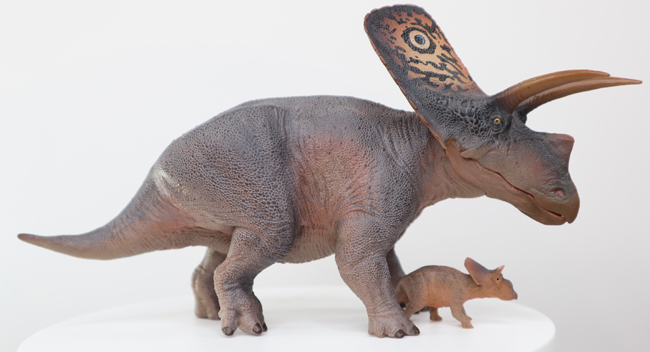
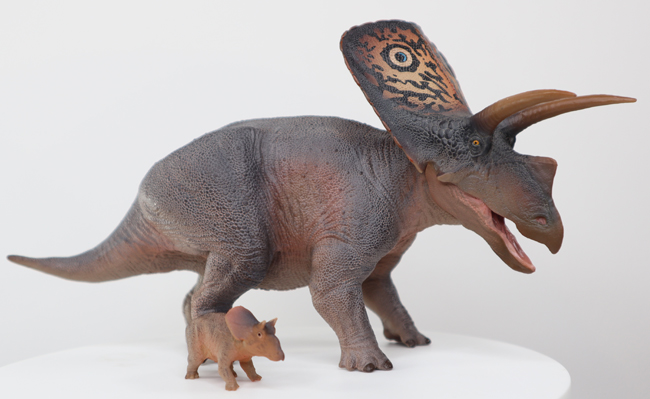
Earlier this year, (spring 2022), PNSO announced that they would be adding a 1:35 scale replica of an adult Torosaurus and juvenile to their scientific art series. The PNSO Aubrey and Dabei Torosaurus models are in stock and have been proving to be very popular amongst dinosaur fans and model collectors.
PNSO Torosaurus dinosaur models in 1:35 scale – Torosaurus Aubrey and Dabei. The baby Torosaurus figure stands close to the adult which is offering protection to the young horned dinosaur. Picture credit: Everything Dinosaur.
Torosaurus Figures in 1/35th Scale
The Torosaurus pair (Aubrey and Dabei) are part of the highly successful 1:35 scale scientific art models series from PNSO. Torosaurus is the second ceratopsian to be featured after the initial introduction of the Triceratops figure (Doyle).
Aubrey, the adult Torosaurus measures an impressive 23 cm in length. The beautiful headshield with its stunning eyespots over the fenestrae stands over 12 cm off the ground. The baby Torosaurus (Dabei) measures approximately 5.5 cm long.
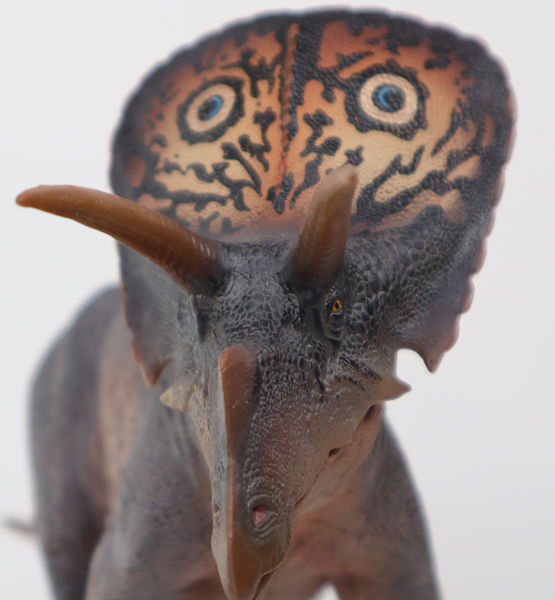
The PNSO Torosaurus 1:35 scale dinosaur model (Aubrey) shown in anterior view. The headshield eyespots and spectacular colouration of this figure are highlighted. Picture credit: Everything Dinosaur.
Torosaurus latus
Torosaurus (T. latus) was formally named and described in 1891 (Othniel Charles Marsh), and is one of the largest, and youngest of the chasmosaurine horned dinosaurs known to science. Fossils have been ascribed to this genus from Upper Cretaceous deposits from both the USA and Canada, although the identification of some of these specimens as Torosaurus fossils remains controversial.
Compared to the closely related Triceratops, fossils of Torosaurus are much rarer.
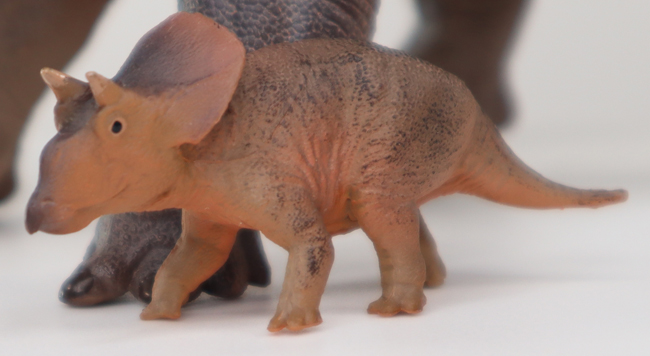
A close-up view of the baby Torosaurus model included in the PNSO model set. Behind Dabei the front foot of Aubrey can be seen, it provides a scale for this juvenile Torosaurus model. Picture credit: Everything Dinosaur.
Twenty Scientific Art Posters
The PNSO Aubrey and Dabei Torosaurus models are supplied with a 48-page, fully illustrated booklet, 7 drawing cards and twenty scientific art posters featuring the two dinosaur figures.
The PNSO Torosaurus pair (Aubrey and Dabei) shown in right lateral view. Picture credit: Everything Dinosaur.
PNSO have earned a deserved reputation for the breadth and depth of their prehistoric animal model range. To view the wide range of PNSO figures available from Everything Dinosaur: PNSO Age of Dinosaurs Models and Figures.
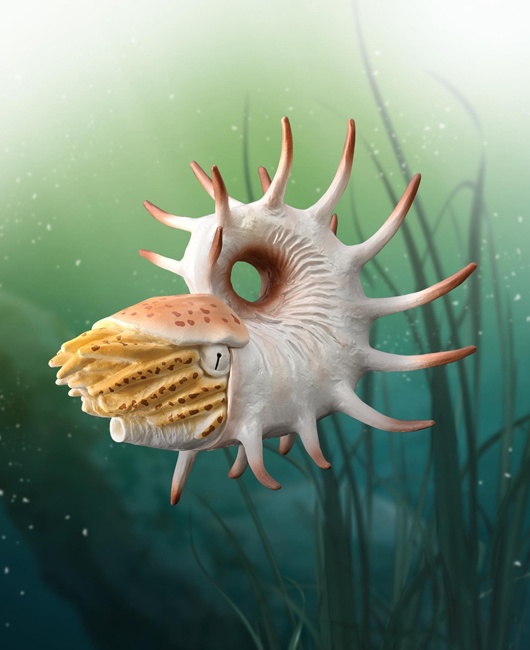
CollectA have supplied Everything Dinosaur with some further images of their new for 2022 prehistoric animal figures including a life reconstruction of the CollectA Cooperoceras model. Part of the CollectA Prehistoric World “Other Prehistoric Animals” series, the replica of Cooperoceras (C. texanum) is shown against a seascape backdrop.
The new for 2022 CollectA Prehistoric Life Popular Cooperoceras model depicted in a shallow marine environment.
Cooperoceras was an early nautiloid with a shell measuring approximately 4 inches (10 cm) long and 3 inches (7.5 cm) high. Its fossils are associated with Upper Carboniferous and Permian marine strata. The type species C. texanum was collected from the Glass Mountains and Sierra Diablo areas of Texas. These deposits contain many cephalopod fossils, and they were laid down in a shallow marine environment. The presence of photosynthesising plants in background of the Cooperoceras seascape indicate that the design team at CollectA wanted to portray Cooperoceras as a shallow water genus.
Cooperoceras along with other nautiloids is regarded as an important zonal fossil by invertebrate palaeontologists. It helps scientists to correlate the relative ages of geographically distant strata based on the fossil specimens contained therein.
A Cooperoceras Fact Sheet
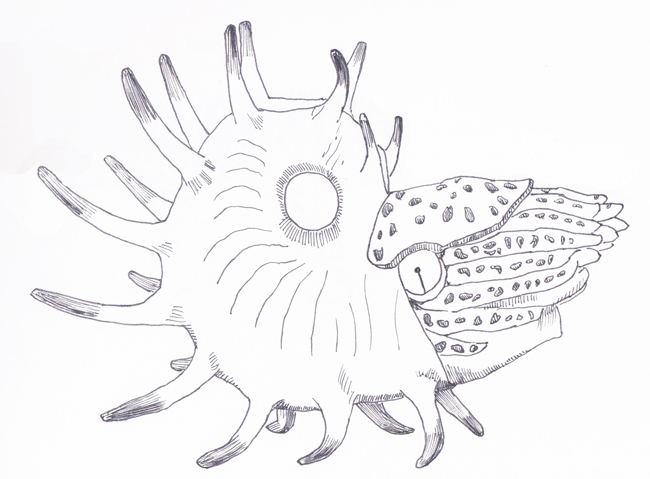
Everything Dinosaur commissioned an illustration of this Palaeozoic cephalopod which could be used in a fact sheet sent out with sales of this new for 2022 CollectA model.
The illustration of the Palaeozoic nautiloid Cooperoceras (C. texanum). The artwork was commissioned by Everything Dinosaur for use in the company’s Cooperoceras fact sheet.
The function of the recurvant spines on the shell remains a mystery, although they are thought to have played a role in defence or possibly denoted sexual maturity.
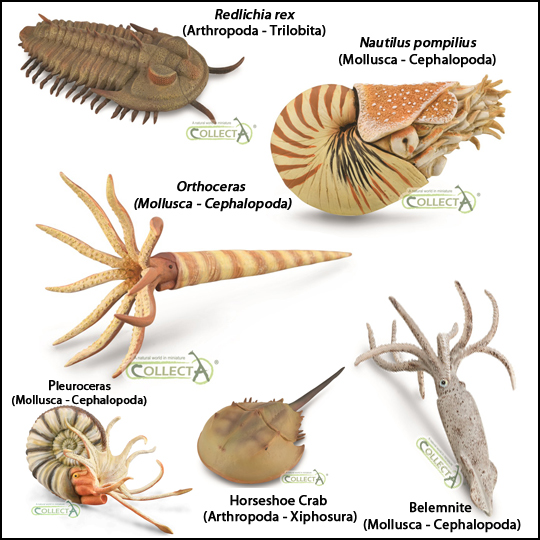
CollectA are to be congratulated for introducing a range of prehistoric animal replicas that represent iconic fossil invertebrates. In recent years, the company has produced a trilobite (Redlichia rex), a model of an Orthoceras, a belemnite and a replica of the extant Horseshoe crab. Furthermore, an ammonite model (Pleuroceras) and a model of the pearly nautilus have been added to the CollectA series.
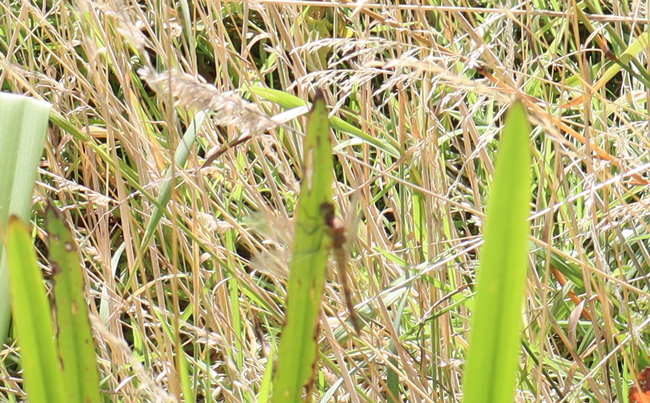
A dragonfly has been spotted by Everything Dinosaur team members on a small patch of grass next to a drainage ditch outside the company’s warehouse. This is the first time that a dragonfly has been seen in the vicinity of the Everything Dinosaur warehouse. There is a small area of grass next to a drainage ditch and we suspect the dragonfly, possibly a male Common darter (Sympetrum striolatum) emerged from the ditch during the recent hot weather. Our litter picking and tidying up of this small body of water outside our warehouse is paying dividends.
Can you spot the dragonfly? Picture credit: Everything Dinosaur.
A Haven for Wildlife
The ditch is a haven for wildlife, and we have spotted several different species of water snails including the Great Pond Snail (Lymnaea stagnalis) and the Great Ramshorn (Planorbarius corneus). There are also small fish – we suspect Stickleback (Gasterosteidae family). There may also be frogs and newts, although we have not observed any amphibians to date, although we were visited by a young Mallard duck a few weeks ago.
Photographing the dragonfly was tricky, we could not get that close to our subject, but we tried our best.
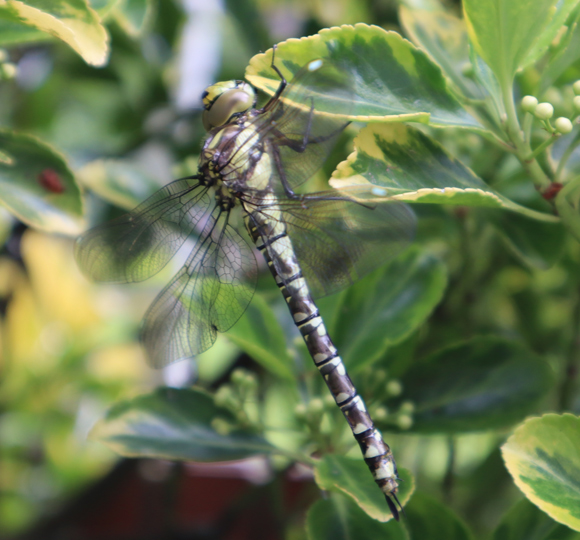
A close-up view of the dragonfly. We think this might be an immature male Common darter (Sympetrum striolatum). Picture credit: Everything Dinosaur.
A spokesperson from Everything Dinosaur commented that it was always exciting to see a dragonfly. Due to loss of habitat and pollution, these magnificent insects are under threat in many parts of the UK. The earliest dragonfly fossils are known from the Carboniferous. Some of these Carboniferous forms (Meganisoptera order) were huge with wingspans in excess of sixty centimetres. Extant dragonflies (Odonata) are distantly related to these ancient, winged insects, the Odonata lineage may have evolved in the Late Permian.
A close-up view of the dragonfly spotted outside the Everything Dinosaur warehouse.
Spotting Dragonflies
The office pond has also produced dragonflies, although no Common darters. As the mature nymphs emerge from the pond, they climb up plant stems and prepare to shed their external skeletons and emerge as winged adults (Ecdysis).
Team members have already spotted several exuviae (shed exoskeletons) around the pond.
A dragonfly that has just emerged from Everything Dinosaur’s office pond. This picture shows a Southern Hawker (Aeshna cyanea) – we think. The photograph was taken in 2020. Picture credit: Everything Dinosaur.
Let’s hope we see a few more dragonflies before the end of summer.
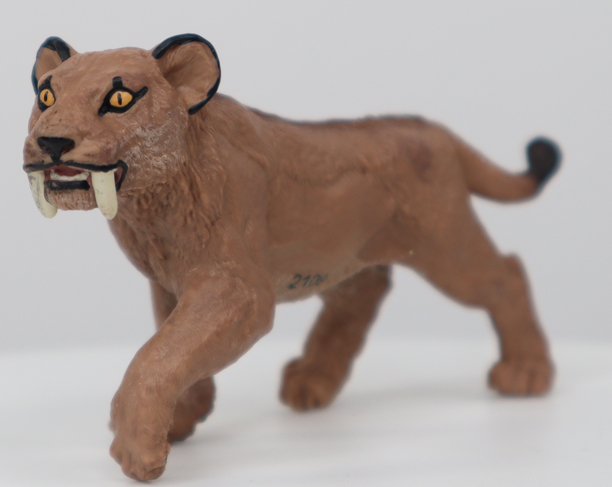
Everything Dinosaur has received stock of the new Papo young Smilodon model. This sabre-toothed cat figure was one of two models scheduled to be introduced by Papo last year. However, like many manufacturers, the global pandemic and issues with logistics had delayed the introduction of this prehistoric mammal figure.
The Papo Megalodon (Otodus megalodon) * arrived in September 2021, the young Smilodon was subject to further delays, but this new replica has safely arrived at Everything Dinosaur’s UK warehouse.
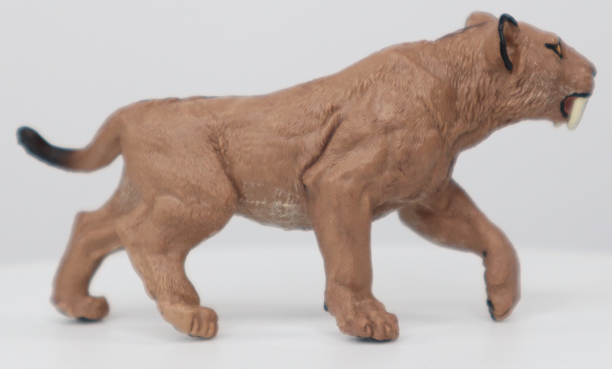
Papo young Smilodon figure in right lateral view. Picture credit: Everything Dinosaur.
Papo Model Colouration
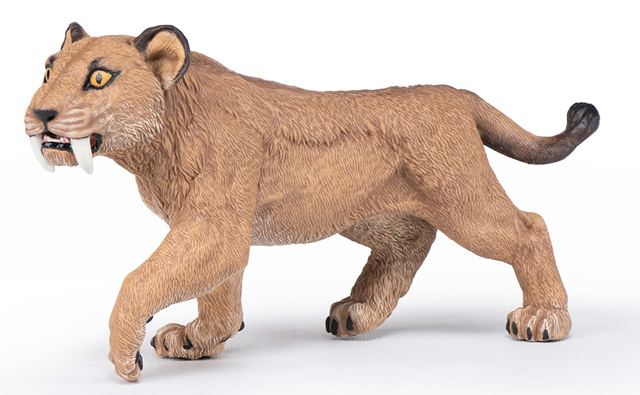
The actual figures are slightly darker than the studio image supplied by Papo. The colouration of a figure can be influenced by the camera settings, the lighting and even the device on which the image is viewed. However, the young Smilodon figure does tend to be a little darker than the official Papo image suggests.
Papo young Smilodon model.
The image (above), is one of the official Papo product images. In contrast, the image below shows a studio shot of the model taken by a team member at Everything Dinosaur. The difference in colouration could reflect different lighting conditions and camera settings.
A view of the new Papo young Smilodon model. Picture credit: Everything Dinosaur.
2109 – The Number of the Beast
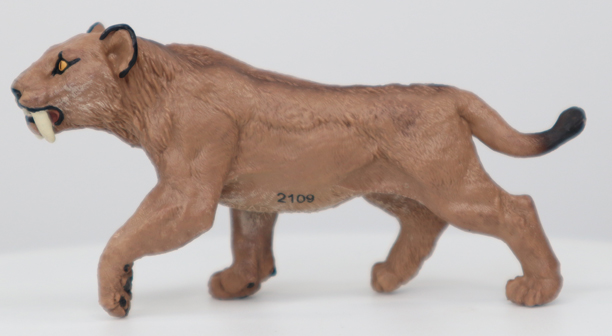
The Papo young Smilodon, or to use the term most familiar with our French chums – “le Papo jeune Smilodon”, has the number 2109 stamped on the lowermost portion of the flank. We suspect that this is the batch number, it being a legal requirement so that production batches can be traced, if there ever was a need to recall them.
Papo young Smilodon in left lateral view. Picture credit: Everything Dinosaur.
Model Measurements
The Papo young Smilodon figure measures approximately 9.5 cm in length and the ears of this hand-painted figure stand around 5 cm off the ground. This is the third Smilodon (Sabre-toothed cat) replica figure to be added to the Papo “Les Dinosaures” range after the adult Smilodon (2011) and the maned, Papo roaring Smilodon (2017).
Papo young Smilodon figure in right lateral view. Picture credit: Everything Dinosaur.
Papo Megalodon (Otodus megalodon) * – to read Everything Dinosaurs review of this prehistoric shark figure from September 2021: Papo The Megalodon Shark Model.
Papo Young Smilodon
A spokesperson from Everything Dinosaur commented that the figure was proving to be extremely popular with Papo model collectors, the black lines around the eyes of the model reminded team members of the eyeliner used in ancient Egyptian culture. Cats are among the most iconic animals in ancient Egyptian art and culture. The feline goddess Bastet is perhaps the best-known. Bastet is associated with wishes for family well-being and health as well as protection from danger.
A view of the new Papo young Smilodon model. Picture credit: Everything Dinosaur.
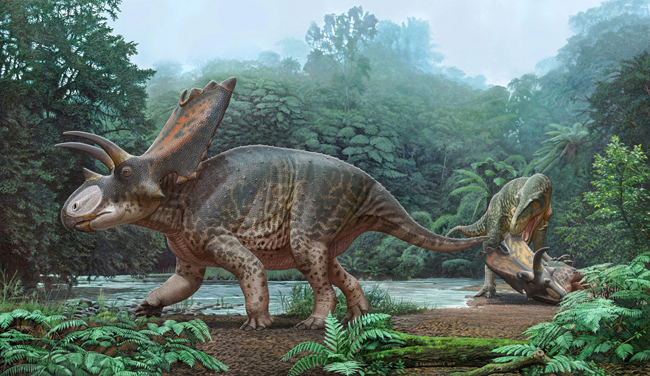
A new species of chasmosaurine horned dinosaur has been described based on a nearly complete skull found in the vicinity of Alamo Mesa in the Bisti/De-na-zin Federal Wilderness Area (New Mexico). The dinosaur has been named Bisticeratops froeseorum and its discovery lends weight to the hypothesis that there was a thriving dinosaur and vertebrate fauna in north-western New Mexico towards the end of the Cretaceous (Campanian stage).
A New Ceratopsian Dinosaur
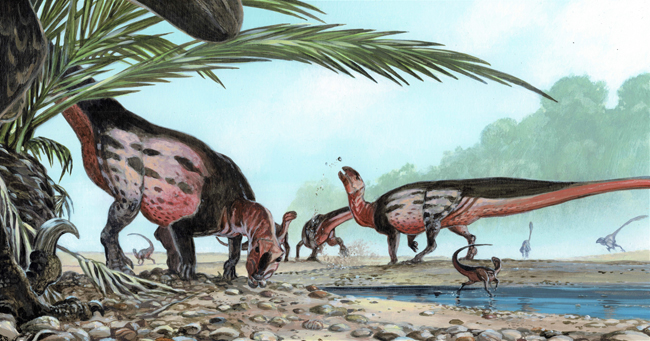
Bisticeratops life reconstruction. North-western New Mexico during the Campanian, note the tyrannosaur attacking a Bisticeratops in the background. Picture credit: Sergey Krasovskiy.
Furthermore, the formal scientific description of Bisticeratops froeseorum adds to the growing record of chasmosaurine ceratopsids in the south-western USA and provides new information about the taxonomic diversity of ceratopsids.
Farmington Member (Kirtland Formation)
A nearly complete fossilised skull was discovered in 1975 by a field party from the University of Arizona.
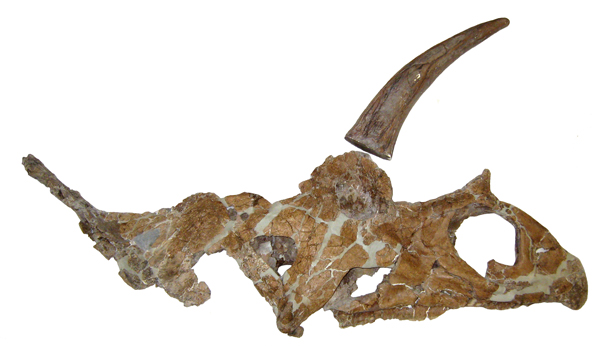
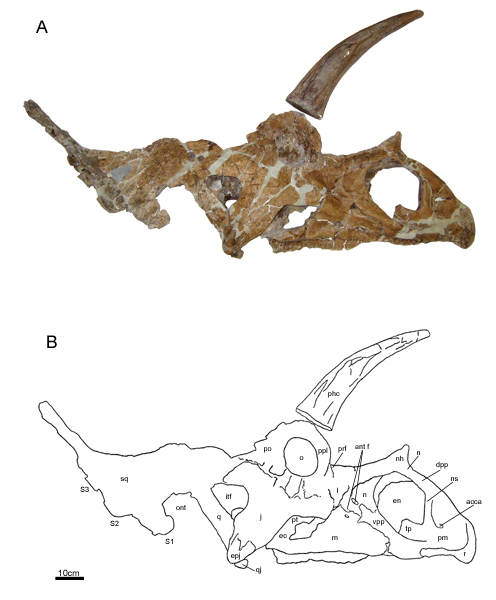
The skull (specimen number NMMNH P-50000) and the holotype for Bisticeratops froeseorum exhibits a combination of character states that clearly differentiate it from the closely related Pentaceratops sternbergi and other chasmosaurines.
The fossil material was recovered from strata associated with the Farmington Member of the upper Kirtland Formation. Dinosaur fossils from the Farmington Member are rare and the biota poorly known. However, the discovery of Bisticeratops results in a substantial increase in the stratigraphic and paleogeographic range of the Chasmosaurinae in the Western Interior Basin of North America.
Holotype skull of Bisticeratops froeseorum (NMMNH P-50000) shown in right lateral view. Picture credit: Dalman et al.
Bisticeratops froeseorum A New Ceratopsian Species
Based on the skull material and a comparative analysis using more complete fossils from related members of the Chasmosaurinae, the latest member of the diverse ceratopsid biota associated with Laramidia is estimated to have measured around seven metres in length, with brow horns over a metre long.
Bisticeratops skeletal drawing. The area shaded blue represents the known fossil material. Note scale bar = 1 metre. Picture credit: Dalman et al.
The Evolutionary Development of the Chasmosaurinae in Southern Laramidia
Writing in the “New Mexico Museum of Natural History and Science Bulletin”, the researchers conclude that in southern Laramidia during the Late Campanian, the Dinosauria were thriving and the biota was experiencing a high faunal turnover with lots of new species evolving.
The formal scientific description of Bisticeratops froeseorum adds to the growing record of chasmosaurine ceratopsids known from the south-western United States and provides new information about the diversity of these horned dinosaurs during the Late Cretaceous.
Two years ago, Everything Dinosaur wrote a blog post about two newly described chasmosaurines from New Mexico (Fowler and Freeman Fowler, 2020). The two newly named horned dinosaurs Terminocavus sealeyi and Navajoceratops sullivani along with other chasmosaurine specimens from the Farmington and De-na-zin Members of the Kirtland Formation (Taxon C), form a sequence of horned dinosaur evolution, stretching over five million years from Utahceratops to Pentaceratops and on to Anchiceratops.
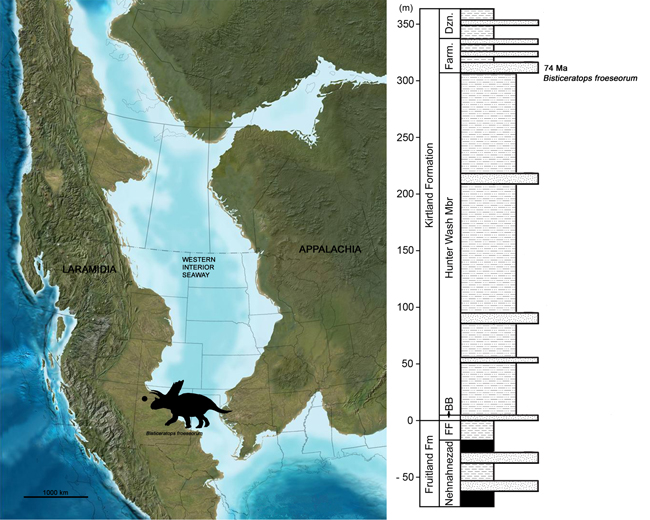
Bisticeratops roamed the southern region of the North American landmass known as Laramidia approximately 74 million years ago. If the sandstones and siltstones of the Farmington Member were deposited around 74 million years ago, this suggests that Bisticeratops is approximately 2 million years younger than Pentaceratops sternbergi and Titanoceratops ouranos
Furthermore, Bisticeratops is younger by 1 million years than the recently named Navajoceratops sullivani and 750,000 years younger than Terminocavus sealeyi. Additionally, Bisticeratops is nearly 500,000 years older than the De-na-zin Member (uppermost Kirtland Formation) unnamed chasmosaurines NMMNH P-21100 and NMMNH P-41228. It is also noted that Bisticeratops occurs approximately 1 million years before Sierraceratops turneri.
Geographic and stratigraphic position of the type locality of B. froeseorum. Paleobiographic reconstruction by Ron Blakely. Image credit: Dalman et al.
Bisticeratops froeseorum – What’s in a Name
The genus name references the Bisti/De-na-zin Wilderness Area, the area from which the specimen came; whilst “ceratops” is from the Greek for “horned face”.
The species name “froeseorum” honours the late Edgar Froese the founder and leader of the instrumental music band Tangerine Dream and his son Jerome Froese the former member of Tangerine Dream. Tangerine Dream is a German instrumental/electronic music band founded in 1967 by Edgar Froese. The group has seen many personnel changes over the years, with Edgar Froese having been the only constant member until his death in 2015. The best-known line-up of the group was in mid 1970s consisting of Edgar Froese, Christopher Franke, and Peter Baumann, then in 1979, Johannes Schmoelling replaced Baumann, and after 5 years Paul Haslinger replaced Schmoelling.
In 1986 the Tangerine Dream trio consisting of Edgar Froese, Christopher Franke, and Paul Haslinger performed in Albuquerque, New Mexico. The concert took place at Kiva Auditorium in downtown Albuquerque.
Senior author of the scientific paper Sebastian Dalman (New Mexico Museum of Natural History) wrote in an email to Everything Dinosaur:
“According to various reports, New Mexico was a favourite place of Tangerine Dream members and every time they toured U.S. they liked to stop by in New Mexico. Today, Tangerine Dream after the passing of Edgar Froese, continues with new members including Thorsten Quaeschning, Hoshiko Yamane, and Paul Frick. I always wanted to honour the band with my scientific work, which their music inspired over the years.”
Holotype skull of B. froeseorum (NMMNH P-50000) shown in right lateral view with accompanying line drawing. Image credit: Dalman et al.
Our thanks to Tangerine Dream fan Sebastian for his assistance in the compilation of this article.
The scientific paper: “A new chasmosaurine ceratopsid from the Upper Cretaceous (Campanian) Farmington Member of the Kirtland Formation, New Mexico” by Sebastian G. Dalman, Steven E. Jasinski and Spencer G. Lucas published in the New Mexico Museum of Natural History and Science Bulletin.
Researchers from the University of Manchester examining the fossilised remains of a Tenontosaurus have revealed new information about this ornithopod as well as evidence to support a trophic relationship (predator/prey or scavenging) with Deinonychus (D. antirrhopus).
A life reconstruction of the iguanodontian Tenontosaurus. A pair of predatory theropods (Deinonychus) are seen in the background and a Deinonychus approaches from the left of the picture (note the raised second toe on the foot). Newly published research lends weight to the argument for a trophic relationship between these two Early Cretaceous dinosaurs. Picture credit: James McKay.
Found in an “Ash Layer” – Cloverly Formation
The fossils of a Tenontosaurus tilletti were discovered on private land in Wheatland County (Montana) in 1994 and acquired by the University of Manchester five years later. The fossils (specimen number MANCH LL.12275) represent one of the most complete and best-preserved T. tilletti known from the fossil record. It was originally described as a mounted, articulated skeleton found with gastroliths and cycad seeds in the stomach region that had been excavated from an ash layer (Cloverly Formation, upper Aptian-lower Albian, upper Lower Cretaceous). In addition, it was stated that two broken Deinonychus teeth had been discovered in association with the cervical vertebrae (neck bones).
The original description of the dinosaur nicknamed “April” was not challenged and the specimen was displayed in the Fossil Gallery of the Manchester Museum, until 2004, when it was replaced with a replica of a Tyrannosaurus rex (“Stan” – BHI 3033).
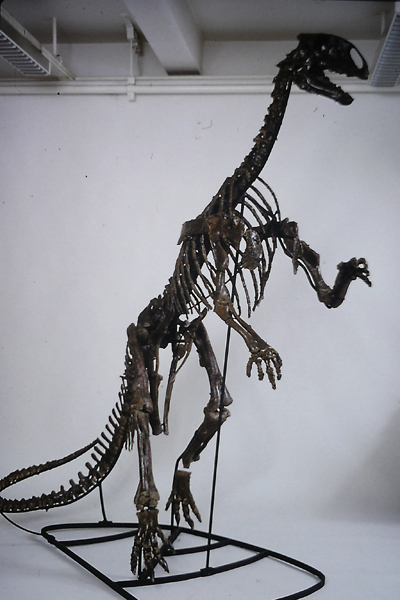
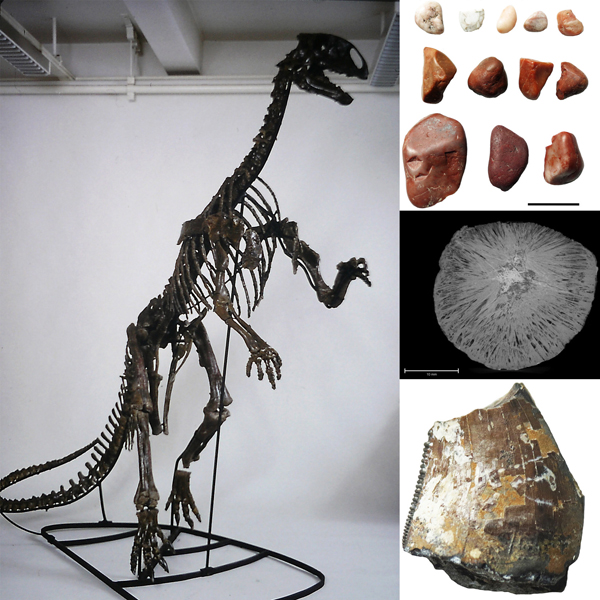
The mounted skeleton of the Tenontosaurus specimen known as “April”. Picture credit: University of Manchester.
Not an Ash Layer and No Cycad Seeds
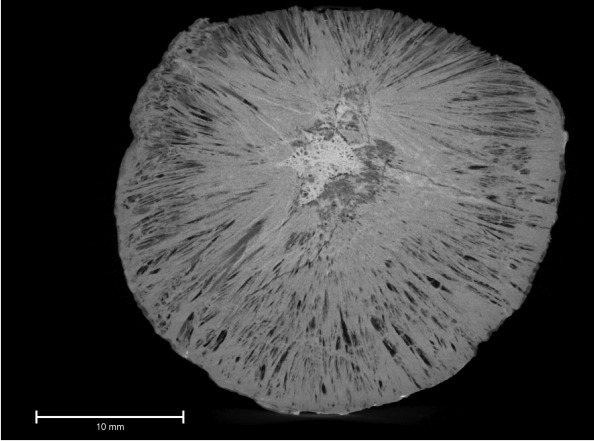
The research team used X-ray CT scanning and X-ray fluorescence (XRF) to assess so-called “seeds” and “ash” found with the specimen and revealed that they were not seeds after all and that the dinosaur did not die in a layer of ash, as had previously been suggested when it was found. The sediment, originally described when the specimen was collected as volcanic ash is actually lime mud. The team concluded that whilst the deposit might consist of a small proportion of volcanic ash, this dinosaur was not buried in a layer of ash as a consequence of a volcanic eruption.
The cycad “seeds” found with the fossilised bones, measure 25 mm and 35 mm in diameter. When analysed, these spherical structures were identified as inorganic mineral concretions and not evidence of the last meal of this plant-eating dinosaur.
One of the alleged cycad seeds, that when examined proved to be a non-organic mineral concretion. Picture credit: University of Manchester.
Evidence of Gastroliths
When first described for sale, it was stated that twelve gastroliths had been found in the body cavity. Gastroliths are stones found in the digestive tract, they help to grind up plant-material, providing mechanical assistance and aiding the extraction of nutrients from the vegetation consumed. Only a handful of examples of gastroliths being associated with ornithopods have been reported. The research team were able to confirm that the small, smooth pebbles found were most probably gastroliths. These small stones could have been washed into the body cavity of the dead dinosaur, but this idea is not compatible with the muddy sediment (representing a low energy depositional environment), in which the skeleton was entombed.
“April’s” stomach stones are the second oldest occurrence of gastroliths in an ornithopod known to science and the first gastroliths to be identified in a more derived member of the Ornithopoda.
The skeleton of “April” the Tenontosaurus with views of gastroliths, a CT scan of an alleged seed that when examined has been found to be a non-organic mineral concretion and a partial Deinonychus tooth found in association with the Tenontosaurus fossil material. Picture credit: University of Manchester.
The Diet of Tenontosaurus
Whilst gastroliths have been recorded in a wide variety of extinct vertebrates, only three unambiguous records of gastroliths in ornithopods had been reported previously. The earliest known evidence of stomach stones in a member of the Ornithopoda comes from Changmiania (C. liaoningensis) from the Lower Cretaceous Yixian Formation of Liaoning Province (China), that was formally named and described in 2020 (Yang et al).
The Manchester Tenontosaurus is the largest ornithopod dinosaur known with gastroliths. The confirmation of stomach stones lends weight to the assertion that the teeth and jaws of Tenontosaurus were not as effective at processing vegetation as later, more derived ornithopods such as the Hadrosauroidea. However, the flora and therefore the diet of these herbivores changed dramatically during the Cretaceous as gymnosperms (conifers, cycads and such like) were gradually replaced by angiosperms (flowering plants).
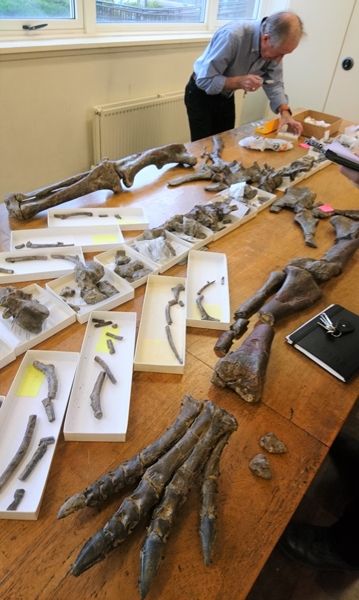
Dr John Nudds, one of the authors of the scientific paper, examining the Tenontosaurus fossil material. Picture credit: University of Manchester.
The Deinonychus Teeth
Writing in the academic journal “Cretaceous Research”, the researchers report that one of the broken teeth was now missing but the other tooth most probably comes from a Deinonychus, providing further evidence to support the long-standing assertion, originally made by John Ostrom in 1970, that Tenontosaurus was a common food item for Deinonychus.
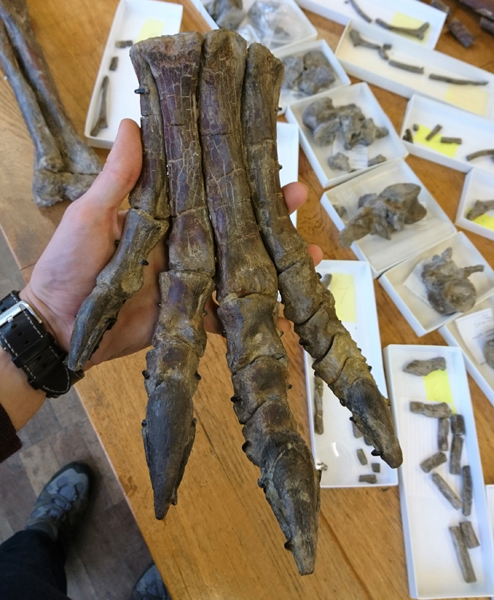
The right foot of “April” the Tenontosaurus. Picture credit: Dr Dean Lomax/University of Manchester.
Dedicated to Dr Jon Tennant
Doctors Dean Lomax and John Nudds from The University of Manchester dedicated this study to their friend, colleague and co-author, Dr Jon Tennant, who sadly died on 9 April 2020, before this study could be published.
Dr Dean Lomax commented:
“Jon completed his Masters at Manchester on this very specimen, in 2010. It was his idea for the three of us to come together and write this paper, which we officially began in 2018. Jon contributed significantly to palaeontology and was a massive advocate for open access. At every opportunity Jon encouraged others and was immensely passionate about palaeontology. This project would not have been possible if it was not for his research on the specimen described herein. Jon leaves a remarkable legacy behind.”
Co-author of the scientific paper Dr Jon Tennant who sadly passed away before the research could be published. Picture credit: University of Manchester.
Whilst predator/prey relationships are often inferred, this specimen provides further evidence to support the hypothesis that Deinonychus fed on Tenontosaurus. The completeness and exceptional state of preservation suggests that further study of “April” may yield yet more information about the life and behaviour of this Early Cretaceous dinosaur.
Everything Dinosaur acknowledges the assistance of a press release from the University of Manchester in the compilation of this article.
The scientific paper: “Gastroliths and Deinonychus teeth associated with a skeleton of Tenontosaurus from the Cloverly Formation (Lower Cretaceous), Montana, USA” by John R. Nudds, Dean R. Lomax and Jonathan P. Tennant published in Cretaceous Research.
On the 7th of September, 1936 the last known Thylacine died at Beaumaris Zoo in Hobart (Tasmania). Although most of the scientific community believe that the Thylacine, or as it is sometimes called the Tasmanian Tiger, is extinct there are occasional reports of sightings, either from Tasmania or elsewhere in Australia.
Researchers at the University of Melbourne believe that extinction does not have to mean forever, and they are pursuing a Thylacine de-extinction project to bring back one of the last of Australia’s marsupial apex predators.
The research team led by Professor Andrew Pask of the Thylacine Integrated Genetic Restoration Research (TIGRR) Lab is confident that a newly signed partnership agreement with Dallas-based Colossal Biosciences will bring the resurrection of the Tasmanian Tiger one step closer.
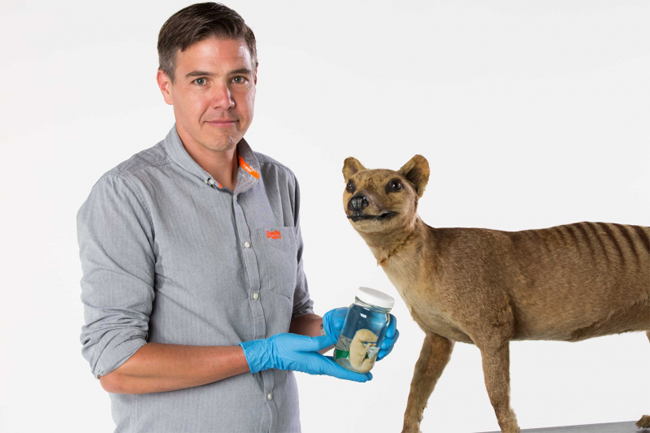
Professor Pask leading the Thylacine de-extinction project. For the time being, the closest scientists can get to a Thylacine is to examine museum specimens and stuffed animals. Professor Pask is holding the Thylacine pup (specimen number C5757), that played a pivotal role in the sequencing of the Thylacine genome. Picture credit: Melbourne University.
Conserving Australia’s Wildlife Heritage
The new American/Australian partnership will provide access to CRISPR DNA editing technology and allow scientists to pool their resources in their quest to bring back the Thylacine and to prevent many of Australian’s endangered mammals from going the same way.
Commenting on the significance of the new partnership and the access to state-of-the-art gene editing technology, Professor Pask stated:
“We can now take the giant leaps to conserve Australia’s threatened marsupials and take on the grand challenge of de-extincting animals we had lost.”
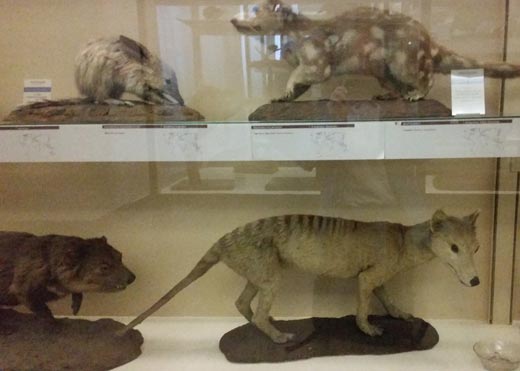
Stuffed Thylacine (Tasmanian tiger) in a museum case alongside other Australian mammals. Picture credit: Everything Dinosaur.
The Professor added:
“A lot of the challenges with our efforts can be overcome by an army of scientists working on the same problems simultaneously, conducting and collaborating on the many experiments to accelerate discoveries. With this partnership, we will now have the army we need to make this happen.”
Genome Sequenced
Thylacines (family Thylacinidae) are part of the marsupial order Dasyuromorphia. In 2018, researchers led by Professor Pask sequenced the genome of the Thylacine. This was achieved by extracting DNA samples from the pouch of a young Thylacine preserved in a jar of alcohol (specimen number C5757), part of the marsupial collection at Melbourne Museum. The team were able to read the approximately 3 billion nucleotide “letters” of the Thylacine genome and with the help of powerful computers to sequence them.
Armed with this knowledge, the research team could establish the genetic relationship between the extinct Thylacine and living, closely related members of the Dasyuromorphia such as the Tasmanian devil.
It would be theoretically possible to mimic the Thylacine genome and reconstruct it using marsupial stem cells.
A Focus on Protecting Extant Marsupials
Professor Pask explained that TIGGR will concentrate efforts on establishing the reproductive technologies tailored to Australian marsupials, such as IVF and gestation without a surrogate, as Colossal simultaneously deploy their CRISPR gene editing and computational biology capabilities to reproduce Thylacine DNA. This research will also help in the long-term protection of many of Australia’s indigenous marsupials, study of Thylacine DNA will help scientists to better understand the genetic makeup of closely related, extant genera. This research will influence the next generation of Australia’s marsupial conservation efforts.
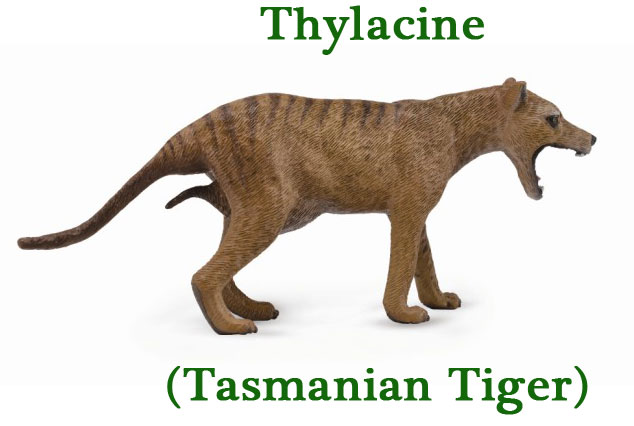
A replica of a female Thylacine (Tasmanian Tiger). Perhaps in the next decade or so this iconic Australasian species will be resurrected.
This partnership with Colossal follows a significant philanthropic donation of $5 million AUD for the TIGGR Lab earlier this year.
Sharing Expertise
Colossal’s experience in CRISPR gene editing will be partnered with TIGGR’s work sequencing the Thylacine genome and identifying marsupials with similar DNA to provide living cells and a template genome that can then be edited to recreate the genetic instructions required to resurrect the extinct marsupial.
Professor Park added:
“The question everyone asks is ‘how long until we see a living Thylacine’ – and I’ve previously believed in ten years’ time we would have an edited cell that we could then consider progressing into making into an animal. With this partnership, I now believe that in ten years’ time we could have our first living baby Thylacine since they were hunted to extinction close to a century ago.”
The TIGRR Lab is believed to be close to producing the first laboratory-created embryos from Australian marsupial sperm and eggs.
Marsupials have a much shorter gestation period when compared to placental mammals. It is conceivable to produce a marsupial without the aid of a surrogate mother. Growing a marsupial, even a Thylacine in a test-tube from conception to the stage at which it would have been born.
Everything Dinosaur acknowledges the assistance of a media release from the University of Melbourne in the compilation of this article.
With the announcement of the new PNSO spinosaurid figure Chongzuo the Sinopliosaurus earlier this week (Monday, 15th August), team members at Everything Dinosaur thought it might be helpful to outline the taxonomic history of this enigmatic theropod. Fragmentary fossils that led to the establishment of the Sinopliosaurus genus were originally thought to represent a marine reptile. One that had lived in a huge freshwater lake during the Early Jurassic around 180 million years ago (Toarcian faunal stage).
Everything Dinosaur expects this dinosaur model to be in stock in the autumn.
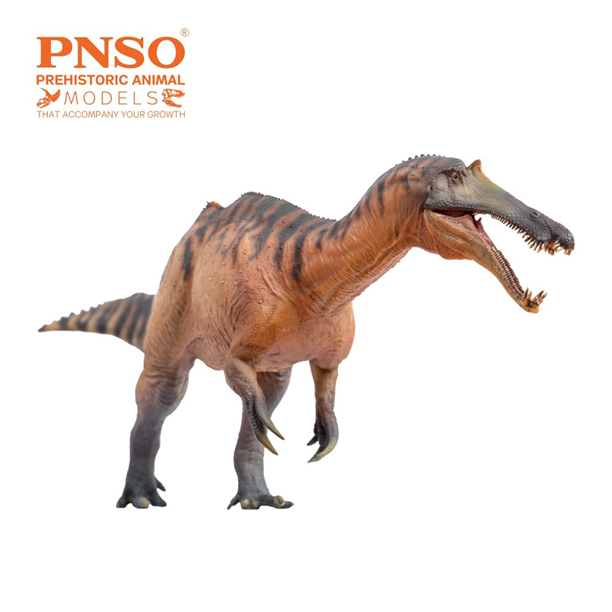
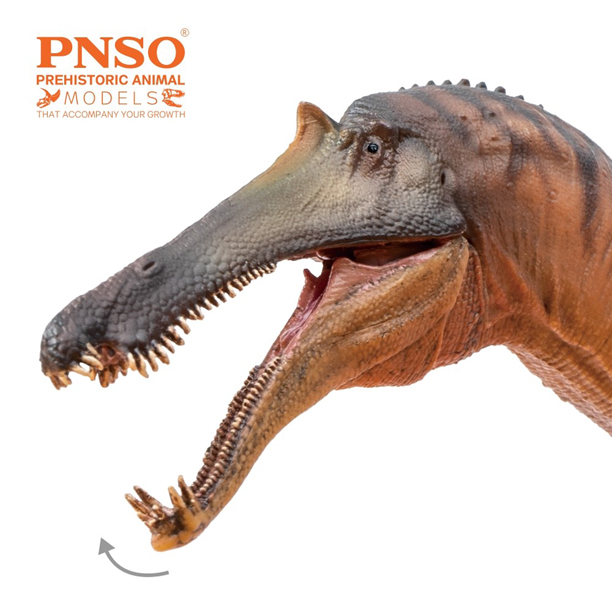
PNSO are adding a second member of the Spinosauridae family to their mid-size model range. Joining Essien the Spinosaurus is Chongzuo the Sinopliosaurus. The taxonomic history of Sinopliosaurus is somewhat complicated.
PNSO Chongzuo the Sinopliosaurus – an Explanation
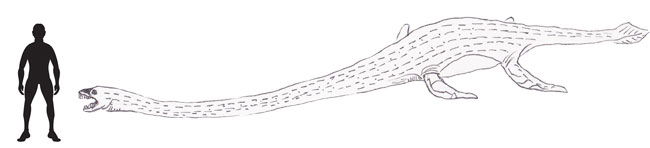
Fragmentary bones including three vertebrae, a tooth, elements from the hips (the ischium) and a femur (thigh bone) found in Lower Jurassic (Toarcian faunal stage) Ziliujing Formation exposures at Weiyuan (Sichuan Province, China) were thought to represent a freshwater pliosaur. Although very little of the skeleton was known, the fossil bones that were found were preserved in three-dimensions and not flattened and the pliosaur species Sinopliosaurus weiyuanensis was confidently erected (1944). The femur for example, was described as being of the “usual Plesiosaurian type”, robust, rather squat and not elongated. The ischium was noted as being reminiscent of the Late Cretaceous Canadian plesiosaur Leurospondylus ultimus, which had been erected by Barnum Brown in 1913. L. ultimus itself is a disputed taxon, classified as “incertae sedis”. This marine reptile was described based on fossil material most likely from a juvenile and the material might represent an elasmosaurid.
The taxonomic status of Leurospondylus ultimus remains unresolved.
The Elasmosaurus scale drawing commissioned by Everything Dinosaur as the company’s fact sheet was updated. When Sinopliosaurus weiyuanensis was described, the ischium was thought to closely resemble the hip bones associated with Leurospondylus (L. ultimus). This helped to confirm the diagnosis that S. weiyuanensis fossil material represented a marine reptile – a member of the Plesiosauria clade.
The genus name (Sinopliosaurus) means “Chinese more lizard”, reflecting the assumed close taxonomic relationship with pliosaurs found elsewhere in the world.
Who Named the Pliosaurus Genus?
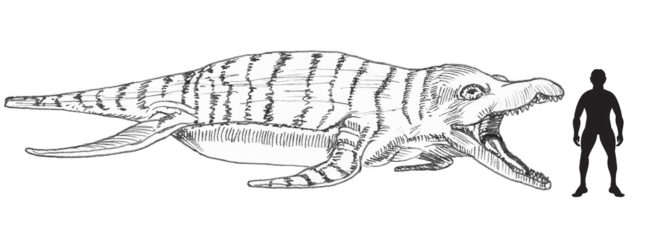
It was the English anatomist Sir Richard Owen who first used the genus Pliosaurus (Pliosaurus brachydeirus) back in 1841. Owen mistakenly believed that Pliosaurus was “more” closely related to “saurians” (including crocodilians) than it was to Plesiosaurus.
A scale drawing of a Pliosaurus. Fossils from the Lower Jurassic Ziliujing Formation and later fossil discoveries from the geologically much younger Xinlong Formation (sometimes referred to as the Napai Formation), were originally thought to represent a freshwater pliosaur. Only later did some of these fossils become ascribed to a species of spinosaurid theropod dinosaur. Picture credit: Everything Dinosaur.
The scientific description of S. weiyuanensis was published in the Bulletin of the Geological Society of China in 1944 by the eminent, Chinese palaeontologist and zoologist C.C. (Chung Chien) Young. Regarded as the “Father of Chinese vertebrate palaeontology”, his diagnosis was not challenged or questioned.
Spinosaurid fossils from Asia were unknown, the only substantial research into this enigmatic family of dinosaurs had been taking place in Germany (Stromer – Spinosaurus aegyptiacus). As the fossils were similar to those fossils ascribed to pliosaurs, it was thought that these Chinese fossils too, also represented a marine reptile.
Sinopliosaurus fusuiensis (Hou et al) 1975
Five isolated teeth from the Early Cretaceous Xinlong Formation (sometimes referred to as the Napai Formation) found in Fusui County, Guangxi Zhuang Autonomous Region (South China), were described by Chinese palaeontologist Hou Lian-Hai and colleagues and a second species of Sinopliosaurus was erected – S. fusuiensis (1975).
The strata associated with these fossils is difficult to date accurately, but the consensus is that these sediments were deposited around 120 to 100 million years ago (Aptian-Albian faunal stage of the Early Cretaceous). The fossils ascribed to S. fusuiensis were around sixty million years younger than the fossil material associated with S. weiyuanensis.
PNSO Chongzuo the Sinopliosaurus has an articulated jaw. The genus was originally erected under the presumption that the fossil material including isolated teeth represented a pliosaur (marine reptile).
The Emergence of Asian Spinosaurs – Siamosaurus suteethorni
Fossil teeth collected from the Lower Cretaceous Sao Khua Formation (Barremian faunal stage) in north-eastern Thailand by a joint Thai/French team in the early 1980s led to the conclusion that they represented an unusual theropod dinosaur or possibly an, as yet undescribed crocodyliform. A reassessment of the fossil material in 1986 led to the establishment of the Asian spinosaurid species Siamosaurus suteethorni. Subsequently, other fossil material has been described and assigned to this genus, principally fossils excavated from the slightly geologically younger Khok Kruat Formation of Thailand.
Siamosaurus was the first Asian spinosaur to be described and following its scientific description (Buffetaut and Ingavat, 1986), teeth and other material found in Asia has been reassigned to the Spinosauridae.
In 2008, Buffetaut and colleagues published a scientific paper (Cambridge University Press), that challenged the placement of Sinopliosaurus fusuiensis as a marine reptile. It was concluded that the conical teeth assigned to S. fusuiensis were not typical of a member of the Plesiosauria. Specifically, it was noted that these teeth bear carinae (sharp edges) on the plane of the crown’s curvature, a characteristic not seen in Plesiosauria teeth. Buffetaut et al subsequently re-described the material and stated that the teeth came from a spinosaurid theropod closely allied to Siamosaurus suteethorni.
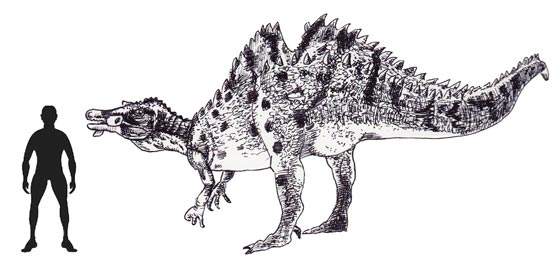
The exact taxonomic position of S. fusuiensis remains unresolved, although the discovery of potential spinosaurid fossil material in Japan and the naming of the spinosaurid Ichthyovenator (I. laosensis) by Allain et al in 2012 confirms the presence of this enigmatic family of theropod dinosaurs in the Early Cretaceous of Asia.
“Fish Hunter” from Laos. A scale drawing of Ichthyovenator laosensis.
PNSO Chongzuo the Sinopliosaurus
The PNSO Chongzuo the Sinopliosaurus (S. fusuiensis), is expected in stock at Everything Dinosaur in the autumn of 2022.
The PNSO Chongzuo the Sinopliosaurus is depicted walking close to a river. Fossils now ascribed to this theropod come from a fluvial/lacustrine palaeoenvironment (Xinlong Formation).