

Palaeontologists have described two new species of azhdarchid pterosaurs from Mongolia’s Gobi Desert. The Gobi Desert is famous for its numerous dinosaur fossils. However, pterosaur remains are very rare in Mongolian Mesozoic deposits. Researchers writing in the academic journal “PeerJ” identified azhdarchid pterosaur fossils.
The material consists of bones from the neck, and from these specimens two new species have been erected. The fossils come from two different localities (Bayshin Tsav and Burkhant). Originally collected in the 1990s, the fossils were described in detail in 2009 (Watabe et al). Yet, at the time the pterosaurs were not named, just described as indeterminate azhdarchids.
Azhdarchid Pterosaur Fossils
Subsequently, knowledge of azhdarchid pterosaur anatomy has improved. As a result, two distinct species have been named. In a paper published in the autumn, researchers identified diagnostic features permitting the establishment of these two new species. The paper was written by researchers from the Universidade de São Paulo (Brazil), Shihezi University (China) and Hokkaido University (Japan).
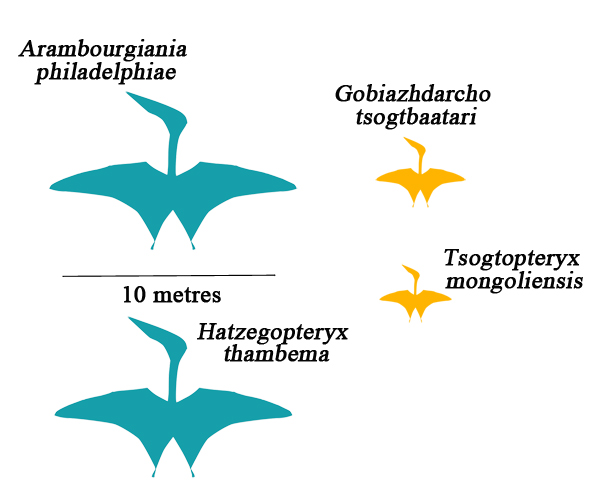
Azhdarchid pterosaur fossils lead to the naming of two new taxa. The two new Mongolian taxa are compared to two of the largest azhdarchid pterosaurs. Picture credit: Everything Dinosaur.
Picture credit: Everything Dinosaur
Gobiazhdarcho tsogtbaatari: A Medium-Sized Pterosaur
The first species is named Gobiazhdarcho tsogtbaatari. It comes from the Burkhant locality of the Bayanshiree Formation. This pterosaur had an estimated wingspan of three to three and a half metres. It has been described as a medium-sized azhdarchid, with a wingspan roughly comparable to an Andean Condor (Vultur gryphus). Fossils associated with this taxon include an atlantoaxis (fused neck vertebrae) and other cervical bones. These show it belonged to a lineage related to giants such as Quetzalcoatlus and Arambourgiania. In evolutionary terms, Gobiazhdarcho is a basal member of this quetzalcoatlid group, bridging gaps in the fossil record.
Its name reflects both its origin and scientific heritage. “Gobi” refers to the desert where it was found. “Azhdarcho” comes from Persian for dragon. The species name honours Mongolian palaeontologist Khishigjav Tsogtbaatar.
Tsogtopteryx mongoliensis: A Small Azhdarchid Pterosaur
The second species named in the paper is Tsogtopteryx mongoliensis. This pterosaur is notably small for an azhdarchid. Its estimated wingspan was approximately two metres, making it one of the smallest members of the Azhdarchidae family. A single, partial mid-cervical vertebra is known for this species. Despite the limited material, distinct features show it belongs to a different pterosaur lineage than Gobiazhdarcho. It was related to Hatzegopteryx. This lineage includes robust-necked azhdarchids previously known only from Europe.
The genus name combines the Mongolian word “Tsogt” (meaning mighty hero) with the Greek word pteryx which means wing. The species name references its discovery in Mongolia.
Azhdarchids Occupied Diverse Ecological Niches
The coexistence of Gobiazhdarcho and Tsogtopteryx in the same geological formation emphasises that azhdarchids occupied diverse ecological niches. Different body sizes suggest varied foraging behaviours and diets. This pattern echoes findings from other Upper Cretaceous deposits. This study sheds fresh light on the diversity and phylogeny of azhdarchid pterosaurs. It reinforces the reoccurring pattern of coexistence between multiple, differently-sized azhdarchid species within the same palaeoenvironment.
The scientific paper: “Azhdarchid pterosaur diversity in the Bayanshiree Formation, Upper Cretaceous of the Gobi Desert, Mongolia” by R. V. Pêgas, Xuanyu Zhou and Yoshitsugu Kobayashi published in PeerJ.
For pterosaur models and other prehistoric animal figures: Pterosaur Models and Prehistoric Animal Figures.

Leave A Comment