All about dinosaurs, fossils and prehistoric animals by Everything Dinosaur team members.
25 05, 2014

The New Schleich Light Green Tyrannosaurus rex Dinosaur Model Reviewed

By |2024-04-12T15:41:29+01:00May 25th, 2014|Categories: Dinosaur Fans, Everything Dinosaur Products, Product Reviews|0 Comments

A Review of the Light Green, 2014 Schleich T. rex Dinosaur Model

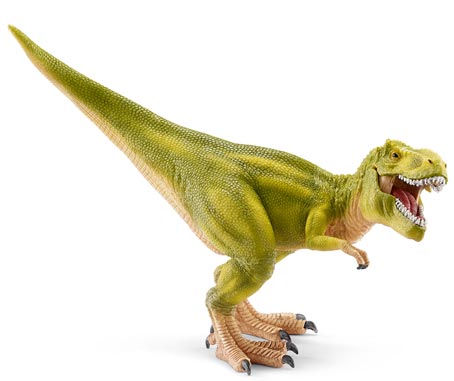
One of the first of the 2014 Schleich World of History dinosaurs to be reviewed by team members at Everything Dinosaur is the new, light green T. rex figure from the German manufacturer.  Schleich have made a number of replicas of what is perhaps the most famous dinosaur of all and this new addition to their prehistoric animal model range is bound to prove popular with young dinosaur fans.

Schleich T. rex Dinosaur Model

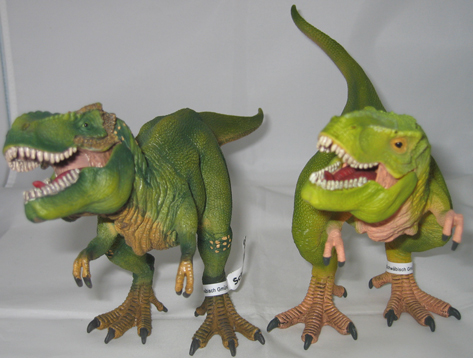
This is the second, large-sized Tyrannosaurus rex model in the World of History series, when compared to the 2012 T. rex, this model is fractionally smaller, the earlier model measuring around 28 centimetres from nose to tail, whilst the 2014 Tyrannosaurus rex measures about 27 centimetres in length.  Apart from the obvious colour difference, the actual pose is slightly different with the head turned more to the left and the slightly longer tail is raised upwards.

A Comparison Between the 2014 T. rex (right) with the Schleich 2012 T. rex (left)

2012 version on left 2014 version on right
2012 version on left with the 2014 version on right. Picture credit: Everything Dinosaur.

Picture credit: Everything Dinosaur

Articulated Lower Jaw

As with the earlier T. rex model, the lower jaw is articulated, so this dinosaur can be posed with its mouth open or closed, or indeed posed in any position in between.  When the jaws are opened, the care attention taken over the painting of the mouth area by the artists at Schleich can be clearly seen.

Schleich Tyrannosaurus rex has an Articulated Lower Jaw

A moveable lower jaw on this T. rex dinosaur model.

The model is very well balanced and it is ideal for creative play, although as with the majority of the Schleich dinosaur replicas that represent bipeds, the hind feet are a little oversized.  The large feet permit this dinosaur model to be posed with the tail raised off the ground, the anatomically correct position.  It seems that Schleich have had to trade off having slightly bigger feet on their meat-eating dinosaur models  against being able to portray them in more dynamic poses.

Examining the Skin Texture

The texture of the skin with its scales and skin folds has been beautifully rendered.  There is a lot of fine skin detail to admire, even individual rounded scales along the flank can be picked out.  The level of detail is also reflected on the underside of the model, an area of some replicas often neglected, but this is not the case with this new Schleich T. rex.

The skull is particularly well modelled with individual wrinkles around the nostrils depicted along with accurate representations of the skull morphology complete with its fenestrae and lumps and bumps.  Intriguingly, this dinosaur’s eye is black, with no obviously definition such as an iris.  This gives this T. rex quite a menacing, frightening look, especially when light reflects off the highly glossy black paint of the eye to give the impression of a white pupil.

To view Everything Dinosaur’s range of Schleich prehistoric animals: Schleich Prehistoric Animal Figures.

As this replica measures approximately 27 centimetres in length,  by our estimates this makes this particular model something like 1:50 scale.  The model is very robust, it almost has a waxy feel to it and it would be a great T. rex model to encourage creative, imaginative play.

These two World of History T. rex models work well together, perhaps the bigger figure could represent a larger, mature female and the slightly smaller, light green model a male, her mate. For scientists believe that, just like many of today’s birds, female T. rexes were bigger than the males.  Here is another opportunity for model collectors and dinosaur fans to acquire another interpretation of Tyrannosaurus rex and there is a lot to commend this particular Schleich replica. Everything Dinosaur even includes a T. rex fact sheet that we send out with all our sales of Tyrannosaurus rex dinosaur models.

24 05, 2014

Could Archaeopteryx Fly? That is an Excellent Question!

By |2024-04-12T15:42:36+01:00May 24th, 2014|Categories: Dinosaur and Prehistoric Animal News Stories, Palaeontological articles|2 Comments

Seeing Archaeopteryx in a New Light (Literally) 

A joint team from the European Synchrotron Radiation Facility (Grenoble, France), the Solnhofen Museum (southern Germany), the Paul Scherrer Institute (Switzerland) and the Palacký University (Czech Republic) have been collaborating on a piece of ground-breaking research in order to assess the flight capabilities of Archaeopteryx.  Ever since the first fossil of this ancient, feathered creature were found amongst the finely grained lithographic limestone strata of Solnhofen, scientists have speculated on whether this “dino-bird” could fly.

Archaeopteryx lithographica

Archaeopteryx fossil material is extremely rare, for much of the known history of Archaeopteryx (A. lithographica), its holotype material consisted of the impression of a single feather.   In all, thirteen fossils ascribed to Archaeopteryx have now been found (if you include the feather specimen), they represent material that is regarded by many palaeontologists as some of the most important vertebrate fossils discovered to date.  Archaeopteryx is viewed as a “transitional fossil” it shows anatomical evidence of both dinosaurs and birds.  Here is a dinosaur with feathers or if you prefer, the fossils represent a bird with teeth!

But could it fly?

The Subject of Intense International Study

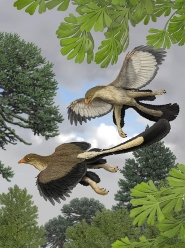
Getting into a flap over Archaeopteryx
Getting into a flap over Archaeopteryx.

Picture credit: Carl Buell

Few Fossils to Study

With so few fossils of Archaeopteryx to study, answering this fundamental question has proved extremely difficult.  Palaeontologists from the Natural History Museum (London), using the “London specimen”, now regarded as the holotype after a ruling in 2011 by the International Commission on Zoological Nomenclature (ICZN), have used X-rays to uncover more information, but the matrix surrounding the fossil has meant that the slabs of limestone in the biggest specimens are too large to be rotated in standard CT scanners.

To read more about the work on Archaeopteryx by the Natural History Museum: Let’s Hear it for Archaeopteryx.

Using a Synchrotron

Other techniques would prove too destructive, so most of the research carried out to date has involved a close up analysis of the surface of the fossil.  However, the use of intense X-ray beams generated by a synchrotron has enabled this European team to probe the depths of Archaeopteryx revealing details of the feathers and vertebrae not seen before.  An X-ray scattering technique employed at the European Synchrotron Radiation Facility (ESRF), has permitted researchers to see images from deep within the rock entombing the 150-million-year-old creature.  A beam of intense light called a slice beam is projected at the fossil, this beam slowly travels down the mounted specimen permitting the X-rays that have been emitted to penetrate deep inside the rock.

As the X-rays are diffused by the substrate and fossil their rate of diffusion can be detected by a camera obscura system, a pin hole within a large sheet of lead, which relays this data to detection software that can produce a computer generated three dimensional image.

A Non-destructive Technique

This is a non-destructive technique that permits scientists to see right inside the fossil and pick up details not revealed on the surface.  This new method of studying life in the past was tried on two specimens of Archaeopteryx, an almost complete specimen known as the Wellnhoferia grandis specimen and an isolated fragment of wing that had not been too distorted or crushed as a result of the fossilisation process.

The Wellnhoferia Archaeopteryx Specimen Used in the Analysis

One of the fossils used in this new study.

Picture credit: Pascal Goetgheluck

Could Archaeopteryx Fly?

The Wellnhoferia Archaeopteryx has had a chequered history.  Originally it had been described as a fossil of the small Jurassic theropod Compsognathus, however, a detailed analysis led to it being declared a new genus of bird and the genus Wellnhoferia (W. grandis) was established.  Further research led to the specimen being referred back to Archaeopteryx, it represents the largest individual known to science with a wingspan of around fifty centimetres.  It is likely to be one of the show piece fossils on display when the Solnhofen museum re-opens today (24th May), after six months of renovation.

One of the Three-Dimensional Images Generated

In the 3-D image feathers on the wings can clearly be made out.

Picture credit: European Radiation Synchrotron Facility

This results of this study will permit scientists to see previously hidden anatomical features of Archaeopteryx which may finally resolve the issue as to whether this creature could fly or not.  It will also contribute significantly to the current knowledge of avian evolution.  It is very likely that other fossil specimens will be analysed using this methodology.

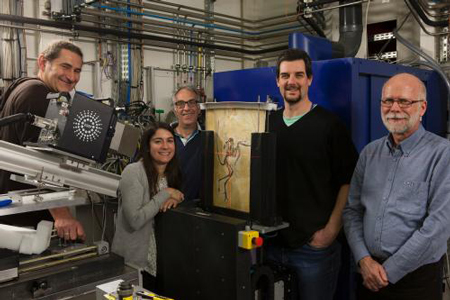
The Research Team Photographed Next to the Wellnhoferia Specimen

Shedding new light on Archaeopteryx.

Picture credit: Pascal Goetgheluck

Papo of France recently introduced a very colourful model of Archaeopteryx (A. lithographica), it has been heralded as one of the best models of this prehistoric animal ever made.

The Papo Archaeopteryx Prehistoric Animal Model

Ready for take off!
Ready for take off!

Picture credit: Everything Dinosaur

To view the Papo range of prehistoric animal models, including theropod dinosaur replicas: Papo Prehistoric Animal Models and Figures.

23 05, 2014

Volunteers Required to Help Protect Scotland’s Unique Fossil Heritage

By |2024-04-12T15:43:03+01:00May 23rd, 2014|Categories: Dinosaur and Prehistoric Animal News Stories, Dinosaur Fans, Geology, Main Page, Palaeontological articles|2 Comments

Action Taken to Safeguard Fossils In Scotland

The Isle of Wight off the coast of southern England might be regarded by some as Britain’s “Dinosaur Isle” but the United Kingdom does in fact have several contenders for this accolade.  Travel north of the border into Scotland to the Inner Hebrides and you might find the residents of the Isle of Skye taking issue with such claims.  However, the island’s rich fossil heritage has been under threat with unscrupulous fossil collectors damaging important scientific sites in their quest to obtain rare vertebrate specimens.

Everything Dinosaur team members reported on the sad case of “fossil vandalism” back in 2011: Important Fossil Site is Vandalised.

Safeguarding Steps

Steps are being taken to help protect Scotland’s fossil heritage and local people on the Inner Hebrides are being asked to volunteer as wardens to help watch over and safeguard sites that are important to geology and palaeontology.  The Isle of Skye may seem like an unlikely place to find dinosaurs and fossils of other Mesozoic vertebrates, but back in the Jurassic, this part of the world was joined up with the land mass that was later to become the western United States.  Rocks laid down in the Middle Jurassic are exposed on the Isle of Skye and in the U.S. States such as Utah, Colorado and Wyoming – parts of America famed for their Jurassic aged dinosaur fossils.

‘To view Everything Dinosaur’s article explaining the importance of the Isle of Skye and its links to the western United States: Question!  What do the Isle of Skye and the State of Wyoming have in Common?

Fossil Heritage

Scotland did introduce a national fossil hunting code back in 2008.  Most fossil hunters and amateur palaeontologists follow this code when collecting fossils, however, there are those who simply see an opportunity to hack into the relatively deserted cliffs and gullies on Scottish islands in a bid to find fossilised bones of vertebrates which then can be sold to private collectors.  A public meeting was held at Portree (Isle of Skye), this week which involved representatives from Scottish National Heritage (SNH), National Museums Scotland, The Hunterian Museum and the Highland Council with the aim of setting up a network of wardens to help record and protect important fossil sites.

With a managed approach to these important fossil sites, it is hoped that more fossil collectors will visit Scotland, especially the Isle of Skye and neighbouring islands, boosting tourism and the local economy.

Important Geology

Skye and the nearby island of Raasay have a rich geological heritage spanning the last three billion years of Earth’s history.  Fossil remains of plants and animals record the evolution of life .  They also record the fascinating journey of the area we now know as Skye and Raasay, as it drifted for hundreds of millions of years across the face of the Earth, from once being part of America to now being part of the western edge of Europe.

Comments on the Plan

Commenting on the plan to form local action groups to protect the beaches, Dr Colin MacFadyen of Scottish National Heritage stated:

“Skye and Raasay have a fantastic fossil heritage, and kids and amateur fossil hunters should be encouraged to collect.  But at the same time something has to be done about irresponsible collecting and to reduce examples where people for whatever reasons damage fossil localities and important fossils.   This is where the local community can get involved and help secure their threatened natural heritage.  Local action may ensure that rare fossil finds are rescued, recorded and saved for the nation.  The public meeting in Portree will encourage local people to play an important part in safeguarding and promoting an internationally significant asset.”

Dr Nick Fraser, Keeper of Natural Sciences at National Museums Scotland commented:

“We are excited by the opportunities to work together to bring Skye’s remarkable fossil heritage into greater prominence.  This is a precious resource which, with support from the wider community, will benefit generations of islanders.”

Everything Dinosaur Comments

A spokes person from Everything Dinosaur explained the importance of the Isle of Skye fossil sites, stating:

“Only a few places in the world have exposed strata dated to the Middle Jurassic that contain vertebrate body and trace fossils preserved within them.  The Isle of Skye is one such location and the fossils found here and on neighbouring islands have helped palaeontologists to understand more about the fauna and flora of our planet around 170 million years ago.  It is vitally important that such fossil bearing sites are protected, whilst at the same time striking a balance to help encourage tourism to boost the economy.”

Everything Dinosaur acknowledges the contribution of a press release from Scottish National Heritage in the compilation of this article.

Visit Everything Dinosaur’s award-winning website: Everything Dinosaur.

22 05, 2014

A Review of the Bullyland Lambeosaurus Dinosaur Model

By |2023-03-13T11:12:19+00:00May 22nd, 2014|Categories: Dinosaur Fans, Everything Dinosaur Products, Photos of Everything Dinosaur Products, Product Reviews|0 Comments

Bullyland Lambeosaurus Under the Spotlight

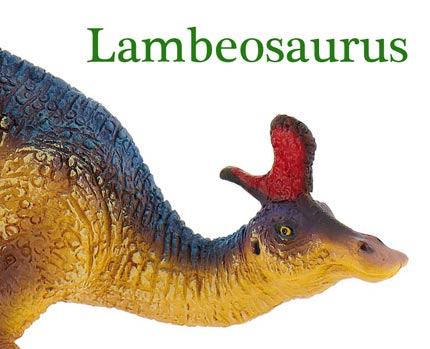
This review is of the new for 2014 Bullyland Lambeosaurus model,  part of the company’s Museum Line prehistoric animal model range.  This is the only duck-billed dinosaur model currently available from this German manufacturer and this replica has a lot to commend it.

Lambeosaurus

Lambeosaurus is one of the better known genera of hadrosaurid dinosaurs and substantial fossil remains ascribed to the lambeosaur family have been found.  All the fossils discovered to date and related to this genus, come from North America.  In most circumstances, it is the lack of fossil material that gives palaeontologists problems when it comes to describing a new dinosaur species and working out where it fits into the dinosaur family tree.

Lambeosaurus is an exception to this, as the amount of fossil material discovered has led to considerable confusion with regards to this dinosaur and to the number of species of Lambeosaurus there might have been and how closely related it is to other crested duck-billed dinosaurs.

The Bullyland Lambeosaurus Dinosaur Model

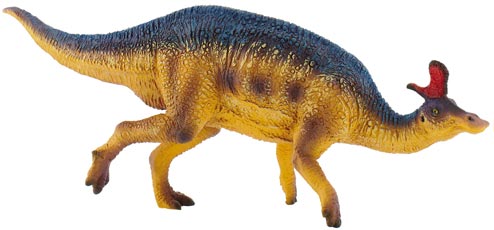
New interpretation of Lambe's lizard.

New interpretation of Lambe’s lizard.

Picture credit: Everything Dinosaur

“Hatchet-like” Crests

As these animals grew and developed, so the size and the shape of that famous “hatchet-like” crest changed.  There may also have been differences in the crest morphology between males and females.  Defining what is actually a species of Lambeosaurus is therefore a bit tricky, however, something like three species are currently recognised and the geographical range of the fossil finds suggests that these types of duck-billed dinosaur lived all along the western part of North America, from Alberta (Canada), in the north, down to New Mexico in the south.

Bullyland Lambeosaurus Dinosaur Model

The Bullyland Lambeosaurus is very well painted and there is lots of detail to admire.  The hatchet crest has a bumpy, roughened texture and it is painted bright red with a brown/black border.  The size and shape of the crest suggests that this model represents one of the larger species of Lambeosaurus currently recognised and that the model is a male.  The ears and nostrils can be clearly seen, little details often overlooked with inferior models.

The replica is roughly in proportion to the known fossil material and the striking blue stripe running down the model gives this Lambeosaurus a certain flamboyance.  The model makers have done a lot of work on the skin texture with some raised dermal scutes and smaller scales, these reflect what is known about Lambeosaurus as impressions of fossilised skin have been found.  The figure measures around twenty-six centimetres in length and based on a comparison with the fossil material associated with one of the bigger Lambeosaurs, Lambeosaurus magnicristatus, we estimate that the figure is in approximately 1:27 scale.  It is posed in quite a dynamic, active stance with the tail held out straight behind the body, to give the impression of movement.

A Close up of the “Hatchet Shaped” Crest

The body and the crest of this dinosaur have been given an authentic roughened texture.

The body and the crest of this dinosaur have been given an authentic roughened texture.

The Bullyland design team have taken care to depict the digits of this dinosaur.  A characteristic of the hadrosaurids is that the fingers of the hand  on the front limbs were often united, connected by skin to form a fleshy pad, whilst the toes of the hind feet could be more splayed.  It is this webbing between the fingers of the hands of this dinosaur that helped give weight to the early hypothesis that these herbivores were largely aquatic.

The model with its Front Digits United to Form a Fleshy Pad

The Museum Line Lambeosaurus with an Everything Dinosaur fact sheet.

The Museum Line Lambeosaurus with an Everything Dinosaur fact sheet. Picture credit: Everything Dinosaur.

Picture credit: Everything Dinosaur

To view Everything Dinosaur’s range of Bullyland prehistoric animal models: Bullyland Dinosaur Figures and Models.

There is much to be admired about this latest interpretation of a Lambeosaurus from Bullyland.  The model’s bright colours and dynamic pose are likely to make it a favourite amongst collectors and dinosaur fans.

21 05, 2014

Mary Anning – A Role Model for Girls and Science

By |2023-03-13T11:06:52+00:00May 21st, 2014|Categories: Key Stage 1/2|Comments Off on Mary Anning – A Role Model for Girls and Science

Mary Anning – Her Story and the National Curriculum

You might be familiar with the tongue-twister that begins “she sells sea shells on the seashore”, this little ditty that originated in the early part of the 20th century is believed to have been inspired by the life and work of Mary Anning, who was one the most important fossil collectors in the early history of palaeontology.

Mary Anning

For teachers of primary school children, especially those in Years 3 and 4, the story of Mary Anning can dove-tail very neatly into the new national teaching curriculum, specifically into the Science section (rocks, fossils and soil) but elsewhere, including English, History and Mathematics.

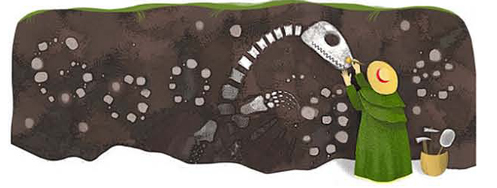
Mary Anning Fossil Collector Gets a Google Doodle

Google celebrates the life and work of Mary Anning.

Happy Birthday Mary Anning.  Google celebrates the life and works of Mary Anning.

Picture credit: Google/Everything Dinosaur

Mary Anning’s (1799-1847), contribution to the nascent science of palaeontology was immense.  This pioneering amateur palaeontologist would often venture out onto the dangerous cliffs of Lyme Regis (along with her faithful dog), searching for fossils or “curios” as they were often referred to.  She is credited with finding the first Ichthyosaur fossils to be studied by scientists (the fossil discovery was made jointly with her brother Joseph).

From her humble little house at Lyme Regis (Dorset, southern England),  Mary collected the many different types of fossil exposed by tides and erosion that could be found in the Jurassic aged coastal strata.  She became prominent as an expert in fossils and fossil hunting, although she did not receive full credit for her contribution to science during her lifetime.

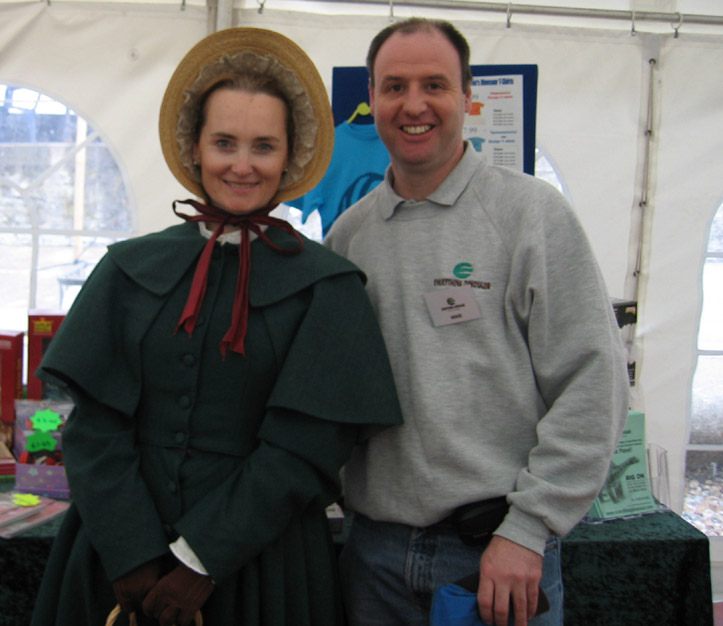
Helping to Promote Science to Girls using Mary Anning as a Role Model

Helping to promote learning in schools.

Helping to promote science for girls by dressing up as Mary Anning.  Mary Anning helping to inspire the next generation of young scientists. Picture credit: Everything Dinosaur.

Picture credit: Everything Dinosaur

The First Plesiosaur Fossil to be Scientifically Studied

Mary Anning discovered the first plesiosaur fossils in 1821 and the first pterosaur (flying reptile) fossils in England in 1828.  The pterosaur in question was named Dimorphodon and it was the first outside Germany to be described and only the third in the world to be scientifically analysed.  Many of Mary’s fossil finds can still be seen in museums today.  Her discoveries helped to build up the collections of a number of wealthy individuals but often no record was kept of her contribution or role in the research and study of such specimens.

Sadly, in Georgian times, women working in an academic capacity was strongly discouraged, Mary had much of the credit for her work taken away from her and it is only in recent years that her contribution has begun to be recognised by the public.

Mary Anning and her story makes a splendid, inspirational tale to help young children (particularly girls), think about studying science and taking up a career in the sciences.

Further information on Mary Anning and resources can be found at the following links:

Lyme Regis Remembers Mary: Lyme Regis Remembers the Contribution to Science Made by Mary Anning.

In Memory of Mary Anning: Anniversary of the death of Mary Anning.

As for a link into the English elements of Key Stage 2, here is the tongue-twister attributed to Mary in full, can your class create tongue-twisters of their own?

“She sells sea-shells on the sea-shore.
The shells she sells are sea-shells, I’m sure.
For if she sells sea-shells on the sea-shore
Then I’m sure she sells sea-shore shells.”

To view replicas of ammonites, belemnites, plesiosaurs and pterosaurs inspired by Mary Anning’s fossil discoveries, visit the models section of Everything Dinosaur’s user-friendly website: Prehistoric Animal and Dinosaur Models.

21 05, 2014

Google Doodle Celebrates the Amazing Mary Anning

By |2024-04-12T15:43:40+01:00May 21st, 2014|Categories: Dinosaur and Prehistoric Animal News Stories, Dinosaur Fans, Main Page, Palaeontological articles, Press Releases|0 Comments

Happy Birthday to Mary Anning – Google Doodle

We wonder what Mary Anning would have made of the internet?  Coming from a poor family she may have found access to a personal computer, smart phone or tablet a little beyond her budget.  Perhaps one of those wealthy individuals who benefited from her fossil finds and research might have provided her with a laptop.  Google has marked the birthday of Mary Anning with a Google Doodle to commemorate her birthday on 21st May 1799.

Google Doodle Celebrates the Birthday of Mary Anning

Happy Birthday Mary Anning

Happy Birthday Mary Anning.

Picture credit: Google

Mary’s contribution to the nascent science of palaeontology was immense.  Along with her brother, Joseph, she is credited with finding the first ichthyosaur skeleton that was scientifically studied, the discovery of Plesiosaurus fossils (the fossil depicted in the Google Doodle) and for finding and bringing to the attention of science the first pterosaur fossil to be formally studied outside Germany (Dimorphodon) and only the third to be described in the world.

For models and replicas of ichthyosaurs and other marine reptiles: CollectA Age of Dinosaurs Popular Range.

Mary Anning

Everything Dinosaur team members were enthusiastic supporters for the life of Mary Anning to be included in the national curriculum of England.  She is one of the designated people who can be studied by school children as part of the science/history scheme of work within the national teaching guidelines.  As a small team, we have done quite a lot to promote science studies in schools and in particular to champion the role of women in science with the aim of encouraging girls to take up science and to develop a career in science disciplines.

Everything Dinosaur with Mary Anning – Helping to Promote Girls into Science

Helping to promote science for girls by dressing up as Mary Anning.

Helping to promote science for girls by dressing up as Mary Anning. Picture credit: Everything Dinosaur.

Picture credit: Everything Dinosaur

A couple of years ago Google created a Google Doodle celebrating the life and works of Mary Leakey, now Mary Anning has been honoured.  Happy Birthday Mary!

For models and replicas of iconic fossils including many from the “Jurassic Coast”: Replicas of Iconic Fossils.

20 05, 2014

New Schleich Pentaceratops Video Review

By |2024-04-12T15:44:41+01:00May 20th, 2014|Categories: Dinosaur Fans, Everything Dinosaur videos, Product Reviews|0 Comments

A Video Review of the 2014 Schleich Pentaceratops Dinosaur Model

The colourful Schleich Pentaceratops dinosaur model gets the Everything Dinosaur video treatment.  In this short video review, (five minutes and forty-two seconds), team members discuss the model, compare it to the Schleich Triceratops replica that came out in 2012 and talk about Pentaceratops fossil finds.

Schleich Pentaceratops Dinosaur Model

Everything Dinosaur’s Video Review of the Schleich Pentaceratops Dinosaur Model

Video credit: Everything Dinosaur

Titanoceratops (Titanoceratops ouranos) even gets a mention.

To view Everything Dinosaur’s range of Schleich models: Schleich Prehistoric Animal Figures and Models.

It may be more than ninety years since the first fossils of Pentaceratops were discovered in New Mexico, but there is a lot of fossil material from the San Juan basin ascribed to Pentaceratops that requires further research and study.  It is also possible that in many of the burlap and plaster wrapped specimens that lie in the vaults of museums there may be other species of ceratopsid awaiting discovery.

19 05, 2014

New Crocodile Attacks Reported

By |2024-02-25T07:38:47+00:00May 19th, 2014|Categories: Animal News Stories, Main Page|2 Comments

More Crocodile Attack Fatalities

A Nile crocodile (Crocodylus niloticus) is reported to have attacked and killed a woman whilst she was collecting reeds in the Shire River (Mangochi district, southern Malawi).  Mangochi Police Station Public Relations Officer, Inspector Rodrick Maida stated that the deceased had been in the river gathering reeds with two female friends when the crocodile grabbed her.  The women were unable to free the victim from the crocodile’s grip and ran to nearby houses to fetch help.

Crocodile Attacks

A search conducted by a group of villagers from Mtalimanja also ended in tragedy when Walani Lawe (aged 51) was attacked and severely injured whilst attempting to retrieve the woman’s body.  The dead woman’s body has yet to be recovered.  Mr Lawe was taken to Mangochi District Hospital and it has been reported that he is responding well to treatment.

This attack comes just a few days after another fatal crocodile attack this time in Papua New Guinea and the species concerned was a Saltwater or Estuarine crocodile (C. porosus).  Several media sources have reported that a four-metre-long reptile attacked and killed an eleven year old boy whilst he fished with his parents.  The incident took place on the Siloura River in Gulf Province, in the southern part of Papua New Guinea. The attack occurred on Thursday afternoon.

Authorities Make Statement

Police Commander Lincoln Gerari, said in the statement that the boy had been identified as Melas Mero.  Following the fatal attack, a large crocodile was tracked by hunters and killed.   The boy’s limbs and part of the hips were found inside the crocodile’s stomach.  Other body parts have been recovered by the police team.

Describing the sudden attack, the Commander explained:

“The crocodile swept the boy with its tail and then attacked the defenceless child.”

This is the second fatal crocodile attack to be reported from Papua New Guinea in 2014.  On January 1st a man was killed by a Saltwater Crocodile at Rawa Bay in North Bougainville.   According to a Darwin based, crocodile data recording team, this is the seventy-fifth crocodile attack recorded in Papua New Guinea since 1958.  Of these seventy-five attacks, sixty-five have proved fatal.

18 05, 2014

A Video Review of the New Schleich Light Green T. rex Dinosaur Model

By |2024-04-12T15:45:13+01:00May 18th, 2014|Categories: Dinosaur Fans, Everything Dinosaur Products, Everything Dinosaur videos, Product Reviews|0 Comments

Schleich Light Green Tyrannosaurus rex Video Review

The new for 2014 Schleich light green Tyrannosaurus rex is the first of the new Schleich dinosaurs to have a a video review created for it.  Team members at Everything Dinosaur have enthusiastically plotted the progress of the four new models scheduled for introduction this year by Schleich into their “World of History” series.  It is our intention to produce reviews for all the new models, but the T. rex replica is a very good place to start.

Tyrannosaurus rex Model

There are a total of three tyrannosaurs currently made by Schleich, two within the larger model series and a third, smaller model in what was called “die kleinen Dinos” by our German friends.  As with all prehistoric animal model manufacturers, T. rex tends to act as a flagship model for the factory, after all, it is the one dinosaur replica that is made by all the model manufacturers and the new, light green Tyrannosaurus rex from Schleich stands up very well to scrutiny.

The Light Green Tyrannosaurus rex Model (Schleich)

T. rex (Schleich 2014)

T. rex (Schleich 2014).

A Video Review by Everything Dinosaur

It is a very tactile model, has lots of detail and the articulated lower jaw is bound to make it very popular amongst young dinosaur fans.  The five minute video review discusses some of the features of this new replica and compares it to the 2012 tyrannosaur model introduced by Schleich when their revamped prehistoric animal model range “Urzeittiere Dinosaurier”, this translates as prehistoric animals – dinosaurs, first came out.

Everything Dinosaur’s Video Review of the Light Green T. rex (Schleich)

Video credit: Everything Dinosaur

In this short video, we look at the possibility of making this new T. rex model the male in a pair of tyrannosaurs with the slightly larger, dark green, 2012 T. rex being the female.  There is evidence to suggest that the females were larger than the males.  The fossil record from locations such as the the Hell Creek Formation of the western United States indicates two forms of Late Cretaceous tyrannosaur, a robust form and a gracile form.  Could this fossil material represent differences between boys and girls just as we see today with some species of birds?

To view the Schleich prehistoric animals available from Everything Dinosaur: Schleich Dinosaur Models and Prehistoric Animal Figures.

The females may have been bigger as they required wider hips to permit the storage and passage of eggs.  Females in many different types of animal tend to be bigger than the males, In tyrannosaur circles, could the girls have ruled the roost?  For the moment, the fossil evidence poses this intriguing question finding definitive proof is somewhat tricky, however, thanks to Schleich at least dinosaur fans and model collectors can create their own family of tyrannosaurs.

17 05, 2014

Biggest Dinosaur of All – A New South American Contender

By |2023-03-13T10:31:10+00:00May 17th, 2014|Categories: Dinosaur and Prehistoric Animal News Stories, Dinosaur Fans, Main Page|0 Comments

Seven Titanosaur Fossil Skeletons – Graveyard of Giants!

So the story is out, we have a new contender for the title of biggest dinosaur known to science!  In fact we have seven of them, for a team of researchers working at an outcrop of Cretaceous aged strata in Chubut Province (southern Argentina),  have uncovered the fossilised remains of seven huge titanosaurs and when we say huge we really mean it.  These giants could well prove to be the largest terrestrial animals of all.  Somebody is going to need a very big dinosaur museum to exhibit this collection.

A Graveyard of Giants

A team of researchers led by scientists from the Museo Paleontológico Egidio Feruglio (Trelew City), a museum and scientific research centre that team members at Everything Dinosaur know very well having visited and viewed the spectacular vertebrate fossil collection on numerous occasions, have uncovered a total of two hundred fossils so far from this single location.  Best of all, a film crew from the BBC Natural History film unit was on hand to visit the site and record the field team at work as they carefully gathered evidence of past habitats within the dinosaur bone bed that has been nick-named the “graveyard of giants”.

An Overview of the Fossil Site
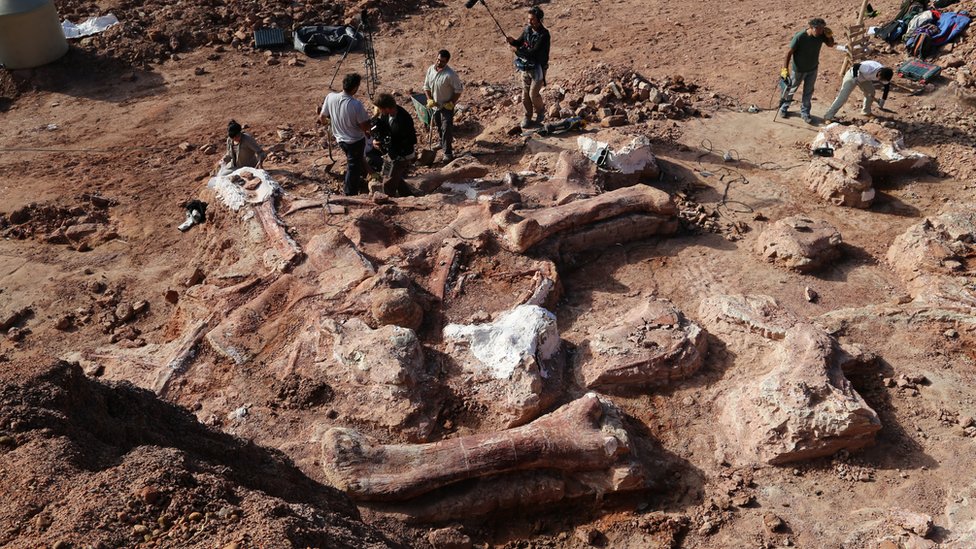
Up to seven individual Titanosaur remains found.

Up to seven individual titanosaur remains found.

Picture credit: Museo Paleontológico Egidio Feruglio (MEF)

Titanosaur Fossils

This part of Argentina has produced a number of giant dinosaurs, including immense titanosaurs, the largest of which, to be formally described is Argentinosaurus huinculensis.  However, this new discovery is remarkable as there are a number of individuals to be studied and the preservation of the bone material is exceptional.  This new species of titanosaur has yet to be named.

Size and Scale of New Dinosaur Discovery
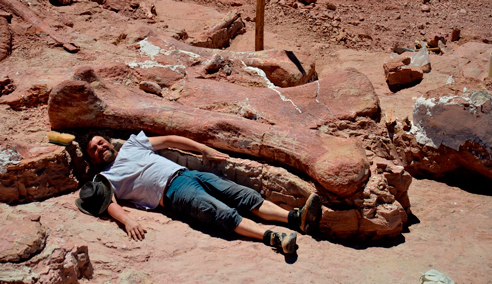
The thigh bone of one of the giant Titanosaurs.

The thigh bone of one of the giant titanosaurs.

Picture credit: Museo Paleontológico Egidio Feruglio (MEF)

The picture above shows one of the researchers lying beside the thigh bone (femur) of one of these enormous plant-eating dinosaurs.  It is a kind of a tradition amongst palaeontologists to have their picture taken lying next to the huge limb bones of these long-necked dinosaurs.  Many field workers have posed for such photographs, it is probably the most practical and simple way to demonstrate the immense size of the fossils in the field.

Large Fossil Bones Discovered

In 2011, a local farmworker contacted the MEF and reported the finding of large bones that were exposed and weathering out of the surrounding rock.  Field team workers have been busy excavating the site, which is approximately 160 miles south-west of Trelew City, close to the small town of El Sombrero.  About one fifth of all the fossil material has been removed and transported back to the MEF for further restoration and preparation.  The size of the fossil bones made transport no easy task and the scientists were grateful for the support and advice of the Highways National Road Administration as well as the National Atomic Energy Commission which provided tools and heavy plant equipment to help with the fossil dig.

Heavy Duty Fossil Handling Equipment Required
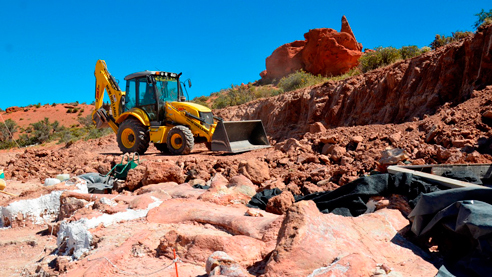
Big fossils require big diggers to excavate them.

Big fossils require big diggers to excavate them.

Picture credit: Museo Paleontológico Egidio Feruglio (MEF)

The industrial plant, more at home on a construction site, certainly beat our hammers and chisels, but big diggers are required when handling fossil extraction on this scale.

The strata in which the fossils have been found has been tentatively dated to around 95 million years ago (Cenomanian faunal stage of the Cretaceous).  This dry and dusty part of Patagonia was very different back then, it was a lush and verdant dinosaur paradise, criss-crossed by slow flowing rivers.  For this group of titanosaurs, it may be a case of “paradise lost” as they all perished together.  Amongst the huge bones, the palaeontologists have found sixty broken teeth from large theropod dinosaurs. It seems the carcases of these animals were scavenged by some big meat-eaters.

Predators Attracted

The heap of decaying corpses would have attracted every carnivorous dinosaur from miles around, after all, there would have been something like 250 – 300 tonnes of meat available for the scavengers to consume.  One of the benefactors of this feast might have been the carcharodontosaurid known as Tyrannotitan (T. chubutensis).  Fossils of this twelve-metre-plus giant have been found in slightly older strata in the same area.

The site has also yielded important data on the flora that existed in this part of the world during the Cretaceous.  Amongst the fossil material excavated to date there are chunks of fossilised wood and the delicate impressions of the leaves of early flowering plants (Angiosperms).  However, with the number of fossil bones found and their degree of preservation, scientists are confident that they can gather accurate data on just how big these dinosaurs were.

At Least Seven Individual Dinosaurs

The seven individuals represent adult animals,  there are some slight differences in the size of the bones, indicating that some of the dinosaurs were bigger than others.  Initial estimates of body size and mass of the largest individual, calculated by measuring the length and circumference of the femur (thigh bone) suggest an animal around eighty tonnes in weight and forty metres in length.  Such figures are approximations and further work is required but the bones are on a par with those ascribed to the biggest dinosaur yet described, the mighty Argentinosaurus.

Recently, Everything Dinosaur reported on a study conducted by an international team of scientists that compared how quickly dinosaurs evolved compared to birds.  As part of this research, the body weights of the largest known dinosaurs were calculated.  The femur size and circumference measure for Argentinosaurus gave this dinosaur a body mass of around ninety tonnes.  However, the femur used was a fragmentary fossil, in this instance scientists have, for the first time, got the virtually complete super-sized titanosaur limb bone material to work with.

To read more about this research: Dinosaurs Shrank So That They Could Continue to Evolve.

Commenting on the size of these potential record breaking dinosaurs, palaeontologist Dr José Luis Carballido (MEF) stated:

“It’s like two semi trucks, one after another, and the equivalent of more than 14 African elephants weighed together.  It’s a real palaeontological treasure, there were so many bones and the remains are practically intact, this does not happen very often.  All previously discovered giant titanosaur fossils are very fragmented”

Titanosaur Fossils

The giants seem to have all perished around the same time, indicating that this might represent a herd or at least a partial herd of these herbivorous dinosaurs.  A spokes person from Everything Dinosaur remarked that the fossil find was indeed astonishing and that the fossils once prepared and protected against further erosion and damage would yield new information on just how big some dinosaurs could grow to.

The spokes person added:

“We can speculate that this bone bed deposit represents a herd of titanosaurs that stayed close to a dwindling water supply that eventually dried up.  In a drought, these giants would have been trapped close to a water source and yet in need of vast amounts of vegetation to fuel their huge bodies, even if they had the lower metabolisms of cold-blooded creatures.  We see similar instances of mass mortality of large herbivores in Africa today, when significant numbers of elephants succumb to drought in places such as within some of the National Parks of Botswana.”

The South American research team are optimistic that these enormous fossils will eventually go on display to the public, but for the Museo Paleontológico Egidio Feruglio, this is going to cause a bit of headache.  They are going to need a much bigger main gallery to display them in.

A Comparison of Body Sizes – Scale of Titanosaurs
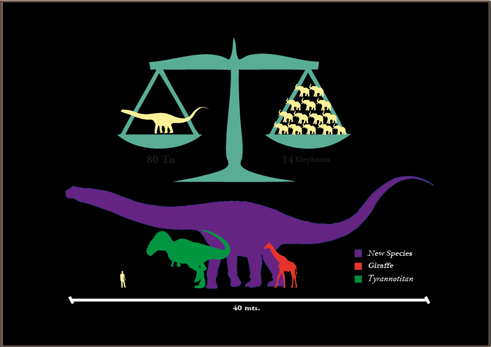
New dinosaur discovery compared to a human, a giraffe and a meat-eating Theropod.

New dinosaur discovery compared to a human, a giraffe and a meat-eating theropod.

Picture credit: Museo Paleontológico Egidio Feruglio (MEF)/Everything Dinosaur

The diagram above shows the new, as yet unnamed dinosaur compared to a human (yellow), a giraffe (red) and the meat-eating, theropod dinosaur known as Tyrannotitan.


Go to Top