

Researchers have reported the discovery of a fragment of pterosaur finger bone from the UNESCO World Heritage site Stevns Klint. The Stevns Klint cliffs are located on the eastern coast of the Danish island of Sjaelland. The fossil along with other fragmentary bones, was found in the uppermost Maastrichtian, Højerup Member of the Møns Klint Formation strata of Holtug limestone quarry. This is the first time that pterosaur remains have been reported from this location. The specimen is a piece of the phalanx 1 of digit IV (the wing finger). Its size suggests that small-bodied pterosaurs with a wingspan of less than half a metre existed during the last fifty to sixty thousand years of the Cretaceous.
Unfortunately, it is not possible to determine whether the specimen is an adult or juvenile. However, if the fossil represents a bone from an adult pterosaur, then this is the smallest pterosaur known from the Late Cretaceous.
It overlaps in size with contemporaneous birds, rejecting previous hypotheses that Late Cretaceous pterosaurs and birds avoided competition through size-based niche partitioning.
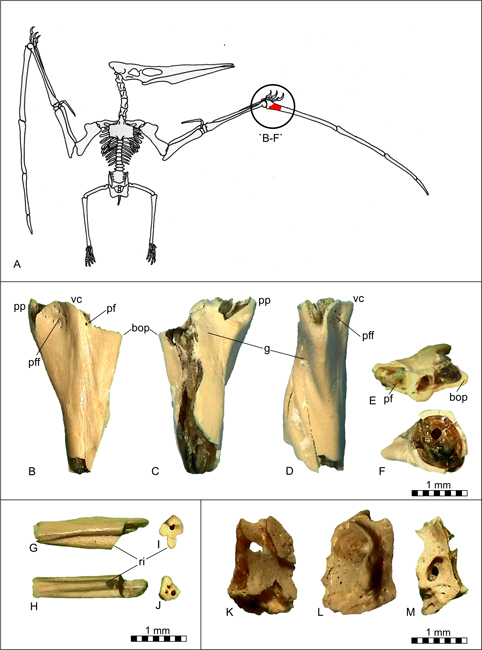
Fragments of the pterosaur finger bone and skeletal reconstruction showing location of a bone fragment. Drawing of pterosaur skeleton showing location of fragment OESM 13096 in red (A). OESM 13096 (B) left phalanx 1 of digit IV in ventral view, dorsal (C), posterior (D), proximal (E), and distal (F) views. OESM 13323, fragment of phalanx 2 or phalanx 3 of digit IV in lateral (G) and ventral (H) views, end cross-sections (I, J). Specimen number OESM 13324 (D) unidentifiable fragment displaying numerous (pneumatic) foramina, rotated around vertical axis in different views (K, L, M). Picture credit: Milàn et al.
Picture credit: Milàn et al
Studying a Fragmentary Pterosaur Finger Bone
The preserved fragments indicate the individual was perhaps a tenth to a fifth the size of the smallest of the latest Maastrichtian pterosaurs from Morocco (Alcione elainus). It is not possible to provide a more precise taxonomic assessment of the specimen, other than referring it to the Pterosauria. The researchers conclude that these bones could indicate a flying reptile with a wingspan of perhaps twenty to fifty centimetres. For comparison, the common blackbird (Turdus merula) has a wingspan of around thirty-five to forty centimetres. This could be evidence of small pterosaurs present in the late Maastrichtian of the Cretaceous. Ironically, a time when it had been thought that birds had replaced small pterosaur species.
Everything Dinosaur’s blog post about pterosaur diversity in the Late Cretaceous: Late Cretaceous Pterosaurs More Diverse Than Previously Thought.
The Stevns Klint Palaeoenvironment
The strata comprising the cliffs on the island of Sjaelland are remarkable. The limestone and chalk deposits represent a sequence of deposition from the very end of the Cretaceous through to the Palaeogene (Danian faunal stage of the Palaeocene). As such, these rocks provide scientists with an insight into the last few thousand years of the Cretaceous and the period immediately after the End-Cretaceous extinction event.
It had been thought that the emergence of birds led to the extinction of small pterosaur species. The niches previously occupied by small-bodied pterosaurs were gradually filled by birds. However, this pterosaur finger bone discovery and the other specimens suggest that this might be an oversimplification of the true picture. That small pterosaurs did persist until the end of the Cretaceous.
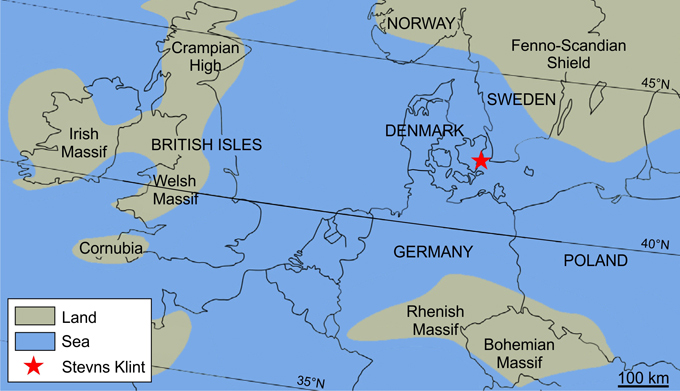
Palaeogeographic map of northern Europe during the end Maastrichtian, showing the location of the present day Stevns Klint. The nearest coastline was at that time located approximately 150 km northeast in the Fenno-Scandian landmass in what is today southern Sweden. Picture credit: Milàn et al.
Picture credit: Milàn et al
An Additional Implication for the Pterosauria
If the new pterosaur specimen derives from a near or fully grown adult individual, then it is evidence for the presence of at least one taxon of small-bodied pterosaur persisting until the end of the Cretaceous. Intriguingly, this discovery opens up another scenario concerning Late Cretaceous pterosaurs. If the fossil is from a hatchling or juvenile of a species that attained much larger size when fully grown, then it was already capable of flying great distances. The fossil material comes from the Højerup Member. These rocks were laid down in a relatively deep-water environment at least ninety miles (one hundred and fifty kilometres) offshore. Hatchling pterosaurs were likely super-precocial and capable fliers.
Previous studies suggested that hatchling or juvenile pterosaurs were initially adapted to active sustained flight in restricted, vegetation-filled environments. As they grew and matured, they became more efficient long-distance gliders necessarily utilising more open environments. In turn, this supports the idea of niche partitioning in pterosaurs, where individuals at different ages occupied different ecological niches and environments. However, this fossil material, if not from an adult, indicates that even young pterosaurs were capable of flying considerable distances in open environments.
The Pterosauria are an enigmatic clade. They were the first vertebrates to evolve powered flight. This study highlights that we still have a lot to learn about these remarkable flying reptiles.
Everything Dinosaur acknowledges the assistance of one of the paper’s authors (Jesper Milàn) in the compilation of this article.
The scientific paper: “A diminutive pterosaur from the uppermost Maastrichtian chalk of Denmark” by Jesper Milàn, Sten Lennart Jakobsen and Bent Erik Kramer Lindow published in
Acta Palaeontologica Polonica.
For pterosaur models and figures: Pterosaur and Dinosaur Models.

Leave A Comment