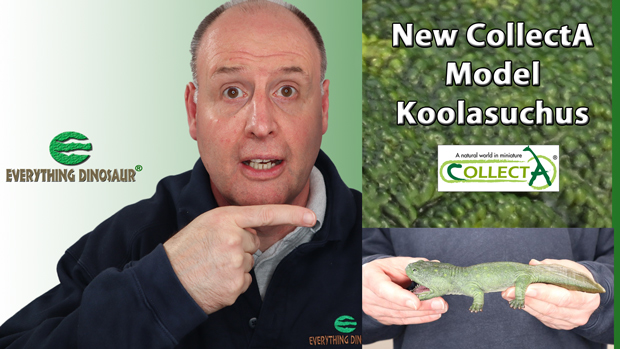
Everything Dinosaur will shortly post up a brief video review of the CollectA Deluxe Koolasuchus model. This 1:20 scale figure is the first prehistoric amphibian to be made by CollectA. It is a magnificent model and team members have been keen to create a video review.
The CollectA Deluxe Koolasuchus video review titles. Everything Dinosaur intends to post up a short YouTube video review of this excellent figure. Picture credit: Everything Dinosaur.
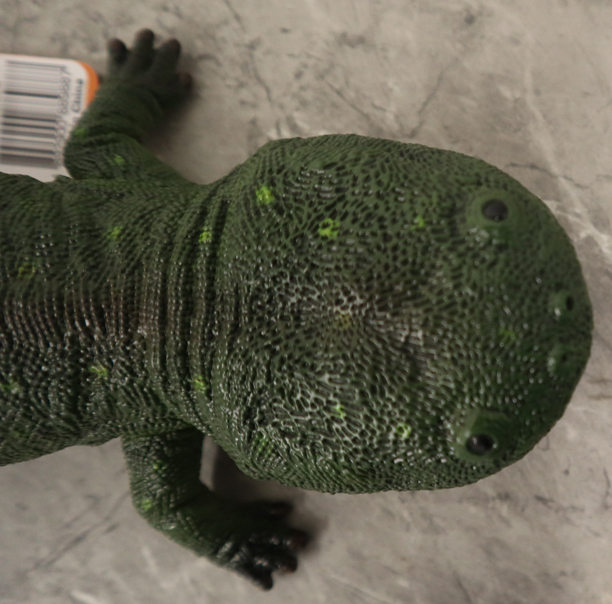
In the YouTube video, various details of the model will be highlighted. For example, the head of the CollectA Deluxe Koolasuchus is covered in a wonderful, criss-crossed, hatching effect. This patterning is typical of temnospondyls, in fact it is diagnostic. Should a palaeontologist encounter skull bones with a hatched, criss-crossed pattern, then it is extremely likely that they have discovered a temnospondyl fossil.
A close-up view of the head of the CollectA 1:20 scale Koolasuchus figure showing the detailed pattern on the head. This patterning on the skull is a characteristic of temnospondyls. Picture credit: Everything Dinosaur.
Picture credit: Everything Dinosaur
Question of the Day?
As the storyboard for the Everything Dinosaur YouTube video comes together, team members want to ask viewers a question. As this is the first prehistoric amphibian made by CollectA, are there other animals that collectors would like a model of?
In the video we will ask the question:
What other type of prehistoric amphibian would you like CollectA to make?
Perhaps collectors would like a replica of giant predator such as Mastodonsaurus? Might an Eryops figure prove popular?
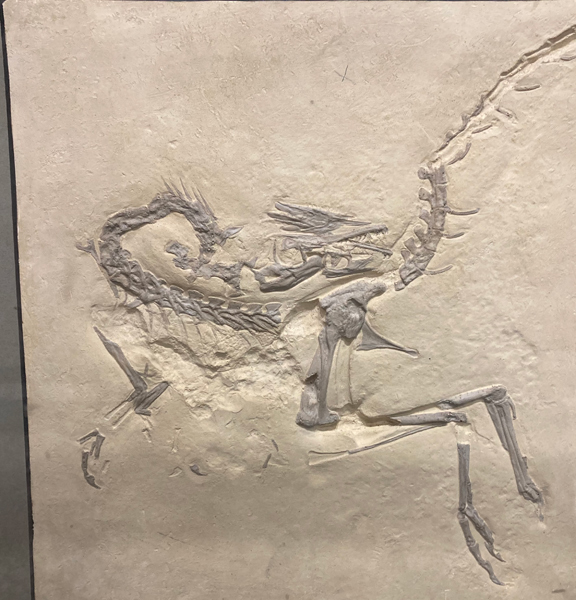
Everything Dinosaur team members took a photograph of the Compsognathus fossil cast on display at the Manchester Museum of Natural History. This chicken-sized theropod is known from two specimens. One fossil was found in France, the other was found in Bavaria (Germany). The fossil cast represents the Bavarian specimen (BSP AS I 563).
A cast of a Compsognathus fossil on display at the Manchester Museum of Natural History. Picture credit: Everything Dinosaur.
Picture credit: Everything Dinosaur
The Famous Compsognathus Fossil Cast
The German specimen was collected from limestone deposits. This fossil came into the ownership of the amateur fossil collector Dr Joseph Oberndorfer. The famous German palaeontologist Johann A Wagner, was loaned the specimen to study. He penned a brief description in 1859. Wagner named this dinosaur Compsognathus longipes. Although at the time, Wagner did not recognise Compsognathus as a member of the Dinosauria. He thought it was a prehistoric lizard.
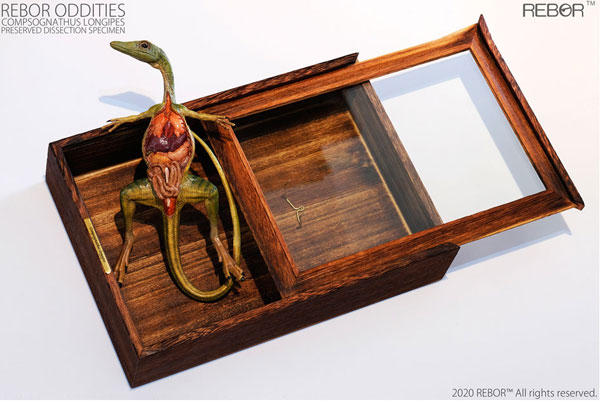
Numerous Compsognathus models and replicas have been manufactured. Perhaps, the most intriguing is the limited-edition Compsognathus dissection replicas made by Rebor.
The Rebor Oddities Compsognathus longipes preserved dissection specimen. An amazing replica, it is as if this dinosaur had been dissected.
The picture (above) shows the stunning and extremely realistic Rebor Oddities Compsognathus longipes preserved dissection specimen.
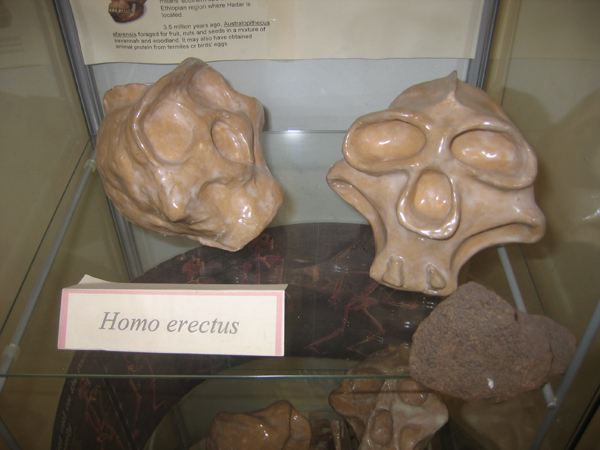
A team member from Everything Dinosaur marvelled at a display featuring a pair of Homo erectus model skulls on display at a school. A visit to Painsley Catholic College back in 2018, provided us with the opportunity to photograph the clay models. The science and art departments had collaborated to create a beautiful exhibit that documented human evolution. Many different hominin species were illustrated. Our personal favourites were the pair of Homo erectus skulls.
The teachers at Painsley Catholic College had built a display of ancient hominins using replicas of stone tools and carefully constructed clay skulls. The image shows a pair of Homo erectus skulls. Picture credit: Everything Dinosaur.
Picture credit: Everything Dinosaur
A spokesperson from Everything Dinosaur praised the teaching staff at the time for creating such an informative display.
The boom in the trade for mammoth tusks threatens extant elephant populations and their habitats. This is the conclusion of newly published research from the University of Portsmouth.
Conservationists and campaigners fear an increase in the buying and selling of mammoth tusks poses a direct threat to elephants. The trade in “ice ivory” was banned in the UK in 2018. The ban was imposed following a Portsmouth University led investigation into the British antiques trade of the material.
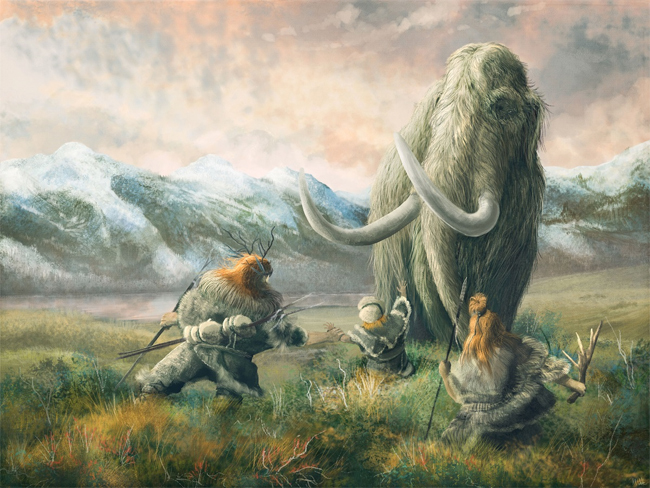
Humans encounter a Woolly Mammoth. A boom in “ice ivory” trade of mammoth tusks presents a threat to elephants and the environment. Picture credit: Mark Witton.
The Trade in Mammoth Tusks
Earlier this year (2023), it was announced the Ivory Act would be extended to protect five more endangered CITES-listed species, including the hippopotamus, narwhal, walrus, orca and sperm whale. However, new research highlights the unregulated sale of mammoth tusks needs to be addressed. The species fall outside of the regulation of the Convention on International Trade in Endangered Species of Wild Fauna and Flora (CITES). This is an international, multi-government agreement set up to ensure the survival of animals and plant species.
The authors argue that while woolly mammoths became extinct thousands of years ago, their lives and ultimate demise has much to teach us about how we conserve and protect existing elephant populations.
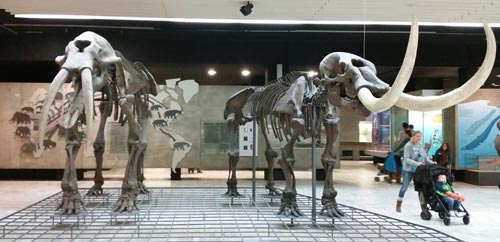
Prehistoric elephants on display at the Senckenberg Museum (Frankfurt). Picture credit: Everything Dinosaur.
Picture credit: Everything Dinosaur
What About Other Prehistoric Elephant Genera?
Everything Dinosaur notes, that many species of extinct elephant had large tusks. Whilst the tusks eroding out of melting Siberian permafrost might usually be associated with the Woolly Mammoth (Mammuthus primigenius), tusks from other extinct species might be traded too. For example, tusks from the American Mastodon (Mammut americanum) or the Columbian mammoth (Mammuthus columbi) found in North America might also be bought and sold.
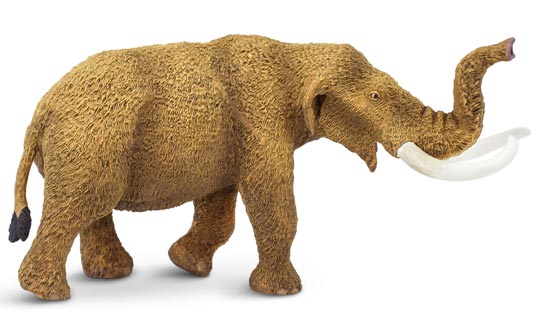
The Wild Safari Prehistoric World Mastodon model. The trade in the ivory of other prehistoric elephants would also need to be controlled.
The picture (above) shows a model of the American Mastodon by Safari Ltd.
Prehistoric Elephant Tusks Labelled as Ivory from Extant Species
Lead author in the recently published paper, Dr Caroline Cox (University of Portsmouth) commented:
“There’s evidence traders are trying to sustain the illegal ivory market with mammoth tusks, by intentionally mislabelling ice ivory as elephant ivory. Modern elephants and woolly mammoths share a common ancestor, so their tusks have close similarities. Instead of profiting from these new discoveries, we should be learning from them – how mammoths lived and how they died – to help protect their endangered relatives.”
It is estimated the illegal wildlife trade to be collectively worth between $15-22.5 billion USD a year. This puts the trade on a par with the illegal arms trade, the illegal drugs trade and the trade in human trafficking.
Schreger Lines in Elephant Ivory
Co-author of the study, Luke Hauser (University of Portsmouth) explained:
“Structurally, mammoth ivory is fundamentally identical to elephant ivory. Both have Schreger lines, which are distinct characteristics of the species.”
The majority of the ivory coming out of Siberia is woolly mammoth, but because evolution is a slow process there would have been crossovers between their characteristics and their predecessors. In theory, a trader could have a document claiming a tusk is from a Steppe Mammoth (M. trogontherii) when in fact it is actually a Woolly Mammoth (M. primigenius). Conservationists could not argue otherwise without an expensive and lengthy DNA test.
It is more than a decade since eBay announced its own complete, worldwide ban on ivory sales. An on-line post stated that the global ban would “protect buyers and sellers, as well as animals in danger of extinction”. Unfortunately, recent studies have shown that sellers of illegal wildlife products operate on the dark web, rather than more openly through on-line social media and auction platforms.
The Trade in Mammoth Tusks Damages the Fossil Record
Dr Cox explained:
“While mammoth tusks continue to be in demand, particularly in the Far East, the Siberian tusk hunters of Yakutia recover only what the buyers want – the ivory. The remains of the mammoth are left behind and lost to science.”
The mining of mammoth tusks is dangerous. It is often illegal, and it damages the environment. The law of the Russian Federation states that only mammoth tusks that have come to the surface, usually as a result of the permafrost melting, can be harvested. However, this is extremely difficult to enforce. Miners can speed up the erosion process by using high pressure hoses to blast the permafrost. The industrial mining of the permafrost also releases huge amounts of greenhouse gases such as methane. This is leading to accelerated global warming.
The paper, published in the “Journal of International Wildlife Law and Policy”, states that the best and most effective way of tackling issues surrounding the “ice ivory” trade is international cooperation from nations sharing resources and intelligence.
Everything Dinosaur acknowledges the assistance of a media release from the University of Portsmouth in the compilation of this article.
The scientific paper: “Ice Ivory to White Gold: Links Between the Illegal Ivory Trade and the Trade in Geocultural Artifacts” by Caroline Cox and Luke Hauser published in the Journal of International Wildlife Law & Policy.
Our thanks to model collector William who sent into Everything Dinosaur his review of the PNSO Tristan the Gorgosaurus model. The Chinese manufacturer was praised for their tyrannosaur figures.
William commented:
“PNSO has favoured me with not one but two stunning Albertosaurinae tyrannosaurid models. Ah, the genius of PNSO.”
The second Albertosaurinae referred to by the reviewer is the recently introduced PNSO Wally the Albertosaurus.
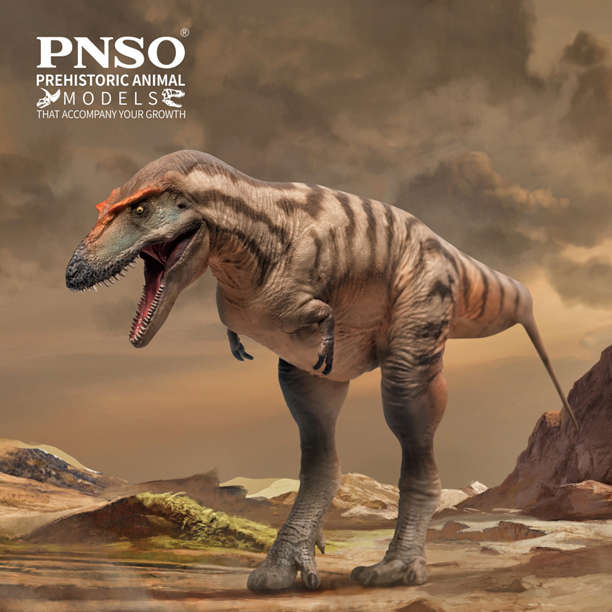
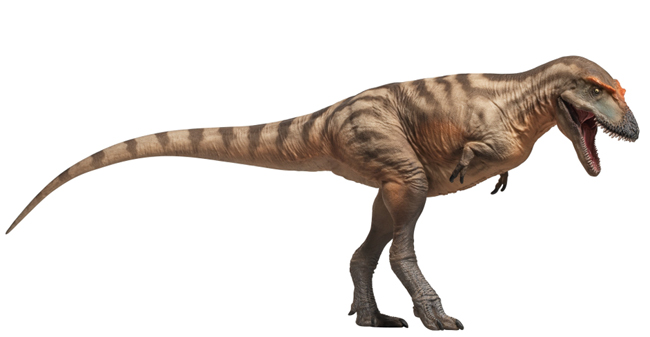
The PNSO Gorgosaurus (Tristan) will have an articulated lower jaw. This tyrannosaur figure was praised by the reviewer.
The reviewer stated that there was a notable difference between “Tristan and Wally”. The Gorgosaurus figure (Tristan) is posed as if looking downwards. It might be surveying potential prey. Perhaps the dinosaur has been left in charge of some hatchlings and it is watching over its brood. William commented that these dinosaurs had acute vision.
The new for 2023 PNSO Tristan the Gorgosaurus dinosaur model. This figure is in stock at Everything Dinosaur.
William complimented both figures and explained that whilst finalising his review of Tristan he received the Albertosaurus model in the post.
He stated:
“In finalising my review of Tristan, I received a second beautiful horned Albertosaurinae model – Wally the Albertosaurus.”
Information About Gorgosaurus
Prior to providing the model review, William supplied some information about the discovery of Gorgosaurus. He wrote that Gorgosaurus is synonymous with the Canadian Province of Alberta. It lived during the Campanian faunal stage of the Cretaceous (76.6-75.1 mya).
William explained that it was the year 1913 and in the young province of Alberta the fossil collector Charles M. Sternberg had unearthed an almost complete holotype Gorgosaurus libratus. Charles M. Sternberg had been exploring the Dinosaur Provincial Park Formation. The following year (1914), Lawrence Lambe published his paper describing and naming the new fossil. Gorgosaurus libratus being the second but older species Albertosaurinae tyrannosaurid discovered.
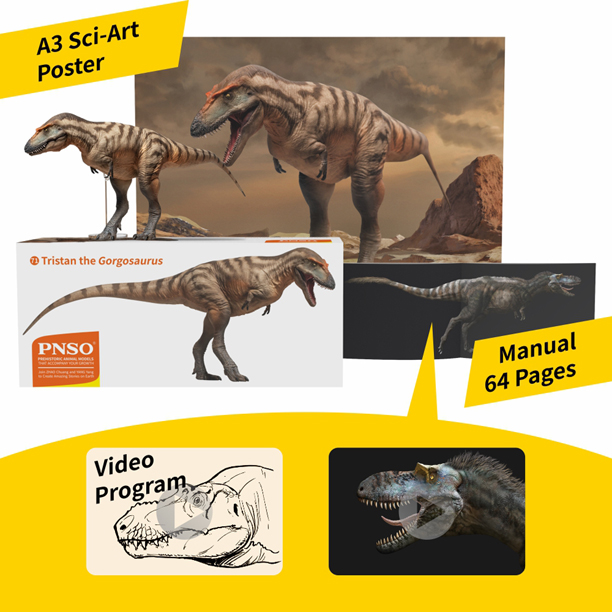
The PNSO Gorgosaurus figure will be supplied with a transparent support stand, an A3-sized Sci-Art poster and a 64-page, illustrated colour booklet.
In concluding his review, William thanked team members at Everything Dinosaur for their hard work sourcing the figures and making them accessible for model collectors.
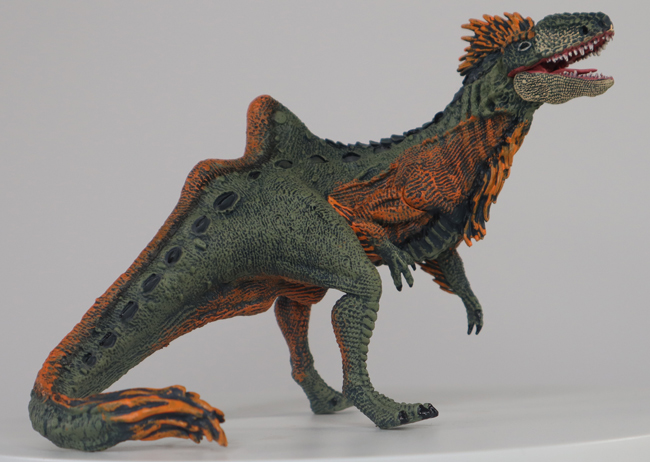
A dinosaur model collector sent a request to Everything Dinosaur to provide some more photographs of the Papo Concavenator figure. We were happy to oblige and set up our studio so that we could create some more images of this new model. The Papo Concavenator is one of four new prehistoric animal figures being introduced this year by Papo.
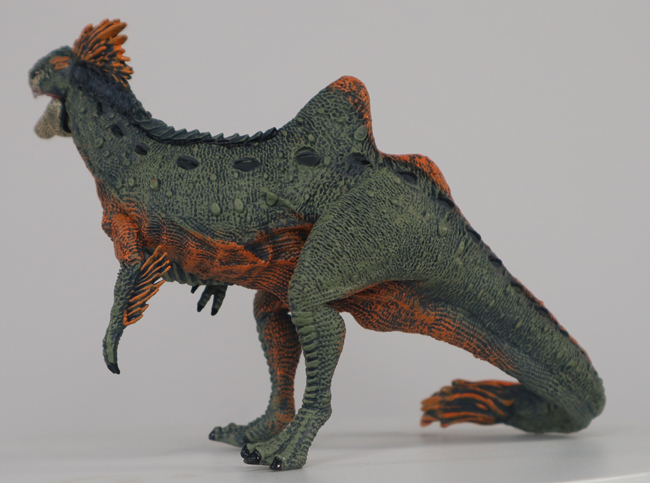
The striking and new for 2023 Papo Concavenator model. Picture credit: Everything Dinosaur.
When first announced, the Papo Concavenator model divided opinions amongst model collectors. The unusual styling of the figure denotes Papo, but some model collectors argued that the model strayed too far from the fossil record.
The Concavenator figure is certainly a striking and very different model of a theropod dinosaur.
The Papo Concavenator model in lateral view. Picture credit: Everything Dinosaur.
Picture credit: Everything Dinosaur
A spokesperson from Everything Dinosaur commented:
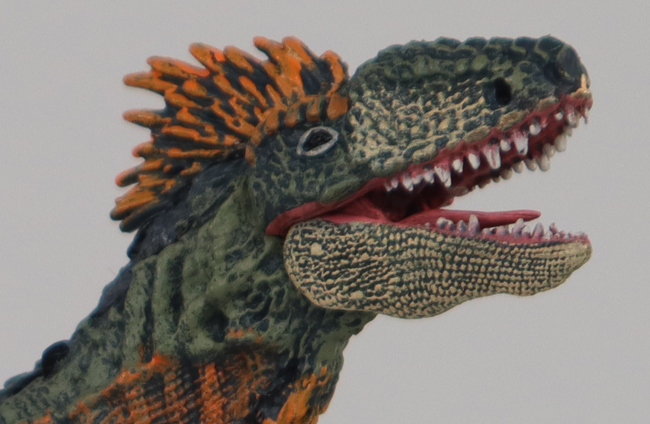
“We were happy to take some additional photographs of this Papo figure. By taking photos of the model from different angles, we could help collectors appreciate the striking use of crests, tufts and scales on this new Papo figure.”
The spokesperson added:
“The orange head crest is certainly eye-catching. Papo have come up with a fascinating interpretation of Concavenator.”
A close-up view of the Papo Concavenator dinosaur model. The flamboyant, orange head crest is a striking feature of this new for 2023 Papo model. Picture credit: Everything Dinosaur.
The new for 2023 Nanmu Studio Alpha T. rex dinosaur figures are now in stock at Everything Dinosaur. Three superb Tyrannosaurus rex models complete with display bases. A spokesperson from Everything Dinosaur has confirmed that all three of these new tyrannosaur figures are now available.
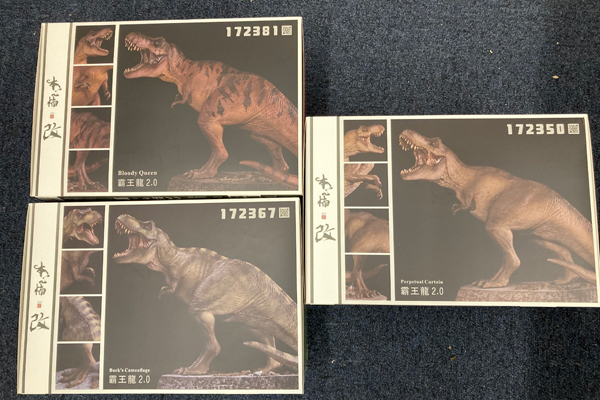
The three new for 2023 Nanmu Studio Jurassic Series Alpha 2.0 T. rex models. Blood Queen (top left), Green Camouflage (bottom left) and the brown colour variant (right). Picture credit: Everything Dinosaur.
The three new Nanmu Studio Alpha T. rex dinosaur models are coming into stock at Everything Dinosaur. We will stock Alpha 2.0 green, brown and Blood Queen. These three eagerly anticipated dinosaur models are expected in stock tomorrow (12th October, 2023).
Three new Nanmu Studio Alpha T. rex dinosaur models are coming into stock at Everything Dinosaur. Each figure will be supplied with a display base.
Nanmu Studio Alpha T. rex Dinosaur Models
Each of these superb Tyrannosaurus rex figures will be supplied with its own detailed, polystone display base. Team members at Everything Dinosaur think that production has been limited to just one production run. Once we sell out, we are unlikely to be able to get anymore.
The Tyrannosaurus rex replicas are:
Nanmu Studio Jurassic Series Alpha T. rex 2.0 (Brown) – complete with display base.
The Nanmu Studio Jurassic Series Alpha T. rex 2.0 (Green) – complete with display base.
Nanmu Studio Jurassic Series Alpha T. rex 2.0 (Blood Queen) – special edition complete with display base.
A spokesperson from Everything Dinosaur commented:
“We should receive these Nanmu Studio figures tomorrow. When the delivery arrives at our warehouse, we will quickly unpack the models, check them over and then contact customers.”
Nanmu Studio Jurassic Series Tyrannosaurus rex Model Codes
The Nanmu Studio Jurassic Series Alpha 2.0 T. rex in the green colour variant is model code 172350. The Tyrannosaurus rex in the brown colour scheme has 172367 as its model code. The special-edition Nanmu Studio Jurassic Series Alpha T. rex 2.0 (Blood Queen) version is model code 172381.
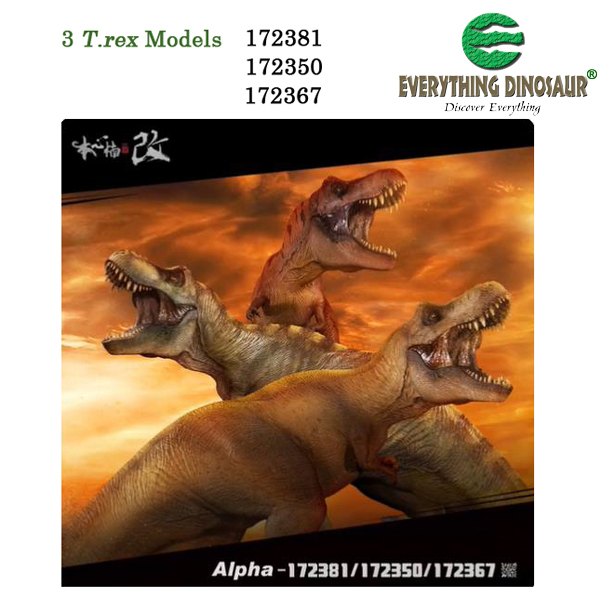
Three superb T. rex replicas, each one with amazing detail. Celebrate the 30th anniversary of the film “Jurassic Park” in style. Collect them all!
Visit the award-winning, user-friendly Everything Dinosaur website: Everything Dinosaur.
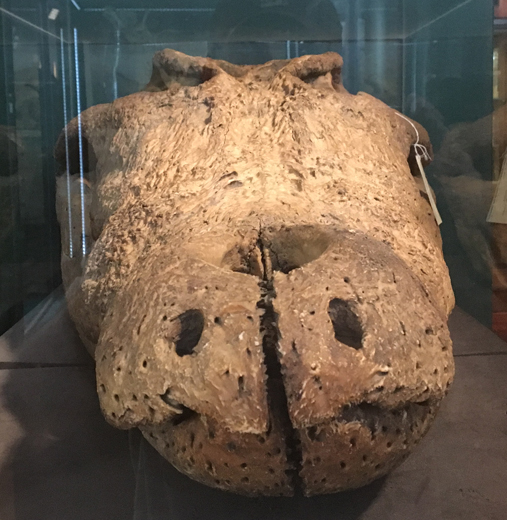
Team members at Everything Dinosaur photographed a huge estuarine crocodile skull on display at a London museum. The stunning skull was part of an exhibit demonstrating reptile anatomy at the Grant Museum of Zoology (London).
An anterior view of the skull of an estuarine crocodile photographed in the Grant Museum, London. The largest reptile on Earth, the estuarine crocodile (Crocodylus porosus) from south-east Asia is also known as the saltwater crocodile or saltie. Picture credit: Everything Dinosaur.
Picture credit: Everything Dinosaur
An Estuarine Crocodile Skull
The Grant Museum is currently closed. It is undergoing a redevelopment programme. Everything Dinosaur visited this amazing museum in 2018. The Grant Museum of Zoology and Comparative Anatomy was established in 1827 by Robert Edmond Grant (1793-1874). It was established to serve as a teaching collection at the newly founded University of London (later University College London).
We photographed the estuarine crocodile skull in anterior view. The estuarine crocodile (Crocodylus porosus) is the largest living reptile. Some specimens weigh more than a tonne. It is a formidable predator, and it is also referred to as the saltwater crocodile or saltie.
These crocodiles inhabit both freshwater and brackish environments. They have been observed swimming far out at sea. This may explain their extensive geographical distribution. These crocodiles are found from India’s eastern coast to northern Australia. They are apex predators and generalist carnivores. This crocodile is regarded as a maneater and sadly, there are numerous fatal attacks reported each year.
Once hunted for its skin, the numbers of this species of crocodile have dramatically increased since legal protection was implemented.
The Grant Museum of Zoology and Comparative Anatomy
The Grant Museum of Zoology and Comparative Anatomy is an amazing place to visit. It is full of stunning skeletons demonstrating the diversity of vertebrate life on Earth. It is also home to a vast collection of invertebrate specimens. If in London in 2024, a visit to this museum is recommended.
Our knowledge of the Dinosauria is constantly changing as new fossil discoveries are made and advanced scientific techniques are employed to interpret dinosaur body and trace fossils. A new book written by Professor Michael Benton (University of Bristol) with superb illustrations by renowned palaeoartist Bob Nicholls brings to life these extraordinary reptiles. Entitled “Dinosaur Behavior” and published by Princeton University Press, this book provides a comprehensive overview of the latest dinosaur research.
Spectacular prehistoric creatures how they lived, fed, sensed the world around them and interacted with each other is vividly portrayed in this comprehensive new dinosaur book.
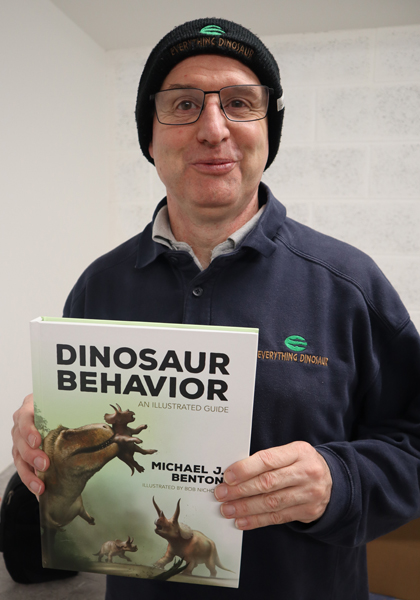
“Dinosaur Behavior” by Professor Michael Benton (University of Bristol) and illustrated by renowned palaeoartist Bob Nicholls. Picture credit: Everything Dinosaur.
Picture credit: Everything Dinosaur
“Dinosaur Behavior”
“Dinosaur Behavior” is divided into seven chapters with each one focusing on a different aspect of the Dinosauria. The first chapter provides a perspective on the dinosaurs, explaining their evolutionary origins, how scientists construct ancient worlds from the geological record and the forensic approach to fossil excavation and preparation. Subsequent chapters deal with various aspects of dinosaur biology and how behaviour can be inferred from scientific evidence.
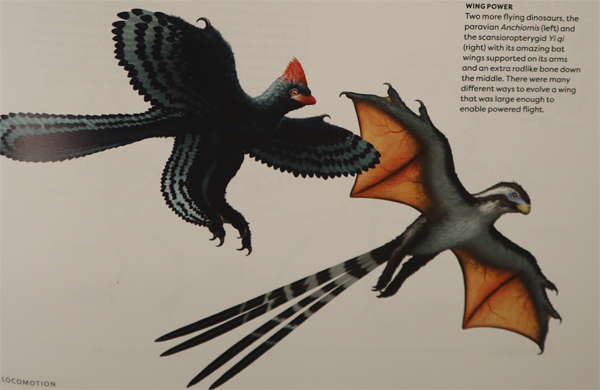
There are over 150 beautiful illustrations by the highly respected palaeoartist Bob Nicholls. Many of these artworks were specially commissioned, helping to portray dinosaurs as active, complex animals. For example, in the chapter dealing with dinosaur locomotion the origins of powered flight are explained. The clear and concise narrative is accompanied by beautiful illustrations of the varied evolutionary paths taken by different types of dinosaur to adapt to a life in the trees.
The text is accompanied by stunning illustrations helping to explain the numerous areas of scientific research concerning the Dinosauria included within the book. Picture credit: Everything Dinosaur.
Picture credit: Everything Dinosaur
The image (above) shows the feathered Anchiornis (top left) and the bizarre Yi qi, a scansoriopterygid with bizarre bat-like wings.
Social and Highly Active Reptiles
Author Michael Benton is a professor of vertebrate palaeontology at the University of Bristol. He is a fellow of the Royal Society. Over a long and distinguished career, he has done a great deal to inform the wider public about how our views regarding iconic dinosaurs have changed. His latest book explores the behaviour and physiology of these fascinating animals. It provides a fresh perspective on the complex lives of non-avian dinosaurs, how they fed, choose mates, raised their young, communicated and ultimately became extinct.
Aimed at the general public as well as dinosaur fans, students and academics, this is a beautifully crafted book that updates the reader on the amazing research that is providing thrilling insights into the lives of dinosaurs.
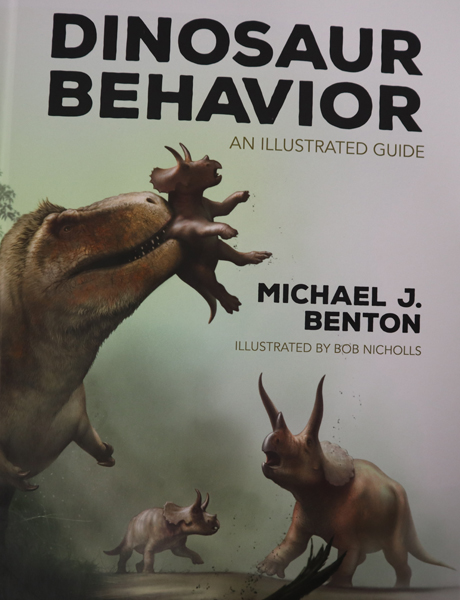
The front cover of the recently launched dinosaur book “Dinosaur Behavior” by Professor Michael J. Benton and illustrated by Bob Nicholls. Picture credit: Everything Dinosaur.
Picture credit: Everything Dinosaur
Published by Princeton University Press
“Dinosaur Behavior” is published by Princeton University Press. It will officially go on sale on the 31st of October (2023).
Published in time for the festive season, this stunningly illustrated guide to the Dinosauria would make an excellent gift.
Highly recommended.
Book Details
The Book: “Dinosaur Behavior An Illustrated Guide”
Publisher: Princeton University Press
Published October 2023 | Price: £30.00/$35.00 USD (hardback) | Pages: 222 Over 150 scientific illustrations plus colour photographs.
ISBN: 9780691244297
Visit the website of Princeton University Press: Princeton University Press. Search on the website for the author or title to find the book.