All about dinosaurs, fossils and prehistoric animals by Everything Dinosaur team members.

Dinosaur and prehistoric animal themed articles, features and stories.

21 08, 2019

Rebor Oddities Foetus Models are in Stock

By |2023-12-29T13:39:05+00:00August 21st, 2019|Categories: Dinosaur Fans, Everything Dinosaur Products, Everything Dinosaur videos, Main Page, Photos of Everything Dinosaur Products|0 Comments

Rebor Oddities T. rex and Velociraptor Foetus Models

The Rebor Oddities Tyrannosaurus rex and Velociraptor models are now in stock at Everything Dinosaur.  They are fantastic dinosaur display pieces, consisting of a beautifully sculpted theropod (either T. rex or Velociraptor), a special display jar with lid and a light-up base, so that you can highlight the figure inside.  To complete the display, simply carefully add water to the jar (tap water is fine) and then immerse the model into the water and place the lid back on.  Don’t forget to turn the light on, which is incorporated into the base (there is even a battery included).

As part of Everything Dinosaur’s promotional activities, we shot a quick unboxing video in our still to be completed studio.

The Rebor Oddities Foetus T. rex Contents

Video credit: Everything Dinosaur

Rebor Oddities Foetus Tyrannosaurus rex Figure

In this short video, we unpack one of the Rebor Oddities T. rex models and we demonstrate how this intriguing display piece is put together.  The video is just under 1 minute 40 seconds in length.  Our studio is not yet complete, we have still got some sound proofing to do and there are more lights to sort out, but we could not wait to put together a brief video highlighting this most original item from the extensive Rebor range.

The Rebor Oddities Foetus Tyrannosaurus rex Figure
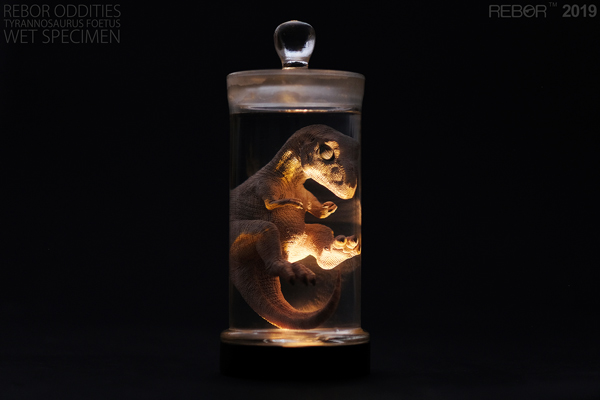
The Rebor Oddities Foetus (T. rex) figure on display.
The Rebor Oddities Foetus (T. rex) figure with the uplighter in operation.

Rebor Oddities Foetus Velociraptor Replica

In addition to the excellent T. rex figure, those talented people at Rebor have created a second display piece, this time featuring a Velociraptor foetus.  The Velociraptor figure is the slightly smaller of the two, it stands twenty-two centimetres high when on its uplighter display base, whilst the T. rex figure is a little taller at approximately twenty-four centimetres high.

The Rebor Oddities Foetus Velociraptor Figure
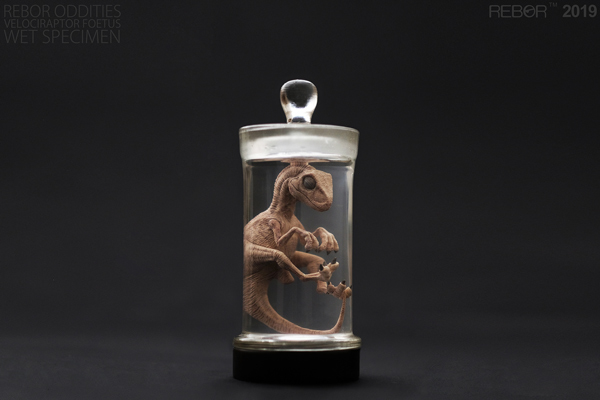
The Rebor Oddities foetus Velociraptor figure.
The beautiful Rebor Oddities Foetus (Velociraptor).

Visit the award-winning Everything Dinosaur website: Everything Dinosaur.

To view these Rebor figures and the rest of the Rebor prehistoric animal replicas and models: Rebor Dinosaurs and Prehistoric Animal Models.

At Everything Dinosaur, the Velociraptor and Tyrannosaurus rex foetus replicas are sold individually, but for a limited period these two figures are available as a pair at a special offer price with additional subsidy on the postage and shipping costs.

A spokesperson from Everything Dinosaur commented:

“These are fascinating prehistoric animal figures and it is great to see such innovative models being introduced by Rebor.  We were so impressed that even though our film and photography studio is not finished we wanted to shoot an unboxing video anyway.”

The Rebor Oddities video is up on the Everything Dinosaur YouTube page, we intend to make lots and lots of prehistoric animal model videos in the future, including more model reviews.

To visit Everything Dinosaur on YouTube: Everything Dinosaur on YouTube.
20 08, 2019

New for 2019 Eofauna Deinotherium

By |2023-12-29T09:37:14+00:00August 20th, 2019|Categories: Dinosaur Fans, Everything Dinosaur News and Updates, Everything Dinosaur Products, Main Page, Photos of Everything Dinosaur Products, Press Releases|2 Comments

Eofauna Scientific Research Deinotherium Model Due October 2019

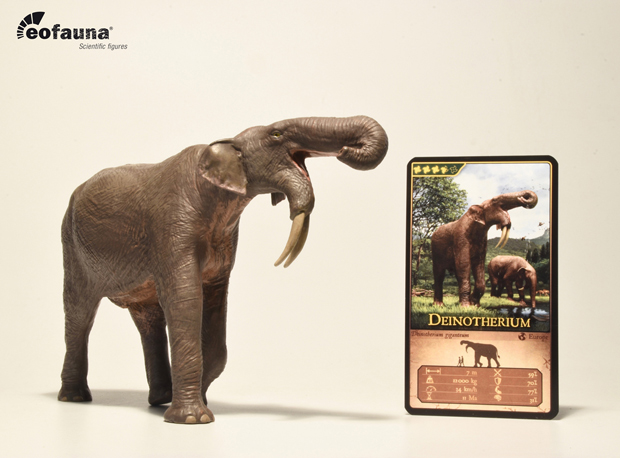
The second, new for 2019 Eofauna prehistoric animal figure has been announced.  A replica of the huge, prehistoric elephant Deinotherium (D. giganteum) is being added to this exciting range.  The Eofauna Deinotherium model will be available in the autumn, probably in October.  The new Eofauna Atlasaurus figure, which was announced a few days earlier, will also arrive soon.

The New for 2019 Eofauna Scientific Research Deinotherium Model

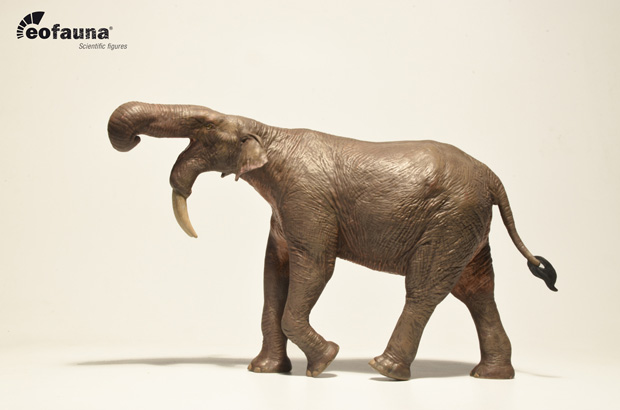
The Eofauna 1:35 scale Deinotherium model.
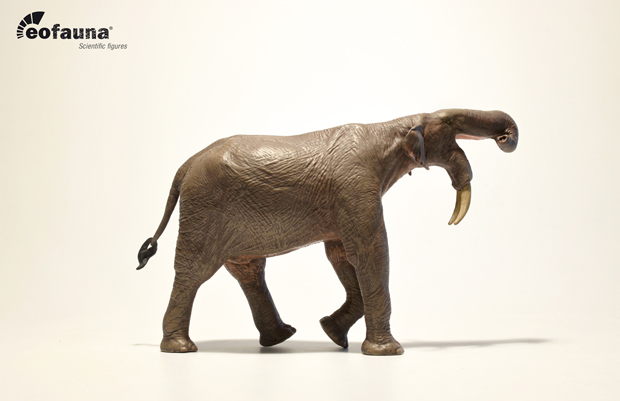
The beautiful, 1:35 scale Eofauna Scientific Research Deinotherium model.

The “Famous Five”

With the addition of the Atlasaurus and the Deinotherium, this brings the total of Eofauna Scientific Figures to five.  Eofauna Scientific Research is staffed by researchers, creatives and specialists with a focus on prehistoric fauna.  The company has demonstrated expertise in the study of ancient members of the Order Proboscidea (elephants and their relatives), three of the five models produced so far are prehistoric elephants.   The D. giganteum figure will be joining a Straight-tusked elephant (Palaeloxodon antiquus) and the first of this range to be introduced, a Steppe mammoth (Mammuthus trogontherii).

A Fact Card will be Supplied with the New for Autumn 2019 Eofauna Scientific Research Deinotherium Model

The Eofauna Deinotherium model (2019)
Eofauna Deinotherium (2019) will be supplied with its own Eofauna fact card as well as an Everything Dinosaur Deinotherium fact sheet.

The Eofauna Deinotherium giganteum

Deinotherium fossils are known from Africa, Europe and parts of Asia.  It was not closely related to extant elephants or the Mammuthus genus.  The Eofauna model shows the long legs and long, low skull associated with this genus.  It is believed Deinotherium became extinct around 2.5 million years ago.

Everything Dinosaur has opened a priority reservation list for this figure, which should be in stock in October.  To join our no obligation, priority reserve list for the Eofauna Scientific Research Deinotherium, just drop us an email: Email Everything Dinosaur.

To view the range of Eofauna models currently in stock including the Straight-tusked elephant and the beautiful Steppe mammoth: Eofauna Scientific Research Models.

The New Eofauna Scientific Research Deinotherium Model

The Eofauna Scientific Research 1:35 scale Deinotherium model.
Striding confidently into view the Eofauna Deinotherium model.

A spokesperson from Everything Dinosaur commented:

“We are delighted to announce that this figure will be in stock at Everything Dinosaur during the autumn.  We should have stocks of this new exciting prehistoric elephant figure and the sauropod Atlasaurus in plenty of time to ensure a happy Christmas for collectors of Eofauna models.”

Eofauna Deinotherium Model Measurements – Tale of the Tape

The new Eofauna Deinotherium model has a stated scale of 1:35.  The model measures around 20 centimetres in length and stands and impressive 13 cm high.

Observant model collectors will note that this new figure is depicted on the move.  Elephants do not have the gaits associated with faster moving, large mammals such as the trot and the gallop.  Instead, when an elephant moves slowly, its limbs remain relatively straight and column-like.   Locomotion studies have shown that when moving quickly, the limbs become more mobile and flexible acting like “pogo sticks”,  helping the animal to maintain velocity.  Even when moving at full speed, the four feet of the elephant do not leave the ground simultaneously, as opposed to the limbs of a horse when galloping.

Visit the Everything Dinosaur website: Everything Dinosaur.

19 08, 2019

Ancient Jurassic Volcano Landscape Found Under Central Australia

By |2023-12-29T09:31:21+00:00August 19th, 2019|Categories: Dinosaur and Prehistoric Animal News Stories, Dinosaur Fans, Geology, Main Page|0 Comments

Volatile Jurassic Landscape Named after Fiery Australian Cricketer

An ancient Jurassic landscape of 100 volcanoes has been discovered underneath Australia’s largest onshore oil and gas region.  Researchers from the University of Aberdeen (Scotland) and the University of Adelaide (South Australia), have identified a network of volcanoes that formed between 180 and 160 million years ago, buried deep within the Cooper-Eromanga Basins of central Australia.   A considerable portion of the scientific paper, published in the journal “Gondwana Research”, was written whilst the University of Aberdeen researchers were in Adelaide, watching an England versus Cricket Australia XI match (November 2017).

Jurassic Landscape Named after Shane Warne

The scientists have called the volcanic region the Warnie Volcanic Province, in recognition of the formidable spin bowling talent of former Australian cricketer Shane Warne, who had a seismic impact on the sport.

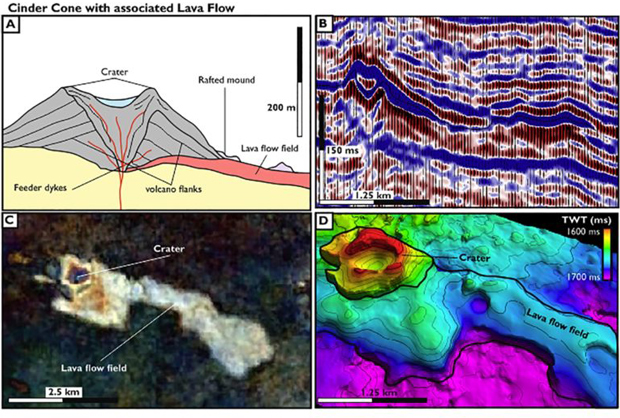
The Scientists were Able to Map Characteristics of the Region Highlighting the Violent Past of the Landscape

Lava flows and volcano cones identified.
Characteristics of the volcanic region as mapped by the scientists.

Picture credit: University of Aberdeen/University of Adelaide

Sixty Years of Petroleum Exploration

The Cooper-Eromanga Basins in the north-eastern corner of South Australia and south-western corner of Queensland have been the site of about sixty years of petroleum exploration and production.  However, evidence for a volcano dominated ancient Jurassic underground landscape had gone largely unrecorded. 

The volcanoes developed in the Toarcian through to the Oxfordian faunal stages and have been subsequently buried beneath hundreds of metres of sedimentary rock.  The researchers used advanced sub-surface imaging techniques, analogous to medical CT (computerised tomography) scanning, to identify the multitude of volcanic craters and lava flows, and the deeper magma chambers that fed them.  In contrast, today, this area of Australia is a very arid and barren landscape.

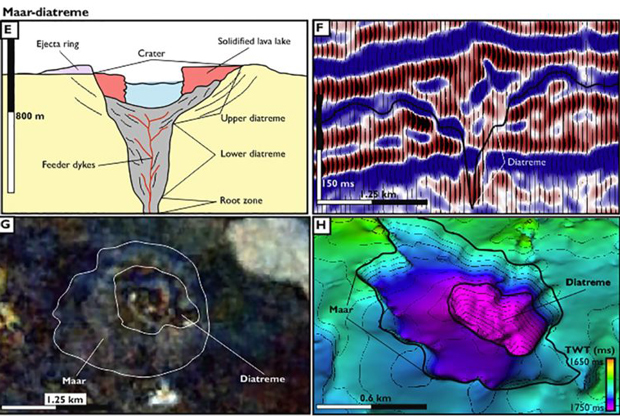
The Study Identified Around a Hundred Volcanoes

Identifying a Jurassic World of Volcanoes in Australia
Line drawings and seismic data from the Warnie Volcanic Province.

Picture credit: University of Aberdeen/University of Adelaide

This study demonstrates that during the Middle to the early Late Jurassic this area would have been a landscape of craters and fissures, expelling hot ash and lava into the air, surrounded by networks of river channels forming large lakes and coal-swamps.  This area was inhabited by dinosaurs and pterosaurs.

Undiscovered Volcanic Worlds

Co-author of the scientific paper, Associate Professor Simon Holford (University of Adelaide), stated that the discovery raised the prospect that more undiscovered volcanic worlds resided beneath the poorly explored surface of Australia.

Associate Professor Holford commented:

“While the majority of Earth’s volcanic activity occurs at the boundaries of tectonic plates, or under the Earth’s oceans, this ancient Jurassic world developed deep within the interior of the Australian continent.”

Jurassic Landscape Records Extensive Volcanic Activity

One of the authors was Jonathon Hardman, at the time a PhD student at the University of Aberdeen, as part of the Natural Environment Research Council Centre for Doctoral Training in Oil and Gas.  Jurassic-aged sedimentary rocks bearing oil, gas and water have been economically important for Australia, but this latest discovery suggests a lot more volcanic activity in the Jurassic period than was previously supposed.  The area has been named the Warnie Volcanic Province, in honour of the explosive Australian cricketer Shane Warne.

Co-author Associate Professor Nick Schofield (University of Aberdeen), explained that the Cooper-Eromanga Basins had been substantially explored since the first gas discovery in 1963.

He added:

“This has led to a massive amount of available data from underneath the ground but, despite this, the volcanics have never been properly understood in this region until now.  It changes how we understand processes that have operated in Earth’s past.”

A Typical Jurassic Landscape

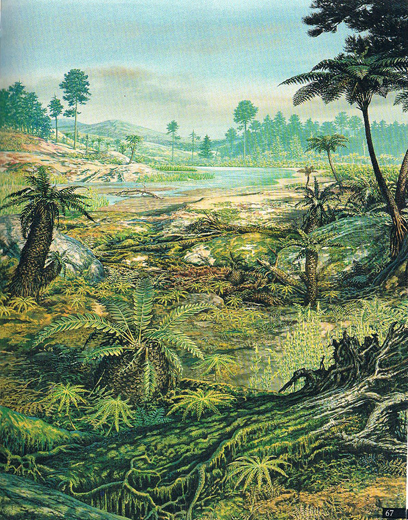
A Jurassic landscape.
A typical Jurassic landscape.

Everything Dinosaur acknowledges the assistance of a media release from “The Lead South Australia” in the compilation of this article.

The scientific paper: “The Warnie volcanic province: Jurassic intraplate volcanism in Central Australia” by Jonathon P.A. Hardman, Simon P. Holford, Nick Schofield, Mark Bunch and Daniel Gibbins published in the journal Gondwana Research.

The Everything Dinosaur website: Everything Dinosaur.

16 08, 2019

Posing the New Papo Pentaceratops

By |2023-12-27T17:47:43+00:00August 16th, 2019|Categories: Adobe CS5, Dinosaur Fans, Everything Dinosaur Products, Everything Dinosaur videos, Main Page, Photos of Everything Dinosaur Products, Product Reviews|0 Comments

Posing the Papo Pentaceratops

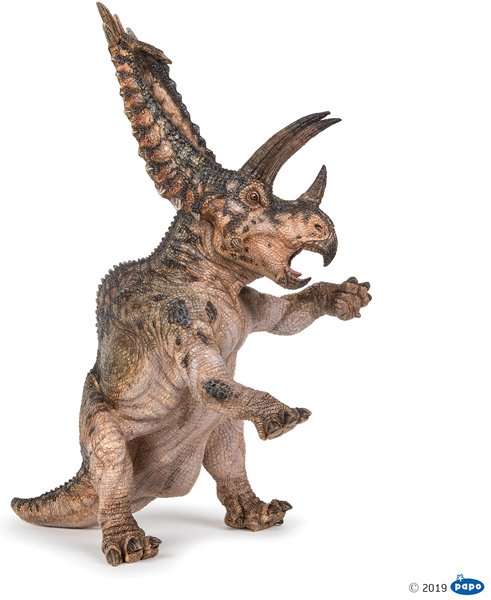
The Papo Pentaceratops model has a rearing pose, but the model is so well designed that it can rest in a horizontal position with three legs resting on the floor.  The Papo Pentaceratops is a beautiful figure, but it is also so well balanced that it can be placed in a couple of different poses if model collectors don’t want to feature it rearing up in their model displays.  To illustrate this point, we created a short video demonstrating the Papo Pentaceratops dinosaur figure in a rearing pose and showing how it can be displayed in other poses too.

Posing the Papo Pentaceratops Dinosaur Model

Video credit: Everything Dinosaur

The Papo Pentaceratops Model

Although the French manufacturer (Papo), has produced several ceratopsian models in the past (Triceratops, baby Triceratops, Styracosaurus and Pachyrhinosaurus), this is the first horned dinosaur to be depicted in a rearing pose.   Much praise has been heaped on the broad shoulders of the Pentaceratops figure, it has proved to be a big hit with collectors and dinosaur model fans.

The New for 2019 Papo Pentaceratops Dinosaur Model

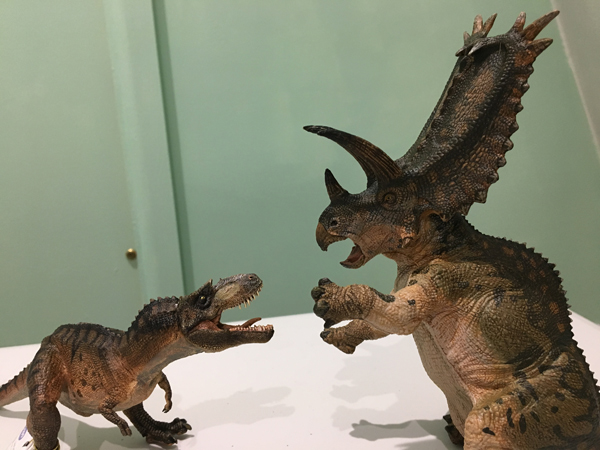
The new for 2019 Papo Pentaceratops and the Papo Gorgosaurus dinosaur models.
The new for 2019 Papo Gorgosaurus (left) and the Papo Pentaceratops dinosaur model (right).  The Papo Pentaceratops figure is much larger than the Gorgosaurus. Picture credit: Everything Dinosaur.

Picture credit: Everything Dinosaur

The Everything Dinosaur website: Everything Dinosaur.

Attracting 5-star Reviews

The Pentaceratops may only have been out for a short while, but it has already received several 5-star reviews from Everything Dinosaur customers.  For example, Ryan left a review on the Everything Dinosaur website saying:

“Fantastic figure!  A really dynamic pose, plenty of finer details and a great realistic paint job.  This one will really stand out amongst my collection.”

Our thanks for your comments, Ryan, we really like the cryptic quip about the model “standing out”, it certainly does with its upright rearing pose.

Model collector David, also piled praise on the model exclaiming:

“Beautiful model!  Very convincing sculpt, full of life with lovely colouration.  Excellent service from Everything Dinosaur!”

For David, the Papo Pentaceratops and our awarding winning customer service are two things worth praising.  A great big thank you to all those very kind people who have taken the time and trouble to review our models, both on our website also via our Feefo feedback pages.

The Papo Pentaceratops and the Papo Gorgosaurus model for that matter, are available from Everything Dinosaur, to view these models and the rest of the extensive Papo prehistoric animal model range: Papo Dinosaur and Prehistoric Animal Models.

14 08, 2019

The Astonishing “Scunthorpe Pliosaur”

By |2023-12-27T10:23:15+00:00August 14th, 2019|Categories: Dinosaur and Prehistoric Animal News Stories, Dinosaur Fans, Main Page, Photos/Pictures of Fossils|1 Comment

The “Scunthorpe Pliosaur” – What is it?  When and Where Did it Live?  What it May Have Eaten and Lived Alongside

A few weeks ago, we set young palaeontologist Thomas a challenge, could he research and write an article for posting up onto the Everything Dinosaur blog.  Thomas has taken up our offer and here is the first of his articles, it provides information on a prehistoric animal close to Thomas’s heart the “Scunthorpe Pliosaur”.

The “Scunthorpe Pliosaur”, a specimen announced earlier this year, was a large plesiosauroid belonging to the family Pliosauridae and is related to the better known pliosaurs such as Pliosaurus and Liopleurodon in fact, it may have lived alongside and directly competed with these two better-known pliosaurs at some point.  It has been estimated at 8 metres long.

The “Scunthorpe Pliosaur” on Display at North Lincolnshire Museum

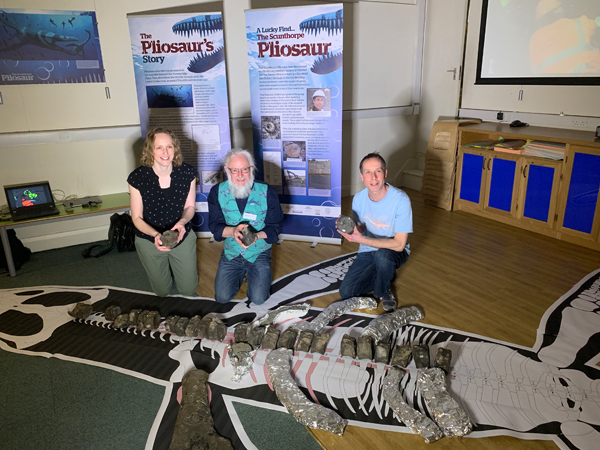
Rose Nicholson, Richard Forrest and Darren Withers with the Scunthorpe Pliosaur.
Rose Nicholson from North Lincolnshire Museum, palaeontologist Richard Forrest and Darren Withers from Stamford and District Geological Society with the “Scunthorpe Pliosaur”.

Picture credit: North Lincolnshire Museum

When and Where Did the “Scunthorpe Pliosaur” Live and Where was it Found?

The “Scunthorpe Pliosaur” lived around 160 to 155 million years ago in what is now north Lincolnshire (England).  These fossils date from the Late Jurassic and the United Kingdom 160 million years ago was a very mysterious place.  Whilst marine fauna is decently represented in the fossil record, there is still much science does not know about the seas from this time and this new specimen may help open up a new window into that mysterious world.  The terrestrial fauna on the other hand, is poorly represented and full of mystery with one of the only described theropods being the British Metriacanthosaurus from Dorset (a close relative of Sinraptor from China).  The pliosaur specimen was recovered from a CEMEX quarry.

What Did it Live With and What Might it Have Eaten?

Inhabiting the seas alongside the “Scunthorpe Pliosaur” were other pliosaurs, plesiosaurs, turtles, fish, ichthyosaurs, squid, ammonites, marine crocodiles, sharks and more.  Some of these animals include the pliosaurs Liopleurodon, Simolestes and Pliosaurus which would have competed with it and the plesiosaurs Cryptocleidus and Colymbosaurus which could have been prey of the pliosaur especially the latter plesiosaur’s young.

Looking at the “Scunthorpe Pliosaur’s” dentition, the known teeth of this pliosaur are reminiscent of teeth associated with Pliosaurus (Pliosaurus brachydeirus),  a species which has been found in Lincolnshire.  From this comparison, it can be concluded that the Scunthorpe individual possibly preyed upon other marine reptiles and other large marine fauna.  Stomach content of related pliosaurs and bite marks left by them on their prey show that pliosaurs like the Scunthorpe specimen would have been hunting a wide range of hard bodied marine prey from large ammonites to plesiosaurs and ichthyosaurs. However, they wouldn’t have shied away from preying on softer bodied animals.

A Powerful Sense of Smell

Like most pliosaurs, the “Scunthorpe Pliosaur” probably had a very powerful sense of smell, good eyesight, acute hearing and a powerful bite, all necessary adaptations for a hunting pliosaur to have in order to hunt effectively.

The ecology at the time would have consisted of kelp forests, reefs, coastal shallows and a steep pelagic drop-off that plummets into a benthic zone.  Pliosaurs such as Liopleurodon, Pliosaurus and the “Scunthorpe Pliosaur” probably used these drop-off points as ambush spots to strike unsuspecting prey from below.

When attacking prey, pliosaurs would have come up from below like white sharks and either rammed or bitten prey in one massive disabling blow to the prey item to prevent it’s escape.   In conclusion, the “Scunthorpe Pliosaur “was a large pliosaur which could have occupied the apex predator niche in its warm, shallow coastal ecosystem hunting all manners of prey from fish and squid to marine reptiles using sight, hearing and smell to track down its prey and applying similar hunting strategies to modern Great Whites to secure and catch that prey.

This discovery is an important one as it opens up a window into a little known area of the Late Jurassic British seas and helps palaeontologists piece together that ancient ecosystem over 155 million years ago.

A Model of a Typical Pliosaur

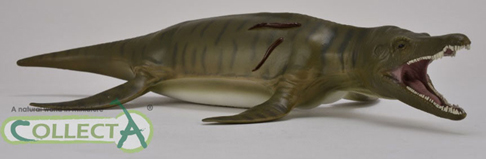
CollectA Deluxe 1:40 scale Pliosaurus marine reptile diorama.
The CollectA Deluxe 1:40 scale Pliosaurus diorama.

Our thanks to Thomas for compiling this article on the “Scunthorpe Pliosaur”.

12 08, 2019

The Next Eofauna Model Will Be… Atlasaurus

By |2023-12-27T10:13:24+00:00August 12th, 2019|Categories: Adobe CS5, Dinosaur Fans, Everything Dinosaur News and Updates, Everything Dinosaur Products, Main Page, Photos of Everything Dinosaur Products|3 Comments

Atlasaurus – The Fourth Prehistoric Animal Figure from Eofauna Scientific Research

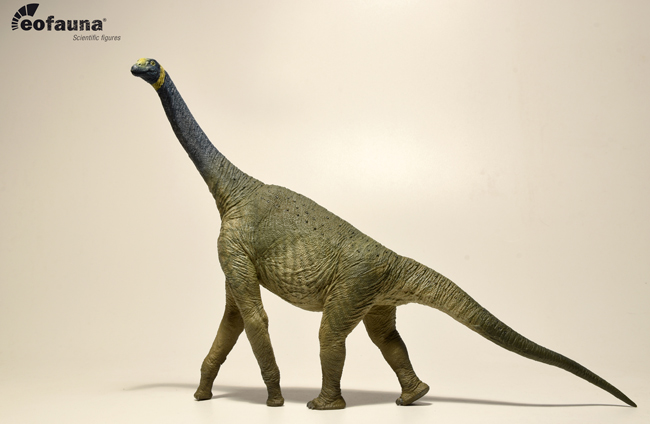
Today, Everything Dinosaur can announce that the fourth figure in the Eofauna Scientific Research range will be… Atlasaurus (A. imelakei), a peculiar sauropod from the Middle Jurassic of North Africa, whose taxonomic affinity within the Sauropoda remains uncertain.  Known from a single specimen, representing an individual animal, this is one very untypical member of the long-necked dinosaurs.  The model is one of two new for 2019 Eofauna Scientific Research figures, both will be available around October, possibly early November.

The Eofauna Scientific Research Atlasaurus Dinosaur Model

The Eofauna Scientific Research Atlasaurus dinosaur model.
Atlasaurus (Eofauna Scientific Research).

Picture credit: Eofauna Scientific Research/Everything Dinosaur

Atlasaurus – A Peculiar Sauropod Trying to Fit In

Named and described in 1999 (Monbaron, Russell and Taquet),  a significant proportion of the skeleton of Atlasaurus (A. imelakei) is known to science.  The type specimen, housed in the Musée des sciences de la Terre de Rabat (Morocco), is just missing a few pieces of bone and about half the caudal vertebrae (tail bones).  This is one very peculiar sauropod, for instance, despite having been named and described quite recently, the type specimen lacks a specific, unique specimen number.  When first studied, it was thought that this dinosaur was similar to Brachiosaurus which was believed to have roamed both Africa and North America.   Subsequently, following a review of brachiosaurid fossils, the African material has largely been attributed to the genus Giraffatitan.   It has been suggested that Atlasaurus may not be closely related to Brachiosaurus at all, it could be a more basal sauropod and a member of the Turiasauria, long-necked dinosaurs that were geographically widespread during the Middle Jurassic.

Unlike Most of the Sauropoda, the Skull of Atlasaurus is Known

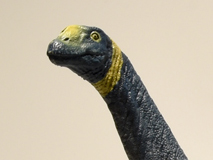
Close-up view of the beautifully painted head of the Eofauna Scientific Research Atlasaurus model.
A close-up view of the beautifully painted head of the Eofauna Scientific Research Atlasaurus model.  Is it us, or is this dinosaur model smiling?

Picture credit: Eofauna Scientific Research/Everything Dinosaur

Bizarre Body Proportions

At first glance, the Eofauna Scientific Research figure might look a little strange.  This has nothing to do with the model, it’s just that Atlasaurus was a very strange-looking dinosaur.  The limbs of this dinosaur were proportionately longer than those of any other sauropod.  It had taken a different evolutionary route when compared to its relatives.  The limbs had become elongated and lengthened, whilst in contrast, the neck remained relatively short.  Relative to the length of its dorsal vertebral column Atlasaurus had a much shorter neck, a longer tail and long legs.  In addition, it had a bigger head.

It roamed North Africa around 168-164 million years ago and it has been suggested that its bizarre body proportions evolved so that it could exploit a particular niche in the ecosystem.  It lived in a seasonal, forested environment close to the coast and it is thought that this sauropod was a medium to high-level browser of the forest canopy.

Everything Dinosaur has already opened a reserve list for this eagerly awaited, 1:40 scale figure.  The model itself, measures around 30 cm in length and has a head height of approximately 22.5 cm.

See the Everything Dinosaur website: Everything Dinosaur.

A Reserve List for the Eofauna Scientific Research Atlasaurus is Now Open

Email Everything Dinosaur to join our priority reserve list for Atlasaurus.
Email Everything Dinosaur to join our reserve list for Atlasaurus.

Picture credit: Eofauna Scientific Research/Everything Dinosaur

To join our reserve list for the Eofauna Atlasaurus model: Email Everything Dinosaur to Join the Atlasaurus Reserve List.

To view the rest of the Eofauna Scientific Research models available from Everything Dinosaur: Eofauna Scientific Research Prehistoric Animal Models.

11 08, 2019

PNSO Megalodon (2019) Video Review

By |2023-12-27T10:08:09+00:00August 11th, 2019|Categories: Adobe CS5, Dinosaur Fans, Everything Dinosaur Products, Everything Dinosaur videos, Main Page, Photos of Everything Dinosaur Products|0 Comments

A Video Review of the PNSO Megalodon Model (Patton)

Our thanks to the talented “Matthew the Dinosaur King” for posting up a video review of the recently introduced PNSO Megalodon model with an articulated lower jaw.  In this short video review, the narrator discusses the taxonomy of this famous prehistoric shark and then examines the model in detail.

The Video Review of the PNSO Megalodon Shark Model

Video credit: Matthew the Dinosaur King

Ancestor of the Great White Shark?

In this very informative video, Matthew comments on the problems involved with classifying this prehistoric fish when palaeontologists have only got the teeth and a few calcified vertebrae to study.  He points out that most scientists consider this shark to be a member of the Odontidae family (pronounced Oh-don-tid-day).  It had been thought that this prehistoric shark was closely related to and the direct ancestor of the Great White shark (Carcharodon carcharias).

PNSO Megalodon

It is likely that Megalodon filled a similar position in the marine ecosystem as the extant Great White, that of an apex predator, hunting and consuming a wide variety of prey including marine mammals.  Any resemblance between Carcharodon carcharias and Megalodon (now, commonly described as Carcharocles megalodon), could be attributed to convergent evolution.  In 2012, Everything Dinosaur produced a short article about a fossil discovery that indicated that Great White sharks could be descended from ancient Mackerel sharks: Getting Our Teeth into the Origins of the Great White Shark.

The Video Review Also Shows the PNSO Megalodon Packaging

The packaging of the PNSO Megalodon model "Patton".
The beautifully designed box of the PNSO Megalodon model “Patton”.  This aspect of the new PNSO “Patton” model is commented upon in detail in the video review.

Visit the Everything Dinosaur website: Everything Dinosaur.

What is in the PNSO Megalodon Box?

The reviewer takes time to examine the packaging of this model.  The box is examined in detail and the clear plastic support base that helps to protect the model in transit is shown.  The plastic base can be used to help display this figure, although it does balance quite well on its pectoral and small pelvic fins.

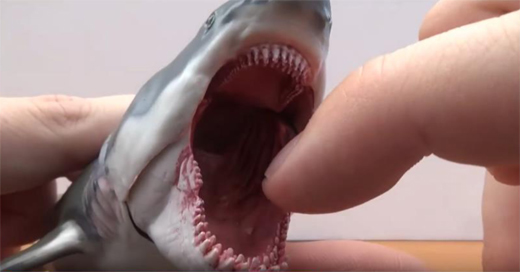
In the video, the articulated jaw of this figure is highlighted.  Other models of Megalodon have been produced before, for example, the narrator comments on the Wild Safari Prehistoric World Megalodon model (introduced in 2014), but “Patton” as PNSO has named this shark figure, has an articulated lower jaw.

A Close View of the Articulated Lower Jaw of the PNSO “Patton” the Megalodon Shark Figure

Mind your fingers! A view of the PNSO "Patton" Megalodon model.
A close up view of the PNSO “Patton” Megalodon model.  Mind your fingers!

Video image credit: Matthew the Dinosaur King

A New for 2019 Shark Figure

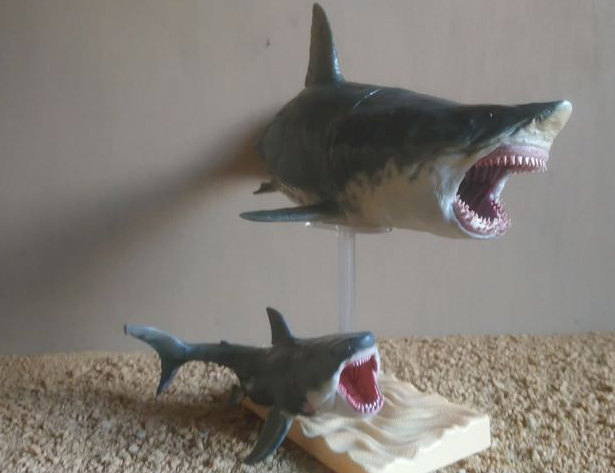
This new for 2019 PNSO figure has certainly proved popular with collectors.  This is the second Carcharocles megalodon model to have been produced by PNSO, both figures are available (whilst stocks last from Everything Dinosaur).  Our thanks to model collector Luke who sent into us a photograph of his recently purchased pair of “Pattons”.  Both the figure with the articulated jaw and the larger model with a stand, are called “Patton”.

The Two PNSO Megalodon Models on Display

Thank you Luke for sending in pics of his two PNSO Megalodon shark models.
Thanks to Luke for sending in pics of his two PNSO Megalodon shark models.

Picture credit: Luke

We thank Luke for his photograph and for “Matthew the Dinosaur King” for providing such an excellent video review.

Everything Dinosaur recommends that readers subscribe to the YouTube channel of “Matthew the Dinosaur King”: “Matthew the Dinosaur King” on YouTube.

To see all the PNSO prehistoric animal models currently in stock at Everything Dinosaur, including the two PNSO Megalodon figures: PNSO Age of Dinosaurs and Prehistoric Animal Models.

Note

This genus has been reclassified and most palaeontologists accept the binomial name of Otodus megalodon.

9 08, 2019

New Prehistoric Animal Model from Eofauna Scientific Research

By |2023-12-27T09:57:13+00:00August 9th, 2019|Categories: Adobe CS5, Dinosaur and Prehistoric Animal News Stories, Dinosaur Fans, Everything Dinosaur News and Updates, Everything Dinosaur Products, Main Page, Photos of Everything Dinosaur Products, Press Releases|0 Comments

New Prehistoric Animal Model from Eofauna Scientific Research

Our chums at Eofauna Scientific Research will be bringing out two new prehistoric animal models this autumn.  Eofauna Scientific Research has produced a trio of stunning prehistoric animal figures and by the end of the year, a further two beautiful replicas will join their range, both of which will be available from Everything Dinosaur. Which Eofauna prehistoric animal will be in stock first?

Which prehistoric animals will be depicted?  We know, but we are not going to reveal what they are just yet, model collectors will have to wait a little while to find out.  However, just for a bit of fun, in association with Eofauna Scientific Research we have put together a little teaser – can you guess which prehistoric animal it is?

Which Prehistoric Animal Figure Will Eofauna Produce Next?

Which prehistoric animal figure will they produce next?
Eofauna Scientific Research which prehistoric animal figure will they produce next? Picture credit: Everything Dinosaur.

Picture credit: Everything Dinosaur

Eofauna Prehistoric Animal Guessing Game

Something like 1,200 dinosaur genera have been described to date.  Scientists have named around 120 different types of pterosaur and hundreds of genera of prehistoric mammal have been erected.  Then of course you have all the amazing and bizarre Palaeozoic creatures to consider.  The Trilobita alone has approximately 20,000 different species arranged in ten orders (sometimes 9 depending on the taxonomy, which is still debated).

Our apologies if you don’t like prehistoric animal guessing games, feel free to attribute blame to Everything Dinosaur, we suggested to Eofauna that providing a “teaser” about new models would be a good way to develop a sense of anticipation and help raise awareness about their range of replicas.

The Eofauna Scientific Research Model Range at the Beginning of 2019

The Eofauna model range (2018).
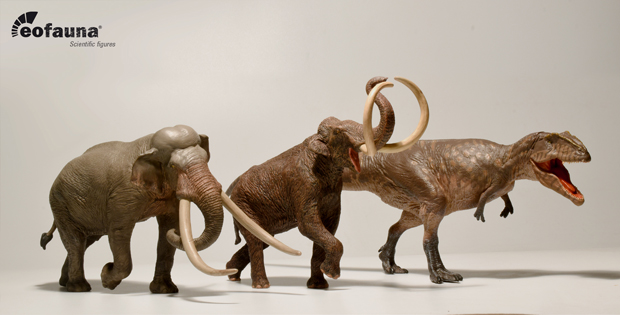
Eofauna model range at the beginning of 2019.  Far left the straight-tusked elephant (Palaeoloxodon antiquus), in the middle a Steppe Mammoth (Mammuthus trogontherii) and far right, the theropod dinosaur Giganotosaurus carolinii.

Commissioning a Scientific Drawing

As well as making preparations for the arrival of a new prehistoric animal model, team members at Everything Dinosaur will be commissioning a scientific drawing to be used in association with this new Eofauna Scientific Research figure.

Previous Scientific Drawing That Have Been Commissioned – Eofauna Scientific Research Models

Three Eofauna replicas illustrated.
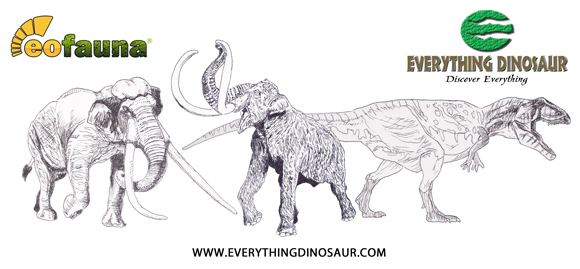
Illustrations based on the three Eofauna replicas (left to right), Palaeoloxodon antiquus, Mammuthus trogontherii and Giganotosaurus carolinii. Picture credit: Everything Dinosaur.

Picture credit: Everything Dinosaur

Visit the Everything Dinosaur website: Visit Everything Dinosaur.

The first of the new for 2019 Eofauna models should be with us in late October, the second figure should follow about 14 days later.  Naturally, the figures could arrive sooner, they could arrive later, but model collectors can be assured these two new models are worth the wait and we look forward to revealing the first of these new 2019 figures in about a week.

We are looking forward to receiving into stock the new Eofauna prehistoric animal figures.

To view the current range of Eofauna Scientific Research models available from Everything Dinosaur: Eofauna Scientific Research Models.

6 08, 2019

New Dinosaur Species Discovered “Hiding in Plain Sight”

By |2023-12-26T16:33:41+00:00August 6th, 2019|Categories: Dinosaur and Prehistoric Animal News Stories, Dinosaur Fans, Main Page, Photos/Pictures of Fossils|0 Comments

The Sauropodomorph Ngwevu intloko “Hiding in Plain Sight”

The fossilised remains of a dinosaur that once roamed South Africa some 200 million years ago and that had lain mislabelled in a university vault for three decades has been identified as an entirely new species of dinosaur, a discovery that helps to demonstrate that ecosystems that developed shortly after the end-Triassic extinction event were much more specious than previously thought.  The dinosaur has been named Ngwevu intloko.

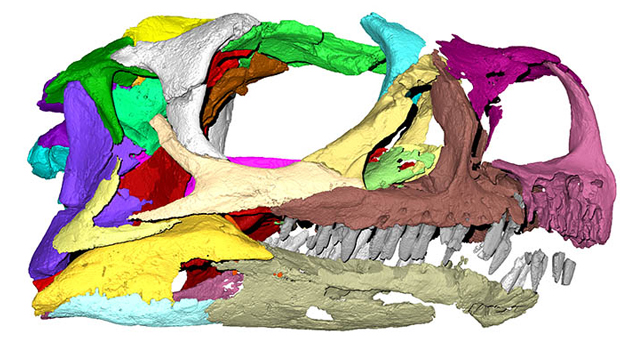
A View of the Skull of the Newly Described Sauropodomorpha N. intloko in the University of Witwatersrand Collection

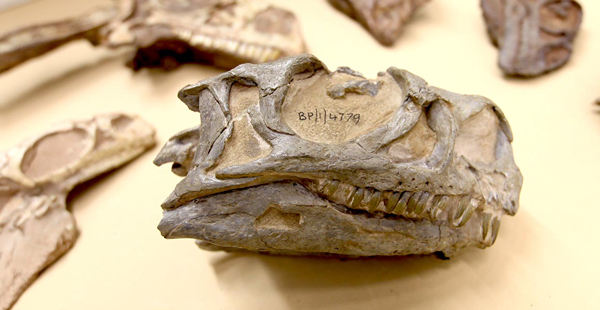
Ngwevu fossil skull (BP/1/4779.
The skull of the newly described South African sauropodomorph Ngwevu intloko.

Picture credit: Kimberley Chapelle (University of Witwatersrand)

A New Dinosaur Species – Ngwevu intloko

The dinosaur has been named Ngwevu intloko and it was PhD student Kimberley Chapelle (University of Witwatersrand), whilst working with her supervisors mapping the extensive fossil material associated with Massospondylus (M. carinatus), that first realised that the well-preserved skull and postcranial remains could represent a new species.  Hundreds of fossils including several nearly complete skulls have been ascribed to Massospondylus (M. carinatus), since it was described by Richard Owen (later Sir Richard Owen) in 1854.  The skull (specimen number BP/1/4779), had been part of the University of Witwatersrand vertebrate fossil collection for years, but it had been thought that this was just an unusual example of this species.

Co-author of the scientific paper, which has been published in the journal PeerJ, Professor Paul Barrett of the Natural History Museum, London explained:

“This is a new dinosaur that has been hiding in plain sight.  The specimen has been in the collections in Johannesburg for about thirty years and lots of other scientists have already looked at it.  But they all thought that it was simply an odd example of Massospondylus.”

Views of BP/1/4779 – The Skull of Ngwevu intloko

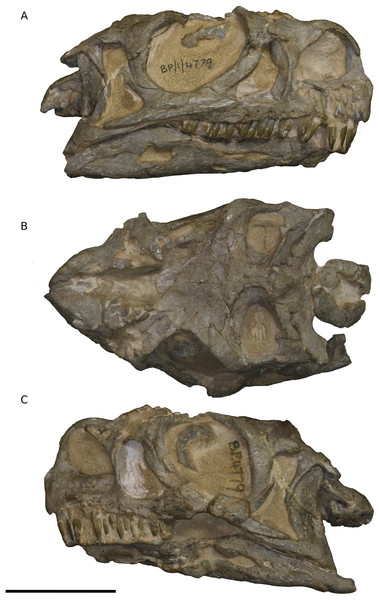
Views of the skull of N. intloko.
Views of the skull of Ngwevu intloko.  Views of BP/1/4779 in (A) right lateral view, (B) dorsal view and (C) left lateral view.  Scale bar = 1 cm.

Picture credit: Kimberley Chapelle (University of Witwatersrand)

A Diverse Sauropodomorpha Fauna of South Africa During the Early Jurassic

Using a variety of techniques including computerised tomography (CT) scans and three-dimensional bone mapping, the team identified a total of sixteen cranial and six postcranial characteristics that supported the establishment of a new dinosaur species.  Deformation due to the fossilisation process and ontogeny were ruled out as the basis of these traits, thus leading to the conclusion that these fossils did not represent Massospondylus, but a different, albeit related dinosaur.  Ngwevu was a bipedal omnivore with a small head, long neck and a robust, chunky body.  It is estimated to have reached a length of about three metres or so.  Analysis of bone cross sections indicate that the specimen would have been about ten years old when it died.

A Life Reconstruction of N. intloko

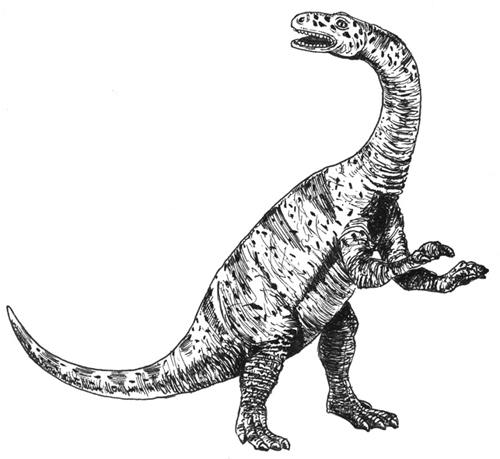
Drawing of Ngwevu intloko (based on Lufengosaurus).
A drawing of Ngwevu intloko (based on Lufengosaurus).  Picture credit: Everything Dinosaur.

Picture credit: Everything Dinosaur

Potentially More Sauropodomorphs to be Identified from Massospondylus Fossil Material

Up until recently, Massospondylus (M. carinatus) was thought to be the only sauropodomorph represented by fossil material from the Lower Jurassic upper Elliot and Clarens formations of southern Africa, but there are now known to have been several different genera present, some of which were to eventually give rise to the huge sauropods of the Late Jurassic.  Scientists are now starting to take a closer look at many of the supposed Massospondylus specimens, believing there to be much more variation than first thought.

Sauropodomorpha from the Elliot Formation include:

  • Antetonitrus ingenipes
  • Massospondylus kaalae
  • Aardonyx celestae
  • Ignavusaurus rachelis
  • Arcusaurus pereirabdalorum
  • Pulanesaura eocollum
  • Ledumahadi mafube to read an article about the naming and scientific description of L. mafubeNew Giant Dinosaur from South Africa.

This new research, helping to support the idea that there were many different types of sauropodomorphs in this part of Gondwana during the Early Jurassic, will help scientists to better understand how ecosystems recovered after the end-Triassic extinction event.

A Three-dimensional Digital Reconstruction of the Skull

Ngwevu intloko fossil skull - digital reconstruction.
A digital reconstruction of the skull of Ngwevu intloko.

Picture credit: Kimberley Chapelle (University of Witwatersrand)

An Interesting New Species of Dinosaur

Professor Paul Barrett commented:

“This new species is interesting, because we thought previously that there was really only one type of sauropodomorph living in South Africa at this time.  We now know there were actually six or seven of these dinosaurs in this area, as well as a variety of other dinosaurs from less common groups.  It means that their ecology was much more complex that we used to think.  Some of these other sauropodomorphs were like Massospondylus, but a few were close to the origins of true sauropods, if not true sauropods themselves.”

This research shows the value of revisiting specimens in museum collections, as many news species are probably sitting unnoticed in cabinets around the world, an example of dinosaurs “hiding in plain sight”.

The scientific paper: “Ngwevu intloko: a new early sauropodomorph dinosaur from the Lower Jurassic Elliot Formation of South Africa and comments on the cranial ontogeny in Massospondylus carinatus” by Kimberley E.J. Chapelle​, Paul M. Barrett, Jennifer Botha and Jonah N. Choiniere published in PeerJ.

The Everything Dinosaur website: Everything Dinosaur.

5 08, 2019

Papo Gorgosaurus and Papo Pentaceratops in Stock

By |2023-12-26T16:28:14+00:00August 5th, 2019|Categories: Adobe CS5, Dinosaur Fans, Everything Dinosaur Products, Main Page, Photos of Everything Dinosaur Products|0 Comments

Papo Gorgosaurus and Papo Pentaceratops in Stock

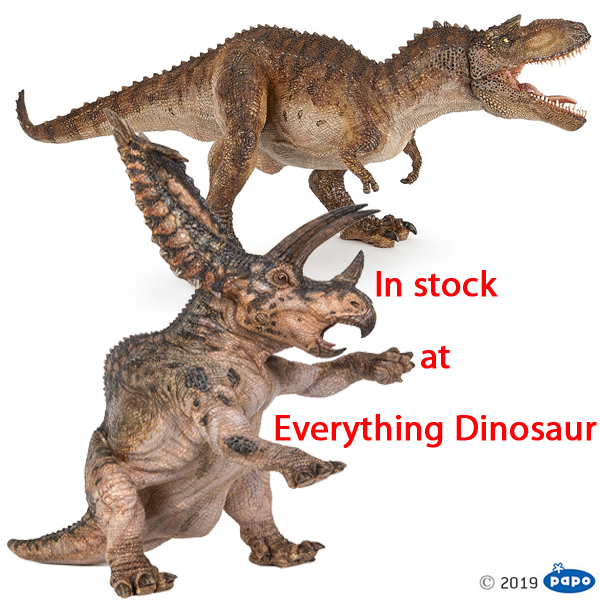
The new for 2019 Papo Gorgosaurus and the Papo Pentaceratops dinosaur models are now in stock at Everything Dinosaur.  These eagerly anticipated Papo figures have arrived at our warehouse and team members are busying themselves emailing all our customers who reserved these wonderful new Papo dinosaurs.

The Papo Pentaceratops and the Papo Gorgosaurus are in Stock at Everything Dinosaur

Available from Everything Dinosaur the Papo Pentaceratops dinosaur model and the Papo Gorgorsaurus.
In stock at Everything Dinosaur the Papo Gorgosaurus and the Papo Pentaceratops dinosaur models. Picture credit: Everything Dinosaur.

Picture credit: Everything Dinosaur

The Papo Gorgosaurus

The Papo Gorgosaurus model is the second member of the Tyrannosauridae family to be depicted by Papo, after the ubiquitous Tyrannosaurus rex.  The Gorgosaurus figure reflects the fossil record in that this model is considerably smaller than the various Papo T. rex models.  It measures around eighteen centimetres in length and the head of the dinosaur is approximately eight centimetres off the ground.

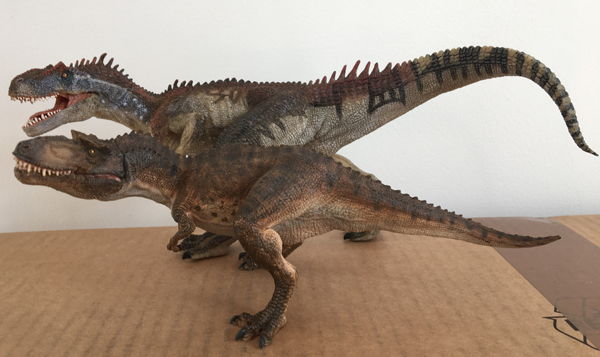
The Papo Gorgosaurus Model Compared to the Papo Allosaurus

The Papo Gorgosaurus compared to the Papo Allosaurus dinosaur model.
In stock at Everything Dinosaur the Papo Gorgosaurus and the Papo Pentaceratops dinosaur models.  The Papo Gorgosaurus (foreground), is compared to the recently introduced Papo Allosaurus dinosaur model (background). Picture credit: Everything Dinosaur.

Picture credit: Everything Dinosaur

The Papo Pentaceratops

Papo have produced a number of horned dinosaur models in the past.  For example, this manufacturer has an adult Triceratops within its model portfolio and until recently a baby Triceratops (it is now retired), too.  In addition, Papo did once have a Pachyrhinosaurus (also out of production), but the Papo Styracosaurus model is still available.  Although Pentaceratops means “five-horned face”, this dinosaur had three anterior facing horns on its head.  It may superficially resemble Triceratops but Pentaceratops is believed to be more closely related to Utahceratops from Utah.

The Papo Pentaceratops Dinosaur Model is in a Rearing Pose

Papo Pentaceratops dinosaur model.
The Papo Pentaceratops dinosaur model.

An Unusual Pose

The Papo Pentaceratops dinosaur model stands an impressive nineteen centimetres high.  This is an unusual pose for a horned dinosaur and it is difficult to provide an estimate of the scale of the model.  Papo does not offer a scale size suggestion for their “Les Dinosaures” range, but based on an adult size for Pentaceratops sternbergii of around 6.3 metres, this new for 2019 Papo figure is in approximately 1:32 scale.

These splendid Papo dinosaurs can be viewed in the 2019 Papo collector’s booklet.  This handy booklet is available free of charge to Everything Dinosaur customers.

To view the range of Papo prehistoric animals and dinosaurs available from Everything Dinosaur: Papo Prehistoric Animal Models.

Everything Dinosaur’s website: Everything Dinosaur.

Go to Top