All about dinosaurs, fossils and prehistoric animals by Everything Dinosaur team members.

Fossil finds, new dinosaur discoveries, news and views from the world of palaeontology and other Earth sciences.

26 08, 2020

Stegosaurus Fossil Bone Found on Scottish Island

By |2024-03-13T17:04:41+00:00August 26th, 2020|Categories: Adobe CS5, Dinosaur and Prehistoric Animal News Stories, Dinosaur Fans, Geology, Main Page, Palaeontological articles, Photos/Pictures of Fossils|0 Comments

Confirmation of Scottish Stegosaurs

The Jurassic-aged strata found on the coastline of the Isle of Skye in Scotland’s Inner Hebrides is recognised as one of the most globally significant locations in the world for dinosaur fossils from the Middle Jurassic.  Recently, the fossil sites on Skye received greater legal protection: Legal Protection for Isle of Skye Fossil Locations.  The vertebrate body and trace fossils confirm the presence of a rich biota of different dinosaurs and early mammals.  Footprints on Skye had hinted at the presence of stegosaurs in Scotland.  It is ironic therefore, that further evidence for the existence of armoured dinosaurs in the Middle Jurassic of Scotland has not come from Skye but from its island neighbour, the Isle of Eigg that lies to the south.

Stegosaur Limb Bone Found on a Beach on the Isle of Eigg
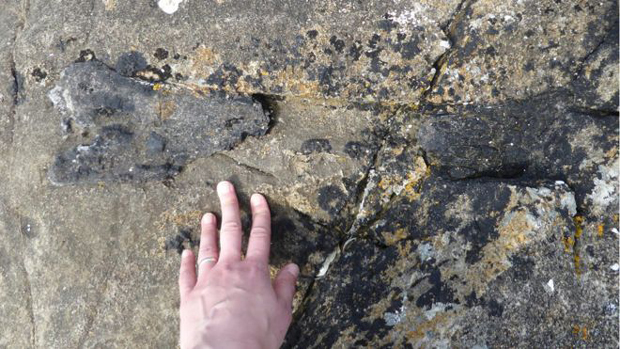
Stegosaur limb bone found on Scottish beach.
The stegosaur limb bone exposed on the beach (Isle of Eigg).

Picture credit: Dr Elsa Panciroli (National Museums Scotland)

A Stegosaurus Fossil Bone – A Serendipitous Discovery

The contemporaneous Jurassic strata that outcrops on the small island of Eigg, it covers an area of just 30² kilometres (11² miles), has been well explored.  It is renowned for its fossils of marine fauna including ammonites, prehistoric sharks and marine reptiles.  This is the first time that a dinosaur bone has been found on the Isle of Eigg.  The 166 million-year-old limb bone (Bathonian faunal stage of the Jurassic), was discovered by chance by Dr Elsa Panciroli (National Museums Scotland).

Dr Panciroli explained:

“I was running along the shore on my way back to meet the rest of the team and I ran right over it.  It wasn’t clear exactly what kind of animal it belonged to at the time, but there was no doubt it was a dinosaur bone.”

The bone is highly eroded, it having been exposed on the face of a boulder for some time, it measures a little over fifty centimetres in length.  It represents a bone from the hind limb.

The Stegosaurus Fossil Bone Specimen Removed from the Boulder
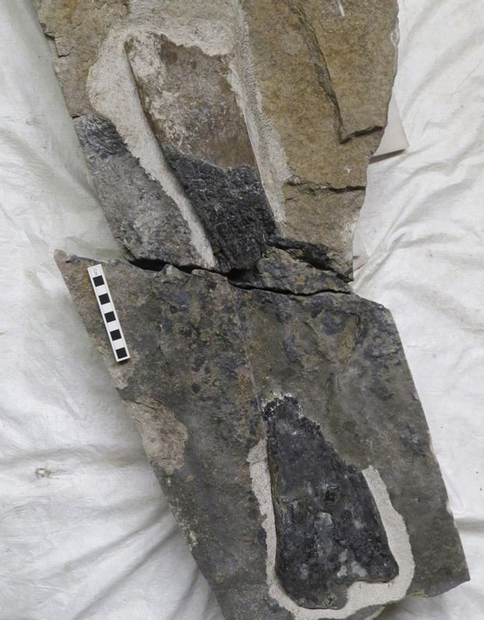
Eroded stegosaur limb bone.
The eroded stegosaur limb bone is now in the collection of the National Museums of Scotland.

Picture credit: N. Larkin

A Hugely Significant Find

The scientists comment that this single fossil bone represents a “hugely significant find”, albeit one found fortuitously thanks to a sharp-eyed field team member.  Dinosaur fossils from the Middle Jurassic are particularly rare and this fossil has a global significance for palaeontologists.

Palaeontologist Dr Steve Brusatte (University of Edinburgh), who has co-authored a paper on the fossil bone stated:

“This fossil is additional evidence that plate-backed stegosaurs used to roam Scotland, which corroborates footprints from the Isle of Skye that we identified as being made by a stegosaur”.

The bone now resides in the collections of National Museums Scotland (Edinburgh), the fieldwork on the Isle of Eigg was funded by the National Geographic Society with the permission of The Isle of Eigg Heritage Trust.

A paper on the fossil specimen will be published in the Earth And Environmental Transactions Of The Royal Society Of Edinburgh.

Mesozoic Strata Associated with Skye, Eigg and Rùm (Inner Hebrides)

Mesozoic strata on the Isle of Skye and the Isle of Eigg.
The Isle of Eigg in relation to the Isle of Skye (Inner Hebrides), the location of Mesozoic-aged strata is highlighted in dark green.

Picture credit: Google Maps with additional annotation by Everything Dinosaur

The British Isles and Stegosaurs

The oldest fossils of a stegosaur described to date, also come from the British Isles, but from a location very much to the south and east of the Inner Hebrides.  The coast of North Yorkshire, notably the Saltwick Formation has yielded at least two stegosaur tracks, attributed to the ichnospecies Deltapodus brodricki.  These are the oldest fossils attributed to a stegosaur known to science (we think).  The Saltwick Formation was laid down around 175-171 million years ago (Aalenian faunal stage of the Middle Jurassic) and are therefore at least five million years older than the stegosaur body and trace fossils associated with the Inner Hebrides.

Natural Casts of Stegosaur Tracks (Deltapodus brodricki) from the North Yorkshire Coast
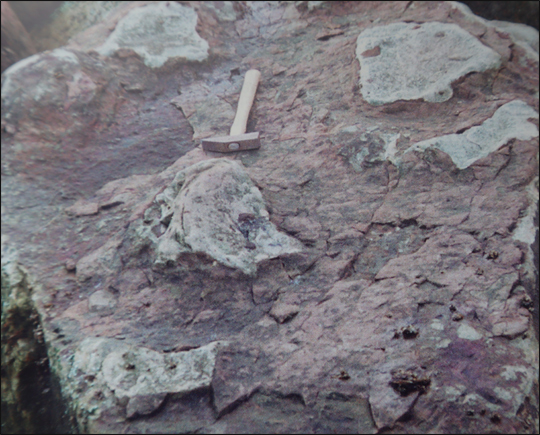
Stegosaur tracks (north Yorkshire coast).
Natural casts of stegosaur tracks Deltapodus brodricki from the Aalenian aged Saltwick Formation.

Picture credit: Martin Whyte and Mike Romano

Isle Skye Middle Jurassic Fossils: Isle of Skye Steps into the Jurassic Spotlight.

The Everything Dinosaur website: Everything Dinosaur.
24 08, 2020

Comprehensive Journal on Pennaraptoran Theropods Published (Past Progress and New Frontiers)

By |2024-03-13T16:40:09+00:00August 24th, 2020|Categories: Adobe CS5, Dinosaur and Prehistoric Animal News Stories, Dinosaur Fans, Main Page, Palaeontological articles, Photos/Pictures of Fossils|0 Comments

Comprehensive Review of Dinosaur/Bird Relationship Published

The evolution of the Aves (birds), can be regarded as one of the most significant moments in tetrapod evolution.   From their Mesozoic origins, the birds have thrived and today they have a global distribution and still outnumber the Mammalia in terms of extant species.  Spectacular fossils, particularly those from northern China, demonstrate that birds are members of the Theropoda.

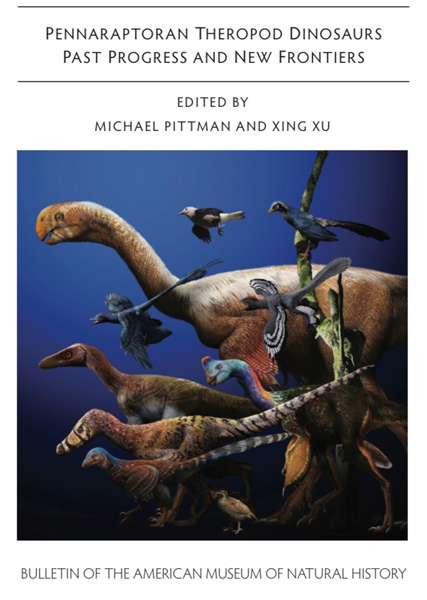
Numerous palaeontologists and other scientists have got together to publish a comprehensive overview of that part of the Theropoda most closely related to living birds.  The volume entitled “Pennaraptoran Theropod Dinosaurs – Past Present and New Frontiers” has been edited by Research Assistant Professor Dr. Michael Pittman of Hong Kong University and Professor Xing Xu (Chinese Academy of Sciences).

Pennaraptoran Theropod Dinosaurs – Past Progress and New Frontiers

Landmark volume on the biology and evolution of early birds and their close relatives.
A landmark volume on the biology and evolution of early birds and their close relatives.

Picture credit: Bulletin of the American Museum of Natural History and Julius T Csotonyi

The Origin of Birds

The Pennaraptora are a clade that consists of the Aves, as well as the pennaceous feathered dromaeosaurids, troodontids, oviraptorosaurians and the scansoriopterygids.  It was erected relatively recently (2014), it is defined as the most recent common ancestor of Oviraptor philoceratops, the “raptor” Deinonychus antirrhopus, and Passer domesticus (the house sparrow), and all descendants.  To improve understanding about this clade the International Pennaraptoran Dinosaur Symposium (IPDS), was held at the University of Hong Kong in the spring of 2018 and as a follow-up to this event, a special volume detailing the scientific papers and research has been published in the journal “Bulletin of the American Museum of Natural History”.

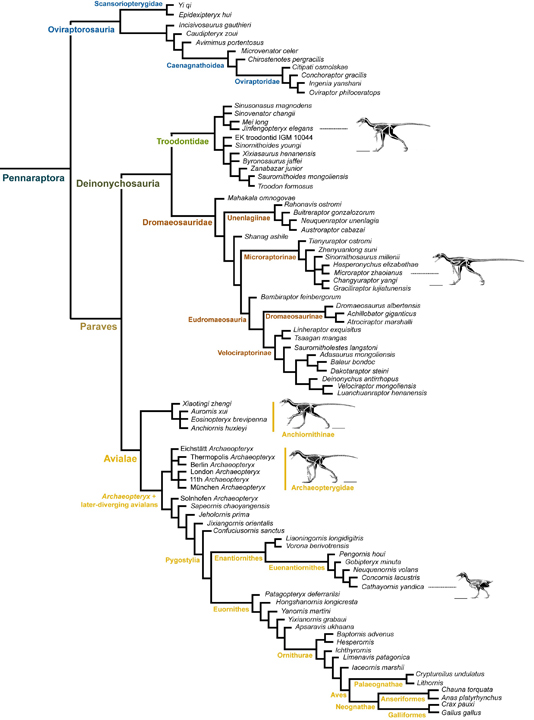
The symposium permitted the drafting of a comprehensive cladogram demonstrating evolutionary relationships within the Pennaraptora.

Evolutionary Tree of Pennaraptoran Theropods

Cladogram of pennaraptoran theropods.
Evolutionary tree of pennaraptoran theropods.

Picture credit: Pittman et al

Commenting on the significance of this volume, co-editor Dr Pittman stated:

“The volume documents past progress, works toward consensus on key unresolved issues, breaks new ground in the field and identifies priority areas for future research.”

Split into Three Sections

The publication has been divided into three main sections and consists of fourteen chapters:

1).  The Fossil Record, Systematics and Biogeography – how fossils have shaped the definition of the clade.

2).  Anatomical Frontiers – with a focus on recent fossil discoveries particularly related to the manus (hand) and the skull.

3).  Early Flight Study – research into the origin and evolution of powered flight.

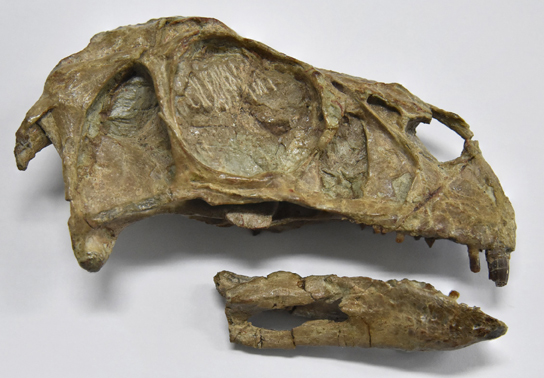
Incisivosaurus – A Primitive Member of the Oviraptorosauria

Incisivosaurus fossil skull.
Skull of the early-diverging oviraptorosaurian pennaraptoran Incisivosaurus.  Later-diverging oviraptorosaurians lost their teeth and evolved a beak.

Picture credit: Xing Xu and Waisum Ma

Examining the Relationship Between Extant Aves and Theropod Dinosaurs

The third part of the volume, looking at the evolution of flight examines recent efforts to identify the small pennaraptorans that first took to the skies, what their flight capabilities were and how their flight might have been acquired.  A new broader context is postulated for flight behaviour as part of a functional landscape.  Wing-assisted incline running (WAIR), a behaviour seen in modern birds that is proposed as an early stage of flight development, is argued as a later innovation based on a study of modern ostriches.

Co-editor Professor Xu commented:

“The volume involved 49 experts from more than 10 countries whose views cover much of the current discussion on pennaraptoran palaeobiology and evolution.”

One of the contributors, Dr Daniel Field (Cambridge University), added:

“This is a landmark volume that advances our understanding of pennaraptoran dinosaurs and identifies key areas to address in the years ahead.”

Sapeornis chaoyangensis – An Early Cretaceous Avialan

Short-tailed fossil bird Sapeornis.
The early short-tailed fossil bird Sapeornis.  Under Laser-Stimulated Fluorescence, the feathers and other soft tissues preserved around the fossil skeleton become clear.  This new information has been used to assess the bird’s soaring abilities.

Picture credit: Serrano et al

Everything Dinosaur acknowledges the assistance of a media release from Hong Kong University in the compilation of this article.

The award-winning website of Everything Dinosaur: Everything Dinosaur.

23 08, 2020

Dramatic Rock Fall Reveals Ancient Fossilised Trackways in Arizona

By |2024-03-13T16:34:53+00:00August 23rd, 2020|Categories: Dinosaur and Prehistoric Animal News Stories, Dinosaur Fans, Geology, Main Page, Palaeontological articles, Photos/Pictures of Fossils|0 Comments

Two Ancient Trackways Discovered in Arizona

A fortuitous rock fall on the Bright Angel Trail in the Grand Canyon National Park (Arizona), has revealed two ancient trace fossils that have been interpreted as the trackways created by small vertebrates as they climbed a steep sand dune.  The sandstone blocks containing the fossilised trackways from the Manakacha Formation, a sub-unit of the extensive Supai Group, are the subject of a scientific paper published in the academic, on-line, open-access journal PLOS One.

Estimated to be around 313 million years old (Moscovian Age of the Pennsylvanian Epoch – Late Carboniferous), the fossilised trackways are thought to have been made by either basal diapsid reptile or a basal synapsid and are the first tetrapod tracks reported from the Manakacha Formation and the oldest known from the Grand Canyon region.

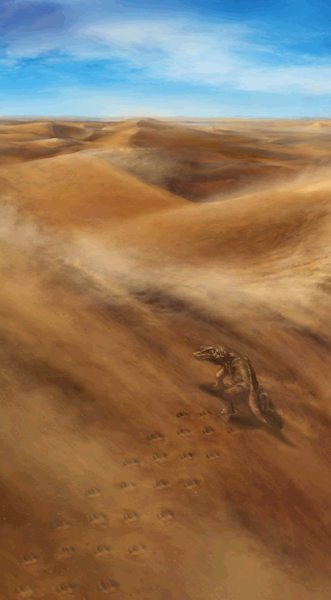
An Artist’s Reconstruction of the Tetrapod Ascending the Sand Dune

Basal amniote moves up a sand dune.
Crossing a sand dune.  A life reconstruction of a basal amniote moving diagonally up a dune creating a trackway similar to the one described in the scientific paper.

Picture credit: Emily Waldman

Ascending Sand Dunes

The rocks in this region are aeolian sandstones and the discovery of the two trackways document the earliest known occurrence of dunefield-dwelling amniotes.  Lead author of the scientific paper, Steve Rowland (professor emeritus of geology at the University of Nevada), commented that these fossils demonstrate that by the Late Carboniferous, the first vertebrates capable of laying eggs out of water had adapted to desert habitats.

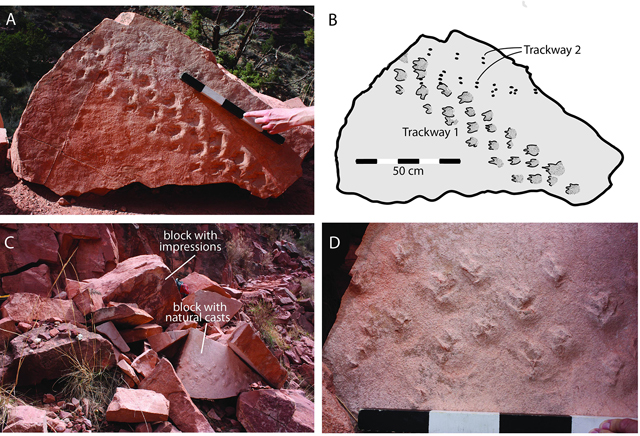
The Main Trackway, Line Drawing, Site of Rock Fall and Counterpart Slab

Trackway evidence at the Grand Canyon.
Main trackway block adjacent to Bright Angel Trail (Grand Canyon), with tracks in concave epirelief (impressions) at (A).  Scale is calibrated in decimeters.  Sketch of main trackway surface (B).  Note occurrence of Trackway 2 (alignments of small black spots) above Trackway 1.  The rocks (C) next to the Bright Angel Trail, including at least two rocks with amniote tracks.  Counterpart block (D) with tracks in convex hyporelief (natural casts).

Picture credit: Rowland et al (PLOS One)

Side-stepping Ascent of a Steep Dune Revealed by Fossilised Trackways

The rock fall occurred close to a popular hiking trail and they were first spotted during a geology field trip to the Grand Canyon in 2016.  The leader of that trip, professor Allan Krill sent a photograph of the tracks to the Department of Geology at the University of Nevada and Professor Rowland decided to investigate further.  The tracks have been interpreted as showing the ascent of a dune slope at an angle of approximately 20 degrees, thus reducing the steepness of the climb.

The second trackway, a series of small rounded depressions in the rock suggest claw marks.  It has been postulated that these marks are a deeper undertrackway, made some hours or days after the first track was produced, possibly by an animal of the same species as the first trackmaker.

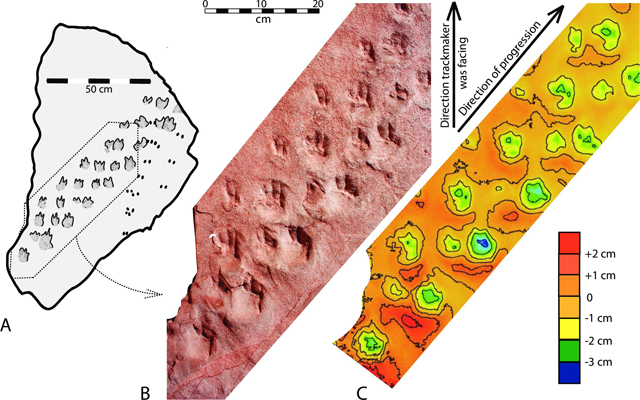
Line Drawing of Main Trackway (1) with a Plotted Three-dimensional Track Interpretation

Line drawing of main trackway surface and coloured digital elevation model.
Studying the fossilised trackways. Sketch of main trackway surface (A).  Detail of a portion of the trackway, with scale (B).  Coloured digital elevation model with explanation of colours (C).  Contour interval is 1 cm.

Picture credit: Rowland et al (PLOS One)

The scientists conclude that to traverse over the steep slope the little animal was moving, laterally one step at a time so that it always had its three other legs to support its body and to grip the surface.  The transition across the dune may not have been particularly elegant but the 28 impressions that have been preserved may help to shed further light on the evolution of early amniotes, which are scarce in the Carboniferous/Early Permian fossil record of North America.

A Controversial Interpretation

Not everyone is convinced of the interpretation of the fossils by the research team which included Mario Caputo (Society for Sedimentary Geology) and Zachary Jensen (College of Southern Nevada).

A spokesperson representing the palaeontology programme at the Grand Canyon commented that there was a lot of disagreement amongst the scientific community when it came to interpreting fossil tracks and inferring animal behaviours from them.  During the Late Carboniferous, this part of Arizona was a coastal-plain on the western edge of the super-continent of Pangaea.  There were extensive dunefields in close proximity, the dunes being formed by the action of the wind (aeolian), occasionally exceptional tidal conditions, storms or other flooding events interrupted the aeolian deposition burying parts of the dunefield in fine mud.

The scientific paper: “Early adaptation to eolian sand dunes by basal amniotes is documented in two Pennsylvanian Grand Canyon trackways” by Stephen M. Rowland, Mario V. Caputo and Zachary A. Jensen published in the open-access, on-line journal PLOS One.

The Everything Dinosaur website: Everything Dinosaur.
20 08, 2020

New Study Reveals Oldest Evidence of Megapredation

By |2024-03-13T13:04:30+00:00August 20th, 2020|Categories: Adobe CS5, Dinosaur and Prehistoric Animal News Stories, Main Page, Photos/Pictures of Fossils|0 Comments

Triassic Ichthyosaur Bit Off More than it Could Chew

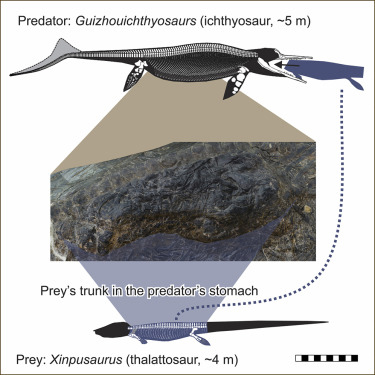
An international team of researchers have reported the oldest evidence found to date of megapredation, that is, when one large predator eats another large animal.  Sadly, for the 4.8 metre ichthyosaur at the centre of this research published in the on-line, open access journal iScience, the victim, a 4-metre-long thalattosaur (another type of marine reptile), turned out to be the last meal this fish lizard ever had.

Evidence of Megapredation – Thalattosaur Torso Found in Stomach of an Ichthyosaur

Guizhouichthyosaurs evidence of megapredation.
The torso of the thalattosaur in the stomach of the ichthyosaur.  Although the thalattosaur was almost as long as the ichthyosaur it was much lighter.

Picture credit: Jiang et al/iScience

Which Marine Reptiles were Top of the Food Chain?

When it comes to mapping Mesozoic food chains it is how big the animal was and the size and shape of the teeth that are usually used to determine position in the food web.  Large animals with big, pointed teeth are usually regarded as the apex predators.  However, there is little direct evidence in terms of stomach contents to support these assertions.

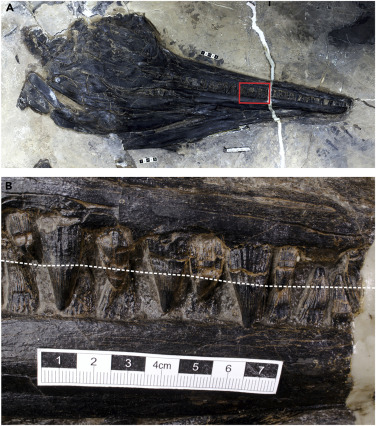
A nearly complete specimen of a Guizhouichthyosaurus has been found that contained the torso of another marine reptile, nearly as big as the ichthyosaur.  Guizhouichthyosaurus is believed to have reached a length of between 6-7 metres (most specimens are much smaller).  Their teeth are not huge and they seem adapted to grabbing slippery prey such as fish and squid.  However, the evidence is quite compelling, it seems that Guizhouichthyosaurus also fed on other large marine reptiles too.  Until this fossil discovery, Guizhouichthyosaurus had not been regarded as an apex predator.

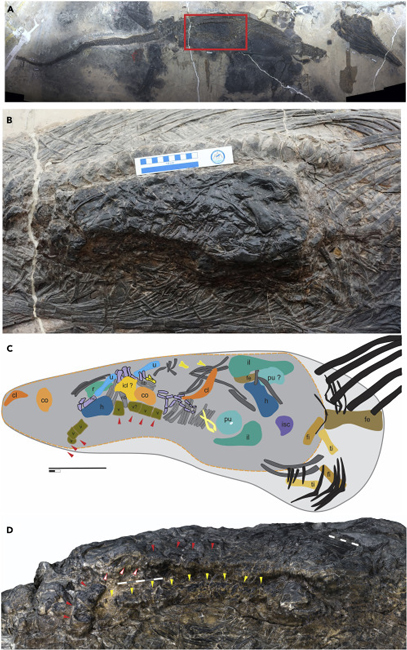
Specimen of Guizhouichthyosaurus with Stomach Contents

The skeleton of Guizhouichthyosaurus and stomach contents.
Skeleton of Guizhouichthyosaurus and stomach contents. Studying the Guizhouichthyosaurus fossil.

Picture credit: Jiang et al/iScience

A Surprise in the Abdominal Region

The ichthyosaur specimen, likely to represent a new species of Guizhouichthyosaurus was found in 2010 and excavated from the Ladinian (Middle Triassic) Zhuganpo Member of the Falang Formation in Xingyi, Guizhou Province, in south-western China.  During preparation, a large block of bones was identified in the stomach cavity.  It soon became clear that these bones were not from the ichthyosaur but represented a thalattosaur, identified as Xinpusaurus xingyiensis.

The seventy-four centimetre mass was classified as a bromalite, a trace fossil representing the remains of material sourced from the digestive tract of the ichthyosaur.  The lack of evidence of damage from stomach acids suggests that the unfortunate Xinpusaurus had been swallowed shortly before the Guizhouichthyosaurus itself died.  Attempting to consume such a large item of prey probably killed the ichthyosaur.

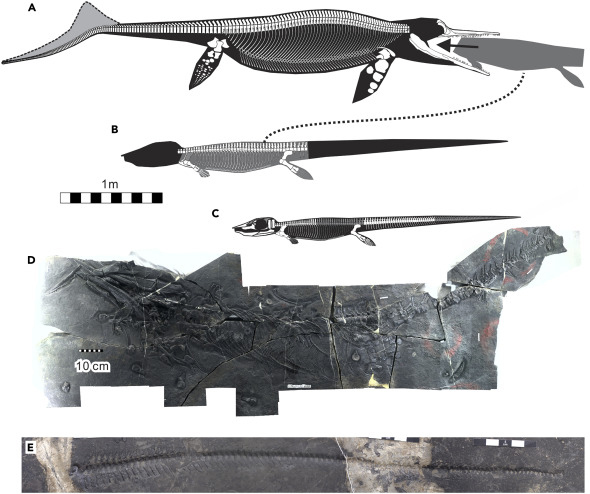
Skeletal Reconstruction of the Ichthyosaur and Thalattosaur

Demonstrating the predator/prey relationship
(A) = Skeletal reconstruction of the predator, Guizhouichthyosaurus, with (B) approximate skeletal map of the prey, Xinpusaurus xingyiensis.  Skeletal reconstruction of X. xingyiensis holotype (C) and photograph of X. xingyiensis holotype fossil (D).  A natural mould of the isolated, articulated tail of Xinpusaurus found 23 metres away from the ichthyosaur/thalattosaur specimen (E).  Scale bars 1 metre (A-C), 10 cm (D) and 25 cm for (E).

Picture credit: Jiang et al/iScience

Scavenging a Carcase Discounted

An articulated Xinpusaurus tail was found some twenty-three metres away from the ichthyosaur/thalattosaur specimen.  Whilst it is not possible to definitively match this tail to the bromalite, the researchers suggest that the tail could have come from the prey.  The presence of limb bones in the stomach cavity indicate that the Xinpusaurus was attacked and that the ichthyosaur was not scavenging a carcase.  If the Guizhouichthyosaurus had been feeding on a rotting corpse, it is likely that the Xinpusaurus limb bones would have become detached from the body as the soft tissue eroded.

It has been proposed that the ichthyosaur attacked the slightly smaller Xinpusaurus at the water’s surface.  The predator employed a “grip and tear” strategy, as seen in extant aquatic predators such as large crocodilians and killer whales (Orcinus orca).  By grabbing the victim and thrashing its powerful body and tail, the Xinpusaurus could have been ripped to pieces by the ichthyosaur.  This might explain why the head and neck of the Xinpusaurus is missing whilst a detached tail was found nearby.

The Skull of the Guizhouichthyosaurus and a Close View of the Teeth

Guizhouichthyosaurus skull showing close-up of jaws lined with small, closely spaced teeth.
The skull of the ichthyosaur with the red rectangle highlighting the area shown in close up view.  Dotted line in (B) indicates the gumline.  The small, closely spaced teeth of Guizhouichthyosaurus do not look typically like the dentition of an apex predator.

Picture credit: Jiang et al/iScience

Guizhouichthyosaurus Fossil Study

The remarkable fossils most likely represent the oldest record of megafaunal predation by a marine reptile and the oldest example of megapredation.  If Guizhouichthyosaurus was capable of such carnage then it seems the many more Mesozoic reptiles, not previously considered as top predators could also have indulged in megapredatory behaviour.

The scientific paper: “Evidence Supporting Predation of 4-m Marine Reptile by Triassic Megapredator” by Da-Yong Jiang, Ryosuke Motani, Andrea Tintori, Olivier Rieppel, Cheng Ji, Min Zhou, Xue Wang, Hao Lu and Zhi-Guang Li published in iScience.

The Everything Dinosaur website: Everything Dinosaur.
15 08, 2020

New Research Identifies Potential Late Triassic Island Dwarfs

By |2024-03-12T15:25:41+00:00August 15th, 2020|Categories: Adobe CS5, Dinosaur and Prehistoric Animal News Stories, Dinosaur Fans, Main Page, Palaeontological articles, Photos/Pictures of Fossils|0 Comments

Bristol Channel Could Provide Oldest Evidence of Insular Dwarfism

The flamboyant Baron Franz Nopcsa did much to establish the concept of island dwarfism, that is animals on islands with limited resources often evolve into much smaller forms.  Baron Nopcsa was the first person to suggest dwarf dinosaurs based on specimens associated with the Late Cretaceous Hateg Island, but a team of researchers including scientists from Bristol University, have uncovered evidence of island dwarfism in strata laid down in the Upper Triassic millions of years before the Hateg biota evolved.

Late Triassic Island Dwarfs

Writing in the “Proceedings of the Geologists’ Association”, the researchers report on an analysis of fossil remains from strata laid down around 205 million years ago that suggests ancient North American reptiles lived on an island archipelago in the area that now forms South Wales and the Bristol Channel.

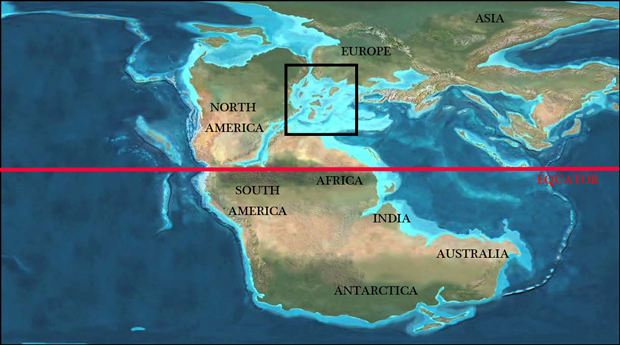
Student Matthew Skinner, (School of Earth Sciences at Bristol University), studied a treasure trove of fossil material that had been collected from Ruthin Quarry back in the 1950s and housed as part of the fossil collection at the National Museum of Wales (Cardiff).  The fragmentary and very fragile material documented life on a small tropical island during a time in Earth’s history when the Atlantic Ocean did not exist and Europe and North America were only partly separated and what division there was consisted of narrow, shallow seaways dotted with small islands.

World Map (Late Triassic) The Black Square Shows the Approximate Location of the Island Archipelago

Position of continents in the Late Triassic.
Pangaea in the Late Triassic, the black square highlights the island archipelago linking Europe and North America.

Eleven Different Taxa

In total eleven different taxa were identified, many of the vertebrates identified from the Ruthin Quarry fossils were reminiscent of fossils associated with much older strata in North America.  The researchers describe the Ruthin Quarry biota as “relictual”, they are the remnants of a population that was once much more widely distributed.  The Ruthin Quarry specimens are some 25 million years younger than the similar fossils known from North America.

Matthew Skinner commented:

“We were amazed to discover that most of the Ruthin beasts showed greatest similarity to relatives from North America.  Of course, at that time, one could just hop across from South Wales to New York.  The islands provided little space and food and so regular-sized animals couldn’t survive on them; the Ruthin animals were all dwarf versions of their closest mainland relatives, maybe half the size on average.”

Professor Mike Benton (Bristol University), who supervised the research study, explained:

“Our other questions were about the effects of island life.  We know today that animals on remote islands can evolve in different ways from on the mainland.  Often they become smaller, as there is less food, and they might be anachronistic – meaning they are throw-backs to much more ancient animals from the mainland.”

As most of the taxa identified from the site possess closest relatives that are found in much older strata and their body size is small, the scientists have concluded that these fossils record evidence of island dwarfism, also referred to as insular dwarfism.  This is the oldest known record of this biological phenomenon.

A New Species – Smilodonterpeton ruthinensis

The team identified cartilaginous fish including the primitive shark Rhomphaiodon minor from a single tooth which helped to date the material.  Numerous reptiles were described including parareptiles from the Procolophonidae family, one procolophonid is a new species and has been named Smilodonterpeton ruthinensis (chisel-toothed reptile from Ruthin).

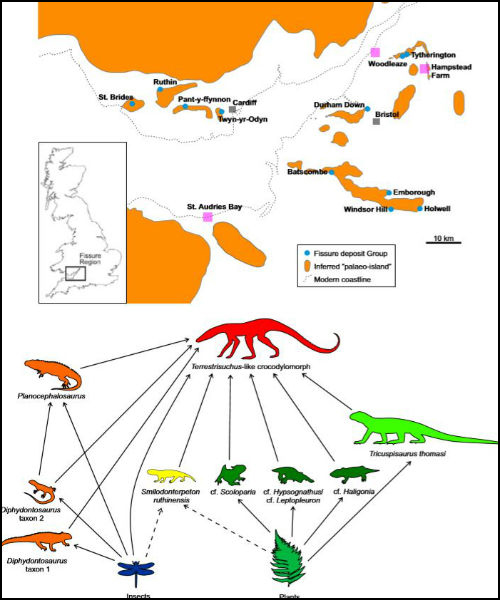
Other reptiles identified include three species of rhynchocephalians (beak lizards, distantly related to the living Tuatara of New Zealand), the herbivore Tricuspisaurus thomasi and archosaurs including a small, predatory crocodylomorph similar to Terrestrisuchus.  Although less than a metre in length, this crocodylomorph may have been the top predator on the island.  From this inventory, a simple food chain for the Ruthin Quarry fossil site could be constructed.

Location of the Fossil Finds and the Ruthin Quarry Food Chain

Ancient islands and a food web for the Late Triassic Ruthin Island.
A map of the Bristol Channel/South Wales area during the Late Triassic showing the ancient islands in relation to the modern coastline. With (below) a food web for Ruthin Island.

Picture credit: Bristol University

CT Scans and Three-Dimensional Computer Models

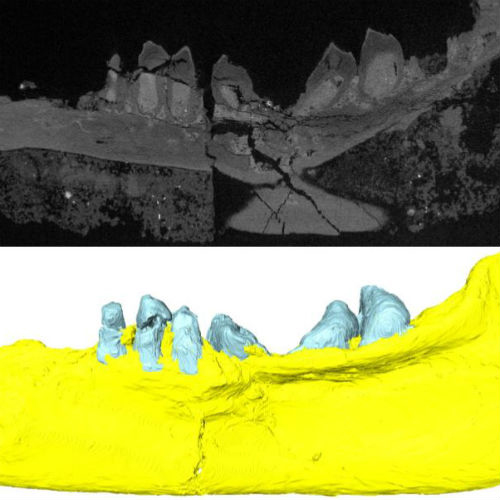
A number of the delicate fossil specimens were subjected to non-destructive CT scans to help reveal their anatomical details.  Tricuspisaurus had been named and scientifically described in 1957, but its taxonomic relationship with other reptiles was unclear.  This research has enabled the scientists to challenge the view that Tricuspisaurus was a procolophonid.

Co-author of the paper, Dr David Whiteside (Bristol University and the Palaeontology Department of the London Natural History Museum), stated:

“It has been questioned for many years how Tricuspisaurus is related to the other reptiles.  I was keen we found out what it really was, and Matthew was able to CT scan the specimens and this showed that its teeth were located in tooth sockets and it had a beak at the front of its jaws.  This confirms it was not a procolophonid, as had been thought, but a distant relative of birds, crocodiles and dinosaurs.”

CT Scan and Digital Image of the Lower Jaw of Tricuspisaurus

Tricuspisaurus CT scan and computer model of the lower jaw.
CT scan and 3-D digital computer model of the lower jaw of Tricuspisaurus.  The scan shows the base of its teeth embedded in tooth sockets.  A clear tooth socket lacking a tooth is visible at the back of the jaw.  Scale bar equals 5 mm.

Picture credit: Bristol University

For a related article on the Bristol Channel/South Wales archipelago: Getting to Grips with the Jaws of Clevosaurus.

The scientific paper: “Late Triassic island dwarfs?  Terrestrial tetrapods of the Ruthin fissure (South Wales, UK) including a new genus of procolophonid” by M. Skinner, D. Whiteside, and M. Benton published in the Proceedings of the Geologists’ Association.

The Everything Dinosaur website: Visit the Everything Dinosaur Website.

12 08, 2020

Vectaerovenator inopinatus – “Unexpected Air Filled Hunter”

By |2024-03-12T14:45:38+00:00August 12th, 2020|Categories: Dinosaur and Prehistoric Animal News Stories, Dinosaur Fans, Geology, Main Page, Photos/Pictures of Fossils|0 Comments

Vectaerovenator inopinatus – “Unexpected Air Filled Hunter from the Isle of Wight”

This week has seen the announcement of the discovery of four fossil bones from the foreshore near Knock Cliff, south of the town of Shanklin on the Isle of Wight that led to the naming of a new species of carnivorous dinosaur.  The new theropod has been named Vectaerovenator inopinatus (pronounced: Vec-tare-row-ve-nay-tor in-op-pin-ar-tus).  Most of the media outlets that have covered this story have focused on the dedicated people who found the fossils and the research team responsible for describing them.  The fossils were found over a period of several weeks in 2019 in three separate discoveries, two by individuals and one by a family group, who all handed in their finds to the nearby Dinosaur Isle Museum (Sandown).

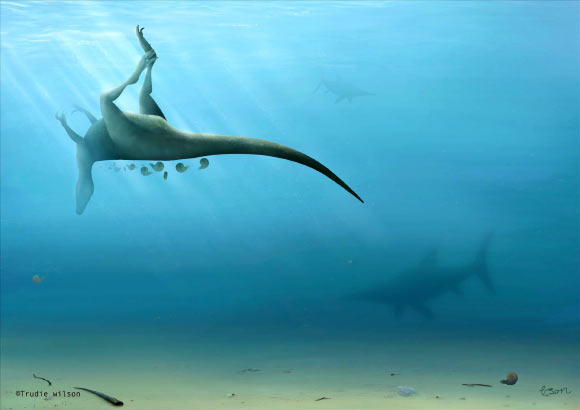
The Carcass of Vectaerovenator inopinatus Floats Out to Sea

The Vectaerovenator inopinatus floats out to sea.
Vectaerovenator inopinatus – carcass floating out to sea.  The fossil bones come from the marine Ferruginous Sandstone Formation of the Lower Greensand Group.

Picture credit: Trudie Wilson

A Vital Contribution to the Earth Sciences

The contribution from amateur fossil hunters cannot be underestimated, such enthusiastic and knowledgeable fossil hunters continue to make a hugely significant contribution to the Earth sciences.  The fossil material, consisting of four vertebrae (one cervical, two dorsal and one caudal), are, with the exception of some isolated teeth, the youngest non-avian theropod remains reported from Mesozoic strata from the British Isles.

The fossils come from the Aptian (Early Cretaceous), Ferruginous Sandstone Formation of the Lower Greensand Group and as these are marine deposits, it is likely that the carcass was washed out to sea and floated for some time before eventually settling on the seabed.  Most Early Cretaceous dinosaur fossil material known from the British Isles come from the Wealden Group or the older Purbeck Limestone Group.

Exposures of the generally younger Ferruginous Sandstone Formation can be found in Dorset as well as the southern part of the Isle of Wight.  These sediments were laid down during a period of rising sea levels.  The rising seas engulfed the lower lying coastal swamps, floodplains and deltas that had been home to many different types of dinosaur.  Dinosaur fossils are exceptionally rare in these strata.  For example, a single, isolated theropod tooth found at Punfield Cove, Dorset represents the very first record of a dinosaur from the Lower Greensand of Dorset.

As the four fossil bones ascribed to V. inopinatus are consistent in size and have the same adhering matrix, it is very likely the all four bones came from a single, individual dinosaur.

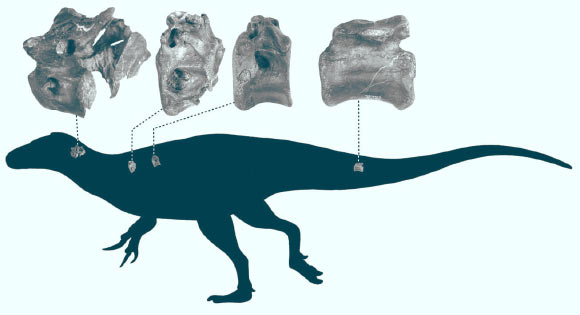
Silhouette of Vectaerovenator inopinatus with the Fossil Bones in Approximate Life Position

Vectaerovenator inopinatus silhouette showing placement of fossil bones.
A silhouette of V. inopinatus showing the placement of the four fossil bones. Although the material was collected on separate occasions, it is thought that they all come from a single skeleton.

Picture credit: Darren Naish

Vectaerovenator inopinatus – One of the Few Valid British Greensand Taxa

What fossils that are associated with the Lower Greensand Group, are often highly fragmentary, substantially eroded and often the result of re-deposition from older strata.  The four vertebrae represent the youngest non-avian theropod remains reported from the British Mesozoic.  Described as a mid-sized tetanuran, the Vectaerovenator specimen is estimated to represent a four-metre-long animal, one that roamed Europe approximately 115 million years ago.  It is the first diagnosable theropod taxon to be named from Aptian deposits associated with Europe.

“Unexpected Air-filled Hunter from the Isle of Wight”

The scientific name translates as unexpected, air-filled hunter from the Isle of Wight.  The neck and back bones are chambered (camerate) and full of air pockets (highly pneumatic).  These are adaptations to help lighten the skeleton and extensions to the lungs, part of an extremely efficient respiratory system seen today in living birds.

The shape of the cervical vertebra, along with the evidence of highly pneumatised bones indicate that Vectaerovenator was a member of the Tetanurae, a clade of theropod dinosaurs defined as all theropods more closely related to birds than they are to the genus Ceratosaurus.   As such, this is by far the largest clade of theropods known, it includes the tyrannosaurs, Maniraptora, megalosaurs, allosaurs, ornithomimosaurs and the Aves.  It is not possible to classify these bones any further, down to the family or the genus name for example.

Formal Scientific Paper Expected Soon

The formal scientific paper is expected to be published next month in the journal Papers in Palaeontology.

The continuing transgression of the sea led to much of the land in this region becoming fully submerged.  Deposition from deltas stopped, land-derived sediments to this part of the world ceased and for millions of years the only material to accumulate on the seabed were the microscopic remains of eukaryotic phytoplankton (coccolithophoroids).  Many coccolithophorids are covered in overlapping scales made of calcium carbonate.  Their remains formed the beautiful white cliffs, (which gave the Isle of Wight its name) and formed the stunning white cliffs associated with the coast of south-eastern England and elsewhere in Europe.

Everything Dinosaur acknowledges the assistance of a media release from the University of Southampton in the compilation of this article.

Visit the Everything Dinosaur website: The Everything Dinosaur Website.

10 08, 2020

Smallest Dinosaur Preserved in Amber a Bizarre Lizard

By |2024-03-12T14:28:59+00:00August 10th, 2020|Categories: Dinosaur and Prehistoric Animal News Stories, Dinosaur Fans, Main Page, Palaeontological articles|0 Comments

Oculudentavis khaungraae Not a Stem Bird

The preliminary manuscript has been made available on-line.  It seems that the remarkable fossil skull found preserved in amber from northern Myanmar does not represent a stem bird but it is the remains of a bizarre lizard.  Everything Dinosaur team members were aware of something big brewing within the scientific community earlier this year and on March 11th (2020), we were able to post up an article on this amazing fossil discovery coinciding with the scientific paper being published in the journal “Nature”.

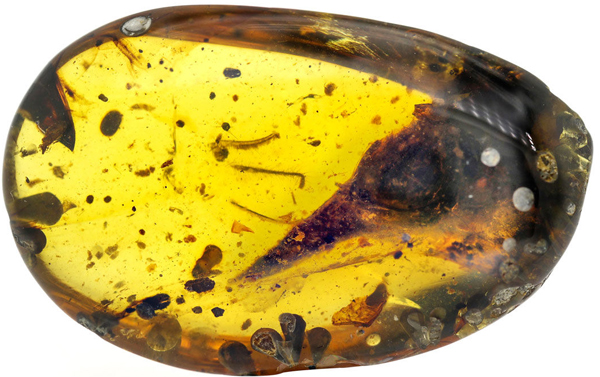
The Polished Amber Nodule Containing the Fossil Skull

Oculudentavis khaungraae skull in amber.
Tiny fossil skull preserved in amber (Oculudentavis khaungraae).  Once thought to be a tiny avian, scientists how think that the skull is from a bizarre lizard.

Picture credit: Lida Xing et al (Nature)

Doubts Over the Scientific Paper

Almost immediately academics cast doubt over the conclusion that the specimen represented an archosaur, specifically a bird.  However, a media feeding frenzy followed with many outlets reporting that the smallest dinosaur known to science had been found.  In our first blog post we highlighted some of the inconsistencies that had been raised by other scientists and included a synopsis of some of the criticisms in a section entitled “Post Publication Doubts”.

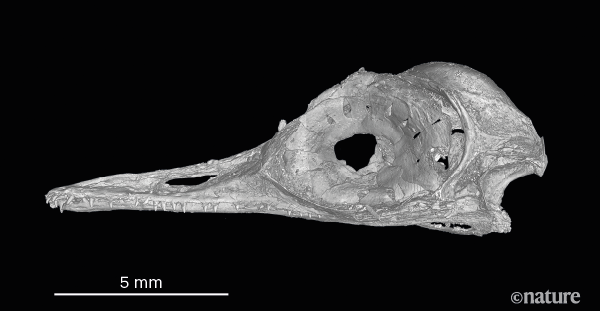
Oculudentavis khaungraae Computer Generated Image of the Skull

Oculudentavis khaungraae computer generated image of the skull.
Oculudentavis khaungraae computer generated image of the skull (left lateral view).

Picture credit: Xing et al (Nature)

Everything Dinosaur followed this up with a second article published on March 15th entitled “Casting Doubt over Oculudentavis”.  Late last month, in a highly unusual development, the scientific paper was retracted: Scientific Paper on Hummingbird-sized Dinosaur Retracted.  Academic papers are often amended and reprised as new evidence/research comes to light, it is very unusual to have a paper retracted, clearly something was amiss.

The Oculudentavis khaungraae Controversy

Rumours had been circulating that a second specimen would confirm that the holotype (HPG-15-3), currently stored in the Hupoge Amber Museum in China, did not represent a bird or a tiny dinosaur.  Scientists from the University of Calgary (Canada), Sam Houston State University, Florida Museum of Natural History, Villanova University, (USA), Bristol University, University College London, Fundación Miguel Lillo, CONICET (Argentina) and Institut Català de Paleontologia, Universitat Autònoma de Barcelona (Spain), have used an analysis of the second specimen to propose that Oculudentavis is actually a bizarre lizard of uncertain taxonomic position.

The narrow rostrum, the huge orbits and the shape of the braincase led to erection of “eye tooth bird”, as the smallest member of the Dinosauria known from the Mesozoic.  However, Oculudentavis showed several traits that were inconsistent with the original assessment.  This amazing specimen might look like a bird, but it the new interpretation and phylogenetic placement highlights a rare case of convergent evolution rarely seen among the Reptilia.

This new manuscript does reinforce the view that amber from Myanmar is affording science an unprecedented insight into the biota that existed in a coastal forest Cretaceous environment, but it also indicates that Oculudentavis khaungraae is a member of the Squamata and not the Archosauria.

The Everything Dinosaur website: Everything Dinosaur.

9 08, 2020

Preparing for a New Edmontosaurus Video

By |2024-03-11T16:41:15+00:00August 9th, 2020|Categories: Adobe CS5, Dinosaur and Prehistoric Animal Drawings, Dinosaur and Prehistoric Animal News Stories, Dinosaur Fans, Main Page, Palaeontological articles|0 Comments

Preparing for Edmontosaurus

As Everything Dinosaur team members prepare to put together a video on their YouTube channel all about the dinosaur taxon Edmontosaurus, we have been busy exploring our archive and database and reviewing the original paper on this famous North American duck-billed dinosaur written by Lawrence Lambe.

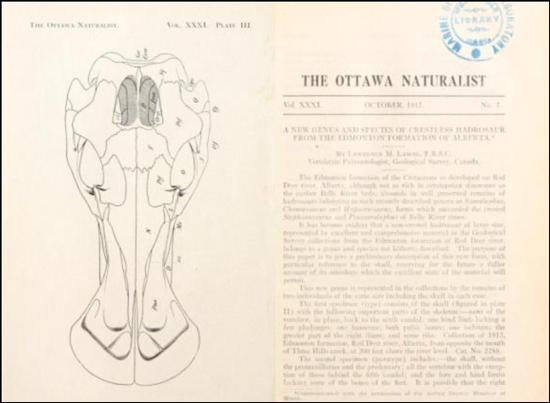
The Title Page for the Scientific Paper on Edmontosaurus (Lambe 1917)

Edmontosaurus is announced to the world.
The title page from the original 1917 Edmontosaurus paper written by the eminent Canadian palaeontologist Lawrence Lambe.  The paper is entitled: “A new genus and species of crested hadrosaur from the Edmonton Formation of Alberta.”

Picture credit: Archive of the “Ottawa Naturalist”

The First Two Fossil Specimens Attributed to Edmontosaurus were found by Brothers

The genus Edmontosaurus was first erected by the Canadian palaeontologist Lawrence Lambe back in 1917, in an article published in the “Ottawa Naturalist”.  He described two specimens found in the Red Deer River area of Alberta, Canada, from a formation known at the time as the Edmonton Formation, but now referred to as the Horseshoe Canyon Formation.  The first specimen, the type specimen for this genus, consisting of a disarticulated skull plus extensive post cranial material was collected in 1912 by Levi Sternberg.  The second fossil specimen which Lambe also described in his 1917 paper, was collected by George Sternberg, Levi’s older brother, during fieldwork in 1916.

Lambe named this new “crestless hadrosaur” in recognition of the geological formation from whence these fossils came and not in honour of Edmonton, the capital city of the Province of Alberta. He did note the resemblance of the Edmontosaurus material to other duck-billed dinosaur fossils associated with the geologically younger Lance Formation of Dakota, these fossils once described as Diclonius mirabilis, were also referred to as Trachodon mirabilis and form part of an extensive fossil collection from the northern United States that went through a number of taxonomic revisions, leading eventually to the establishment of the species Edmontosaurus annectens.

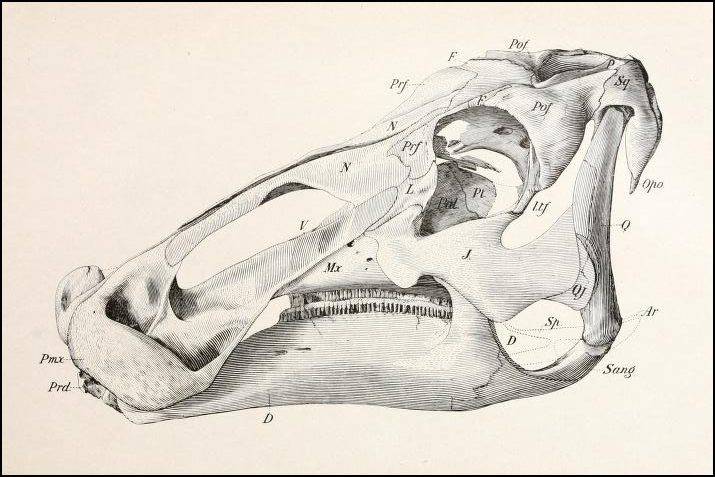
The Illustration of the Skull of Edmontosaurus (1917)

A line drawing of the skull of Edmontosaurus.
The illustration of the type skull from the 1917 Edmontosaurus paper.  Illustration by Arthur Miles.  The paper described this lateral view of the skull as being in approximate 1:7 scale when it was reproduced in the Ottawa Naturalist.

Picture credit: Archive of the “Ottawa Naturalist” skull diagram attributed to Arthur Miles

Everything Dinosaur on YouTube

The Everything Dinosaur YouTube channel contains over 170 dinosaur and prehistoric animal-themed videos.  The Edmontosaurus video will be posted up shortly and team members encourage blog readers to subscribe to our YouTube channel.

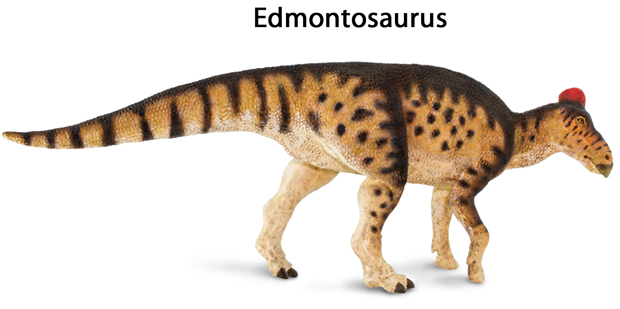
A Life Reconstruction of the Hadrosaurid Edmontosaurus

Wild Safari Prehistoric World Emontosaurus model.
The new for 2020 Wild Safari Prehistoric World Edmontosaurus dinosaur model.

Picture credit: Everything Dinosaur

The Everything Dinosaur website: Everything Dinosaur.
The model (pictured above), is the new for 2020 Edmontosaurus dinosaur model.  To view this figure and the rest of the models in the Wild Safari Prehistoric World range: Wild Safari Prehistoric World Models and Figures.

For dinosaur and prehistoric animal related videos and reviews, visit Everything Dinosaur on YouTube: Subscribe to Everything Dinosaur on YouTube.

8 08, 2020

Little Euparkeria into the Spotlight

By |2024-03-09T21:19:08+00:00August 8th, 2020|Categories: Adobe CS5, Dinosaur and Prehistoric Animal News Stories, Dinosaur Fans, Main Page, Palaeontological articles, Photos/Pictures of Fossils|0 Comments

A Fresh Look at Euparkeria

The fossilised remains of a little, lithe reptile that wandered South Africa during the Middle Triassic have come into the spotlight more than a hundred years after they were first scientifically described.  The fossils represent the taxon Euparkeria (pronounced Yoo-park-air-ree-ah) and they are regarded as highly significant in terms of plotting the evolution of tetrapods.

Formally named and described in 1913 (Robert Broom), Euparkeria is phylogenetically regarded as a basal member of the Archosauria.  As such, by studying the fossil remains of this animal, palaeontologists can gain a better understanding of the evolution of the archosaurs – a diverse group of tetrapods that includes the crocodilians, birds and of course, the dinosaurs.

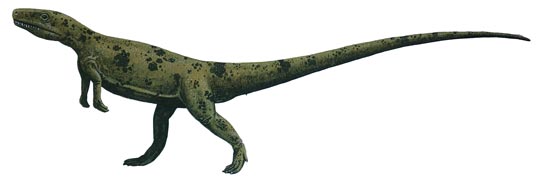
A Life Reconstruction of Euparkeria (Euparkeria capensis)

Euparkeria life reconstruction
A life reconstruction of the basal archosauriform Euparkeria.  Picture credit: Everything Dinosaur.

Picture credit: Everything Dinosaur

Represented By More Than Ten Fossil Specimens

The fossils all come from a single locality, Aliwal North on the Eastern Cape and Free State Province boundary in South Africa.  The fossilised bones having been collected from a solitary stone quarry, adjacent to a small stream.

Measuring around sixty centimetres in length (the tail made up more than half the body length), Euparkeria is known from at least ten specimens.  This material was extensively reviewed in 1965, but over the last six decades or so, there have been huge advances in fossil bone imaging techniques and the researchers led by Roland B. Sookias (Museum für Naturkunde in Berlin), subjected Euparkeria material to CT scanning at the Evolutionary Studies Institute, University of the Witwatersrand, Johannesburg.

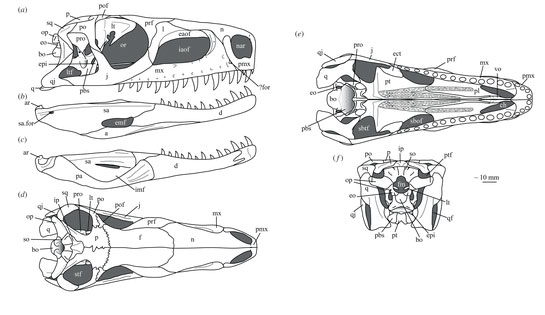
The Research Has Enabled Detailed Diagrams of the Skull of Euparkeria to be Compiled

Euparkeria capensis drawings of the skull.
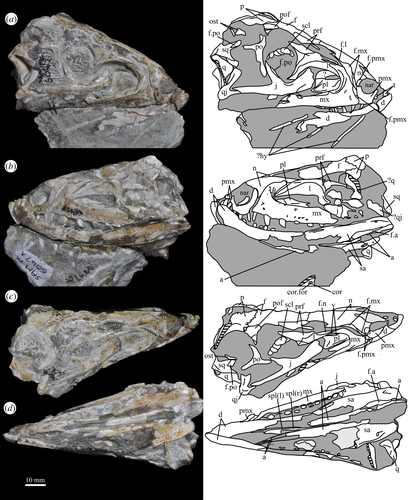
Reconstruction of the skull and mandible of Euparkeria capensis.  Cranium (a) and right mandible (b) in right lateral view; (c) left mandible in medial view; and cranium in (d) dorsal, (e) ventral and (f) posterior view.

Picture credit: Sookias et al (Royal Society Open Science)

Examining the Skull of Euparkeria

The CT scans enabled the scientists to describe the skull and jaw of Euparkeria in much greater detail than ever before.  Anatomical features previously unclear, are fully described for the first time.  The researchers were able to examine the palate, determine the number of teeth in the premaxilla (4 teeth in each premaxilla) and reconstruct the braincase.  The modular composition of the skull would have ensured that the cranium was quite flexible, adapted to coping with the stress of prey struggling in the jaws.

The study, published by the Royal Society Open Science, confirms Euparkeria as a major advance in tetrapod evolution and helps to place the crown Archosauria in greater context informing palaeontologists about the early stages of archosaur evolution.  Euparkeria most probably spent most of its time on all fours, a comparison of forelimb versus hindlimb length suggests that it was a facultative biped (usually walking on all fours but capable of walking as a biped when it needed to).  It was one of the first reptiles capable of running on just its hind legs.

Skull of Euparkeria capensis Specimen (SAM-PK-6047A) with Line Drawings

Fossil skull of Euparkeria with accompanying line drawings.
Skull of Euparkeria with accompanying line drawings.

Picture credit: Sookias et al (Royal Society Open Science)

Euparkeria from the Triassic

Euparkeria, which lived approximately 245 million years ago, shows a number of anatomical advances including an increase in brain size with improved senses, upright locomotion and a likely rapid metabolism placing this taxon in a pivotal position between ancestral diapsids the very first members of the Archosauria.

The scientific paper: “The craniomandibular anatomy of the early archosauriform Euparkeria capensis and the dawn of the archosaur skull” by Roland B. Sookias, David Dilkes, Gabriela Sobral, Roger M. H. Smith, Frederik P. Wolvaardt, Andrea B. Arcucci, Bhart-Anjan S. Bhullar and Ingmar Werneburg published by the Royal Society Open Science.

The Everything Dinosaur website: Everything Dinosaur.
7 08, 2020

New Research Means Tanystropheus Becomes Two

By |2024-03-09T21:13:56+00:00August 7th, 2020|Categories: Dinosaur and Prehistoric Animal News Stories, Dinosaur Fans, Main Page, Palaeontological articles, Photos/Pictures of Fossils|0 Comments

New Study Solves Mystery of Tanystropheus

A newly published scientific paper demonstrates that small specimens of Tanystropheus from the Middle Triassic Lagerstätte of Monte San Giorgio (Italy/Switzerland border), represent a separate species (Tanystropheus longobardicus) and that they co-existed with much larger examples of this genus (Tanystropheus hydroides).  Writing in the academic journal “Current Biology”, the researchers which include Olivier Rieppel (Field Museum in Chicago), postulate that the larger species was an aquatic ambush predator, whilst the smaller species fed on other types of prey.

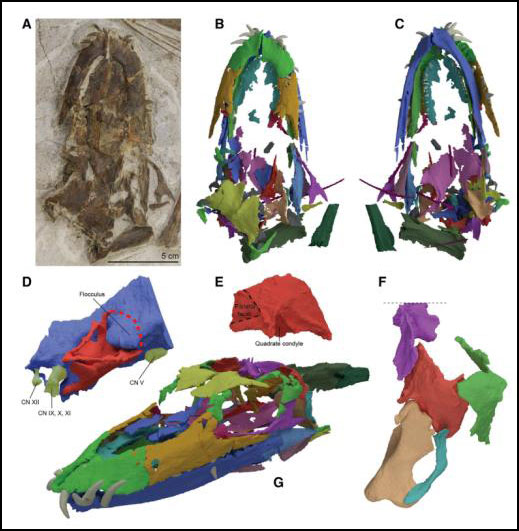
Sophisticated Computer Models Developed from High Resolution CT Scans Identified the Two Species

New scientific paper identifies new species of Tanystropheus.
Computer model of CT scan showing a reconstructed skull of T. hydroides, line drawing and fossil material.  Skeletal size comparison and line drawing with close-up of bone growth rings associated with T. longobardicus.

Picture credit: Spiekman et al (Current Biology)

Tanystropheus longobardicus Remains but Referencing Smaller Species

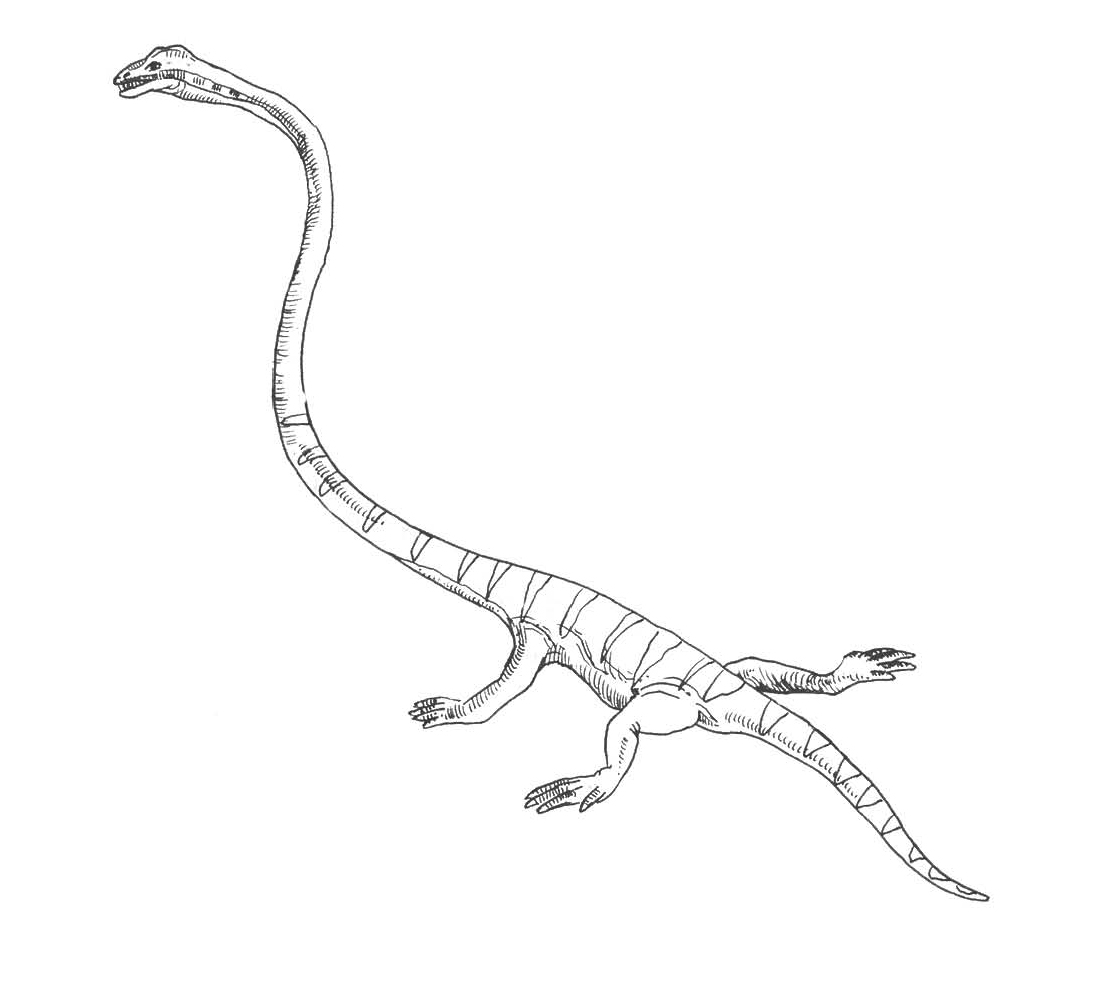
Tanystropheus represents one of the most bizarre of all the vertebrates known from the Mesozoic.  It is characterised by an extremely long and inflexible neck that is almost three times the length of its torso.  The palaeobiology of this reptile has remained contentious with a fully aquatic, semi-aquatic and entirely terrestrial lifestyle having been proposed since it was formally described back in 1852 (Hermann von Meyer).

An Illustration of the Bizarre Triassic Archosauromorph Tanystropheus

A drawing of Tanystropheus.
A drawing of the bizarre Triassic reptile Tanystropheus. Picture credit: Everything Dinosaur.

Picture credit: Everything Dinosaur

The research team used high-resolution CT scans to construct three-dimensional computer generated models of fossil specimens that had been crushed and flattened.  The skulls that were constructed revealed that the larger specimens were anatomically very different from the skulls of the smaller specimens.  The smaller morphotype was known for having different shaped teeth when compared to the teeth of larger specimens from the same strata.  Historically, this had been interpreted as evidence for juveniles of T. longobardicus feeding on different types of prey compared to fully-grown adults.

Lead author of the paper, Stephan Spiekman (University of Zurich), explained:

“The power of CT scanning allows us to see details that are otherwise impossible to observe in fossils.  From a strongly crushed skull we have been able to reconstruct an almost complete 3-D skull, revealing crucial morphological details.”

The computer generated models permitted the team to conclude that two species of Tanystropheus co-existed in the Middle Triassic coastal ecosystem.   The larger species, which grew up to six metres long, has been named Tanystropheus hydroides, whilst the smaller species is retained as T. longobardicus.

A Crushed Skull and Examples of a Three-Dimensional Skull Map

Computer generated model of the holotype skull T. hydroides.
The skull of Tanystropheus hydroides (holotype material).  The different coloured portions represent different bones.

Picture credit: Spiekman et al (Current Biology)

A Marine Predator

The study also revealed strong evidence that Tanystropheus hydroides was a marine predator.  The scans of the skull revealed that the nostrils were on top of the snout, rather like a crocodile’s.   The long, pointed teeth in the anterior portion of the jaw enabled it to grab and hold onto slippery prey, the teeth being described by the scientists as a “fish-trap type dentition”.   Both species were probably confined to coastal environments, the larger of the two species ambushing small fish whilst Tanystropheus longobardicus may have fed on shrimps and other  types of crustacean.  Although adapted to a marine habitat, both species probably had to return to land in order to lay eggs.

The co-occurrence of these two species of very different sizes and tooth morphology provides strong evidence for niche partitioning, highlighting the surprising versatility of the Tanystropheus bauplan and the complexity of Middle Triassic nearshore ecosystems.

Line Drawings Comparing the Skull and Bauplan of the Two Tanystropheus Species

Two different species of Tanystropheus identified.
Tanystropheus hydroides compared with Tanystropheus longobardicus  Skull illustrations (lateral, dorsal and ventral views), with a scale drawing (G).  T. longobardicus is represented by D-F, whilst T. hydroides is represented by A-C.

Picture credit: Spiekman et al (Current Biology)

The scientific paper: “Aquatic Habits and Niche Partitioning in the Extraordinarily Long-Necked Triassic Reptile Tanystropheus” by Stephan N.F. Spiekman, James M. Neenan, Nicholas C. Fraser, Vincent Fernandez, Olivier Rieppel, Stefania Nosotti and Torsten M. Scheyer published in Current Biology.

Visit the Everything Dinosaur website: Everything Dinosaur.
Go to Top