Team members at Everything Dinosaur were very saddened to hear the news of the death of Dr Angela Milner formerly the senior dinosaur researcher in the Dept of Palaeontology at the London Natural History Museum. Dr Milner passed away on the morning of the 13th August (2021). During her long career, she played a prominent role in vertebrate fossil research and authored many books about dinosaurs.
The death of Dr Angela Milner was announced on Friday 13th August, 2021. Dr Milner talks about the discovery of Baryonyx walkeri and discusses the famous thumb claw. Picture credit: Natural History Museum (London).
Baryonyx walkeri
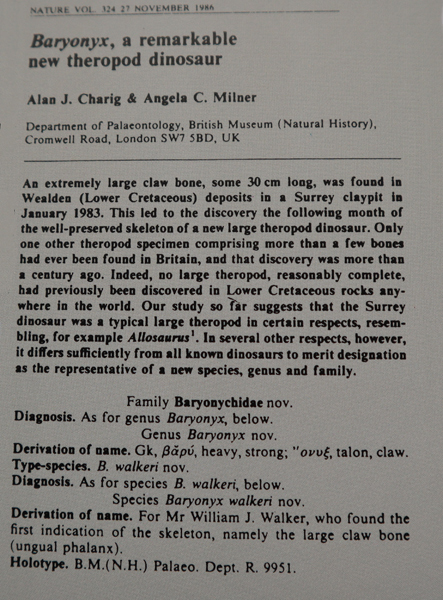
The Everything Dinosaur blog has featured the work of Dr Milner on numerous occasions. We have blogged about her work on the evolution of birds, her research into Archaeopteryx, using the famous “London” specimen in the collection of the Natural History Museum and discussed her contribution to a better understanding of the evolution of tyrannosaurs. Perhaps, she is most closely associated with the theropod dinosaur Baryonyx walkeri. In 1986, Natural History Museum colleagues Alan Charig and Angela Milner published in the journal Nature, a formal, scientific description of Baryonyx walkeri.
The scientific paper announcing Baryonyx walkeri by Alan J. Charig and Angela C. Milner (London Natural History Museum).
In 2011, the contribution of Dr Milner to vertebrate palaeontology was recognised when the specific name of a new carcharodontosaurid from the famous Tendaguru Formation of Tanzania – Veterupristisaurus was named in her honour (V. milneri).
A spokesperson from Everything Dinosaur commented:
“We were all very sad when we heard this news. Our thoughts are with Dr Angela Milner’s family and friends.”
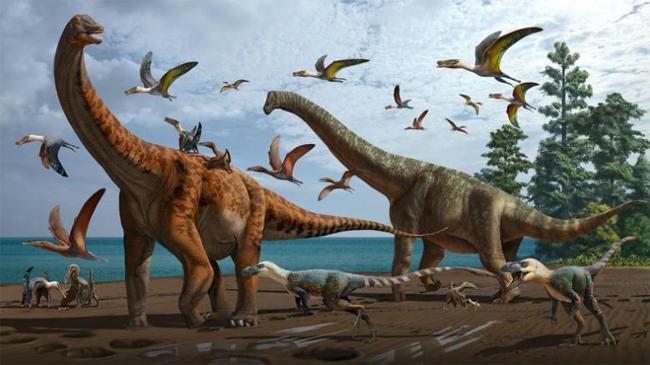
In 2017, Everything Dinosaur reported on the discovery of an extensive pterosaur nesting site that had been found south of the Tian Shan Mountains in Xinjiang (Xinjiang Uygur Autonomous Region), in north-western China. The bonebeds represented colonial nesting sites of Hamipterus tianshanensis. It was a flying reptile that had been formally named and described back in 2014.
Fieldwork in this area has revealed the presence of dinosaurs and a paper has been published this week describing sauropod fossils. These are the first dinosaurs to be identified from this part of China. Two of the fossil specimens have led to the erection of new sauropod species Silutitan sinensis and Hamititan xinjiangensis. Four incomplete bones from the sacrum along with associated sacral ribs representing another sauropod specimen have also been found, but as yet, no genus for these fossils has been assigned.
Two sauropods disturb a nesting colony of Hamipterus pterosaurs. Silutitan sinensis (left) and Hamititan xinjiangensis (right), a single theropod tooth found in association with the H. xinjiangensis material indicates the presence of carnivorous dinosaurs. Picture credit: Zhao Chuang.
Silutitan sinensis
Described from a series of six articulated cervical vertebrae (neck bones), with associated cervical ribs, Silutitan sinensis (which translates as Chinese Silk Road Titan), has been assigned to the Euhelopodidae family and is thought to have been closely related to Euhelopus (E.zdanskyi). At an estimated twenty metres plus, it is the larger of the two sauropods to be described in the scientific paper.
Silutitan sinensis gen. et sp. nov. (holotype-IVPP V27874) in left lateral view. Note scale bar in (B) = 50 cm. Picture credit: Wang et al.
Hamititan xinjiangensis
Although contemporaneous with Silutitan (Lower Cretaceous, Shengjinkou Formation of the Tugulu Group). Hamititan was not closely related. Cladistic analysis based on the tail bones (caudal vertebrae) from which this dinosaur was described, suggests that Hamititan is a titanosaur (a lithostrotian titanosaur), as such, it seems more closely related to South American titanosaurs such as Epachthosaurus and Notocolossus.
The genus name translates as Hami City Titan, whilst the species name honours the Xinjiang Uygur Autonomous Region of China.
A single theropod tooth (below, picture F), indicates the presence of theropod dinosaurs.
Hamititan xinjiangensis gen. et sp. nov., caudal sequence (HM V22) in right lateral view. Scale bar for specimen (top) = 50 cm. Scale bar for theropod tooth (F) = 5 cm. Picture credit: Wang et al.
No Name for the Third Specimen
A third specimen consisting of four sacrum bones and associated sacral ribs has not been assigned to a species. However, the researchers, writing in the academic journal Scientific Reports conclude that not only do these fossils represent the first dinosaurs to be described from the Shengjinkou Formation but they also help to support the hypothesis that Asia was home to a great variety of different types of sauropod during the Early Cretaceous.
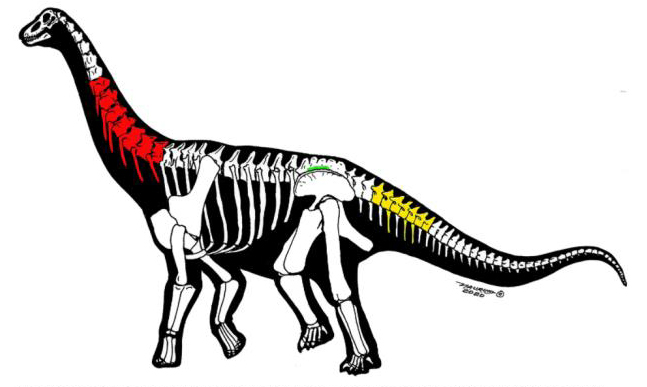
All specimens described in the scientific paper shown in one skeleton of a typical titanosaur. Preserved cervical elements of Silutitan sinensis (IVPP V27874) in red with preserved caudal elements of Hamititan xinjiangensis (HM V22) shown in yellow and the preserved sacral elements of the unnamed sauropod (specimen number IVPP V27875) in green. Picture credit: Maurílio Oliveira.
The scientific paper: “The first dinosaurs from the Early Cretaceous Hami Pterosaur Fauna, China” by Xiaolin Wang, Kamila L. N. Bandeira, Rui Qiu, Shunxing Jiang, Xin Cheng, Yingxia Ma and Alexander W. A. Kellner published in Scientific Reports.
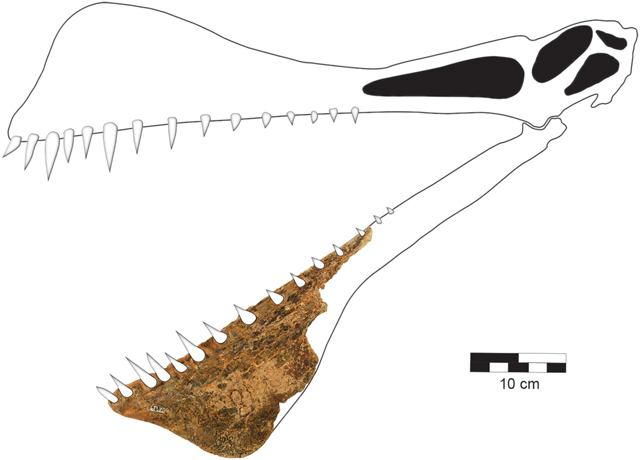
A new species of Australian pterosaur has been named and described based on a fragmentary fossil representing the front portion of the lower jaw. Thapunngaka shawi is just the fourth pterosaur to have been named and described from the “land down under” and with a wingspan estimated to be as much as 9.47 metres, it might just be the largest Australian flying reptile known to science.
A reconstruction of the metre-long skull of Thapunngaka shawi showing the placement of the rostral portion of the mandible. Scale bar = 10 cm. Picture credit: Richards et al.
Thapunngaka shawi
Pterosaur fossils from Australia are exceptionally rare. The light and hollow bones of flying reptiles rarely survive fossilisation, T. shawi is only the fourth pterosaur to have been described from the twenty fossil specimens attributed to members of the Pterosauria discovered in Australia.
Council worker and local fossil collector Len Shaw found the fossil bone ten years ago at a site known as the “water pond” at the “Free Fossil Hunting Site”, located seven miles northwest of the town of Richmond (Queensland). The strata at this site were laid down at the bottom of the Eromanga Sea (Toolebuc Formation) around 106 million years ago (Early Cretaceous). A researcher from the Kronosaurus Korner Museum was sent out to view and excavate the area and a scientific paper on T. shawi was published this week in the “Journal of Paleontology” with the collaboration of scientists from the University of Queensland.
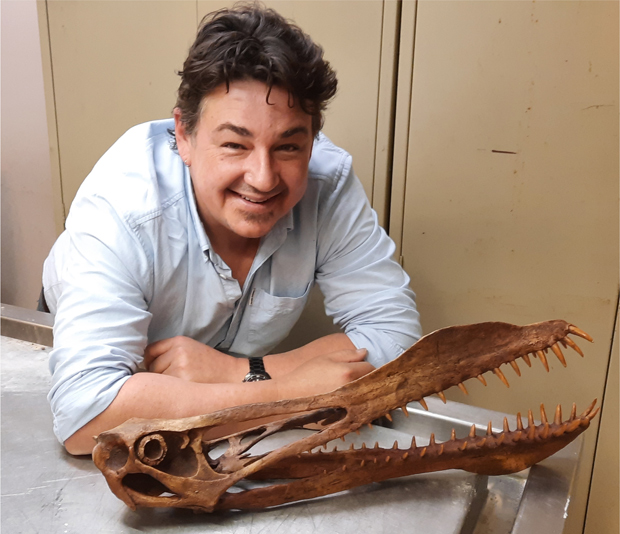
PhD student Tim Richards (University of Queensland), poses with a cast of the skull and jaws of an anhanguerid pterosaur.
Commenting on the significance of the fossil discovery, one of the report’s authors, University of Queensland PhD student Tim Richards stated:
“By world standards, the Australian pterosaur record is poor, but the discovery of Thapunngaka contributes greatly to our understanding of Australian pterosaur diversity.”
“Shaw’s Spear Mouth”
The genus name is derived from the local aboriginal language of the Wanamara Nation, on whose land the holotype material was found. It translates as “spear mouth”, a reference to the sharp teeth that would have been located in the alveoli (tooth sockets) preserved on the fossil specimen. The species name honours Len Shaw.
Assigned to the Anhangueridae, Thapunngaka and other anhanguerid pterosaurs from Queensland help to demonstrate the global distribution of these types of flying reptile during the Cretaceous, with anhanguerids known from South America, Africa, Europe and Australia.
A phylogenetic assessment indicates that Thapunngaka was related to Tropeognathus from South America.
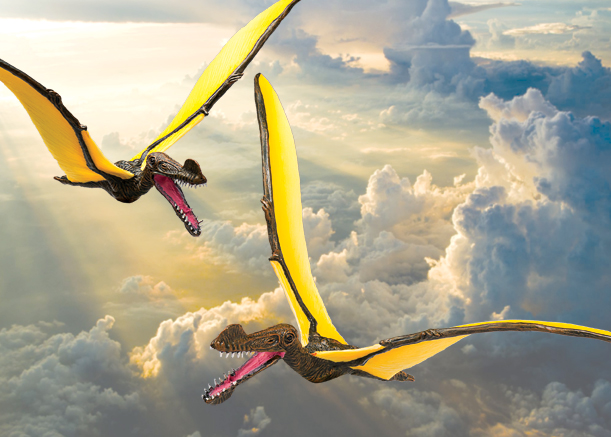
A pair of Mojo Fun Tropeognathus pterosaurs. The newly described Australian anhanguerid T. shawi would have looked similar to Tropeognathus.
The picture (above) shows a pair of Mojo Fun Tropeognathus pterosaur figures. This flying reptile figure was recently introduced into the Mojo Fun Prehistoric and Extinct range.
Of the four Australian pterosaurs named to date, three of them Mythunga, Ferrodraco and Thapunngaka have been assigned to the Anhangueridae family which suggests anhanguerids were the dominant group of Australian pterosaurs during the Early Cretaceous.
Aussiedraco molnari is the only non-anhanguerian pterosaur described so far from Australian fossil finds. This flying reptile has been assigned to the Targaryendraconia, a clade of pterosaurs that was created following a reassessment of ornithocheirid fossil material.
A List of the Australian Pterosaurs Described to Date:
Mythunga camara – a member of the Anhangueridae family, named and described in 2008 based on fossils from the Toolebuc Formation.
Ferrodraco lentoni – also an anhanguerid and believed to be the sister taxon of M. camara which was named and described in 2019: Australia’s Most Complete Pterosaur Fossil.
Thapunngaka shawi – the third anhanguerid to be described.
Aussiedraco molnari – named and described in 2011, also from the Toolebuc Formation.
The Largest Australian Pterosaur
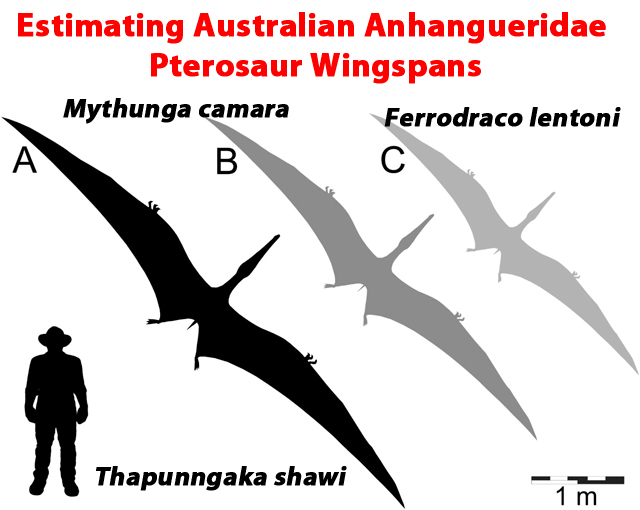
Estimating the size of Thapunngaka with only a fossil fragment to study is challenging. The researchers compared the size and proportions of the mandible fossil with those of better-known and more complete anhanguerids. Although the authors of the scientific paper admit that there is not a strong relationship between mandible size and wingspan, they estimate that Thapunngaka could have had a wingspan from around 5.83 metres up to a massive 9.47 metres. The researchers suggest that Thapunngaka shawi is the largest pterosaur known from Australia.
Estimates of the wingspans of Australian anhanguerid pterosaurs. Based on a comparison of mandibles, Thapunngaka shawi is thought to have had a wingspan from 5.83 to 9.47 metres in diameter. Note scale bar = 1 metre. Picture credit: Richards et al with additional annotation from Everything Dinosaur.
The scientific paper: “A new species of crested pterosaur (Pterodactyloidea, Anhangueridae) from the Lower Cretaceous (upper Albian) of Richmond, North West Queensland, Australia” by Timothy M. Richards, Paul E. Stumkat and Steven W. Salisbury published in the Journal of Vertebrate Paleontology.
Scientists have named a new species of dromaeosaurid from fragmentary jawbones found in Upper Cretaceous deposits in the Brazilian state of Minas Gerais (south-eastern Brazil). Named Ypupiara lopai, this is the first dromaeosaurid described from fossils found in Maastrichtian-aged deposits in Brazil. Y. lopai has been classified as a member of the dromaeosaurid subfamily the Unenlagiinae, possibly a sister taxon to Austroraptor (A. cabazai), which is known from the Late Cretaceous of Argentina.
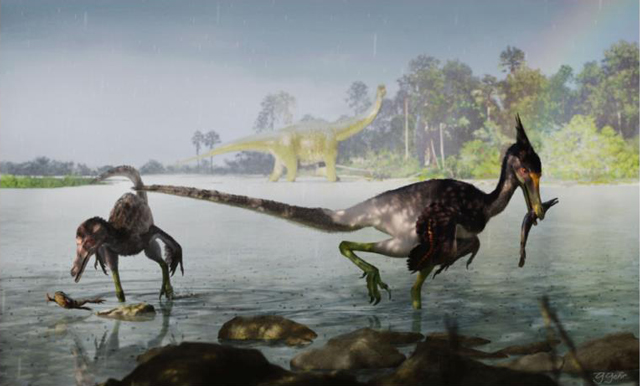
A life reconstruction of Ypupiara lopai. The shape and spacing of the teeth of this small dromaeosaurid suggest that it was a fish-eating dromaeosaurid. Picture credit: Guilherme Gehr.
Fragmentary Bones from the Jaws
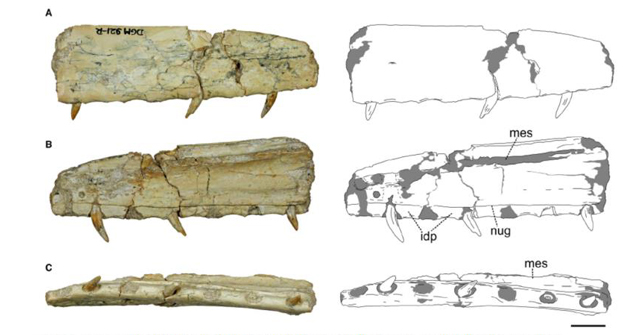
A fragment of upper jaw and a piece of bone representing the back portion of the lower jaw (dentary), were found in close association and are believed to have come from a single animal. The fossils originate from the Marília Formation (Maastrichtian faunal stage).
The right maxilla of the newly described fish-eating dromaeosaurid Ypupiara lopai from Brazil. The maxilla (DGM 921-R), is shown in lateral view (A), medial view (B) and ventral view (C) with accompanying line drawings. Note scale bar = 1 cm. Sadly, this fossil and the portion of dentary were lost in a fire that took place in September 2018. Picture credit: Brum et al.
The researchers, writing in “Papers in Palaeontology”, conclude that these fossils represent the first evidence of unenlagiines from the Marília Formation (Bauru Group, Brazil) and the second confirmed evidence of this type of dromaeosaur in Brazil. Previously, a single dorsal vertebra from the geologically younger Adamantina Formation (Bauru Group) had been assigned to the Unenlagiinae subfamily. Numerous isolated teeth had hinted at the presence of dromaeosaurs including potential unenlagiines in the Late Cretaceous of Brazil, but Ypupiara is the first to be named and scientifically described.
Outlining the Unenlagiinae
The Dromaeosauridae consists of several subfamilies although the taxonomy of this geographically and temporally widespread family of theropod dinosaurs is subject to almost constant revision as more fossil discoveries are made around the world. The Unenlagiinae comprises several genera of small to medium-sized theropods and for the time-being they are confined to the southern portion of the Gondwana landmass (Antarctica and South America). Their geographical distribution may change as fossil specimens from Madagascar, Europe, Australia and North America have been putatively assigned to the Unenlagiinae.
The biggest member of this subfamily described to date is Austroraptor, which at five-metres long was much larger than Ypupiara. To read Everything Dinosaur’s article from 2008 about the discovery of Austroraptor: Introducing Austroraptor – Fearsome Predator of the Late Cretaceous.
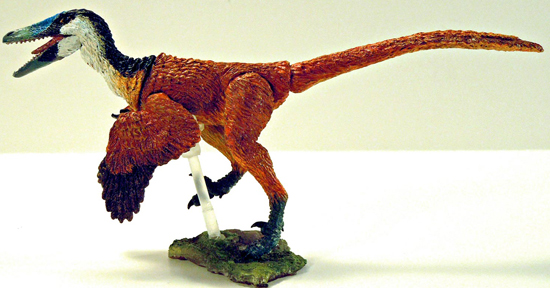
Models of this kind of dromaeosaur are few and far between, but within the Beasts of the Mesozoic “Raptor” series, the Wetlands Accessory Pack features a replica of Buitreraptor, an unenlagiine from western Argentina known from deposits some 30 million years older than those associated with Ypupiara lopai.
The Beasts of the Mesozoic Buitreraptor gonzalezorum model from the Wetlands Accessory Pack.
The picture above shows an articulated dinosaur figure from the Beasts of the Mesozoic model series.
Analysis of the three teeth located in the upper jaw (shape and spacing along the jaw), suggests that Ypupiara was a piscivore (fish-eating). The strata associated with the fossil find, indicates that Ypupiara inhabited an alluvial floodplain with sediments extensively reworked by a braided river system. The genus name comes from the local Tupian dialect and refers to a mythical aquatic creature, a reference to the high probability that this little dinosaur lived near water. The species name honours Alberto Lopa, for his role in helping to map the geology of the state of Minas Gerais and in recognition of his discovery of the fragmentary bones that led to the erection of this new dinosaur genus.
Lost to Science
Sadly, the original fossils are no longer available to study. The fossil material was on loan to the Museu Nacional-Universidade Federal do Rio de Janeiro when fire destroyed the main building of the museum in September 2018, the fossils were not recovered and are considered to have been lost.
The scientific paper: “A New Unenlagiine (Theropoda, Dromaeosauridae) from the Upper Cretaceous of Brazil” by Arthur S. Brum, Rodrigo V. Pĕgas, Kamila L. Bandeira, Lucy G. Souza, Diogenes A. Campos and Alexander W. A. Kellner published in Papers in Palaeontology.
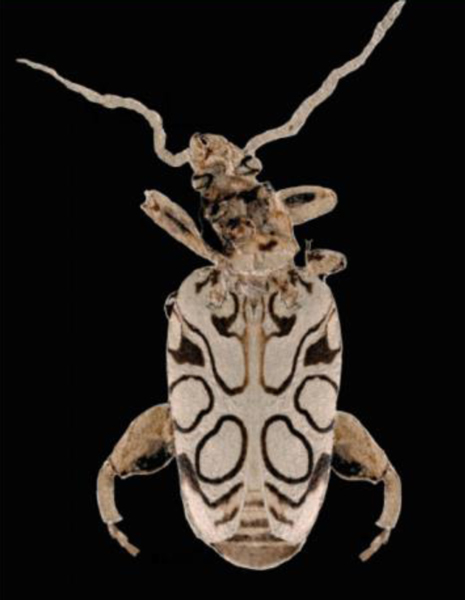
A stunning fossil of a beetle that had been on display at the Denver Museum of Nature and Science (Colorado), has been identified as a new species and named in honour of the English naturalist and broadcaster Sir David Attenborough. Named Pulchritudo attenboroughi (Attenborough’s beauty), the fossil originates from the famous Green River Formation and it is believed to be around 49 million years old.
The stunning Pulchritudo attenboroughi fossil beetle from the Green River Formation of Colorado (USA). Picture credit: Krell and Vitali.
Incorrectly Labelled
In the Museum’s exhibition display the fossil was labelled as a longhorn beetle, however, Senior Curator of Entomology at the Denver Museum of Nature and Science, Frank Krell had doubts so he invited Francesco Vitali of the National Museum of Natural History of Luxembourg, an authority of fossil beetles, to examine the fossil.
The crooked hind legs identified in the specimen, gave away the beetle’s true affinity. The fossil represents an example of a frog-legged beetle, a widespread family of beetles, which are sometimes referred to as kangaroo beetles, as they are found in Australia as well as Africa, Asia and South America.
Writing in the academic journal “Papers in Palaeontology”, the researchers concluded that the 2.2 cm long fossil represented a female frog-legged beetle from the subfamily Sagrinae. This is only the second known fossil representative of this beetle subfamily known from North America. Beetles of the subfamily Sagrinae are not found in North America today, but the authors noted that Atalasis sagroides from Argentina is remarkably similar to the fossil specimen.
Digital reconstruction of Pulchritudo attenboroughi based on the part and counterpart of the holotype fossil. Picture credit: Krell and Vitali.
Honouring Sir David Attenborough
Sir David Attenborough has been honoured on numerous occasions by having new species (living and extinct) named after him. For example, he has had a placoderm (Materpiscis attenboroughi), as well as the pliosaurid Attenborosaurus conybeari and a Cretaceous damselfly – Mesosticta davidattenboroughi named after him. Sir David might be ninety-five years young, but his influence on the scientific community as well as the wider public is undiminished.
In the scientific paper, naming and describing this new genus of beetle from the Eocene Epoch, the researchers wrote that the specific name attenboroughi is from the Latinised form of the surname Attenborough and they state that this fossil genera is:
“dedicated to Sir David Frederick Attenborough, broadcaster and naturalist, who has nothing to do with this fossil but has been inspiring the authors, their family down to the littlest, and millions of others by his unsurpassed documentaries on the natural world, extant and bygone. Nobody imparts the grandeur and beauty of nature more impressively than Sir David. This fossil, unique in its preservation and beauty, is an apt specimen to honour the great man”.
Still Enthusing about the Natural World. Picture credit: Everything Dinosaur.
A genus of beetle from the Eocene honours Sir David Attenborough.
The scientific paper: “Attenborough’s beauty: exceptional pattern preservation in a frog‐legged leaf beetle from the Eocene Green River Formation, Colorado (Coleoptera, Chrysomelidae, Sagrinae)” by Frank-Thorsten Krell and Francesco Vitali published in Papers in Palaeontology.
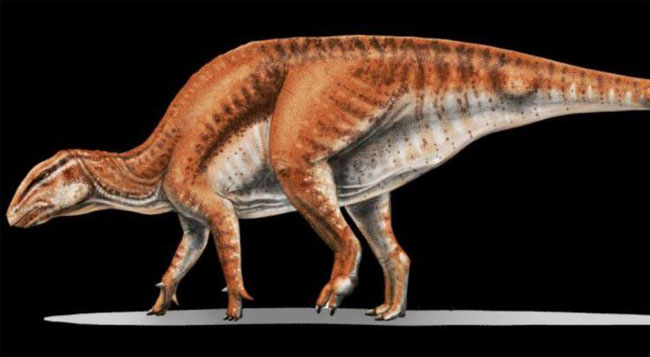
Scientists have examined the fossilised remains of a large ornithopod dinosaur, whose fragmentary remains were discovered in 1963 and concluded that these remains represent one of the “oldest” dinosaurs known to science. The fossils assigned to a basal member of the Hadrosauroidea known as Gobihadros mongoliensis are not that geologically old, this dinosaur roamed Mongolia around 93 million years ago, the important point to note is that the fossils come from a very aged dinosaur. These fossilised bones have provided palaeontologists with a unique insight into the ageing process of non-avian dinosaurs.
A life reconstruction of the basal hadrosauroid Gobihadros mongoliensis. The bones from an elderly dinosaur indicate that when fully grown Gobihadros was around 7.5 metres long. Picture credit: A. Kapuścińska.
Most Dinosaur Fossils Represent Young Animals
Palaeontologists classify vertebrate fossils such as dinosaur remains into three broad age categories. These categories are juvenile, subadult and adult. In the absence of a detailed assessment of bone structure examining lines of arrested growth (LAGs), that can provide a guide to the number of years an animal has lived, the age of the vertebrate is estimated by looking at the degree of ossification of the skeleton, the bone microstructure and the size of animal. Larger animals with more ossification present in their skeleton indicate older animals.
Most of the dinosaur fossil remains represent young animals such as subadults or juveniles. However, a team of scientists writing in the academic journal “Scientific Reports”, have published a paper looking at the fragmentary Gobihadros material that was discovered in 1963 and concluded that these bones represent a very aged dinosaur. How old is difficult to tell, but the presence of abnormal calcium deposits in some of its bones indicate that this Gobihadros suffered from a form of arthritis, which is found mostly in very old members of a population.
Probably Gobihadros mongoliensis
Elements representing limb bones, part of the left foot and nine tail bones (caudal vertebrae) have been preserved. The femur and tibia match fossil material assigned to Gobihadros (G. mongoliensis) which was named and described in 2019: A New Hadrosauroid Dinosaur from Mongolia.
As G. mongoliensis is the only large ornithopod known from the Baynshire Formation in the Khongil Tsav locality (Mongolia), where the fossils were found, the material has been assigned to this species. When first scientifically described in 2019, the holotype fossil material indicated a dinosaur around three metres in length, these fossils, representing a much larger animal suggest that Gobihadros grew to a maximum size of around 7.5 metres long.
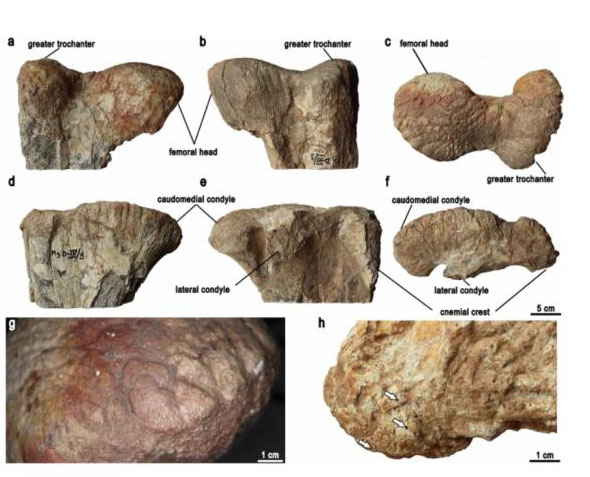
The absence of open transcortical channels associated with the limb bones indicate that this dinosaur was very old when it died.
Views of the top end of the right femur (a-c) and the partial tibia (d-f) of the fragmentary bones attributed to G. mongoliensis. Picture (g) shows a close-up view of the top of the femur (proximal) open transcortical channels associated with bone growth are not found in the Gobihadros femur, but can be seen in the femur of a Protoceratops andrewsi shown for comparison (h). The white arrows in (h) mark the open transcortical channels. Picture credit: Slowiak et al.
Calcium Pyrophosphate Crystals Found
Traces of abnormal calcium deposits were identified in some of the bones. Computerised tomography (CT scans) revealed that this dinosaur suffered from a form of very painful arthritis called CPPD (calcium pyrophosphate crystal deposition). These calcium crystals build up in the joints and lead to restricted movement, joint stiffness and considerable pain. This condition is found in our own species, it most often affects people in their late fifties.
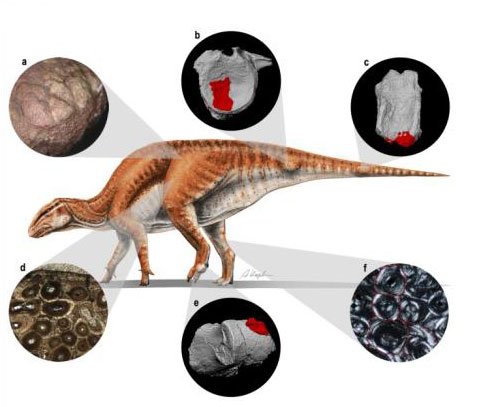
Life reconstruction of Gobihadros mongoliensis with pathology including evidence of CPPD highlighted indicating that this dinosaur was very old when it died. Picture credit: Slowiak et al.
Co-author of the paper Dr Tomasz Szczygielski (Polish Academy of Sciences) commented:
“Dinosaurs in the reptile family tree are close to birds, but some of their characteristics, such as metabolism, refer to mammals. That is why it is still difficult for us to interpret how these organisms aged”.
The fossilised remains of this elderly dinosaur are currently on display at the Museum of Evolution at the Palace of Culture and Science in Warsaw (Poland). The scientists hope that further research using other museum specimens may provide more information on how dinosaurs aged and this might provide an insight into why some kinds of archosaur such as the crocodiles survived the end-Cretaceous mass extinction event but the non-avian dinosaurs did not.
The scientific paper: “Dinosaur senescence: a hadrosauroid with age-related diseases brings a new perspective of “old” dinosaurs” by Justyna Słowiak, Tomasz Szczygielski, Bruce M. Rothschild & Dawid Surmik published in the journal Scientific Reports.
The clade of very bird-like dinosaurs known as the Oviraptorosauria, were very successful and widely distributed in the Northern Hemisphere during the Late Cretaceous. For example, the Nemegt Formation (Mongolia), is famous for the numerous oviraptorosaur dinosaurs that have been named and described from fossils, dinosaurs such as Conchoraptor, Rinchenia, Gobiraptor and the recently described two-fingered Oksoko (O. avarsan) that we featured in an article in October 2020: A New Species of Two-fingered Oviraptorosaur is Described.
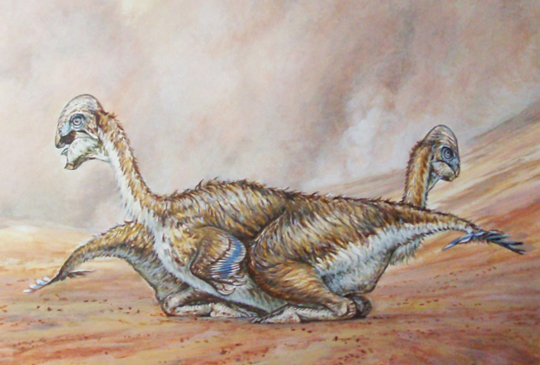
Roosting oviraptorids. The discovery of fragmentary fossils attributed to Elmisaurus (E. rarus) suggests that there was only one caenagnathid dinosaur present in the Nemegt Formation biota rather than two as previously thought. Picture credit: Mike Skrepnick.
Analysis of fragmentary fossil remains attributed to the caenagnathid Elmisaurus suggests that these members of the oviraptorosaur clade (the Caenagnathidae) were actually rare in Mongolia compared to the much more numerous and diverse oviraptorids.
Researchers, which include the eminent Professor Phil Currie (University of Alberta), writing in PLOS One conclude that caenagnathids may have been outcompeted by other oviraptorosaurs and as such, caenagnathids like Elmisaurus only made up a tiny portion of the dinosaur population associated with the Nemegt Formation.
Examining the Oviraptorosauria
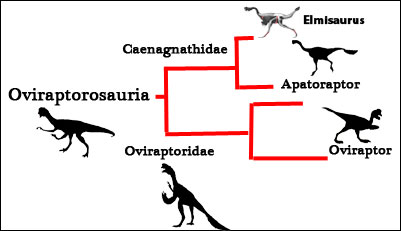
The Oviraptorosauria clade consists primarily of two large families of feathered dinosaur, the Caenagnathidae “recent jaws” and the closely related Oviraptoridae “egg thieves”.
Overall, the anatomy of caenagnathids is very similar to that of oviraptorids, but there are a number of differences. For example, caenagnathid jaws exhibited a distinct suite of specialisations not seen in other oviraptorosaurs. The jaws of caenagnathids tend to be relatively long and shallow, this suggests that their bite was not as powerful. The inside of the lower jaws also reveal a complex series of ridges and tooth-like processes, as well as a pair of horizontal, shelf-like ridges. Recent studies have demonstrated that as caenagnathids grew and got older they started to lose their teeth (ontogenetic edentulism).
The unusual jawbone morphology was produced by various tooth reduction patterns and this in turn, suggests that these dinosaurs changed their diet as they matured. Furthermore, the jaws of caenagnathids are unusual as the bones are hollow and air filled. In addition, in general terms caenagnathids tend to be more lightly built than the closely related oviraptorids.
The clade of feathered dinosaurs known as the Oviraptorosauria (egg thief lizards) contains two large families the Caenagnathidae, represented by Elmisaurus in the Nemegt Formation and the Oivraptoridae family which in the Nemegt Formation is represented by Conchoraptor, Nemegtomaia and Rinchenia. In a recently published research paper (summer 2021), scientists conclude that oviraptorids may have restricted caenagnathids to marginal roles in Late Cretaceous Asian ecosystems. Picture credit: Everything Dinosaur.
Picture credit: Everything Dinosaur
Nomingia gobiensis Actually Elmisaurus rarus
Two members of the Caenagnathidae had been described from fossils associated with the Nemegt Formation, Elmisaurus rarus which was scientifically described back in 1981 and Nomingia gobiensis which was named in the year 2000. The research team which included Gregory Funston (University of Edinburgh), Chinzorig Tsogtbaatar (North Carolina State University), Tsogtbaatar Khishigjav (Mongolian Academy of Sciences) as well as Professor Currie, examined a partial skeleton which had been discovered in 2018, close to the site where the holotype fossils of Nomingia had been found.
The team were able to highlight similarities in the overlapping elements of Elmisaurus and Nomingia. They concluded that fossil material previously attributed to Nomingia gobiensis might represent Elmisaurus rarus and that just one species of caenagnathid is known from the Nemegt Formation.
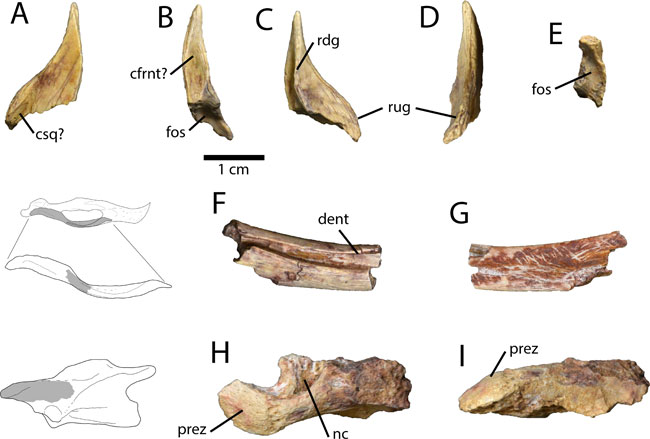
Fragmentary cranial and axial elements attributed to Elmisaurus rarus. The researchers concluded that fossil material assigned to the genus Nomingia actually represented Elmisaurus and therefore just one caenagnathid was currently known from the Nemegt Formation. Picture credit: Funston et al.
Oviraptorids Outcompeted Caenagnathids
The researchers discount the idea that a bias in fieldwork has led to the lack of caenagnathid fossil specimens found. After all, numerous small dinosaurs such as dromaeosaurids and oviraptorids are known from Nemegt Formation. The team postulated that the caenagnathids were marginalised and out competed by the similarly sized oviraptorids.
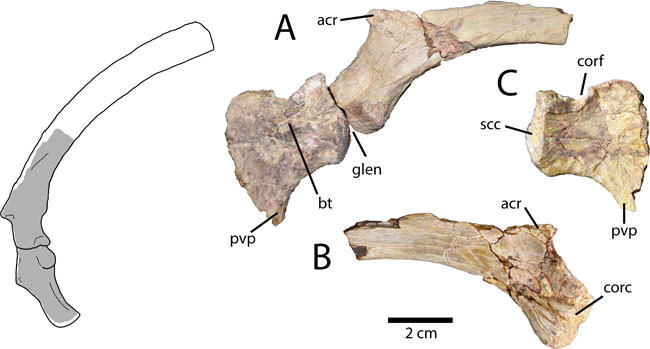
The pectoral girdle of Elmisaurus. Left scapulocoracoid in lateral view (A) and (B), left scapula in medial view. Left coracoid in medial view (C). Interpretive illustration of the closely related Canadian caenagnathid Apatoraptor pennatus for comparison. A fragmentary, weathered caenagnathid skeleton discovered near to the holotype quarry of Nomingia gobiensis is referable to Elmisaurus rarus, revealing more of the morphology of the skull, jaws, pectoral girdle, and pubis. Picture credit: Funston et al.
Differences in Asian and North American Late Cretaceous Ecosystems
The lack of caenagnathids reported from the Nemegt Formation might reflect competition amongst different types of small, cursorial, feathered dinosaurs. In North America, caenagnathids were the only oviraptorosaurs present (no oviraptorids are currently known from North America). In contrast, both oviraptorids and another type of oviraptorosaur closely related to the Caenagnathidae – the avimimids Avimimus portentosus and Avimimus nemegtensis were present in Mongolia during the Late Cretaceous.
The researchers conclude that although the highly diverse Nemegt Formation oviraptorids probably had very specialised diets, they may have outcompeted the caenagnathids in the niche of small omnivores.
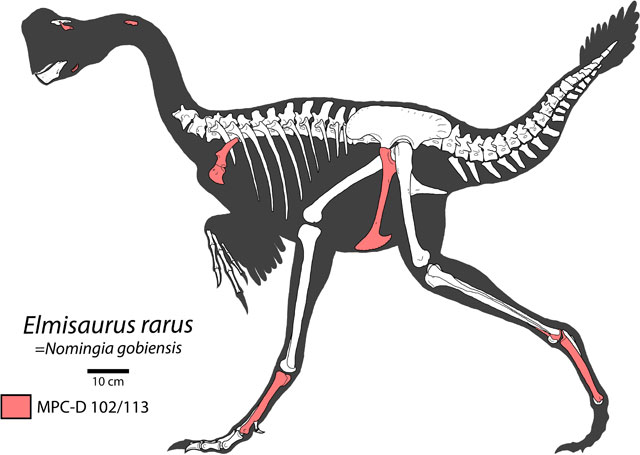
A skeletal reconstruction of Elmisaurus rarus. Fossils highlighted in red represent the recently discovered material from a site adjacent to the Nomingia holotype quarry. Analysis of the pectoral girdle suggests that Elmisaurus had quite powerful arms, adapted for rapid movements and the grabbing of prey. Picture credit: Funston et al.
As Nomingia gobiensis was named and scientifically described some nineteen years after Elmisaurus rarus, the research team postulate that Nomingia gobiensis should be regarded as a junior synonym of Elmisaurus. In addition, low caenagnathid diversity in the Nemegt Formation might reflect their inability to compete with other oviraptorosaurs, particularly oviraptorids.
The scientific paper: “A partial oviraptorosaur skeleton suggests low caenagnathid diversity in the Late Cretaceous Nemegt Formation of Mongolia” by Gregory F. Funston, Philip J. Currie, Chinzorig Tsogtbaatar, Tsogtbaatar Khishigjav published in PLOS One.
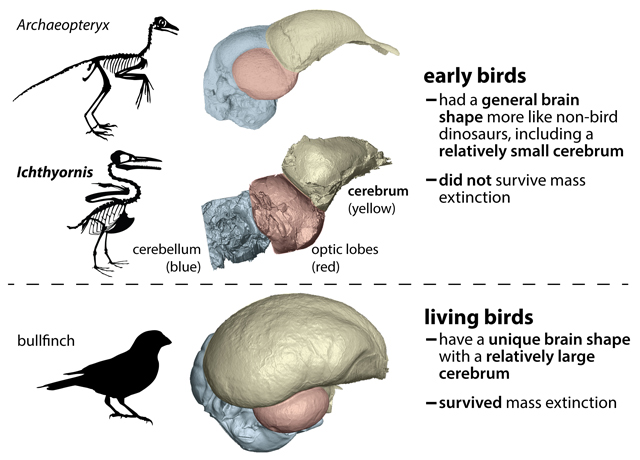
An Ichthyornis skull study sheds light on the evolution of brains within the Avialae.
Living birds are very diverse, globally distributed and occupy a huge number of ecological niches. Today, there are more species of birds than mammals, they are certainly extremely successful and they are the only members of the Dinosauria to have survived the end-Cretaceous extinction event. A new study published in Science Advances suggests the unique brain shape of the ancestors of modern birds may have helped them survive the mass extinction that wiped out all the other dinosaurs.
Rendering of the skull block showing the position of the endocast (pink) relative to the cranium and nearby preserved facial elements (translucent white). Picture credit: Christopher Torres / The University of Texas at Austin.
Studying a Fossil Skull
A beautifully preserved skull and jaws of the toothed stem bird (Avialae) Ichthyornis (I. dispar) was subjected to x-ray computed tomography at the University of Texas at Austin so that researchers could gain an better understanding of the shape of the brain of this Late Cretaceous bird.
Brain morphology in Mesozoic birds is very poorly understood. Only two other Mesozoic birds have had their brains mapped – Archaeopteryx lithographica from the Late Jurassic of Germany and the probable enantiornithine Cerebavis cenomanica from the Volgograd Region of Russia which is known from the Middle Cenomanian of the Cretaceous.
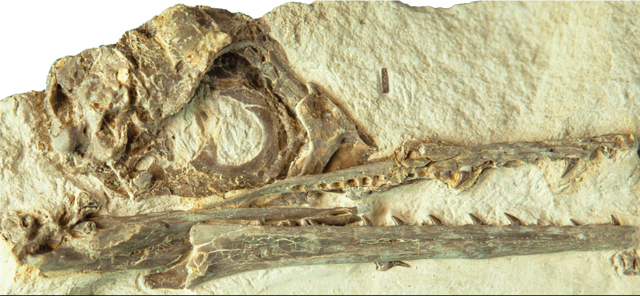
Photograph of skull block including the neurocranium and partial upper and lower jaws of the Ichthyornis specimen (AMNH FARB 32773). Picture credit: Christopher Torres / The University of Texas at Austin.
With the CT-imaging data, the researchers used the skull of Ichthyornis like a mould to create a three-dimensional replica of the brain called an endocast. They then compared that endocast with ones created for living birds and more distantly related, non-avian members of the Dinosauria.
To read a blog post from 2018 about an earlier study of an Ichthyornis skull that provided new information on the evolution of the beak in birds: The First Beak Under the Noses of Scientists.
Ichthyornis Skull Study
The scientists found that the brain of Ichthyornis had more in common with non-avian dinosaurs than it did with living birds. Specifically, the cerebral hemispheres – where higher cognitive functions such as speech, thought and emotion occur in humans – are much bigger in living birds than in Ichthyornis. That pattern suggests that these functions could be connected to surviving the mass extinction.
Lead author of the study, PhD student Christopher Torres (The University of Texas at Austin), commented:
“Living birds have brains more complex than any known animals except mammals. This new fossil finally lets us test the idea that those brains played a major role in their survival.”
The ancestors of living birds had a brain shape that was very different from other dinosaurs (including other early birds). This suggests that brain differences may have affected survival during the mass extinction that wiped out all non-avian dinosaurs. Picture credit: Christopher Torres / The University of Texas at Austin.
Co-author of the study Julia Clarke, a professor at the University of Texas Jackson School of Geosciences added:
“Ichthyornis is key to unravelling that mystery. This fossil helps bring us much closer to answering some persistent questions concerning living birds and their survivorship among dinosaurs.”
To read a related article published in 2013, that suggested that dinosaur brains were pre-programmed to permit complicated co-ordinated moves, helpful when evolving powered flight : Study Shows Dinosaur Brains Pre-programmed for Flight.
The scientific paper: “Bird neurocranial and body mass evolution across the end-Cretaceous mass extinction: The avian brain shape left other dinosaurs behind” by Christopher R. Torres, Mark A. Norell and Julia A. Clarke published in Science Advances.
Analysis of a beautifully preserved lower jawbone found in the southern Pyrenees of Spain has led to a new species of Late Cretaceous hadrosauroid dinosaur being erected. Named Fylax thyrakolasus (F. thyrakolasus), it is the youngest non-hadrosaurid hadrosauroid described to date. This dinosaur was one of the very last of all the non-avian dinosaurs to have existed and a phylogenetic assessment places Fylax as the sister taxon of Tethyshadros which is known from north-eastern Italy and was formally named and described in 2009.
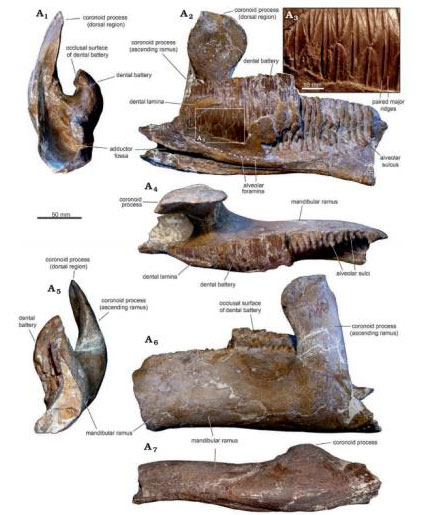
Dentary of the hadrosauroid dinosaur Fylax thyrakolasus gen. et sp. nov. (IPS-36338, holotype) from the uppermost Maastrichtian Figuerola Formation. Views of the specimen in posterior (A1), medial (A2), dorsal (A4), anterior (A5), lateral (A6), and ventral (A7) views. A detailed lingual view of the tooth crowns appears in A3. Picture credit: Prieto-Márquez and Carrera Farias.
Described from a Dentary
Described from a left dentary (lower jawbone), found in Lleida Province in Spain, the researchers from The Autonomous University of Barcelona (Universitat Autònoma de Barcelona), identified several unique characteristics that enabled them to erect a new taxon. The genus name is derived from the Greek thýra which means door or gate and kólasi which means hell. This translates as the “keeper of the gates of hell” a reference to the proximity of the fossil dentary to the layers of rock that mark the end Cretaceous mass extinction event that saw the demise of the non-avian dinosaurs.
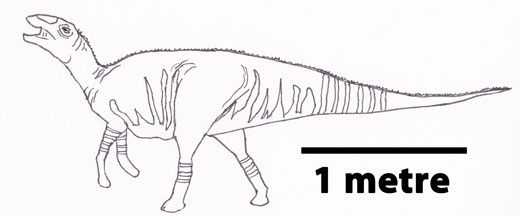
Based on analysis of more complete hadrosaurid fossil remains, Fylax is estimated to have been between 3.5 to 4 metres in length and it is the stratigraphically youngest non-hadrosaurid hadrosauroid known to date.
A life reconstruction of the recently described hadrosauroid from the uppermost Maastrichtian strata of the Figuerola Formation in the southern Pyrenees of Spain. The dinosaur, one of the very last to exist, has been named Fylax thyrakolasus. Note scale bar = 1 metre. Picture credit: Everything Dinosaur.
Picture credit: Everything Dinosaur
An Asian Origin for Hadrosauroids
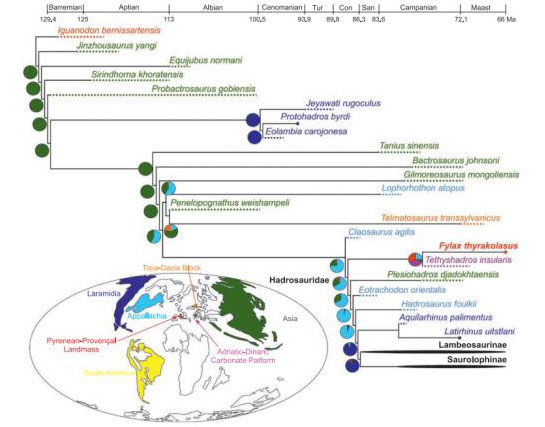
Although not the focus of their study, subsequent analysis and mapping of the geographical distribution of ornithopod fossil remains led the researchers to support the hypothesis of an Asian origin for hadrosauroids, which then subsequently dispersed to the eastern North American landmass of Appalachia. They suggest that the European archipelago that existed during the Late Cretaceous could have facilitated the westward dispersal of hadrosaurid outgroups from Asia to Appalachia.
A time calibrated cladogram showing global distribution of hadrosaurs and their close relatives. Pie charts indicate the likelihood of ancestral areas. This study suggests an Asian origin for hadrosauroids and subsequent dispersal to Appalachia, where Hadrosauridae probably evolved, from here once dispersed into Laramidia the Lambeosaurinae and Saurolophinae subfamilies evolved. The European archipelago probably provided a series of island stepping stones permitting the dispersal of hadrosaurids from Asia into North America. Picture credit: Prieto-Márquez and Carrera Farias.
The scientific paper: “A new late-surviving early diverging Ibero-Armorican duck-billed dinosaur and the role of the Late Cretaceous European Archipelago in hadrosauroid biogeography” by Prieto-Márquez, A. and Carrera Farias published in Acta Palaeontologica Polonica.
Researchers have described a new species of crocodilian from the Late Jurassic of Chile. Named Burkesuchus (B. mallingrandensis), it heralds from the Toqui Formation of southern Chile. As such, this 70-centimetre-long reptile shared its home with sauropods and the bizarre Chilesaurus (C. diegosuarezi). Analysis of the fragmentary fossil bones, including all important skull material suggests that Burkesuchus was a basal member of the Mesoeucrocodylia, the crocodilian lineage that led to modern crocodiles.
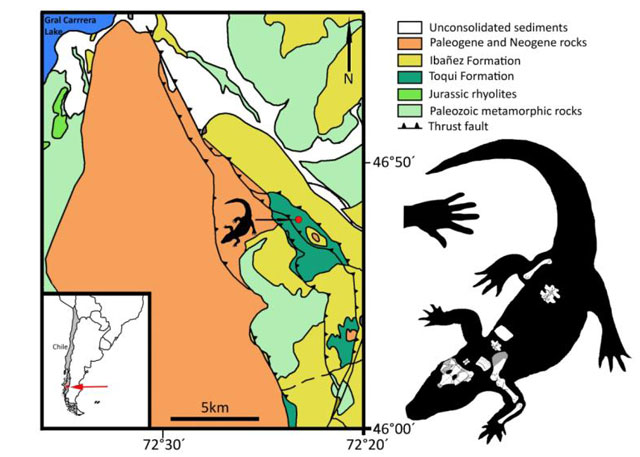
A map (insert) showing the location of the fossil finds, the geology of the region and a silhouette of Burkesuchus showing location of known bones within the skeleton with a human hand silhouette to show scale. The silhouette shows the skeletal location of the prehistoric crocodile remains. Picture credit: Novas et al.
Shedding Light on the Fauna Associated with the Toqui Formation
Fossils of Burkesuchus were collected from outcrops of the Toqui Formation (Tithonian stage of the Late Jurassic). Analysis of zircon samples subjected to radiometric dating suggest that this small crocodilian lived around 147 million years ago. The fossils found consist of skull material, dorsal vertebrae, elements from the limbs including a right scapula and coracoid (shoulder bones) a nearly complete right femur (thigh bone) and several osteoderms (body armour).
Photographs and line drawings of the cranium (SGO.PV 17700) of Burkesuchus mallingrandensis in (A, B) dorsal; (C, D) posterior; and (E, F) left lateral views. Note scale bar equals 1 cm. Picture credit: Novas et al.
A “Missing Link” in Crocodile Evolution
The genus name honours the American Coleman Burke for his financial support of the field work and “suchus” from Latin, meaning crocodile. The species name is a reference to Mallín Grande, the name given to this scenic, very beautiful but remote part of Chile, south of General Carrera Lake.
Semi-aquatic crocodilian fossils dating from the Jurassic of South America are rare. To date, the only other non-marine crocodilian known from this continent is Batrachomimus from the Upper Jurassic of Brazil, which is thought to be a paralligatorid. However, analysis of the limb bones associated with Burkesuchus reveals that it possibly represents an intermediate form between crocodilians with a more semi-erect gait and sprawling forms reflecting the gait and locomotion of modern crocodilians. Burkesuchus could represent a transitional form, helping palaeontologists to understand the evolutionary history of this important group of archosaurs.
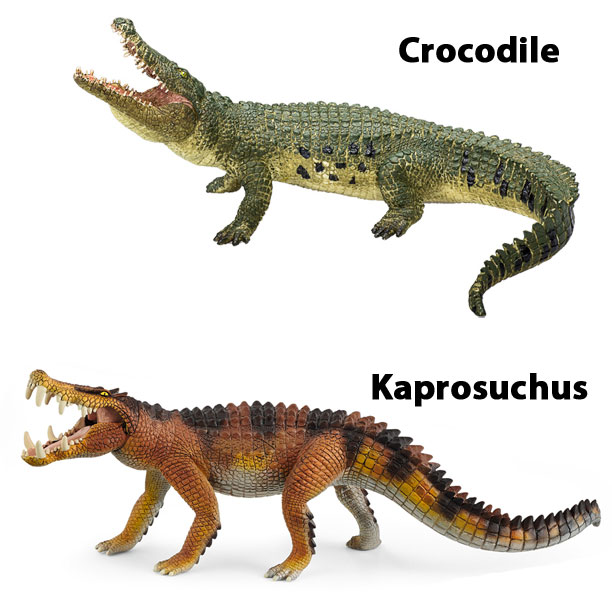
Comparing the gait of a modern crocodile (top) with that of Kaprosuchus from the Late Cretaceous of Niger. During the Mesozoic crocodyliforms occupied a wide variety of ecological niches and many different gaits were adopted. Today, modern extant crocodilians and their relatives all have a sprawling gait. Picture credit: Everything Dinosaur.
Picture credit: Everything Dinosaur
The Significance of a Prehistoric Crocodile
The discovery of Burkesuchus expands the meagre record of non-marine crocodile representatives from the Late Jurassic of South America and the researchers conclude that Batrachomimus and Burkesuchus indicate that the evolution of more derived crocodyliforms could have occurred in South America.
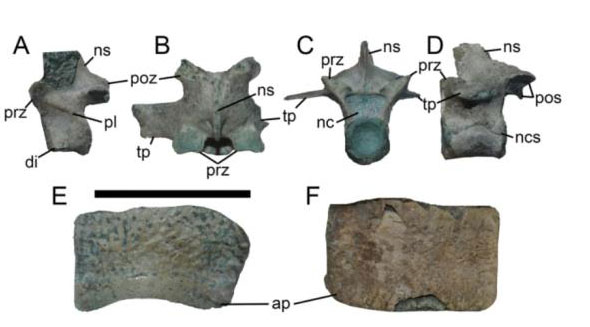
Photographs of vertebrae and osteoderm of Burkesuchus mallingrandensis (SGO.PV 17700). (A) cervical vertebra in left lateral view; (B–D) dorsal vertebra in (B) dorsal, (C) anterior, and (D) left lateral views; (E–F), dorsal osteoderm in (E), dorsal and (F), ventral views. Scale bar equals 1 cm. Picture credit: Novas et al.
The scientific paper: “New transitional fossil from late Jurassic of Chile sheds light on the origin of modern crocodiles” by Fernando E. Novas, Federico L. Agnolin, Gabriel L. Lio, Sebastián Rozadilla, Manuel Suárez, Rita de la Cruz, Ismar de Souza Carvalho, David Rubilar-Rogers and Marcelo P. Isasi published in Scientific Reports.