All about dinosaurs, fossils and prehistoric animals by Everything Dinosaur team members.

About Mike

Mike runs Everything Dinosaur, a UK-based mail order company specialising in the sale of dinosaur and prehistoric animal models, He works alongside Sue, and between them they have become the "go to guys" for museum quality prehistoric animal models and figures. An avid fossil collector and reader of dinosaur books, Mike researchers and writes articles about palaeontology, fossil discoveries, research and of course, dinosaur and prehistoric animal models.
4 04, 2022

Rebor Saurophaganax “Badlands” Video Showcase

By |2022-10-23T16:51:48+01:00April 4th, 2022|Categories: Dinosaur Fans, Everything Dinosaur News and Updates, Everything Dinosaur Products, Everything Dinosaur videos, Main Page, Photos of Everything Dinosaur Products|0 Comments

Team members at Everything Dinosaur have created a short product video showcase featuring the Rebor Saurophaganax maximus “Badlands” version. The “Badlands” colour variant is one of three, 1:35 scale Saurophaganax figures recently introduced by Rebor, Everything Dinosaur plans to make short YouTube videos for each variant – “Badlands”, “Jungle” and the crimson coloured “Volcanic Cavern”.

The Everything Dinosaur Product Showcase Video of the Rebor Saurophaganax maximus Notorious Big in the “Badlands” colour scheme.

Rebor Saurophaganax maximus Notorious Big “Badlands”

The short video lasts for approximately 45 seconds. It was shot in Everything Dinosaur’s studio and shows the new Rebor dinosaur model on a rotating turntable. This permits viewers to get a good view of the figure from a variety of angles. The snug fit of the tail piece can be observed, the seam is barely visible.

Rebor Saurophaganax maximus "Notorious Big"
The Rebor Saurophaganax maximus “Notorious Big” 1:35 scale dinosaur model shown in right lateral view. The model is in the “Badlands” colour scheme. The video highlights the tight fit of the tail piece. There is virtually no sign of a seam.

The video concludes by showing the model held by a person, which gives an immediate impression of size. The articulated jaw is demonstrated and the tail is repositioned to highlight its flexibility.

The model is very stable as it slowly rotates on the turntable during the video.

Rebor Saurophaganax dinosaur model "Badlands"
REBOR 1:35 Saurophaganax maximus Museum Class Replica “Notorious Big” in the “Badlands” colour scheme. A short video has been created that highlights the features of this dinosaur model.

To view the Rebor Saurophaganax maximus in the “Badlands” colour scheme and the rest of the models and prehistoric animals in stock at Everything Dinosaur: Rebor Models and Figures.

For more product showcase videos take a look at Everything Dinosaur on YouTube: Visit Everything Dinosaur on YouTube and Subscribe.

3 04, 2022

Preparing for Exclusive Rebor Saurophaganax Product Showcase Videos

By |2024-11-04T07:18:45+00:00April 3rd, 2022|Categories: Adobe CS5, Dinosaur Fans, Everything Dinosaur News and Updates, Everything Dinosaur Products, Everything Dinosaur videos, Main Page, Photos of Everything Dinosaur Products, Press Releases|0 Comments

Team members at Everything Dinosaur are busy creating three Rebor Saurophaganax maximus product showcase videos that will be posted up on the company’s YouTube channel. The plan is to produce one short video showcase for each of the three colour variants that have been introduced “Badlands”, “Jungle” and the crimson coloured “Volcanic Cavern”.

Rebor Saurophaganax in the "Badlands" colour scheme, the product video showcase.

The Rebor Saurophaganax maximus in a scale of 1:35. This is the Notorious Big “Badlands” colour variants, one of three versions produced and the first to have a product video showcase posted up on Everything Dinosaur’s YouTube channel. Picture credit: Everything Dinosaur.

Picture credit: Everything Dinosaur

Popular Rebor Dinosaur Models

The three Rebor Saurophaganax maximus replicas have proved to be extremely popular amongst dinosaur fans and model collectors. Everything Dinosaur has received a number of requests to develop more product showcase videos, highlighting features such as the articulated jaw, the different colour schemes, the movable arms and the flexible tail.

A spokesperson from Everything Dinosaur commented:

“We are happy to oblige, the footage has been shot and in the next few days the first product video showcase featuring the “Badlands” colour variant will be posted up onto our YouTube channel.”

Visit the Everything Dinosaur website: Dinosaur Toys and Models.

A trio of Rebor Saurophaganax models.

Three in a row! The three new for 2022 Rebor Saurophaganax maximus dinosaur models. Foreground “Jungle” colour scheme, middle “Badlands” and in the background “Volcanic Cavern”. Picture credit: Everything Dinosaur.

Picture credit: Everything Dinosaur

Product Video Showcases of Rebor Notorious Big “Jungle” and “Volcanic Cavern” to Follow

Everything Dinosaur plans to upload the product video showcases for the other two colour schemes “Jungle” and “Volcanic Cavern” shortly. This will provide potential purchasers with the opportunity to view videos of the actual models.

Rebor Saurophaganax in the "Jungle" colour scheme, the product video showcase.

The Rebor Saurophaganax 1:35 scale dinosaur model in the “Jungle” colour variant. Everything Dinosaur plans to add three Saurophaganax product showcase videos to the company’s YouTube channel – one for each colour variant. Picture credit: Everything Dinosaur.

Picture credit: Everything Dinosaur

The videos will be posted up on Everything Dinosaur’s YouTube channel and shared across its social media platforms. To visit Everything Dinosaur on YouTube: Visit Everything Dinosaur on YouTube.

Rebor Saurophaganax in the "Volcanic Cavern" colour scheme, the product video showcase.

The Rebor Saurophaganax maximus “Volcanic Cavern” colour scheme. The Everything Dinosaur product video showcase titles. The UK-based mail order company intends to post up on the company’s YouTube channel a short video highlighting this Rebor replica.

Picture credit: Everything Dinosaur

The picture (above), shows the crimson coloured Rebor Saurophaganax maximus in the “Volcanic Cavern” colour scheme. Everything Dinosaur intends to post up on the company’s YouTube channel a short video highlighting this fabulous Rebor replica.

To view the Saurophaganax dinosaur models and the rest of the Rebor prehistoric animal figures in stock at Everything Dinosaur: Rebor Prehistoric Animal Models and Figures.

2 04, 2022

Everything Dinosaur Receives 200 Unique Google 5-Star Reviews

By |2024-11-04T07:11:32+00:00April 2nd, 2022|Categories: Dinosaur Fans, Everything Dinosaur News and Updates, Main Page, Press Releases|0 Comments

Everything Dinosaur has received 200 Google 5-star reviews in a row. Every single one of our last 200 Google reviews from customers has been 5-stars. It’s top marks for Everything Dinosaur.

Everything Dinosaur records 200 5-star Google reviews in a row.

Everything Dinosaur has recorded 200 5-star Google reviews. Of the 200 reviews on Google gathered by Everything Dinosaur since it moved into its new premises last year, everything single one of these customer reviews have been 5-stars. Top marks for Everything Dinosaur.

Reviews on Products and Customer Service

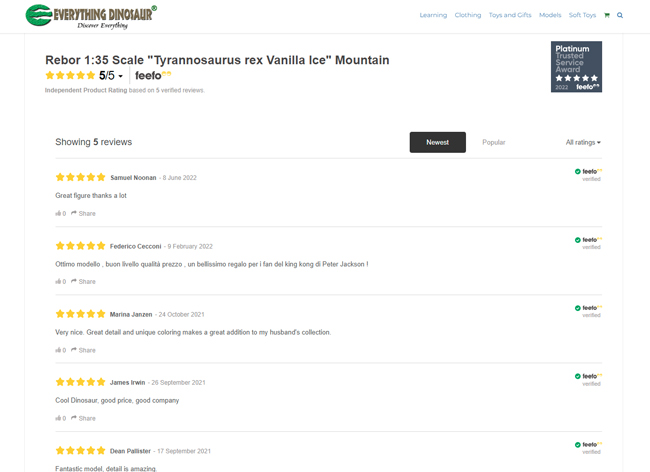
Everything Dinosaur has won numerous awards for its customer service and the quality of the dinosaur and prehistoric animal models that it stocks. It has been a winner of the prestigious Feefo Platinum Service Award, ever since this accolade was introduced by the independent ratings company Feefo.

The UK-based specialist mail order company can now boast a run of two hundred 5-star Google reviews in a row.

Feefo 2022 Awards.

Everything Dinosaur wins the Platinum Service Award.  Everything Dinosaur receives 5-star reviews.

With the company moving into larger premises last year (2021), the decision was taken to start collecting Google customer reviews that could be shown on Google maps to mark the location of the new offices and warehouse. Of the two hundred reviews collected to date, every single customer has awarded Everything Dinosaur the highest mark for customer service – five gold stars.

A spokesperson for the company stated:

“We are grateful for all the feedback and reviews that we receive. We have thousands of customer comments logged on our website, along with thousands more collected by the independent ratings agency Feefo. It is pleasing to note that our excellent customer service and extensive product range is acknowledged by Google reviews to.”

Since the move to the new premises, a total of two hundred customer reviews have been collected, all of the reviews award Everything Dinosaur the highest rating for customer service and quality.

The spokesperson added:

“We are humbled by all the kind words and comments that have come our way. We are grateful for every single review we receive and we welcome feedback from our customers.”

To view the award-winning Everything Dinosaur’s website that highlights the extensive range of dinosaur and prehistoric animal merchandise that the company stocks: Everything Dinosaur dinosaur models, toys and games.

1 04, 2022

New PNSO Dinosaur Models Arrive

By |2024-11-04T07:06:25+00:00April 1st, 2022|Categories: Adobe CS5, Dinosaur Fans, Everything Dinosaur News and Updates, Everything Dinosaur Products, Main Page, Photos of Everything Dinosaur Products, Press Releases|0 Comments

The first of the 2022 PNSO dinosaur models have arrived at Everything Dinosaur. Team members have been busy sorting out all the orders from enthusiastic collectors of the PNSO prehistoric animal model range and contacting all those dinosaur fans who wanted to know when these exciting new figures arrived.

New for 2022 PNSO models in stock at Everything Dinosaur

The first of the new for 2022 PNSO prehistoric animal models have arrived at Everything Dinosaur. Picture credit: Everything Dinosaur.

Picture credit: Everything Dinosaur

Seven New Dinosaur Models

Although PNSO have a deserved reputation for producing a wide range of Mesozoic figures the first new for 2022 models to be delivered to our warehouse are all dinosaurs.

Here is the full list:

  • Anthony the Styracosaurus (horned dinosaur model).
  • Doyle the Triceratops with skull.
  • Xiaoqin the Tsintaosaurus in 1:35 scale.
  • Essien the Spinosaurus in 1:35 scale (new colour scheme).
  • Harvey the Iguanodon in 1:35 scale.
  • Jennie the Centrosaurus (horned dinosaur model).
  • Lu Xiong the Zhuchengtyrannus.
New PNSO dinosaur models (2022)

Six new for 2022 PNSO dinosaur models are due in stock at Everything Dinosaur in a few days. Top row Harvey the Iguanodon (left), Doyle the Triceratops (centre) and Anthony the Styracosaurus. On the bottom row – (left) Jennie the Centrosaurus, Lu Xiong the Zhuchengtyrannus (centre) and Xiaoqin The Tsintaosaurus (right).

A spokesperson from Everything Dinosaur commented:

“Team members at Everything Dinosaur are going to have a busy few days contacting all the customers who wanted to be emailed when these new PNSO figures arrived. However, we will be working as hard as we can and we will ensure that parcels get despatched to customers as quickly as possible.”

Visit the Everything Dinosaur website: Dinosaur Models and Toys.

PNSO Essien the Spinosaurus (2022)

The new Essien the Spinosaurus in 1:35 scale (revised colour scheme). Picture credit: Everything Dinosaur.

Picture credit: Everything Dinosaur

To view the new PNSO dinosaur models and the rest of the PNSO prehistoric animal model series in stock at Everything Dinosaur: PNSO – Age of Dinosaurs.

31 03, 2022

Large Mammals with Small Brains Prone to Extinction

By |2024-10-30T13:47:40+00:00March 31st, 2022|Categories: Adobe CS5, Dinosaur and Prehistoric Animal News Stories, Key Stage 3/4, Main Page, Palaeontological articles|0 Comments

Scientists from the University of Tel Aviv in collaboration with colleagues from the University of Napoli have published a study that suggests having a small brain relative to your body size predisposed Late Quaternary mammals to extinction. If you were a “smart” mammal, with a relatively big brain in proportion to your body size, you were less likely to become extinct.

A Megatherium soft toy.

A soft toy Megatherium. The newly published research suggests that mammals with relatively small brains in proportion to their large bodies for example, many members of the Order Pilosa such as the ground sloths, were more likely to go extinct in the Late Quaternary.

The Extinction of Megafauna

The Late Quaternary is marked by a drastic global extinction event, mainly of large-bodied, land mammals. Causes proposed for these extinctions include overhunting by an increasing human population, particularly in areas such as the Americas and Oceania where modern humans had been largely absent previously. Earlier papers had proposed that species with traits that make them less prone to human hunting (arboreal, nocturnal, or forest dwelling) were more likely to survive.

However, the rapid decline and extinction of large, terrestrial animals is linked to the end of the last glacial period (25,000 to 12,000 years ago) which saw dramatic climate change. The research team hypothesised that the large mammals that survived the extinctions might have been endowed with larger brain sizes than those that perished. Larger brains might have helped these animals to adapt better and to cope with the wild fluctuations in climate.

To test this idea, the scientists assembled data on the brain size of 291 living mammal species plus 50 more that went extinct during the Late Quaternary.

The team found that models that used brain size in addition to body size predicted extinction status better than models that used only body size. It was concluded that possessing a large brain was an important, yet so far neglected and rarely studied characteristic of surviving megafauna species.

Quaternary mammal extinction study

The phylogenetic tree used in the brains size relative to body size paper. Terminal branches are colored according to residuals of endocast volume versus body mass regression with order as a random effect (large brains: green; small brains: gold). Large mammals with proportionately large brains such as monkeys record a lower level of extinction compared to other types of mammal. Picture credit: Dembitzer et al.

Picture credit: Dembitzer et al

Implications for Large Mammals Living Today

One prominent feature shared by many extinct taxa was their large body size. In mammals, body size is correlated with several traits, including low population density, small population size, long lifespans, extended gestation periods along with prolonged inter-birth intervals and low fecundity.

Brain size is strongly correlated with body size as well and yet, mammals of similar size can have greatly different brain sizes.

An illustration of Doedicurus. Prehistoric life models.

Members of small-brained orders may not have possessed the behavioural flexibility needed to cope with a changing climate and/or the arrival of Homo sapiens. Glyptodonts such as Doedicurus (order Cingulata), with their large bodies and small brains died out in the Late Quaternary.  Picture credit: Everything Dinosaur.

Picture credit: Everything Dinosaur

In studies of modern birds and mammals, large brains have been found to improve survivability as these animals can modify their behaviour and adapt to rapidly changing environments and new threats such as an expanding human population.

When considering which animals around today might be under the most severe threat of extinction, brain-size should be considered when calculating the risk factors.

The paper published as an open access document in “Scientific Reports”

The scientific paper: “Small brains predisposed Late Quaternary mammals to extinction” by Jacob Dembitzer, Silvia Castiglione, Pasquale Raia and Shai Meiri published in Scientific Reports.

The Everything Dinosaur website: Dinosaur Toys and Models.

30 03, 2022

Preparing for the New Zhuchengtyrannus Model

By |2024-10-30T13:36:01+00:00March 30th, 2022|Categories: Adobe CS5, Dinosaur Fans, Everything Dinosaur News and Updates, Everything Dinosaur Products, Main Page, Press Releases|0 Comments

The new for 2022 PNSO Zhuchengtyrannus dinosaur model is due to be in stock at Everything Dinosaur in the next few days and team members have been busy completing the free fact sheet on this fearsome dinosaur that we send out with product purchases.

As part of our preparations, we have created a scale drawing for our free fact sheet. Zhuchengtyrannus might not be the best-known member of the Tyrannosauridae family but based on the fragmentary fossils ascribed to this genus it is the largest tyrannosaur described from Asia known to science.

Zhuchengtyrannus magnus scale drawing.

Everything Dinosaur’s scale drawing of the giant, Late Cretaceous Asian tyrannosaur Zhuchengtyrannus (Z. magnus). Picture credit: Everything Dinosaur.

Picture credit: Everything Dinosaur

PNSO Lu Xiong the Zhuchengtyrannus Dinosaur Model

The PNSO Lu Xiong the Zhuchengtyrannus dinosaur model is due to arrive along with several other new for 2022 PNSO figures in the next few days (expected early April 2022). As well as containing the PNSO Zhuchengtyrannus other new PNSO models in the shipment include Jennie the Centrosaurus and Anthony the Styracosaurus along with the 1:35 scale new Triceratops, Tsintaosaurus and Harvey the Iguanodon.

PNSO Zhuchengtyrannus dinosaur model

The new for 2022 PNSO Zhuchengtyrannus model. This fearsome Late Cretaceous theropod was formally named and described in 2011 (Hone et al).

Preparing for Zhuchengtyrannus

A spokesperson from Everything Dinosaur commented: Dinosaur Models.

“PNSO have earned a formidable reputation over the last few years or so for the excellence of their prehistoric animal models and figures. More new models will be announced in the near future, for the time being we are just delighted to be getting these fantastic dinosaur figures into stock. In addition, we are busy preparing for Zhuchengtyrannus.”

The award-winning Everything Dinosaur website: 

New PNSO dinosaur models (2022)

Six new for 2022 PNSO dinosaur models are due in stock at Everything Dinosaur in a few days. Top row Harvey the Iguanodon (left), Doyle the Triceratops (centre) and Anthony the Styracosaurus. On the bottom row – (left) Jennie the Centrosaurus, Lu Xiong the Zhuchengtyrannus (centre) and Xiaoqin The Tsintaosaurus (right).

To view the range of PNSO prehistoric animal models and figures available from Everything Dinosaur: PNSO Age of Dinosaurs Models.

29 03, 2022

When Did the Beetles Take Over the World?

By |2024-10-30T13:08:19+00:00March 29th, 2022|Categories: Adobe CS5, Animal News Stories, Dinosaur and Prehistoric Animal News Stories, Main Page, Palaeontological articles, Photos/Pictures of Fossils|1 Comment

Remarkably, one in four named animal species is a beetle. There are over 380,000 beetle species that have been scientifically described and perhaps several million more awaiting formal description. Members of the Order Coleoptera are distinguished from other insects as their front pair of wings are hardened into wing-cases (elytra) and they exploit a huge range of ecological niches and environments. However, their evolutionary origins remain uncertain and it is not known exactly when these six-legged animals became so numerous and specious.

Seventeen scientists including researchers from the University of Bristol have set about unravelling the evolutionary history of these amazing insects.

Permian beetle fossils and line drawings.

Examples of Permian beetles including fossilised wings and carapaces with (B and D) life reconstructions. Picture credit: NIGPAS.

Picture credit: NIGPAS

Mammoth Mathematical Models

A project to map the evolutionary history of arguably, the most successful and diverse animals of all time was a mammoth task. The researchers used a 68-gene character dataset that had been compiled previously which had sampled 129 out of the 193 recognised beetle families alive today and compared this to the beetle fossil record to provide a refined timescale of beetle evolution. A supercomputer at the University of Bristol’s Advanced Computing Research Centre slogged through the information for 18 months to produce the most comprehensive evolutionary tree of the Coleoptera ever created.

The mathematical models at the very heart of this research demonstrated that different beetle clades diversified independently, as various new ecological opportunities arose. There was no single, immense, all-encompassing divergence event.

One of the corresponding authors of the paper, published by Royal Society Open Science, Professor Chenyang Cai (University of Bristol) commented:

“There was not a single epoch of beetle radiation, their secret seems to lie in their remarkable flexibility. The refined timescale of beetle evolution will be an invaluable tool for investigating the evolutionary basis of the beetle’s success story”.

A beautifully preserved weevil fossil (Crato Formation).

Although beetle fossils are exceptionally rare, the research team used data from a total of 57 beetle fossils to help map the evolutionary development of the Coleoptera. The picture above shows the fossilised remains of a beetle from the Early Cretaceous of Brazil (Crato Formation). Picture credit: Museu Nacional.

Picture credit: Museu Nacional

Carboniferous Origins but the Evolution of Flowering Plants had Little Impact

The oldest beetle fossils date back to around 295 million years ago (Early Permian), molecular clock studies indicate an origin in the Late Carboniferous. The analysis revealed that all the modern beetle suborders had originated by the Late Palaeozoic with a Triassic-Jurassic origin of most of the extant families.

It had been thought that as flowering plants became the dominant terrestrial plants in a period referred to as the Cretaceous Terrestrial Revolution (KTR), so beetles diversified to take advantage of new ecological niches as the angiosperms evolved. However, this study concludes that the major beetle clades were present before the KTR. Nevertheless, some scarabaeoid and cucujiform clades underwent diversification during the Late Jurassic to Early Cretaceous, partly overlapping with the diversification of major angiosperms clades in the Early to mid-Cretaceous.

However, the previously postulated strong link between flowering plant evolution and the rapid expansion of the beetle suborder is refuted by this research.

Ancient weevil life reconstruction.

Newly published research concludes that the rise of the flowering plants did not result in a substantial expansion of the Coleoptera. Picture credit James McKay.

Picture credit: James McKay

Advances in Technology and Genetics

Professor Cai explained that this research into the Coleoptera would not have been possible without advances in computer technology and genetics. He stated:

“Reconstructing what happened in the last 300 million years is key to understanding what gave us the immense diversity beetles are known for today”.

Everything Dinosaur acknowledges the assistance of a media release from the University of Bristol in the compilation of this article.

The scientific paper “Integrated phylogenomics and fossil data illuminate the evolution of beetles” by Chenyang Cai, Erik Tihelka, Mattia Giacomelli, John F. Lawrence, Adam Ślipiński, Robin Kundrata, Shûhei Yamamoto, Margaret K. Thayer, Alfred F. Newton, Richard A. B. Leschen, Matthew L. Gimmel, Liang Lü, Michael S. Engel, Patrice Bouchard, Diying Huang, Davide Pisani and Philip C. J. Donoghue published in Royal Society Open Science.

The Everything Dinosaur website: Prehistoric Animal Models.

28 03, 2022

Important News as Plans to Put Product Videos onto Company Website Suspended

By |2024-10-30T12:57:30+00:00March 28th, 2022|Categories: Adobe CS5, Dinosaur Fans, Everything Dinosaur News and Updates, Main Page, Photos of Everything Dinosaur Products, Press Releases|0 Comments

In late January, Everything Dinosaur announced plans to add short videos to the product pages of its award-winning website: Everything Dinosaur however, the lack of a suitable plug-in to facilitate videos without compromising the site speed has led to a suspension of the project.

Everything Dinosaur YouTube video showcase.

Everything Dinosaur’s YouTube channel will include more short product videos, each one less than a minute in length that will highlight product features and showcase the prehistoric animal figure. Picture credit: Everything Dinosaur.

Picture credit: Everything Dinosaur

Balancing the Needs of Customers

The intention had been to include product videos, highlighting prehistoric animal models to compliment the images found on Everything Dinosaur’s product pages. However, the three WordPress plug-ins tried either failed to work properly or compromised the website’s load speed.

Rebor hatchling Deinosuchus (Estuary variant) - the video showcase image.

Several showcase videos had been created including one of the limited edition Rebor hatchling Deinosuchus in the estuary colour scheme. Whilst these videos will still be available on Everything Dinosaur’s YouTube channel they will not be featuring on the company’s website.

A spokesperson from Everything Dinosaur commented:

Our website is quite sophisticated and we require a plug-in to be able to play embedded videos from our YouTube channel without causing conflicts with other elements of our website and not slowing down the site. So far, despite our dedicated efforts we have not found the ideal partner.”

Everything Dinosaur’s website is optimised for fast loading on all devices including mobile phones. The site loading time is a key performance indicator for the company as fast loading websites provide an enhanced customer experience.

Visit the Everything Dinosaur website: Dinosaur Toys.

Continuing to Look

Whilst the project has been shelved, Everything Dinosaur will continue to look for suitable plug-ins for their website so that product showcase videos can be played. These videos will still be available on the company’s YouTube channel providing potential purchasers with more information on prehistoric animal models than can be conveyed using standard images alone.

Schleich Styracosaurus video showcase

Images as well as videos had been prepared but the lack of a suitable plug-in to accommodate short product videos without compromising the loading of the website has led to the video project being suspended.

To visit Everything Dinosaur’s YouTube channel: Everything Dinosaur on YouTube.

27 03, 2022

The Oldest Dinosauromorph from South America

By |2024-10-30T12:49:22+00:00March 27th, 2022|Categories: Adobe CS5, Dinosaur and Prehistoric Animal News Stories, Dinosaur Fans, Main Page, Palaeontological articles, Photos/Pictures of Fossils|0 Comments

The debate continues as to when the first dinosaurs evolved. Some of the oldest specimens described to date come from the famous Ischigualasto Formation located in north-western Argentina. These sediments are estimated to be around 232 million years old. It is thought that the first true dinosaurs evolved in the Southern Hemisphere and many palaeontologists favour a South American origin whilst others consider the evolutionary cradle of the Dinosauria was Africa: Dinosaurs Out of Africa?

To compound this debate, the fossil record of the ancestors of dinosaurs is particularly sparse. Some older Argentinian deposits have provided evidence of the precursors to the “true dinosaurs”, with some of these fossils estimated to be around 236 million years of age. However, scientists from the Universidade Federal de Santa Maria (Rio Grande do Sul, Brazil), have reported the discovery of a single fossilised thigh bone from Middle Triassic sediments in Brazil that predates all the Argentinian dinosauromorph fossils.

Dinosauromorph femur fossil from Brazil.

A skeletal drawing showing the placement of the right femur bone (shown in white) and a photograph of the actual fossil. Skeletal drawing by Maurício Silva Garcia, photography by Rodrigo Temp Müller. Note scale bar = 50 cm.

Picture credit: Maurício Silva Garcia/Rodrigo Temp Müller

The Dinodontosaurus Assemblage Zone

The fossilised thigh bone (right femur) measures 11 cm in length and it comes from Middle Triassic sediments (Pinheiros-Chiniquá Sequence) from the famous Dinodontosaurus Assemblage Zone, so named because as well as archosaur fossils, the sediments have yielded an abundance of fossil material associated with the dicynodont Dinodontosaurus. The femur has a morphology similar to the thigh bones of other dinosauromorphs, but it comes from much older stratum, estimated to be at least 237 million years old (Ladinian faunal stage of the Middle Triassic).

This newly described specimen establishes that the Dinosauromorpha (dinosaurs and their close ancestors), were present in South America earlier than previously recorded and extends the fossil record of South American dinosauromorphs into the Ladinian stage of the Triassic.

The thigh bone might be small and no genus has been erected based on this single fossil, but it does represent the oldest dinosauromorph fossil found in South America to date.

Fossils of South American dinosauromorphs compared.

A skeletal drawing of the Brazilian dinosauromorph (femur shown in white) with a comparison of fossil specimen stratigraphy from Argentina and Brazil which demonstrates the thigh bone represents the oldest evidence of Dinosauromorpha described to date in South America. Picture credit: Müller and Garcia.

Picture credit: Müller and Garcia

An Ecosystem Dominated by Other Reptiles

Based on comparisons with more complete fossil specimens the femur came from an animal around a metre in length, most of which was accounted for by its long, thin tail if this dinosauromorph possessed a similar body plan. It lived in a diverse ecosystem dominated by other types of reptile. For example, the giant pseudosuchian Prestosuchus was probably the apex predator and at nearly 7 metres in length, this giant member of the crocodile-line of the Archosauria would have dwarfed all the dinosauromorphs in the ecosystem.

A life reconstruction of the Brazilian dinosauromorph

A life reconstruction of the Brazilian dinosauromorph based on the 11 cm long femur. This ancestor of the Dinosauria would have been dwarfed by other archosaurs in the ancient environment (Prestosuchus). Picture credit: Caetano Soares.

Picture credit: Caetano Soares

For an update on the research into South American dinosauromorphs: A New Silesaurid from South America.

Dinosauromorph compared to Prestosuchus

A scale drawing showing the relative sizes of the Brazilian dinosauromorph from the Pinheiros-Chiniquá Sequence compared to Prestosuchus chiniquensis. Picture credit: Everything Dinosaur.

Picture credit: Everything Dinosaur

The scientific paper: “Oldest dinosauromorph from South America and the early radiation of dinosaur precursors in Gondwana” by Rodrigo T. Müller and Maurício S. Garcia published in Gondwana Research.

Visit the Everything Dinosaur website: Prehistoric Animal Models.

26 03, 2022

First Titanosaur Nesting Site from the Late Cretaceous of Brazil

By |2024-10-30T12:24:45+00:00March 26th, 2022|Categories: Adobe CS5, Dinosaur and Prehistoric Animal News Stories, Dinosaur Fans, Main Page, Palaeontological articles, Photos/Pictures of Fossils|0 Comments

Scientists have identified the first confirmed dinosaur nesting site in Brazil. The fossilised eggs found suggest a colonial titanosaur nesting site and indicate individuals returning periodically to the same location to breed.  A paper has been published in the journal “Scientific Reports”.

The fossils consisting of preserved clutches and isolated egg fragments were excavated from sandy deposits in an abandoned limestone quarry (Lafarge Quarry) at Ponte Alta District, Uberaba Municipality in Minas Gerais State (south-eastern Brazil). The fossils were recovered from the Serra da Galga Formation (Upper Cretaceous) and although no fossilised embryos were found at the site, the shape of the eggs strongly suggest that they were laid by titanosaurs.

Images of titanosaur eggs from Brazil

Images of selected titanosaurian eggs and egg-clutches collected from the Late Cretaceous Serra da Galga Formation (Bauru Group) at Ponto Alta nesting site, Uberaba Municipality, Minas Gerais State, Brazil. CPPLIP 1798, (a) the best-preserved recovered egg-clutch, bottom view. CPPLIP 1801, (b) isolated egg, with accompanying tomographic slice, showing thickness of the shell and its sedimentary fill. Specimen number CPPLIP 1799, (c) egg-clutch with accompanying tomographic slice, showing thickness of the shell, shells collapsed and its sedimentary fill. The specimen number CPPLIP 1800, (d and e) two eggs found associated. Specimen number CPPLIP 1804 (f) isolated partial egg. Note scale bars 5 cm. Picture credit: Fiorelli et al.

Picture credit: Fiorelli et al

Nesting in Colonies and Evidence of Breeding-site Fidelity

The Titanosauria were a highly successful clade of long-necked, long-tailed herbivores that were globally distributed during the Cretaceous and survived up until the very end of the Mesozoic. Some of the biggest terrestrial animals known to science are members of this clade, dinosaurs such as Patagotitan, Argentinosaurus and Notocolossus. All three of these titanosaurs lived millions of years before the Lafarge Quarry eggs were laid and they lived much further south (higher palaeolatitude).

Patagotitan scale drawing.

A scale drawing of the giant titanosaur Patagotitan mayorum commissioned by Everything Dinosaur. This huge dinosaur was estimated to have measured around 35 metres when its fossil bones were initially examined. When Patagotitan was formally named and scientifically described its body size and weight was reduced slightly. However, a reconstructed, life-size skeleton was built measuring 37.2 metres in length. Titanosaurs are amongst the largest terrestrial animals known to science. Picture credit: Everything Dinosaur.

Picture credit: Everything Dinosaur

Numerous titanosaur nesting sites are known (Spain, Romania, France, India and most notably Argentina), writing in the academic journal “Scientific Reports”, the researchers report the first titanosaur nesting site from the Late Cretaceous of Brazil (Maastrichtian faunal stage). The fossil material consisting of several egg-clutches, partially preserved, isolated eggs and many eggshell fragments were found in two distinct levels, approximately two metres apart.

This discovery adds further support to the theory that these large herbivores nested in colonies and had preferred locations for their nesting sites, what is often referred to as breeding-site fidelity.

To read a related blog post about breeding-site fidelity (philopatry) identified in South American titanosaurs: Two New South American Titanosaurs Described.

Brazilian titanosaur nesting site

The titanosaur egg fossils were found in two distinct layers (L1 and L2) approximately two metres apart. This suggests that this area was a preferred nesting site for titanosaurs. This is the first confirmed dinosaur nesting area found in Brazil. The eggs attributed to titanosaurs also represent the most northerly titanosaurian nesting site known from South America. The discovery of nests located at different levels indicates that titanosaurs returned regularly to preferred nesting areas. Picture credit: Fiorelli et al.

Picture credit: Fiorelli et al

Which Titanosaur Species?

Isolated and fragmentary remains of titanosaur eggs had previously been reported from Brazil, but the Lafarge Quarry specimens provide unambiguous proof of titanosaur nesting in Brazil. As no embryos have been found in association with the fossilised eggs, it is not possible to comment on the specific genus involved.

However, the researchers state that between the Santonian to the Maastrichtian faunal stages of the Late Cretaceous (86 to 66 million years ago) only derived titanosaurs such as saltasaurids and colossosaurians are recorded from South America. It is likely that the fossils associated with the nesting site represent an unknown genus.

Patagotitan skeleton on display.

Sue from Everything Dinosaur poses in front of the colossal Patagotitan skeleton which is being exhibited at the Natural History Museum (London). Picture credit: Everything Dinosaur.

Picture credit: Everything Dinosaur

During the Late Cretaceous the Ponte Alta District would have been located at around 26 degrees south of the Equator, putting it on a similar palaeolatitude of titanosaur nesting sites found in India. Previously, South American titanosaur nesting sites have been recorded between 33 to 47 degrees south of the Equator. This latitudinal difference could also influence the distribution of species on the Gondwana continent. The palaeoclimatic variation and geological characteristics could result in a difference in nesting time between titanosaurs living at different latitudes.

How Did Titanosaurs Build Nests?

The Lafarge Quarry site indicates colonial nesting which also suggests that these herbivorous dinosaurs moved around in herds. It is likely that Ponte Alta District titanosaurs scooped out pits in the soft sand using their back legs and then laid their eggs in clutches, before burying them and perhaps covering the nest with vegetation to help incubation.

To read an article about the naming of Austroposeidon magnificus the largest dinosaur from Brazil described to date: Brazil’s Biggest Dinosaur.

The scientific paper: “First titanosaur dinosaur nesting site from the Late Cretaceous of Brazil” by Lucas E. Fiorelli, Agustín G. Martinelli, João Ismael da Silva, E. Martín Hechenleitner, Marcus Vinícius Theodoro Soares, Julian C. G. Silva Junior, José Carlos da Silva, Élbia Messias Roteli Borges, Luiz Carlos Borges Ribeiro, André Marconato, Giorgio Basilici and Thiago da Silva Marinho published in Scientific Reports.

The award-winning Everything Dinosaur website: Dinosaur Models.

Go to Top